
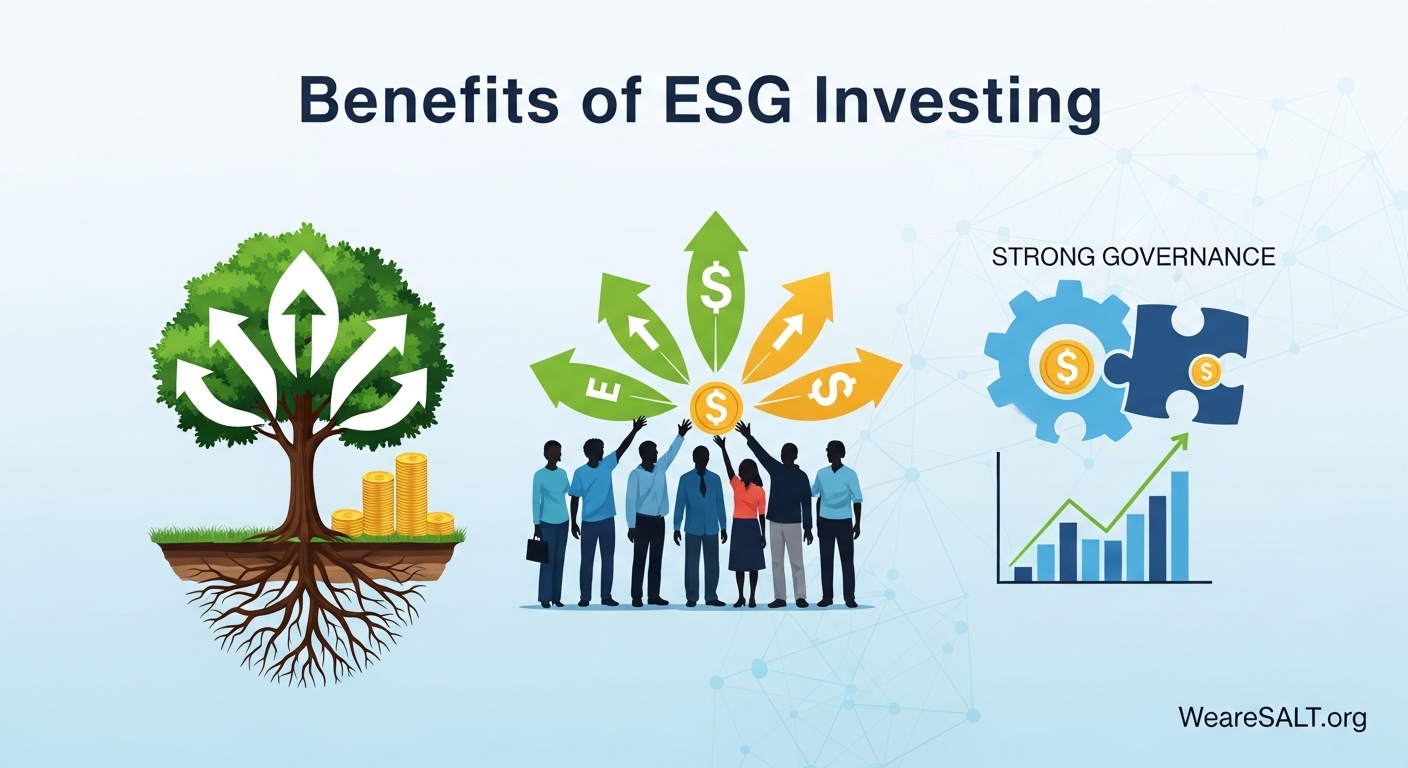
When I first started exploring sustainable investing 2026, I kept hearing the same question from fellow investors: does ESG investing actually work, or is it just feel-good marketing? After spending months analyzing portfolio data, reading academic studies, and speaking with fund managers, I can tell you the benefits of ESG investing go far beyond doing the right thing. They translate into real financial advantages that smart investors are already capturing.
In this guide, I will walk you through exactly what ESG investing means, how it differs from traditional approaches, and the seven concrete benefits that make it worth considering for your portfolio. Whether you are new to sustainable investing or looking to understand why ESG criteria matter more than ever, this article gives you the facts you need to make informed decisions.
Table of Contents
What is ESG Investing?
ESG investing is an investment approach that evaluates companies based on three specific criteria: Environmental impact, Social responsibility, and Governance quality. Instead of looking only at revenue and profit margins, ESG investors analyze how companies manage risks and opportunities related to sustainability, ethics, and corporate behavior.
The term ESG stands for Environmental, Social, and Governance. These three pillars form the foundation of how analysts assess whether a company operates responsibly. Unlike traditional investing, which focuses almost exclusively on financial metrics, ESG investing adds a layer of qualitative analysis that can reveal hidden risks and opportunities.
Research shows that 2026, approximately 82 percent of companies now report on their ESG practices in some form. This represents a dramatic shift from just a decade ago, when sustainability reporting was considered optional. Today, major institutional investors like BlackRock and Vanguard actively incorporate ESG factors into their investment decisions.
The Three Pillars of ESG Explained
Understanding ESG criteria starts with breaking down each pillar. Environmental factors examine how a company affects the natural world. This includes carbon emissions, energy use, waste management, water consumption, and biodiversity impact. Companies with strong environmental practices typically invest in renewable energy, reduce waste, and plan for climate risks.
Social factors focus on how companies treat people. This covers employee relations, diversity and inclusion, labor standards, customer satisfaction, and community impact. Companies scoring well on social metrics often have lower turnover, higher employee satisfaction, and better brand loyalty.
Governance factors assess how a company is run. This includes board diversity, executive compensation, shareholder rights, transparency, and ethical business practices. Strong governance reduces the risk of scandals, fraud, and value-destroying decisions.
These three pillars work together. A company cannot claim strong ESG credentials if it excels environmentally but treats workers poorly. The best ESG investments show balanced performance across all three areas.
7 Key Benefits of ESG Investing
The benefits of ESG investing extend across risk management, performance, and impact. Here are the seven advantages that research and real-world results consistently demonstrate.
1. Improved Risk Management
Companies with strong ESG practices typically manage risk better than their peers. By examining environmental, social, and governance factors, investors can identify risks that traditional financial analysis might miss. Climate exposure, regulatory changes, labor disputes, and governance failures often show up in ESG metrics before they impact the bottom line.
A study by MSCI found that companies in the bottom fifth of ESG ratings were significantly more likely to suffer severe stock price declines. These companies faced higher risks of accounting fraud, environmental disasters, and regulatory penalties. ESG analysis acts as an early warning system for these dangers.
Consider the example of BP before the Deepwater Horizon disaster. Traditional analysis showed a profitable oil company. ESG analysis would have flagged safety concerns and environmental risks that eventually destroyed billions in shareholder value. Investors who paid attention to ESG factors could have avoided those losses.
2. Enhanced Portfolio Performance
Contrary to the belief that sustainable investing requires sacrificing returns, multiple studies show that ESG investments often outperform traditional portfolios over the long term. Research from Morningstar found that the majority of sustainable funds outperformed their traditional counterparts over the past decade.
During the market volatility of recent years, ESG funds demonstrated notable resilience. When markets dropped, companies with strong sustainability practices generally fell less and recovered faster. This suggests that ESG criteria identify companies with operational strength and management quality that matter during downturns.
The performance advantage comes from several sources. ESG leaders tend to be innovators, attracting capital and talent that drives growth. They face lower regulatory and legal costs. They also benefit from consumer preferences shifting toward sustainable products and services.
3. Positive Environmental Impact
One of the most appealing benefits of ESG investing is the ability to drive real environmental change. When investors channel capital toward companies with strong environmental practices, they reward sustainability and encourage broader adoption of green technologies.
Real companies demonstrate this impact. Cisco achieved 100 percent renewable energy across its global operations, avoiding millions of tons of carbon emissions. Verizon invested heavily in renewable energy, powering its networks with clean electricity. These commitments were partly driven by investor demand for ESG performance.
Green bonds, a popular ESG investment vehicle, fund specific environmental projects. Investors can track exactly how their money supports renewable energy installations, clean water projects, or sustainable agriculture. This transparency appeals to investors who want measurable impact alongside returns.
4. Greater Innovation and Adaptability
Companies that prioritize ESG factors tend to be more innovative. They invest in research and development, adapt to changing regulations, and position themselves ahead of market shifts. This forward-thinking approach creates competitive advantages that show up in long-term performance.
Consider the automotive industry. Companies that invested early in electric vehicles, driven partly by ESG considerations, are now dominating a rapidly growing market. Traditional automakers that delayed this transition are struggling to catch up. ESG investing identified the innovators before the market did.
This innovation advantage extends across industries. Technology companies with strong ESG practices develop more efficient data centers. Manufacturers invest in circular economy models that reduce waste and create new revenue streams. Energy companies pivot toward renewables as fossil fuel demand peaks.
5. Attracting and Retaining Talent
Talent is a critical driver of business success, and ESG performance significantly affects a company’s ability to attract and keep the best people. Research consistently shows that younger workers prioritize employers with strong environmental and social commitments.
A Deloitte survey found that climate change and environmental concerns rank among the top issues for Millennials and Gen Z workers. These demographics increasingly choose employers whose values align with their own. Companies with poor ESG records struggle to compete for talent in tight labor markets.
Employee satisfaction also correlates with ESG performance. Companies that treat workers well, offer fair compensation, and maintain inclusive workplaces see lower turnover and higher productivity. These factors directly impact profitability and shareholder returns.
6. Strengthened Regulatory Compliance
Regulatory requirements around environmental reporting, diversity, and corporate governance are tightening globally. Companies that already meet high ESG standards face lower compliance costs and reduced risk of fines. They are better prepared for new regulations that their competitors may struggle to meet.
The European Union has implemented comprehensive ESG reporting requirements under the Corporate Sustainability Reporting Directive. Similar regulations are emerging in the United States and Asia. Companies with mature ESG programs have a head start in meeting these requirements.
Beyond avoiding penalties, strong compliance creates opportunities. Companies that exceed regulatory standards often gain preferred supplier status, qualify for green financing, and attract ESG-focused institutional investors. These advantages compound over time.
7. Contribution to Global Sustainability Goals
ESG investing connects individual portfolios to the United Nations Sustainable Development Goals. These 17 goals address global challenges including poverty, inequality, climate change, and environmental degradation. By directing capital toward companies advancing these objectives, investors participate in solutions to humanity’s biggest challenges.
The scale of capital flowing into ESG investments creates meaningful impact. In 2021 alone, global sustainable fund inflows exceeded 649 billion dollars. This capital funds renewable energy projects, sustainable agriculture, clean water initiatives, and social programs worldwide.
For many investors, this alignment between financial goals and personal values is the most compelling benefit of ESG investing. They can build wealth while supporting the transition to a more sustainable economy. This dual purpose resonates especially with younger investors who will shape markets for decades to come.
ESG Investing vs Traditional Investing
Understanding how ESG investing differs from traditional approaches helps investors decide when each strategy makes sense. Traditional investing evaluates companies primarily through financial metrics: revenue growth, profit margins, return on equity, and valuation ratios. This approach has served investors well for generations.
ESG investing adds another layer of analysis. It asks how companies generate their returns, not just how much they earn. A company with excellent financial metrics but poor labor practices or high carbon emissions might receive a lower ESG score. Conversely, a company with modest financials but exceptional sustainability practices might rank higher on ESG criteria.
The key difference lies in time horizon and risk assessment. Traditional investing often focuses on quarterly earnings and immediate returns. ESG investing emphasizes long-term sustainability and hidden risks that may not appear in financial statements for years. Companies that abuse workers or pollute the environment may look profitable today but face existential threats tomorrow.
Both approaches have merit. Traditional investing works well for investors who trust markets to price all relevant information efficiently. ESG investing appeals to those who believe sustainability factors are systematically undervalued and will increasingly affect performance.
Challenges and Criticisms of ESG Investing
Honest analysis requires acknowledging the challenges ESG investing faces. Understanding these limitations helps investors make better decisions and set realistic expectations.
Greenwashing remains a significant concern. Some companies and funds exaggerate their ESG credentials to attract capital without making meaningful changes. Investors must look beyond marketing claims to verify actual practices. Independent ESG ratings from agencies like MSCI, Sustainalytics, and Bloomberg help, but even these ratings can vary significantly between providers.
Rating inconsistencies create confusion. One agency might score a company highly while another gives it a mediocre rating. These differences stem from varying methodologies and weightings. Environmental factors might dominate one rating while governance matters more to another.
Some critics question whether buying shares of ESG companies actually helps those companies. Since most trading happens on secondary markets, the money goes to other investors rather than the companies themselves. However, strong demand for ESG stocks does lower their cost of capital, indirectly supporting growth and innovation.
Political opposition has also emerged. Some policymakers argue that ESG investing improperly mixes social and political goals with financial decisions. This criticism peaked in discussions around energy policy and has led to restrictions on ESG investing in certain states. Investors should understand the political context around these debates.
Finally, ESG investing sometimes requires accepting limited options. In certain sectors, few companies meet strict ESG criteria. Investors might need to exclude entire industries or accept lower diversification. This concentration can increase portfolio risk if those sectors outperform.
Frequently Asked Questions About Benefits of ESG Investing
What are the benefits of ESG investing?
The seven key benefits of ESG investing are: 1) Improved risk management through early identification of environmental, social, and governance risks, 2) Enhanced long-term portfolio performance, as ESG leaders often outperform peers, 3) Positive environmental impact by directing capital toward sustainable companies, 4) Greater innovation and adaptability as ESG-focused companies invest in future-ready solutions, 5) Attraction and retention of talent, particularly among younger workers, 6) Strengthened regulatory compliance reducing legal and penalty risks, and 7) Contribution to global sustainability goals including the UN Sustainable Development Goals.
Is ESG investing worth it?
ESG investing is worth it for investors who value both financial returns and positive impact. Research shows that ESG funds have delivered competitive or superior returns compared to traditional funds over the long term while reducing exposure to certain risks. However, investors should verify ESG claims to avoid greenwashing and understand that ESG criteria may limit investment options in some sectors.
What does Warren Buffett think of ESG?
Warren Buffett has expressed skepticism about ESG investing, particularly its politicization and the inconsistency of ESG ratings. He believes investment decisions should focus on maximizing shareholder value rather than social or political goals. However, his company Berkshire Hathaway has invested in companies with strong environmental and social practices when they meet traditional value criteria.
What is the dark side of ESG ratings?
The dark side of ESG ratings includes significant inconsistencies between rating agencies, potential greenwashing by companies exaggerating their credentials, and the subjective nature of what counts as good ESG performance. Additionally, some critics argue that ESG ratings can be influenced by political biases, and the lack of standardized reporting makes comparisons difficult across companies and industries.
How does ESG improve risk management?
ESG improves risk management by identifying non-financial risks that traditional analysis might miss. Environmental factors reveal climate and regulatory risks. Social factors expose labor and reputational risks. Governance factors highlight management quality and ethical risks. Companies with strong ESG practices typically face fewer lawsuits, regulatory penalties, and operational disruptions.
Conclusion: The Benefits of ESG Investing Matter Now More Than Ever
The benefits of ESG investing are clear and well-supported by data. From improved risk management to enhanced portfolio performance, from positive environmental impact to attracting top talent, ESG criteria identify companies positioned for long-term success. As regulatory requirements tighten and consumer preferences shift toward sustainability, these advantages will likely grow.
That said, ESG investing is not without challenges. Greenwashing, rating inconsistencies, and political opposition require careful navigation. Investors should verify ESG claims independently and understand that no investment approach guarantees returns.
For those willing to do the research, ESG investing offers a compelling combination of financial opportunity and positive impact. It aligns portfolios with the transition to a more sustainable economy while potentially delivering competitive returns. In 2026 and beyond, the benefits of ESG investing make it an approach worth considering for any forward-thinking investor.