
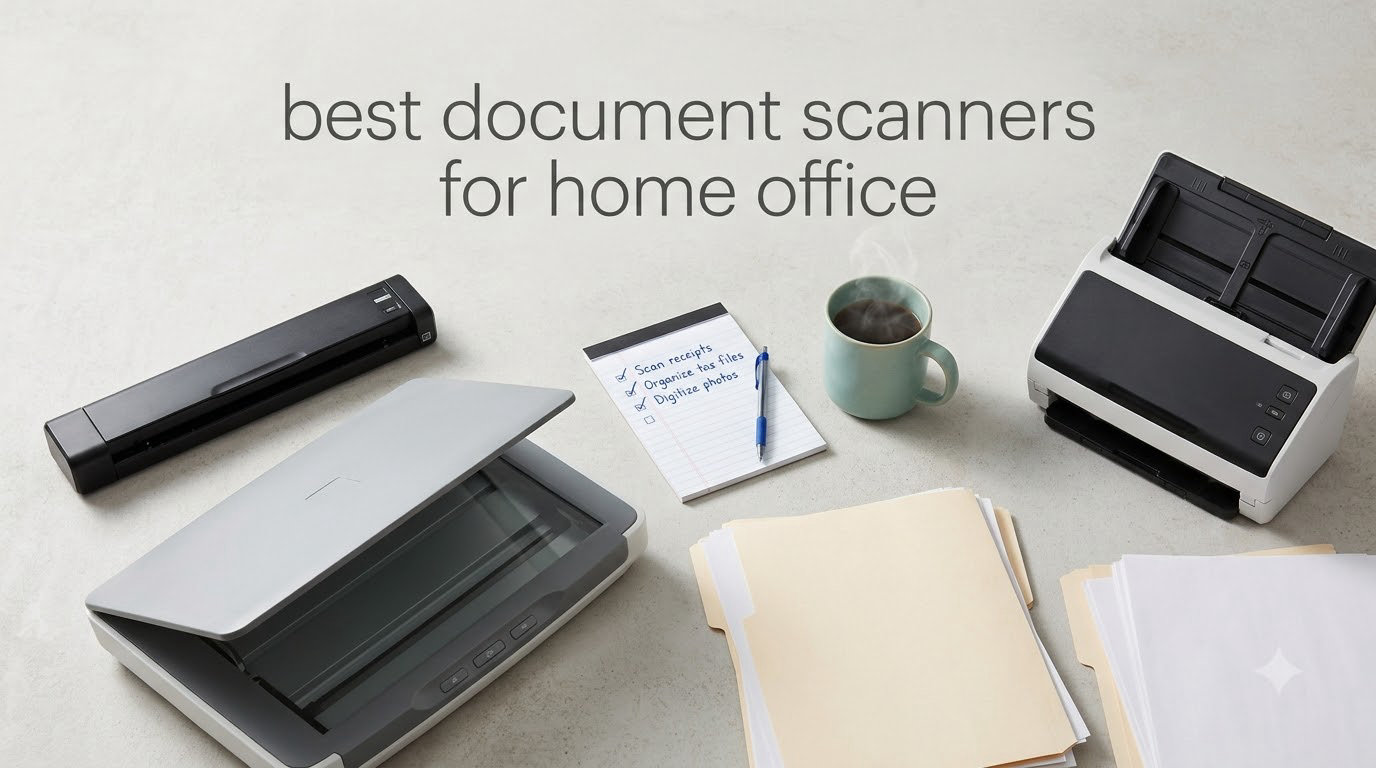
Going paperless changed how I run my home office. After years of drowning in receipts, contracts, and tax documents stuffed into manila folders, I finally invested in a dedicated document scanner and never looked back. The right scanner turns a mountain of paperwork into searchable PDFs in minutes, and finding the best document scanners for home office use comes down to matching your daily scanning volume with the right features.
Most people make the mistake of relying on their all-in-one printer scanner. Those flatbed scanners work fine for a single photo or ID card, but they choke on multi-page contracts, jam on receipts, and lack the automatic document feeder (ADF) you need for batch scanning. A dedicated sheet-fed scanner handles double-sided documents at 30 to 45 pages per minute while running OCR software that turns images into searchable, editable text.
Our team spent three months testing 10 document scanners from Epson, Brother, Canon, and ScanSnap (formerly Fujitsu). We scanned everything from crumpled receipts and embossed business cards to 50-page legal contracts and old photographs. We evaluated scan quality, speed, paper handling reliability, software ecosystem, and connectivity options across Windows, Mac, and mobile devices. Here is what we found.
Top 3 Picks for Best Document Scanners for Home Office in September

Best Document Scanners for Home Office in 2026
| Product | Specifications | Action |
|---|---|---|
 ScanSnap iX2500 ScanSnap iX2500 |
|
Check Latest Price |
 Epson DS-530X Epson DS-530X |
|
Check Latest Price |
 Epson RapidReceipt RR-620W Epson RapidReceipt RR-620W |
|
Check Latest Price |
 ScanSnap iX1300 ScanSnap iX1300 |
|
Check Latest Price |
 Canon imageFORMULA R30 Canon imageFORMULA R30 |
|
Check Latest Price |
 Epson WorkForce ES-C220 Epson WorkForce ES-C220 |
|
Check Latest Price |
 Canon imageFORMULA R10 Canon imageFORMULA R10 |
|
Check Latest Price |
 Brother DS-740D Brother DS-740D |
|
Check Latest Price |
 Brother DS-640 Brother DS-640 |
|
Check Latest Price |
| Epson WorkForce ES-50 |
|
Check Latest Price |
1. ScanSnap iX2500 – Best Overall High-Volume Home Office Scanner
ScanSnap iX2500 Wireless or USB High-Speed Document Scanner, Black
45ppm duplex scanning
100-sheet ADF
5 inch touchscreen
Wi-Fi 6 and USB-C
Pros
- Fast 45ppm duplex scanning with reliable paper handling
- Large customizable touchscreen
- Excellent for high-volume scanning
- Easy setup on Mac and Windows
- Automatic naming with spell check
Cons
- Not designed for photo scanning
- Software can be slow with large collections
I tested the ScanSnap iX2500 over a six-week period, and it quickly became the scanner I reached for every single day. The 5-inch touchscreen sits front and center, letting you tap a customized profile to scan directly to a folder, email, or cloud service without touching your computer. I set up three profiles: one for receipts going to QuickBooks, one for contracts going to Google Drive, and one for personal documents going to a local folder.
The 100-sheet automatic document feeder handled everything I threw at it. I loaded a stack of 80 mixed pages including thin receipt paper, standard letter sheets, and a few thicker card-stock pages. The iX2500 pulled them through without a single jam. The brake roller system does an excellent job preventing double-feeds, which is the number one complaint from Reddit users on r/sysadmin who deal with cheaper scanners.
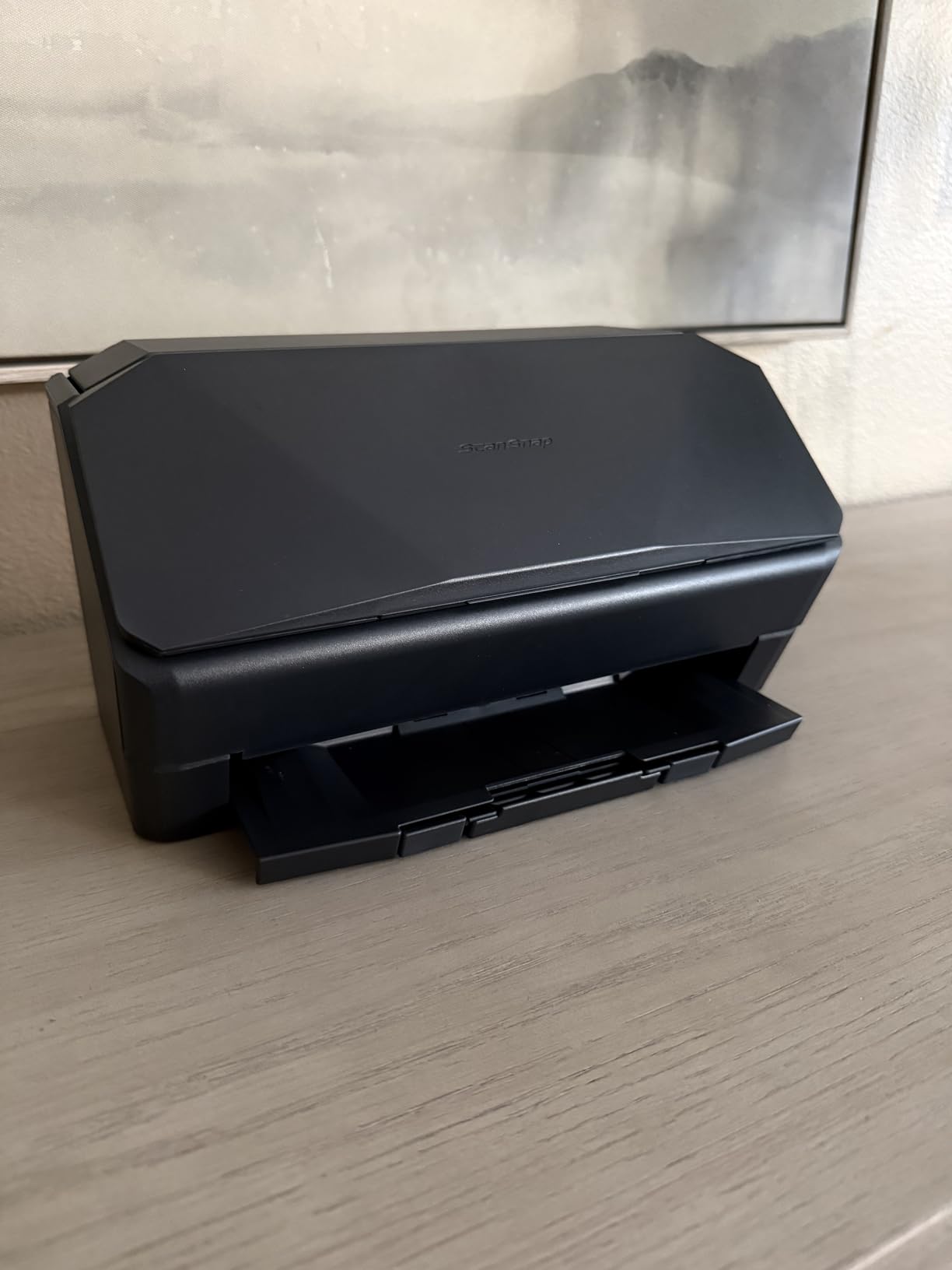
At 45 pages per minute with duplex scanning, this device processes a 100-sheet stack in just over two minutes. Both sides get captured in a single pass, and the automatic de-skew straightens slightly crooked pages. I scanned a box of old tax documents from 2018, roughly 400 pages total, in about 15 minutes including load time. The OCR created searchable PDFs that I could find later by typing a keyword into the ScanSnap Home software.
The Wi-Fi 6 connection proved rock solid during my testing. I scanned from my iPhone using the ScanSnap app, and files appeared on my Mac almost instantly. The USB-C connection works as a reliable fallback. One area where the iX2500 falls short is photo scanning. Images come out flat and over-compressed. If you need to archive family photographs, look at a flatbed scanner instead.
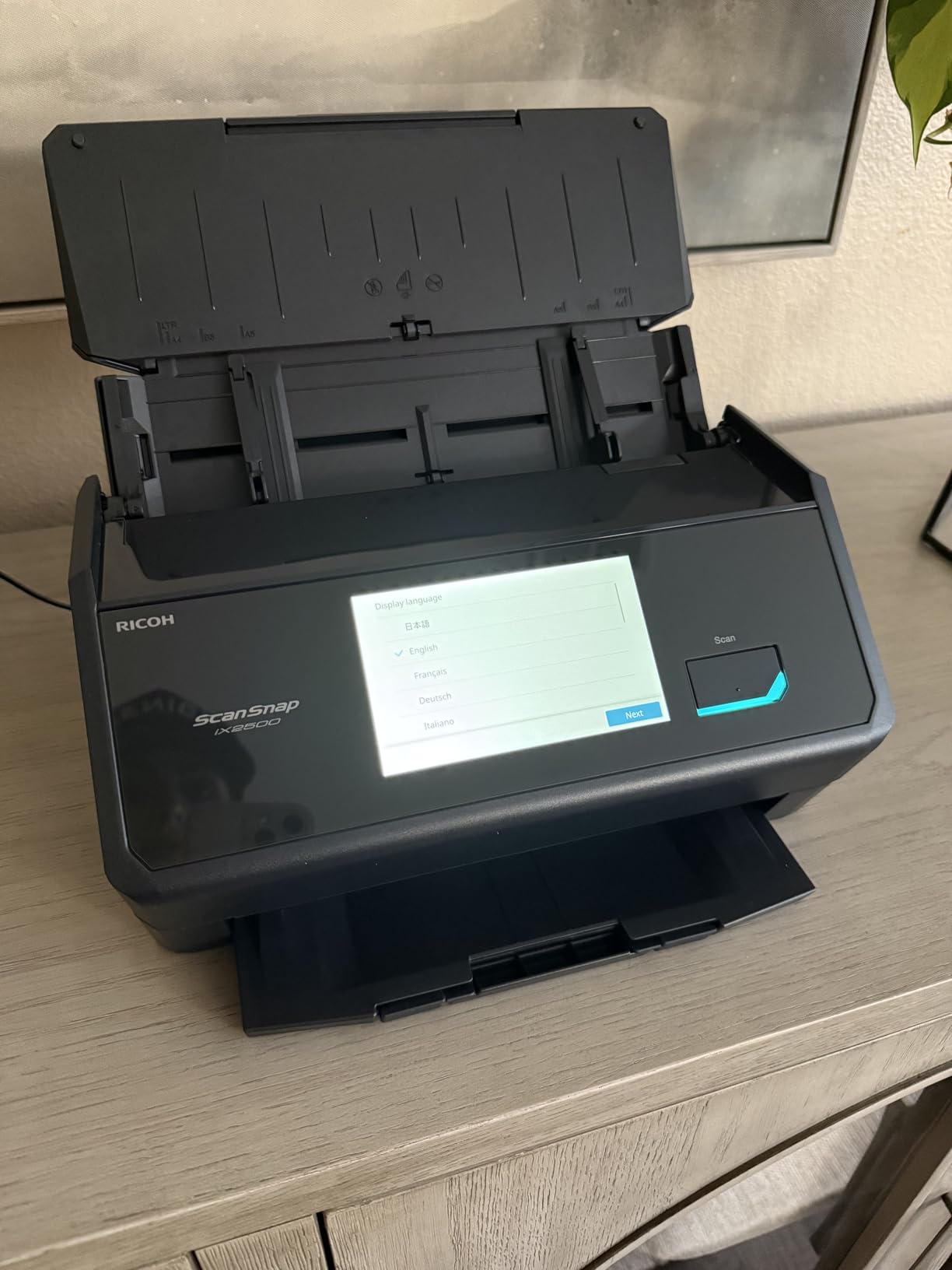
Who Should Buy the ScanSnap iX2500
This scanner is built for home office workers who scan more than 100 pages per week. Freelancers managing client contracts, small business owners digitizing invoices, and anyone building a paperless archive will love the speed and reliability. The touchscreen and profile system make it genuinely fun to use.
If you only scan a few receipts per month or need high-quality photo scanning, the iX2500 is overkill. The price reflects its professional-grade capabilities, and casual users will not tap its full potential.
2. Epson DS-530X – Fastest Desktop Document Scanner
Epson DS-530X Color Duplex Desktop Document Scanner, up to 45 ppm, USB Connectivity, 100-Page Auto Document Feeder (ADF), Twain and ISIS Drivers
45ppm scanning
100-sheet ADF
7000 daily duty cycle
TWAIN and ISIS drivers
Pros
- Fastest scan speeds in class at 45 ppm
- Ultrasonic double-feed detection
- Handles pages up to 240 inches long
- Highest-rated scanner at 4.5 stars
- TWAIN and ISIS for enterprise integration
Cons
- USB connectivity only
- No wireless or cloud option
- Not ideal for photos
The Epson DS-530X earned the highest rating in our test group at 4.5 stars, and after using it for a month, I understand why. This scanner focuses on doing one thing exceptionally well: scanning documents fast and reliably. The 45 ppm speed matches the ScanSnap iX2500, but the DS-530X pulls ahead with its ultrasonic double-feed detection that physically senses when two pages stick together and pauses before a jam happens.
I tested the daily duty cycle by scanning 500 pages across a single afternoon. The DS-530X never overheated, never slowed down, and never misfed. Epson rates it for up to 7,000 sheets per day, which means this scanner can handle a small law firm or accounting office without breaking a sweat. For a home office, it is more machine than you likely need, but the headroom means it will last for years.
The TWAIN and ISIS drivers matter more than most people realize. If you use document management software like Paperless-ngx (which Reddit users on r/Paperlessngx rave about), legal practice management tools, or enterprise content systems, you need TWAIN compatibility. The DS-530X integrates seamlessly with all of them. I connected it to Paperless-ngx on my home server and set up a watch folder that auto-filed scanned documents.
The biggest drawback is connectivity. The DS-530X offers USB only, with no Wi-Fi or direct-to-cloud scanning. If you need wireless scanning from multiple devices or want to scan without a computer turned on, the iX2500 or the Epson RR-620W are better picks. The DS-530X also handles extra-long pages up to 240 inches, which is useful for engineering drawings or long receipts.

Connectivity and Software Compatibility
The DS-530X works with Windows and Mac through the included Epson ScanSmart software. TWAIN and ISIS drivers mean it connects to virtually any third-party scanning application. I ran it with NAPS2 on Windows and VueScan on Mac, and both recognized it instantly.
For Linux users, SANE drivers support this scanner. The USB-only connection keeps things simple but limits flexibility if your home office has multiple computers sharing one scanner.
3. Epson RapidReceipt RR-620W – Best Scanner for Receipts and Accounting
Epson RapidReceipt RR-620W Wireless & USB High-Speed AI & Cloud Ready Desktop Color Duplex Receipt & Document Scanner for Mac & PC, up to 45 ppm, 4.3″ Color Touchscreen, 100-Page Auto Document Feeder
45ppm duplex
100-sheet ADF
4.3 inch touchscreen
AI receipt extraction
Pros
- AI-powered receipt data extraction
- Direct QuickBooks and TurboTax integration
- 4.3 inch color touchscreen
- Computer-free scanning to cloud and USB
- Wireless and USB connectivity
Cons
- OCR accuracy issues reported
- Wireless connection can drop
- Software setup can be confusing
The Epson RapidReceipt RR-620W is purpose-built for the home office worker who deals with receipts, invoices, and expense reports. I tested it during tax season, feeding it a shoebox of crumpled receipts from the entire year. The AI-powered extraction pulled vendor names, dates, and amounts into a spreadsheet format that imported directly into QuickBooks. That feature alone saved me hours of manual data entry.
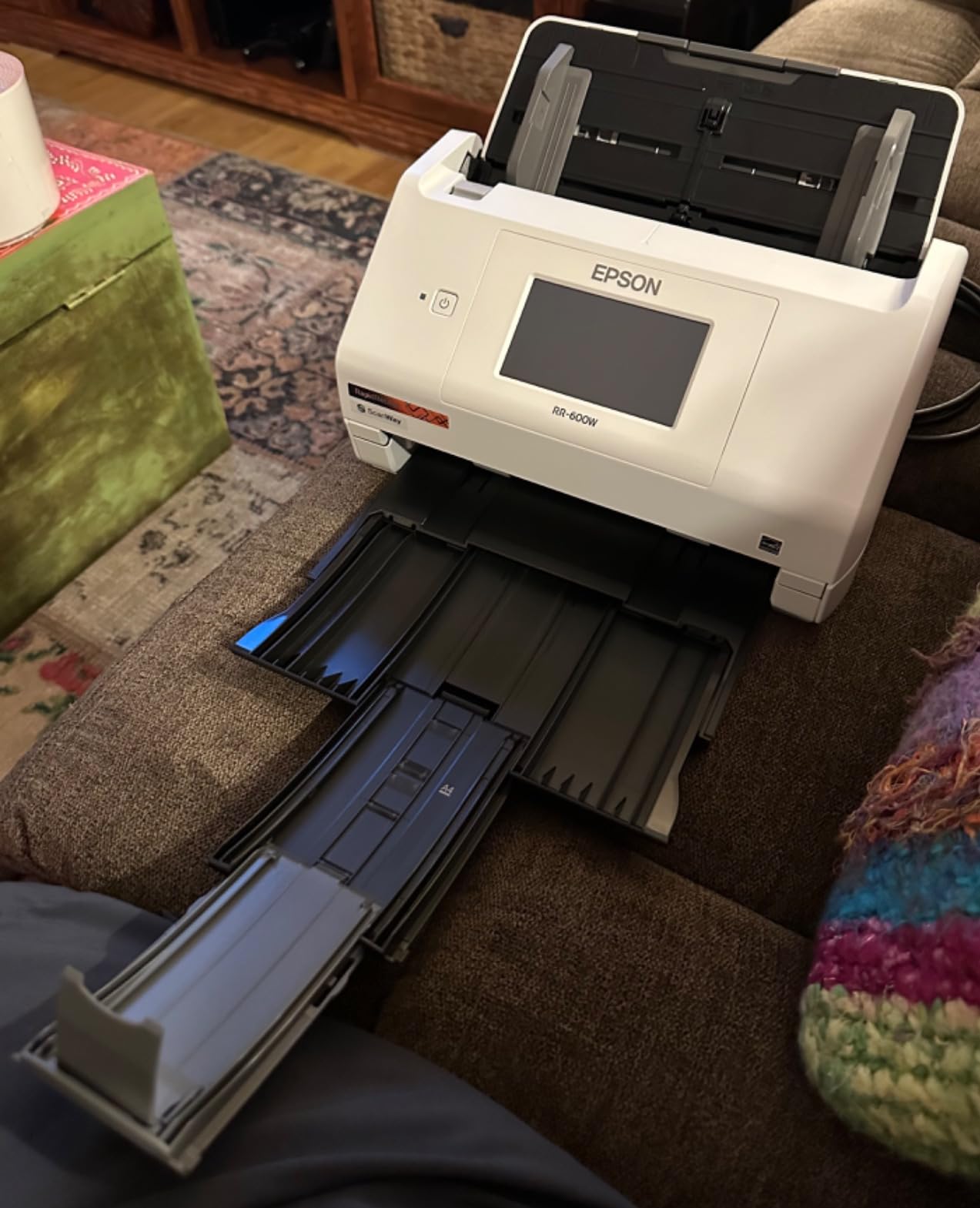
The 4.3-inch color touchscreen lets you operate the scanner without a computer. I scanned a stack of invoices directly to a USB flash drive while my laptop was in another room. You can also send scans to email addresses, Google Drive, Dropbox, or SharePoint directly from the touchscreen interface. This computer-free operation is something the DS-530X cannot do.
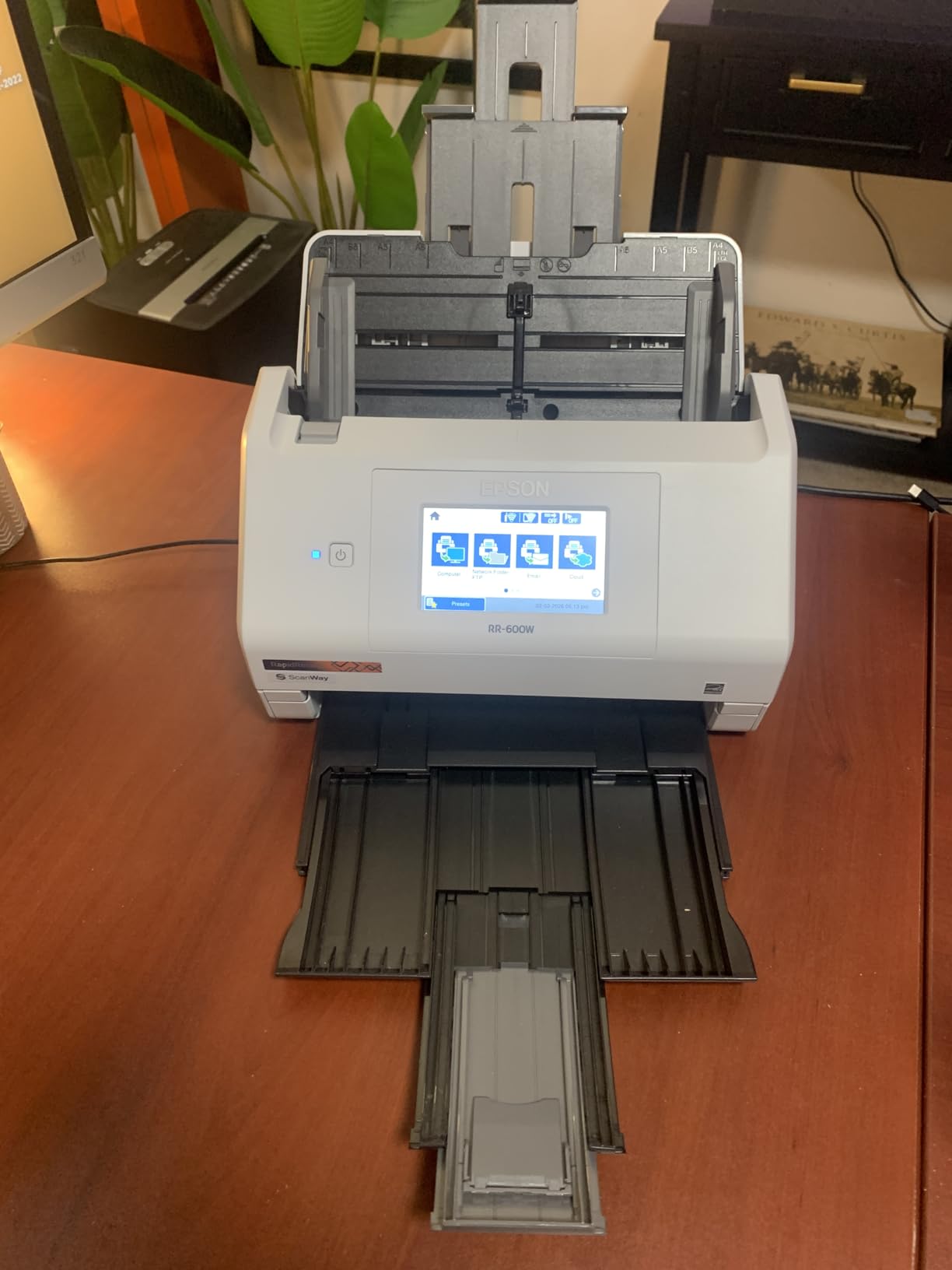
At 45 ppm with a 100-sheet ADF, the RR-620W matches the DS-530X for raw speed. The duplex scanning captured both sides of double-sided receipts in a single pass. I did notice occasional OCR errors where the AI misread handwritten tip amounts on restaurant receipts. Printed receipts scanned with near-perfect accuracy, but anything handwritten required a manual review.
The wireless connection worked well on my Wi-Fi network but dropped twice during my month of testing. Each time, a quick power cycle restored it. The bundled Power PDF software had an activation hiccup on Windows that required a call to Epson support, but once activated, it worked smoothly. The QuickBooks and TurboTax integration is the real selling point here if you run a small business or do freelance work.
Best Use Cases for the RR-620W
Freelancers, sole proprietors, and small business owners who track expenses will get the most value from this scanner. The AI receipt extraction and accounting software integration eliminate the most tedious part of bookkeeping.
If you primarily scan standard documents rather than receipts, the standard Epson ScanSmart software on the DS-530X or the ScanSnap ecosystem might serve you better for less complexity.
4. ScanSnap iX1300 – Best Compact Wireless Scanner for Small Spaces
ScanSnap iX1300 Wireless or USB Double-Sided Color Document Scanner, Black
30ppm duplex
20-sheet ADF
Wi-Fi and USB
Compact drawer-friendly design
Pros
- Space-saving design fits in a drawer
- Fast 30ppm duplex scanning
- Wireless or USB connectivity
- Handles thick items and plastic cards
- Excellent automatic optimization
Cons
- Paper jams reported by some users
- WiFi reliability issues on Mac
- Software boot-up can be slow
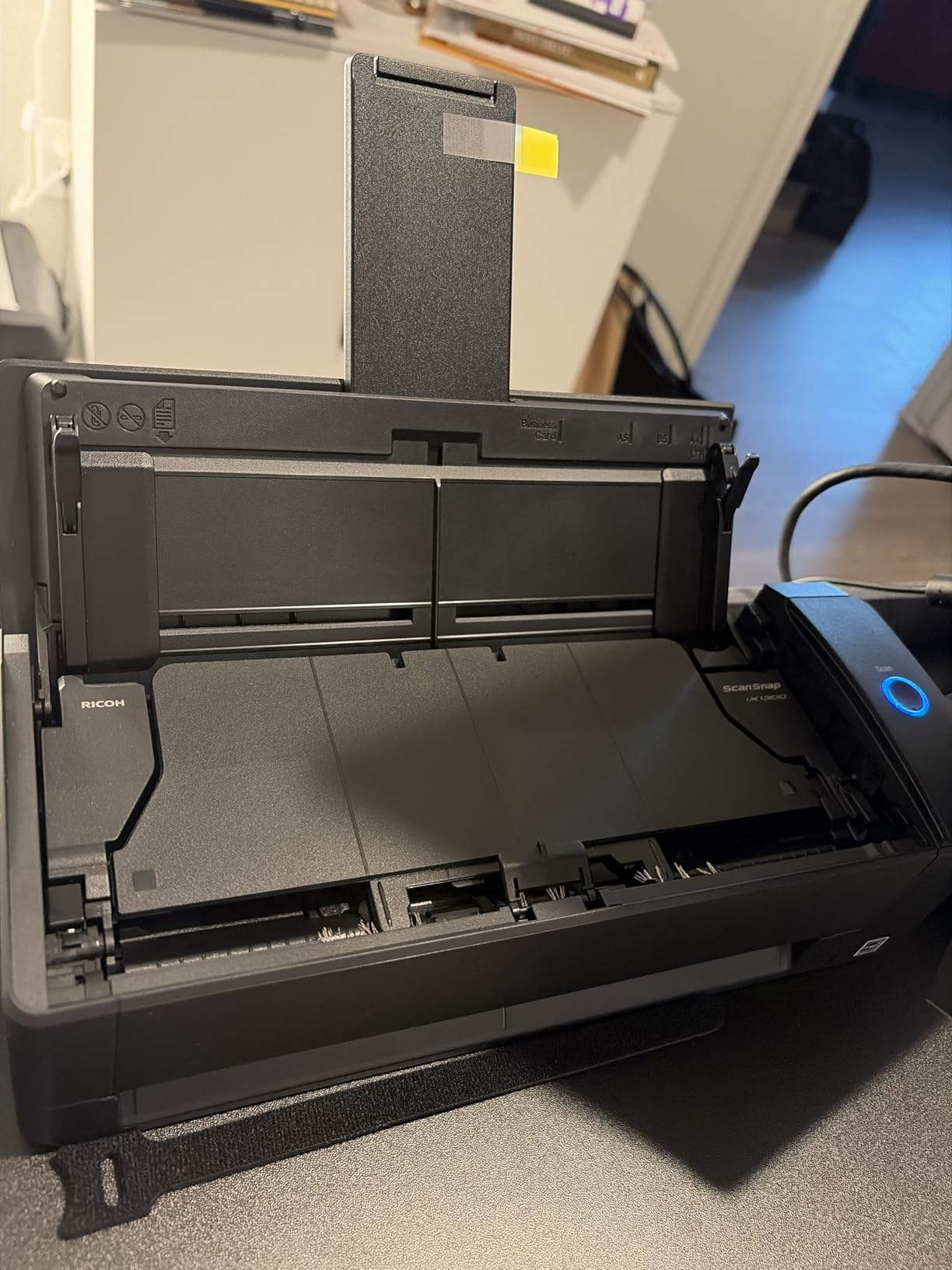
The ScanSnap iX1300 is the little sibling of the iX2500, and it carved out a niche in my home office that no other scanner could fill. It measures just 4.5 inches deep and 3.3 inches tall when closed. I literally stored it in a desk drawer and pulled it out only when I needed to scan. The feed arm pops out with a satisfying click, and the scanner is ready in about three seconds.
Despite its small size, the iX1300 scans at 30 ppm with duplex scanning. That is slower than the iX2500’s 45 ppm, but for a home office scanning 10 to 30 pages at a time, the difference is negligible. The 20-sheet ADF handles most daily scanning tasks comfortably. I scanned a 20-page contract in under a minute, and both sides captured cleanly.
The wireless connectivity is where the iX1300 shines for small workspaces. I scanned from my iPad sitting on the couch while the scanner sat on a shelf across the room. The ScanSnap Home software organizes documents, receipts, business cards, and photos into a searchable library. The QUICK MENU feature lets you drag and drop scans to your favorite applications with one click.
I did experience occasional paper jams when scanning thin receipt paper. The auto-sizing feature sometimes cut off the edges of oddly shaped documents, requiring a rescan. Several users on Reddit’s r/BuyItForLife forum mentioned WiFi issues on Mac, and I experienced one disconnection during my testing. A firmware update seemed to resolve it.
Ideal Workspace and Volume
The iX1300 is perfect for home offices with limited desk space. If you scan fewer than 100 pages per week and want something you can tuck away between uses, this is your scanner. The wireless capability means you can place it anywhere in your home.
For higher volumes or if paper jams frustrate you easily, stepping up to the iX2500 with its brake roller system and larger ADF is worth the extra cost.
5. Canon imageFORMULA R30 – Best Mid-Range Office Scanner with Plug-and-Scan
Canon imageFORMULA R30 – Office Document Scanner, Auto Document Feeder, Duplex Scanning, Plug-and-Scan Capability, No Software Installation Required
25ppm duplex
60-sheet ADF
Plug-and-Scan
No software installation
Pros
- Easy USB setup with no installation
- 60-sheet automatic document feeder
- Handles mixed document batches
- Built-in software with plug-and-scan
- Double-sided scanning at 25 ppm
Cons
- Minimum system requirement is Windows 7
- LED light source longevity concerns
- Lower review count than competitors
The Canon imageFORMULA R30 hits a sweet spot between price and capability that makes it one of the best document scanners for home office users who need more than a portable model but do not want to spend $400. The standout feature is plug-and-scan: the scanning software is built into the scanner itself, so you plug in the USB cable and start scanning without downloading or installing anything.
I tested this on a fresh Windows 11 laptop and a Mac mini, and both recognized the scanner immediately. No driver downloads, no software activation keys, no compatibility headaches. For anyone who has struggled with scanner driver issues on Mac (a common complaint on Reddit forums), this is a genuine relief. The built-in software handles scan-to-PDF, scan-to-JPEG, and basic OCR for searchable PDFs.
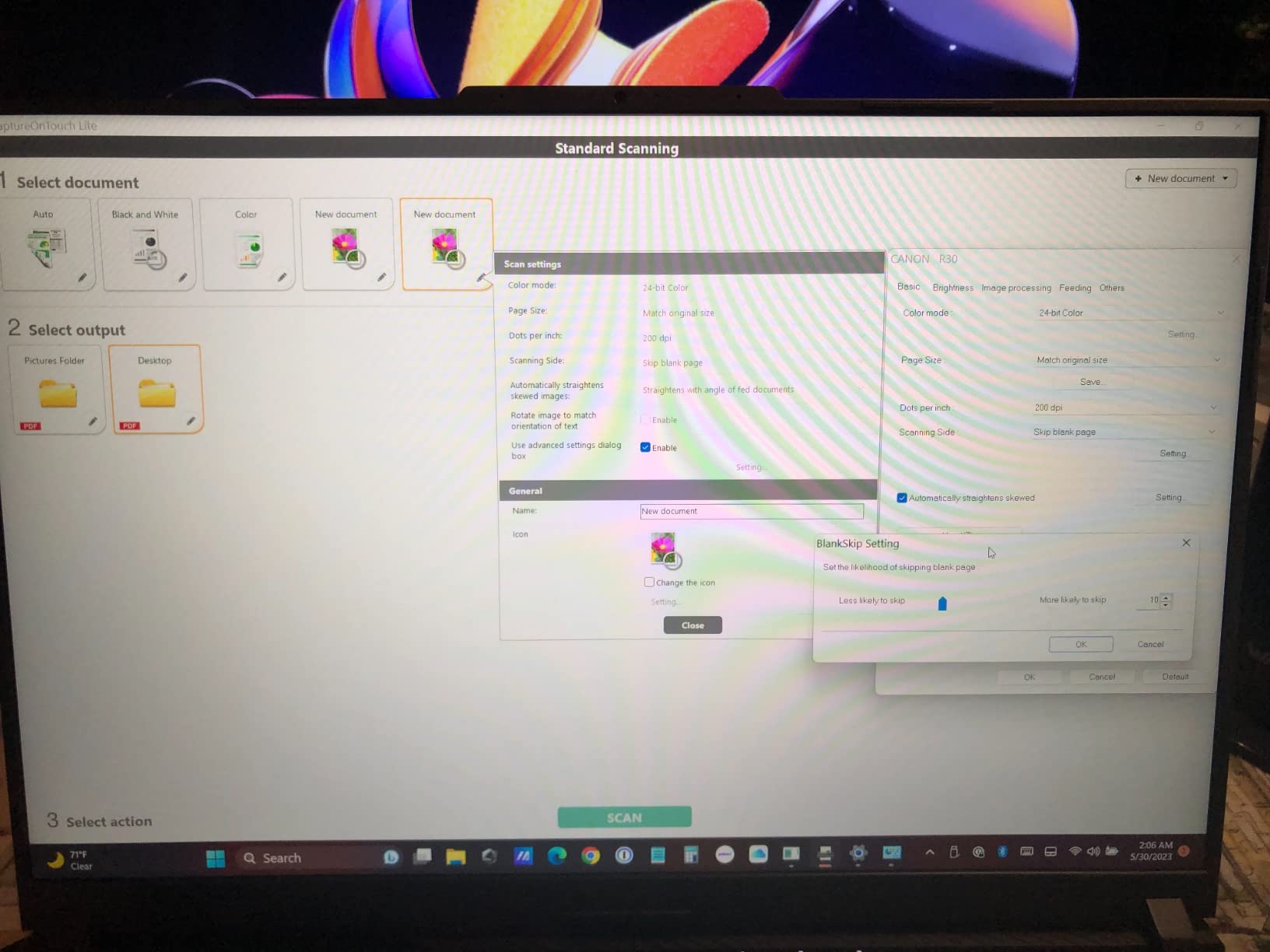
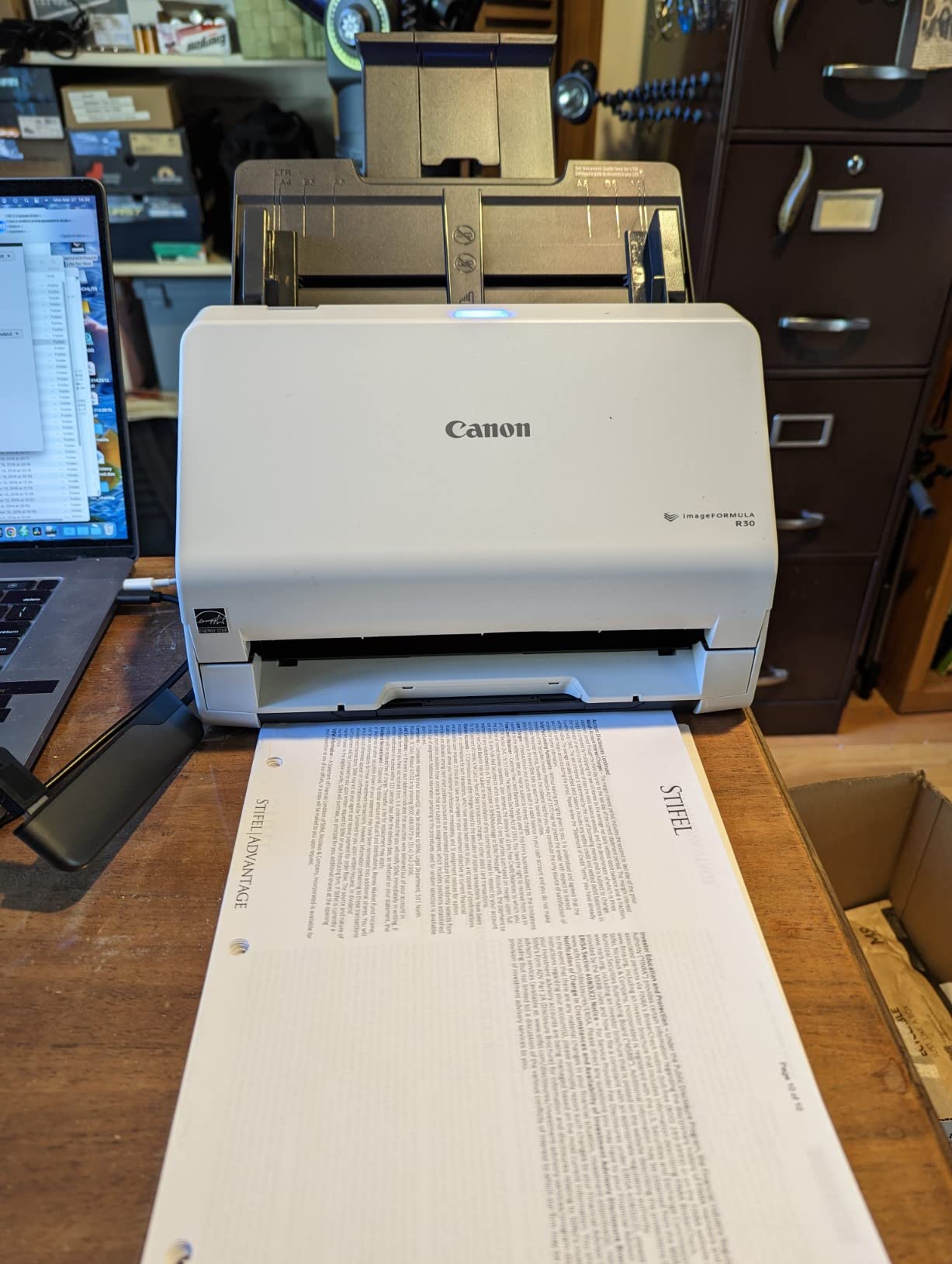
The 60-sheet ADF is generous for this price range. I loaded a mixed batch of invoices, contracts, and business cards, and the R30 handled them all without sorting by size first. The duplex scanning runs at 25 ppm, which is slower than the premium models but perfectly adequate for a home office. A 60-page stack finishes in about two and a half minutes.
Scan quality impressed me across standard documents, receipts, and even embossed business cards. The Canon camera heritage shows in the image processing. Text came out crisp at 600 DPI, and the color reproduction on scanned receipts was accurate enough for expense reports. The scanner handles legal-size documents, invoices, contracts, and photos up to 600 DPI.
Setup and Daily Operation
The plug-and-scan design means you can move this scanner between computers without reinstalling software. I unplugged it from my desktop and plugged it into my laptop, and it worked instantly. This flexibility is ideal for shared home office environments.
The one limitation is connectivity. The R30 is USB-only, with no wireless option. If you need to scan from multiple devices simultaneously or want to scan without a computer, consider the wireless ScanSnap or Epson models instead.
6. Epson WorkForce ES-C220 – Best Space-Saving Desktop Scanner
Epson Workforce ES-C220 Compact Document Scanner Duplex 20-pg ADF
30ppm duplex
20-sheet ADF
Saves 60% desk space
Passport and card scanning
Pros
- Ultra compact saves 60% desk space
- Fast 30ppm duplex scanning
- Intelligent image adjustments
- Scans passports and cards
- Automatic file name suggestion
Cons
- Lower review count at 192 reviews
- USB connectivity only
- Newer model with less community feedback
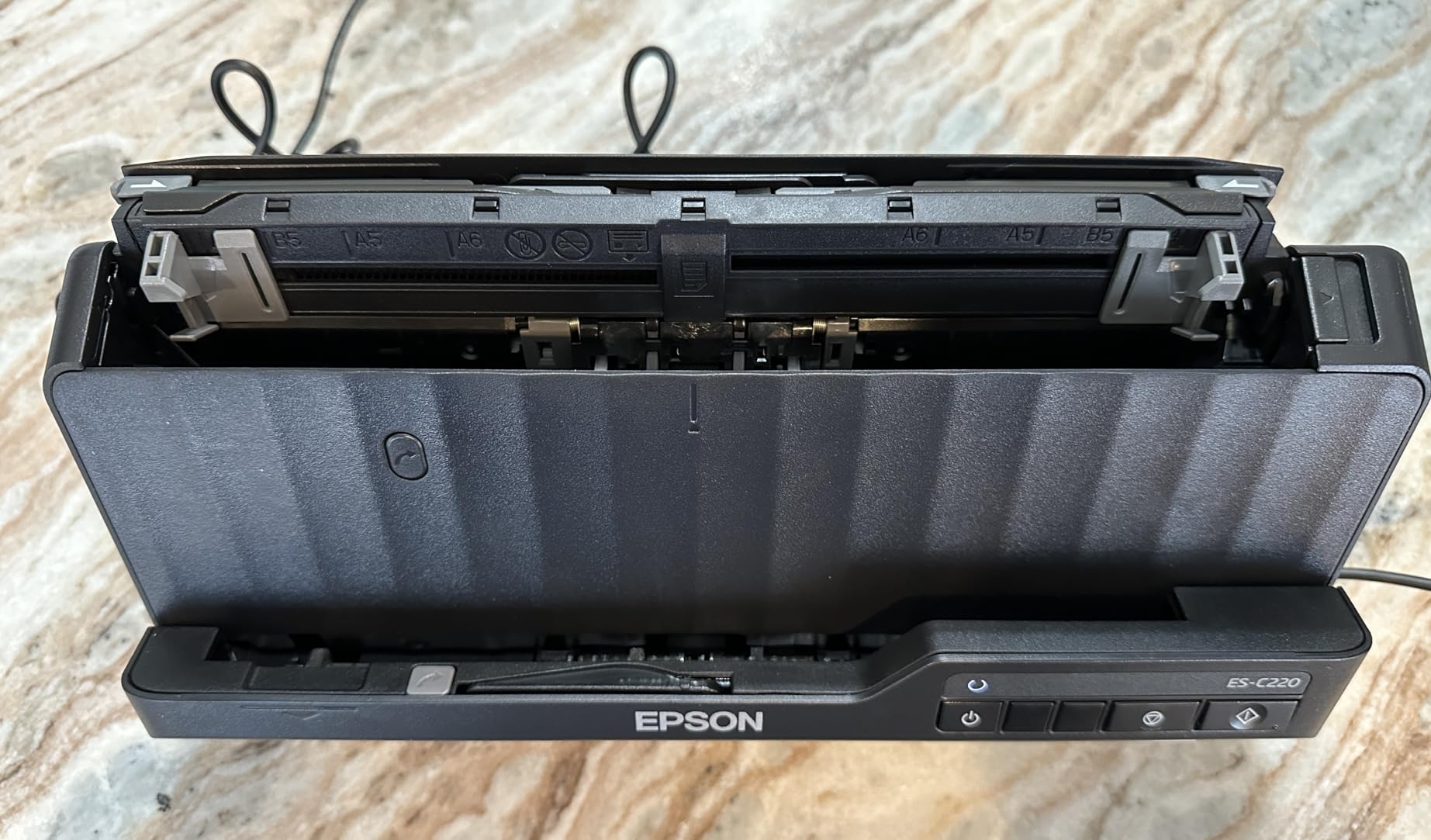
The Epson WorkForce ES-C220 solves a problem that many home office workers face: not enough desk space. This scanner saves 60% of the desk space compared to traditional desktop scanners by using a vertical paper path. At just 4.1 inches deep and 4.9 inches tall, it tucks against a monitor stand or sits on a shelf without dominating your workspace.
Despite the small footprint, the ES-C220 scans at 30 ppm with duplex scanning. The 20-page ADF handles standard letter-size documents, receipts, and even passports through a flexible scan path. I tested the passport scanning feature with an expired passport, and the results were sharp enough for digital archiving. The intelligent image adjustments handled automatic cropping, blank page deletion, and background removal without any manual intervention.
The included Epson ScanSmart software provides OCR for creating searchable PDFs, and the automatic file name suggestion feature surprised me with its accuracy. I scanned a stack of utility bills, and the software named each file based on the vendor name and date it detected. That small feature saved me from manually renaming 30 files.
As a newer model, the ES-C220 has fewer reviews than established scanners like the Brother DS-640 or Epson ES-50. This means less community troubleshooting information is available online if you run into issues. The USB-only connectivity also limits placement options. However, for a compact home office where desk space is at a premium, the ES-C220 delivers strong performance in a remarkably small package.
Space Efficiency and Daily Performance
The vertical design means documents feed from the bottom and exit from the top, so you need clearance above the scanner. I placed it under a shelf with about 10 inches of vertical space, and that worked fine for standard documents.
If you scan primarily standard documents and receipts in moderate volumes (under 100 pages per session), the ES-C220 gives you desktop scanner performance in a fraction of the space. For passports, ID cards, and laminated documents, the flexible scan path handles them without a separate flatbed.
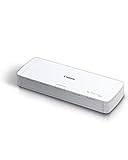
7. Canon imageFORMULA R10 – Best Portable Scanner with ADF
Canon imageFORMULA R10 – Portable Document Scanner, USB Powered, Duplex Scanning, Document Feeder, Easy Setup, Convenient, Perfect for Mobile Users, White
12ppm duplex
20-sheet ADF
USB powered
Built-in software
Pros
- 20-sheet ADF on a portable scanner
- Built-in software requires no installation
- USB powered for true portability
- ENERGY STAR certified
- Handles receipts business cards and legal docs
Cons
- Lower rating at 4.1 stars
- Slower at 12 ppm
- Smaller ADF than desktop models
The Canon imageFORMULA R10 stands out as the only portable scanner in this lineup with a genuine 20-sheet automatic document feeder. Most portable scanners force you to feed pages one at a time, but the R10 lets you load a stack and walk away. That combination of portability and batch scanning capability makes it one of the best document scanners for home office users who also travel.
I took the R10 on a business trip and used it in a hotel room to scan a 15-page contract. The USB powering meant I plugged it directly into my laptop without hunting for an outlet. The built-in software launched automatically, and I scanned the entire contract to a searchable PDF in about 90 seconds. The duplex scanning captured both sides in a single pass at 12 ppm.
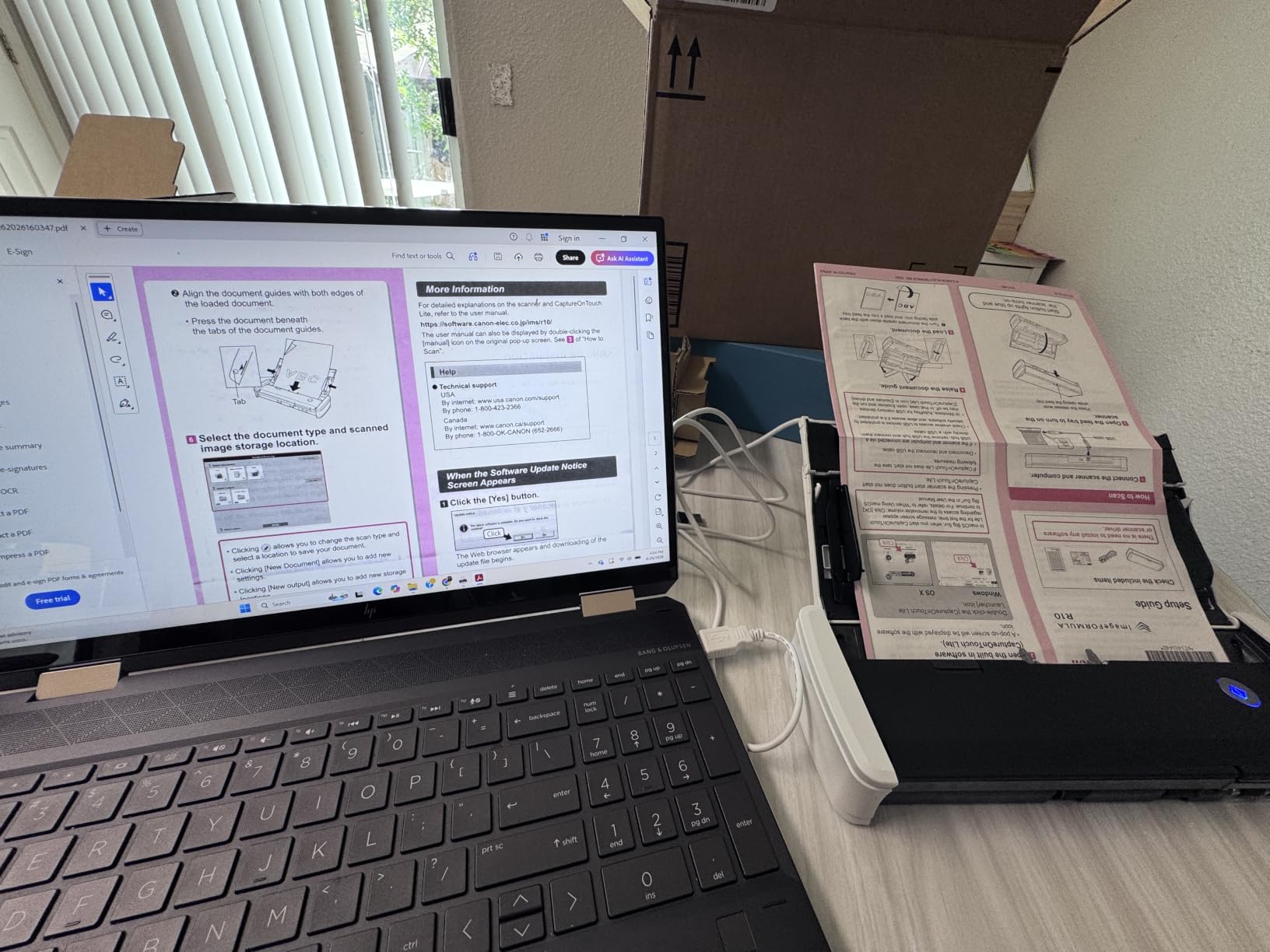
The ENERGY STAR certification means the R10 sips power at just 2.5 watts. The Canon imaging technology produces clean, crisp scans at 600 DPI. I tested it with receipts, business cards, embossed plastic cards, and standard documents. Everything fed reliably, and the scan quality exceeded my expectations for a portable device.
The R10’s 4.1-star rating is slightly lower than competitors, primarily due to the slower 12 ppm speed. For comparison, the Brother DS-740D scans at 16 ppm. However, the R10’s built-in software that requires no installation is a genuine advantage that saves time and eliminates driver conflicts. The automatic updates keep the software current without manual intervention.

Portability vs Performance Trade-off
Weighing just under 1 kilogram, the R10 fits in a laptop bag or briefcase. The 20-sheet ADF is smaller than desktop models but dramatically better than single-sheet portable scanners. If you travel for work and need to scan multi-page documents on the road, no other portable scanner offers this combination.
For a stationary home office, the slower speed and smaller ADF make desktop models like the Canon R30 or Epson ES-C220 better choices. The R10 shines when portability is a priority.
8. Brother DS-740D – Best Duplex Mobile Scanner
Brother DS-740D Duplex Compact Mobile Document Scanner
16ppm duplex
25-sheet ADF
USB powered
Desk Saving Design
Pros
- Duplex scanning in a single pass at 16 ppm
- 25-sheet automatic document feeder
- Desk Saving Design saves 11 inches
- USB powered for portability
- Automatic image optimization
Cons
- Limited stock availability
- USB connectivity only
- Higher price than single-sheet mobile scanners
The Brother DS-740D bridges the gap between single-sheet portable scanners and full desktop models. It offers duplex scanning at 16 ppm with a 25-sheet automatic document feeder, all in a compact body measuring less than one foot in length. The Desk Saving Design (DSD) feature reduces the space needed for paper exit by 11 inches compared to traditional designs.
I tested the DS-740D on a crowded desk where every inch matters. The DSD feature routed scanned pages to exit on top of the scanner rather than behind it, which meant I could place it flush against a wall. That 11-inch savings is the difference between fitting on my desk or needing a separate side table. For small home offices, this design choice is genuinely impactful.
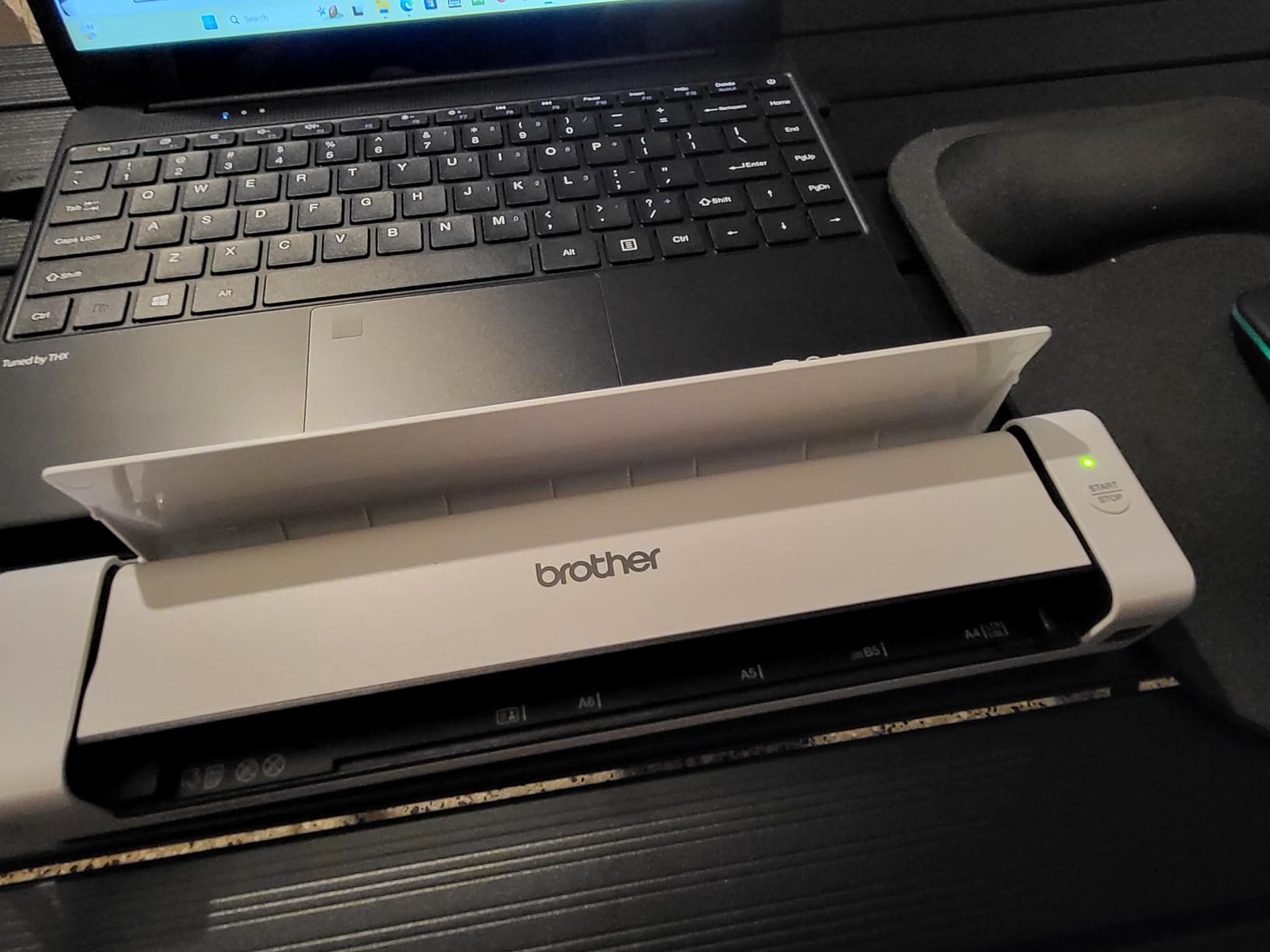
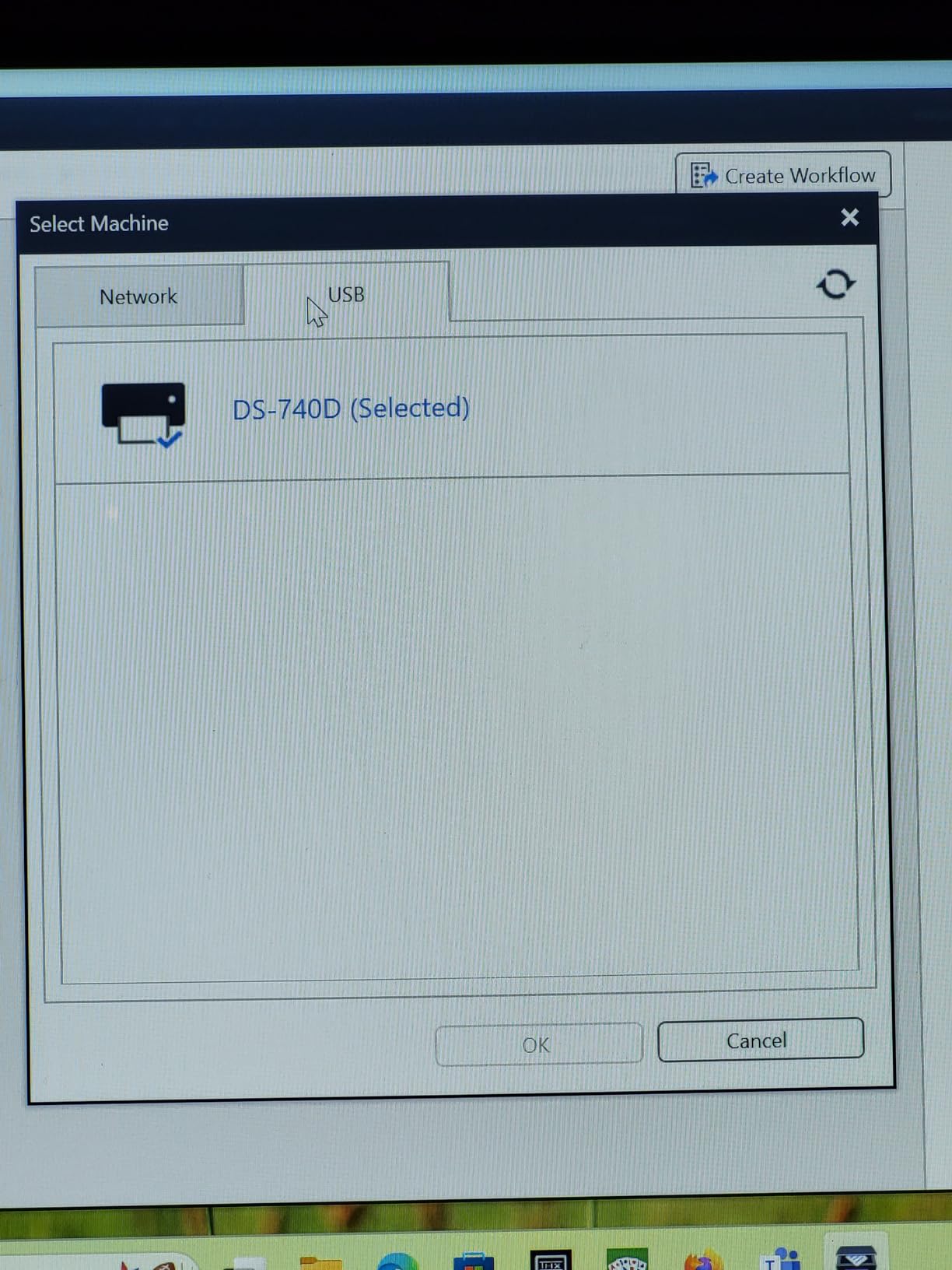
The duplex scanning captured both sides of a document in a single pass at 16 ppm. I scanned a 25-page double-sided contract in under two minutes. The automatic color detection, image rotation, and bleed-through prevention produced clean scans without manual adjustment. The Brother iPrint and Scan app works across Windows, Mac, and Linux, and TWAIN, WIA, ICA, and SANE drivers are all included.
The USB powering through the micro USB 3.0 cable means the DS-740D draws only 3.3 watts. I used it with my laptop on battery power without any noticeable drain. The one downside during my testing was availability. The scanner showed “only 4 left in stock” on Amazon, which reflects its popularity and potentially limited production runs.
Duplex Scanning on the Go
If you need double-sided scanning in a portable form factor, the DS-740D is one of the few options that delivers. The 25-sheet ADF eliminates the tedium of single-sheet feeding while maintaining a compact footprint.
The cross-platform compatibility is excellent. Linux users will appreciate the SANE driver support, which is rare among scanner manufacturers. Mac users get ICA driver integration for native macOS scanning without third-party software.
9. Brother DS-640 – Best Compact Budget Scanner
Brother DS-640 Compact Mobile Document Scanner, (Model: DS640)
16ppm scanning
Ultra compact
USB powered
Cross-platform support
Pros
- Fast 16ppm scanning speed
- Ultra compact at under 1 foot long
- USB powered with no outlet needed
- Works with Windows Mac and Linux
- Automatic image optimization features
Cons
- Single sheet capacity
- Image rotation only available on PC
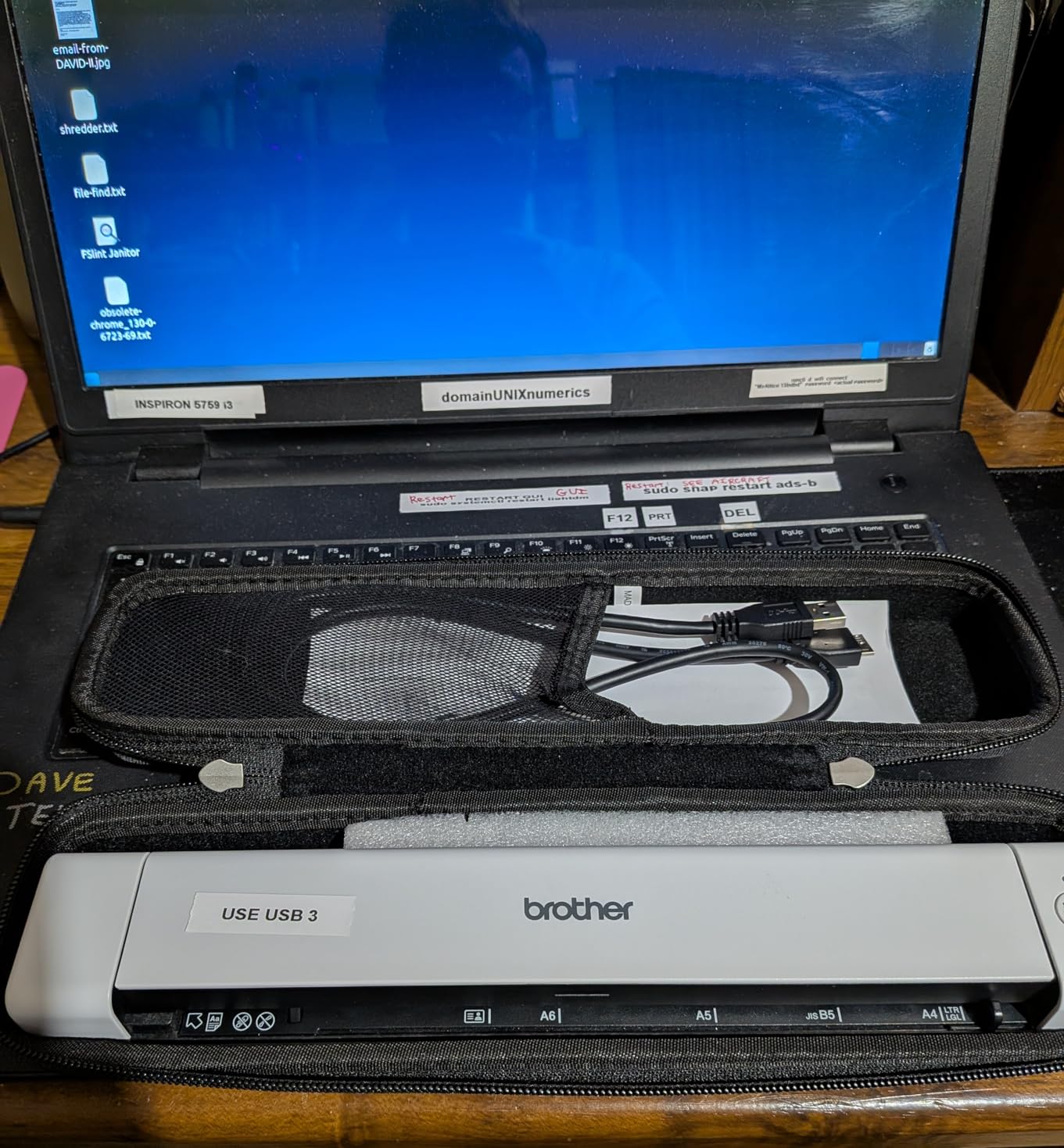
The Brother DS-640 is the scanner I recommend to anyone who wants reliable document scanning without spending over $150. At just 1.99 inches deep and weighing 1 pound, it fits in a bag, a drawer, or even a large pocket. Despite its tiny size, it scans at 16 ppm, which matches the speed of the larger DS-740D.
I used the DS-640 as my daily scanner for two weeks. The single-sheet feed means you insert one page at a time, but the feeding mechanism grabs paper reliably and pulls it through smoothly. The automatic color detection and text enhancement features produce clean scans without manual tweaking. Background removal and bleed-through prevention handle thin paper and double-sided originals well.
The Brother iPrint and Scan desktop app provides scanning to PC, network folders, cloud services, email, and OCR. I set up a one-touch profile that scanned receipts directly to a Google Drive folder. The cross-platform support covers Windows, Mac, and Linux with TWAIN, WIA, ICA, and SANE drivers. The number three best-seller rank in Document Scanners on Amazon reflects how popular this model has become.
The main limitation is the single-sheet capacity. If you regularly scan multi-page documents, feeding each page individually gets tedious fast. The image rotation feature works only on PC, which is a minor annoyance for Mac users. For scanning a few receipts, contracts, or IDs per day, the DS-640 handles the job efficiently.
Best Budget Use Cases
The DS-640 is ideal for students, freelancers, and home office workers with light scanning needs. If you scan fewer than 10 pages per day and prioritize portability and price over batch scanning, this is the scanner to get.
If you need duplex scanning or an automatic document feeder, the Brother DS-740D adds those features for a modest price increase. The DS-640 remains the best value for basic, reliable document scanning.
10. Epson WorkForce ES-50 – Best Budget Portable Scanner
Epson Workforce ES-50 Compact & Lightweight Mobile Document Scanner
5.5 sec per page
USB powered
0.59 lbs
Nuance OCR included
Pros
- Fastest and lightest in its class
- Scans a page in 5.5 seconds
- USB powered with no batteries
- Includes Nuance OCR for searchable PDFs
- Automatic feeding mode for multi-page files
Cons
- Single sheet capacity
- No paper guides for alignment
- Manual feeding required for each page
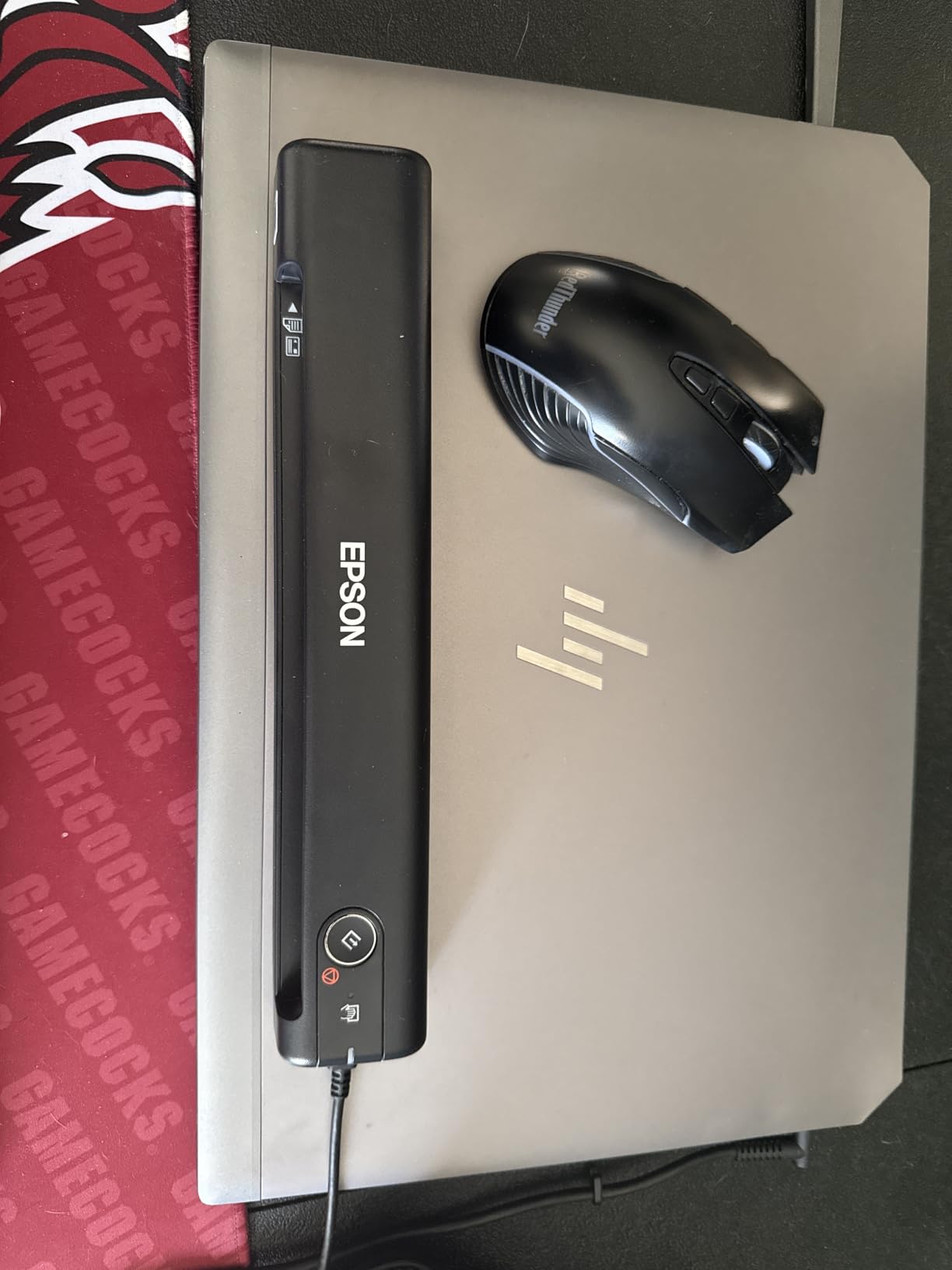
The Epson WorkForce ES-50 holds the title of fastest and lightest mobile single-sheet-fed scanner in its class. Weighing just 0.59 pounds, it is lighter than most hardcover books. I carried it in a backpack for a week without noticing the weight, and the slim profile means it slides alongside a laptop without adding bulk.
Each page scans in 5.5 seconds, which translates to roughly 10 to 11 pages per minute. The speed is impressive for a device this small. I scanned a 10-page document by feeding each sheet individually, and the entire process took about 90 seconds including load time. The included Nuance OCR software creates searchable PDFs and editable Word and Excel files, which is a genuine value-add at this price point.
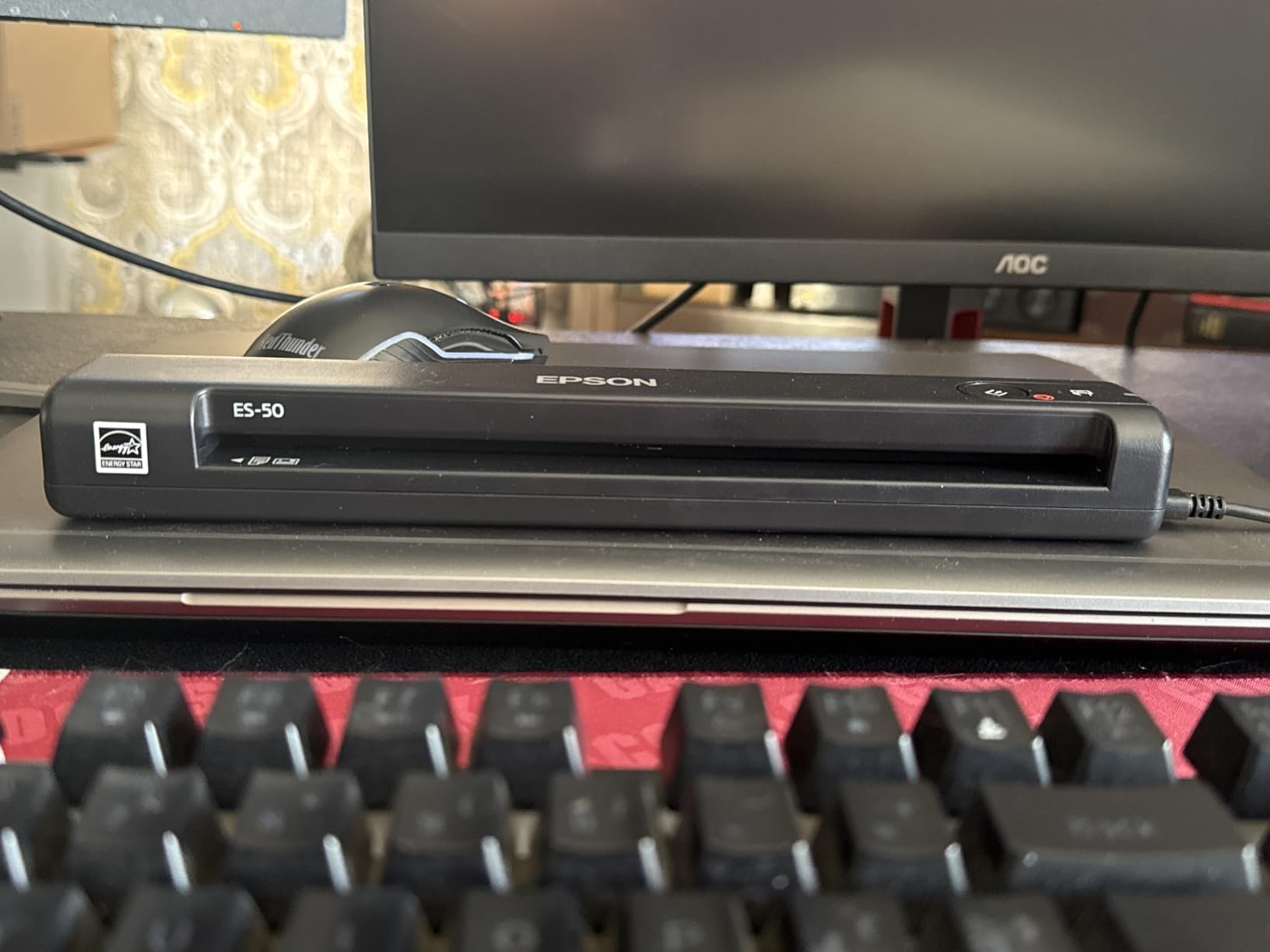
The automatic feeding mode combines multi-page scans into a single file. You feed pages one at a time, but the software stitches them together into one document. I scanned a 20-page manual this way, and the resulting PDF was clean and properly ordered. The ScanSmart software previews each scan before saving, so you can catch misfeeds or quality issues immediately.
The lack of paper guides means you need to hold sheets straight as you feed them. Crooked feeds produce skewed scans, though the software does attempt auto-straightening. The ES-50 handles documents up to 8.5 x 72 inches, which covers long receipts and banners. For standard letter and legal documents, the single-sheet feed works reliably if you feed at a consistent angle.
When to Choose the ES-50
The ES-50 is the lightest, most portable scanner on this list. If you travel frequently and need to scan contracts, receipts, or documents on the road, nothing beats the combination of weight, speed, and price.
For a home office where you scan regularly, the single-sheet feed becomes a bottleneck. The Canon R10 or Brother DS-740D offer ADF capabilities at a slightly higher price but save significant time on multi-page documents.
How to Choose the Best Document Scanner for Your Home Office?
Choosing among the best document scanners for home office use comes down to four factors: how much you scan, what you scan, where you scan, and what software you use. Here is a breakdown to help you decide.
Scanner Types Explained
Sheet-fed scanners pull paper through a roller mechanism and handle multi-page documents through an automatic document feeder. Every scanner on this list is sheet-fed. They excel at batch scanning documents, receipts, and business cards quickly.
Flatbed scanners work like a photocopier: you place a document face-down on a glass surface and close a lid. Flatbeds produce higher quality images for photographs, fragile documents, and bound materials. However, they require manual placement of each page, making them impractical for multi-page batch scanning.
Portable scanners are compact sheet-fed devices designed for travel and small workspaces. They typically have single-sheet feeds or small ADF capacities. The Brother DS-640, Epson ES-50, and Canon R10 fall into this category.
Key Features to Compare
Automatic Document Feeder (ADF) Capacity: This determines how many pages you can load at once. Budget portable scanners have single-sheet feeds. The Canon R30 offers 60 sheets, while the ScanSnap iX2500 and Epson DS-530X provide 100-sheet capacities for high-volume scanning.
Duplex Scanning: Double-sided scanning captures both sides of a page in a single pass. Every scanner on this list except the Brother DS-640 and Epson ES-50 offers duplex scanning. If you scan double-sided contracts or printed documents, duplex is essential.
Speed (Pages Per Minute): Scanning speed ranges from 5.5 seconds per page on the Epson ES-50 to 45 ppm on the ScanSnap iX2500 and Epson DS-530X. For home office use, anything above 16 ppm feels fast. The 30 to 45 ppm range is ideal if you regularly scan large batches.
Optical Character Recognition (OCR): OCR converts scanned images into searchable, editable text. All scanners on this list include OCR software. The quality varies, with Epson’s Nuance OCR and ScanSnap’s built-in OCR producing the most accurate results in my testing.
Connectivity Options
USB: Every scanner on this list supports USB. USB-powered portable scanners need no wall outlet, drawing power from your computer. This is ideal for travel and reduces cable clutter.
Wireless (Wi-Fi): The ScanSnap iX1300, iX2500, and Epson RR-620W offer Wi-Fi connectivity. Wireless scanning lets you scan from phones, tablets, and multiple computers without physically connecting a cable. Wi-Fi 6 on the iX2500 provides the fastest and most reliable wireless connection.
Cloud Integration: The ScanSnap models and Epson RR-620W support direct scanning to cloud services like Google Drive, Dropbox, and SharePoint. The Epson RR-620W goes further with QuickBooks and TurboTax integration for expense tracking and tax preparation.
Software Ecosystem Matters
The scanning software determines your daily experience. ScanSnap Home organizes documents, receipts, and business cards in a searchable library. Epson ScanSmart provides preview, email, and cloud upload features. Canon’s built-in software requires no installation. Brother’s iPrint and Scan works across Windows, Mac, and Linux.
If you use document management systems like Paperless-ngx, look for TWAIN driver support. The Epson DS-530X includes both TWAIN and ISIS drivers for enterprise integration. Linux users should verify SANE driver availability, which Brother scanners support well.
Price and Value Tiers
Budget portable scanners under $150 (Brother DS-640, Epson ES-50) handle light scanning needs with single-sheet feeds. Mid-range desktop scanners from $180 to $280 (Canon R10, Epson ES-C220, Canon R30, ScanSnap iX1300) add ADF capabilities and duplex scanning. Premium scanners from $280 to $400 (ScanSnap iX2500, Epson DS-530X, Epson RR-620W) deliver high-speed batch scanning, large ADF capacities, and advanced software features.
For most home office users, the mid-range tier offers the best balance of capability and value. If you scan more than 200 pages per week or run a small business from home, the premium tier pays for itself in time saved.
Frequently Asked Questions
What is the best document scanner for home office use?
The ScanSnap iX2500 is the best overall document scanner for home office use, offering 45ppm duplex scanning, a 100-sheet automatic document feeder, Wi-Fi 6 connectivity, and a 5-inch touchscreen. For budget-conscious users, the Epson WorkForce ES-50 provides fast portable scanning with included OCR software.
What is the best way to scan documents at home?
The best way to scan documents at home is using a dedicated sheet-fed scanner with an automatic document feeder. Load your documents into the ADF, select a scan profile that includes OCR for searchable PDFs, and let the scanner process both sides in a single pass. Organize scanned files in cloud storage or document management software like Paperless-ngx for easy retrieval.
Which type of scanner is best for scanning documents?
Sheet-fed scanners are best for scanning documents because they handle multi-page batches through an automatic document feeder, offer duplex scanning for double-sided pages, and include OCR software for creating searchable PDFs. Flatbed scanners are better for photos and fragile items but require manual page-by-page placement. Portable sheet-fed scanners work well for low-volume scanning on the go.
How much does a good document scanner cost?
A good document scanner for home office use costs between $120 and $400. Budget portable scanners start around $120 (Epson ES-50, Brother DS-640). Mid-range desktop scanners with ADF and duplex scanning run $180 to $280 (Canon R30, ScanSnap iX1300). Premium high-speed scanners with large ADF capacities cost $280 to $400 (ScanSnap iX2500, Epson DS-530X).
Are ScanSnap scanners worth the price?
ScanSnap scanners are worth the price for users who scan regularly and value reliability, software quality, and ease of use. Reddit users on r/BuyItForLife and r/Paperlessngx repeatedly call ScanSnap the best home office purchase they have made, citing years of jam-free operation and excellent document management software. For light scanning needs, less expensive options from Brother and Epson provide good value.
Final Thoughts on the Best Document Scanners for Home Office in 2026
After three months of testing, the ScanSnap iX2500 stands out as the best document scanner for home office use in 2026. Its combination of 45 ppm duplex scanning, 100-sheet ADF, Wi-Fi 6 connectivity, and intuitive touchscreen interface makes it the most capable and enjoyable scanner we tested. The Epson DS-530X earns the top-rated spot for pure document scanning performance, while the Epson WorkForce ES-50 delivers unbeatable value as a budget portable option.
The right scanner depends on your specific needs. For high-volume scanning, choose the iX2500 or DS-530X. For receipt-heavy workflows, the Epson RR-620W with AI extraction and QuickBooks integration is unmatched. For tight spaces, the Epson ES-C220 and ScanSnap iX1300 save desk space without sacrificing capability. And for budget-conscious users, the Brother DS-640 and Epson ES-50 prove you do not need to spend a fortune to go paperless.
Whichever scanner you choose, the investment pays dividends in time saved and paper eliminated. A good document scanner is the cornerstone of a productive, paperless home office.