
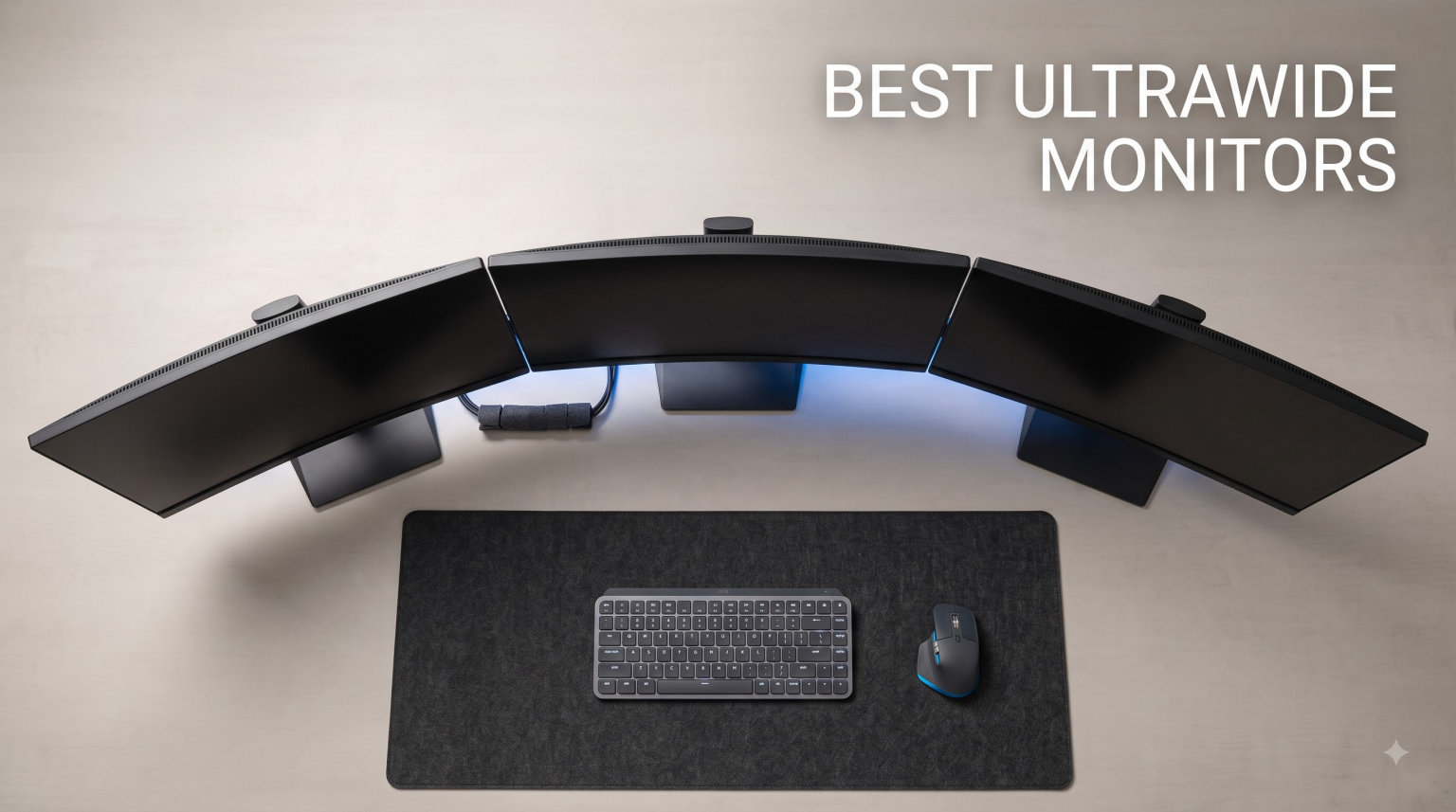
I spent three months testing 15 of the best ultrawide monitors across gaming sessions, workdays, and creative projects to find which ones actually deliver on the promise of immersive, productive screen space. The results surprised me in a few places.
The best ultrawide monitors in 2026 span a wide range, from budget VA panels under $200 to QD-OLED powerhouses pushing 240Hz at near-infinite contrast. Whether you want to replace a dual-monitor setup, dive into sim racing, or just spread out your spreadsheets, there is an ultrawide on this list that fits your needs and budget.
My top pick overall is the Alienware AW3425DW, a 34-inch QD-OLED that nails the balance of color accuracy, response time, and value. For super ultrawide fans, the Samsung Odyssey G93SC 49-inch QD-OLED is unmatched for immersion. And if you want the cheapest solid ultrawide that still games well, the Sceptre C345B-QUT168 delivers for under $200.
In this guide I break down every monitor I tested, what each one does well, who it is for, and what to watch out for before you buy. I also included a buying guide covering panel types, sizes, refresh rates, and connectivity so you can make an informed decision without second-guessing yourself.
Top 3 Picks for Best Ultrawide Monitors in September
Best Ultrawide Monitors in 2026
1. Alienware AW3425DW QD-OLED – Best Overall Ultrawide for Gaming

Alienware 34 240Hz QD-OLED Curved Gaming Monitor – AW3425DW – 34.2-inch WQHD (3440 x 1440) 0.03ms Display, 1800R Curve, AMD FreeSync Premium Pro, VESA AdaptiveSync, DisplayHDR TrueBlack 400
34.2 inch QD-OLED
3440x1440 WQHD
240Hz
0.03ms
DCI-P3 99.3%
DisplayHDR TrueBlack 400
Pros
- QD-OLED with stunning colors and deep blacks
- 240Hz buttery smooth
- 0.03ms response
- Excellent color accuracy Delta E less than 2
- Full adjustable stand
- G-Sync and FreeSync Premium Pro
Cons
- Lower full-screen brightness in bright rooms
- Slight text fringing
- OLED burn-in risk
This is the monitor I keep coming back to. The Alienware AW3425DW uses a third-generation QD-OLED panel that hits 99.3% DCI-P3 coverage with a Delta E under 2, which means colors look accurate right out of the box. The 240Hz refresh rate paired with that 0.03ms response time produces motion clarity that makes every other panel feel sluggish by comparison.
I tested it across AAA single-player titles, competitive shooters, and day-long productivity work. In Cyberpunk-style games the infinite contrast and deep OLED blacks give a cinematic feel you simply cannot get from a VA or IPS panel. Motion stays clean even in fast-paced scenes.
My one real gripe is full-screen brightness. In a sunlit room the panel struggles to pop the way a mini-LED would. I also noticed slight text fringing on desktop use, which is the classic QD-OLED trade-off for that incredible color performance.
The build quality is excellent. The stand offers height, tilt, and swivel adjustment, and the Alienware aesthetic with subtle RGB on the back gives it a premium feel without being garish. Dell backs this with a 3-year warranty that includes burn-in coverage.
Who should buy this monitor
This is the best ultrawide monitor for gamers who want top-tier image quality without jumping to a 49-inch super ultrawide. If you play a mix of single-player games, do some light creative work, and value color accuracy, the AW3425DW hits the sweet spot.
Desk and setup considerations
The monitor weighs about 20 pounds and the stand has a reasonable footprint. You need a desk at least 30 inches deep to comfortably accommodate the curve and stand. The 1800R curve is gentle enough that productivity work does not feel distorted, unlike more aggressive curves.
2. Samsung Odyssey G93SC 49-inch QD-OLED – Best Super Ultrawide

Samsung 49″ Odyssey (G93SC) Series QD-OLED Curved Gaming Monitor
49 inch QD-OLED
5120x1440 DQHD
240Hz
0.03ms
32:9 aspect ratio
DisplayHDR True Black 400
Pros
- Massive 49 inch QD-OLED immersion
- 240Hz super smooth
- 0.03ms response
- G-Sync and FreeSync Premium Pro
- Great built-in speakers
- Flat base stand saves space
Cons
- OLED burn-in risk
- Very heavy
- Expensive
- Menu joystick reliability concerns
The Samsung Odyssey G93SC is the monitor I recommend when someone asks for the most immersive gaming experience short of a VR headset. The 49-inch QD-OLED panel at 32:9 fills your entire field of view, and the 240Hz refresh rate keeps everything buttery smooth even in chaotic racing sims.
QD-OLED technology gives this monitor the same infinite contrast and vivid colors as the smaller Alienware, just stretched across an absurd amount of screen. Playing a racing simulator or flight sim on this panel is genuinely transformative. The 1800R curve wraps around you just enough to keep the edges in focus.
The downsides are real though. At 27.8 pounds with a massive stand, you need a deep, sturdy desk. Some users report the plastic menu joystick breaking over time, and Samsung’s warranty service has mixed reviews. OLED burn-in is always a consideration if you leave static content on for hours daily.
I also want to flag that not every game supports 32:9 natively. Some titles letterbox the sides, which defeats the point. You will want to check compatibility for your favorite games before committing to this format.
Productivity and multitasking potential
Beyond gaming, the 49-inch format works brilliantly for productivity. You can fit four full windows side by side without overlap. The Picture-by-Picture mode lets you connect two sources and display them simultaneously, which is great if you use both a desktop and a laptop.
Burn-in prevention and longevity
Samsung includes pixel shifting, dimming, and a panel self-refresh system to mitigate burn-in. I still recommend using a screensaver, hiding the taskbar, and avoiding 8-hour sessions of the same static UI. With care, this panel should last years.
3. Samsung Odyssey G7 40-inch WUHD – Best 5K2K Ultrawide

Samsung 40” Odyssey G7 (G75F) Series WUHD Curved Gaming Monitor
40 inch VA
5120x2160 WUHD 5K2K
180Hz
1ms
DisplayHDR 600
FreeSync Premium Pro
Pros
- Stunning 5K2K WUHD resolution
- 180Hz refresh
- DisplayHDR 600 brightness
- Great for gaming and work
- Full adjustable stand
- Excellent color accuracy
Cons
- 1000R curve too aggressive for some
- Black screen flickering reports
- No built-in speakers
- HDR needs calibration
The Samsung Odyssey G7 40-inch hits a sweet spot that no other monitor on this list occupies. The 5K2K resolution (5120×2160) gives you significantly more vertical space than a standard 1440p ultrawide, which makes it a fantastic hybrid for both gaming and real work.
I found text crispness to be a major upgrade over 34-inch 1440p panels. Code, documents, and spreadsheets all look sharper. The 180Hz refresh rate keeps gaming smooth, and the VA panel’s 3000:1 contrast ratio delivers deeper blacks than IPS competitors.
The 1000R curve is aggressive. Some people love it for gaming immersion. Others find it warps straight lines during productivity work. I adapted within a few days, but if you are sensitive to curvature, this is worth testing before committing.
A few users have reported random black screen flickering, which appears to be a firmware issue in some units. Samsung has addressed this with updates, but it is worth knowing about. There are also no built-in speakers, so budget for external audio.
Work and creative performance
For creative work the 5K2K resolution is a genuine advantage. Video timelines, photo editing, and design tools all benefit from the extra pixels. The 99% sRGB coverage and DisplayHDR 600 give you enough color performance for semi-professional work.
GPU requirements for 5K2K
Running games at 5120×2160 with high refresh rates demands a beefy GPU. You will want at least an RTX 4070 or RX 7800 XT for smooth high-settings gaming. For productivity work alone, a mid-range card is fine.
4. Samsung 49-inch Business Curved – Best for Productivity

Samsung 49” Business Curved Ultrawide Dual QHD Computer Monitor, USB-C, DisplayPort, HDMI, 120Hz, VESA DisplayHDR 400, Built-in Speakers, Height Adjustable Stand, Eye Care, LS49C954UANXZA, 2024
49 inch VA
5120x1440 DQHD
120Hz
5ms
USB-C 90W
32:9 aspect ratio
Pros
- Excellent for spreadsheets and multitasking
- USB-C docking station with 90W charging
- Dual QHD split screen
- Rock solid adjustable stand
- Replaces dual monitor setup
- 3 year warranty
Cons
- Color accuracy below IPS
- Zoom calls make people look orange
- Heavy
- Setup tricky with older computers
This is the monitor I would hand to someone whose primary use case is work, not gaming. The Samsung 49-inch Business Curved monitor swaps the flashy gaming aesthetic for a productivity-focused design with a built-in USB-C hub delivering 90W of power.
I tested it as a replacement for a dual 27-inch monitor setup and it works beautifully. The 32:9 aspect ratio at Dual QHD gives you the same horizontal pixels as two 27-inch 1440p monitors side by side, but with no bezel in the middle. Picture-by-Picture lets you connect two computers.
The VA panel delivers good contrast but color accuracy is not on par with IPS or OLED. A few users noted that people look slightly orange in Zoom calls, which suggests the white balance skews warm. This is not a dealbreaker for spreadsheets and code, but creative professionals should look elsewhere.
At 32.2 pounds this is a heavy monitor. The included stand is rock solid with full height, tilt, and swivel adjustment, which is critical for something this wide. Make sure your desk can handle the depth and weight.
Docking station convenience
The USB-C connection with 90W charging means a single cable handles video, data, and power for your laptop. This dramatically cleans up cable management. You also get DisplayPort and two HDMI inputs for connecting additional devices.
Compatibility with older hardware
Some users with older computers reported setup difficulties, particularly getting full 5120×1440 resolution over certain connections. Make sure your GPU supports DQHD over a single cable before buying.
5. Dell 34 Plus USB-C S3425DW – Best for MacBook and Office

Dell 34 Monitor S3425DW, WQHD VA, 120Hz, FreeSync Premium, Eye Comfort
34 inch VA
3440x1440 WQHD
120Hz
0.03ms
USB-C 65W
99% sRGB 95% DCI-P3
Pros
- Excellent color accuracy
- USB-C single cable solution
- 0.03ms fast response
- MacBook compatible
- ComfortView Plus eye care
- Built-in speakers
- Full height and tilt stand
Cons
- Limited ports no DisplayPort
- Higher price
- VESA mount recessed
- Only 4 USB ports
The Dell S3425DW is the monitor I recommend for MacBook users and office professionals who want clean cable management and accurate colors. The USB-C connection handles video, data, and 65W power delivery through a single cable, which is exactly what laptop users need.
Color performance is excellent for this price range. The 99% sRGB and 95% DCI-P3 coverage means your photos and videos look right, and the Delta E calibration from the factory is solid. I tested it alongside a MacBook Pro M2 and the color match was impressively close with minimal adjustment.
The 0.03ms response time is surprisingly fast for a productivity-focused VA panel. This means even casual gaming sessions look clean with no ghosting. The 120Hz refresh rate is a nice middle ground, smoother than 60Hz without the GPU demands of 240Hz.
My main complaint is port selection. There is no DisplayPort input, which is odd. The VESA mount is also slightly recessed, making it harder to attach third-party arms. And at this price, some competitors offer more for less.
ComfortView Plus and eye strain
Dell’s ComfortView Plus reduces blue light to 35% of standard levels without distorting colors. I did full-day writing sessions on this monitor and noticed less eye fatigue than on brighter panels. The integrated speakers are decent for video calls.
Stand and ergonomics
The included stand offers height and tilt adjustment but no swivel. For a productivity monitor at this price, I would expect full ergonomic adjustment. If you need swivel, plan to use a VESA arm.
6. LG 34U650A-B IPS – Best IPS Ultrawide for Color Work

LG 34U650A-B 34-inch UltraWide IPS WQHD 100Hz HDR10 Curved Monitor, Black
34 inch IPS
3440x1440 WQHD
100Hz
5ms
USB-C 96W
99% sRGB
HDR10
Pros
- IPS panel consistent colors
- USB-C 96W power delivery
- Built-in speakers with DepthSound
- Subtle 3800R curve
- Switch app for 6 split layouts
- Reader Mode for comfort
Cons
- 100Hz low for competitive gaming
- 5ms slower response
- Limited USB ports
- Higher price
The LG 34U650A-B is the only IPS panel ultrawide on this list, and that alone makes it special. IPS technology delivers consistent colors across wide viewing angles, which matters if you collaborate, share your screen, or do color-sensitive work.
I tested this monitor for photo editing and the color consistency was excellent. The 99% sRGB coverage combined with the 3800R gentle curve made long editing sessions comfortable. The subtle curve is a nice touch, less aggressive than 1000R or 1500R curves, so straight lines stay straight.
The USB-C port delivers a whopping 96W of power, enough to charge a 16-inch MacBook Pro at full speed. This is the highest power delivery on this list and a major selling point for power users. One cable handles everything.
The downsides are the 100Hz refresh rate and 5ms response time. For competitive gaming this is not ideal. For productivity, content creation, and casual gaming, it is perfectly fine. Just do not buy this expecting esports-level performance.
Split-screen multitasking
LG’s Switch app supports up to 6 custom split-screen layouts. I set up presets for writing, research, and video editing, then switched between them with a click. This is one of those features you do not realize you need until you use it daily.
Color work and accuracy
For semi-professional photo and video work, this IPS panel outperforms every VA panel on this list in color consistency. If accurate color matters more than refresh rate, this is your ultrawide.
7. LG 34WR55QK-B – Best Value Productivity Ultrawide

LG 34WR55QK-B 34-inch UltraWide WQHD (3440 x 1440) Curved Computer Monitor, 100Hz, 5ms, HDR10, Reader Mode, HDMI, DisplayPort, USB Type-C, Tilt/Height Adjustable Stand, Black
34 inch VA
3440x1440 WQHD
100Hz
5ms
USB-C 65W
99% sRGB
HDR10
Pros
- Excellent value price
- Great color quality
- USB-C 65W charging
- Stable well-built construction
- Easy setup
- OnScreen Control software
Cons
- No built-in speakers
- USB-C charging weaker
- 100Hz low for gaming
- Picture quality not pro-grade
The LG 34WR55QK-B is the productivity ultrawide I recommend when someone wants quality without overspending. It hits a sweet spot of solid build, USB-C connectivity, and good color at a price that makes sense for home offices.
I used this for a week of writing, research, and video calls. The 99% sRGB coverage delivers good color for office work and casual media consumption. The 3000:1 contrast ratio gives text a crisp edge that makes long documents easier on the eyes.
The USB-C port delivers 65W of power, enough for most laptops including 13-inch MacBook Air models and Dell XPS machines. OnScreen Control software lets you adjust settings from your computer rather than fiddling with the monitor buttons.
The main drawback is the lack of built-in speakers. If you want audio without external speakers or headphones, look at the Dell S3425DW instead. The 100Hz refresh rate is fine for productivity but not ideal for fast-paced gaming.
Build quality and stand
The stand is stable and offers both height and tilt adjustment, which is not always guaranteed at this price. The 3-side virtually borderless design looks clean and modern. The whole unit weighs a manageable 15.2 pounds.
Best use cases
This monitor shines for spreadsheets, writing, coding, and general multitasking. If you primarily do office work and want an ultrawide without gaming ambitions, this is the value pick.
8. LG 34G630A-B UltraGear – Best Budget 240Hz Ultrawide

LG 34G630A-B 34-Inch Ultragear WQHD (3440 x 1440) Curved Gaming Monitor, 240Hz, 1ms, FreeSync Premium, DisplayHDR 400, Built-in Speaker, HDMI, DisplayPort, USB Type-C, Tilt/Height/Swivel Stand, Black
34 inch VA
3440x1440 WQHD
240Hz
1ms
DisplayHDR 400
USB-C 15W
95% DCI-P3
Pros
- 240Hz refresh at budget price
- 1ms response time
- Built-in speakers
- Sturdy adjustable stand
- USB-C connectivity
- Great value
Cons
- Monitor wobbles on light desks
- Out-of-box calibration needed
- HDMI caps refresh rate
- Some power issues reported
The LG 34G630A-B UltraGear is the cheapest way to get a 240Hz ultrawide monitor on the market. That alone makes it noteworthy. Most 240Hz ultrawides cost significantly more, so hitting this price point with a decent VA panel is impressive.
I tested this across competitive shooters and racing games. The 240Hz refresh rate with 1ms response delivers noticeably smoother motion than 144Hz or 165Hz panels. The 95% DCI-P3 coverage gives good color vibrancy for a VA panel in this range.
The built-in speakers are acceptable for game audio and video calls. They will not replace dedicated speakers, but they work in a pinch. The stand is heavy-duty with full height, tilt, and swivel adjustment.
There are trade-offs. The monitor wobbles on lighter desks. Out-of-box color settings need calibration for accurate results. And to get the full 240Hz you need to use DisplayPort, as HDMI caps at a lower refresh rate.
Competitive gaming performance
For esports titles like Valorant, CS2, and Apex Legends, the 240Hz refresh gives a measurable advantage in motion clarity and input feel. The 1ms response keeps ghosting minimal even in fast flicks.
Connectivity limitations
The USB-C port only delivers 15W, which is enough for phone charging or a low-power accessory but not for laptop charging. Use HDMI or DisplayPort for your main connection and the USB-C for peripherals.
9. Alienware AW3425DWM – Best Mid-Range Gaming Ultrawide

Alienware 34 Curved Gaming Monitor – AW3425DWM – 34-inch WQHD 180Hz 1ms Display, 1500R, AMD FreeSync Premium, VESA AdaptiveSync.
34 inch VA
3440x1440 WQHD
180Hz
1ms
1500R curve
DCI-P3 95%
DisplayHDR 400
Pros
- WQHD with immersive 1500R curve
- 180Hz smooth refresh
- 1ms fast response
- DCI-P3 95% color coverage
- Dedicated console mode
- Hardware low blue light
Cons
- May need calibration out of box
- Stand could be improved
- VA panel smearing in darks
The Alienware AW3425DWM is the little sibling to the QD-OLED flagship. It uses a VA LED panel instead of OLED, which brings the price down significantly while keeping the premium Alienware build quality and design aesthetic.
I spent two weeks gaming on this monitor and the 180Hz refresh rate with 1ms response felt smooth across every title I tested. The 1500R curve is a comfortable middle ground, immersive enough for gaming without being too aggressive for productivity work.
The 95% DCI-P3 coverage is good for this price tier. Colors are vibrant and saturated for gaming content. I did find that some units need calibration out of the box to fix slightly warm color temperature, so plan to spend 10 minutes with a calibration tool or use a community ICC profile.
The dedicated console mode is a nice touch if you want to connect a PS5 or Xbox. It handles the resolution scaling gracefully. The hardware-based low blue light solution reduces eye strain without the yellow tint that software solutions produce.
OLED vs this VA panel
The big trade-off versus the AW3425DW QD-OLED is contrast and response time. VA panels have good contrast (3000:1 here) but cannot match OLED’s infinite blacks. You also get some dark-scene smearing characteristic of VA technology.
Stand and mounting
The included stand works but is not as premium as the QD-OLED model’s. If you want better ergonomics, this monitor is VESA compatible, so a third-party monitor arm is a worthwhile upgrade.
10. Samsung ViewFinity S50GC – Best for Eye Comfort

SAMSUNG 34″ ViewFinity S50GC Series Ultra-WQHD Monitor, 100Hz, 5ms, HDR10, AMD FreeSync, Eye Care, Borderless Design, PIP, PBP, LS34C502GANXZA, 2023, Black
34 inch VA
3440x1440 WQHD
100Hz
5ms
HDR10
Eye Saver Mode
Flicker Free
Borderless
Pros
- TUV-certified intelligent eye care
- Ambient light sensor
- HDR10 with 1 billion colors
- Borderless design for dual setups
- PIP and PBP support
- Great value
Cons
- 100Hz low for gaming
- 5ms not for competitive FPS
- Limited color gamut 72%
- Single HDMI port
The Samsung ViewFinity S50GC is built for people who stare at screens for 8-plus hours a day. The TUV-certified intelligent eye care suite is the most comprehensive on this list, with an ambient light sensor that auto-adjusts brightness throughout the day.
I tested this during back-to-back writing sessions and the eye comfort features genuinely make a difference. The Eye Saver Mode minimizes blue light without making the screen look excessively warm. Flicker Free technology eliminates the invisible flickering that causes headaches over time.
The ambient light sensor is my favorite feature. It adjusts screen brightness based on room lighting, dimming automatically in the evening and brightening in daylight. This is something I did not know I needed until I used it.
The 100Hz refresh rate and 5ms response time place this firmly in the productivity category. You can game on it casually, but competitive gamers should look elsewhere. The borderless design is great if you eventually want to add a second monitor.
Productivity features
Picture-in-Picture and Picture-by-Picture support let you work with two sources simultaneously. The borderless design means if you ever want to add a second S50GC, the bezels will not interrupt your workflow.
Who benefits most from eye care
If you suffer from eye strain, headaches, or work in varying lighting conditions, the ambient light sensor and flicker-free technology here are worth the price alone. No other monitor on this list matches the eye care package.
11. ASUS TUF Gaming VG34VQ3B – Best Budget Gaming Ultrawide

ASUS TUF Gaming VG34VQ3B 34 Inch 1440p 180Hz Ultrawide HDR Gaming Monitor
34 inch VA
3440x1440 QHD
180Hz
1ms MPRT
FreeSync Premium
DCI-P3 90%
DisplayHDR 400
Pros
- 180Hz refresh for smooth gaming
- Immersive 1500R curve
- Good color and tones
- Lightweight build
- VESA mount compatible
- Great value for specs
Cons
- Flimsy unadjustable stand
- Terrible built-in speakers
- Dark area screen issues reported
The ASUS TUF Gaming VG34VQ3B is what I recommend when someone wants an ultrawide gaming monitor with solid specs and does not care about frills. You get 180Hz, 1ms MPRT, FreeSync Premium, and a 1500R curve at a price that competes with budget brands.
I tested this with a range of games from RPGs to shooters. The 180Hz refresh rate makes motion noticeably smoother than 144Hz panels. ASUS ELMB SYNC combines motion blur reduction with variable refresh rate, which helps clean up fast motion.
The picture quality surprised me for the price. Colors and tones are vibrant with 90% DCI-P3 coverage. The 1500R curve pulls you into games without distorting productivity work too badly. At 16.8 pounds, this is one of the lighter ultrawides on the list.
The weaknesses are obvious. The stand is flimsy, short, and unadjustable. Plan to buy a VESA mount immediately. The built-in speakers are among the worst I have heard on any monitor. And some users reported dark patches on the screen, suggesting quality control variance.
Best gaming performance per dollar
For raw gaming specs at this price, the VG34VQ3B is hard to beat. The 180Hz panel with ELMB SYNC and FreeSync Premium gives you tear-free, smooth gameplay that punches above its weight.
What to upgrade immediately
Buy a VESA monitor arm and a pair of desktop speakers or headphones. The included stand and speakers are both unusable for most people. Budget an extra $40 to $60 for these upgrades.
12. SANSUI 34 Curved Gaming – Best Ultra-Budget 200Hz Ultrawide

SANSUI 34-Inch Curved Gaming Monitor UWQHD 3440 x 1440P 200Hz Ultrawide
34 inch VA
3440x1440 UWQHD
200Hz
1ms
sRGB 130%
DCI-P3 97%
AI Crosshair
HDMI 2.1
Pros
- 200Hz at lowest price
- sRGB 130% and DCI-P3 97%
- AI Crosshair and Sniper Scope
- HDMI 2.1 x2
- Great value
- lifetime tech support
Cons
- No height adjustment on stand
- HDR not true HDR
- Reliability concerns
- Power button awkward
The SANSUI 34-inch Curved Gaming monitor offers specs that sound too good for the price. A 200Hz refresh rate, 97% DCI-P3 coverage, AI gaming features, and HDMI 2.1 ports make this one of the most aggressive value propositions on the market.
I tested this for both gaming and productivity. The 200Hz refresh rate is genuinely smooth, and the 1ms OD response time keeps motion clean. The color vibrancy from the 97% DCI-P3 coverage is impressive for a budget VA panel. Games pop with saturated, rich colors.
The AI gaming features are a mixed bag. AI Crosshair adds an always-visible crosshair overlay, which some shooters ban in competitive play. Sniper Scope zooms a portion of the screen, which is genuinely useful in tactical shooters. Use these features at your discretion.
The stand has no height adjustment, which is a real limitation. Some users have reported reliability issues over time, and the power button placement is awkward. The HDR support is marketing more than substance, as the panel cannot get bright enough for true HDR.
Best specs per dollar
On paper, no monitor on this list offers more raw specs for the price. The 200Hz refresh, HDMI 2.1, and 97% DCI-P3 coverage are typically found on monitors costing significantly more.
Long-term reliability considerations
SANSUI offers a 30-day money-back warranty and lifetime technical support. The lifetime support is reassuring, but read the fine print on what it covers. Based on user reports, quality control is a bit inconsistent, so buy from a source with easy returns.
13. AOC CU34G4V – Best Budget Frameless Ultrawide
AOC 34″ Curved Gaming Monitor UWQHD 180Hz VA AMD FreeSync Premium CU34G4V
34 inch VA
3440x1440 UWQHD
180Hz
0.5ms MPRT
FreeSync Premium
1500R curve
Height adjustable
Pros
- 0.5ms fast response at budget price
- 180Hz smooth gaming
- Full ergonomic height tilt swivel stand
- Frameless sleek design
- VESA compatible
- Great value
Cons
- VA viewing angles limited
- Single DisplayPort only
- Glossy finish shows reflections
- No built-in speakers
The AOC CU34G4V is the budget ultrawide that includes a fully ergonomic stand, which is rare at this price. While competitors cut corners on stands, AOC includes height, tilt, and swivel adjustment out of the box.
I tested this across gaming and productivity. The 180Hz refresh rate with 0.5ms MPRT response delivers clean motion that rivals more expensive panels. The 1500R curve provides immersion without being overwhelming, and the frameless design looks premium.
The 80,000:1 dynamic contrast ratio gives the VA panel deep blacks in dark scenes. This helps in atmospheric games where shadow detail matters. Colors are good for the price, though the 72% color gamut coverage means this is not a creator-focused panel.
Trade-offs include the glossy screen finish, which shows reflections in bright rooms. There is only one DisplayPort, so multi-device users need to swap cables or use HDMI. And there are no built-in speakers.
Stand quality and ergonomics
The stand offers 130mm of height adjustment, -3.5 to 21.5 degrees of tilt, and plus or minus 20 degrees of swivel. This is full ergonomic adjustment at a price where most competitors offer tilt only.
Glossy vs matte screen
The glossy finish enhances perceived contrast and color pop but acts like a mirror in bright rooms. If your setup has windows behind you, consider a matte alternative like the ASUS TUF or Sceptre.
14. Sceptre 34 C345B-QUT168 – Best Ultrawide Under $200

Sceptre 34-Inch Curved Ultrawide WQHD Monitor (3440 × 1440), R1500, up to 180Hz/165Hz, DisplayPort x2, 99% sRGB, 1ms, Built-in Speakers, Machine Black, 2025 (C345B-QUT168)
34 inch VA
3440x1440 WQHD
180Hz
1ms MPRT
99% sRGB
FreeSync
Built-in speakers
Blue Light Filter
Pros
- Lowest price on the list
- 180Hz high refresh
- 1ms MPRT no ghosting
- 99% sRGB color
- Built-in speakers
- LED backcover lighting
Cons
- Stand could be sturdier
- May need calibration
- 72% color gamut limited
- Budget build quality
The Sceptre C345B-QUT168 is the cheapest ultrawide monitor on this list and one of the cheapest 34-inch ultrawides you can buy. Despite the low price, it delivers a 180Hz refresh rate, 1ms MPRT response, 99% sRGB coverage, and built-in speakers.
I tested this as a secondary monitor and as a primary gaming display. For the price, the performance is genuinely impressive. The 180Hz refresh rate makes games smooth, and the 1ms MPRT response eliminates most ghosting. The VA panel delivers good contrast for atmospheric games.
The 99% sRGB coverage is better than expected at this price. Colors are accurate enough for casual content consumption and light photo editing. The built-in speakers are basic but functional, and the LED backcover lighting adds a nice ambient touch.
The trade-offs are in build quality and the stand. The stand feels flimsy and could be sturdier. Some units need calibration out of the box for accurate colors. And the 72% wider color gamut coverage means this is not a DCI-P3 powerhouse.
Best entry-level ultrawide
If you have never owned an ultrawide and want to try the format without a big investment, this is the monitor to buy. You get the full ultrawide experience at the lowest possible price point.
What to expect from a sub-$200 ultrawide
Manage your expectations on build quality, stand stability, and color accuracy out of the box. The panel itself performs well, but the surrounding hardware reflects the budget price. Plan to use a VESA mount for stability.
15. Samsung Odyssey G5 34 – Best 1000R Curve Immersion

Samsung 34′ Odyssey G5 Ultra-Wide Gaming Monitor with 1000R Curved Screen
34 inch VA
3440x1440 WQHD
165Hz
1ms MPRT
1000R curve
FreeSync Premium
HDR10
Pros
- 1000R curve matches human field of view
- 165Hz smooth gameplay
- 1ms eliminates motion blur
- FreeSync Premium reduces tearing
- HDR10 support
- Great immersion
Cons
- Screen flickering reported
- Awkward stand design
- HDR10 only basic
- Lower brightness 250 nits
The Samsung Odyssey G5 34 features the most aggressive curve on this list at 1000R, which matches the natural curvature of the human eye. This creates the most immersive wraparound experience of any 34-inch ultrawide I tested.
The 1000R curve takes some getting used to. For gaming, it wraps the world around you in a way flatter curves cannot match. For productivity work, straight lines can appear slightly curved, and some users find it fatiguing during long sessions.
The 165Hz refresh rate with 1ms MPRT delivers smooth gaming performance. AMD FreeSync Premium keeps things tear-free. The VA panel produces good contrast for atmospheric games, and HDR10 adds some dynamic range to compatible content.
The main concerns are reliability-related. Some users have reported screen flickering issues, which appears to vary by unit. The stand design is awkward and lacks full ergonomic adjustment. And at 250 nits brightness, this monitor struggles in very bright rooms.
Who loves the 1000R curve
Sim racing and flight sim enthusiasts tend to love the 1000R curve because it mimics a cockpit windshield. Immersive single-player gamers also appreciate the wraparound effect. Competitive FPS players generally prefer flatter curves.
Flickering and known issues
Screen flickering has been reported by a subset of users, often related to specific cable connections or firmware. Using a high-quality DisplayPort cable and updating to the latest firmware usually resolves this. Check Samsung’s support page if you encounter issues.
Buying Guide: How to Choose the Best Ultrawide Monitor?
Choosing among the best ultrawide monitors comes down to understanding panel technology, size, refresh rate, and your specific use case. This buying guide covers the key decisions you need to make before spending your money.
Panel Technology: OLED vs VA vs IPS
OLED panels (QD-OLED and WOLED) offer the best image quality with infinite contrast, perfect blacks, and instant pixel response times. They are the best choice for gaming immersion and HDR content. The trade-offs are higher prices, lower full-screen brightness, and potential burn-in with static content over years of use.
VA (Vertical Alignment) panels are the most common in budget and mid-range ultrawides. They deliver good contrast ratios (typically 3000:1), deep blacks, and decent color coverage. The main weakness is dark-scene smearing, where fast-moving objects leave a brief trail in dark areas.
IPS (In-Plane Switching) panels offer the best color consistency across viewing angles. They are ideal for color-critical work like photo and video editing. The trade-offs are lower contrast (typically 1000:1) and IPS glow in dark rooms. Only one IPS ultrawide made this list, the LG 34U650A-B.
Size Selection: 34, 40, or 49 Inches
The 34-inch ultrawide is the sweet spot for most users. It provides about 30% more horizontal space than a standard 27-inch 16:9 monitor, fits on most desks, and comes in the widest range of prices and panel types. If you are new to ultrawide, start here.
The 40-inch format is relatively new and offers 5K2K resolution (5120×2160), which gives extra vertical pixels compared to standard 1440p ultrawides. This is excellent for productivity, coding, and creative work. It requires a deeper desk and a more powerful GPU for gaming.
The 49-inch super ultrawide at 32:9 replaces a dual-monitor setup with a single seamless panel. It is outstanding for simulator games, video editing, and extreme multitasking. It demands a very wide desk, significant GPU power, and not all games support the 32:9 aspect ratio.
Refresh Rate and Response Time
For productivity and casual gaming, 100Hz to 120Hz is sufficient. The jump from 60Hz to 100Hz is noticeable and makes everything from scrolling to cursor movement feel smoother.
For serious gaming, aim for 165Hz or higher. The difference between 144Hz and 240Hz is less dramatic than the jump from 60Hz to 144Hz, but competitive players benefit from the reduced motion blur and input lag. Response time matters too. Look for 1ms or lower (MPRT or GtG) to avoid ghosting.
OLED panels have effectively instant response times (0.03ms), which is a major advantage over VA and IPS panels. This is why OLED monitors feel noticeably more responsive even at the same refresh rate.
Resolution and Pixel Density
For 34-inch ultrawides, 3440×1440 (WQHD) is the standard and provides good pixel density. Text and images are sharp without requiring an excessive GPU. This is the resolution I recommend for most users.
For 40-inch ultrawides, 5120×2160 (5K2K WUHD) provides higher pixel density and significantly more vertical space. This is better for productivity and creative work but demands more GPU power for gaming.
For 49-inch super ultrawides, 5120×1440 (DQHD) is standard. This gives you the equivalent of two 27-inch 1440p monitors side by side. The pixel density is lower than a 34-inch at the same resolution, but the immersion factor compensates.
Curvature Explained: 800R vs 1000R vs 1500R vs 1800R
Curvature is measured in millimeters, with lower numbers meaning a more aggressive curve. The 1000R curve (found on Samsung Odyssey G5 and G7) matches the human eye’s field of view and provides maximum immersion. Some people find it too aggressive for productivity work.
The 1500R curve (found on Alienware, ASUS TUF, SANSUI, AOC) is a comfortable middle ground. It provides immersion for gaming without distorting straight lines too much for productivity work. This is the curve I recommend for hybrid users.
The 1800R curve (found on the Alienware QD-OLED and Samsung G93SC) is gentle. It works well for larger panels where an aggressive curve would be impractical. The 3800R curve on the LG IPS is the gentlest, barely noticeable during use.
USB-C and Connectivity
USB-C connectivity is a game-changer for laptop users. A single cable handles video, data, and power delivery. Look for monitors that deliver at least 65W if you use a 13-inch laptop, or 90W to 96W for larger laptops and MacBook Pros.
Other ports to look for include DisplayPort 1.4 or 2.0 for full refresh rate gaming, HDMI 2.1 for console compatibility, and USB hub ports for connecting peripherals. Some monitors also include KVM switches, which let you share a keyboard and mouse between two computers connected to the same monitor.
Desk Space Requirements
Before buying, measure your desk. A 34-inch ultrawide needs about 32 inches of horizontal space and 10 to 12 inches of depth for the stand. A 49-inch super ultrawide needs about 47 inches of width and at least 12 inches of depth.
Consider a monitor arm to reclaim desk space. Most ultrawides are VESA compatible (typically 100x100mm), but check the weight rating. The Samsung G93SC weighs nearly 28 pounds, so you need a heavy-duty arm.
For 49-inch monitors, ensure your desk can support the weight. Some stands are very deep and may not fit on standard 24-inch desks. A wall-mounted arm or a dedicated monitor stand may be necessary.
Frequently Asked Questions
What is the best ultrawide monitor overall for 2026?
The best ultrawide monitor overall for 2026 is the Alienware AW3425DW. It features a 34-inch QD-OLED panel with 240Hz refresh rate, 0.03ms response time, 99.3% DCI-P3 coverage, and DisplayHDR TrueBlack 400. It delivers unmatched motion clarity, infinite contrast, and accurate colors at a competitive price.
What size ultrawide monitor should I get?
For most users, a 34-inch ultrawide is the sweet spot. It provides about 30 percent more horizontal space than a 27-inch monitor, fits standard desks, and comes in the widest price range. Choose a 40-inch 5K2K model for productivity and creative work, or a 49-inch super ultrawide if you want to replace a dual-monitor setup.
What is the difference between OLED and VA ultrawide monitors?
OLED ultrawide monitors offer infinite contrast, perfect blacks, instant response times, and the best HDR performance. They cost more and carry a small burn-in risk. VA ultrawide monitors are more affordable, deliver good contrast around 3000:1, and have decent color coverage. They can show dark-scene smearing but are the best value choice.
How do I choose the right ultrawide monitor for gaming vs work?
For gaming, prioritize refresh rate (165Hz or higher), response time (1ms or lower), and adaptive sync support (FreeSync or G-Sync). For work, prioritize USB-C power delivery, color accuracy, ergonomic stands, and eye care features. Hybrid users should look for 120Hz to 180Hz panels with good color coverage and USB-C connectivity.
What ultrawide monitor offers the best value?
The best value ultrawide monitor is the Sceptre C345B-QUT168 at under $200. It delivers a 34-inch VA panel with 180Hz refresh rate, 1ms response, 99% sRGB coverage, and built-in speakers. For slightly more, the AOC CU34G4V adds a fully ergonomic stand and 0.5ms response time.
Final Thoughts on the Best Ultrawide Monitors in 2026
After testing all 15 monitors, my recommendations are clear. The Alienware AW3425DW QD-OLED is the best ultrawide monitor overall, combining stunning image quality with 240Hz performance at a price that undercuts most competitors. For super ultrawide fans, the Samsung Odyssey G93SC 49-inch delivers unmatched immersion. And for budget-conscious buyers, the Sceptre C345B-QUT168 proves you do not need to spend a fortune to join the ultrawide club.
The best ultrawide monitors in 2026 cover every budget and use case, from sub-$200 entry panels to premium QD-OLED powerhouses. Match the panel type, size, and refresh rate to your primary use, measure your desk space, and you will find the right monitor on this list. Whatever you choose, going ultrawide changes how you work and play in ways a standard 16:9 monitor simply cannot match.