
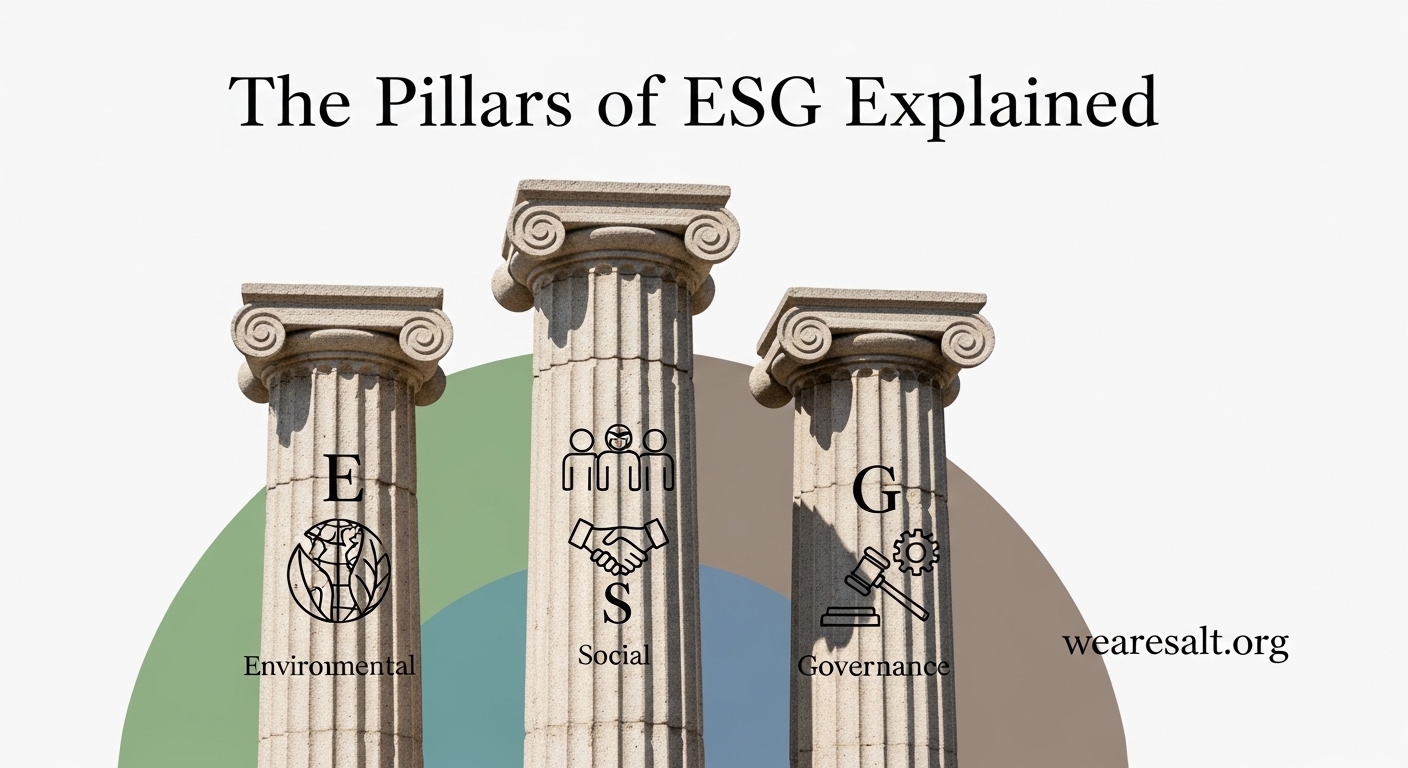
ESG stands for Environmental, Social, and Governance. It is a framework that evaluates how companies impact the planet, treat their people, and manage their operations ethically.
The term was coined in 2004 by the United Nations Global Compact. Since then, ESG has evolved from a niche investment concept to a mainstream business priority that shapes corporate strategy 2026.
In this guide, I will break down each pillar of ESG in plain language. You will understand what ESG measures, why investors care about it, and how companies actually implement these principles in practice.
Table of Contents
What Is ESG? The Three Pillars Explained
ESG evaluates companies across three interconnected dimensions. These pillars help investors, regulators, and consumers assess corporate behavior beyond just financial returns.
Each pillar represents a different aspect of how a business operates:
- Environmental: How the company treats the planet
- Social: How the company treats its people and communities
- Governance: How the company is managed and controlled
Together, these three pillars form a comprehensive lens for evaluating corporate responsibility and long-term sustainability.
The Environmental Pillar: Protecting Our Planet
The environmental pillar focuses on how a company manages its ecological footprint. This includes everything from energy consumption to waste disposal to climate risk exposure.
Companies with strong environmental performance typically track several key metrics. These include greenhouse gas emissions, water usage, energy efficiency, waste generation, and resource consumption.
Climate change adaptation has become a major focus area 2026. Companies now report on their carbon reduction targets, renewable energy adoption, and plans for transitioning to a low-carbon economy. Investors increasingly view climate resilience as a critical business risk.
Resource efficiency also matters. Companies that minimize waste, recycle materials, and design products for circularity score higher on environmental criteria. This often reduces costs while improving sustainability outcomes.
Biodiversity protection rounds out environmental considerations. Companies in sectors like agriculture, mining, and construction face scrutiny over their impact on ecosystems and wildlife habitats.
The Social Pillar: People and Communities
The social pillar examines how a company treats its employees, customers, suppliers, and the communities where it operates. Strong social performance indicates healthy workplace culture and sustainable business relationships.
Employee relations form the core of social metrics. This includes fair wages, benefits, workplace safety, training opportunities, and labor rights. Companies with high employee satisfaction and low turnover tend to outperform peers.
Diversity and inclusion have gained prominence in recent years 2026. Investors want to see diverse leadership teams, equitable hiring practices, and inclusive workplace policies. Research consistently shows that diverse companies make better decisions and generate higher returns.
Community engagement matters too. Companies that invest in local communities through philanthropy, volunteer programs, and responsible sourcing build stronger stakeholder relationships. This goodwill translates into brand loyalty and operational stability.
Human rights considerations extend throughout the supply chain. Companies face pressure to ensure their suppliers follow ethical labor practices and do not exploit workers in developing markets.
The Governance Pillar: Leadership and Ethics
The governance pillar evaluates how a company is managed, controlled, and held accountable. Strong governance structures reduce corruption risk and ensure decisions align with stakeholder interests.
Board composition receives significant attention. Investors favor independent directors who can challenge management when necessary. Board diversity in terms of expertise, background, and perspective strengthens oversight capabilities.
Executive compensation structures reveal governance priorities. Well-designed incentive plans align leadership pay with long-term performance and ESG outcomes. Excessive or poorly structured compensation raises red flags.
Transparency and disclosure practices indicate governance quality. Companies with clear reporting, accessible data, and honest communication build trust with investors and regulators. This includes accurate sustainability reporting alongside financial statements.
Ethical business practices complete the governance picture. Anti-corruption policies, whistleblower protections, and compliance frameworks demonstrate commitment to operating with integrity.
Why ESG Matters for Businesses 2026
ESG has moved from optional to essential for modern businesses. Several factors drive this shift in corporate priorities.
Investor expectations have transformed dramatically. Institutional investors managing trillions of dollars now incorporate ESG criteria into their decision-making. Companies without strong ESG performance risk losing access to capital.
Risk management benefits are substantial. Companies that address environmental and social risks early avoid costly crises later. Climate disasters, labor strikes, and governance scandals can destroy shareholder value overnight.
Competitive advantage accrues to ESG leaders. Customers increasingly prefer brands aligned with their values. Talented employees seek purpose-driven employers. Strong ESG performance attracts both revenue and talent.
Regulatory compliance requirements are expanding globally. The European Union’s Corporate Sustainability Reporting Directive (CSRD) mandates detailed ESG disclosures. Similar regulations are emerging worldwide, making ESG data collection a compliance necessity.
How ESG Is Measured: Frameworks and Standards
Measuring ESG performance requires standardized frameworks that allow comparison across companies and industries. Several major frameworks dominate the landscape 2026.
The Global Reporting Initiative (GRI) provides comprehensive sustainability reporting standards. GRI covers the full range of ESG topics and emphasizes stakeholder impacts. Thousands of companies worldwide use GRI for their sustainability reports.
The Sustainability Accounting Standards Board (SASB) focuses on financially material ESG issues. SASB identifies industry-specific metrics that affect investment returns. This framework resonates strongly with investors seeking decision-useful data.
The Task Force on Climate-related Financial Disclosures (TCFD) addresses climate-specific reporting. TCFD recommendations cover governance, strategy, risk management, and metrics related to climate change. Many regulators now mandate TCFD-aligned disclosures.
The Carbon Disclosure Project (CDP) specializes in environmental data. CDP runs a global disclosure system for companies to report their environmental impacts. High CDP scores indicate strong environmental management.
These frameworks increasingly converge. The International Sustainability Standards Board (ISSB) is working to create a unified global baseline for sustainability reporting, which should reduce fragmentation 2026.
Common Criticisms and Challenges
ESG faces legitimate criticism that deserves honest examination. Understanding these challenges helps separate valid concerns from political rhetoric.
Political controversy has emerged around ESG in some regions. Critics label ESG as progressive activism or “woke capitalism.” However, ESG is fundamentally about risk management and long-term value creation, not political ideology.
Rating inconsistencies present real problems. Different ESG rating agencies often assign conflicting scores to the same company. This occurs because methodologies vary and data quality remains uneven across industries.
Greenwashing risks undermine ESG credibility. Some companies exaggerate their environmental or social commitments while continuing harmful practices. Investors must verify claims rather than accepting them at face value.
Short-term cost pressures complicate ESG implementation. Some sustainability investments require upfront spending that reduces immediate profits. Companies must balance long-term benefits against quarterly earnings expectations.
Despite these challenges, the underlying logic of ESG remains sound. Companies that manage environmental and social risks effectively tend to perform better over time.
Implementing ESG in Your Organization
Starting an ESG program requires systematic planning and commitment from leadership. Here is a practical framework for implementation.
Conduct a materiality assessment first. Identify which ESG issues matter most to your stakeholders and your business model. Not every company faces the same risks or opportunities.
Set measurable targets with clear timelines. Vague commitments like “be more sustainable” fail. Specific goals like “reduce carbon emissions 30% by 2030” drive action.
Integrate ESG into core business processes. Sustainability should not sit in a separate department. Embed ESG considerations into strategy, risk management, and performance evaluation.
Report transparently on progress and challenges. Honest disclosure builds credibility. Acknowledge areas where you fall short and explain your improvement plans.
Engage stakeholders regularly. Investors, employees, customers, and communities all have perspectives worth hearing. Their input improves your ESG strategy and builds support.
The Pillars of ESG Explained: Frequently Asked Questions
What are the pillars of ESG?
The three pillars of ESG are Environmental, Social, and Governance. Environmental focuses on a company’s impact on the planet, including carbon emissions, resource use, and waste management. Social examines how a company treats employees, customers, and communities. Governance evaluates leadership structures, executive compensation, transparency, and ethical business practices.
What are the 3 P’s of ESG?
The 3 P’s of ESG refer to People, Planet, and Profit. This is an alternative framework that emphasizes balancing social impact (People), environmental sustainability (Planet), and financial performance (Profit). While related to the three ESG pillars, the 3 P’s framework focuses more explicitly on the triple bottom line approach to business success.
What are the big 4 ESG standards?
The four major ESG standards and frameworks are: 1) GRI (Global Reporting Initiative) – comprehensive sustainability reporting standards, 2) SASB (Sustainability Accounting Standards Board) – industry-specific metrics focused on financially material issues, 3) TCFD (Task Force on Climate-related Financial Disclosures) – climate-specific reporting guidelines, and 4) CDP (Carbon Disclosure Project) – environmental disclosure and scoring system.
How do the 3 P’s differ from the 3 pillars of ESG?
The 3 P’s (People, Planet, Profit) and the 3 pillars of ESG (Environmental, Social, Governance) share similar concepts but emphasize different aspects. The 3 P’s explicitly include financial performance (Profit) as a core pillar, while ESG focuses on non-financial factors that influence long-term value. ESG is primarily used for investment analysis and corporate evaluation, while the 3 P’s framework emphasizes business strategy and stakeholder value creation.
Conclusion: Building a Sustainable Future with ESG
The pillars of ESG – Environmental, Social, and Governance – provide a framework for evaluating how companies impact the world beyond their financial statements. Understanding these three pillars helps investors, employees, and consumers make informed decisions.
As we move through 2026, ESG continues to evolve from a nice-to-have into a business imperative. Companies that embrace these principles position themselves for long-term success. Those that ignore them risk falling behind competitors and losing stakeholder trust.
Whether you are an investor evaluating portfolios, a professional implementing corporate strategy, or a consumer making purchasing decisions, understanding the pillars of ESG gives you the tools to align your choices with your values.