
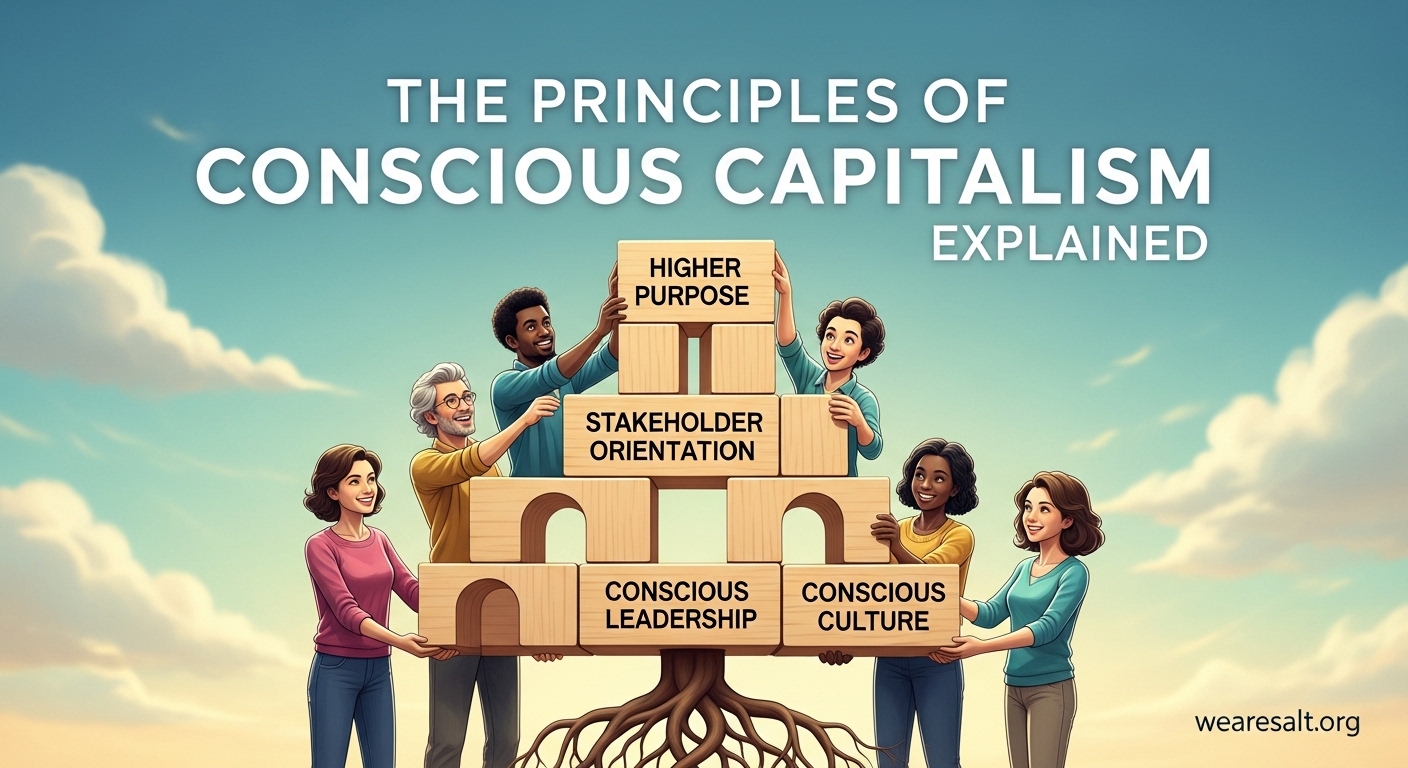
Conscious capitalism is a business philosophy that encourages companies to serve all stakeholders rather than focusing solely on shareholders. This approach integrates a higher purpose, stakeholder orientation, conscious leadership, and conscious culture into the core of business operations.
In this guide, I will explain each of the four conscious capitalism principles in detail. You will learn how these principles work in practice, why they matter for modern businesses, and see real examples from companies that have embraced this philosophy.
Table of Contents
What Is Conscious Capitalism?
Conscious capitalism is an economic and political philosophy that believes businesses should operate with a higher purpose beyond maximizing profit. The term was popularized by John Mackey, co-founder of Whole Foods Market, and marketing professor Raj Sisodia in their 2026 book “Conscious Capitalism: Liberating the Heroic Spirit of Business.”
Traditional shareholder capitalism treats profit as the primary goal, with other considerations secondary. Conscious capitalism rejects this narrow view. It argues that businesses create value for multiple stakeholders simultaneously – customers, employees, suppliers, communities, and the environment – while still generating strong financial returns.
The movement has gained significant traction over the past decade. Research from Harvard Business Review shows that conscious companies, referred to as “firms of endearment,” outperform the S and P 500 by a factor of 10 over a 15-year period. This data suggests that doing good and doing well financially are not mutually exclusive.
The Four Principles of Conscious Capitalism
The conscious capitalism framework rests on four interconnected principles. Each principle supports and reinforces the others, creating a holistic approach to business that benefits all stakeholders.
Higher Purpose
Conscious businesses are driven by a purpose that transcends profit. This higher purpose answers the fundamental question of why the company exists and what positive impact it seeks to make in the world.
Take Whole Foods Market as an example. Their purpose is not simply to sell groceries but to nourish people and the planet. This purpose guides every decision, from sourcing products to store design to community partnerships. When employees understand and connect with this larger mission, their work gains meaning beyond a paycheck.
Patagonia provides another compelling example. Their purpose – “We’re in business to save our home planet” – influences everything from their supply chain to their famous “Don’t Buy This Jacket” advertising campaign encouraging consumers to repair rather than replace. Purpose-driven businesses attract customers who share their values, creating deeper brand loyalty than transactional relationships alone can sustain.
Stakeholder Orientation
Stakeholder orientation means actively considering the interests of all parties affected by business decisions, not just shareholders. This principle recognizes that businesses exist within an interconnected ecosystem where each stakeholder group contributes to and benefits from the company’s success.
The stakeholder ecosystem includes customers who provide revenue, employees who create value, suppliers who enable production, communities that host operations, and the environment that provides resources. Conscious businesses understand that optimizing for one group at the expense of others ultimately harms everyone, including shareholders.
Costco demonstrates this principle through its industry-leading employee compensation. The company pays an average hourly wage significantly above competitors and provides comprehensive benefits including health insurance to most workers. While critics argued this would hurt profitability, Costco has consistently outperformed retail competitors while maintaining employee turnover rates below industry averages by 50 percent or more.
Conscious Leadership
Conscious leadership embodies the principles of servant leadership and authentic care. Leaders in conscious businesses see their role as serving the purpose of the organization and supporting the people who make success possible.
These leaders cultivate self-awareness and emotional intelligence. They model the values they want to see throughout the organization. Decision-making considers long-term impacts rather than short-term quarterly pressures. Conscious leaders foster trust through transparency and consistency.
Greg Koch, co-founder of Stone Brewing Company, exemplifies conscious leadership in practice. When asked about hiring practices, Koch emphasized that values alignment matters more than filling positions quickly. He would rather leave a role open than compromise on the cultural fit. This patience in hiring contributes to the strong culture that has made Stone Brewing one of the most respected craft breweries in America.
Conscious Culture
Conscious culture creates an environment where trust, transparency, and care flourish. Culture encompasses the unwritten rules, values, and behaviors that shape how work gets done within an organization.
Building a conscious culture requires intentional effort. It starts with clearly articulated values that guide behavior. These values must be more than words on a wall – they must be integrated into hiring, performance management, and daily operations. When employees see leaders living the values, trust develops organically.
Trader Joe’s has built one of the most celebrated cultures in retail. Their “Neighborhood Shares” program donates 100 percent of unsold but still edible food to local food banks and shelters. Store captains have significant autonomy to adapt to local needs. Employees, called “crew members,” receive above-average wages and benefits. This culture translates into industry-leading customer satisfaction and employee retention.
Benefits of Conscious Capitalism
The benefits of adopting conscious capitalism principles extend across multiple dimensions of business performance. Companies practicing these principles consistently demonstrate advantages in financial returns, talent attraction, customer loyalty, and long-term resilience.
Financially, conscious companies outperform their peers. The aforementioned Harvard Business Review study found that firms explicitly practicing conscious capitalism outperformed the market by 10x over 15 years. These companies also weathered the 2008 financial crisis more effectively than traditional competitors.
Employee satisfaction metrics show similarly impressive results. Companies with strong purpose and values-based cultures report turnover rates 25 to 50 percent below industry averages. This directly impacts the bottom line through reduced recruitment and training costs. Engaged employees also deliver better customer experiences.
Customer loyalty increases when buyers feel aligned with a company’s values. Conscious brands develop communities of advocates rather than just customer bases. This loyalty translates into pricing power and reduced customer acquisition costs over time.
Conscious Capitalism Companies in Action
Several well-known companies demonstrate conscious capitalism principles in practice. These examples show how the philosophy translates into specific programs and policies.
Starbucks provides a strong example of stakeholder orientation through their College Achievement Plan. The program covers full tuition for eligible employees pursuing a bachelor’s degree through Arizona State University’s online program. Since launching in 2014, thousands of employees have graduated debt-free. This investment in employees builds loyalty while addressing the critical issue of student debt.
TOMS Shoes pioneered the One for One model, donating a pair of shoes to someone in need for every pair purchased. While the company has evolved its approach over time, the original model demonstrated how business could integrate social impact directly into the transaction. This created a powerful story that resonated with consumers and built a billion-dollar brand.
Patagonia’s environmental activism extends beyond marketing to structural business decisions. They donate 1 percent of sales to environmental causes through their membership in 1% for the Planet. The company has sued the federal government to protect public lands and encourages customers to repair rather than replace products through their Worn Wear program.
Implementation Challenges and Criticisms
Despite its benefits, conscious capitalism faces legitimate skepticism and implementation challenges. Some critics argue that the approach is simply sophisticated marketing or “greenwashing” designed to appeal to socially conscious consumers while maintaining profit maximization as the true goal.
This skepticism has merit in some cases. Not every company claiming conscious practices delivers genuine stakeholder value. The challenge for observers is distinguishing authentic commitment from marketing spin. Look for specific, measurable commitments rather than vague statements. Authentic conscious capitalism shows up in compensation structures, supplier relationships, environmental reporting, and community investment.
Another criticism comes from those who argue that capitalism itself cannot be conscious because the system structurally prioritizes profit above all else. They contend that individual well-intentioned companies cannot overcome the systemic pressures of competitive markets and shareholder expectations.
Proponents acknowledge these challenges while maintaining that conscious capitalism represents meaningful progress. Even if perfection is impossible, moving toward stakeholder orientation creates tangible benefits for workers, communities, and the environment.
Frequently Asked Questions
What are the 4 principles of conscious capitalism?
The four principles of conscious capitalism are: (1) Higher Purpose – operating with a mission beyond profit, (2) Stakeholder Orientation – considering all stakeholders including employees, customers, suppliers, and communities, not just shareholders, (3) Conscious Leadership – practicing servant leadership with authenticity and care, and (4) Conscious Culture – building values-based environments where trust and transparency flourish.
What is conscious capitalism in simple terms?
Conscious capitalism is a business approach where companies try to make money while also caring about their employees, customers, communities, and the environment. Instead of focusing only on profits for shareholders, conscious businesses consider how their decisions affect everyone involved.
Does conscious capitalism work?
Yes, research shows conscious capitalism works. A Harvard Business Review study found that conscious companies outperformed the S and P 500 by 10 times over 15 years. These companies also show lower employee turnover, higher customer loyalty, and greater resilience during economic downturns.
Conclusion
The principles of conscious capitalism offer a framework for building businesses that create value for all stakeholders while generating strong financial returns. Higher purpose, stakeholder orientation, conscious leadership, and conscious culture work together to create organizations that people want to work for, buy from, and support.
As consumers increasingly demand ethical business practices and employees seek meaningful work, conscious capitalism represents more than an idealistic alternative. It offers a proven competitive advantage. The companies practicing these principles are not sacrificing profit for purpose – they are discovering that purpose drives profit.
Whether you are a business leader, employee, investor, or consumer, understanding conscious capitalism principles helps you recognize and support businesses that are building a better kind of capitalism for 2026 and beyond.