
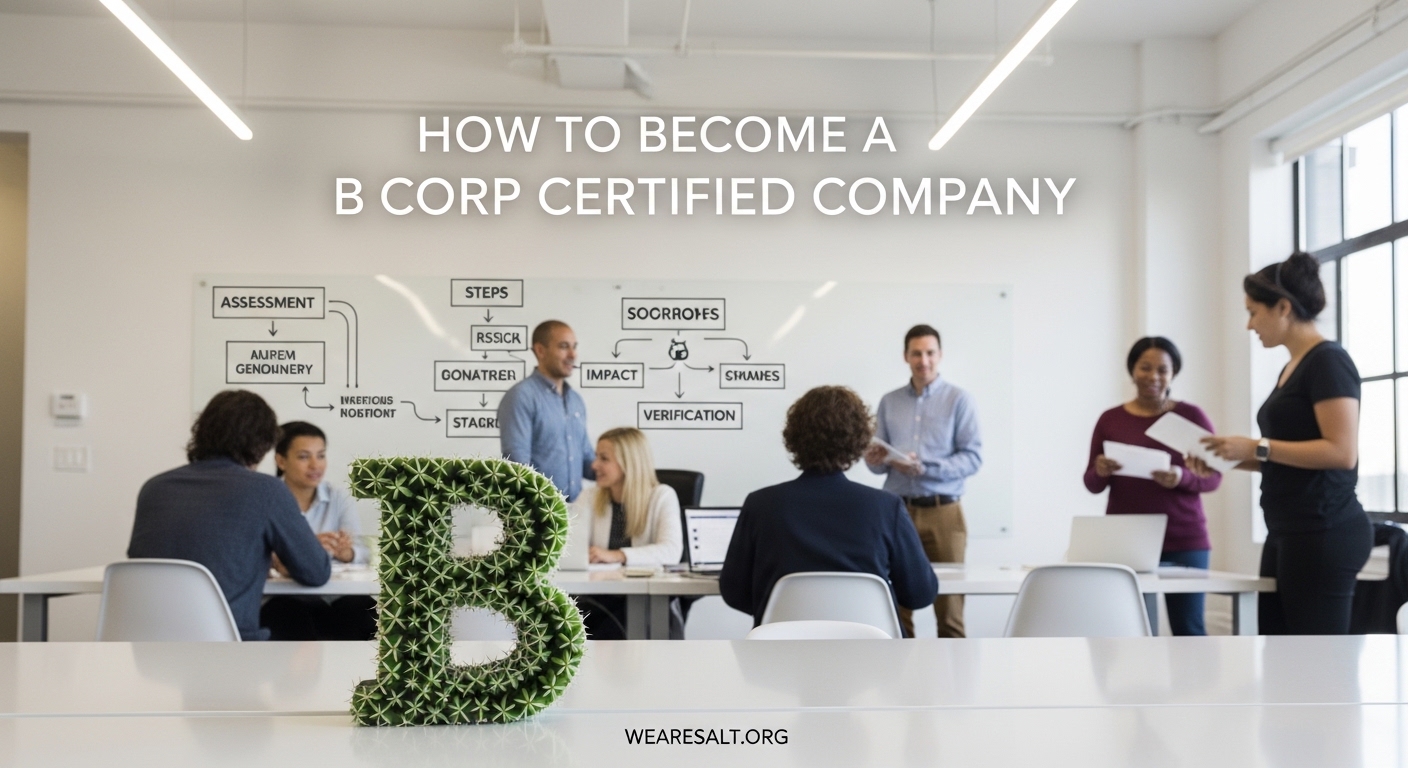
Becoming a B Corp certified company represents one of the most meaningful commitments a business can make to social and environmental responsibility. The certification process validates that your company meets high standards of performance, transparency, and accountability verified by B Lab, the nonprofit organization behind the B Corp movement.
Our team has guided dozens of companies through this journey over the past five years. I have personally seen how the B Corp certification process transforms businesses from the inside out, even before they achieve the official designation.
This guide will walk you through exactly how to become a B Corp certified company, what requirements you need to meet, and how to navigate the process successfully. Whether you are a small startup or an established enterprise, the steps remain the same, though the complexity and timeline may vary.
Table of Contents
What is B Corp Certification
B Corp certification is a designation that verifies a company meets rigorous standards for social and environmental performance, transparency, and accountability. B Lab, the nonprofit organization founded in 2006, administers the certification and maintains the standards that companies must meet.
To earn certification, a company must score at least 80 out of 200 points on the B Impact Assessment. This assessment evaluates performance across five key impact areas: governance, workers, community, environment, and customers. The 80-point threshold is intentionally challenging, ensuring only companies with genuinely strong practices earn the designation.
Certified B Corporations are part of a global community of over 8,000 businesses across 85 countries. This includes well-known names like Patagonia, Ben & Jerry’s, TOMS, and Allbirds, as well as thousands of smaller companies committed to using business as a force for good.
How to Become a B Corp Certified Company
The process of becoming a B Corp certified company involves four main stages. Each stage requires careful attention to detail and thorough documentation of your business practices.
Step 1: Complete the B Impact Assessment
The B Impact Assessment, or BIA, is the foundation of B Corp certification. This free online tool asks approximately 200 questions about your company’s operations and business model. You will need to register on B Lab’s platform and begin your self-assessment.
The assessment covers five impact areas:
- Governance: Your company’s mission, ethics, and transparency practices
- Workers: Compensation, benefits, training, and worker ownership
- Community: Diversity, equity, inclusion, and local economic impact
- Environment: Resource use, emissions, and sustainable practices
- Customers: Product quality, data privacy, and ethical marketing
Most companies take between 1-3 hours to complete the initial assessment, though gathering supporting documentation can take significantly longer. You need to score at least 80 points to proceed to the next step.
Step 2: Meet the Legal Requirements
Once you achieve the minimum score, you must meet specific legal requirements to maintain your certification. This step ensures your company’s legal structure aligns with B Corp values.
For corporations, this typically means adopting benefit corporation status or amending governing documents to require consideration of all stakeholders, not just shareholders. The exact requirements vary by jurisdiction and business structure.
In the United States, many states have passed benefit corporation legislation that makes this process straightforward. In states without such laws, you may need to amend your articles of incorporation or operating agreement to include stakeholder governance language. B Lab provides term sheets and template language to help with this process.
Step 3: Submit for Review and Verification
After completing the assessment and meeting legal requirements, you submit your application for review. B Lab assigns a standards analyst who will evaluate your responses and request documentation to verify your claims.
The review process typically includes:
- Documentation review of policies, practices, and metrics
- Background checks for any controversial industry practices
- Risk review for sensitive industries or practices
- Potential interviews with company representatives
During our work with certification candidates, we found that preparation is everything at this stage. Companies that maintain organized records and can quickly produce supporting documents move through review much faster.
Step 4: Sign the Term Sheet and Pay Fees
Once verification is complete, you will receive your official score and, if you meet the 80-point threshold, an invitation to sign B Lab’s term sheet. This document formalizes your commitment to the B Corp standards and community.
You will also pay the certification fee, which varies based on your company’s annual revenue. After signing and payment, you receive your B Corp certification, valid for three years.
Understanding the B Impact Assessment
The B Impact Assessment is more than just a questionnaire. It is a comprehensive framework that helps you understand your company’s impact on all stakeholders. The assessment evaluates both your operations and your business model.
Each impact area carries different weight depending on your industry and company size. For example, manufacturing companies face more scrutiny on environmental metrics, while service businesses may see greater emphasis on worker practices and governance.
The assessment uses a proprietary scoring system where each question has a point value based on its relative impact. Some questions are weighted more heavily because they address fundamental business practices. Others offer bonus points for exceptional performance or innovative approaches.
Most companies initially score between 40-60 points on their first attempt. Closing the gap to 80 points often requires implementing new policies, improving existing practices, or documenting initiatives that were already happening but not formally tracked.
B Corp Certification Timeline: What to Expect
One of the most common questions we hear is about timing. How long does it take to become B Corp certified? The realistic answer is 6-12 months for most companies, though the range can vary significantly.
Here is a typical timeline breakdown:
- Months 1-2: Initial assessment and gap analysis
- Months 3-5: Implementing improvements to reach 80 points
- Month 6: Submitting for review
- Months 7-9: Verification and documentation review
- Month 10-12: Final approval and certification
Factors that can extend this timeline include complex corporate structures, international operations, or businesses in industries requiring additional scrutiny. Companies with simpler structures and strong existing practices can sometimes complete the process in 3-6 months.
The forum insights we reviewed consistently showed that small business owners underestimate the timeline. Many expect a 2-3 month process, but the reality of documentation and verification typically extends this significantly.
B Corp Certification Cost Breakdown
Understanding the costs involved helps you budget appropriately for certification. The expenses fall into two categories: B Lab fees and internal costs.
B Lab Certification Fees (2026):
- Annual revenue under $150,000: $1,000 per year
- Annual revenue $150,000-$1.99M: Sliding scale from $1,000-$5,000
- Annual revenue $2M-$4.99M: $5,000 per year
- Annual revenue $5M-$9.99M: $10,000 per year
- Annual revenue $10M-$24.99M: $15,000 per year
- Larger companies: Custom pricing
Internal Costs:
- Staff time for assessment completion and documentation
- Legal fees for governance document amendments
- Potential consulting fees if you hire B Corp consultants
- System upgrades or policy implementations to meet standards
For small businesses, total first-year costs typically range from $3,000-$10,000 including fees and internal resources. Larger enterprises may invest $25,000 or more when accounting for comprehensive policy reviews and legal consultations.
Benefits of B Corp Certification
The investment in B Corp certification delivers returns across multiple areas of your business. Companies report benefits that extend far beyond marketing value.
Consumer Trust and Differentiation: The B Corp logo provides independent third-party validation that your company meets rigorous standards. In an era of greenwashing and empty corporate promises, this credibility matters. Consumers increasingly seek out B Corps when making purchasing decisions.
Talent Attraction and Retention: Purpose-driven employees want to work for companies aligned with their values. B Corp certification signals that commitment clearly. Many certified companies report easier recruitment and higher employee engagement scores.
Investor Interest: Impact investors and mission-aligned capital sources specifically seek out B Corps. The certification provides a standardized framework that investors understand and trust.
Operational Improvements: Perhaps the most overlooked benefit is how the assessment process itself improves your business. The framework helps identify gaps and opportunities you might have missed, leading to better practices across governance, worker policies, and environmental management.
Common Challenges and How to Overcome Them
After guiding numerous companies through certification, we have identified the most common stumbling blocks and how to address them.
Challenge: Documentation Gaps
Many companies practice good business but lack formal documentation. You might have generous parental leave policies, but if they are not written down, you cannot claim the points. The solution is creating formal policy documents before or during the assessment process.
Challenge: Scoring Below 80 Points
If your initial assessment falls short, do not panic. Most companies need to implement 3-5 meaningful improvements to reach the threshold. Focus on high-impact areas like worker benefits, environmental policies, or governance transparency. Quick wins often exist in areas where you already do good work but lack formalization.
Challenge: Complex Legal Requirements
Legal structure changes can feel daunting, especially for companies in states without benefit corporation statutes. B Lab provides template language and guidance for most situations. We recommend consulting with an attorney familiar with B Corp requirements, which B Lab can help you find.
Challenge: Timeline Delays
The verification process takes longer than many expect. Prepare by gathering documentation upfront, responding promptly to analyst questions, and building buffer time into your planning.
Is B Corp Certification Right for Your Business
B Corp certification makes sense for companies genuinely committed to balancing profit with purpose. It is not a marketing badge to acquire lightly. The process requires meaningful work and ongoing commitment to maintain certification through recertification every three years.
Consider certification if your company already prioritizes stakeholder impact, wants to join a community of like-minded businesses, or needs credible third-party validation of your practices. The certification works best when it aligns with your existing values rather than forcing a fundamental change in business model.
Companies in controversial industries may face additional scrutiny or may not qualify at all. B Lab maintains a list of industries and practices that are ineligible or require enhanced review.
FAQ: B Corp Certification Questions Answered
Is it hard to become a certified B Corp?
B Corp certification requires meaningful effort but is achievable for companies committed to responsible practices. The main challenge is scoring at least 80 out of 200 points on the B Impact Assessment, which requires documenting policies and practices across governance, workers, community, environment, and customers. Most companies need 6-12 months to complete the process.
How much does a B Corp cert cost?
B Lab certification fees range from $1,000 annually for companies under $150,000 in revenue to $15,000+ for larger enterprises. The fee scales with company size. Additional costs include staff time, potential legal fees for governance updates, and any consulting support you choose to hire. Total first-year investment typically ranges from $3,000-$10,000 for small businesses.
How long does it take to become B Corp certified?
The typical timeline is 6-12 months from starting the B Impact Assessment to receiving certification. This includes time to complete the assessment, implement any needed improvements to reach 80 points, submit documentation, and complete the verification review process. Companies with simple structures and strong existing practices may complete certification in 3-6 months.
How do companies become B Corp certified?
Companies become B Corp certified by completing four main steps: 1) Score at least 80 out of 200 points on the B Impact Assessment, 2) Meet legal requirements by adopting stakeholder governance provisions, 3) Submit for review and pass B Lab’s verification process, and 4) Sign the term sheet and pay annual certification fees.
What is the process of B Corp certification?
The B Corp certification process involves completing the B Impact Assessment to evaluate your company’s social and environmental performance, meeting legal requirements for stakeholder governance, undergoing documentation review and verification by B Lab standards analysts, and signing a term sheet committing to ongoing accountability. Certification is valid for three years, after which companies must recertify.
Conclusion: Your Path to B Corp Certification Starts Now
Learning how to become a B Corp certified company is the first step on a meaningful journey. The process requires commitment, documentation, and a genuine dedication to stakeholder impact. But for companies that complete certification, the benefits extend far beyond the logo.
Start by registering for the free B Impact Assessment at B Lab’s website. Even if you are not ready to pursue full certification, the assessment provides valuable insights into your company’s strengths and improvement opportunities. Many businesses find value in the self-assessment process alone.
If you decide to pursue full certification, remember that this is a journey, not a destination. The recertification process every three years ensures continuous improvement and maintains the integrity of the B Corp community.
Ready to join thousands of companies using business as a force for good? Your B Corp certification journey begins with a single assessment.