
The Task Force on Climate-related Financial Disclosures (TCFD) framework is a globally recognized set of recommendations for reporting climate-related financial information. Established in 2015 by the Financial Stability Board, it helps companies disclose how climate change affects their business, strategy, and financial planning.
Understanding the TCFD framework has become essential for businesses, investors, and sustainability professionals in 2026. Organizations worldwide use these recommendations to communicate climate-related risks and opportunities with greater clarity and consistency.
This guide explains everything you need to know about the TCFD framework. We will cover its history, the four pillars, eleven recommendations, climate risk types, and how the framework has evolved into 2026.
Table of Contents
What Is the TCFD Framework?
The Task Force on Climate-related Financial Disclosures (TCFD) is a framework designed to improve the reporting of climate-related financial information. It provides a structured approach for organizations to disclose how climate change impacts their governance, strategy, risk management, and financial metrics.
The Financial Stability Board established the TCFD in December 2015. The FSB is an international body that monitors and makes recommendations about the global financial system. Michael R. Bloomberg, former mayor of New York City and businessman, served as the chair of the Task Force throughout its existence.
The framework addresses a critical gap in financial reporting. Before TCFD, climate information appeared inconsistently across sustainability reports, annual filings, and separate disclosures. This made it difficult for investors to compare companies and assess climate-related financial risks properly.
Why Was TCFD Created?
The TCFD emerged from growing recognition that climate change presents significant financial risks to the global economy. Extreme weather events, policy changes, and technological shifts threaten business operations, supply chains, and asset values across industries.
Financial markets needed better information to price these risks accurately. Investors, lenders, and insurance underwriters could not make informed decisions without standardized, comparable climate disclosures. The TCFD framework solved this by creating a common language for climate-related financial reporting.
Over 4,900 organizations across 103 jurisdictions eventually supported the TCFD recommendations. This included companies with a combined market capitalization exceeding $27 trillion, demonstrating the framework’s widespread adoption.
The Four Pillars of TCFD
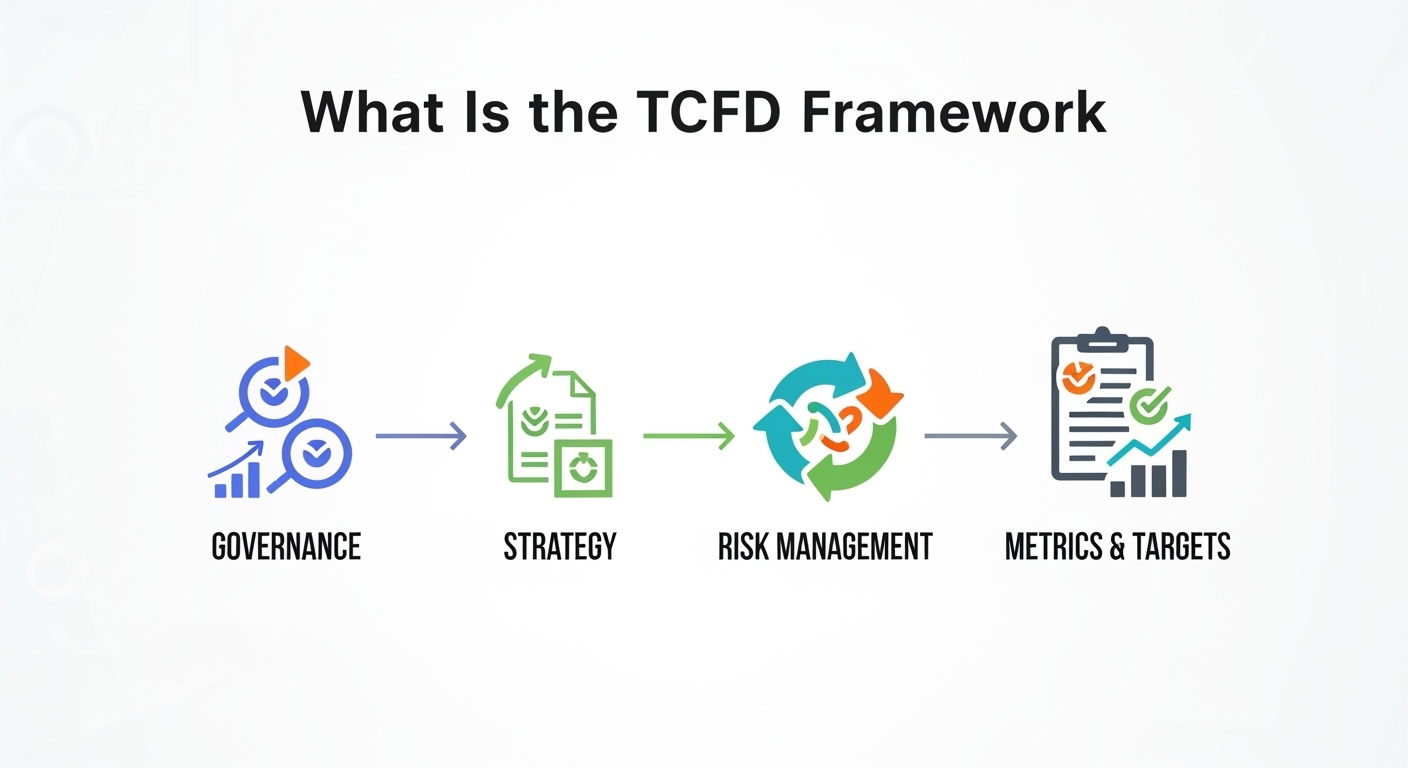
The TCFD framework organizes its eleven recommendations around four thematic pillars. These pillars represent core elements of business operations that climate change affects. Each pillar contains specific disclosure recommendations that guide companies in reporting relevant information.
Governance
Companies must disclose their governance around climate-related risks and opportunities. This pillar examines how boards and management oversee climate issues.
The governance pillar includes four specific recommendations. Organizations should describe the board’s oversight of climate-related risks and opportunities. They must also explain management’s role in assessing and managing these risks.
Effective governance disclosure shows investors that climate considerations are integrated into decision-making at the highest levels. It demonstrates accountability and structured oversight rather than ad-hoc responses to climate issues.
Strategy
The strategy pillar requires companies to disclose the actual and potential impacts of climate-related risks and opportunities on their business. This includes strategy and financial planning where such information is material.
This pillar contains four recommendations. Companies should describe the climate-related risks and opportunities they have identified over the short, medium, and long term. They must explain the impact on business strategy and financial planning.
Organizations also need to describe the resilience of their strategy under different climate-related scenarios. This includes a 2 degrees Celsius or lower scenario, which tests whether business plans hold up under aggressive climate action.
Risk Management
Companies must disclose how they identify, assess, and manage climate-related risks. This single recommendation focuses on processes rather than specific risk outcomes.
Organizations should describe their processes for identifying and assessing climate-related risks. They need to explain how these processes integrate into overall risk management. Companies should also disclose how they prioritize different climate risks relative to other business risks.
This pillar helps investors understand whether companies have robust systems for managing climate risks or whether these issues receive insufficient attention compared to traditional financial and operational risks.
Metrics and Targets
The metrics and targets pillar requires disclosure of the metrics and targets used to assess and manage relevant climate-related risks and opportunities. This provides quantitative data for comparison and tracking progress.
This pillar contains two recommendations. Companies should disclose the metrics they use to assess climate-related risks and opportunities in line with their strategy and risk management process. They must also disclose Scope 1, Scope 2, and if appropriate, Scope 3 greenhouse gas emissions and the related risks.
Organizations should describe the targets they use to manage climate-related risks and opportunities and their performance against these targets. This creates accountability and enables stakeholders to track progress over time.
The 11 TCFD Recommendations Explained
The TCFD framework contains eleven specific recommendations distributed across the four pillars. These recommendations provide detailed guidance on what companies should disclose.
Under Governance, the recommendations cover: describing the board’s oversight, describing management’s role, explaining how climate is considered in governance structures, and disclosing frequency of board-level climate discussions.
Under Strategy, the recommendations address: describing climate risks and opportunities, explaining their impact on business and strategy, disclosing the resilience of strategy under climate scenarios, and explaining how climate affects financial planning.
The Risk Management recommendation requires describing processes for identifying, assessing, and managing climate risks and how these integrate into overall risk management.
Under Metrics and Targets, the recommendations cover: disclosing the metrics used to assess climate risks, disclosing Scope 1, 2, and 3 GHG emissions, and describing climate-related targets and performance against them.
The 7 Principles for Effective Disclosure
Beyond the eleven recommendations, the TCFD framework established seven principles for effective disclosure. These principles guide how companies should present information rather than what they should disclose.
The principles state that disclosures should be: present relevant information, be specific and complete, clear and balanced, understandable, consistent over time, comparable among companies, and verifiable.
These principles ensure that climate disclosures serve their intended purpose. Without them, companies might provide vague, incomplete, or inconsistent information that frustrates rather than informs decision-making.
Understanding Climate-Related Risks
The TCFD framework categorizes climate-related risks into two major types. Understanding this distinction is essential for proper implementation and risk assessment.
Physical Risks
Physical risks arise from the physical impacts of climate change. These include both acute events and longer-term shifts in climate patterns.
Acute physical risks include increased severity of extreme weather events such as cyclones, floods, droughts, and wildfires. These events can damage assets, disrupt operations, and affect supply chains with immediate financial consequences.
Chronic physical risks involve longer-term changes such as rising sea levels, changing precipitation patterns, and increasing average temperatures. These shifts can reduce agricultural productivity, damage infrastructure, and make certain business locations or operations uneconomical over time.
Transition Risks
Transition risks arise from the process of adjusting toward a low-carbon economy. These risks stem from policy changes, technological developments, market shifts, and reputation concerns.
Policy and legal risks include increased regulation of emissions, carbon pricing mechanisms, and litigation risks for companies that contribute significantly to climate change. New regulations can increase compliance costs or limit certain business activities.
Technology risks involve the substitution of existing products and services with lower-emission alternatives. Companies heavily invested in high-carbon technologies may face stranded assets as cleaner alternatives become economically preferable.
Market risks include changes in supply and demand for certain commodities and products as consumer preferences shift toward low-carbon options. Reputation risks affect companies perceived as contributing to climate change or failing to address their climate impacts.
Risk Time Horizons
The TCFD framework encourages companies to consider risks across three time horizons. Short-term risks typically manifest within 0-2 years, medium-term within 2-10 years, and long-term beyond 10 years.
Physical risks often have longer time horizons, though acute weather events create immediate risks. Transition risks may accelerate as policy commitments intensify, potentially compressing the timeline for business model adjustments.
GHG Emissions: Scope 1, 2, and 3
The TCFD framework specifically requires disclosure of greenhouse gas emissions under the Metrics and Targets pillar. Understanding the three scopes of emissions is essential for proper reporting.
Scope 1 Emissions
Scope 1 emissions are direct emissions from sources owned or controlled by the company. This includes emissions from company vehicles, manufacturing processes, and on-site power generation.
These are the most straightforward emissions to measure and control. Companies have direct control over their Scope 1 sources and can implement operational changes to reduce these emissions directly.
Scope 2 Emissions
Scope 2 emissions are indirect emissions from the generation of purchased energy. This includes electricity, heat, steam, and cooling purchased by the company.
While the company does not directly control these emissions, it controls the decision to purchase energy. Companies can reduce Scope 2 emissions through energy efficiency measures, renewable energy procurement, and power purchase agreements.
Scope 3 Emissions
Scope 3 emissions are all other indirect emissions that occur in a company’s value chain. This includes both upstream emissions from suppliers and downstream emissions from product use and disposal.
Scope 3 often represents the largest portion of a company’s total emissions, particularly for companies in retail, financial services, and manufacturing. However, these emissions are also the most complex to measure accurately due to limited data availability from value chain partners.
The TCFD recommends that all companies report Scope 1 and Scope 2 emissions. Scope 3 reporting is encouraged where data permits and where these emissions represent a significant portion of the company’s total climate impact.
Why the TCFD Framework Matters
The TCFD framework has fundamentally changed how businesses approach climate-related financial reporting. Its impact extends across companies, investors, and financial markets worldwide.
Benefits for Businesses
Companies that adopt TCFD recommendations gain improved internal risk management. The framework forces organizations to systematically examine climate risks and opportunities, often revealing issues that previous processes missed.
TCFD adoption strengthens investor confidence and can reduce the cost of capital. Companies with transparent climate disclosures face less uncertainty in the eyes of investors, lenders, and insurers. This transparency often translates to better credit ratings and lower insurance premiums.
The framework also helps companies identify new business opportunities. The transition to a low-carbon economy creates markets for clean technologies, sustainable products, and climate-resilient services. TCFD analysis helps organizations position themselves to capture these opportunities.
Benefits for Investors
Investors gain access to decision-useful information about climate risks in their portfolios. TCFD-aligned disclosures enable better assessment of climate-related financial risks and opportunities across companies and sectors.
The standardized format enables meaningful comparison between companies. Investors can compare climate strategies, risk management approaches, and performance metrics across potential investments rather than deciphering inconsistent reporting formats.
TCFD disclosures also support more accurate asset valuation and capital allocation. When markets understand climate risks properly, capital flows toward climate-resilient investments and away from stranded assets.
Benefits for Markets
The TCFD framework contributes to more efficient capital markets overall. Better information enables better pricing of climate-related risks, reducing the likelihood of sudden market corrections as climate impacts materialize.
Widespread adoption supports the transition to a sustainable, low-carbon economy. When climate considerations integrate into mainstream financial decision-making, market forces naturally drive capital toward climate solutions.
TCFD Status Update: Transition to ISSB in 2026
The TCFD Task Force completed its work and disbanded in October 2023. This important development is often overlooked in older articles about the framework.
The Financial Stability Board announced that the Task Force had fulfilled its mandate. The International Sustainability Standards Board (ISSB) assumed responsibility for advancing the TCFD’s work through its own sustainability disclosure standards.
The ISSB and IFRS Standards
The ISSB incorporated the TCFD recommendations into its first two standards: IFRS S1 (General Requirements for Sustainability-related Disclosures) and IFRS S2 (Climate-related Disclosures). These standards build upon and extend the TCFD framework.
IFRS S2 specifically requires climate-related disclosures consistent with the TCFD recommendations. Companies following IFRS S2 are effectively implementing the TCFD framework, though the standards add additional requirements and guidance.
In 2026, many jurisdictions are in the process of incorporating ISSB standards into their regulatory frameworks. This creates a direct pathway from voluntary TCFD adoption to mandatory climate disclosure requirements.
Regulatory Landscape
Several jurisdictions have made TCFD-aligned disclosures mandatory. The United Kingdom requires TCFD-aligned reporting from premium-listed companies, large private companies, and limited liability partnerships.
New Zealand requires climate-related disclosures aligned with the TCFD recommendations from certain financial entities. The European Union’s Corporate Sustainability Reporting Directive (CSRD) incorporates TCFD principles, though with additional requirements.
Japan, Singapore, and Hong Kong have also implemented TCFD-aligned reporting requirements for certain listed companies. This regulatory momentum continues as the ISSB standards gain adoption worldwide.
How to Implement the TCFD Framework
Organizations beginning their TCFD journey often struggle with where to start. The framework can seem overwhelming, but practical implementation follows a logical progression.
Getting Started: The Three-Phase Approach
Most successful implementations follow an establish, expand, and embed approach. This phased methodology allows companies to begin reporting quickly while building toward comprehensive disclosures over time.
In the establish phase, companies build the foundation for climate-related disclosures. This involves understanding TCFD requirements, assessing current disclosure practices, and identifying gaps. Organizations should form a cross-functional team including finance, sustainability, risk management, and legal expertise.
The expand phase involves filling disclosure gaps and improving existing disclosures. Companies develop new processes for climate risk identification, scenario analysis, and metrics calculation. They begin collecting data for Scope 1, 2, and potentially Scope 3 emissions.
The embed phase integrates TCFD considerations into core business processes. Climate risk management becomes part of standard risk frameworks. Scenario analysis informs strategic planning. Metrics and targets connect to executive compensation and decision-making.
Common Implementation Challenges
Companies often face specific challenges when implementing the TCFD framework. Understanding these common obstacles helps organizations prepare effective responses.
Scenario analysis presents a significant challenge for many organizations. The TCFD requires testing strategy resilience under different climate scenarios, including a 2 degrees Celsius or lower scenario. Many companies lack experience with this type of forward-looking analysis.
Data availability, particularly for Scope 3 emissions, frustrates many companies. Value chain partners may not track or share emissions data, making comprehensive reporting difficult. Companies should focus first on the most significant Scope 3 categories where data is available.
Integration with existing reporting processes also challenges many organizations. Climate disclosures must connect with mainstream financial reporting rather than existing as separate sustainability documents. This requires coordination between sustainability and finance teams that may not have worked closely before.
Resources and Tools
Several resources can help organizations implement the TCFD framework. The original TCFD reports and annexes provide detailed guidance on each recommendation and disclosure element.
The IFRS Foundation provides guidance on implementing IFRS S1 and S2 standards, which incorporate the TCFD recommendations. Industry-specific guidance is available for sectors including banking, insurance, asset management, and energy.
Various software platforms now support TCFD-aligned reporting, including climate risk assessment tools, carbon accounting platforms, and integrated sustainability reporting solutions. Organizations should evaluate these tools based on their specific needs and maturity level.
FAQ: Common Questions About the TCFD Framework
What is the purpose of the TCFD framework?
The TCFD framework aims to improve the reporting of climate-related financial information. It helps companies disclose climate-related risks and opportunities to investors, lenders, and insurance underwriters in a consistent, comparable, and decision-useful format. The framework enables better pricing of climate risks and supports the transition to a sustainable, low-carbon economy.
What are the 4 pillars of TCFD?
The four pillars of TCFD are: 1) Governance – how boards and management oversee climate-related risks and opportunities; 2) Strategy – the actual and potential impacts of climate-related risks and opportunities on business and strategy; 3) Risk Management – how organizations identify, assess, and manage climate-related risks; and 4) Metrics and Targets – the metrics and targets used to assess and manage climate-related risks and opportunities.
Has the TCFD been disbanded?
Yes, the TCFD Task Force was disbanded in October 2023 after completing its mandate. The International Sustainability Standards Board (ISSB) has assumed responsibility for advancing the TCFD’s work. The TCFD recommendations are now incorporated into IFRS S1 and S2 standards, ensuring their continued relevance and adoption worldwide.
What is the TCFD climate risk framework?
The TCFD climate risk framework categorizes climate-related risks into two types: physical risks (acute events like floods and chronic shifts like rising sea levels) and transition risks (policy changes, technological shifts, market movements, and reputation issues during the transition to a low-carbon economy). Companies must assess and disclose both risk types across short, medium, and long-term time horizons.
How does TCFD differ from other ESG frameworks?
TCFD specifically focuses on climate-related financial disclosures rather than broader environmental, social, and governance issues. Unlike GRI or SASB, TCFD emphasizes financial materiality and integration with mainstream financial reporting. TCFD has been incorporated into IFRS S2, making it the foundation for mandatory climate disclosure standards in many jurisdictions.
Is TCFD mandatory?
TCFD is mandatory in several jurisdictions including the UK, New Zealand, and increasingly across the EU under CSRD. Many other countries are adopting TCFD-aligned requirements through IFRS S2. Even where not mandatory, investors increasingly expect TCFD-aligned disclosures from large companies. The framework is moving from voluntary adoption toward regulatory requirement in most major markets.
Conclusion: What Is the TCFD Framework and Why It Still Matters
The TCFD framework represents the most significant development in climate-related financial reporting of the past decade. While the Task Force itself disbanded in 2023, its recommendations live on through ISSB standards and regulatory requirements worldwide.
Understanding the TCFD framework remains essential for business leaders, sustainability professionals, and investors in 2026. The four pillars of Governance, Strategy, Risk Management, and Metrics and Targets provide a structured approach to climate disclosure that markets increasingly demand.
Organizations that have not yet begun their TCFD journey should start now. The establish, expand, embed approach provides a practical pathway from initial assessment to full integration. With regulatory requirements expanding globally, early adoption offers competitive advantages over rushed compliance.
The TCFD framework has successfully shifted climate from a peripheral sustainability concern to a central financial reporting issue. This transformation supports the broader transition to a sustainable, low-carbon economy that benefits businesses, investors, and society alike.