
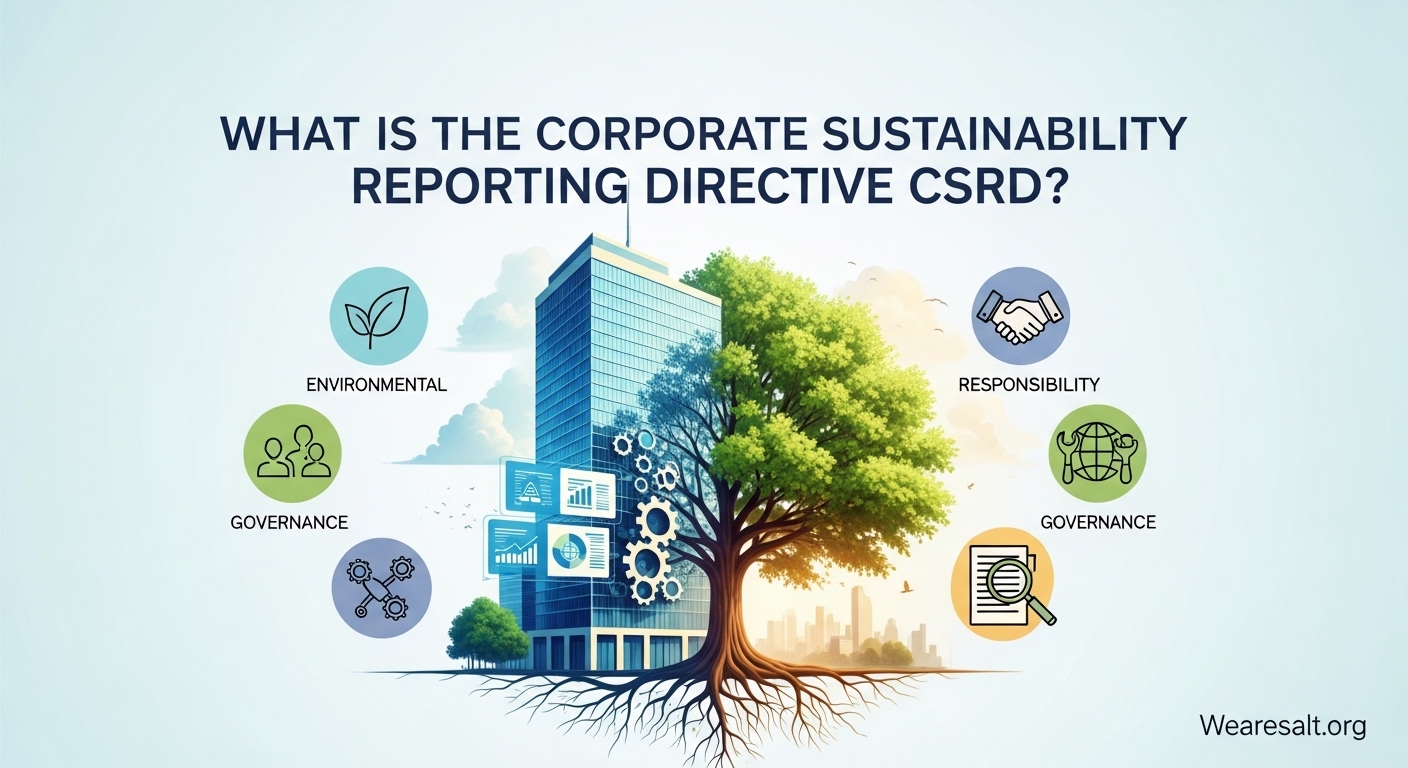
The Corporate Sustainability Reporting Directive (CSRD) represents one of the most significant shifts in corporate transparency requirements in recent decades. Whether you are a sustainability professional, CFO, or business leader with EU operations, understanding this regulation is essential for 2026 compliance and strategic planning.
This guide breaks down everything you need to know about CSRD. We will cover what it is, why it was introduced, who must comply, and practical steps to meet the requirements. Our team has analyzed the legislation, spoken with compliance professionals, and reviewed hundreds of forum discussions to give you the clearest picture of what this directive means for your business.
By the end of this article, you will understand the full scope of CSRD requirements, know exactly which compliance cohort your company falls into, and have actionable steps to begin your sustainability reporting journey.
Table of Contents
What is the Corporate Sustainability Reporting Directive CSRD
The Corporate Sustainability Reporting Directive (CSRD) is European Union legislation that mandates companies to disclose detailed information about their environmental and social impacts. It came into effect on January 5, 2023, replacing the previous Non-Financial Reporting Directive (NFRD).
CSRD requires companies to report according to the European Sustainability Reporting Standards (ESRS). These standards cover environmental, social, and governance factors across the entire value chain. The directive aims to standardize sustainability reporting across the EU, making data more comparable and reliable for investors and stakeholders.
Unlike voluntary sustainability reporting, CSRD is mandatory for companies within its scope. Reports must be published alongside financial statements and are subject to independent third-party assurance. This creates a new level of accountability for corporate sustainability claims.
The directive connects directly to the European Green Deal, which targets climate neutrality by 2050. By requiring granular disclosures about climate risks, transition plans, and environmental impacts, CSRD supports the EU’s broader sustainability goals while giving investors the data they need to assess corporate performance.
The Legal Framework Behind CSRD
CSRD was adopted by the European Parliament and Council in December 2022. It amends several existing regulations including the Accounting Directive, the Transparency Directive, and the Audit Directive. The European Financial Reporting Advisory Group (EFRAG) develops the technical reporting standards that companies must follow.
Companies subject to CSRD must prepare their sustainability reports according to ESRS requirements. These reports must be tagged using the European Single Electronic Format (ESEF) and submitted to the European Single Access Point for public viewing.
Key Components of CSRD
CSRD introduces several critical requirements that distinguish it from previous frameworks. Companies must conduct a double materiality assessment, examining both how sustainability issues affect the business and how the business affects people and the environment.
Reports must cover Scope 1, 2, and 3 greenhouse gas emissions, providing a complete picture of carbon impact across the value chain. Companies must also disclose transition plans for climate change mitigation, aligning with the Paris Agreement’s 1.5-degree target.
Why Was CSRD Introduced
The previous Non-Financial Reporting Directive (NFRD) covered only about 11,700 companies across the EU. Critics argued it was too vague, allowing companies to cherry-pick information and making comparisons between businesses nearly impossible. Investors and stakeholders demanded better data to assess sustainability risks and opportunities.
CSRD expands coverage to approximately 50,000 companies. It establishes detailed, standardized reporting requirements that eliminate ambiguity. This addresses the growing problem of greenwashing, where companies make misleading environmental claims without substantive evidence.
The directive also responds to mounting evidence that climate change poses serious financial risks to businesses. Investors need comparable, audited sustainability data to make informed decisions. Without standardization, sustainability reports were essentially marketing documents rather than reliable sources of information.
The Problem with Previous Reporting Standards
Under NFRD, companies could choose what to report. Some disclosed extensive sustainability information while others provided minimal details. This inconsistency made benchmarking impossible and frustrated investors trying to compare ESG performance across portfolios.
NFRD also lacked mandatory assurance requirements. Companies could publish unaudited sustainability claims without independent verification. CSRD changes this by requiring limited assurance initially, moving toward reasonable assurance in the coming years.
Supporting the European Green Deal
The European Green Deal aims to make Europe the first climate-neutral continent by 2050. CSRD is a cornerstone of this strategy. By requiring companies to disclose their environmental impacts and transition plans, the directive creates accountability mechanisms that drive real change.
Standardized reporting also enables better policy-making. When thousands of companies report comparable data, regulators can identify trends, measure progress, and adjust policies accordingly. This data-driven approach supports evidence-based environmental policy.
Who Must Comply with CSRD
CSRD applies to three main categories of companies. Understanding which category your business falls into determines your compliance timeline and reporting obligations.
First, all large EU companies must comply if they meet at least two of these three criteria: 250 or more employees, turnover exceeding €50 million, or total assets over €25 million. These are called “large undertakings” under the directive.
Second, all EU-listed companies must comply regardless of size. This includes small and medium-sized enterprises (SMEs) that have securities listed on EU regulated markets. However, listed SMEs have proportionate standards and delayed timelines compared to larger companies.
Third, non-EU companies must comply if they have significant EU operations. Specifically, companies headquartered outside the EU must report if they generate more than €150 million in EU revenue and have at least one EU subsidiary or branch meeting certain size thresholds.
Large Undertakings Criteria
The threshold for large undertakings is specific. Companies must exceed at least two of the three criteria on their balance sheet date. If your company has 250+ employees, €50M+ turnover, and €25M+ assets, you definitely qualify.
Employee count includes all full-time equivalents. Turnover refers to net revenue from sales of products and services. Total assets include both current and non-current assets on the balance sheet. Companies approaching these thresholds should monitor their position carefully.
Listed SMEs and Proportionality
Listed SMEs have a specific definition under CSRD. They are companies with securities listed on EU regulated markets that do not meet the large undertaking criteria. These companies have lighter reporting requirements than large companies.
The December 2025 Omnibus I changes removed non-listed SMEs from mandatory CSRD scope. Previously, listed SMEs would eventually need to comply. Now they have simplified requirements and can opt out until 2028, giving smaller businesses more time to prepare.
Non-EU Companies with EU Operations
Non-EU companies face CSRD requirements if they have substantial EU presence. The €150 million EU revenue threshold captures major multinational corporations. These companies must report on their entire global value chain, not just EU operations.
US companies with EU subsidiaries are particularly affected. If your US-based company has an EU subsidiary with €40M+ net turnover, you likely need to comply. This has significant implications for data collection and reporting systems.
CSRD Compliance Timeline
CSRD implementation happens in phases based on company size and type. The staggered approach gives companies time to build reporting capabilities while starting with those best positioned to comply.
Phase 1 began with reports published in 2025 covering fiscal year 2024. This phase applies to large public-interest entities already subject to NFRD. These are typically large listed companies and financial institutions with over 500 employees.
Phase 2 covers reports published in 2026 for fiscal year 2025. This includes all other large undertakings not covered in Phase 1. If you are a large EU company meeting the employee, turnover, or asset thresholds, this applies to you.
Phase 3 originally covered listed SMEs, small and non-complex credit institutions, and captive insurance companies. Reports would be published in 2027 for fiscal year 2026. However, Omnibus I changes have modified these requirements.
Omnibus I Updates and Timeline Changes
The Omnibus I package, announced in December 2025, made significant changes to CSRD scope and timelines. These changes respond to concerns about regulatory burden, particularly for smaller companies.
Key changes include removing listed SMEs from mandatory scope, allowing voluntary reporting instead. Small banks and captive insurers are also exempted. The changes maintain requirements for large companies while reducing the burden on smaller entities.
For companies already in scope, reporting deadlines remain unchanged. Large companies must still publish their first CSRD-compliant reports in 2025 or 2026 depending on their cohort. The Omnibus changes primarily affect companies not yet required to report.
Non-EU Company Timeline
Non-EU companies meeting the €150 million EU revenue threshold must publish their first CSRD reports in 2029 for fiscal year 2028. This gives multinational corporations additional time to build reporting systems and collect value chain data.
These companies must file consolidated sustainability reports covering their entire global operations. The reports must follow ESRS standards and include the same level of detail as EU-headquartered companies.
CSRD Reporting Requirements and ESRS Standards
The European Sustainability Reporting Standards (ESRS) form the technical backbone of CSRD compliance. These standards specify exactly what companies must disclose across environmental, social, and governance topics.
There are 12 ESRS standards in total. Two are cross-cutting standards that apply to all companies: ESRS 1 General Requirements and ESRS 2 General Disclosures. The remaining ten cover specific sustainability topics, divided into environmental, social, and governance categories.
Environmental standards include Climate Change (E1), Pollution (E2), Water and Marine Resources (E3), Biodiversity and Ecosystems (E4), and Resource Use and Circular Economy (E5). Social standards cover Own Workforce (S1), Workers in the Value Chain (S2), Affected Communities (S3), and Consumers and End-Users (S4). Governance standards include Business Conduct (G1).
Companies must report on all material topics identified through their double materiality assessment. This means you may not need to report on every standard if certain topics are not material to your business. However, climate change (E1) is presumed material for all companies unless you can prove otherwise.
Double Materiality Assessment Explained
Double materiality is a core concept in CSRD. It requires companies to examine sustainability issues from two angles. First, how do environmental and social factors affect your company’s financial performance? Second, how does your company affect people and the environment?
Impact materiality looks outward at your company’s effects on the world. This includes carbon emissions, water usage, labor practices in your supply chain, and community impacts. Financial materiality looks inward at how climate change, resource scarcity, and social trends affect your business model and valuation.
Companies must document their materiality assessment process in their CSRD report. This includes stakeholder engagement, criteria for determining materiality, and the outcome of the assessment. The assessment determines which ESRS standards you must fully report against.
Value Chain Reporting Requirements
CSRD requires reporting across the entire value chain, not just your own operations. This upstream and downstream reporting is one of the most challenging aspects of compliance.
Upstream reporting covers your suppliers and the impacts embedded in purchased goods and services. Downstream reporting covers your products’ use phase and end-of-life impacts. For many companies, Scope 3 emissions from the value chain represent the majority of their total carbon footprint.
Companies may use estimates where primary data is unavailable. The ESRS standards provide proportionality mechanisms for companies with limited influence over their value chain. However, you must still make reasonable efforts to collect accurate data and document your methodology.
Third-Party Assurance Requirements
CSRD reports require independent assurance from a statutory auditor or accredited third party. This requirement distinguishes CSRD from voluntary sustainability reporting.
Initially, companies need limited assurance. This means the assurance provider believes nothing has come to their attention suggesting the sustainability report is not prepared in accordance with ESRS. Over time, requirements will move toward reasonable assurance, which provides higher confidence levels.
Assurance providers examine both the processes for preparing reports and the accuracy of disclosed data. Companies should engage with assurance providers early in their CSRD preparation to understand expectations and build appropriate controls.
Key Differences Between CSRD and NFRD
Understanding how CSRD differs from its predecessor helps explain why compliance requires new approaches and systems. The differences are substantial across scope, depth, and rigor.
Scope expansion is the most visible difference. NFRD covered approximately 11,700 large companies. CSRD expands this to roughly 50,000 companies, including listed SMEs and non-EU companies with significant EU presence.
Reporting depth increased dramatically. NFRD allowed companies to choose what to report and how to report it. CSRD mandates specific disclosures across 12 ESRS standards with detailed data requirements and standardized formats.
Assurance requirements represent another major shift. NFRD had no mandatory assurance. CSRD requires limited assurance from the start, moving toward reasonable assurance. This independent verification adds credibility but also increases preparation requirements.
Digital Reporting and Accessibility
CSRD requires digital tagging of sustainability reports using XBRL format. Reports must be submitted to the European Single Access Point, making them freely available to investors, researchers, and the public.
This digital format enables automated analysis and comparison across companies. It also means any errors or inconsistencies are more visible. Companies need systems capable of producing tagged, auditable sustainability data.
Value Chain and Scope 3 Coverage
NFRD focused primarily on company operations. CSRD explicitly requires value chain reporting, including Scope 3 emissions. This extends responsibility for sustainability data collection to suppliers, distributors, and product users.
For many industries, Scope 3 emissions dwarf operational emissions. A clothing retailer’s supply chain emissions may be 20 times higher than their store operations. CSRD captures this full picture, creating accountability across entire value chains.
Practical Implementation Steps
Preparing for CSRD compliance requires systematic action. Our team has spoken with dozens of sustainability professionals about their implementation experiences. Here are the practical steps that work.
Step 1: Conduct your double materiality assessment. Engage stakeholders, analyze your value chain impacts, and determine which ESRS standards apply to your business. Document your process and rationale thoroughly.
Step 2: Build your data collection infrastructure. Identify data owners across your organization and value chain. Implement systems for tracking environmental metrics, social indicators, and governance information. Many companies underestimate the time needed for this step.
Step 3: Develop your reporting processes. Create templates aligned with ESRS requirements. Establish internal controls for data quality. Consider how you will tag reports in XBRL format.
Step 4: Engage your assurance provider early. Discuss their expectations and methodology. Understanding assurance requirements helps you build appropriate documentation from the start rather than retrofitting later.
Common Challenges and Solutions
Value chain data collection frustrates many companies. Suppliers may lack sustainability data or be unresponsive to requests. Start with your largest suppliers and work down. Use industry averages where necessary while building toward primary data collection.
Data quality concerns plague early CSRD implementations. Establish clear definitions, consistent measurement methodologies, and robust internal controls. Document everything. Your assurance provider will want to see how you calculated every number.
Resource constraints hit smaller companies hardest. Consider phased approaches, shared service arrangements, or software solutions that automate data collection. The investment in proper systems pays dividends in reduced manual effort and better audit trails.
CSRD and Other Reporting Frameworks
Companies often ask how CSRD relates to existing ESG reporting frameworks they may already use. Understanding these relationships helps streamline reporting and avoid duplication.
CSRD does not replace the Global Reporting Initiative (GRI) standards. Many companies will continue using GRI for broader sustainability communications while using ESRS for regulatory compliance. The frameworks are complementary rather than competitive.
CSRD incorporates recommendations from the Task Force on Climate-related Financial Disclosures (TCFD). Companies familiar with TCFD will recognize elements in ESRS climate reporting requirements. However, CSRD goes further than TCFD in scope and specificity.
The Sustainable Finance Disclosure Regulation (SFDR) affects financial market participants. CSRD provides the underlying data that feeds into SFDR disclosures. Companies reporting under CSRD help their investors meet SFDR requirements.
EU Taxonomy Integration
The EU Taxonomy provides a classification system for environmentally sustainable economic activities. CSRD requires disclosure of Taxonomy alignment percentages. This integration creates a consistent framework for identifying and reporting sustainable business activities.
Companies must report the proportion of turnover, capital expenditure, and operating expenditure aligned with the EU Taxonomy. These disclosures appear within CSRD reports, linking sustainability performance to financial metrics.
FAQ
What does the corporate sustainability reporting directive do?
CSRD requires companies to disclose detailed information about their environmental and social impacts according to standardized European Sustainability Reporting Standards (ESRS). It mandates sustainability reporting for approximately 50,000 companies across the EU and beyond, with reports subject to independent third-party assurance.
Is CSRD mandatory for all companies?
CSRD is mandatory for companies meeting specific criteria but does not apply to all companies. It covers large EU companies meeting employee, turnover, or asset thresholds; all EU-listed companies; and non-EU companies with significant EU revenue over €150 million. Small unlisted companies are generally exempt.
What is CSRD in a nutshell?
CSRD is EU legislation requiring companies to report their environmental and social impacts using standardized ESRS standards. It expands sustainability reporting from 11,700 to 50,000 companies, mandates third-party assurance, and requires value chain disclosure. Reports must be published alongside financial statements starting in 2025.
Which companies does CSRD apply to?
CSRD applies to three groups: large EU companies with 250+ employees or €50M+ turnover or €25M+ assets; all EU-listed companies including SMEs with listed securities; and non-EU companies generating over €150M in EU revenue with an EU subsidiary or branch.
Does CSRD replace GRI?
No, CSRD does not replace GRI. CSRD is a legal requirement for regulatory compliance using ESRS standards. GRI remains a voluntary framework used for broader sustainability communications. Many companies use both frameworks for different purposes, with ESRS feeding regulatory reports and GRI supporting stakeholder engagement.
What is the difference between CSR and CSRD?
CSR (Corporate Social Responsibility) refers to voluntary company initiatives addressing social and environmental impacts. CSRD (Corporate Sustainability Reporting Directive) is mandatory EU legislation requiring standardized sustainability disclosure. CSR is about what companies choose to do; CSRD is about what they must report.
When does CSRD come into effect?
CSRD came into effect on January 5, 2023. Reporting requirements are phased: large public-interest entities report in 2025 for FY2024; other large companies report in 2026 for FY2025; listed SMEs have delayed timelines; and non-EU companies report in 2029 for FY2028.
What is CSRD compliance?
CSRD compliance means preparing and publishing a sustainability report according to European Sustainability Reporting Standards (ESRS), including a double materiality assessment, value chain disclosures, climate risk analysis, and transition plans. Reports must be digitally tagged, submitted to the European Single Access Point, and subject to independent third-party assurance.
Conclusion
The Corporate Sustainability Reporting Directive CSRD represents a fundamental shift in corporate transparency. It moves sustainability reporting from voluntary marketing to mandatory, audited disclosure using standardized European Sustainability Reporting Standards.
Understanding what is the Corporate Sustainability Reporting Directive CSRD is the first step toward compliance. Whether you are preparing for your first report in 2025 or building systems for future requirements, starting early gives you the best chance of success.
Focus on building robust data collection systems, conducting thorough materiality assessments, and engaging with assurance providers. The companies that treat CSRD as a strategic priority rather than a compliance burden will find the process smoother and the outcomes more valuable for their business and stakeholders.
If your company falls within CSRD scope, begin your preparation now. The reporting requirements are detailed, the data collection is extensive, and the assurance standards are rigorous. But with proper planning and the right systems, CSRD compliance becomes manageable, and the insights gained can drive genuine business value beyond the regulatory requirement.