
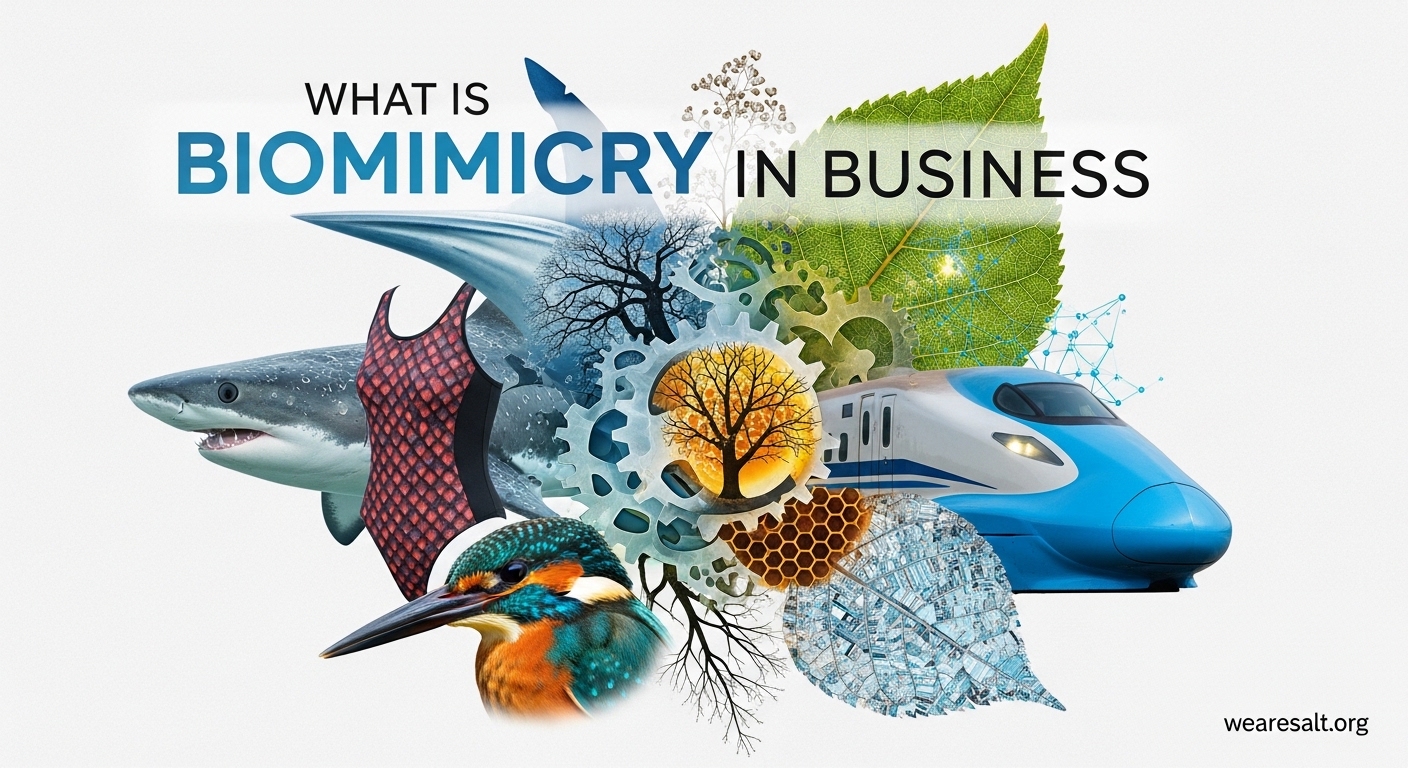
Biomimicry in business is the practice of studying nature’s time-tested strategies and applying them to innovate products, processes, and systems for sustainable competitive advantage. Nature has already solved many of the problems businesses face today, from efficient energy use to resilient organizational structures.
Our team has studied how companies across industries are using this approach to cut costs, spark innovation, and build more sustainable operations. This guide will show you exactly how biomimicry works, real examples from companies you know, and practical steps to apply it to your own business.
Table of Contents
What is Biomimicry in Business?
Biomimicry (from the Greek words “bios” meaning life and “mimesis” meaning to imitate) is innovation inspired by nature. In a business context, it means looking at how organisms and ecosystems solve challenges, then applying those same principles to human-made products, systems, and processes.
Janine Benyus, who popularized the term in her 1997 book “Biomimicry: Innovation Inspired by Nature,” describes it as a new way of viewing and valuing nature. Rather than extracting resources from the natural world, businesses learn from it. The Biomimicry Institute, which she co-founded, now maintains AskNature.org, a database of over 2,000 biological strategies that businesses can reference for inspiration.
What makes biomimicry different from simply copying nature is the depth of understanding required. Surface-level copying (like making something look like a leaf) is not true biomimicry. Real biomimicry understands the underlying mechanisms that make natural systems work so well.
Biomimicry vs Biomimetics: What is the Difference?
The terms biomimicry and biomimetics are often used interchangeably, but they have subtle differences. Biomimetics is the broader technical field of imitating natural processes and structures. It includes everything from medical adhesives inspired by gecko feet to military camouflage patterns.
Biomimicry carries an additional layer of meaning. It specifically refers to learning from nature not just to solve problems, but to create conditions conducive to life. Biomimicry practitioners aim for regenerative solutions that support rather than deplete natural systems. While biomimetics asks “what can we take from nature,” biomimicry asks “what can we learn from nature about how to thrive.”
For most business purposes, the distinction matters less than the shared goal: using 3.8 billion years of natural evolution as a research and development lab to create better, more sustainable solutions.
Core Principles of Biomimicry
Biomimicry operates on three interconnected principles that guide how businesses approach nature-inspired innovation. Understanding these principles helps teams apply biomimicry more effectively to their specific challenges.
Nature as Model: Learning From 3.8 Billion Years of R&D
Life on Earth has been solving problems for 3.8 billion years. In that time, organisms have evolved strategies for everything from water collection in deserts to self-healing materials to waste-free manufacturing. When businesses look at nature as a model, they treat the natural world as a vast research and development database.
The lotus leaf repels water through microscopic surface structures. Termite mounds maintain stable internal temperatures without air conditioning. Spider silk is stronger than steel yet biodegradable. These are not random facts. They are functional strategies that businesses can adapt to their own challenges.
Nature as Measure: Evaluating What Works
Nature serves as a benchmark for evaluating whether our innovations are truly sustainable. If a business process creates toxic waste that nature cannot break down, it is not aligned with natural systems. If a material requires fossil fuels to produce while natural materials do not, there is room for improvement.
This principle pushes businesses to ask harder questions about their environmental impact. Is our packaging biodegradable? Do our manufacturing processes close resource loops like natural ecosystems do? Are we using life-friendly chemistry? Nature sets the standard for what sustainable really means.
Nature as Mentor: Changing Our Relationship
Rather than viewing nature as something to exploit, biomimicry positions nature as a teacher. This shift in perspective changes how businesses approach problem-solving. Instead of asking “what resources can we extract,” teams ask “what can we learn.”
This mentor relationship often leads to unexpected insights. When researchers studied how kingfisher birds dive into water without splashing, they applied that insight to the nose cone of the Japanese Shinkansen bullet train. The result reduced noise, eliminated sonic booms in tunnels, and used 15% less electricity. The train did not look like a bird, but it worked like one.
Real-World Biomimicry Examples in Business
Biomimicry is not theoretical. Companies you have heard of are already using these principles to create competitive advantages. Here are seven powerful examples across different industries.
1. Interface: Carpet Tiles Inspired by Forest Floors
Interface, one of the world’s largest modular carpet manufacturers, looked at forest floors to redesign their products. In a forest, when a tree falls or a plant dies, the gap is quickly filled by surrounding growth. The ecosystem remains whole.
Interface applied this principle to their carpet tiles. Instead of perfectly matching patterns that show every stain and require replacing entire sections, they created tiles with slightly different patterns that blend together like a forest floor. When one tile needs replacement, it fits seamlessly with its neighbors. This reduced waste and created a more durable, natural-looking product.
The company also eliminated PVC from their products after studying how nature avoids toxic materials. They have since become a leader in sustainable manufacturing, proving that biomimicry can drive both environmental and business success.
2. Sharklet Technologies: Bacteria-Repelling Surfaces
Shark skin has a unique microscopic pattern that prevents bacteria and algae from attaching. Sharklet Technologies studied this pattern and created a surface texture that mimics it. The textured surface prevents bacteria from colonizing without using antibiotics or toxic chemicals.
Their products are now used in medical devices, hospitals, and public surfaces where bacterial resistance is a concern. This approach works with physics rather than chemistry, creating a passive, long-lasting solution that does not contribute to antibiotic resistance. The company demonstrates how understanding a simple natural mechanism can create entirely new product categories.
3. Pax Technologies: Self-Mixing Bottles Inspired by Amazonian Flowers
Pax Technologies designed a water bottle that mixes drinks without shaking or stirring. They were inspired by the way certain Amazonian flowers create swirling vortices to capture pollen. The bottle has a similar internal structure that creates a vortex when liquid is poured in.
This passive mixing system eliminates the need for batteries, motors, or manual shaking. It is a perfect example of how nature’s elegant solutions often outperform human-engineered complexity. The product has applications in everything from sports drinks to medical solutions requiring precise mixing.
4. WhalePower: Wind Turbine Blades Modeled on Humpback Fins
Humpback whales have tubercles, or bumps, on the leading edges of their fins. These bumps may seem counterintuitive for efficient swimming, but they actually reduce drag and increase lift. WhalePower applied this insight to wind turbine blades.
Their tubercle-enhanced blades generate more power at low wind speeds and maintain efficiency in turbulent conditions. This means turbines can operate in areas previously considered unsuitable for wind energy. The technology is also being applied to fans, compressors, and other rotating equipment where efficiency matters.
5. Eastgate Centre: Buildings That Breathe Like Termite Mounds
The Eastgate Centre in Harare, Zimbabwe is an office and shopping complex that stays cool without air conditioning. Architect Mick Pearce studied how termite mounds in the African savanna maintain constant internal temperatures despite extreme external heat.
Termites open and close vents to create convection currents that regulate temperature. The Eastgate Centre uses a similar system of chimneys and vents to draw in cool air at night and circulate it during the day. The building uses 90% less energy for climate control than conventional buildings of similar size. It demonstrates how looking at nature can solve energy challenges in ways no engineer had previously considered.
6. Velcro: The Classic Biomimicry Story
No discussion of biomimicry is complete without Velcro. In 1941, Swiss engineer George de Mestral noticed burrs sticking to his dog’s fur during a hike. Examining the burrs under a microscope, he saw they had tiny hooks that caught on fur and fabric.
He spent years perfecting a synthetic version, creating the hook-and-loop fastening system we know today. Velcro is now a multi-billion dollar company, and the product is used in everything from shoes to space suits. It remains the most famous example of how a simple observation in nature can lead to revolutionary products.
7. Blue Planet: Carbon-Negative Concrete Inspired by Coral
Concrete production accounts for about 8% of global carbon emissions. Blue Planet looked at how coral reefs form calcium carbonate structures by capturing carbon dioxide from seawater. They developed a process that mimics this natural mineralization.
Their concrete actually captures more carbon dioxide than its production releases, making it carbon-negative. The material is being used in construction projects around the world, offering a pathway to reduce the built environment’s carbon footprint. This example shows how biomimicry can address some of our most pressing environmental challenges while creating viable business opportunities.
The Biomimicry Spectrum: Established vs Pioneering
Not all biomimicry is created equal. Businesses operate on a spectrum from established applications to pioneering innovations. Understanding where your business fits can help set realistic expectations and identify opportunities.
Established Biomimicry includes proven, widely adopted applications. Velcro is an established example. These solutions have been tested over decades and represent lower-risk implementations. Businesses can adopt these with confidence, knowing the concepts work.
Pioneering Biomimicry involves newer applications still being refined. Many of the examples above, like Blue Planet’s carbon-negative concrete, fall into this category. These offer competitive advantages to early adopters but may require more investment and patience.
Where should your business start? If you are new to biomimicry, look at established applications first. Can you use Velcro-like fastening instead of adhesives? Can you incorporate termite-inspired ventilation concepts? Once you build confidence with these proven approaches, you can explore more pioneering opportunities.
Some businesses also engage in bio-assisted approaches, using living organisms directly. Mycelium packaging grown from mushroom roots is an example. Others focus on ecosystem-level biomimicry, redesigning entire supply chains to function like natural nutrient cycles.
Benefits of Biomimicry for Businesses
Beyond the environmental appeal, biomimicry offers concrete business advantages. Companies implementing these principles report measurable improvements across multiple areas.
Cost Reduction Through Efficiency
Nature does not waste energy. When businesses apply nature’s efficient designs, they often see significant cost savings. The Eastgate Centre’s 90% energy reduction is an extreme example, but even modest efficiency gains add up over time. WhalePower’s turbine blades generate more power from the same wind. Interface’s carpet tiles reduce waste and replacement costs.
These efficiencies translate directly to bottom-line improvements. Energy costs drop. Material waste decreases. Maintenance requirements fall. Over the lifecycle of a product or building, the savings can be substantial.
Competitive Differentiation
Products inspired by nature often stand out in crowded markets. Sharklet’s bacteria-resistant surfaces created an entirely new category of medical equipment. Pax’s self-mixing bottles offer convenience no competitor matched. Blue Planet’s carbon-negative concrete appeals to environmentally conscious developers.
In a world where consumers increasingly value sustainability, biomimicry provides a genuine basis for green marketing rather than greenwashing. The stories behind these products resonate with customers looking for authentic environmental commitment.
Resilience and Adaptability
Natural systems are resilient because they adapt to changing conditions. Businesses applying biomimicry principles often develop more flexible operations. Supply chains modeled on ecosystem diversity can better withstand disruptions. Organizational structures inspired by fungal networks create more responsive teams.
As the business environment becomes more volatile, this resilience offers real competitive advantage. Companies that can adapt quickly to market changes, resource constraints, and regulatory shifts will outperform those locked into rigid systems.
Innovation Breakthroughs
Biomimicry pushes teams outside conventional thinking. When engineers study how whales swim, they discover aerodynamic principles that contradict textbook wisdom. When designers look at forest floors, they rethink entire product categories.
This fresh perspective can break innovation logjams. Teams stuck on a design problem find that nature has already solved it in unexpected ways. The biological world represents an infinite source of inspiration for creative challenges.
How to Apply Biomimicry to Your Business
Ready to bring nature-inspired innovation into your organization? Here is a practical framework for getting started.
Step 1: Define Your Challenge
Start with a specific problem. Are you trying to reduce energy use? Eliminate waste? Create a more durable product? Improve packaging? The more specific your challenge, the easier it is to find relevant biological analogies.
Write your challenge as a question. “How can we cool our building without air conditioning?” “How can we prevent bacterial growth without chemicals?” “How can we create packaging that decomposes naturally?”
Step 2: Translate to Biology
Reframe your challenge in biological terms. Instead of asking about cooling systems, ask “how does nature cool itself?” Instead of asking about packaging, ask “how does nature contain and protect?”
This translation is crucial. It opens your search to biological strategies that might not look like your current solutions but solve the same functional problem. Nature does not make air conditioners, but it does regulate temperature constantly.
Step 3: Research Biological Strategies
Now look for organisms that solve your reframed challenge. AskNature.org is an excellent resource, cataloging thousands of biological strategies by function. You can search for “temperature regulation,” “material protection,” “water collection,” or any functional need.
Also observe nature directly. What do local plants and animals do to survive in your environment? How do they handle the challenges your business faces? Your local ecosystem may have relevant insights.
Step 4: Abstract the Principle
Do not copy the superficial appearance. Extract the underlying principle. The kingfisher’s beak is not just pointy. It creates a smooth transition from air to water. The termite mound is not just big. It uses passive ventilation driven by temperature differentials.
Identify the mechanism that makes the natural solution work. This is what you will adapt to your business challenge.
Step 5: Apply and Iterate
Adapt the biological principle to your specific context. The first attempt will not be perfect. Test, refine, and iterate just as nature did through millions of years of evolution. Your development cycle will be faster, but the principle of continuous improvement is the same.
Consider working with biomimicry specialists or joining communities like the Biomimicry Institute’s network. Learning from others who have walked this path accelerates your progress.
When Biomimicry May Not Work
Biomimicry is powerful, but it is not a universal solution. Honest assessment of its limitations helps set appropriate expectations.
Some business challenges have no clear biological analog. Financial derivatives, for example, do not exist in nature. Neither do digital advertising algorithms or many software problems. These domains may offer limited biomimicry opportunities.
Scale differences matter. What works at insect scale may not work at building scale. Surface tension dominates at small scales but gravity dominates at large scales. Engineering challenges change as size changes, so biological strategies need careful scaling analysis.
Time and material constraints sometimes limit application. Natural processes can be slow. Coral takes years to build reefs. Trees take decades to grow. If your timeline is weeks, you may need to accelerate or simplify natural processes.
Cost of implementation is another factor. Some biomimicry solutions require new materials or manufacturing processes. The long-term benefits may justify the investment, but short-term budget constraints can block adoption.
Finally, organizational resistance is real. If your company culture is not open to unconventional approaches, biomimicry may struggle to gain traction. Change management is part of any innovation initiative.
Frequently Asked Questions
What are 5 examples of biomimicry?
Five key examples include: 1) Velcro inspired by burr hooks, 2) Eastgate Centre building inspired by termite mound ventilation, 3) Sharklet surfaces inspired by shark skin texture, 4) Japanese bullet train nose inspired by kingfisher beaks, and 5) WhalePower turbine blades inspired by humpback whale fin tubercles.
What is biomimicry in simple terms?
Biomimicry is innovation inspired by nature. It means studying how plants, animals, and ecosystems solve problems, then applying those strategies to human challenges like product design, manufacturing, and business systems.
What companies use biomimicry?
Major companies using biomimicry include Interface (carpet tiles inspired by forest floors), Sharklet Technologies (bacteria-resistant medical surfaces), Blue Planet (carbon-negative concrete), WhalePower (wind turbine blades), and Pax Technologies (self-mixing bottles).
What skills are needed for biomimetics?
Biomimetics requires interdisciplinary skills including biology knowledge, design thinking, systems thinking, observation abilities, and creative problem-solving. Many practitioners have backgrounds in engineering, design, biology, or sustainability, but curiosity and willingness to learn from nature matter most.
How do I start applying biomimicry to my business?
Start by identifying a specific challenge, then reframe it in biological terms. Research how nature solves similar problems using resources like AskNature.org. Extract the underlying principles rather than copying appearances, then adapt them to your context. Consider working with biomimicry specialists or joining practitioner communities.
The Future of Business Inspired by Nature
Biomimicry in business is more than a trend. It represents a fundamental shift in how we approach innovation. As resource constraints tighten and environmental pressures mount, nature’s efficient, waste-free solutions become increasingly attractive.
The businesses that thrive in the coming decades will likely be those that learn to work with natural systems rather than against them. They will design products that decompose like leaves, create buildings that breathe like termite mounds, and build organizations that adapt like ecosystems.
What is biomimicry in business? It is the recognition that the best solutions to our challenges already exist in the natural world around us. Our job is simply to pay attention and apply what we learn. The 3.8 billion years of research and development waiting in your backyard might be the most valuable business resource you have not tapped yet.