
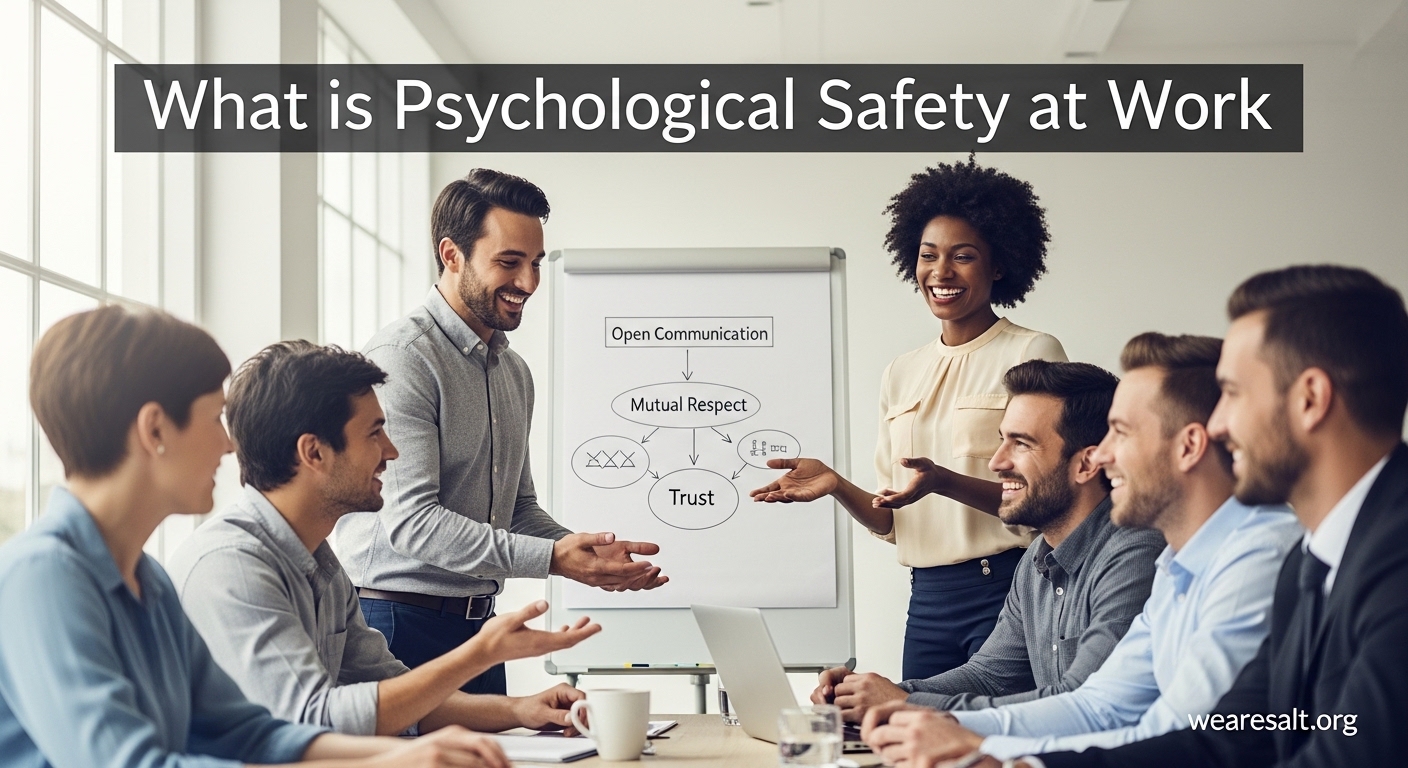
Imagine sitting in a team meeting, watching your colleague present an idea you know has a critical flaw. You stay silent. Not because you lack expertise, but because you’re afraid. Afraid of looking foolish. Afraid of embarrassing your coworker. Afraid of retaliation from a manager who dismissed your last suggestion with eye-rolling sarcasm. This is what happens when psychological safety at work is missing. In this guide, I’ll explain exactly what psychological safety means, why it matters for your career and organization, and how you can help create it whether you’re a team member or a leader.
Psychological safety at work is the belief that you won’t be punished, humiliated, or judged for speaking up with ideas, questions, concerns, or mistakes. Harvard Business School professor Amy Edmondson coined the term in 1999 after studying medical teams and discovering that the best-performing teams weren’t the ones who made fewer errors. They were the teams who felt safe enough to report and discuss their errors openly. When you have psychological safety, you can express half-finished thoughts, ask “dumb” questions, voice dissenting opinions, and admit mistakes without fear of negative consequences to your status, career, or relationships.
The concept gained mainstream attention after Google’s Project Aristotle, a massive research initiative that studied hundreds of teams to identify what makes them effective. The data was clear: psychological safety mattered more than any other factor. It predicted team performance better than dependability, structure, meaning, or even impact. Teams with high psychological safety were more innovative, made better decisions, and retained top talent. This wasn’t just about feeling good at work. It was about creating the conditions where excellence becomes possible.
Table of Contents
What Psychological Safety Is (And What It’s Not)
Many people misunderstand psychological safety. It is not about being nice, avoiding conflict, or lowering performance standards. It is not a free pass for poor work or an excuse to skip accountability. True psychological safety coexists with high standards and rigorous debate. It simply means those debates happen without personal attacks, ridicule, or career-threatening consequences. You can have difficult conversations, challenge decisions, and demand excellence while maintaining an environment where people feel safe to contribute.
Psychological safety differs from trust, though the two are related. Trust is about predicting how someone will behave based on past interactions. Psychological safety is a team-level climate about interpersonal risk-taking. You might trust your manager personally while still feeling unsafe speaking up in a broader team context because of how other colleagues or senior leaders might react. The climate is shaped by everyone in the room, not just one relationship.
It also differs from simply being comfortable. Growth requires discomfort. Learning requires admitting you don’t know something. Innovation requires proposing ideas that might fail. Psychological safety creates the foundation that allows people to move through that discomfort productively rather than shutting down to protect themselves. The goal is not a tension-free environment. It is an environment where tension serves progress rather than self-preservation.
The Four Stages of Psychological Safety
Dr. Timothy Clark expanded on Edmondson’s work by identifying four progressive stages of psychological safety. Understanding these stages helps explain why some team members remain quiet even when they technically have permission to speak. Each stage builds on the previous one, creating a ladder of inclusion and contribution.
Stage 1: Inclusion Safety
Inclusion safety is the foundation. It is the sense that you belong, that you’re accepted as a member of the team with equal status and value. Without inclusion safety, you feel like an outsider. You’re cautious about participating because you haven’t been fully welcomed into the group. Leaders build inclusion safety by learning names, asking for input, acknowledging contributions, and ensuring all voices are heard in discussions. They actively counter cliques and in-group dynamics that leave people on the margins.
Stage 2: Learner Safety
Once you feel included, you need to feel safe to learn. This means asking questions, admitting gaps in knowledge, experimenting with new approaches, and making mistakes without fear of embarrassment. Teams with learner safety treat ignorance as a temporary condition and errors as learning opportunities. Leaders create this by modeling curiosity, asking questions themselves, and responding to mistakes with problem-solving rather than blame.
Stage 3: Contributor Safety
Contributor safety is the confidence to use your skills and knowledge to make a meaningful difference. You feel safe to apply your expertise, take ownership of projects, and make decisions within your scope. Without contributor safety, capable people hesitate to act, second-guess themselves excessively, or defer to louder voices even when they have better information. Leaders foster this by delegating real authority, protecting people when their decisions don’t work out, and resisting the urge to micromanage.
Stage 4: Challenger Safety
The highest level is challenger safety. This is the confidence to question the status quo, disagree with authority, suggest major changes, and challenge existing practices without fear of retaliation. Challenger safety is rare because it requires leaders to genuinely welcome dissent. Teams with challenger safety catch problems early, avoid groupthink, and continuously improve because people feel empowered to speak truth to power. Leaders build this by explicitly requesting dissent, rewarding people who surface problems, and never punishing messenger behavior.
Why Psychological Safety Matters
The business case for psychological safety is overwhelming. Google’s research found it was the single strongest predictor of team effectiveness across their entire organization. Teams with high psychological safety brought in more revenue, were rated more effective by executives, and retained employees longer. The effect wasn’t small. It was the difference between average and exceptional performance.
For innovation, psychological safety is essential. Creativity requires risk. New ideas are by definition unproven. They often sound strange, impractical, or even foolish at first. In psychologically safe environments, people share these half-formed ideas, build on each other’s suggestions, and develop breakthrough solutions through iterative collaboration. In unsafe environments, people self-censor. They wait until ideas are polished and safe, which means waiting until someone else has already pioneered the concept. The companies that innovate fastest are the ones where people feel safe being wrong.
Decision-making quality improves dramatically with psychological safety. When people can voice concerns, dissenting opinions, and missing information without fear, leaders get the full picture before making choices. The alternative is what researchers call the “ABC syndrome”: people Agree to avoid conflict, they Bounce their real opinions to colleagues outside the room, and they Cover up problems to protect themselves. Decisions made with ABC input fail at high rates because they weren’t stress-tested against reality.
Employee engagement and retention directly correlate with psychological safety. People don’t quit jobs where they feel valued, heard, and able to grow. They do quit jobs where they’re afraid. The cost of turnover is massive. Studies consistently show that replacing an employee costs between 50% and 200% of their annual salary when you account for recruitment, training, and lost productivity. Creating psychological safety isn’t a soft perk. It is a hard business strategy that protects your investment in human capital.
From my experience working with teams across multiple industries, the difference between safe and unsafe environments is palpable. In safe environments, meetings are energetic. People lean forward, interrupt with ideas, challenge assumptions respectfully, and laugh together. In unsafe environments, people sit back, check phones, stay silent until called upon, and agree with whatever the senior person suggested. The energy difference is immediate and obvious within minutes of observing a team.
How to Build Psychological Safety in Your Workplace
Creating psychological safety is not a one-time training session or a poster on the wall. It is a daily practice of behaviors that accumulate over time. Both leaders and team members play roles in building it. Here are the practical strategies that actually work.
1. Admit your own mistakes and uncertainties first
Leaders must go first. When you model vulnerability by admitting what you don’t know or acknowledging your own errors, you give everyone else permission to do the same. Say things like “I was wrong about that approach” or “I don’t know the answer. What do you all think?” This isn’t weakness. It is the courage that creates safety for others.
2. Ask questions instead of giving answers
Resist the urge to solve problems immediately. Ask “What do you see that I’m missing?” or “Help me understand your thinking.” This invites contribution and signals that you value others’ perspectives. It also prevents the dynamic where people wait for the boss to give the answer rather than thinking for themselves.
3. Respond to bad news with curiosity, not anger
When someone brings you a problem, your first reaction teaches the entire organization whether honesty is safe. If you get angry, defensive, or blaming, that person and everyone who hears about it will hide problems in the future. Instead, say “Thank you for telling me. Let’s figure this out together.” This protects the messenger and ensures you hear about issues while they’re still fixable.
4. Create explicit permission structures
Sometimes people need explicit invitations to participate. In meetings, say “I haven’t heard from Sarah yet. Sarah, what’s your take?” or “Let’s hear from someone who hasn’t spoken yet.” For quieter team members, check in privately before meetings to ask what they’d like to contribute, then create space for them to share it. This is especially important for remote and hybrid teams where it’s harder to read body language and jump into conversations.
5. Establish norms for how failure is handled
Create clear agreements about how the team responds to mistakes. Blameless postmortems are a powerful practice where teams analyze what went wrong without assigning individual blame. Focus on systems, processes, and context rather than personal failings. This turns failures into organizational learning rather than career risks.
6. Protect your team when they take interpersonal risks
When someone on your team speaks up in a difficult conversation, disagrees with a senior leader, or admits a mistake, protect them. This might mean redirecting criticism away from them, reminding others of context they lack, or privately thanking them for their courage. Team members watch how you respond when they stick their necks out. Your response determines whether they’ll do it again.
7. Check in regularly about team climate
Don’t assume you know how safe your team feels. Ask them. Use anonymous surveys or regular one-on-one conversations to ask specifically about psychological safety. Questions like “Do you feel safe speaking up in meetings?” and “Have you seen anyone punished for being honest?” reveal gaps between your intentions and the reality your team experiences.
8. Address breaches immediately and transparently
When psychological safety is violated, repair it quickly. If someone is punished for speaking up, if a manager lashes out at dissent, or if a clique excludes someone, address it openly. Explain why the behavior was harmful, what will change, and how you’ll prevent it from happening again. Without this repair work, one breach can undo months of safety-building.
For remote and hybrid teams, psychological safety requires extra attention. The cues that signal safety in person, like body language and hallway conversations, are missing. Leaders should create explicit space for informal connection, encourage camera use during important discussions, and use collaborative documents where quieter voices can contribute in writing. The isolation of remote work can amplify fears about status and belonging, so inclusion efforts need to be more deliberate.
What Psychological Safety Looks Like in Action
Recognizing psychological safety in practice helps you identify what you’re building toward. Here are the observable behaviors that signal a psychologically safe environment.
People admit when they don’t know something. You’ll hear phrases like “I’m not sure I understand. Can you explain that again?” or “This is outside my area. I need to learn more before I can contribute.” This honesty allows teams to fill knowledge gaps rather than pretending everyone understands.
Mistakes are discussed openly in meetings. Rather than hiding errors or deflecting blame, people say “I tried that and it didn’t work because…” or “Here’s where I went wrong.” The conversation focuses on learning, not fault-finding. This is particularly visible in how leaders discuss their own missteps.
Dissenting opinions surface before decisions are finalized. When a plan is proposed, multiple people offer different perspectives. The group debates merits rather than deferring to the highest-status person or the first suggestion. Decisions emerge stronger because they’ve been stress-tested against real concerns.
Feedback flows in all directions. Junior employees give input to senior leaders. Peers offer constructive criticism without walking on eggshells. The feedback is specific, actionable, and received with gratitude rather than defensiveness. This multi-directional flow indicates that hierarchy isn’t being used to silence voices.
Half-formed ideas get airtime. People say “This might be crazy, but what if we…” or “I’m still thinking this through, but…” These speech patterns show people feel safe being vulnerable about incomplete thinking. In unsafe environments, people wait until ideas are polished and safe, which slows innovation.
A manager I interviewed described their realization that their team lacked psychological safety: “I always said ‘If something’s wrong, just tell me.’ And I believed that was enough. Until one day, someone told me quietly that they didn’t feel safe sharing problems with me. That was a gut punch. I learned that my words didn’t matter. Only my reactions mattered.” This story illustrates what forum discussions consistently reveal: true psychological safety isn’t measured by what you say or your intentions. It is measured by behavioral evidence from your team.
Common Barriers and How to Overcome Them
Even with good intentions, leaders often undermine psychological safety through common mistakes. Recognizing these barriers helps you avoid them.
The most frequent mistake is saying the right things but doing the wrong things. Leaders declare “my door is always open” but then punish people who bring bad news. They say they value honesty but get defensive when challenged. They talk about learning from failure but visibly blame individuals when projects fail. The solution is simple: align your actions with your words. Your behavior teaches the real rules, not your policies.
Another barrier is confusing psychological safety with comfort. Some leaders avoid giving hard feedback because they want people to feel safe. This creates the opposite of safety. It creates uncertainty where people don’t know where they stand. True safety includes clarity about expectations and direct conversations about performance. The discomfort of honest feedback is different from the fear of arbitrary punishment.
Hierarchy can be a barrier when leaders dominate conversations, dismiss junior input, or visibly favor certain voices. Combat this by explicitly inviting contributions from quieter members, rotating meeting facilitation, and using anonymous input tools for sensitive topics. Make space for the perspectives that hierarchy might otherwise suppress.
Remote work introduces specific barriers. The lack of informal connection means trust takes longer to build. Video fatigue leads to cameras off, which removes emotional cues that signal safety. Written communication lacks tone, increasing the risk of misinterpretation. Overcome these by creating structured social time, encouraging video for important discussions, and using voice or video for sensitive topics rather than text.
Recovery from psychological safety breaches is essential but rarely discussed. When safety is violated, acknowledge it specifically. Apologize if you were the cause. Explain what you’ll do differently. Give the injured party space to share how they were affected. Without this repair work, the breach becomes evidence that safety isn’t real, and trust erodes further.
FAQ
What are the 4 types of psychological safety?
The four types of psychological safety are: 1) Inclusion Safety – feeling accepted and belonging to the group, 2) Learner Safety – feeling safe to ask questions, make mistakes, and learn, 3) Contributor Safety – feeling confident to apply your skills and contribute meaningfully, and 4) Challenger Safety – feeling empowered to question the status quo and challenge existing practices without fear of retaliation. These stages build progressively, with each level supporting the next.
What does psychological safety look like at work?
Psychological safety at work looks like team members speaking up freely in meetings, admitting mistakes openly without fear of blame, asking questions when they don’t understand, offering dissenting opinions respectfully, and sharing half-formed ideas for feedback. You’ll observe people engaging energetically, building on each other’s contributions, and treating failures as learning opportunities. Leaders model vulnerability by acknowledging their own errors, and feedback flows in all directions regardless of hierarchy.
What is an example of an unsafe work environment?
An unsafe work environment is one where employees fear speaking up about problems or ideas, where mistakes are hidden or blamed on individuals rather than analyzed for improvement, where questions are met with ridicule or dismissal, and where dissenting opinions lead to retaliation or career consequences. Warning signs include high turnover, meetings where only a few people speak, employees venting frustrations outside official channels, and a culture where everyone agrees with the boss regardless of their actual views.
What are 5 examples of psychosocial hazards?
Five examples of psychosocial hazards are: 1) Excessive workload or time pressure causing chronic stress, 2) Workplace bullying, harassment, or interpersonal conflict, 3) Lack of role clarity or conflicting job demands, 4) Poor management support including lack of feedback or recognition, and 5) Job insecurity or fear of job loss. These hazards differ from psychological safety specifically, which focuses on the climate for interpersonal risk-taking, though unsafe environments often contain multiple psychosocial hazards.
Conclusion
What is psychological safety at work? It is the foundation of every high-performing team, the engine of innovation, and the protector of your best people. Without it, talent hides, problems fester, and mediocrity becomes the norm. With it, people bring their full selves to work, take the risks that lead to breakthroughs, and build careers worth keeping.
The good news is that psychological safety can be built. Start today with one small action. Admit a mistake in your next meeting. Ask for dissenting opinions before making a decision. Thank someone who delivered hard feedback. Check in with a quiet team member about what they think. These small acts accumulate into a climate where people feel safe to be human, to grow, and to contribute their best work.
Whether you’re a leader with formal authority or an individual contributor with influence, you play a role in creating the environment you want to work in. Psychological safety at work isn’t something that happens to you. It is something you build together, one interaction at a time.