
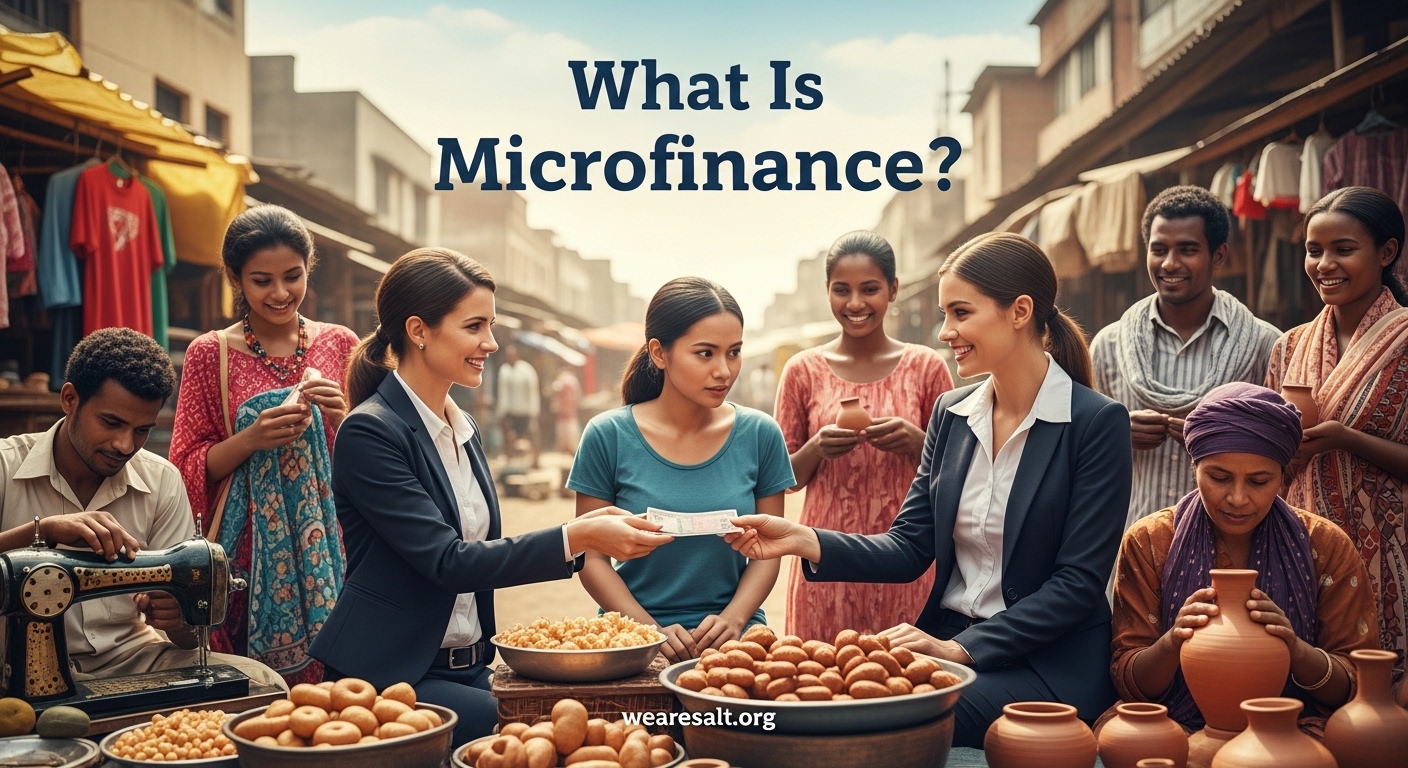
Microfinance refers to financial services including small loans, savings accounts, insurance, and money transfers provided to low-income individuals or groups who lack access to traditional banking.
I have spent years researching financial inclusion initiatives, and microfinance consistently stands out as one of the most impactful tools for poverty alleviation. In 2026, approximately 1.7 billion adults worldwide remain unbanked, lacking access to basic financial services that many of us take for granted.
This guide will walk you through everything you need to know about microfinance. You will learn how it works, who benefits from it, and why it has become a cornerstone of global development efforts. Whether you are a student researching financial inclusion, a professional in the nonprofit sector, or simply curious about how small loans can change lives, this article will give you a comprehensive understanding.
Table of Contents
What Is Microfinance?
Microfinance is a banking service delivered to unemployed or low-income individuals who otherwise have no access to traditional financial services. The term encompasses a broad range of financial products designed specifically for people living in poverty or those excluded from conventional banking systems.
The core principle of microfinance is simple: small amounts of money can help people break the cycle of poverty. A $100 loan might seem insignificant to many, but for a woman in rural Bangladesh wanting to buy a sewing machine, it can be the difference between subsistence and building a sustainable business.
Microfinance institutions (MFIs) provide several key services. These include microcredit for business and personal needs, savings facilities that encourage financial discipline, microinsurance products that protect against health emergencies or crop failures, and money transfer services that help families support each other across distances.
The History and Evolution of Microfinance
Modern microfinance traces its origins to the 1970s in Bangladesh. Dr. Muhammad Yunus, an economics professor, discovered that local craftsmen were trapped in debt cycles because they borrowed small amounts from moneylenders at exorbitant rates. In 1976, he personally lent $27 to 42 craftspeople, proving that small loans could make a significant difference.
This experiment led to the founding of Grameen Bank in 1983. Yunus developed the group lending methodology where borrowers formed small groups and guaranteed each other’s loans. This social collateral proved remarkably effective, with repayment rates exceeding those of traditional banks.
By the 1990s, microfinance had spread globally. Organizations like FINCA International, Opportunity International, and Accion International adapted the model for different contexts. The United Nations declared 2026 the International Year of Microcredit, recognizing its potential for poverty reduction.
Today, microfinance has evolved beyond simple lending. Digital technology has transformed how services are delivered, with mobile banking and fintech integration making financial inclusion possible even in remote areas. The industry now serves over 200 million clients worldwide.
How Does Microfinance Work?
Microfinance operates on principles fundamentally different from traditional banking. Understanding these mechanics helps explain why this model succeeds where conventional finance has failed.
Group Lending and Social Collateral
The group lending model forms the backbone of many microfinance programs. Five to ten borrowers form a group, and each member receives an individual loan. However, the entire group is responsible if any member defaults. This creates powerful social pressure to repay.
This solidarity lending approach replaces traditional collateral requirements. In conventional banking, borrowers need assets like land or property to secure loans. Microfinance clients typically lack such assets. Group responsibility becomes the collateral, and it works surprisingly well. Repayment rates in microfinance often exceed 95%, higher than many commercial banks.
The 5 Cs of Credit in Microfinance
Microfinance institutions evaluate borrowers using modified credit assessment criteria known as the 5 Cs:
Character: The borrower’s reputation, trustworthiness, and willingness to repay. Field officers assess this through community interviews and observing the borrower’s standing in their community.
Capacity: The borrower’s ability to repay based on their income and existing obligations. Unlike traditional banks requiring salary slips, MFIs evaluate business potential and cash flow from informal activities.
Capital: The borrower’s personal investment in their business. Even small contributions demonstrate commitment and reduce risk.
Collateral: In microfinance, this often takes the form of group guarantees or community backing rather than physical assets. Some MFIs accept household items as collateral.
Conditions: The external factors affecting the borrower’s ability to repay, including market conditions, seasonality of income, and local economic factors.
Repayment Structure and Schedules
Microfinance loans typically require weekly or bi-weekly repayments rather than monthly installments. This frequent schedule aligns with how poor entrepreneurs generate income through daily sales. It also allows for early detection of repayment problems.
Loans usually start small, perhaps $50 to $100, and increase with each successful repayment cycle. This progressive lending builds trust and repayment history. Interest rates vary widely by region and institution but generally range from 20% to 70% annually, which reflects the high administrative costs of processing small loans.
Types of Microfinance Services
While microcredit gets the most attention, modern microfinance encompasses a comprehensive suite of financial services. These offerings address the diverse needs of low-income clients.
Microcredit and Microloans
Microcredit remains the flagship product. These small loans typically range from $50 to $1,000 and fund income-generating activities. Borrowers use them to buy inventory, equipment, livestock, or raw materials. Loan terms usually run from 6 to 24 months.
Some MFIs offer emergency loans for medical expenses or education costs. These may have different terms than business loans. Agriculture loans often align repayment schedules with harvest cycles, recognizing the seasonal nature of farming income.
Savings Accounts
Many microfinance institutions emphasize savings alongside borrowing. Clients can deposit small amounts daily or weekly, building financial cushions for emergencies or future investments. These accounts often pay minimal interest but provide security unavailable at home.
Forced savings requirements accompany many microcredit programs. Borrowers must save a percentage of their loan amount or make regular deposits as a condition of borrowing. This builds financial discipline and creates a buffer against repayment difficulties.
Microinsurance
Microinsurance protects low-income families against specific risks. Health microinsurance covers medical expenses and hospitalization. Crop insurance protects farmers against weather-related losses. Life insurance provides payouts to families when breadwinners die.
Premiums are designed to be affordable, sometimes costing just a few dollars annually. Coverage amounts match the economic realities of poor households. These products prevent families from falling back into poverty when unexpected events occur.
Money Transfers and Mobile Banking
Domestic and international remittances represent a vital service for poor families. Migrants working in cities or abroad send money home through MFIs, often at lower costs than traditional wire services. In 2026, mobile money platforms have revolutionized this space.
Mobile banking allows clients to access services through their phones, eliminating the need to travel to branch offices. This innovation has dramatically expanded financial inclusion, particularly in sub-Saharan Africa and South Asia.
Microfinance vs Traditional Banking
Understanding the differences between microfinance and traditional banking clarifies why each serves different populations. These distinctions explain why microfinance was necessary in the first place.
Traditional banks require collateral, credit history, and stable income proof. Their business model depends on lending larger amounts to minimize transaction costs relative to loan size. They cannot profitably serve clients needing $100 loans because the administrative costs would exceed interest income.
Microfinance institutions use group lending and simplified procedures to reduce costs. They employ loan officers who visit clients rather than requiring clients to visit branches. Repayment schedules align with informal income patterns. Interest rates reflect higher administrative costs but remain far below those charged by informal moneylenders.
Traditional banks typically reject applicants without formal employment or property ownership. Microfinance specifically targets these excluded populations, viewing their lack of banking history not as a liability but as a market opportunity.
Who Benefits from Microfinance?
The target demographic for microfinance includes anyone excluded from traditional financial services. However, certain groups have particularly benefited from these programs.
Women Entrepreneurs
Women represent approximately 80% of microfinance clients globally. Traditional societies often exclude women from property ownership, making them ineligible for bank loans. Microfinance group lending does not require individual collateral, opening doors that have historically been closed.
Research consistently shows that women invest loan proceeds in family welfare. They buy food, pay school fees, and improve housing. When women control household finances, children benefit. This gender-focused approach has become a cornerstone of development strategy.
Rural Communities
People living in rural areas face particular challenges accessing banking services. Physical distance from branches, lack of transportation, and seasonal income patterns make traditional banking impractical. Village banking models bring financial services directly to communities.
Farmers use microcredit to buy seeds, fertilizer, and equipment before harvests. Repayment schedules align with agricultural cycles. Livestock loans allow families to build assets gradually. These products acknowledge the realities of rural life.
The Unbanked and Underbanked
Approximately 1.7 billion adults worldwide lack bank accounts. Many more have accounts but rarely use them. Microfinance reaches these populations with appropriate products and delivery methods.
Recent immigrants, refugees, and displaced persons often find themselves without banking access. Microfinance institutions frequently serve these vulnerable populations when traditional banks will not. Flexible documentation requirements and community-based assessment make inclusion possible.
Benefits and Impact of Microfinance
The documented impact of microfinance extends far beyond individual borrowers to families and entire communities. Research and field experience reveal several key benefits.
Financial inclusion represents the most fundamental impact. Access to formal financial services replaces reliance on informal moneylenders who often charge monthly interest rates exceeding 10%. Borrowers gain dignity and agency when they can access fair financial services.
Income generation creates upward mobility. Small loans enable entrepreneurs to expand businesses, hire helpers, and increase profits. Over time, successful microenterprises can grow into small businesses employing multiple people.
Women’s empowerment transforms communities. When women control economic resources, their status in families and societies improves. Girls stay in school longer. Family health outcomes improve. Gender-based violence often decreases when women have economic independence.
Repayment rates demonstrate the model’s effectiveness. Despite serving high-risk populations without collateral, MFIs maintain repayment rates between 90% and 98%. This success challenges assumptions about the poor being unreliable borrowers.
Criticisms and Challenges
Despite its successes, microfinance faces legitimate criticism. Understanding these challenges provides a balanced view of the industry.
High interest rates concern many observers. Annual rates of 30% to 70% seem exploitative compared to commercial bank rates. However, these rates reflect the reality of serving dispersed, low-income clients with small transactions. Administrative costs per loan remain high regardless of loan size. Critics argue rates should be capped, while proponents warn that caps would exclude the poorest borrowers.
Over-indebtedness has emerged as a problem in some markets. When multiple MFIs operate in the same area, borrowers sometimes take loans from several institutions simultaneously. Without centralized credit bureaus, debt burdens can become unsustainable.
Coercive collection practices have been documented in some institutions. Group pressure, while generally positive, occasionally becomes excessive. Public shaming and asset seizure have occurred, though these practices are condemned by responsible MFIs.
Impact measurement remains challenging. While success stories abound, rigorous studies show mixed results regarding poverty reduction. Some research suggests microfinance helps the moderately poor more than the extremely poor. Critics argue that structural economic issues require policy solutions, not just individual lending.
Digital Transformation in Microfinance
Technology is reshaping microfinance in 2026 in unprecedented ways. Digital innovation promises to reduce costs, expand reach, and improve services.
Mobile money platforms have revolutionized financial access. In Kenya, M-Pesa demonstrated that poor populations will adopt digital financial services when properly designed. Clients can deposit, withdraw, and transfer money using basic mobile phones. Transaction costs have plummeted compared to traditional methods.
Digital lending algorithms now assess creditworthiness using alternative data sources. Mobile phone usage patterns, utility payments, and social network data supplement traditional credit scoring. This innovation extends financial access to populations previously excluded even from microfinance.
Fintech partnerships combine the outreach of MFIs with the efficiency of technology companies. Traditional microfinance institutions are investing heavily in digital transformation to remain competitive. The future likely holds a hybrid model combining personal relationships with technological efficiency.
Blockchain technology offers possibilities for transparent record-keeping and identity verification. Smart contracts could automate loan disbursement and repayment. While still emerging, these innovations may further reduce costs and increase transparency.
Frequently Asked Questions
What is microfinance in simple words?
Microfinance is banking for people who cannot access regular banks. It provides small loans, savings accounts, and other financial services to low-income individuals, especially those in developing countries, who lack collateral or credit history. The goal is to help people start businesses, support their families, and escape poverty.
Does microfinance need to be paid back?
Yes, microfinance loans must be repaid according to agreed schedules. Most microfinance programs have high repayment rates above 90% because they use group lending where members guarantee each other’s loans. Repayment terms are usually weekly or bi-weekly rather than monthly, and borrowers often start with small amounts that increase over time as they build repayment history.
What is an example of microfinance?
Grameen Bank in Bangladesh, founded by Muhammad Yunus, is the most famous example of microfinance. Kiva is another well-known example, operating as a crowdfunding platform where individuals can lend money to entrepreneurs in developing countries. FINCA International and Opportunity International are also major microfinance institutions operating globally.
What are the 5 C’s of microfinance?
The 5 Cs are Character (reputation and trustworthiness), Capacity (ability to repay based on income), Capital (personal investment in the business), Collateral (often group guarantees or community backing rather than physical assets), and Conditions (external factors affecting repayment like market conditions and seasonality).
What exactly is microfinance?
Microfinance refers to financial services including small loans (microcredit), savings accounts, microinsurance, and money transfer services provided to low-income individuals or groups who lack access to traditional banking. It typically serves the unbanked, including women entrepreneurs, rural poor, and small business owners in developing economies.
What is the difference between a bank and a microfinance?
Traditional banks require collateral, credit history, and stable income, and typically make larger loans. Microfinance institutions serve clients without these requirements, offering smaller loans using group guarantees instead of collateral, simplified documentation, and repayment schedules aligned with informal income patterns. Interest rates are higher in microfinance to cover administrative costs.
Conclusion
What is microfinance? It is a powerful tool for financial inclusion that has transformed millions of lives since Muhammad Yunus made his first loans in Bangladesh nearly 50 years ago. By providing banking services to those excluded from traditional finance, microfinance enables entrepreneurship, empowers women, and creates pathways out of poverty.
The model is not without challenges. High interest rates, over-indebtedness concerns, and questions about impact measurement require ongoing attention. However, the fundamental insight remains valid: poor people are capable of building better lives when given access to fair financial services. The 90%+ repayment rates prove that the poor are bankable when approached with appropriate products and respect.
As digital technology continues transforming the industry, microfinance will likely reach even more people in the coming years. Whether you are considering supporting a microfinance initiative, researching the field, or simply expanding your knowledge of global development, understanding how microfinance works gives you insight into one of the most significant social innovations of our time.
Financial inclusion remains one of the most pressing challenges in global development. With 1.7 billion adults still unbanked, microfinance will continue playing a vital role in building a more equitable world where everyone has access to the tools they need to thrive.