
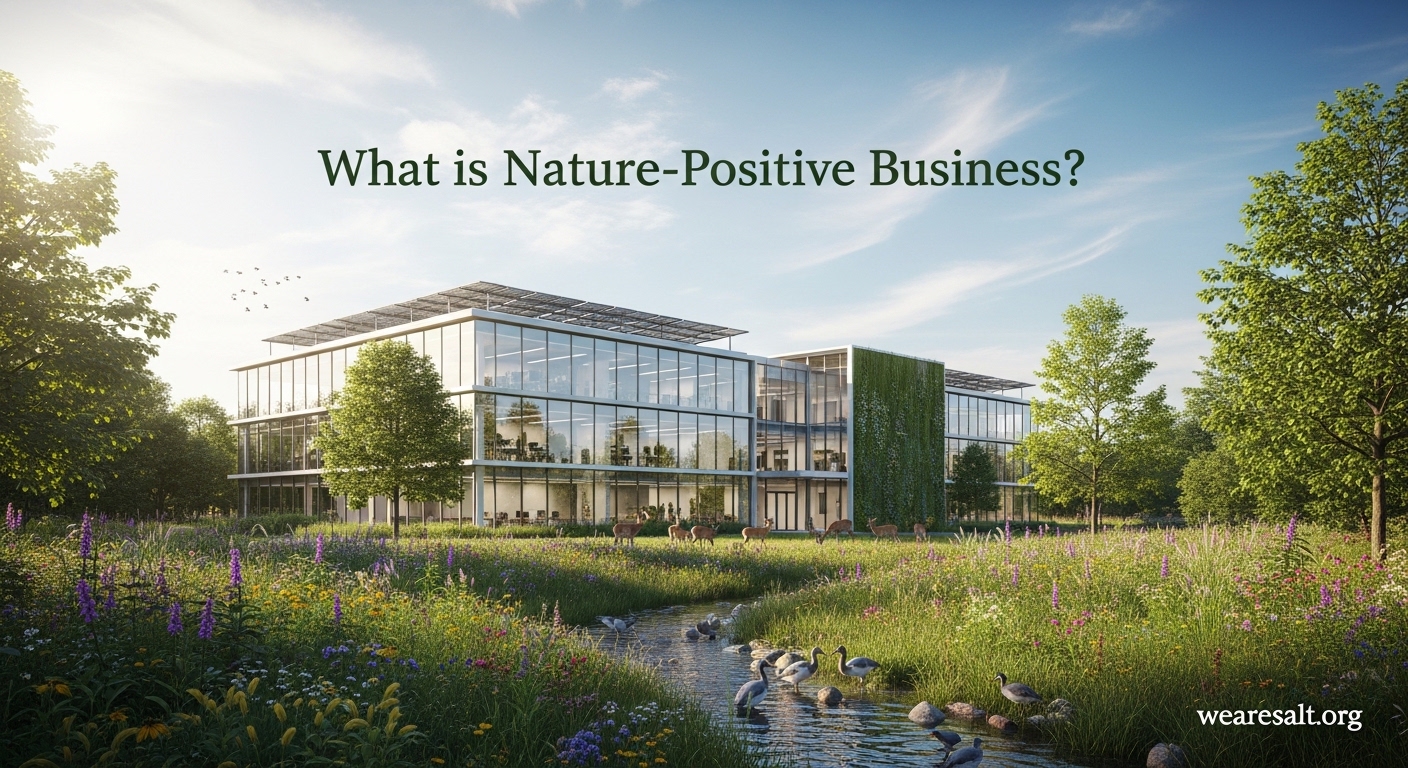
A nature-positive business actively works to restore and regenerate the natural world, moving far beyond simply reducing harm to creating measurable benefits for biodiversity. This approach has become essential for companies seeking long-term resilience in 2026.
The concept comes from the global goal adopted by nearly 200 countries: halt and reverse nature loss by 2030 on a 2020 baseline, and achieve full recovery by 2050. For business leaders, this represents both a responsibility and an opportunity to reshape operations for a changing world.
In this guide, we will explore exactly what nature-positive business means, why it differs from other sustainability frameworks, and how organizations of any size can start their journey toward genuine environmental regeneration.
Table of Contents
What Is Nature-Positive Business?
Nature-positive business means contributing to the restoration and regeneration of the natural world rather than simply extracting from it. The formal definition adopted by the Nature Positive Initiative states the goal is to “halt and reverse nature loss by 2030 on a 2020 baseline, and achieve full recovery by 2050.”
Traditional corporate sustainability often focused on doing less harm. Companies aimed to minimize their negative footprint, reduce waste, and lower emissions. Nature-positive flips this paradigm entirely. Instead of asking “How do we reduce our damage?” companies ask “How do we leave nature better than we found it?”
This means businesses must assess their impacts across land use, water use, pollution, and biodiversity. They then implement strategies that enhance ecosystem health, support species recovery, and regenerate natural resources. The shift requires moving from defensive compliance to proactive regeneration.
A nature-positive business might restore degraded land, eliminate pesticides that harm pollinators, redesign products to eliminate plastic pollution, or invest in habitat creation. The key metric is whether the world is measurably better because that business exists.
The Global Goal for Nature and the Kunming-Montreal Framework
The Kunming-Montreal Global Biodiversity Framework, adopted in December 2022, established the global goal for nature. This landmark agreement brought together 188 governments to address the crisis facing our planet’s living systems. It represents the biodiversity equivalent of the Paris Agreement on climate change.
The framework sets clear and ambitious targets. By 2030, nations must halt and reverse biodiversity loss, protecting 30% of land and sea areas while restoring 30% of degraded ecosystems. By 2050, ecosystems should be in recovery, with nature’s capacity to provide essential services fully restored. This timeline gives businesses just five years to transform their relationship with the natural world.
The triple planetary crisis drives this urgency. Climate change, nature loss, and pollution together threaten over half of global GDP. The World Economic Forum estimates that $44 trillion of economic value depends on nature. Without healthy ecosystems, supply chains collapse, food security fails, water scarcity spreads, and economies destabilize.
The Kunming-Montreal Framework specifically calls on businesses to monitor and disclose their risks and impacts on biodiversity. It encourages sustainable supply chains and the elimination of harmful subsidies. These provisions create both obligations and opportunities for forward-thinking companies.
Nature-Positive vs Net-Zero vs Carbon Neutral: What Is the Difference?
These three terms get used interchangeably in casual conversation, but they describe fundamentally different approaches to environmental responsibility. Understanding the distinction matters for setting clear business strategies and avoiding greenwashing accusations.
Net-zero focuses exclusively on greenhouse gas emissions. A net-zero business balances the carbon it releases with the carbon it removes from the atmosphere through reduction measures and carbon capture. This is essential for climate stability but does not address biodiversity loss, water depletion, soil degradation, or ecosystem health.
Carbon neutral is similar to net-zero but typically relies more heavily on offsetting. Companies pay to reduce emissions elsewhere rather than transforming their own operations. This can mean buying carbon credits from forestry projects while continuing to emit at home. Critics argue this allows business as usual under a green banner.
Nature-positive encompasses a broader scope. It addresses biodiversity loss, ecosystem degradation, water pollution, land use change, and habitat destruction. A company could be net-zero while still destroying rainforests, depleting water tables, or eliminating pollinators through pesticide use. Nature-positive requires holistic attention to all impacts on living systems.
The frameworks complement each other rather than competing. The most resilient businesses in 2026 will pursue both net-zero and nature-positive strategies together. Climate action and nature restoration are interdependent. Healthy ecosystems store carbon. Stable climates support biodiversity. Both are necessary for a sustainable future.
Why Nature-Positive Business Matters in 2026
Over half of the world’s economic output depends on nature. Agriculture, construction, food and beverages, and pharmaceuticals all rely directly on natural inputs. When ecosystems fail, businesses face immediate operational risks that no amount of financial engineering can solve.
Regulatory pressure is mounting rapidly. The Taskforce on Nature-related Financial Disclosures (TNFD) released its final recommendations in 2023, creating a comprehensive framework for reporting nature-related risks and opportunities. The European Union’s Nature Restoration Law requires member states to reverse ecosystem degradation across their territories. Similar legislation is spreading globally, from the UK to Brazil to Singapore.
ESG ratings increasingly weigh biodiversity factors. Major rating agencies now assess how companies manage their interface with nature. Investors want visibility into nature-related risks and how companies address them. Early adopters of nature-positive strategies gain competitive advantage in capital markets and lower their cost of capital.
Consumer expectations have shifted too. People want to support businesses that leave the world better, not merely less damaged. Companies that authentically commit to nature-positive outcomes build stronger brand loyalty, attract top talent, and command pricing power in competitive markets. The business case for nature-positive action grows stronger every year.
How to Become a Nature-Positive Business: The Six Building Blocks
The World Business Council for Sustainable Development developed a practical framework for nature-positive action. These six building blocks guide businesses from initial assessment through complete transformation. They work for multinationals and small businesses alike.
Step 1: Assess and Prioritize
Start by mapping your business’s interface with nature. Where does your supply chain touch land, water, and living systems? Which operations depend on ecosystem services like clean water, pollination, or stable climates? The LEAP approach (Locate, Evaluate, Assess, Prepare) provides a structured method for this analysis.
Prioritize by materiality and risk. Focus first on operations in biodiversity hotspots, supply chains with high ecosystem impacts, and dependencies that would cripple your business if disrupted.
Step 2: Commit
Set science-based targets for nature. Make public commitments aligned with the global goal of halting and reversing nature loss by 2030. Join initiatives like Business for Nature or the Science Based Targets Network. Public accountability drives internal action and signals seriousness to stakeholders.
Commitments should be specific, measurable, and time-bound. Avoid vague promises like “we care about nature.” Instead, commit to measurable outcomes like “we will achieve net-positive biodiversity impact in our operations by 2030.”
Step 3: Measure and Value
You cannot manage what you do not measure. Implement systems to track impacts on biodiversity, water quality, soil health, and ecosystem function. Natural capital accounting helps quantify the value of nature to your business and the value your business provides to nature.
Measurement should cover direct operations, supply chains, and product use phases. Use established frameworks like the Natural Capital Protocol or ENCORE to ensure consistency and comparability.
Step 4: Act Through the Mitigation Hierarchy
Follow the established sequence: avoid impacts where possible, minimize those you cannot avoid, restore affected ecosystems, and offset remaining impacts as a last resort. This hierarchy ensures genuine positive outcomes rather than greenwashing.
Avoidance means not developing in critical habitats or sourcing from deforested areas. Minimization means reducing resource use and pollution. Restoration means healing degraded lands. Offsets should only be used for truly unavoidable impacts.
Step 5: Transform
Redesign value chains, products, and business models. This is where deep change happens. It might mean switching to regenerative suppliers, redesigning packaging to eliminate plastic, creating products that actively restore ecosystems, or shifting business models toward sharing and circularity.
Transformation requires innovation. Some of the most successful nature-positive companies have found that rethinking their relationship with nature sparks new products, services, and revenue streams.
Step 6: Disclose and Report
Transparency builds trust. Report progress using frameworks like TNFD or GRI. Share both successes and challenges. Disclosure creates accountability and helps other businesses learn from your experience.
Good disclosure includes quantitative metrics, qualitative narrative, and future targets. Acknowledge where you are still developing capabilities. Honesty about challenges enhances credibility more than pretending perfection.
Nature-Positive Strategies for Small and Medium Businesses
Large corporations dominate the headlines, but small and medium businesses form the backbone of most economies. The good news is that nature-positive action is accessible regardless of company size. In fact, smaller organizations often move faster because they lack the bureaucratic inertia of massive enterprises.
Start with quick wins that cost little but matter. Eliminate single-use plastics in operations. Switch to renewable energy suppliers. Source from local producers to reduce transport emissions and support regional ecosystems. Plant native species on company grounds or sponsor local restoration projects.
Engage employees in nature restoration. Volunteer days for local habitat projects build culture while creating tangible benefits. Even small teams can make measurable differences in local biodiversity. These activities also improve employee satisfaction and retention.
Focus on your direct sphere of influence. A small business may not transform global supply chains, but it can choose suppliers carefully, reduce waste, and engage customers in nature-positive behaviors. These actions scale when thousands of businesses participate together.
Cost concerns are valid but often overstated. Many nature-positive shifts reduce expenses over time. Energy efficiency, waste reduction, and sustainable sourcing typically lower operational costs after initial transition periods. Government incentives and green financing options increasingly support these transitions.
Small businesses should also consider partnerships. Joining local business associations, industry coalitions, or community restoration initiatives amplifies impact while sharing costs. No business needs to tackle nature-positive transformation alone.
Implementation Challenges and How to Overcome Them
Greenwashing accusations pose a real risk in the nature-positive space. When companies claim environmental benefits without evidence, they damage their reputation and undermine the broader movement. The solution is radical transparency. Share specific targets, report progress honestly, and avoid vague marketing claims that cannot be substantiated.
Measurement remains genuinely difficult. Unlike carbon accounting, where one tonne of CO2 equals another, biodiversity metrics are complex and location-specific. A species lost in one region cannot be replaced by the same species thriving elsewhere. Start with available frameworks and improve methodologies over time as standards evolve.
Supply chain complexity overwhelms many businesses. Large companies have thousands of suppliers across dozens of countries. Mapping nature impacts through these networks requires significant resources. Begin with tier-one suppliers and high-risk commodities. Expand coverage as systems mature rather than trying to solve everything at once.
Short-term costs can deter action. Some nature-positive investments pay back quickly through efficiency gains. Others require longer time horizons to show returns. Frame these as resilience investments rather than expenses. The cost of inaction, measured in disrupted supply chains, regulatory penalties, and reputational damage, exceeds the cost of transition.
Skepticism from stakeholders sometimes blocks progress. Some investors view nature-positive commitments as distractions from profit maximization. Some employees see sustainability as empty corporate rhetoric. Address these concerns with clear business cases, authentic engagement, and early wins that demonstrate tangible benefits.
Frequently Asked Questions
What does Nature Positive mean for business?
For businesses, nature-positive means actively contributing to the restoration and regeneration of the natural world beyond simply reducing harm. It involves assessing impacts on biodiversity, setting science-based targets to halt and reverse nature loss by 2030 on a 2020 baseline, and transforming operations to create positive outcomes for ecosystems. This approach requires moving from defensive compliance to proactive regeneration.
What is the Nature Positive business model?
The nature-positive business model follows six building blocks: assess and prioritize nature impacts across operations and supply chains; commit to science-based targets aligned with the 2030 global goal; measure and value outcomes using natural capital accounting; act through the mitigation hierarchy of avoid, minimize, restore, offset; transform value chains, products, and business models; and disclose progress transparently using frameworks like TNFD.
What is the concept of Nature Positive?
Nature-positive is a global societal goal defined as halting and reversing nature loss by 2030 on a 2020 baseline, and achieving full recovery by 2050. The concept emerged from the Kunming-Montreal Global Biodiversity Framework adopted by 188 governments in 2022. It represents a paradigm shift from damage reduction to active ecosystem restoration, addressing the triple planetary crisis of climate change, nature loss, and pollution.
Who is the CEO of Business for Nature?
Eva Zabey serves as the Executive Director of Business for Nature, a global coalition of organizations and businesses working to accelerate business action on nature. Note that Business for Nature operates as a coalition and campaign effort rather than a traditional company with a CEO. The organization brings together influential businesses and conservation groups to advocate for policy changes that support nature-positive outcomes.
Conclusion
Nature-positive business represents the next evolution of corporate sustainability. Rather than asking how to do less harm, leading companies now ask how to leave nature better than they found it. The global goal is clear: halt and reverse nature loss by 2030, achieve full recovery by 2050. The Kunming-Montreal Framework provides the roadmap. The TNFD offers the reporting mechanisms. What remains is business action.
The six building blocks provide a practical framework for any organization ready to begin. Assess your impacts, commit to targets, measure outcomes, act through the mitigation hierarchy, transform operations, and disclose progress. Whether you lead a multinational corporation or a small local business, nature-positive action is both necessary and achievable in 2026.
The question is no longer whether nature-positive business makes sense. The evidence for economic dependence on nature, regulatory momentum, and stakeholder expectations is overwhelming. The question is how quickly you can begin your journey toward genuine environmental regeneration. The 2030 deadline is approaching fast, and the businesses that start today will be the leaders of tomorrow.