
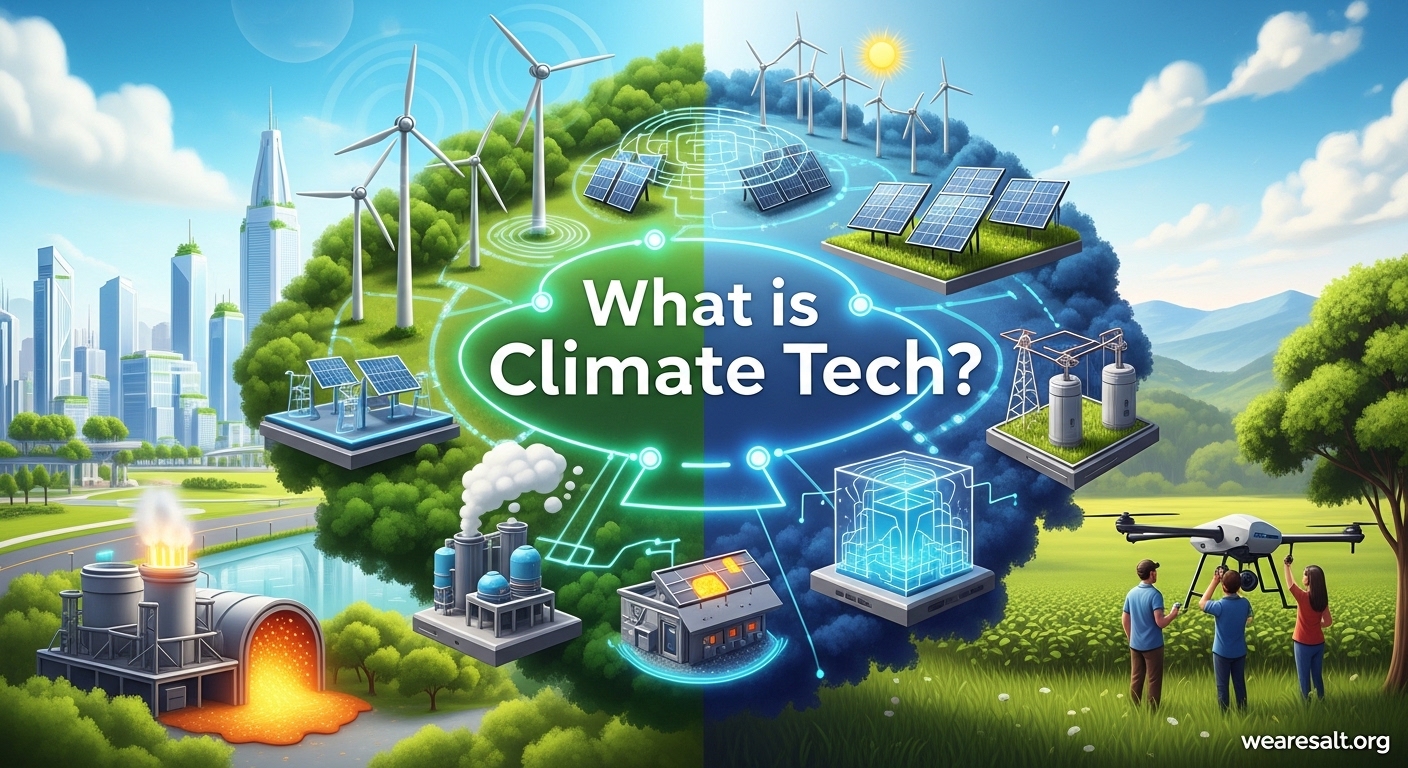
The climate crisis demands immediate action. Every year we delay, the challenge grows more complex and the solutions more urgent. This reality has sparked a global movement focused on one critical question: what is climate tech and how can it help us build a sustainable future?
Climate tech represents the technological solutions designed to reduce greenhouse gas emissions, remove carbon from the atmosphere, and help communities adapt to climate change impacts. It spans everything from solar panels and electric vehicles to advanced carbon capture systems and climate prediction algorithms. These innovations form the backbone of our energy transition and offer a pathway to decarbonization.
In this guide, I will walk you through the full scope of climate technology. You will learn the five key areas driving innovation today, see real-world examples of these technologies in action, understand why 2026 is a pivotal year for climate solutions, and discover career opportunities in this rapidly growing field.
Table of Contents
What Is Climate Tech?
Climate tech (short for climate technology) refers to technological innovations specifically designed to address the climate crisis. This includes solutions that reduce greenhouse gas emissions, actively remove carbon dioxide from the atmosphere, or help human and natural systems adapt to changing climate conditions.
The term emerged as a broader, more comprehensive category than its predecessor, cleantech. While cleantech traditionally focused on clean energy generation and pollution reduction, climate tech encompasses the full spectrum of solutions needed to achieve global climate goals. This includes not just energy, but also industrial processes, agriculture, transportation, and climate adaptation technologies.
Clarifying the Terms: Climate Tech vs Cleantech vs Green Tech
Many people use these terms interchangeably, but important distinctions exist. Cleantech typically refers to technologies that reduce environmental impact across all areas, including water purification and waste management, not just climate specifically. Green tech is often used as a marketing term for environmentally friendly products and services.
Climate tech has a specific focus: addressing climate change through emissions reduction, carbon removal, or adaptation. This narrower scope makes it the most precise term when discussing technologies aimed at meeting Paris Agreement targets and achieving net-zero emissions.
Five Key Areas of Climate Tech
Climate tech operates across five interconnected domains. Each area addresses different sources of emissions and different aspects of the climate challenge. Together, they form a comprehensive approach to sustainability.
Clean Energy and Storage
The energy sector produces the largest share of global greenhouse gas emissions. Clean energy technologies aim to replace fossil fuels with renewable sources and improve how we generate, store, and distribute power.
Solar photovoltaic technology has seen dramatic cost reductions, making it the cheapest electricity source in history. Wind energy, both onshore and offshore, continues to scale with larger, more efficient turbines. Battery storage technology addresses intermittency challenges, allowing renewable energy to provide reliable power even when the sun does not shine or wind does not blow.
Grid modernization represents another critical area. Smart grids use digital technology to optimize electricity distribution, reduce waste, and integrate distributed energy resources like rooftop solar and electric vehicle charging.
Carbon Management
Reducing emissions is essential, but some carbon dioxide will remain in the atmosphere. Carbon management technologies focus on capturing, storing, or utilizing this excess carbon.
Carbon capture and storage (CCS) technologies intercept emissions at their source, such as power plants or industrial facilities, before they enter the atmosphere. Direct air capture (DAC) takes this further by removing carbon dioxide directly from ambient air. These technologies are particularly important for addressing emissions from hard-to-abate sectors like cement and steel production.
Carbon utilization transforms captured carbon into valuable products like synthetic fuels, building materials, or chemicals. This creates economic incentives for carbon removal while reducing the need for virgin fossil resources.
Industrial Decarbonization
Heavy industry accounts for approximately 25% of global carbon emissions. Industrial decarbonization technologies aim to transform manufacturing processes to eliminate or drastically reduce their carbon footprint.
Green hydrogen offers a promising alternative to fossil fuels in high-heat industrial processes. Unlike gray hydrogen produced from natural gas, green hydrogen uses renewable electricity to split water into hydrogen and oxygen, producing zero emissions. This technology can decarbonize steel, cement, and chemical production.
Process electrification replaces fossil fuel combustion with electric heating powered by renewable energy. Advanced materials and digital optimization reduce waste and improve efficiency across manufacturing operations.
Sustainable Agriculture and Food
Agriculture contributes approximately 24% of global greenhouse gas emissions through livestock methane, fertilizer use, and land use change. Climate tech solutions in this sector focus on reducing these impacts while maintaining food security.
Precision agriculture uses sensors, drones, and data analytics to optimize water, fertilizer, and pesticide application. This reduces emissions from agriculture while lowering costs for farmers. Alternative proteins, including plant-based meats and cultivated proteins, offer lower-carbon alternatives to traditional livestock farming.
Supply chain optimization technologies track emissions from farm to table, identifying opportunities for reduction and enabling carbon-conscious purchasing decisions.
Climate Intelligence and Adaptation
Even with aggressive emissions reduction, some climate change impacts are now unavoidable. Climate intelligence technologies help predict, monitor, and adapt to these changes.
Advanced climate modeling provides increasingly accurate predictions of temperature changes, extreme weather events, and sea level rise. Risk assessment platforms help businesses, governments, and communities understand their specific vulnerabilities and plan adaptation strategies.
Early warning systems for floods, droughts, and storms save lives and reduce economic losses. Ecosystem monitoring technologies track biodiversity, deforestation, and ocean health, informing conservation and restoration efforts.
Real-World Examples of Climate Tech
Climate technology is already transforming everyday life. Understanding these concrete examples helps illustrate the breadth and impact of climate solutions.
Consumer applications include electric vehicles with rapidly improving range and declining prices, heat pumps that efficiently heat and cool homes using electricity instead of fossil fuels, and smart thermostats that optimize energy use automatically. Rooftop solar combined with home battery storage allows households to generate and store their own clean power.
Industrial applications include massive offshore wind farms generating gigawatts of clean electricity, green hydrogen production facilities powering steel mills, and direct air capture plants removing thousands of tons of carbon dioxide annually. Electric arc furnaces for steel production and alternative cement formulations reduce emissions from construction materials.
Agricultural innovations include vertical farming systems that grow crops indoors using 95% less water, precision irrigation systems that apply water only where needed, and methane-reducing feed additives for livestock. Satellite-based crop monitoring helps farmers optimize yields while minimizing environmental impact.
Data and AI applications include platforms that track corporate emissions across supply chains, algorithms that optimize renewable energy grid integration, and machine learning models that predict climate risks for insurance and investment decisions.
Why Climate Tech Matters in 2026
The urgency for climate solutions has never been greater. The window for limiting warming to 1.5 degrees Celsius is rapidly closing, making 2026 a critical year for accelerating deployment of climate technologies.
The year 2030 represents a scientifically significant milestone. According to the Intergovernmental Panel on Climate Change, global emissions must fall by 45% from 2010 levels by 2030 to have a reasonable chance of limiting warming to 1.5 degrees. Missing this target does not mean giving up, but it does mean facing more severe impacts and requiring even steeper reductions afterward.
Beyond environmental necessity, climate tech represents a massive economic opportunity. The energy transition will require trillions of dollars in investment over the coming decades. This spending creates jobs, drives innovation, and builds new industries. Countries and companies leading in climate technology position themselves for economic success in a low-carbon world.
The climate crisis also demands equity considerations. Climate tech must address not just emissions reduction but also adaptation and resilience, particularly for vulnerable communities already experiencing climate impacts. Technologies that improve air quality, enhance food security, and provide clean energy access deliver benefits beyond carbon reduction.
Careers in Climate Tech
The climate tech sector is creating job opportunities across diverse fields. Whether you are an engineer, policy expert, finance professional, or communicator, pathways exist to contribute to climate solutions.
Engineering roles dominate the technical side, with high demand for electrical, mechanical, chemical, and software engineers. Data scientists and AI specialists develop climate models, optimize renewable energy systems, and analyze emissions data. Research scientists advance breakthrough technologies in materials science, chemistry, and biology.
Business and finance professionals play critical roles in scaling climate technologies. Venture capitalists and impact investors fund early-stage companies. Project finance experts structure deals for renewable energy installations and carbon capture facilities. Operations and supply chain managers ensure climate technologies reach market at competitive costs.
Policy and communications experts shape the enabling environment for climate tech. Regulatory specialists navigate complex permitting processes. Policy advocates build support for climate legislation. Communications professionals translate technical concepts for public understanding.
Climate tech roles typically offer competitive compensation comparable to traditional tech and energy sectors. Many professionals report high job satisfaction from working on meaningful problems. Educational backgrounds vary, with many successful climate tech professionals transitioning from adjacent industries through self-study and specialized programs.
Frequently Asked Questions
What does climate tech mean?
Climate tech refers to technological solutions designed to reduce greenhouse gas emissions, remove carbon dioxide from the atmosphere, or help communities adapt to climate change impacts. It encompasses innovations across energy, industry, agriculture, transportation, and climate adaptation.
What are examples of climate tech?
Examples include electric vehicles, solar panels, wind turbines, battery storage systems, carbon capture technology, heat pumps, precision agriculture systems, green hydrogen production, climate modeling software, and sustainable alternative proteins.
What’s the difference between cleantech and climate tech?
Cleantech is a broader category encompassing all technologies that reduce environmental impact, including water purification and waste management. Climate tech specifically focuses on addressing climate change through emissions reduction, carbon removal, and adaptation. While overlapping, climate tech has a narrower scope targeting the climate crisis directly.
Why is 2030 the point of no return?
2030 represents a critical milestone because the Intergovernmental Panel on Climate Change states global emissions must fall by 45% from 2010 levels by 2030 to limit warming to 1.5 degrees Celsius. Missing this target makes achieving climate goals significantly harder and increases the severity of climate impacts.
Does climate tech pay well?
Climate tech generally offers competitive salaries comparable to traditional technology and energy sectors. Engineering, data science, and finance roles often pay at or above market rates. Many professionals also report high job satisfaction from contributing to meaningful climate solutions. Compensation varies by role, experience level, and company stage.
Conclusion
Climate tech represents our best toolkit for addressing the defining challenge of our time. From renewable energy and carbon capture to sustainable agriculture and climate adaptation, these technologies offer concrete pathways to reduce emissions and build resilience.
Understanding what is climate tech helps us recognize both the scale of the challenge and the scope of available solutions. The five key areas I have outlined demonstrate that climate innovation is not limited to a single technology or sector. It requires coordinated progress across energy, industry, agriculture, and intelligence systems.
The urgency is real, but so is the opportunity. 2026 marks a pivotal moment where climate technology is maturing rapidly, costs are falling, and deployment is accelerating. Whether you are considering a career in this space, making investment decisions, or simply seeking to understand the solutions available, climate tech offers a lens for seeing how human ingenuity can rise to the climate challenge.