
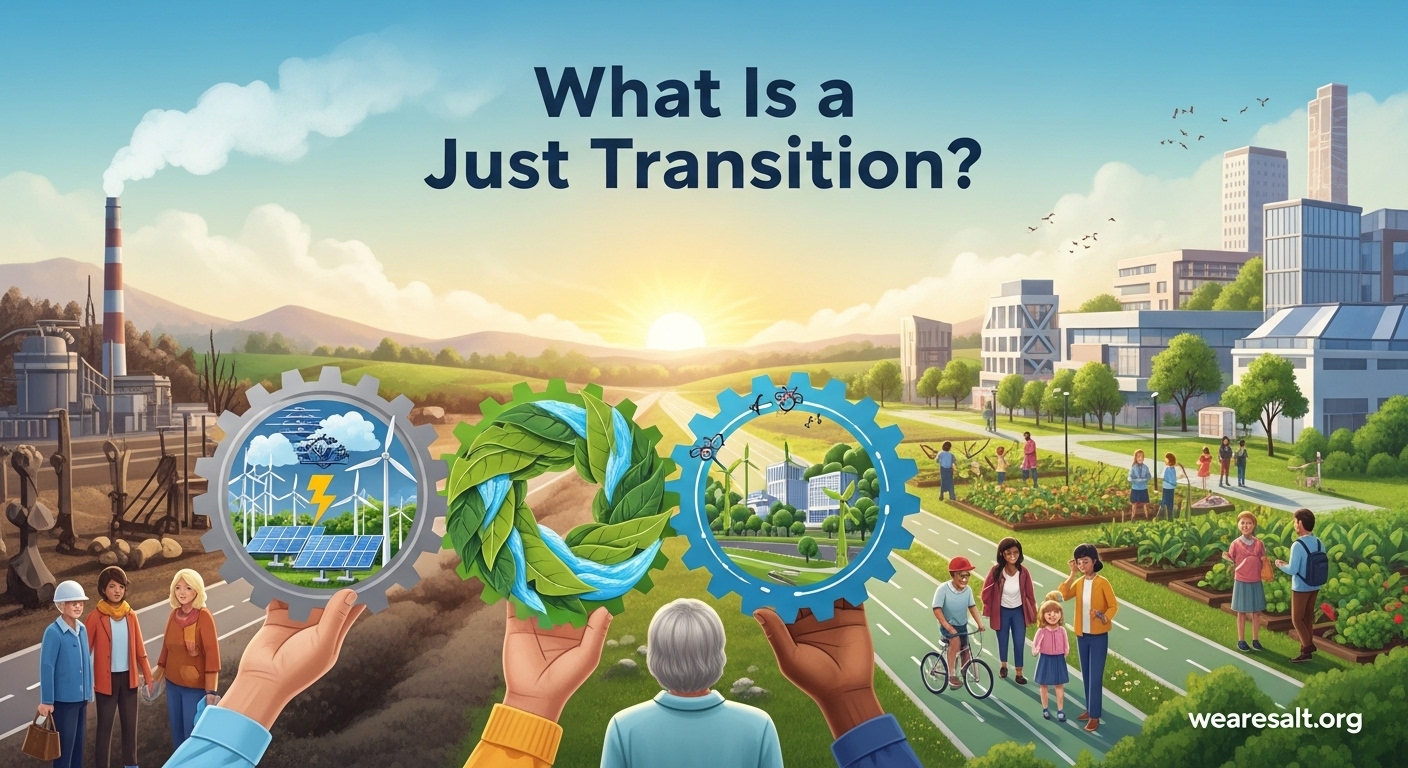
A just transition means greening the economy in a way that is as fair and inclusive as possible to everyone concerned, creating decent work opportunities and leaving no one behind. This definition from the International Labour Organization (ILO) has become the foundation for how governments, businesses, and communities approach the massive economic shifts required to address climate change.
In this guide, I will walk you through everything you need to understand about just transition. We will explore where the concept came from, why it has become urgent in 2026, the key principles that make it work, and real examples from countries that are leading the way.
Whether you are a worker wondering what the shift to renewable energy means for your job, a policymaker designing climate programs, or simply someone who cares about fairness in the face of climate change, this article will give you a clear understanding of what a just transition really means.
Table of Contents
What is Meant by a Just Transition?
The ILO definition I opened with captures the essence well, but let us unpack what it really means in practice. A just transition is not just about protecting jobs in polluting industries. It is about ensuring that the shift to a net zero economy creates better opportunities for everyone while supporting those who face disruption.
Think of it this way: climate change forces us to transform how we produce energy, manufacture goods, and move people around. Without careful planning, these changes could throw millions of workers into unemployment, devastate entire communities built around fossil fuel industries, and widen the gap between rich and poor. A just transition approach aims to prevent that harm while building a cleaner, more equitable economy.
The concept connects closely to climate justice. While climate justice focuses broadly on how climate change and responses to it affect different groups unequally, just transition specifically addresses the fairness of moving away from fossil fuels. It asks: how do we phase out coal, oil, and gas without abandoning the workers and communities who depend on them?
Key aspects of a just transition include creating good-quality green jobs, providing income support and retraining for displaced workers, ensuring communities have a voice in planning processes, and directing public investment toward affected regions. It also means recognizing that some communities have borne the environmental and health costs of fossil fuel extraction for decades, and they deserve support and investment as those industries decline.
The Origins of Just Transition: From Labor Movement to Climate Policy
The term “just transition” has been around since the 1980s, when it emerged from the labor movement in the United States. Back then, trade unions used the concept to advocate for workers who were being displaced by new environmental regulations, particularly around water and air pollution controls affecting industrial jobs.
The idea was straightforward but revolutionary for its time: environmental protection and workers’ rights do not have to be in conflict. Done right, environmental policies could actually improve working conditions and create new opportunities. The just transition framework gave unions a way to support environmental goals while fighting for their members’ livelihoods.
Throughout the 1990s and early 2000s, the concept evolved as globalization and trade agreements displaced manufacturing workers in developed countries. Labor advocates pushed for transition assistance programs, retraining funding, and early retirement options for workers who lost jobs to offshoring. These experiences shaped how later climate transition policies would be designed.
The breakthrough for climate policy came around 2015 with the Paris Agreement. For the first time, a major international climate treaty explicitly referenced just transition. The preamble recognized “the imperatives of a just transition of the workforce and the creation of decent work and quality jobs in accordance with nationally defined development priorities.” This brought the concept from labor advocacy into mainstream climate diplomacy.
Since 2015, just transition has become embedded in climate policy frameworks worldwide. The ILO developed its Guidelines for a Just Transition in 2015, giving governments and social partners a practical roadmap. The European Union made just transition a pillar of its Green Deal. Scotland established a Just Transition Commission. South Africa developed a comprehensive Just Energy Transition Partnership. By 2026, just transition has moved from a labor movement slogan to a central principle of climate governance.
Why Just Transition Matters Now
We are at a critical moment in 2026. The science tells us that global emissions must fall dramatically by 2030 to keep warming within manageable limits. Many experts identify 2030 as a point of no return because beyond that, the physical impacts of climate change accelerate and the costs of adaptation become exponentially higher.
This urgency means we must scale up climate action faster than ever before. Renewable energy deployment must triple. Coal power must be phased out in wealthy countries within years, not decades. Electric vehicles need to replace internal combustion engines. Buildings must be retrofitted for efficiency at unprecedented speed.
But here is the challenge: if this rapid transition is perceived as unfair, it will face political backlash that could derail climate progress entirely. We have already seen this dynamic play out. The gilets jaunes protests in France began partly in response to fuel tax increases seen as burdensome to working people. Political movements defending fossil fuel jobs have gained traction by exploiting legitimate fears about economic security.
Just transition matters because it builds the social license for climate action. When workers and communities see that their concerns are being addressed, they become allies rather than opponents. When transition plans include concrete support for affected regions, those regions can become champions of change rather than strongholds of resistance.
The economic case is equally compelling. Managing transition poorly costs more in the long run. Unemployment benefits, healthcare costs from stress and depression, and lost tax revenue from shuttered industries create fiscal burdens. Social conflict and political instability carry their own costs. By investing upfront in just transition, governments save money and build stronger economies.
The Four Pillars of Just Transition
The ILO framework for just transition rests on four key pillars. Understanding these helps explain how just transition works in practice and what policies are needed to support it.
1. Social Dialogue
Social dialogue means involving workers, employers, and governments in planning the transition together. It is not enough for policymakers to design climate policies and then announce them to affected communities. Real consultation must happen early and often.
Social dialogue creates better policies because the people who know industries best are the people working in them. It builds trust because communities see their voices matter. And it produces more durable outcomes because policies have broad buy-in from stakeholders.
Effective social dialogue requires strong labor unions and employer organizations, institutional mechanisms for consultation, and genuine commitment from governments to listen and adapt plans based on feedback. It also means going beyond formal consultation to include community meetings, citizen assemblies, and other participatory processes.
2. Decent Work
Decent work means jobs that provide fair wages, safe conditions, social protection, and respect for workers’ rights. The transition to a green economy must create jobs that meet these standards, not low-wage, precarious employment.
This pillar recognizes that simply replacing a coal mining job with a poorly paid solar installation gig is not a just outcome. The new green economy needs to offer real improvements in job quality, not just quantity. That means unionized positions with benefits, training and advancement opportunities, and safe working conditions.
Decent work also means ensuring that emerging industries respect labor rights from the start. Renewable energy sectors have sometimes been criticized for labor practices that fall short of standards in traditional utilities. Getting this right early helps build sustainable industries.
3. Social Protection
Social protection covers the safety net that supports workers and communities through transition. This includes unemployment benefits, healthcare coverage, pensions, and income support during retraining periods.
No transition will be perfectly smooth. Some workers will face periods between jobs. Others may need to relocate. Older workers may need bridge benefits to reach retirement. Social protection ensures that temporary hardship does not become permanent poverty.
Strong social protection systems also reduce fear, which is important because fear drives resistance to change. When workers know they will not lose their homes or healthcare if their plant closes, they are more willing to engage constructively with transition planning.
4. Inclusion and Stakeholder Engagement
The final pillar recognizes that just transition affects more than just formal workers. It includes communities, informal workers, women, youth, indigenous peoples, and others who may be impacted by or benefit from the economic transformation.
Inclusion means deliberately reaching out to groups that are often marginalized in policy processes. It means gender-responsive policies that address how women experience transition differently. It means considering how indigenous communities with traditional land relationships are affected by new energy projects. And it means ensuring that communities hosting polluting industries get support, not just blame, as those industries close.
Who is Involved in Making Just Transition Happen?
Just transition requires coordination across many actors. No single group can deliver it alone. Here is how different stakeholders contribute.
Governments
National and regional governments set the policy framework for just transition. They develop climate targets that drive economic change, allocate public funding for transition programs, and establish the social protection systems that support workers.
Governments also play a coordinating role, bringing together different ministries, facilitating dialogue between employers and unions, and ensuring that climate, labor, and social policies are aligned. Some governments have created dedicated just transition institutions, like Scotland’s Just Transition Commission, to focus attention and resources on these challenges.
Workers and Trade Unions
Workers and their unions are central to just transition, both as affected parties and as advocates. Unions bring worker perspectives into policy discussions, negotiate transition agreements with employers, and help members access retraining and support services.
Many unions have developed sophisticated positions on climate policy, recognizing that their members’ long-term interests lie in a stable climate while insisting that the path there must protect livelihoods. Unions have been instrumental in winning just transition commitments from governments and employers.
Businesses
Businesses shape transition through their investment decisions, employment practices, and participation in social dialogue. Companies in declining industries can manage workforce reductions responsibly or destructively. Companies in growing green sectors can offer decent jobs or race to the bottom on wages and conditions.
Some forward-thinking businesses have embraced just transition as part of their social license to operate. They recognize that treating workers well during transition builds community support, attracts talent, and reduces reputational risk. Others have been dragged toward just transition practices by union pressure and government requirements.
Communities
Communities, especially those historically dependent on carbon-intensive industries, are both stakeholders and advocates. Community organizations often push for just transition funding and attention, organize affected residents, and monitor whether promised benefits materialize.
Communities also play a planning role. Effective transition plans need local knowledge about what kinds of new industries might thrive, what infrastructure investments are needed, and what social services require strengthening. Top-down plans that ignore community input tend to fail.
International Organizations
Bodies like the ILO, United Nations Development Programme, and World Bank provide guidance, technical assistance, and funding for just transition efforts. They help spread best practices across countries, develop assessment tools, and mobilize climate finance for transition programs.
International institutions also create norms and expectations. When the ILO publishes guidelines or when the Paris Agreement references just transition, it signals to governments and businesses that this is a legitimate and important concern.
What Are Examples of Just Transition Policies?
Theory is important, but concrete examples show what just transition looks like in practice. Here are several country cases that illustrate different approaches.
Canada: Managing Coal Phase-Out
Canada committed to phasing out coal-fired electricity by 2030, affecting several provinces with significant coal mining and power generation employment. The federal government established a Just Transition Task Force for Canadian Coal Power Workers and Communities to advise on how to manage this shift fairly.
The task force recommended expanding employment insurance benefits, creating community transition centers, providing skills training, and making early retirement options available. Canada also allocated funding for infrastructure investment in affected communities and supported economic diversification efforts. The approach recognized that different communities faced different challenges and needed tailored responses.
South Africa: Just Energy Transition Partnership
South Africa relies heavily on coal for electricity and employment, making the energy transition particularly challenging. In 2021, South Africa announced a Just Energy Transition Partnership (JETP) with France, Germany, the United Kingdom, the United States, and the European Union, backed by $8.5 billion in international funding.
The JETP aims to accelerate South Africa’s decarbonization while supporting affected workers and communities. It includes financing for renewable energy deployment, grid infrastructure, electric vehicles, and skills development. South Africa developed an implementation plan that prioritizes social inclusion, labor rights, and community benefits. The partnership represents a new model for international cooperation on just transition in developing countries.
Germany: Coal Commission and Structural Transformation
Germany established a Commission on Growth, Structural Change and Employment in 2018 to plan its coal phase-out. The commission included representatives from government, industry, unions, environmental groups, and affected regions. After months of negotiation, it produced a consensus plan to end coal power by 2038 at the latest.
The plan included 40 billion euros in structural support for coal regions, funding for early retirement and retraining for workers, and commitments to replace coal jobs with new employment in clean industries and other sectors. The commission process demonstrated that even contentious transitions could be negotiated successfully when stakeholders were genuinely involved.
Scotland: Institutionalizing Just Transition
Scotland has taken a proactive approach by establishing a Just Transition Commission in 2018 and embedding just transition principles in its climate change legislation. The commission advises the Scottish government on managing the shift to net zero in ways that are fair for all.
Scotland’s approach includes regional just transition plans developed with local input, funding for community-led economic development, and attention to the specific needs of North Sea oil and gas workers as that industry declines. The Scottish model shows how small countries can develop comprehensive just transition governance frameworks.
Obstacles to Achieving Just Transition and How to Overcome Them
Despite growing commitment to just transition, significant obstacles remain. Understanding these challenges helps identify solutions.
Funding Constraints and Allocation Concerns
Just transition requires substantial public investment, and funding is always limited. There are legitimate concerns about whether money reaches the right people. Forum discussions reveal skepticism that public funds sometimes flow to large corporations rather than directly supporting workers and communities.
Solution: Transparent funding mechanisms with community oversight. Direct cash support to affected workers. Community benefit agreements that guarantee local hiring and procurement. Independent monitoring of fund allocation. Scotland’s approach of publishing detailed regional transition plans with public input offers one model.
Worker Exclusion from Planning
Despite rhetorical commitments to stakeholder engagement, workers and communities are sometimes excluded from meaningful participation in transition planning. Plans get developed by consultants and announced as fait accompli.
Solution: Institutionalized social dialogue with real decision-making power for stakeholders. Legal requirements for consultation before major policy changes. Community benefit agreements negotiated between developers and local representatives. Participatory budgeting that gives communities direct control over transition funding.
Job Security Uncertainty
Workers facing transition often cannot see what comes next. Will retraining lead to real jobs? Will new industries locate in their communities? Uncertainty creates anxiety and resistance.
Solution: Job guarantees for transition programs. Advance commitments from employers to hire retrained workers. Place-based economic development strategies that bring new industries to affected regions. Bridge employment programs that provide paid work during retraining periods. Germany’s approach of guaranteeing no worker would be left without support offers a strong example.
Monitoring and Accountability Gaps
It is difficult to track whether just transition promises are being kept. Are workers actually getting jobs? Are communities seeing investment? Without good data, accountability suffers.
Solution: Robust monitoring frameworks with publicly reported indicators. Independent evaluation of transition programs. Community-based monitoring that supplements official statistics. Regular reporting requirements tied to continued funding. The frameworks developed by organizations like the World Resources Institute provide templates for comprehensive monitoring.
Political Resistance and Short-Term Thinking
Just transition requires upfront investment for long-term gain. Politicians focused on immediate electoral cycles may prefer to delay difficult transitions or avoid spending on support programs.
Solution: Bipartisan or cross-party commitments to just transition institutions that survive government changes. Legislated rights for workers and communities that constrain future policy choices. International commitments that create reputational costs for backsliding. Independent commissions with long mandates that transcend electoral cycles.
FAQ
What is meant by a just transition?
A just transition means greening the economy in a way that is as fair and inclusive as possible to everyone concerned, creating decent work opportunities and leaving no one behind. This ILO definition captures the core idea: ensuring that the shift to a net zero economy protects workers, supports communities, and shares benefits fairly rather than leaving some groups to bear the costs of change.
What are the 4 pillars of just transition?
The four pillars are: 1) Social dialogue – involving workers, employers, and governments in planning together; 2) Decent work – creating good-quality jobs with fair wages and safe conditions in the green economy; 3) Social protection – providing safety nets like unemployment benefits and retraining support; 4) Inclusion and stakeholder engagement – ensuring marginalized groups and communities have voice in transition processes.
Why is 2030 the point of no return?
2030 is identified as critical because global emissions must fall dramatically by then to keep warming within manageable limits. Beyond this point, physical climate impacts accelerate and adaptation costs rise exponentially. This urgency makes just transition essential in 2026 – rapid climate action is needed, but it must be fair to maintain public support and avoid political backlash that could derail progress.
What are examples of just transition policies?
Examples include: Canada’s coal phase-out task force with expanded benefits and community transition centers; South Africa’s $8.5 billion Just Energy Transition Partnership with international partners; Germany’s 40 billion euro structural support package for coal regions negotiated through a multi-stakeholder commission; and Scotland’s Just Transition Commission that institutionalizes fairness principles in climate planning. These show different models for supporting workers and communities through economic transformation.
What Is a Just Transition? Key Takeaways and Next Steps
Throughout this guide, we have explored what a just transition really means and why it matters so much in 2026. Let me summarize the key points that I hope you will take away.
First, just transition is about fairness in the face of necessary economic change. The climate crisis requires us to transform how we produce and consume energy. Doing that fairly means protecting workers, supporting communities, and ensuring the benefits of green growth reach everyone.
Second, the concept has deep roots in the labor movement but has evolved into a mainstream climate policy principle. From its origins in 1980s union advocacy to its inclusion in the Paris Agreement and national climate plans, just transition has become an essential framework for managing economic transformation.
Third, the four pillars provide a practical guide: social dialogue brings stakeholders together, decent work ensures quality employment, social protection provides safety nets, and inclusion makes sure no one is left out of planning processes.
Fourth, real examples prove this can work. Canada’s coal transition task force, South Africa’s international partnership, Germany’s consensus-based commission, and Scotland’s institutional approach all show different ways to put just transition into practice.
Fifth, obstacles remain but they can be overcome. Funding concerns, worker exclusion, job security fears, and accountability gaps are real challenges. Transparent processes, genuine stakeholder engagement, job guarantees, and robust monitoring provide pathways forward.
What can you do with this knowledge? If you are a worker in a carbon-intensive industry, get involved in your union or community organization. Make sure your voice is heard in transition planning. If you are an employer, engage proactively with workers on transition plans and commit to decent job standards in new operations. If you are a policymaker, prioritize social dialogue and invest in the social protection systems that make transitions manageable.
If you are a citizen, support political leaders who take just transition seriously. Ask candidates how they will protect workers and communities in the shift to net zero. Vote for those with concrete answers. Follow the progress of just transition initiatives in your region and hold leaders accountable for delivering on promises.
The transition to a sustainable economy is not optional. Climate science makes that clear. What is optional is whether we manage that transition fairly. A just transition is both a moral imperative and a practical necessity. Without it, climate action faces political resistance that could doom our chances of avoiding the worst climate impacts. With it, we build the broad coalitions needed for rapid decarbonization while creating better livelihoods for millions of people.
I believe we can get this right. The examples in this guide prove that just transition is not just theory – it is happening in real places with real benefits for real people. The challenge now is to scale these approaches, improve them based on experience, and make just transition the standard for all climate policy in 2026 and beyond.