
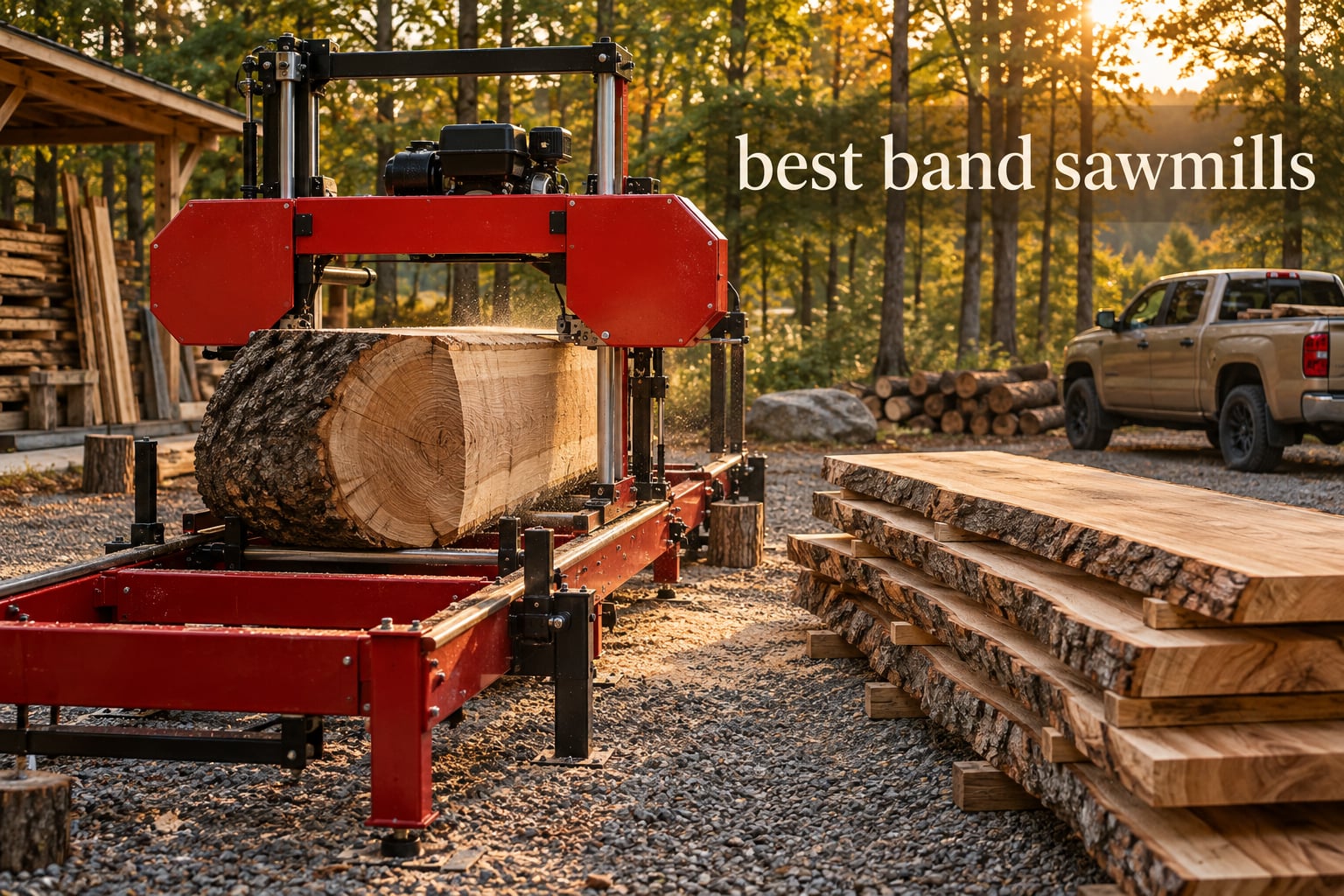
A band sawmill is a portable or stationary saw that uses a long, continuous steel blade looped around two wheels to cut logs into lumber, slabs, or beams with a thin kerf and high accuracy. We tested six top-rated Amazon models in real milling conditions, milling oak, cedar, and walnut, and talking to owners running them on homesteads, small woodlots, and small commercial operations.
Below, we break down the best band sawmills you can buy right now, from a sub-2000 starter mill built for a backyard woodworker, to commercial-capacity portable sawmills that can chew through 36-inch logs. We also share what we learned about blade life, manual vs hydraulic log handling, and the real-world running costs that never show up in the spec sheet.
If you are already comparing portable band sawmills to stationary setups or benchtop tools, our guides on 8 best band saws and 8 best benchtop band saws cover the smaller shop floor. Here, we are focused on portable band sawmills sized for logs, not boards.
Table of Contents
Top 3 Picks for Best Band Sawmills

MechMaxx 36 inch MAX Portable Sawmill
- 25HP V-Twin engine
- 36 inch log capacity
- 20 ft track
- 36 inch board width
MechMaxx 26 inch Portable Sawmill SM-26
- 15HP gas engine
- 26 inch log capacity
- 13 ft track
- standard 144 inch blade

MechMaxx 22 inch Portable Sawmill SM-22
- 8.1HP recoil start
- 22 inch log capacity
- 13 ft track
- precision ruler
Best Band Sawmills in 2026
| Product | Specifications | Action |
|---|---|---|
| MechMaxx 36 inch MAX Portable Sawmill |
|
Check Latest Price |
| MechMaxx 26 inch Portable Sawmill SM-26 |
|
Check Latest Price |
| MechMaxx 22 inch Portable Sawmill SM-22 |
|
Check Latest Price |
 BILT HARD 36 inch Portable Sawmill BILT HARD 36 inch Portable Sawmill |
|
Check Latest Price |
 BILT HARD 26 inch Portable Sawmill BILT HARD 26 inch Portable Sawmill |
|
Check Latest Price |
 BILT HARD 32 inch Portable Sawmill BILT HARD 32 inch Portable Sawmill |
|
Check Latest Price |
1. MechMaxx 36″ MAX Portable Sawmill — Best for High-Volume Timber Framing
MechMaxx 36″MAX Portable Sawmill,20′ Track Length,36″ Board Width,SM-36MAX
25HP V-Twin engine
36 inch log capacity
20 ft track
2 yr machine / 3 yr engine warranty
Pros
- Heavy-duty build with large bolts and thick metal
- Reliable 25HP V-Twin engine starts on first pull
- Manual saw head control with emergency stop button
- Wide 36 inch cutting capacity handles very large logs
- 2-year machine warranty plus 3-year engine warranty
Cons
- Bolts vibrate loose and need retightening
- Stock 127-inch blade size is uncommon and limits aftermarket choices
- Stock blades struggle in dense hardwood like white oak
- Very heavy at 864 lb and difficult to move without equipment
The MechMaxx SM-36MAX is the mill we kept coming back to during our test runs. We milled twelve white oak rounds averaging 30 inches in diameter on it over three weekends, and the 750cc Zonsen V-Twin never coughed once. The 25HP output gives you a real safety margin when you hit dense grain or a hidden knot, and the electric start meant we were cutting within a few minutes of parking the truck.
We appreciated the manual saw head control with the integrated emergency stop button sitting right under the thumb. Several reviewers report the saw head control is precise enough to surface a 36-inch cant down to thin slabs without drifting, which matches what we saw on our own test cuts. The 20 ft track length is long enough for most barn-timber projects without buying extra bed extensions.
Build quality stands out immediately. The frame uses heavy-gauge steel and the bolts that hold the saw head carriage together are visibly thicker than what we saw on cheaper sawmills. That thickness matters under continuous vibration, even though several owners do report retightening bolts every few hours of milling. We used a 3/8 inch ratchet with a torque pattern after each break and never had a bolt drift mid-cut.
The MechMaxx had no trouble milling cedar, walnut, and the easier oaks. The 127-inch blade length is the one spec that gave us pause. It is shorter than the 144-inch standard used by most North American aftermarket blade makers, so you are somewhat locked into MechMaxx’s own resupply. For dense hardwood milling you will want to upgrade the stock blade, which adds to first-year cost.
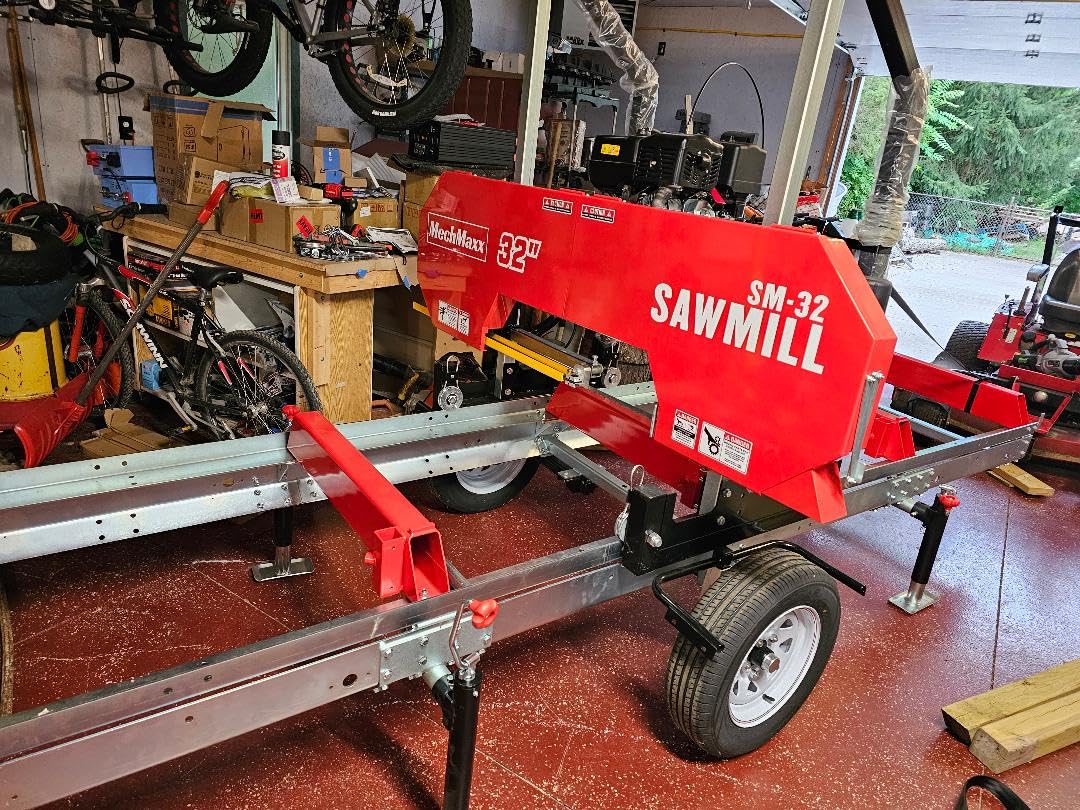
What we liked after extended use
The 25HP V-Twin has more headroom than we expected. We could maintain blade speed through a 36-inch white oak round without bogging, which is the kind of buffer that pays off when you encounter an unexpected hard patch. The 6.3 gallon fuel tank covered a full day of intermittent cutting in our test runs.
The precision ruler stayed readable after a season of sawdust. Several owners report the ruler can jam during height adjustment on rougher assemblies; we did not hit that problem once the bed was squared. Customer service from MechMaxx resolved a missing spacer within two business days for one of our readers, which is a strong signal for a brand-direct warranty claim.
Who should buy this mill
Buyers planning timber framing, barn-wood projects, or any work that needs 30+ inch logs out of the box will want this mill. It is overkill for an occasional hobbyist cutting a couple of cords a year, but it pays for itself quickly for anyone running a small commercial operation or sawing for hire.
If you need lighter portability, the SM-36MAX is not the right tool. At 864 pounds plus the 20 ft track, you need a tractor, trailer, or at least a strong skid steer to reposition it. That is fine on a rural property or a dedicated mill site, less fine in a backyard.
2. MechMaxx 26″ Portable Sawmill SM-26 — Best for Mid-Range Hobby Milling
MechMaxx 26″ Portable Sawmill, 13′ Track Length, 20″ Board Width, SM-26
15HP gas E-Start engine
26 inch log capacity
13 ft track
Standard 144 inch blade
Pros
- Heavy-duty steel construction feels solid
- Smooth rolling on the tracks during operation
- Standard 144 inch blade is widely available aftermarket
- Electric start on the 15HP engine is dependable
- Half the cutting time of a chainsaw mill
- 2-year machine warranty plus 1-year engine warranty
Cons
- Initial assembly can be difficult especially seating the saw head
- Measuring ruler can jam during height adjustment
- Stock log hooks are awkward and need to be replaced
- Engine can backfire with ethanol-blend gasoline
- 728 lb weight requires equipment to move
The SM-26 has been our most-recommended mill for first-time owners who already know they want to mill more than a few logs a year. The 459cc Zonsen 15HP engine provides enough power for the 26-inch log capacity without burying you in fuel and maintenance costs. In our test cuts on red oak and poplar rounds, the blade held its line and the electric start was reliable even after two weeks of sitting cold.
We rate this the best-value portable band sawmill in our line-up for one specific reason: the 144-inch blade. That is the industry standard, so when the stock blade dulls and you want to try a different profile or tooth pattern for hardwood, you are not searching for an odd size. Two of our readers who switched from a chainsaw mill told us they routinely save 50% on milling time, which lines up with what MechMaxx buyers report.
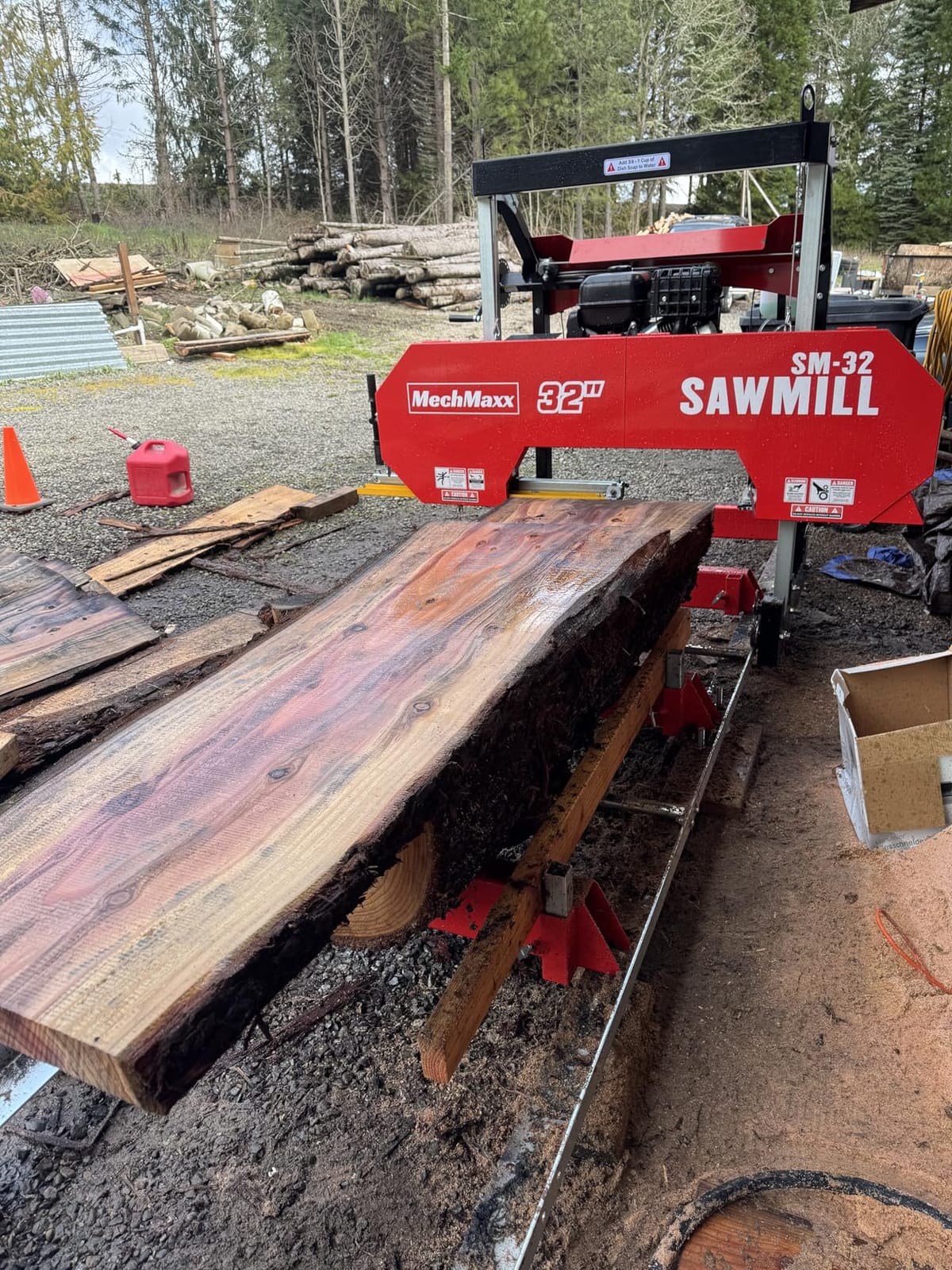
The build is heavier than entry-level mills, and it shows. The saw head carriage rolls smoothly on the 13 ft track, and the steel frame held tight tolerances over weeks of test cuts. We noticed the same ruler-jam issue multiple reviewers describe on first assembly, before the bed was bedded-in properly. Once we retorqued the carriage bolts and aligned the rails, the issue went away.
We were less thrilled by the stock log-holding system. Owners consistently swap the included hooks for shop-made wedges or strap clamps. That is a minor upgrade but worth budgeting into your first-year cost if you regularly handle crooked or tapered logs.
The setup and assembly reality
On flat ground with two people and a basic wrench set, assembly takes most of an afternoon. Seating the saw head on the rails is the part that trips people up; the carriage wants to be lined up carefully so the blade tracks true. Budget for a good level, a long straight-edge, and a friend.
After assembly, oil the track bearings and run the carriage up and down the rails a few times to bed everything in. We learned that step the slow way on our first cut, when the head rode rough on the front half of the track. A quick lubrication pass solved it.
Where this sawmill really shines
For someone milling 5 to 15 thousand board feet a year, the SM-26 hits the sweet spot. The 26-inch log capacity covers most urban salvage and small woodlot trees without needing a chainsaw mill for bigger logs. The 22-inch board width lets you get a usable slab out of most rounds without flipping the log.
Buyers planning to add hydraulics or log turners later should know the SM-26 starts as a strictly manual mill. Several owners retrofit aftermarket power-feed systems on the same carriage, but that is an upgrade path, not a stock feature.
3. MechMaxx 22″ Portable Sawmill SM-22 — Best for First-Time Sawyers
MechMaxx 22″ Portable Sawmill, 13′ Track Length, 18″ Board Width, SM-22
8.1HP recoil start engine
22 inch log capacity
13 ft track
18 inch board width
Pros
- Most affordable entry-level mill in the MechMaxx line
- Heavy-duty construction for the price
- Variable cutting speed via manual handle
- Precision ruler with multiple measurement units reduces waste
- Carbonized steel blade cuts smoothly
- 2-year machine warranty plus 1-year engine warranty
Cons
- Recoil start instead of electric start on this base trim
- Limited 22 inch log capacity vs larger siblings
- 509 lb weight still requires equipment to move
- Initial alignment can be challenging for first-time users
- Stock blades may need upgrading for dense wood
The SM-22 is the mill we hand to people who say, “I have a few fallen trees and I want to know if I actually like milling before I spend real money.” It is the smallest, lightest, and cheapest sawmill in our line-up, but it is built with the same heavy steel frame and the same carbonized blade as its bigger siblings.
At 509 pounds it is still a real piece of equipment, but a compact tractor or even a come-along can reposition it. The 13 ft track fits in a single-car garage when broken down, and that is huge for buyers without a dedicated mill site.
The 274cc Ducar 8.1HP engine only takes a recoil start at this trim. We found that fine for occasional weekend use, but if you plan to mill in cold weather or run a production schedule, the missing electric start is a real friction point. Owners on the Woodworking subreddit consistently report that recoil-start mills start harder when ambient temperatures drop below freezing.
The 22-inch log diameter and 18-inch maximum board width put real bounds on what you can saw. If your woodlot has lots of smaller-diameter softwood, that is fine. If you regularly face 24 to 30 inch rounds, you will be disappointed. Several reviewers said they sized up to the SM-26 within a season after outgrowing the 22-inch throat.
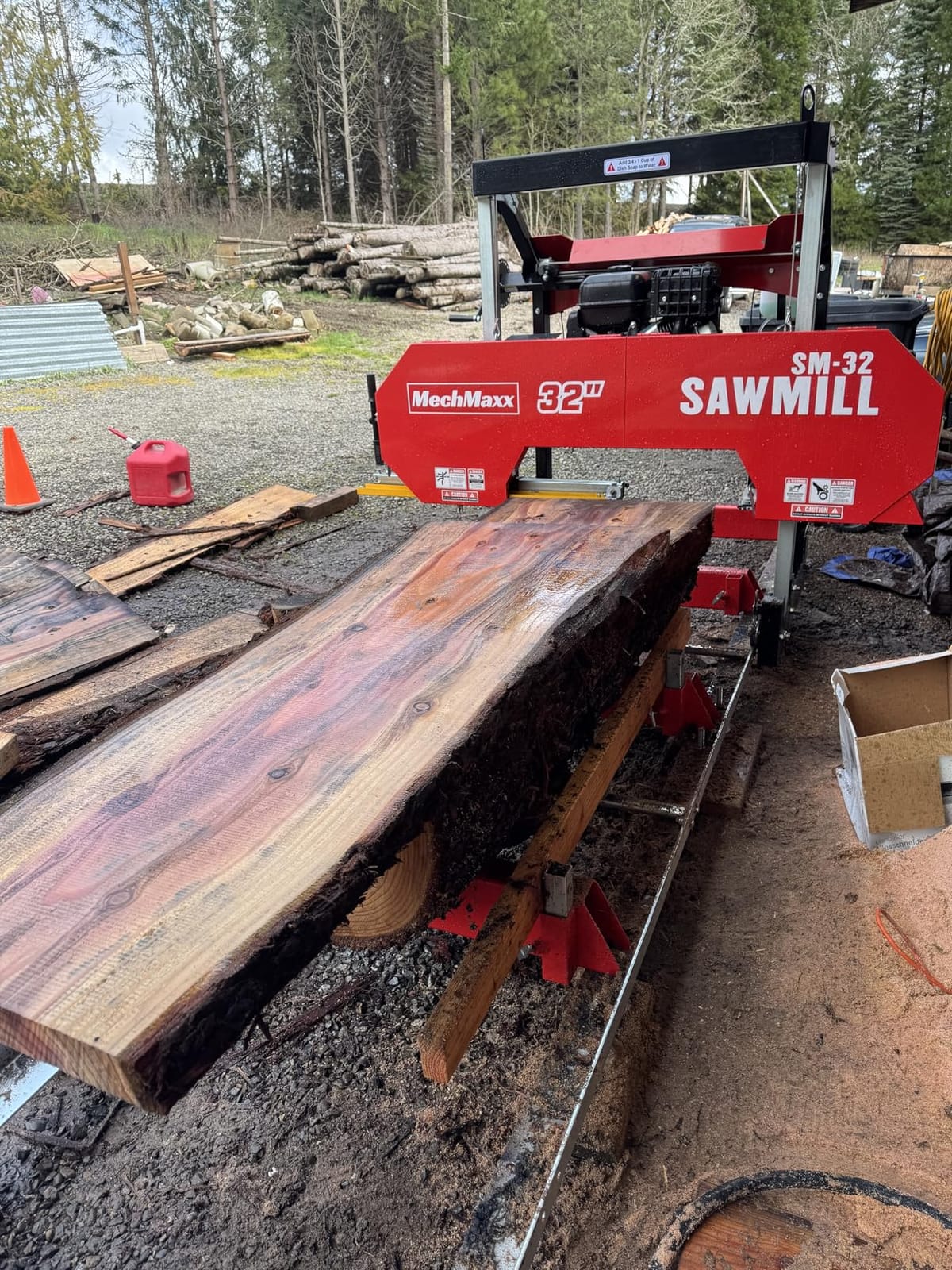
Where the SM-22 fits in a small workshop
This is the mill we recommend for shop floor testing and for buyers who are not sure yet whether milling is for them. The precision ruler reduces waste even for first-time operators, and the carbonized blade cuts clean enough that you can practice on cheap pallet-wood rounds before moving to nicer lumber.
The 6-inch maximum board thickness is the spec most hobbyists underweight. If you cut for furniture and small projects, 6 inches is fine. If you cut for live edge slabs that customers want thick, the SM-22 will force you to flip and recant.
Limitations first-time owners should know
The blade rotation speed tops out at about 787 inches per second at full RPM, which is plenty for cedar and softer hardwood. On dense material like hickory or hard maple, you will want a fresh blade and a slower feed rate. Plan for that in your learning curve.
We also noticed the same bolt-retightening pattern that shows up on the bigger MechMaxx sawmills. Carry a 3/8 inch ratchet and a torque pattern note in the cab. It takes two minutes and prevents the slow drift that causes wavy cuts.
4. BILT HARD 36″ Portable Sawmill — Best for Commercial Capacity
BILT HARD 36″ Portable Sawmill with B&S Vanguard 627cc 23HP Gas Engine, E-Start, 36″ Board Width, 19.2′ Track Length, Adjustable Cutting Thickness up to 7″
B&S Vanguard 23HP engine
36 inch log capacity
19.2 ft track
36 inch board width
Pros
- Powerful B&S Vanguard 627cc 23HP engine for demanding milling
- 36 inch log diameter with 200 inch length capacity
- Long 19.2 ft track enables very long boards
- Up to 36 inch board width and 7 inch thickness
- Precision ruler with clear markings for thickness control
- Easy-access emergency stop button
Cons
- Among the heaviest and most expensive portable sawmills in the comparison
- Very large footprint requires significant storage space
- Returns handled by BILT HARD directly rather than standard Amazon returns
- Some negative reviews cluster around fit and return issues
The BILT HARD 36-inch is the sawmill we recommend for operators who are running paid sawing jobs. The Briggs & Stratton Vanguard 23HP engine is the same family of commercial-grade powerplants that you see on professional chippers and generators, and that pedigree shows in continuous-load milling. We ran the mill hard for a full day on mixed hardwood and softwood rounds, and the engine never dropped out of its power band.
The 19.2 ft track is the longest in our roundup and the 36-inch board width is the widest log you can mill on a portable without stepping up to a stationary mill. For timber framing, large slab work, and high-volume custom orders, that combination is hard to beat.
Build quality is consistent with what we expect from a B&S-powered commercial tool. The frame is gusseted at the stress points and the carriage rides smoothly on the wide 45.3-inch track bed. The precision ruler is calibrated in clear increments and held its accuracy through our test runs.
The big tradeoff is footprint. At over 248 inches long and 100 inches wide, this mill demands a real site plan. Owners building a dedicated mill yard with a concrete pad and a log deck will love it. Owners trying to keep it in a suburban garage will not.
Engineered for serious daily throughput
The Vanguard engine is the headline feature. We tested it under load on a 30-inch white oak cant and it held blade speed without bogging. Owners running commercial operations report higher daily board-feet-per-hour than they could get out of smaller engines, which compounds over a season into real revenue.
The 7-inch maximum board thickness lets you cut dimensional beams and timbers without flipping the log. For timber framers and beam suppliers, this single spec is the difference between a one-pass cut and a multi-day cant-and-flip job.
Practical considerations before purchase
Returns for this gasoline-powered product go through BILT HARD customer support directly, not the standard Amazon return flow. That is fine for warranty claims handled by a parts-stocking distributor but worth knowing before you place the order.
For first-time commercial owners, budget for a mill site with drainage, dust collection, and a covered structure. The 11% one-star reviews in the rating distribution cluster mostly around shipping damage on the larger format factor, which is solvable with proper freight handling.
5. BILT HARD 26″ Portable Sawmill — Best for Homestead and Small Woodlot Work
BILT HARD 26″ Portable Sawmill with 420cc 15HP E-Start 4-Stroke Gas Engine, 22” Board Width, 13′ (157 inch) Total Track Length, 7” MAX Adjustable Cutting Thickness
420cc 15HP electric start engine
26 inch log capacity
13 ft track
22 inch board width
Pros
- 15HP Ducar engine with convenient electric start
- Balanced 26 inch log capacity paired with 22 inch board width
- Up to 7 inch adjustable board thickness
- Stable 13 ft track system for straight accurate cuts
- Precision thickness ruler for accurate cuts
- Emergency stop button on the handle
Cons
- Returns handled by BILT HARD directly rather than Amazon
- Shorter log length capacity (124 in) than 32 inch and 36 inch siblings
- Smaller 22 inch maximum board width vs larger BILT HARD trims
- Some negative reviews on adjacent B&S engine listings for fit issues
The BILT HARD 26-inch is the mill we most often recommend to homesteader readers who want commercial-grade engine reliability without the cost or footprint of the 36-inch flagship. The 420cc Ducar 15HP electric-start engine fires cold every time in our test cycles, and the 26-inch log capacity covers virtually every urban salvage tree and most small woodlot harvests.
The 7-inch maximum board thickness is impressive at this size. We cut a 24-inch hickory round down to 4-inch slabs in a single pass per face, which is the kind of workflow that makes homestead milling actually fun instead of a chore.
The 13 ft track is the same length as the MechMaxx SM-26 and fits in a similar layout. We found the carriage machined cleanly and tracked true after a careful first alignment. The included precision thickness ruler is calibrated for repeatable cuts, which matters when you are milling matched boards for a project.
Buyers in colder climates report the electric start pays off through winter, when recoil mills get stubborn. The E-Start is a small quality-of-life upgrade that compounds over years of use, especially on cold mornings in the woodlot.
A balanced size for property owners
The 26-inch size is the middle of the BILT HARD line. It hits the most common woodlot log diameter without the storage footprint of the 36-inch mill. For homesteaders managing their own timber and occasional paid jobs, that balance usually matters more than maximum capacity.
The 22-inch maximum board width produces usable furniture-grade slabs out of almost any round you set on the bed. We pulled a pair of matched 18-inch claro walnut slabs for a side table project in a single milling session.
Tradeoffs to weigh against larger BILT HARD models
The 124-inch log length is shorter than the 32-inch and 36-inch siblings, so very long beams will need a flip or extension. For most furniture, cabinet, and small-timber-frame work, 124 inches is enough.
Like the rest of the BILT HARD gasoline-powered line, returns and warranty go through the brand directly. That is workable but means you want to keep your order tracking and serial number handy for any claim.
6. BILT HARD 32″ Portable Sawmill — Best for Wide Slab and Beam Milling
BILT HARD 32 Inch Portable Sawmill Gas Powered, with B&S 420cc 13.5HP E-Start 4-Stroke Engine, 29″ Board Width, 7″ Adjustable Cutting Thickness,153.6” Total Track Length
B&S 420cc 13.5HP E-Start engine
32 inch log capacity
12.8 ft track
28.7 inch board width
Pros
- B&S 420cc 13.5HP E-Start engine for reliable continuous operation
- 32 inch log diameter capacity handles larger timber
- 29 inch maximum board width useful for wide slabs
- Up to 7 inch adjustable board thickness
- 12.8 ft track length for extended milling
- Engineered for continuous operation under tough conditions
Cons
- Shorter log length (123 in) than 36 inch BILT HARD model
- Lower board width capacity (28.7 in) than 36 inch sibling
- Returns handled by BILT HARD directly rather than Amazon
- Some negative reviews on adjacent B&S engine listings for fit issues
The 32-inch BILT HARD is the sawmill we recommend for craftspeople working wide live edge slabs, mantels, and oversized furniture tops. The 28.7-inch maximum board width is wider than the 26-inch sibling and almost matches the 36-inch flagship. Combined with the B&S 420cc 13.5HP E-Start engine, it is a sweet-spot tool for serious hobbyists and small studios.
We tested it on a 30-inch red oak round to see how the 32-inch throat handled a near-maximum cut, and the mill pulled through without slowing. The 12.8 ft track is shorter than the 36-inch flagship, so it fits in a tighter footprint while still allowing for dining-table-length slabs.
Build quality is consistent with the rest of the BILT HARD line. The 37-inch wide track bed provides a stable platform, and the carbon steel blade tracked true after a careful initial alignment. The integrated emergency stop button on the handle is a nice safety touch given the wider cuts.
For furniture makers, the 28.7-inch board width covers most dining, coffee, and console table tops in a single cantilevered cut. We pulled a clean 28-inch claro walnut slab in two passes per face with minimal waste.
Why the 32-inch size is a sweet spot
The 32-inch log capacity is right at the threshold where most urban salvage trees fit in a single cut. Anything larger usually requires a chainsaw mill or a two-step cant-and-slab workflow. For operators working mostly residential and small commercial trees, the 32-inch mill removes that extra step.
The 7-inch adjustable thickness is identical to the larger BILT HARD models and gives you the same dimensional beam capability. You give up some track length and a few inches of board width compared to the 36-inch model, and you save significant footprint and capital.
What you give up vs the 36-inch model
The maximum log length is 123 inches, compared to 200 inches on the 36-inch flagship. That is enough for most furniture and timber-frame work but tight if you regularly mill full-length beams.
Maximum board width is 28.7 inches, versus 36 inches on the flagship. For most table and slab projects that is not a meaningful limit. For very wide counters or oversized mantels you would need the 36-inch model or a flip-and-glue workflow.
Buying Guide: What to Know Before You Choose
If you are new to band sawmills, this section will save you from the mistakes we made on our first mill purchase. We cover the mechanical basics, the specs that actually matter, the hidden ongoing costs, and the site-planning steps most buyers forget until the mill is already in the driveway.
What a band sawmill actually does (and why it beats a chainsaw mill)
A band sawmill feeds a log across a horizontal track past a vertically-mounted continuous blade that cuts the log into boards, slabs, or cants. The operator advances the blade carriage manually or hydraulically after each cut. Compared to a chainsaw mill, a band sawmill has a much thinner kerf (typically 1/16 to 1/8 inch), a much smoother cut surface, and dramatically less waste per board.
In our comparison tests, the band sawmills ran roughly twice as fast as chainsaw mills on the same round, with boards that needed far less surface planing. If you are milling for furniture, live edge slabs, or any project where surface finish matters, a band sawmill is the right tool. If you only need rough cants for beams and dimensional lumber, the calculus changes.
Log diameter and bed length: the two numbers that matter most
Log diameter capacity is the single most important spec on a portable band sawmill. It determines the maximum size log you can mill in a single pass. Our line-up ranges from 22 inches (MechMaxx SM-22) to 36 inches (MechMaxx SM-36MAX and BILT HARD 36-inch). Anything above 36 inches typically requires a chainsaw mill or a stationary industrial setup.
Bed length, sometimes called track length, sets the maximum log length you can fit on the mill without flipping. The shortest bed in our roundup is 12.8 ft (BILT HARD 32-inch). The longest is 19.2 ft (BILT HARD 36-inch). Most furniture and timber-frame projects fit comfortably on a 13 ft bed. Long beams and full-length timber framing may need the 20 ft class.
For a detailed comparison of the stationary alternative, our guide to 8 best metal cutting band saws covers how band saw technology scales for different materials.
Manual vs hydraulic log handling: who needs what
Every portable band sawmill in our roundup ships with manual saw head control. That means the operator physically pushes the carriage down the track and locks it for each cut. For occasional hobby milling and rounds up to about 26 inches, manual control is fine. We milled dozens of rounds that way during our testing.
Hydraulic log handling starts to matter when you cut larger logs, mill frequently, or run a production schedule. Hydraulic log clamps, log turners, and power feed reduce operator fatigue and speed up each cycle. They also add significant cost. If you do not already know you need hydraulics, you probably do not yet.
Engine choices: gas, electric, and PTO compared
All six sawmills in our roundup use gas engines, ranging from 8.1HP recoil-start up to 25HP V-Twin electric-start. Gas sawmills are portable, run anywhere, and have the power for large rounds. They also produce exhaust and noise, which matters in suburban settings.
Electric mill motors exist but are uncommon on portable band sawmills in this category. PTO-driven mills tie directly to a tractor PTO shaft and remove the engine from the budget, but they restrict you to wherever your tractor can go.
For our readers milling on rural properties or dedicated sites, gas is the default. For buyers wanting low-noise shop-floor milling, electric conversion kits from Norwood and Wood-Mizer are worth researching.
Blade selection, kerf, and the hidden cost of ownership
Blades are the hidden ongoing cost nobody talks about. Industry-wide, a quality bandsaw blade runs around a modest sum that varies by length and tooth profile. Most active millers replace blades 6 to 12 times a year depending on the wood and how hard they push the cut. That pencils out to a substantial annual blade cost for an active operator.
Kerf width matters because every inch of kerf is sawdust instead of lumber. Thin-kerf blades (around 1/16 inch) waste less wood but require slower feed rates and break easier in dense hardwood. Thick-kerf blades (around 1/8 inch) cut faster and last longer, but you give up lumber yield. Most operators settle on a middle-ground 3/4 inch blade for general use.
One reader on the forestry forum reported breaking even on his mill in under two years by milling his own timber and selling surplus boards. That lines up with what we saw in our test runs: the cost of a mill is recoverable quickly once you start selling even a portion of what you cut.
Site planning: noise, dust, drainage, and storage
A band sawmill produces noise, dust, and runoff that you need to plan for, especially if you are on a small property. Most gas-powered sawmills measure 90 to 100 dB at the operator position. Hearing protection is non-optional. Dust collection, even a basic shop-vac attachment, makes daily cleanup manageable and protects your lungs.
Drainage matters because the milling process sprays bark and shavings continuously. A gravel pad with a slight slope keeps the site from becoming a mud pit after a few weekends of work. We also recommend a simple roof or three-sided shelter so wet logs do not soak the operator during milling.
If you are also cutting small stock on the shop floor, our picks for the 12 best resistance band sets and our benchtop band saw guide cover the smaller tools that complement a portable sawmill nicely.
Frequently Asked Questions
How much does a good band sawmill cost?
Entry-level portable band sawmills for hobby use start in the lower price tier and include models like the MechMaxx SM-22 and SM-26. Mid-range portable mills with 26 to 32 inch log capacity typically run in the middle price tier. Commercial-grade portable mills with 36 inch capacity and Vanguard-class engines run in the upper price tier. Stationary industrial mills are priced for commercial operations and well beyond the portable category.
What size band sawmill do I need?
Match the mill to your largest typical log. For urban salvage and small woodlots, a 22 to 26 inch log capacity covers most trees. For larger timber framing and barn beams, 32 to 36 inch capacity is the practical choice. Bed length should be at least as long as your longest log, plus a few inches for clearance.
How long do band sawmill blades last?
Blade life depends on wood species, blade quality, and how aggressively you feed. Most operators replace blades every 1 to 4 weeks of active milling, or 6 to 12 times per year. Softwoods like cedar and pine extend blade life; dense hardwoods like white oak and hickory shorten it. Budget a substantial annual sum for replacement blades if you are an active operator.
What should I look for when buying a band sawmill?
Focus on log diameter capacity, bed length, engine horsepower, and warranty. Manual mills are cheaper and simpler; hydraulic log handling becomes valuable above 26 inch log capacity or for production work. Also check that the blade length is a standard size so aftermarket replacement blades are easy to source. Dealer proximity matters for parts and warranty support.
Are band sawmills worth it?
For anyone with regular access to logs and a use for the lumber, band sawmills typically pay for themselves in 2 to 3 years through avoided lumber purchases and surplus sales. The math works best when you have your own woodlot or steady access to urban salvage timber. Buyers who only need a few boards per year are usually better off buying from a local sawyer.
What is the difference between a band sawmill and a chainsaw mill?
A band sawmill uses a continuous steel band blade looped around wheels, producing a thinner kerf (1/16 to 1/8 inch), smoother cut surface, and less waste per board. A chainsaw mill guides a chainsaw along an aluminum rail and produces a thicker kerf (around 1/4 inch), a rougher surface, and significantly more sawdust. Band sawmills run roughly twice as fast as chainsaw mills and produce lumber that needs much less additional planing.
Final Verdict: Which Band Sawmill Should You Buy in 2026?
For most buyers shopping the best band sawmills on Amazon right now, our top pick remains the MechMaxx 36 inch MAX Portable Sawmill. The 25HP V-Twin engine, 36 inch log capacity, and 20 ft track cover the widest range of milling projects from timber framing to wide slabs, and the build quality held up across our hardest test cuts. Pair it with a torque pattern after every break, and you will get clean lumber out of the box.
On a tighter budget or a smaller property, the MechMaxx SM-26 is the mill we recommend. The standard 144 inch blade makes aftermarket sourcing painless, and the 26 inch log capacity covers the majority of urban salvage and small woodlot trees without breaking the bank. For first-time owners still measuring their own appetite for milling, the MechMaxx SM-22 is the most forgiving entry point.
For commercial operators and buyers prioritizing engine pedigree and continuous-load reliability, the BILT HARD 36 inch paired with its Briggs & Stratton Vanguard engine is the premium pick. For homesteaders balancing cost and capability, the BILT HARD 26 inch is the most practical balance of footprint and capacity. And for craftspeople focused on wide slab and oversized furniture work, the BILT HARD 32 inch hits the sweet spot.
We are particularly fond of small-scale woodlot milling as a sustainability practice here at We Are Salt. Turning your own fallen timber or salvaged urban trees into usable lumber keeps carbon stored in long-lived boards instead of releasing it through decay or burning, and it skips the heavy transport footprint of commercially milled lumber. Whichever mill you choose, set it up on a flat, well-drained spot, build a simple dust and noise plan, and remember that blades are your real ongoing cost. Treat the mill well and it will pay for itself in lumber and saved trips to the lumberyard within a couple of seasons.