
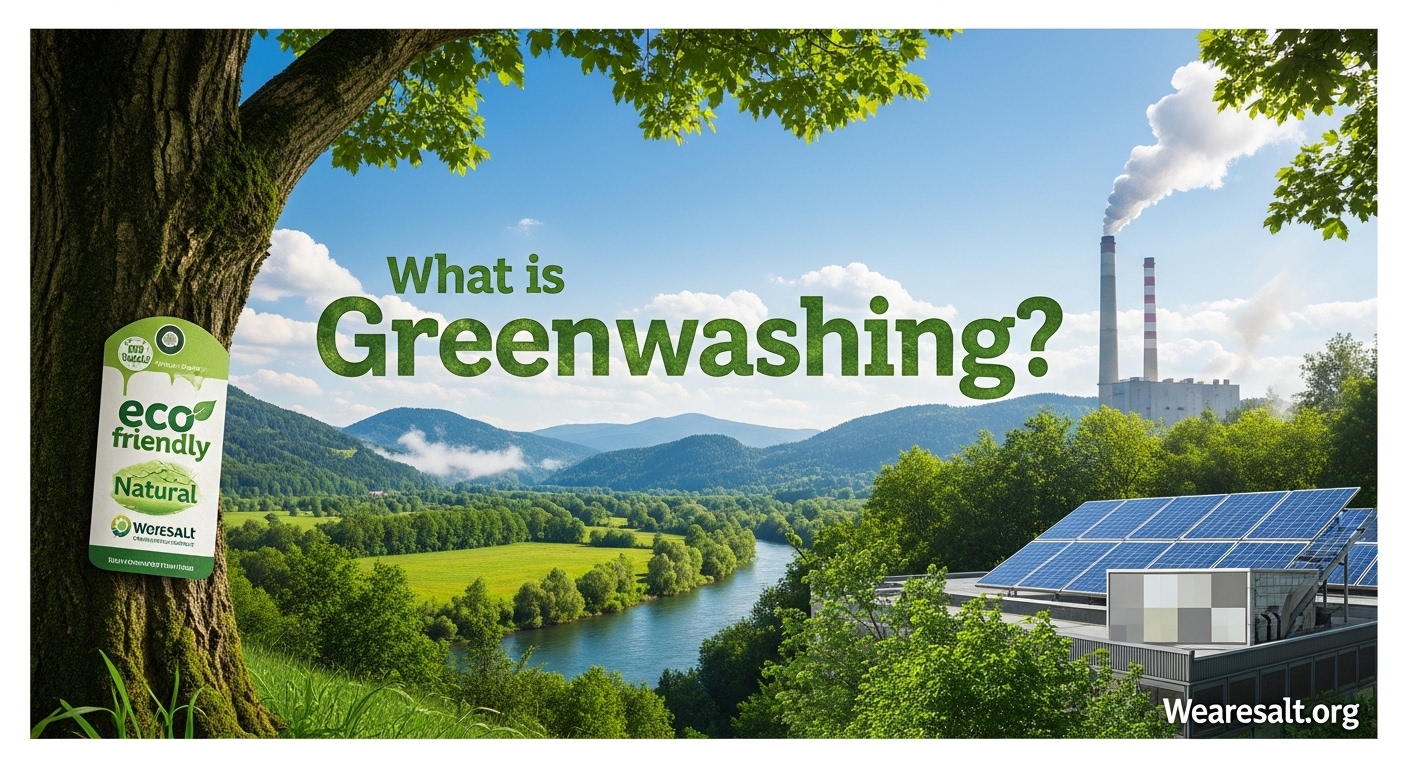
Greenwashing is the act of making false or misleading statements about the environmental benefits of a product, service, or practice. Companies use this deceptive marketing tactic to persuade the public that their operations are more eco-friendly than they actually are. Understanding what is greenwashing helps you make informed purchasing decisions and avoid falling for corporate environmental claims that don’t hold up under scrutiny.
Our team has spent months researching corporate sustainability claims across multiple industries. We’ve analyzed hundreds of environmental marketing campaigns, reviewed regulatory filings, and spoken with environmental advocates to bring you a comprehensive guide to recognizing and avoiding greenwashing. This article will walk you through the history of the term, specific examples you should know about, and practical steps to identify deceptive environmental claims in 2026.
Whether you’re a conscious consumer trying to shop more sustainably, an investor evaluating ESG claims, or simply someone who wants to understand modern corporate environmentalism, this guide will give you the tools you need to separate genuine sustainability from clever marketing spin.
Table of Contents
What Is Greenwashing?
What is greenwashing exactly? At its core, greenwashing is a form of advertising or marketing spin that deceptively uses green PR and green marketing to persuade the public that an organization’s products, goals, or policies are environmentally responsible. The term describes any communication that misleads consumers regarding the environmental practices of a company or the environmental benefits of a product or service.
The practice takes many forms. Some companies exaggerate their environmental credentials with vague buzzwords like “natural” or “eco-friendly” without substantiation. Others make selective disclosures that highlight minor green initiatives while hiding major environmental harms. Some use nature-based imagery like leaves, trees, and green colors to create an environmental impression that has no basis in reality.
Greenwashing differs from legitimate green marketing in one crucial way: intent and substance. Legitimate green marketing accurately represents genuine environmental improvements backed by data and third-party verification. Greenwashing, by contrast, involves deception, misrepresentation, or the presentation of an unreasonably optimistic environmental picture.
Where Did the Term Greenwashing Come From?
The term “greenwashing” was coined in 1986 by environmentalist Jay Westerveld. In an essay, Westerveld described his observations of the hotel industry’s “save the towel” movement. Hotels encouraged guests to reuse towels to “save the environment” while simultaneously expanding their operations and consuming more resources overall.
Westerveld noted that these towel reuse programs had little to do with environmental concern. They were primarily cost-cutting measures presented as environmental initiatives. This observation led him to create the term “greenwashing” by combining “green” (environmentalism) with “whitewashing” (covering up wrongdoing).
The concept gained mainstream attention in the 1990s as environmental awareness grew and companies sought to capitalize on consumer demand for eco-friendly products. The term has evolved to encompass a wide range of deceptive practices, from outright lies about environmental benefits to subtler forms of misdirection through imagery and language choice.
Today, greenwashing has become more sophisticated. Companies have moved beyond simple false claims to complex strategies involving carbon offsets, selective disclosure, and the use of official-looking but meaningless certifications. The practice has also expanded beyond consumer products to include corporate sustainability reporting, ESG investing, and even government policies.
Why Do Companies Engage in Greenwashing?
Companies greenwash because it works. Consumer demand for sustainable products has grown dramatically over the past decade. Studies show that a significant percentage of consumers are willing to pay more for products they believe are environmentally friendly. This creates a powerful financial incentive for companies to appear green, even when their actual environmental performance hasn’t improved.
The cost of marketing a product as eco-friendly is often far lower than the cost of actually making it eco-friendly. Redesigning supply chains, switching to renewable energy, and reducing waste require substantial investments. Slapping a green leaf on the packaging and calling it “natural” costs almost nothing by comparison. For many companies, greenwashing represents a quick path to higher profit margins.
Competitive pressure also drives greenwashing behavior. When one company in an industry successfully markets itself as sustainable, competitors often feel pressure to make similar claims to avoid losing market share. This can create a race to the bottom where companies compete on the volume and visibility of their green marketing rather than on actual environmental performance.
Some companies greenwash to deflect criticism. When activists or journalists expose environmental harms, companies often respond with high-profile green initiatives designed to shift the narrative. These initiatives may be genuine in some cases, but they are frequently cosmetic responses designed to generate positive press without requiring fundamental changes to business practices.
The regulatory environment has historically been weak in this area. Until recently, few jurisdictions had specific laws against misleading environmental claims. Even where regulations exist, enforcement has often been lax. This regulatory gap has allowed greenwashing to flourish with relatively low risk of consequences.
The 7 Sins of Greenwashing
In 2007, environmental marketing firm TerraChoice conducted a comprehensive study of greenwashing and identified seven common patterns they called the “Seven Sins of Greenwashing.” This framework has become the standard way to categorize and identify greenwashing tactics. Understanding these seven sins will help you spot greenwashing whenever you encounter it.
1. The Sin of the Hidden Trade-Off
This is the most common form of greenwashing. Companies highlight one positive environmental attribute while ignoring other significant negative impacts. A paper product might be marketed as “recycled” without mentioning the toxic chemicals used in its production. An electric car company might emphasize zero emissions while downplaying the environmental damage from mining lithium for batteries.
The hidden trade-off exploits consumer trust by presenting an incomplete picture. Just because a product has one environmental benefit doesn’t mean it’s overall environmentally friendly. Life cycle assessment is necessary to truly evaluate environmental impact, but companies practicing this sin focus only on the positive aspects they want you to see.
2. The Sin of No Proof
Companies commit this sin when they make environmental claims that cannot be verified through easily accessible information. A product might claim to be “30% more eco-friendly” without explaining what that means or providing supporting data. A company might state it uses “sustainable practices” without defining what those practices are.
Legitimate environmental claims should be backed by evidence that consumers can verify. Look for third-party certifications, detailed sustainability reports, and specific data points. When a company makes vague claims without supporting evidence, they’re likely committing this sin.
3. The Sin of Vagueness
This sin involves using poorly defined or broad terms that sound meaningful but have no clear environmental definition. Words like “natural,” “eco-friendly,” “green,” “nontoxic,” and “environmentally safe” mean very little without context. Arsenic is natural. Many pollutants are nontoxic in small doses. These terms create a positive impression without communicating any substantive environmental information.
The sin of vagueness is particularly insidious because it sounds like communication. Consumers feel informed after reading these terms, but they haven’t actually received useful information. Always be skeptical of broad environmental claims that aren’t backed by specific details.
4. The Sin of Worshiping False Labels
Some companies create fake certifications or labels that look official but have no meaning. They might design a logo that resembles legitimate third-party certifications, hoping consumers will assume the product has been verified by an independent organization. These fake labels give products an air of authority without any actual third-party validation.
Real certifications come from recognized organizations with transparent standards. Look for certifications from established entities like Energy Star, Fair Trade, USDA Organic, B Corp, or FSC. When you see a label you don’t recognize, research it. Legitimate certification bodies will have websites explaining their standards and verification processes.
5. The Sin of Irrelevance
This sin occurs when companies make true but unimportant environmental claims. A product might be marketed as “CFC-free” even though CFCs have been banned for decades and no products legally contain them. A “non-GMO” label on salt is meaningless because salt doesn’t contain genetic material.
These claims are technically true, but they distract from more significant environmental concerns. By highlighting irrelevant attributes, companies create the impression of environmental responsibility while avoiding discussion of real impacts.
6. The Sin of the Lesser of Two Evils
This sin involves making a product look good by comparing it to an even worse alternative. An SUV might be marketed as fuel-efficient compared to other SUVs, even though SUVs as a category have much higher emissions than smaller vehicles. A cigarette company might promote organic tobacco, ignoring the fundamental environmental and health problems of tobacco production and use.
The lesser of two evils framing distracts from the bigger picture. A product might be slightly better than its competitors while still being environmentally harmful in absolute terms. Always consider whether the category itself is sustainable, not just whether one product is better than others in that category.
7. The Sin of Fibbing
This is the most blatant form of greenwashing: outright lying about environmental credentials. Companies might claim products have certifications they don’t possess, report emissions reductions that never happened, or describe materials as recycled when they’re not. These are not exaggerations or misleading framing; they are false statements presented as facts.
While less common than other sins, outright fibbing does occur. Volkswagen’s emissions scandal is a prime example of this sin. The company installed software in vehicles to cheat on emissions tests, then marketed those vehicles as clean diesel. This wasn’t misleading marketing; it was deliberate deception with falsified data.
Notable Examples of Greenwashing
Understanding real-world examples helps illustrate how greenwashing works in practice. Here are some of the most significant and well-documented cases of corporate greenwashing from recent years.
Volkswagen’s “Clean Diesel” Scandal
Perhaps the most notorious example of greenwashing is Volkswagen’s Dieselgate scandal. For years, Volkswagen marketed its diesel vehicles as “clean diesel” with low emissions and excellent environmental performance. The company ran extensive advertising campaigns emphasizing the eco-friendly nature of these vehicles, targeting environmentally conscious consumers.
In 2015, investigators discovered that Volkswagen had installed defeat devices in approximately 11 million vehicles worldwide. These devices detected when cars were being tested for emissions and activated pollution controls only during testing. On the road, these vehicles emitted up to 40 times the legal limit of nitrogen oxides.
The scandal demonstrated how far companies will go to maintain a green image while continuing harmful practices. Volkswagen faced billions in fines, executive prosecutions, and massive reputational damage. The case serves as a reminder that environmental claims should always be verified independently.
Chevron’s “People Do” Campaign
In the 1980s, Chevron launched an award-winning advertising campaign called “People Do.” The ads showed Chevron employees protecting wildlife, cleaning beaches, and engaging in other environmental stewardship activities. The campaign won awards for its emotional appeal and production quality.
While Chevron was running these ads highlighting their environmental commitment, the company was actively violating environmental laws. Chevron was one of the largest polluters in the United States at the time, with extensive violations of the Clean Air and Clean Water Acts. The campaign is often cited in marketing textbooks as a classic example of greenwashing.
BP’s “Beyond Petroleum” Rebrand
In 2000, British Petroleum spent $200 million rebranding itself as “Beyond Petroleum.” The company changed its logo to a green and yellow sunburst design and launched extensive advertising about renewable energy investments. The messaging suggested BP was transitioning from an oil company to a clean energy company.
The reality was starkly different. At the time of the rebrand, BP was investing less than 5% of its budget in renewable energy. The company continued to expand oil and gas operations while its marketing suggested a fundamental transformation. The 2010 Deepwater Horizon oil spill further exposed the gap between BP’s green image and its actual environmental impact.
Fashion Industry Sustainability Claims
The fashion industry has become a major source of greenwashing in recent years. Fast fashion brands have launched numerous “sustainable” clothing lines using recycled materials or organic cotton. H&M’s “Conscious Collection” is one prominent example, marketed as an eco-friendly alternative to their regular offerings.
However, investigations have found that many of these claims are misleading. A 2021 report found that 96% of sustainability claims from H&M could not be substantiated. The Changing Markets Foundation found that 60% of sustainability claims in the fashion industry overall were misleading. The fundamental business model of fast fashion, which encourages overconsumption and rapid disposal of clothing, is inherently unsustainable regardless of the materials used.
Greenwashing by Industry
Greenwashing manifests differently across industries. Understanding sector-specific tactics can help you recognize greenwashing in the products and services you encounter most frequently.
Greenwashing in Fashion and Apparel
The fashion industry is responsible for approximately 10% of global carbon emissions and significant water pollution. Yet brands have successfully marketed themselves as sustainable through clever framing. A t-shirt might be marketed as “made with organic cotton” while ignoring the massive water usage and carbon emissions from production and shipping.
Clothing recycling programs are another common greenwashing tactic. Brands encourage customers to return old clothes for recycling, positioning themselves as circular and sustainable. In reality, less than 1% of clothing is actually recycled into new garments. Most returned clothing ends up in landfills or is shipped to developing countries where it overwhelms local waste systems.
Look for specific data when evaluating fashion sustainability claims. Legitimate sustainable brands will provide detailed information about their supply chain, energy usage, and labor practices. They’ll acknowledge areas where they’re still working to improve rather than presenting a uniformly positive picture.
Greenwashing in Food and Beverage
The food industry uses extensive green imagery and natural associations to market products. Coca-Cola’s “World Without Waste” campaign commits to collecting a bottle or can for every one sold by 2030. While this sounds ambitious, it doesn’t address the fundamental environmental impact of single-use plastic production and the energy-intensive process of recycling.
Meat and dairy industries have been found to engage in particularly egregious greenwashing. A 2021 study found that 98% of environmental claims in the meat and dairy industry qualified as greenwashing. Companies use images of happy animals on small farms while operating industrial factory farming operations that generate massive greenhouse gas emissions and pollution.
“Natural” and “all-natural” labels on food products are largely meaningless from an environmental perspective. These terms aren’t regulated in most jurisdictions and tell you nothing about farming practices, packaging, transportation emissions, or land use impacts.
Greenwashing in Finance and ESG Investing
Environmental, Social, and Governance (ESG) investing has exploded in popularity, with trillions of dollars flowing into funds marketed as sustainable. However, investigations have revealed widespread greenwashing in this sector. Many ESG funds contain significant holdings in fossil fuel companies, weapons manufacturers, and other environmentally harmful industries.
The problem lies in inconsistent and weak ESG rating methodologies. Different rating agencies can give the same company wildly different scores based on their methodologies. A company might receive a high ESG rating for having good governance practices while continuing to generate massive carbon emissions.
Investors should look beyond ESG labels to actual portfolio holdings. What percentage of a “sustainable” fund is invested in renewable energy versus fossil fuels? What are the actual carbon emissions of companies in the portfolio? Real sustainable investing requires due diligence, not just trusting marketing labels.
Greenwashing in Energy and Utilities
Energy companies have been among the most aggressive greenwashers, often while actively lobbying against environmental regulations. Many utilities now market themselves as committed to renewable energy while continuing to operate coal plants and invest in new fossil fuel infrastructure.
Carbon offsets are a particularly problematic area in energy sector greenwashing. Companies claim to be “carbon neutral” by purchasing offsets while continuing to emit greenhouse gases. Many offset programs have been found to be ineffective, double-counted, or outright fraudulent. A company might claim offset status for preserving forests that were never actually at risk of being cut down.
Net-zero pledges have become another common greenwashing tactic in the energy sector. Companies announce ambitious long-term climate goals while continuing to expand fossil fuel production in the present. These pledges often rely on unproven technologies like carbon capture that may never work at scale.
Why Greenwashing Matters
Greenwashing isn’t just annoying marketing; it has real negative consequences for consumers, the environment, and the transition to genuine sustainability. Understanding these impacts helps explain why identifying and calling out greenwashing is important.
Consumer Deception and Financial Harm
Greenwashing directly harms consumers by causing them to make purchasing decisions based on false information. People who want to reduce their environmental impact often pay premium prices for products they believe are sustainable. When those products aren’t actually eco-friendly, consumers have wasted money while believing they’ve made a positive choice.
This deception also erodes trust in legitimate environmental claims. As consumers become aware of greenwashing, they may become cynical about all environmental marketing. This makes it harder for genuinely sustainable companies to differentiate themselves and can reduce overall market demand for real eco-friendly products.
Undermining Real Sustainability Efforts
Greenwashing creates unfair competition that disadvantages companies making genuine environmental improvements. A company that invests millions in reducing its carbon footprint may find itself competing against a greenwashing competitor that spends a fraction of that amount on marketing while continuing harmful practices. The greenwasher can offer lower prices while claiming similar environmental benefits.
This dynamic can discourage real investment in sustainability. If companies can reap the marketing benefits of appearing green without making actual changes, they have less incentive to invest in expensive operational improvements. Greenwashing effectively subsidizes environmental harm by allowing polluters to compete on an uneven playing field.
Delaying Climate Action
Perhaps the most serious consequence of greenwashing is its contribution to delaying meaningful climate action. As the United Nations has noted, greenwashing promotes false solutions to the climate crisis that distract from and delay concrete action. When companies claim to be addressing climate change through marketing campaigns while continuing business as usual, they reduce pressure for genuine systemic transformation.
Net-zero pledges and carbon offset programs are particularly problematic in this regard. They create the appearance of progress while emissions continue to rise. This can lull policymakers and the public into complacency, making them believe that voluntary corporate action is sufficient when the evidence shows it is not.
Environmental Justice Concerns
Greenwashing often disproportionately harms vulnerable communities. Industrial facilities that generate pollution while marketing themselves as environmentally responsible tend to be located in low-income areas and communities of color. These communities bear the health and environmental costs while the companies reap the reputational benefits of green marketing.
Environmental justice advocates have increasingly focused on greenwashing as an issue of equity and corporate accountability. When companies can profit from environmental reputations they haven’t earned, they avoid responsibility for the real harms they cause to frontline communities.
How to Spot Greenwashing
Recognizing greenwashing requires a critical eye and a willingness to look beyond surface-level claims. Here are practical steps you can take to identify and avoid greenwashed products and services in 2026.
Red Flags to Watch For
Be skeptical of vague buzzwords without specifics. Terms like “natural,” “eco-friendly,” “green,” and “nontoxic” sound good but mean very little without context. Look for specific claims with measurable data instead. A product that claims to use “50% less water than the industry average” is making a verifiable claim. One that just says “eco-friendly” is not.
Watch out for nature imagery and green color schemes. Just because packaging has leaves, trees, or the color green doesn’t mean the product is environmentally friendly. These are visual cues designed to trigger positive environmental associations without any substance behind them.
Question claims that seem too good to be true. If a product promises to solve environmental problems while offering superior performance at a lower price, be skeptical. Real environmental improvements often involve trade-offs. Products that claim to have no downsides are probably hiding something.
Look for Third-Party Verification
Legitimate environmental claims are typically backed by third-party certifications from recognized organizations. Look for certifications like Energy Star, Fair Trade, USDA Organic, B Corp, FSC (Forest Stewardship Council), or Cradle to Cradle. These certifications involve actual verification processes with defined standards.
Research any certifications you don’t recognize. Fake labels are common in greenwashing. A legitimate certification body will have a website explaining their standards, verification process, and the organizations that have received certification. If you can’t find information about a certifier, the label is probably meaningless.
Check for Transparency
Genuinely sustainable companies tend to be transparent about their operations, including areas where they’re still working to improve. They’ll provide detailed information about their supply chain, energy usage, waste generation, and environmental goals. They’ll acknowledge challenges and setbacks rather than presenting a uniformly positive picture.
Greenwashing companies, by contrast, tend to be vague and selective in their disclosures. They’ll highlight minor green initiatives while avoiding discussion of major environmental impacts. Look for comprehensive sustainability reports rather than isolated marketing claims.
Investigate the Full Lifecycle
A product’s environmental impact includes its entire lifecycle from raw material extraction through manufacturing, transportation, use, and disposal. Greenwashing often involves highlighting one positive aspect while ignoring other significant impacts. An electric car has zero tailpipe emissions but may have significant environmental impacts from battery production. A recycled paper product may still be manufactured using toxic chemicals.
Consider the broader context of a product’s category. Fast fashion is inherently unsustainable due to the overconsumption it encourages, regardless of the materials used. Single-use disposable products are difficult to justify environmentally, even if they’re made from recycled materials.
Research the Company
Individual products don’t exist in isolation. A company’s overall environmental record matters. A genuinely sustainable company will have strong environmental practices across its operations, not just on a few product lines. Research whether the company has been cited for environmental violations, whether they lobby against environmental regulations, and what their overall carbon footprint looks like.
Independent watchdog organizations and environmental groups often track corporate environmental performance. Reports from organizations like Greenpeace, the Sierra Club, and Friends of the Earth can provide valuable perspective on whether a company’s environmental image matches its actual practices.
Regulations and Legal Consequences
Regulators around the world are increasingly cracking down on greenwashing. Understanding the legal landscape can help you understand which claims are more likely to be legitimate and what recourse exists when companies mislead consumers.
United States: FTC Green Guides
The Federal Trade Commission (FTC) issues the “Green Guides” which provide guidance on environmental marketing claims. While these guidelines don’t have the force of law, the FTC can take action against companies that make deceptive environmental claims under Section 5 of the FTC Act, which prohibits unfair or deceptive practices.
The FTC has brought enforcement actions against companies for misleading environmental claims, though critics argue that enforcement has been inconsistent and penalties insufficient to deter large companies. Recent updates to the Green Guides have strengthened requirements for carbon offset and recycling claims.
European Union: Green Claims Directive
The European Union has taken stronger action against greenwashing than the United States. The EU’s Green Claims Directive, adopted in recent years, requires companies to substantiate explicit environmental claims with scientific evidence. Claims based solely on carbon offsets face strict limitations.
The Directive also bans generic environmental claims like “eco-friendly” or “green” unless companies can demonstrate excellent environmental performance. Member states are required to implement penalties for violations, including fines and exclusion from public procurement.
Industry Self-Regulation
Some industries have developed self-regulatory codes for environmental marketing. The advertising standards bodies in many countries have taken action against greenwashing advertisements, requiring companies to modify or withdraw misleading claims. However, self-regulation has limited effectiveness and doesn’t replace strong government oversight.
Recent years have seen increased regulatory attention to greenwashing, particularly in the financial sector. The SEC in the United States and financial regulators in Europe have proposed rules requiring more detailed disclosure of ESG investment practices to prevent misleading marketing of sustainable investment products.
Frequently Asked Questions About Greenwashing
What is an example of greenwashing?
A common example is when a clothing company markets a small sustainable collection while its main business relies on fast fashion practices that generate massive waste. Another is Volkswagen marketing ‘clean diesel’ vehicles while installing defeat devices to cheat emissions tests. Companies might also label products as ‘natural’ or ‘eco-friendly’ without providing any evidence or certification to support these claims.
What is greenwashing in simple terms?
Greenwashing is when a company pretends to be more environmentally friendly than it actually is. They use marketing tricks, vague words like ‘natural’ or ‘eco-friendly,’ and green-colored packaging to make you think their products are good for the planet when they’re not really making significant environmental improvements. It’s essentially false advertising about environmental benefits.
What is greenwashing and why is it bad?
Greenwashing is the practice of making misleading environmental claims about products, services, or business practices. It’s bad because it deceives consumers into making purchasing decisions based on false information, undermines companies that are genuinely trying to be sustainable, erodes public trust in environmental claims, and delays real action on climate change by promoting false solutions while harmful practices continue.
Is Coca-Cola greenwashing?
Critics argue that Coca-Cola engages in greenwashing through initiatives like ‘World Without Waste,’ which promises to collect a bottle or can for every one sold by 2030. While this sounds positive, it doesn’t address the fundamental environmental impact of producing billions of single-use plastic bottles annually. The company remains one of the world’s largest plastic polluters while marketing itself as committed to sustainability. This disconnect between marketing claims and actual environmental impact is characteristic of greenwashing.
Conclusion
What is greenwashing? It is one of the most significant barriers to genuine environmental progress in 2026. By understanding how companies use misleading marketing to appear more sustainable than they are, you can make better purchasing decisions, avoid being deceived, and support companies that are making real environmental improvements.
The seven sins of greenwashing provide a practical framework for evaluating environmental claims. Look for specific, verifiable information rather than vague buzzwords. Seek out third-party certifications from recognized organizations. Consider the full lifecycle of products and the overall record of companies making environmental claims.
Remember that genuine sustainability requires transparency, accountability, and measurable progress. Companies that are truly committed to environmental responsibility will acknowledge their challenges and areas for improvement, not present a uniformly positive picture. They’ll back up their claims with data and third-party verification.
As consumers, we have power in our purchasing decisions. By learning to spot greenwashing and choosing genuinely sustainable products, we can create market incentives for real environmental improvement. We can also hold companies accountable by calling out misleading claims and supporting stronger regulation of environmental marketing.
The fight against greenwashing is ultimately about creating a world where environmental claims mean something. Where companies are rewarded for genuine sustainability improvements, not clever marketing. Where consumers can trust that eco-friendly labels represent real benefits for the planet. By staying informed and vigilant, you can be part of building that world.