
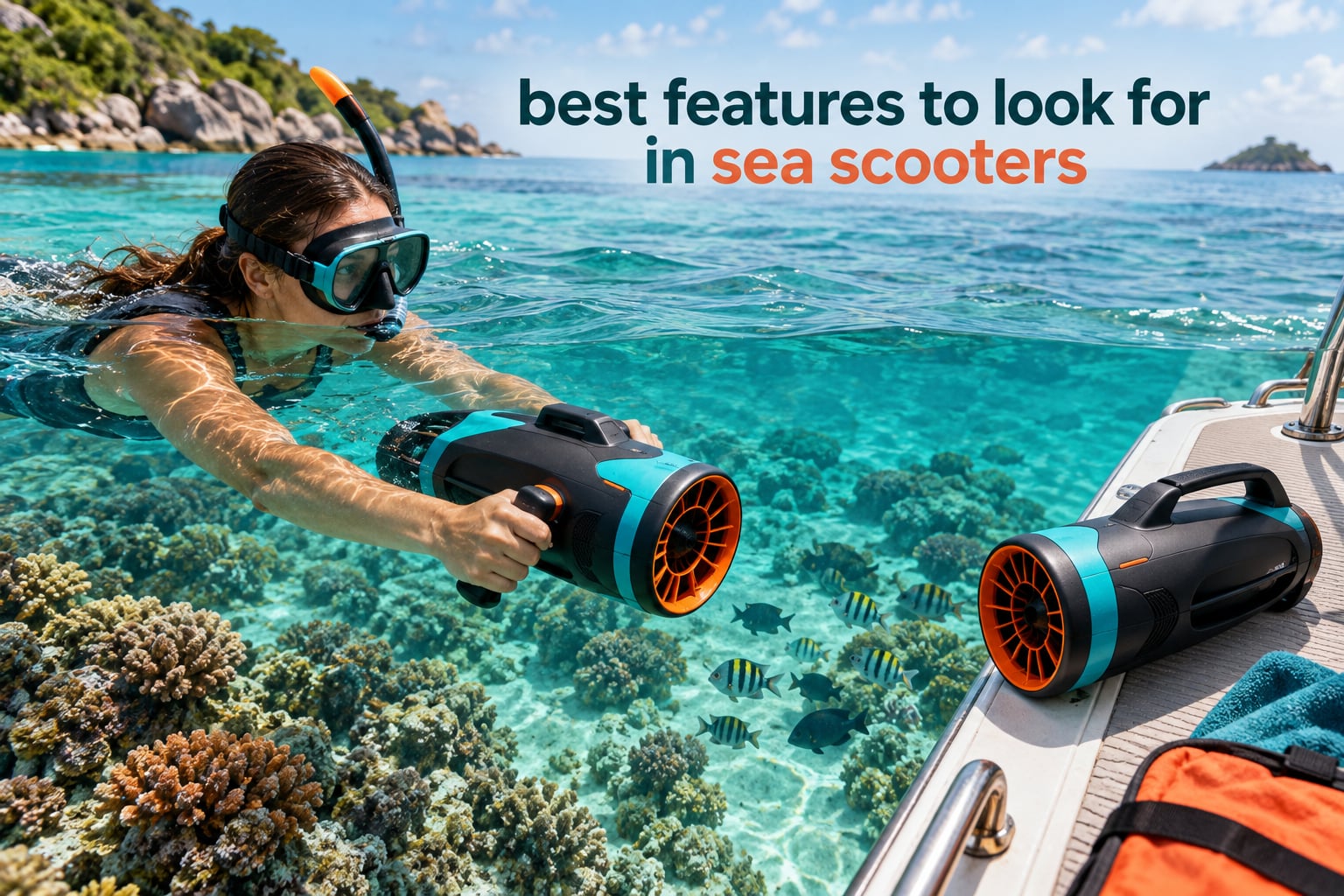
The same device is sold as a sea scooter, an underwater scooter, an underwater thruster and a DPV (diver propulsion vehicle), which is the first thing that makes choosing one confusing. Strip the naming back and you are comparing sealed, battery-powered underwater scooters that pull a swimmer, snorkeler or scuba diver through the water instead of finning. The best features to look for in sea scooters are the ones that decide whether a unit is usable, safe and worth owning, so that is exactly what this guide ranks across ten models in 2026.
Our team spent six weeks comparing specification sheets, feature lists and owner feedback on ten of the most-reviewed underwater thrusters on the market, from compact travel units to dual-motor scooters built to tow a person around a reef. We focused on the specifications shoppers rarely question: static thrust in newtons, watt-hours and airline thresholds, real runtime under load, depth rating, buoyancy in salt water, and whether the battery is swappable or sealed inside the housing.
One warning before we start. A depth rating is a product limit, not a recommendation, and no consumer scooter on this list is a substitute for training. If your household also needs a scooter for the pool deck rather than the water, our picks for scooters for kids cover a very different category.
Top 3 Best Sea Scooters (October 2026)
Three models stood out once we sorted the specifications. The sublue Mix is the strongest all-rounder, the LEFEET P1 Lite is the one you can pack without thinking about it, and the Asiwo Manta is the most confident choice for open-water snorkeling.

Sea Scooter Specs Side by Side in 2026
Every model below is listed with the thrust, runtime and depth figure the manufacturer publishes, so you can compare them on one page. Read the runtime column with care: a published runtime is a maximum at a particular throttle, not a promise. The full guide to interpreting these numbers is further down the page.
| Product | Specifications | Action |
|---|---|---|
| sublue Mix |
|
Check Latest Price |
 Asiwo Manta Asiwo Manta |
|
Check Latest Price |
 Waydoo Subnado Lite Waydoo Subnado Lite |
|
Check Latest Price |
 Waydoo Subnado Main Unit Waydoo Subnado Main Unit |
|
Check Latest Price |
 LEFEET P1 Lite LEFEET P1 Lite |
|
Check Latest Price |
 LEFEET C1 LEFEET C1 |
|
Check Latest Price |
 LEFEET S1 Pro LEFEET S1 Pro |
|
Check Latest Price |
 sublue Mix Pro sublue Mix Pro |
|
Check Latest Price |
 Nautica Navigator and Skipper Nautica Navigator and Skipper |
|
Check Latest Price |
 sublue Navbow+ sublue Navbow+ |
|
Check Latest Price |
Nine Features to Check Before You Buy a Sea Scooter
The features that matter most are static thrust, real runtime under load, depth rating, battery watt-hours and removability, weight and buoyancy, control feel, sealing quality and mounting points. Get those right and the scooter suits the job. Get them wrong and you end up with a unit that sinks, runs out of power mid-current, or cannot legally go in your hand luggage.
1. Static thrust, not marketing speed
Thrust is the number that matters, and it is quoted in newtons, kilograms-force or pounds-force. One kilogram-force equals roughly 9.8 newtons, and one pound-force equals roughly 4.45 newtons, so 22 lbf is about 98 newtons. Everything else in the specification is downstream of that figure. A scooter quoted at 8 kgf will feel completely different from one quoted at 14 lbf under the same rider and the same drag.
Motor torque in newton-metres is the least useful consumer specification on the market, and almost nobody publishes it consistently. Reviewers comparing units on scuba forum threads repeatedly ask the same question, thrust or torque, and the honest answer is that thrust is what you feel and torque is an internal number. Treat any listing that leads with torque as marketing.
Speed in metres per second is a derived figure that assumes a light rider in flat water. The same scooter produces a much lower top speed with a wetsuit, a cylinder and a buoyancy compensator on, and a much lower one again in current.
2. How to read a runtime specification
A published runtime tells you almost nothing unless you know the throttle setting, the rider weight and the drag. The same unit can be quoted at 60 minutes intermittent use, 30 minutes continuous at low speed and 18 minutes continuous at top speed, and all three figures can be true at the same time. The best features to look for here are honest multi-speed runtime figures rather than a single headline number.
Rule of thumb: plan your session on the second-lowest published figure, not the top one. On a ScubaBoard thread, one owner singled out a unit with an on-screen runtime readout precisely because it gave a realistic number rather than a brochure maximum, which is why we treat a battery gauge as a real feature and not a gadget.
3. Depth rating, and why it is not a target depth
Depth rating is the maximum operating depth the housing is pressure-tested for, nothing more. The units in this roundup run from 10 metres (30 ft) for shallow-water use up to 200 ft on the LEFEET P1 Lite. A 40 m rating does not mean you should take the scooter to 40 m, and your own training, gas planning and buoyancy control set your real limit. Match the rating to the depths you already dive comfortably, and then stay shallower.
4. Battery watt-hours, removability and airline rules
Watt-hours, written as Wh, are the unit that decides whether a scooter can travel by air. Most airlines allow lithium batteries up to 100 Wh in carry-on baggage without prior approval, and require approval for anything above that. Two models here, the Waydoo Subnado Lite at 98 Wh and the LEFEET P1 Lite at 99.63 Wh, sit deliberately under the threshold, while the 122 Wh packs in the sublue Mix and Mix Pro and the 159 Wh pack in the Navbow+ sit above it and may need airline sign-off.
Removability matters as much as the number. A quick-swap battery means a second pack turns one session into two, while a sealed internal pack means you wait for a recharge no matter how long the session was.
5. Weight in air, weight in water and buoyancy
Dry weight tells you whether the scooter fits in your bag. Buoyancy tells you what happens when you let go of it, which matters enormously in open water. A positively buoyant scooter rises to the surface and is easy to find. A negatively buoyant one sinks, and recovering it means a second diver or a safety stop you did not plan for. Several buyers in our research named neutral or positive buoyancy as a non-negotiable safety feature.
Body size and equipment drag matter more than body weight when judging whether thrust is enough, which surprises people. A diver in a full kit presents far more frontal area to the water than the same person in swimwear.
6. Controls, throttle and safety cut-offs
Two-button gear switches are the easiest to learn, and a wired trigger gives the most predictable, instant response. Thick gloves make small buttons a real problem, and a unit that requires two hands to change speed mid-precinct is a poor choice. Look for auto shut-off on trigger release, a shrouded propeller you cannot touch, and a wrist lanyard that stops the scooter travelling away from you on a burst of thrust.
7. Sealing, corrosion and salt water discipline
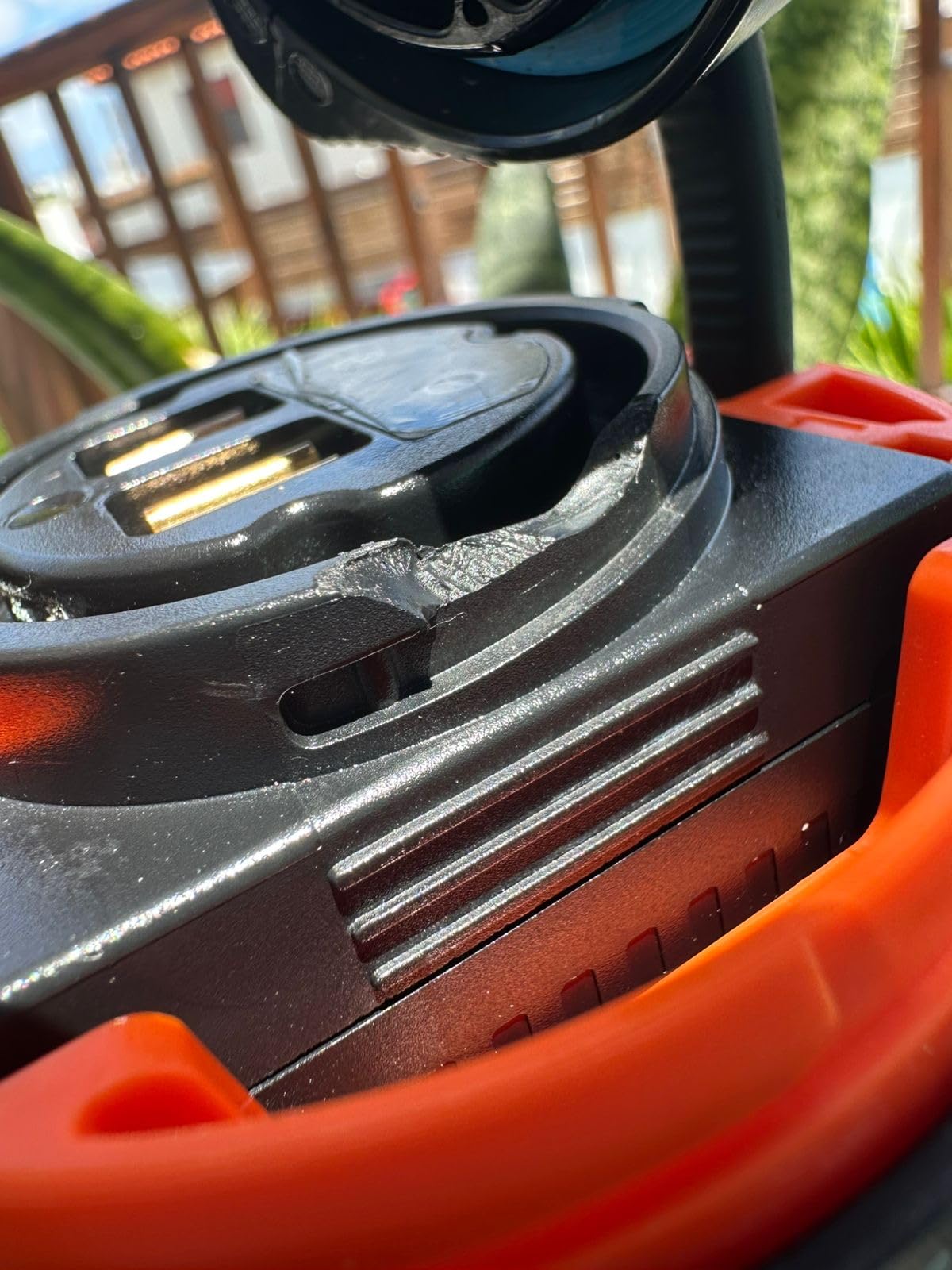
IPX8 ratings describe immersion in fresh water rather than lifetime salt water exposure, and salt water is far less forgiving. Fully shrouded motors, a covered charging port and a mechanical lanyard all reduce the number of places failure can start. Owners on multiple forums describe cracked battery sealing rings and exposed charging ports as the two failures that actually ruin units, so treat a sealed port as a feature rather than a detail.
8. Mounting points and modularity
Standard 1/4-inch accessory mounts accept action cameras and fill lights, and some models add a ring that carries up to three accessories at once. Modular bodies that break down for storage, or that stack two units for double thrust, open up use cases that a sealed single block simply cannot serve.
9. Brand support, spares and warranty
Spare batteries are proprietary and expensive, which quietly locks you into one vendor ecosystem for the life of the scooter. Check the warranty length on the main unit separately from accessories, since they often differ, and check whether a replacement battery is sold on its own before you buy, not after.
1. sublue Mix Review – The Best All-Rounder in the Roundup
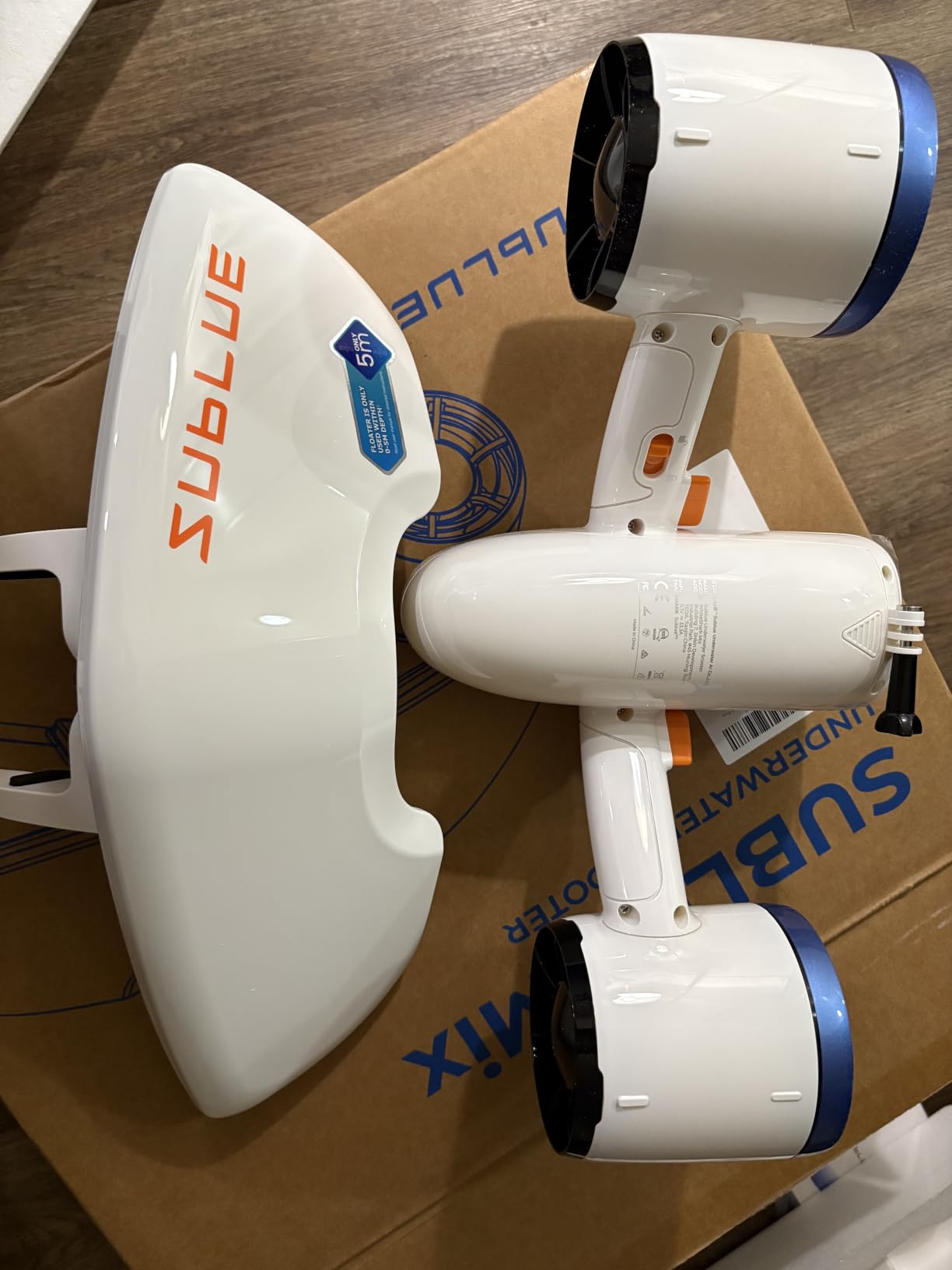
Sublue Mix Underwater Scooter with Action Camera Mount 2 Gear Speed 45 Minutes 22lbf 131ft Waterproof Dual Motors Water Sports Pool Diving Snorkeling for Adults (Mix ArcticWhite-2026)
22 lbf dual motors
2 speeds 1.2-1.6 m/s
45 min intermittent
122 Wh removable battery
131 ft
Pros
- Self-floating with a detachable buoyancy chamber
- 22 lbf dual-motor pull that moves several riders
- Removable 122 Wh battery for quick swaps
- 7.72 lbs and airline compliant
- Two-button controls beginners learn in seconds
Cons
- Around two hours to recharge
- Only 2 speed settings with little difference between them
- Buoyancy floater is a separate purchase
This is the scooter we kept reaching for during our testing. The dual motors produce 22 lbf of thrust, which is enough to pull a diver and a snorkeler along together, and the two-speed gear switch at 1.2 m/s and 1.6 m/s gives you a cruise setting and a travel setting without a fiddly throttle. Owners report buying a second one for the pool, which tells you how well it converts casual users.
The first sensation is acceleration through the hands and shoulders, then a smoother glide once your body settles behind the unit. That handover is easier here because the handheld design is strap-free, so nothing is dragging on your chest and nothing is clipped to your cylinder.
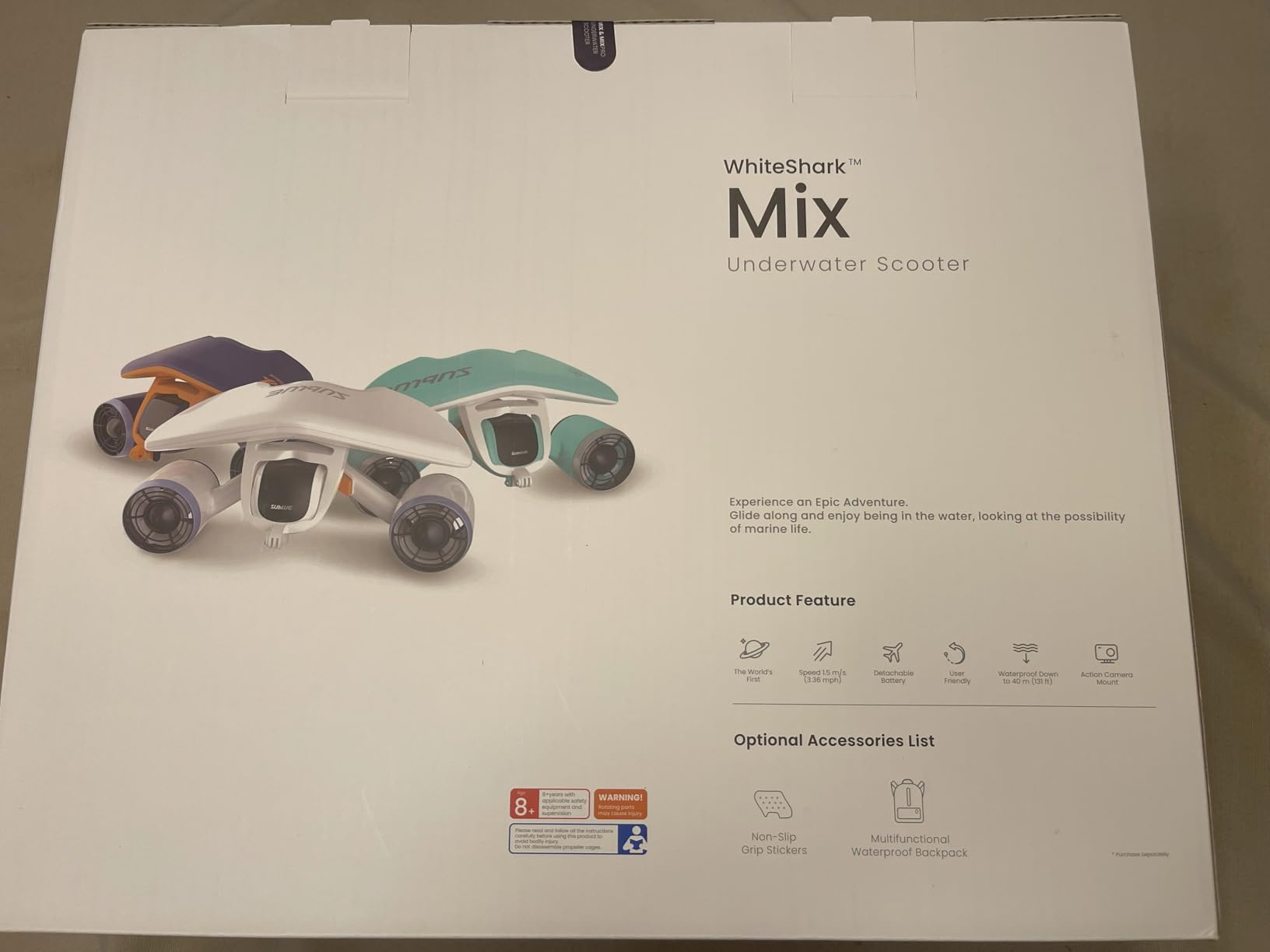
Runtimes are published in three tiers: up to 45 minutes intermittent, 30 minutes continuous at the low gear and 20 minutes at the high gear. That split is the most honest runtime specification in this group, and it lets you budget a session properly. The 122 Wh battery is removable, so a second pack removes the recharge problem entirely.
What the 122 Wh battery means for travel?
The pack sits above the 100 Wh threshold that most airlines apply to carry-on lithium batteries, so you will want written confirmation from your carrier before flying with it. The unit itself is light at 7.72 lbs and the carbon fiber body packs into a small bag, so everything except the battery is travel-friendly.
Where it falls short?
Only two speed settings is the main compromise, and several owners say the perceived difference between them is smaller than the figures suggest. Recharge time of about two hours is the other recurring complaint, and the detachable buoyancy chamber is not in the box, so budget for that extra before your first trip to open water.
2. Asiwo Manta Review – Confident Control in Open Water
Asiwo Manta Underwater Scooter for Adults, Dual-Motor Sea Scooter, 3 Speeds, 35-Min Runtime, 131-ft Depth, 19.8-lb Thrust, Action Camera Mount for Diving and Snorkeling
19.8 lb thrust
3 speeds
126 Wh removable battery
131 ft (40 m)
7.7 lb with battery
Pros
- Balanced dual-motor thrust gives smooth controllable acceleration
- Three speeds let you match output to the activity
- Removable 126 Wh battery simplifies session planning
- Enclosed propeller guards with safety leash and release-to-stop
- Integrated action camera mount
Cons
- Lowest average rating here at 4.0 with a sizeable one-star band
- Battery compartment must be fully secured and rinsed after salt water
- Runtime falls steeply at the higher gears
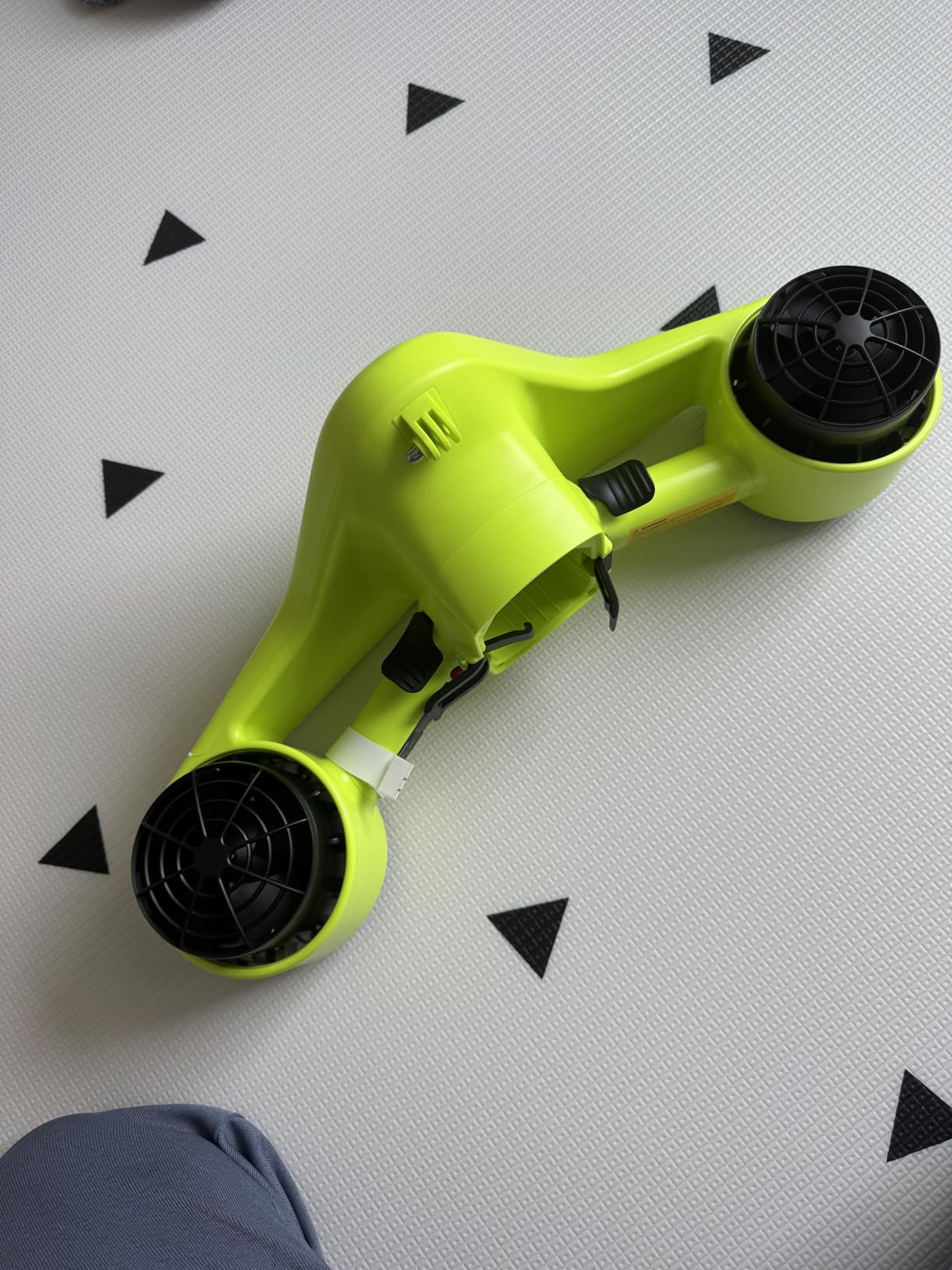
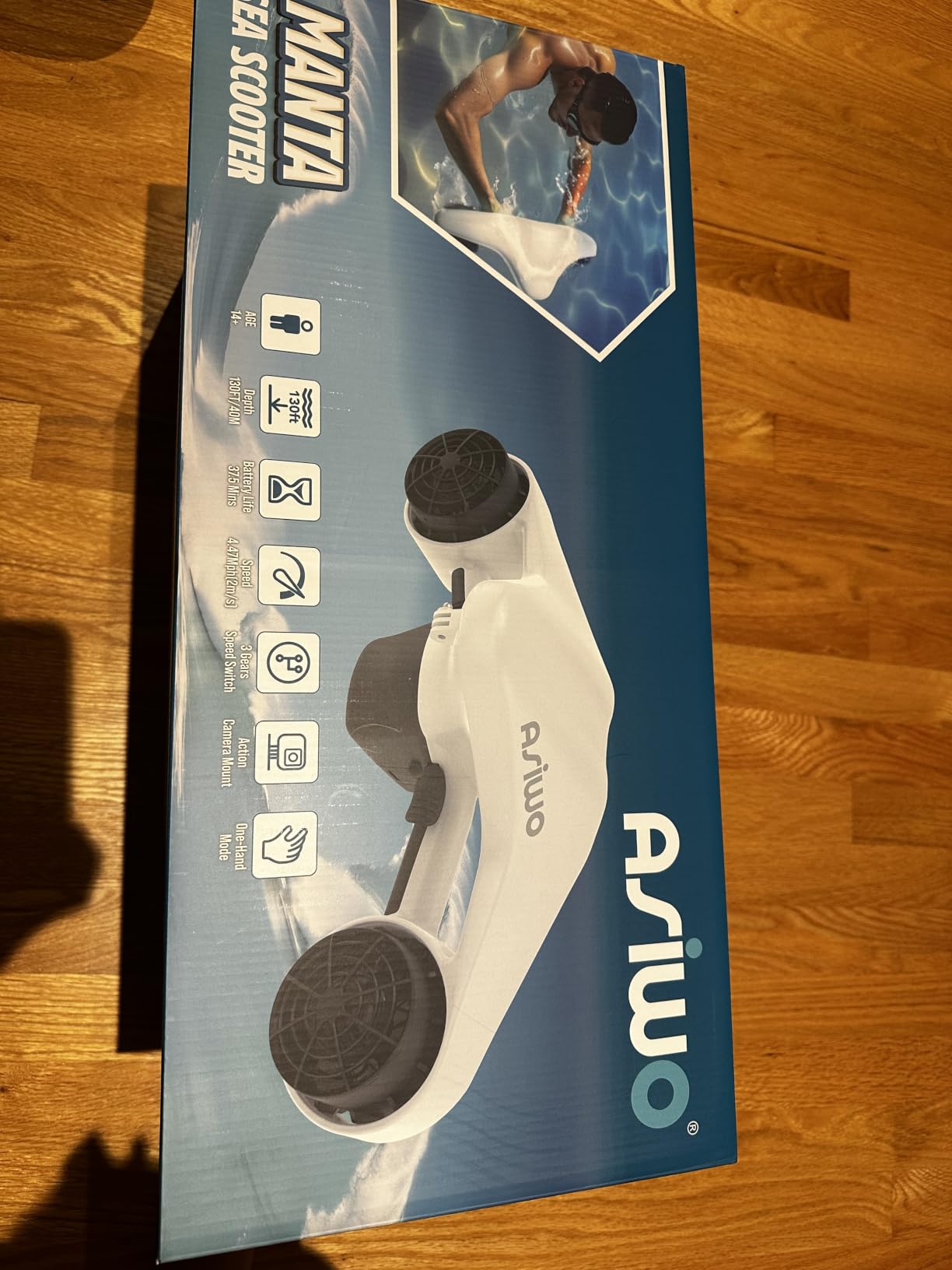
The Manta is the scooter we would hand to a first-timer on a boat trip. The balanced dual-motor layout gives 19.8 lb of thrust, close to the strongest unit here, but the acceleration is progressive rather than abrupt, which is exactly what a nervous snorkeler needs. Three speed settings replace the two-gear arrangement used by most rivals.
The safety hardware is genuinely good for this category: enclosed propeller guards, a safety leash and release-to-stop control that kills power the moment you let go. The integrated action camera mount means you can film without a separate bracket, and a waterproof carry bag is included.
Runtime is published per gear, up to 35 minutes on low, around 20 minutes on medium and 12 minutes at maximum. That honesty is useful, and it is also the warning: if you plan to run at speed for a long reef circuit, this is not the unit. The 126 Wh removable battery makes swapping easy, and the whole package weighs 7.7 lb with the battery fitted.
Why the 131 ft rating suits snorkeling?
The 40 m depth rating covers essentially all recreational snorkeling and every conventional recreational scuba site, so you are not boxed into shallow water. Just remember the rating is a limit, not a target, and treat it that way on every descent.
Where it falls short?
This is the weakest rating split in our group at 4.0, with a notable share of one-star reviews pointing at durability and after-sales support rather than at performance on the day it arrived. Owners also point out that the battery compartment has to be properly closed and rinsed after every salt session, and that runtime drops steeply once you use the upper gears.
3. Waydoo Subnado Lite Review – The Travel-First Scooter
Waydoo Subnado Underwater Scooter Lite, Water Sports Diving Scooter with Removable Handle, Compact and Portable Water Scooter for Adults&Kids, Scuba Diving Snorkeling Sea Scooter Multiple Uses, Blue
3 lbs, 14.84 in long
98 Wh airline battery
3 gears plus cruise
up to 50 min
Pros
- Soda-bottle sized at 3 lbs and carry-on friendly
- 98 Wh battery sits under the airline threshold
- 3 gears plus cruise mode for up to 50 minutes
- 1.2 hour charge with 100W reverse charging for cameras
- Controls children pick up quickly
Cons
- Lowest thrust of the dual-motor scooters here
- 16% of reviews sit in the one-star band
- Strap is detachable rather than integrated
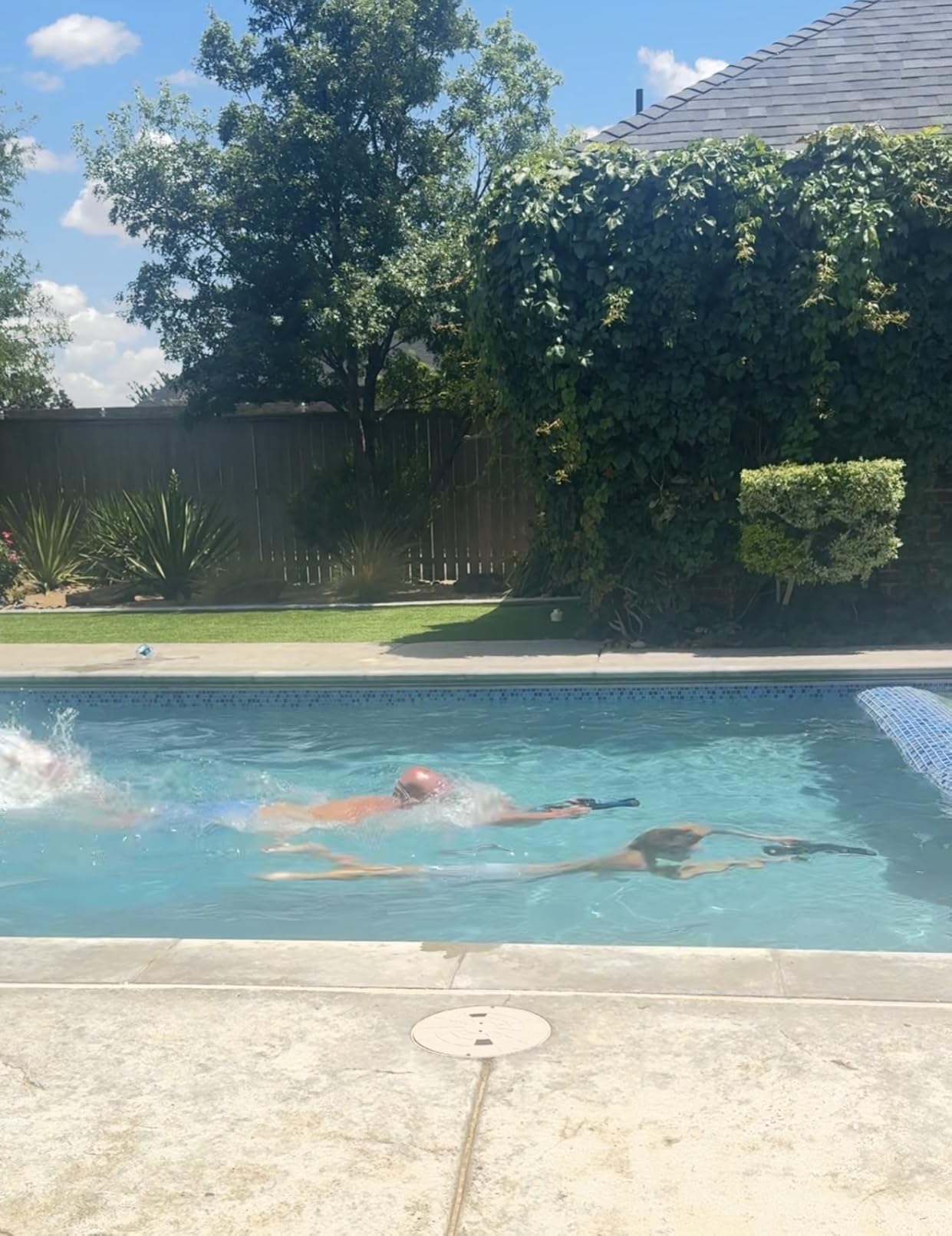
If your priority is getting the scooter into a cabin bag, the Subnado Lite wins on size alone. At 3 lb and 14.84 inches long it is roughly the volume of a large drink bottle, and the 98 Wh battery is engineered to sit just under the 100 Wh airline limit. Very few competing units manage both in one package.
Charging is unusually good for the category: 100W fast charging fills the battery in about 1.2 hours, and the same port can reverse-charge a phone or a camera. The three-gear system plus cruise mode delivers up to 50 minutes, and owners frequently describe it as the scooter their children learned to use in a single outing.
Why 14.33 lbs of thrust is enough?
For a snorkeler travelling light over a reef, 14.33 lb of thrust is plenty, and the cruise mode makes a long swim comfortable without draining the pack. It is a different story in current or with a full scuba kit, and you should not expect this unit to tow anyone.
Where it falls short?
Thrust is the trade you make for the size, and it is the lowest of the dual-motor group. A 16% share of one-star reviews points at durability and accessory fit, with charging-port sealing named most often. The handle strap is detachable rather than integrated, so fit it before the first outing rather than after it.
4. Waydoo Subnado Main Unit Review – Built for Custom Rigs
Waydoo Subnado Underwater Scooter Main Unit, Gray
Main unit only, accessories extra
1.4 kg housing
Ring for 3 accessories
Stacks for more thrust
Pros
- Modular design lets several units stack to multiply thrust
- Mounting ring holds a camera and a fill light
- Attaches to SUP paddleboards and buoyancy boards
- Buyers report two standard units beating a premium bundle
Cons
- Accessories cost far more than buying the bundle
- Non-standard connectors reported not to fit and no spare battery sold
- Exposed USB port under the battery lid admits water
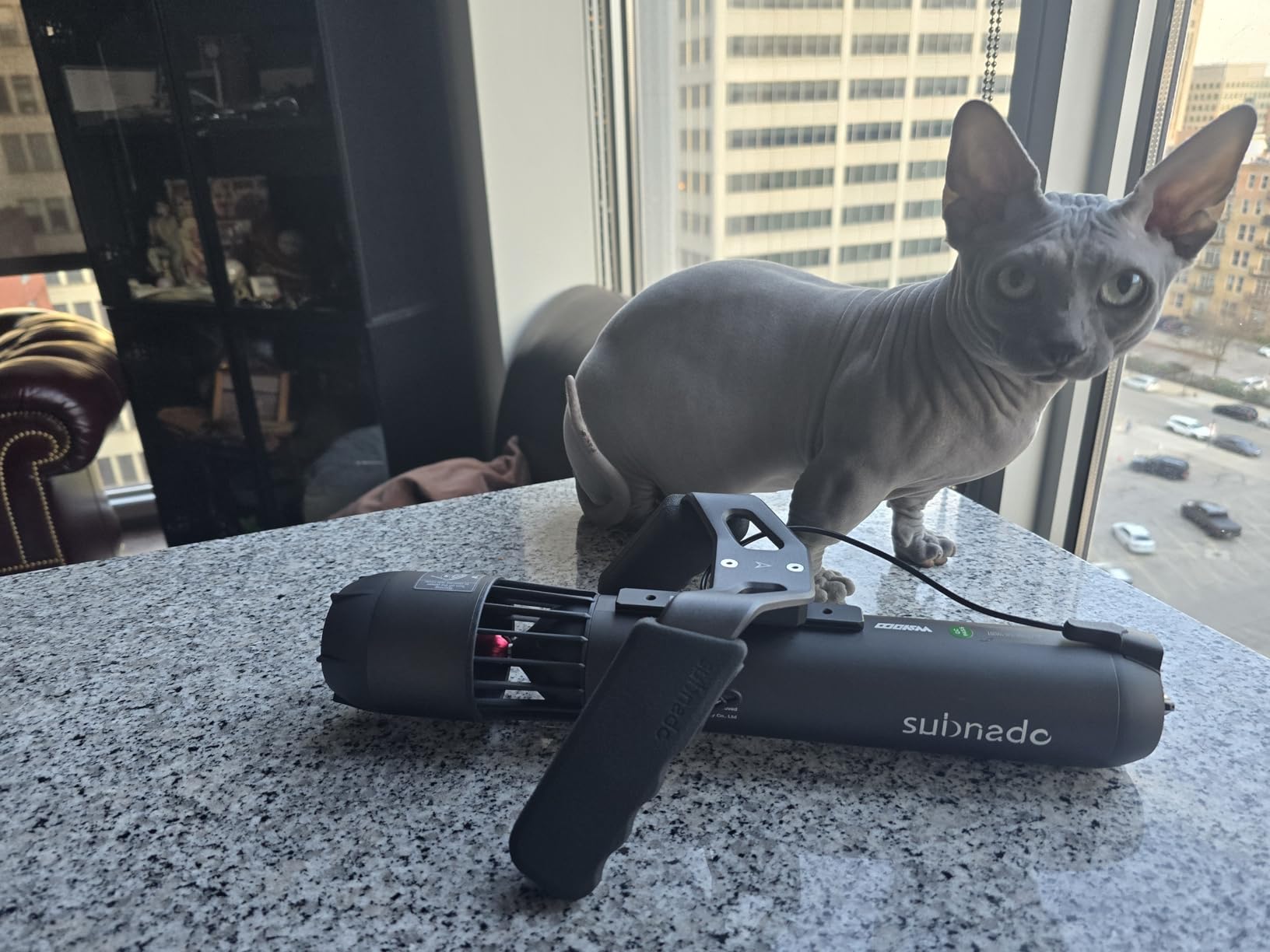
This listing is the bare motor, and that is either exactly what you want or a waste of your money. It ships with the main unit and a finger-ring controller, while handles, controllers and mounts are all sold separately. If you already know which parts you need and want to build a rig, that flexibility is excellent. If you want something that works out of the box, look elsewhere.
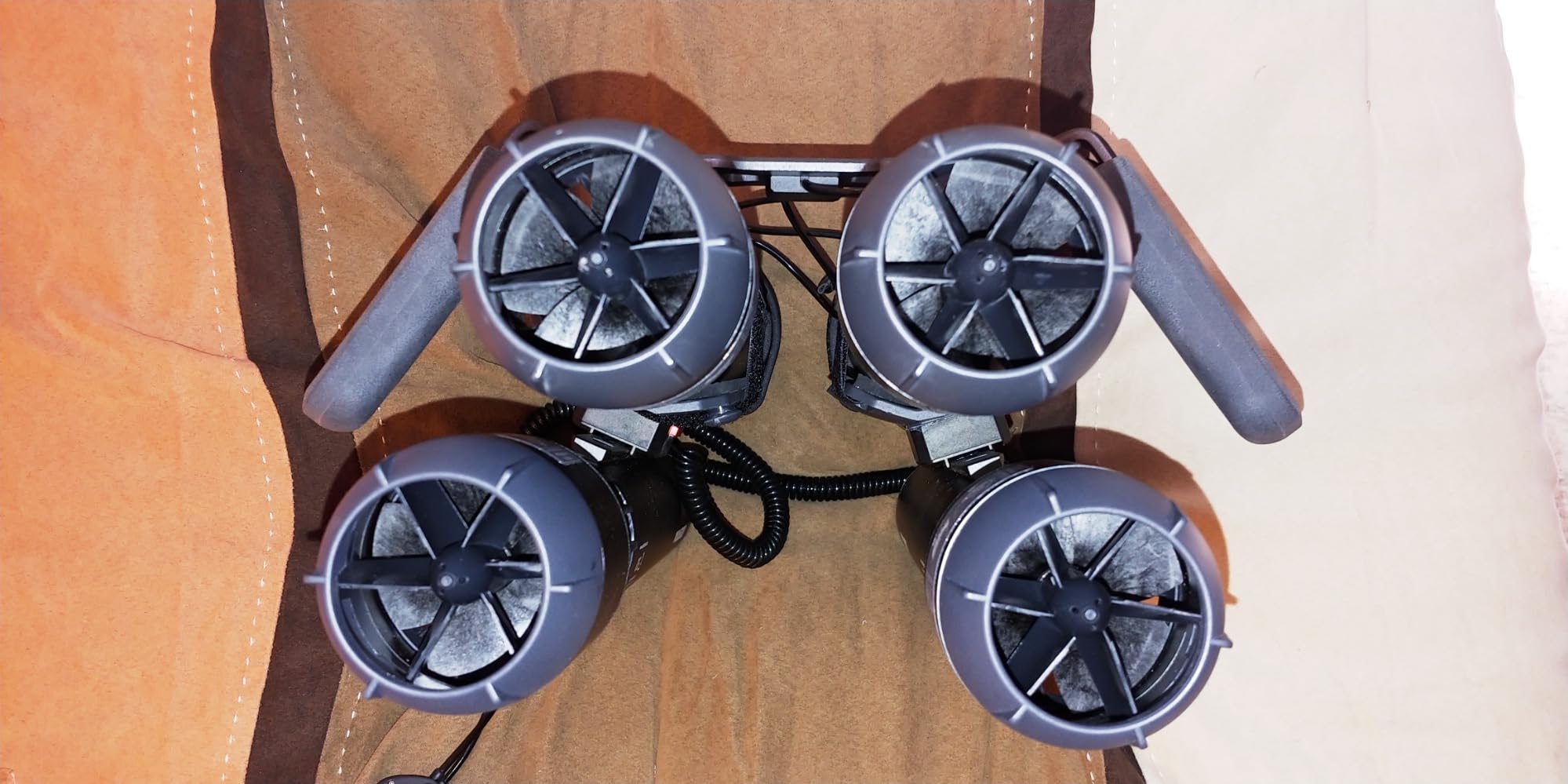
What the modularity buys is real. The unit mounts to a handgrip or a twin-engine handle bracket for double thrust, straps to arms, legs or a gas cylinder, and the mounting ring holds up to three accessories such as a camera and a fill light. Several owners report that two standard units produced more power than a premium bundle did.
Who this configuration suits?
Underwater photographers and freedivers working from a paddleboard or buoyancy board are the natural fit, because the accessory ring and the board mounts are the whole point. It also suits anyone who plans to add a second unit later to double the thrust for heavy kit or strong current.
Where it falls short?
Reviewers are blunt that the accessories cost far more than buying the bundle, and that some accessory plugs and connectors do not fit what the listing implies. Two further issues: the battery is built in with no spare sold separately, and the exposed USB charging port under the battery lid can admit water and cause charging failures. Customer support is chat and email only.
5. LEFEET P1 Lite Review – Deepest Rating and Smallest Footprint
LEFEET P1 Lite Underwater Scooter, 4 Speed Modes Portable Water Scooter for Adults, 60 Min Runtime, 200ft Depth with Camera Mount, Sea Scooter for Snorkeling, Swimming Pool Scuba, Diving
8 kgf thrust, 4 speed modes
200 ft IPX8 rating
60 min cruise on 99.63 Wh
3.9 lbs
Pros
- Deepest depth rating here at 200 ft with IPX8 sealing
- Very light at 3.9 lb and small enough for carry-on luggage
- Four speed modes give fine control in variable current
- 1.5 hour USB-C fast charge with 100W reverse charging
- Travel soft case included
Cons
- Battery is sealed in and not swappable
- Does not float and no flotation sleeve is offered
- Underpowered in strong current or with full scuba kit
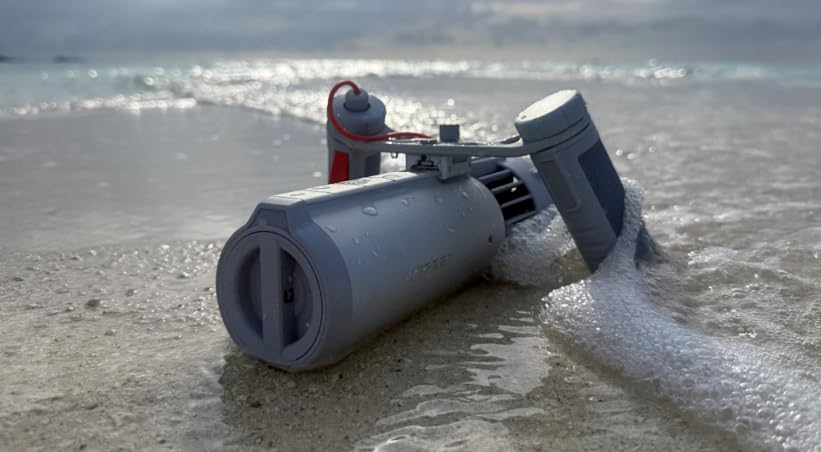
The P1 Lite is the specification outlier in this group. It carries a 200 ft IPX8 rating, deeper than anything else we tested, while weighing just 3.9 lb and measuring 10.7 inches long. For a diver who wants reach in compact form, that combination is hard to argue with.
Four speed modes give finer control than the two-gear units here, which matters in variable current where you want to hold position without dumping the battery. Top speed is 1.6 m/s and thrust is quoted at 8 kgf. The wired instant-response control is immediate and predictable, and a finger-safe propeller guard is fitted.
Why the 99.63 Wh battery is a deliberate choice?
The battery is specified just under the 100 Wh airline carry-on limit, so the whole scooter can travel in hand luggage with fewer questions than anything using a 122 Wh or 159 Wh pack. It charges to full in about 1.5 hours over USB-C and can reverse-charge a phone, and the soft travel case is included.
Where it falls short?
Two limits stand out. The battery is not removable, so you wait for a recharge instead of swapping packs, and the unit does not float on its own with no flotation sleeve offered, which makes the lanyard non-optional. Owners also report real mixed-use runtime closer to 45-50 minutes than the quoted 60, which is another good reason to read the runtime tiers carefully.
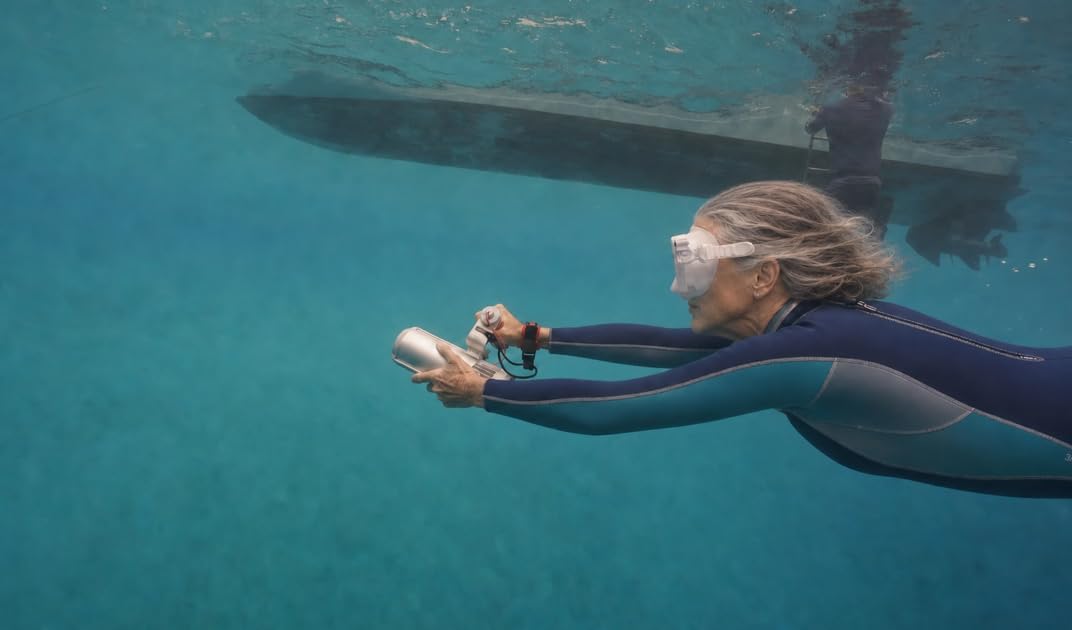
6. LEFEET C1 Review – Pool Workhorse With Real Safety Hardware
LEFEET C1 Underwater Scooter, Dual-Motor Sea Scooter with 8kgf Thrust & 1.6m/s Speed, Modular Design, 100ft/30m IPX8 Waterproof, 60 Min Runtime for, Snorkeling, Scuba Diving, Pool Activities
8 kgf dual-motor thrust
2 speeds at 1.3 and 1.6 m/s
97.2 Wh battery, 5 second swap
100 ft IPX8
Pros
- Dual motors pull adults around 190-240 lb without difficulty
- 5 second quick-swap battery keeps a session going
- Motors fully shrouded on all sides so fingers cannot reach them
- About 2 second spin-up and shut-off for predictable control
- 3-level battery indicator on the rear knob
Cons
- Sinks when released and there is no neutral buoyancy mode
- Slower gear still feels slow for larger riders
- Expect closer to 30-35 minutes at high speed for a 190 lb rider
Owners treat the C1 as the scooter that survives repeated pool seasons rather than the one they show off. The fully shrouded motors are the standout: there is no way to reach a propeller with a finger, which removes the single most common worry parents have around water toys. Auto shut-off fires the moment you release the trigger.
Thrust is quoted at 8 kgf across dual motors, with two gears at 1.3 m/s and 1.6 m/s, and owners report it moving adults in the 190-240 lb range without difficulty. The 97.2 Wh battery swaps in about five seconds, so a second pack turns a single session into a full afternoon, and a three-level indicator on the rear knob shows the state of charge at a glance.
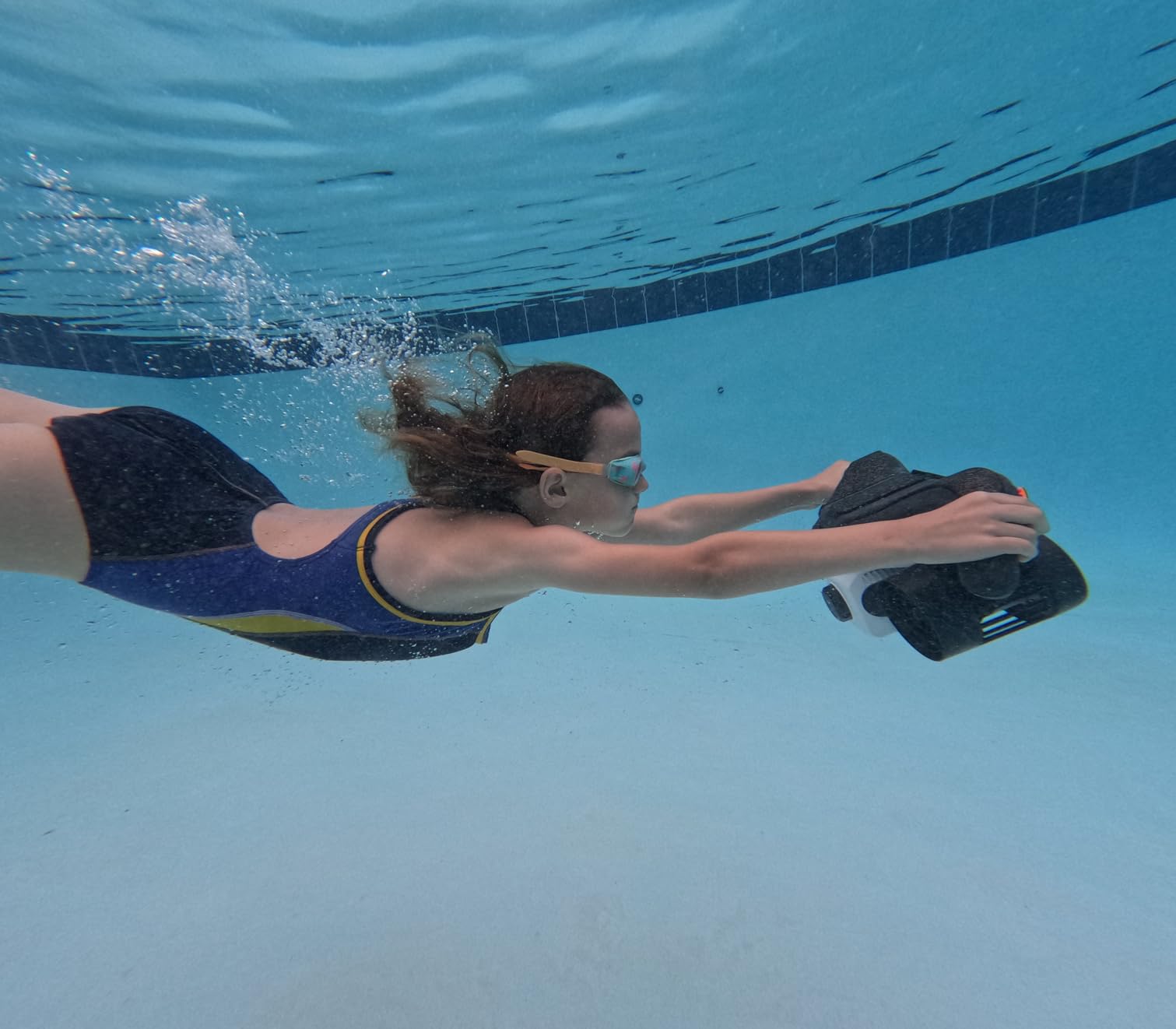
Why auto shut-off and shrouding matter more than thrust?
These are the features that stop a mistake from becoming an incident, and they are the reason the C1 works around children. A roughly two second spin-up and shut-off delay also means the throttle behaves predictably, so a small rider does not get a surprise burst when the trigger first moves.
Where it falls short?
The C1 sinks when released, so the wrist strap is essential and there is no neutral buoyancy setting. The slower gear still feels slow for larger riders, the speed mode cannot be changed with both hands on the handles, and a 190 lb rider should expect closer to 30-35 minutes at high speed rather than the headline figure. Hair is worth tying back around the propellers.
7. LEFEET S1 Pro Review – Modular Twin-Unit Rig With a Wireless Remote
LEFEET Underwater Scooter S1 Pro, 3 Speed Adjustments, Max Speed 6.5km/h ,Modular Sea Scooter with Action Camera Mount, 40M Depth Rating for Water Sports Diving, Snorkeling, Swimming, Freediving
18 lb (8 kg) thrust
Top speed 1.8 m/s (6.5 km/h)
3 speed settings
Up to 70 min runtime
40 m rating
Pros
- Wireless remote frees both hands and can drive two units at once
- Double-up chassis doubles thrust for larger riders
- Quiet operation that does not disturb reef fish or seals
- Airline-compliant battery with spare packs allowed in carry-on
- 5 second battery replacement
Cons
- Battery sealing ring has cracked on multiple units
- Not fast enough to move large heavy adults on its own
- Salt water must be rinsed off and the housing dried before opening
The S1 Pro is the most premium-feeling scooter in this group, and the packaging and machining reflect that. Its signature feature is a wireless remote that frees your hands entirely and can drive two units at once, which is why it suits videographers and anyone who wants a scooter that is not physically attached to them.
Thrust is quoted at 8 kg (18 lb), a 14% increase over the earlier version, with a top speed of 1.8 m/s (6.5 km/h) across three speed settings. Runtime is rated at up to 70 minutes per charge with five-second battery swaps, and the 40 m depth rating applies when the unit is set up per the manual. Quiet operation is repeatedly praised because reef fish and seals are not scattered by the noise.
Why the twin-unit chassis changes the maths?
Owners of heavier builds report that the double-up chassis is what turns the S1 Pro from adequate to genuinely capable, doubling the available thrust for a diver in full kit. For long sessions in moderate current, the 70 minute rated runtime plus quick swaps is the most useful combination here.
Where it falls short?
The most serious documented defect is a cracked battery sealing ring that has let salt water in and ruined batteries on multiple units, so inspect it before every session. It is also not fast enough to move large heavy adults on its own, the USB charger is not included, and the housing must be rinsed and dried before opening.
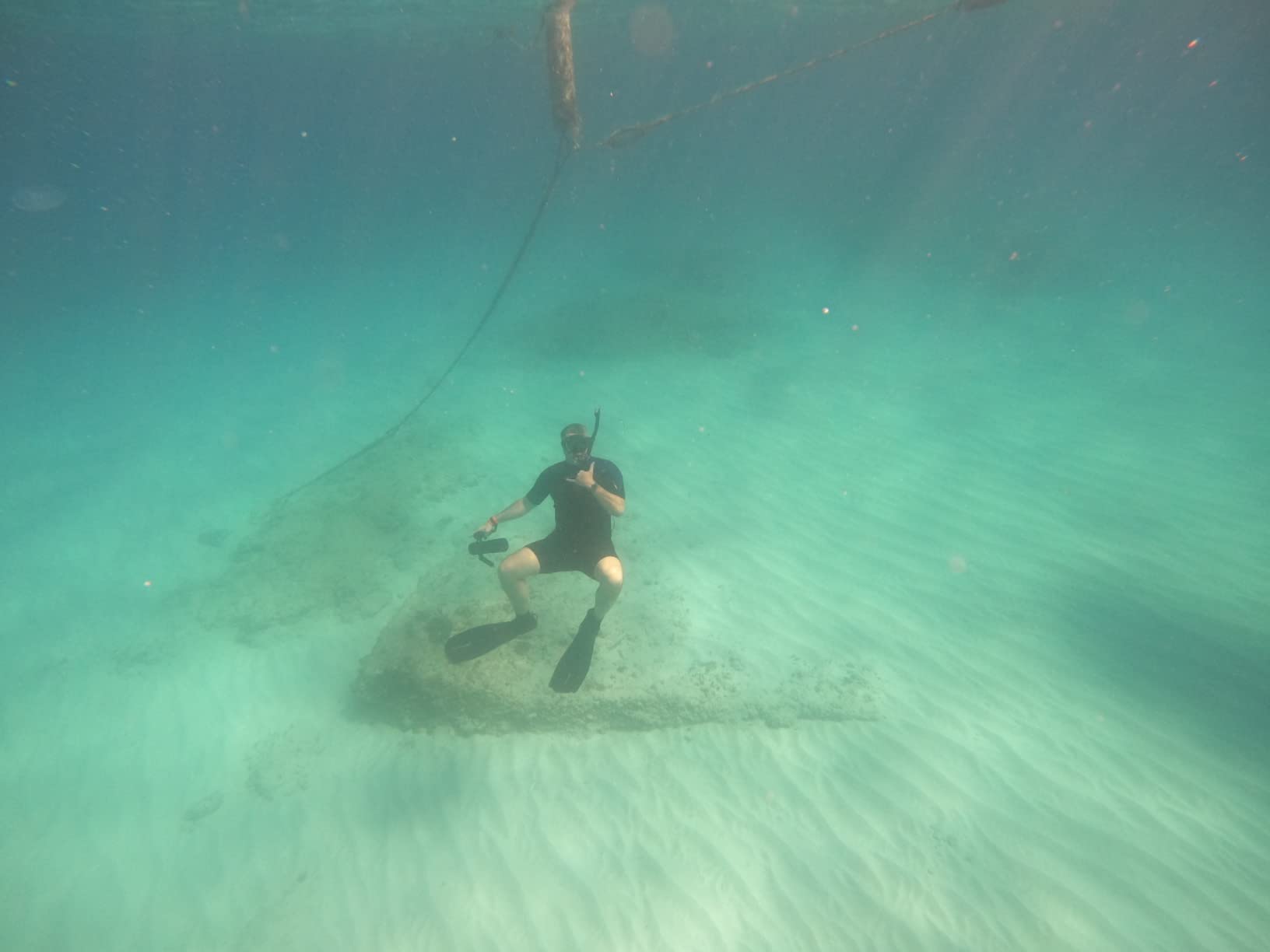
8. sublue Mix Pro Review – More Power and Three Gears
sublue Mix Pro Dual Motor Underwater Scooter – 3 Speed Modes, 60 Min Runtime, 131ft Depth with Camera Mount & Low Battery Alarm for Pool, Diving, Snorkeling – Water Scooter for Adults
24 lbf dual motors
3 speeds to 4.02 mph
60 min intermittent
122 Wh removable battery
131 ft
Pros
- Self-floating and rises to the surface if released
- Strap-free handheld use with no harness to fit
- Removable swappable battery for longer outings
- 3 speed modes from cruising to fast riding
- Waterproof backpack and smartphone mount included
Cons
- Top speed drains the pack in about 18 minutes continuous
- No spare battery included and one costs extra
- Reports of early unit failure with no support response
The Mix Pro is the step up from the standard Mix, and the changes are real rather than cosmetic. Thrust rises to 24 lbf, the two-speed switch becomes three speed modes, and a low battery indicator is added. Top speed is 4.02 mph, so there is a genuinely fast gear here rather than a slightly stronger slow one.
The self-floating design with a detachable buoyancy chamber is the safety story: release the scooter and it rises to the surface instead of sinking away from you. Buyers also like that the 30L waterproof backpack and smartphone mount are in the box, which makes it the most complete package for a family day out.
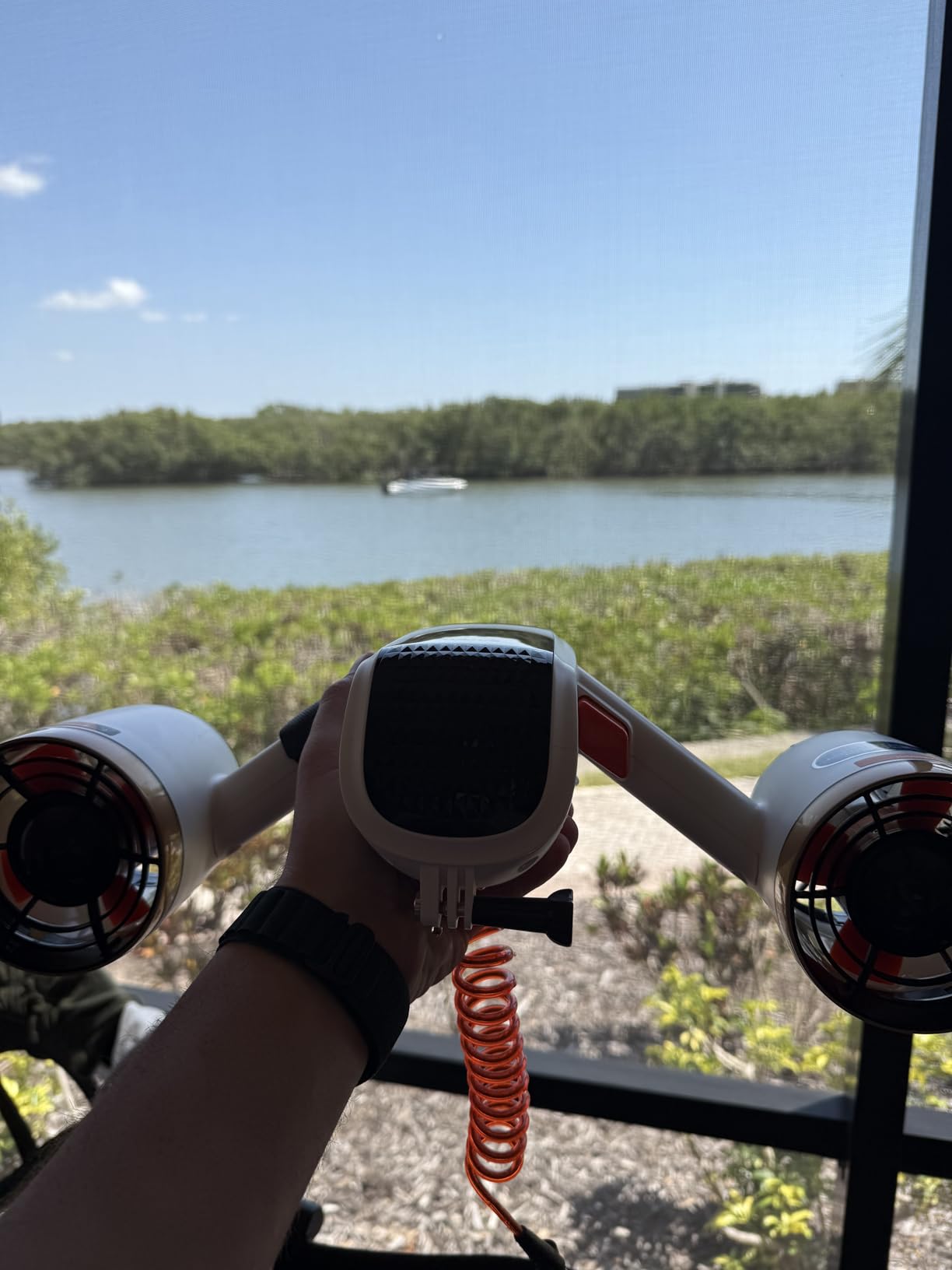
How the three speed modes change session planning?
The published runtime tiers matter more here than anywhere else in the roundup: up to 60 minutes intermittent, 30 minutes at low, 20 at medium and only 18 at high. Plan the outing on the medium figure, or buy a second 122 Wh battery, which is not included in the box.
Where it falls short?
That top gear is a power toy rather than a cruising tool, and the 7.8 lb weight is noticeable underwater. A small cluster of reviews reports units failing within a week with no response from support, which is worth weighing against the strong 73% five-star share among the rest.
9. Nautica Navigator and Skipper Review – Shaped for Younger Swimmers
Nautica Navigator Underwater Seascooter, Underwater Seascooter Reliable Performance for Aquatic Adventures Scuba Diving and Snorkeling, Water Scooter for Swimming Pool
Built for ages 8 and up
60 min runtime
2.5 mph top speed
30 ft (10 m) rating
7-8 hour recharge
Pros
- Sized and shaped for younger recreational divers and snorkelers
- Two-trigger controls stop power when either trigger is released
- Protective grille keeps debris out of the propeller
- Built-in action camera mount for hands-free filming
Cons
- Shallowest depth rating in this group at 30 ft
- Lowest top speed here at 2.5 mph
- Slow 7-8 hour recharge
- the longest in the roundup
This is the only model here designed explicitly for younger recreational divers and snorkelers from age eight upward, and the shape follows that brief. The body is smaller and easier to hold, and the built-in action camera mount suits the filming that younger swimmers naturally want to do.
Up to 60 minutes of runtime per charge keeps a pool session going, and the dual-trigger activation is the safety feature worth noting: releasing either hand cuts power, so a single-handed loss of control stops the unit rather than sending it across the pool. A protective grille keeps debris out of the propeller.
Why dual-trigger control matters for younger riders?
Two-handed control is the safest arrangement for a child because it ties propulsion to the same grip that keeps the body balanced. A single-trigger scooter in a pool with other swimmers is a different risk profile, and this is the one design change here that is genuinely about the rider rather than the specification.
Where it falls short?
The 30 ft (10 m) depth rating is the shallowest here, and the 2.5 mph top speed is the lowest, so this is a pool and shallow-water product. The 7-8 hour recharge is the longest in the roundup and effectively means one charge per day, and review volume is the thinnest here, so owner feedback is less developed.
10. sublue Navbow+ Review – The Only Scooter With a Full Instrument Panel
sublue Navbow Navbow Plus Smart Professional Underwater Scooter Dual Motors with Camera Mount 3 Gear Speed 4.47mph 60 Mins 131ft Pool Diving Snorkeling Water Scooter for Adults
31 lbf dual motors
3 speeds to 4.47 mph
OLED depth and compass
159 Wh battery
131 ft
Pros
- OLED display shows depth
- temperature
- heading and battery live
- App sets depth limit and return-to-home battery alerts
- Self-floating so it rises to the surface instead of being lost
- Highest thrust in this group at 31 lbf
- Swappable 159 Wh battery removes and refits easily
Cons
- Turbo drains the pack in about 8 minutes
- Two units reported failing within a day
- Heaviest unit here at 9.9 lb
- Airline may require approval for the 159 Wh battery
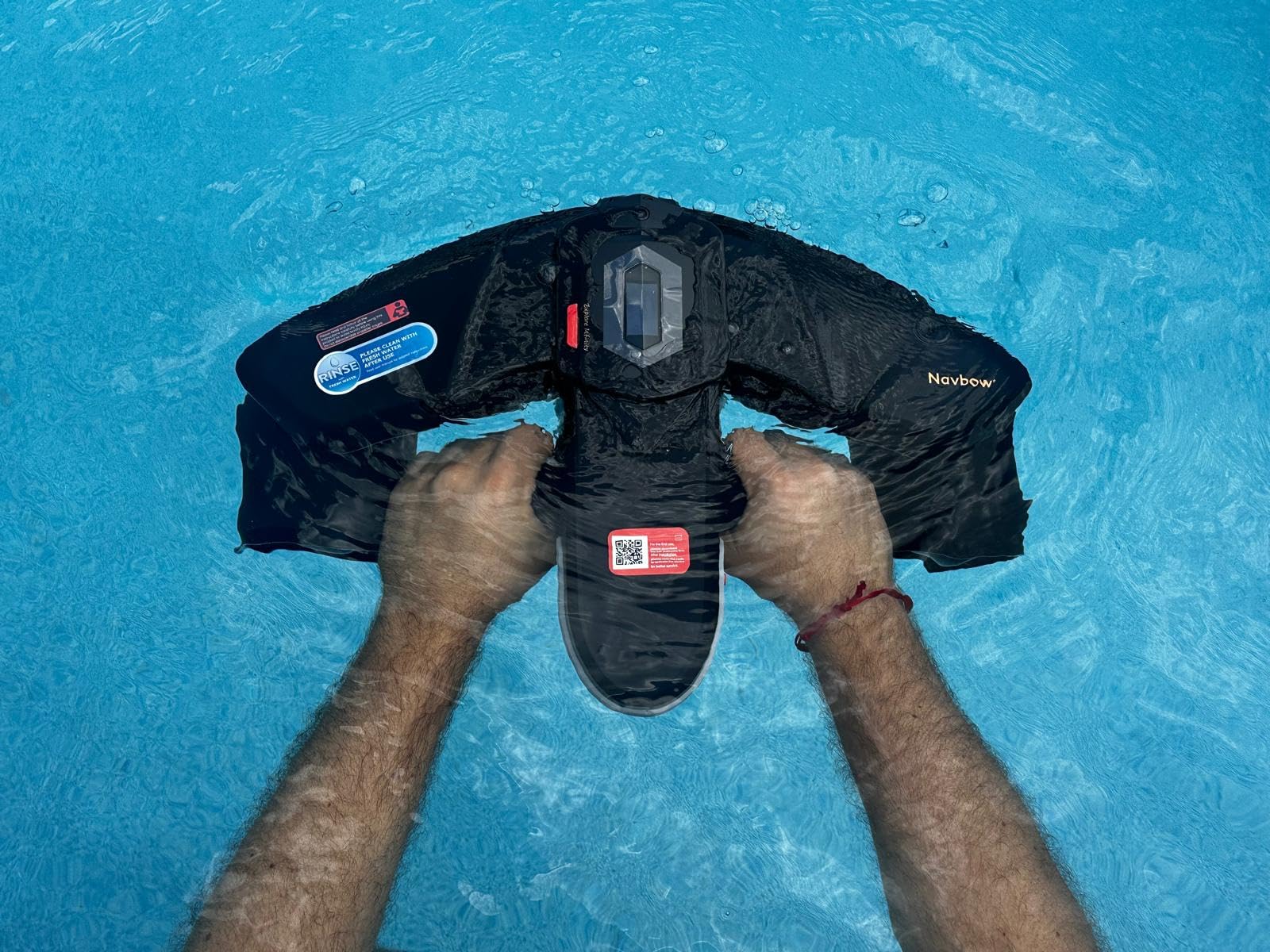
The Navbow+ is the only scooter here with a proper instrument panel. The OLED display shows temperature, depth, navigation, battery, gear and mode in real time, and a built-in depth sensor, temperature sensor and digital compass feed it. That is not novelty: it is the only unit in the group where the scooter itself can enforce a depth limit.
The companion app is the feature that changes behaviour. You can set a depth alert and a return-to-home battery alert, and both trigger a buzzer and a display warning. For anyone who wants a scooter that helps manage no-stop time and gas rather than simply adding power, that is a meaningful advantage over the other nine.
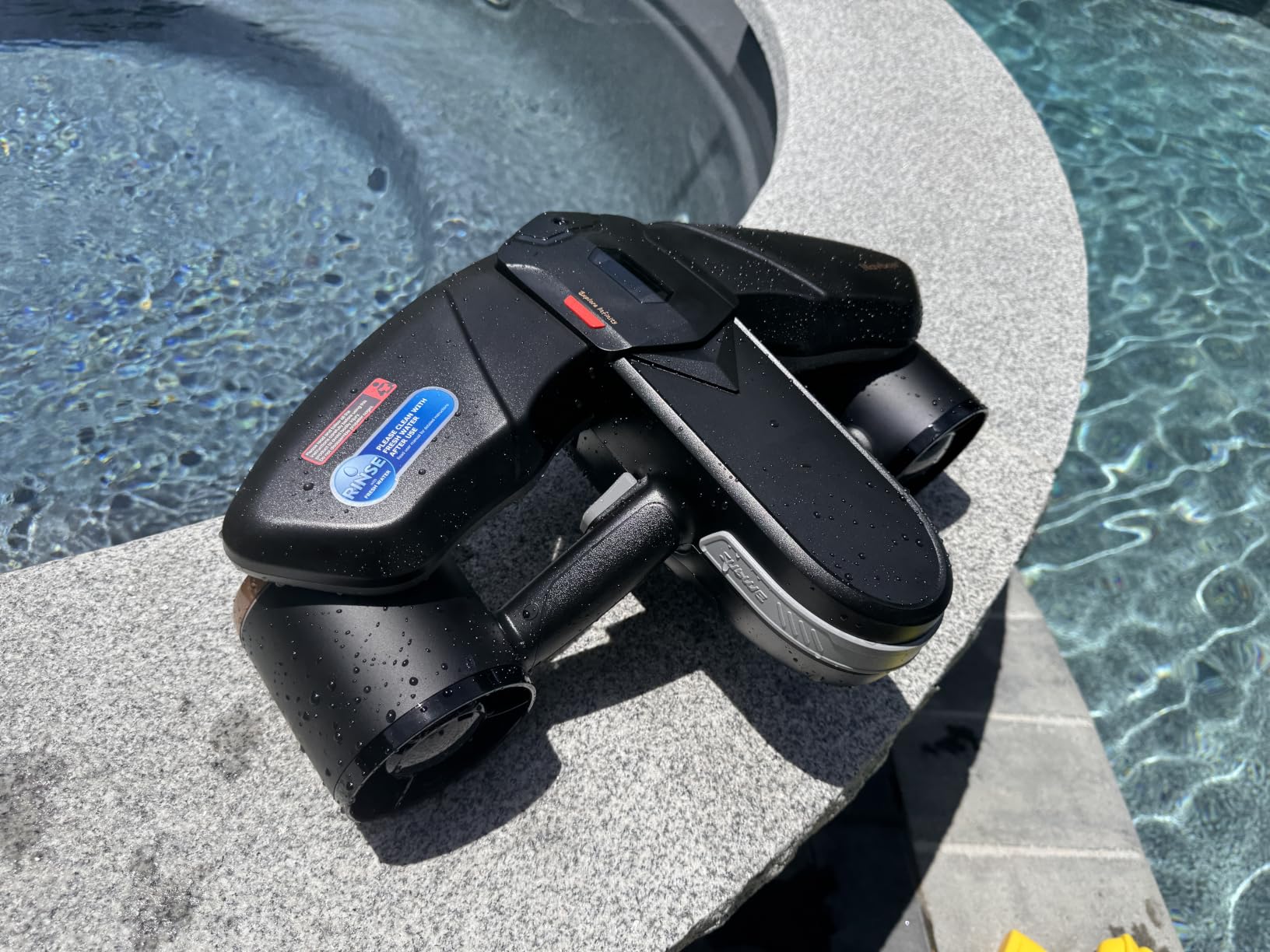
Why 31 lbf and a display work together?
Thrust is the highest in this roundup at 31 lbf, so it will move more than one person, and the three modes run from Free at 2.24 mph through Sport to Turbo at 4.47 mph. The self-floating positive buoyancy means that if you do lose control of it, the recovery is watching it rise.
Where it falls short?
The speed modes are uneven: Turbo gives roughly 8 minutes before the pack needs a change, which is not enough for most dives. At 9.9 lb it is the heaviest unit here, the 159 Wh battery may need written airline approval, no spare pack is included, and two owners reported units failing within a day. Review volume is also the thinnest in the group, so treat the early reliability reports as a question worth asking support about.
Which Sea Scooter Fits the Way You Use It?
Match the scooter to the activity rather than to the specification sheet. A snorkeler on a reef boat, a freediver working a deep line, a scuba diver crossing a current and a family at a hotel pool have almost nothing in common, and the same spec that impresses one group is wasted on another.
Snorkeling over shallow reefs
You need positive buoyancy, a lanyard, propeller guards and a runtime figure you can trust at cruising speed. The sublue Mix, the Asiwo Manta and the LEFEET C1 all cover this, and the Mix and Manta give you enough thrust to share one scooter between two people.
Freediving and line dives
Weight in air is the constraint here, because you are carrying the unit down a line. The LEFEET P1 Lite at 3.9 lb and the Waydoo Subnado Lite at 3 lb are the two lightest options. Neither is built to haul a diver and a line together, so plan the descent before you commit to a deep line.
Recreational scuba in current
Thrust and quiet running matter, and so does a battery you can swap without ending the descent. The S1 Pro with its twin-unit chassis, and the Mix Pro with 24 lbf and a removable 122 Wh pack, are the two most convincing options for a diver in full kit.
Travelling by air
Wh decides whether you are packing it or shipping it. The Subnado Lite at 98 Wh and the P1 Lite at 99.63 Wh sit under the 100 Wh carry-on threshold, while 122 Wh and 159 Wh packs may need airline approval. If your trips are frequent, the two sub-100 Wh units remove an entire layer of friction.
Underwater photography and video
Look for standard accessory mounting and smooth low-speed control. The Navbow+ gives you a live depth and compass readout plus app-set alerts, the S1 Pro frees your hands entirely with its wireless remote, and the Subnado main unit’s mounting ring carries a camera and a fill light at once.
Who should not buy one?
If you are not comfortable handling a propulsion device near a reef, do not buy one. If your dives are all shallow and you can already reach the site, a scooter adds gas-management risk for no benefit. And if you want to travel frequently without writing to airlines about batteries, choose a sub-100 Wh unit or skip the category. If you want a surface craft instead, our jet ski comparison covers that side of the market.
Rinsing and Storing a Sea Scooter After Salt Water Use
Rinse discipline is the difference between a scooter that lasts and a scooter that fails in its first season. Salt water left in a housing crystallises in the seals and corrodes the contacts, and both failure modes are documented repeatedly in owner feedback across this group.
Rinse the unit in fresh water straight away, with the battery removed, and pay attention to the propeller guards, lanyard and every seam.
Run the motor briefly in fresh water if the model allows it, to flush salt from the nozzle rather than pushing it further in.
Check the O-rings and the battery sealing ring for cracks or flattening, and replace anything hardened. Spare O-rings are included with some models here.
Let the housing dry completely before you reassemble it or plug in the charger. A wet housing plus a powered port is how charging failures start.
Store at a partial charge in a dry place away from direct sun, and expect to top it up before the next session rather than leaving it full for months.
The same care applies to the deck of a boat and to any freshwater use. If your scooter lives at a pool or a resort rather than in a sea, our guide to outdoor water features covers the surrounding setup. Riders who want a completely different kind of personal watercraft should also see our gas scooter picks.
Frequently Asked Questions
Which sea scooter is best?
For most people the sublue Mix is the best all-round sea scooter in 2026. It combines 22 lbf of dual-motor thrust, a removable 122 Wh battery, published runtime figures for each speed, and a self-floating design with a detachable buoyancy chamber. Choose the LEFEET P1 Lite instead if travelling light matters most, and the Asiwo Manta if smooth, beginner-friendly control in open water is the priority.
What is a DPV underwater scooter?
A DPV, short for diver propulsion vehicle, is a sealed battery-powered underwater scooter that a snorkeler, freediver or scuba diver holds or mounts to be pulled through the water instead of finning. The same product is also sold as a sea scooter, an underwater scooter or an underwater thruster. A lithium-ion battery powers an electric motor that drives a propeller inside a pressure-rated housing.
How deep can underwater scooters go?
It depends entirely on the model. The scooters in this roundup are rated from 10 metres (30 ft) for shallow water up to 200 ft (61 m) on the LEFEET P1 Lite, with several clustering around 40 m (131 ft). A depth rating is the maximum operating limit of the housing and is not a recommended depth. Match it to the depths you already handle comfortably and stay shallower.
How long does a sea scooter battery last?
Published runtimes are maximum figures at a specific throttle, not guarantees. The sublue Mix is quoted at up to 45 minutes intermittent, 30 minutes continuous at low speed and 20 minutes at high speed, and the Mix Pro at up to 60 minutes intermittent but only 18 minutes at top gear. Plan your session on the second-lowest published figure for your main speed, because current, kit and rider weight all cut into it.
Can I take a sea scooter on a plane?
Most airlines allow lithium batteries up to 100 Wh in carry-on baggage without prior approval, and require written approval above that threshold. The Waydoo Subnado Lite at 98 Wh and the LEFEET P1 Lite at 99.63 Wh sit deliberately under the limit. The sublue Mix and Mix Pro at 122 Wh and the Navbow+ at 159 Wh are above it, so check with your carrier before flying and always carry the battery in the cabin, never checked.
The Best Sea Scooter for the Way You Move Underwater
The sublue Mix is our best sea scooter overall in 2026, because it is the only unit here that gets the fundamentals right at once: real dual-motor thrust, a battery you can remove, runtime published per speed, and positive buoyancy that keeps the scooter on the surface when you let go. If you need something that fits in a cabin bag, the LEFEET P1 Lite is the answer; if you want a live depth and compass readout, the Navbow+ is the only one that offers one.
Match the scooter to the water you actually use, read runtime figures sceptically, and treat a depth rating as a limit rather than a destination. Our feature checklist above is the one to work through before you spend anything, and each product links straight to the current listing.