
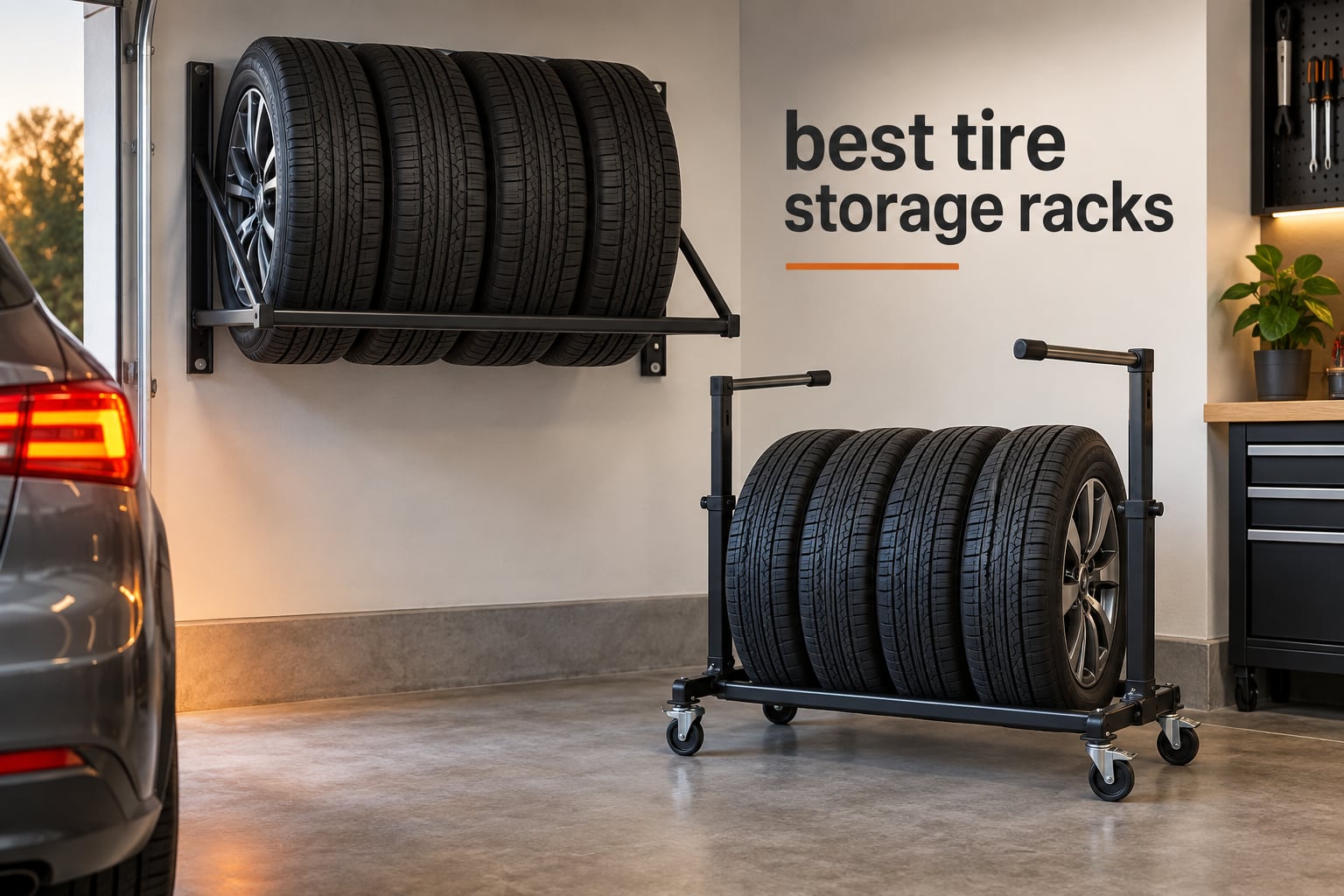
The best tire storage rack for most garages is the HyLoft 01000, an adjustable wall-mounted alloy steel rack rated to 400 lb that expands from 34 to 58 inches. Add the SafeRacks 400 lb wall rack for thicker tubing and a lifetime warranty, or the MaxxHaul 70489 if you want a folding rack that collapses flat when the seasonal set is on the car.
That answer holds because of one number most listings bury. A single set of four mounted wheels and tires lands somewhere between 300 and 550 lb once the rims are on them, and a stack of loose tires on the floor takes up roughly 8 to 10 square feet of garage you would rather park in. A rack with a 300 lb total rating is already marginal for a performance set. A rack rated 400 lb is the practical floor.
We compared ten wall-mounted, folding and rolling racks, checking published load ratings, stated width adjustment, tube gauge, mounting hardware and the tire sizes each listing actually claims to fit. Seven of the ten are wall mounts, which tells you something about how garages actually work. Floor space is the scarcest thing in a one-car garage, and a rack that hangs at shoulder height hands it back.
There are four rack types worth understanding before you shop. Wall-mounted racks bolt into studs and cradle each tire upright. Folding wall racks do the same thing but swing flat against the wall when empty. Freestanding and rolling racks stand on the floor on casters, holding tires lying down on horizontal shelves. Commercial shelving racks are boltless pallet-style units built for shops holding far more than one vehicle’s worth of rubber.
Before you pick a brand, check three numbers on any listing: the total weight rating, the width adjustment range in inches, and the largest tire diameter it clears. Those three decide whether the rack works in your garage. Everything else is finish and convenience.
Top 3 Tire Storage Racks in 2026
HyLoft 01000 Multi-Tire Wall Rack
- Adjusts 34-58 inch width
- 400 lb total capacity
- Alloy steel with black powder coat

SafeRacks 400 lb Adjustable Wall Rack
- 400 lb capacity
- 12-gauge tubing extends to 56 inch
- Tires up to 34 inch diameter
MaxxHaul 70489 Folding Wall Rack
- 300 lb capacity
- Adjusts 32-48 inch width
- Folds flat against the wall
Best Tire Storage Racks at a Glance
All ten picks below are wall-mounted or rolling steel racks. The comparison table puts every one of them side by side so you can scan load rating, adjustment range and tire fitment in a single pass.
| Product | Specifications | Action |
|---|---|---|
| HyLoft 01000 Multi-Tire Wall Rack |
|
Check Latest Price |
| SafeRacks 400 lb Adjustable Wall Rack |
|
Check Latest Price |
| MaxxHaul 70489 Folding Wall Rack |
|
Check Latest Price |
 VEVOR TC0513 Folding Wall Rack VEVOR TC0513 Folding Wall Rack |
|
Check Latest Price |
 VEVOR TC0519 Adjustable Wall Rack VEVOR TC0519 Adjustable Wall Rack |
|
Check Latest Price |
 Fioracl 31-56 Inch Adjustable Wall Rack Fioracl 31-56 Inch Adjustable Wall Rack |
|
Check Latest Price |
 JY PERFORMANCE Adjustable Wall Rack JY PERFORMANCE Adjustable Wall Rack |
|
Check Latest Price |
 ROBLOCK Folding Wall Tire Rack ROBLOCK Folding Wall Tire Rack |
|
Check Latest Price |
 STEELAID 60 Inch Rolling Tire Rack STEELAID 60 Inch Rolling Tire Rack |
|
Check Latest Price |
 EROTASH Rolling Tire Rack with Trays EROTASH Rolling Tire Rack with Trays |
|
Check Latest Price |
1. HyLoft 01000 Multi-Tire Wall Rack – Best Overall
HyLoft 01000 Heavy Duty Adjustable Garage Wall Multi-Tire Rack Storage, Black
Alloy steel
Adjusts 34 to 58 inch
400 lb total rating
28 x 58 x 31.5 inch
Pros
- Widest published review base of any pick
- Adjustable width handles staggered tire sizes
- Holds more than its rated load when installed properly
- Limited lifetime warranty
Cons
- Included lag bolts are the weak point in the kit
- Instructions are thin on stud placement
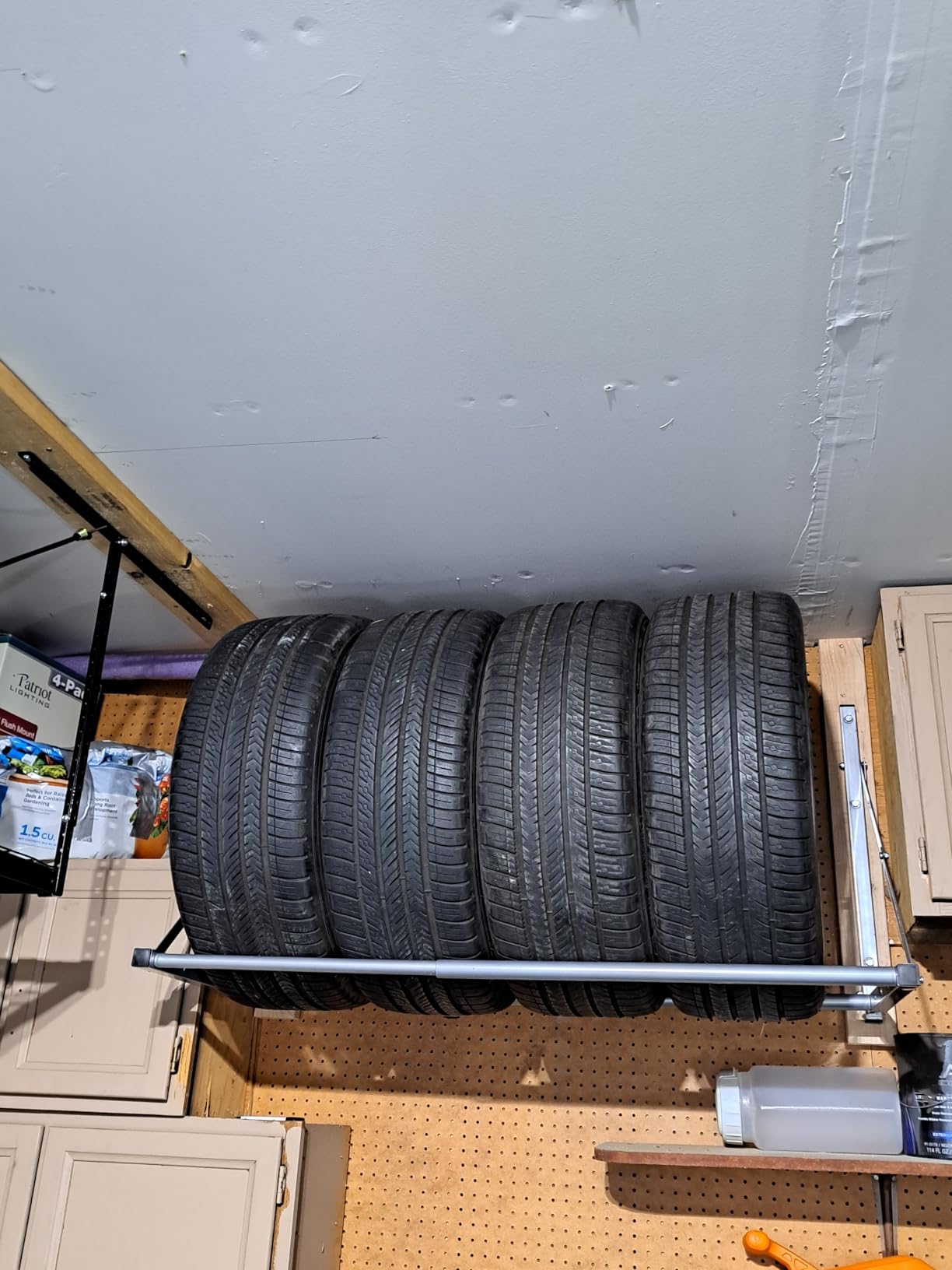
The HyLoft 01000 is the rack we kept coming back to while comparing the field. Its TiresLoft arms telescope from 34 to 58 inches, which is a wider adjustment range than most of the wall racks in this group, and the whole thing is rated to 400 lb across four tires. That combination of reach and load is exactly what a full mounted wheel set needs.
Owners with five-plus years of service report the same thing over and over: the rack still holds its shape and still holds its load. The 22.27 kg frame is heavier than most of the wall racks here, and that extra steel is why the arms do not visibly bow with a set of staggered performance wheels on board. Long-term owners also report it carrying more than its 400 lb rating when mounted properly into studs.
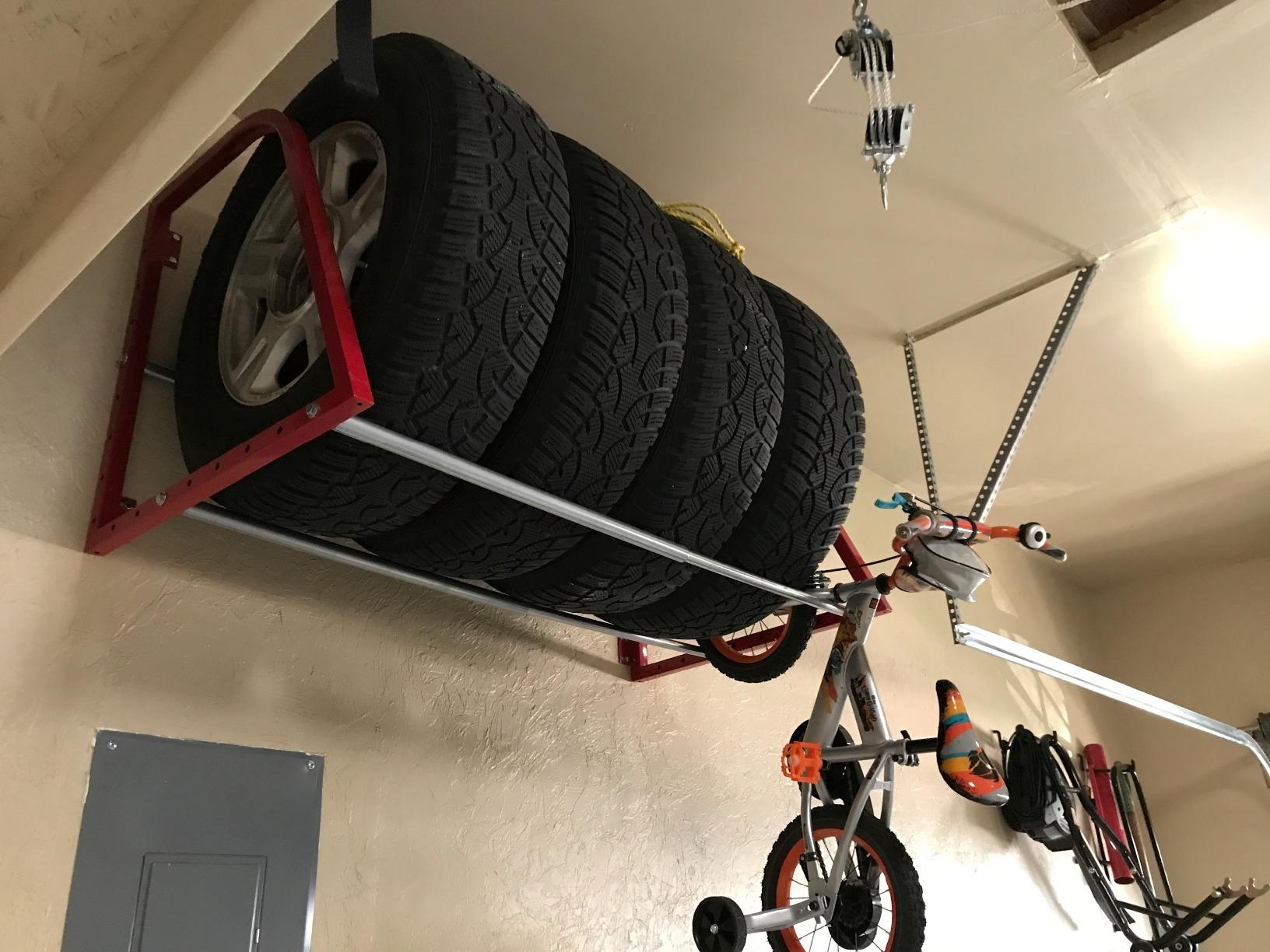
The build is all steel with a scratch-resistant black powder coat, and the manufacturer lists a limited lifetime warranty, which is unusual in this category. The rack is sold as a one-shelf unit with hardware included, and it is marketed for seasonal tires, RV tires and ATV tires rather than passenger cars alone.
The weaknesses are real but fixable. The lag bolts that ship in the box are the most common complaint across reviews, and the advice from owners is to swap them for grade 8 bolts with washers. Nuts can need a second tightening after the first load goes on, and at the widest settings tires can brush the wall behind them.
What you should check before mounting it
Measure the stud-to-stud span where you want the rack. The HyLoft needs its mounting holes to land on framing, and owners report needing a small modification when their stud spacing exceeds 48 inches. A magnetic stud finder and a 3/8 inch driver are enough for the install.
Confirm your tire diameter before drilling. At 28 inches deep and 31.5 inches tall, the rack is sized for standard passenger and light truck tires, and the manufacturer does not publish a maximum tire diameter for this model.
When to pick something else
Skip the HyLoft if you have no usable stud bay, or if you need a rack that folds flat out of the way during the driving season. Its arms are fixed once set, so they project roughly a foot into the room at all times. If that depth is a problem in a tight single-car garage, look at a folding design instead.
2. SafeRacks 400 lb Adjustable Wall Tire Rack – Best Premium Wall Rack
SafeRacks Heavy-Duty Adjustable Steel Wall Mount Tire Rack, Black, 400 lb
12-gauge steel tubing
Extends to 56 inch
400 lb total rating
27 x 56 x 10 inch
Pros
- Tubing is 15 percent thicker and larger than typical rivals
- Grade 8 lag bolts included
- Holds tires up to 34 inch without leaning on the wall
- Limited lifetime warranty
Cons
- Tubes can flex at full extension
- Optional bushing kit sells separately
Where the HyLoft wins on range of reviews, the SafeRacks wins on hardware. The manufacturer states the tubing is 15 percent thicker and 15 percent larger in diameter than comparable racks, and it is 12-gauge telescoping steel that extends up to 56 inches. The wall mounts are 11 gauge, fastened with 5/16 inch by 3 inch grade 8 lag bolts that are actually included.
That bolt grade matters more than most spec sheets admit. A loaded set of four mounted EV off-road wheels runs about 70 lb each, and that load hangs from whatever fasteners are in the wall. Having grade 8 bolts in the box removes the single most common installation complaint in this category, which is failing factory hardware.
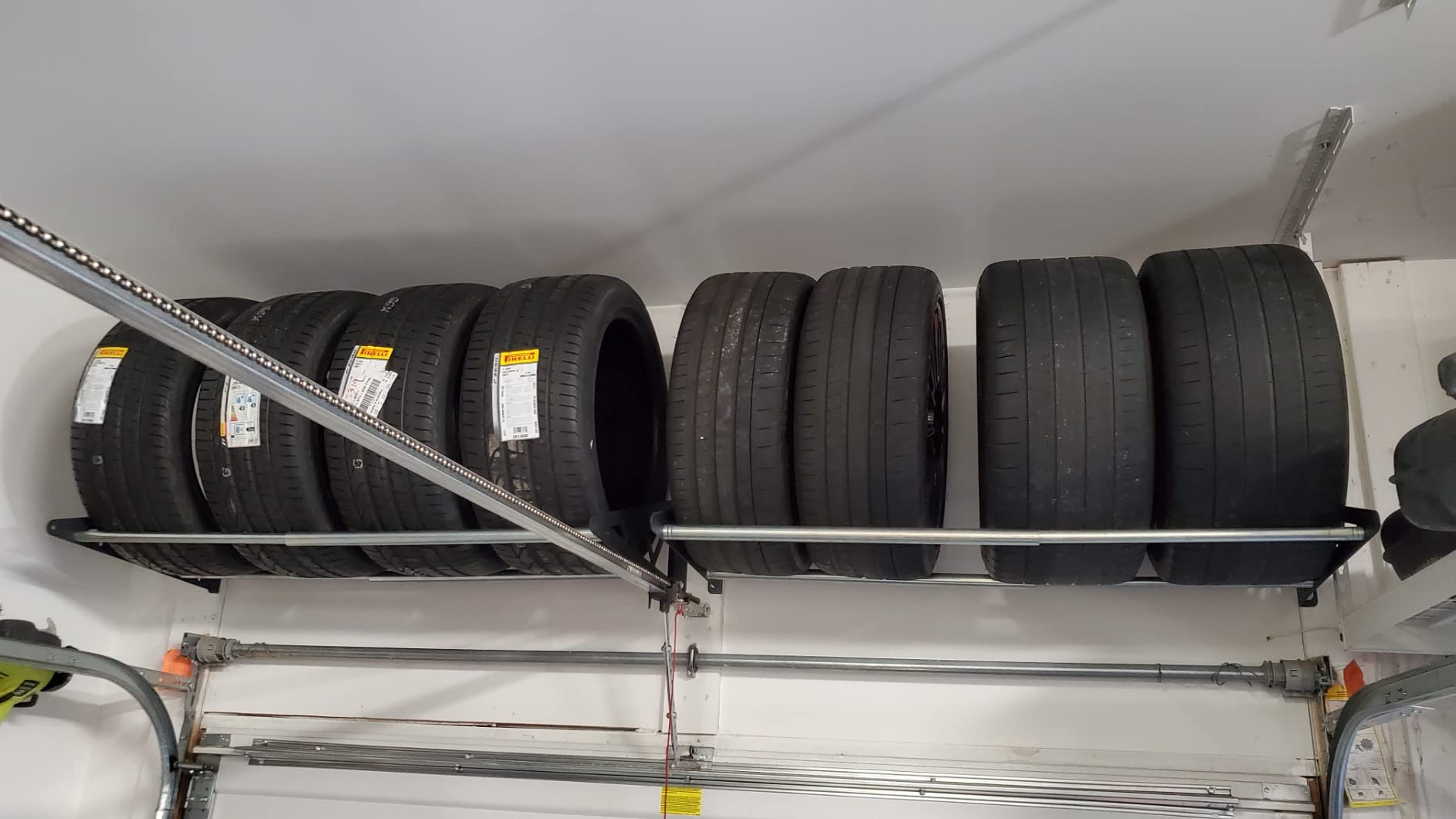
The SafeRacks also solves the diameter problem better than most. Multiple rod positions let you store tires up to 34 inches without using the wall as a backstop, which means the sidewall is not pressed against drywall. At 21 pounds it is lighter than the HyLoft, and the listed dimensions of 27 inches deep by 56 inches wide by 10 inches tall are among the tightest footprints here.
The reported weakness is flex. Owners note the tubes can bend or sag at full extension under heavy loads, and the optional bushing kit exists specifically to stiffen them. Mounting holes are fixed rather than slotted, so the rack has to be positioned around your studs, not adjusted to them.
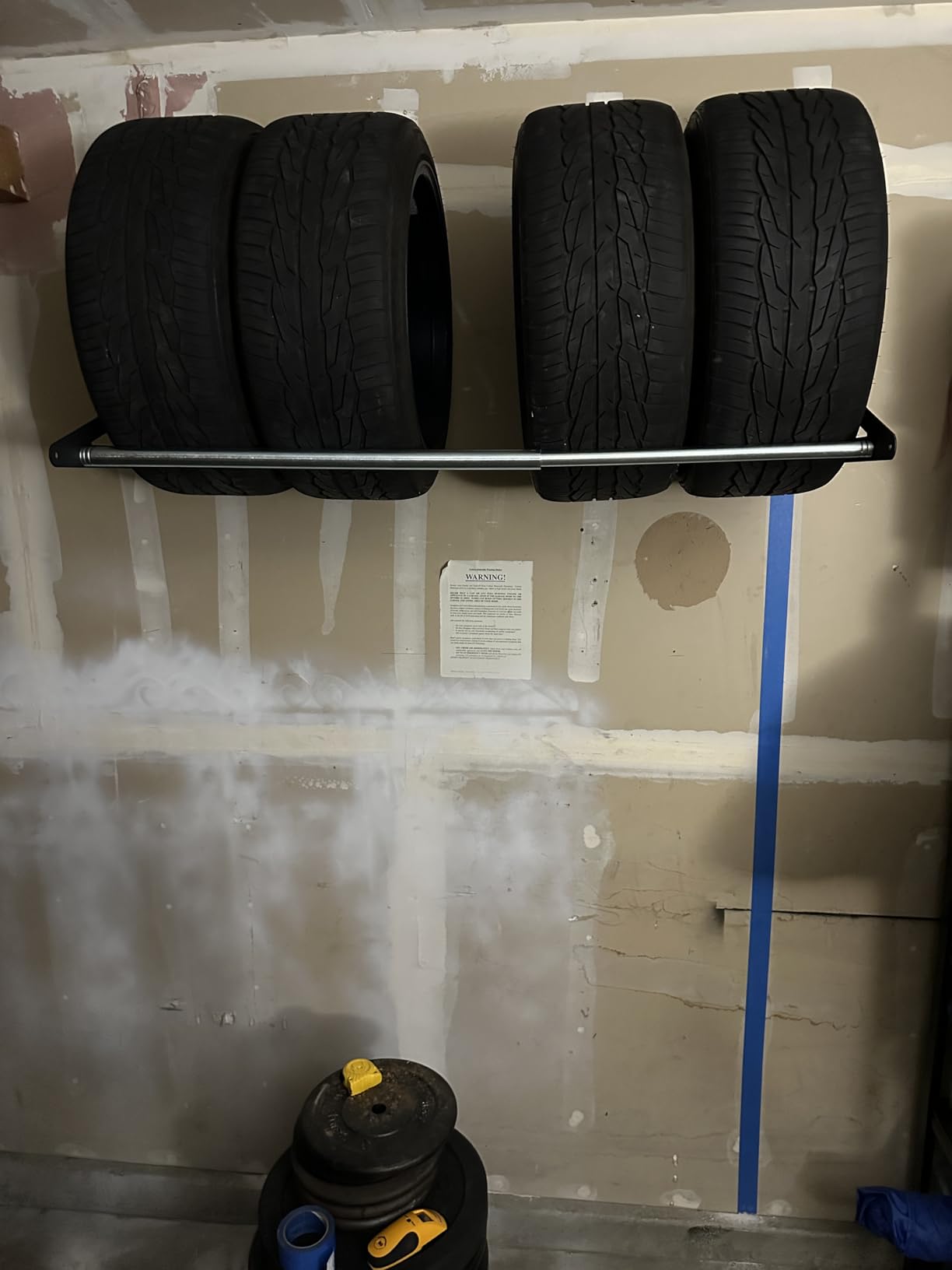
How the width adjustment actually works
The telescoping tubes slide and lock, so you set the total span once and leave it. Because the holes are fixed, measure the distance between the two studs you intend to use before you unpack anything, and confirm the tube length reaches past both centers with clamping surface on each side.
Set the width to the widest tire in your set plus a couple of inches of clearance. Staggered setups, where the rear tires are wider than the front, need the wider measurement as the driver.
When to pick something else
This rack is a poor match for a masonry wall, a sloped-ceiling room or a garage with no exposed framing. It also does not fold, so it stays at shoulder height year round. If you need mobility or a rack that doubles as general shelving, one of the rolling units further down this list is a better fit.
3. MaxxHaul 70489 Folding Wall Tire Rack – Best Value
MaxxHaul Adjustable Wall Mount Folding Tire Rack – 32 to 48 Inch Width – 300 lb Capacity – Heavy Duty Steel Garage Tire Storage Holds 4 Tires – 70489
Steel round tubing
300 lb total rating
32 to 48 inch width
Folds flat
Pros
- Folds flat to reclaim wall depth between seasons
- Adjustable width handles varied stud spacing
- Installs with basic hand tools
- Also works for vertical bike storage
Cons
- Included lag bolts are short and light grade
- Usable width is nearer 46 inch than the stated 48
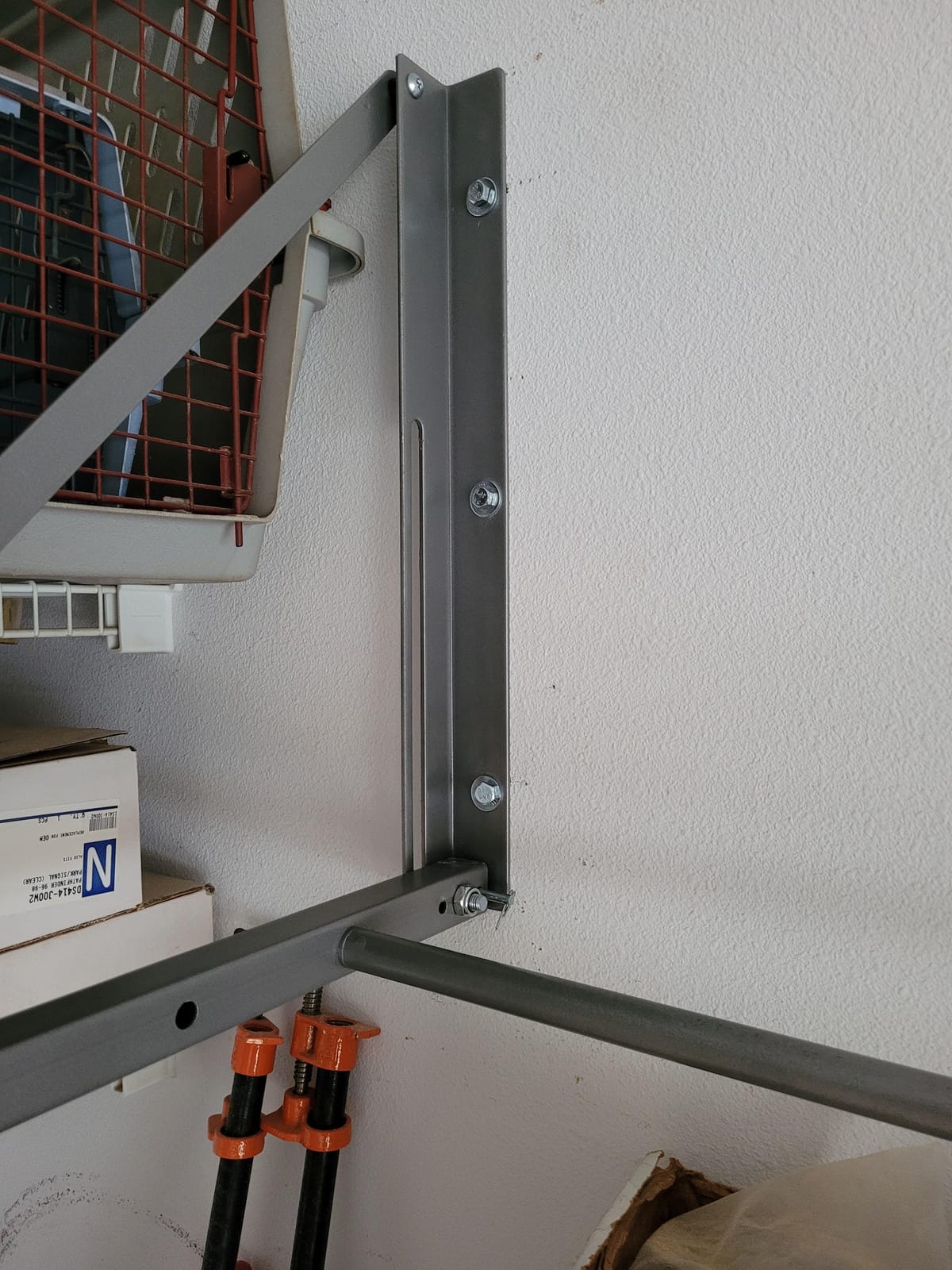
The MaxxHaul 70489 solves the problem no other rack in this list addresses cleanly: it folds flat against the wall when the seasonal set is back on the car. Owners with two sets of wheels for one vehicle use it that way, swinging the arms out for a swap and folding them away for the summer.
Construction is all steel with rigid round tubing, powder coated, rated to 300 lb. The width adjusts from 32 to 48 inches between the uprights, and at 17.12 pounds it is the lightest rack here. Installation is into vertical wall studs, and owners report basic tools are enough. Several users also store bikes vertically on it.
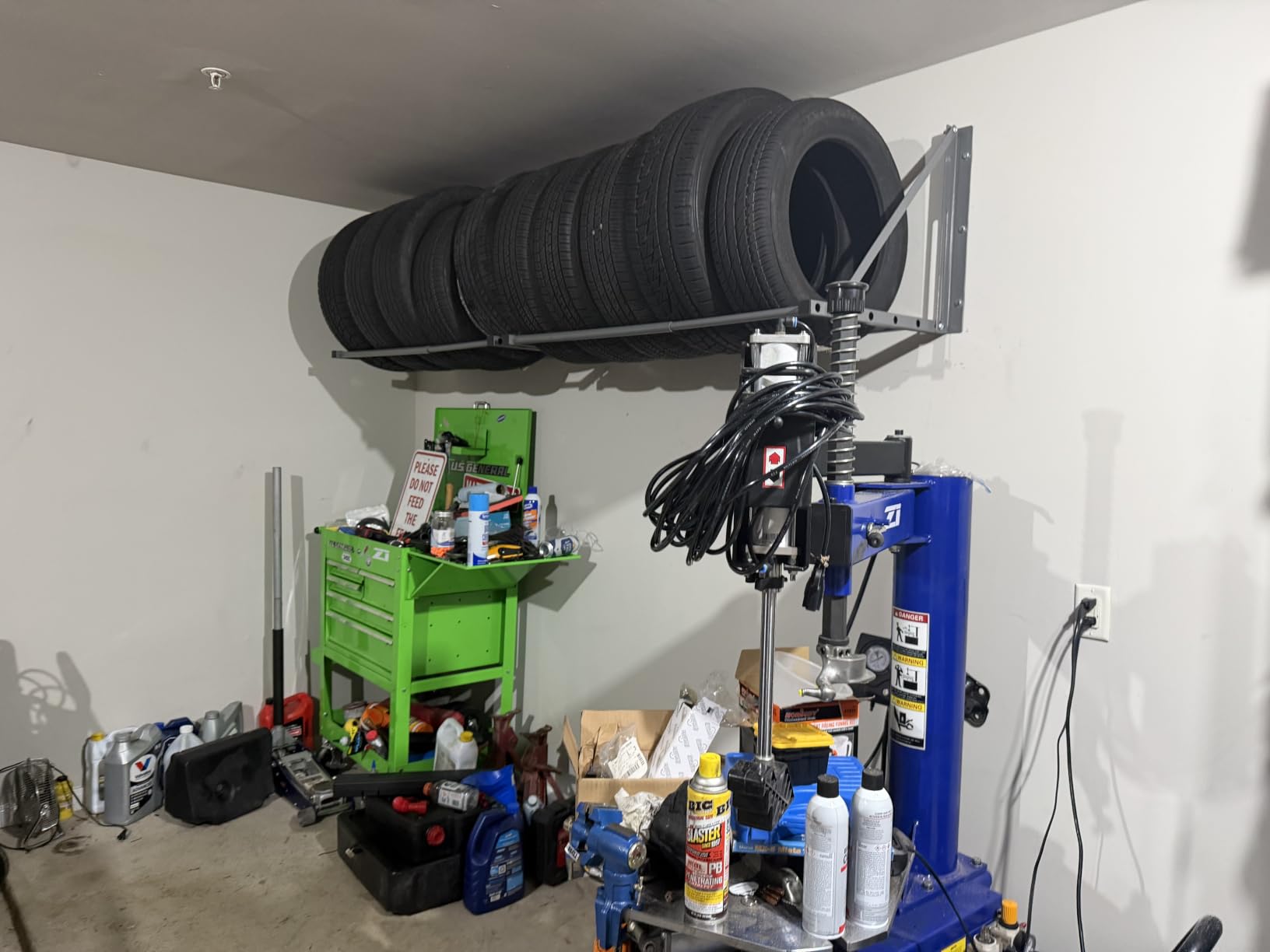
Two honest caveats. The effective usable width is closer to 46 inches because of how the brackets attach, so a set of staggered wide tires is tighter than the headline number suggests. And the included lag bolts are consistently described as short and low grade, with washers and shims often added for drywall installations.
One more small thing that catches people: assembly needs a 5/16 inch Allen wrench, which is not in the box, and the factory bolts can arrive over-torqued enough to fight back as you tighten the arms.
Where this rack earns its place
It suits a one-car garage where the wall is the only free real estate, and where the tires come off twice a year rather than every week. A rolling rack cannot be folded away the same way, and a floor stack never can.
It also suits anyone who wants to test whether they even like a wall rack before committing to a heavier unit. The 300 lb rating covers a normal daily-driver set of mounted wheels with margin, but tight for performance wheels.
When to spend more instead
Move up if your set includes staggered widths, if your tires are 20 inch plus with substantial sidewall height, or if you plan to add a second vehicle set on the same wall. At those weights, a 400 lb rack with thicker tubing is the more sensible purchase than adding hardware to a 300 lb frame later.
4. VEVOR TC0513 Folding Wall Rack – Best for a Tight Garage
VEVOR Wall Mounted Folding Tire Rack, 32″ – 48″ Adjustable Tire Rack, Q235 Heavy-Duty Steel Tire Storage Rack for R14-R20 inch Standard Tires, Max 300lbs Load Capacity for Garage Workshop Repair Shop
Q235 carbon steel
300 lb total rating
32 to 48 inch width
Holds 4 R14 to R20 tires
Pros
- Folds flat against the wall
- Explicit R14 to R20 fitment stated
- Adjustable support bars extend 32 to 48 inch
- Holds up to 4 standard tires
Cons
- Expansion bolts for concrete are not included
- Listing gives only 75 lb per shelf
The TC0513 is the folding option for people who care most about wall depth. It collapses to almost nothing when empty, and the manufacturer states it holds up to 4 standard tires across a 32 to 48 inch adjustment range. The frame is Q235 carbon steel with a rust-resistant finish, rated to 300 lb, or 136 kg.
What sets this listing apart is that it names its fitment. Most racks in this category say “tires” and leave it there. VEVOR specifies R14 to R20 inch standard tires, which tells you immediately whether your wheels clear the arms. The support bars extend from 32 to 48 inches, so it fits inside a typical 16 inch on center stud bay as well as wider spans.
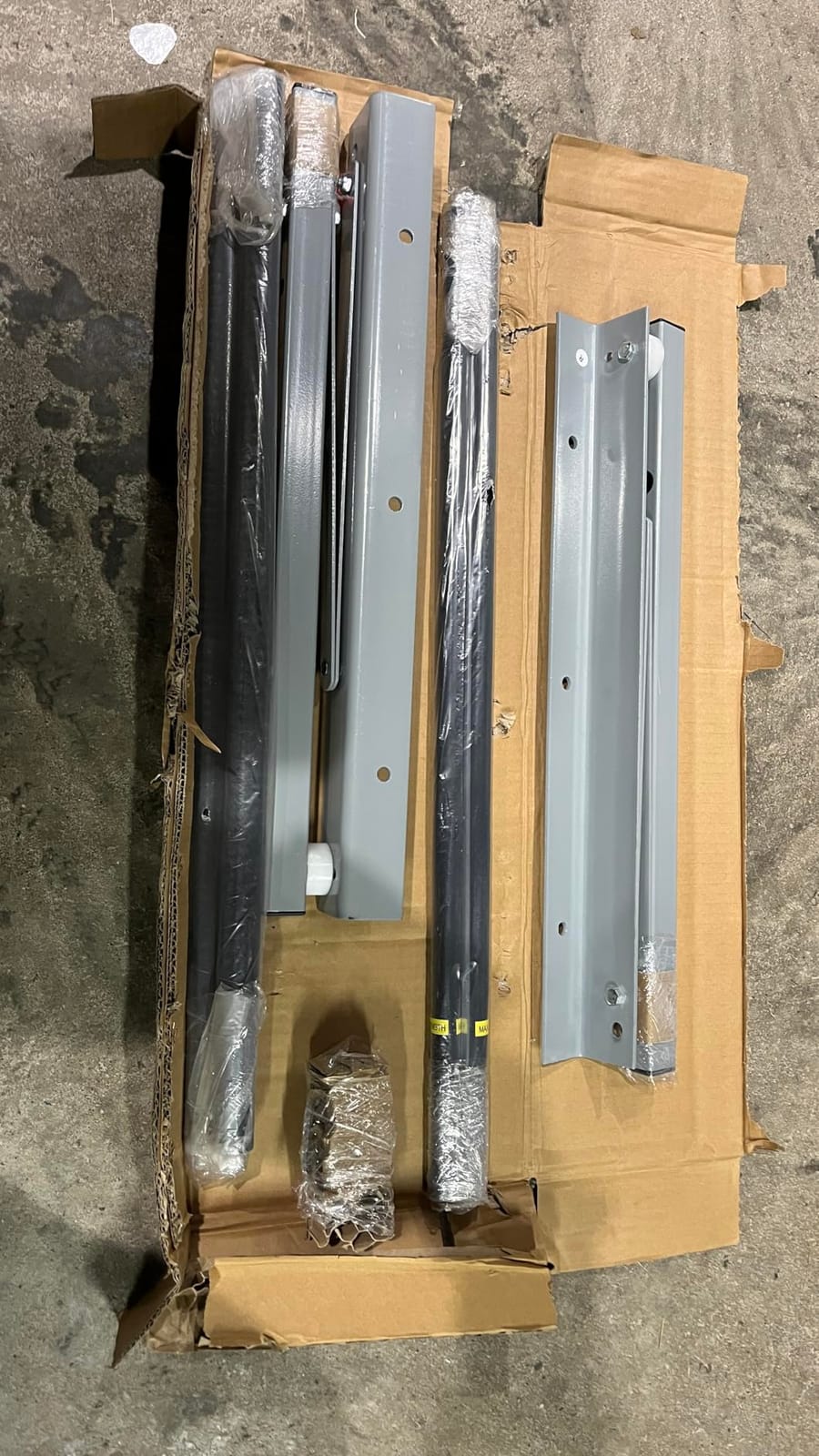
Owners like the fold, the finish and the straightforward assembly with included parts and instructions. The rack is intended for garages, workshops and repair shops, and it uses the wall rather than the floor, which is the entire point in a tight space.
The limitation to know is hardware. Expansion bolts for concrete walls are not included, and the listed shelf capacity of 75 lb per shelf is a different number from the 300 lb total, so read carefully which figure applies to your mounting. This is also a newer listing with a shorter review history than most of the field.
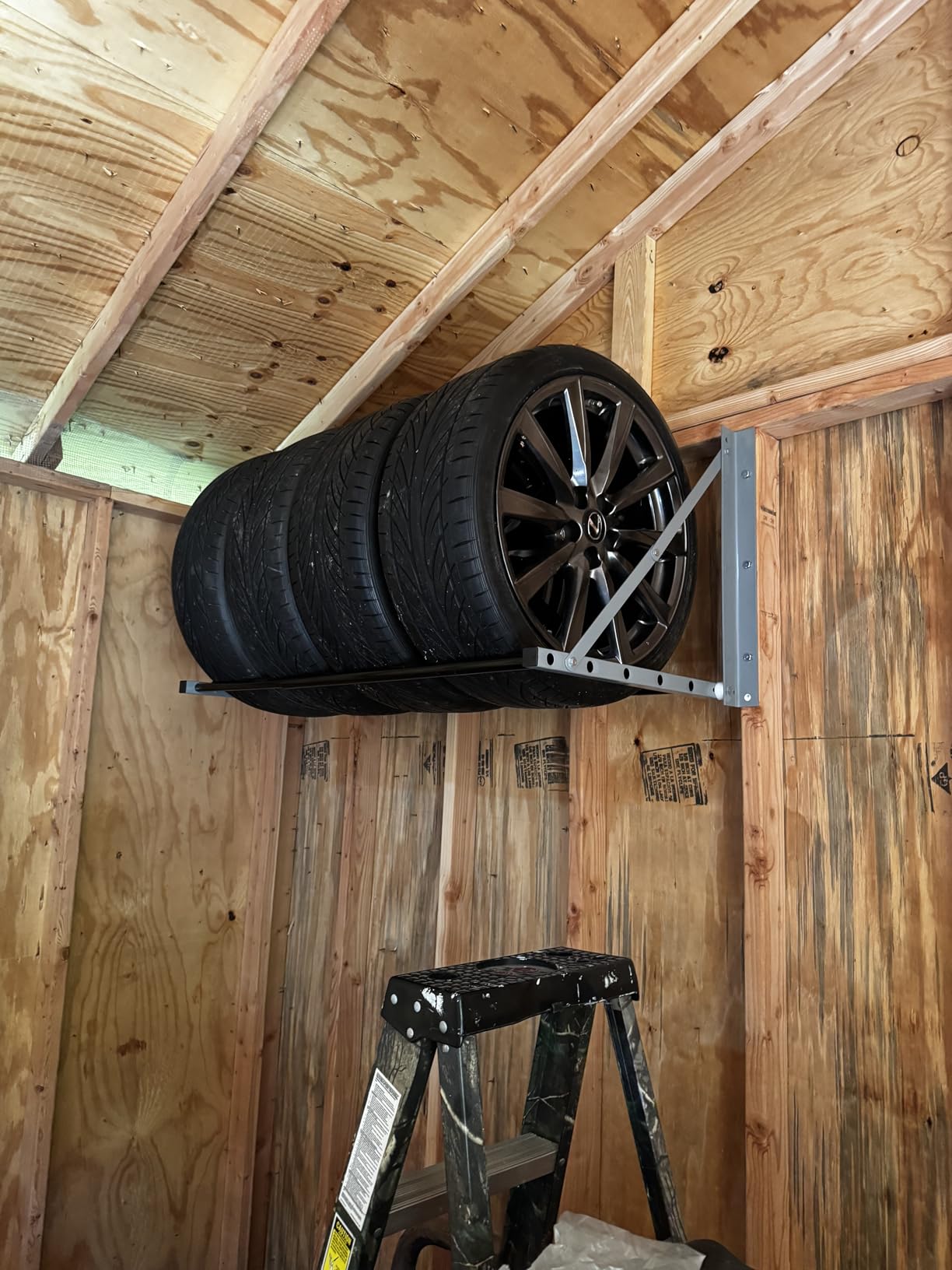
How to check it will fit your tires
Measure the outside diameter of your mounted tire, not the tire size code. If the total height from floor to top of the tire exceeds roughly 27 inches, the arms will not clear it and the wheel will need to lean on the wall behind.
Then measure the span between your studs. The bars cover 32 to 48 inches, which handles most framed garages but not a wall where the studs sit further apart than that.
When to pick something else
Skip it for oversized light truck rubber, where tire height rather than width becomes the constraint, and for anyone mounting into block or concrete who does not already own appropriate expansion anchors. For a daily-driver seasonal set in a small garage, the fold makes this one of the more useful designs on the market.
5. VEVOR TC0519 Adjustable Wall Tire Rack – Best for Auto Shops
VEVOR Wall Mounted Tire Rack, 31″ – 56″ Adjustable Tire Rack, Q235 Heavy-Duty Steel Tire Storage Rack for R14-R20 inch Standard Tires, Max 400lbs Load Capacity, Ideal for Garage Workshop Repair Shop
Q235 carbon steel
400 lb total rating
31 to 56 inch width
R14 to R20 fitment
Pros
- 400 lb total capacity on a folding footprint
- 31 to 56 inch range covers wide tire sets
- Stated R14 to R20 fitment
- Holds up to 4 standard tires
Cons
- Only 72 reviews so far
- Concrete mounting hardware not included
The TC0519 is the same design idea as the TC0513 with a heavier rating and a wider adjustment range. It extends from 31 to 56 inches, which is the widest span of the VEVOR pair and enough to take staggered front and rear widths on a performance car without squeezing.
At 400 lb, or 181 kg, it sits in the tier we consider the safe floor for mounted wheels. That matters in a shop context where the rack may be loaded and unloaded several times a week, and where the previous occupant might have run a set of truck tires on it. The finish is powder coated for rust resistance, and the rack is sold with brackets and installation accessories.
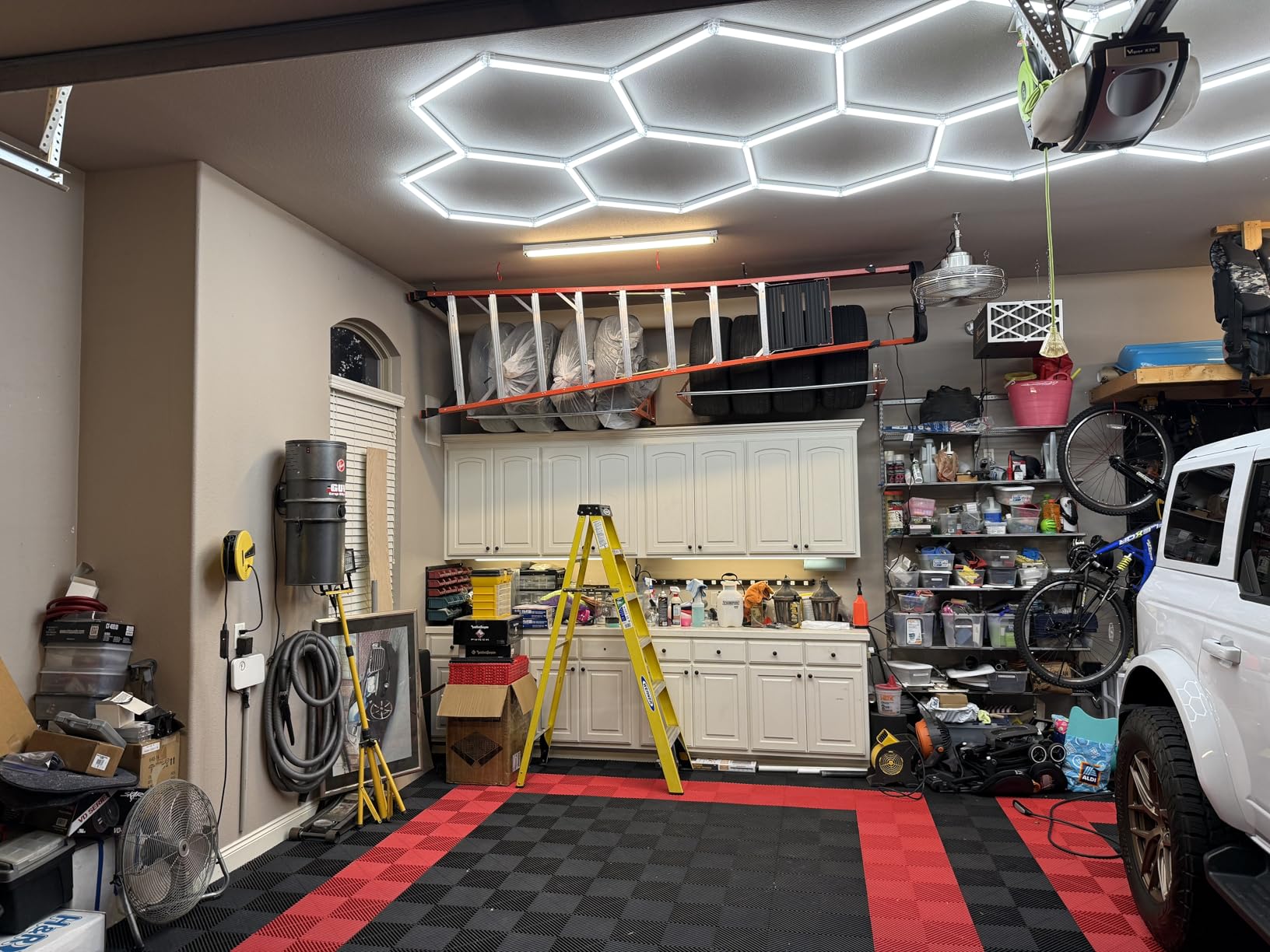
Early owner feedback is strongly positive, with the build quality and simple installation coming up most often. The wall-mounted layout keeps tires off the floor and out of the working lane, which is the main reason a shop would choose it over a rolling unit.
Be honest about the evidence. With 72 reviews, this is the least battle-tested product in the lineup, and long-term durability data is thin. Expansion bolts for concrete are not included, and the listed item dimensions in the product record look inconsistent, so confirm the actual span and depth against your wall before ordering.
Why a shop should reach for this tier
Repeated loading punishes thin tubing far faster than occasional seasonal swaps. A 400 lb rating in Q235 carbon steel gives you headroom above a 300 lb set, and the 31 to 56 inch range means one rack can cover passenger and light truck fitment instead of forcing two different wall units.
If the shop stores more than eight tires, a rolling or pallet-style rack is the better answer. For one to four tires per bay, a wall mount keeps the floor clear for the actual work.
What to verify before drilling
Confirm your studs are where you need them, because fixed mounting holes mean the rack positions around framing. If your tires are taller than about 27 inches overall, check the arm clearance before buying. And buy your own concrete or masonry anchors rather than assuming the box covers your wall type.
6. Fioracl 31-56 Inch Adjustable Wall Rack – Best Widest Adjustment Range
Fioracl Tire Rack Wall Mount Adjustable 31″-56″ Tire Storage Rack Wall Mount wheel rack with Heavy Duty Telescopic RodsSteel 400 Pound Weight Capacity (Orange)
Adjusts 31 to 56 inch
400 lb total rating
1 inch inner and 1.2 inch outer tube
Orange powder coat
Pros
- Widest published adjustment range in the group
- Thick dual-diameter tubes resist bending
- Includes lag bolts for both studs and concrete
- Holds 4 to 5 tires at 48 inch
Cons
- Low side rails let tires tip
- Included lag bolts reported breaking
The Fioracl takes a 31 to 56 inch span, which is the widest adjustment range in this comparison, and pairs it with 400 lb of capacity. The tubes are noticeably heavier than typical: a 1 inch inner tube sliding into a 1.2 inch outer tube, with a galvanized coating under the orange powder coat for corrosion resistance.
That tube diameter is the design’s whole argument. Thicker arms are exactly what resists the bending that shows up on lighter racks at full extension, and owners report the difference when the rack is set wide for a staggered set. Several users fit a fifth tire at 48 inches, which makes this the pick if you are storing a spare alongside a full set.
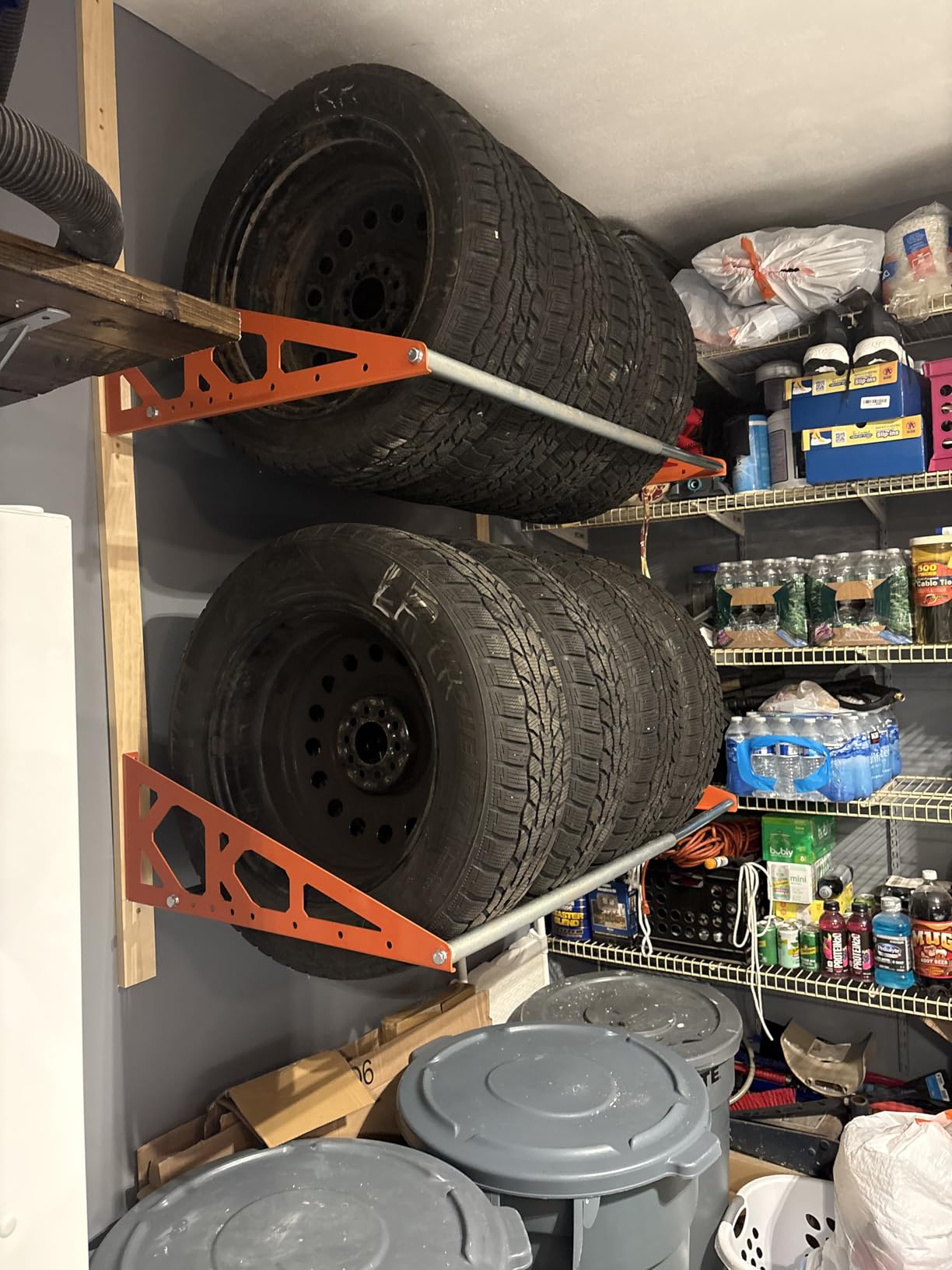
Unusually for this category, the kit includes different lag bolts for stud mounting and for concrete. That removes a common trip point, and the rack is listed for seasonal tires, RV tires and ATV tires in home, garage, shop, apartment or shed settings.
Two drawbacks stand out. The side rails are low, so tires can tip if you roll them on hard. And despite the included hardware, reviewers still report the supplied lag bolts breaking during installation, so upgrading them remains worthwhile. There is also reported flex at the full 56 inch extension.
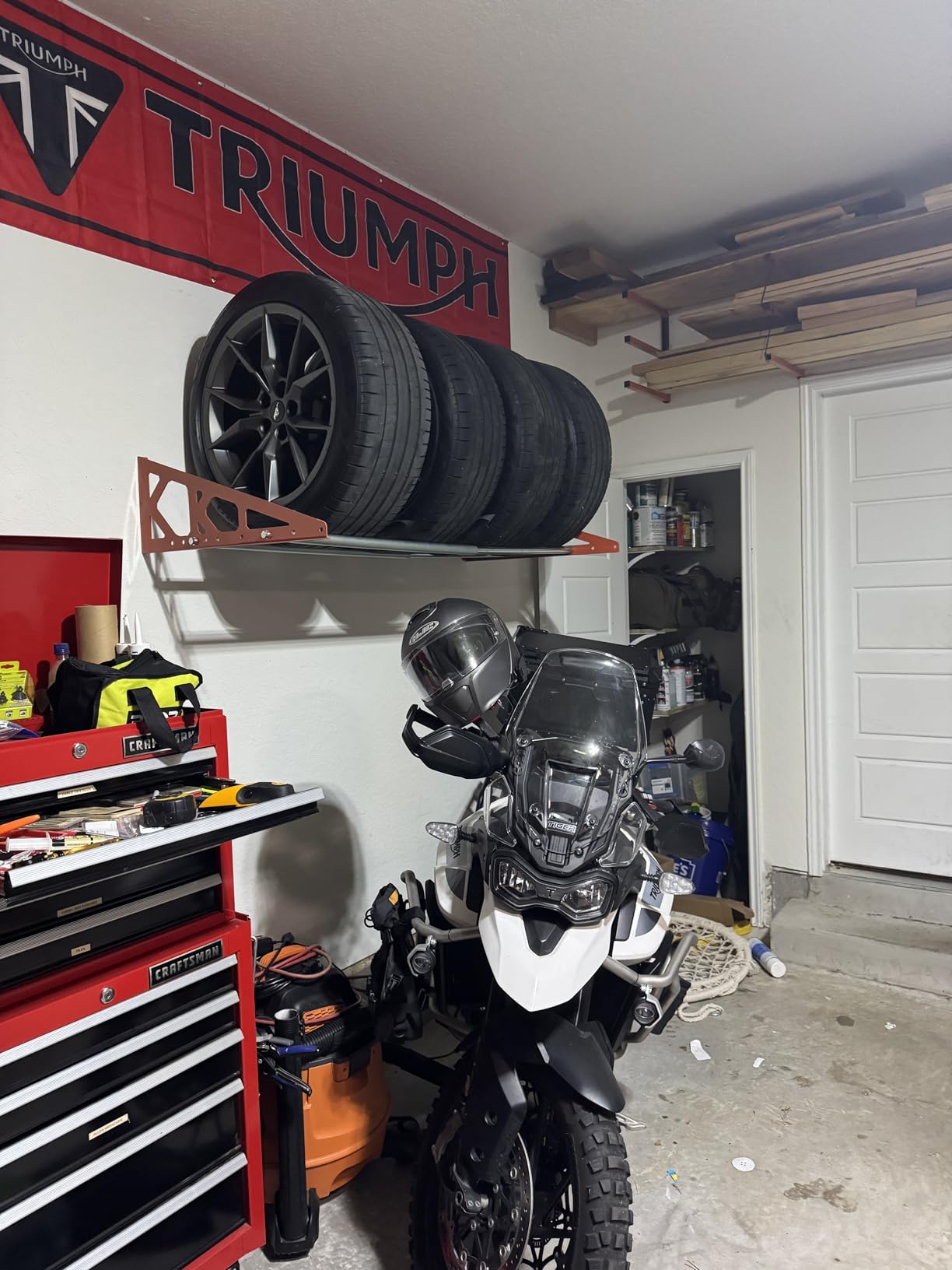
When the wide range earns its keep
Wide adjustment matters when your wall framing does not cooperate. In a finished garage the studs may sit at 16 inches on center, but a wall with a window or a beam above often has an odd span. A rack that covers 31 to 56 inches will almost always find a pair of studs somewhere along that run.
It also matters for fitment. Staggered setups with a wider rear tire, plus oversized light truck rubber, need more span than a 32 to 48 inch rack can give you.
When to pick something else
Choose a rack with taller side containment if you have small wheels or rims that could roll off, and choose one with a published lifetime warranty if you plan to keep it mounted for a decade. Those who want a fixed, rigid install report tack-welding the rods rather than relying on set screws, which is a reasonable approach for a permanent mount.
7. JY PERFORMANCE Adjustable Wall Tire Rack – Best for Five-Wheel Sets
JY PERFORMANCE Adjustable Wall Mounted Tire Rack, Fits 31″-56″ Wide
Adjusts 31 to 56 inch
400 lb total rating
Cantilever shelf
25 x 53.94 x 25.59 inch
Pros
- Holds a fifth wheel in practice
- 400 lb capacity with powder coated steel
- Easy to install and adjust
- High share of 5-star ratings
Cons
- Set screw threads can be coated over and strip
- Poles flex at full extension
- Newer listing with 90 reviews
Runners-up in this category often promise a fifth tire and cannot deliver it. The JY PERFORMANCE DAC050 does. Owners report fitting five wheels and tires on the same rack, which makes it the option for anyone carrying a full seasonal set plus a spare or a donor wheel.
The span adjusts from 31 to 56 inches with telescopic rods, and the rated capacity is 400 lb. The shelf style is listed as cantilever, and the overall dimensions of 25 inches deep by 53.94 inches wide by 25.59 inches tall are among the more compact wall profiles here. The finish is powder coated black, and hardware is included.
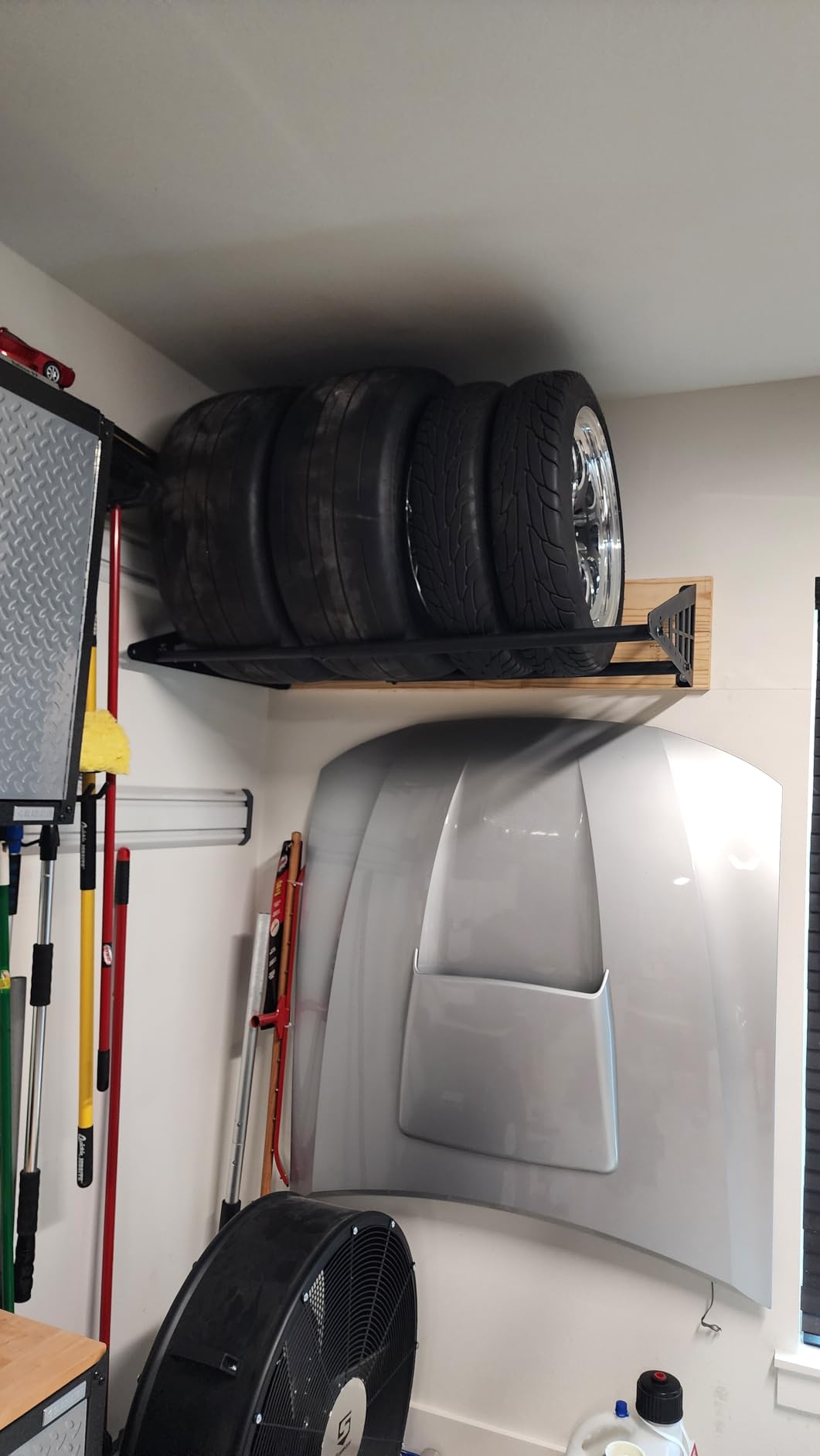
Installation is straightforward and the rods adjust easily, which matters when the same wall has to serve both the summer and winter sets at different widths. Early reception is strong, with 88 percent of ratings at five stars, and the manufacturer lists a one year warranty.
The most common complaint is a small but real one: powder coat frequently gets into the set screw threads, so the threads strip when you tighten the rods. Chasing the threads with a thread tap before assembly is a five minute fix that several owners recommend. Pole flex at the full 56 inch setting is also reported, and stud mounting is treated as non-negotiable by users.
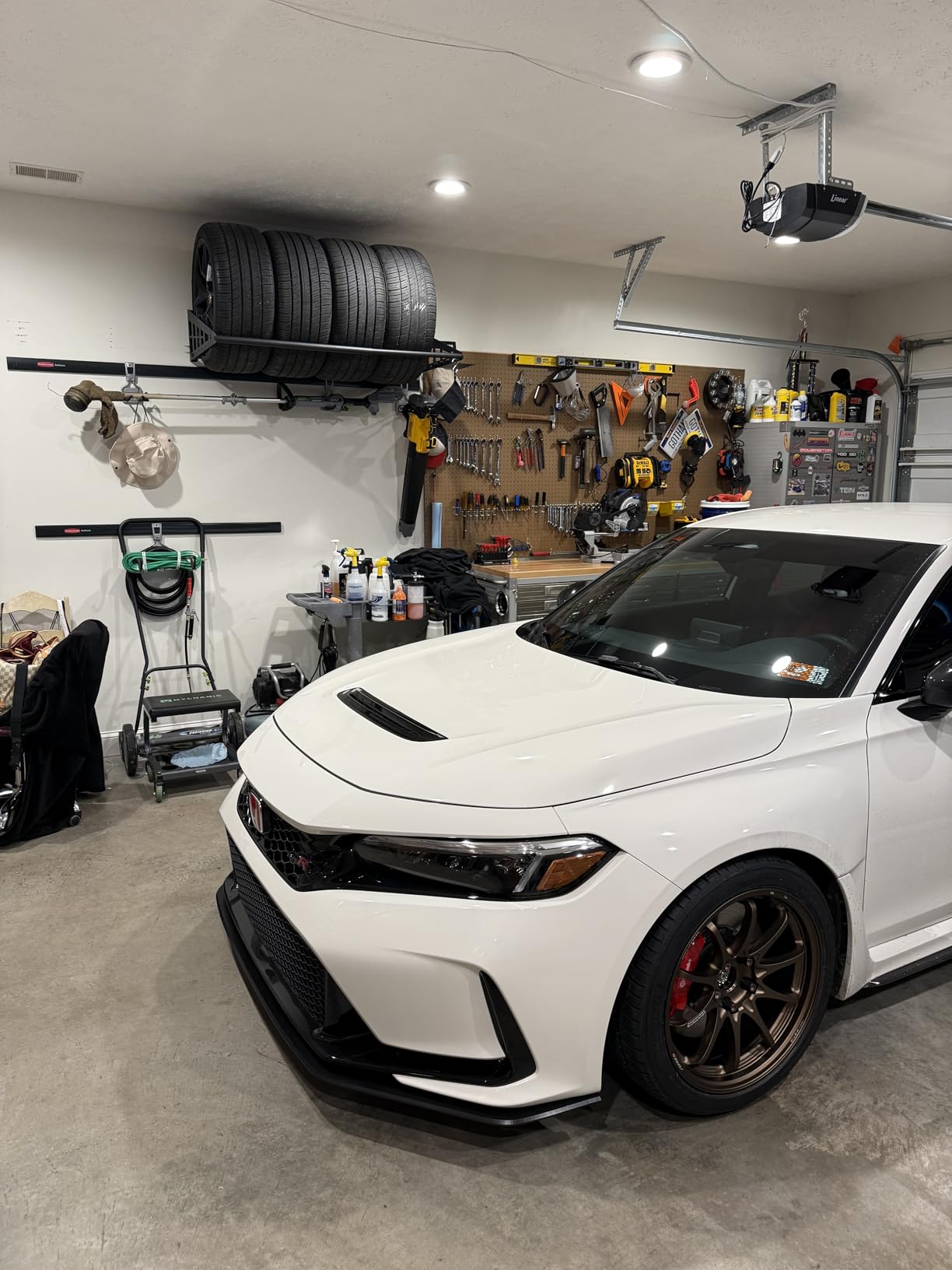
Plan for a fifth tire properly
A fifth wheel fits because the arms span further, not because the rack holds more weight than rated. Count the total weight of everything you load, including the spare, and stay inside 400 lb. If a fifth mounted wheel pushes you past that, this is the wrong rack and a two-rack setup is the safer answer.
Position the extra wheel at the end of the span rather than the middle, where the arms are least supported.
How to get a rigid mount
Mount into studs with quality lag bolts, and check that each mounting point lands on framing before you tighten. If you want a permanent installation, some owners weld the rods in place instead of relying on set screws, which removes both the flex and the thread problem in one step.
8. ROBLOCK Folding Wall Tire Rack – Best for RV and ATV Tires
ROBLOCK Folding Tire Wheel Rack Wall Mount Multi-Tire Spare Carriers Garage (32″-48″) x 22″ x 22″, Red
Powder coated steel
300 lb total rating
32 to 48 inch width
Measures 22 x 22 inch arms
Pros
- Folds flat when not in use
- Handles RV and ATV tire sizes as well as cars
- Some owners fit 5 tires on one rack
- Light enough for a simple install
Cons
- No stud mounting bolts included
- Factory bolts can arrive over-torqued
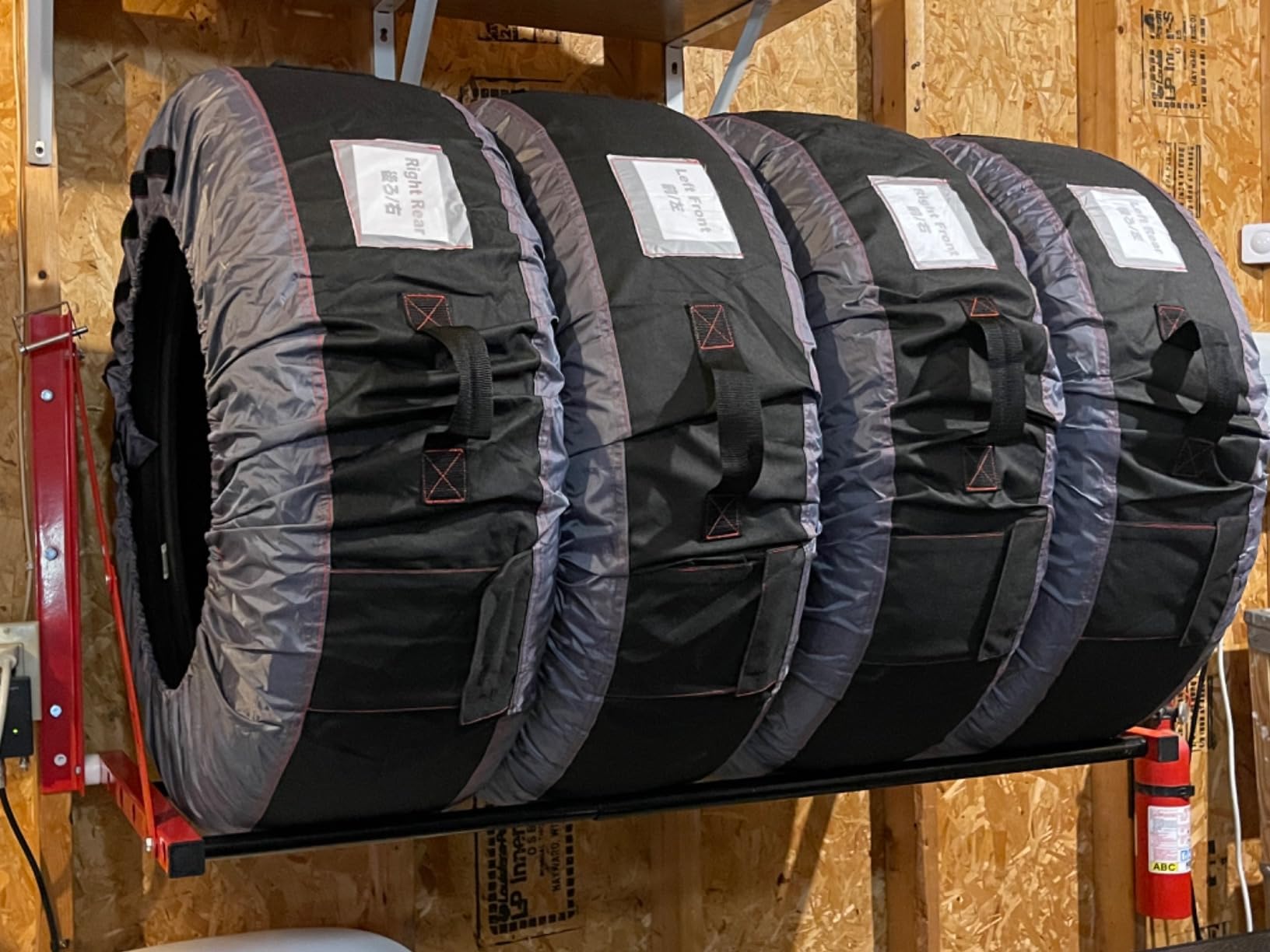
The ROBLOCK is a 100 percent steel, powder coated folding wall rack that holds four standard seasonal tires and folds away when not needed. The telescopic tubes adjust from 32 to 48 inches and the listed capacity is 300 lb. At 18 pounds and 22 by 22 inch arm dimensions, it is one of the simplest designs here to handle in a small workspace.
Where it earns its place is fitment range. The manufacturer lists seasonal tires, RV tires and ATV tires as target applications, which is broader than most listings in this group. A handful of owners report getting five tires onto one rack, so it is closer to the JY PERFORMANCE on capacity in practice than the four-tire spec suggests.
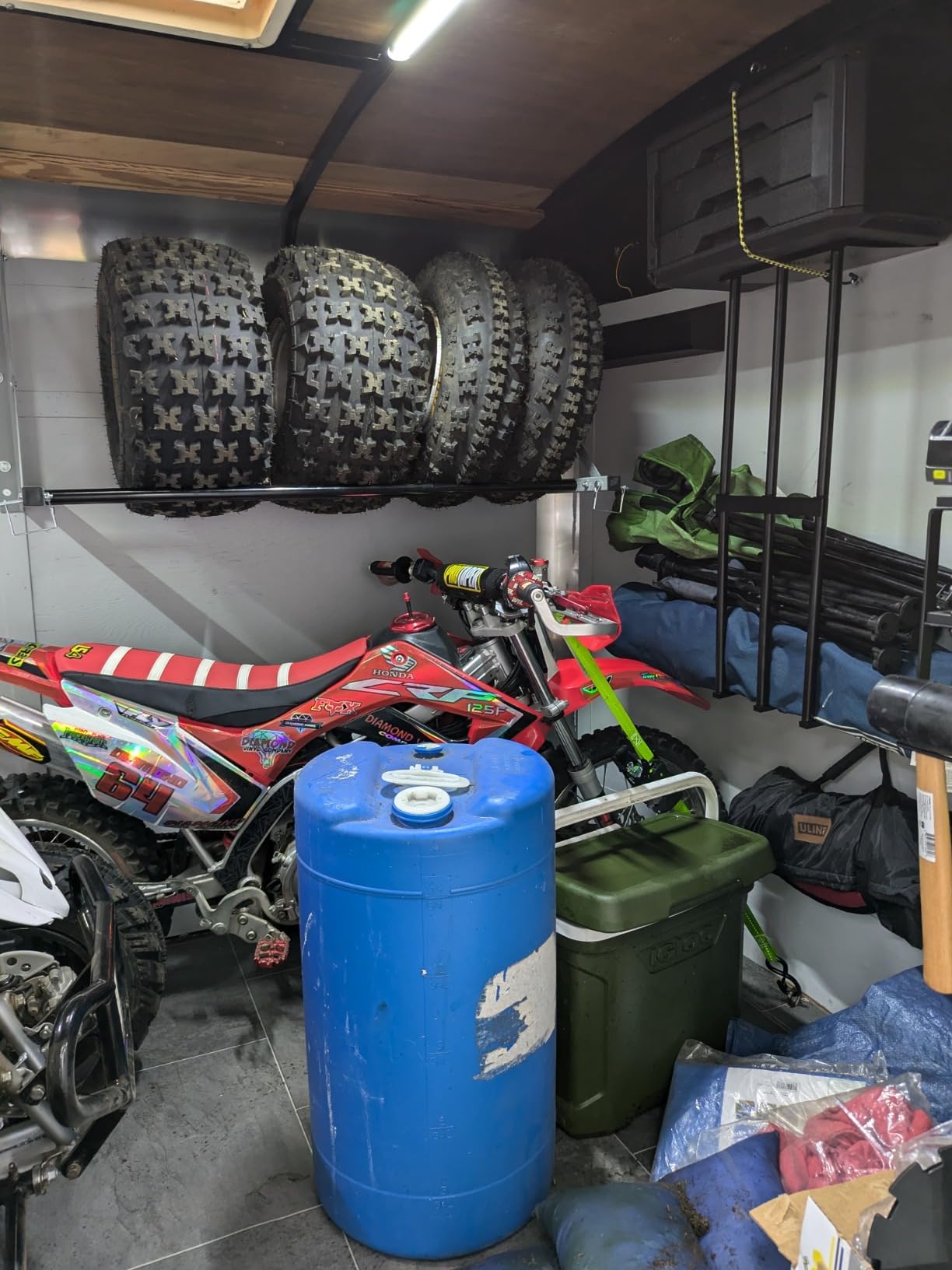
Owners generally find the construction solid for the tier and the fold smooth to operate. The arms telescope cleanly and hold their position once set, and the finish resists rust as advertised. Buyers comparing against name brands at higher tiers tend to see it as the better value.
The complaints are practical rather than structural. Mounting bolts for stud installation are not in the box, so you will need your own, and assembly needs a 5/16 inch Allen wrench that is also not included. There are reports of over-torqued factory bolts, and a few instances of quality control problems where shipped pole diameters did not match the listing.
What to check for RV and ATV fitment
RVT and ATV tires run taller than passenger car tires, so measure overall diameter and compare it to the 22 inch arm height before ordering. If the tire stands taller than the arms, it will lean on the wall, which is exactly what you want to avoid with a heavy spare.
Also check the width. RV and truck tires are often wider than 48 inches worth of arm span allows once clearance is added at each end.
When to buy something heavier
Move to a 400 lb rack if your set includes more than four mounted tires, if the rubber is heavier than a typical car set, or if the wall is one you will rely on for a decade. The ROBLOCK is a good short-cycle choice and a weaker long-cycle one.
9. STEELAID 60 Inch Rolling Tire Rack – Best Rolling Rack
STEELAID Tire Storage Rack – Rolling Rack for Garage – Indoor/Outdoor Shelves 60 inch Organizer
Holds 10 to 12 tires
617 lb total capacity
59.5 x 59.5 x 20.9 inch
Locking side brakes
Pros
- Highest tire count of any pick
- 617 lb total capacity with 2 layers
- Side brakes lock the casters in place
- Protective cover included for outdoor use
Cons
- Casters can bend under heavy truck tires
- Some wobble when rolling while loaded
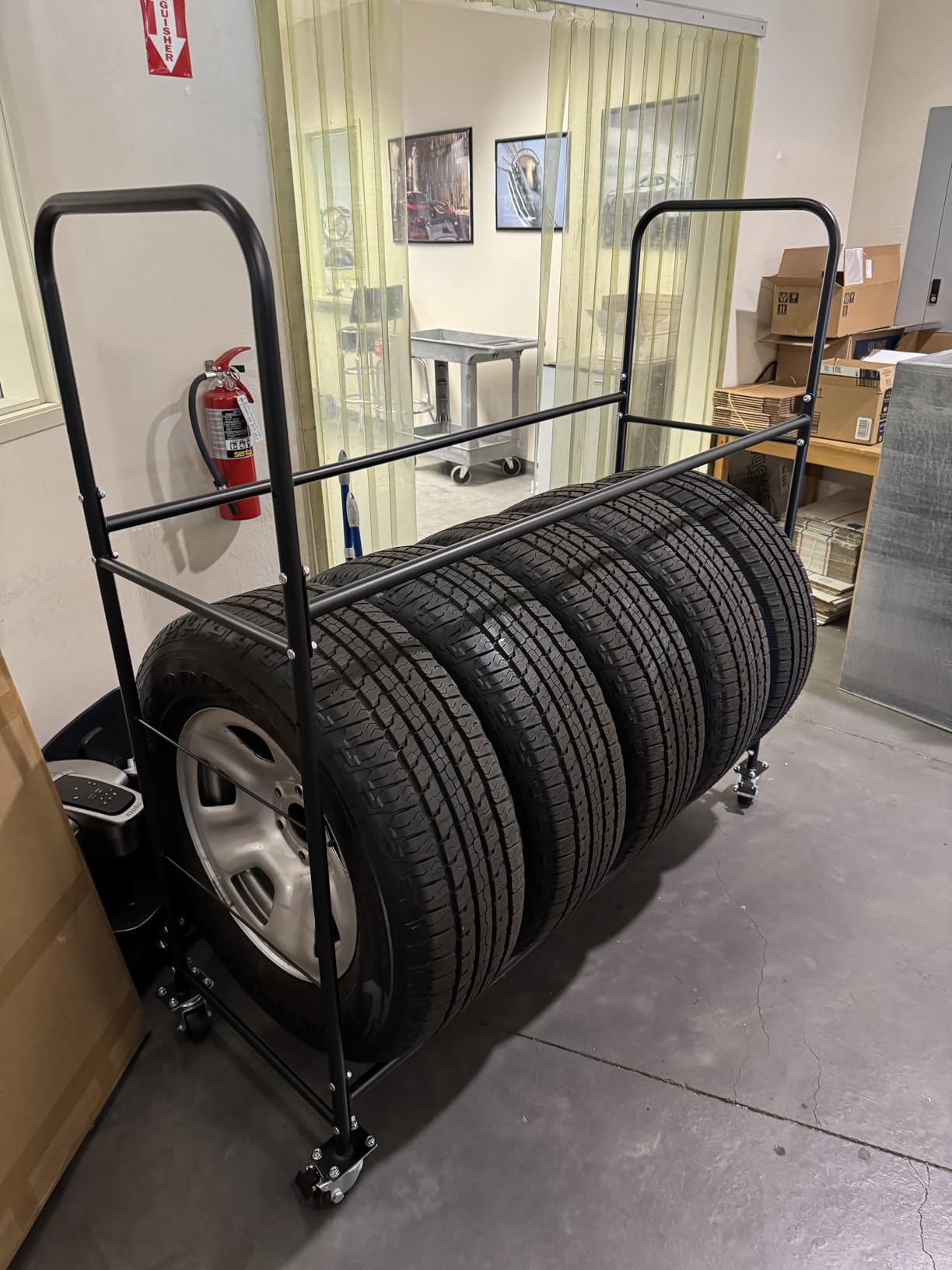
The STEELAID changes the conversation because it holds tires lying down on two shelves rather than upright on a wall. The manufacturer states capacity for truck tires or 10 to 12 extra SUV tires, with 57 inches of interior space inside a 59.5 by 59.5 by 20.9 inch frame. Total capacity is listed at 617 lb across the two layers.
Mobility is the reason to buy it. The casters are 360 degree rotatable rubber wheels with side brakes on each, which answers the most common complaint about rolling racks, namely that a loaded unit drifts across a sloped garage floor. Side trays add a place for tools and a jack, and a protective cover is included for rain, snow, dust and spiderwebs if you store it outside.
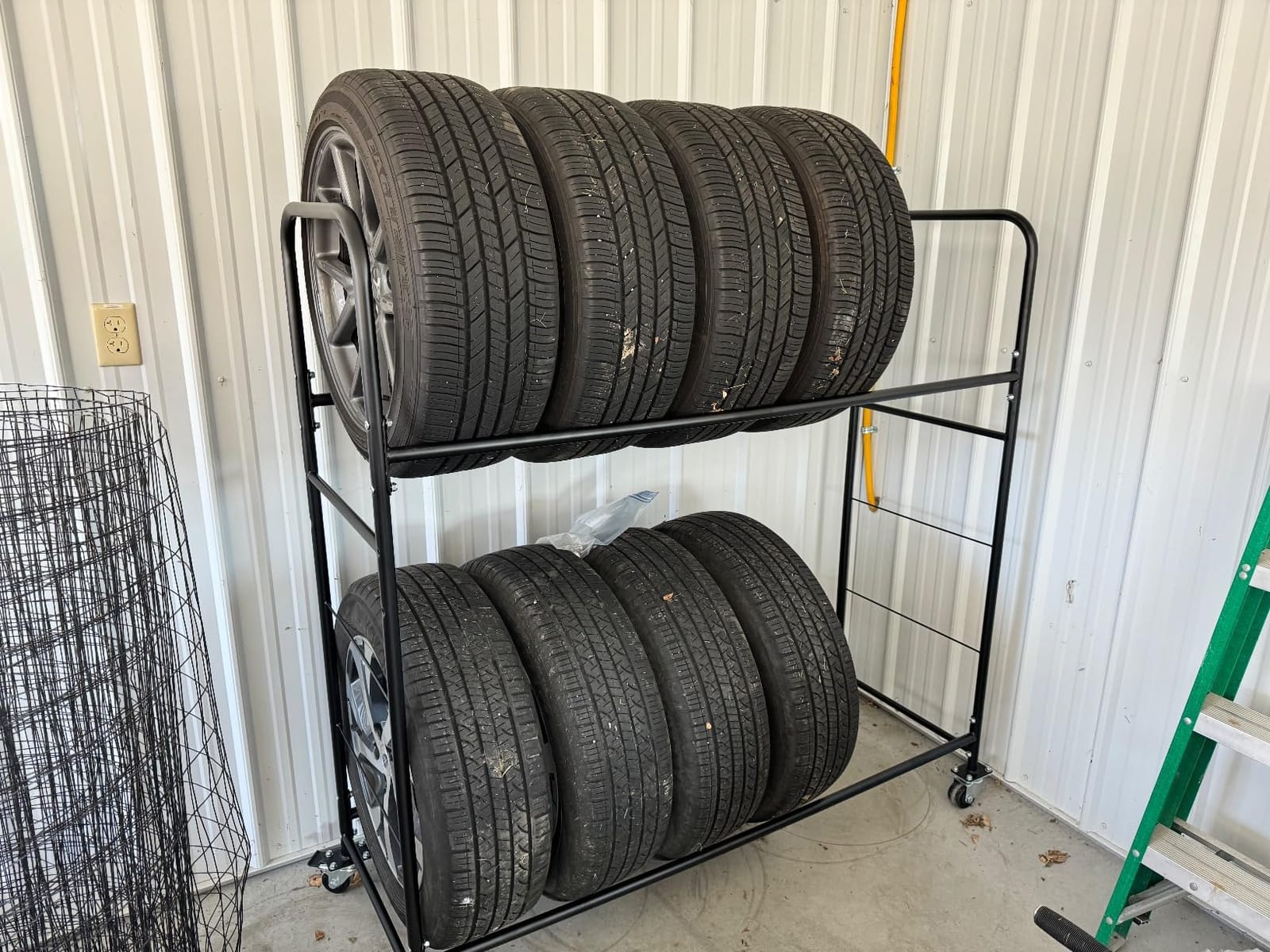
Assembly is quick, with owners reporting around 20 minutes. Two layers of horizontal storage means each tire is a slide-and-lift rather than a shoulder-height lift, which is easier on your back and faster when you are pulling a single wheel to check pressure or swap a puncture.
Be realistic about load movement. It is not commercial grade, and owners report some wobble when rolling it loaded and caster bending under heavy truck and mid-size SUV tires. Plan to roll it empty or lightly loaded, then lock the brakes and work from a stationary rack.
When horizontal storage wins
If you store more than one vehicle’s worth of tires, or if you rotate sets frequently, horizontal shelves are faster. You can see every tire in the stack at a glance, grab any one without disturbing the rest, and check tread depth without lifting anything.
The floor footprint is the trade. Nearly 60 inches square is real estate in a single-car garage, so measure the parking bay before ordering. Paired with overhead garage storage racks, a rolling unit can share a bay with a car.
When to choose a wall rack instead
Choose wall-mounted storage if floor space is the constraint, if you want the tires visibly protected from dust and accidental damage, or if you swap only twice a year. Rolling racks earn their price through flexibility, and flexibility is not the point when you have 8 to 10 square feet to reclaim.
10. EROTASH Rolling Tire Rack with Trays – Best for Jack and Tool Storage
EROTASH [Upgraded Rolling Tire Rack for Garage,Tire Storage Rack, Heavy-Duty Wheel Rack, Tire Shelf with 4″ Caster Wheels
Holds up to 8 tires
650 lb per layer
4 inch locking casters
Removable shelf and two trays
Pros
- Two shelves plus a tool shelf and two jack trays
- 650 lb capacity on each layer
- Side brakes on all 4 inch casters
- Assembles in 10 to 20 minutes
Cons
- Casters reported failing under heavy SUV and truck tires
- Trays mount on one side only
- No manufacturer warranty
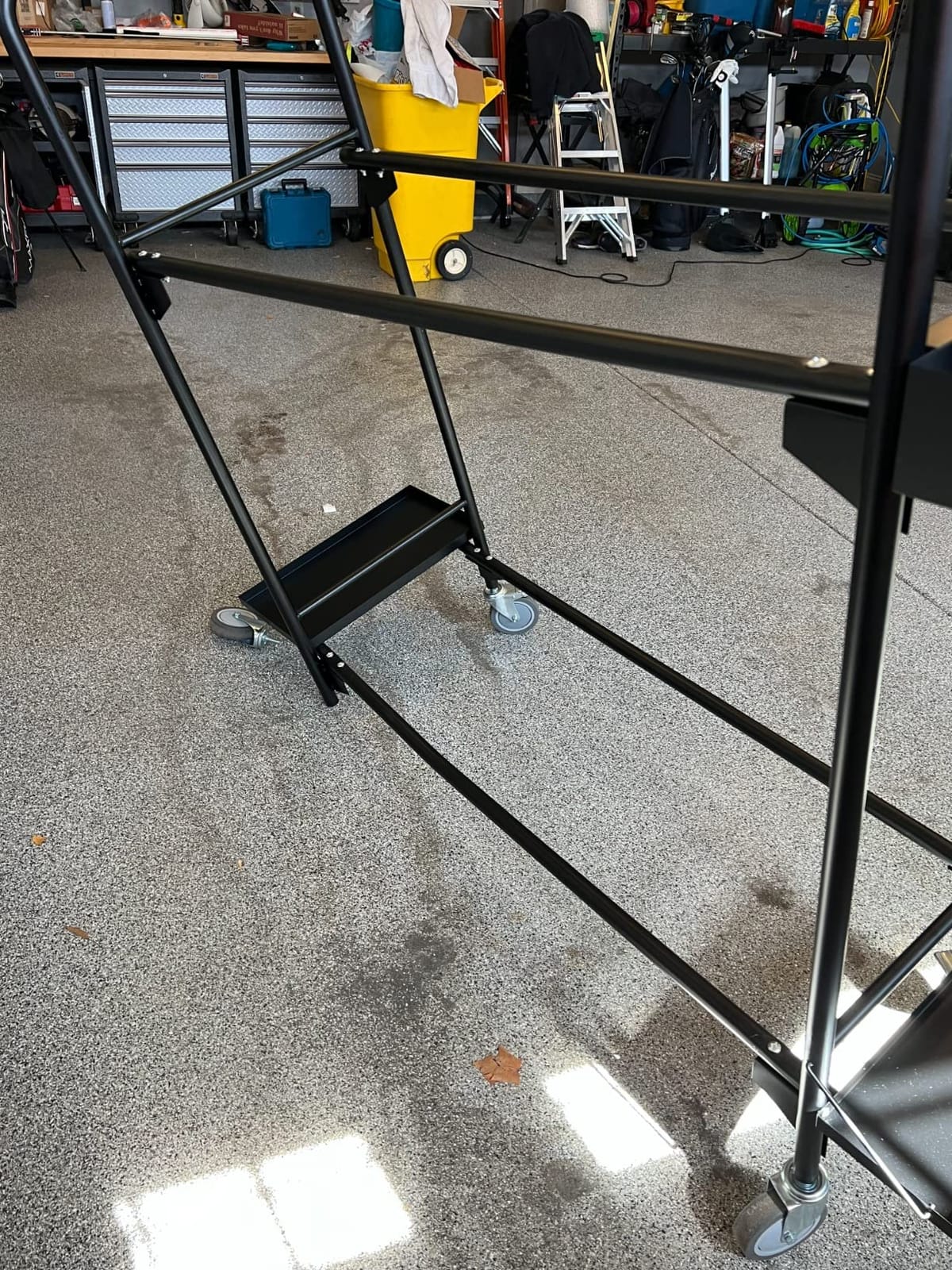
The EROTASH is the pick if your tire storage and your tool storage are the same problem. Alongside the two tire shelves it includes a removable shelf for hardware and tools plus two removable trays sized for a floor jack and a jack stand, so the rack becomes a mobile service station rather than a tire pile.
Capacity is 650 lb per layer on a heavy duty metal frame, holding up to eight passenger, light truck or SUV tires, and motorcycle tires or bare rims as well. At 41 pounds unladen it is the heaviest rack in this list, which is what keeps a loaded unit from tipping when you roll it. The four 4 inch casters are 360 degree rotatable with side brakes on each.
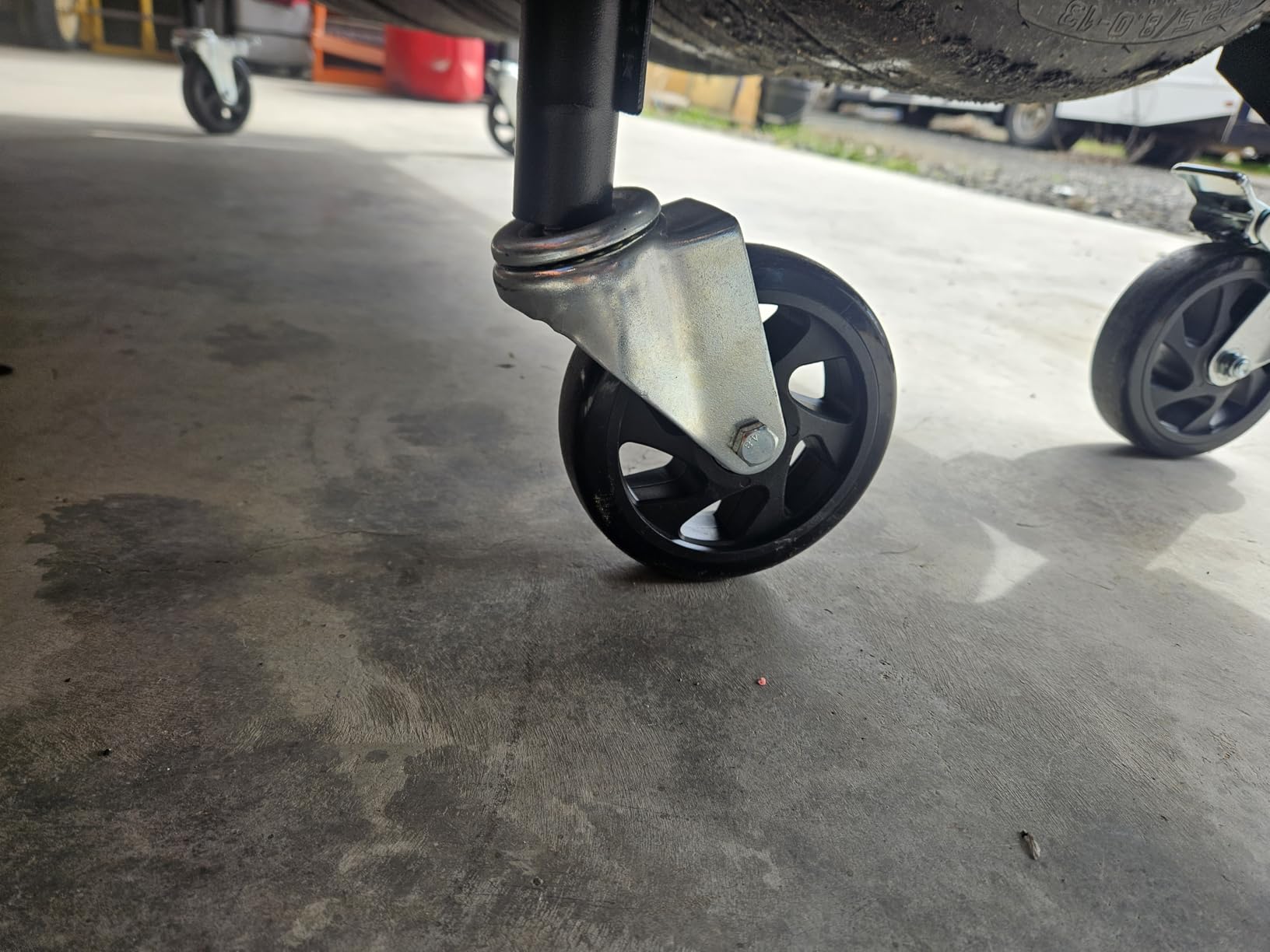
Owners like the trays as much as the tire shelves. Putting the jack and stands on the same frame as the spare set means one trip instead of three, which matters on a cold morning during a seasonal changeover. Assembly is reported at 10 to 20 minutes.
This is also the least proven product in the lineup, with the lowest rating of our ten and the shortest review history. The recurring complaint is caster failure under heavy SUV and truck tires, plus wobble when the loaded rack is moved. The trays also mount on one side only and are not reversible, and the jack tray fits smaller jacks.
Size check before you commit
The frame is 57 inches deep, 20.7 inches wide and 60 inches tall, which is a tall, narrow footprint. Measure door clearance and ceiling height in your garage, and confirm the bay can hold a car plus this footprint. At 20.7 inches wide it tucks against a wall better than the square rolling racks.
Count the tires you are storing and divide by two shelves. Eight is the stated maximum, so a full set plus a second vehicle’s set means two units.
When to pick the STEELAID instead
Choose the STEELAID if you need higher tire counts, a protective cover, or a longer review history. Choose the EROTASH if jack and tool storage on the same frame solves a problem you currently solve with a separate cart taking up floor space. If your tires are heavy truck rubber, neither rolling rack is the right tool and a wall-mounted 400 lb unit is.
Which Type of Tire Storage Rack Do You Need?
Start with the rack type, because it decides everything else. Wall-mounted racks give back floor space and cost the most in installation effort. Rolling racks give back flexibility and cost floor space. Freestanding shelving costs the most space of all but needs no tools and doubles as storage for everything else.
Wall-mounted racks cradle each tire upright on arms that bolt into studs. They are the best choice for a single-car garage, a narrow bay, or any situation where floor area is the binding constraint. Every wall rack in this list is rated between 300 and 400 lb and holds four tires, with a few managing five.
Folding wall racks are wall racks with hinges. They swing flat when you are not using them, which is the single most useful feature for a two-season swap pattern. The MaxxHaul, VEVOR TC0513 and ROBLOCK are all of this type.
Rolling racks stand on casters and hold tires lying down. They suit multiple vehicles, track sets, and anyone who wants to reach one tire without moving three others. Locking brakes are the feature to verify; the STEELAID and the EROTASH both have side brakes on every caster.
Freestanding shelving is boltless pallet-style racking of the kind sold for warehouses. It holds far more than a household needs, and it only makes sense if you are storing tires for several vehicles or running a shop.
How to Size a Tire Rack: Weight, Width and Tire Diameter
Weight rating: read the basis, not the number. A rack rated 400 lb may mean 400 lb total across four tires, or 100 lb per tire. Treat any listing that does not state which it means as a warning. For a set of four mounted passenger wheels, 300 lb is workable and 400 lb is the floor we would not go below.
Width range: measure the widest tire in the set. Staggered fitment is the most common real-world failure, where rear tires are wider than front tires. The 31 to 56 inch racks cover staggered setups comfortably, while a 32 to 48 inch rack is tighter and may squeeze the widest tire against the wall.
Tire diameter: this is the number listings hide. Most wall racks clear tires up to about 27 inches tall. Beyond that, the wheel leans on the wall and the sidewall takes a constant load. The SafeRacks is the one pick here that publishes a maximum of 34 inches using multiple rod positions. For 33 inch truck tires, look for that figure or measure before you order.
A quick three-step measurement: stand one mounted tire against the wall and mark the height. Measure the tire width at the widest point of the tread. Then measure the stud-to-stud span on your wall. Those three numbers, matched against a listing, tell you in under a minute whether a rack works.
How to Install a Wall-Mounted Tire Rack Safely
Wall racks carry several hundred pounds at shoulder height. Installation is not where you economise, and the failure mode when fasteners pull out of drywall is a loaded set of wheels on the floor.
Find two studs with a magnetic stud finder and mark both edges of each. Standard framing is 16 inches on center, so measure the center-to-center distance and confirm it falls inside the rack’s adjustment range. In a finished garage, joist bays sometimes leave no stud where you want the rack, and that is the moment to move the rack rather than reach for an anchor.
Use grade 8 lag bolts with washers, not the hardware supplied in the box. Nearly every product in this category ships fasteners that owners report stripping or breaking, and the cost difference is trivial compared with a loaded rack on the floor. Pre-drill slightly undersized so the bolt threads bite into the wood rather than splitting it.
Mount the rack with the arms projecting away from the studs by enough that a tire sits on the tubes, not against the wall behind. Then load it gradually and re-tighten after the first full set goes on, because nuts can settle. Owners report a few need a second pass with a wrench.
Finally, load test before you trust it. Push firmly on the front of each tire with both hands and watch for movement at the mounting points. Any give at the wall means the fix is a longer bolt or another stud, not a bigger bracket.
Should Tires Be Stored Vertically or Horizontally?
Store tires vertically, cradled upright on a wall rack, whenever you can. Horizontal stacks work for short-term storage, but they concentrate weight on the bottom tires in a way that ages sidewalls faster over a six-month seasonal layup.
Vertical storage spreads the load through the tread shoulder rather than letting the weight of the stack sit on one sidewall. It also means every tire is retrievable without moving another, which is the deciding factor for anyone swapping more than once a season. Garage Journal forum discussion on the question leans the same way, toward vertical racks for frequent swappers.
Five habits keep stored tires in good shape. First, keep them off the floor. Cold, wet concrete is the fastest route to sidewall degradation, and every rack on this list except the lowest shelves does that. Second, cover them if the garage is dusty or the unit is exposed, and the STEELAID is the one pick that ships with a cover.
Third, do not stack weight on top of a tire. A box of parts resting on a tread block deforms it slowly and invisibly. Fourth, inflate stored tires to the pressure on the sidewall, not to a higher number, since underinflation under static load is what causes flat spotting.
Fifth, if tires live in a rented storage unit, keep them in a sealed bag or tote and off the bare slab. UV exposure through unit doors and temperature swings accelerate rubber aging, and you cannot control either in a facility you do not own. Rotating stored sets every few months also spreads any flattening across the whole set.
On retirement timing: tread depth matters less than most people assume, and age matters more. Industry guidance treats 3 percent tread as a replacement trigger for most tires regardless of remaining depth, and tires older than five years from the manufacture date are commonly replaced regardless of appearance. Storage conditions affect that clock, which is the practical argument for keeping them dry and covered. If your set is near that age, budget for a tire inflator to keep pressure checks on top of new tires, and plan the replacement rather than the rack.
DIY Tire Rack vs Buying One
Building a rack is genuinely popular, and forum threads about it run long. The two approaches that recur are angle iron and 2x lumber, and both work for a single set of four.
An angle iron build is typically 1-1/2 inch by 1-1/2 inch angle cut into short uprights welded or bolted to horizontal tubes. My350Z drift forum owners describe exactly this build for track sets, where weight matters more than appearance. Expect a full afternoon plus welding or a drill, a tap and patience, and you still need a load path into studs.
A lumber build uses 2×4 or 2×6 sections with plywood or steel cradles. Canadian Woodworking forum members describe spanning two laminated veneer lumber beams across a garage as a heavy duty horizontal mount, which suits a shop rather than a single car bay.
Buying wins when your studs are not where you need them, when you want a listed weight capacity, or when you plan to move the rack later. A factory rack arrives with a known rating and known dimensions. Building wins when you need a size nothing sells, when you want the rack to match existing cabinetry, or when you already own the tools.
One middle path works well for small garages and it is how bikes and tires get stored together. A vertical hook or rail system that the bikes hang from, similar to the racks in our indoor bike storage roundup, reuses the same wall real estate twice over.
Frequently Asked Questions
What is the best tire storage rack?
The HyLoft 01000 is the best overall tire storage rack for most garages. It is a wall-mounted alloy steel rack rated to 400 lb that adjusts from 34 to 58 inches, which covers staggered tire widths and a full set of four mounted wheels. The SafeRacks 400 lb model is the premium alternative, with 12-gauge tubing and grade 8 bolts included.
What is the best wall mounted tire rack?
The HyLoft 01000 and the SafeRacks 400 lb rack are the two strongest wall-mounted options. The HyLoft offers the wider published review history and a 34 to 58 inch adjustment range, while the SafeRacks ships thicker tubing and grade 8 lag bolts and clears tires up to 34 inches. Both must be mounted into wall studs.
Should tires be stored vertically or horizontally?
Store tires vertically whenever possible. Upright storage on a wall rack spreads load through the tread shoulder instead of concentrating it on the bottom sidewalls of a horizontal stack, and it lets you retrieve one tire without moving the rest. Horizontal shelves on a rolling rack are better for short-term storage or frequent access to a single wheel.
Are wall mounted tire racks safe?
They are, when mounted into studs with grade 8 lag bolts and washers. A loaded set of four mounted wheels runs roughly 300 to 550 lb, so drywall anchors alone are not an acceptable substitute for framing. Check that both mounting points land on studs, pre-drill undersized, and load test with a firm push before trusting the rack.
Is it a good idea to store tires in a storage unit?
It works, but conditions are outside your control. Keep tires off the bare slab, sealed in a tote or bag, and out of direct sunlight, because UV exposure and temperature swings accelerate rubber aging. Inflate to the sidewall pressure rather than higher, and rotate the stack every few months to avoid flat spotting on one tire.
The Best Tire Storage Racks to Buy in 2026
The HyLoft 01000 is the best tire storage rack for most people in 2026, because a 400 lb rating, a 34 to 58 inch adjustment range and five years of owner reports add up to a rack that fits real garage walls. Buy the SafeRacks 400 lb if you want thicker tubing and grade 8 bolts in the box, and buy the MaxxHaul 70489 if the folding profile matters more than the extra hundred pounds of capacity.
Match the rack to the job instead. A folding wall rack earns its place in a tight one-car garage, a 31 to 56 inch rack is the answer for staggered performance fitment, and a rolling rack only makes sense if you store more than one set. Whatever you choose, mount it into studs with your own hardware, and store the tires upright, off the floor and covered.