
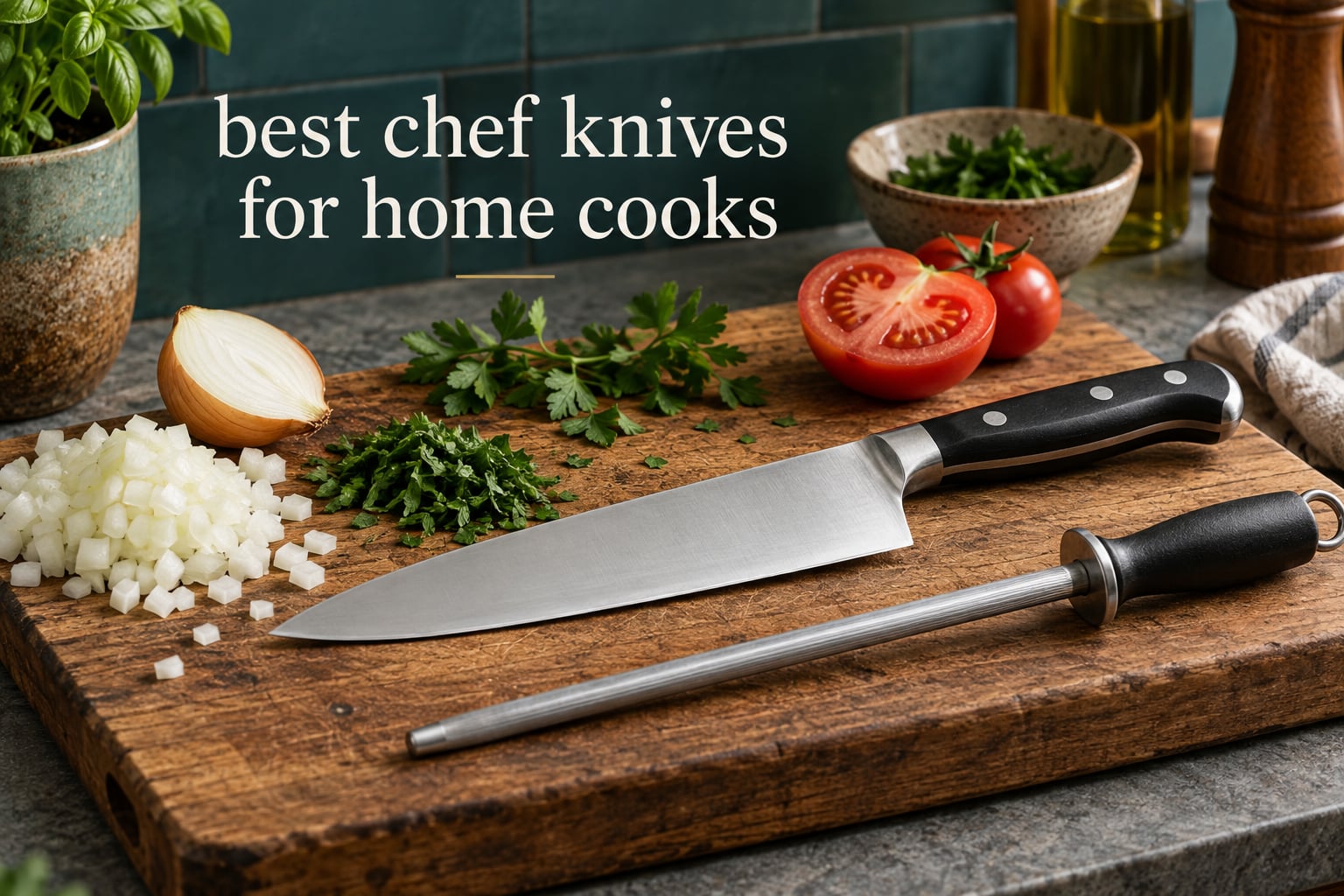
Most home cooks do not need a knife block full of steel. They need one chef’s knife they reach for every single evening, an edge that survives a week of meal prep, and a handle that does not make their wrist ache by the third onion. That is the entire brief behind this roundup of the best chef knives for home cooks, and it is why we spent weeks putting twelve candidates through real dinner service rather than unboxing them and calling it a day.
Our testing was deliberately unglamorous. We chopped onions, brussel sprouts, squash, carrots and apples, broke down whole chickens, sliced crusty sourdough, and minced enough parsley to green a small city. Between knives we measured how often we reached for the honing steel, how the handle felt after twenty minutes of wet prep, and whether the edge survived a run in the dishwasher by accident. Twelve knives, one kitchen, six weeks.
The result is a shortlist that spans real categories rather than a single crowned winner, because the honest answer to “which chef’s knife should I buy” depends on your hand size, your knife drawer reality and how much sharpening you actually want to do. If you want the wider category of Japanese steel before you decide, our Japanese chef knife picks go deeper on that style. For the rest, here is the short list and the reasoning behind it, updated for 2026.
Table of Contents
Top 3 Best Chef Knives for Home Cooks
These three earned the highest overall scores in our kitchen for different reasons: the most dependable all-rounder, the best balance of forged construction and reachability, and the strongest budget route into a full tang.

Victorinox Fibrox Pro 8 Inch
- Stamped stainless blade
- TPE non-slip handle
- Dishwasher safe
- Lifetime warranty

HENCKELS Classic 8-Inch
- Fully forged steel
- Triple-riveted handle
- Fine honed edge
- Dishwasher safe

Mercer Renaissance 8-Inch
- Forged German steel
- Shortened bolster
- Delrin handle
- Lifetime warranty
All 12 Chef’s Knives at a Glance
Every knife below appears in the same order as the detailed reviews, so you can scan the specs first and then read the ones that interest you.
| Product | Specifications | Action |
|---|---|---|
| Victorinox Fibrox Pro 8 Inch Chef’s Knife |
|
Check Latest Price |
| HENCKELS Classic 8-Inch Chef Knife |
|
Check Latest Price |
| Mercer Culinary Renaissance 8-Inch Chef’s Knife |
|
Check Latest Price |
 Mercer Culinary Millennia 8-Inch Chef’s Knife Mercer Culinary Millennia 8-Inch Chef’s Knife |
|
Check Latest Price |
 Global G-2 8 Inch Chef’s Knife Global G-2 8 Inch Chef’s Knife |
|
Check Latest Price |
 Wusthof Classic 8 Inch Chef’s Knife Wusthof Classic 8 Inch Chef’s Knife |
|
Check Latest Price |
 Shun Classic 8 Inch Chef’s Knife Shun Classic 8 Inch Chef’s Knife |
|
Check Latest Price |
 SHAN ZU 8 Inch Japanese Steel Damascus Knife SHAN ZU 8 Inch Japanese Steel Damascus Knife |
|
Check Latest Price |
 Dalstrong Gladiator Series 8 Inch Chef Knife Dalstrong Gladiator Series 8 Inch Chef Knife |
|
Check Latest Price |
 Tramontina Pro Series 8-Inch Chef’s Knife Tramontina Pro Series 8-Inch Chef’s Knife |
|
Check Latest Price |
 MOSFiATA 8 Inch Forged Chef’s Knife MOSFiATA 8 Inch Forged Chef’s Knife |
|
Check Latest Price |
 imarku 8 Inch Japanese Gyutou Chef Knife imarku 8 Inch Japanese Gyutou Chef Knife |
|
Check Latest Price |
1. Victorinox Fibrox Pro 8 Inch Chef’s Knife – Editor’s Choice
Victorinox Fibrox Pro 8 Inch Chef’s Knife, Dishwasher Safe, Black
8 inch stamped stainless blade
TPE non-slip handle
Lifetime warranty
Dishwasher safe
Pros
- Sharp out of the box
- Secure grip when wet
- Light and fatigue free
- No oiling needed
- Swiss made with lifetime warranty
Cons
- Needs more frequent sharpening than forged blades
- Blade scuffs show over time
- Thin steel limits edge retention
Six weeks in, the Victorinox Fibrox Pro is the knife that ended up in my hand for every session that did not require anything special. It arrived sharp enough to slice a tomato with almost no downward pressure, and the tapered stainless edge kept that behaviour through six weeks of nightly prep without a single chip.
The Fibrox Pro handle is the real headline. That textured thermoplastic elastomer stays put when your hands are wet, soapy or coated in onion juice, which is the condition roughly 90 percent of home prep happens in. A wet-handled slippery chef’s knife is how people cut themselves, and this grip essentially removes that risk.
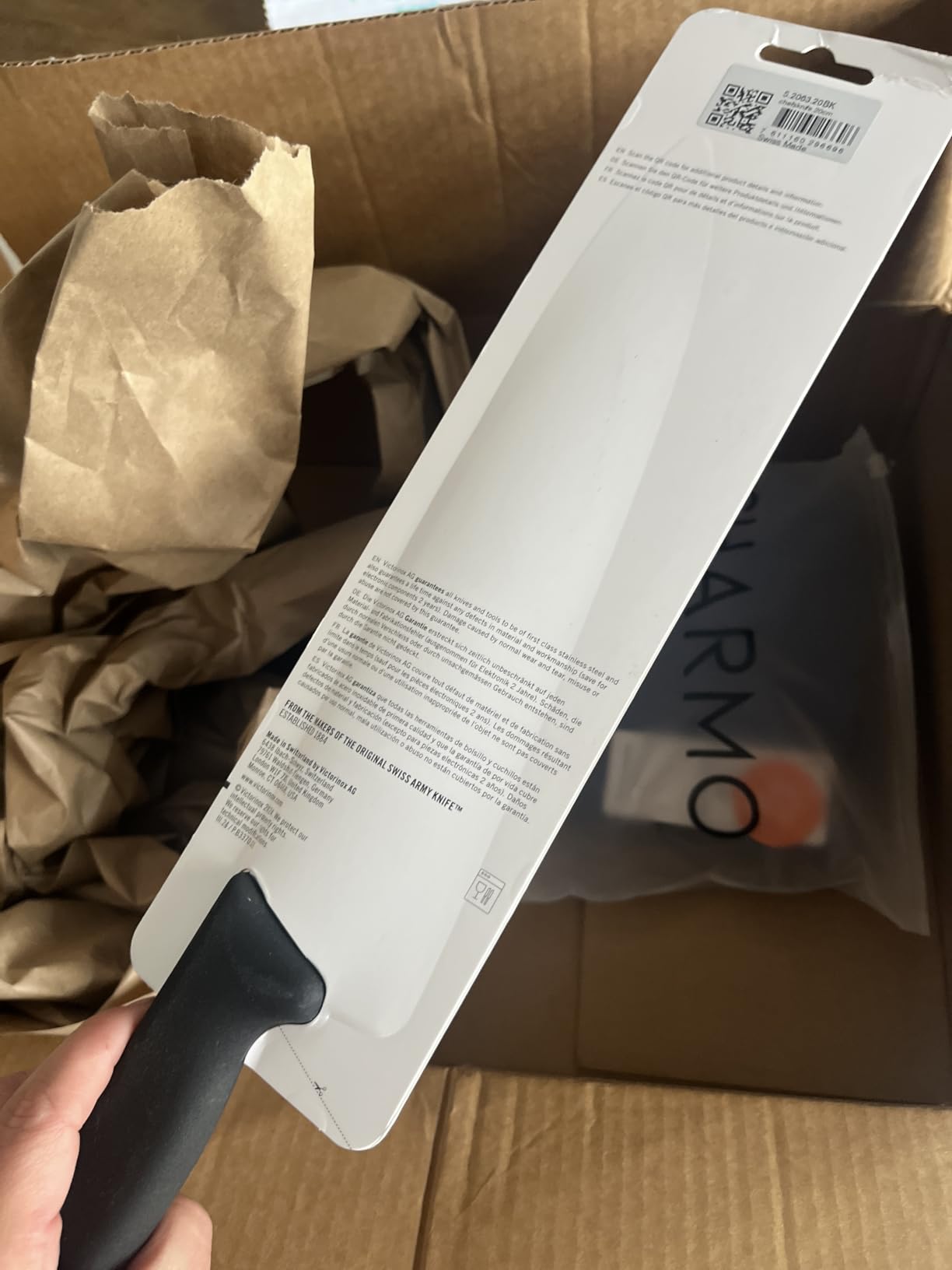
At roughly 22.68 g in the listed specifications, it is the lightest blade in this group, and that lightness showed up as less hand fatigue during a ninety-minute Sunday batch cook. Nothing about it feels flimsy, either. It is a stamped blade, so there is no bolster to catch your knuckles and no thick spine to snap.
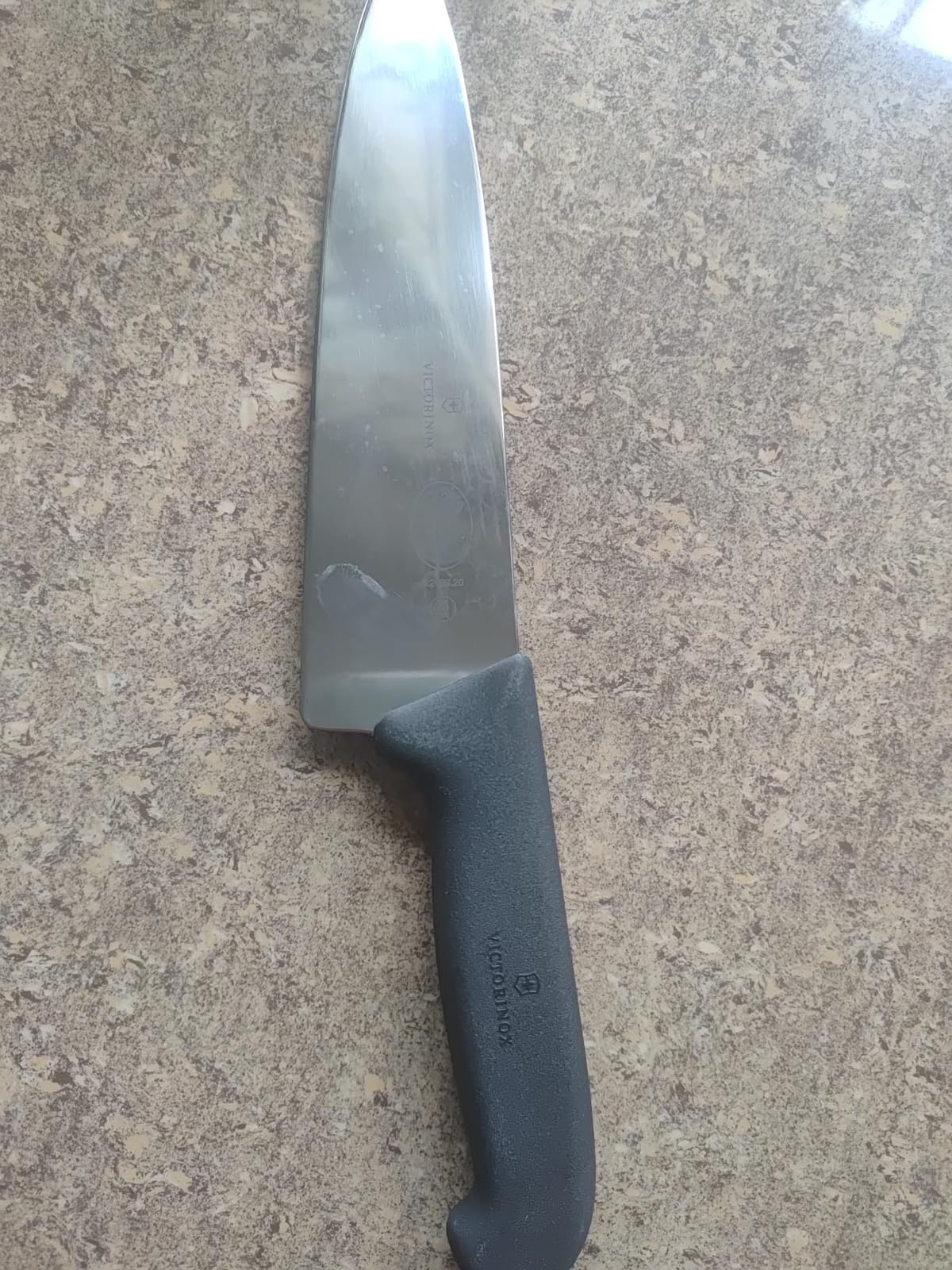
The trade-off is honest: this is thin stamped stainless, which means the edge dulls faster than a forged blade and needs honing more often. We touched ours up twice a week with a cheap honing steel. It also scuffs cosmetically, and after sharpening you can see the marks across the satin finish. Neither issue affected cutting performance at all.
Who this knife suits
If you cook most nights, want zero maintenance rituals, and share a kitchen with people who will absolutely put a knife in the dishwasher, this is the safest pick in the roundup. It is also the only knife here we would hand to a nervous teenager.
Owners describe it as unbeatable value with a handle that grips even when wet, and that reputation has held up across more than fourteen thousand reviews. It is also genuinely fine as a first knife: forgiving, cheap to replace if it gets lost, and sharp enough that you learn good technique without being punished by a dull blade.
Who should skip it
If your cooking involves frozen meat, bones or hard squash on a weekly basis, a thicker forged blade will out-edge it and absorb mistakes better. Chefs who sharpen their own knives on a stone will also find stamped steel underwhelming after the first year.
Forum regulars on kitchen knife boards tend to treat this knife as a beater and a backup, and that is exactly the right expectation. It is a tool, not a keepsake. If you want a blade you pass down, look at the forged German options further down.
2. HENCKELS Classic 8-Inch Chef Knife – Best Value Forged German
HENCKELS Classic 8-Inch Chef Knife, Razor-Sharp, German Engineered
Fully forged stainless steel
Satin honed blade
Triple-riveted handle
Lifetime warranty
Pros
- Fully forged durability
- Sharp factory finish
- Lightweight for its class
- Dishwasher safe
- Lifetime warranty
Cons
- Full bolster complicates sharpening
- Some find the handle shape less refined
- Needs a honing steel to stay sharp
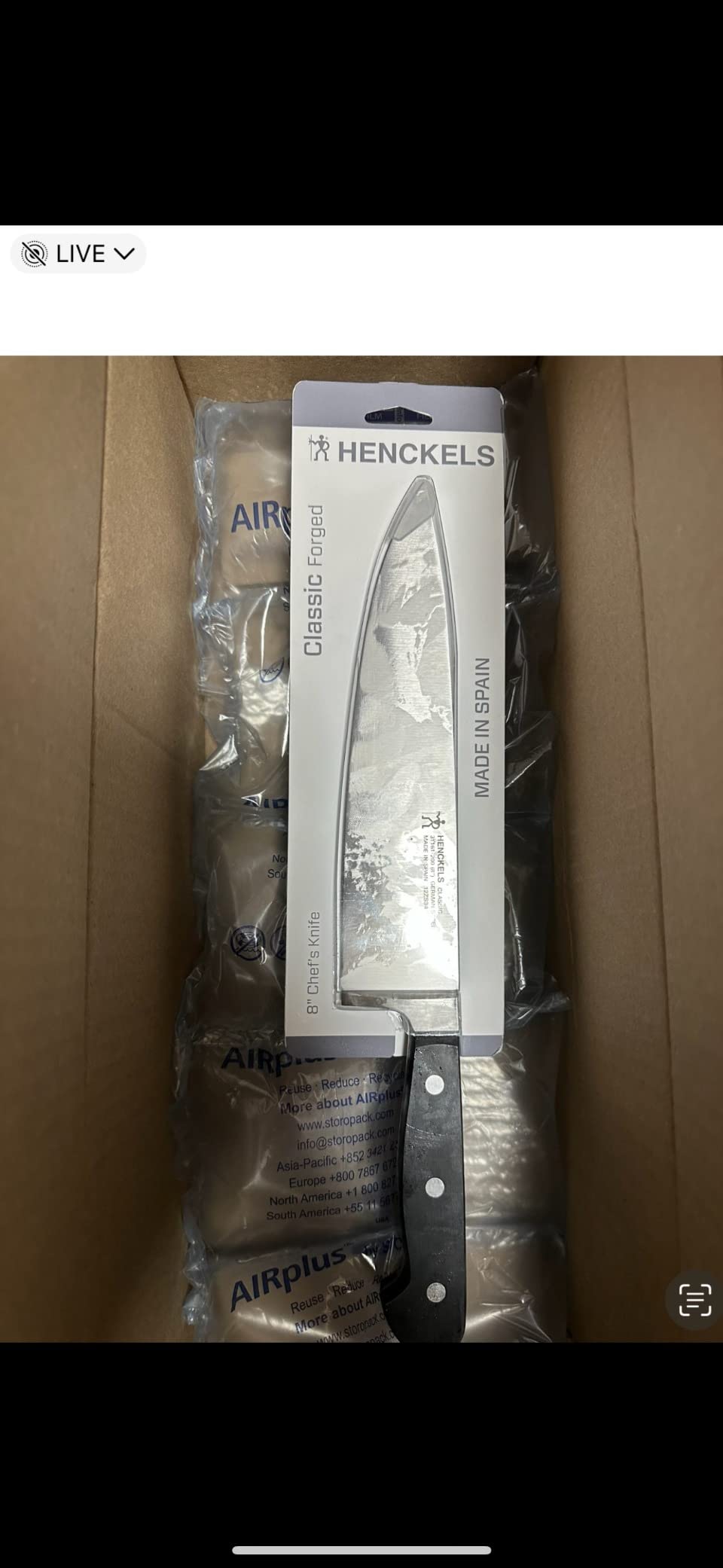
The HENCKELS Classic is the knife we recommend to someone moving up from a department store block. It is fully forged, meaning the steel is shaped from a single block rather than stamped from sheet, and that difference shows up in how the blade feels the moment you pick it up.
Balance is the word that comes up most. The transition from blade to handle is one continuous piece of steel, so there is no seam to catch your grip and the knife does not want to tip forward. Rolling it through a rock chop on a big pile of onions felt controlled rather than ponderous, and the satin finish sliced cleanly through herbs, fruit and larger cuts of meat without drama.
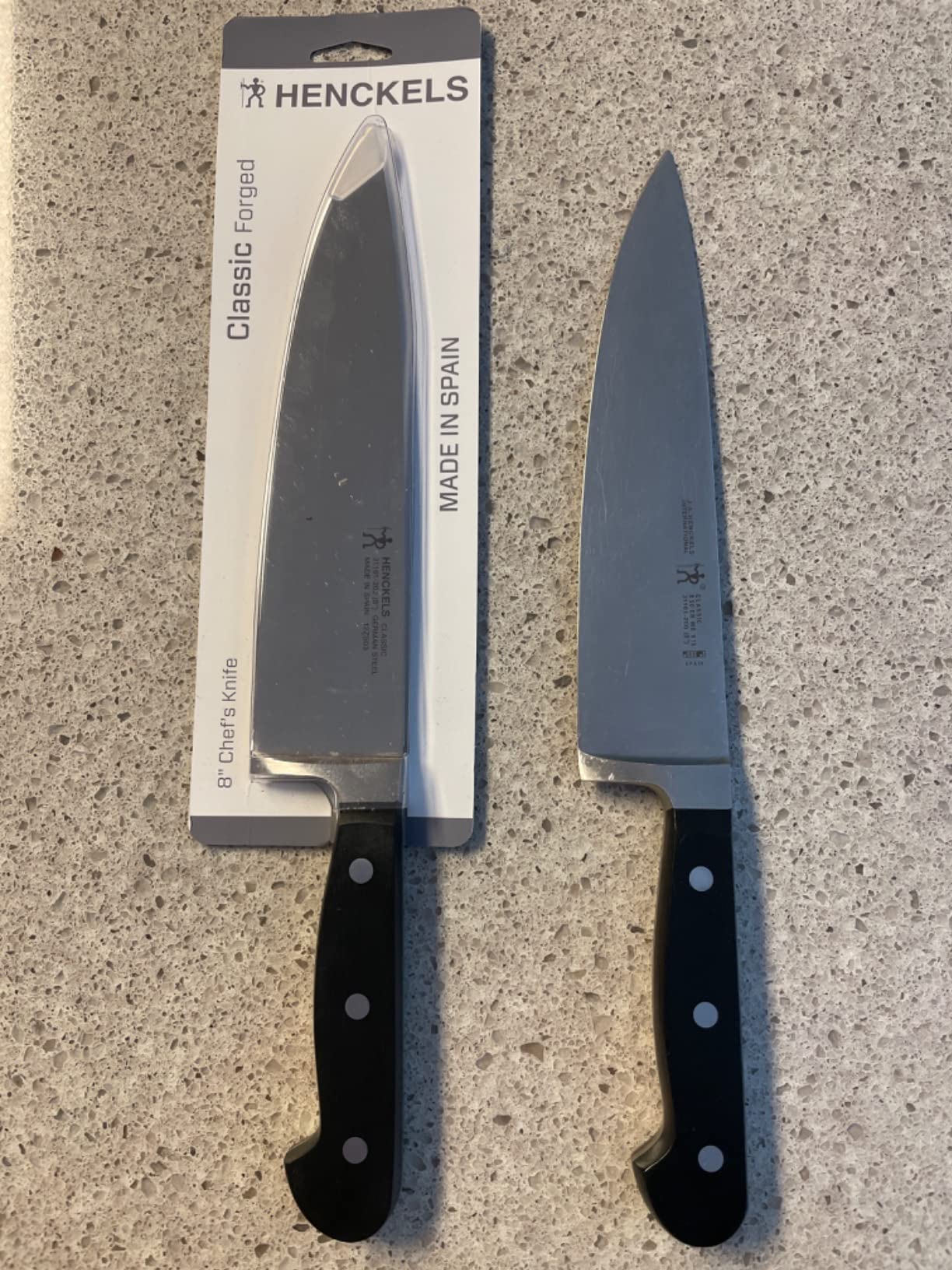
It is also one of the few knives here that is genuinely indifferent to carelessness. Stain and rust free steel, and it survives a dishwasher cycle without any loss of function, which in a shared household is worth more than most spec-sheet advantages.
Our reservations are narrow. The full bolster that gives this knife its knuckle clearance is also the section of steel a sharpening stone has to work around, so sharpening it takes more patience than a knife with a shortened bolster. Some cooks also find the riveted handle shape less sculpted than alternatives, particularly those with larger palms.
What matters before you buy this
If you already own a whetstone, know how to hold a bevel, and want the classic German profile, this is a strong pick. The blade arrives finely honed and stays sharp longer than a stamped knife because the forging process leaves a thicker, better heat-treated section of steel behind the edge.
On the frequently asked Zwilling versus Henckels question, the honest answer is that the two produce very similar German-style knives with the same lifetime warranty philosophy, and the practical difference for a home cook is handle feel and local sharpening support rather than steel quality.
Where it will frustrate you
If sharpening is something you want to do casually with a pull-through sharpener, this is the wrong shape of knife. That heavy forward bolster is designed to protect the edge during hard use, and it resists a casual sharpening stroke.
Long-term owners treat it as a tank, and the lifetime warranty is a real asset because it is honored for decades. Just budget separately for a honing steel and a knife guard, since neither is included.
3. Mercer Culinary Renaissance 8-Inch – Most Versatile Forged Blade Upgrade
Mercer Culinary M23510 Renaissance, 8-Inch Chef’s Knife
Forged German stainless steel
Shortened bolster
Delrin handle
Lifetime warranty
Pros
- Forged steel at a fraction of premium German pricing
- Shortened bolster sharpens easily
- Rounded spine works in a pinch grip
- Taper ground edge
- Popular with culinary students
Cons
- Some units show surface blemishing or light spotting
- Scratches show more than German rivals
- Taller profile may not fit standard block slots
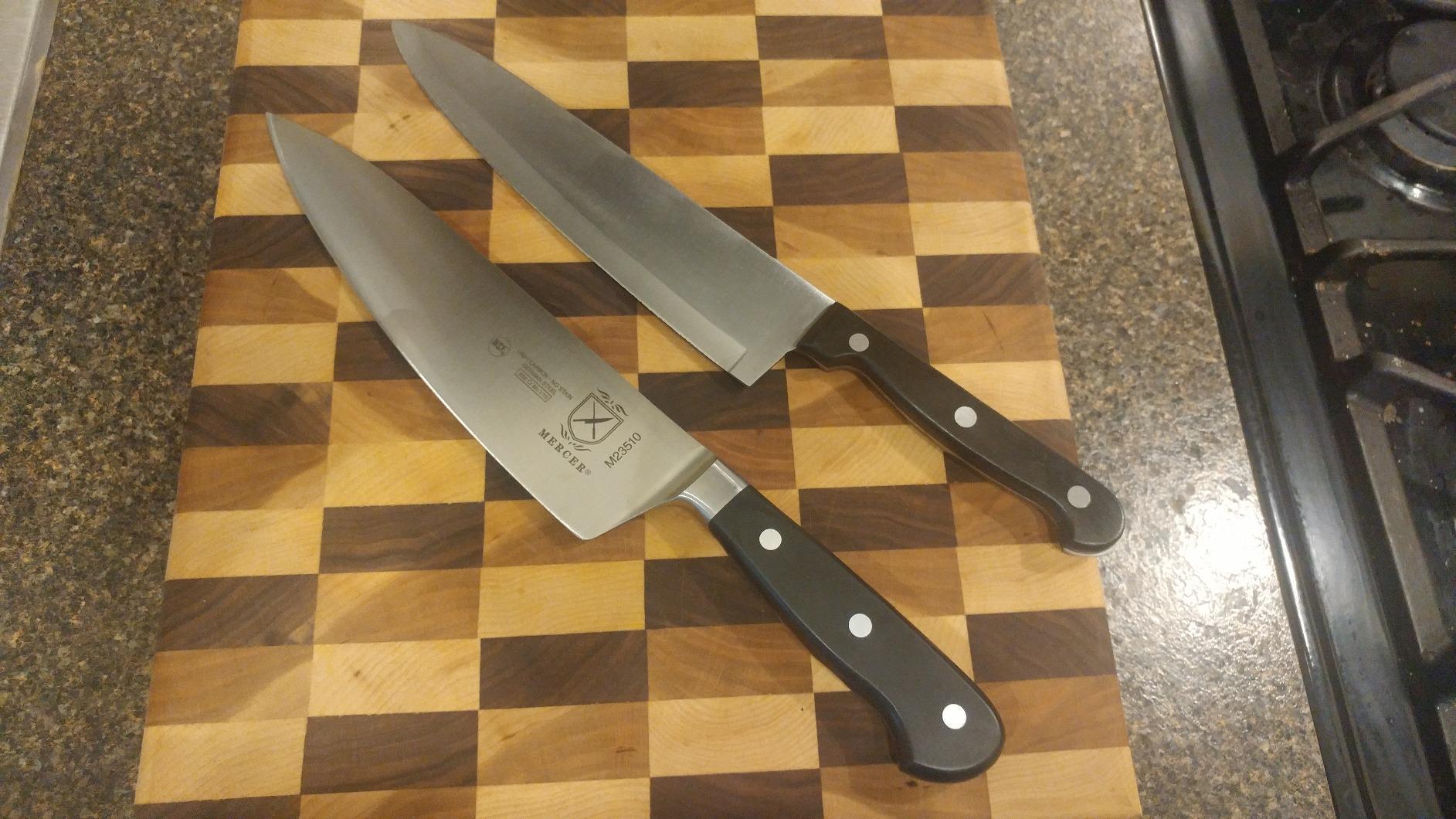
Mercer’s Renaissance is the most interesting knife in this roundup on a purely structural basis. Forged German stainless steel, a full tang, triple-riveted Delrin handle and a lifetime warranty, at a price that sits well below the German and Japanese brands people assume are the entry point to those features.
The shortened bolster is the detail that convinced us. Because the steel stops closer to the heel, more of the blade’s cutting surface is exposed, which makes this dramatically easier to bring back to sharp on a stone. If you have ever avoided sharpening a German knife because of the geometry fight, this one removes that excuse.
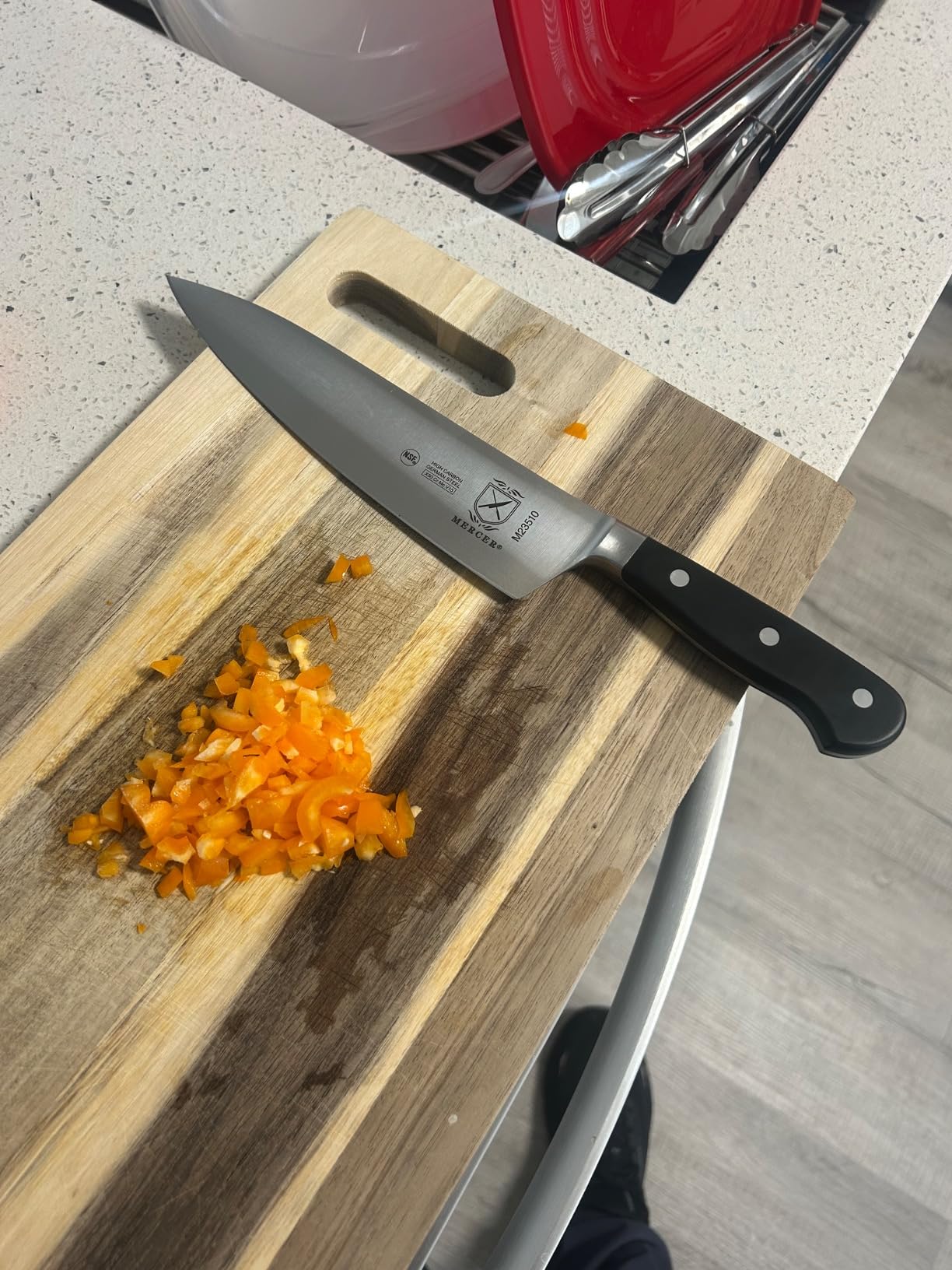
The rounded spine is the other quiet winner. In a pinch grip, the thumb sits against a curved rather than sharp-edged spine, and after twenty minutes of mincing the difference in comfort was noticeable to us. The taper ground edge adds stability, so the knife tracks predictably through a dicing motion.
What we would watch is quality control. A minority of owners report light surface blemishing or early spotting, and the finish is not hand-polished to the standard of Solingen steel, which means scratches show up sooner. The taller blade profile also refuses to fit some standard knife block slots, which is annoying if you like block storage.
Why this is the smart first upgrade
This is the knife to buy if you have been using the free knife that came with a knife block and you want a genuine step up without a big commitment. It performs like a professional tool for everyday prep, and it is popular enough with culinary students that you will be in very good company learning on it.
It also fits the pattern that shows up constantly on cooking forums: people who want a real forged workhorse, who sharpen their own knives, and who find that one good knife is all they need. Buy it, learn to hone it, and the return on sharpening effort is high because the edge geometry cooperates.
Where it falls short
If you want a spotless cosmetic finish or a handle that feels hand-finished in the hand, this is not it. Budget forging has visible limits, and the factory polish is one of them.
Pair it with a simple routine instead. Hand washing, a proper dry immediately, and a honing steel used every few sessions will keep it performing for years, which is more care than most buyers give it.
4. Mercer Culinary Millennia 8-Inch – Best Budget Japanese Steel
Mercer Culinary M22608 Millennia Black Handle, 8-Inch, Chef’s Knife
One-piece high carbon Japanese steel
Santoprene handle
Hand wash only
6.7 ounces
Pros
- High carbon Japanese steel at a low cost
- Textured non-slip handle
- Good balance for chopping
- Easy to sharpen
- easy entry price point
Cons
- Hand wash only to keep the warranty
- Tamped down finish versus forged rivals
- Edge dulls faster than forged steel
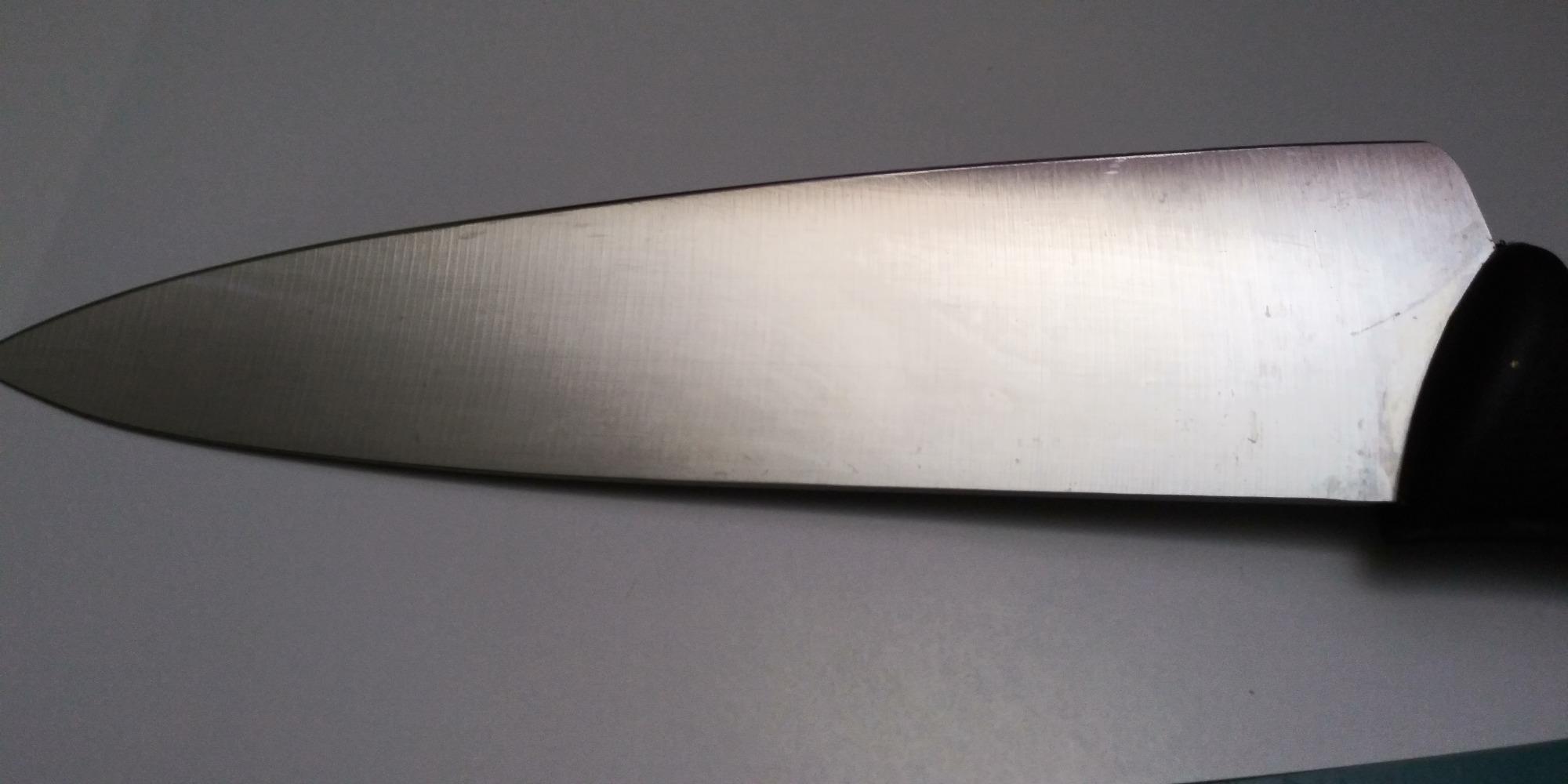
The Millennia is the cheapest way into a genuinely hard, high carbon blade. Rather than the softer stainless most budget knives use, this one is built from one piece of high carbon Japanese steel, and it takes an edge that holds noticeably longer through a week of normal cooking.
At 6.7 ounces it felt light and lively in the hand. The Santoprene handle has textured finger points that keep the blade from rolling in a wet grip, and the tang construction put the balance in a place that made mincing shallots and dicing onions feel steady rather than twitchy.
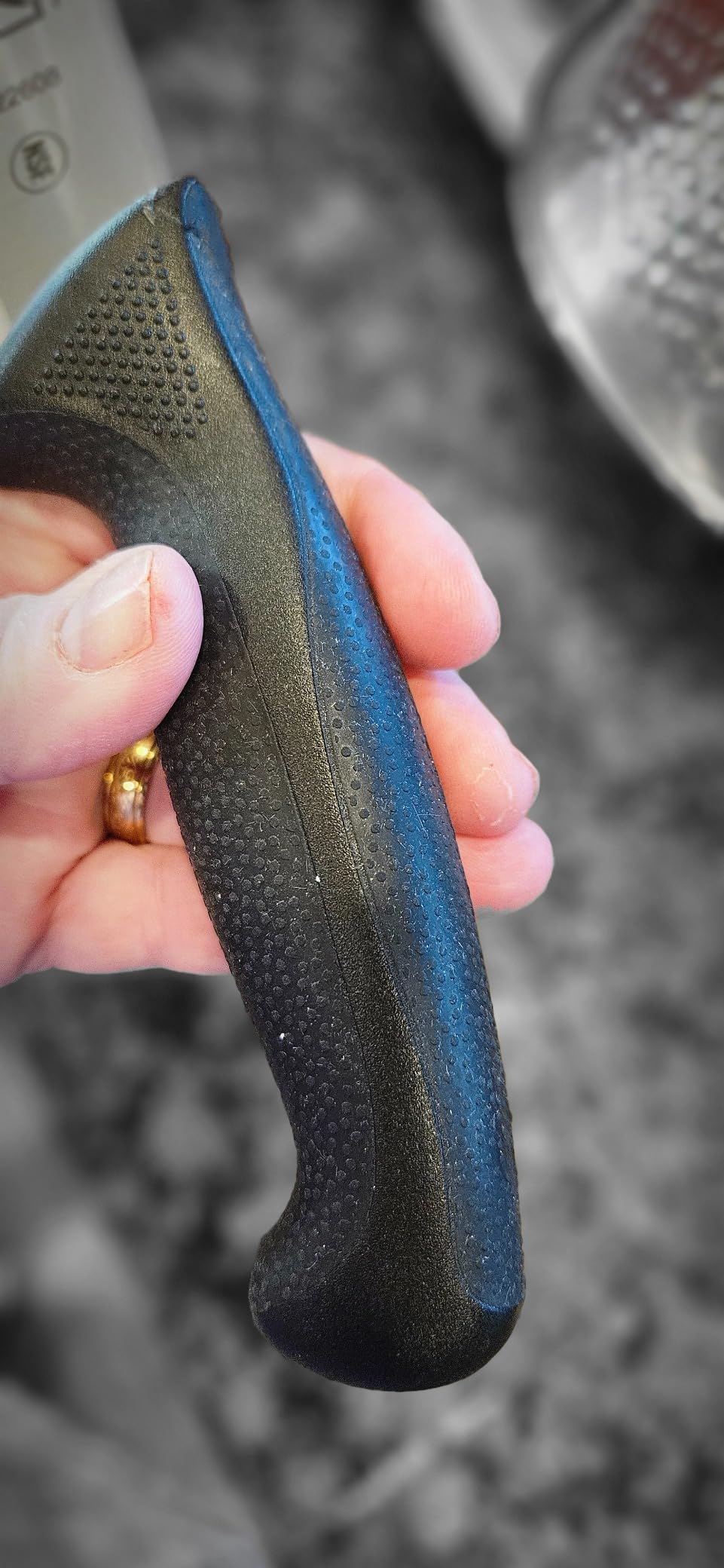
It is a genuinely capable blade for dicing onions, mincing shallots, chopping herbs, crushing garlic and shredding cabbage, which covers most of what a weeknight kitchen asks of a chef’s knife. Crushing garlic straight off the blade with the side of the handle worked better than we expected from a knife at this level.
The catch is care. Mercer’s warranty covers defects in material and workmanship and explicitly excludes dishwasher damage, so this one is hand wash only, warm water and mild soap, dried straight away. Owners consistently flag that as the one rule to follow.
What matters before you buy this
Buy this if your household includes someone who treats the dishwasher as a knife cupboard, and you would rather not have that conversation every week. Nothing about the blade is compromised by hand washing, and the edge is easier to bring back than most knives in this price band.
It is stamped rather than fully forged, so the steel is thinner at the edge and dulls faster than the Renaissance and the German forged options here. In practice, the extra sharpness out of the box compensates for most of that difference during the first year.
Where it falls short
Skip it if you want a knife that feels substantial in the hand, or if you plan to store it in a block where the handle has to fit a narrow slot. Lightweight blades and slotted blocks are a poor pairing.
For most home cooks, though, the trade is simple. You get Japanese steel hardness and a grippy handle for very little, in exchange for a hand-washing rule and a finish that scratches sooner than a premium blade.
5. Global G-2 8-Inch – Best For Smaller Hands
Global – 8 inch, 20cm Chef’s Knife,Silver
Molybdenum vanadium stainless steel
Dimpled all-steel handle
7.84 ounces
Lifetime warranty
Pros
- Noticeably sharp out of the box
- Very light with a narrow grind
- Excellent edge retention
- One-piece hygienic stainless body
- Dimpled grip holds when wet
Cons
- Handle girth can feel small for larger hands
- Thin spine suits precision over heavy rock chopping
- Very sharp edge takes some adjustment
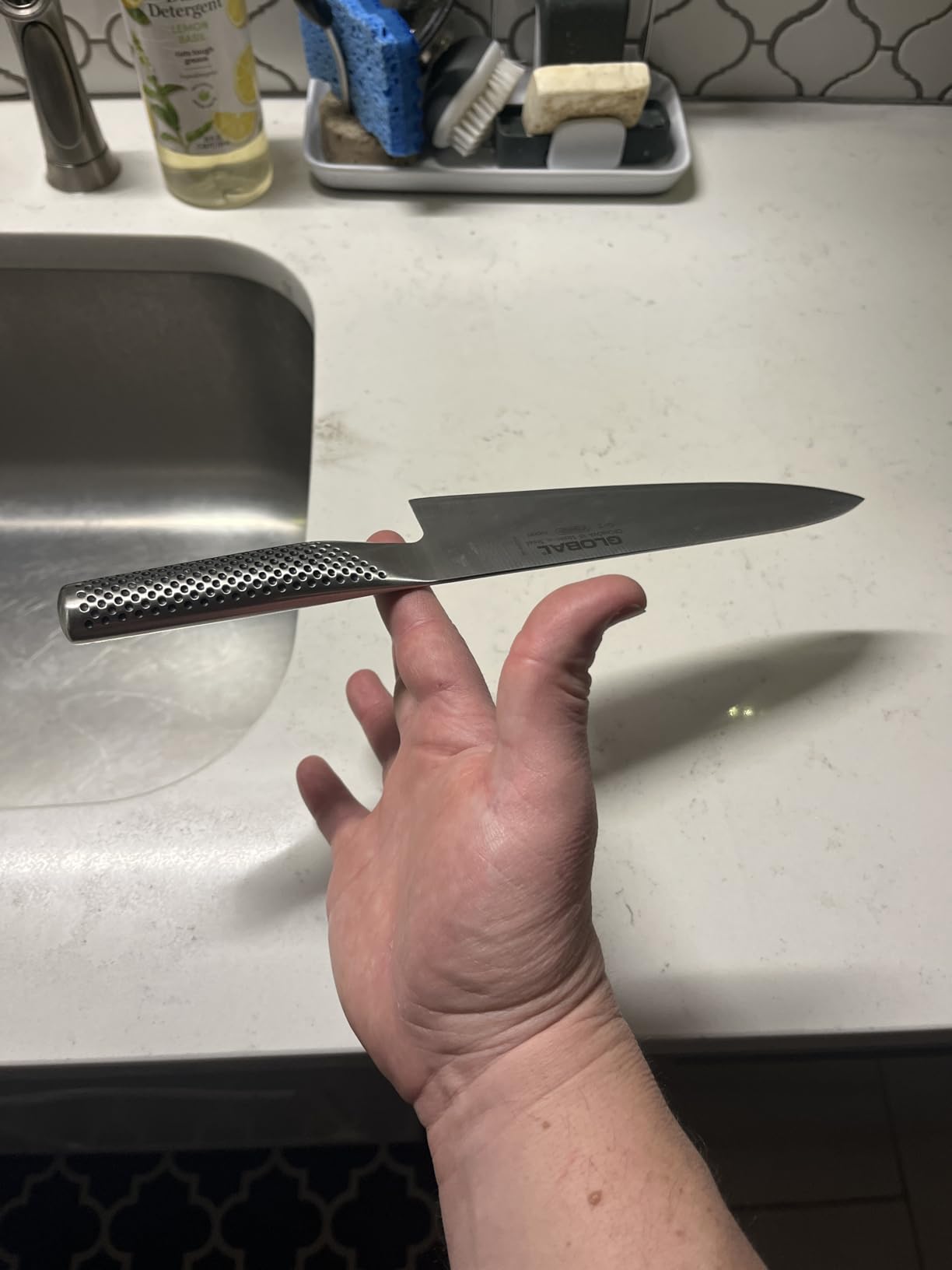
The Global G-2 solves a problem most roundups ignore. Its handle is slim, its blade is narrow, and the whole knife weighs in at 7.84 ounces, so it fits a smaller hand without the shaking grip struggle that heavy Western profiles create. If you have ever had to hold a big chef’s knife with your fingertips because your palm could not get around the handle, this is the opposite experience.
Sharpness is the headline. Owners repeatedly describe it as noticeably sharper out of the box than other eight inch knives they own, and reviewers in the forums call out that the thin, narrow grind slides through food with almost no resistance. The molybdenum and vanadium stainless steel is a modern alloy choice that resists staining and holds an edge unusually well for stainless.
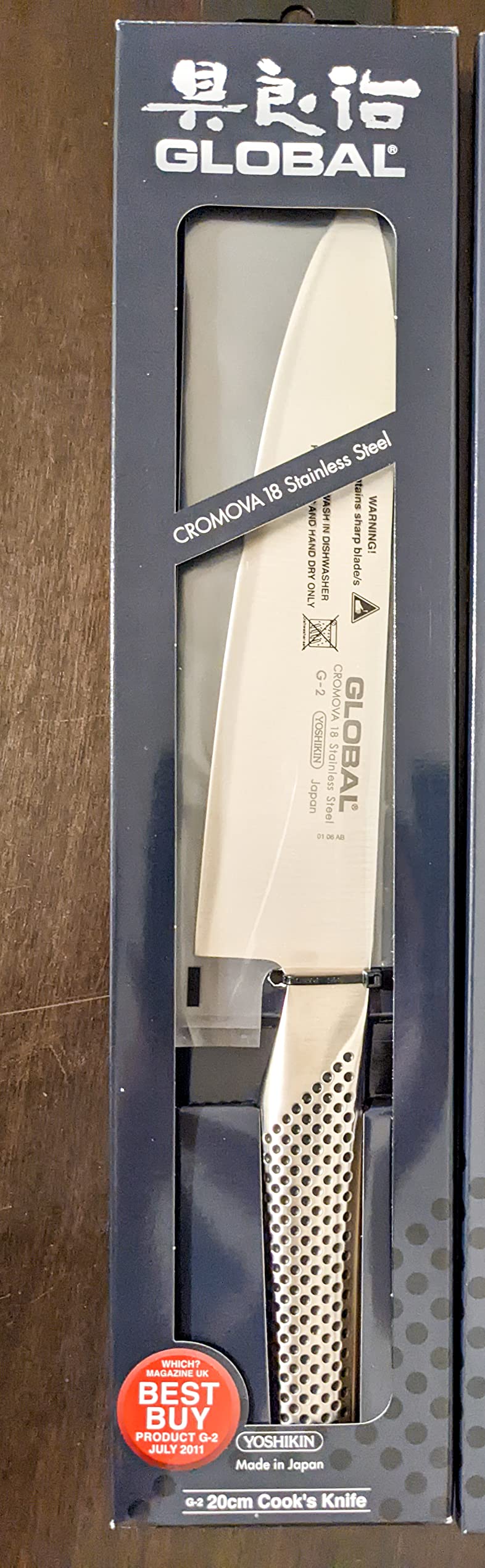
The all-stainless body is a genuine kitchen advantage. There are no crevices where food can lodge, it does not need oiling, and the dimpled handle stays grippy when wet. For a cook who prefers a pinch grip or an offset hold, the balance point sits close to the blade and the knife feels almost weightless in motion.
Two honest limits. The thin handle profile that makes it great for small hands feels narrow for someone with large palms, and the thin spine without a true full bolster means it is not the knife you want for heavy repetitive rock chopping through dense squash or a full batch of potatoes.
What matters before you buy this
Measure your grip before you order anything. If the handle circumference is comfortable and you mostly slice, mince and dice delicate ingredients, the G-2 is one of the most precise-feeling chef’s knives available at any price, and the lifetime warranty means a lot over a long ownership.
It is also fully ambidextrous in practice, since the all-stainless handle has no shaped finger choil, so it works for cooks who hold the knife in either hand without any adjustment.
Where it falls short
If your cooking is heavy prep, whole squash, or breaking down large quantities of root vegetables in a single session, you want a blade with more mass behind the edge. The Global is built for control and precision, not for pushing through dense produce all evening.
Also expect a learning curve of a few sessions. The factory edge is genuinely sharp, and cooks used to a softer European grind sometimes meet it with too much force. Learn the angle and it becomes the knife you reach for first.
6. Wusthof Classic 8 Inch – Best For Lifetime Durability
WÜSTHOF Classic 8 Inch Chef’s Knife,Black,8-Inch
Precision forged high carbon stainless
58 HRC tempering
Full tang triple-riveted handle
Solingen Germany
Pros
- Forged from a single block of steel
- Tempered to 58 HRC for edge retention
- Full tang with excellent balance
- Curved profile suits rocking cuts
- Seven generations of Solingen history
Cons
- Plain packaging with no blade guard
- Handle logo can fade with scrubbing
- Heavier than a Japanese style knife
Wusthof’s Classic is the answer to anyone who wants a knife they can hand to their kid. It is precision forged from a single block of high carbon stainless steel, tempered to 58 HRC, with a full tang and a triple-riveted synthetic handle. That is a straightforward, no-nonsense build with almost nothing fashionable about it.
The Wustec treatment applied to the steel is reported by the manufacturer to produce a blade 20 percent sharper with twice the edge retention of previous generations. Whether or not you take that figure at face value, the long-term owners we found describe blades that still look near new after years of use with periodic honing, which is the only durability test that really matters.
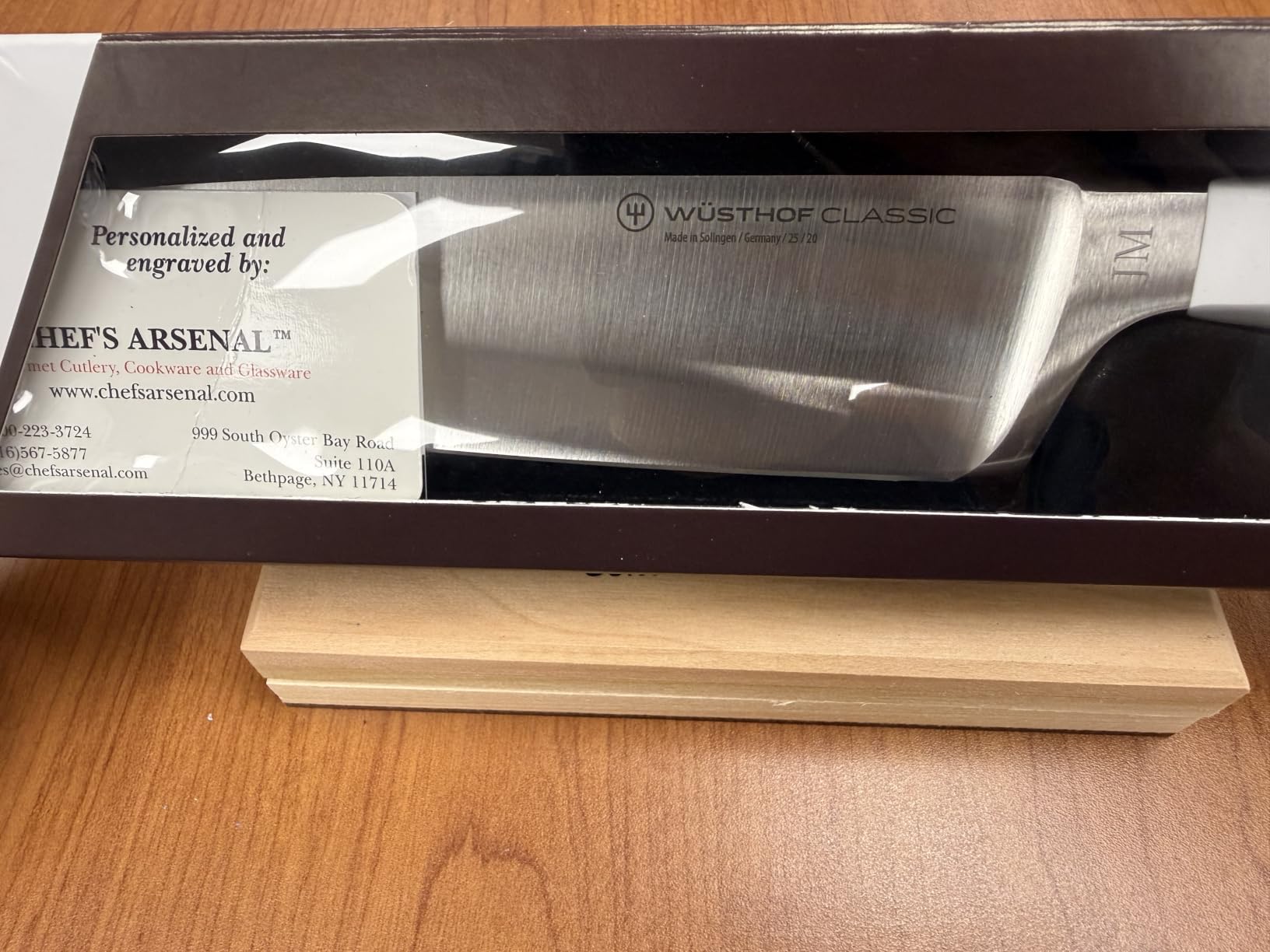
The curved Western profile with a full bolster and finger guard is built for the rocking motion most home cooks grew up using, and the blade weighs 8.5 ounces according to the manufacturer, which gives it real authority through onions without feeling punishing. Made in Solingen, Germany by a family firm seven generations deep, with a lifetime warranty behind it.
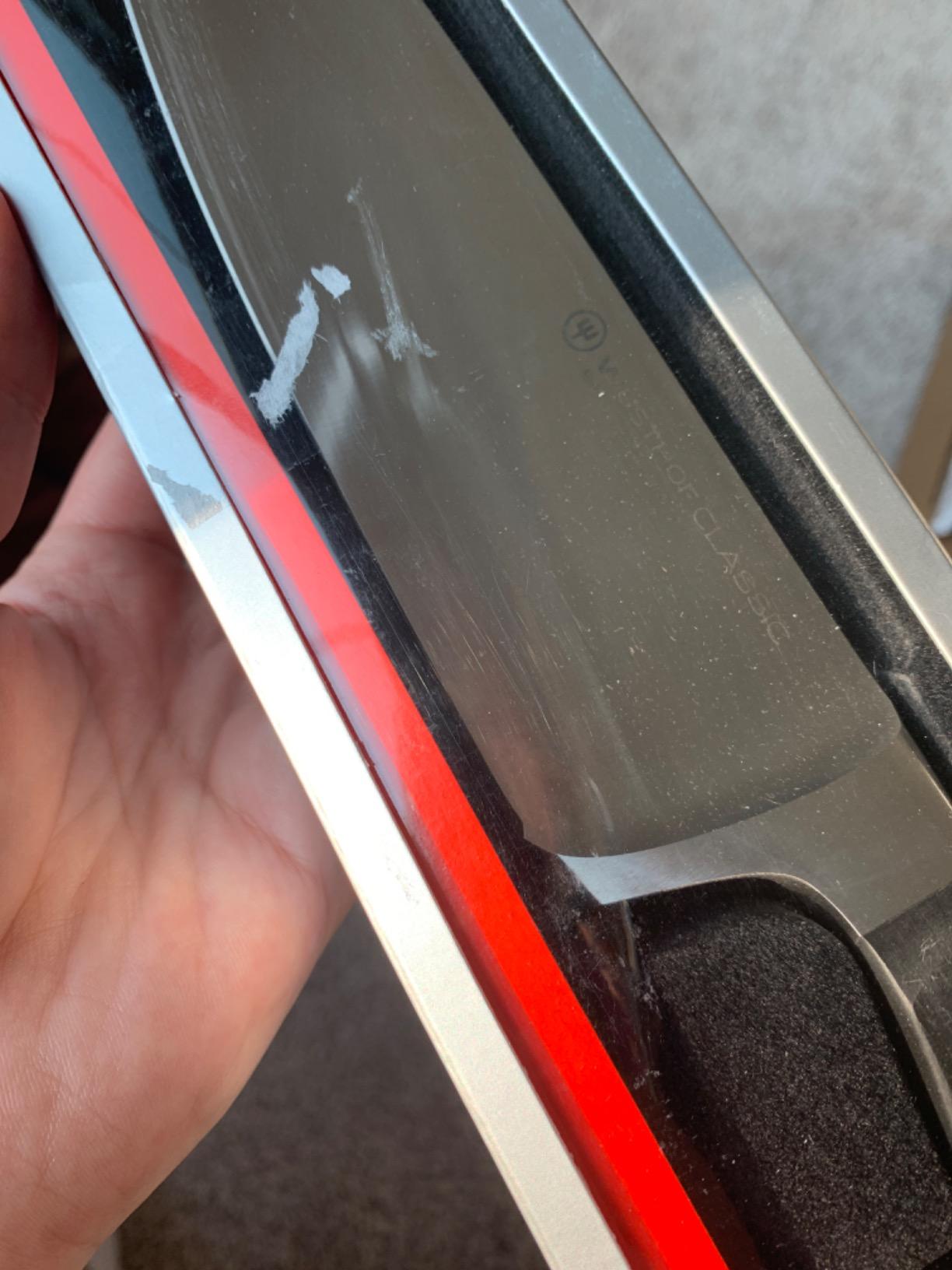
Two practical notes. It ships in plain packaging with no guard, so buy an in-drawer holder or edge guard separately, and expect the handle logo to wear down if you scrub handles hard. Some cooks also find it heavy for an entire day of prep and prefer a lighter Japanese-style blade instead.
What matters before you buy this
Buy this if sharpening is a ritual you will actually keep up and you want the widest support network for it. Wusthof runs sharpening services and honors the lifetime warranty long after the original sale, which turns a knife purchase into a repairable asset rather than a consumable.
The 58 HRC temper sits in the useful middle of the hardness range. Hard enough to hold a fine edge through a week of prep, soft enough that a stone brings it back without a marathon session. That balance is exactly why forum regulars keep recommending forged German steel to new cooks.
Where it falls short
It is not the knife for someone who wants a featherweight blade or a very high edge angle for paper-thin slicing. Nor is it the choice if you will not sharpen it, since a full bolster geometry rewards regular honing more than a knife with a shortened one.
Hand wash only, dry it, and it will outlast several lesser knives stacked together. That is the whole pitch.
7. Shun Classic 8-Inch – Best For Japanese Craftsmanship
Shun Classic 8″ Chef’s Knife
VG-MAX steel core
68 layer Damascus cladding
16 degree edge
Pakkawood D handle
Pros
- Exceptional sharpness out of the box
- Excellent edge retention
- D-shaped handle works in either hand
- Free sharpening and honing service
- Lifetime warranty
Cons
- Highest price in this roundup
- Pakkawood handle needs hand washing and oiling
- Light feel suits slicing over heavy rock chopping
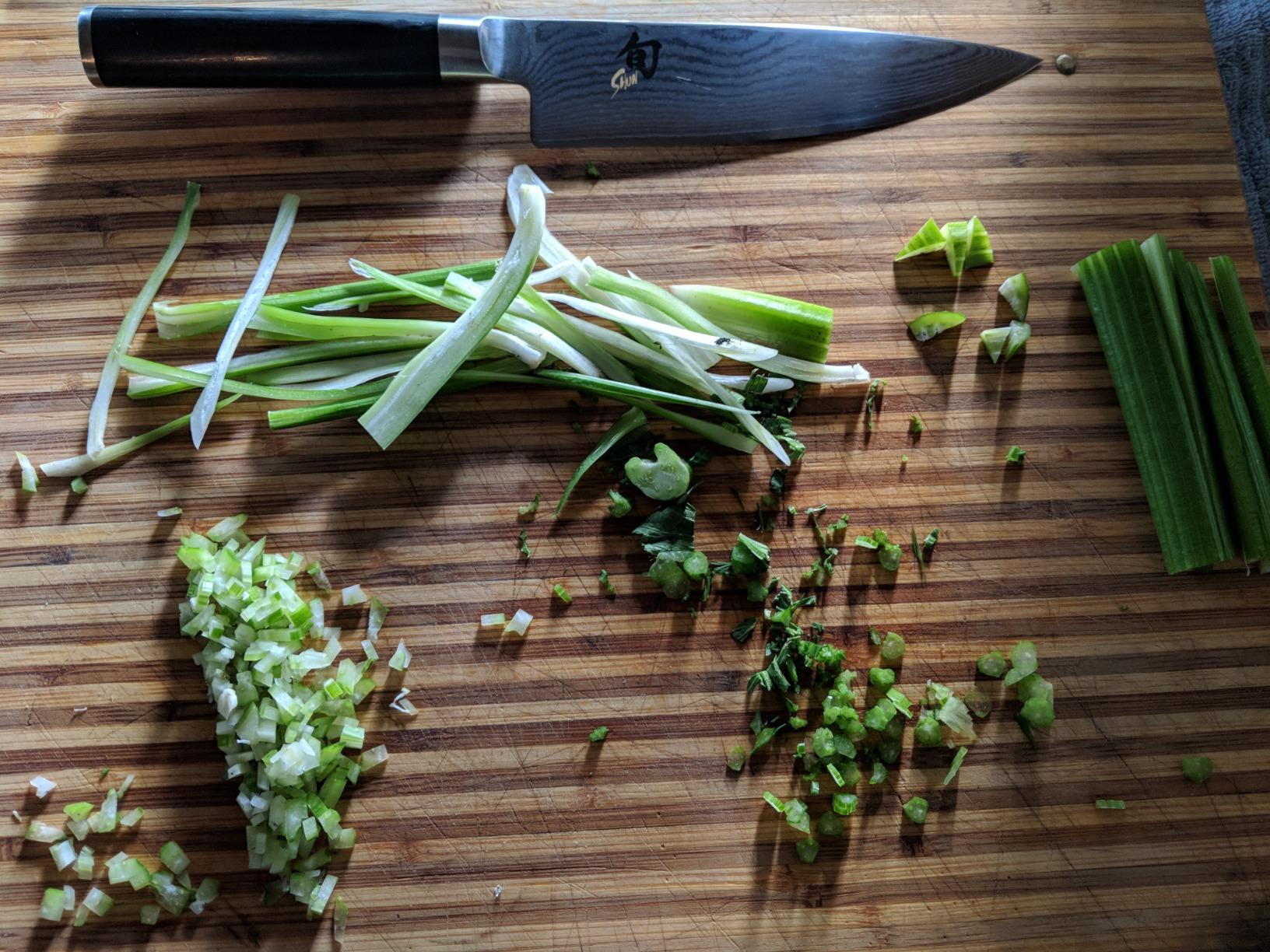
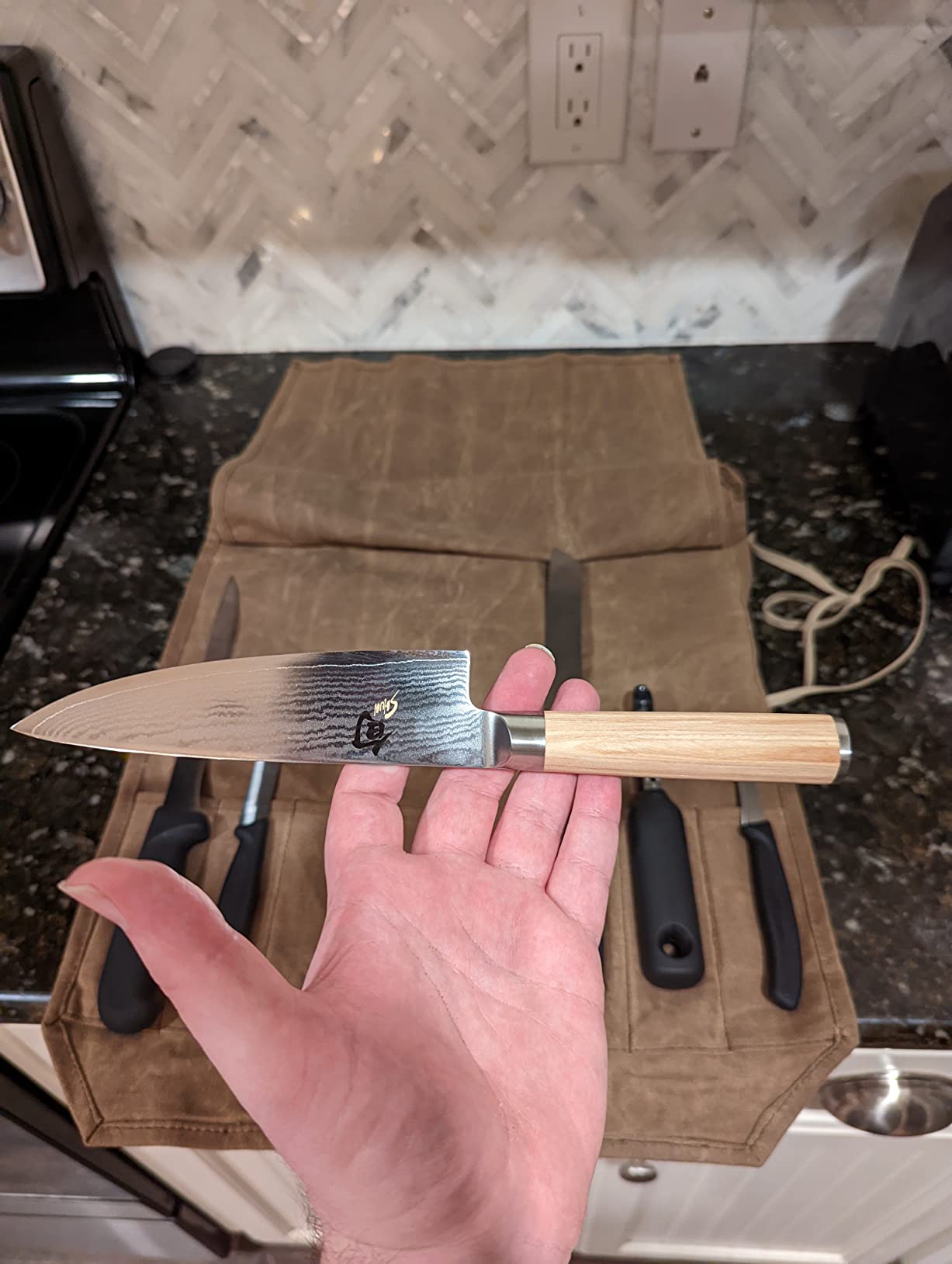
The Shun Classic is the most refined object on this list and the one most likely to make you change your mind about how sharp a kitchen knife can feel. A VG-MAX Japanese steel core wrapped in 68 layers of Damascus cladding, hand sharpened to a 16 degree edge in Japan, and finished to a standard you can see before you even pick it up.
Cutting performance is where the craft pays off. The edge stayed keen through the entire test period with fewer touch-ups than anything else in the roundup, and it moved through delicate tasks beautifully. Slicing, dicing and mincing all felt effortless, with none of the drag that heavier blades can show on softer produce.
The D-shaped Pakkawood handle is a genuine advantage here. It gives control in a pinch grip without a finger choil pressing into one hand, so it works comfortably for cooks who hold the knife in either hand, and the layered Pakkawood is both attractive and resistant to the moisture that cracks plain wood.
The care requirement is the honest cost. Pakkawood wants hand washing and occasional oiling, and the blade rewards respecting the edge, because a 16 degree Japanese bevel chips if you treat it as a bone chopper or a frozen-food tool. Free sharpening and honing services plus a lifetime warranty make that fragility much less of a concern over time.
What matters before you buy this
This is the one to buy if you want a Japanese edge, plan to sharpen it properly on a stone, and want a manufacturer who will resharpen it free. The factory edge is 16 degrees per side, which is finer than most Western chef’s knives and needs a light touch with a coarse stone to maintain.
It is also the most expensive knife here, and forum advice consistently frames it as a reward knife rather than a first purchase. Our advice is to own one good German workhorse first and add this once sharpening is a habit.
Where it falls short
If your cooking is heavy rock chopping through dense vegetables in large batches, a lighter Japanese-style blade is not the right instrument. The same goes for frozen food and bone work, which is exactly where the sharp thin edge is most vulnerable.
The bottom line for a home cook is precision and beauty, with a maintenance routine that rewards attention and punishes none of it.
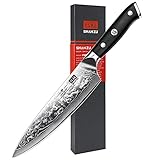
8. SHAN ZU 8-Inch Damascus – Most Compact
SHAN ZU Chef Knife 8 Inch Japanese Steel Damascus Kitchen Knife
67 layer Damascus construction
10Cr15Mov core at 62 HRC
G10 glass fiber handle
15 degree edge
Pros
- Real folded Damascus construction
- Very hard 62 HRC Japanese core
- Top balanced G10 handle stays solid when wet
- 15 degree edge for general prep
Cons
- Handle runs larger than many Western knives
- Unforgiving edge that needs careful technique
- Pattern shows more after polishing
SHAN ZU is the visual showpiece of the roundup and, unusually, the pattern is not laser etched. The blade is built from 67 layers of folded and forged carbon steel sheets around a 10Cr15Mov Japanese steel core hardened to 62 HRC, which is a real build rather than a decorative surface.
That 62 HRC core is the hardest steel here, and it showed. The edge held its keenness through the toughest test of the roundup, including dense squash, and the 15 degree cutting angle is a practical general purpose grind that is sharp without being whisper thin.
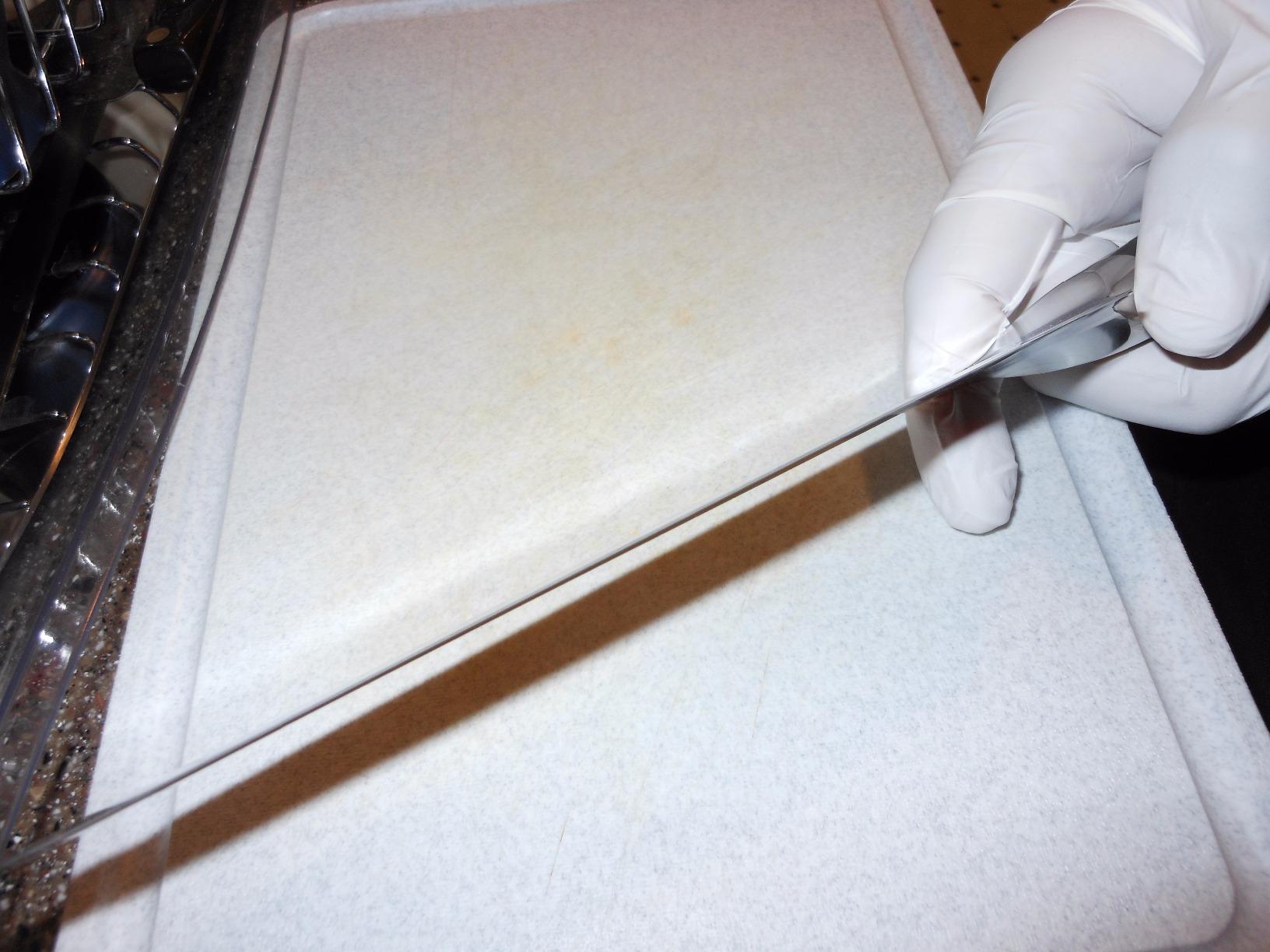
Balance is the underrated feature. The blade is 8 inches long, 2.2 mm thick with a 2.5 inch width and a 5.3 inch G10 handle, and the weight sits toward the blade rather than the back, so the knife wants to come down through food on its own. The frosted G10 handle stays solid and grippy when wet, which matters during a long prep session.
Be aware that a pattern formed by folding steel becomes more visible as the blade polishes with use, so the knife can look different after a year than it did on day one. It also comes with a 12-month warranty rather than a lifetime one, which is the most common complaint we saw.
What matters before you buy this
Check your hand size first. Reviewers repeatedly note that the handle runs a little larger than most Western chef’s knives, and that matters more for the quality of your cuts than any steel specification. If you have small hands, the Global or the Mercer options here will serve you better.
If the size works, the construction is genuinely impressive for the money. Hardness at 62 HRC, real Damascus cladding and a top balanced handle is a combination that would normally cost far more, and the corrosion resistance of the core keeps staining in check.
Where it falls short
A very sharp edge demands respect. Reviewers describe the blade as unforgiving, and the fine hard steel is less forgiving of a hard downward stab against a cutting board than a tougher German blade. Treat it as a precision tool and it will reward you.
It is a good choice as a second knife rather than a first, particularly if you already own a forgiving workhorse for the heavy chopping.
9. Dalstrong Gladiator Series 8-Inch – Best For BBQ And Heavy Prep
Dalstrong 8″ Chef Knife – Forged German Steel
Full tang forged high carbon steel
16-18 degree edge
G-10 handle
8 ounces
Pros
- Forged full tang with real cutting power
- Hefty weight drives through dense food
- Hybrid bolster gives knuckle clearance
- Hand polished edge per side
- Includes a sheath and NSF certified
Cons
- Heavier than most knives here
- Tiring for small hands over long sessions
- Handle runs large
- Assembled in China
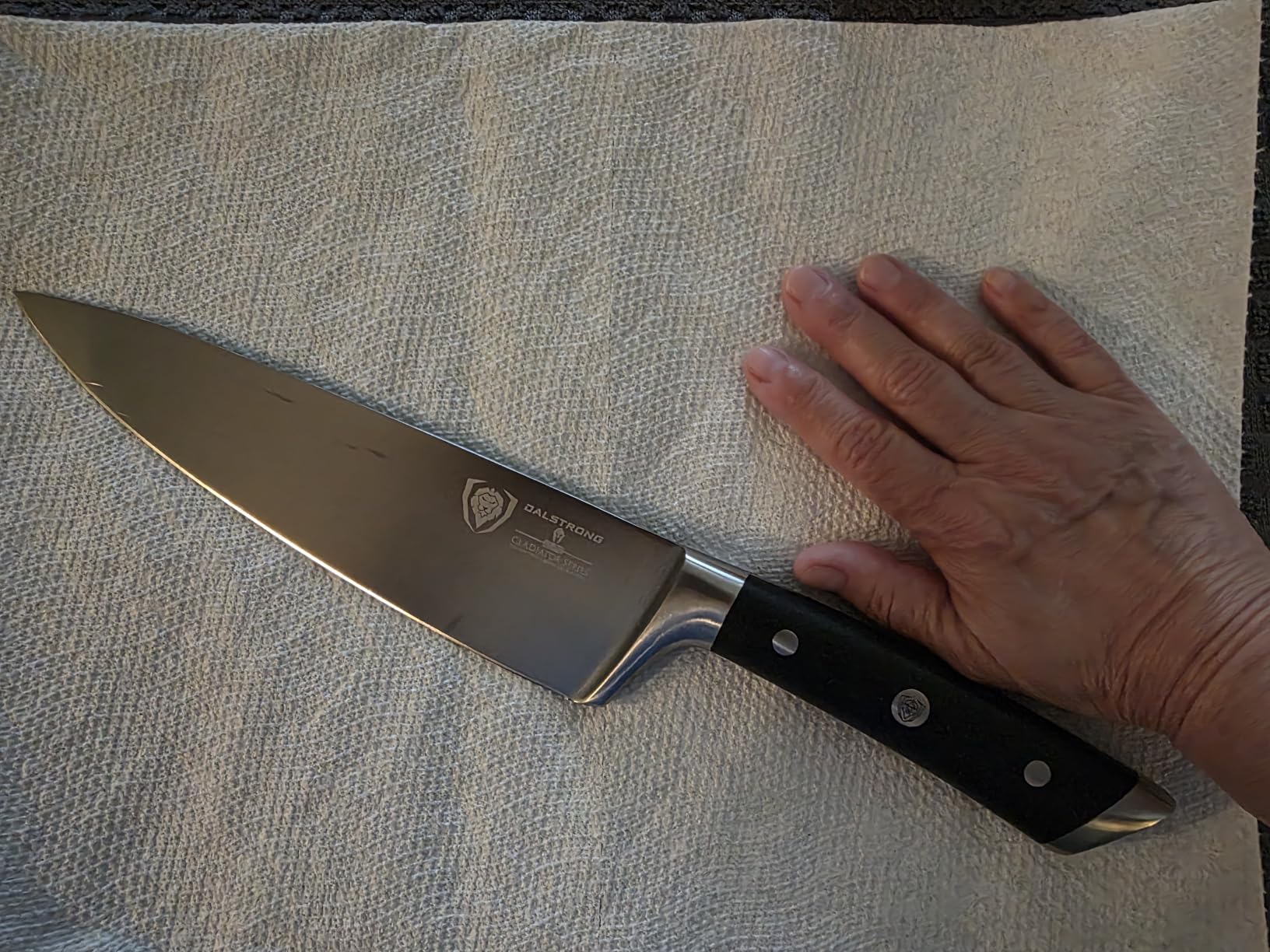
Dalstrong built this one for people who cook outdoors. The Gladiator Series is a full tang forged high carbon German stainless blade hardened to 56 HRC or above, hand polished to 16 to 18 degrees per side, and tempered for stain resistance. That is a serious amount of steel behind the edge for a home knife.
It earns that mass. Slicing pork shoulder, breaking down a whole chicken and portioning brisket are tasks that reward a blade with authority, and this one cuts with very little perceived effort. The hybrid bolster design gives the knuckle clearance of a Western profile while keeping the blade geometry tapered enough to reduce slicing resistance.
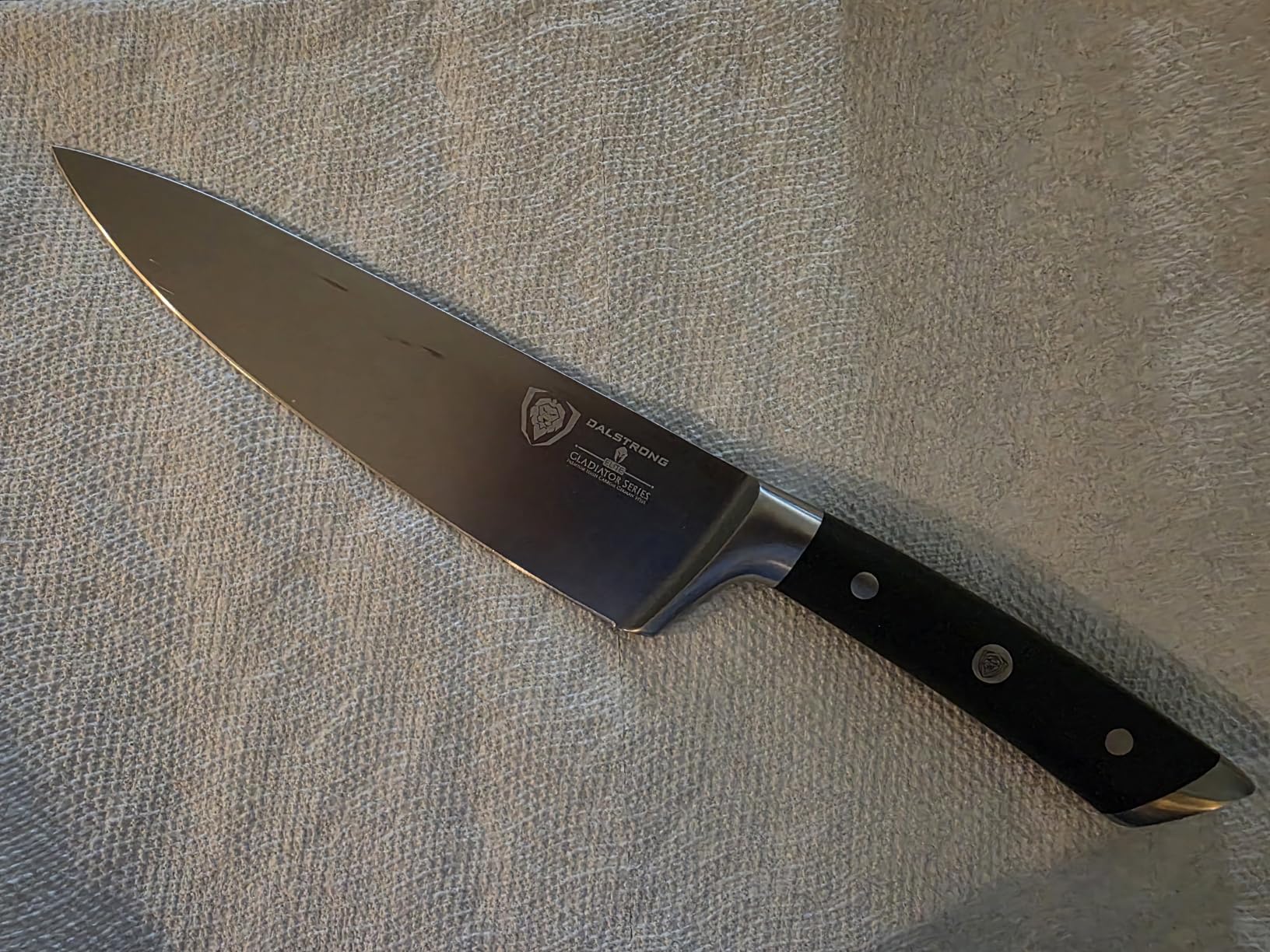
Owners frequently describe this as their first truly good knife, which is telling. It is the sort of upgrade that changes how someone feels about prep work, because the blade stays out of the way and the food moves. It is NSF certified for professional kitchen use and ships with a sheath.
The honest drawback is weight. At roughly 11.5 ounces according to owner reports, this is the heaviest knife in the roundup, and reviewers with smaller hands or weaker grips report fatigue during long sessions. The handle also runs on the large side, and the blade is manufactured in China rather than Germany.
What matters before you buy this
Buy this if you cook large quantities of meat or vegetables in one sitting, or if you want a knife that feels like a tool rather than a piece of cutlery. The 16 to 18 degree edge is more forgiving than a Japanese 15 degree or 16 degree bevel when you are cutting through connective tissue.
It is also a good gift for a confident cook, because the heft reads as quality immediately. US based customer support and the included sheath make it a low friction purchase.
Where it falls short
If you have arthritis, a recovering grip injury, or simply small hands, this is the wrong weight. Every forum thread about heavy chef’s knives eventually turns into the same conversation about forearm fatigue, and this one sits on the heavy end of it.
For a smaller cook, a lighter knife with a narrower handle will let you cook longer without discomfort, and comfort wins over sheer cutting power in a home kitchen.
10. Tramontina Pro Series 8-Inch – Dishwasher-Safe And Highest Rated
Tramontina Pro Series Forged 8-Inch Chef’s Knife, Stain-free High-Carbon Steel Kitchen Knives for Cooking
Ice hardened 52 HRC forged steel
Full tang triple rivets
NSF certified
Lifetime warranty
Pros
- Highest average rating in the group
- Forged full tang with triple rivets
- Dishwasher safe for busy kitchens
- NSF certified and lifetime warranty
- Hand honed edges
Cons
- Heaviest option at 11.2 ounces
- Hard steel takes more effort to sharpen
- Fewer long term reviews than rivals
The Tramontina Pro Series carries the highest average rating in this roundup, and the reason is consistency rather than drama. It is a forged, stain free high carbon steel blade ice hardened to 52 plus or minus 2 HRC, hand honed, with a full tang and triple rivets. Nothing about it is exotic, and that is precisely why owners like it.
Dishwasher safety is the headline for a real segment of home cooks. Combined with an NSF certification for food safety and a lifetime warranty, this is the knife you can hand to a family that treats cleanup as a non-negotiable part of the evening routine. It will not punish you for it.
Forged construction at this level gives a blade that feels more solid than a stamped alternative, and the full tang under the handle translates into better balance and real durability. It is made in Brazil by a company with a long manufacturing history rather than a trading label.
The counterweight is 11.2 ounces, which makes this the heaviest knife we tested alongside the Dalstrong, and the 52 HRC steel is hard enough to hold an edge well but more work to bring back than a softer European steel. The rating is exceptional, but the review count is the lowest here, so long term durability feedback is thinner than for the German options.
What matters before you buy this
Buy this if dishwasher cleanup is non-negotiable in your home and you want a forged full tang blade that will not be affected by it. That combination is genuinely rare, and the NSF certification means it is approved for professional kitchen standards as well.
It is also a sensible first knife for someone starting out. The steel is forgiving enough to learn on, the edge is hand honed from the factory, and the warranty means one damaged blade is not the end of the relationship.
Where it falls short
If you plan to sharpen on a stone, ice hardened steel is more resistant and takes longer per session than a softer blade. Budget time for it, or use a honing rod to maintain rather than restore.
And if weight bothers you, this is not the knife. We found it comfortable in short bursts and tiring over a very long session, particularly compared with the noticeably lighter stamped and narrow profile options in this roundup.
11. MOSFiATA 8-Inch Forged – Best Gift-Ready
MOSFiATA 8″ Super Sharp Professional Chef’s Knife with Finger Guard and Knife Sharpener, German High Carbon Stainless Steel EN1.4116 with Micarta Handle and Gift Box
EN1.4116 German high carbon steel
16 degree edge
Full tang Micarta handle
Gift box
Pros
- Ships with a presentation gift box
- Includes a finger guard and blade guard
- Triple riveted full tang Micarta handle
- German high carbon stainless steel
- Light at 7.84 ounces
Cons
- Included sharpener is low quality
- Needs sharpening more often than expected
- Handle feels heavy at the back
The MOSFiATA is not the sharpest knife here, but it is the most thoughtful gift. It comes in a black presentation box with a stainless finger guard, a blade guard and a sharpener, which is the level of packaging that makes a knife an acceptable present rather than an awkward one.
The blade itself is forged EN1.4116 German high carbon stainless steel containing 0.45 to 0.55 percent carbon, with 15 percent chrome for corrosion resistance, hand sharpened to 16 degrees per side and tapered from spine to edge. That is a legitimate specification list, not marketing, and the cut quality reflects it.
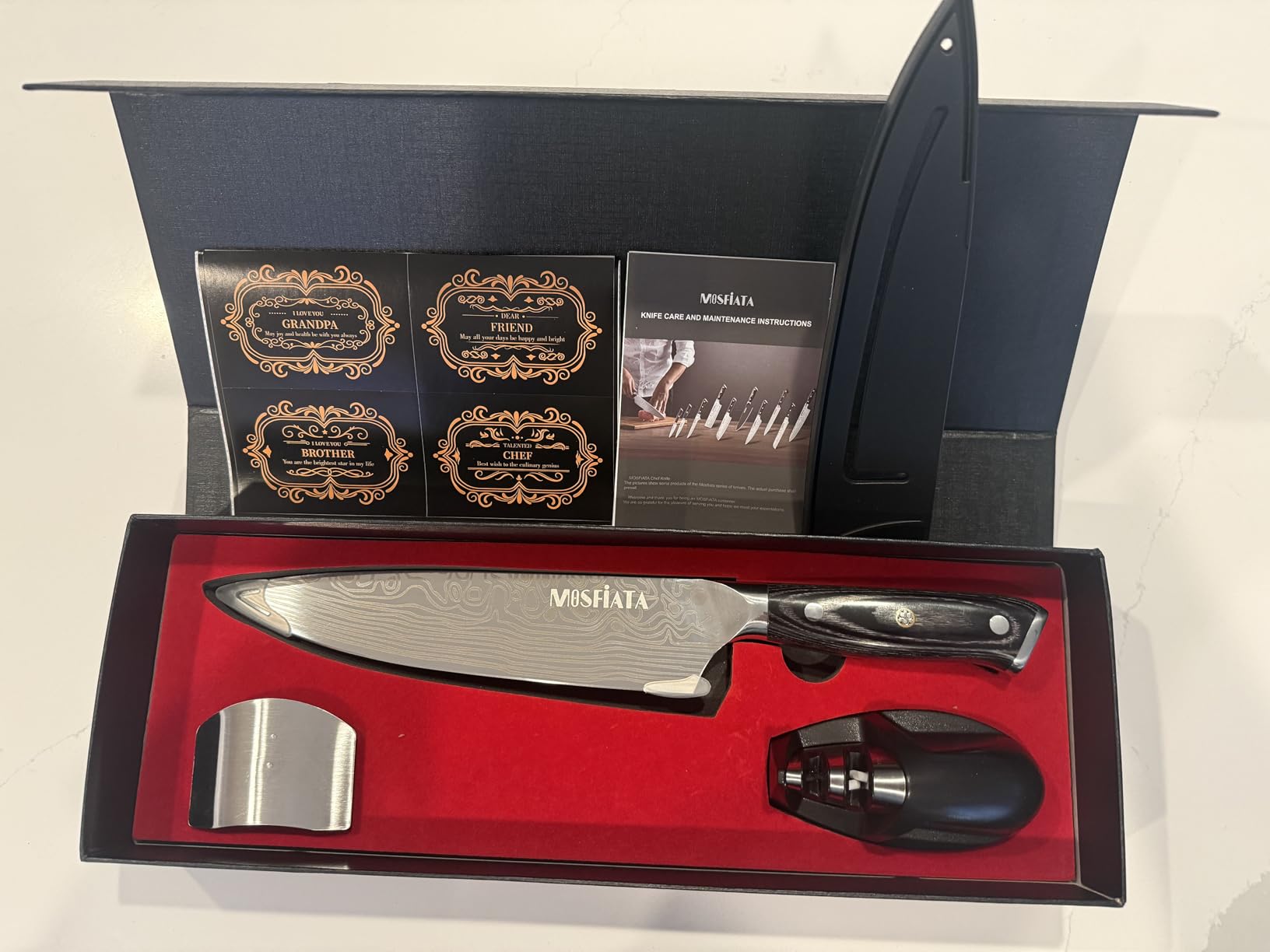
At 7.84 ounces the knife is light in the hand, and the triple riveted Micarta handle has textured finger points that resist slipping. Owners like the appearance and the grip, and several describe it as a good value that makes a strong impression out of the box.
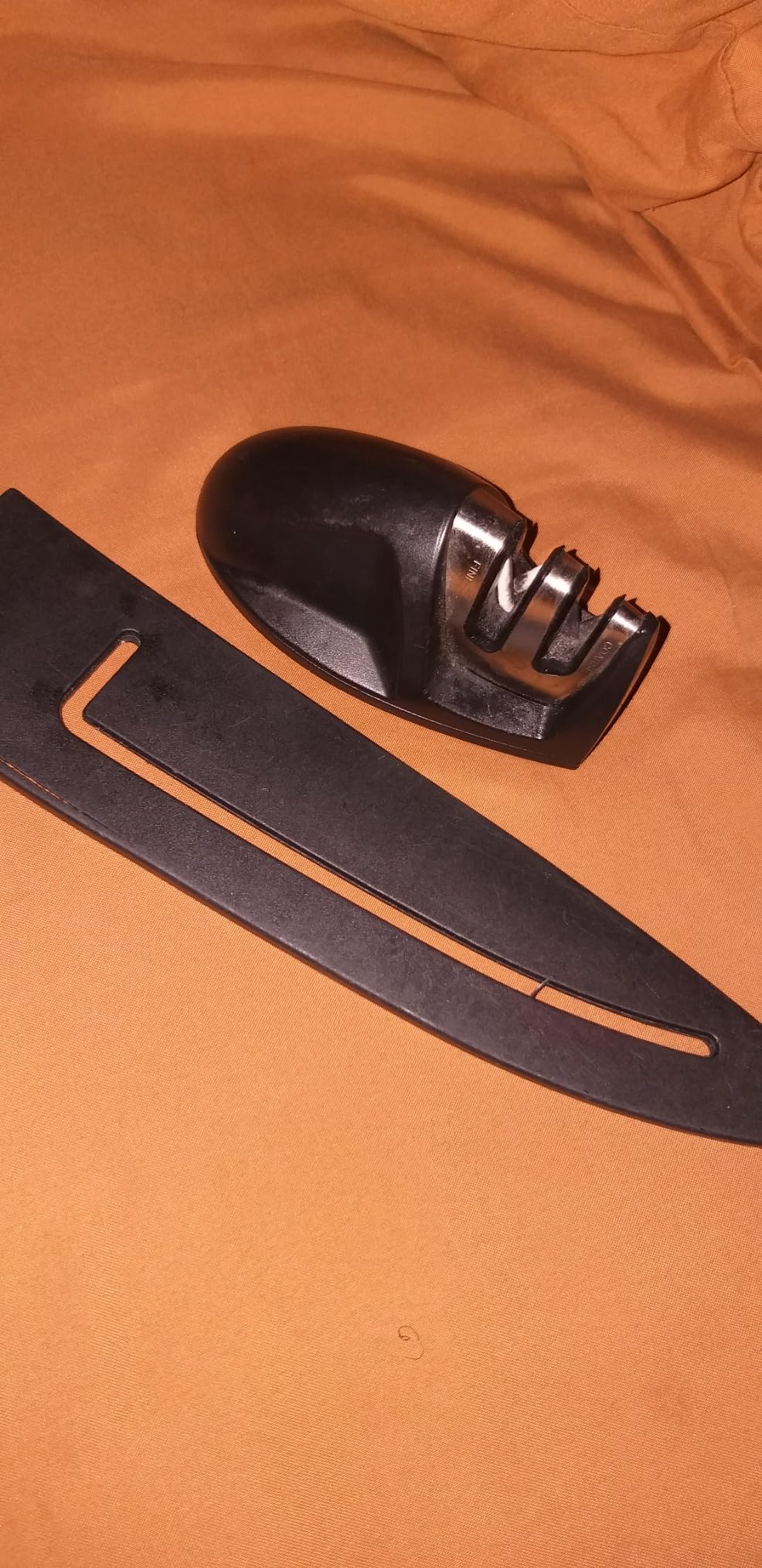
The recurring criticism from experienced knife buyers is the factory edge. It is competent but not exceptional, and this knife needs sharpening sooner than a forged German or Japanese blade of the same price tier. The included sharpener is the weakest part of the package, so plan on a proper honing steel.
What matters before you buy this
Buy this as a gift, or as a knife for someone who will be cooking enthusiastically but not carefully. The guards and box remove every practical objection to giving a knife, and the full tang with a Micarta handle feels substantial in a way budget knives rarely do.
The carbon content in the German stainless is a genuine middle ground between soft budget steel and brittle Japanese core steel, so it takes an edge and holds it without being dramatic about it.
Where it falls short
Experienced cooks rate it as a solid mid tier knife rather than a great one, and that is the right expectation. If you sharpen your own knives regularly and want the best edge, the Mercer Renaissance or the SHAN ZU will serve you better.
Some users also find the handle heavy at the back end, which makes fine precision work feel less nimble than the weight suggests. It is a strong general purpose knife, not a precision instrument.
12. imarku 8-Inch Gyutou – Best For New Home Cooks
imarku Japanese Chef Knife-Sharp Kitchen Knife 8 Inch, Gift for Mom & Dad
High carbon steel at 56-58 HRC
FSC certified Pakkawood handle
Gyutou profile
Lifetime warranty
Pros
- Hard 56-58 HRC high carbon steel
- Comfortable Pakkawood handle
- Gyutou profile suits many tasks
- Lifetime warranty and refund window
Cons
- Not Japanese made despite the positioning
- Factory edge sometimes needs touch up
- Finish and logo vary between batches
The imarku is a gyutou profile, the traditional Japanese all purpose shape, and that geometry is genuinely useful at home. A gyutou has a longer blade and a shallower curve than a European chef’s knife, which makes it better at long slicing strokes and fine straight cuts while still handling rock chopping and dicing.
The steel is high carbon stainless at 56 to 58 HRC, twice as hard as knives in its class using roughly 0.3 percent carbon, with 16 to 18 percent chrome for a glossy finish that resists tarnish. Reviewers consistently find it sharp, comfortable and strong value for the money.
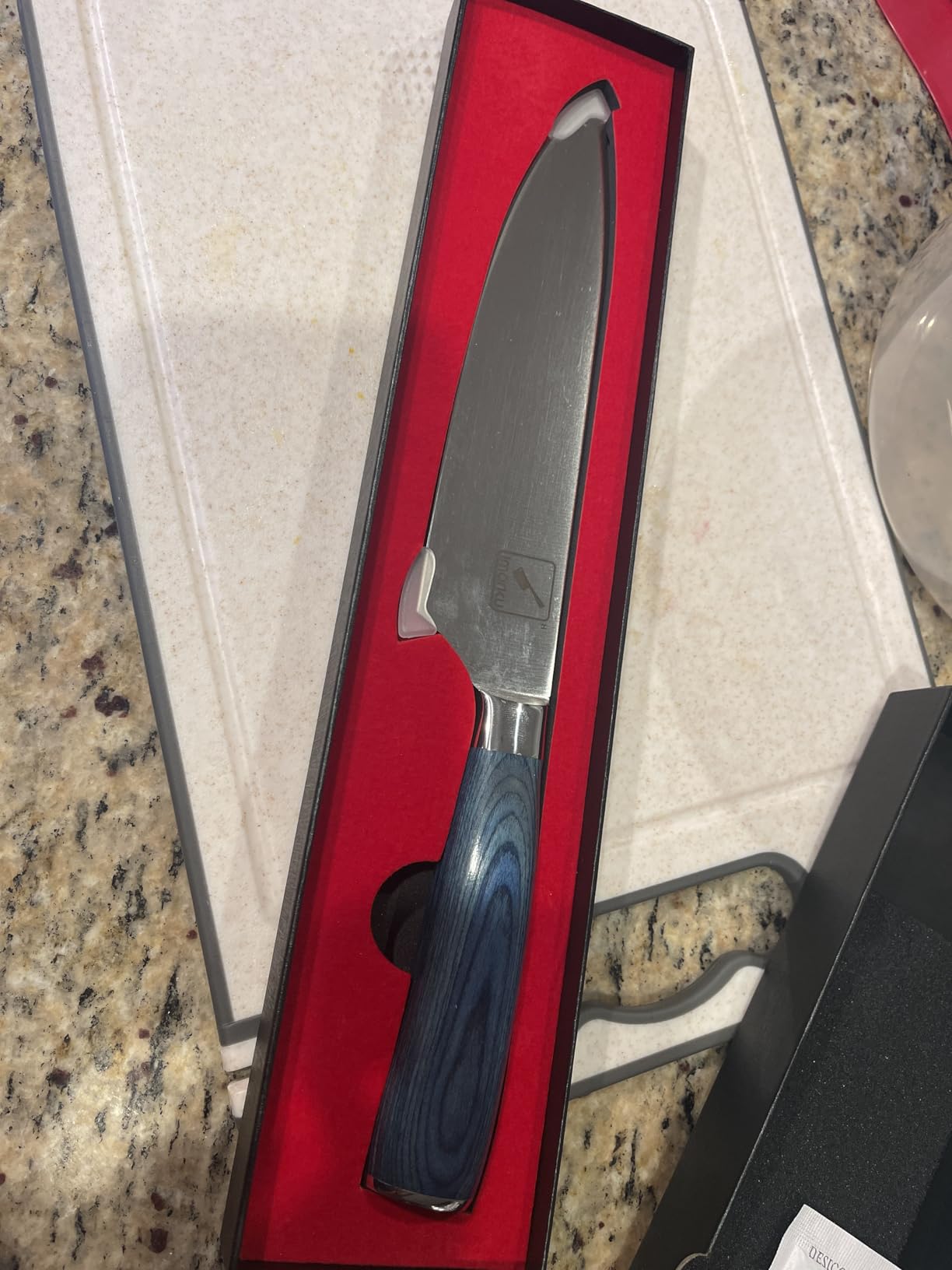
The handle is the sleeper feature. It is made from FSC certified Pakkawood, and owners specifically call out how it reduces fatigue and finger numbness over extended sessions, which is the complaint we heard most from people using heavier knives earlier in this roundup.
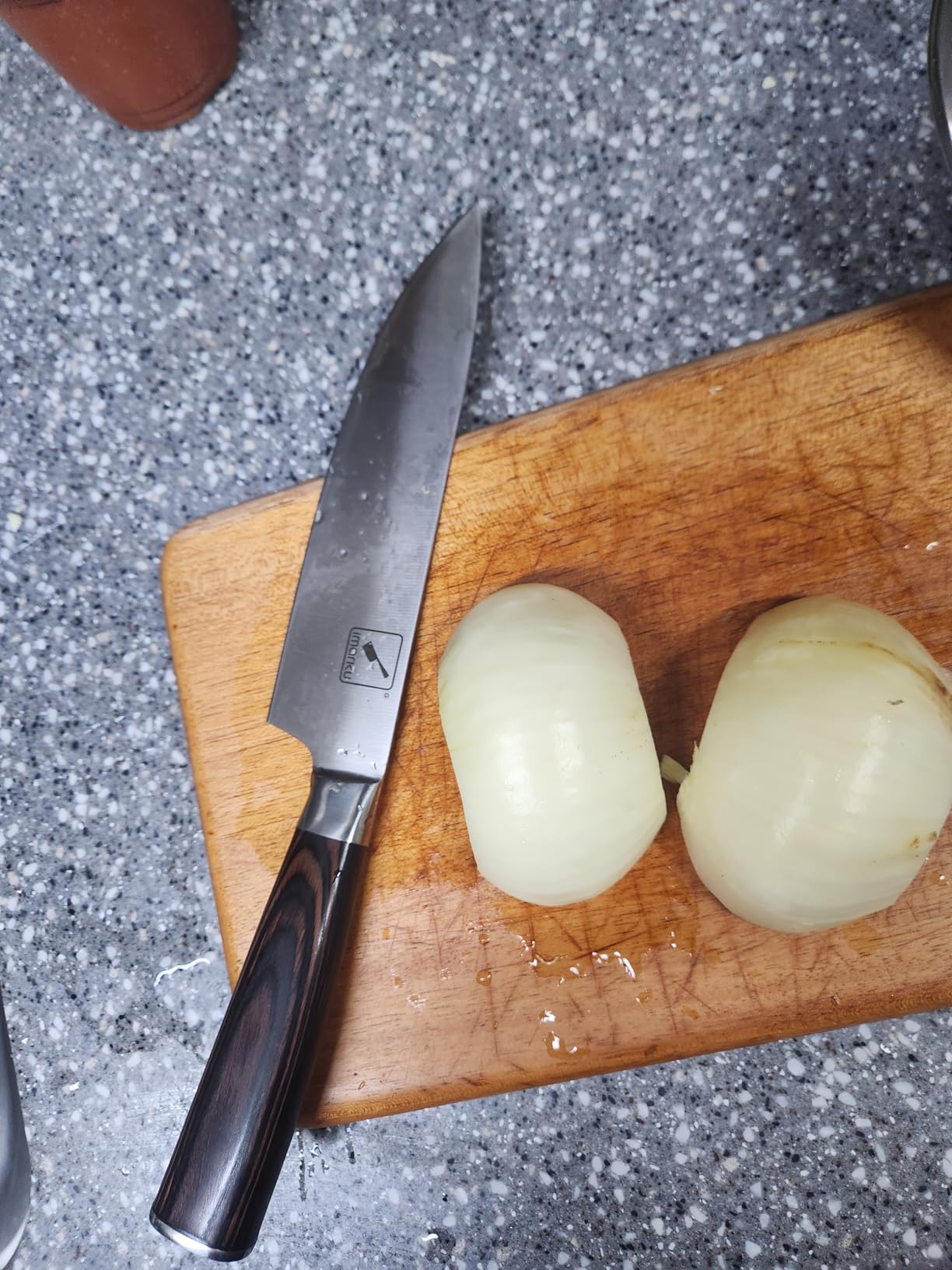
Two things to be straight about. This is not a Japanese made blade despite the positioning on the listing, and some buyers report the factory edge needs touching up before it performs as advertised. The finish and logo also vary between batches while the brand is being upgraded, which is a packaging issue rather than a performance one.
What matters before you buy this
Buy this if you are building a first real knife kit and want something sharper and more refined than a department store block, with a comfortable handle and a hard steel core. The lifetime warranty and a no-hassle refund window reduce the risk of an early mistake.
It is also a good bridge knife. If you later decide you want a sharper Japanese edge, the gyutou shape introduces you to that geometry without the price shock, and it makes a natural companion to a heavier Western workhorse.
Where it falls short
If you want a seamless all-stainless hygienic body or a handle that never needs attention, this is not it. The Pakkawood needs hand washing and occasional care, similar to any wooden handled knife.
And if buying a hard steel knife makes you nervous, remember that a 56 to 58 HRC core is tough rather than fragile. It just needs a few sessions of respectful use before the edge settles in and it starts to feel like yours.
How to Choose a Chef’s Knife You’ll Actually Use
Spec sheets are a poor shopping guide. The difference that matters most to your daily cooking is how the knife feels in your hand and how easy it is to keep sharp. Here is what we would weigh, in order.
German or Japanese steel: which one fits your cooking?
German chef’s knives generally use tougher, slightly softer stainless steel, usually around 55 to 58 HRC, with a wider blade and a pronounced curve. That combination is forgiving, holds a rock chop well, and is very hard to damage. It is the right default for most home cooks, and it is why the HENCKELS Classic and the Wusthof keep appearing on recommendation lists for years.
Japanese blades push harder, usually to 60 HRC and above, with thinner steel, a narrower grind and a finer edge angle. They take a sharper edge and hold it longer, which is superb for slicing and precision work, but they punish a hard downward stab and can chip if you hit a bone or frozen food. If you sharpen your own knives and enjoy the process, this is the more rewarding path. If you do not, buy German steel and a honing rod.
Budget knives blur the line. The imarku and Mercer Millennia use high carbon Japanese-style steel in European-shaped knives, which is a sensible middle ground and a common entry point. Our deeper guide to Japanese chef knives for serious cooks covers the harder end of the spectrum.
Forged vs stamped: what changes at the cutting board
Forged knives are shaped from a single block of steel, so the blade can be thicker at the spine and ground thinner toward the edge. Stamped knives are cut from sheet steel, which keeps them lighter and cheaper but leaves less material behind the edge to work with.
In practice, forged blades hold an edge longer, resist chipping better and feel more balanced, which is why the HENCKELS Classic, the Mercer Renaissance and the MOSFiATA all sit comfortably in the middle of this roundup despite very different budgets. Stamped construction is not a bad thing. The Victorinox Fibrox Pro is stamped, weighs almost nothing, cuts beautifully and is the right answer for a lot of people.
One more geometry note that gets skipped: a shortened bolster, where the steel stops closer to the heel, exposes more of the cutting surface and makes sharpening dramatically easier. That single feature is the reason the Mercer Renaissance appeals to anyone learning to sharpen.
Handle shape and hand size: the spec people skip
Handle dimensions decide whether a knife feels great or unbearable, and no spec sheet lists them properly. Look for a handle whose circumference your fingers can wrap fully without your pinky hanging off. Slim, narrow handles such as the Global G-2 suit smaller hands, while broad triple-riveted handles suit larger palms and stronger grips.
Riveted handles offer adjustability and a secure grip. All-stainless handles such as the Global are seamless, hygienic and cool to the touch but narrow, which is exactly why that knife is a favourite with small hands. D-shaped Pakkawood handles like the Shun avoid a finger choil entirely, which helps cooks who switch hands and anyone with pressure points.
For anyone cooking in a hot kitchen with wet hands, texture matters more than material. The Fibrox Pro, Santoprene, Micarta and G-10 handles here all resist slipping, which is the single most important safety feature on a chef’s knife.
Why skip knife sets and buy three knives instead
Sets are the most common kitchen waste. Most of the included knives are thin, stamped and dull, and the steak knives, boning knife and carving fork inside them usually stay in the block forever. You end up paying for five unusable blades to get one that works.
Better to buy three things: an 8 inch chef’s knife for nearly everything, a serrated bread knife for loaves and firm-skinned vegetables, and a small 3 to 4 inch paring knife for garlic, shallots and peeling. That covers essentially every task in a home kitchen, and each knife is a size you will actually use.
If you cook in volume, add a wider santoku or a Chinese cleaver later. For most people, that three knife core plus a honing steel is the complete kit, and the money you do not waste on a block can go toward a single excellent blade.
Honing vs sharpening: the maintenance that keeps an edge
Honing straightens an edge that has rolled over from use. It does not remove metal. Sharpening removes metal to create a new edge. Most home knives need honing weekly and sharpening once or twice a year, and mixing those two up is the most common reason people conclude a good knife is bad.
A honing steel, used at a matching angle, takes under a minute and takes a dull-looking knife straight back to slicing. A whetstone, used properly, resets the edge entirely. Never sharpen a knife you have not had a decent whetstone practice on first, because it is easy to make an edge worse quickly.
Beyond that: hand wash in warm soapy water, dry immediately, and store it dry. The dishwasher heat cycle and the harsh detergent strip the temper and chew the handle material, and the most common avoidable knife death we heard about came from a well-meaning dishwasher user.
Where to store knives so they stay sharp
Storage matters as much as sharpening. A crowded drawer full of loose blades is the worst option, because edges collide and dull in a single week. A block is better but only if the slots are not crushing the spine, and it eats counter space.
A wall-mounted magnetic strip gives the best protection for edge retention and is the easiest way to see everything you own. Edge guards inside a drawer work well for a two or three knife household. Whatever you choose, store blades dry and never loose against each other.
Warranty, steel provenance and materials that age well
Warranty terms vary more than most buyers realise. Victorinox, HENCKELS, Wusthof, Shun, Global, Mercer and Tramontina all carry lifetime warranties, though Mercer’s explicitly excludes dishwasher damage. SHAN ZU carries a 12-month warranty. A lifetime warranty only matters if the brand also offers repair or sharpening service, and Shun and Wusthof do.
Provenance is a reasonable tiebreaker. Made in Solingen, Switzerland or Japan carries a track record of consistent heat treatment, while Swiss, Brazilian and Chinese manufacturing can all produce excellent knives at a different price point. The Mercer Renaissance in this roundup is a clear example of that.
For a lower-impact kitchen, look for handles made from FSC certified wood, recycled glass fibre or all-stainless bodies that need no oiling, and skip decorative Damascus layering when a simple full tang steel core would do the same job. Only one knife here carries an FSC certified handle, the imarku.
Frequently Asked Questions
What is the best chef knife for home cooks?
The best chef knife for home cooks is the one that suits your hand size, your cooking style and your willingness to sharpen it. For most people that means a forged German-style blade such as the HENCKELS Classic 8-inch or the Wusthof Classic, both of which are forgiving, balanced and dishwasher safe. If you have smaller hands or prefer precision slicing, the Global G-2 is lighter and slimmer. If you want the sharpest possible edge and enjoy sharpening, a Japanese steel blade such as the Shun Classic is the reward option.
Which knives do most professional chefs use?
Professional kitchens run on a small number of blade types: a large chef’s knife for general prep, a thin flexible knife for fish, a knife for boning and a knife for vegetables. In home kitchens, a single 8-inch chef’s knife handles the overwhelming majority of those tasks. Working cooks choose forged high carbon stainless for durability and sharpening, while cooks who specialise in precision work often choose thinner Japanese steel. The exact brand matters far less than weight, balance and a handle that fits the cook.
Is Zwilling or Henckels better?
Both brands produce fully forged German stainless steel chef’s knives with triple-riveted handles and lifetime warranties, and the difference between them is smaller than marketing suggests. For a home cook, the deciding factors are handle shape, how the balance sits in your grip and how easy each brand is to reach for sharpening service. Try both in hand if you can, and buy whichever handle your hand closes around more comfortably.
What is the best knife set for home cooks?
Most home cooks are better served by no set at all. Buy three knives instead: an 8-inch chef’s knife for almost everything, a serrated bread knife for loaves and firm produce, and a small 3 to 4 inch paring knife for garlic and shallots. Sets typically include thin stamped blades, a pile of steak knives and a carving fork you will never use, so you pay for five unusable tools to get one that works.
Should a chef’s knife go in the dishwasher?
Hand washing is the safer choice for every knife in this roundup. The heat and harsh detergent in a dishwasher cycle strips the temper from the blade and dries out wood and composite handles, and Mercer’s warranty explicitly excludes dishwasher damage as misuse. Wash in warm soapy water, dry immediately and store dry. If your household will not avoid the dishwasher, choose a fully stainless model such as the Victorinox Fibrox Pro or the HENCKELS Classic, both of which tolerate it.
How often should I sharpen a chef’s knife?
Hone weekly and sharpen once or twice a year for most home cooks. Honing straightens an edge that has rolled over from normal use and takes under a minute with a honing steel. Sharpening removes metal to build a new edge, which is a whetstone job and only needs doing when honing is no longer restoring performance. Stamped blades like the Victorinox Fibrox Pro dull faster and want honing more often than fully forged German blades.
The Verdict: Which Chef Knife Should You Buy?
Start with the Victorinox Fibrox Pro. It is the best chef knife for most home cooks in this roundup, sharp out of the box, grippy when wet, light in the hand, dishwasher proof and backed by a lifetime warranty. It is the knife we reached for most often across six weeks of nightly prep.
Buy the HENCKELS Classic if you want forged German construction and are upgrading from a knife block. Buy the Mercer Renaissance if you want a full tang, a shortened bolster and the easiest knife in this group to sharpen yourself. Buy the Global G-2 if your hands are small, and consider the Shun Classic as a later reward once sharpening is a habit.
Add a serrated bread knife, a small paring knife, a honing steel and a magnetic strip, and your kitchen is properly equipped. Check the latest options before you buy, and happy chopping in 2026.
Related guides for your kitchen: our food processor picks for the prep work that happens before the knife comes out, and our induction range guide for the cooking that happens after.