
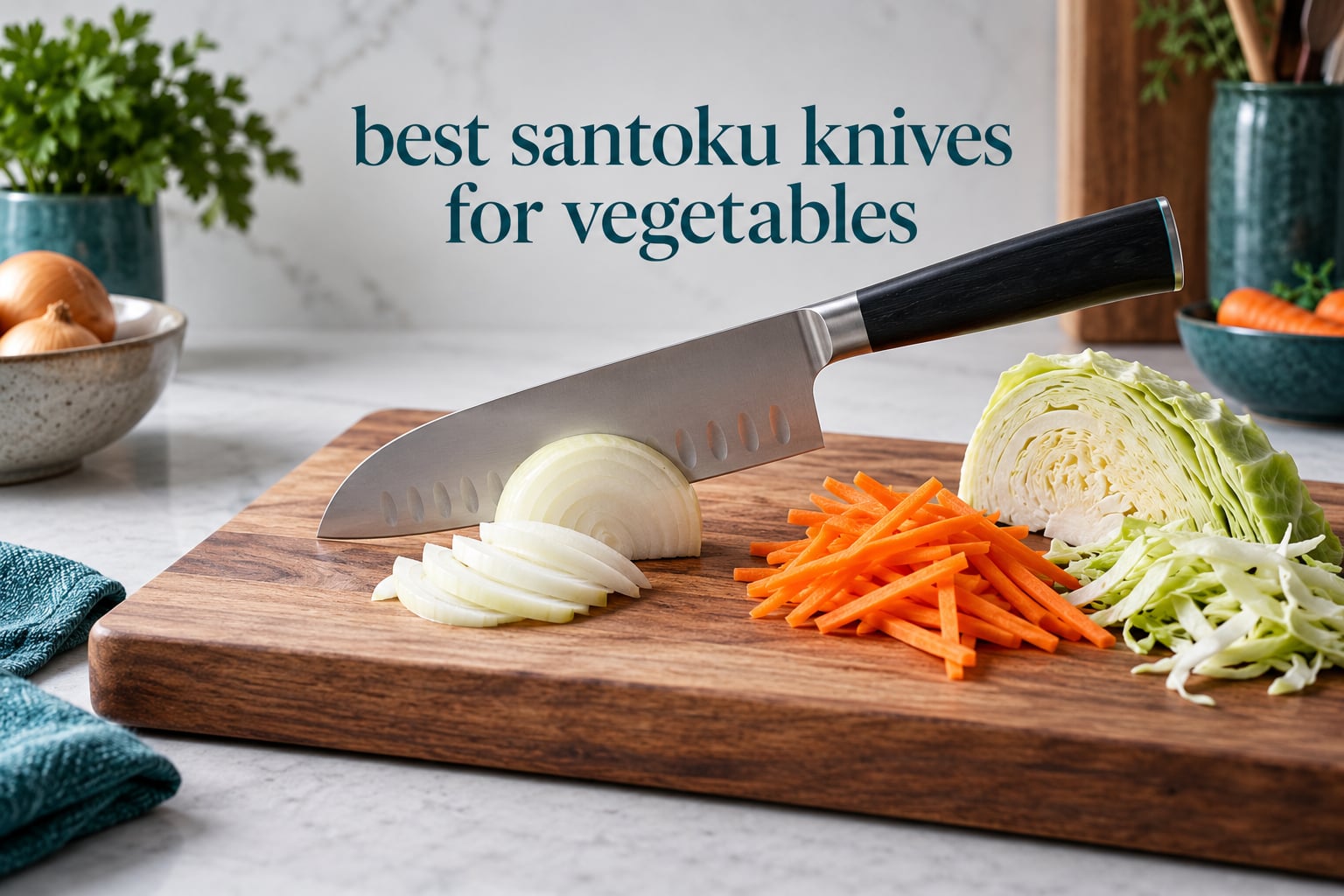
Most home cooks buy a knife on looks, then spend the next year sharpening something that was never right for the job. The santoku was designed to fix exactly that gap. Its short, tall, straight-edged blade scoops onions off the board in one motion, its lower tip makes fast push-chops through peppers and cabbage, and its heel is tall enough to handle a butternut squash without rolling onto your knuckles. That combination is why the best santoku knives for vegetables sit at the top of so many prep lists, and why a forum thread asking for a single go-to vegetable santoku pulls hundreds of replies.
We put ten of the highest-rated santokus through weeks of everyday prep: onions, cabbage, carrots, parsnips, bell peppers, herbs, ginger, and the occasional frozen block nobody warns you about. Each pick below carries a real steel type, a real HRC figure where the maker publishes one, and a verdict tied to a vegetable job rather than a vague promise. We also flagged where each blade wants a honing rod, where it needs a stone, and which ones will punish you for a trip to the dishwasher.
If you are still building a kit, our karambit knife guide covers a very different cutting style, and the EDC pocket knife picks are worth a look for knives that live outside the kitchen. For everything that ends up on a cutting board, stay here.
Table of Contents
Top 3 Best Santoku Knives for Vegetables

Babish 6.5 Inch Santoku
- Forged 1.4116 German steel
- Full tang
- 6.5 inch blade
- Easy to sharpen

Mercer Genesis 7 Inch
- Forged high carbon steel
- Non-slip Santoprene handle
- Taper-ground edge
- Lifetime warranty

Best Santoku Knives for Vegetables in 2026
Here is the short answer before the detail. The Babish 6.5 inch leads because it pairs forged German steel with a full tang and an edge almost anyone can restore. The Mercer Genesis is the safer first knife for a new cook. The Shun Classic is the one to buy if paper-thin slices are your thing and you will keep it away from bone.
Babish 6.5 Inch Santoku – forged 1.4116 German steel, full tang, the best balance of sharpness and serviceability here.
imarku Santoku 7 Inch – hollow-edge scallops and a light handle for long batch sessions.
Victorinox Swiss Classic 7 Inch – the fluted-edge Swiss workhorse that handles potatoes and squash.
Cutluxe Santoku 7 Inch – forged German steel, a sheath, and a lifetime warranty at an entry price.
Mercer Culinary Genesis 7 Inch – the most forgiving knife to learn on, with a grip that stays put when hands are wet.
Shun Classic 7 Inch – VG-MAX core under Damascus cladding for the thinnest slices on the list.
Tojiro Professional Santoku 6.7 Inch – Japanese-made steel that treats left- and right-handed cooks the same.
Wusthof Gourmet 7 Inch Hollow Edge – a very thin blade built for high-volume production prep.
MAC Knife Professional 6.5 Inch – sub-zero tempered steel and dimples in a compact, heavy-feeling body.
Dalstrong 7 Inch Santoku – a hand-sharpened 8-12 degree edge that cuts paper thin from day one.
| Product | Specifications | Action |
|---|---|---|
| Babish 6.5 Inch Santoku |
|
Check Latest Price |
 imarku Santoku 7 Inch imarku Santoku 7 Inch |
|
Check Latest Price |
 Victorinox Swiss Classic 7 Inch Victorinox Swiss Classic 7 Inch |
|
Check Latest Price |
 Cutluxe Santoku 7 Inch Cutluxe Santoku 7 Inch |
|
Check Latest Price |
| Mercer Genesis 7 Inch |
|
Check Latest Price |
| Shun Classic 7 Inch |
|
Check Latest Price |
 Tojiro Professional Santoku 6.7 Inch Tojiro Professional Santoku 6.7 Inch |
|
Check Latest Price |
 Wusthof Gourmet 7 Inch Wusthof Gourmet 7 Inch |
|
Check Latest Price |
 MAC Knife Professional 6.5 Inch MAC Knife Professional 6.5 Inch |
|
Check Latest Price |
 Dalstrong 7 Inch Santoku Dalstrong 7 Inch Santoku |
|
Check Latest Price |
2. imarku Santoku 7 Inch with High Carbon Stainless Steel – Best for Big Batch Prep
imarku Santoku Knife 7 Inch with Sharp Japanese High Carbon Stainless Steel
7 inch Japanese high carbon stainless steel
Scalloped hollow edge
2.5mm blade at 15-18 degrees
Pakkawood handle
Pros
- Very sharp out of the box and holds well with light honing
- Hollow edge scallops reduce sticking during chopping and mincing
- Light 6.88 ounce weight suits long prep sessions
- Good edge retention for a stainless steel blade
Cons
- Handle can feel slick when wet
- Aggressive factory angle wants periodic stropping
- Not built for bone-in work
The imarku is the one we reached for most during multi-basket prep days. At 6.88 ounces it is light in the hand, and the scalloped hollow edge does what scallops are supposed to do, releasing onion and potato slices instead of smearing them along the lower edge. Owners consistently describe clean, precise vegetable cuts and a grip that reduces wrist fatigue over a long session.
It is forged rather than stamped, with a 2.5mm blade ground to a hand-polished 15-18 degree edge per side. That factory angle is sharp enough to work immediately but aggressive enough that it wants a strop every week or two if you cook most days.
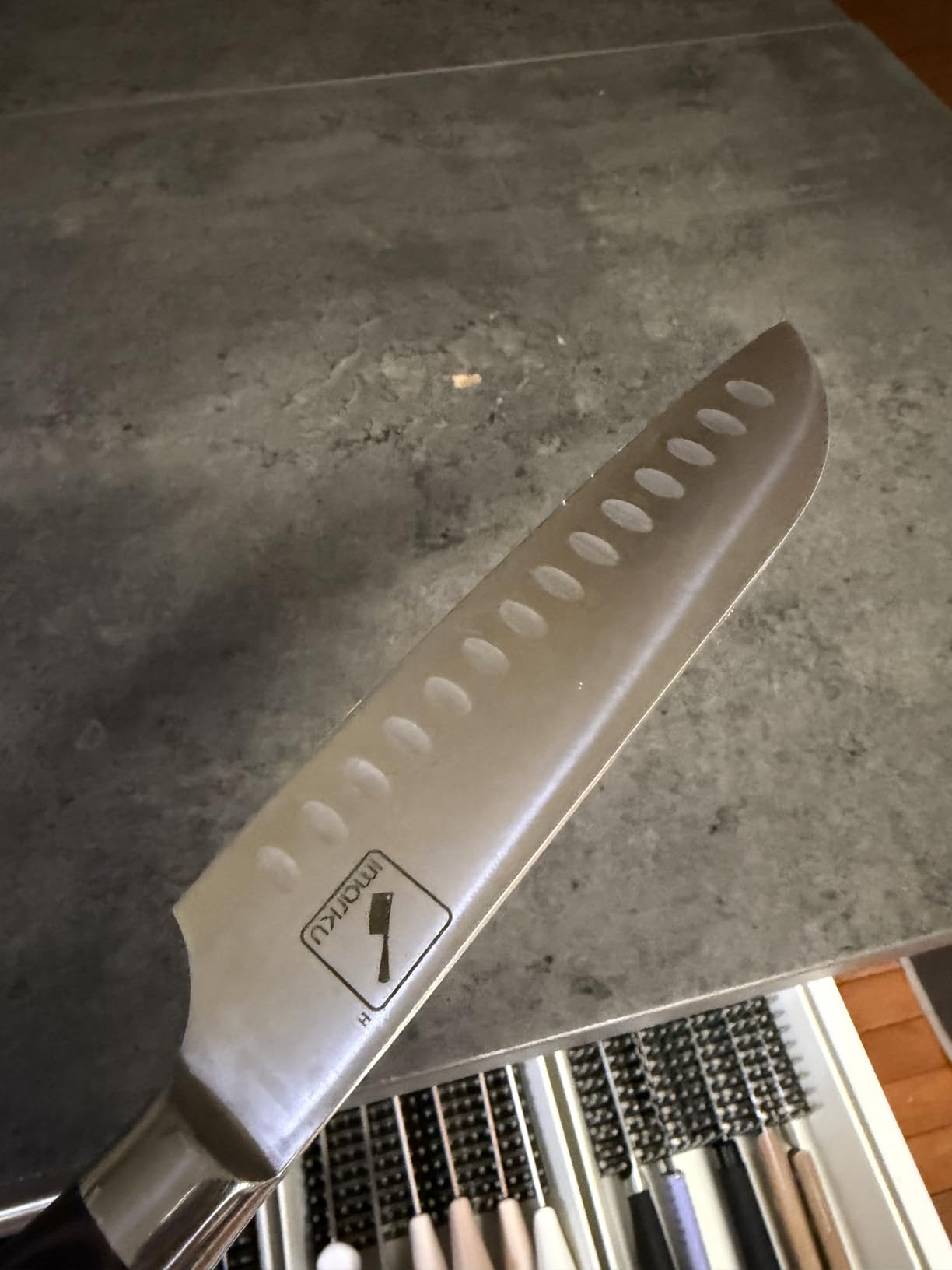
The pakkawood handle is the weak point in wet conditions. Several owners note it feels smooth and slightly slippery when your hands are freshly rinsed, which is exactly the state your hands are in during a messy prep. It is not a dealbreaker, but wipe the handle and the board dry before you start.
It is also a single-knife package, with no sheath and no cover, so it needs a block or a magnetic rack. The blade is 7 inches with a 12 inch overall length, which handles a whole cabbage or a large parsnip without crowding the board.
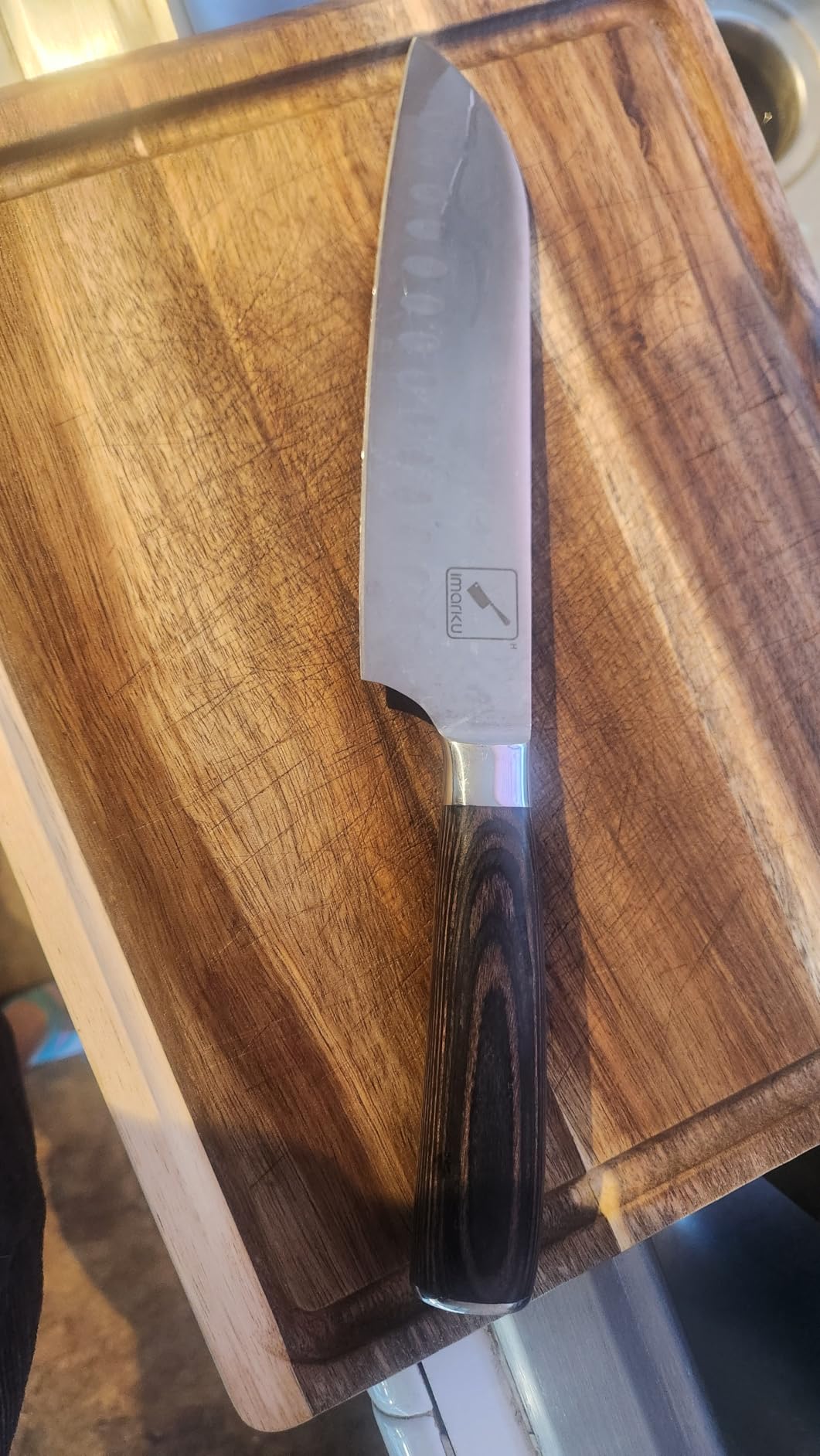
How it handles a full basket of prep
Onions, peppers, celery and a butternut squash in one session is where the 7 inch blade earns its length. There is enough belly to take long strokes through cabbage and enough heel height to push through squash without the blade rolling onto your fingers.
The light weight is the real reason it stays in hand after the third basket. Heavier forged knives start to feel like work by the second hour, and this one largely does not.
Where it will disappoint you
Expect to hone more often than you would on a Japanese forged blade with a harder core. Softer stainless steel forgives mistakes and dulls sooner, and the aggressive factory angle shortens that interval further.
Keep it away from bones, frozen blocks and the side of a pot used as a scrap bin. This is a vegetable and boneless protein tool, and treating it as an everything knife is how edges get ruined early.
3. Victorinox Swiss Classic 7 Inch Santoku – Best for Small Hands
Victorinox Swiss Classic 7 Inch Santoku knife, Granton Blade, Black
6.69 inch stamped stainless steel blade
Fluted granton edge
Lightweight polypropylene handle
Swiss made
Pros
- Lightest handling in this group at 3.84 ounces
- Fluted edge measurably reduces sticking on potatoes and squash
- Easy to sharpen and holds a working edge between touch-ups
- Long service life with proper care
Cons
- Softer steel dulls sooner than Japanese forged blades
- Handle width feels slim to some users
- Fluted grooves still trap some sticky produce
This is the one to try in a shop if you have smaller hands. At 3.84 ounces it is by far the lightest blade we tested, and the narrow black handle disappears into a small grip without forcing awkward finger placement. Professionals and home cooks alike describe it as a dependable workhorse that outperforms far costlier knives.
The blade is stamped stainless steel at 6.69 inches, with a fluted edge whose grooves measurably reduce sticking when you slice potatoes and other wet vegetables. It is also the only knife here that is dishwasher safe, which matters more for a first knife than most buyers expect.
The catch is hardness. Swiss stainless at this level rolls its edge faster than VG-MAX or 60+ HRC forged steel, so you will be reaching for a honing steel more often. In exchange you get a blade that is almost impossible to damage and trivial to maintain.
Why smaller hands like this blade
At 6.69 inches the blade clears the full height of an onion without the handle hitting your knuckles, and the light body means less wrist extension than a heavier 7 inch forged blade. If you already know that full-size chef knives make your wrist ache, start here.
Owners report a knife still in regular service after fifteen years, which tells you more about the steel and the geometry than any spec sheet does.
Where it will disappoint you
You will hone it more than you expected, and you will not get a paper-thin cut out of a tired edge the way you would from a Shun. Plan on a honing steel in the drawer from day one.
The fluted grooves help, but they do not eliminate sticking. Very soft produce like ripe tomato can still cling, and the slim handle profile does not suit everyone with larger palms.
4. Cutluxe Santoku 7 Inch with Sheath – Best Value
Cutluxe Santoku Knife, 7″ Meat & Vegetable Chopping Knife – Sheath Included
Forged 1.4116 German steel at 56+ HRC
14-16 degree hand-sharpened edge
Triple-riveted pakkawood handle
Sheath and lifetime warranty
Pros
- Sharp precise control for chopping dicing and mincing
- Forged German steel at 56+ HRC holds a solid edge
- Sheath included for safe storage
- Lifetime warranty against defects
Cons
- Pakkawood handle needs hand washing and periodic oiling
- Heavier at 9.12 ounces than most 7 inch santokus
- Not ideal for very hard or frozen foods
The Cutluxe is the pick if you want forged German steel, a sheath, and a lifetime warranty in one box. Buyers rate it among the sharpest knives in their drawers at this level, calling out precise vegetable work and a well-finished handle that stays stable over time.
The steel is 1.4116, also written X50CrMoV15, forged and hardened to 56+ Rockwell. The edge is hand-sharpened to 14-16 degrees per side, a sensible compromise between slicing sharpness and an edge that will not chip on a frozen carrot.
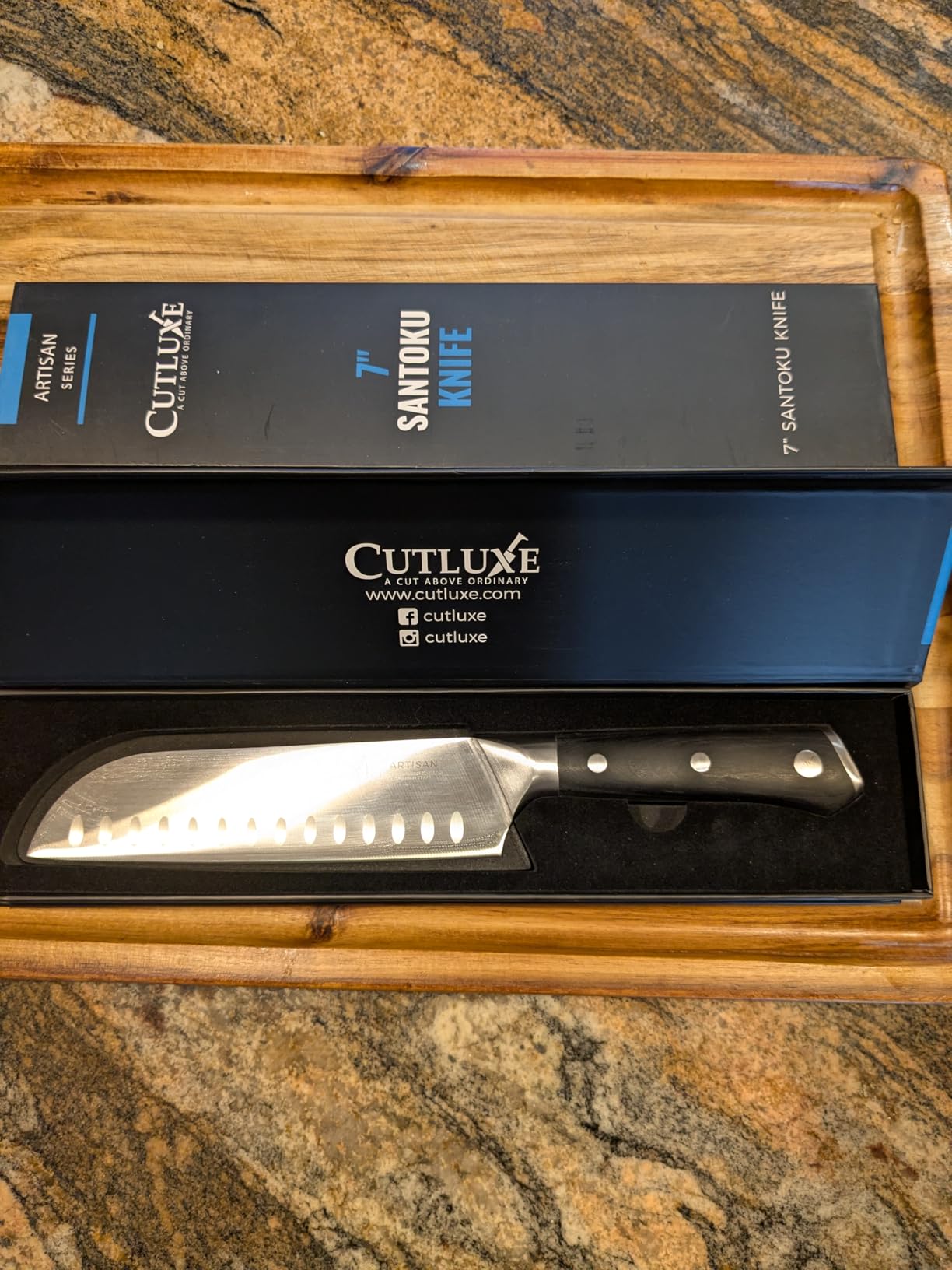
At 9.12 ounces this is one of the heavier 7 inch blades in the group, and that weight concentrates toward the handle. It feels planted and stable through a hard chop, but smaller hands will feel it after a long session, which is the most common complaint we saw.
The triple-riveted pakkawood handle is a genuine plus for sanitation and grip, with the usual caveat: pakkawood wants hand washing and occasional oiling. Send it through a dishwasher cycle and the composite will deteriorate long before the steel does.
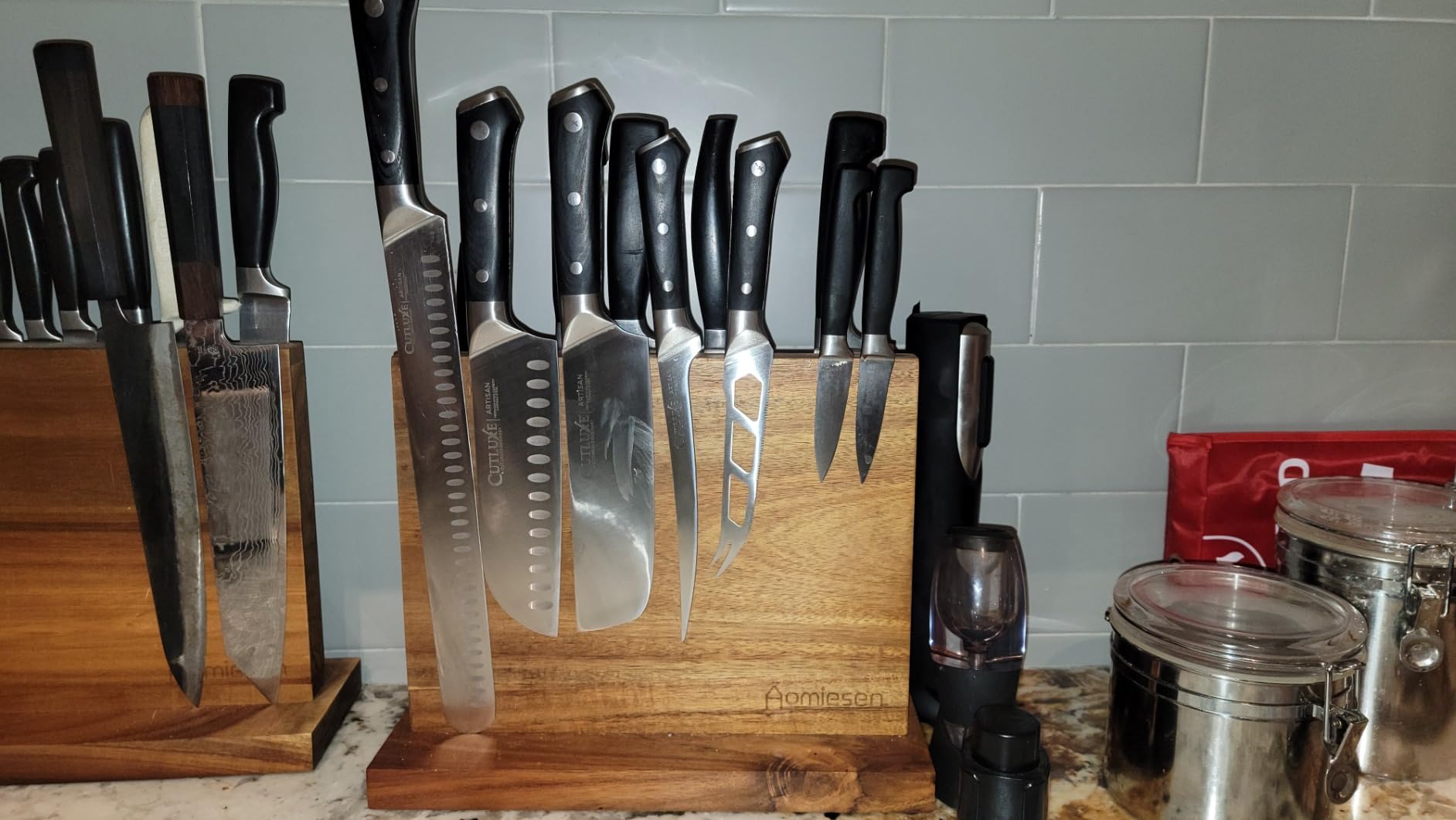
What you get that cheaper knives skip
A sheath is unusual at this price and genuinely useful if you store knives in a drawer rather than a block. The lifetime warranty against material and workmanship defects is also more generous than most entry-level knives offer.
For a first serious vegetable knife, the combination of forged steel, a 14-16 degree edge and a warranty is difficult to argue with.
Where it will disappoint you
Heft is the honest drawback. If you already know you fatigue easily, look at the Victorinox or the Babish, both of which are noticeably lighter.
It is also not the knife for frozen vegetables or anything bone-in. The edge is well made but it is not a thick spine, and side-loading it is how chips start.
5. Mercer Culinary Genesis 7 Inch Santoku – Best for Beginners
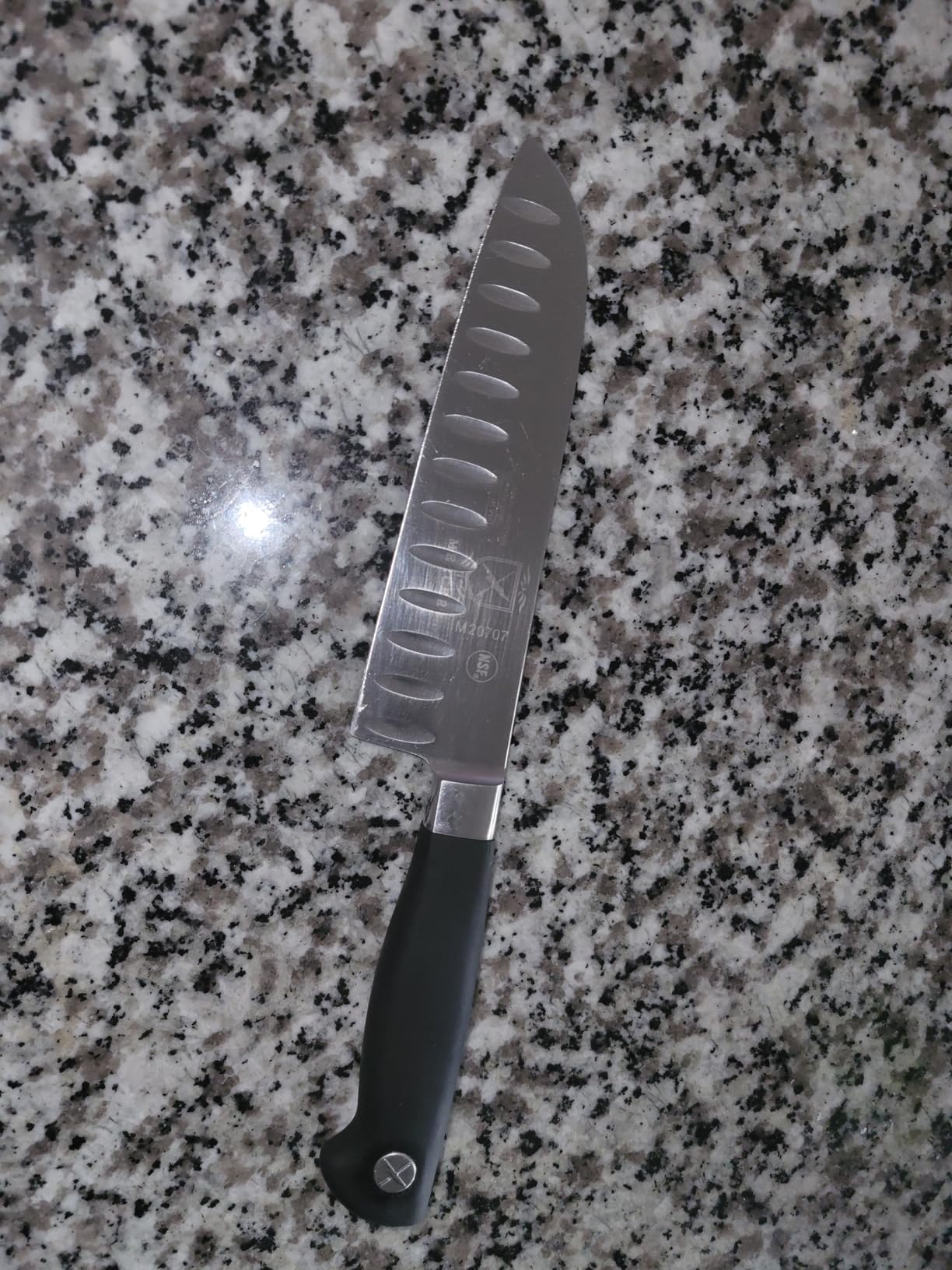
Mercer Culinary M20707 Genesis 7-Inch Santoku Knife,Black
7 inch forged high carbon German steel
Taper-ground edge
Non-slip Santoprene handle
Hand wash only
Pros
- Extremely sharp out of the box with a very thin slicing blade
- Non-slip handle grips well with wet or messy hands
- Forgiving of hard use and easy to sharpen
- Limited lifetime manufacturer warranty
Cons
- Medium hardness steel rolls its edge and needs regular honing
- Some users find it slightly heavy toward the handle
- May need a touch of sawing motion on a tomato skin
The Genesis is the knife we hand to someone who has never sharpened anything. The Santoprene handle stays put with wet, messy hands, and the blade is thin enough to slice paper even before you have done anything to it. Owners who already own Japanese knives frequently buy this as a step up and are impressed by the forged German steel and the balance.
It is a 7 inch precision-forged high carbon steel blade with a taper-ground edge, a plain edge with no scallops at all. That plain geometry gives a continuous cut line, and the maker specifically names dicing onions, mincing shallots, chopping herbs, crushing garlic and shredding cabbage as the intended jobs.
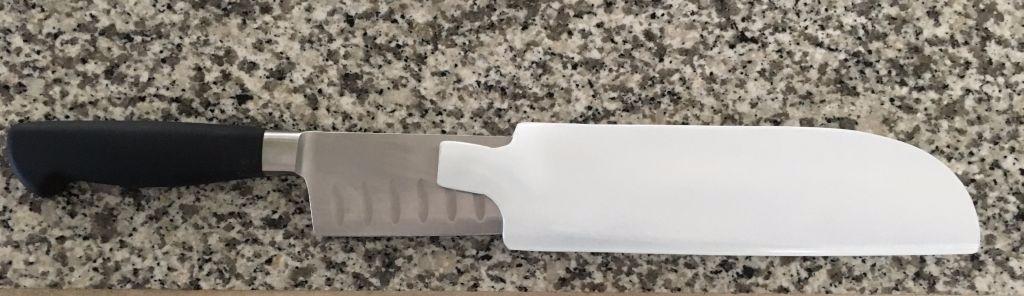
Two things to plan for. First, hand wash only, with warm water and mild soap, because the Santoprene handle and the polished taper will not thank you for a dishwasher cycle. Second, the steel is medium hardness, so the edge rolls under normal use and wants regular honing. The upside is that restoring it takes almost no skill with a honing steel.
Some users also note a touch of sawing motion helps break the skin of a tomato on a first cut, which is a sharpening-priority thing rather than a geometry flaw. A few find the weight sits slightly toward the handle, so pinch grip close to the bolster.
Why this is the easiest knife to learn on
The taper-ground edge is thin, forgiving and quick to restore, which means a beginner’s mistakes are cheap. You do not need a stone, a strop or a steady hand to get a good result, just a honing rod a couple of times a week.
It also carries a limited lifetime manufacturer warranty from Mercer Tool Corp, so the risk of a first purchase is low.
Where it will disappoint you
You are giving up edge retention. Compared with the VG-MAX Shun or the 60+ HRC Dalstrong, the Genesis loses its working edge faster and asks for more attention, which is the trade for being nearly unbreakable in a new cook’s hands.
If you already have a good knife and want something for delicate work like slicing tomato, the lack of grantons means more sticking than a scalloped blade gives you.
6. Shun Classic 7 Inch Santoku – Best for Thin Slices
Shun Classic 7″ Santoku Knife
VG-MAX core with 68 layer Damascus cladding
16 degree factory edge
D-shaped pakkawood handle
Handcrafted in Japan
Pros
- Exceptional out of the box sharpness that slices tomato paper thin
- VG-MAX steel holds its edge far longer than German steel
- Light 3.53 ounce build suits repetitive prep
- D-shaped handle gives control for either hand
Cons
- Hard VG-MAX steel chips more readily and must stay away from bone
- Handle resin can carry a strong odor onto hands
- Factory edge arrives at an angle some owners want reset
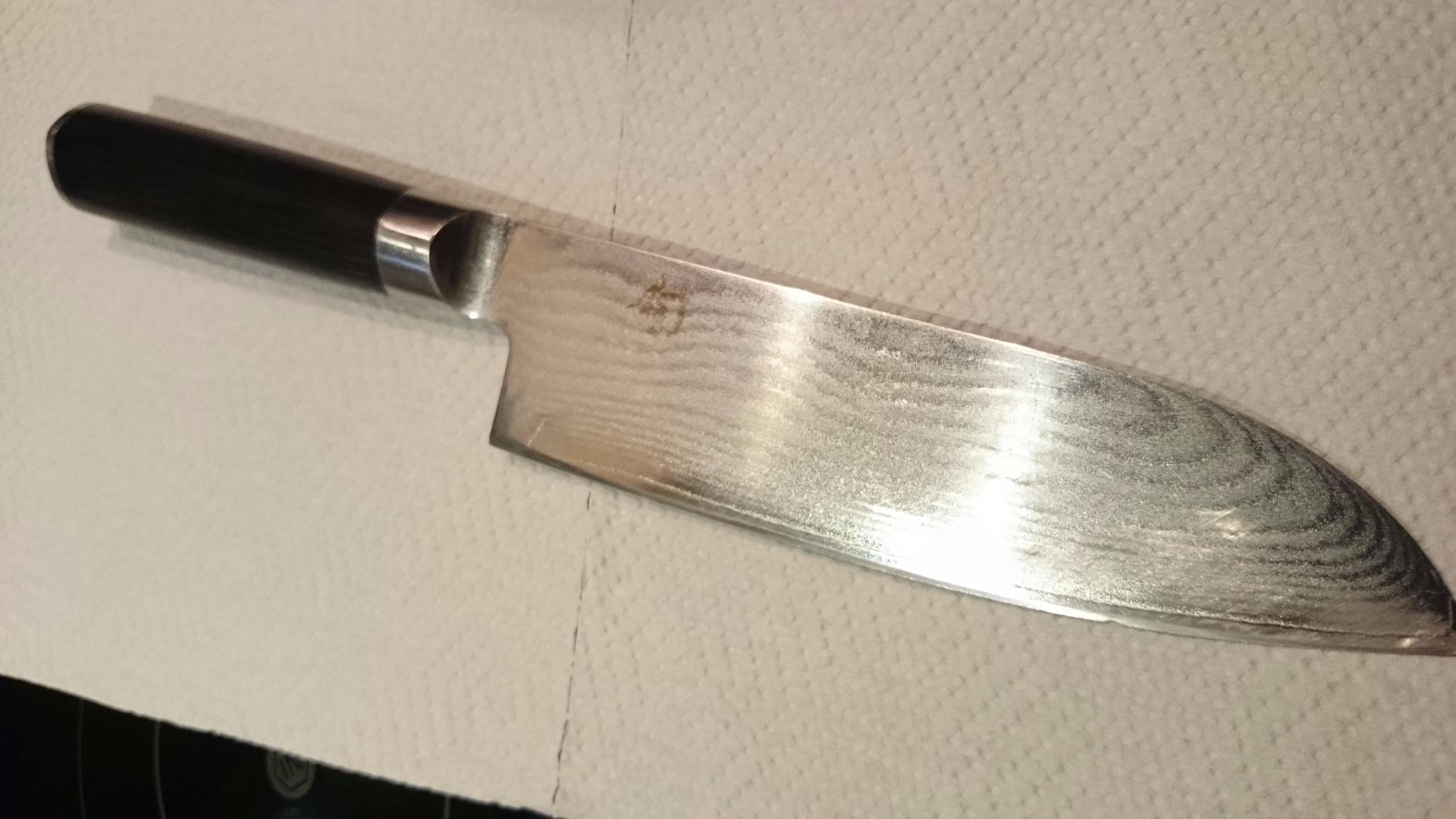
The Shun is the sharpest thing in this group the day it arrives, and it stays that way with ordinary maintenance. Long-term owners describe it as the only knife they need for daily prep, praising how the edge makes chopping vegetables feel effortless and fatigue free. Tomato slices come off so thin they are almost translucent.
The core is VG-MAX Japanese steel under 68 layers of Damascus stainless cladding, ground to a 16 degree factory edge and handcrafted in Japan. At 3.53 ounces it is light and agile despite the layered construction, and the D-shaped pakkawood handle is symmetrical enough for both left- and right-handed control.
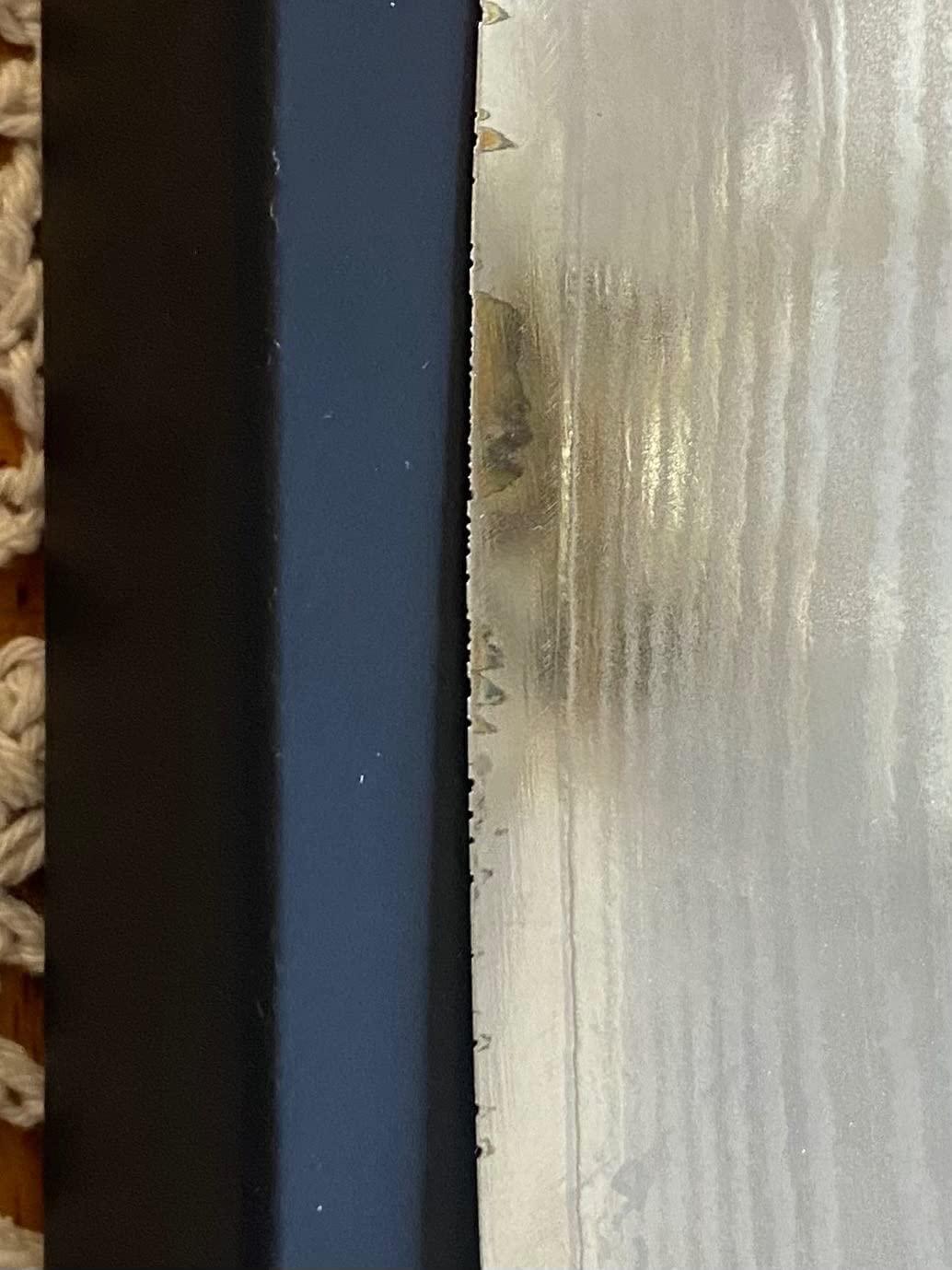
There is a real trade. VG-MAX is hard steel, and hard steel chips if you hit a frozen vegetable, a bone or the rim of a pan. This is a blade for onions, peppers, herbs, fish and boneless protein, and nothing else.
The pakkawood handle uses a resin that some owners say transfers a noticeable smell to your hands when the blade is new. It fades with time, but it is worth knowing before you fall in love with the knife on day one. Shun also backs the knife with a lifetime warranty and free sharpening and honing service from the manufacturer, which softens the long-term maintenance question.
What changes when the edge is this fine
Onions and bell peppers separate into clean slivers instead of tearing. Soft herbs bruise less because you are not sawing through them, and a ripe tomato slices without any downward force at all.
Weekly stropping is enough for most cooks. The steel rewards a little attention in a way the softer European blades do not.
Where it will disappoint you
This is a hard blade with a thin profile, so one careless chop into a frozen stock block can put a chip in the edge that takes a stone to fix. If you cook from the freezer aisle often, choose the Cutluxe or the imarku instead.
The layered Damascus cladding is cosmetic, and the premium is real. If your prep is mostly hard roots and cabbages rather than delicate slicing, you are paying for sharpness you will not always use.
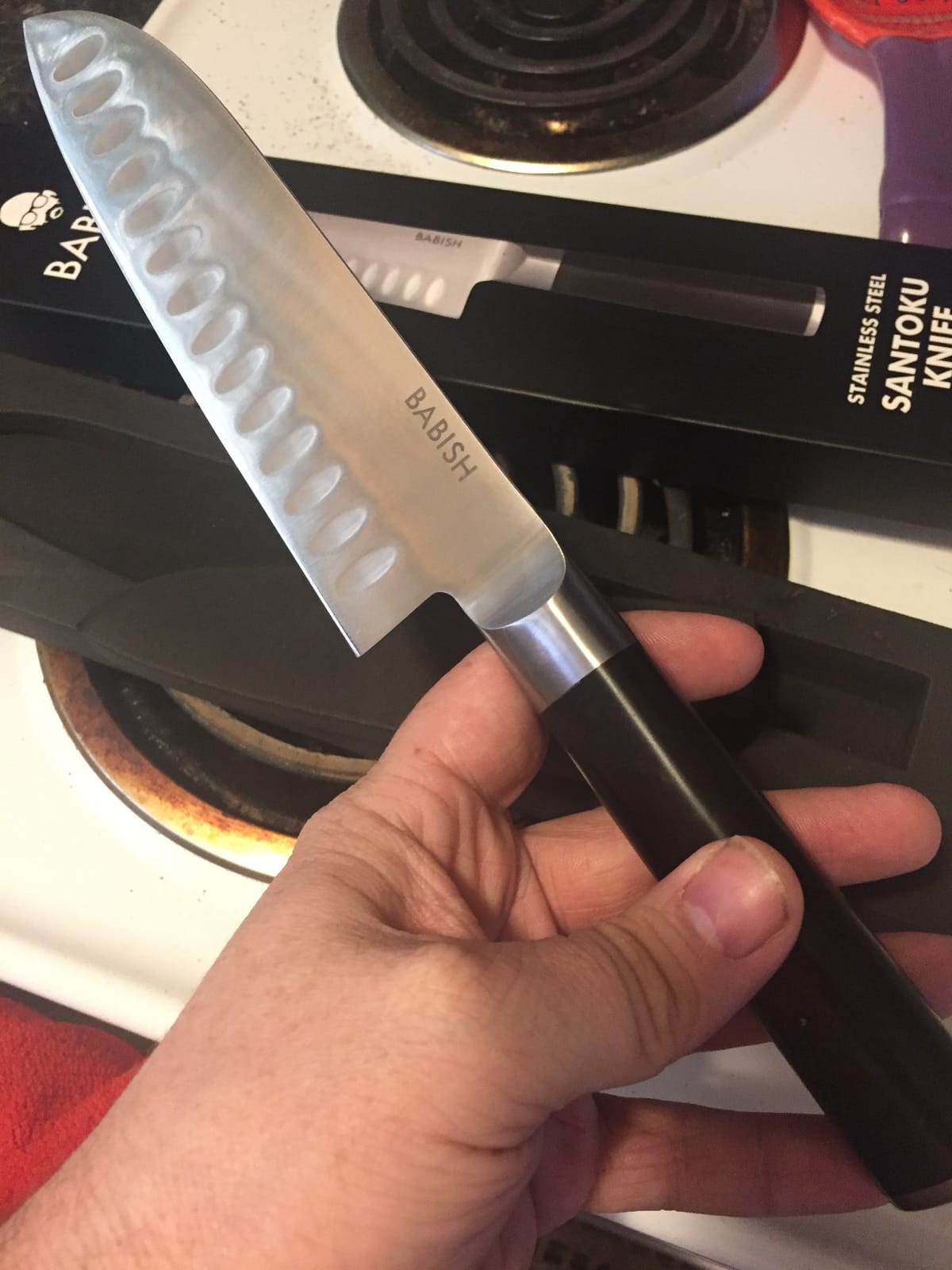
1. Babish 6.5 Inch Santoku – Editor’s Choice for Vegetables
Babish 6.5 Inch Santoku Knife High Carbon 1.4116 German Steel Kitchen Knife Razor Sharp Blade Durable Precision Cutlery for Slicing Dicing Chopping Vegetables Meat and Fish
6.5 inch forged 1.4116 German steel
Full tang construction
Granton edge
Roughly 56-58 HRC
Pros
- Very sharp out of the box and takes a honing rod easily
- Full tang gives a solid feel and a ringing tap
- Forged 1.4116 steel comparable to higher priced German lines
- Excellent value at the entry price
Cons
- 6.5 inch blade is short for large batch prep
- Granton edge does not fully prevent sticking while dicing
- Handle can feel semi-slippery with wet hands
This is the knife we recommend most often, and the reason is unglamorous: it is the only blade here that combines forged German steel, a full tang and an edge that a beginner can restore. Reviewers who know steel praise the 1.4116 construction as comparable to the steel used in higher priced German lines, and report paper-thin slices and effortless dicing from the first use.
It is forged from a single piece of high carbon 1.4116 German steel at roughly 56-58 Rockwell, tempered, ground and polished. The full tang runs the length of the handle, which is why it feels solid and why it rings when you tap the spine. At 0.34 kg the balance is substantial without feeling unwieldy.
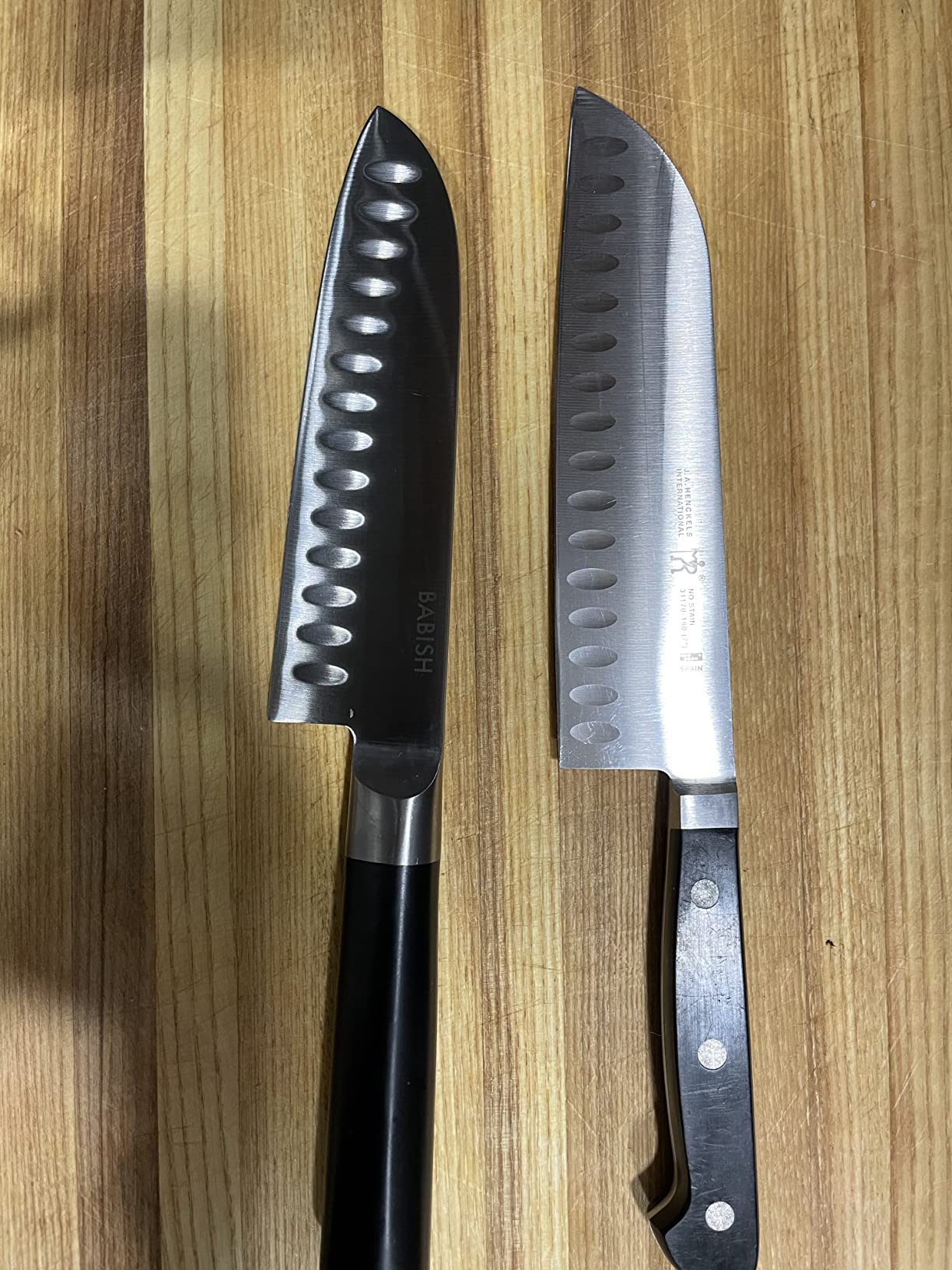
The granton edge is intended to reduce drag and sticking, and it helps, but reviewers are honest that it does not fully solve the problem while dicing. Wet onion will still cling occasionally, and you will clear it with the side of the blade or the spine of the knife as you would with any plain edge.
There is one size complaint that comes up repeatedly: 6.5 inches is compact. If you batch-prep a full cabbage or a large squash every week, you will notice the board edge arriving before the blade does. For most weeknight cooking the shorter blade is easier to control.
Why it edges out the field
It is very easy to sharpen. A few passes on a honing steel restore a working edge, and when it does need a stone, 56-58 HRC forgives mistakes better than anything harder on this list. That combination of sharpness and recoverability is why it suits both a new cook and someone who already owns four knives.
At the entry price point, forged steel with a full tang is unusual. The construction is the reason this blade feels like a step up rather than a step sideways.
Where it will disappoint you
It holds its edge less long than higher HRC steel, so regular honing is part of the deal. Treat it as a tool that needs ten seconds of attention a week and the trade stops mattering.
The handle is smooth enough that some users find it semi-slippery with wet hands, and 6.5 inches is the shortest blade among the forged picks here. If you want more length, the Cutluxe is 7 inches with the same family of steel.
7. Tojiro Professional Santoku 6.7 Inch – Best for Left-Handed Cooks
Tojiro Knife Professional Santoku 6.7″ (17cm) – JAPAN
17cm cobalt alloy core with 13 chrome layers
Laminated reinforced wood handle
Even edge usable either hand
Japanese made
Pros
- Japanese made steel well below the price of other Japanese options
- Even plain edge suited to precise slicing and dicing
- Stain resistant steel that stays clean through heavy use
- Symmetrical edge works for left- and right-handed cooks
Cons
- Plain edge with no granton scallops so more food sticks
- No sheath or protective cover included
- Sharpening calls for a whetstone rather than a honing rod
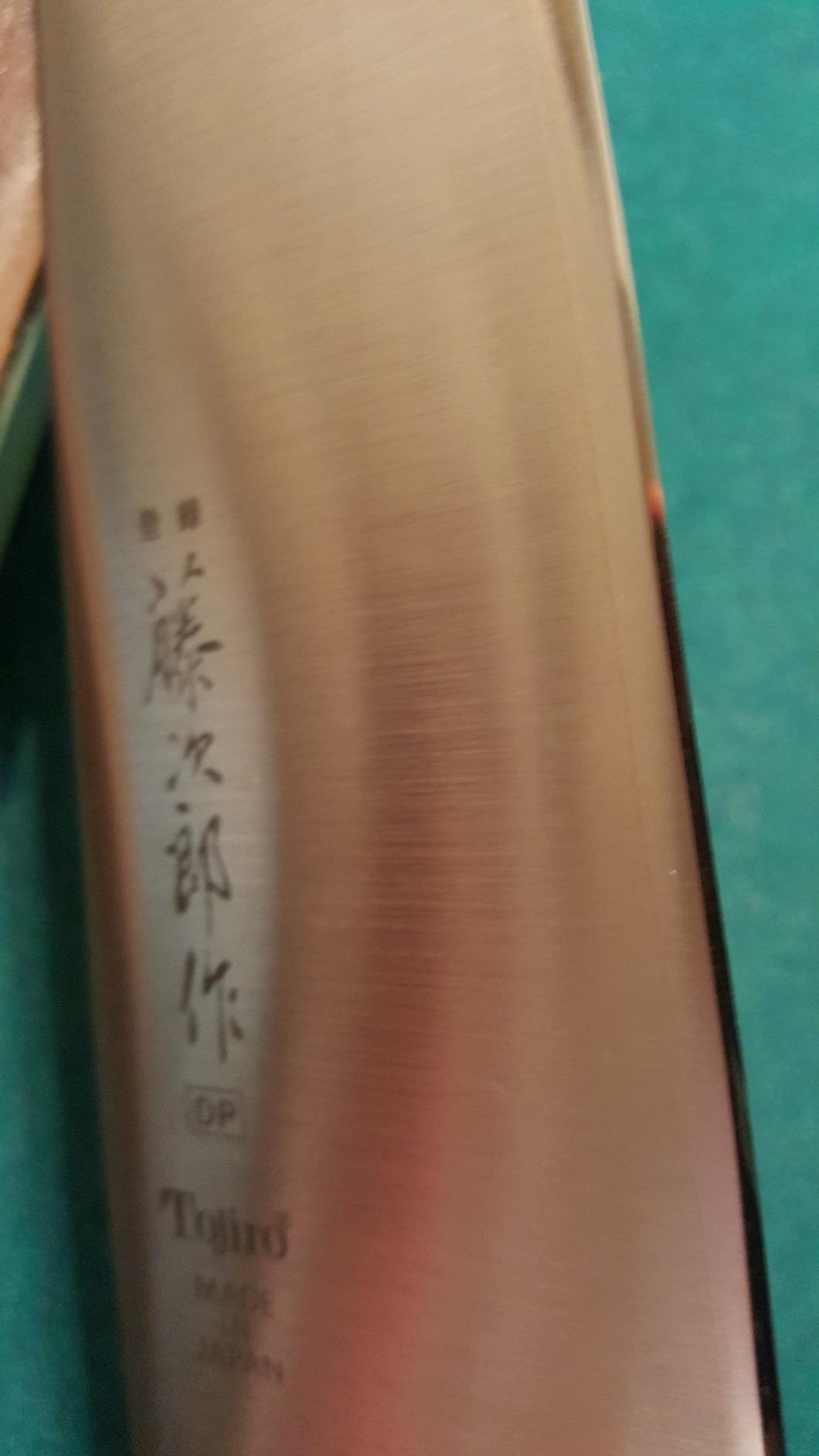
The Tojiro is the Japanese-made option on this list, and owners treat it as an affordable step into that category. The blade is a cobalt alloy steel core with 13 chrome stainless layers over an 18-8 stainless base, at 17 centimeters, or 6.7 inches, and 29.5 centimeters overall.
Two things make it stand out for a specific cook. The edge is even and undamaged by any handedness, so left-handed users get the same result as right-handed ones. And the steel is stain resistant enough that heavy prep with wet produce does not grey it down.
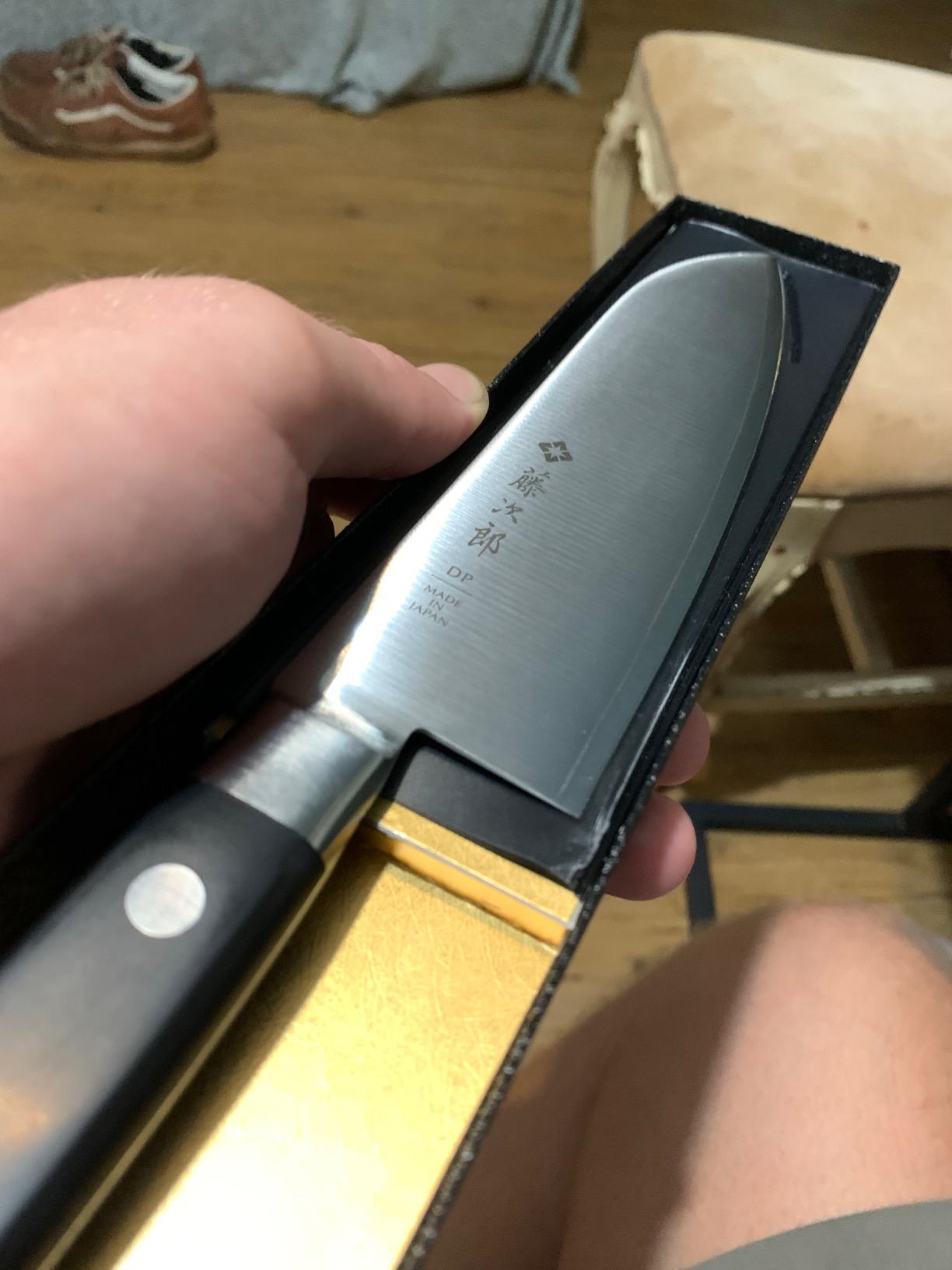
The honest trade is the plain edge. With no granton scallops, more onion and potato stick to the blade than on the Babish, the imarku or the MAC. On very wet produce you will be clearing the blade more often, and some cooks decide that is an acceptable price for a clean, uninterrupted cut line.
There is no sheath, and the edge is set fine enough that reviewers recommend a whetstone rather than a quick pass on a rod. If you have never sharpened on stone, that is a real learning curve, and it is why this is not our beginner pick despite the accessible price.
What left-handed cooks actually get
Most asymmetric D-shape handles favour a right hand. This handle is a black laminated reinforced wood, and the edge geometry is straight through, so a left-handed cook gets the same clearance at the heel and the same results as everyone else.
If you also cook for two people with different dominant hands, that symmetry is a genuine practical advantage over several knives on this list.
Where it will disappoint you
Sticking during a wet prep session is the main friction point, and there is no sheath in the box, so plan on a block or a rack.
The fine factory edge wants a stone. A honing rod will keep it going between sharpenings, but a proper whetstone session is where this knife really comes into its own.
8. Wusthof Gourmet 7 Inch Hollow Edge Santoku – Best for High Volume Prep
WÜSTHOF Gourmet 7″ Hollow Edge Santoku Knife,Black
7 inch laser-cut high carbon stainless steel
Hollow edge indentations
10 degree cutting edge
Made in Solingen
Pros
- Very thin blade built for rapid production vegetable prep
- Light enough at 4.64 ounces for smaller hands
- Sharp durable steel that holds a working edge
- Solingen made with a limited lifetime warranty
Cons
- Hollow edge dimples do not reduce sticking as much as expected
- Factory edge is a step below true razor sharpness
- No sheath included and hand wash only
The Wusthof Gourmet is the blade for volume. Long-time owners and professional cooks describe it as a very light, extremely thin santoku that is excellent for high-volume prep and holds up under daily service. The 10 degree edge and the thin stamped blade make fast, repeated strokes through peppers, onions and cabbage almost effortless.
It is laser-cut high carbon stainless steel with a hollow edge of evenly spaced vertical indentations, made in Solingen, and it carries a limited lifetime warranty. At 4.64 ounces it is light enough for smaller hands while still feeling substantial at the spine.
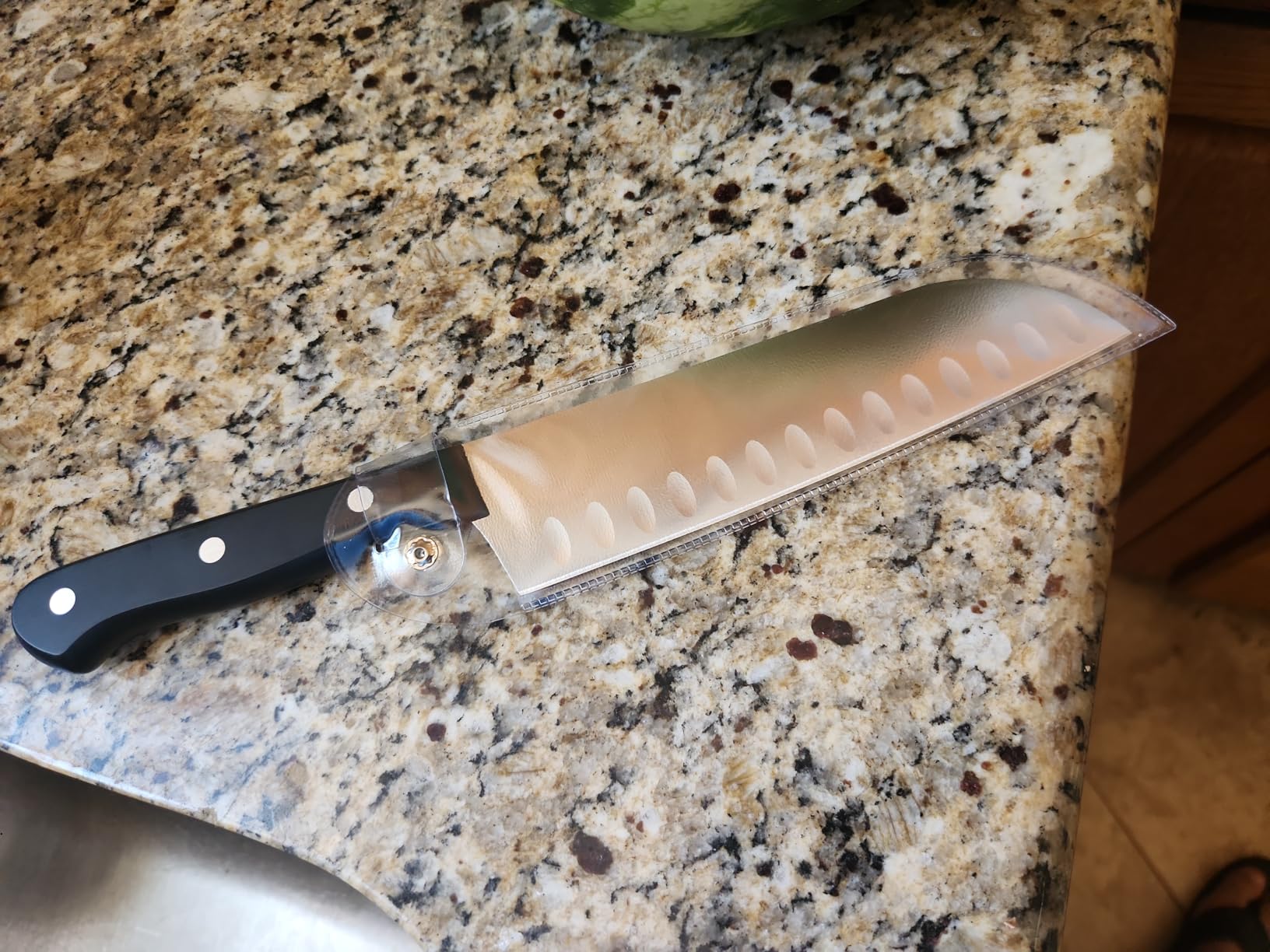
Set expectations on two points. The hollow edge dimples are marketed to release food, and owners report they help less than expected on sticky produce, so you will still clear the blade regularly. And the factory edge is sharp but not razor sharp, so if you want a finer bite, a stone improves it noticeably.
There is no sheath or blade cover, and the polypropylene handle, while it resists fading, discoloration, heat and impact, is less refined than the full-tang forged rivals here. Hand wash only.
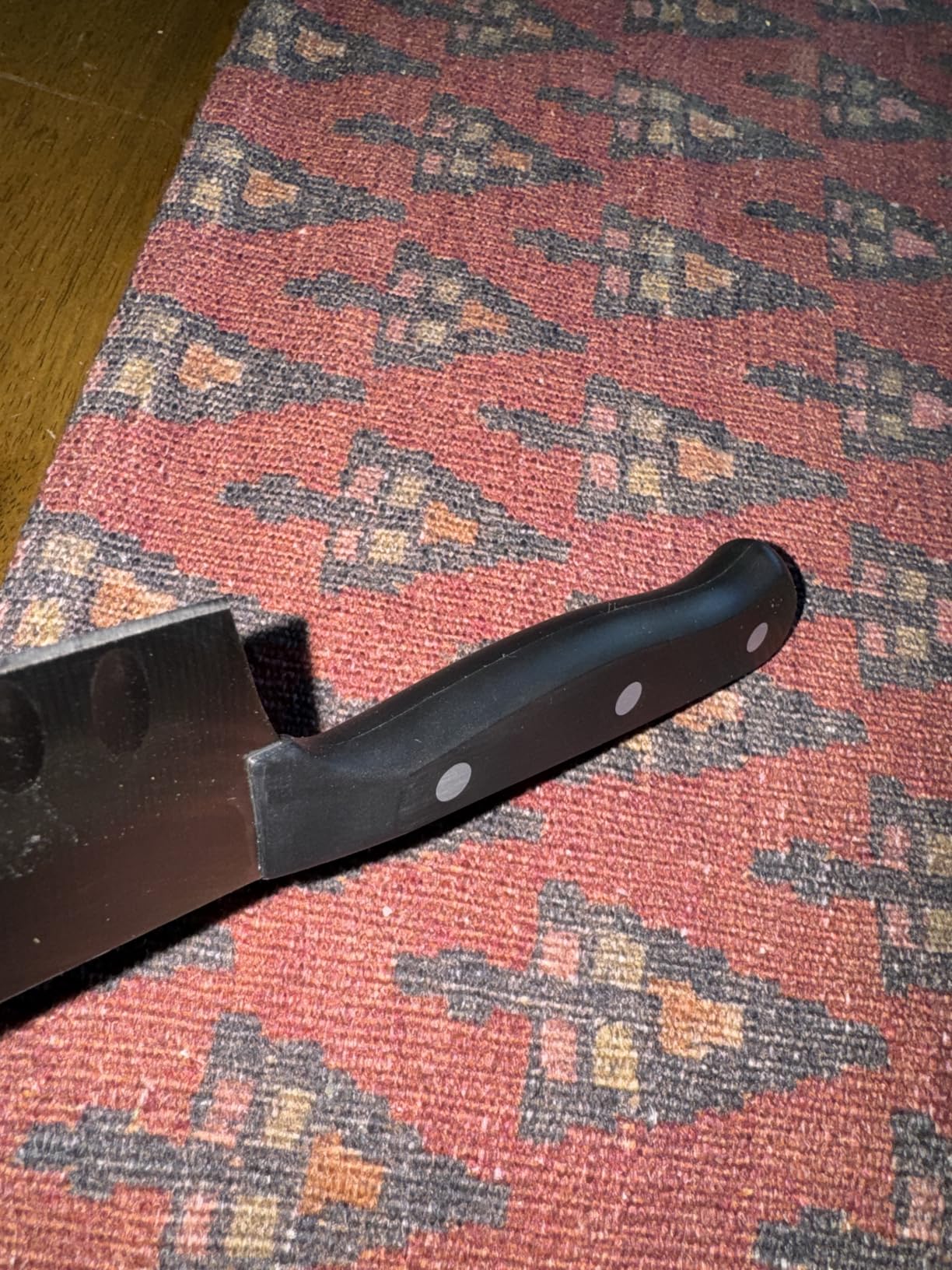
What makes it fast in bulk
The blade is thinner than a traditional chef’s knife and the edge curves up at the tip, which reduces the resistance you meet at the start of a cut. Over a full shift of dicing, that difference adds up.
It is also a knife you can hand to someone else without worrying, because stamped stainless steel at this hardness is difficult to damage.
Where it will disappoint you
If your idea of good knife work is an 8-12 degree ultra-fine edge, this is not that knife. It is a durable production blade, and it will not compete with the Shun or the Dalstrong on thin-slicing finesse.
The dimples disappoint more often than not, and the handle is the plainest on the list. None of that ruins the knife, but you are buying performance rather than refinement.
9. MAC Knife Professional 6.5 Inch Santoku – Best for Compact Kitchens
MAC Knife Professional series 6.5″ Santoku with dimples MSK-65, made in Japan
6.5 inch forged blade at 2.5mm thick
Sub-zero tempered alloy steel
Dimples on the blade surface
Japanese made
Pros
- Sub-zero tempered steel holds its edge for extended periods
- Dimples release food during slicing and dicing
- Solid 2.5mm blade construction from a Japanese maker
- Compact 6.5 inch size suits small hands and tight spaces
Cons
- Compact size is short for large batch vegetable prep
- Pakka wood handle needs hand drying to prevent damage
- Blade dimples are harder to clean than a plain edge
The MAC is the one enthusiasts in the forums keep coming back to for people who want a fast, low-maintenance workhorse. The sub-zero tempered alloy steel holds its edge for extended periods, and owners of this Japanese-made blade point to that as the defining feature rather than the edge angle.
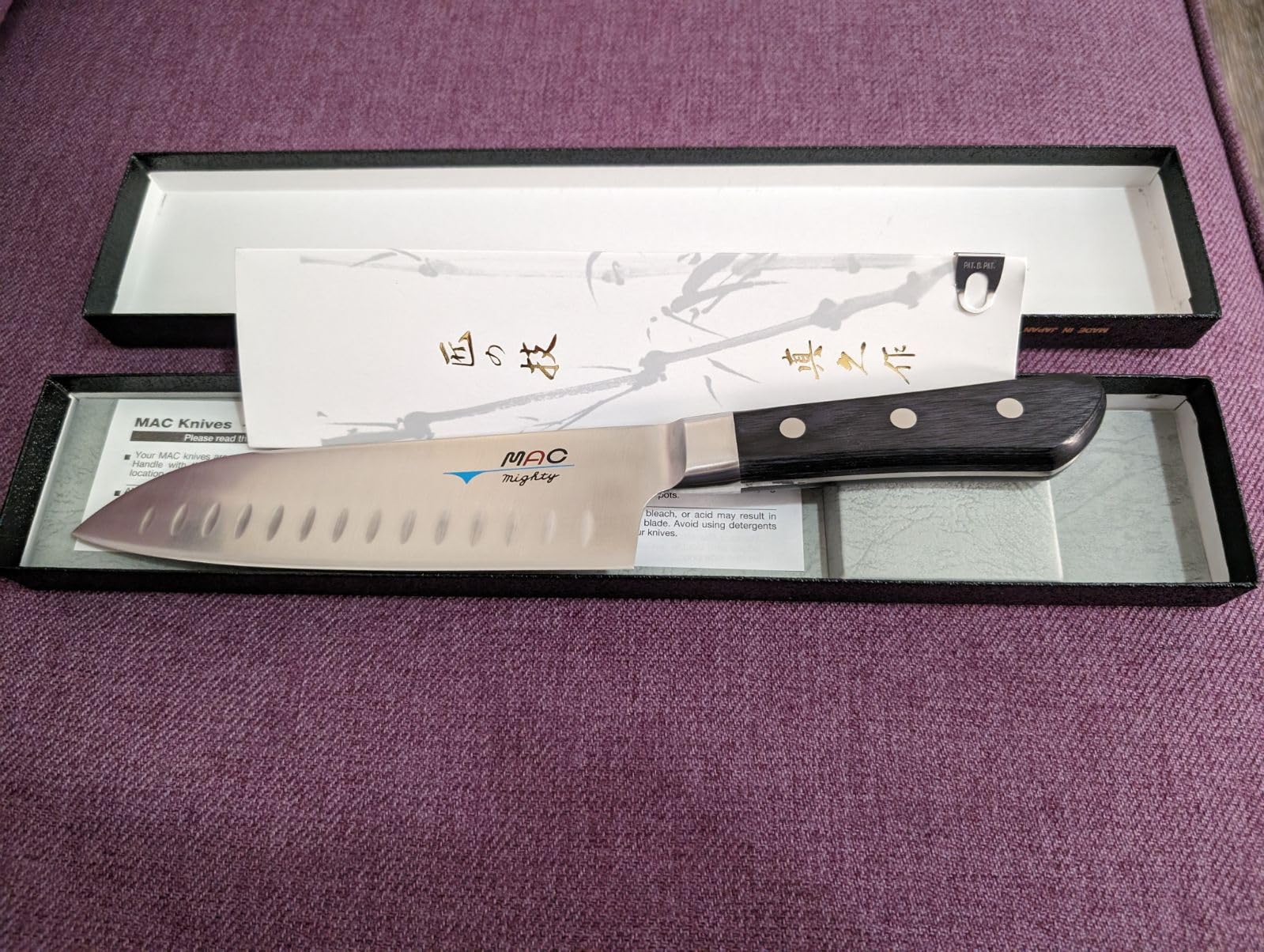
It is forged at 2.5mm thick with dimples, or grantons, across the blade surface, and it arrives razor sharp. The brushed stainless blade and black pakka wood handle give it a compact, deliberate feel, and at 6.5 inches it fits smaller hands and tight prep spaces where a 7 inch blade feels crowded.
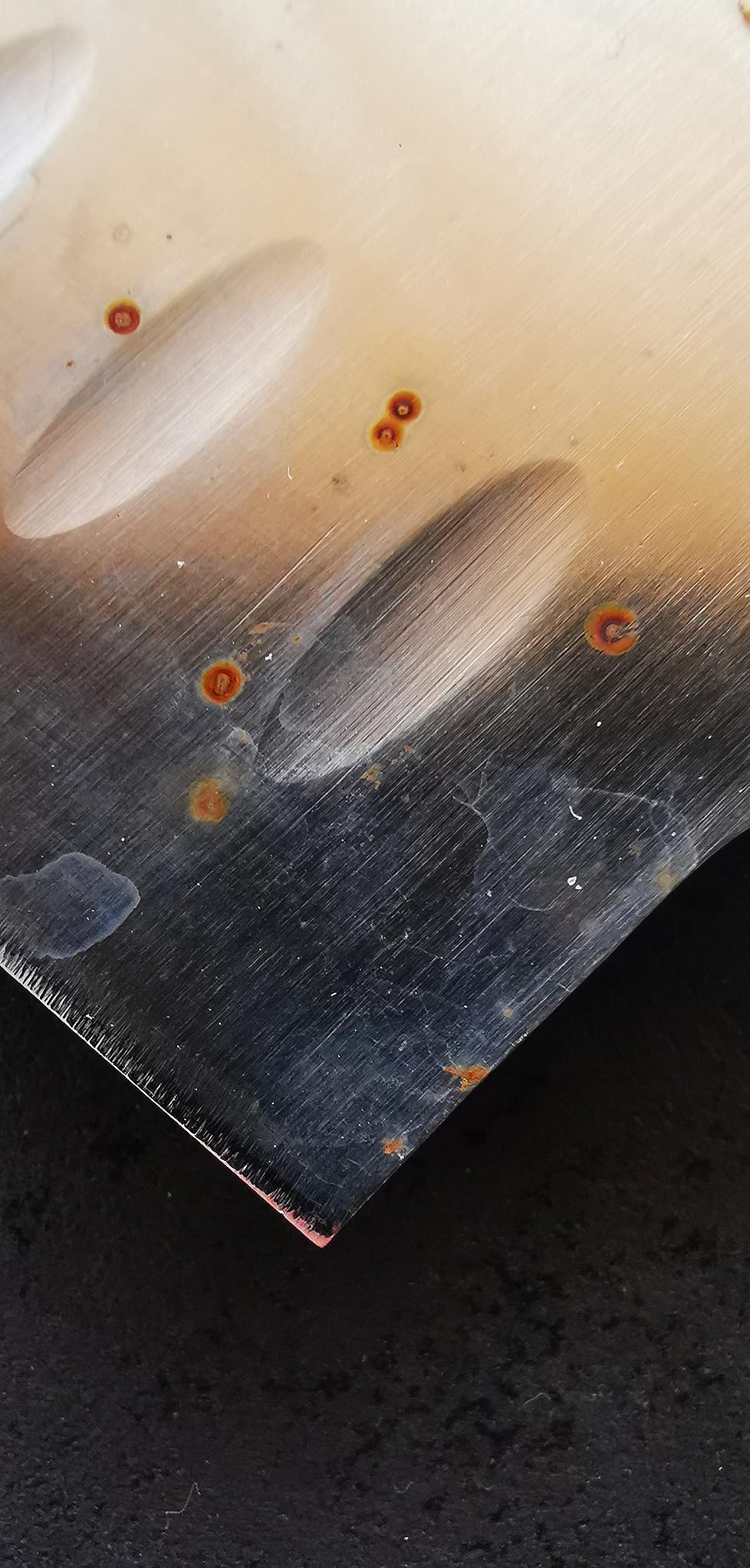
Two practical notes. The pakka wood handle needs hand drying, because moisture left in the composite is what causes swelling and loosening over time. And the dimples, useful as they are during a cut, are more work to clean than a plain edge, so rinse and dry the blade face properly rather than dropping it in a sink of water.
At 8.8 ounces this is a compact knife with real heft. If you associate small knives with light ones, the weight is the first thing you will notice, and it is not unpleasant during chopping.
Why it holds an edge so long
Sub-zero tempering treats the steel at temperatures below freezing after hardening, which reduces the brittleness that usually comes with edge retention. You get a blade that stays sharp through a week of prep without becoming fragile.
For a cook who dices daily and does not want to think about a whetstone, that property matters more than factory sharpness you can no longer use.
Where it will disappoint you
The 6.5 inch blade is short for a big batch of cabbage or roots, and that is the recurring theme in owner feedback. If you cook for six or more people most nights, look at a 7 inch option instead.
Hand washing is required, and the dimpled face needs a proper dry rather than a quick wipe. It is a low-maintenance blade, not a no-maintenance one.
10. Dalstrong 7 Inch Santoku Vegetable Knife – Best for Out-of-the-Box Sharpness
Dalstrong 7″ Santoku Vegetable Knife – 9CR18MOV High-Carbon Steel
7 inch forged high carbon steel at 60+ HRC
Hand-sharpened 8-12 degree edge
Resin and wood handle with bolster
Leather sheath included
Pros
- Razor sharp factory edge makes paper-thin vegetable slices
- Excellent weight and balance reduces fatigue in long sessions
- Forged 60+ HRC steel outlasts many German steel blades
- Resin and wood handle with a stainless bolster feels secure
Cons
- Shallow blade height can let the hand brush the cutting board
- Aggressive 8-12 degree angle needs more frequent re-sharpening
- Very sharp edges near the bolster have caused accidental nicks
The Dalstrong is the most aggressive edge in this group out of the box. Prep cooks and enthusiasts describe paper-thin tomato and vegetable slices on the first session, and the weight and balance reduce fatigue during repetitive chopping even though the blade is 9.28 ounces.
It is forged from a single piece of high carbon steel at 60+ Rockwell and hand-sharpened to 8-12 degrees per side. The handle is stabilized wood and resin with a stainless steel bolster, and a Valhalla-embossed leather sheath is included for storage.
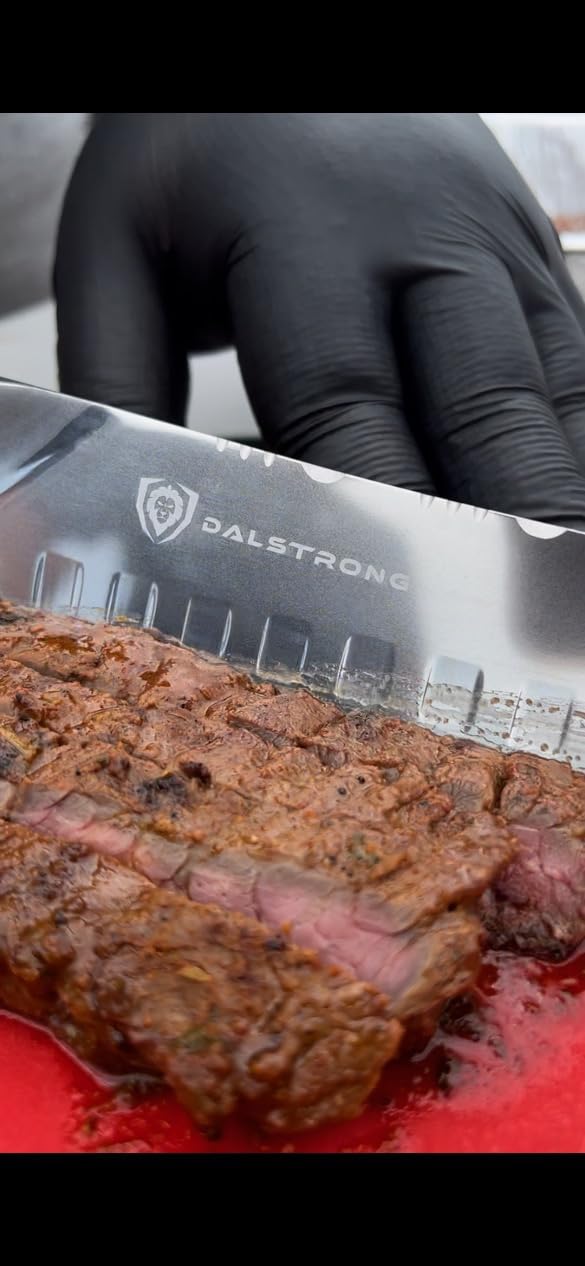
Two things give owners pause. The blade height is shallow, so during fast chopping your knuckles can brush the cutting board unless you raise your grip slightly. And an 8-12 degree edge is a slicing angle, which means it wants a stone more often than a 15-18 degree edge does.
Several users also report accidental nicks from the very sharp section where the blade meets the bolster. That is a handling issue rather than a defect, and it is worth slowing down for the first few sessions while you learn the angle of the edge.
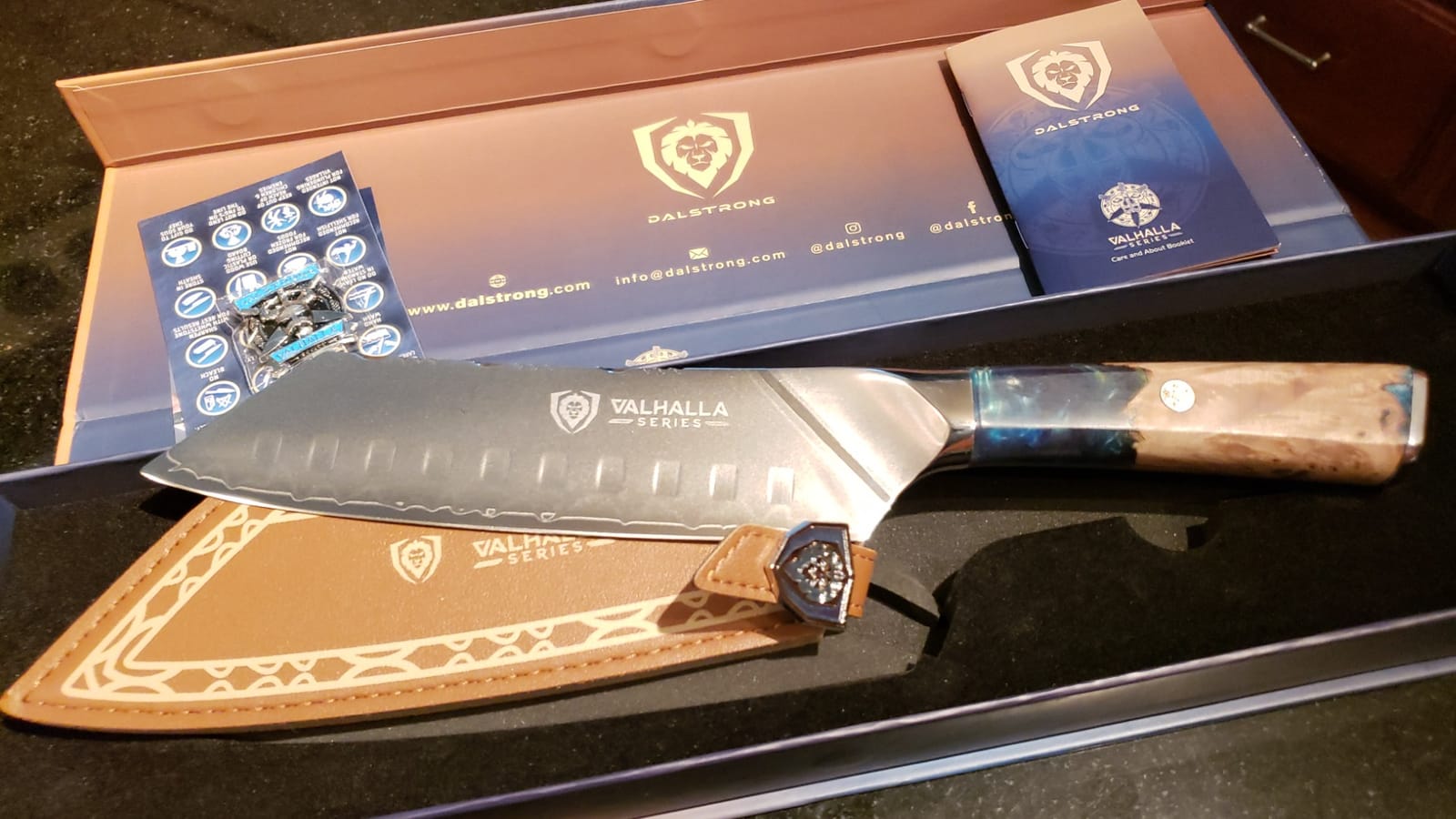
What an 8-12 degree edge buys you
It slices rather than pushes. Tomato, onion, peppers and soft fruit separate into paper-thin sheets, and herbs cut clean without bruising, which is the payoff for maintaining a fine edge on a stone every few months.
The 60+ HRC steel is why the edge survives that treatment. It is harder than every European steel on this list except none, and it is the reason reviewers report longer retention than many German knives.
Where it will disappoint you
Hard steel at a fine angle is the least forgiving combination here. Hit a frozen vegetable or a bone and you will be visiting a stone rather than a rod.
Shallow blade height and the nick risk near the bolster mean this is not the knife for a brand-new cook learning knife control. The Babish or the Mercer will forgive far more mistakes for a long time.
Santoku vs Nakiri vs Gyuto for Vegetables
This is the question that comes up most often in knife forums, and the answer changes depending on the vegetable. A santoku is the generalist: a tall, narrow blade with a heel tall enough to cut through a whole onion and a lower tip that suits a forward push-chop. A nakiri is a rectangular cleaver with a straight edge all the way to the tip, and it is built for downward cuts into dense produce. A gyuto is a longer Japanese chef’s knife that takes a rocking motion well and handles protein and fish as comfortably as vegetables.
For onions, peppers, cabbage and herbs, the santoku wins on control and speed. For very dense vegetables such as butternut squash, celeriac and large carrots, a nakiri’s straight edge and full blade height cut down with less wrist effort, and that is exactly why people buy one as a companion rather than instead.
The consensus among experienced cooks is that the santoku should be your only vegetable knife unless you prepare dense roots weekly. A nakiri tip on a santoku body is understood by most enthusiasts as basically a nakiri: excellent on vegetables, and treated as a knife that stays off bone and frozen food.
How to Choose a Santoku for Vegetable Prep
Blade length. Seven inches, roughly 170-180mm, is the consensus sweet spot for home cooks. Six and a half inches gives you more control and suits smaller hands, but users report it creates resistance on tall vegetables such as whole carrots, and you will make more strokes per onion. Five-inch santokus exist for very small hands and tight prep areas, at the cost of more strokes on anything large.
Steel and hardness. Below 55 HRC, expect to hone often. Between 56 and 58 HRC is the sweet spot for home cooks because the edge recovers easily and resists chipping. At 60 HRC and above you get longer retention and finer cuts, along with a real risk of chipping on frozen or hard produce. Almost every hard steel in this group is stainless or clad, so acid exposure from tomatoes, citrus and vinegar is far less of a concern than with a pure carbon blade, but you should still rinse and dry promptly.
Hollow edge versus plain edge. Grantons and dimples reduce sticking on wet, starchy produce like potato, onion and cabbage. Plain edges, such as the Tojiro and the Shun, cut a cleaner, more continuous line and suit delicate slicing. If your prep is mostly raw vegetables, take the hollow edge. If it is mostly soft fruit and herbs, either works.
Handle and grip. Wet hands decide this more often than people expect. Textured composite, Santoprene or pakkawood grips stay put when the board is wet, while smooth moulded plastic can slide. For left-handed cooks, look for a symmetrical handle and an undamaged edge, which rules some D-shaped designs out. Our metal detecting knife picks cover grip patterns in more depth if you are comparing handle shapes.
Tang and construction. A full tang, where the steel runs the full length of the handle, gives better balance and durability, and you can feel the difference in a knife that lasts years. Sandwich and half tangs are fine in a lighter knife but are the first place to fail if the handle loosens.
Testing in store. Hold the knife in a pinch grip at the bolster and rock it forward, the way you would push through an onion. If the tip digs in too easily, the edge is too fine for your control yet. Check that the handle does not rotate in your hand, and run a thumbnail lightly along the spine to feel the grind transition near the heel.
Sharpening and Care Without Losing the Edge
Every knife here is restored with a honing steel in seconds. Honeing realigns a rolled edge and keeps a sharp knife sharp, and it should happen every few sessions for the European steels and weekly for VG-MAX. Sharpening removes metal to set a new angle, and that is a stone job every few months rather than a weekly one.
Hand wash with warm water and mild soap, and dry immediately. A dishwasher uses heat and detergent that destroy handle adhesives, pit stainless steel, and strip the factory edge faster than a year of careful use. Several knives in this group are dishwasher safe by design, and they will outlast many that are not, but the pakkawood and resin handles here are not.
Store knives in a block, on a magnetic rack or in a sheath. The Cutluxe, the Dalstrong and the Tojiro differ on whether a sheath is included, and the Tojiro’s lack of one is a common complaint for drawer storage.
Common Mistakes When Using a Santoku
1. Rocking the blade like a Western chef’s knife. A santoku is shaped for a forward push-chop. The rocking motion works, but it is slower and it concentrates force near the tip.
2. Using the tip as a screwdriver or lever. That is the fastest way to put a chip in an 8-12 or 16 degree edge, and chips take a stone to fix.
3. Cutting through bone or frozen food with a fine-edged blade. Hard steel at a fine angle will chip, and frozen vegetables are the most common culprit in owner reports.
4. Leaving food on the blade overnight. Onion and tomato acids sit on steel and dull it faster than daily use does. Rinse and dry right after prep.
5. Running the blade through a dishwasher. Heat, detergent and prolonged moisture damage the edge, the handle and the tang in one cycle.
6. Ignoring food sticking. If onion slices cling, the edge is usually rolling rather than the hollow edge failing. Hone, then reassess the blade.
Frequently Asked Questions
What is the best knife for cutting vegetables?
A tall, straight-edged santoku is the best general answer for home cooks. Its straight spine collects chopped onion and pepper in one motion, its low tip keeps knuckles clear during a push-chop, and hollow edge grantons reduce sticking on wet produce. If you only prep very dense roots like squash and celeriac, a nakiri cleaver is more efficient, but for mixed everyday vegetable work a 7 inch santoku covers it.
Which Japanese knife is best for cutting vegetables?
Among the picks here, the Tojiro Professional 6.7 inch is the Japanese-made option, with a cobalt alloy core under 13 chrome stainless layers and an even edge that treats left- and right-handed cooks the same. The Shun Classic 7 inch takes thinnest slices thanks to a VG-MAX core under 68 layers of Damascus cladding, but its harder steel chips more readily and stays away from bone.
Should I get a 5 inch or 7 inch Santoku knife?
Seven inches is the consensus sweet spot for home cooks because it clears a whole onion in fewer strokes while staying controllable. Six and a half inches, as on the Babish and the MAC, suits smaller hands and tight prep spaces but takes more strokes on tall vegetables like whole carrots. A 5 inch santoku is worth considering only for very small hands, and it is the shortest and least versatile option.
What are the common mistakes when using a santoku?
The most common mistakes are rocking the blade like a Western chef’s knife, using the tip as a lever, cutting bone or frozen vegetables with a fine edge, leaving acidic food on the steel overnight, and putting the knife in a dishwasher. A santoku is built for a forward push-chop, and keeping it out of the dishwasher preserves both the edge and the handle resin or pakkawood.
Is a santoku knife worth buying?
Yes, if you prep vegetables most days and want one versatile blade rather than a set. A well-made santoku handles onions, cabbage, peppers, carrots, soft herbs and boneless protein, which covers the overwhelming majority of a home cook’s cutting board. It is worth it when paired with a honing steel and hand washing, and a stamped stainless model like the Victorinox can stay in service for well over a decade.
Why does my santoku knife stick to vegetables?
Sticking is usually a dull edge rather than a failed hollow edge design. A rolled edge grips wet, starchy produce, so run the blade on a honing steel before you blame the grantons. Some sticking is normal on plain-edge blades such as the Tojiro and the Shun, which trade the anti-stick scallops for a cleaner, more continuous cut line.
Conclusion
After weeks of prep, the Babish 6.5 inch Santoku is the pick we hand over most often, because forged 1.4116 German steel, a full tang and an edge any cook can restore make it the least demanding knife here. If you want a 7 inch blade and do not mind the weight, the Cutluxe adds a sheath and a lifetime warranty, and the Shun Classic is the one to buy for the thinnest slices in the drawer.
Whatever you choose, the best santoku knives for vegetables all follow the same three rules: hand wash, hone often, and keep the tip away from bone and frozen produce. Pick the blade that matches the vegetables you actually cook, and the edge will take care of itself. Our raised garden bed guide covers the other half of the same question, which is where the produce comes from.