
Impact investing has grown from a niche concept into a powerful movement reshaping how we think about capital. The Global Impact Investing Network (GIIN) defines it as investments made with the intention to generate positive, measurable social and environmental impact alongside a financial return. This approach differs from traditional investing because it actively seeks to create change, not just avoid harm.
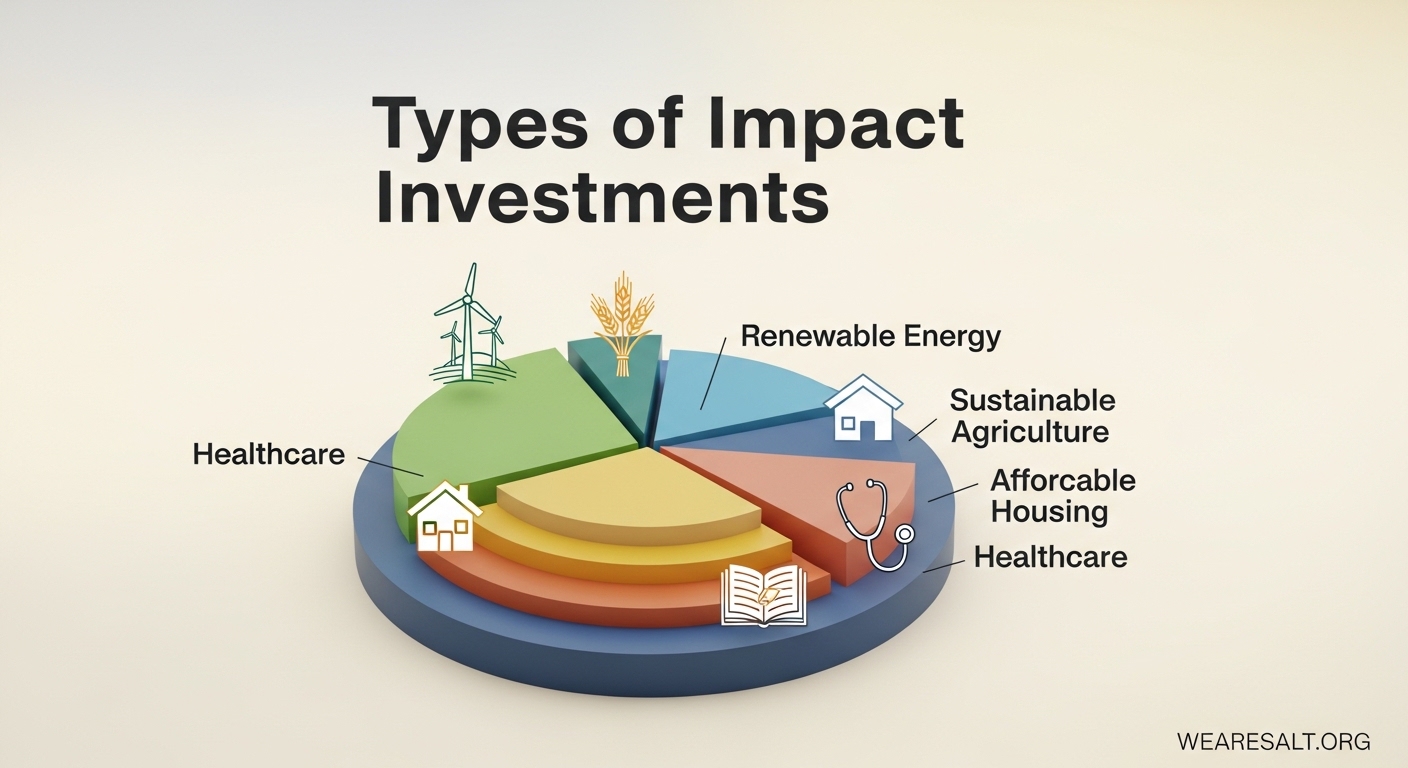
The landscape of impact investments is broader than many people realize. You will find opportunities across public equities, private debt, venture capital, real assets, and alternative investments. Common types include green bonds funding renewable energy, social impact bonds addressing public health challenges, microfinance institutions serving underserved communities, and program-related investments made by foundations.
I have spent years studying how investors balance profit with purpose. Through conversations with fund managers, foundation leaders, and individual investors, one pattern keeps emerging. Success in impact investing requires understanding not just what you are investing in, but how you define success. Some investors prioritize measurable outcomes above all else. Others treat impact as a bonus alongside market-rate returns. This guide will walk you through the different types of impact investments, the various investor approaches, and how to find the right fit for your goals in 2026.
Table of Contents
What Is Impact Investing?
Impact investing is an investment strategy that intentionally directs capital toward companies, organizations, or funds working to solve social or environmental challenges. Unlike traditional investing focused solely on financial returns, impact investing explicitly targets measurable positive outcomes alongside profit. The practice spans asset classes, geographies, and return expectations, making it accessible to individual investors, foundations, and institutions alike.
The roots of impact investing stretch back centuries. Religious groups in the 1700s avoided investments in slavery, alcohol, and tobacco based on moral principles. The modern movement gained momentum in the 1960s during the civil rights and anti-war movements, when investors began screening portfolios for social responsibility. Today, impact investing represents over $1 trillion in assets under management globally, according to GIIN estimates from 2026.
What separates impact investing from other sustainable approaches is the combination of three elements. First, there must be intentionality, meaning the investor actively sets out to create positive change. Second, there must be measurability, with clear metrics tracking social or environmental outcomes. Third, there must be financial returns, ranging from below-market to market-rate depending on the investor’s goals.
The 4 Core Characteristics of Impact Investing
The GIIN identifies four essential characteristics that define authentic impact investing. Understanding these helps distinguish true impact investments from marketing claims or related approaches like ESG screening. Each characteristic addresses a fundamental question about how capital can drive change while generating returns.
1. Intentionality
The investor must have the explicit intention to generate positive social or environmental impact through their investment. This goes beyond incidental benefits. An impact investor actively seeks out opportunities where capital deployment will directly address a specific challenge. Without this intentional focus, an investment might create positive outcomes by accident, but it does not qualify as impact investing.
2. Financial Returns Expected
Impact investing requires an expectation of financial return on capital. This distinguishes it from philanthropy or charitable giving. The return may range from below-market rates for concessionary investors to competitive market returns for commercial investors. What matters is that the investor expects to get their principal back with some level of financial gain.
3. Range of Return Expectations
Impact investors accept diverse return profiles depending on their strategic goals. Some prioritize impact maximization and accept below-market returns. Others pursue market-rate returns while adding impact as a secondary benefit. This spectrum of expectations allows impact investing to attract different types of capital, from foundations seeking mission alignment to pension funds seeking competitive yields.
4. Impact Measurement
Investors must commit to measuring and reporting the social and environmental performance of their investments. Transparency and accountability are essential. Frameworks like IRIS+ provide standardized metrics for measuring outcomes across sectors. Without measurement, claims of impact remain unsubstantiated and the field risks greenwashing.
The 3 Types of Impact Investors
Not all impact investors approach the market the same way. Industry research identifies three distinct investor archetypes based on how they balance financial and impact objectives. Understanding which category you fit into helps clarify your strategy, set appropriate expectations, and select suitable investment vehicles.
Impact-First Investors
Impact-first investors prioritize social or environmental outcomes above financial returns. These investors typically accept below-market-rate returns if necessary to achieve greater impact. Foundations and mission-driven organizations often fall into this category. They use tools like program-related investments (PRIs) to advance their charitable missions while preserving some capital.
Impact-first investors might fund early-stage social enterprises that commercial investors would consider too risky. They may support affordable housing developments in underserved communities where market-rate returns are impossible. Their success metrics emphasize lives improved, carbon reduced, or communities transformed rather than internal rate of return.
Investment-First Investors
Investment-first investors seek market-rate financial returns as their primary goal. They add impact as a valuable secondary benefit, treating it as a risk mitigation strategy or value differentiator. Institutional investors, pension funds, and wealth managers increasingly adopt this approach. They demonstrate that competitive returns and positive impact can coexist.
These investors typically allocate capital to publicly traded ESG funds, green bonds with market yields, or growth-stage impact companies with proven business models. Their portfolios look similar to conventional investments but with additional screening for impact potential. They prove that impact investing can scale by attracting mainstream capital.
Catalyst-First Investors
Catalyst-first investors focus on building the infrastructure and ecosystems needed for impact investing to thrive. They accept high risk and potentially lower returns to demonstrate new models, develop standards, or support field-building organizations. Development finance institutions, family offices, and pioneering fund managers often play this role.
Catalyst investors might fund impact measurement platforms, support policy advocacy organizations, or seed first-of-their-kind funds in emerging markets. Their goal is to make the entire impact investing ecosystem more robust and accessible. They sacrifice individual investment returns for systemic impact that benefits all future investors.
Types of Impact Investments by Asset Class
Impact investing spans the full spectrum of asset classes available to traditional investors. Each category offers different risk profiles, return expectations, and impact potential. Understanding these options helps build a diversified impact portfolio aligned with your goals and constraints.
Public Equities and Fixed Income
Publicly traded impact investments offer the easiest entry point for most investors. Green bonds finance renewable energy projects, sustainable buildings, and clean transportation infrastructure. Social impact bonds fund social services with payment tied to outcome achievement. ESG-themed mutual funds and ETFs screen public companies for environmental, social, and governance performance.
These liquid investments provide market-rate returns with relatively low barriers to entry. You can start with small amounts through standard brokerage accounts. However, the impact may feel indirect since you are buying shares of already-public companies rather than directly funding new projects.
Private Equity and Venture Capital
Private equity impact funds invest directly in companies driving social or environmental change. Venture capital focuses on early-stage startups with high growth potential. Growth equity supports scaling proven business models. Buyout funds acquire and transform existing companies to improve their impact profile.
These investments offer high impact potential because you are providing essential growth capital. The direct relationship allows for active engagement and influence. However, they require higher minimum investments, longer time horizons (typically 7-10 years), and greater risk tolerance. Accredited investors and institutions dominate this space.
Real Assets and Infrastructure
Real asset impact investments include affordable housing developments, renewable energy installations, sustainable agriculture operations, and water treatment facilities. These tangible projects generate both financial returns and measurable environmental or social benefits. Community development financial institutions (CDFIs) often structure these investments for retail participation.
Infrastructure investments typically provide steady, bond-like returns over long holding periods. Solar farms, wind projects, and energy-efficient buildings produce predictable cash flows. The physical nature of these assets makes impact measurement straightforward. You can count megawatt-hours of clean energy or units of affordable housing created.
Alternative Investments
Alternative impact investments include microfinance institutions providing small loans to entrepreneurs in developing countries, sustainable forestry and agriculture operations, natural resource conservation projects, and blended finance structures that combine philanthropic and commercial capital. These specialized categories often require sector expertise but offer unique impact profiles.
Microfinance has demonstrated that small loans can lift families out of poverty while generating financial returns. Sustainable forestry protects biodiversity while producing timber income. Conservation investments preserve ecosystems while developing nature-based tourism or carbon credit revenue streams.
Program-Related Investments (PRIs)
Program-related investments are a specialized tool for private foundations. PRIs are investments made primarily to accomplish charitable purposes rather than generate financial returns. They count toward a foundation’s required annual charitable distributions. Common forms include low-interest loans to nonprofits, equity investments in social enterprises, and loan guarantees.
PRIs allow foundations to recycle their capital. Unlike grants, which are spent once, PRIs are repaid and can be redeployed for further impact. This structure multiplies a foundation’s impact over time. The Tax Reform Act of 1969 created PRI rules to encourage foundations to use their endowments for mission advancement rather than just generating returns for future grantmaking.
Mission-Related Investments (MRIs)
Mission-related investments differ from PRIs in that they do not count toward a foundation’s payout requirement. MRIs seek market-rate returns while aligning with the foundation’s mission. They can be made from the endowment corpus rather than the annual distribution budget. This approach allows foundations to align 100% of their assets with their values.
MRIs face fewer restrictions than PRIs since they do not require IRS qualification. Foundations can invest in public equities with strong ESG profiles, private market funds targeting specific impact themes, or direct investments in mission-aligned companies. The key is that the investment strategy supports rather than undermines the foundation’s charitable goals.
ESG vs SRI vs Impact Investing: Key Differences
Three terms dominate conversations about values-based investing, but they represent distinct approaches. Understanding the differences helps you choose the right strategy for your goals and communicate clearly with advisors and fund managers. Each approach has valid applications depending on your priorities.
Environmental, Social, and Governance (ESG) investing focuses on material risk factors. ESG analysis examines how environmental and social issues affect a company’s financial performance and long-term viability. It is fundamentally a risk management tool. ESG investors may hold companies in controversial industries if those companies demonstrate strong management of relevant risks. The primary goal remains financial returns with ESG as an overlay.
Socially Responsible Investing (SRI) uses negative screening to exclude companies or industries that conflict with an investor’s values. Common exclusions include tobacco, weapons, fossil fuels, and gambling. SRI also employs positive screening to favor companies with strong ethical practices. The focus is on avoiding harm rather than actively creating positive change. SRI portfolios can look similar to conventional portfolios minus the excluded sectors.
Impact investing goes further by actively seeking investments that generate measurable positive outcomes. Rather than avoiding tobacco companies, an impact investor might fund smoking cessation programs. Instead of divesting from fossil fuels, they invest in renewable energy projects. The intentionality to create change, combined with impact measurement, distinguishes impact investing from both ESG and SRI approaches.
Real-World Examples of Impact Investments
Concrete examples help illustrate how impact investing works in practice. These real-world cases span asset classes, geographies, and impact themes. Each demonstrates the variety of approaches available and the types of outcomes impact investors seek.
Renewable Energy Projects: The Danish wind energy company Vestas has attracted impact capital to expand wind turbine manufacturing and installation. Investors receive dividends from power sales while supporting the transition from fossil fuels. Green bonds from development banks fund similar projects in emerging markets where capital is scarce.
Affordable Housing Development: Enterprise Community Partners raises capital from impact investors to finance affordable housing across the United States. These investments preserve and expand housing stock for low-income families while generating bond-like returns. Investors measure success by units created, rents kept affordable, and community stability metrics.
Microfinance and Financial Inclusion: Grameen Bank in Bangladesh pioneered microcredit for entrepreneurs lacking access to traditional banking. Impact investors now fund microfinance institutions globally, enabling small business loans, agricultural credit, and savings products. Success metrics include loans disbursed, businesses started, and families moved out of poverty.
Sustainable Agriculture: Root Capital provides loans and financial training to agricultural cooperatives in Africa and Latin America. Impact investors fund these lending activities, supporting farmers transitioning to sustainable practices. The investments generate returns while improving farmer incomes, preserving ecosystems, and strengthening food security.
Healthcare Infrastructure: Impact investors have funded clinics, medical supply chains, and health technology platforms in underserved regions. The Affordable Healthcare Fund in India combines equity and debt investments in healthcare providers serving low-income populations. Metrics track patients served, lives saved, and quality-adjusted life years improved.
Benefits of Impact Investing
Impact investing offers advantages beyond the satisfaction of aligning your money with your values. Research and market experience have demonstrated several compelling benefits that attract both individual and institutional investors to this approach.
Alignment with Personal Values: The most immediate benefit is the ability to put your capital to work for causes you care about. Whether your priority is climate action, racial equity, education access, or public health, impact investing lets you support those goals directly. You no longer need to separate your financial decisions from your ethical commitments.
Competitive Financial Returns: A persistent myth suggests impact investing requires sacrificing returns. Multiple studies have debunked this. The GIIN’s annual surveys consistently find that most impact investors achieve market-rate returns. Some impact funds have outperformed conventional benchmarks, particularly in renewable energy and financial inclusion sectors. As the market matures, return expectations continue to align with mainstream investing.
Measurable Positive Outcomes: Impact investing provides accountability that philanthropy and traditional investing often lack. Investors receive regular reports on specific metrics like tons of carbon avoided, students educated, or jobs created. This transparency builds trust and allows you to optimize your portfolio for maximum impact over time.
Risk Mitigation Through ESG Factors: Companies and funds addressing environmental and social challenges often face lower regulatory, reputational, and operational risks. Fossil fuel investments face stranded asset risk as climate policy tightens. Companies with poor labor practices face lawsuits and boycotts. Impact investing naturally screens out many of these risk factors while positioning capital for emerging opportunities.
Market Growth and Innovation: Impact capital drives innovation in sectors overlooked by traditional finance. Early impact investors in clean technology, microfinance, and affordable housing helped prove these markets viable. As these sectors mature, early investors often benefit from first-mover advantages and strong returns.
Considerations and Potential Challenges
Impact investing is not without challenges. Understanding potential pitfalls helps you set realistic expectations and develop strategies to address common obstacles. Awareness of these issues also helps distinguish legitimate impact opportunities from marketing exercises.
Higher Due Diligence Requirements: Evaluating impact investments demands expertise in both financial analysis and impact measurement. You must assess not only whether an investment will generate returns, but whether it will achieve its stated social or environmental goals. This dual analysis takes time and often requires specialized knowledge. New investors may need to rely on advisors, fund managers, or platform tools to handle this complexity.
Measuring Impact Can Be Complex: While frameworks like IRIS+ provide standardization, impact measurement remains challenging. Different investments require different metrics. A renewable energy project measures kilowatt-hours and emissions avoided. A job creation fund tracks employment numbers and wage levels. Comparing impact across sectors requires careful interpretation. Investors must resist the temptation to oversimplify or accept weak proxy metrics.
Greenwashing Risks: As impact investing has grown popular, some funds have adopted the label without the substance. Marketing materials may emphasize minor ESG improvements while ignoring major negative impacts elsewhere in a company’s operations. Investors must look past surface-level claims to verify genuine impact intentionality and measurement. Third-party certifications and verified impact reports help identify authentic opportunities.
Liquidity Considerations: Many impact investments, particularly in private markets and real assets, require long holding periods. Unlike publicly traded stocks that can be sold instantly, private equity and infrastructure investments may lock up capital for five to ten years. Investors must match their liquidity needs with their investment choices. Those requiring quick access to capital should emphasize liquid public market options.
How to Get Started With Impact Investing
Starting your impact investing journey requires thoughtful planning but does not demand massive wealth or specialized expertise. Individual investors can begin with small amounts and scale up as they gain experience and confidence. This step-by-step guide helps you move from interest to action.
Step 1: Assess Your Values and Priorities
Begin by clarifying what issues matter most to you. Climate change, education, health equity, economic opportunity, and sustainable agriculture represent common focus areas. Ranking your priorities helps narrow the vast field of impact opportunities to those aligned with your values. Consider both the causes you want to support and the regions where you want to make a difference.
Step 2: Determine Your Risk Tolerance and Return Expectations
Be honest about your financial needs and constraints. Are you seeking market-rate returns comparable to traditional investments? Or are you willing to accept lower returns or higher risk to maximize impact? Do you need liquidity within a few years, or can you commit capital for a decade? These answers determine which investment types suit your situation.
Step 3: Choose Your Investment Vehicles
Select the mix of vehicles that matches your capital, expertise, and time availability. For beginners, impact-focused mutual funds and ETFs offer instant diversification and professional management. Green bonds and CDFI notes provide fixed-income options. Accredited investors can explore private funds and direct investments for greater control and impact.
Step 4: Research Platforms and Advisors
Identify reputable platforms and advisors specializing in impact investing. Look for track records, transparency in reporting, and alignment with your values. Online platforms like Calvert Impact Capital, CNote, and Swell offer accessible entry points. Traditional wealth managers increasingly provide impact options. Verify that any advisor understands impact measurement, not just financial returns.
Step 5: Start Small and Scale Up
You do not need to convert your entire portfolio immediately. Many investors begin by allocating 5-10% of their investments to impact options. This approach lets you learn the landscape, evaluate performance, and build confidence. As you gain experience and see results, you can increase your impact allocation. Document your impact goals and review progress annually to refine your strategy.
Step 6: Measure and Report Your Impact
Commit to tracking the outcomes your investments generate. Request regular impact reports from fund managers or platforms. Use standardized metrics where possible to compare across investments. Share your results with other investors to build the field and demonstrate that impact investing works. Transparency drives accountability and improvement across the market.
FAQ
What are the different types of impact investments?
The main types of impact investments include public equities and fixed income (green bonds, ESG funds), private equity and venture capital (direct company investments), real assets and infrastructure (affordable housing, renewable energy projects), and alternative investments (microfinance, sustainable agriculture). Specialized categories include program-related investments (PRIs) for foundations and mission-related investments (MRIs) for endowment alignment.
What are the 4 types of investment?
The four main types of investment asset classes are equities (stocks), fixed income (bonds), cash equivalents (money market instruments), and alternative investments (real estate, commodities, private equity, hedge funds). Within impact investing, these translate to public equities with ESG screening, green and social impact bonds, cash held in mission-aligned institutions, and alternatives like microfinance or sustainable infrastructure.
What are the 4 features of impact investing?
The four core characteristics of impact investing according to the GIIN are: 1) Intentionality (active intent to generate positive impact), 2) Financial returns expected (with capital returned plus some financial gain), 3) Range of return expectations (from below-market to market-rate returns), and 4) Impact measurement (commitment to measuring and reporting social and environmental performance).
What are the negatives of impact investing?
Potential challenges in impact investing include higher due diligence requirements compared to traditional investing, complexity in measuring impact across different sectors, greenwashing risks from funds making misleading impact claims, and liquidity constraints particularly in private market investments. Some investors also worry about return trade-offs, though research increasingly shows competitive financial performance.
What is socially responsible investing?
Socially responsible investing (SRI) is an investment approach that uses screening to align portfolios with ethical values. SRI typically employs negative screening to exclude companies in controversial industries like tobacco, weapons, or fossil fuels. It may also use positive screening to favor companies with strong ethical practices. Unlike impact investing, SRI focuses on avoiding harm rather than actively creating measurable positive change.
Conclusion
Types of impact investments span a broad spectrum of asset classes, strategies, and return expectations. From green bonds and ESG funds accessible to any investor, to specialized program-related investments for foundations, the field offers options for diverse financial situations and impact goals. The three investor types, impact-first, investment-first, and catalyst-first, demonstrate that impact investing can accommodate different priorities and risk tolerances.
The evidence from 2026 increasingly confirms that impact investing can deliver both measurable positive outcomes and competitive financial returns. Whether you are an individual investor starting with a few thousand dollars in an impact ETF, or an institution deploying millions into private equity funds, you can find opportunities aligned with your values. The key is clarity about your goals, thorough due diligence on opportunities, and commitment to measuring real outcomes rather than accepting marketing claims.
Impact investing represents a fundamental shift in how we think about the role of capital in society. Rather than viewing profit and purpose as competing priorities, this approach recognizes that they can reinforce each other. As more investors embrace impact strategies, the capital available for solving social and environmental challenges grows. Your investment decisions become votes for the kind of world you want to build.