
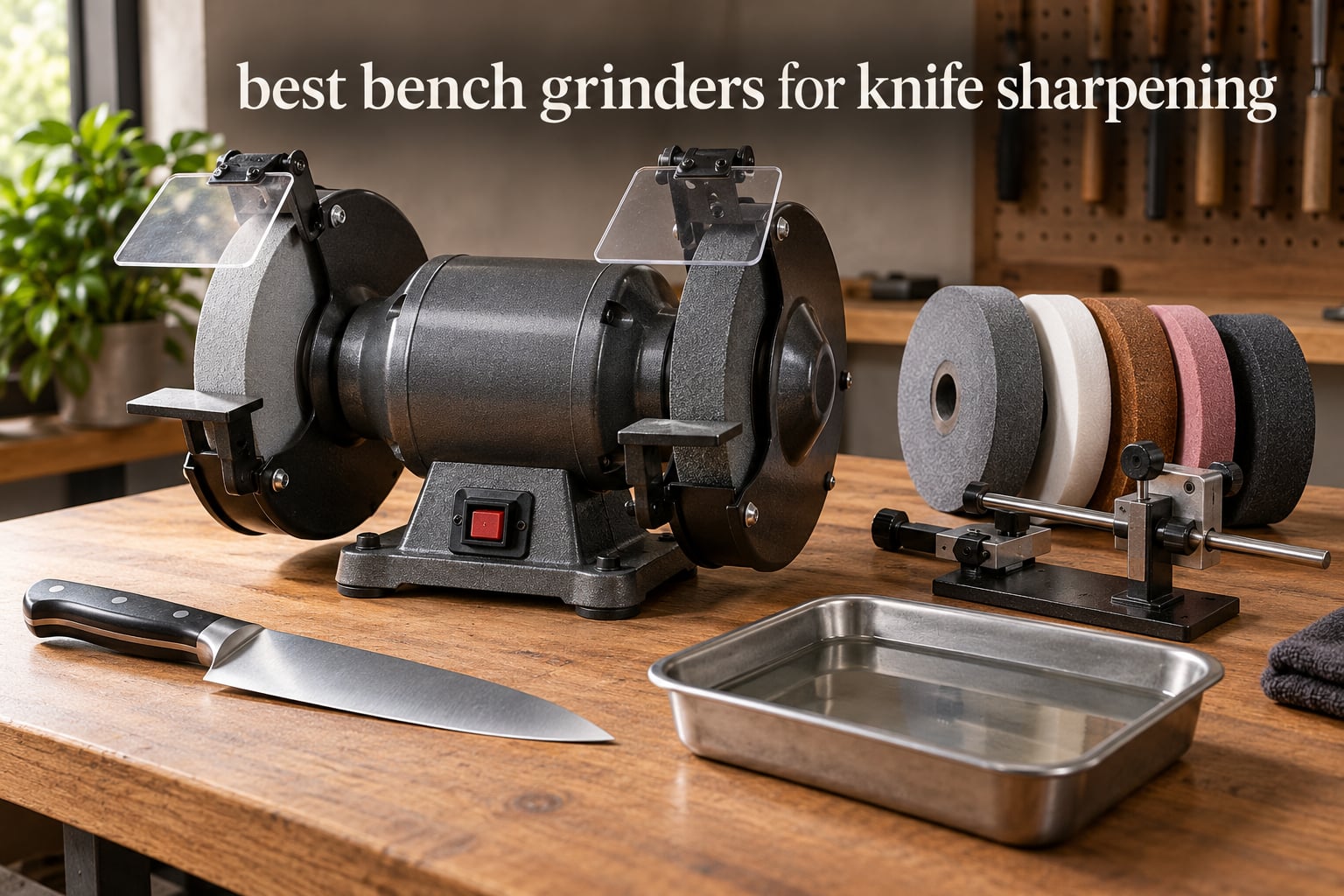
The most common mistake people make with a bench grinder is treating it like a knife sharpener. It is not one. A 3600 rpm wheel cuts a hardened edge fast enough to strip the temper off the steel in seconds, and once the steel turns straw, bronze, or blue, no amount of honing brings the hardness back. Almost every roundup we read while researching this one skips that warning entirely.
So here is the honest framing before we get to the list. The best bench grinders for knife sharpening are not the ones with the most horsepower or the highest RPM. They are the ones that let you control speed, hold a rigid tool rest, and finish with a fine wheel. We compared ten bench grinders on the specs that actually decide whether your knife survives the session: no-load speed, wheel grit and material, motor rating, base mass, and whether the tool rest flexes.
Two thresholds came out of that work and we use them throughout this guide. For knife work, stay under 2000 RPM. Above 3000 RPM, save the machine for rough material removal and deburring, and cool the edge in water every few seconds. If a machine cannot give you either low speed or a variable dial that reaches low, it is a general workshop grinder that happens to accept knives, not a sharpening-first tool.
We also have to be straight about the ceiling. A bench grinder alone will not produce a true razor edge. It removes metal fast and it removes the burr, but finishing the edge still means honing on a stone or stropping on leather. Think of the grinder as stage one and the strop as stage four. If you want the whole chain in a single machine, our guide to sharpening systems for kitchen knives covers the belt and wet systems side by side.
Top 3 Bench Grinder Picks for Knife Sharpening in 2026

DEWALT DW758 8-Inch Bench Grinder
- 3/4 HP induction motor
- 3600 rpm
- Cast iron base
- Precision-machined aluminum tool rests
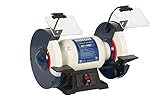
RIKON 80-805 8-Inch Slow Speed Grinder
- 1750 RPM low speed
- 60 and 120 grit white aluminum oxide
- Wheel dresser included
- Five-year warranty
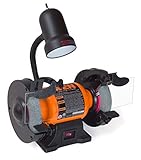
WEN BG4276 6-Inch Bench Grinder
- 2.1 amp motor
- 3450 rpm
- 36 and 60 grit wheels
- Flexible work light
The DEWALT DW758 takes the editor’s choice on the strength of the widest combination of rating and review volume in the group, backed by a 3/4 HP induction motor and a cast iron body that does not walk across the bench. The RIKON 80-805 is the sharper knife choice: 1750 RPM and fine white aluminum oxide wheels make bluing far harder to do by accident. The WEN BG4276 is the one to buy if you want a quiet, low-vibration machine for occasional edge repair and nothing exotic.
Best Bench Grinders for Knife Sharpening (October 2026)
| Product | Specifications | Action |
|---|---|---|
| DEWALT DW758 8-Inch Bench Grinder |
|
Check Latest Price |
| WEN BG4276 6-Inch Bench Grinder |
|
Check Latest Price |
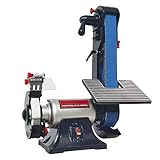 BUCKTOOL 2×42 Belt and Grinder Combo BUCKTOOL 2×42 Belt and Grinder Combo |
|
Check Latest Price |
| RIKON 80-805 8-Inch Slow Speed Grinder |
|
Check Latest Price |
 WEN BG4270T 10-Inch Wet Sharpening System WEN BG4270T 10-Inch Wet Sharpening System |
|
Check Latest Price |
 BUCKTOOL 6-Inch Low Speed Grinder BUCKTOOL 6-Inch Low Speed Grinder |
|
Check Latest Price |
 Woodskil 6-Inch High Speed Grinder Woodskil 6-Inch High Speed Grinder |
|
Check Latest Price |
 BUCKTOOL 8-Inch Low Speed CBN Grinder BUCKTOOL 8-Inch Low Speed CBN Grinder |
|
Check Latest Price |
 VEVOR 8-Inch Grinder and Belt Combo VEVOR 8-Inch Grinder and Belt Combo |
|
Check Latest Price |
 WEN BG4108 8-Inch Wet Sharpening System WEN BG4108 8-Inch Wet Sharpening System |
|
Check Latest Price |
1. DEWALT DW758 – The Heavy-Duty All-Rounder
DEWALT DW758 8-Inch Bench Grinder
3/4 HP induction motor
3600 rpm wheel speed
8 inch wheels
Cast iron base and housing
Pros
- 3/4 HP induction motor holds up under load
- Rugged cast iron base and housing
- Precision-machined wrench-adjustable aluminum tool rests
- 12.5 inch between wheels suits long chisels
- Quiet at idle
Cons
- Some grinders come with wheels that need truing
- Poor assembly documentation
- Narrow 1.5 inch tool rests
- Mismatched fastener spec needs a 10 mm wrench
The DW758 is the machine we kept coming back to. Its 3/4 HP induction motor is the most we found in this group, and that power matters more than the RPM figure suggests because it means the wheel does not bog down when you take a real bite out of a dull edge.
Reviewers describe it as a long-lived workhorse. Owners consistently praise the cast iron base and motor housing for durability, and the precision-machined aluminum tool rests are wrench-adjustable, which is what you want when you are dialing in a bevel angle rather than just touching an edge to stone.
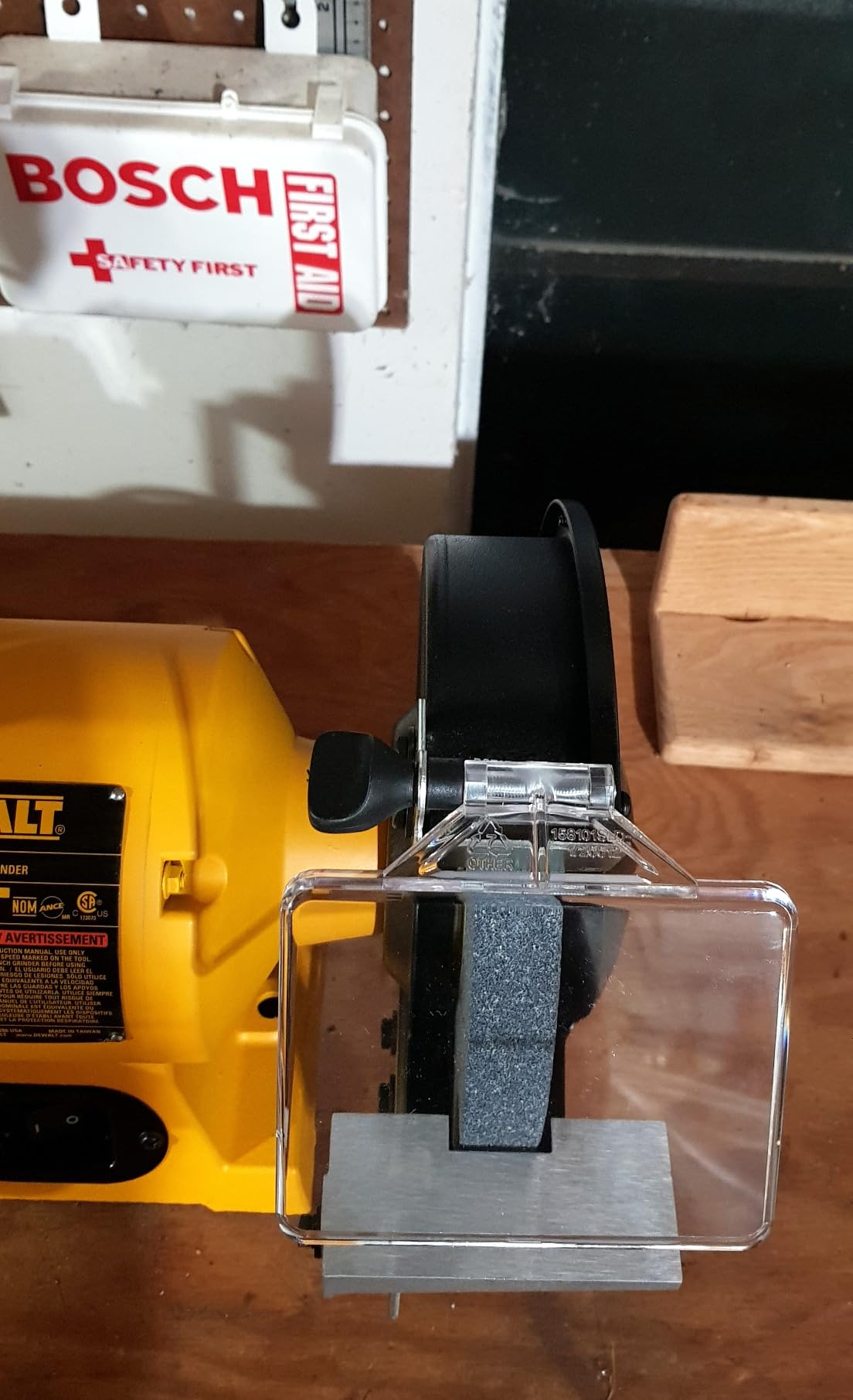
The catch is speed. At 3600 rpm this is a workshop machine for general grinding, and a thin kitchen knife held against that wheel will heat in seconds. We would use it for reprofiling a dull 20-degree chef’s knife with frequent water dips, then move to a finer wheel or a stone to finish.
Rear exhaust ports in the wheel guards and adjustable eye shields come standard, and the 12.5 inch gap between wheels is the widest in the group, which is genuinely useful for longer workpieces like plane irons and scabbards.
Is the DW758 right for fine knife edges?
Only if you manage the heat. There is no speed control on this machine, which means your entire heat strategy depends on grit choice, pressure, and how often you dip. Owners who ruined edges on this grinder almost always describe the same mistake: holding a thin blade at one spot too long.
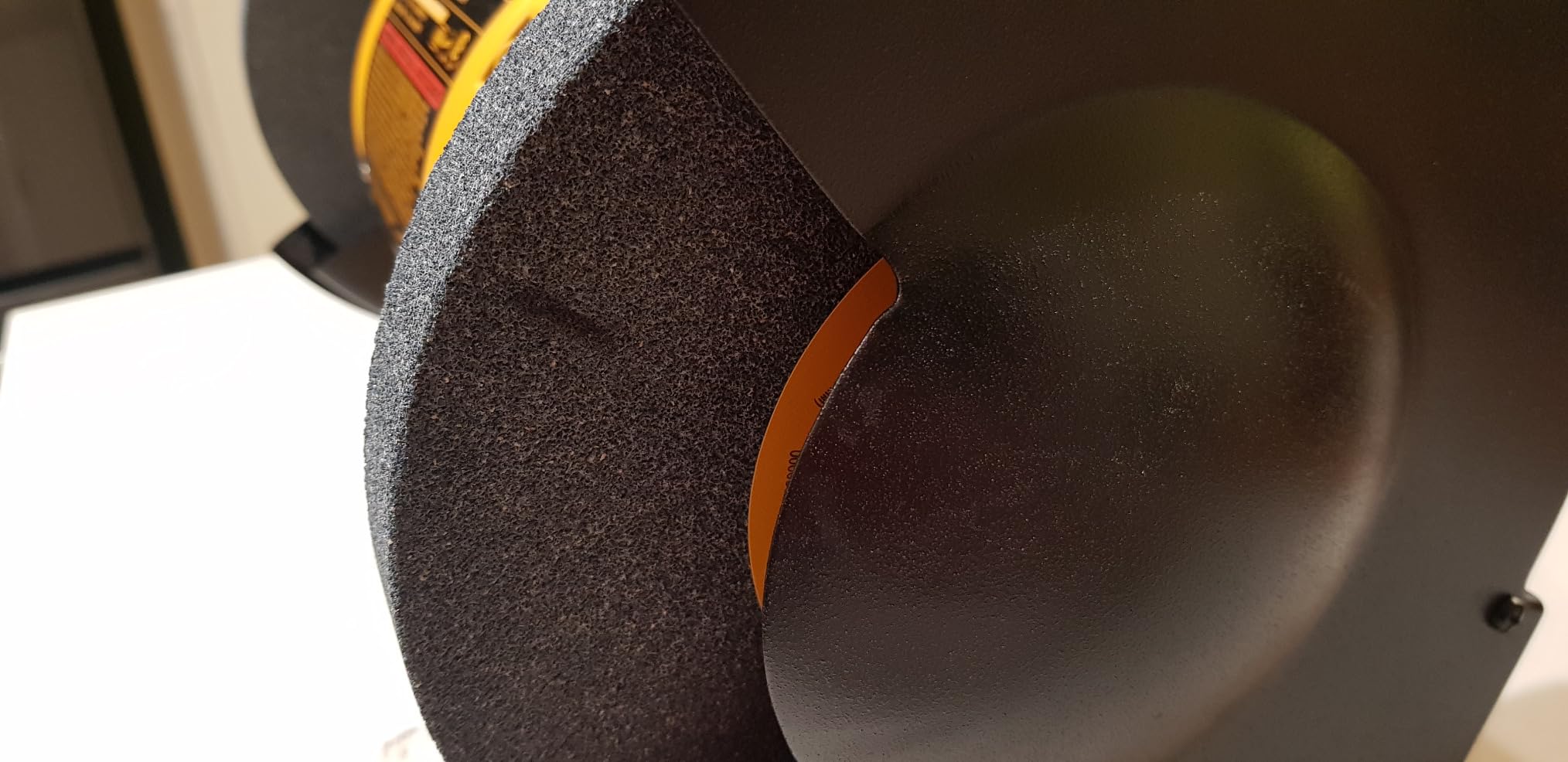
Swap the 60 grit wheel for something finer before you touch a quality edge and the picture improves a lot. Reviewers report that truing the supplied wheels also fixes the walking-across-the-bench problem that shows up on a minority of grinders.
Where it falls short
The included wheels are the weak point. Reviewers report out-of-balance wheels on some grinders, and a handful solved it by truing the wheels or fitting aftermarket ones. Assembly documentation is also criticized as sub-par, with parts described in tiny print.
The tool rests measure 1.5 inch wide at the wheel face, which is narrower than the broad cast aluminum rests you get on the slow-speed machines later in this list. If you plan to fit a sharpening jig, that narrow face matters.
2. WEN BG4276 – Quiet, Compact and Hard to Upset
WEN BG4276 2.1-Amp 6-Inch Single Speed Bench Grinder with Flexible Work Light, Black,orange
2.1 amp motor
3450 rpm
6 inch by 3/4 inch wheels
Flexible work light
Pros
- Quiet with minimal vibration
- Soft spin-up avoids walking on the bench
- Flexible work light really helps
- Handles dull chisels and bits
- Easy to assemble
Cons
- Supplied wheels are mediocre and can unbalance
- No bulb included for the work lamp
- Long spin-up and coast with no brake
- Awkward mounting hole placement
This is the budget machine we recommend to anyone who wants to sharpen knives occasionally without turning their bench into a shed. The soft spin-up is the detail that matters most in daily use: it does not jump or walk, so you can put it on a bench without bolting it down.
Reviewers call it nearly silent with low vibration, and they credit the bearings and rubber feet for that. The flexible work light is singled out as useful, though no bulb is included for the work lamp, which is the first thing you will need to buy.
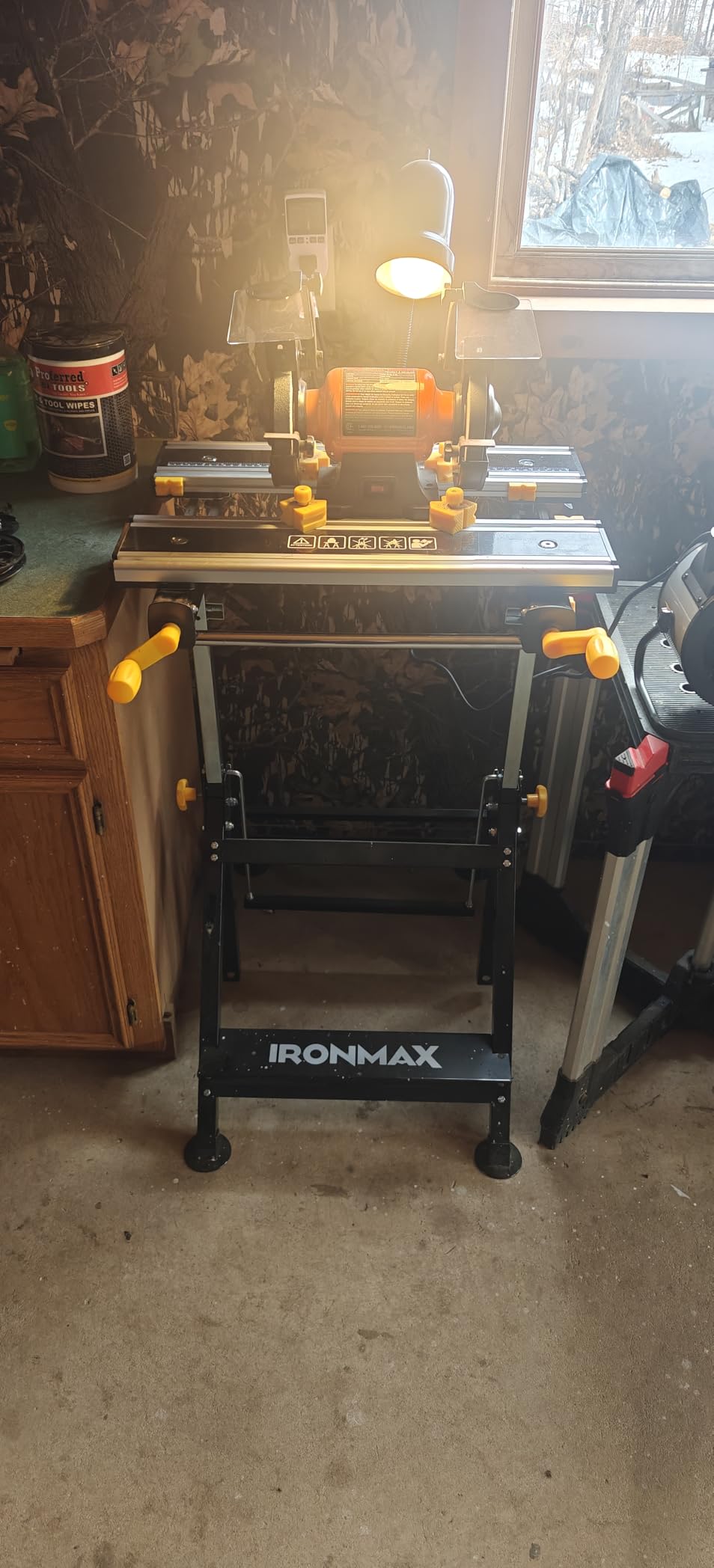
The 2.1 amp motor is enough to revive dull bits, chisels, and knives without drama. It is not enough for serious material removal, and at 3450 rpm it produces more heat than you want near a fine edge.
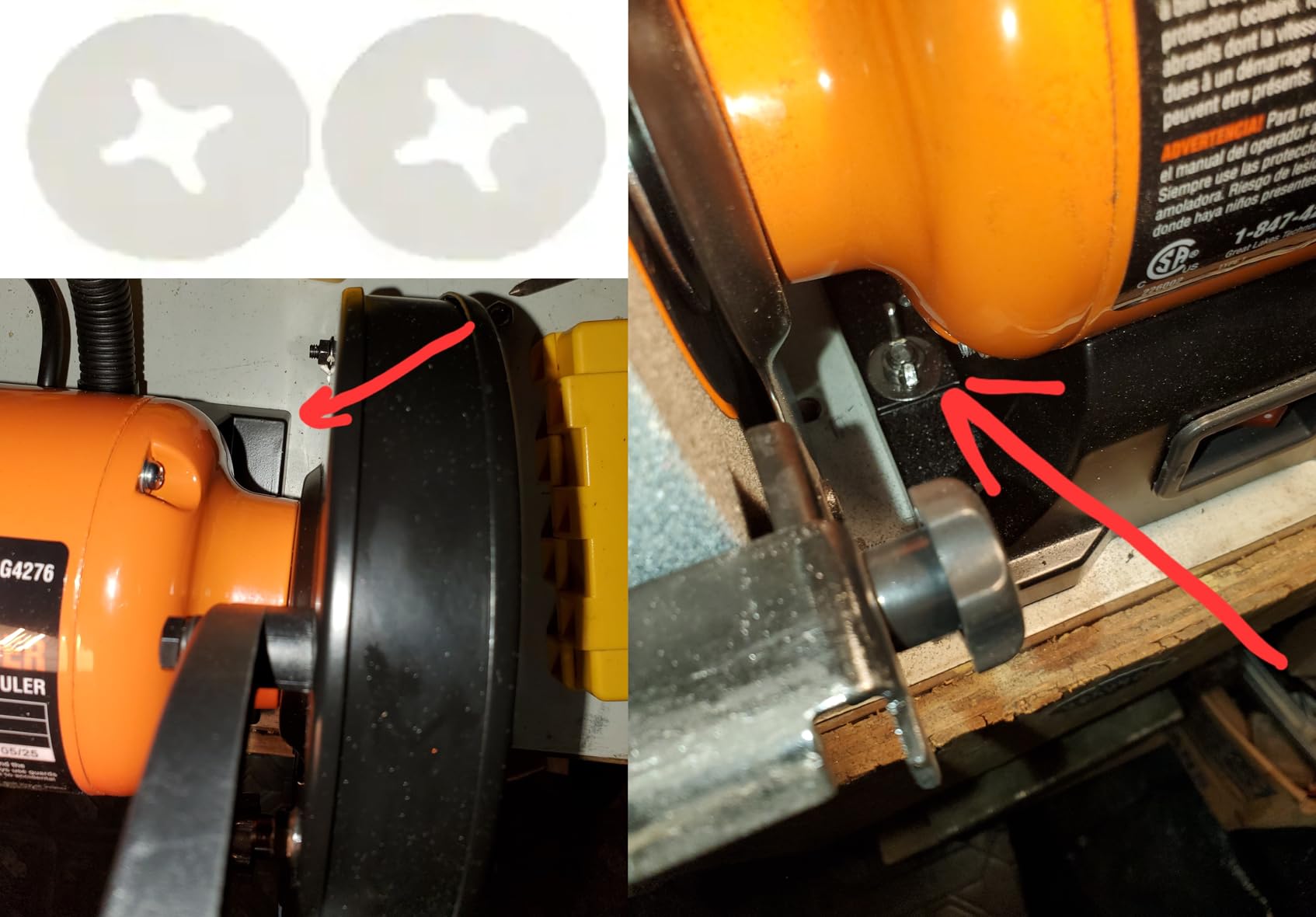
Worth noting for your setup: the mounting holes sit mid-plate under the motor shaft, so top-down bolt installation is awkward. If you plan to bolt this one down, budget extra time for that step.
Who should buy the BG4276?
Home cooks with a small knife collection who want something quiet and forgiving. Reviewers report that it exceeds expectations for what it costs, and the tool rests are easy to fine-tune by hand without tools.
It also works as a general shop machine for bits, chisels, and axes. If your knife work is one session a month rather than a weekly habit, this is the honest answer.
Where it falls short
The supplied wheels are the recurring complaint. Reviewers describe them as mediocre quality that can cause imbalance, so plan on dressing them before first use or buying a decent 60 grit white aluminum oxide wheel.
Spin-up takes roughly 25 to 30 seconds and it can coast for up to two minutes with no motor brake. That is fine for shop work and mildly annoying when you are making small corrections.
3. BUCKTOOL 2×42 Combo – Coarse Shaping and Fine Finishing in One Box
BUCKTOOL 2×42″ Belt Sander 6″ Bench Grinder Combo for Metalworking,3.5A
1/3 HP 3.5 amp motor
3450 rpm wheel
2 x 42 inch belt at 4480 FPM
Cast iron base
Pros
- Coarse wheel then fine belt in one machine
- Belt tilts 0 to 90 degrees with swiveling housing
- Quick-release belt tension and tracking
- Cast iron table supports metal work
- LED light and tool-free eye shield
Cons
- Tall and deep footprint needs real bench space
- Supplied wheel and belt may need dressing
- 1/3 HP motor is modest for heavy removal
The logic of a combo machine is simple: the wheel does coarse shaping and the belt does the refining, so you finish an edge in the same session without moving it across the shop. For knife makers working through a batch of blanks, that saves a lot of time.
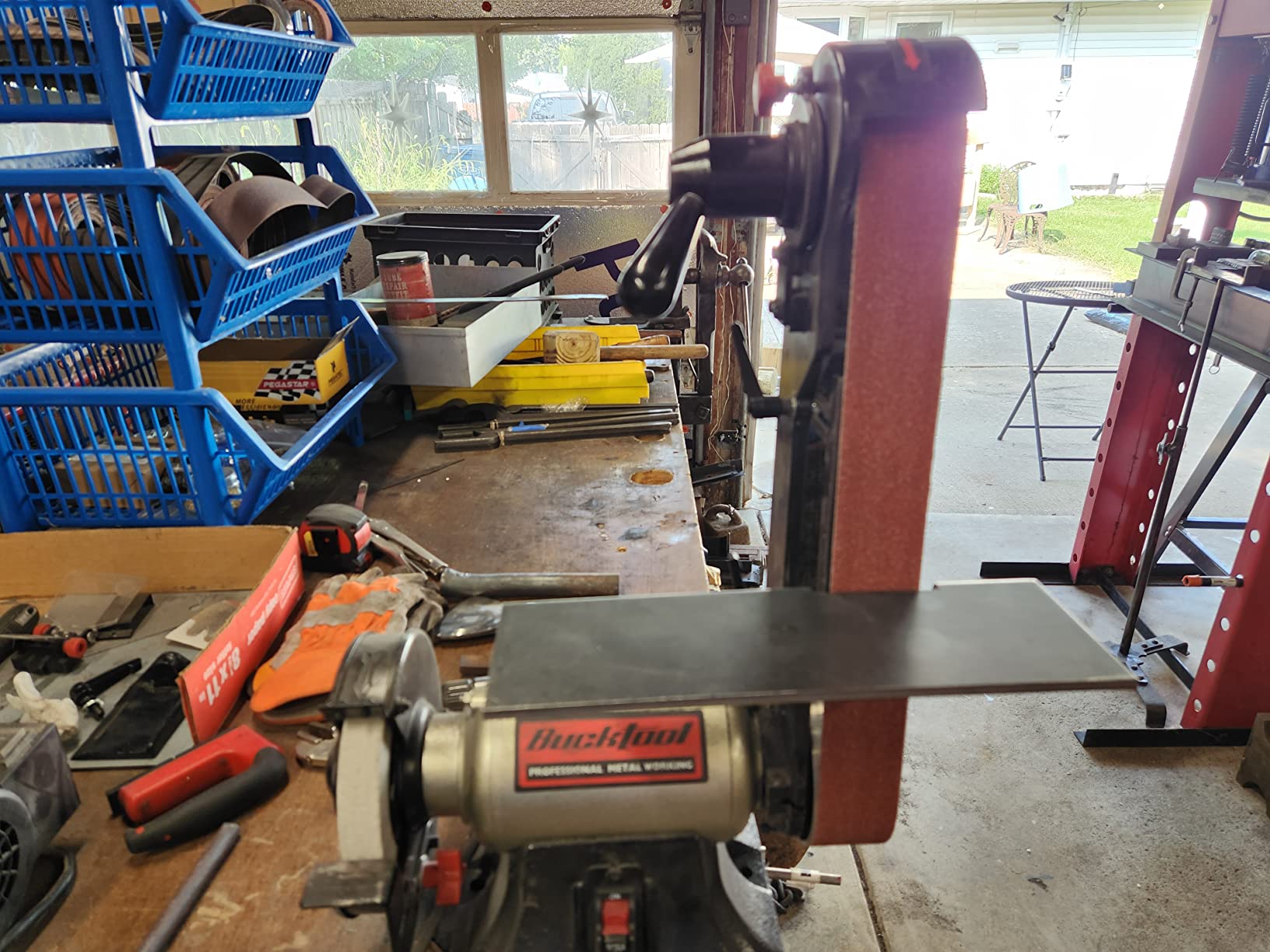
Reviewers highlight the tilt and swivel features and the two worktables, one cast iron for metal and one cast aluminum for wood. The cast iron table is the relevant one here because it gives the knife a solid support while you work.
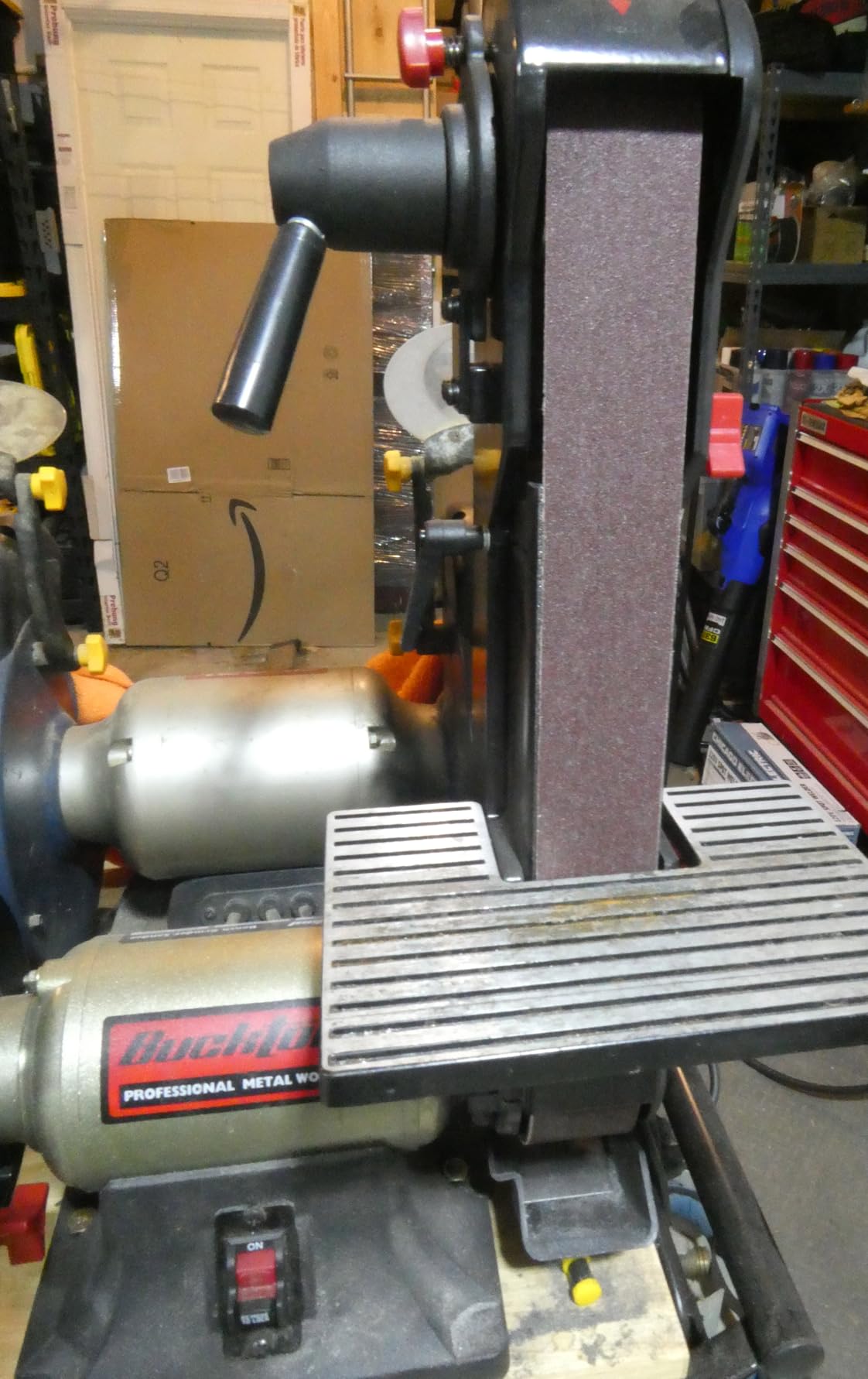
The quick-release belt tension and tracking mechanism gets called out frequently as a genuine time saver when you are swapping grits mid-project. The LED work light and the tool-free adjustable eye shield are both more than you would expect at this tier.
The 6-inch wheel runs at 3450 rpm with 60 grit white abrasive. Belt speed is 4480 FPM, and the 1/3 HP motor handles general purpose finishing without straining.
Is a belt grinder better than a wheel for knife work?
The belt gives you a wider, cooler contact area than a wheel, and it does not dish the same way when you work on a bevel. That makes it a better finishing surface, not a better shaping surface.
If you already own a solid bench grinder, this is an addition rather than a substitute. If you are starting from nothing and your knife work is more than occasional shaping, the pairing covers both stages. We cover dedicated belt machines separately in our guide to the best stationary belt grinders for knife makers.
Where it falls short
Size is the big one. At 24.53 inches tall and nearly 18 inches deep, this needs a dedicated section of bench, and reviewers call out the footprint specifically.
Some buyers report the initial wheel and belt needing dressing or truing before results become consistent, and the 1/3 HP motor is not meant for bulk material removal.
4. RIKON 80-805 – The Slow-Speed Answer to Bluing
RIKON 80-805 Professional 8-Inch Low Speed Bench Grinder, 1/2 HP, 1750 RPM
1/2 HP at 1750 RPM
8 inch 60 and 120 grit white aluminum oxide wheels
Cast iron base
Five-year warranty
Pros
- 1750 RPM minimizes sparks and heat
- Anti-vibration rubber feet steady the machine
- Heavy stable cast iron base
- Diamond wheel sharpener included
- Built-in drill bit groove
- Five-year warranty
Cons
- Slower removal on heavy material removal jobs
- Heavier and bulkier than 6 inch machines
- Low speed needs more passes for a full bevel
If you only take one machine from this guide for knives specifically, this is the one. The entire design runs against the usual grinder logic: 1750 RPM, fine white aluminum oxide wheels in 60 and 120 grit, and a heavy cast iron base with anti-vibration rubber feet.
Owners consistently cite the low speed as the standout feature, noting far less spark and heat than high-speed grinders and much easier control. On a knife edge, that difference is the whole ballgame.
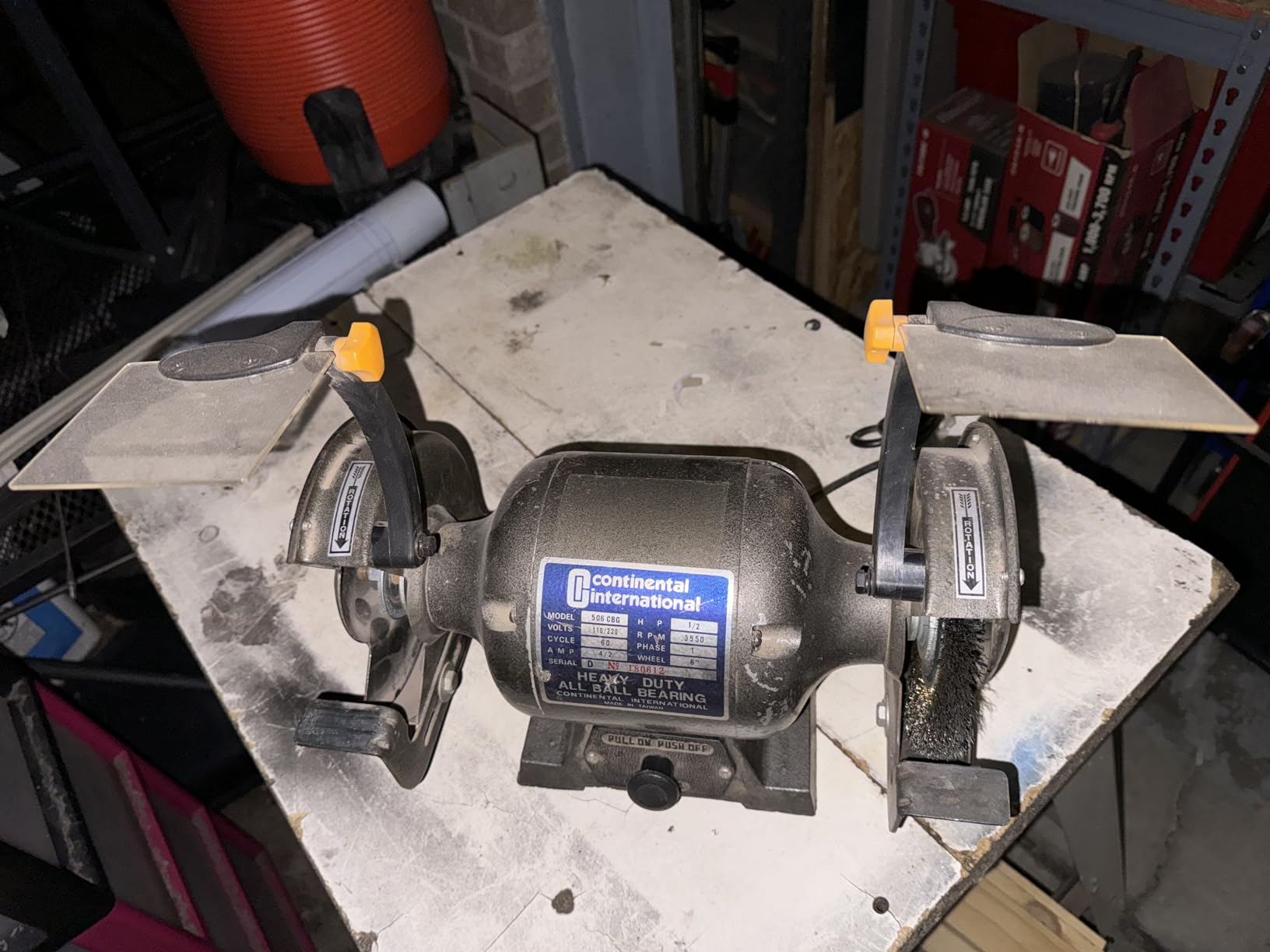
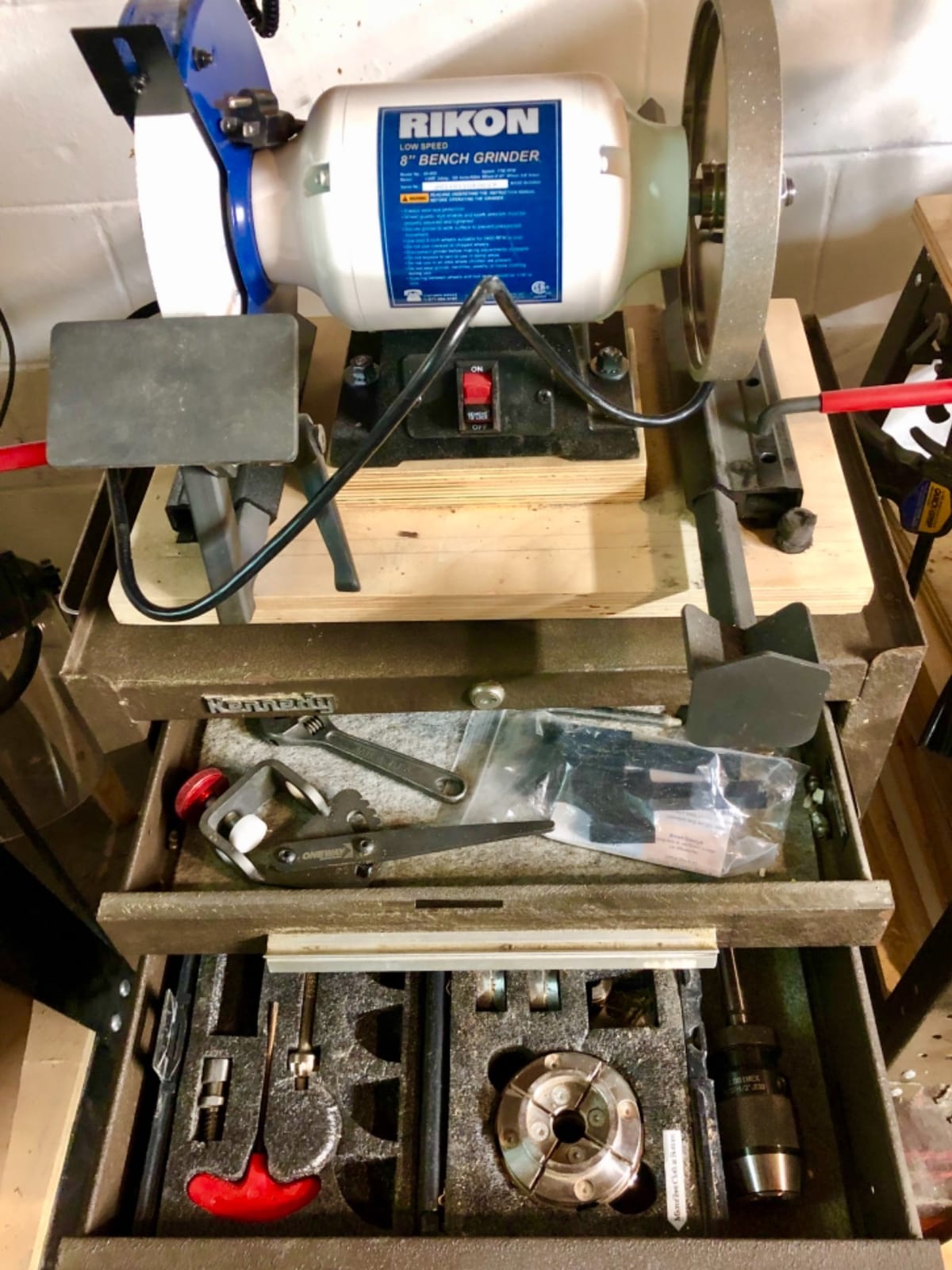
The wheel specification is the part to understand. 60 grit white aluminum oxide reshapes a damaged edge, and 120 grit refines it. Both are white aluminum oxide, which cuts cooler than silicon carbide, and the included diamond wheel sharpener is a finishing stone that reduces heat build-up further.
There is also a built-in groove in the tool rest for sharpening drill bits, which is a small thing that ends up being used constantly once you own one.
Why low speed wins for knife edges
Heat is generated by friction at the contact point, and frictional heat scales with surface speed. Halving the wheel speed roughly halves the heat you dump into the edge, which is why a 1750 rpm wheel forgives mistakes that ruin a blade at 3450 rpm.
On r/sharpening and Sawmill Creek, users repeatedly pair low-speed bench grinders with CBN wheels as the ideal knife combination, praising the low heat and fast material removal together. The RIKON is one of the few stock machines in this list that pairs low speed with enough torque to drive that kind of wheel.
Where it falls short
Speed. At 1750 RPM, material removal is slow, and owners note that bulk grinding takes longer than on a high-speed machine. Some also find that forming a full bevel needs more passes than they expect.
At 16.65 kg it is heavier and bulkier than the 6-inch machines here. Plan your bench mounting before it arrives.
5. WEN BG4270T – The Wet System That Removes the Burn Question
WEN BG4270T 10-Inch Two-Direction Water Cooled Wet/Dry Sharpening System
10 inch 220 grit stone
8 inch leather stropping wheel
115 RPM
Two-direction rotation
Pros
- Water cooling prevents burning hardened steel
- Very fast on plane irons and chisels
- Universal jig bar accepts Tormek jigs
- Reversible rotation suits both hands
- Angle guide and honing compound included
Cons
- Accessory bar is low quality with too much play
- Mount bar is short and jigs can slide off
- Stamped chisel jig is hard to use
- Leather strop wheel is mediocre
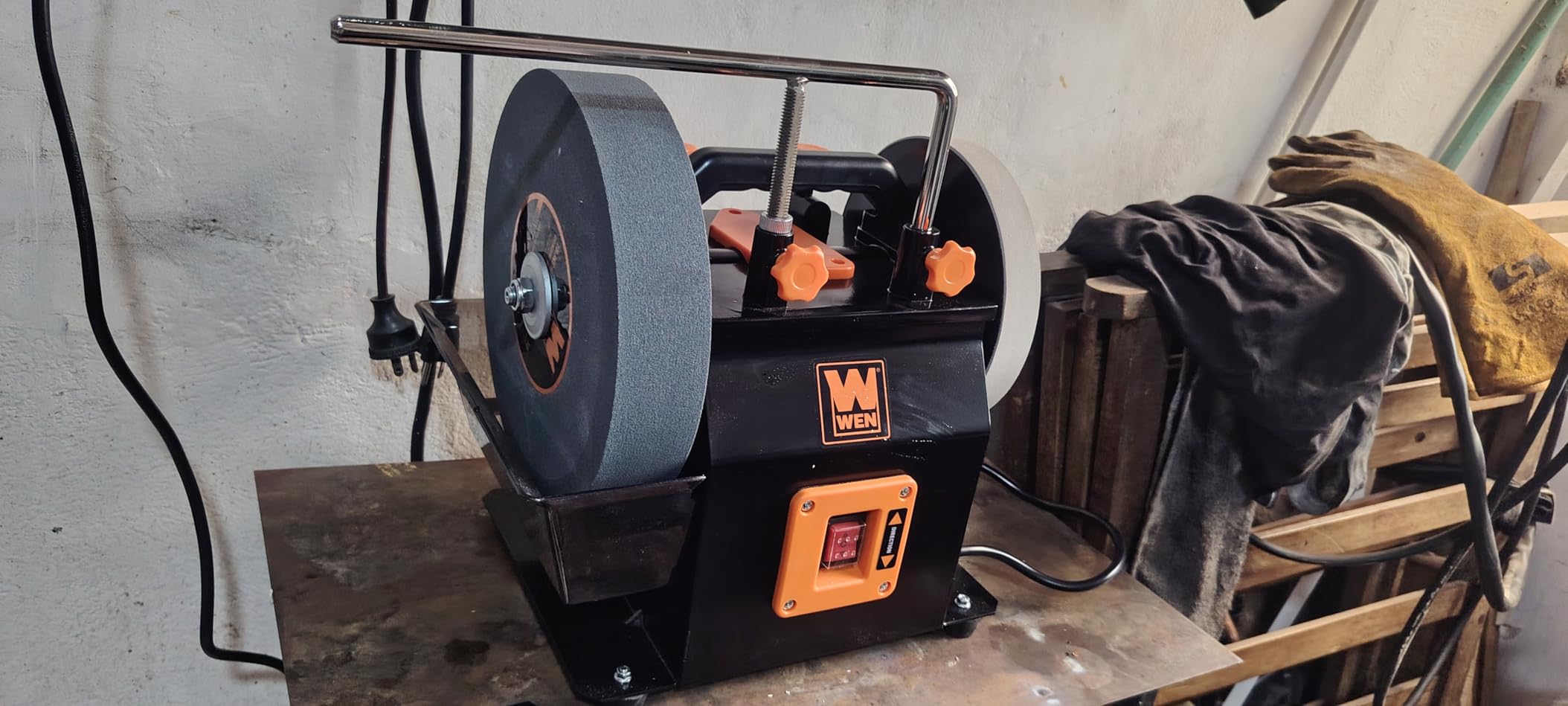
The BG4270T is not a bench grinder, and we want to be clear about that. It is a water-cooled sharpening system with a 10-inch 220 grit stone and an 8-inch leather stropping wheel. It belongs in this guide because it solves the same problem a grinder does, and it solves the heat problem completely.
At 115 RPM with a water reservoir feeding the stone, bluing is essentially off the table. Buyers compare it favorably to premium Tormek-style systems, noting quick, sharp results on chisels, plane irons, and knives at a fraction of the cost.
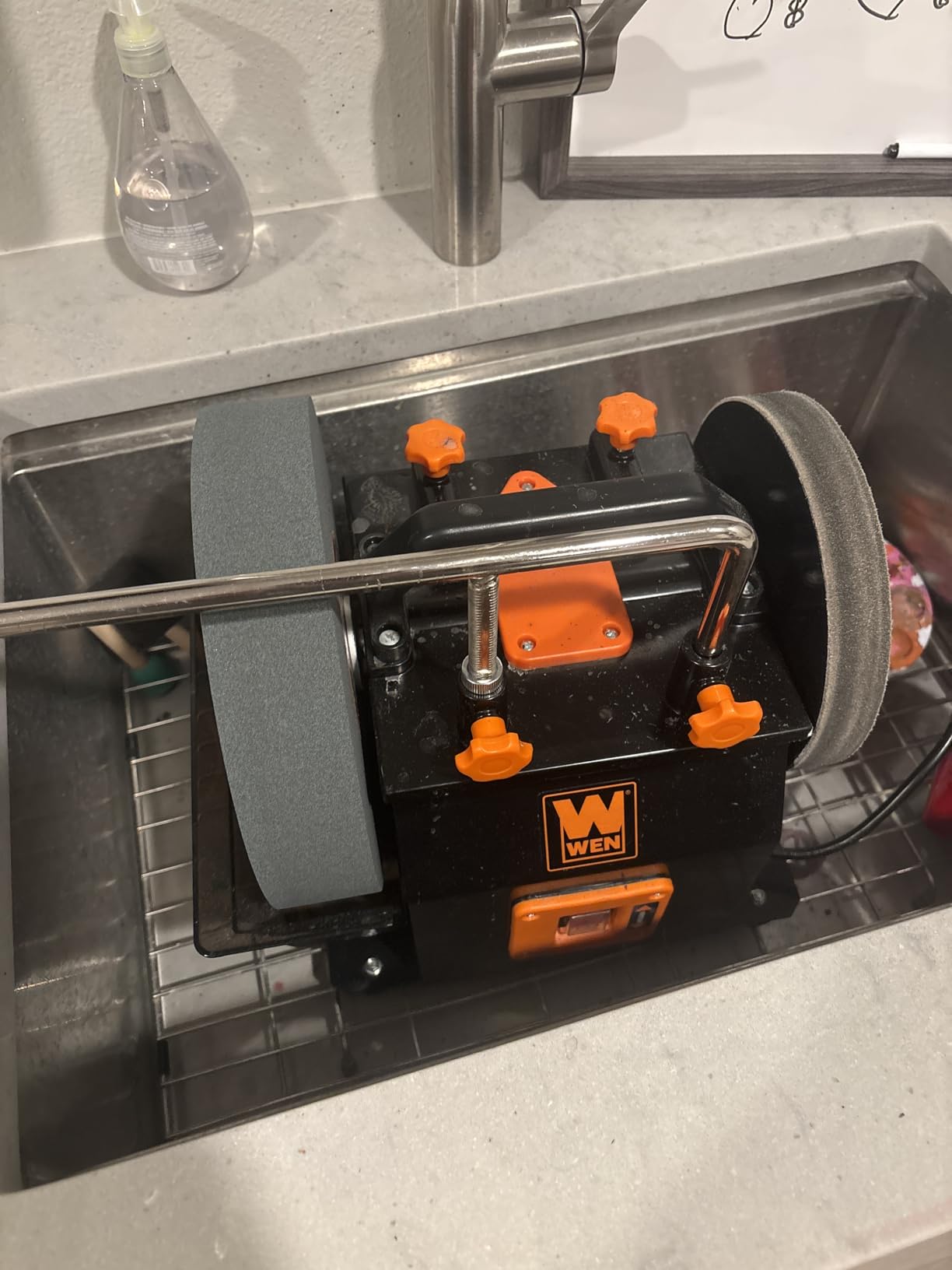
The universal jig support bar accepts Tormek jigs and accessories with an adapter nut. That is a significant advantage, because the jig is where repeatability comes from, and reviewers who add a proper Tormek jig report better repeatability than with the bundled hardware.
Rotation reverses with a simple flip switch, which suits both right- and left-handed sharpening tasks. Included are a carrying handle, an angle guide, honing compound, and a jig for chisels and planer blades.
Is a wet system better than a dry grinder for knives?
For heat control, yes, unambiguously. If your knives are thin, high-carbon, or single-bevel Japanese steel, water cooling removes the risk that makes people afraid of grinders in the first place.
The trade is speed and grit. A 115 RPM system removes metal slowly, and a 220 grit stone is a shaping surface, not a finishing one. You finish on the leather strop wheel, which is included.
Where it falls short
The accessory bar is the consistent complaint across reviews. It has too much play and drifts out of parallel with the stone when tightened, and it is short enough that jigs can slide off the end when working across the full stone width.
The bundled chisel jig is stamped steel, hard to use, and its stops do not work on a standard-length chisel. The leather wheel is also described as mediocre and difficult to reattach.
6. BUCKTOOL 6-Inch Low Speed – Compact Sharpening-First Grinder
BUCKTOOL 6″ 1/3HP Low Speed Bench Grinder,High Precision Wobble Free Wheels
1/3 HP at 1750 RPM
60 grit brown aluminum oxide and 80 grit white aluminum oxide
6 inch wheels
Two-year warranty
Pros
- 1750 RPM suits knives chisels and axes
- Low vibration from the rubber-footed base
- Tool-free adjustable work rest
- Brown and white aluminum oxide wheel pair
- Eye shields and spark arrestor included
Cons
- 1/3 HP motor bogs down on heavy work
- Wheels need dressing or truing over time
- Cast aluminum base is lighter than cast iron
This is the RIKON approach in a smaller package. The 1750 RPM speed is the same design decision, and it shows up in reviews exactly as you would expect: owners highlight controlled, accurate sharpening of chisels, plane irons, axes, and knives.
The wheel pairing here is interesting. A 60 grit brown aluminum oxide wheel for shaping and an 80 grit white aluminum oxide wheel for finishing gives you more grit separation than a standard 36 and 60 pair, which is exactly what a knife bevel wants.
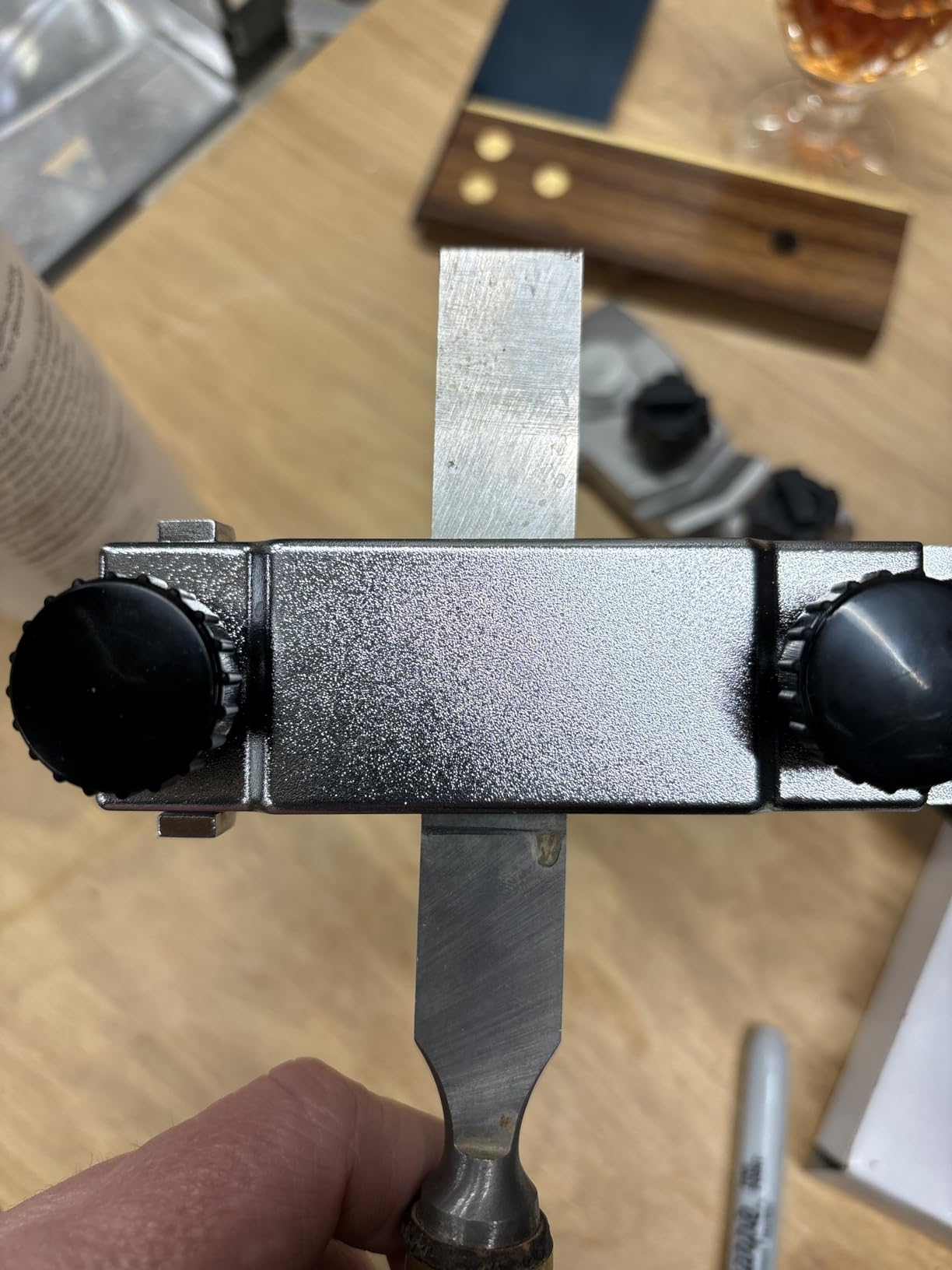
At 10.16 kg with a 6-inch footprint, this is the machine to buy if your bench space is limited or you want to move it between a garage and a kitchen. The tool-free adjustable work rest means setup changes take seconds.
Review sentiment is strong on this one, with 83 percent of reviews at five stars. Low vibration from the rubber-footed cast aluminum base is mentioned repeatedly as a contributor to control.
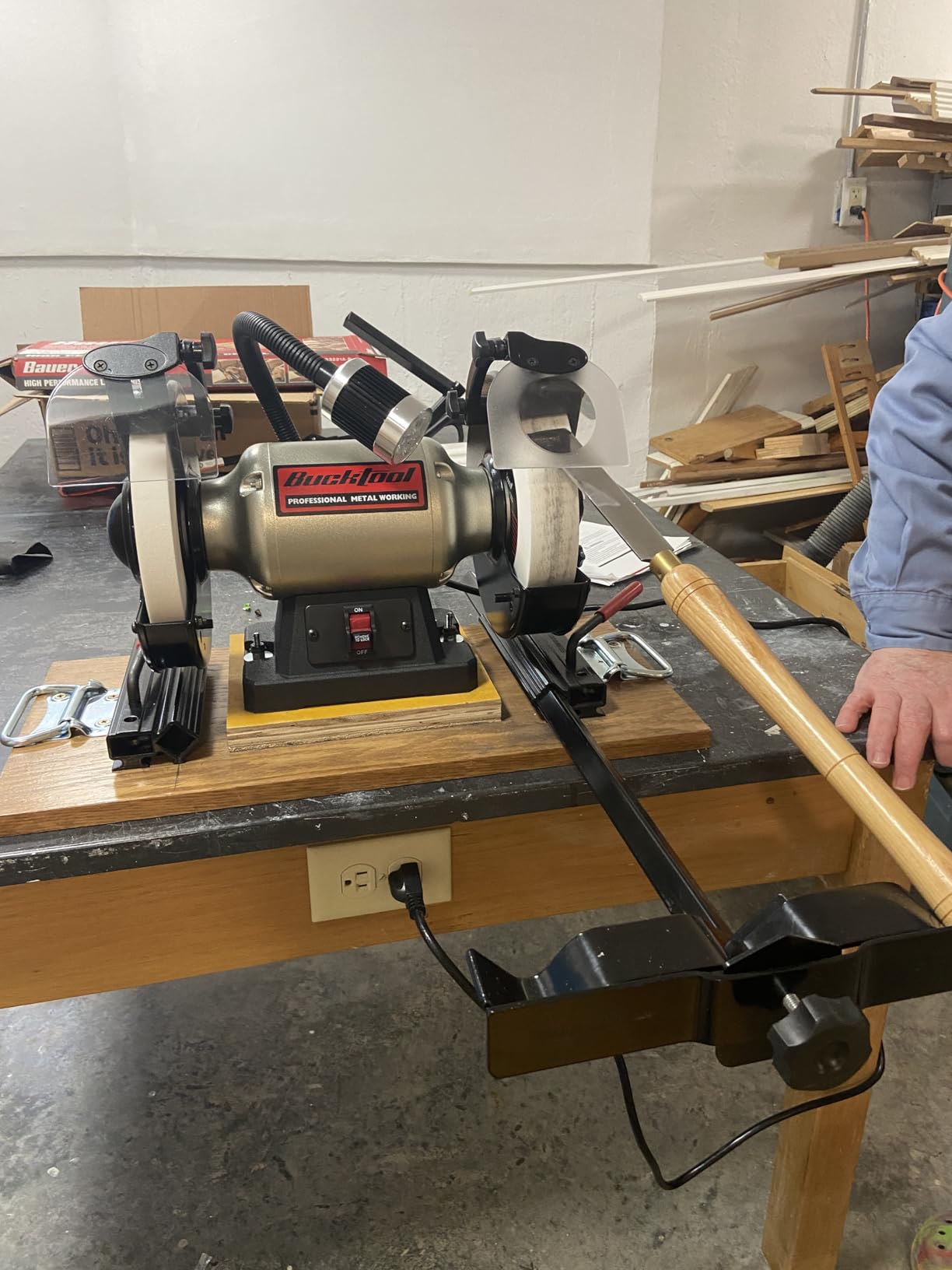
How does it compare with the RIKON?
The RIKON has more torque at 1/2 HP, an 8-inch wheel with more contact area, and a five-year warranty against two years here. This one is smaller, lighter, and roughly half the size on the bench.
If you have the bench space and sharpen heavy stock as well as knives, the RIKON is the better machine. If you sharpen mostly thin kitchen edges in a small shop, this does the same job with less commitment.
Where it falls short
The 1/3 HP motor is the honest limitation. Owners note it is fine for sharpening but not for heavy material removal, where it bogs down.
Because the base is cast aluminum rather than cast iron, it is lighter, so more mounting care is needed to stop it moving. Wheels will need dressing or truing over time to stay true.
7. Woodskil 6-Inch High Speed – Best for Rough Work, Not Final Edges
Woodskil 6″ 1/2HP High Speed Bench Grinder for sharpening,CSA Listed
1/2 HP 2.8 amp motor at 3450 RPM
6 x 3/4 x 1/2 inch wheels
36 and 60 grit aluminum oxide
CSA certified
Pros
- 1/2 HP at 3450 RPM removes material fast
- Pre-drilled steel base is wobble-free
- 36 and 60 grit wheels cover shaping and polishing
- CSA certified with eye shield and spark arrestor
- Light enough to move between benches
Cons
- High speed produces more spark and heat
- Lightweight base is less vibration damped
- Wheels need dressing before first use
- No work light or drill bit groove
The Woodskil sits at the opposite end of the speed spectrum from the two low-speed machines above it, and reviewers treat it as a capable general grinder rather than a dedicated sharpener. At 3450 RPM with a 1/2 HP motor, it removes metal quickly and handles general knife and tool work well.
The pre-drilled heavy-duty steel base gets specific praise for stability. Unlike some lighter machines in this range, reviewers report a wobble-free platform.
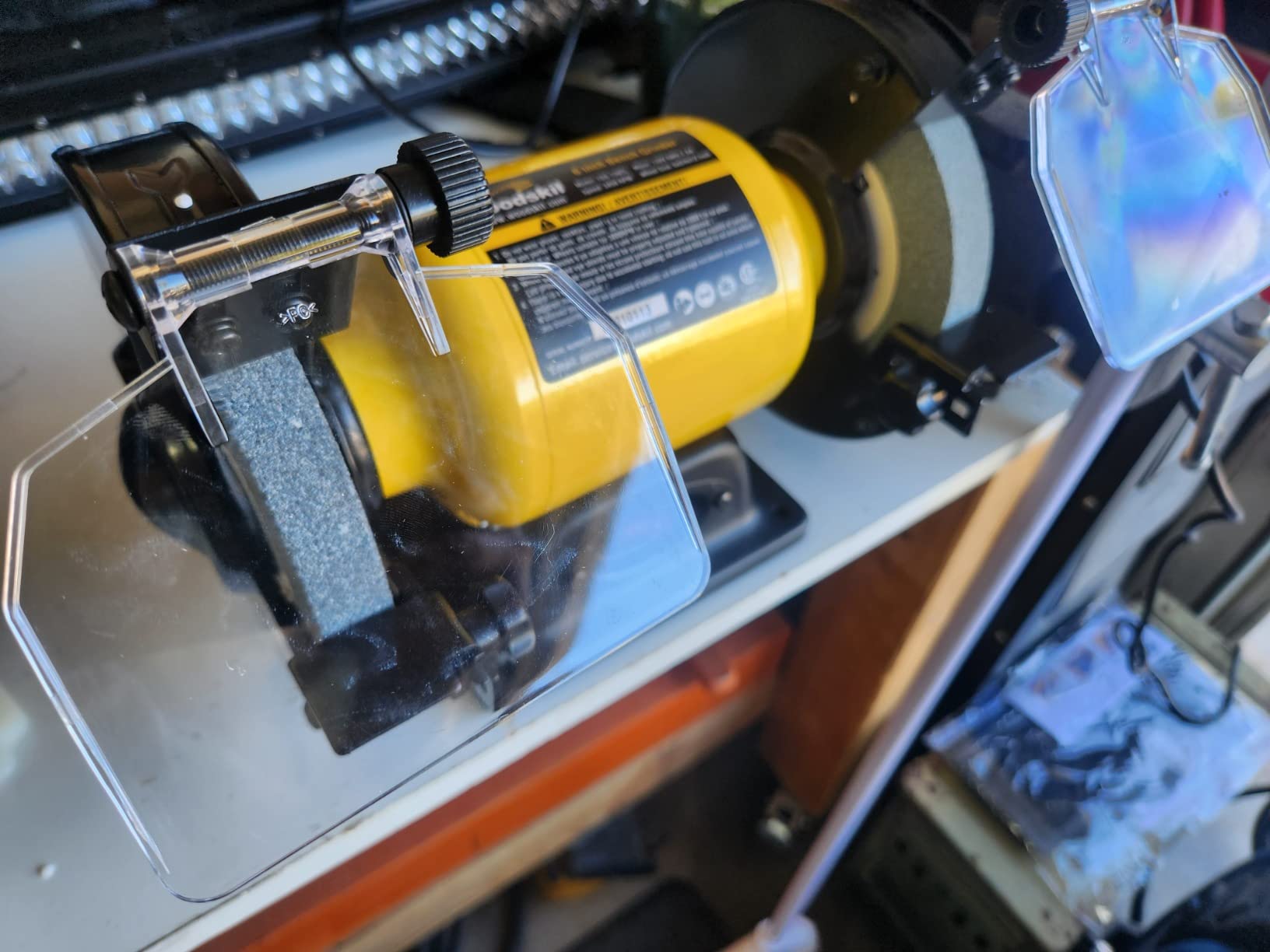
Both 36 grit and 60 grit aluminum oxide wheels come included, which covers rough shaping and finer polishing in a single machine. The wheels measure 6 x 3/4 x 1/2 inch, so 1/2 inch arbor wheels are the ones to buy for replacements.
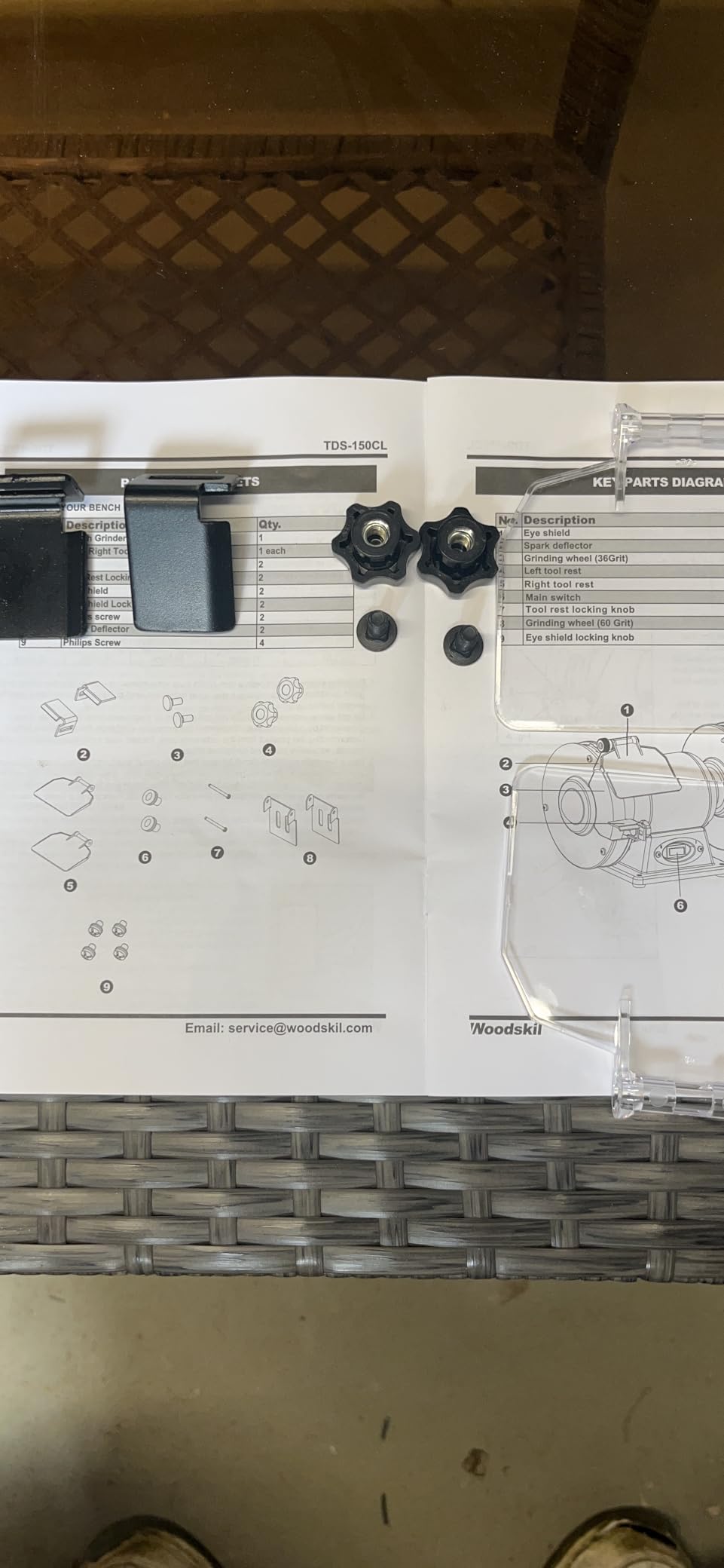
The most common advice in reviews is to dress the wheels before first use, both to reduce vibration and because it improves consistency straight away.
When is a high-speed machine the right call?
When you are reprofiling. A 20-degree bevel that has been abused or a knife with a thick, rolled edge needs fast material removal before it can be refined. At 3450 RPM this machine does that in seconds.
It also handles non-knife work well, which is where a high-speed grinder earns its keep. Bring a water tray into the session and dip every few seconds, then move the finishing stage to a stone or strop.
Where it falls short
Heat. Reviewers explicitly treat the 3450 RPM speed as higher-heat for fine edge work, and that means more care near a quality edge. There is no speed control to dial back.
It also has no work light and no drill bit sharpening groove, unlike several competitors here, and the lightweight steel base offers less vibration damping than a cast iron unit.
8. BUCKTOOL 8-Inch Low Speed – Wide Wheels That Take CBN
BUCKTOOL 8″ 3/4HP Low Speed Bench Grinder fit CBN Wheel,Wobble Free Wheels
3/4 HP rated at 1750 RPM
Narrow 8 x 1 inch 80 grit and wide 8 x 1.5 inch 120 grit wheels
Accepts 1.5 inch CBN wheels
Cast iron base
Pros
- 3/4 HP at low speed gives low heat without stalling
- Extra wide 1.5 inch face for bevels and broad blades
- Tool rests adjustable 0 to 45 degrees
- LED task light with its own switch
- 3x magnifying eye shield
- Keyed safety switch
Cons
- Low speed means noticeably longer work on heavy material removal
- Dry system so edge temperature needs managing
- Heaviest and largest unit in the group
The machine we would single out for anyone planning to get serious about sharpening. It combines a 3/4 HP rated motor with a 1750 RPM wheel speed, a pairing you rarely see, and the extra-wide wheels are built to take a 1.5 inch CBN wheel.
Sharpening-focused owners like exactly that combination: control and low heat from the speed, with enough power to drive a CBN wheel without stalling. The motor is rated 3/4 HP with a peak of 1-1/4 HP.
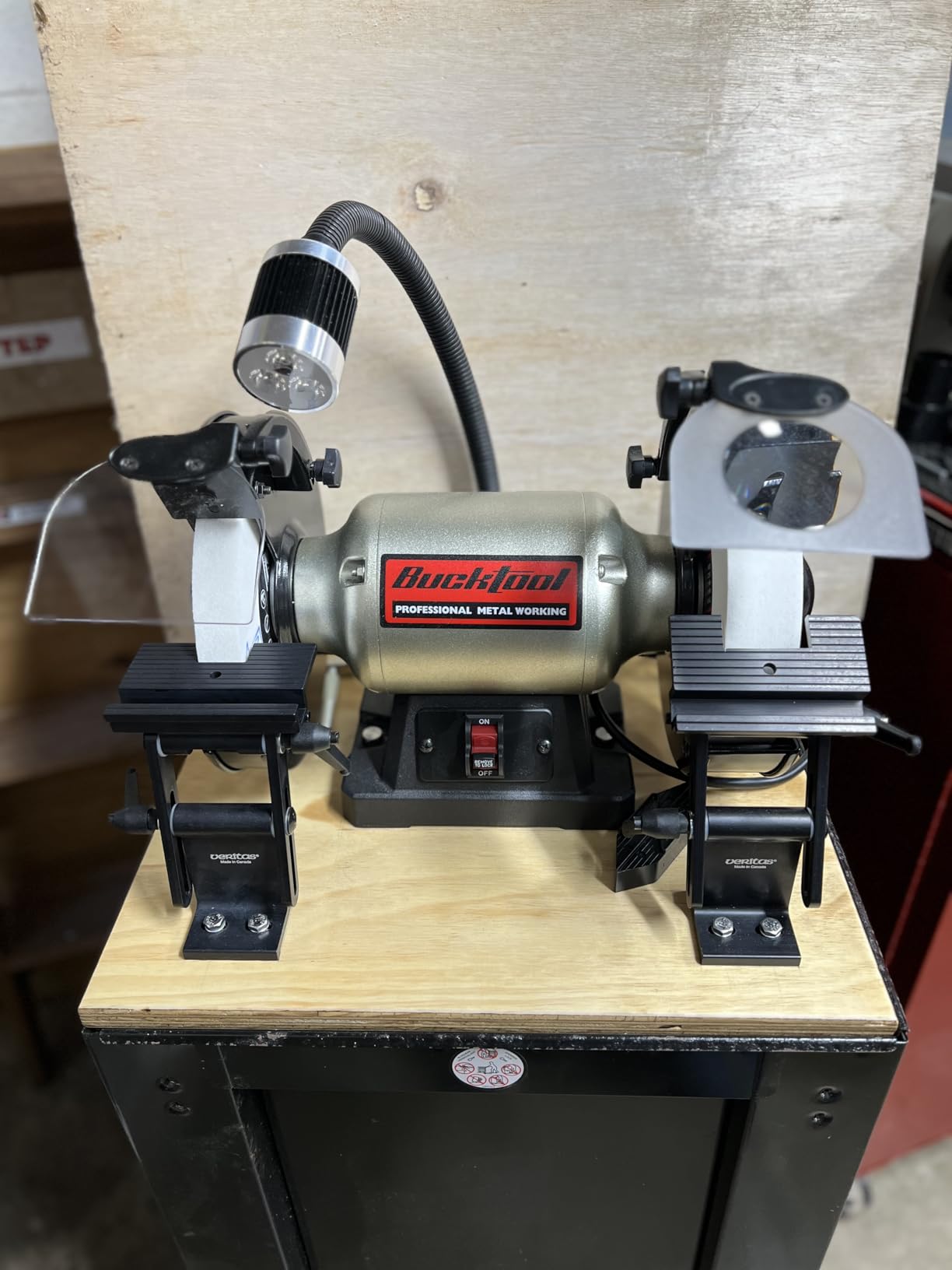
The wheel layout is asymmetric on purpose. One side runs an 8 x 1 inch 80 grit wheel and the other an 8 x 1-1/2 inch 120 grit wheel, so the wide face gives you a broad working surface for bevels and wider blades.
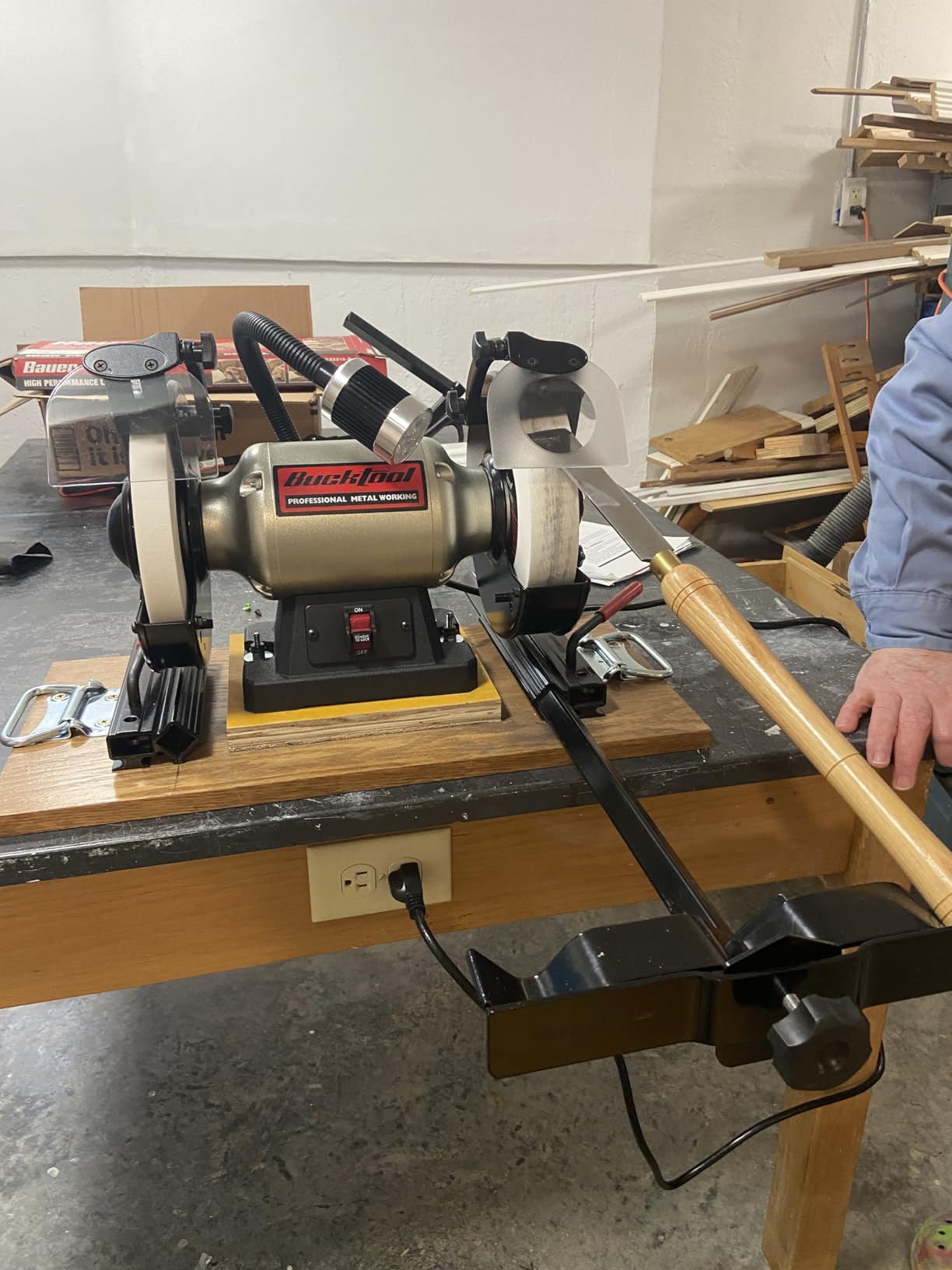
Three details separate this from every other machine here: a 3 watt LED work light with its own switch, an angle-adjustable eye shield including one with 3x magnification for judging edge finish, and cast aluminum tool rests adjustable from 0 to 45 degrees.
Do I need CBN wheels?
Not to start. But on r/handtools and Sawmill Creek, CBN wheels on a slow-speed bench grinder are repeatedly praised as the ideal knife-sharpening combination, because they cut fast, run cooler than abrasive wheels, and leave a sharper, more consistent bevel once trued.
This machine is one of the few here designed for that upgrade path. The cast iron base with rubber feet is reported as effectively vibration-free, and the wheel dresser is included, which matters more than it sounds because a CBN wheel needs regular truing.
Where it falls short
Size and weight. At 16.5 kg and the largest dimensions in this group, it needs a solidly mounted bench. Owners consistently note this as the main tradeoff.
Low speed still means noticeably longer work for bulk material removal, and this is a dry system, so edge temperature has to be managed by dipping rather than by the machine.
9. VEVOR 8-Inch Combo – Two Machines in One, Widest Rating Spread
VEVOR 8″ Bench Grinder & 2″ x 28″ Belt Sander Combo, 350W Professional Grinding Sanding Machine with LED Work Light & Protective Eye Shield for Metalworking, Woodworking, Knife Sharpening
350W 2.9 amp motor
8 inch wheel at 3450 RPM
2 x 28 inch belt at 1500 RPM
LED work light and eye shield
Pros
- 8-inch wheel plus 2 x 28 inch belt in one machine
- Belt arm adjusts 0 to 90 degrees
- LED work light and transparent eye shield
- Steel body with non-slip rubber feet dampens vibration
- Two-function format saves bench space
Cons
- Lowest rating in the group at 4.1 with a 13 percent one-star share
- 350W motor slows on heavier metal work
- Coarse 80 grit belt limits finishing
- Small belt alignment is fiddly
The VEVOR does the same two-function trick as the BUCKTOOL combo earlier in this list, but with an 8-inch wheel and a shorter 2 x 28 inch belt. That makes it the more compact of the two, and it puts both a grinding wheel and a belt on one machine.
Buyers value the format along with the 0 to 90 degree belt adjustment, and the LED light and eye shield at this tier are a nice inclusion. The steel body and non-slip rubber feet are described as minimizing wobble.
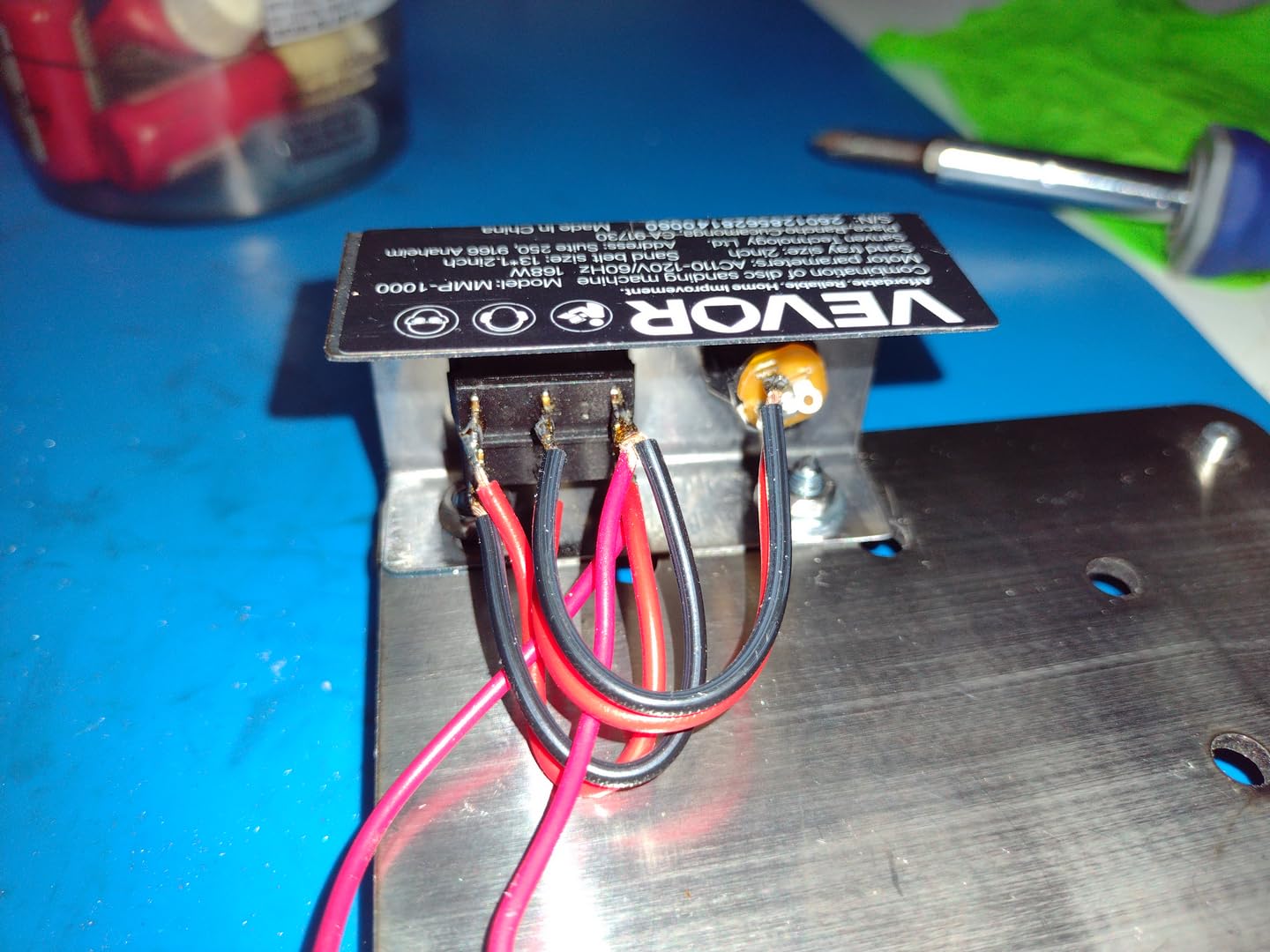
Two worktable assemblies and a hex wrench are included. The wheel runs at 3450 RPM and the belt at 1500 RPM, which means the belt is the slower and finer of the two surfaces, so finishing happens on the belt.
Our honest read is that many owners buy this as an occasional finishing tool rather than a dedicated sharpening station, and that framing is fair.
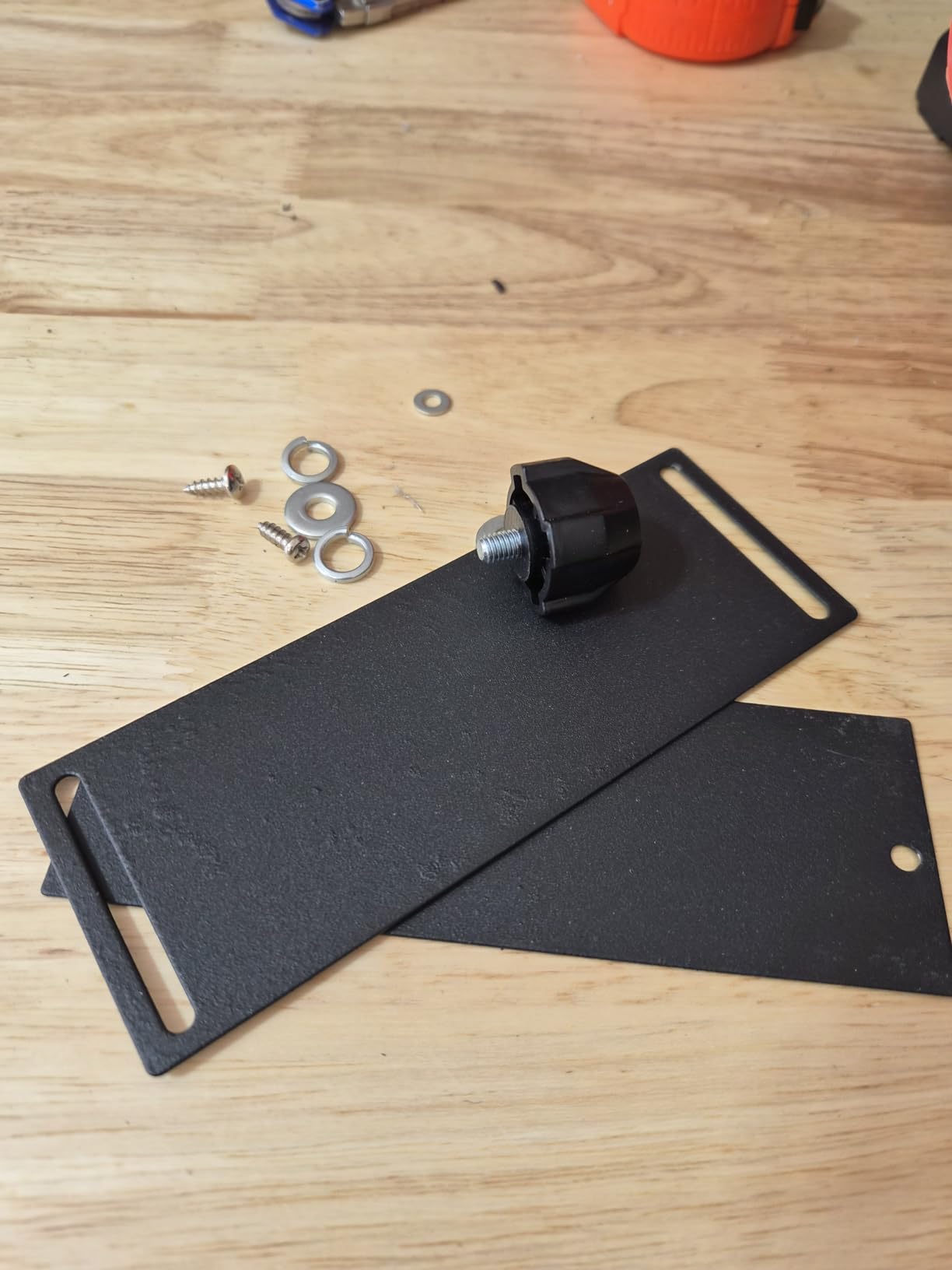
Is this a good knife sharpening machine?
It will do the job, but it is not a first choice for anyone who cares about consistency. The belt speed of 1500 RPM is a reasonable finishing speed, and having a wheel and a belt available in one machine is genuinely useful for reprofiling followed by refining.
If your sharpening is infrequent and you also want a general shop sander, the two-in-one format is a reasonable trade. If you are sharpening weekly, spend the difference on a low-speed machine instead.
Where it falls short
At 4.1 average with a 13 percent one-star share, this has the widest rating distribution in the group. Buyers report assembly difficulty, inconsistent wheel concentricity, and limited power for heavier grinding.
Only 350W means heavier metal work slows it down, and the coarse 80 grit belt limits fine finishing compared with a dedicated sharpener. Aligning the small 2 x 28 inch belt is fiddly.
10. WEN BG4108 – Compact Wet Sharpening on a Small Footprint
WEN 8-Inch Water-Cooled Wet/Dry Sharpening System (BG4108)
8 inch 220 grit stone
8-3/4 inch leather stropping wheel
120 RPM
Adjustable-height water reservoir
Pros
- Water-cooled stone sharpens without burning edges
- 120 RPM gives controlled repeatable bevels
- Reservoir repositions as the stone wears down
- Universal jig bar accepts WEN 42704B and 42703 kits
- Leather strop in the same machine
Cons
- Rating spread is wide with 11 percent two-star reviews
- 220 grit stone cannot finish an edge alone
- Accessory bar shares the play and squareness issues
- Stone can need truing and run out of true
- Reservoir splashes onto the machine
The BG4108 is the compact answer to the same question the BG4270T answers at larger size. Eight-inch 220 grit stone, 8-3/4 inch leather stropping wheel, 120 RPM, and a water reservoir that keeps the stone wet while you work.
Owners generally find it does what it should for the money: a fast, wet, low-speed system that takes knives, chisels, and plane irons to a sharp edge without burning. The adjustable-height reservoir is a thoughtful detail, since it repositions as the stone wears down.
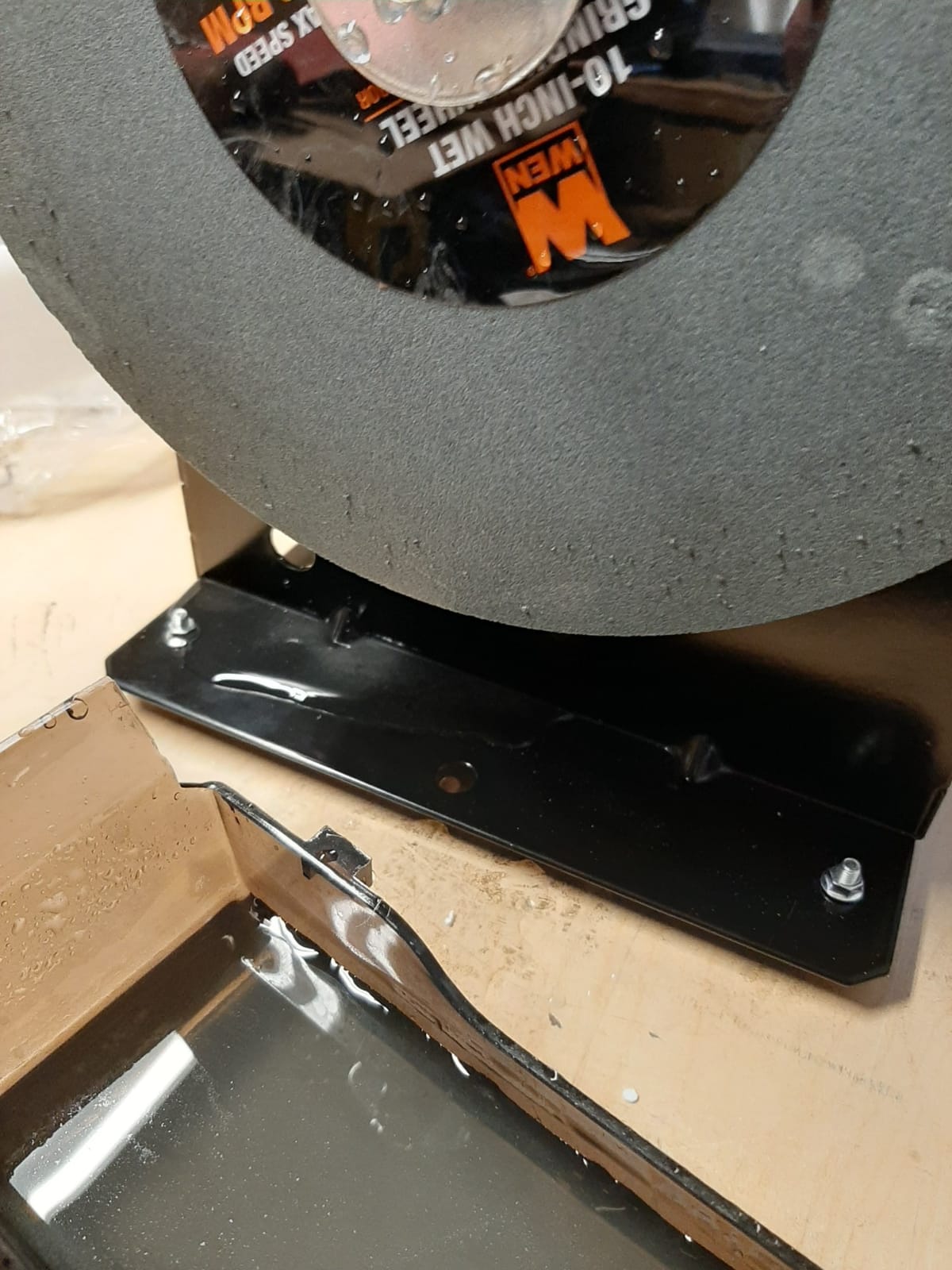
It is noticeably lighter than the 10-inch system at 9.96 kg with a 13-inch footprint, which makes it easier to move and cheaper to bench-mount. The universal jig support accepts the WEN 42704B and 42703 sharpening kits.
Included are an angle guide, honing compound, adjustable water reservoir, and a jig for chisels and planer blades, so the accessory list is complete out of the box.
Is the smaller wet system worth it over the 10-inch?
If bench space is the constraint, yes. Same 220 grit stone family, same low speed, same water cooling, roughly a third less mass. For knife work the difference in results between an 8-inch and 10-inch stone is marginal.
The 10-inch system scores better on hardware quality, particularly the accessory bar, so if you have the room and can afford the step up, that is the better machine. Both need a finer stone or a hone afterward.
Where it falls short
At 4.1 average with 11 percent two-star reviews and only 54 percent five-star, the rating spread is notably wide for a machine that does its basic job.
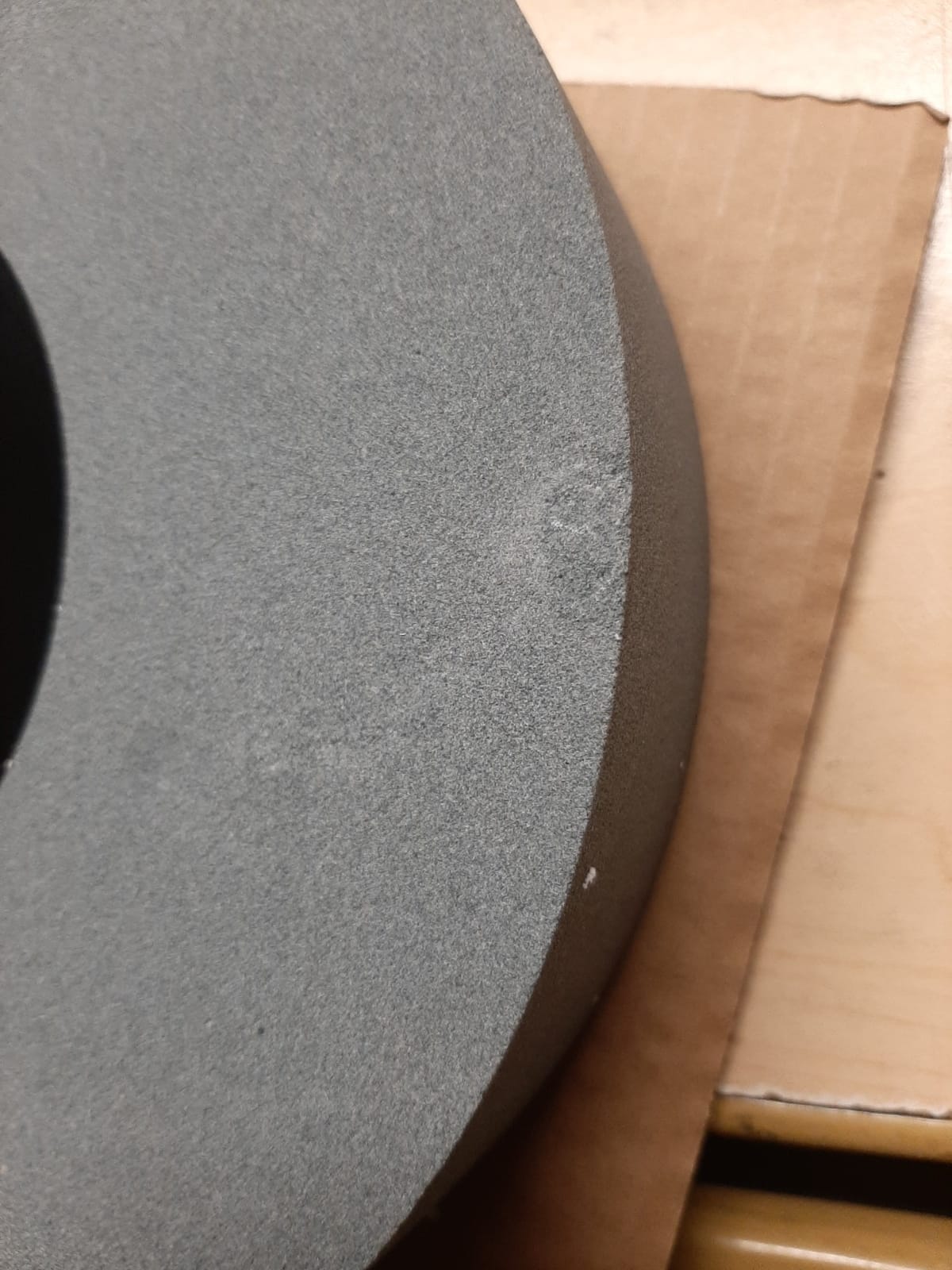
Three recurring complaints: the coarse 220 grit stone cannot finish an edge on its own, the accessory bar and stamped jig share the same play and squareness problems as the larger WEN system, and the stone can require truing or be out of true on first use. The reservoir also tends to splash onto the machine and bench.
How Much Speed Do You Need for Knife Sharpening?
Stay under 2000 RPM for knife edges, and use 3000 RPM and above only for rough material removal. That is the single most useful number in this guide, and it is the one most roundups leave out.
Heat at the contact point scales with wheel surface speed. A 3600 rpm 8-inch wheel travels roughly twice as fast as a 1750 rpm 8-inch wheel, and it dumps roughly twice the frictional energy into the same small contact patch. That is why the RIKON and the two BUCKTOOL low-speed machines are forgiving and the DEWALT and WEN dry grinders are not.
Here is how we map speed to task. The pattern holds across every machine in this group.
Rough shaping and reprofiling, 3000 RPM and up. Fast metal removal on thick, rolled, or badly damaged edges. Dip in water every few seconds.
Coarse bevel work, 1750 to 2000 RPM. The sweet spot for knives. Enough bite to form a bevel, slow enough to control heat.
Edge refinement, 1750 RPM or lower. Fine wheels at low speed keep the burr thin and reduce the grinding work needed later.
Deburring, any speed. Light pressure and a slow wheel. This is where a honing compound or leather strop does most of the work.
Wet systems, 115 to 120 RPM. Water cooling replaces the need for low speed. These machines never approach burn temperature.
If a machine has no speed control and runs above 3000 RPM, it is workable for knives but you are managing heat entirely through technique and grit. If it has a dial or runs slow by design, heat stops being the deciding factor.
Wet Grinder vs Dry Bench Grinder vs Belt Grinder: Which One Do You Need?
Pick a dry bench grinder if you want one machine for everything: knives, chisels, drill bits, bolts, and general shop work. Pick a wet system if your priority is a heat-free edge on thin or high-carbon steel. Pick a belt grinder if you are making knives in volume or reprofiling frequently, because the belt gives a wider, more controllable contact area.
Most people who own a decent dry grinder end up wanting a second tool anyway. That is not a marketing line, it is the most common recommendation in the sharpening communities, where people consistently treat bench grinders as a fast shaping and deburring tool and lean on belts or Tormek-style systems for serious edge work.
If you have decided a belt machine is the missing piece, our in-depth belt grinder guide covers the larger formats in detail, and the professional belt grinder picks cover the high-end end of the range.
Choosing a Bench Grinder for Knife Sharpening
Wheel grit decides what the machine can do. A 36 grit wheel reshapes a badly damaged edge but leaves a heavy burr that takes real work to remove. An 80 or 120 grit wheel refines an existing bevel and leaves a burr you can knock off quickly. Look for a pair that spans both jobs, like the 60 and 80 grit aluminum oxide setup on the BUCKTOOL low-speed machine.
Wheel material is the second decision and the one most people get wrong. Silicon carbide cuts fast and runs cooler on stone, but on hardened tool steel it generates more heat and loads up faster. White aluminum oxide is the safer choice for knives because it fractures into fresh sharp grains rather than glazing, and it is what the RIKON ships with. Brown aluminum oxide is a good general-purpose middle ground.
Arbor size determines which wheels you can buy. Most 6-inch machines use a 1/2 inch arbor and most 8-inch machines use 5/8 inch, and the two are not interchangeable. The Woodskil 6-inch takes 1/2 inch wheels while the BUCKTOOL 8-inch takes 5/8 inch ones. Check this before you order replacement wheels, because it is an annoying mistake to make.
Tool rest rigidity is what separates a good sharpening machine from a bad one, and it is the complaint that comes up most often on cheaper grinders. Rest flex ruins precision, and the fix is well documented: several experienced users replace factory tool rests with OneWay rests, describing them as the stoutest they could find, with no flex at all. That is the single highest-value upgrade on any grinder in this list.
Base mass and mounting come next. Cast iron bases hold position under load, and anti-vibration rubber feet help a lot on a machine running slow. Most machines here have pre-drilled mounting holes, but check the placement, because the WEN BG4276 has its holes mid-plate under the motor shaft where a top-down bolt is awkward.
Finally, warranty length is a decent proxy for how the manufacturer expects the machine to be used. The RIKON carries five years, and the DEWALT and WEN machines in this group run two to three. That is a real signal about duty cycle.
One upgrade deserves its own paragraph because it changes results more than any machine choice. Hand-sharpening freehand on a moving wheel gives you an inconsistent bevel every time, which is the complaint that drives people to jigs within weeks of buying a grinder. The Oneway Wolverine system with a Vari-grind jig is the most frequently mentioned way to make a bench grinder repeatable, and several experienced users fit stiffer OneWay rests to their factory mounts instead of replacing the whole rest assembly.
If you buy one extra thing, buy a guide or a jig rather than a better wheel. Consistent angle beats aggressive removal every single time, and an inconsistent 20-degree bevel will always underperform a repeatable one.
Wet Systems Also Need Maintenance
If you go with a water-cooled machine, the water is doing the work and the water is a maintenance item. Change it regularly, because metal particles suspended in the coolant keep abrading the edge you are trying to form and they dull the stone surface faster than dry use.
Watch for mineral buildup around the stone and the splash zone. Let the stone dry fully between sessions rather than leaving it wet, because a permanently soaked stone can dish unevenly. Reviewers of both WEN wet systems also note that the reservoir tends to throw water over the machine and the bench, so plan your bench surface accordingly.
How to Sharpen a Knife on a Bench Grinder Without Ruining It
Dress the wheel before every sharpening session. A loaded wheel glazes, stops cutting, and generates far more heat than a fresh one. Two or three passes with the diamond dresser is not optional.
Set the bevel on the coarser wheel and make light passes. Rest the knife on the tool rest or a jig, keep the angle constant, and lift after each pass rather than grinding continuously. You are looking for a burr, not a smooth surface.
Move to the finer wheel to refine. The goal here is a thinner, more uniform burr. If you can still slice a piece of paper with the burr rubbed off, you are close.
Remove the burr. A wire edge is just folded-over steel and it is what makes a knife feel dull after sharpening. Deburr on the fine wheel with a very light touch, then move to leather or a hone. This is the step most people skip and the reason they think their sharpening failed.
Finish on stone or strop. Remember the ceiling from earlier: the grinder cannot give you a true razor edge on its own. A few passes on a whetstone or a stropping wheel is what turns a sharp knife into a properly sharp one.
Dip the blade in water every few seconds on any dry machine, and stop the moment you see color.
Reading Heat: What Bluing Does to Your Knife’s Temper
Any color change on the steel means stop. Hardened knife steel was heat treated to a specific hardness, and friction heat from a grinder permanently alters that treatment. The damage goes deeper than the visible grind marks, and the edge will never hold sharpness the same way again.
The color sequence tells you how far you have gone. It runs in this order.
Faint straw or light gold. The first warning. You have heated the steel but probably not ruined it. Back off immediately and cool.
Dark bronze or brown. Meaningful temper damage. The edge will be noticeably less retentive than it should be.
Blue or purple. Serious damage. Treat that edge as compromised and stop using the grinder on it.
Gray or dull white. The steel has lost its temper almost entirely. This is the failure everyone is afraid of.
Prevention is entirely mechanical: lower the speed, use a finer grit, lighten your pressure, and dip more often. Wet systems simply remove the problem by design.
How to Fix a Wobbling Wheel in Five Minutes
A wobbling wheel is the most common ownership complaint across this whole group, and it is usually not a defective wheel. A new wheel is often slightly out of true, and a small amount of dressing corrects it in one pass.
Set the dresser against the wheel about 1/8 inch from the edge and rotate the wheel by hand. Walk the dresser around the circumference in overlapping passes, spending most of your time on the high spots you feel.
Turn the wheel on and let it spin up to full speed. Listen and watch for a heavy spot. Dress that spot again, with the wheel running and the dresser held very lightly, never leaning on it.
Repeat until the wheel sounds even and you cannot feel a dead spot through the dresser. On a diamond dresser this takes minutes. Only replace a wheel if a pronounced dead spot persists, because that indicates a bent arbor or a cracked wheel, which is a safety issue rather than a performance one.
Before mounting any wheel, spin it by hand and check it against a straight edge. A wheel that is out of true by more than a hairline will never be fixed by dressing alone.
Safety and Shop Setup Before You Sharpen
Wear eye protection every time. Not sometimes. The eye shields and spark deflectors included with these machines are a first line of defense, not a substitute for safety glasses. Sparks and abrasive fragments both travel.
Bolt the grinder down. A machine that walks across the bench mid-pass is the fastest way to lose control of a knife. The cast iron machines here, including the DEWALT, the RIKON, and the 8-inch BUCKTOOL, benefit most from this because their mass works against you otherwise.
Set the spark deflector to about 1/8 inch from the wheel face. Most owners never adjust this from the factory setting, and the narrow gap is what keeps sparks out of the air rather than at your face.
Never grind a hardened tool without a rest and a jig. Freehand work on a moving wheel is how thin blades get rolled and how people lose fingers. One experienced sharpener on r/sharpening put it plainly: bench grinders can overheat and blue a tool very easily, and the tempering damage goes deeper than the visible grind marks.
Make sure the wheel is dressed before you start. A glazed wheel drags the knife sideways, and a sideways-moving knife on a spinning wheel is the most dangerous combination in the shop.
Frequently Asked Questions
Can a bench grinder be used to sharpen knives?
Yes, but with care. A bench grinder reshapes a bevel and removes the burr faster than any other benchtop method. It also generates enough friction heat to ruin temper in seconds, so stay under 2000 RPM for fine work, use a white aluminum oxide wheel, and dip the blade in water every few seconds. Above 3000 RPM, limit the grinder to rough material removal.
What RPM is best for a bench grinder?
Under 2000 RPM for knife edges, and 3000 RPM or above only for rough material removal. Heat generated at the contact point scales with wheel surface speed, so halving RPM roughly halves the heat going into the edge. The RIKON 80-805 and both BUCKTOOL low-speed machines run at 1750 RPM for this reason.
What grit wheel should I use for sharpening knives?
Use 60 grit white aluminum oxide to reshape a damaged edge and 80 to 120 grit to refine an existing bevel. White aluminum oxide is safer than silicon carbide on hardened tool steel because it fractures into fresh grains rather than glazing. 36 grit is for heavy material removal and leaves a burr that takes real work to remove.
Why does my bench grinder burn the knife edge?
Three causes. You are running too high a speed, using too fine a wheel with too much pressure, or holding one spot too long. The fix is to drop below 2000 RPM, use a coarser grit for shaping, lift after every pass, and dip the blade in water every few seconds. Once the steel turns straw, bronze, or blue the temper change is permanent.
Why is my knife getting duller after sharpening?
Almost always because the burr was never removed. A wire edge is folded-over steel that feels sharp but slices nothing, and it dulls quickly on the first cut. Finish by deburring on the fine wheel with a light touch, then honing on stone or stropping on leather before you test the edge.
Do you heat treat a knife before or after sharpening?
Before. A knife must already be hardened to hold an edge at all, and heat treatment changes the steel permanently. Sharpening is a finishing operation on already-hardened steel, so it comes last. Sharpening after heat treatment is correct because the heat from grinding is localized to the edge and is a separate, damaging thing entirely.
Are bench grinders good for sharpening knives?
Good for rough shaping, reprofiling, and removing a burr. Poor for producing a final edge. A bench grinder cuts the bevel faster than a stone but leaves work to do, so the finishing stage still needs a whetstone or a strop. A grinder alone will not produce a true razor edge.
What do professionals use to sharpen their knives?
Most knife makers use a belt grinder for fast material removal and bevel work, then a honing system or stones for finishing. Tormek-style water-cooled systems are the other common choice for the finishing stage. A bench grinder is used for shaping and deburring, not as the final step.
Final Verdict: Which Bench Grinder Should You Buy?
The best bench grinders for knife sharpening come down to speed control and wheel choice, not raw power, and the DEWALT DW758 takes our editor’s choice as the best all-round buy. It has the highest rating and the largest review base in this group at 4.7 stars from more than 2,600 owners, and the 3/4 HP induction motor under a cast iron body means the wheel holds speed when you take a real bite out of a dull edge. If knives are all you sharpen, the RIKON 80-805 is the specialist choice, because 1750 RPM and fine white aluminum oxide wheels make it nearly impossible to burn an edge by accident, and it is backed by a five-year warranty. The BUCKTOOL 8-inch low-speed machine is the step up if you want to move to CBN wheels later.
If you want one machine for the whole shop and you are willing to manage heat, the DEWALT DW758 has the most owner feedback in this group. If heat is your main worry, the WEN BG4270T wet system removes the question entirely. For occasional work on a small budget, the WEN BG4276 is quiet, stable, and hard to criticize for what it costs.
Whatever you pick, stay under 2000 RPM near an edge, dress the wheel first, install a rigid tool rest, and finish on stone or leather. Those four habits will do more for your knives than any machine on this list. If you want the finishing stage handled in one machine, start with our picks for sharpening systems for kitchen knives.