
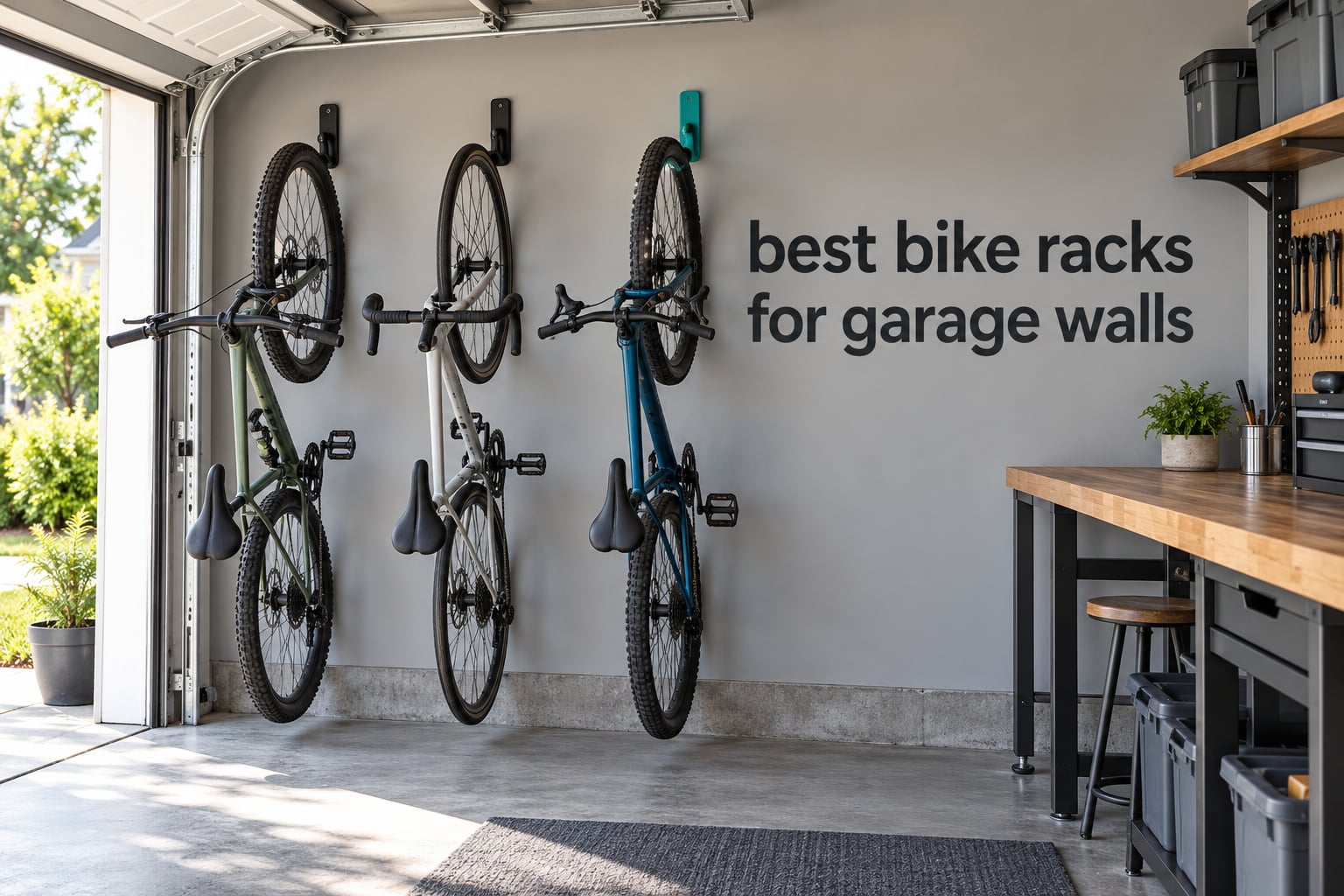
Garage walls are the most valuable real estate most of us never think about. Right now, yours is probably holding two bikes that lean at a slight angle, a wheel that has gone flat from a slow leak, and a coil of extension cord. The best bike racks for garage walls solve a problem that is less about tidiness and more about usable floor area, and the right rack can hand back an entire parking bay.
We spent the last several months going through the wall rack category in detail: swivel arms, fixed hooks, horizontal multi-bike rails, and the odd floor stand that pretends to be a wall mount. We looked at every mount rating, every tire width limit, and every set of included screws, because the difference between a rack that lasts a decade and one that tears out of the wall in a year is almost always in the fasteners rather than the steel. What follows covers ten of the strongest options for 2026, with a straight answer on who each one suits and a short list of what it cannot do.
One framing note before we start. The four types of wall rack you will see most are swivel vertical mounts, fixed hooks, horizontal multi-bike rails, and slatwall or pegboard panels. Only the first three are in this roundup as standalone products, because a slatwall panel is a wall system you may already own rather than a rack you buy. The tenth pick is a gravity stand, and it is not wall mounted at all, so we flagged it clearly rather than pretending it fits the topic.
Top 3 Picks for Garage Wall Bike Racks in 2026

Steadyrack Swivel Mount
- 160-degree swivel
- No-lift roll-in loading
- Holds 35 kg / 77 lb
- Fits 24-29 in wheels

PRO BIKE TOOL Hanger
- Ratcheted adjustable arms
- 8.7-12.6 in wall standoff
- Holds 22 kg
- Rubber frame cradles

monTEK Swivel 4-Pack
- 150-degree swivel
- Rear wheel stabilizer
- Holds 30 kg / 66.2 lb per rack
- Accepts fenders
Those three cover the most common garage. The Steadyrack is the one we would put in a garage with a car parked nose-in, because the 160-degree pivot is the smoothest of the group and it takes the highest weight rating. The PRO BIKE TOOL is the single-bike choice when appearance matters as much as function. The monTEK four-pack is the value pick for anyone covering four bikes at once.
Quick Comparison: Every Bike Rack in This Roundup in 2026
| Product | Specifications | Action |
|---|---|---|
| Steadyrack Swivel Wall Mount |
|
Check Latest Price |
| PRO BIKE TOOL Horizontal Hanger |
|
Check Latest Price |
| monTEK Swivel Mount 4-Pack |
|
Check Latest Price |
 StoreYourBoard 5-Bike Rack StoreYourBoard 5-Bike Rack |
|
Check Latest Price |
 Ultrawall 6-Bike Wall Rail Ultrawall 6-Bike Wall Rail |
|
Check Latest Price |
 Housolution 4-Pack Hooks Housolution 4-Pack Hooks |
|
Check Latest Price |
 TORACK BIKEPAL Swivel 2-Pack TORACK BIKEPAL Swivel 2-Pack |
|
Check Latest Price |
 Wallmaster 2-Pack Hooks Wallmaster 2-Pack Hooks |
|
Check Latest Price |
 TORACK 6-Bike Interlock Rail TORACK 6-Bike Interlock Rail |
|
Check Latest Price |
 Delta Michelangelo Gravity Stand Delta Michelangelo Gravity Stand |
|
Check Latest Price |
Note the spread in weight ratings across the table. Three of these racks quote a per-hook figure in the 35 to 45 kg range, two quote a whole-system figure of 200 or 300 lbs, and one sits at 40 lb per bike. Those numbers are not comparable, which is a trap worth understanding before you buy.
The Four Types of Garage Wall Bike Rack
Four wall rack designs cover almost every garage. Knowing which one you need before you start reading specs saves a lot of returns.
Swivel vertical mounts cradle the front wheel and pivot the whole bike out of the way after you roll it in. The Steadyrack pivots 160 degrees, the monTEK 150 degrees, and the TORACK BIKEPAL rotates side to side. This is the type you want when a car is parked close to the wall, because the swing range is what determines whether your door mirror survives.
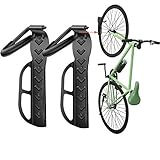
Fixed hooks are a single bent rod screwed to the wall. There is no moving part, nothing to loosen, and nothing to maintain. The Housolution and Wallmaster packs are both in this group. They project the bike further from the wall than a swivel arm, but they cost a fraction as much and hold up fine on a stud.
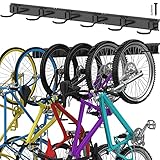
Horizontal multi-bike rails are long steel bars that hold a row of hooks you can slide along and reposition. The Ultrawall, StoreYourBoard, and TORACK rails are all rail systems, and they solve a different problem: a household with four to six bikes that wants them all in one line above a workbench rather than scattered around a perimeter.
Slatwall and pegboard panels are a fourth option that shows up constantly in forum threads and rarely in roundups. If your garage already has a slatwall or a pegboard panel, you can buy single hooks that clip into the panel rather than drilling individual brackets. The tradeoff is load capacity, because the panel itself is only as strong as the studs behind it, and a fat-tire bike on a flimsy panel is a real risk.
A fifth product category gets compared to wall racks constantly: floor stands. The Delta Cycle in this roundup is one. It is genuinely useful in a rental or a shed with no studs, but it works by leaning against the wall, which means the bikes occupy floor depth instead of clearing it.
1. Steadyrack Swivel Bike Wall Mount – Best Overall for a Garage With a Car
Steadyrack Swivel Bike Wall Mount, Vertical Mountain Bike Rack, Garage
160-degree swivel
No-lift roll-in loading
35 kg / 77 lb capacity
Fits 24-29 in wheels
Pros
- Highest average rating in this roundup at 4.8
- Swivel pivot folds the bike flat against the wall
- Accepts 24-29 in wheels and 2.1-2.8 in tires
- Rear cradle keeps the tire off the wall
Cons
- Not suitable for bikes with fenders or mudguards
- Included drywall anchors are not adequate
- Handlebars need about 14 in of clearance from the next bike
The Steadyrack is the name that comes up most in real garage conversations, and after working with the spec sheet it is easy to see why. The rack is a fixed vertical column with a pivoting arm on top, rated to hold 35 kg, or about 77 lb, and sized for 24 to 29 inch wheels with tires from 2.1 to 2.8 inches. That tire range covers the vast majority of mountain and gravel bikes.
What makes it stand out is the pivot range. At 160 degrees the arm folds far enough that a loaded bike sits nearly flat against the wall, and the arm itself can fold flat when nothing is hanging from it. In a one-car garage where the bumper sits a foot or two from the wall, that is the difference between a workable layout and an unusable one.
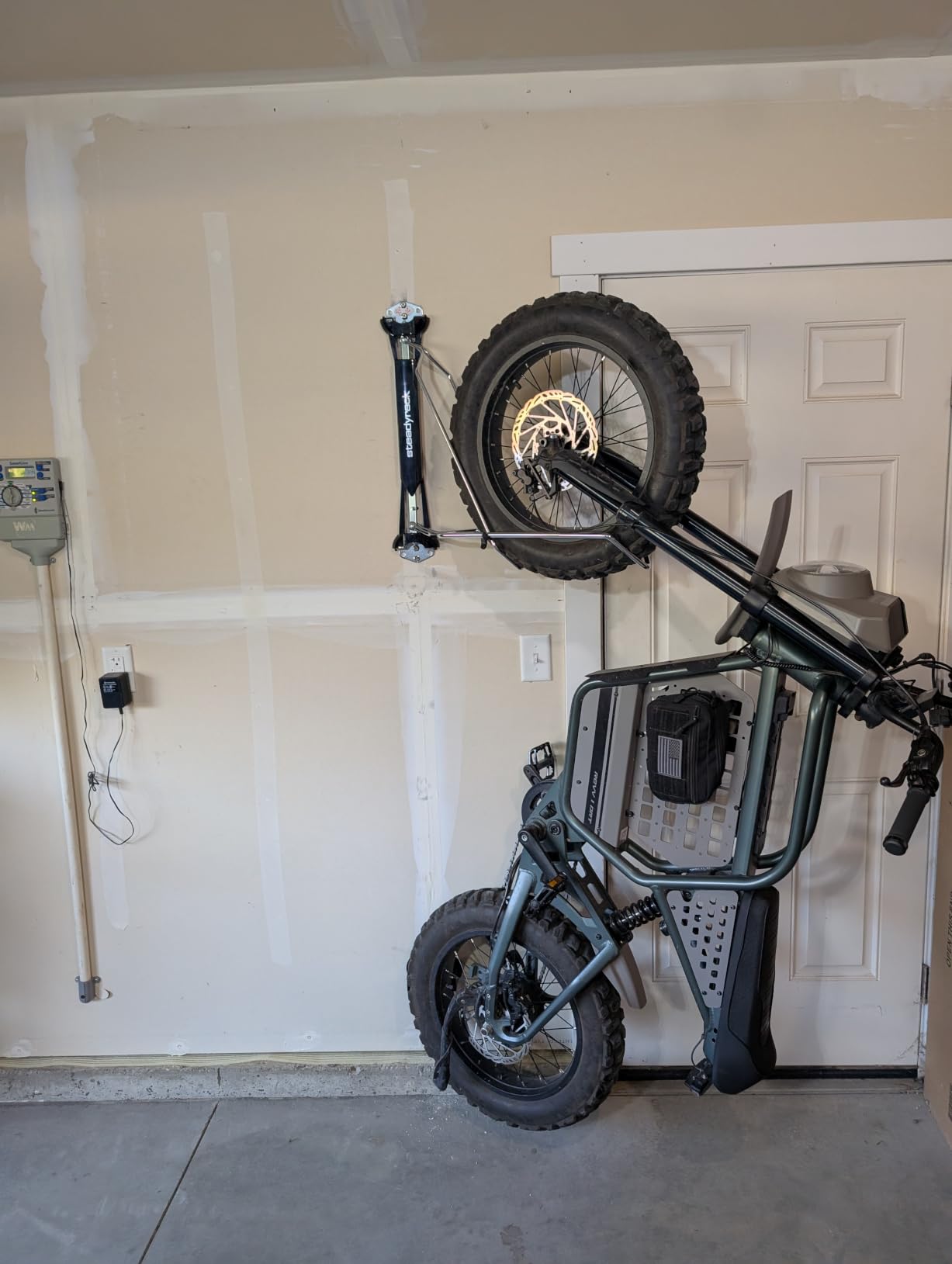
The no-lift loading design is the feature owners mention most. You balance the bike on its rear wheel and roll it forward into the cradle rather than lifting it overhead, which changes who can use the rack. A household with a nine-year-old who wants to put their own bike away does not need a step stool with this mount.
The honest drawback is fenders. Steadyrack states plainly that this rack is not suitable for bikes with a fender or mudguard, and that is a hard exclusion rather than a caveat. Commuters, touring riders, and anyone running full guards should look at the monTEK instead, which is explicitly designed to accept fenders.
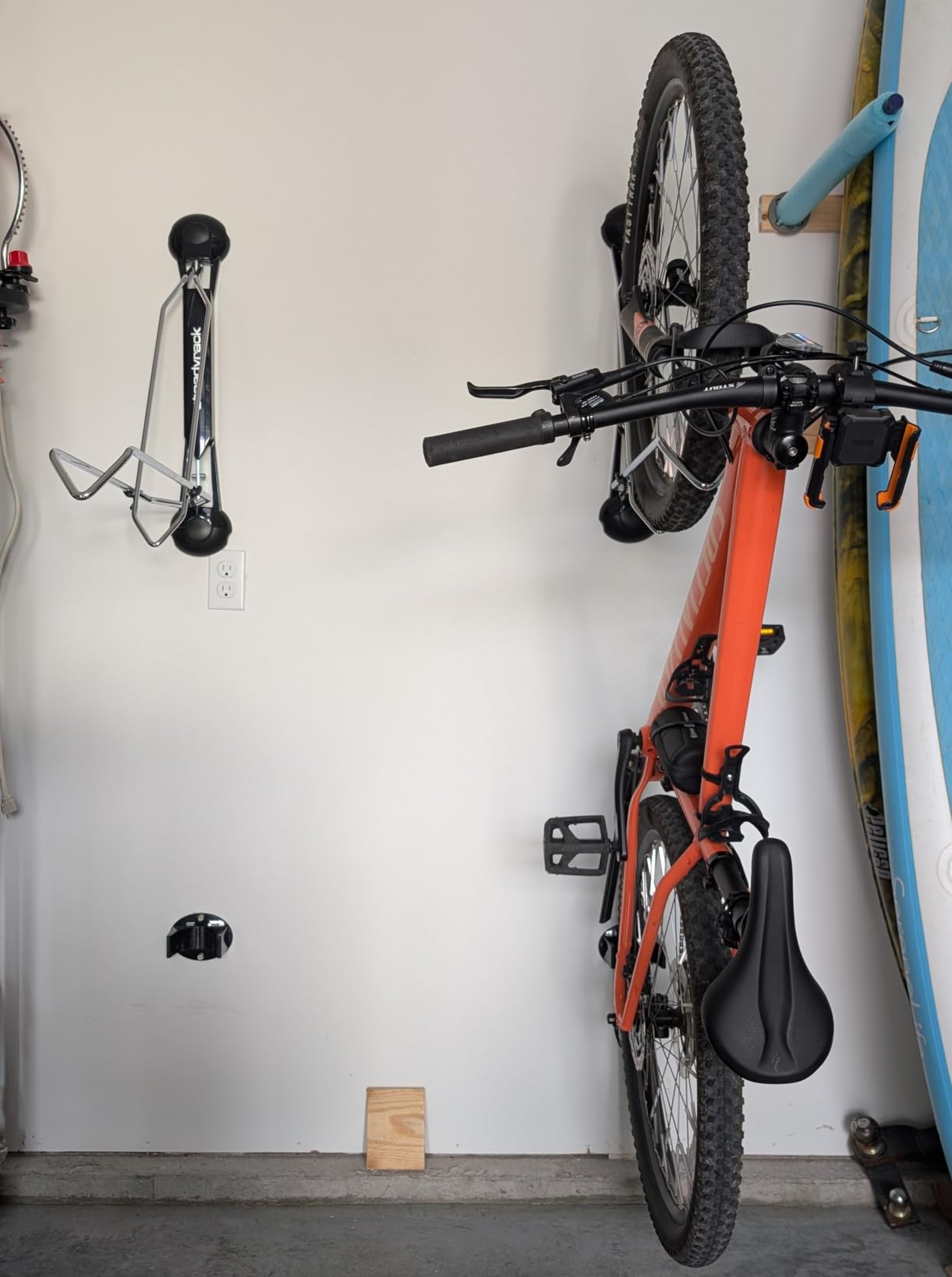
The included fasteners are the other real issue, and it is a common one across this whole category. The drywall anchors in the box are not adequate for a 77 lb cantilevered load, and the printed drill bit sizes in the instructions are reported as inaccurate. Plan to use lag screws into studs or masonry anchors into block, and ignore the bits that come in the box.
How it performs with a car parked against the wall
This is where the Steadyrack earns its place at the top of the list. The 160-degree pivot is the widest in the roundup, and reviewers with multiple units report that the swivel action still feels tight after years of daily use. Where a fixed hook leaves a bike projecting a foot out from the drywall, this one folds back close enough to clear a door panel.
Two caveats. Handlebars still need roughly 14 inches of spacing from the next rack, so plan the layout before you drill. And if your bikes have fenders, this is the wrong mount, full stop.
What it cannot do
It will not hold a cargo e-bike. The 77 lb rating is generous for a standard e-bike but tight for the heavier hub-driven or cargo models that push past 90 lb. It also will not work in bare drywall without a stud behind it, and the fender exclusion rules it out for a whole category of commuting bikes.
Chrome plating is a minor concern in a covered outdoor garage, where owners occasionally report surface rust appearing over time. Inside a dry attached garage it has not been an issue.
2. PRO BIKE TOOL Horizontal Bike Wall Mount – Best Finish and Adjustability for One Bike
PRO BIKE TOOL Bike Rack for Garage Wall Mount – Horizontal Bike Storage
Ratcheted adjustable arms
8.7-12.6 in wall standoff
22 kg / 49 lb capacity
Rubber frame cradles
Pros
- Ratchet arms hold the bike level at any frame angle
- Adjustable wall distance keeps bars off the drywall
- Soft rubber cradles protect alloy and titanium frames
- Front-wheel strap stops the tire touching the wall
Cons
- Small included screws need replacing with lag screws
- Elastic wheel strap is thin and can snap
- One bike per unit so multi-bike garages need several
The PRO BIKE TOOL does something the other swivel racks in this list do not: it holds the bike horizontally, by the frame, rather than by the wheel. That changes the geometry entirely. The bike hangs level with the bars projecting out, which makes it a genuinely attractive display mount as well as a storage one.
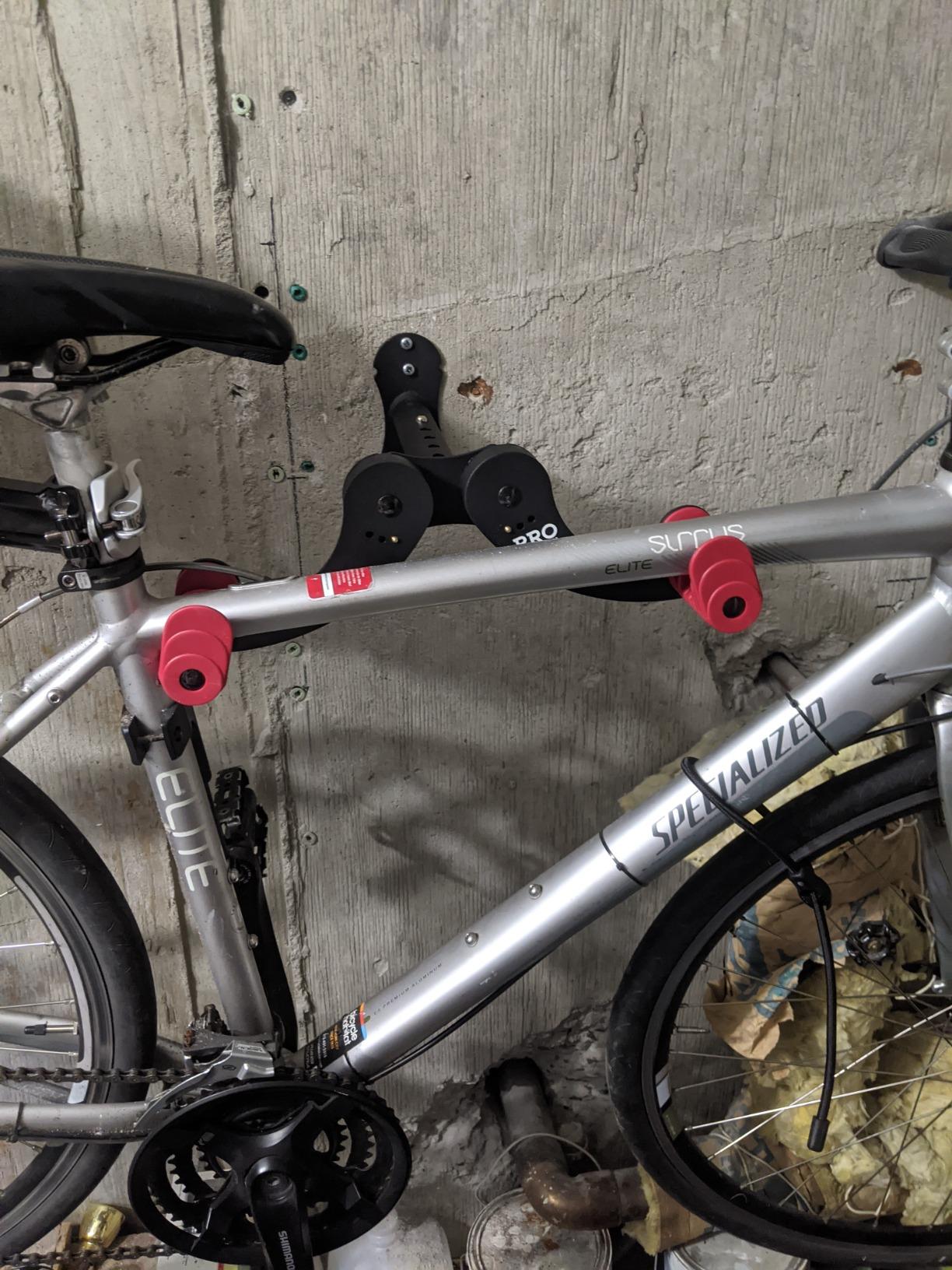
The ratchet gear system is the core mechanism. Instead of a fixed hook, there is an adjustable arm you set to the angle of the frame tube and lock in place, so a sloping top tube and a straight down tube both sit straight. The whole assembly also telescopes from 8.7 to 12.6 inches away from the wall, which is how you get handlebars to clear the drywall.
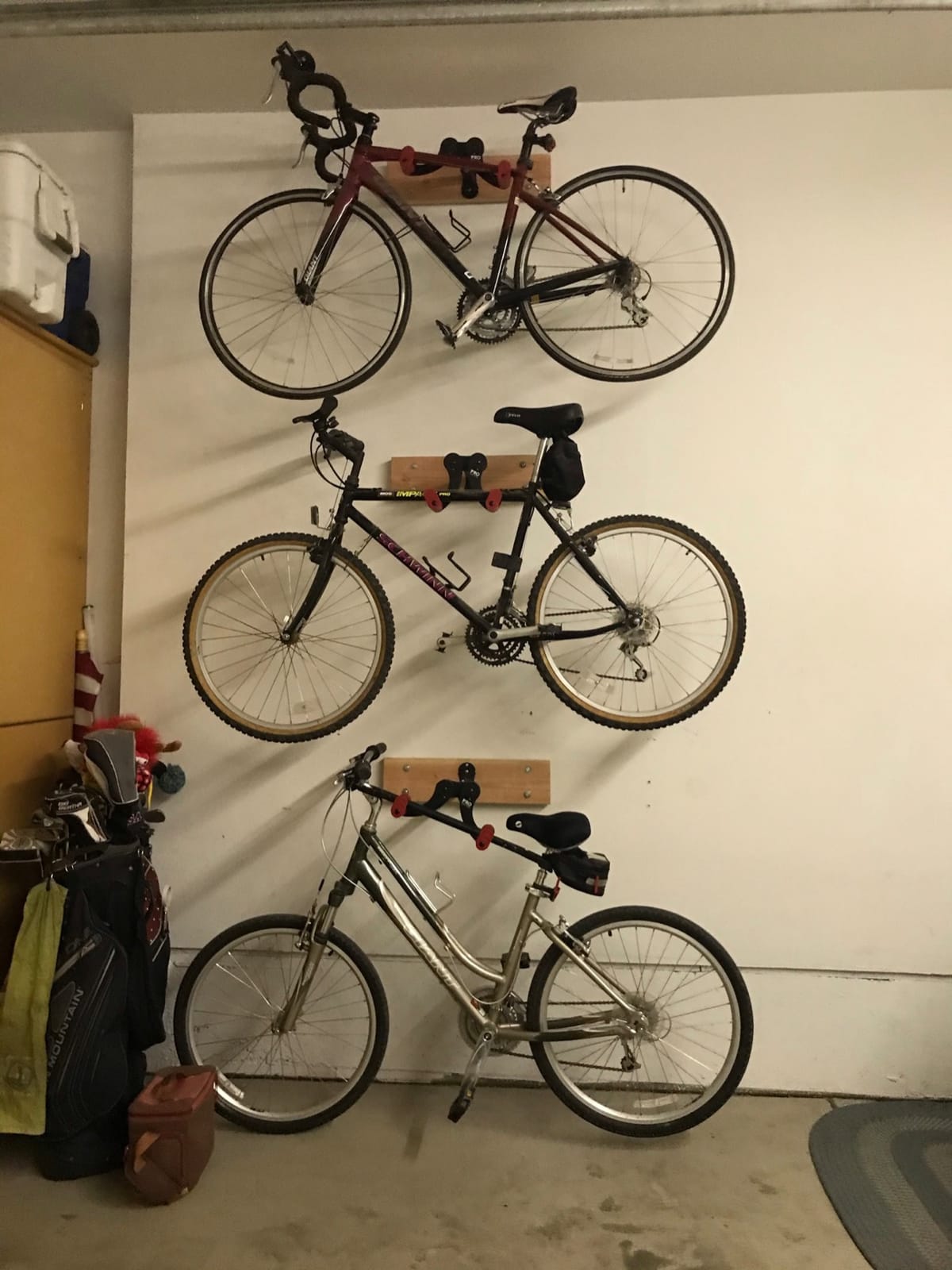
Frame protection is unusually good here. The contact points are soft rubber cradles rather than bare steel, and an elastic strap holds the front wheel steady so the tire does not rub the wall over time. For a valuable alloy or titanium frame, that detail is worth more than it sounds.
Owners frequently report that this is the first bike rack in their house that does not look like a piece of hardware from a workshop. It gets used in hallways and spare rooms as well as garages, which is a fair signal about the finish quality.
What holds it back is scale and hardware. The weight rating is 22 kg, roughly 49 lb, which is the lowest of the serious racks here and rules out most e-bikes. And one bike per unit means a four-bike garage needs four mounts, four sets of holes, and a stud behind each one.
Best for a garage with a wide, open wall
This rack is the right answer when you have wall to spare and only one or two bikes to put away. Because the arm angle and the standoff both adjust, it is also the most forgiving rack in the roundup for odd frames, including bikes with unusual tube angles and kids bikes that would twist in a plain hook.
It is a poor fit for a dense multi-bike wall, where a fixed hook that stacks bikes in a single vertical column is more space efficient. Think of it as the display mount, not the fleet rack.
What it cannot do
It will not hold heavy e-bikes, and it will not survive being screwed into unsupported drywall. Low-star reviews on this product almost all trace back to the same root cause: someone used the small included screws in drywall with no stud behind them. Fix that and the complaints largely disappear.
The elastic front-wheel strap is the other known weak point. It is thin, and it can snap after extended use, at which point the wheel is free to swing into the wall.
3. monTEK Swivel Bike Wall Mount 4-Pack – Best Value Swivel Set
monTEK Swivel Bike Wall Mount, Bike Hangers for Garage, 4 Pack
150-degree swivel
30 kg / 66.2 lb per rack
Fits tires to 3.54 in
Rear wheel stabilizer
Pros
- Four racks in one pack
- 150-degree bearing swivel
- Explicitly accepts bikes with fenders
- Rear wheel stabilizer keeps the bike upright
Cons
- Tires or rims deeper than 3.54 in will not fit
- Must be anchored to a stud or masonry
- Bike projects further out than a fixed hook
Four rack arms, four sets of hardware, and one purchase. That packaging is the reason the monTEK makes this list as the value pick, because most swivel mounts sell singly and force a four-bike garage into four separate orders at four separate shipping costs. This one arrives as a complete set.
Mechanically it is a 150-degree swivel on a ball bearing system, which is smooth enough that the bike moves without a fight when you rotate it. You hook the front wheel in, rest the rear wheel on the stabilizer bar, and swing the arm to whatever angle clears your car door. The rear stabilizer is what keeps the bike upright instead of letting it tip forward off the hook.
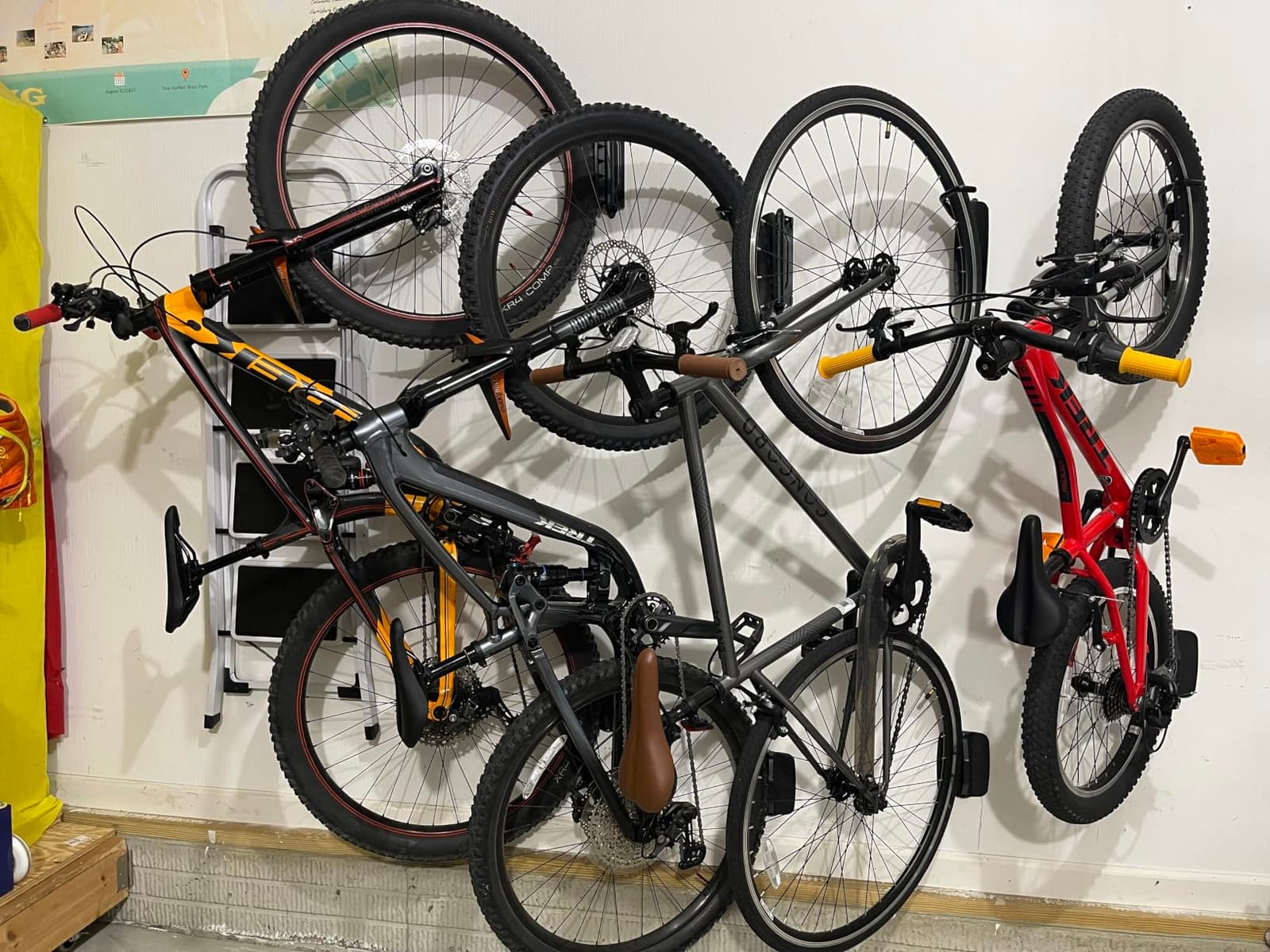
The monTEK is also the swivel option that works with fenders. The manufacturer lists road, mountain, cruisers, BMX, and bikes with fenders as supported, with one limit: tires and rims deeper than 3.54 inches, or 90 mm, will not fit. That is a real ceiling for anyone running a plus-size or fat tire.
Weight rating is 30 kg, or 66.2 lb per rack. It handles a mid-weight e-bike without drama but sits at the low end for the heavy ones, so check your bike against that number before ordering.
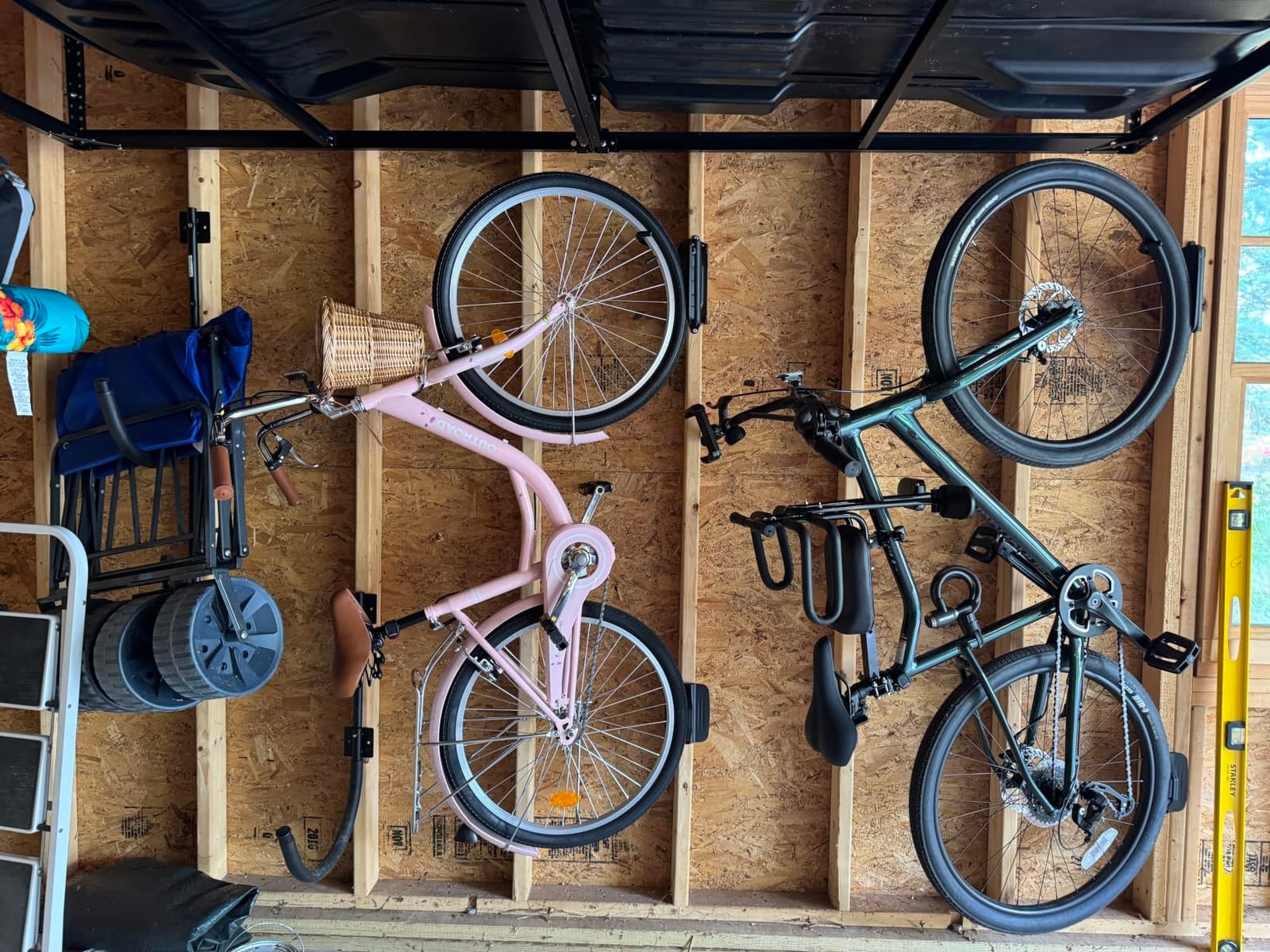
The rubber coating on the contact arm is worth noting because it is where the load actually concentrates. It spreads pressure across the wheel, rim, and spokes rather than pinching a single point, and owners of cheap mounts often report spoke damage that this coating prevents.
How it handles four bikes on a shared wall
This is the config the pack is designed for. Four arms on a single wall, spaced at roughly 20 to 24 inches apart, give you a garage that stays clear from floor to ceiling and a row of bikes that a child can put away independently. No-lift roll-in loading means the smallest rider in the house can manage it.
The 150-degree pivot is slightly less than the Steadyrack, so bikes sit a little further from the wall when swung. In a garage where the car is parked with real clearance, this makes no practical difference.
What it cannot do
Fat tires and deep-section rims are out at anything past 3.54 inches of depth. The instructions also state clearly that it must go into a stud, concrete, brick, or masonry, and not onto unsupported plasterboard, which is the single most common installation mistake in this category.
There is no fold-flat feature here, so a swung-aside bike still occupies a shallow band of floor area. In a very tight garage that is worth knowing in advance.
4. StoreYourBoard 5-Bike Garage Rack – Best for Larger Bike Households
StoreYourBoard Bike Storage Rack – Heavy Duty Garage Bike Rack for 5 Bicycles, Space-Saving Vertical Bike Rack, Adjustable Wall Bike Mount for Garage Organizer, Bicycle Hanger, Holds 300 lbs
Holds 5 bikes
45 adjustable mounting slots
200 lb system rating
Rubber-coated hooks
Pros
- Highest true bike count among the rail racks
- 45 slots with a locking pin that cannot slip
- Brackets accept 16 in or 24 in stud spacing
- Hooks protect both frame and tire
Cons
- The 46 in rail is tight for five wide-bar bikes
- Mounting height is not explained in the instructions
- Block walls require Tapcons and a hammer drill
The StoreYourBoard is a single 46 inch steel bar designed to hold five bicycles, which makes it the densest layout in the roundup. Where most rails advertise six and quietly deliver four, this one is built around the number on the label. Reviewers running families with multiple riders per child consistently report that the advertised capacity matches reality.
The adjustment system is the standout. There are 45 mounting slots along the bar, and each hook is secured with a three-dimensional locking pin that cannot slip once seated. You reposition with a drill and a single pin, and nothing rattles or creeps afterward. That is a better mechanism than the friction-fit hooks used on most competing rails.
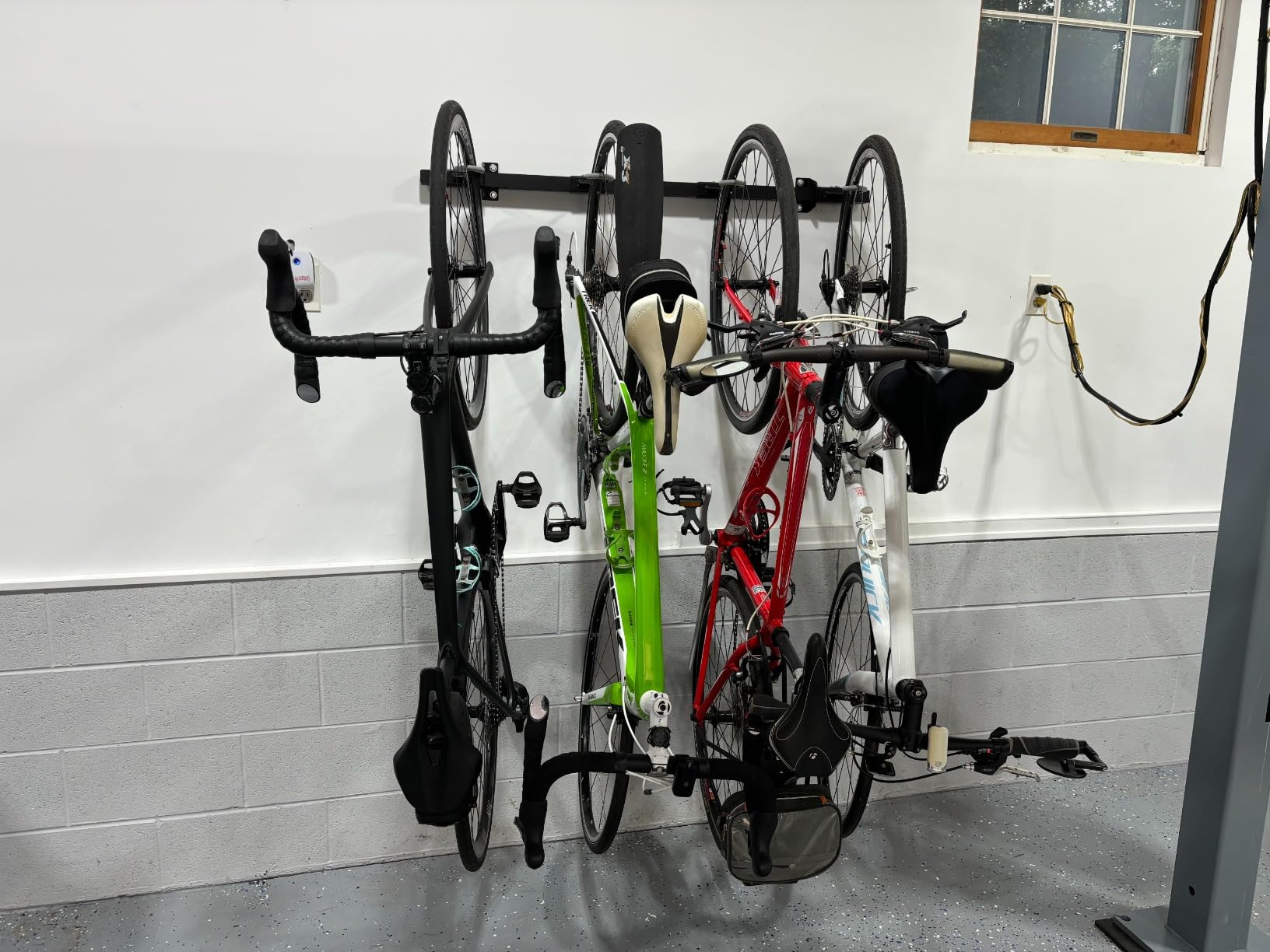
Stainless steel construction, rubber-coated hooks, and a system rating of 200 pounds make this the sturdiest-feeling rail in the group. The Infinity Stud System is also unusually practical: the mounting brackets accept either 16 inch or 24 inch stud spacing, which covers both common garage wall layouts without a ledger board.
It handles a wide size range, from 20 inch folders up to 27.5 inch mid-fat mountain bikes, hanging by either the front or the rear wheel.
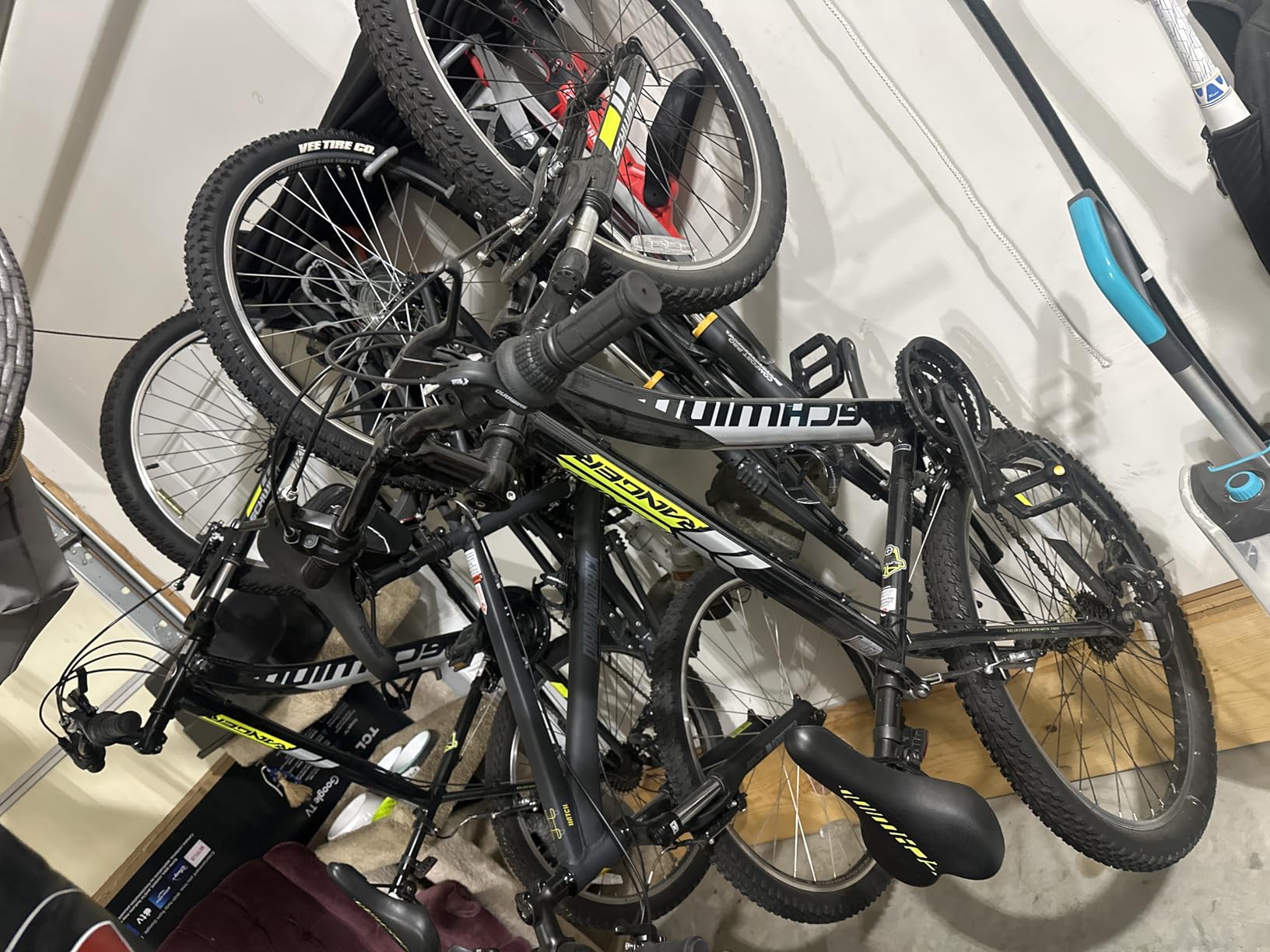
There is a caveat on fit that experienced installers all mention. A 46 inch bar holding five bikes is comfortable for road bikes with narrow bars. If your household runs wide-handlebar mountain bikes, the same bar is snug, and a longer version of this rail is the more sensible buy.
Getting the mounting height right
This is the most common complaint in the reviews and it is a real planning issue, not a defect. Bikes are hung by the wheel, and the wheel drops into the hook under load, so a rail mounted too high leaves every bike hanging awkwardly and a rail mounted too low means you are lifting rather than rolling.
Mark the height with the bike in hand before you drill, and check where the tire actually rests. Owners who did this report a dramatically better result than those who followed a guess.
What it cannot do
It is a fixed-rail design, so there is no swivel and bikes project from the wall by roughly the depth of a handlebar. In a garage with a car parked tight against the same wall, that is a genuine limitation and the reason it does not take the top slot despite strong ratings.
On a block or concrete wall you will need Tapcons and a hammer drill, which the kit does not include. On a framed wall with studs, the included hardware is fine.
5. Ultrawall 6-Bike Wall Rail – Best for Custom Spacing
Ultrawall Stainless Steel Bike Storage Rack, Wall Mount 6 Bike Hanger
48 in sliding rail
Holds up to 300 lbs
Rubber-coated sleeves
Works on four wall types
Pros
- Hooks slide to any position along the rail
- 300 lb system rating across the rail
- Rubber sleeves resist rust chipping and scratches
- Hardware kit covers stud drywall concrete and brick
Cons
- Six bikes is an optimistic figure for wide handlebars
- Spacing can crowd wider bars
- Crowded row is harder to load in the middle
The Ultrawall takes a different approach to the rail category. Instead of hooks locked into fixed slots, the hooks slide freely along a 48 inch steel rail and tighten with a 5 mm drill. Spacing is genuinely continuous rather than quantized, which is the feature that separates it from the pin-and-slot systems.
The system rating is 300 pounds across the whole rail, the highest total load figure in this roundup. Powder-coated steel with an epoxy finish resists rust, chipping, and cracking, and the hooks carry rubber-coated sleeves so neither the frame nor the wheel touches bare metal.
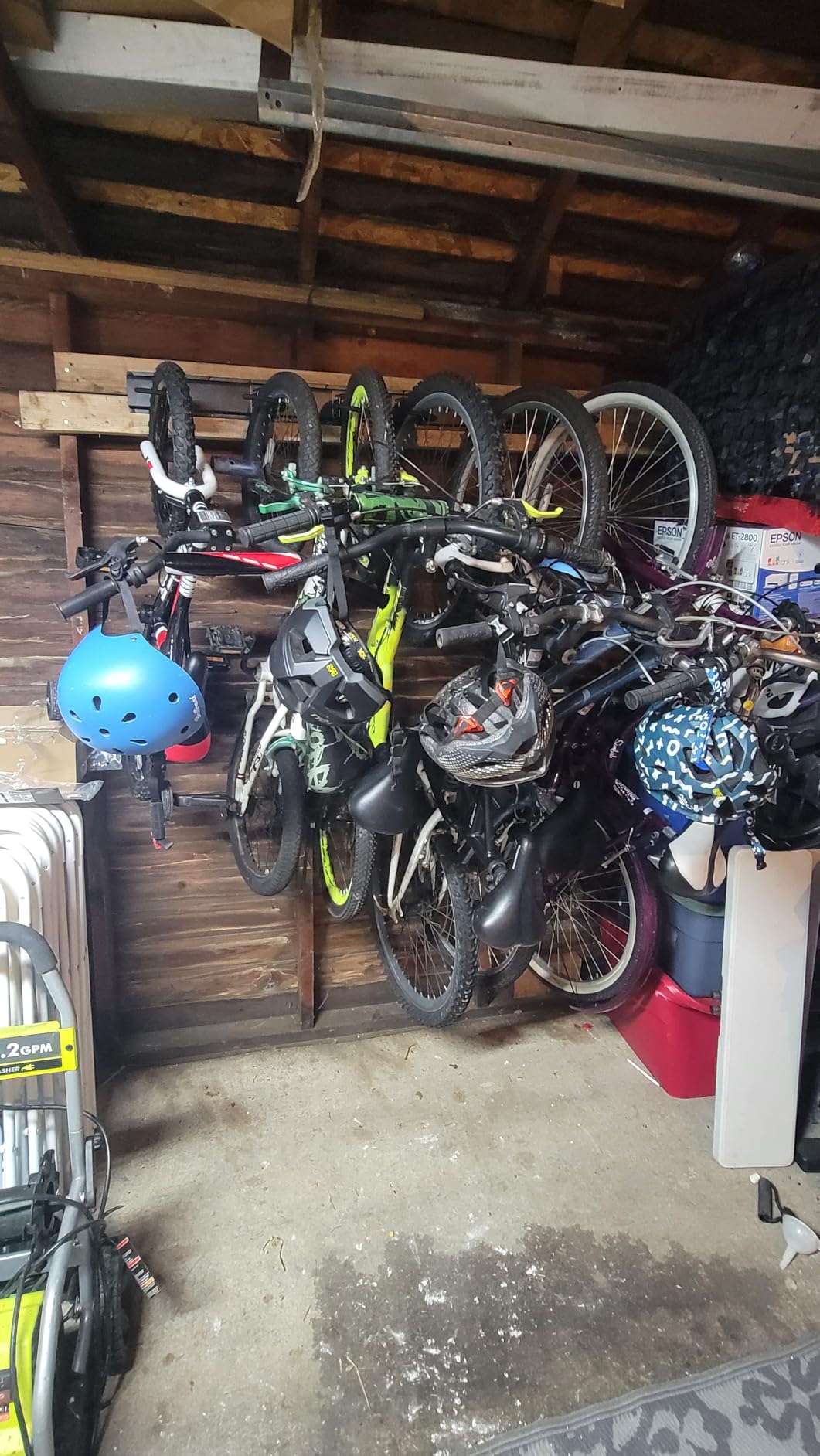
The hardware kit is unusually complete. Sixteen screws and sixteen expansion tubes cover wood stud, drywall, concrete, and brick, so the same rail works whether you are in a framed garage, a basement, or a masonry workshop. The safety hook design also resists accidental release, which matters if a bike gets knocked by something in the garage.
Buyers like the finish. This is one of the few racks in the category that looks considered enough for a finished garage rather than a utility space.
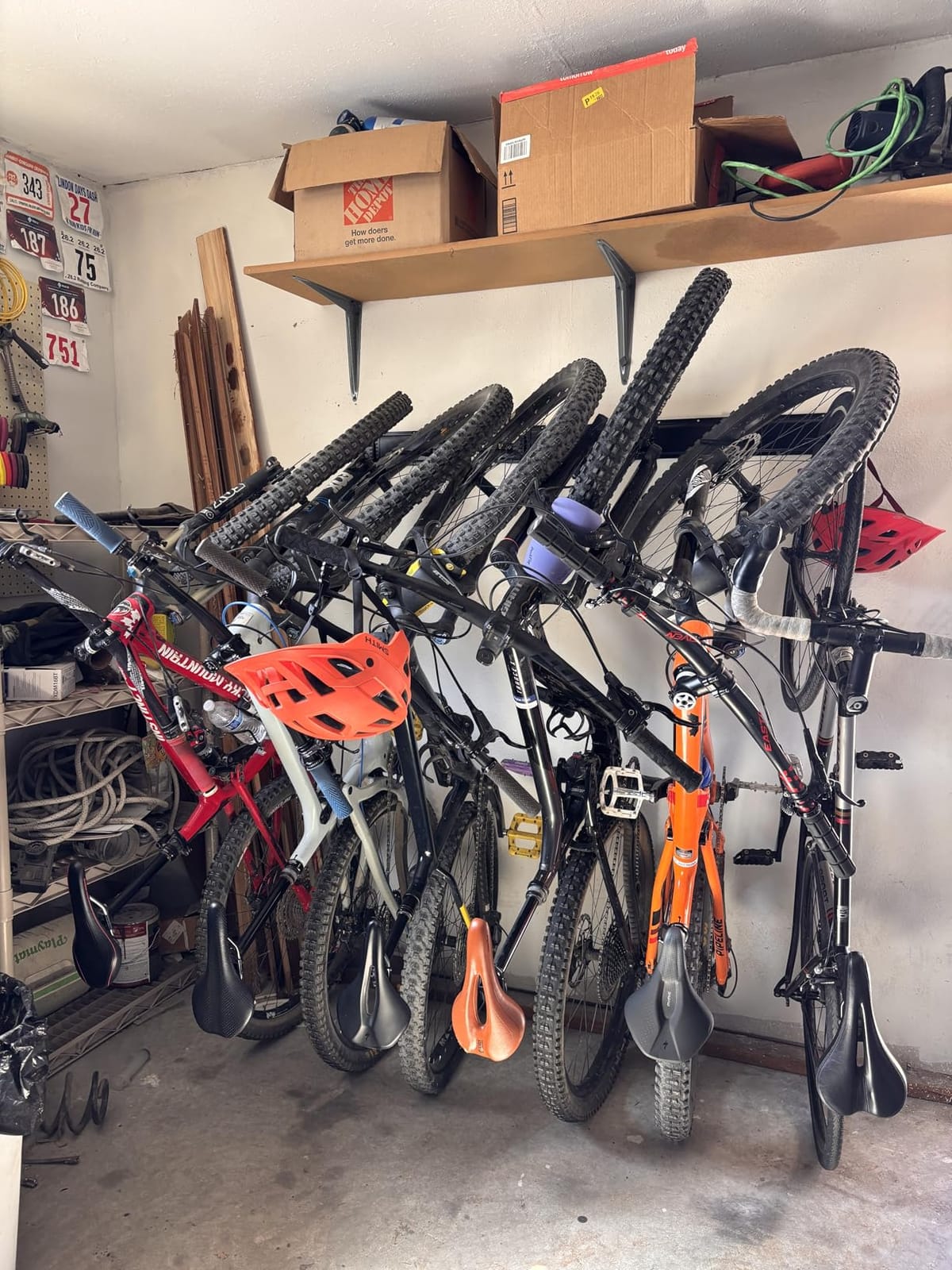
Now the honest part. The manufacturer itself suggests hanging four bikes rather than the rated six, and that is a fair piece of engineering advice rather than a hedge. Six bikes on a 48 inch rail leaves about eight inches of center-to-center spacing, which is less than a mountain bike handlebar.
Best for a mixed collection on one wall
Continuous hook adjustment is what makes this the right pick for a household where the bikes are not uniform. Put the road bike at one end with 14 inches of clearance, the kids bikes in the middle at a tighter spacing, and the e-bike where the rail is best supported. Most competing rails force you into fixed increments that do not suit that layout.
Because the rail spans 48 inches, it also mounts across two stud bays comfortably, which keeps the load path short and direct.
What it cannot do
It is a fixed rail with no swivel, so it shares the projection problem of every rail system in this roundup. It is not the answer for a garage where the car is parked within a foot of the wall, and it is not the answer for a family of six wide-bar mountain bikes on one bar.
Plan on four bikes as a realistic working count and treat the sixth position as headroom for a narrow-bar bike you add later.
6. Housolution 4-Pack Fixed Bike Hooks – Best Budget Multi-Pack
Housolution Bike Wall Mount with Fixed Hook, [4 Pack] Bike Storage Rack
4-pack fixed iron hooks
35-45 kg per hook
No assembly required
Solid wall installation
Pros
- Lowest per-hook cost in the roundup
- Iron construction holds adult bikes without bending
- Rubber coating is bonded to the metal
- Two screws per bracket
- about 15 minutes for the set
Cons
- Big-lug and fat tire bikes do not fit the hook opening
- Must be installed on solid walls
- Fixed hook with no swivel so bikes project outward
The Housolution pack is four identical fixed hooks made of iron with a rubber-coated contact point and a locking mechanism that resists accidental release. There is no assembly, no pivot, and no adjustment. You hold a bracket against the wall, drill two screws, and hang a bike on it. Four brackets take about fifteen minutes.
For a four-bike garage on a budget, the per-hook cost here is the lowest of anything in this roundup, and the iron does not flex the way lighter-gauge steel does. Reviewers confirm the hooks hold adult mountain and road bikes without bending.
![Housolution Bike Wall Mount with Fixed Hook, [4 Pack] Bike Storage Rack customer photo 1](https://www.wearesalt.org/wp-content/uploads/2026/09/B09R1T2FTY_customer_1.jpg)
One detail worth calling out: the rubber is bonded to the metal rather than slipped on as a sleeve. That matters because a slip-on sleeve can migrate and expose bare iron to a wet frame, which is how rust transfers from a hook onto a bike tube.
The compact footprint is useful in a shed or an apartment too. Each bracket is roughly 5.5 by 4.7 by 4.3 inches, so four of them use less than two feet of wall.
![Housolution Bike Wall Mount with Fixed Hook, [4 Pack] Bike Storage Rack customer photo 2](https://www.wearesalt.org/wp-content/uploads/2026/09/B09R1T2FTY_customer_2.jpg)
The locking hook also does a specific job. It keeps a bike from swinging out off the hook if something brushes past it in the garage, which is a common problem in a shared space with a mower or a workbench nearby.
Best for a garage with wide open wall and studs
Fixed hooks excel in one situation: a wall with studs and plenty of empty space, where you simply want four bikes off the floor for the least money. Hang them at shoulder height, spaced about 20 inches apart, and the bikes will be easy to lift on and off.
They are also the right pick for a garage that doubles as storage for several small bikes, since the hook height is easy to set low for kids and high for an adult frame.
What it cannot do
Big-lug mountain bike and fat tire wheels do not fit the hook opening, so this is not a pick for a household running wide tires. The instructions are explicit that installation is on solid walls only, and a fixed hook gives you no swing clearance for a parked car.
Because there is no adjustment, the height is whatever you drilled. Plan the whole row before the first hole.
7. TORACK BIKEPAL No-Lift Swivel Rack – Best Rim Protection
TORACK BIKEPAL No Lifting Swivel Bike Racks, Wall Mounted Bike Holder
U-shaped wheel cradle
No-lift roll-on loading
78 lb per rack
Fits 18-28 in wheels
Pros
- Cradle supports the whole wheel instead of one rim point
- Roll-on and roll-off with no lifting
- Swivel rotates to clear a parked car
- Arrives assembled
- three screws to mount
Cons
- Tire width cap of 2.4 in
- Lower rear tire keeper is undersized
- Mounting height must be measured carefully
The defining feature of the BIKEPAL is its U-shaped wheel cradle. A conventional hook contacts the rim at one point and concentrates the entire bike weight on that single spot. This cradle supports the arc of the wheel instead, spreading the load across the whole lower portion of the rim, which is where fatigue cracks and sidewall damage tend to start.
That matters most for lightweight alloy rims and for anyone whose bikes spend years hanging. If your bike lives on a wall for eight months of the year, a single-point contact is a slow, invisible problem.
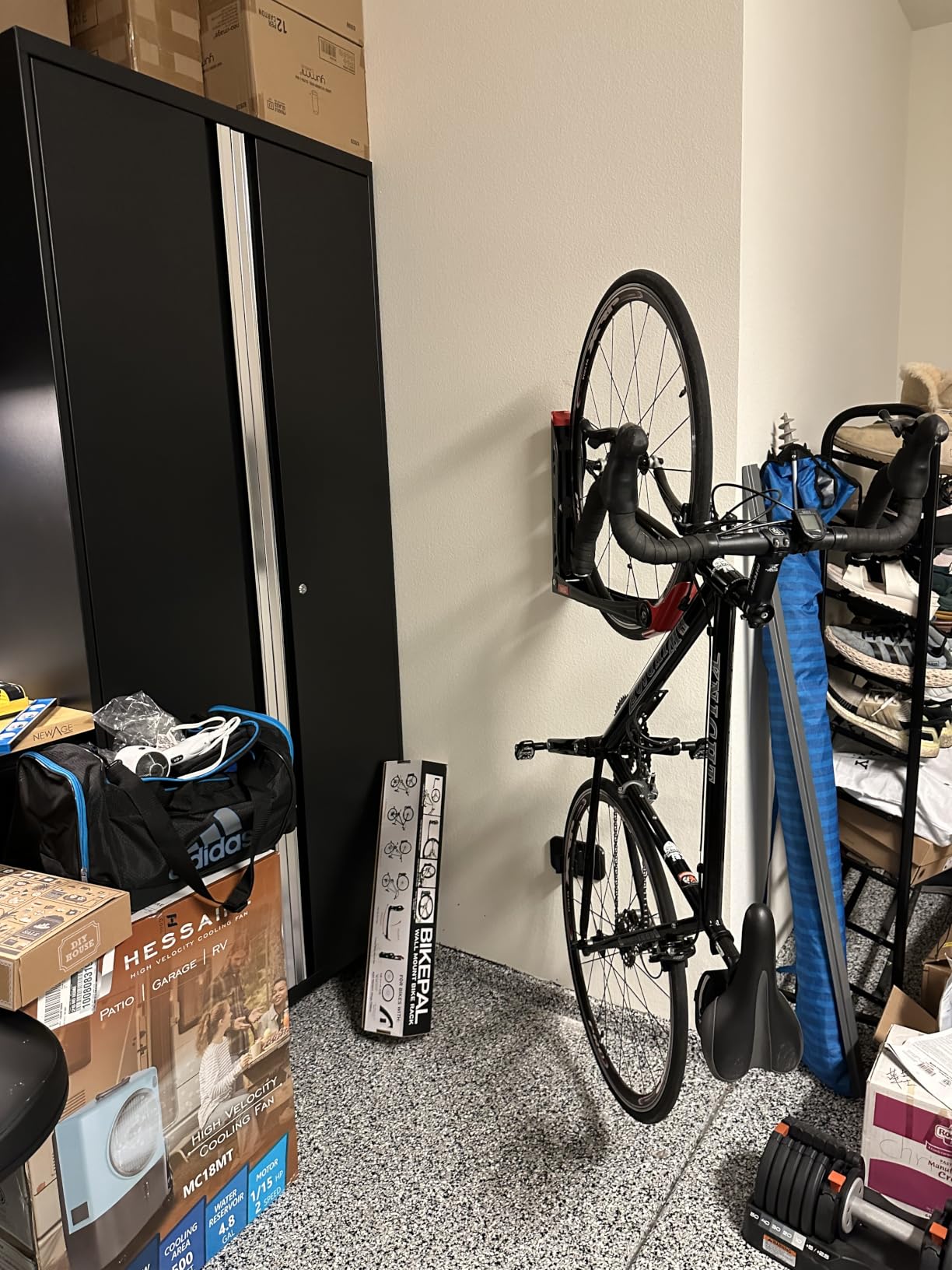
Loading is genuinely no-lift if you mount it at the right height. The bike rolls in on its own wheels rather than being raised into place, and the swivel rotates the arm so you can load from whichever side is open. The rack arrives fully assembled, so the install is three screws and a stud finder.
Weight capacity is 78 lb per rack, the highest single-bike rating among the swivel options here, and the wheel range is a broad 18 to 28 inches. It suits kids bikes, road bikes, and hardtails in one unit.
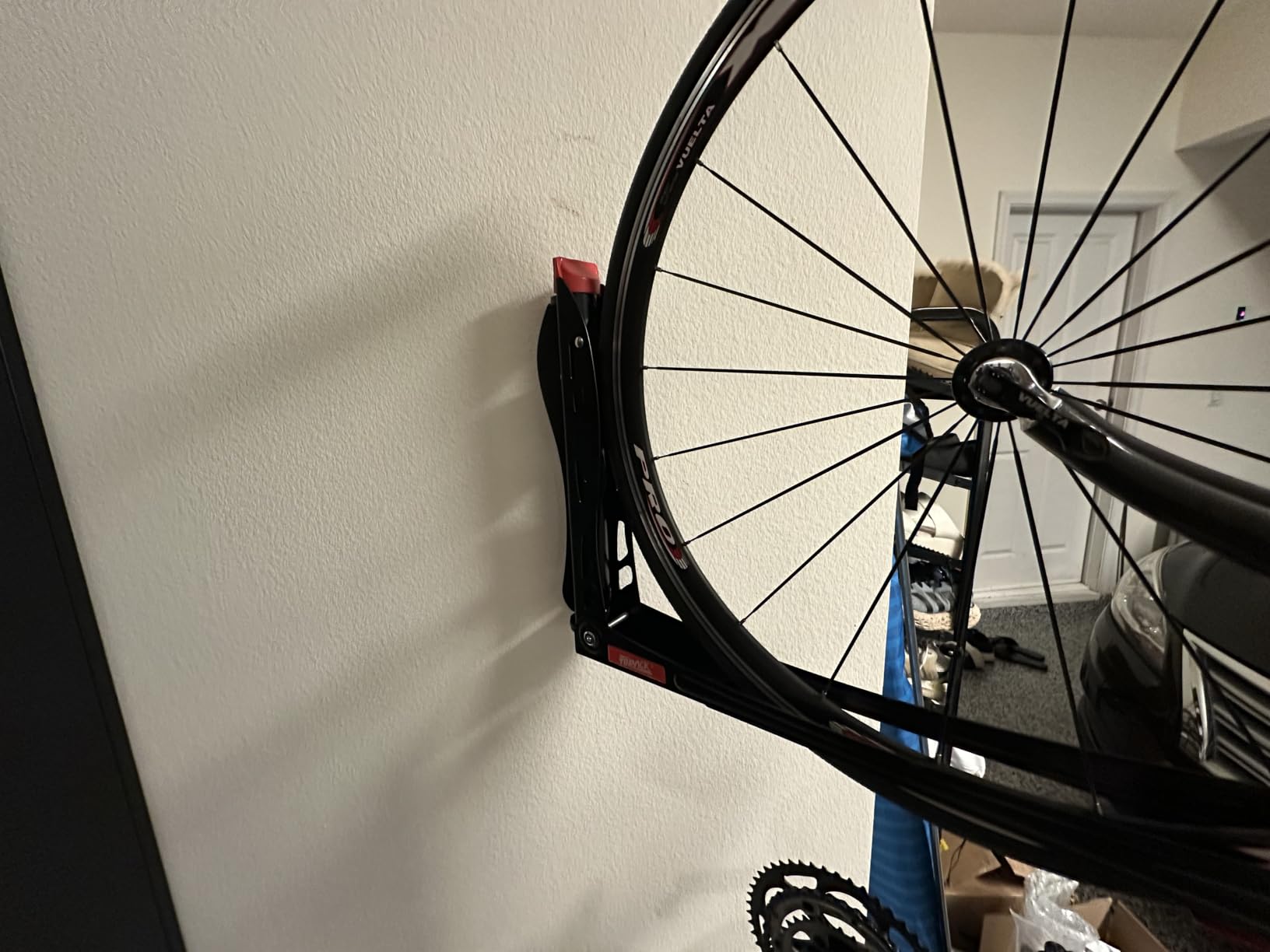
The bike also stores closer to the wall than most swivel racks once folded, which reviewers with narrow side walls specifically call out as the reason it earned a place in their garage.
Getting the height right on this one
Two reviews say the same thing, so we will repeat it: mounting height determines whether this rack works. Too high and the bike will not roll on without a shove. Too low and you are lifting again, which defeats the design entirely. Mark the height with a bike in hand first.
The lower rear tire holder is the part to watch. It is smaller than the upper cradle and lets the tire kick outward when the arm is folded flat, so check it after a week of use and tighten if it moves.
What it cannot do
Tire width is capped at 2.4 inches, which is the tightest limit on any swivel rack in this roundup. Plus-size and fat tires are out. And the review base here is much smaller than the others, at 264 ratings, so treat long-term durability as less well documented.
It is also sold in twos, so a four-bike garage means two packs.
8. Wallmaster 2-Pack Vertical Bike Hooks – Best Simple Fixed Hook
Wallmaster Bike Storage Rack for Garage, Wall Mount Bicycles Hanger
2-pack fixed hooks
Holds 50 lb each
Rubber anti-scratch hook
Four-screw install
Pros
- Cheapest per-rack entry in the roundup
- No assembly
- four screws and you are done
- Rubber coating prevents scratches and slipping
- Fixed design resists accidental release
Cons
- Included screws and anchors are too weak for the 50 lb rating
- Skinny road rims twist sideways in the hook
- Fat and wide mountain rims fit loosely
The Wallmaster is the simplest thing in this roundup: two solid steel hooks, powder coated, with a rubber-coated contact point, and eight screws and eight wall anchors in the box. The hook is a fixed design with a small lip that stops a bike sliding out.
That simplicity is the appeal. There is no pivot to loosen, no ratchet to strip, and nothing that can seize in a damp garage. For a renter, a workshop, or anyone who wants bike storage in an afternoon, it is hard to beat.
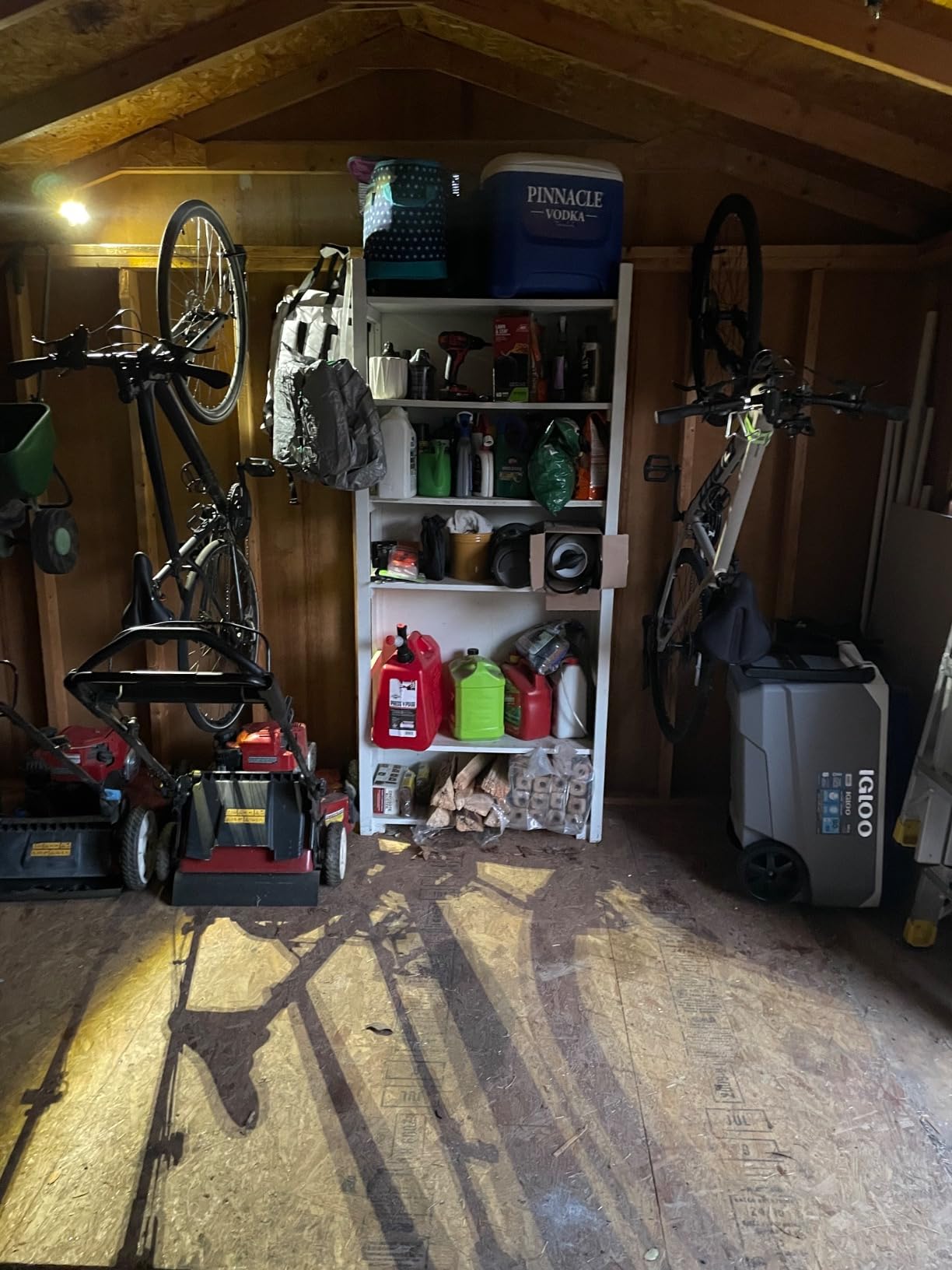
The 50 lb rating per rack is lower than the other steel hooks here, but it comfortably covers road bikes, hardtails, and most hybrids. The rubber coating does its job on frame protection, which is the damage that actually shows up after a year on a wall.
Reviewers rate the value highly, and the installation genuinely takes minutes with no assembly required.
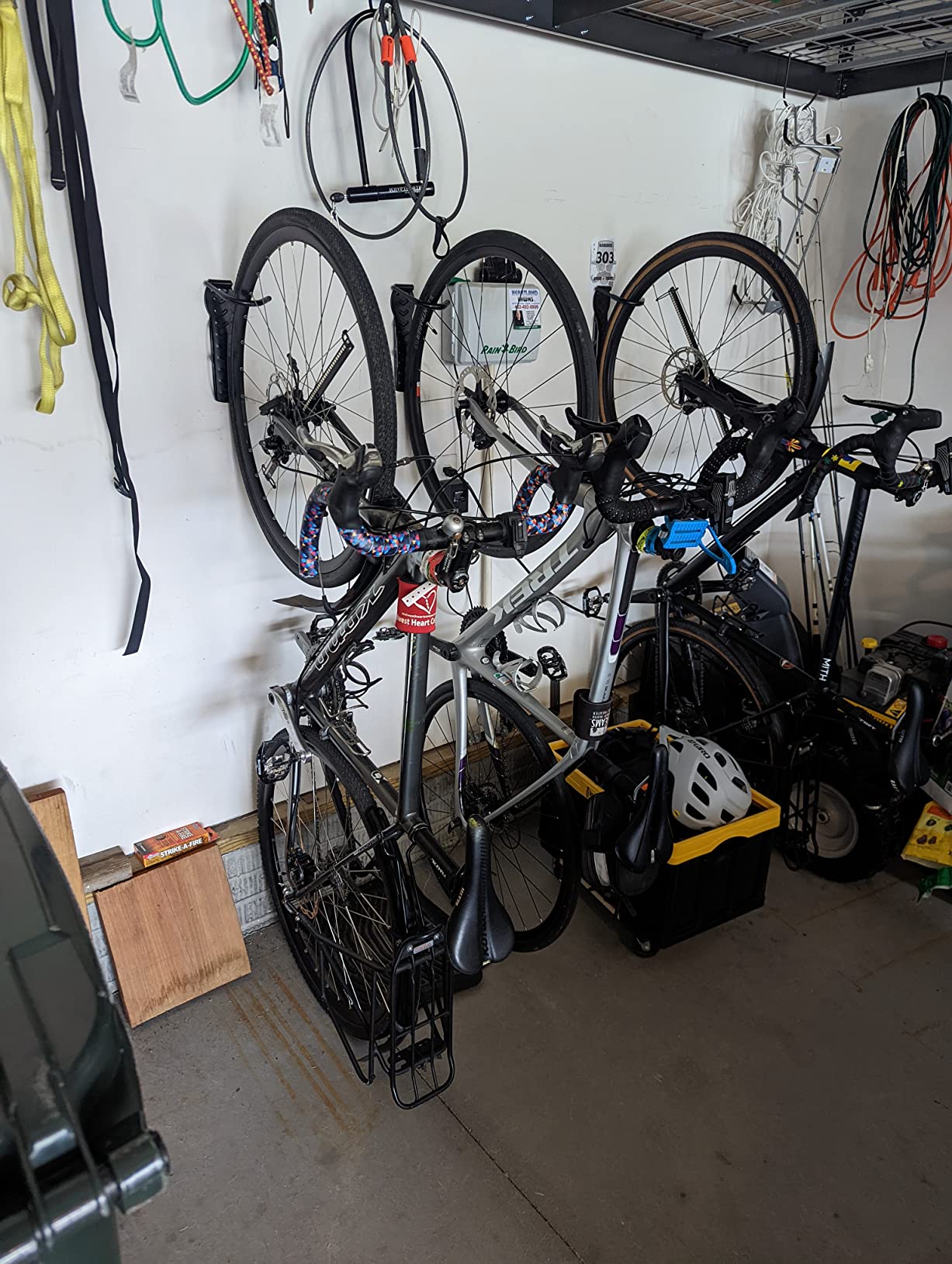
There is one theme that comes up more than any other across reviews of budget hooks in general, and this product is a textbook case. The included fasteners are not strong enough to hold the stated load in drywall. Multiple owners report replacing them.
Best for a low-traffic, low-weight setup
Two of these handle a couple of road bikes, a commuter, or a pair of kids bikes very well on a wall with studs. The rubber hook grips securely enough that a bike does not slide, and the fixed design means nothing moves once it is loaded.
Plan on roughly 18 inches between mounts so you can lift bikes straight off the hook without catching a handlebar on the next bike. That spacing is the difference between a wall that works and a wall where every bike is twisted sideways.
What it cannot do
It will not carry a heavy e-bike, and it should not be asked to. Do not use the included anchors in unsupported drywall. Skinny road bike rims have a habit of twisting in the hook, and wide mountain or fat bike rims sit loosely enough that the bike can pivot.
If your bikes are valuable or heavy, move up to a rated iron hook or a swivel mount rather than relying on the box hardware.
9. TORACK 6-Bike Interlocking Rail – Best for Fat Tires
TORACK Bike Storage Rack, 6 Bike Rack Wall Mount Home and Garage Organizer
3 x 16 in interlockable rails
6 hooks fit 4.4 in tires
300 lb steel system
Snap-hook spacing
Pros
- Widest hook opening in the roundup at 4.4 in
- Three 16 in rails interlock for longer runs
- Two-year manufacturer warranty
- Rubber-coated sleeves resist rust and slipping
Cons
- Lowest average rating here at 4.3
- Reports of hooks breaking after a few months
- Rail can pull from drywall and bend under six bikes
The TORACK rail system is the fat-tire specialist of the group. Its hooks accept tires up to 4.4 inches wide, which is wider than anything else in this roundup by a comfortable margin, and it is the only rail here where a plus-size or 4.8 inch tire is a supported configuration rather than a squeeze.
The modularity is the other idea worth understanding. You get three 16 inch rails and six hooks. The rails interlock end to end, so three make a 48 inch run, and you can also run them separately as three 16 inch sections mounted wherever the studs happen to be. That flexibility matters in garages where a single continuous 48 inch bar would cross a window or a door.
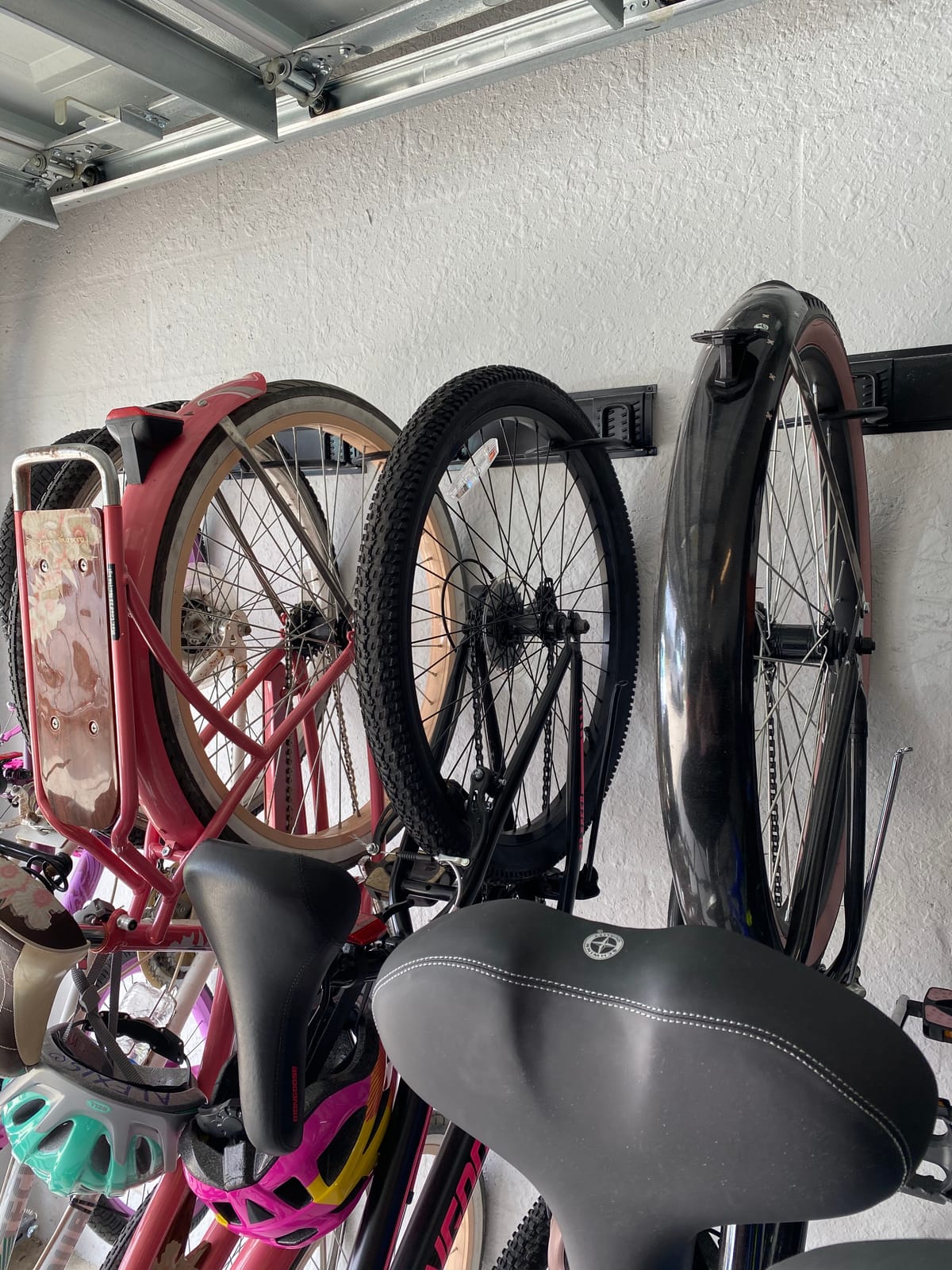
Hooks attach with a snap-hook design, so changing spacing takes seconds with a drill. The material is heavy-gauge powder-coated steel with rubber-coated sleeves, rated to 300 pounds across the system, and the fit-and-finish is clean enough for a garage with good lighting.
It is also one of the few racks here with a stated two-year manufacturer warranty, which is worth something on a component that carries the full weight of a bike.
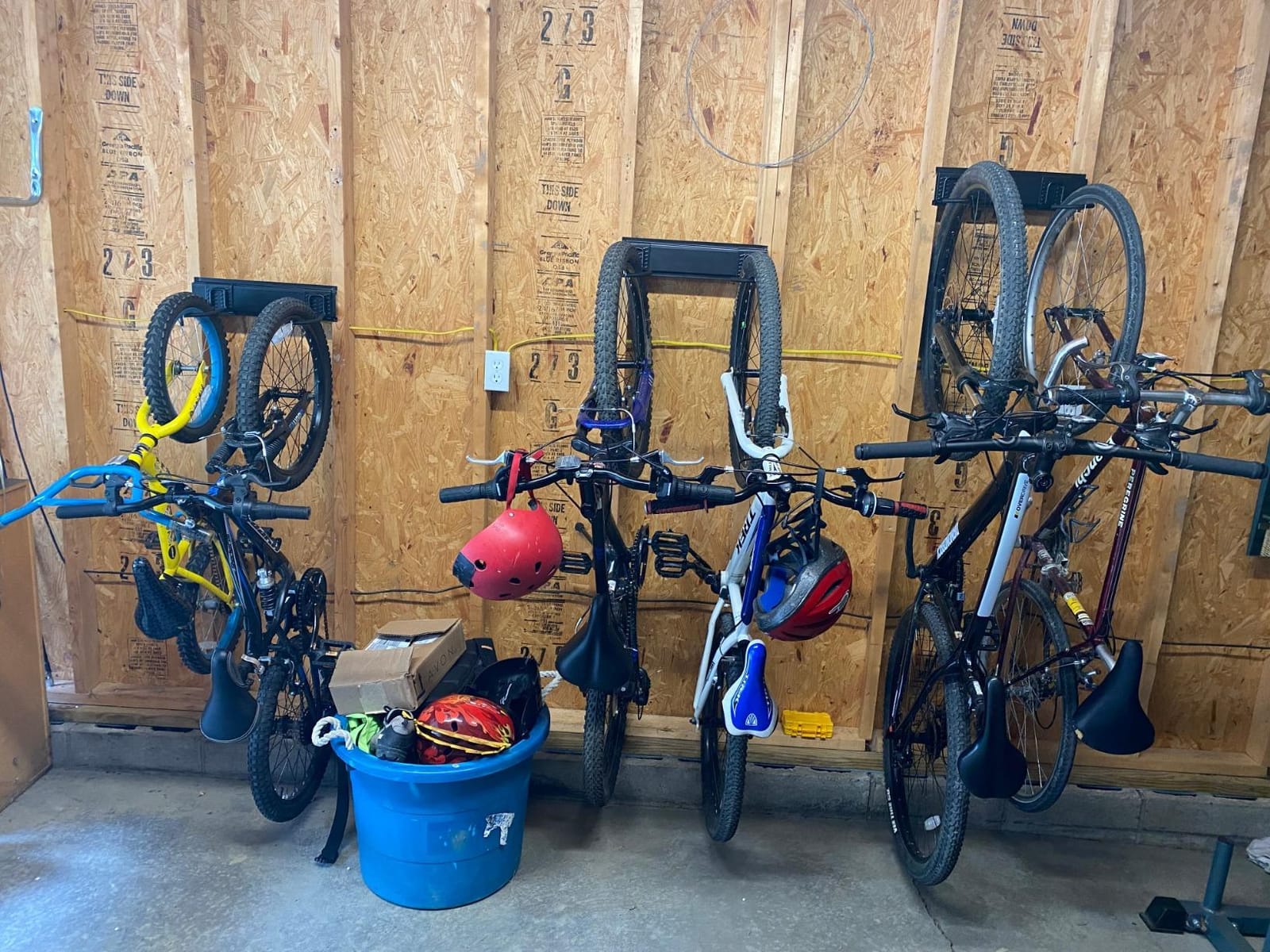
We are including this one with clear reservations, and readers should weigh them. It has the lowest average rating in the roundup at 4.3, with a measurable share of one-star reviews.
When the wide hook is the deciding factor
If you ride fat tires, plus-size rubber, or a bike with a very wide rim, this is the only rail in the list that genuinely fits without a workaround. The hook opening swallows the wheel and the sleeve grips the sidewall without crushing it.
The interlocking rail design also makes it the easiest of the multi-bike systems to install around obstacles, which is how most garages are actually laid out. The instruction specifies 16 inch stud spacing for mounting, so check your wall before buying.
What it cannot do
Durability is the concern. Owners report hooks breaking after a couple of months of light use, and the rack pulling out of drywall, which points back to fasteners and substrate rather than to the steel itself. Into studs or a ledger board it behaves far better.
Rails bending under a full six-bike load is also reported. Plan on four as a working count, mount into studs, and check the hardware before you trust it with a heavy frame.
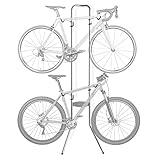
10. Delta Cycle Michelangelo Gravity Stand – Best for No-Drilling Installations
Delta Cycle Michelangelo 2 Bike Storage Rack – Gravity Fully Adjustable Bike Storage Garage For Road, MTB, and Hybrid Bicycles – Vertical Bike Rack Holds Up To 80 lbs
Gravity lean design, no drilling
2 bikes at 40 lb each
Adjustable arms
Powder-coated steel
Pros
- No drilling and no wall mounting of any kind
- Stores two bikes vertically in a small footprint
- Adjustable arms fit road MTB and hybrid frames
- Screwdriver-only assembly
Cons
- Not a wall mount
- rated 40 lb per bike
- Two-bike capacity only
Full disclosure first: the Michelangelo is not a wall rack. It is a gravity stand that leans against the wall and holds bikes by the front wheel, and it is in this roundup because a very large share of garage bike storage searches end up comparing it against wall mounts, often from people who cannot drill into their wall at all.
The mechanism is clever. The rack is a tall frame with adjustable arms angled so that a bike rolled in by the front wheel is held by the arm and its own weight. The rear of the frame rests on the wall and the base sits on the floor with durable rubber feet, so the whole structure is self-supporting. Nothing is anchored to anything.
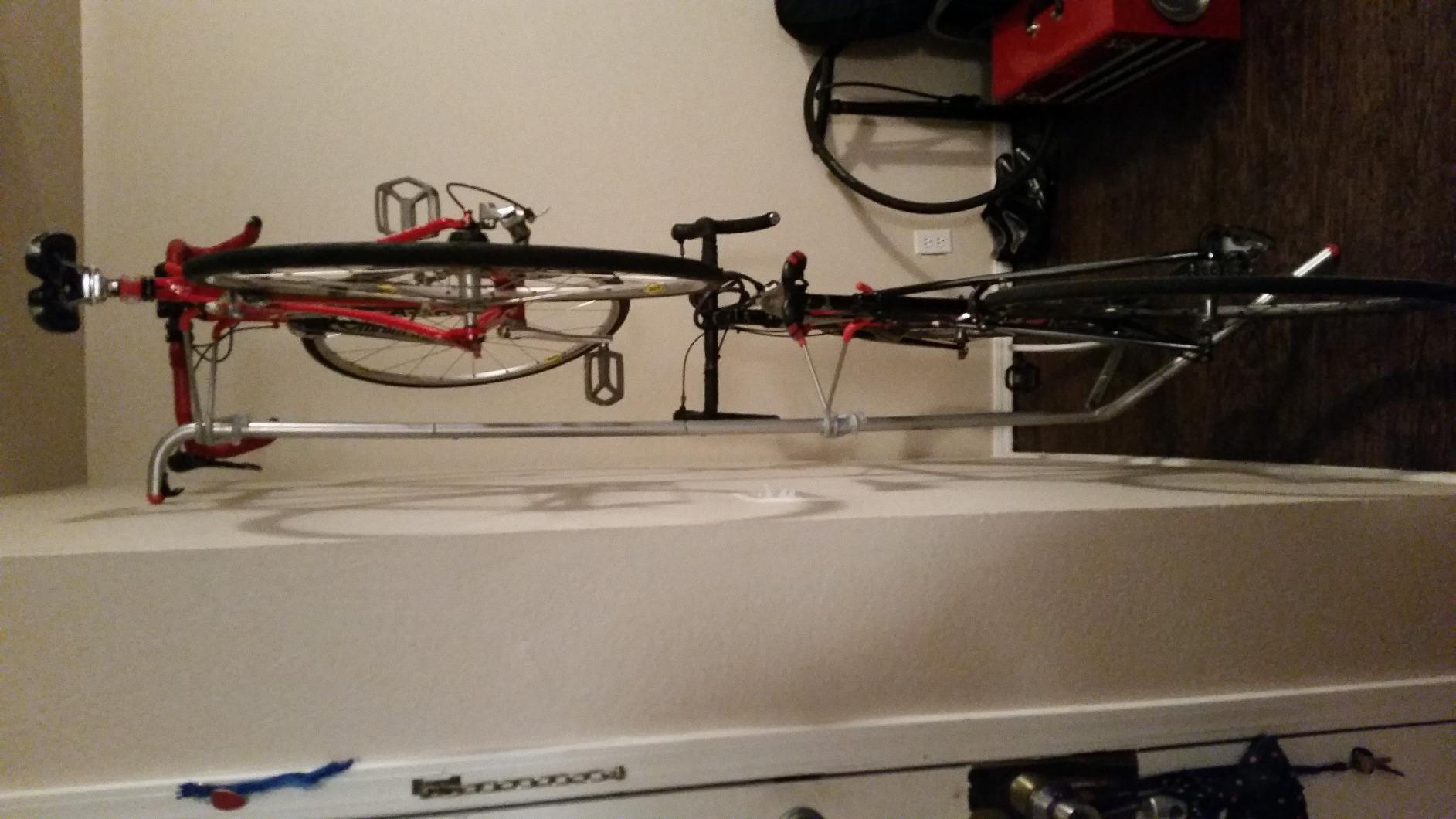
It is a genuinely good fit for rented garages, apartment balconies, sheds, and any space where studs are not an option. Assembly takes minutes with a screwdriver, and the steel frame is powder coated to survive a damp floor.
At 84 by 26 by 16 inches, it holds two bikes upright in a footprint of about two feet of floor depth, which is a fraction of what two bikes leaning against a wall take up when you include the door swing they block.
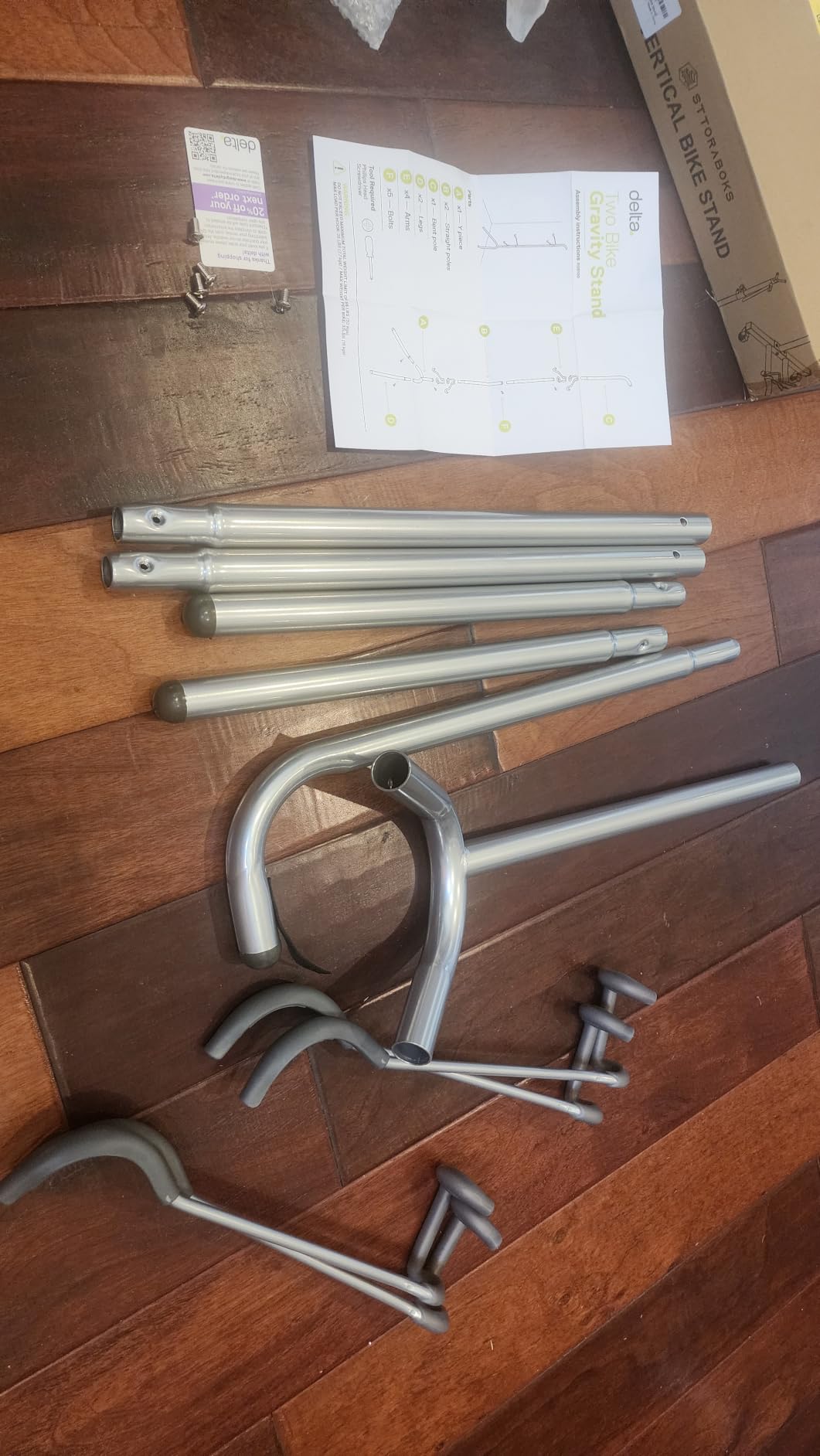
The adjustable arms accommodate road, mountain, and hybrid frames, and the unit holds up to 40 lb per bike, or 80 lb total.
Who this is actually right for
Start with the no-drilling requirement. Tenants, people in concrete apartments, and anyone in a building where penetrating the wall is forbidden are the clear audience. It is also useful as overflow storage in a garage that already has a good wall system, since two bikes is a realistic number for a couple or a single rider.
It moves easily too. If you need the wall for something else on a given day, you drag the stand out of the way instead of unhooking four bikes.
What it cannot do
It is a floor stand, so it does not clear floor space the way a wall mount does. It reclaims vertical space and tidiness, not area. And at 40 lb per bike it is not suitable for most e-bikes, which is the most common reason people end up returning gravity stands.
Capacity is two bikes, so scaling up means buying multiple stands, each taking its own floor footprint.
How to Install a Bike Rack on a Garage Wall
Hang a bike on a garage wall in six steps: find the studs, mark the height, mark the holes, drill into wood or masonry, hang the rack, then test the swing. The first two steps decide whether the install works, and everything after that is straightforward.
1. Find the studs and mark them. Use a stud finder or knock along the wall and listen for the hollow change. In a standard framed garage, studs sit 16 inches on center. Mark every stud in the stretch of wall you plan to use, because a cantilevered bike wants the fastener in wood, not in the face of drywall.
2. Set the height with a bike in hand. Hold the rack where you want it and hang a bike on it. Most wheel hooks sag slightly under load, and a mount that is a few inches too high means lifting instead of rolling. Decide this before you drill, because moving a rail later means patching holes.
3. Mark holes and check the substrate. On a framed wall, every mounting screw should pass through drywall and into the stud face. On a masonry or block wall, you need a hammer drill and appropriate anchors, and the same kit that works on a stud will not work on block.
4. Drill and fasten. Use lag screws long enough to bite at least an inch into the stud. Skip the drywall anchors supplied in the box for any load-bearing bike; they are the single most common reason racks come loose or tear out.
5. Space the mounts. Allow roughly 18 to 24 inches between bike positions, and closer to 14 inches minimum for narrow bars. Wide handlebars need the larger figure or bikes will not lift off cleanly.
6. Test the swing and the load. Load one bike fully, push it to its parked position, and check that the pivot holds and nothing contacts the wall or a car door. Then hang the heaviest bike in the household and leave it for a day before trusting the row.
What not to do: do not install into unsupported drywall. This is the most repeated complaint in every forum thread about garage bike storage, and it is a safety issue rather than an aesthetic one. A 50 lb bike hanging from an anchor in hollow drywall will eventually pull the anchor out and drop the bike, usually while nobody is standing there. If you cannot find a stud, install a ledger board of solid lumber across the wall first, then hang from that.
For garages that already have a slatwall or pegboard panel, single hooks that clip into the panel are the fast path, provided you know what is behind the panel. A pegboard on an unfinished stud wall holds a road bike without drama. The same panel over hollow drywall with four e-bikes on it is a different calculation entirely.
How to Choose a Bike Rack for Your Garage Wall
Choose a wall rack by matching four things: the weight of your heaviest bike, the material of your wall, the depth you have available, and whether the bikes have fenders. Get any one of those wrong and the rack becomes a nuisance.
Start with weight, and use the heaviest bike as the number. Ratings across this category run from 40 lb to 78 lb per hook, and the difference matters more than most listings suggest. A standard pedal bike sits between 20 and 30 lb. A mid-weight e-bike runs 50 to 60 lb. A cargo or high-torque hub e-bike can exceed 90 lb, and no wall hook in this roundup is rated for one. A hook that is rated at 60 lb and holds a 30 lb bike has double the margin; the same hook holding a 55 lb e-bike has almost none.
Second, know what your wall is made of. Drywall over studs is the easy case. Concrete block and brick need a hammer drill and the right anchors, and several manufacturers say so explicitly. Hollow plasterboard, sometimes called plasterboard or unsupported paneling, is the one substrate on which no bike rack should ever be mounted. If you have that surface, your options are a ledger board, a no-drill floor stand, or a pole-mounted system.
Third, work out real capacity rather than advertised capacity. This is the biggest gap between what a listing says and what you get. A rail advertised for six bikes on a 48 inch bar works out to about eight inches of center-to-center spacing, and a mountain bike handlebar is wider than that. Treat six as a ceiling and four as a plan. The same applies to vertical columns: bikes hung in a line need 18 to 24 inches each, and kids bars are wider than adults bars even though the bikes are smaller.
Fourth, check the tire and fender fit before anything else. Nearly every vertical cradle has a maximum tire depth, usually expressed in millimeters. The monTEK fits up to 3.54 inches, the Steadyrack is explicitly not for fenders at all, the BIKEPAL caps tire width at 2.4 inches, and the TORACK rail is the outlier at 4.4 inches. Measure the widest tire in your household, then subtract nothing.
On swivel versus fixed, the decision is simple. If a car is parked close to the wall, buy a swivel. The pivot exists so the bike can move out of the space the car occupies, and a fixed hook does not give you that. If the wall is clear, a fixed hook is cheaper, has no moving part to fail, and projects the bike only a few inches.
On one bike per mount versus a rail, count your household first. Rails are efficient for four or more bikes and awkward for two. Individual hooks are the reverse. Many people end up mixing, which works fine: two swivel arms for the heavy e-bikes on a stud bay near the door, and a rail above the workbench for everyone else.
A last note on security. A wall hook holds a bike in place, not safe. Anyone who can reach the rack can lift a bike off it in seconds. If the garage is shared, detached, or near a side gate, run a cable lock through the frame and the rack, or anchor the bike to a fixed floor ring.
Space Math: How Many Bikes Fit on Your Wall
Bike count is a function of wall width and mount spacing, and the honest numbers are lower than the packaging suggests. Use 24 inches of wall per bike as a safe planning figure for a vertical wall row, and 18 inches as the absolute minimum.
On an 8 foot wall, or 96 inches, that gives you four bikes at comfortable spacing, or five at the tight minimum. On a 12 foot wall, 144 inches, you get six at 24 inches each. On a 16 foot wall, 192 inches, you get eight, which is beyond what most families need but is a realistic figure for a household with multiple riders per child.
Rails follow the same math with one adjustment for handlebars. A 46 inch bar holds five narrow-bar bikes or four wide-bar bikes. A 48 inch rail with sliding hooks can absorb that difference by spacing two bikes tightly and the rest loosely, which is the practical argument for adjustable rails over fixed multi-bike bars.
Add 6 to 8 inches of clearance on each end of a row so the first and last bike can be lifted straight out without catching a handlebar or a pedal on its neighbour. On a 96 inch wall, that turns a nominal four into a very comfortable three plus a storage shelf.
Frequently Asked Questions
What is the best bike rack for a garage wall?
A swivel vertical wall mount is the best general choice for a garage wall, because the pivot lets a bike swing flat against the wall and clear a parked car door. The Steadyrack is our top pick at a 35 kg (77 lb) rating and a 160-degree pivot. Choose a fixed hook instead if your wall is clear of vehicles, and choose a horizontal rail if you are storing four or more bikes at once.
Can you install a bike rack on drywall?
Only if the screws pass through the drywall into a stud. Drywall anchors and hollow plasterboard will not hold a cantilevered bike, and the anchor will eventually pull out and drop the bike. If you cannot find a stud, fasten a ledger board of solid lumber across the wall first and mount the rack into that, or use a floor stand that needs no drilling.
How far apart should bike hooks be on a garage wall?
Allow 18 to 24 inches between mounts for comfortable lifting, and never closer than about 14 inches between bikes with narrow handlebars. Wide-handlebar mountain bikes need the full 24 inches or handlebars catch on the neighbouring bike when you try to remove it.
Will a swivel bike wall rack work with fenders?
It depends on the model. The monTEK swivel mount is listed as suitable for bikes with fenders, while Steadyrack states plainly that its rack is not suitable for a fender or mudguard. Check the rim and tire depth limit for any rack, and measure the widest tire in your household before ordering.
How many bikes can I realistically store on one garage wall?
Plan on 24 inches of wall per bike. That gives four bikes on an 8 foot wall, six on a 12 foot wall, and eight on a 16 foot wall. Rail systems advertised for six bikes on a 48 inch bar usually hold four wide-handlebar bikes in practice, so check handlebar width against the rail length before you count on the full number.
What is the best way to secure my bike in a shed?
Mount the rack into studs or masonry, not into unsupported board, and use a cable lock or a D-lock through the frame and a fixed anchor point in the shed. A wall hook keeps a bike organised and lifts it clear of the floor, but anyone who can reach the rack can remove the bike in seconds.
Conclusion: The Best Bike Racks for Garage Walls
If you only buy one thing, buy the Steadyrack swivel mount for a garage shared with a car, and the monTEK four-pack if you are covering four bikes at once. The Steadyrack has the widest pivot and the highest rating, the monTEK accepts fenders and comes as a complete set, and both are wasted if you mount them into hollow drywall rather than a stud.
For a wall of four or more bikes, the StoreYourBoard rail gives the truest capacity and the Ultrawall rail gives the best spacing control. For fat tires specifically, the TORACK interlocking rail is the only one here with a hook wide enough. And if drilling is not an option at all, the Delta Cycle gravity stand puts two bikes vertical with no holes in the wall.
Whichever you pick, measure the wall with a real bike in hand, check the tire and fender fit, and give the mount at least one stud. That is the whole decision, and it takes about ten minutes. If you want to widen the scope, our guides to bike storage racks for every kind of space, indoor bike storage, and overhead garage storage cover the options above and beyond the wall.