
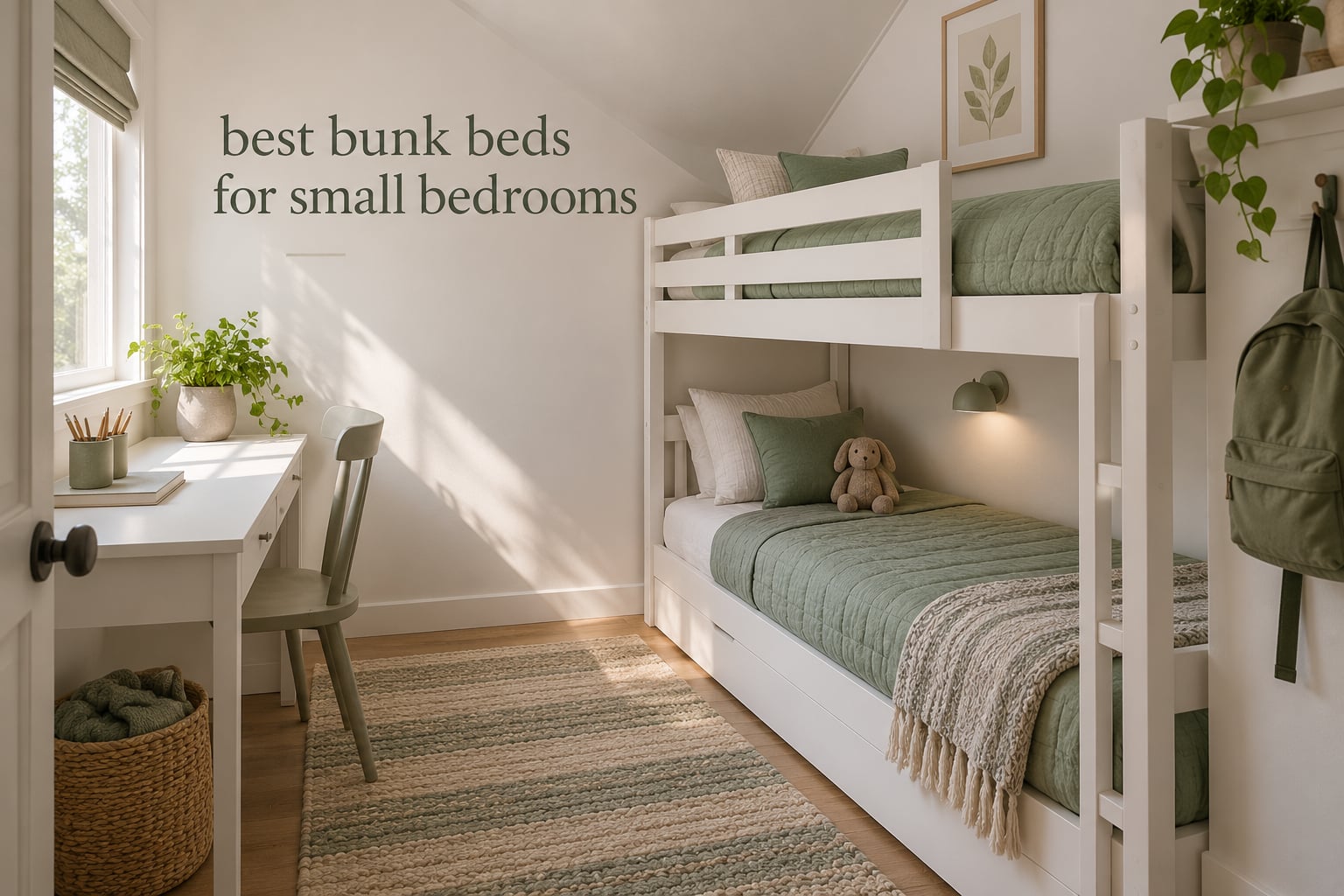
The best bunk beds for small bedrooms are low-profile and modular space-saving designs that stack two sleeping surfaces inside one footprint without crowding the ceiling. Height is the number that decides whether a bunk bed works in a small room, and it is the number most roundups bury.
Two sleepers take up the floor space of a single twin bed, which is the only way a 7-foot-by-8-foot room can hold a bed, a desk, and a walkway. Everything else about the frame matters less than whether the top sleeper can sit up without scraping their head. We went through the published dimensions on ten frames and sorted them by overall height, footprint width, and underbed clearance so you can match a bed to your room before you commit to it.
Below each pick we note the exact frame height and footprint, what reviewers like after living with the bed, and the complaints that show up repeatedly. For the wider background, our general guide to bunk beds for kids covers configurations we could not fit in this roundup.
Key Features to Look For
Low-Profile Height – Anything under roughly 55 inches tall leaves a usable adult sitting space on the top bunk. Frames at 68 inches and above need a ceiling of at least 8 feet to stay comfortable.
Built-In Storage – Drawers, a storage staircase, or pegboard storage turn the square footage under and beside the bed into usable space, which matters more than any finish or colour.
Material Choice – Solid pine and low-VOC powder-coated steel age well and keep the profile slim. MDF panels are lighter and cheaper but can emit a noticeable odour in a small, closed room.
Top 3 Bunk Beds for Small Bedrooms (October 2026)

Max and Lily Low Bunk
- Low-profile 49.25 inch height
- 400 lb capacity
- 14 inch guardrails
- Low-VOC pine finish

Jocoevol Metal Twin Bunk
- Converts to two single beds
- 440 lb lower bunk
- 16.5 inch guardrails
- 11.2 inch underbed gap

LIKIMIO House Twin Bunk
- Slim 40.7 inch width
- House-frame canopy
- Metal frame
- Compact 76.8 inch length
Every Pick at a Glance
| Product | Specifications | Action |
|---|---|---|
| Max and Lily Fundamental Twin Low Bunk |
|
Check Latest Price |
| Jocoevol Metal Twin Over Twin |
|
Check Latest Price |
| LIKIMIO House Twin Over Twin |
|
Check Latest Price |
 SHA CERLIN Twin Over Twin SHA CERLIN Twin Over Twin |
|
Check Latest Price |
 GIANTEX Twin Low Bunk Bed GIANTEX Twin Low Bunk Bed |
|
Check Latest Price |
 Itaar Metal Bunk with Storage Itaar Metal Bunk with Storage |
|
Check Latest Price |
 ADORNEVE Low Bunk with Storage Staircase ADORNEVE Low Bunk with Storage Staircase |
|
Check Latest Price |
 ZJIAH Solid Wood Low Bunk ZJIAH Solid Wood Low Bunk |
|
Check Latest Price |
 Zevemomo Metal Low Profile Bunk Zevemomo Metal Low Profile Bunk |
|
Check Latest Price |
 JOYMOR Solid Wood Low Bunk JOYMOR Solid Wood Low Bunk |
|
Check Latest Price |
1. Max & Lily Fundamental Twin Low Bunk – Best Overall for Small Bedrooms
Max & Lily Fundamental Twin Low Bunk Bed, Kids Solid Wood Modern Bed Frame with Strong Wooden Slats, Non-Toxic Finishes, High Weight Capacity, White
80 x 54.25 x 49.25 inch solid pine frame
400 lb capacity
14 inch guardrails
Low-VOC finish
Pros
- Lowest-profile wood frame in the group at 49.25 inches
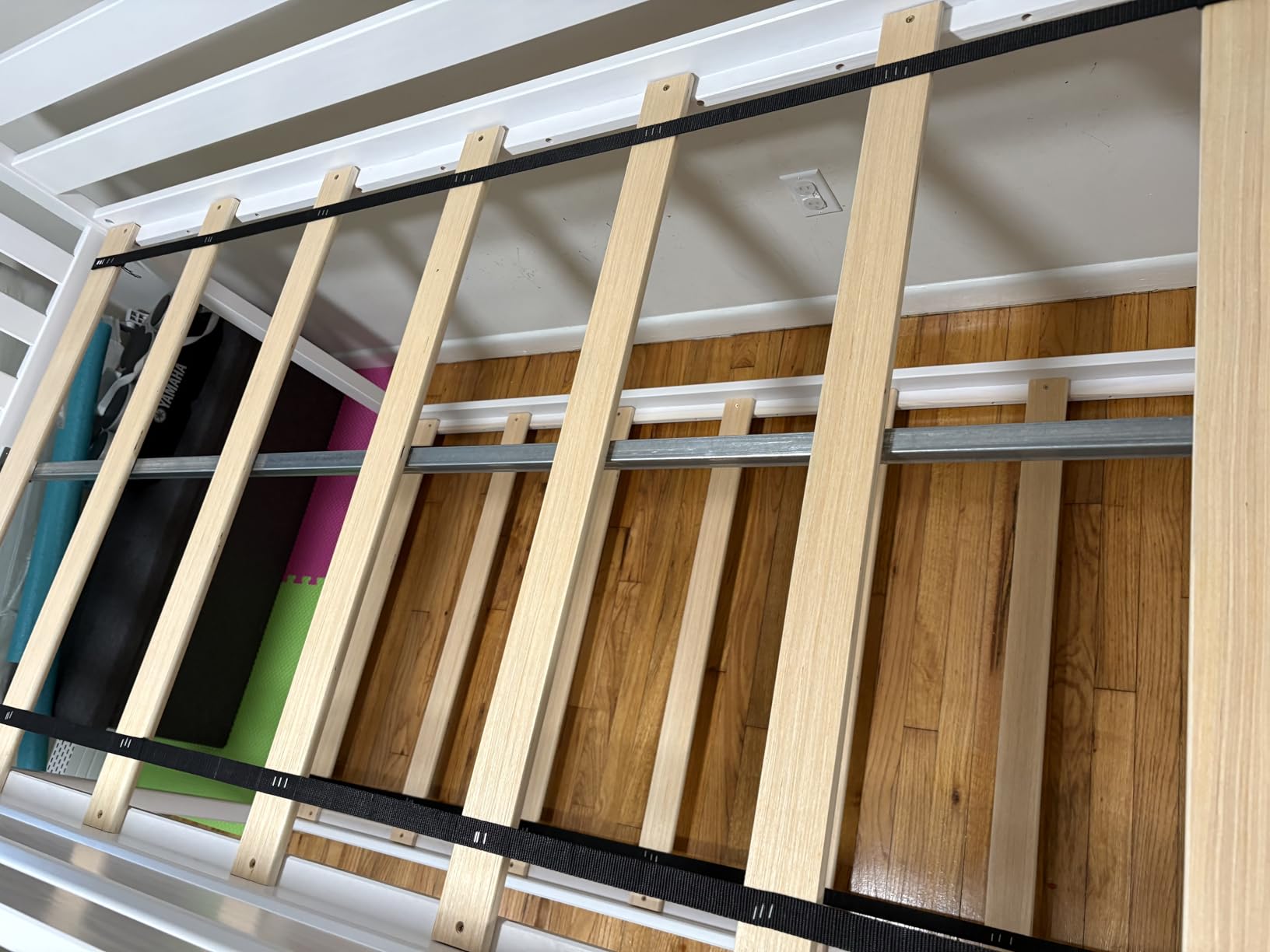
- 400 lb capacity backed by wooden slats and a metal support bar
- Tall 14 inch guardrails
- Non-toxic low-VOC finish
- No box spring or bunkie board needed
Cons
- Heaviest wood frame here at 81 lb so moving it takes two people
- 54.25 inch width is the widest footprint in the roundup
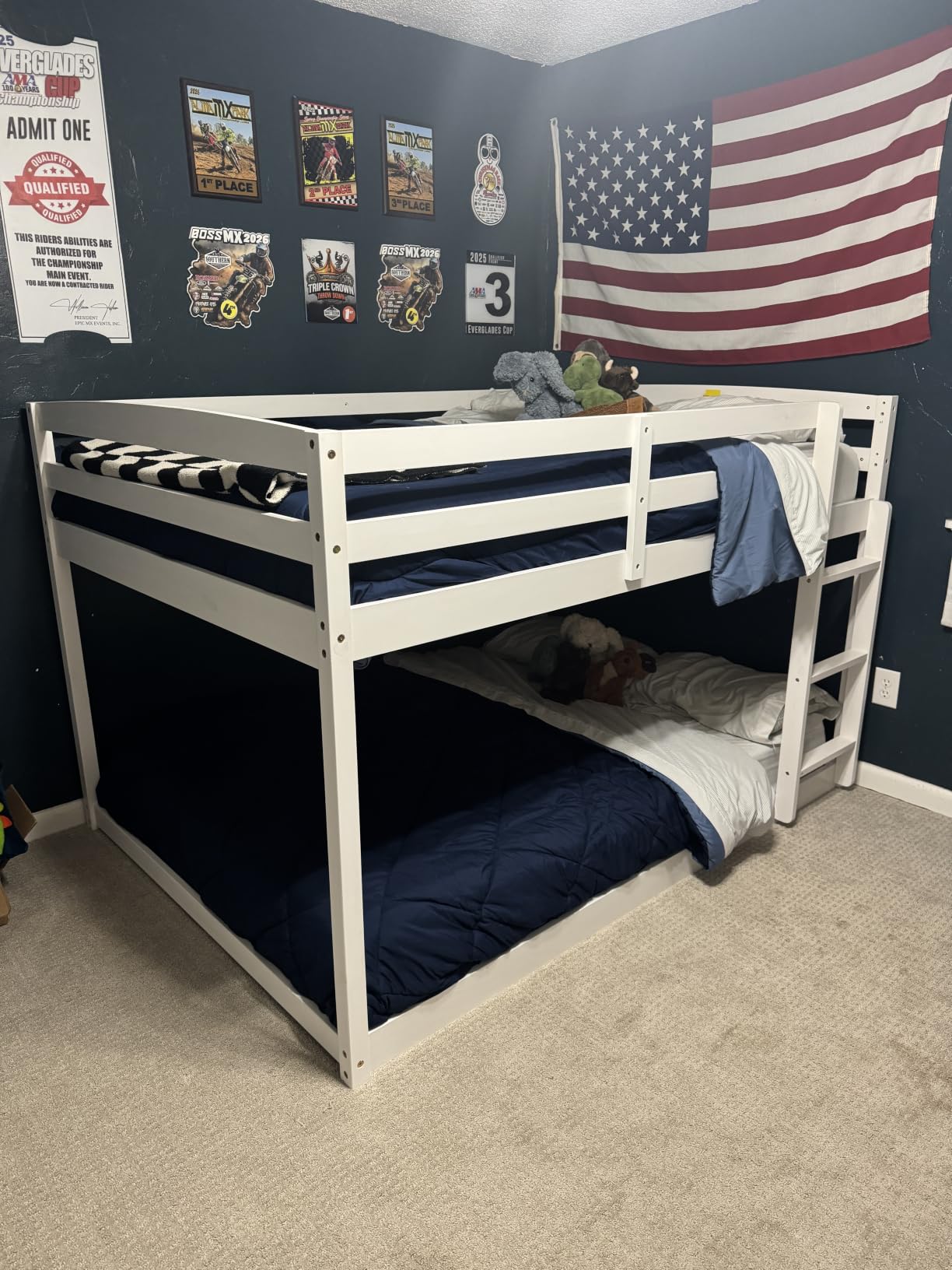
The single most useful thing about this frame is its 49.25-inch overall height. In a room with a 7-foot ceiling that leaves roughly 35 inches between the top mattress and the ceiling, which is enough for a teenager to sit cross-legged and read.
It is also the most reviewed bed in this roundup with more than 3,300 ratings, and 76 percent of those buyers give it five stars. The weight comes from real use: pine frames with hardwood slats and a metal support bar hold 400 pounds per sleeper, and the metal-on-metal bolt connections are what separate it from the flimsier MDF builds.
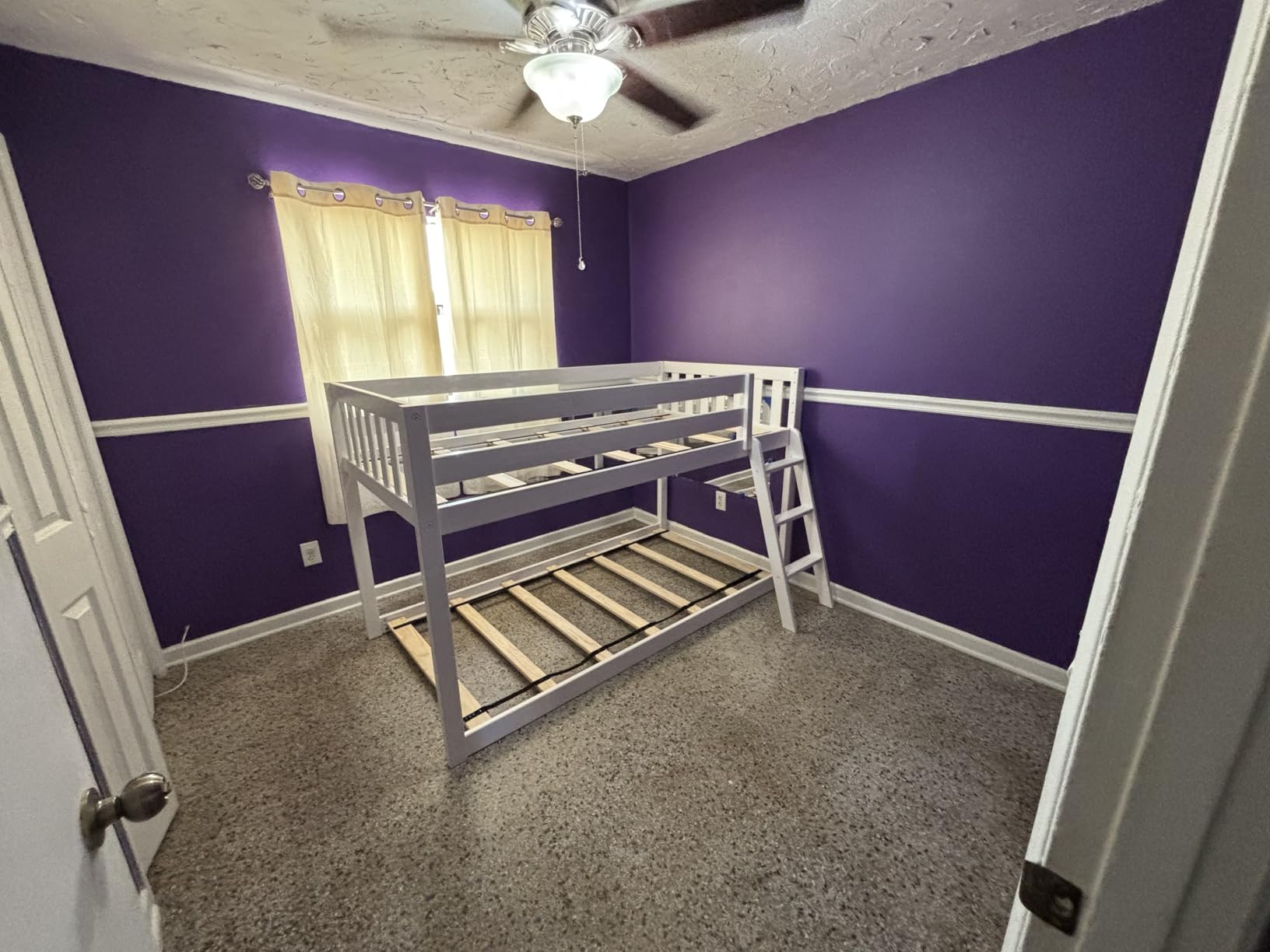
The trade-offs are physical. At 81 pounds this is a two-person move, and the 54.25-inch width means you need the widest wall in the room. If your room is 8 feet across with furniture on the other wall, measure the walk gap before ordering.
One thing reviewers mention constantly: no box spring is needed. A 5 to 8 inch mattress drops straight onto the slats, and the taller guardrails give you margin even with a thicker mattress.
Why the 49.25-inch height solves the low-ceiling problem
Owners in low-ceiling rooms report that taller bunks made the space feel smaller rather than bigger, because the frame became the visual ceiling of the room. A 49-inch frame leaves the walls visible and the top sleeper relaxed, which changes how the whole room reads.
The wide 14-inch guardrails matter more here than on a taller frame, since short overall heights mean proportionally taller rails for the same mattress.
Where this bunk bed is a compromise
The width is the honest drawback. At 54.25 inches it takes roughly 13 inches more floor than the metal models in this list, and that is floor you cannot recover.
The 81-pound frame also means this bed rarely moves once it is assembled. Plan its final position before you build it, and check that your doorway can take the 80-inch frame length.
2. Jocoevol Metal Twin Over Twin – Best Value Convertible Bunk
Jocoevol Metal Bunk Bed Twin Over Twin, Industrial Bunkbeds Heavy Duty Bed with Safety Guard Rails and Space-Saving Design, Steel Bed for School, Bedroom (Vintage Brown)
78.59 x 41.3 x 68 inch iron frame
440 lb lower and 330 lb upper
Converts to two single beds
16.5 inch guardrails
Pros
- Converts into two separate single beds for a guest room or changing needs
- 440 lb capacity on the lower bunk
- 16.5 inch guardrails
- Reversible ladder can mount on either side
- 11.2 inch underbed gap plus a bedside bag and four hooks
Cons
- 68 inch height needs a tall ceiling
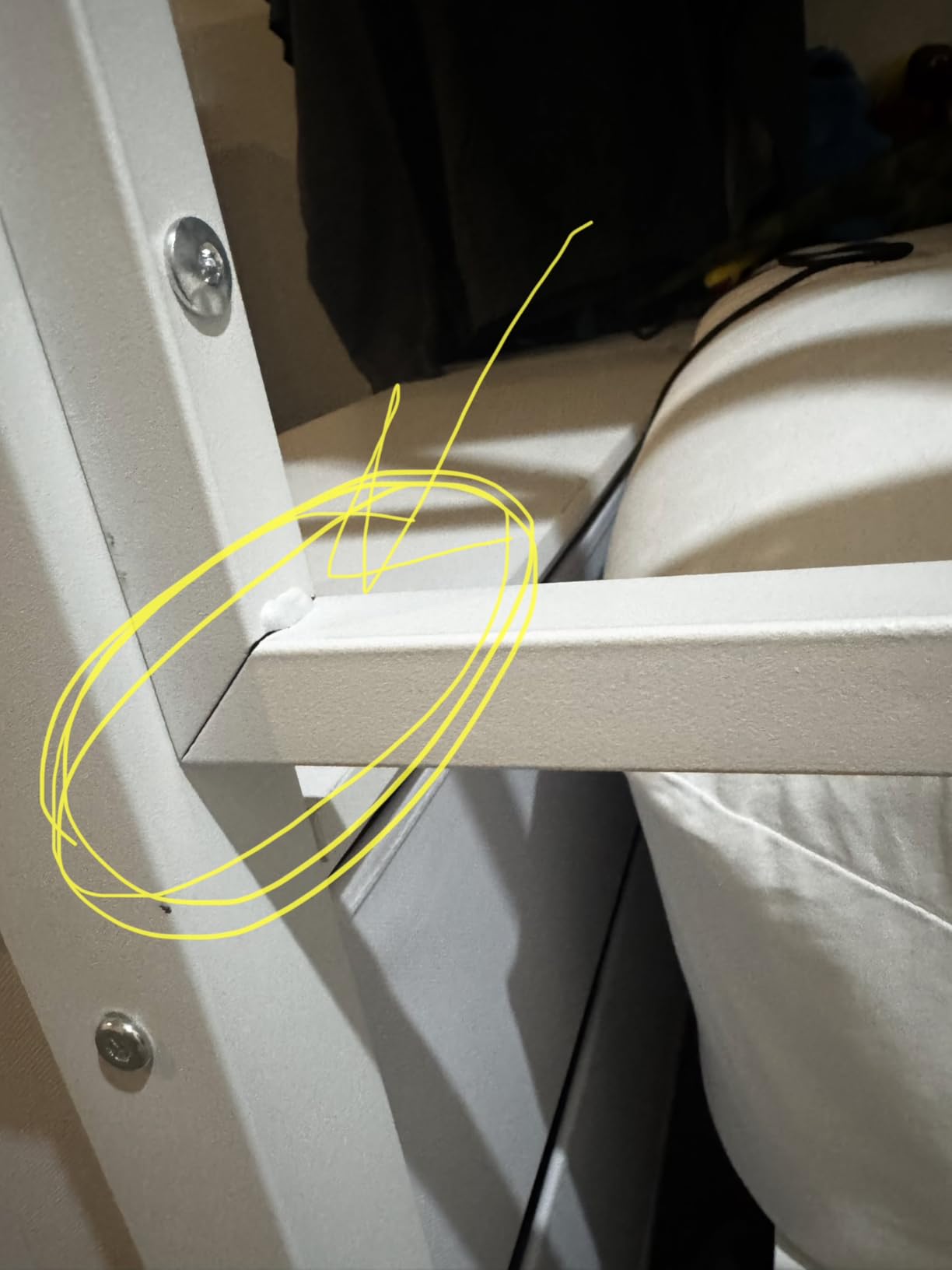
- Reviewers report screws loosening over time
- A minority report slat pieces shifting out of place
At 68 inches tall this is not a low-profile bed, and that single fact should decide whether it belongs in your room. Give it 8-foot ceilings or more and it works well. Under 7.5 feet, keep reading.
What you get for the compromise is the highest capacity in the roundup at 440 pounds on the bottom bunk, plus a genuinely useful conversion: pull it apart and it becomes two separate single beds. Families who move often or who need a guest bed that disappears mention this as the reason to buy it.
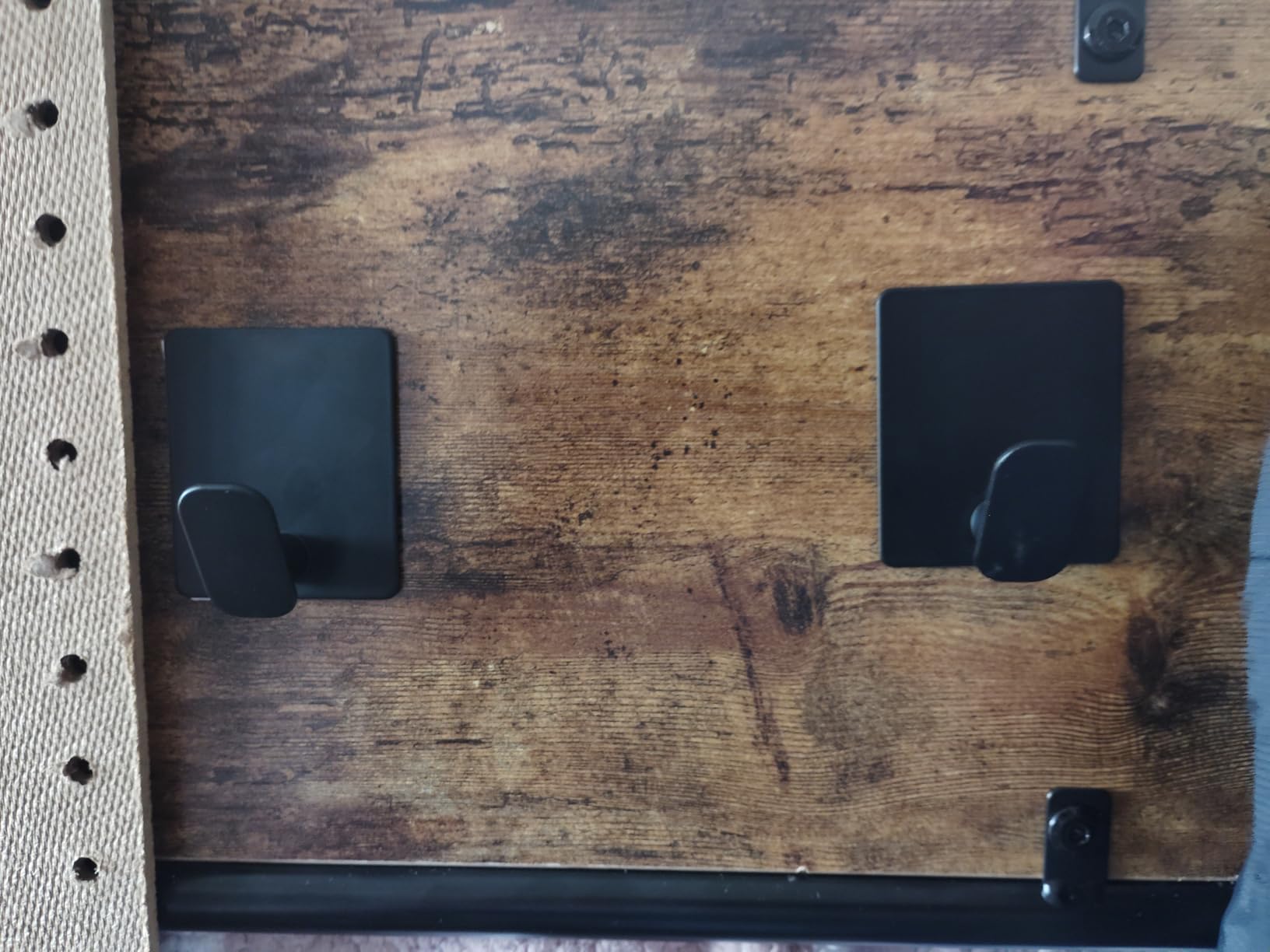
Reviewers also like the 41.3-inch width and the 11.2 inches of clearance underneath, which is enough for a low rolling cart rather than full bins. The reversible ladder is a small thing that quietly helps when the ladder blocks a window.
Budget roughly two hours for the build and have a second pair of hands available. Metal frames go together faster than wood, but the bolts take some torque to seat properly.
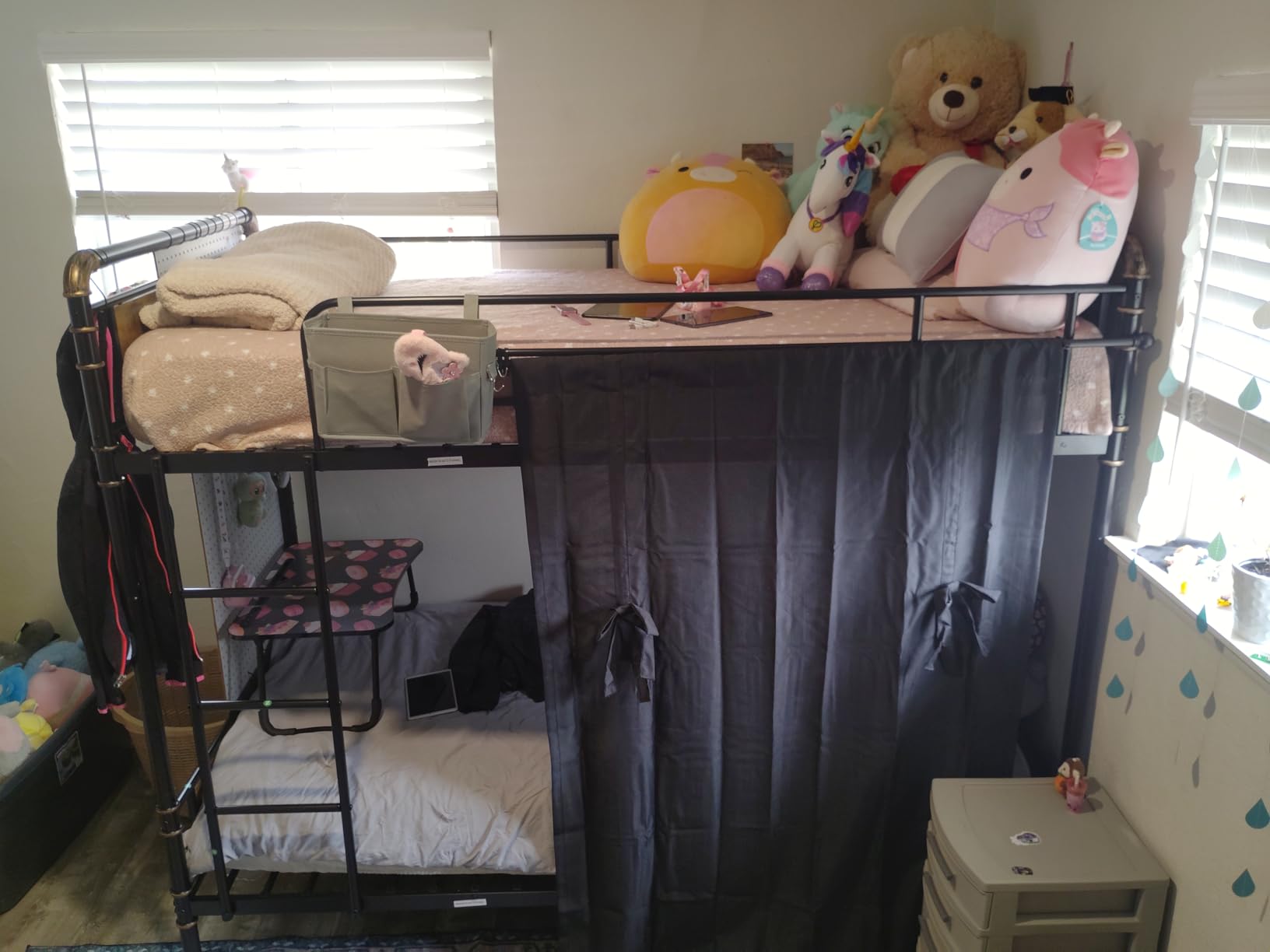
Who this convertible metal bunk suits
Dorm rooms, studio apartments, and guest rooms that double as kids rooms benefit most from the split-into-two-beds design. When the kids outgrow it you have two singles instead of one obsolete stack.
The 440-pound rating also makes it the safest pick here for two adults, which matters if older teens are sleeping on both levels.
Where reviewers report problems
Loosening hardware is the recurring theme. Some owners tighten the frame bolts every few months, and a smaller number report slat pieces that do not stay seated. Neither is dangerous, but both are irritating.
The 93.7-pound weight is heavier than several wood options, so repositioning it after assembly is a two-person job.
3. LIKIMIO House Twin Over Twin – Top Rated for Young Kids
LIKIMIO Bunk Bed Twin Over Twin, House Bunk Bed Frame with Ladder, White
76.8 x 40.7 x 71.7 inch metal frame
House-frame canopy
40.7 inch width
No box spring needed
Pros
- Highest rating average in the roundup with 81 percent five-star reviews
- Slim 40.7 inch width suits tight rooms
- House frame doubles as a play fort
- All parts and tools arrive in one box
- Open space underneath fits cube organizers
Cons
- 71.7 inch height is the tallest frame listed
- Top canopy needs a second person if the builder is under 5 foot 5
- Slight paint nicks reported on a few pieces out of the box
This is the highest-rated frame we looked at, at 4.6 stars across 655 reviews with only a small share of one-star feedback. That consistency is what separates it from the cheaper metal bunks that share a rating but not a reliability record.
The 40.7-inch width is the reason it earns a place in a small bedroom. It is the second narrowest frame here, and combined with a 76.8-inch length it slots into rooms where a 54-inch-wide wood bed simply will not turn the corner.
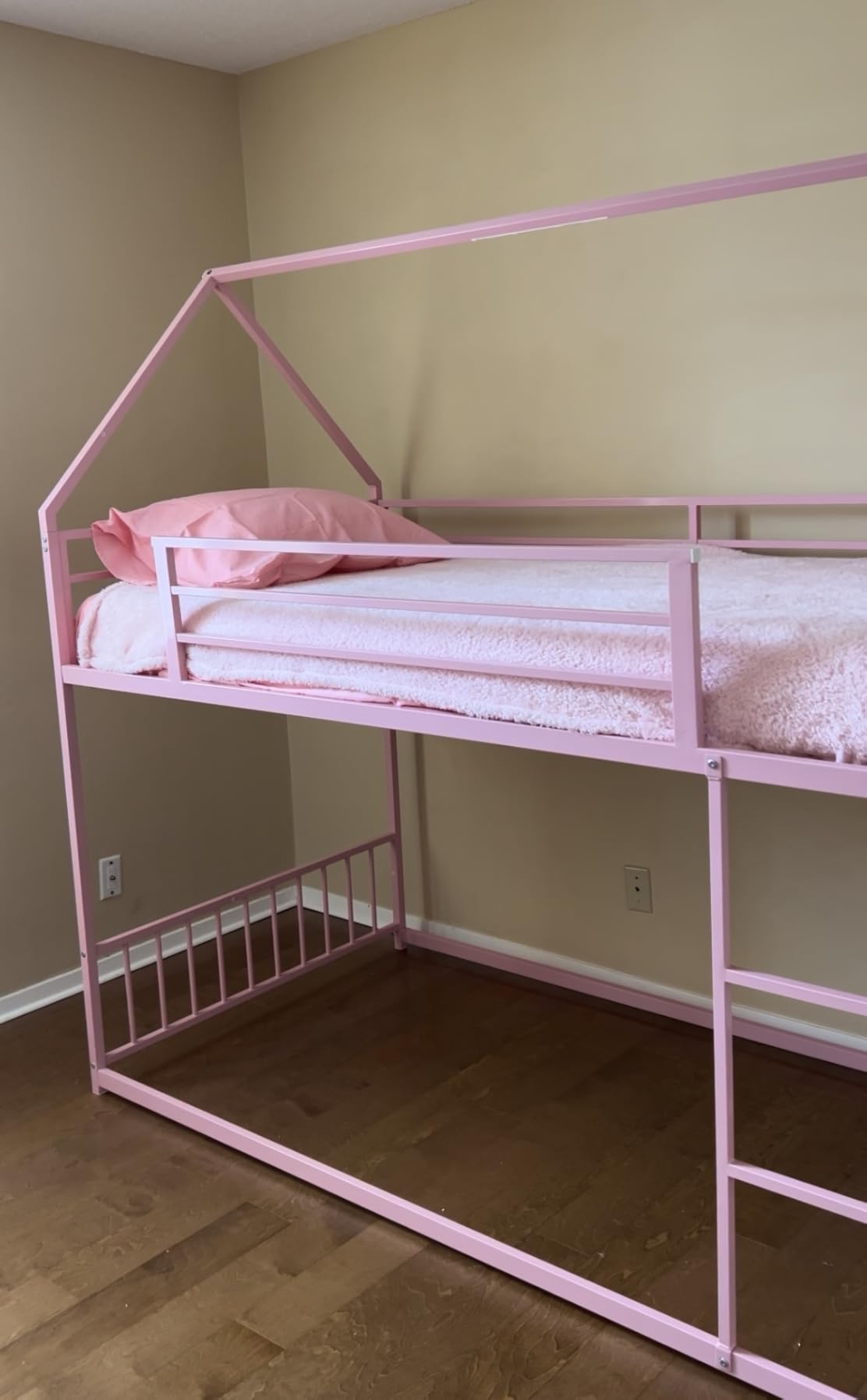
The house-shaped canopy is not decoration for this age group. Families describe it as a fort, a reading nook, and the reason kids actually want to sleep up top. Open space underneath takes cube organizers and toy boxes without a separate storage unit.
Assembly is reported at around an hour for a single competent builder, with the canopy being the only step that needs a hand.
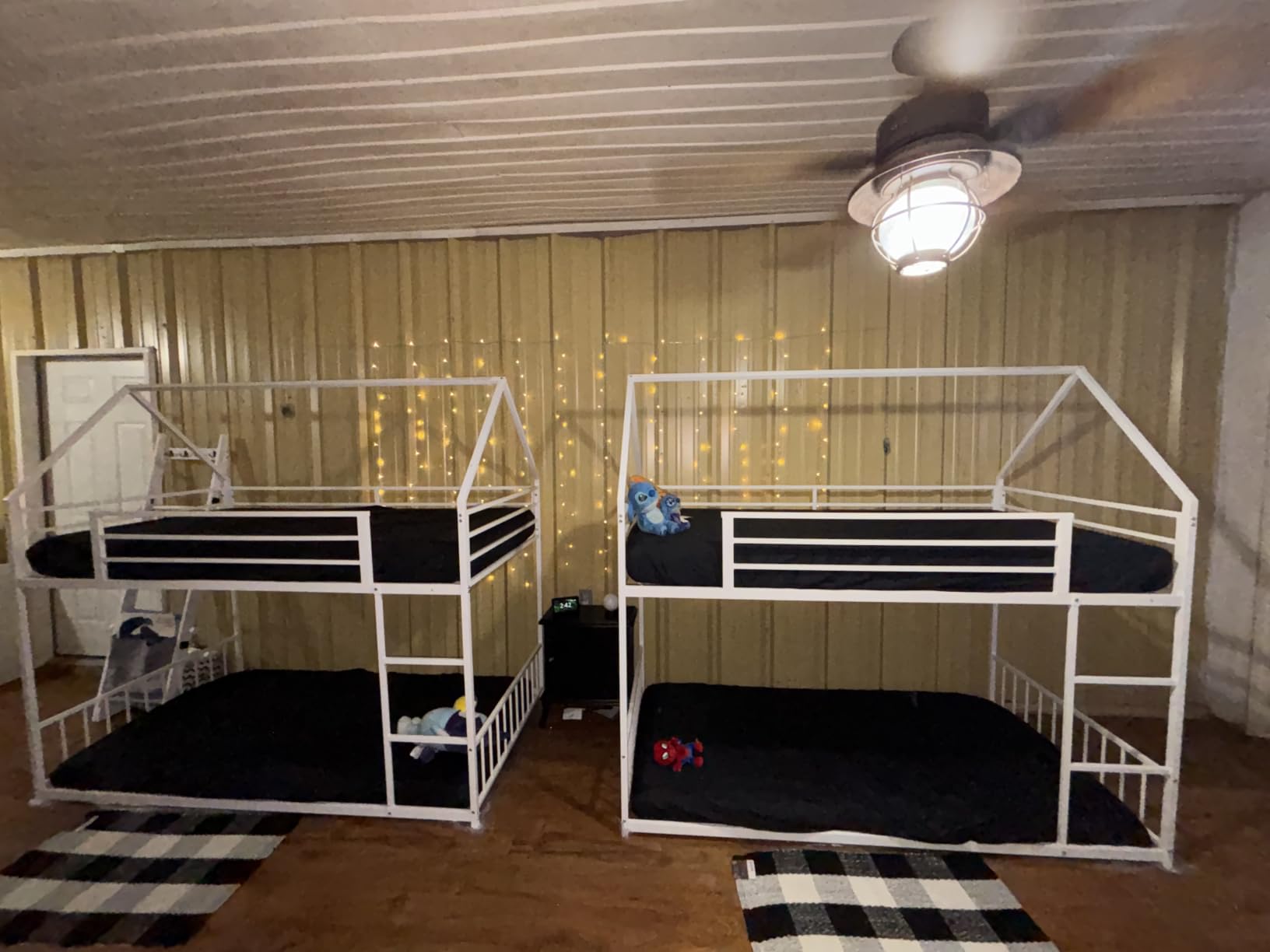
Why the narrow width matters more than the height
A room feels small when you cannot walk around the bed. At 40.7 inches wide, this frame leaves more floor clear than the wood options while still sleeping two people, which is the trade that matters in a 7-by-8-foot room.
For a shared room where the lower sleeper is a young child, the wide gap under the top bunk doubles as the play area that a full-height frame takes away.
Where this house-frame bunk falls down
It is 71.7 inches tall, the tallest frame in this roundup, so it needs a ceiling of roughly 8 feet to stay usable. In a low room the top sleeper will feel it.
The canopy is also the step most likely to go wrong on a solo build. If you are assembling alone and are shorter than about 5 foot 5, plan to have someone steady the frame.
4. SHA CERLIN Twin Over Twin – Best for Narrow Rooms
SHA CERLIN Bunk Bed Twin Over Twin Size with Ladder and Guardrail,Black
77.6 x 41.3 x 63.2 inch metal frame
14 inch guardrail on all four sides
400 lb per level
10.6 inch clearance
Pros
- Top bunk fully enclosed on all four sides
- 20 slats per level rated to 400 pounds
- 10.6 inch clearance underneath for seasonal storage
- Angled external ladder with smooth round tube rungs
- Two people can assemble in about 30 minutes
Cons
- Published width figures differ between dimension fields so measure carefully
- Upper mattress must sit at least 5 inches below the guardrail edge
- 63.2 inch height suits mid-height ceilings only
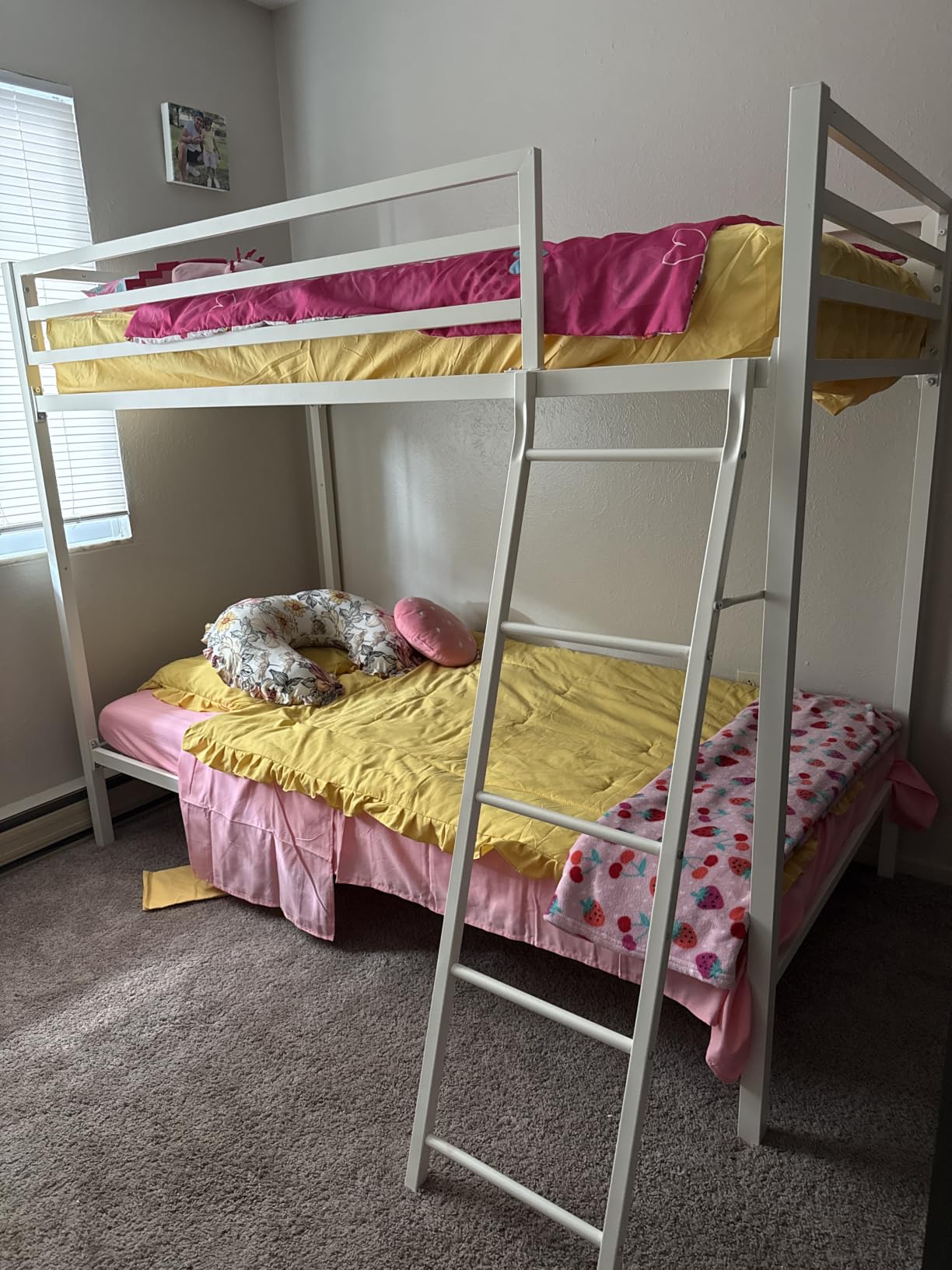
The fully enclosed top bunk is the distinguishing feature. All four sides carry a 14-inch iron guardrail, which removes the open-sided climb risk that makes some parents rule out upper bunks entirely.
Height sits at 63.2 inches, so this is a mid-profile frame. It works in a standard 8-foot ceiling and feels cramped under 7 feet, which makes it the bridge option between the low-profile wood beds and the tall metal frames.
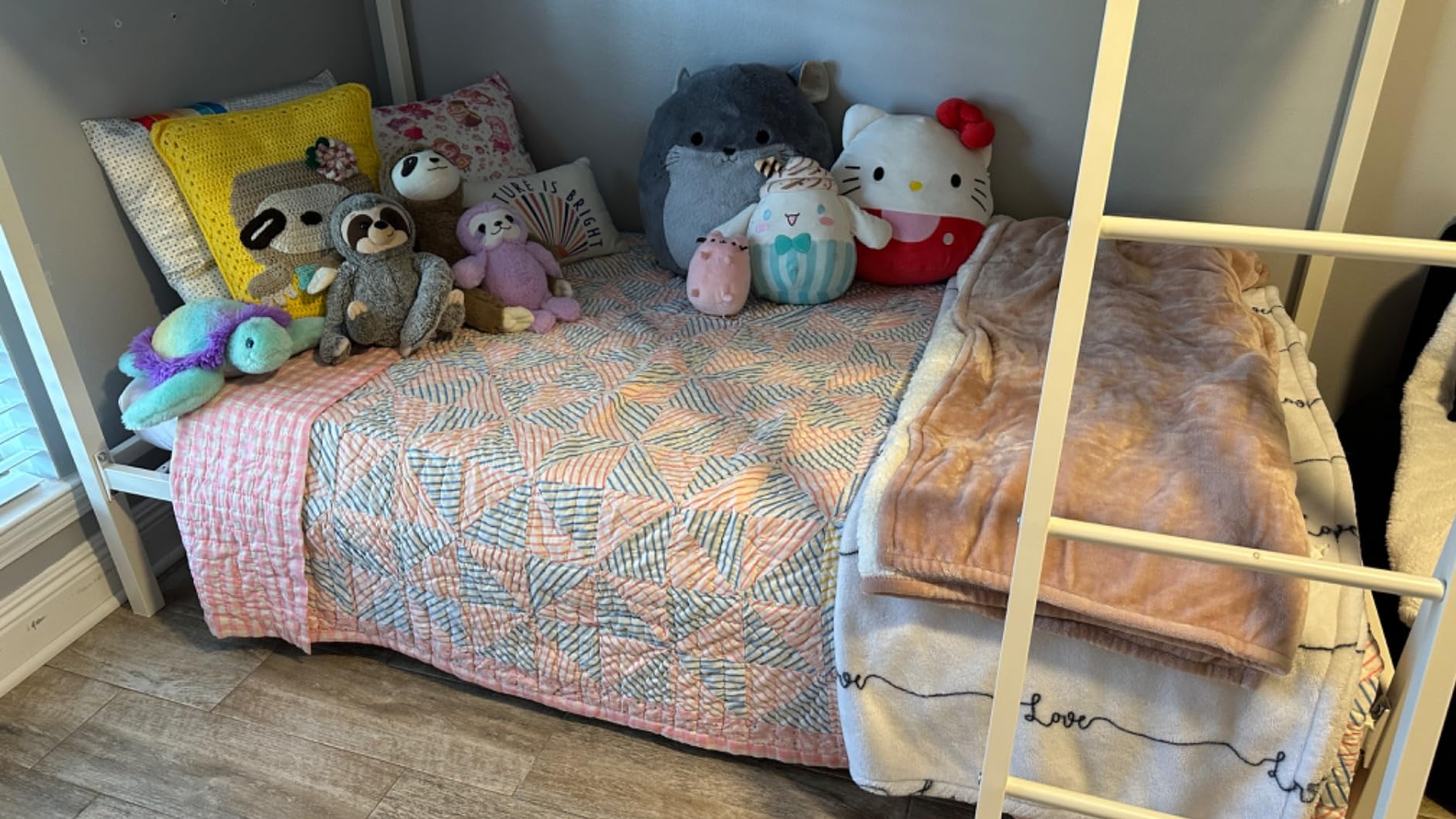
The 10.6 inches of clearance underneath is a real gain in a small room. That gap takes rolling bins of off-season clothing, board games, or the toy avalanche from the last play session, and it means you do not need a separate storage tower against the wall.
Reviewers rate the angled external ladder highly because smooth round tube rungs are easier on small feet than the squared rungs on many metal frames. Two people reported a 30-minute build with tools included.
Why full-length guardrails change the safety conversation
Parents on forums describe bunk beds as a perceived hazard once installed, and the kids room turning into a no-play zone. A fully enclosed top bunk is the closest thing to a fix for that within the frame itself, because there is no open gap to climb through.
The 14-inch rail height also gives you mattress thickness margin, though you still must keep the mattress at least 5 inches below the rail top.
Where the dimensions need care
The listing carries two different width figures across its dimension fields, 41.3 inches and 56.3 inches. Before ordering, measure the space yourself and confirm with the manufacturer if the gap is tight.
The angled ladder also projects into the room rather than sitting flush, so it eats floor space on the ladder side. In a square room, plan which corner it goes in before delivery.
5. GIANTEX Twin Low Bunk – Low-Profile Pick for Toddler Rooms
GIANTEX Twin Low Bunk Bed, Solid Wood Twin Over Twin Bunk Bed Frame with Full Guardrails & Integrated Ladder, Floor Twin Bunk Beds for Kids Boys and Girls, No Box Spring Needed, Grey
79.5 x 43.5 x 51 inch pine frame
350 lb per bed
Integrated ladder
Full-length guardrails
Pros
- Low 51 inch frame suits toddler rooms and low ceilings
- Solid pine frame with 14 plus 7 slats
- Integrated ladder simplifies climbing
- No strong chemical odour reported
Cons
- Lowest rating in the group at 4.2 stars
- Reviewers report bolts loosening and needing repeated tightening
- A few owners report cracking wood or sap leaks after assembly
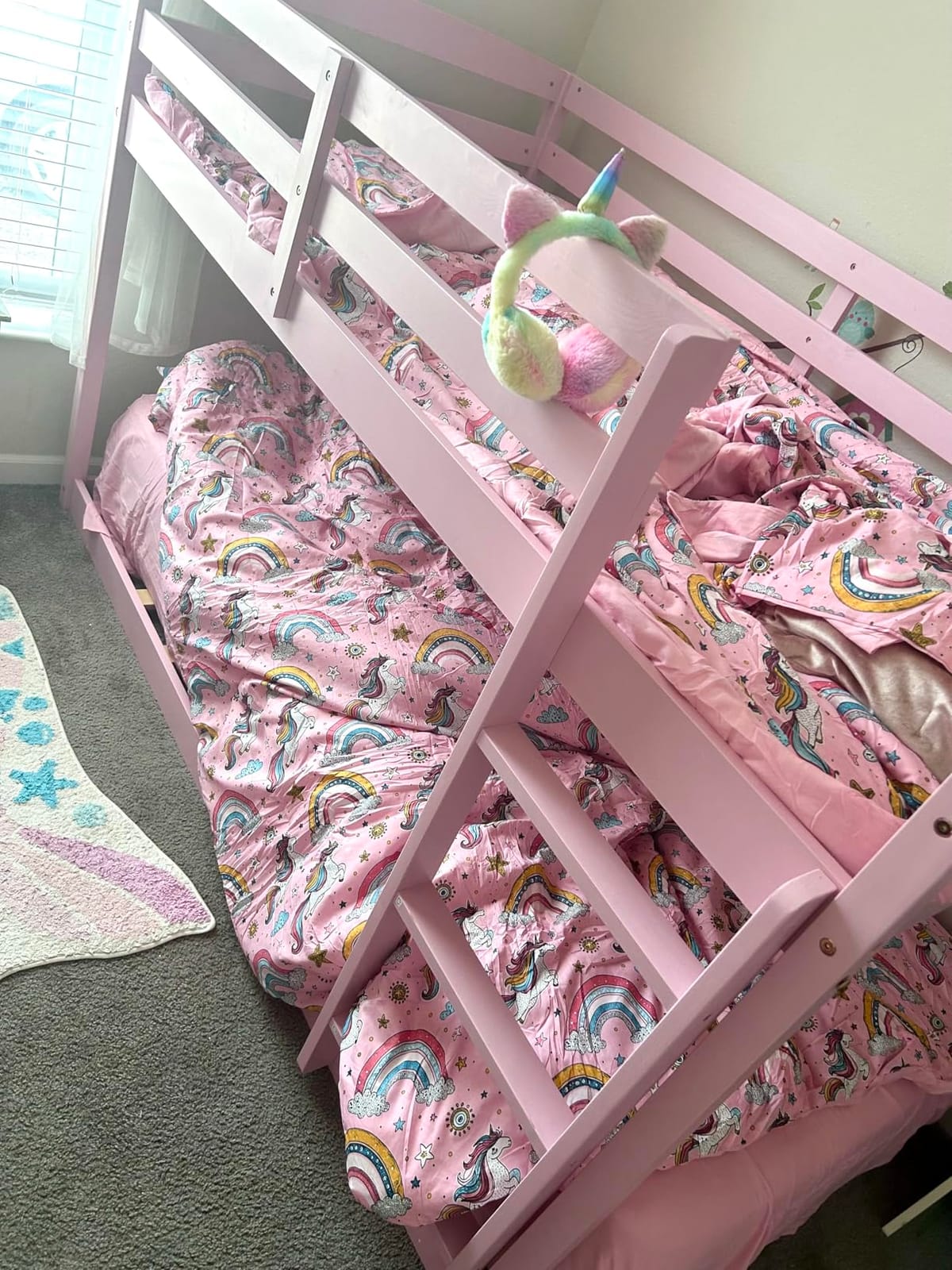
The pitch here is simple: a 51-inch overall height with a full-length guardrail and an integrated ladder, so a toddler on the bottom bunk is not climbing into a tall frame. Reviewers single out the absence of a strong chemical smell, which matters in a small closed kids room.
Construction is solid pine at 350 pounds per bed. That is below the 400-pound figure several competitors carry, so an adult or a full-grown teen on the top bunk would be pushing it.
Be realistic about this one. It carries the lowest rating in our roundup at 4.2, with roughly 9 percent of buyers giving one star. The complaints cluster around hardware loosening in the first months and occasional cracking in the wood or sap leaking from the frame.
That is a sturdiness signal rather than a fit signal, and it is why this bed sits below the stronger pine frames on our list.
When a 51-inch low profile is the right call
Toddler and preschool rooms are where low frames earn their keep. At 51 inches the top sleeper is reachable for an adult standing beside the bed, which removes the step stool from the nightly routine.
If both sleepers are under about eight years old, the 350-pound limit is not a concern and the pine build is genuinely good value.
Where owners report disappointment
Bolts loosening is the most common report, and it appears among buyers who expected a sturdier frame from solid pine. Check the hardware after a month of use and tighten as needed.
The slats have no pre-drilled holes, so you need a power screwdriver rather than the included hand tools. Budget more time than the simple build suggests.
6. Itaar Metal Bunk Bed with Hall Tree – Best for Built-In Storage
Itaar Metal Bunk Bed Twin Over Twin with Hall Tree, Power Outlet, LED Bunk Bed with 4 Storage Drawers, Bed with Safety Guardrail & Ladders, No Box Spring Needed, Easy Assembly, Rustic Brown
89 x 38.1 x 64.6 inch steel frame
4 storage drawers and 8-hook pegboard
Power outlets and USB ports
220 lb capacity
Pros
- Narrowest footprint here at 38.1 inches wide
- Four fabric drawers plus a coat rack and 8-hook pegboard
- Charging hub with 2 outlets and 2 USB ports
- RGB under-bed lighting with app control
- Full-length 13 inch guardrail with anti-toppling device
Cons
- 89 inch length is the longest of the narrow frames
- 220 lb capacity is about half the sturdier frames
- Fixed 64.6 inch height needs a tall ceiling
Storage is the entire argument for this frame. Four fabric drawers, a coat rack, and a pegboard with eight hooks are built into the end, which is exactly the wall space a small room cannot spare for a separate wardrobe.
At 38.1 inches wide it is the narrowest footprint in this roundup, narrower than every wood option by a wide margin. For a long narrow bedroom, width is the dimension that makes or breaks the layout, and this frame wins it.
The charging hub with two AC outlets and two USB ports, plus app-controlled RGB lighting under the bed, is not a gimmick in a room where both kids charge a phone by the bed every night. Reviewers rate this model at 4.5 with 75 percent five-star feedback, which is unusual for the budget end.
Two placement configurations are offered, so you can decide which end the storage faces before assembly. Numbered parts and clear instructions are included.
Why storage beats a taller frame in a small room
In a small bedroom the storage piece you delete is worth more than the floor space a shorter frame gives back. Four drawers and a pegboard can replace a slim wardrobe that would otherwise eat a full wall.
This is our pick for a kids room where both sleepers are young and neither exceeds the 220-pound rating by much.
Where the trade-offs bite
At 89 inches long, this is among the longest frames listed, and length is what fails in a small square room rather than a narrow one. Measure along the wall first.
The 220-pound limit is the lowest here. Buyers treat weight limits as a safety line rather than a comfort issue, so treat it as one.
7. ADORNEVE Low Bunk with Storage Staircase – Best for Young Climbers
ADORNEVE Low Bunk Bed Twin Over Twin with Storage Staircase, Black
92 x 40.6 x 54.1 inch steel frame
3 drawers in the staircase
54 inch low profile
Power hub and mood lighting
Pros
- Low 54 inch profile suits young children
- Staircase contains 3 pull-out drawers plus two open shelves
- Best rating consistency here with only 1 percent one-star reviews
- Floating power hub with 2 AC plugs plus USB-A and USB-C
- Anti-toppling device and wrap-around top rails
Cons
- Heaviest frame in the roundup at 102.3 lb
- 220 lb weight capacity
- 92 inch length is the longest low bunk listed
This ties for the highest rating in the roundup and has the best consistency of any frame here, with about 1 percent one-star reviews. For a product that people buy once and rely on for a decade of fort-building, that consistency is worth noticing.
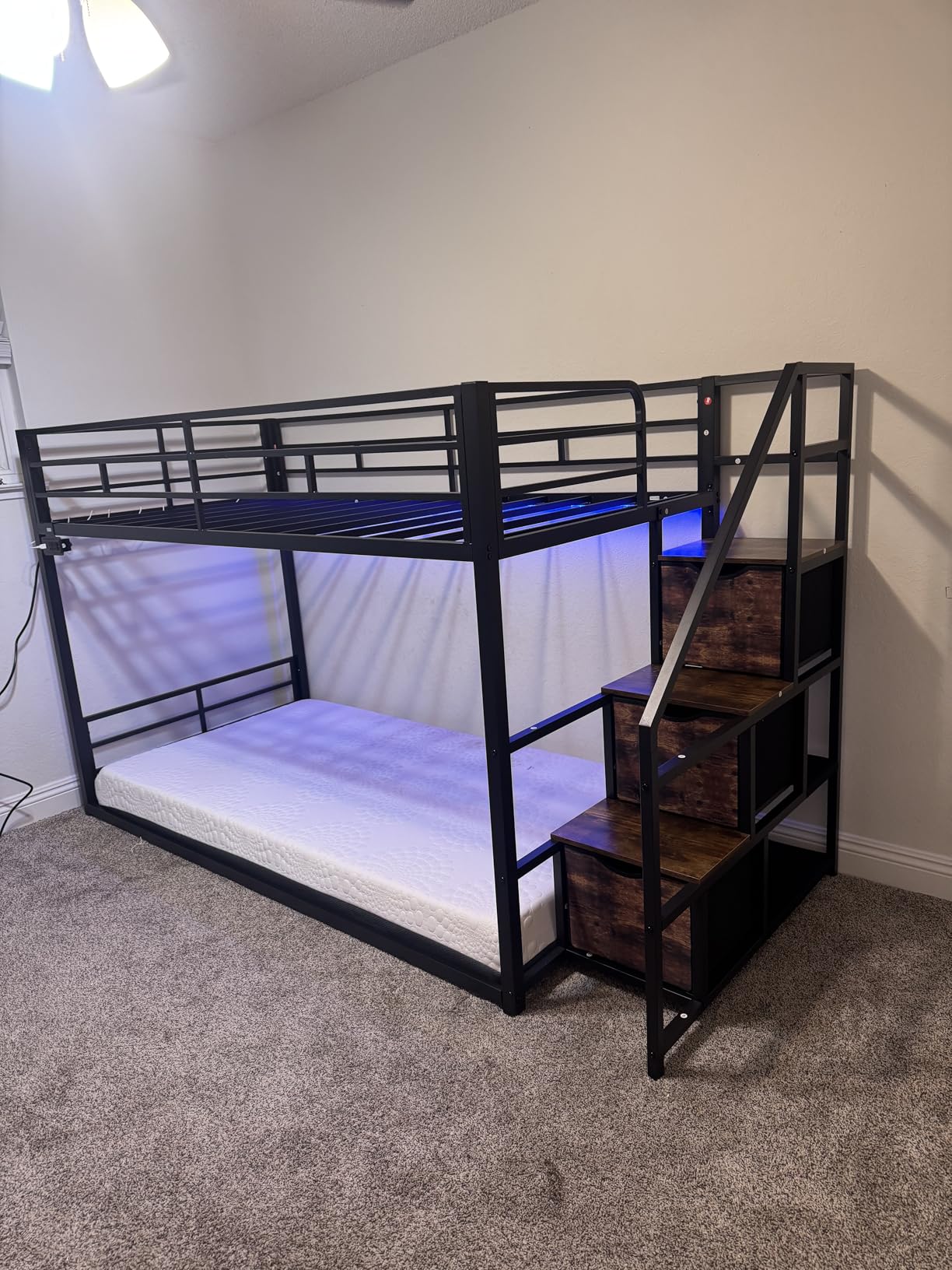
The staircase is the smart part. Three steps pull out as storage drawers, which turns the route to the top bunk into the place where things live. Two open shelves flank the stairs for books and small items.
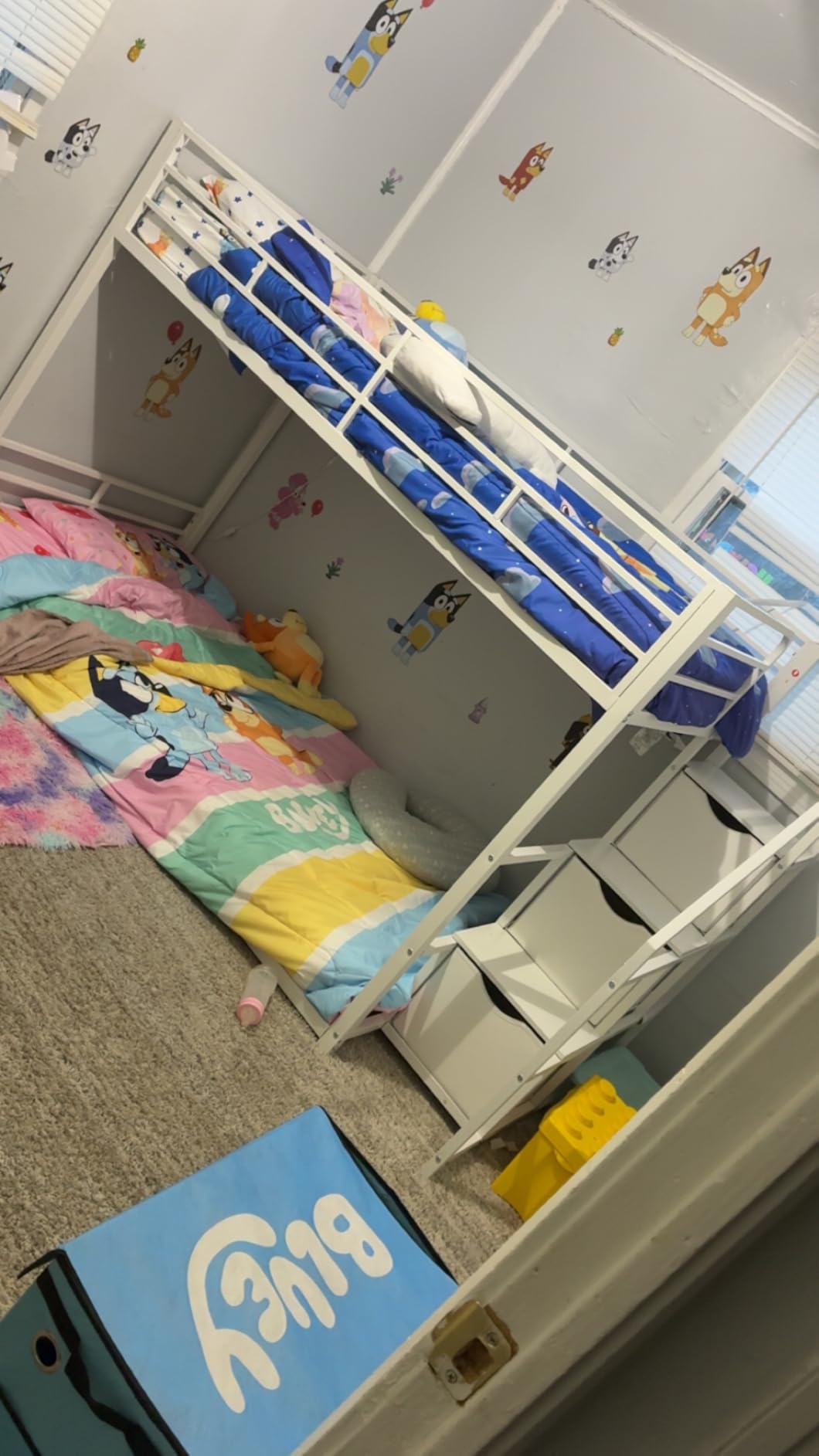
At 54.1 inches tall with curved entrance rails, this is a low bunk that a small child can manage without a step stool. Parents who were nervous about an older sibling on a high top bunk point to that combination as the reason it worked.
Under-bed RGB lighting and a floating power hub with USB-C are the extras that show up in reviews as soon-to-favourites.
Why a storage staircase beats a ladder in a small room
A ladder occupies floor beside the bed. A staircase occupies floor and gives something back. In a room measured in feet, that is the difference between a walkway and a squeeze past.
The trade-off is length. At 92 inches this is the longest low bunk in the roundup, so it needs a long wall and clear floor in front of the stairs.
Where this frame costs you
At 102.3 pounds it is the heaviest frame we listed. It stays put, which is good, and it is hard to reposition, which matters if you are not certain of the layout.
The 220-pound limit again rules out adult and older-teen sleepers. Plan it for two children.
8. ZJIAH Solid Wood Low Bunk – Best for Sloped Ceilings
ZJIAH Low Bunk Bed Twin Over Twin, Solid Wood Floor Bunk Bed Frame with Ladder & Safety Guardrails, Twin Bunk Beds for Kids Boys and Girls, Saving Space, No Box Spring Needed, Gray
79.1 x 42 x 46.5 inch wood frame
Lowest profile in the group
400 lb capacity
3-step wide ladder
Pros
- Lowest overall height here at 46.5 inches for low and sloped ceilings
- Solid wood frame with 14 noiseless slats rated to 400 pounds
- 13.4 inch full-length guardrails
- Built-in 3-step wide ladder
- Convertible bottom section usable as a play or storage loft
Cons
- Lower mattress sits on the floor in the base configuration
- Lower bunk is so low only toddlers can sit up
- Many small parts and a drill is recommended for the slats
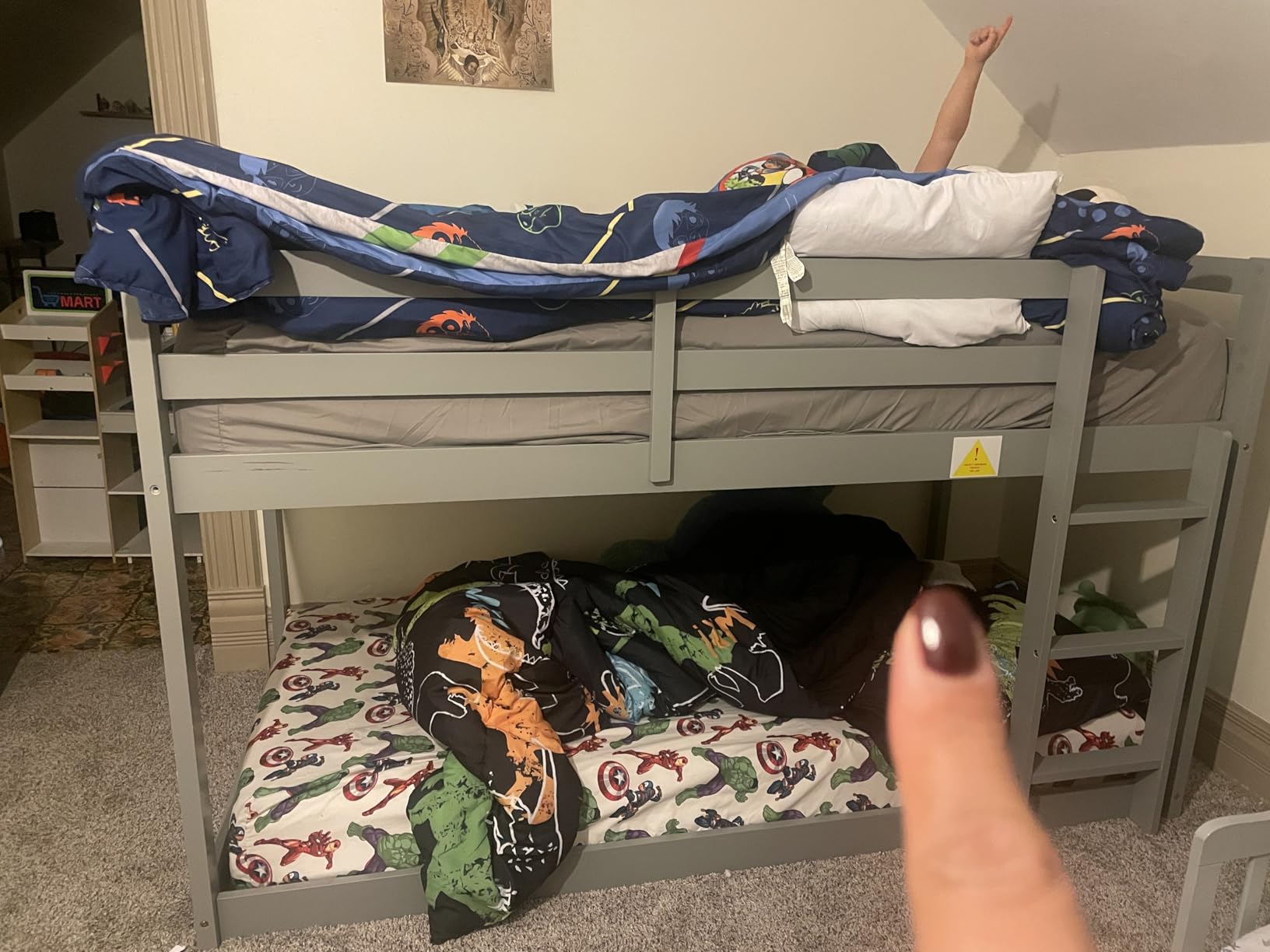
At 46.5 inches this is the lowest profile frame in the roundup, and that single measurement is why it wins the sloped-ceiling category. Under an attic ceiling that slopes toward the wall, a 46-inch frame still leaves a usable sitting space where a 68-inch metal frame would put a sleeper’s head into the roofline.
It also carries a 4.6 rating with 77 percent five-star feedback and just 2 percent one-star, which is unusually strong for a bed this compact.
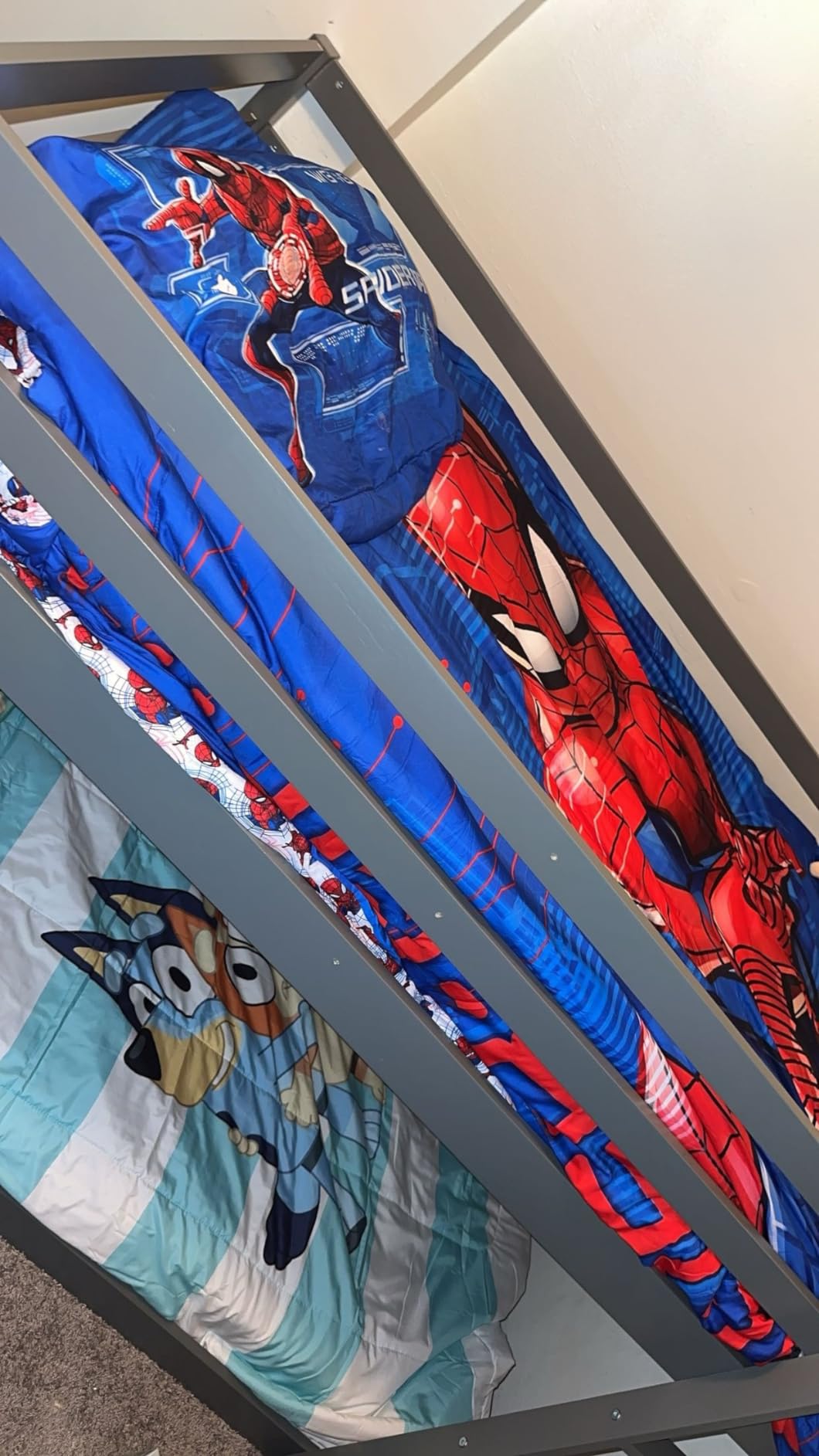
The 3-step wide ladder is a genuine differentiator in this category. Wide treads are far easier for a child in socks than the narrow vertical rungs on most metal frames, and reviewers call it out by name.
The bottom section can be used as a loft for play or storage instead of a bed, which is a useful fallback in a room where you only occasionally need the second sleeper.
Why the lowest profile wins awkward rooms
Height is the first thing to fail in a low or angled room, and no amount of clever layout fixes a sleeper who cannot sit up. Buying the shortest frame available and keeping the room flexible is the better trade.
For parents who want to supervise a toddler from beside the bed, 46.5 inches means you can reach the top bunk without climbing.
Where the low profile gets awkward
In the base floor-bed configuration the lower mattress sits directly on the floor, and parents add slats or a protector. That is a real cost in comfort for the bottom sleeper.
The lower bunk is also too low for an older child to sit up on. If the younger sleeper is past toddler age, check this before you commit.
9. Zevemomo Metal Low Profile Bunk – Best for Moving Between Rooms
Zevemomo Twin Over Twin Bunk Bed, Metal Low Profile Bunkbeds with Full-Length Guardrail and Ladder, Space Saving, No Boxing Spring Needed, Black
76.69 x 40.94 x 54.09 inch metal frame
Lightest frame at 60 lb
350 lb upper and 400 lb lower
11 inch guardrail
Pros
- Lightest frame in the roundup at 60 lb so one person can move it
- Anti-rust powder coating and 22 reinforced slats
- 40.94 inch width suits tight rooms
- Slat-lock design and non-marring foot pads keep it quiet
- Full-length 11 inch guardrail
Cons
- 11 inch guardrail is shorter than the 14 inch rails on several competitors
- 76.69 inch length is the shortest listed and may not suit larger mattresses
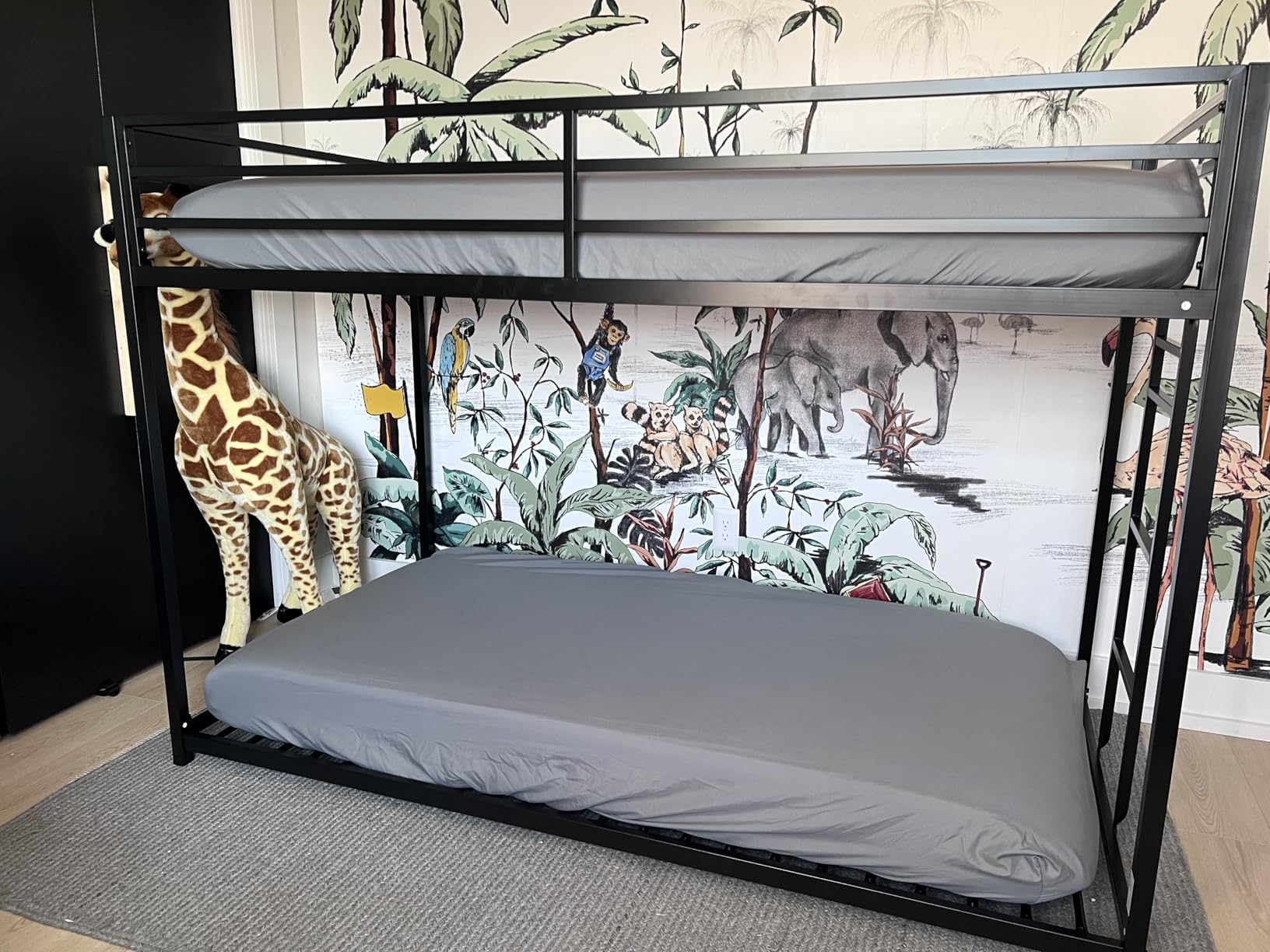
At 60 pounds this is the lightest frame here by a wide margin, and that is not a spec-sheet nicety. Bunk beds get moved. Kids outgrow rooms, families rearrange after a move, and a 60-pound frame can be taken apart and repositioned by two people without a van.
It is also a low-profile design at 54.09 inches with a 40.94-inch width, so it belongs in the same room category as the wood low bunks while weighing 20 pounds less than most of them.
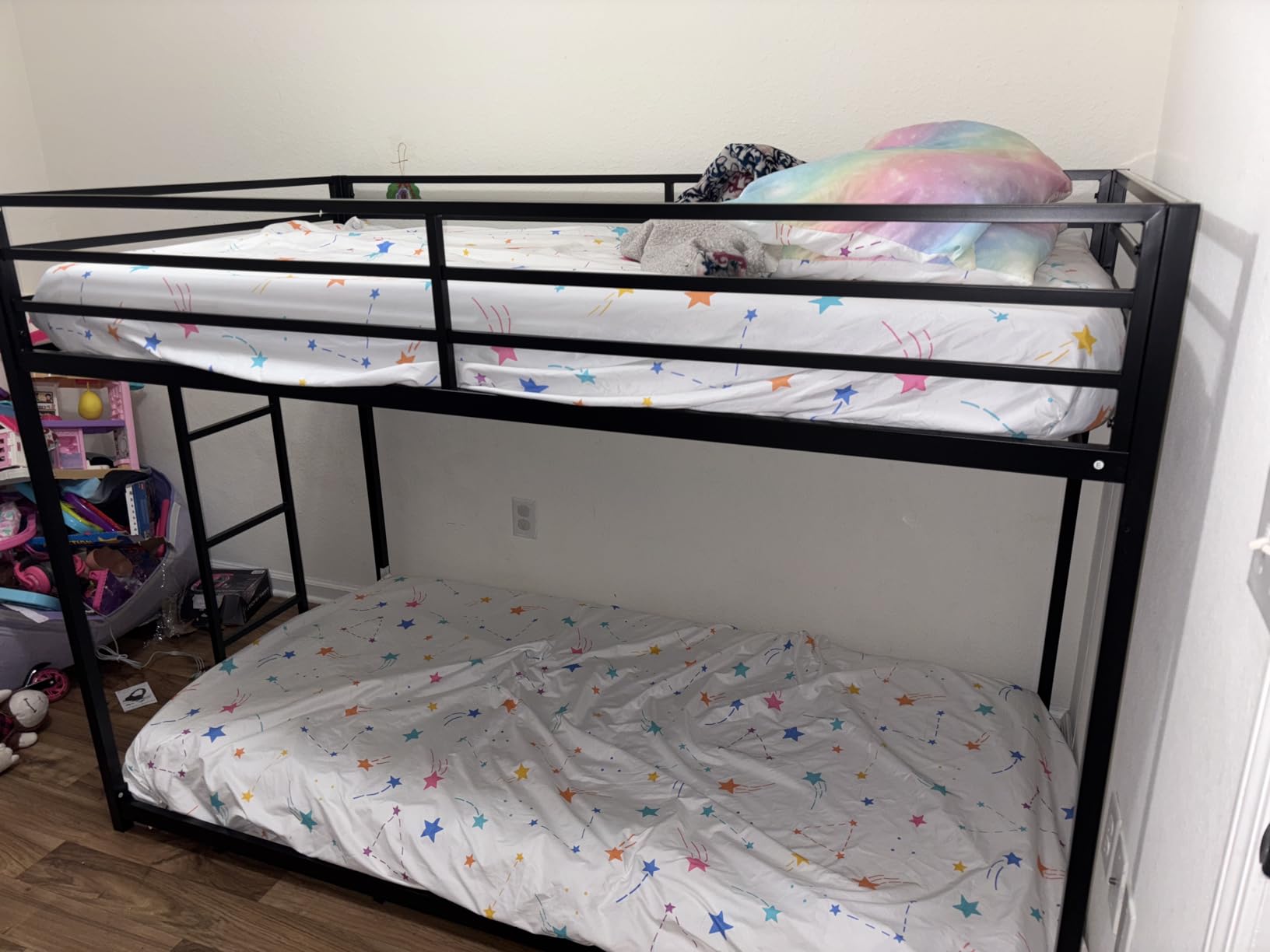
Reviewers rate it 4.5 with 75 percent five-star feedback, and the quietness of the slat-lock design plus the non-marring foot pads comes up often from anyone who has lived with it in a shared room.
Capacity is 350 pounds on the upper bunk and 400 on the lower, and the side ladder position is flexible for working around a window or a door.
Why frame weight matters in a small bedroom
Rooms change. A bed that two people can lift and reposition lets you move a desk, repaint, or take a corner out of use during the school year. Heavy solid wood frames rarely get moved once built.
This frame also disassembles into manageable sections, which matters if the route to the room involves a stairwell.
Where the trade-offs sit
The 11-inch guardrail is shorter than the 14-inch rails on the Max & Lily, SHA CERLIN, and GIANTEX frames, so mattress thickness has less margin. Keep the top mattress within the guardrail line.
At 76.69 inches long it is the shortest frame listed, which is useful for tight rooms but can be a problem if you plan to use a longer mattress than standard.
10. JOYMOR Solid Wood Low Bunk – Premium Solid Wood Pick
JOYMOR Solid Wood Low Twin Over Twin Bunk Bed for Kids/Junior, Bunk Bed Frame with Guardrails & Ladder for Boys Girls, No Box Spring Needed (White)
77.17 x 41.33 x 47.24 inch pine frame
264.5 lb capacity
Flat ladder
Disassembles for moving
Pros
- Solid pine with hardwood slats at a low 47.24 inch height
- Only 41.33 inches wide so it fits narrow rooms and pairs well mirrored
- Flat ladder is easy for small children to climb
- Easy to disassemble for moving or storage
- Free replacement within 1 year for damage or missing parts
Cons
- Lowest weight rating among the solid wood options at 264.5 lbs
- Joining the slat ends is difficult for a single builder
- 47.24 inch height is low enough that older children cannot sit up on the lower bunk
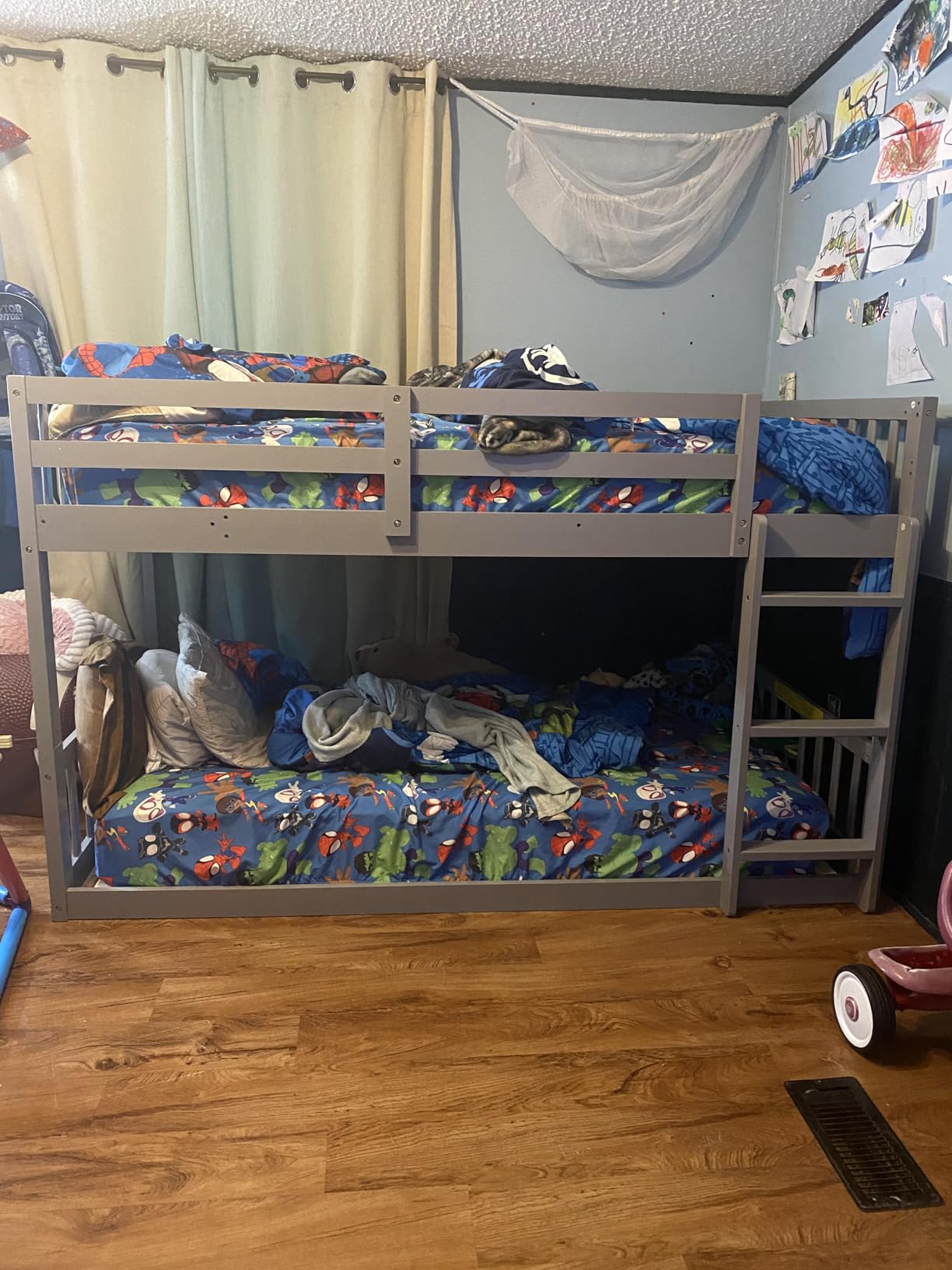
The 47.24-inch height combined with a 41.33-inch width makes this the narrowest solid wood low bunk we found. Those two numbers together are why it works in rooms where a wider pine frame has to be pushed into a corner and left there.
Owners rate it 4.5 with 74 percent five-star reviews, and the recurring reasons are the low profile for toddlers and sloped ceilings, plus the narrow footprint.
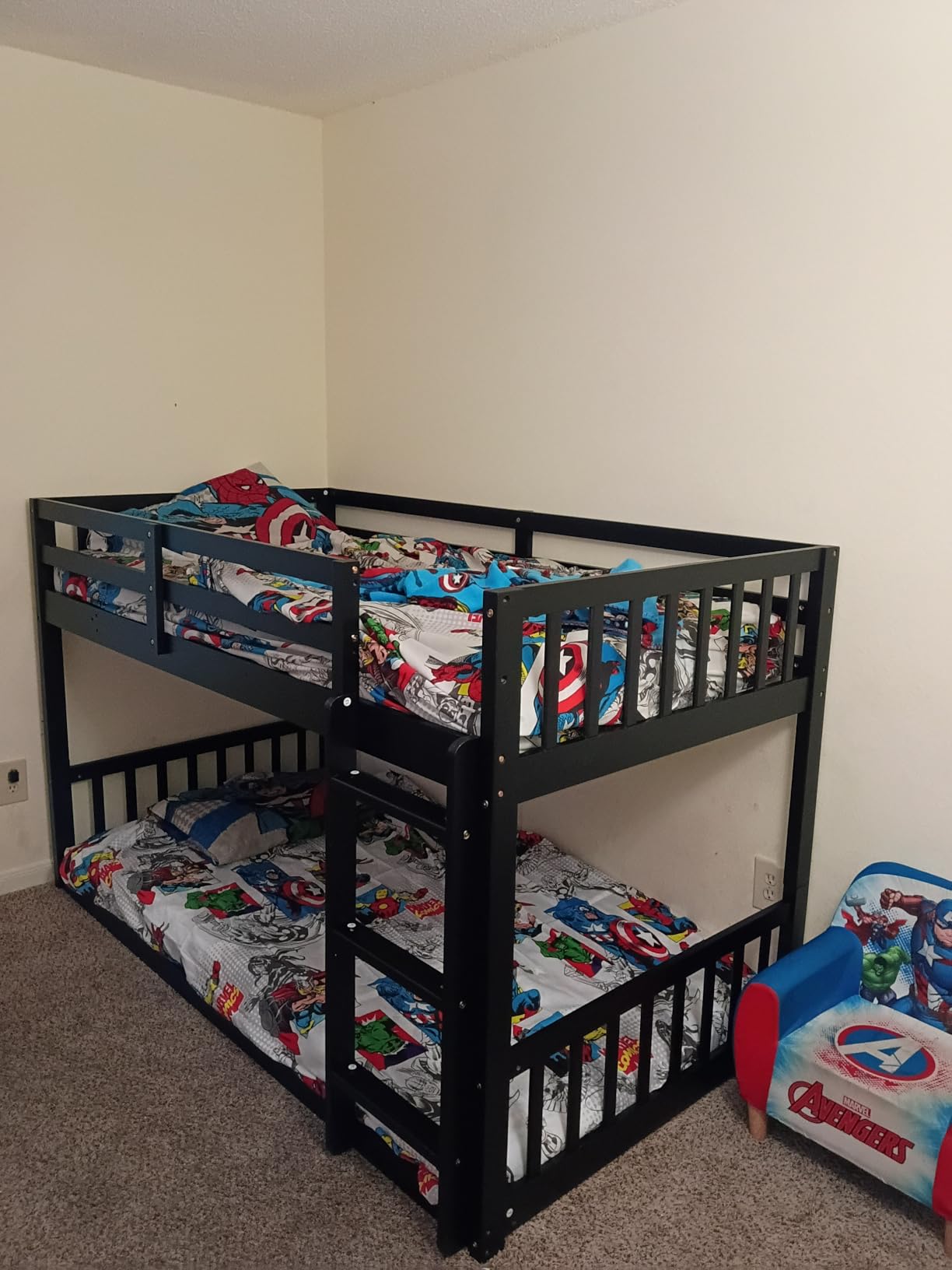
The flat ladder is the detail families mention most. There is nothing for a socked foot to catch on, which makes the top bunk usable by a child who hesitates on the rounded rungs of a metal frame.
Unlike most wood bunks, it disassembles cleanly for moving or seasonal storage, and the listing includes free replacement within one year for installation problems, damage, or missing parts.
Why narrow solid wood is worth the build effort
Owners of solid wood frames report that durability is the emotional reason to pay more, because the frames survive fort-building, climbing, and repeated moves between houses. Wood does not scratch the way powder-coated steel can and does not transmit the same creak.
For a room that will be used for a decade, the wood frame ages better than the fabric and MDF components that break down first.
Where this premium solid wood pick falls short
The 264.5-pound rating is the lowest of the solid wood options, and buyers treat weight limits as a safety line. That rules out adult sleepers on either level.
Joining the slat ends takes two people. One builder will finish everything else and then stall on that step.
How to Choose a Bunk Bed That Fits Your Small Room
Match the frame height to your ceiling, not the other way round
Aim for at least 24 inches of clearance between the top mattress and the ceiling. Frames under 55 inches tall sit comfortably under a 7-foot ceiling. Mid-profile frames between 60 and 65 inches need closer to 8 feet. Anything at 68 inches or above wants an 8-foot ceiling or more, and it will feel cramped below that.
Also check where your ceiling light hangs. Buyers on home improvement forums warn that an upper bunk placed directly under a pendant light leaves the sleeper staring into a spotlight all night. Offset the bed along the wall rather than centring it.
Pick a configuration for your room shape
Square room: go low and central. A straight low-profile bunk leaves equal walking space on all sides, and an L-shaped layout frees the centre where you need it.
Long narrow room: width decides everything. Prioritise the narrowest footprint you can live with, and treat the ladder and staircase footprints as part of the room plan.
Room with a sloped or attic ceiling: only the sub-50-inch frames will sit properly. Ask for the corner clearance measurement before you buy.
Room that also needs a desk: pick frames with underbed storage or built-in drawers. The space under a low bunk becomes the desk zone rather than dead air.
Check size, weight limits, and safety before ordering
Weight capacity is a safety threshold, not a comfort guideline. Most parents hold a firm line at 400 pounds for a top bunk, and the frames here range from 220 pounds up to 440. Most manufacturers and paediatric guidance advise against children under six on the upper bunk.
Guardrails should sit at least 5 inches above the top mattress, which caps how thick that mattress can be. Check the stated mattress range before you buy the frame, not after.
For materials, solid pine and low-VOC powder-coated steel are the two that suit a small, closed kids room. If you are focused on indoor air quality, our sustainable bunk bed guide covers the certification marks to look for, including GREENGUARD Gold and FSC-certified components.
Measure the room in five steps
1. Measure ceiling height at the tallest point and at the corners, and use the lowest figure.
2. Measure the wall length where the bed will sit, then subtract the frame length plus 24 inches for climbing and making the bed.
3. Measure the wall space the ladder or staircase needs, including the angled projection.
4. Measure the doorway and any corners the boxed frame must turn through before delivery day.
5. Check that your mattresses fit the stated thickness range, then measure the space under the lower bunk for the storage you plan to put there.
Once the frame is chosen, mattress thickness still has to work with the guardrails. Our guide to organic kids mattresses for bunk beds covers the slim options that stay within those limits.
Frequently Asked Questions
What is the minimum ceiling height required for a bunk bed?
Plan on a ceiling of at least 7 feet for a low-profile frame under 55 inches tall, and 8 feet or more for frames between 63 and 72 inches. The goal is roughly 24 inches of clearance between the top mattress and the ceiling so the upper sleeper can sit up comfortably. Measure at the lowest point of the room, since sloped ceilings reduce usable height.
How much headroom should you have for bunk beds?
About 24 inches above the top mattress is the practical target, which is enough for an adult to sit upright and read. Frames at 46 to 51 inches overall sit comfortably under a 7-foot ceiling, while frames at 63 inches and above need a ceiling closer to 8 feet to avoid a cramped feeling on the top bunk.
How much weight can a bunk bed hold on top?
Weight capacity in this roundup ranges from 220 pounds on storage-focused models to 440 pounds on the strongest metal frame, with most solid wood and metal options landing at 350 to 400 pounds. Treat the figure as a safety limit rather than a comfort guideline, and check it before an adult or a full-grown teen uses the upper level.
What is the bunk bed rule?
The most common rule is that children under six should not sleep on the upper bunk, since they are less likely to respond to a fall or to free themselves from entrapment. Guardrails should rise at least 5 inches above the top mattress, which also caps mattress thickness. Anti-tip hardware should be fitted to any bunk bed used by children.
What are some good bunk beds for low ceiling rooms?
Low-profile frames under 55 inches are the answer, and the shortest options work best: a 46.5-inch solid wood model for sloped ceilings, a 47.24-inch pine low bunk at 41.33 inches wide, and a 49.25-inch pine bunk with a 400-pound rating. Metal frames at 68 to 72 inches need a ceiling close to 8 feet before the top bunk stays usable.
What are the best space saver beds for small rooms?
For small rooms, a low-profile bunk under 55 inches tall gives a second sleeper without a second footprint. Adding built-in storage raises the value further: drawers, a storage staircase, or a pegboard replace a separate wardrobe that would take a whole wall. If you need one bed rather than two, our guide to murphy beds for small spaces covers the fold-away option.
Final Verdict: The Best Bunk Beds for Small Bedrooms
The Max & Lily Fundamental is our top pick for the best bunk beds for small bedrooms, because a 49.25-inch frame height with 400-pound capacity and 14-inch guardrails solves the ceiling problem without giving up strength. For a very low or sloped room, take the ZJIAH at 46.5 inches. For a long narrow room, take the Itaar at 38.1 inches wide. For the space itself rather than the bed, take the ADORNEVE storage staircase.
Measure your ceiling and your walkways first, then buy. A frame that fits is worth more than any feature list.