

If you want one answer: the DREO Tower Fan 307 is the best tower fan under 100 dollars we could justify, and it stays comfortably below the ceiling most shoppers set. It is a 36-inch bladeless tower with a brushless DC motor, eight speeds, four modes, 90-degree oscillation and a listed noise figure of 25 dB, and it carries more owner reviews than anything else in this guide.
That said, the phrase “best tower fans under 100 dollars” covers a very wide range of hardware. Some of the picks below are 30-inch bladeless columns for a dorm room. Others are 42-inch high-velocity towers aimed at a garage or a home gym. The right answer depends almost entirely on whether you need quiet at night, raw air movement by day, or a narrow footprint next to a bed.
We went through ten tower fans that sit under the 100-dollar mark, pulled the published specifications for each one, and matched them against what owners actually report after living with them. We also flagged where the manufacturer’s own numbers disagree with each other, because this category has a reputation problem that is worth understanding before you spend anything.
A note on pricing first, since it changes constantly: the buttons below each pick take you to the current listing. We do not print prices in this guide, and everything here was written to a strict sub-100-dollar ceiling. If a listing has moved above that line by the time you click, the specifications in this article still describe the model accurately.
We also earn a commission when you buy through those links, at no extra cost to you. That does not change the order of the picks.
Top 3 Tower Fans Under 100 Dollars (October 2026)
Three models stand out from the rest. One is the strongest all-rounder, one is the quietest for a bedroom, and one is the best value for the money.

DREO Tower Fan 307 36 inch
- 28 ft/s airflow
- 25 dB
- 8 speeds and 4 modes
- 90 degree oscillation
- Remote and touch panel

Honeywell QuietSet HYF290B 40 inch
- 40 inch tower
- 8 speed settings
- Remote with rear storage nest
- Only 10 watts
- Oscillating

Lasko T42954 42 inch Tower
- 42.5 inch tall
- Nighttime setting
- 60 degree oscillation
- 7.5 hour timer
- Carry handle
Our full list starts with the DREO 307 and works outward from there, through the Honeywell QuietSet, the two Lasko towers, both PELONIS models, Levoit, and the Amazon Basics option at the end.
Quick Overview: All 10 Tower Fans Under 100 Dollars Side by Side
The table below lists every pick with its headline specs. Noise figures and airflow numbers are the manufacturers’ published values, which are not always measured the same way from one brand to the next.
| Product | Specifications | Action |
|---|---|---|
| DREO Tower Fan 307 36 inch |
|
Check Latest Price |
| Honeywell QuietSet HYF290B 40 inch |
|
Check Latest Price |
| Lasko T42954 42 inch Tower |
|
Check Latest Price |
 Lasko 2510 36 inch Tower Lasko 2510 36 inch Tower |
|
Check Latest Price |
 PELONIS 40 inch Bladeless Tower PELONIS 40 inch Bladeless Tower |
|
Check Latest Price |
 DREO 42 inch 9-Speed Tower DREO 42 inch 9-Speed Tower |
|
Check Latest Price |
 Levoit LTF-F361 36 inch Tower Levoit LTF-F361 36 inch Tower |
|
Check Latest Price |
 Lasko U35115 35 inch High Velocity Lasko U35115 35 inch High Velocity |
|
Check Latest Price |
 PELONIS 30 inch Tower Fan PELONIS 30 inch Tower Fan |
|
Check Latest Price |
 Amazon Basics 40 inch Digital Tower Amazon Basics 40 inch Digital Tower |
|
Check Latest Price |
How We Picked: What We Checked and What We Trust
We narrowed ten tower fans against one rule: everything had to sit under 100 dollars and be a genuine floor-standing tower, not a desk fan or a bladeless column fan repackaged as one.
For each model we compared the published specification block against the owner-review pattern. Airflow volume, noise level, oscillation angle, speed count, motor type, wattage, dimensions and warranty length all came from the product data. Everything we say about how a fan feels in a room came from the recurring themes in owner reviews, not from adjectives in a product page.
We deliberately did not rank on noise figure alone, because a 25 dB rating on the lowest speed tells you almost nothing about what the fan sounds like at full blast. That gap between the best number and the worst number is where most disappointed buyers end up.
We also stopped trusting the spec sheets in a few places. Owners on r/fans have pointed out that AI-generated and manufacturer comparisons in this category regularly mix up models and report figures that do not match the listing. Where two published numbers for the same fan disagree, we say so instead of picking the flattering one.
Finally, we treat the 100-dollar ceiling as a real constraint, not a suggestion. You will notice that means no Dyson, no Vornado ARA and no premium 200-dollar Dreo models here. We cover what that ceiling costs you further down the page.
1. DREO Tower Fan 307 36 inch – Best Overall
DREO Tower Fan for Bedroom, 28ft/s Velocity, Ultra Quiet Fan, 8 Speeds
36.2 in tall
8 speeds and 4 modes
25 dB listed
1158 CFM
28 ft/s max wind
Pros
- Brushless DC motor stays near-inaudible on low speeds
- Strong airflow even on low settings
- Silent 90 degree oscillation
- Removable rear grille and impeller for cleaning
- Remote batteries included in the box
Cons
- Top speed settings get noticeably louder in a large room
- Remote occasionally needs a second press
- Settings reset to default after a power outage
What makes the DREO 307 the best tower fan under 100 dollars is that it does not force a choice between quiet and powerful. On our reading of the owner feedback, most people settle into the middle of the eight-speed range and stay there, which is exactly where a brushless DC motor shines.
The published figures back that up. DREO lists 1158 CFM of airflow, a top wind speed of 28 ft/s projected up to 34 feet, and a noise level of 25 dB. The body is 36.22 inches tall on an 11.81-inch base and weighs 8.4 pounds, which is light enough to move between rooms without wrestling with it.
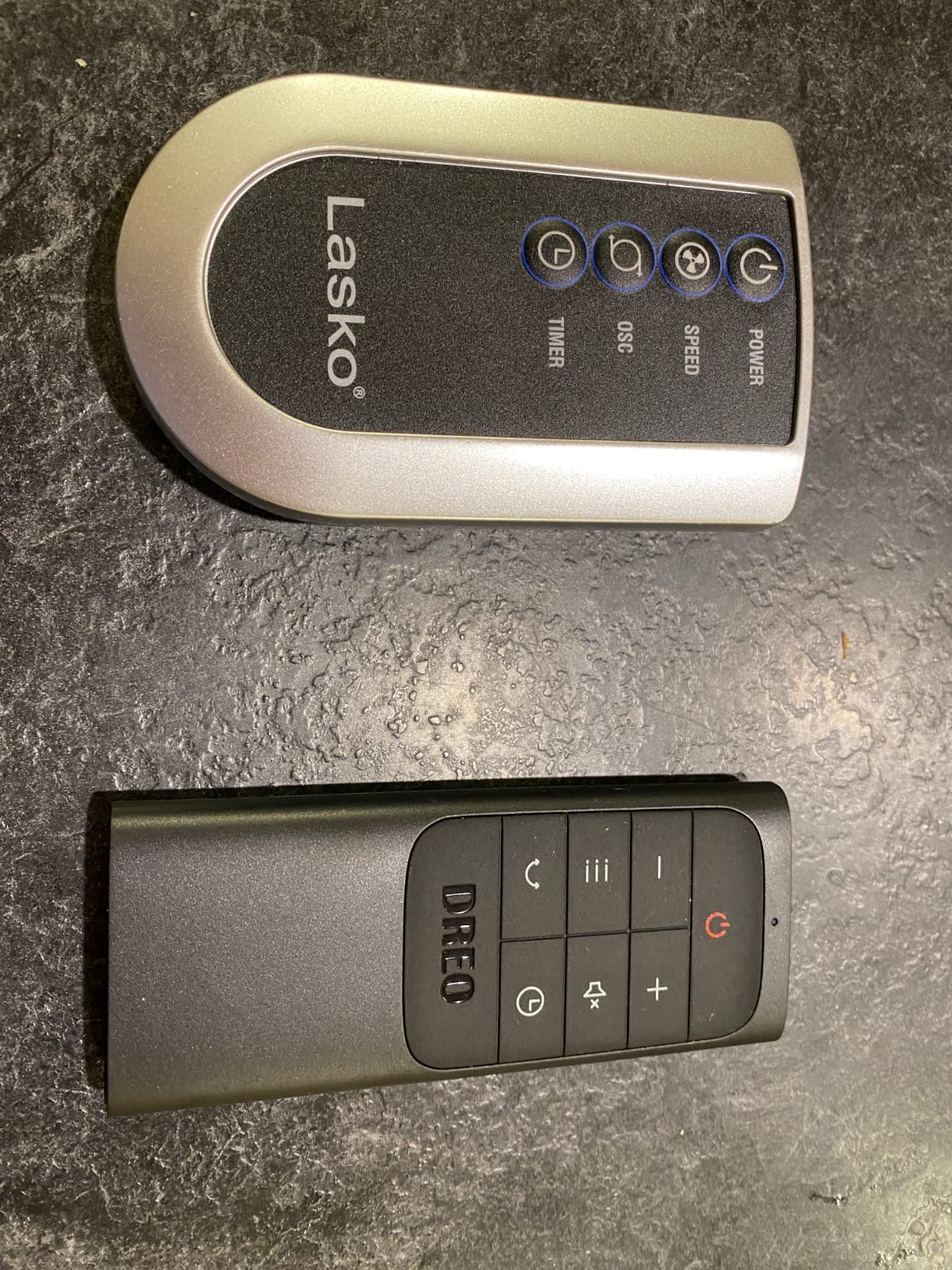
The modes matter more than they sound. Four modes across eight speeds give you Normal, Natural, Sleep and Auto, and the Sleep setting is the one that turns this into a bedroom fan rather than a daytime circulator. The 90-degree oscillation is also the best combination of range and silence in this group, and owners report no rattle at the ends of the sweep.
Two details tell you this is a well-built unit rather than a bargain-bin copy. The rear grille and impeller both detach for cleaning, which is the single biggest quality-of-life difference in this category. And the remote ships with batteries included, a small thing that saves an annoying trip to the drawer.
The warranty runs 12 months by default and extends to 30 months if you register the product, which is generous for this tier.
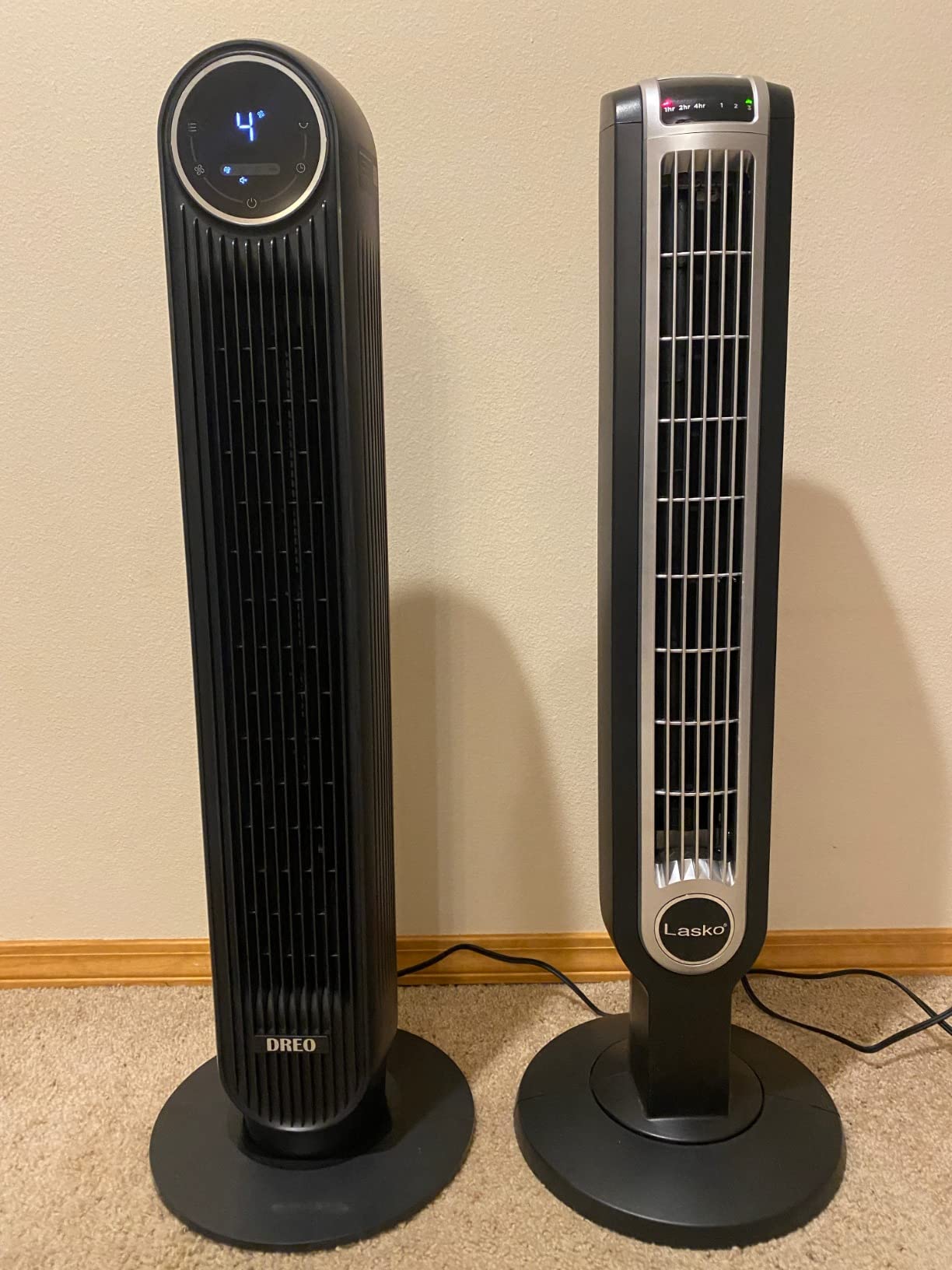
Is the DREO 307 quiet enough for a bedroom?
On the lower half of the speed range, yes, and that is where most owners use it overnight. Sleep mode eases the sound down and the 25 dB figure is a low-speed number, so treat the top three settings as daytime settings.
If you are a light sleeper who runs a fan all night on high, the PELONIS 40-inch in position 5 has a similar profile and a longer timer. If you are sensitive to indicator lights, this model has no backlit display, which is a genuine advantage in a dark room.
Where the DREO 307 falls short
The recurring complaint is noise at the top of the speed range, especially in a large open space where there is soft furnishing to absorb it. On the highest settings owners describe it as a real hum rather than a whisper, and that is physics rather than a defect.
The second issue is reliability of the small things. A few owners report needing a second press on the remote, and more than one mentions that the settings reset to default after a power cut. Neither is serious, but both are annoying if you plan to run the fan overnight on a timer you set once.
2. Honeywell QuietSet HYF290B 40 inch – Best Whole-Room Fan With Remote
Honeywell QuietSet Whole Room Tower Fan, Oscillating Tower Fan with Remote, Black, HYF290B
40 in tall
8 speed settings
10 watt draw
45 dB listed
Remote with rear nest
Pros
- Eight speed steps give fine control
- Remote nests in the back of the housing
- Very low 10 watt consumption pairs well with central air
- Oscillating format covers medium to large rooms
- Long-running design with a large review base
Cons
- Louder than the bladeless DC motor fans at comparable settings
- No backlit display and no modes beyond speed and timer
- Unlit touch controls are hard to read in a dark room
The Honeywell QuietSet is the one to pick if you want a fan that works all day next to central air without adding meaningfully to the power bill. Its 10-watt draw is the lowest figure of any pick in this guide by a wide margin.
It is also the tallest of the two Honeywell-style whole-room designs we considered, at 40 inches on a 10-inch base and 9.2 pounds. The bladed column is rated at 45 dB, which is louder than any of the bladeless fans here, so it is a daytime and living-room fan first and a bedside fan second.
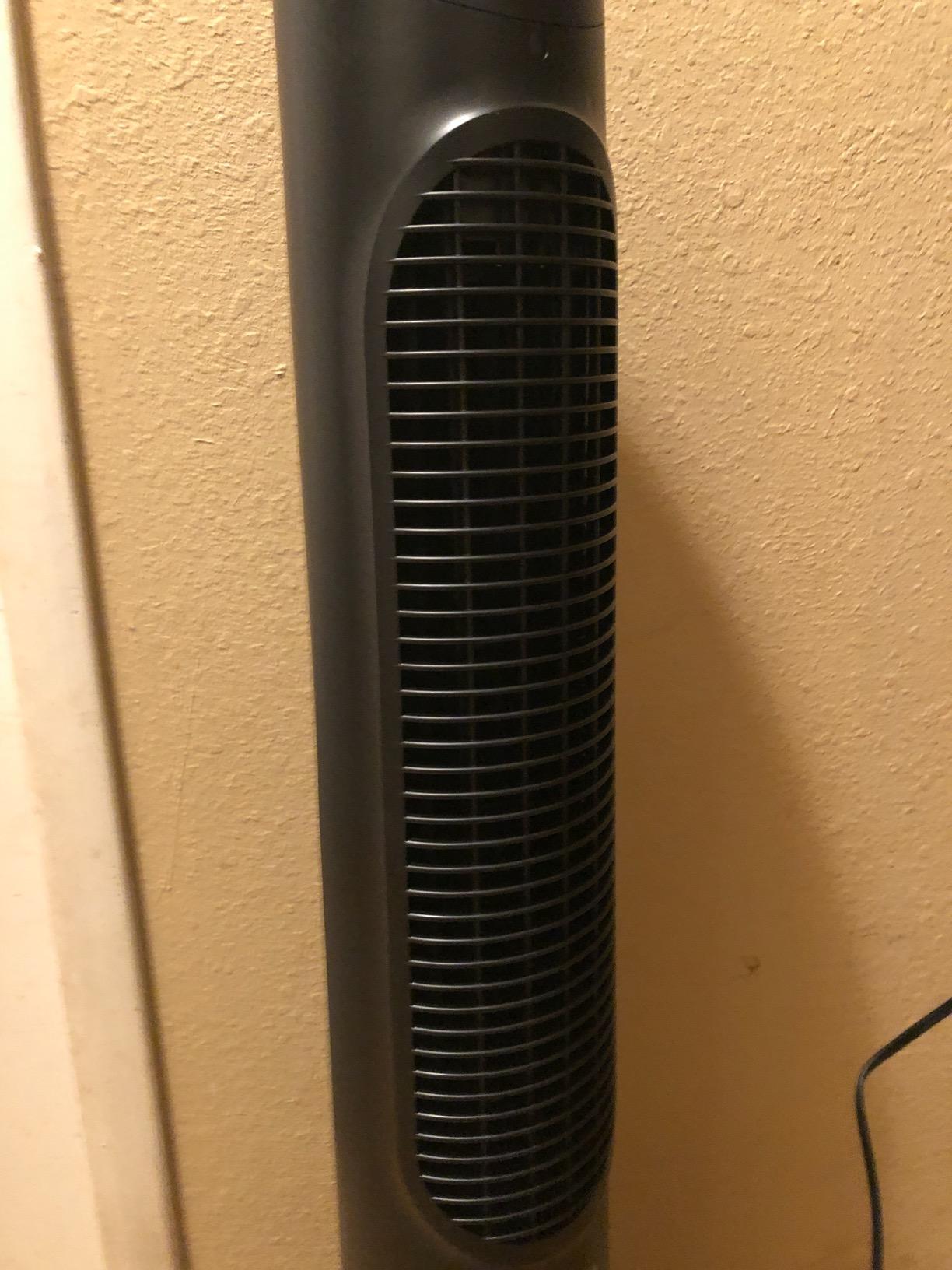
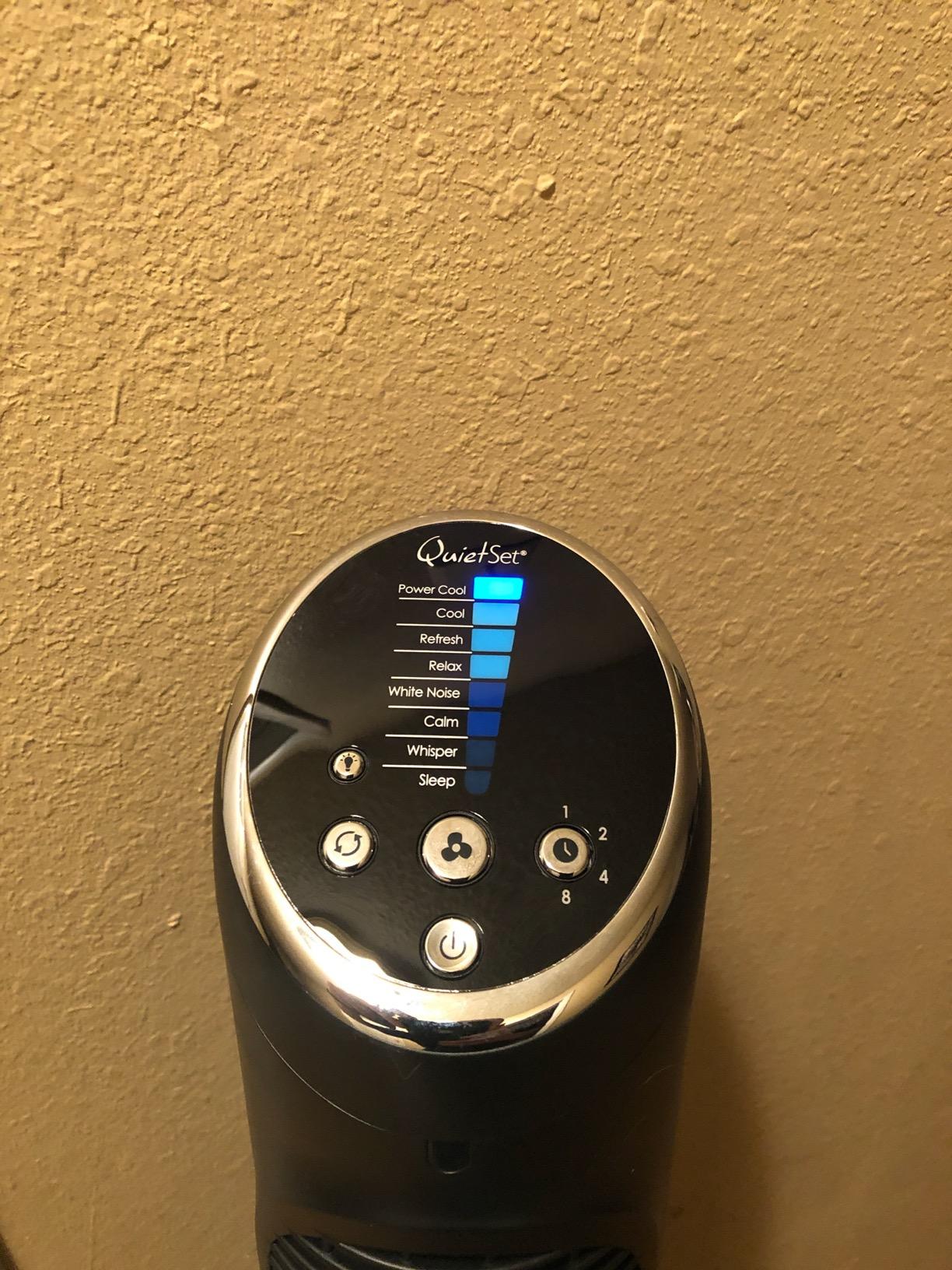
Eight speed settings is the real headline. Most budget towers give you three, and the jump from one to three is coarse enough that you end up choosing between too weak and too strong. Eight steps mean you can land on the airflow that suits a specific person in a specific room.
The remote nests in the back of the housing. On a fan you use from a sofa or a bed, that single design decision removes the most common small annoyance in this category, which is a remote that ends up under a cushion.
Owners frequently describe pairing this with central air or a portable unit, using the tower to push conditioned air into the far corners of a floor plan rather than to cool on its own. That is a sensible use of a 10-watt fan.
Who should look past the Honeywell QuietSet?
If the room is a bedroom, the 45 dB rating is the deciding factor and it points you toward a bladeless DC motor model instead. If noise is not the priority and you want the tallest reach with the least electrical cost, this is the right pick.
The control panel is also the weakest of its features. There is no display, no mode selection beyond speed, oscillation and timer, and the touch controls are unlit. In daylight that is invisible; at night it means getting up to confirm what you set.
Durability and long-term ownership
This is a design that has been in continuous production for years with a very large review base, and that history is itself a signal. Long-running designs that accumulate tens of thousands of reviews tend to have replacement parts and firmware habits that newer churn-driven models do not.
The warranty is one year, which is the standard for this tier and less generous than the DREO registration offer. If durability is your main concern, the length of production for this specific model matters more than the warranty length does.
3. Lasko T42954 42 inch Tower – Best Nighttime Mode
Lasko Oscillating Tower Fan with Remote – 42″ Tall – Gray/Woodgrain
42.5 in tall
3 speed settings
7.5 hour timer
60 degree oscillation
262 CFM
Pros
- Tallest body here
- throws air over a bed
- Nighttime setting dims the LEDs and drops the speed
- 7.5 hour timer suits overnight or work-from-home use
- Carry handle and no-tool setup
- Woodgrain and grey finish suits home decor
Cons
- Only three speed settings
- Audible at a listed 55.4 dB
- Modest 262 CFM compared with high-velocity models
The Lasko T42954 wins on one specific feature that none of the other picks has: a dedicated nighttime setting. It dims the LED controls and steps the fan down, which is a different thing from a sleep mode that just runs quietly at a fixed low speed.
At 42.5 inches with a 13-inch base, it is the second-tallest fan in this guide, and that height does something specific: it pushes the air stream over the top of a bed rather than into your face. Owners in tall-ceilinged rooms and high beds rate that highly.
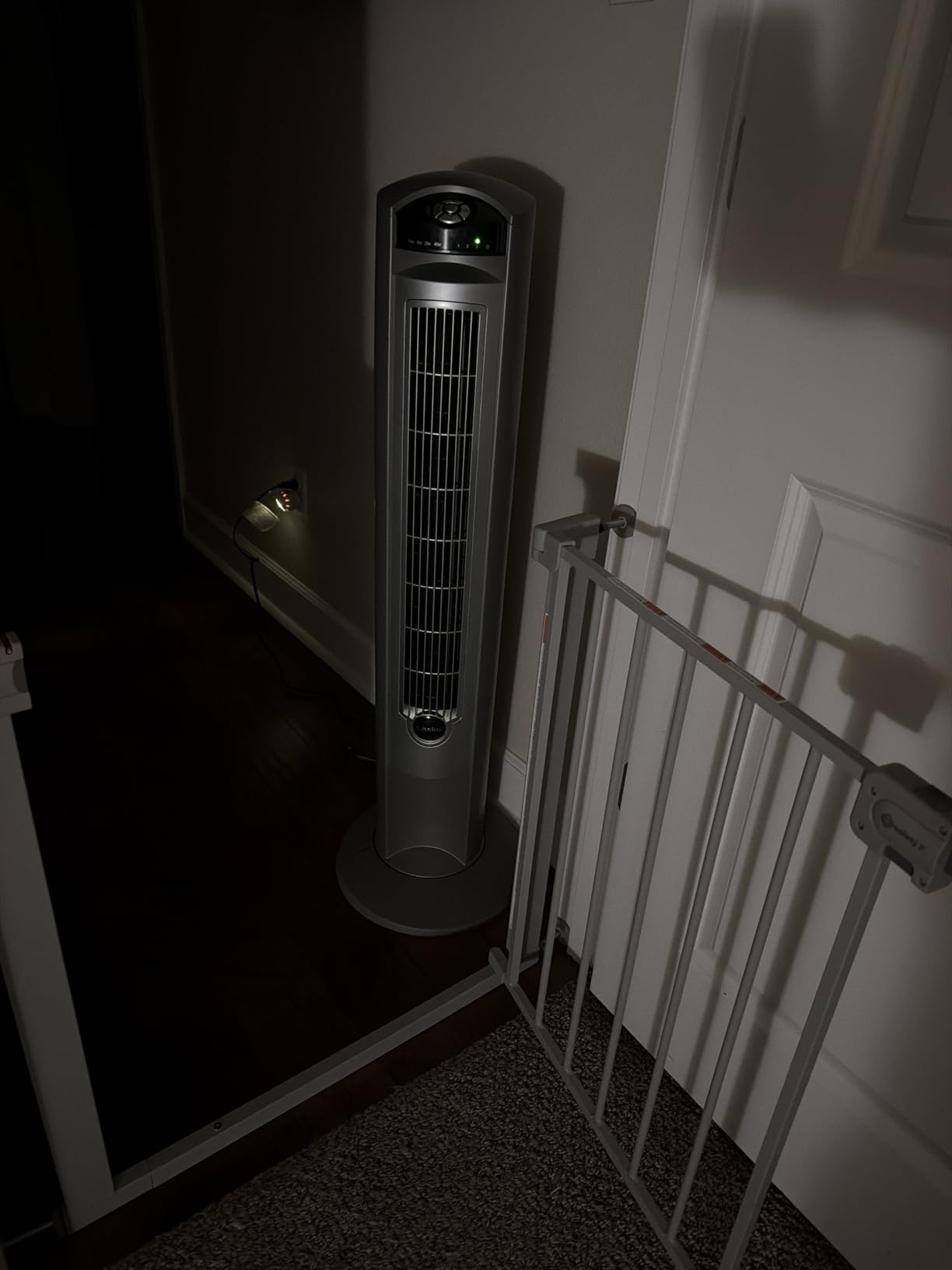
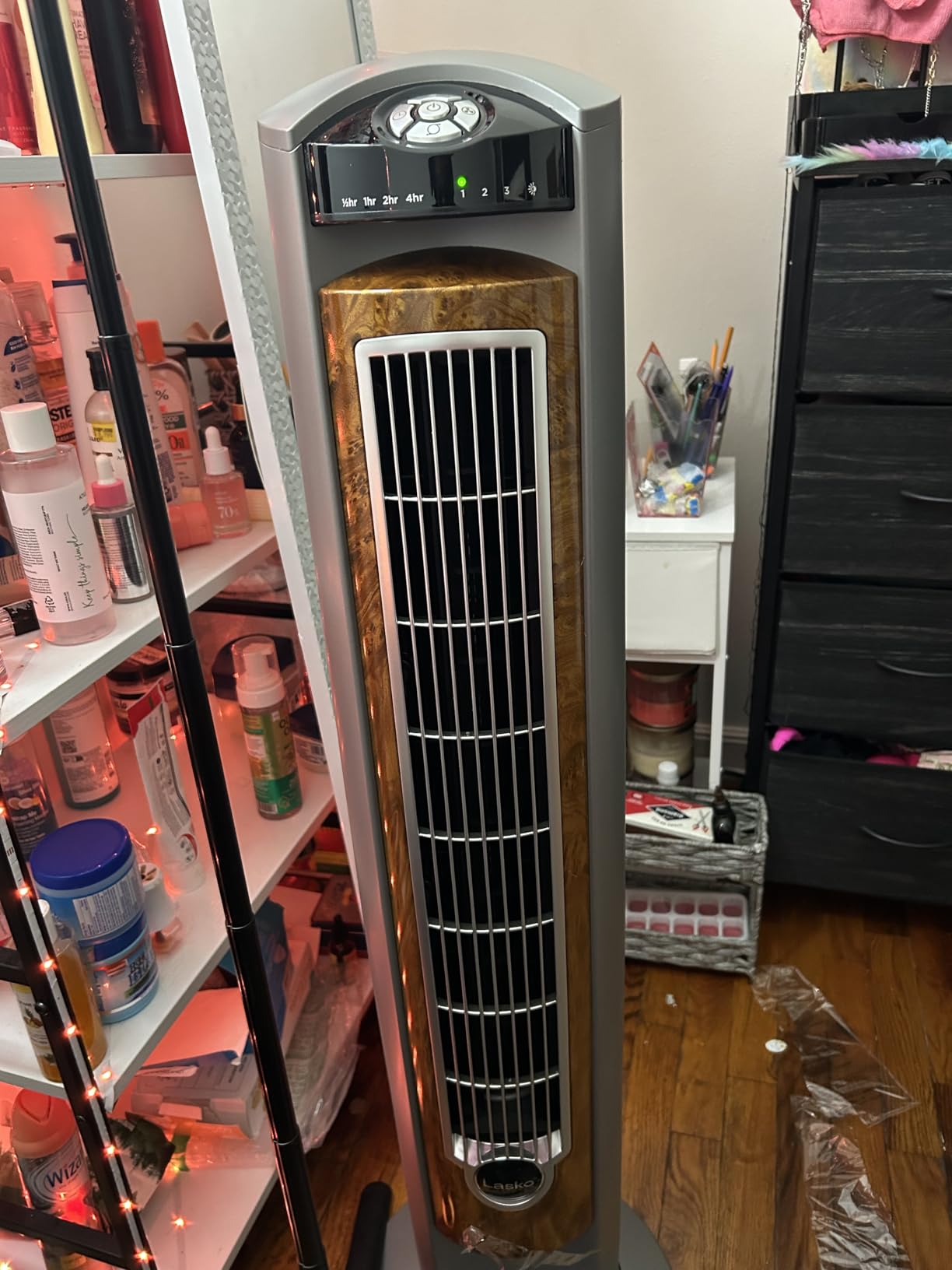
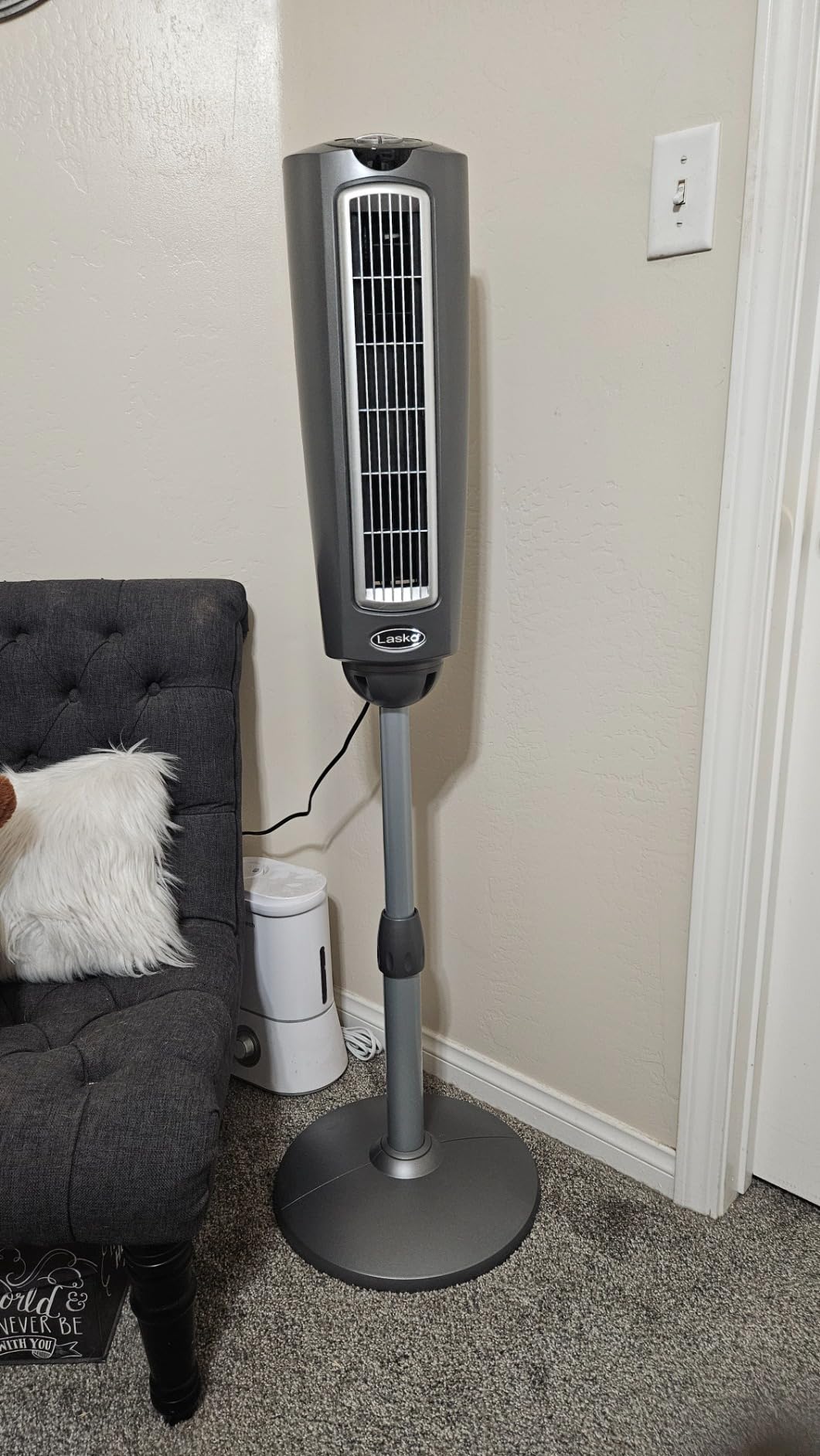
The woodgrain and grey finish is worth a mention because it is the only pick here that is not a black or white column. In a bedroom or a home office that does not look like a utility closet, that counts for more than most spec sheets suggest.
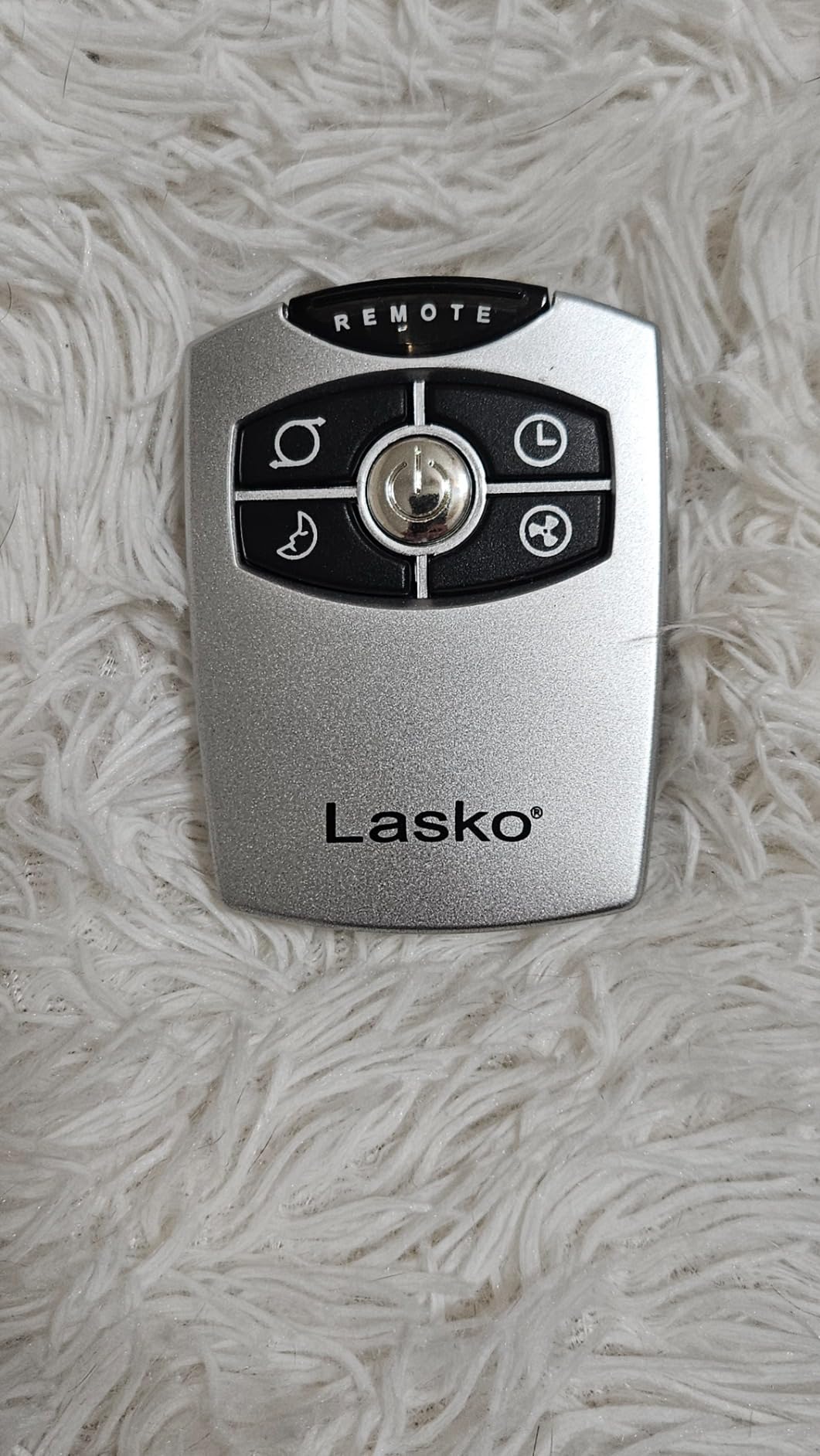
There is a 7.5-hour programmable timer, which is longer than the 7-hour timers on the other Lasko models and long enough to cover a full night of sleep without a mid-night reset. Oscillation is 60 degrees, and a multi-function remote handles power, speeds, oscillation, timer and the nighttime mode.
It is also the only pick in this guide with a carry handle built into the design, at 10.6 pounds. That is a real difference when you are moving between a bedroom, a study and a living room.
Is three speeds a problem?
For some people it is not. If you want a set-and-forget night fan, three speeds are ample. If you share a room with someone who runs warm and someone who runs cold, three steps makes compromise harder, and the eight-speed Honeywell or the nine-speed DREO handles that better.
At a listed 55.4 dB, this fan is loud compared with every bladeless model here. That rating comes from a brushed motor running at speed, so treat the nighttime setting as the mitigation rather than assuming the fan is inherently quiet.
What the 42 inches actually buys you
Height changes the shape of the air column, not just the reach. A taller body discharges air higher into the room, which means it mixes with the ceiling air instead of blasting a narrow horizontal stream at one level. That produces a more even room, but it takes longer to feel the effect in a small space.
The 262 CFM airflow figure is modest against the 1000-plus CFM bladeless models in this list. In a large living room you will feel the difference, and if that is your situation the DREO 42-inch in position 6 is the better tool.
4. Lasko 2510 36 inch Tower – Best Value
Lasko Oscillating Tower Fan with Remote Control – 36″ – 2510 – White
36 in tall
3 speed settings
7 hour timer
54.5 dB listed
210 CFM
Pros
- Very long production run with tens of thousands of reviews
- Three speeds described as quiet enough for sleeping and working
- 60 degree oscillation suits small to medium rooms
- Light at 8.9 pounds and easy to reposition
- White finish blends into bedrooms and offices
Cons
- Only 210 CFM
- which is modest for larger rooms
- Brushed motor is louder than modern brushless DC towers
- Unlit printed numbers are unreadable in the dark
- Rear grille is held by six screws and awkward to clean
The Lasko 2510 has been in production since 2013, which tells you more about its reliability than any specification does. It is a 36-inch, three-speed tower with a seven-hour auto-off timer, 60-degree oscillation and a multi-function remote.
It is also the most-reviewed pick in this guide outside the DREO and Honeywell models, and the review pattern is consistent in a way that long-lived designs rarely are. People buy it, it works, they buy another one.
The efficiency figure is worth noting: Lasko rates it at 5.83 CFM per watt. That is not the highest number in this group, but it comes from a 36-watt draw, so the total energy use stays modest even when the fan runs all day.
Owners regularly use it in dorm rooms, home offices and small bedrooms, and the white finish is the reason it blends into those spaces better than the black towers do.
The one design flaw that gets repeated is the rear grille, which is secured by six screws. That is the single biggest reason to rule this model out if you have pets, because hair in the impeller is the most common tower fan problem and a six-screw grille is the hardest version of that job.
Is the older brushed motor a real drawback?
Yes, and there is no way around it. The 2510 uses a brushed motor rated at 54.5 dB, while every bladeless fan in this guide runs a brushless DC motor between 25 and 30 dB. That is a real difference in a quiet bedroom.
What the brushed motor buys you is simplicity. No firmware, no app, no sensor behaviour to learn, and a mechanical design that has had 13 years of production runs to shake out its problems.
Which rooms suit the 2510
At 210 CFM this is a small-to-medium room fan. A bedroom, a dorm, a home office or a study is the sweet spot. Push it into a large open living room and you will be disappointed, because the air stream feels narrow and weak at distance.
If you need a large room, the two high-CFM options in this guide are the DREO 42-inch and the Lasko U35115. Both will fill a space, and both will be louder doing it.
5. PELONIS 40 inch Bladeless Tower – Best Quiet Airflow Combination
PELONIS 40-inch Bladeless Tower Fan for Bedroom, Standing Fan with Remote Control, 26ft/s, 90° Oscillation, 3 Speed Settings, 27 dB, 3 Modes, 15-Hour Timer, LED Display, Fan that Blows Cold Air, Black
39.88 in tall
26 ft/s wind speed
27 dB
1200 CFM
93 degree oscillation
Pros
- Very quiet even on the higher settings
- 1200 CFM of airflow for a bladeless design
- 93 degree oscillation covers a wide arc
- Remote works from up to 30 feet
- Snap-together assembly with no complicated parts
- Small and stable footprint
Cons
- Sleep mode is hard to distinguish from the top speed
- Remote storage slot leaves half the remote sticking out
- A few owners report the oscillation mechanism failing early
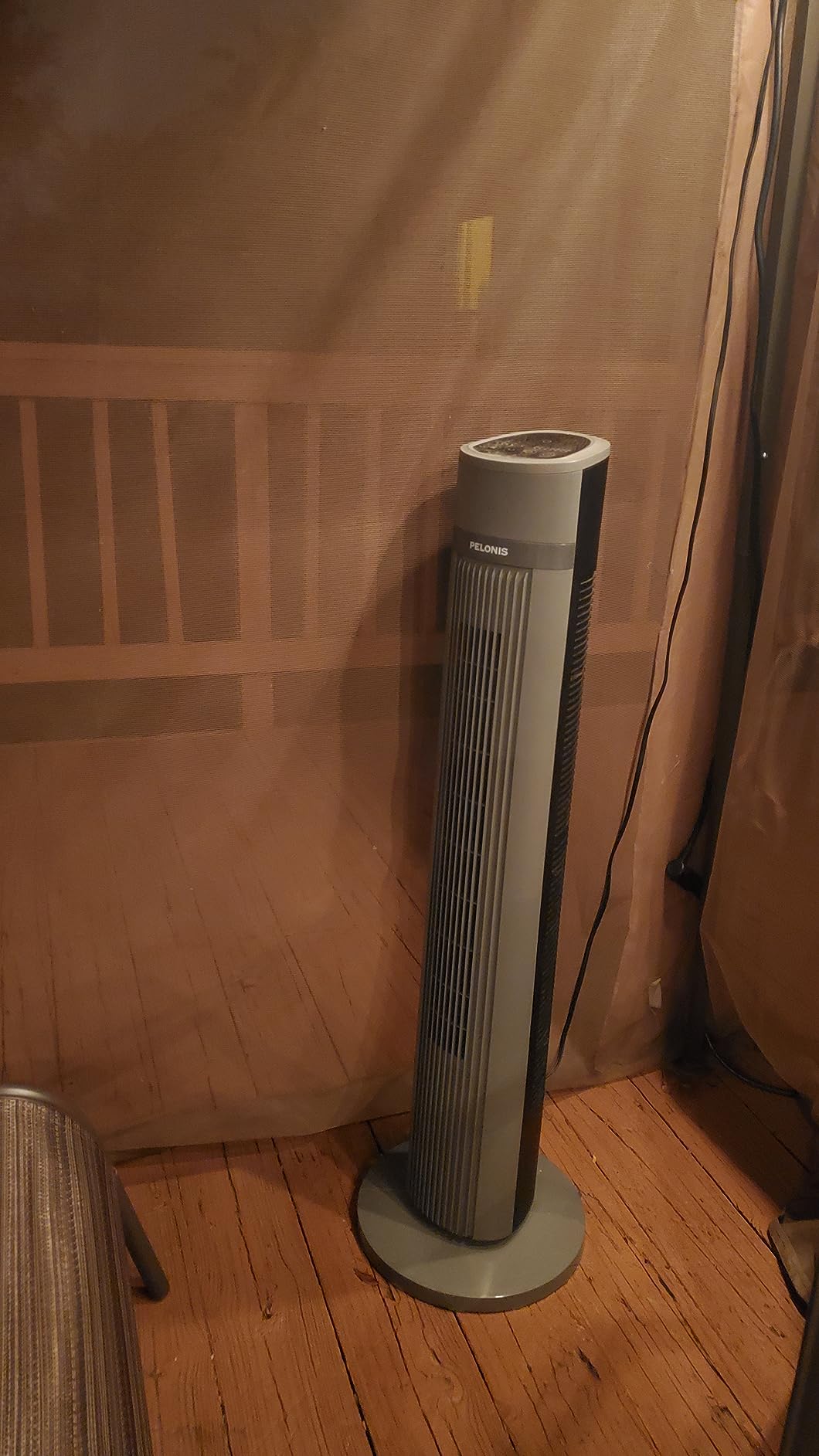
The PELONIS 40-inch is the pick that answers the most common complaint about bladeless fans. Bladeless designs are usually quiet but feeble, and this one is rated at 1200 CFM and 26 ft/s while holding a 27 dB noise level.
It is 39.88 inches tall, weighs 8.2 pounds and has a 90-plus degree oscillation that PELONIS rates at 93 degrees. The 15-hour timer is the longest in this guide, which makes it the pick if you want to run the fan all night plus part of the morning without touching it.
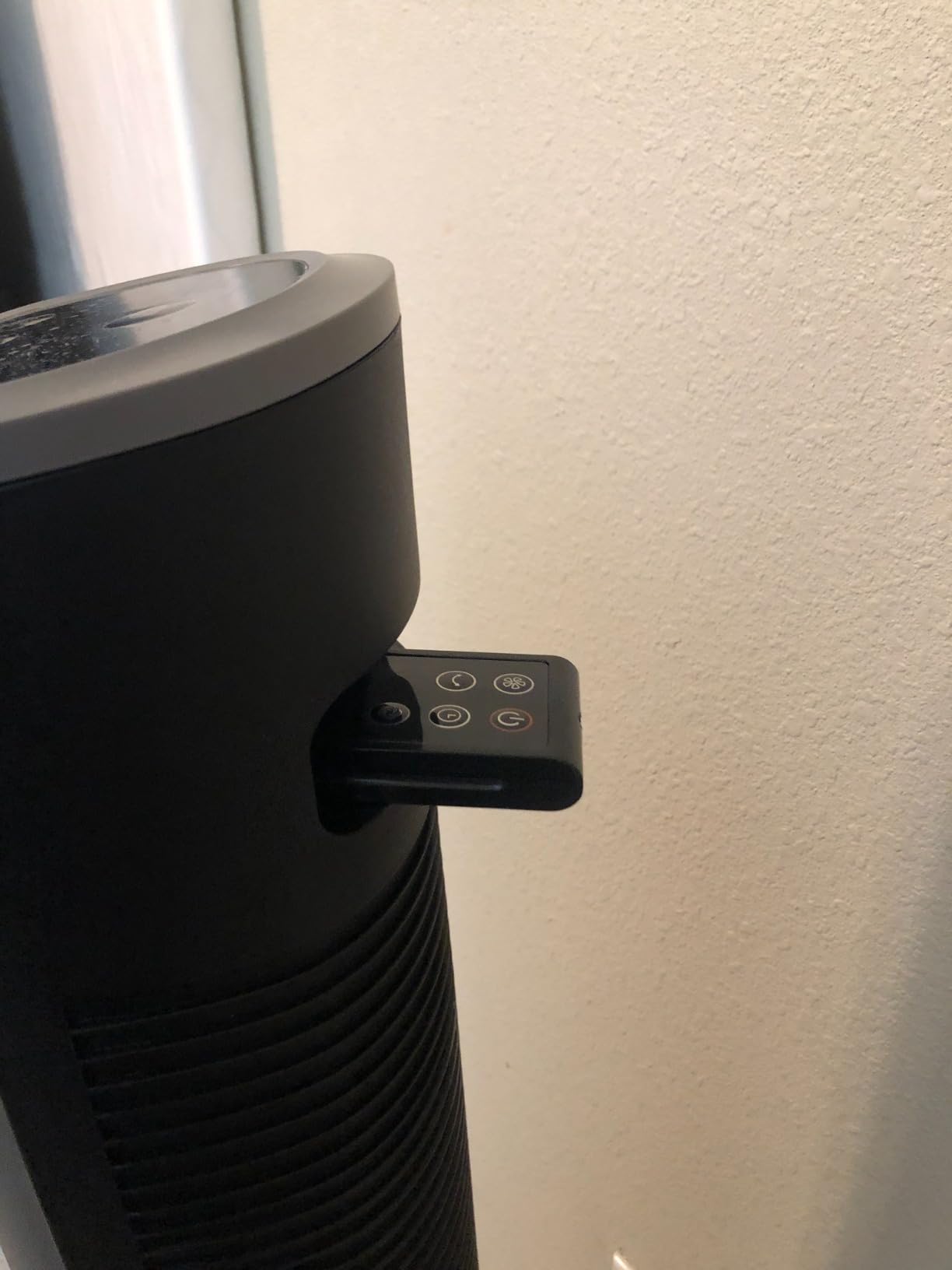
Assembly is a snap-together job with nothing complicated to align, and the small base stays stable in tight spaces. The remote reaches 30 feet, which is genuinely useful in a larger bedroom or an open-plan office.
Owners also report several years of continued operation, which matters for a fan you plan to leave running through a whole season.
The honest criticism here is the sleep mode. Reviewers are blunt that it is not audibly different from the highest speed, so if you are buying this for night use, set the speed low manually and ignore the mode. The 27 dB figure still holds at moderate settings, which is the part that matters.
Is the bladeless design worth it over a bladed tower?
For a bedroom, a child or a pet, yes. There is no exposed impeller to reach into and no blade to catch hair, and the smooth column has far fewer crevices for dust to build up in. You can run a cloth down the front grille in a minute.
For a workshop, a garage or a large open room, no. A bladed high-velocity tower moves more air per watt and takes abuse better, and the exposed-grille models are easier to blow dust out of.
Reliability notes from owners
Two recurring issues appear in the reviews. A small number of owners report oscillation units failing after about a month, which is worth weighing if you rely on oscillation heavily. Others describe creaking at the oscillation joint after several years of daily use, which is a wear issue rather than a defect.
Replacement remotes are also hard to source because the model number is not printed where you would expect. That is a minor annoyance, but it is exactly the kind of thing that turns into a dead fan if you lose the original remote in year two.
6. DREO 42 inch 9-Speed Tower – Top Rated for Large Rooms
DREO Tower Fan for Bedroom, Upgraded DC 28ft/s Velocity, 9 Speeds
42 in tall
28 ft/s and 1397 CFM
9 speeds and 4 modes
28 dB listed
30 watts
Pros
- Highest rated of the group with 4.6
- Quiet through the mid speeds and silent when oscillating
- Sleep mode dims the display
- True 90 degree oscillation
- Removable coil and back assembly for cleaning
- 30 watt draw
Cons
- Clearly loud on the top two or three speeds
- Highest price in this roundup
- Display lighting can be distracting at night
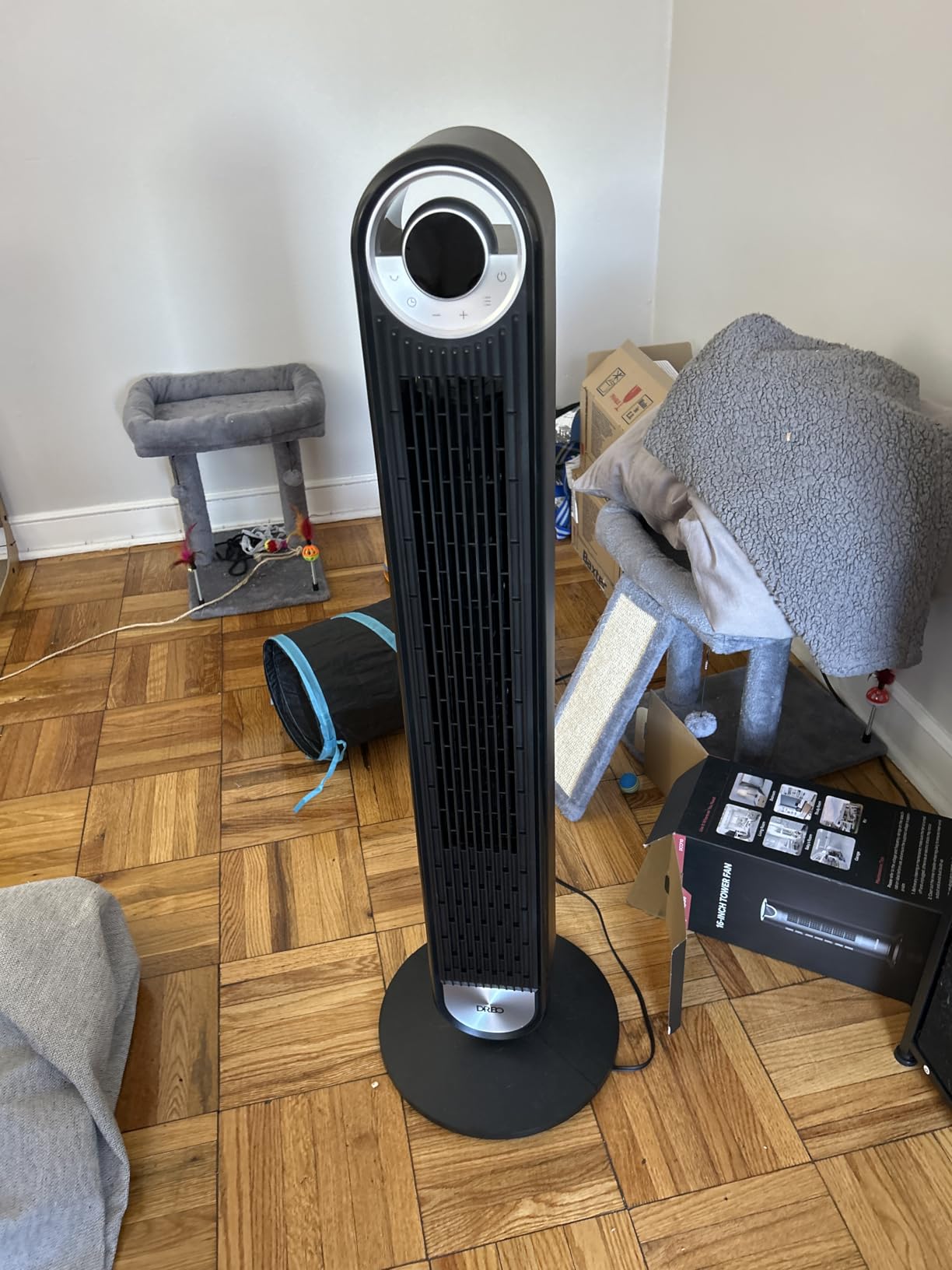
The DREO 42-inch is the highest-rated fan in this guide at 4.6, and it is the one to buy if you need real air movement in a big room. At 1397 CFM and 28 ft/s it is the strongest airflow figure of the ten picks, and the 42-inch height gives it reach.
It also adds a temperature-sensing auto mode, which adjusts the wind speed based on room temperature, plus nine speed settings across four modes. That is the most granular control in the group, and it is why the fan works for two people with different preferences in one room.
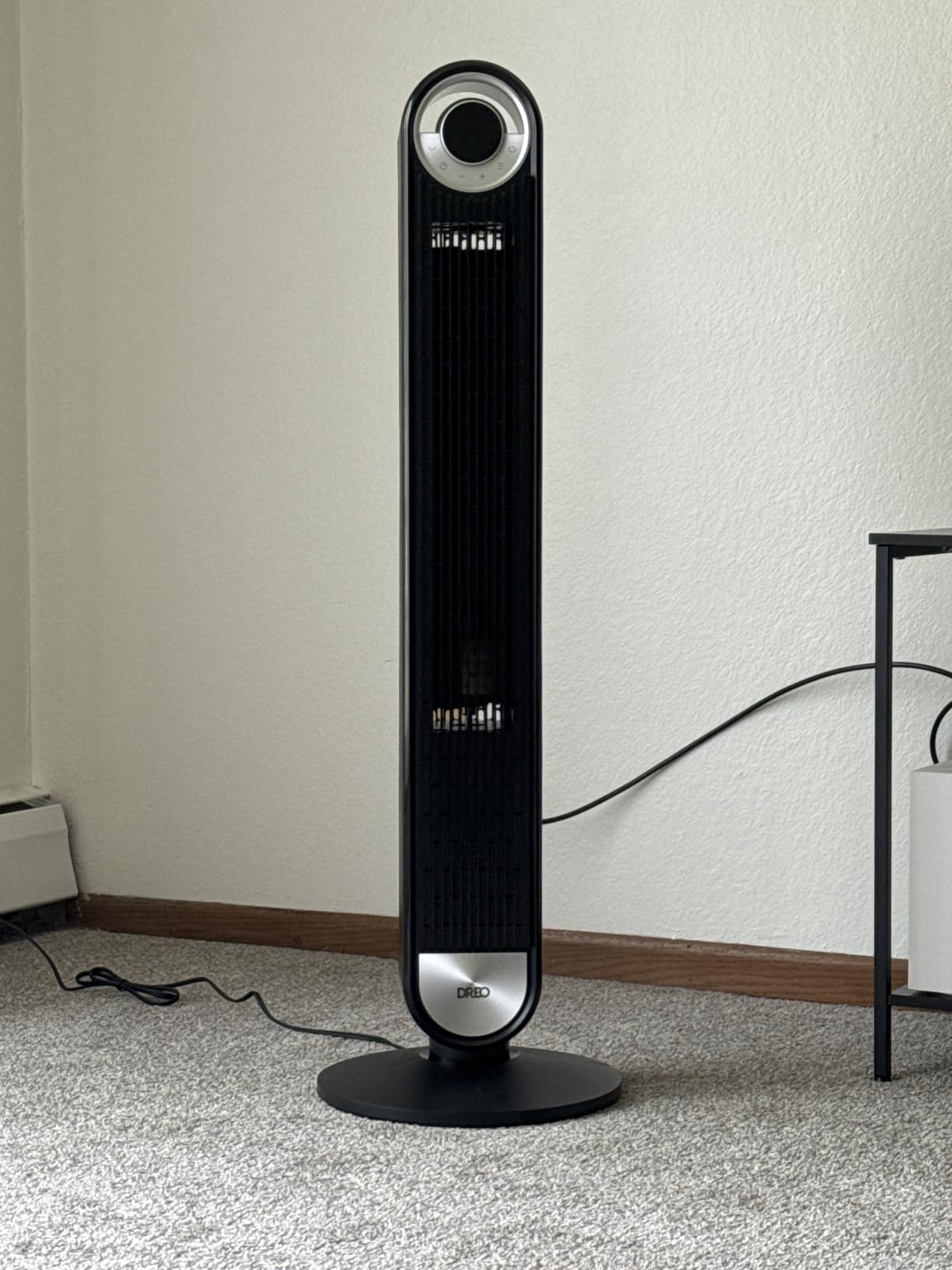
Owners describe it as replacing a louder pedestal or box fan, which is the useful comparison. The reason people upgrade to a tower is not the decibel number, it is the footprint and the noise at equivalent airflow, and this model wins on both.
The DC brushless motor stays quiet through the mid speeds and adds no rattle when the head swings, and the removable coil and back assembly make cleaning far less of a chore than on the screwed-down models.
Warranty coverage is the best here: 12 months by default, extendable to 30 months by registration, with a five-year extended option also available.
Is it quiet enough to sleep next to?
Through the middle of the speed range, yes. The 28 dB figure reflects that range, and Sleep mode dims the display and eases the sound down. Owners commonly report running it overnight without complaint on low and mid settings.
On the top two or three speeds it is clearly loud, and that is the tradeoff for the 1397 CFM figure. If you want maximum quiet at all times, the PELONIS 40-inch gives up some airflow for a lower ceiling on noise.
What you give up at the top of the list
This is the priciest model in the roundup, which means less headroom if you find a deal elsewhere. The display is also the brightest in the group, and light sleepers should check whether they can dim or disable it before committing.
If the room is small, this is more fan than you need, and a 30-inch model will serve you better while taking up less space.
7. Levoit LTF-F361 36 inch Tower – Best for Tight Spaces
Levoit Tower Fan for Bedroom, 28ft/s Fans that Blow Cold Air, 28dB Quiet
36.2 in tall
6.5 inch base
28 dB on low
1044 CFM
5 speeds and 4 modes
Pros
- Near-silent on low speed
- Very slim 6.5 inch footprint
- Auto mode with a built-in temperature sensor
- 12 hour timer
- Removable back grille
- Backed by a 2 year warranty
Cons
- AC motor is louder than the brushless DC models at higher settings
- Remote-only control with limited top-panel feedback
- 4.4 average rating sits below the top-scoring models
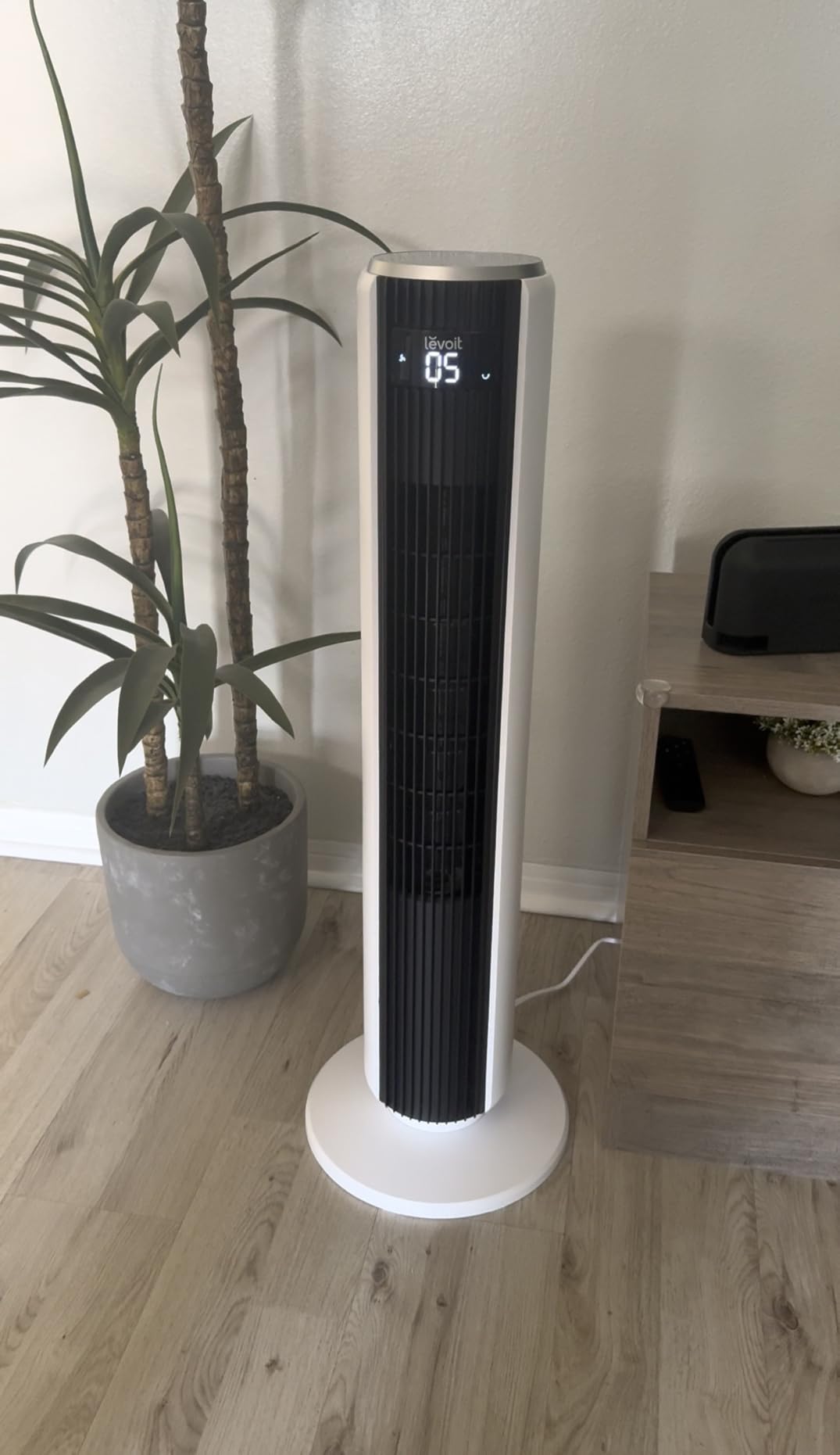
The Levoit LTF-F361 is the narrowest fan in this guide at a 6.5-inch base, and that footprint is the entire reason to choose it. In a small bedroom where a 12-inch base means you cannot walk past the bed, the difference is not cosmetic.
It delivers 28 ft/s and 1044 CFM, so it is not a compromise on airflow despite the slim body. On low speed the published noise level is 28 dB, which is quiet enough for light sleepers and for rooms with pets that startle at noise.
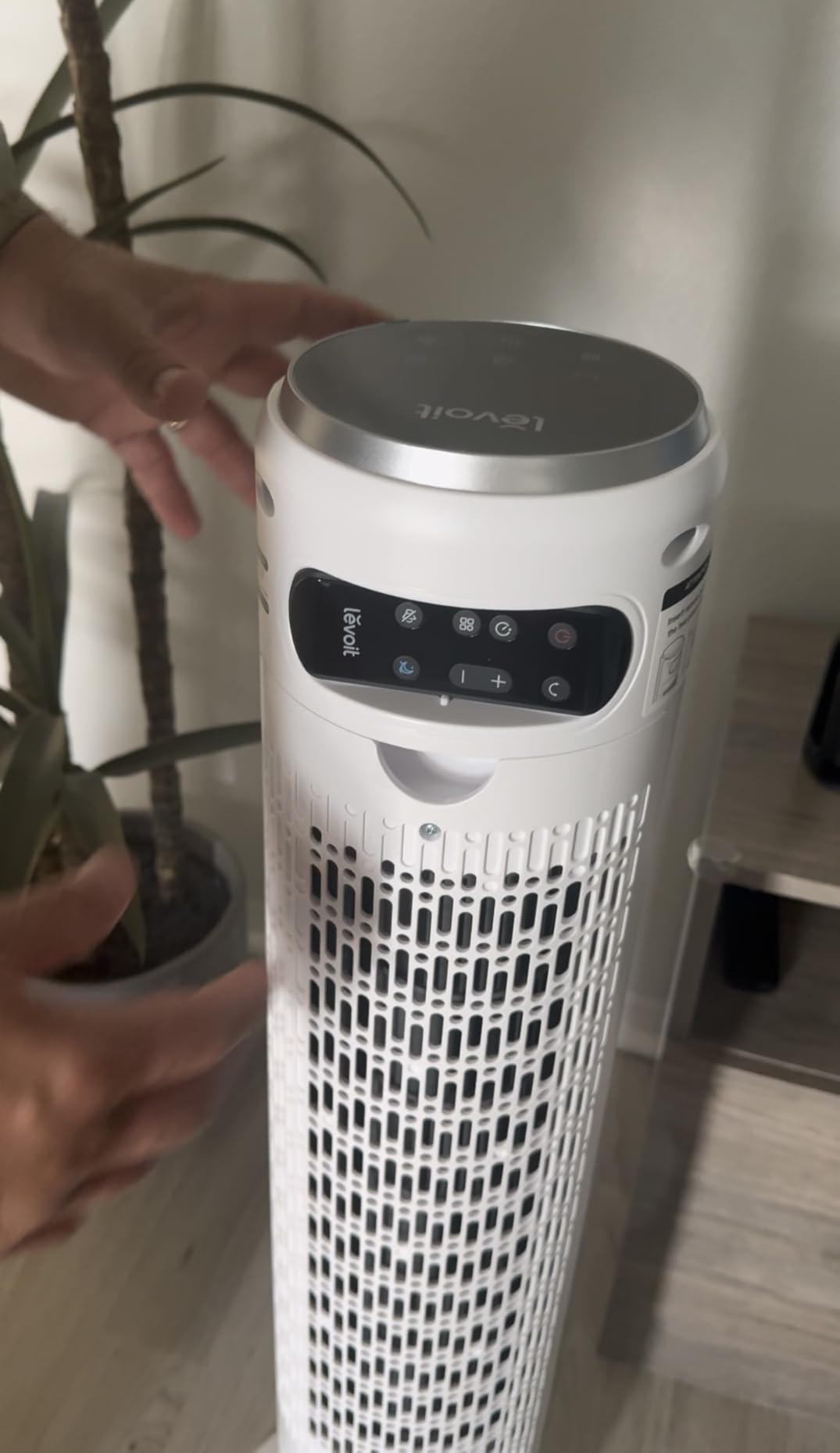
The auto mode uses a built-in temperature sensor to adjust the wind speed, which is useful when the room warms up in the evening and you are not near the remote. Five speeds across Normal, Turbo, Sleep and Auto give reasonable granularity, and the 12-hour timer covers a full night.
The two-year manufacturer warranty is the longest standard coverage in this roundup without registration, which is a genuine plus on a fan you expect to keep running for years.
The removable back grille is another cleaning win. On a fan this narrow, being able to lift the grille off without a screwdriver keeps the impeller from turning into a hair collector.
Why does an AC motor matter here?
An AC motor uses brushes and a mechanical commutator, which is both louder and less efficient than the brushless DC motors in the DREO, PELONIS and Lasko bladeless models. In practice the difference shows up on the top speeds, where owners say this fan becomes audible.
For low and mid settings the penalty is small. If you plan to run the fan on high in a large space, the DC motor models are the better engineering choice.
Is remote-only control a limitation?
Mildly. The top panel gives limited feedback, so if you lose the remote you are guessing at what setting the fan is on. That is a smaller problem than it sounds, because the physical power button is still there.
Consider a model with a backlit display if you want to confirm settings at a glance in the dark. The DREO 42-inch has one, though its brightness is exactly what some sleepers object to.
8. Lasko U35115 35 inch High Velocity – Best for Garages and Gyms
Lasko High Velocity Oscillating Tower Fan – 35″ – U35115 – Silver/Black
35 in tall
509 CFM high velocity
3 speeds
7 hour timer
12 pounds
Pros
- Raw airflow that a pedestal fan cannot match
- Low speed is fine as sleep white noise
- Remote stores on the back of the fan
- Slim body replaces a bulky box fan
- Owners report five years or more of service
Cons
- Clearly audible on the highest speed
- Outer louvre vents cannot be adjusted
- Grilles need a torx screwdriver to remove
- Very bright power light at night
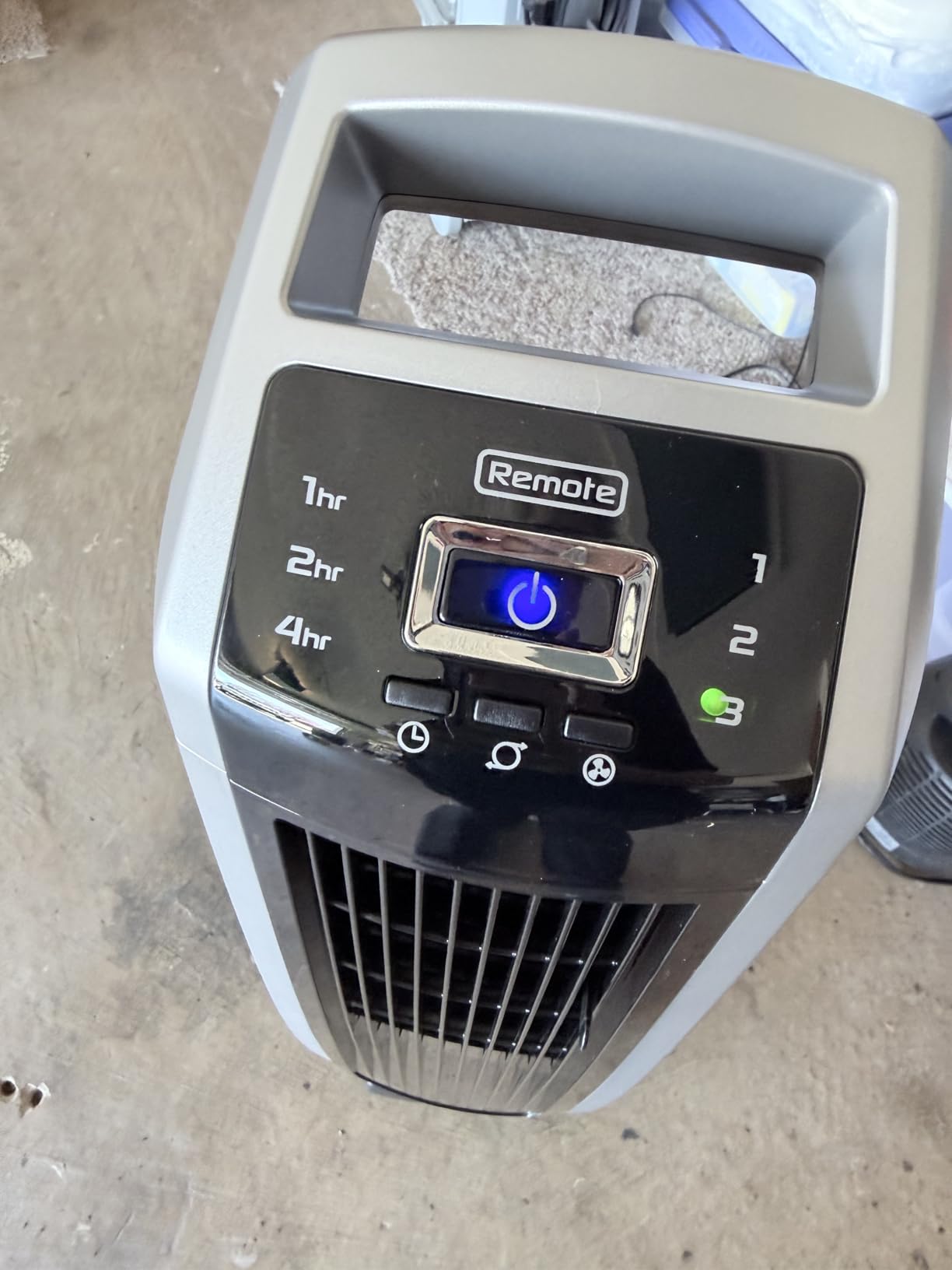
The Lasko U35115 is the rough-environment pick. At 35 inches and 12 pounds it is the heaviest fan here, and at 509 CFM of high-velocity airflow it is built for garages, basements, home gyms and workshops rather than bedrooms.
The design brief is different from every other pick in this list. Instead of a bladeless column, it uses a bladed high-velocity impeller that Lasko rates at roughly 25 percent more velocity than a standard tower fan. That is the difference between moving air and feeling a breeze on your arm.
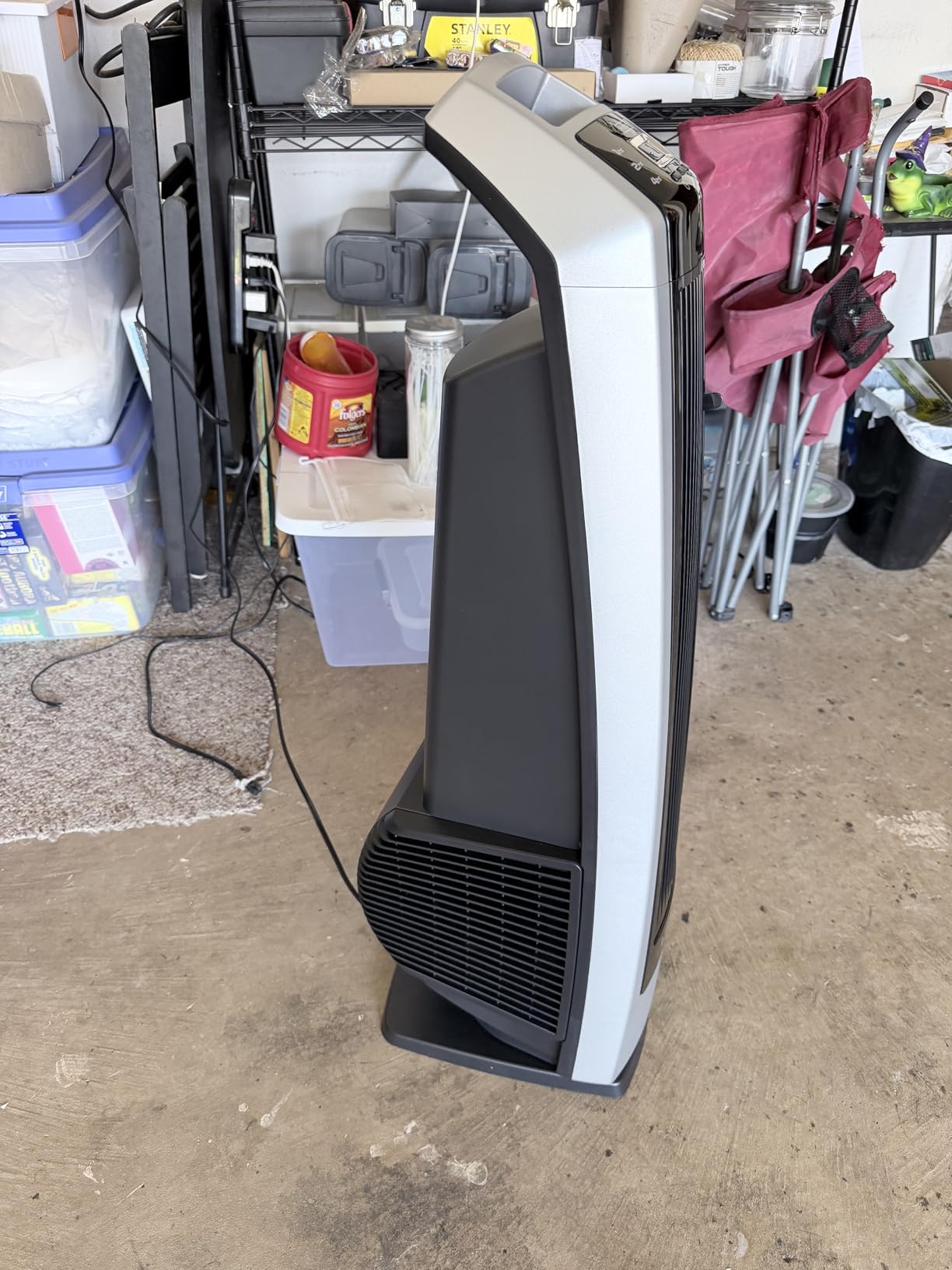
Owners who bought it to replace a box fan in a garage are the happiest users, because the slim body stands where a box fan would be knocked over. The remote stores on the back, the oscillation sweeps widely across a work area, and the seven-hour timer handles a session.
At 96 watts this is by far the highest power draw in the group. That is fine for a workshop where you need real air movement and irrelevant if you are trying to run a fan all night next to a sleeping person.
It carries a 4.6 rating, tied for the highest here, with a review base in the low thousands. That is smaller than the other Lasko and DREO models, so treat the rating as encouraging rather than decisive.
Who should not buy this fan?
Anyone sleeping near it. The listed noise level is 56.35 dB, the second highest in this guide, and owners describe the top speed as comparable to a box fan. The lowest speed is fine as white noise, and that is the setting most people actually use.
It is also the priciest model in the roundup, and it sits closer to the ceiling than some of the premium models we deliberately left out.
Maintenance reality in a dusty space
This is the fan where cleaning difficulty is most likely to matter, because workshop air puts dust into everything. The grilles need a torx screwdriver to remove, and the outer louvre vents are fixed with only the inner motor vents moving.
The fixed outer vents mean you cannot aim the air. In a garage where you want the flow pointed at a workbench, that is a genuine limitation, and it is the main reason to choose the high-CFM DREO 42-inch instead.
9. PELONIS 30 inch Tower Fan – Budget Pick for Dorms and Studios
PELONIS 30-Inch 3-Speed Oscillating Tower Fan for Bedroom, Quiet 30dB
29.7 in tall
7 pounds
3 speeds
120 minute timer
90 degree oscillation
Pros
- Smallest and lightest fan in the group
- Carry handle for moving between rooms
- Tool-free assembly with a plastic nut
- 90 degree oscillation
- Owners report units running after nearly four years
- Compact 6.8 by 7 inch base
Cons
- Weakest airflow here at 20 ft/s
- High setting is louder than the 30 dB rating suggests
- Touch buttons make loud clicking sounds
- No remote control on this model
- Base feels flimsy to some owners
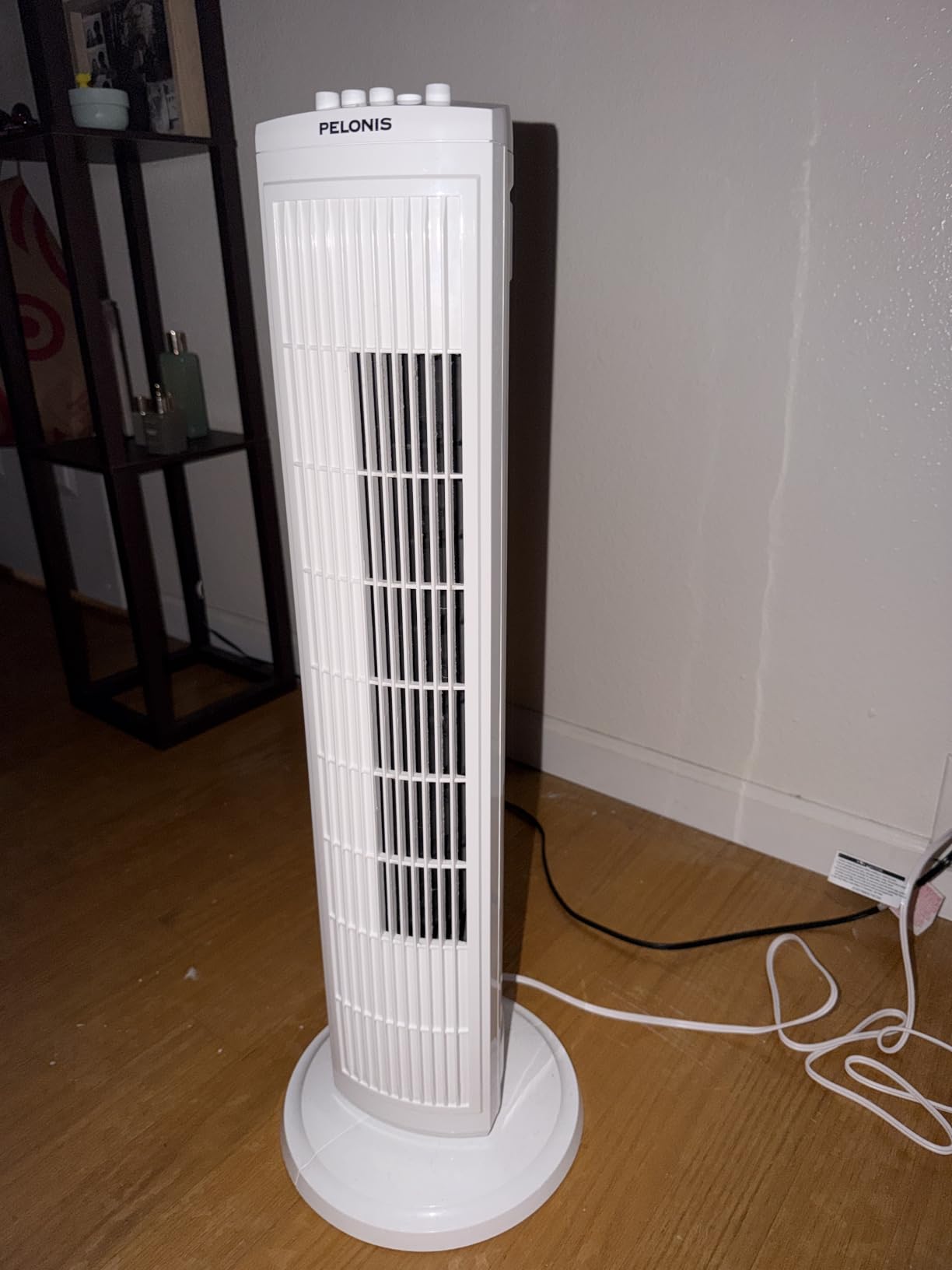
The PELONIS 30-inch is the pick when space, weight and cost matter more than raw air movement. At 7 pounds with a carry handle and a 6.8 by 7 inch base, it is the easiest fan here to move between a dorm, a studio apartment and a home office.
It is also the lowest-rated model in this guide at 4.2, and the reason is visible in the numbers: 20 ft/s of wind speed and 1060 CFM. That is fine for personal cooling at a desk. It is not enough to move the air in a shared room.
The 90-degree oscillation is wider than several pricier models here, and the 120-minute auto-off timer sets in 20-minute increments, which is a useful short-cycle option for a room you only use for a few hours a day.
Assembly is genuinely tool-free. The base snaps together and secures with a plastic nut, so there is nothing to misalign, which matters if you are assembling it in a small room on the floor.
Owners report units still running after nearly four years, and the quirky low-speed white noise has its own audience among people who use fan noise to sleep.
What you give up at this tier
The first thing is control. This model has no remote, so if you want to change the speed from bed you have to walk to it. Among the picks here, only the Lasko 42-inch has more to lose.
The touch speed buttons make audible clicks, which is a genuine problem for light sleepers even though the fan itself is quiet on low. The 30 dB rating is a low-speed figure, and owners report the high setting is louder than that number suggests.
Which rooms is it actually right for?
A dorm room, a home office, a studio apartment or a child’s bedroom where one person needs personal airflow. In all of those, the compact size and low weight are the deciding factors and the 20 ft/s figure is adequate.
If more than one person needs cooling or the room is open-plan, spend up to the PELONIS 40-inch or the DREO 307 and the gap will be obvious.
10. Amazon Basics 40 inch Digital Tower – Best Starter Fan
Amazon Basics 40″ 70-Degree Oscillating Digital Tower Fan with Powerful Airflow for Bedroom, Living Room, Office, 4 Speeds, 3 Modes, 15-Hour Timer, Remote Control, 50W, Black
40 in tall
4 speeds and 3 modes
70 degree oscillation
15 hour timer
50 watts
Pros
- Assembly takes almost no parts
- Curtains move at 15 feet in a single room
- Oscillation runs smoothly with no rattle at the ends
- Remote works at unusual angles
- Sleep mode varies the wind and sound pattern
- 15 hour timer at this tier
Cons
- Moves noticeably less air than a comparable Lasko tower
- 70 degree oscillation is narrower than 90 degree models
- Top indicator lights stay on and are too bright for a dark bedroom
- Slow oscillation that lingers at the end of the sweep
The Amazon Basics 40-inch is the straightforward first fan to buy. It is 40 inches tall, weighs 7.5 pounds, and has four speeds across three modes with a 15-hour timer and a remote, which is a better spec sheet than most fans at twice the price.
The sleep mode is worth a specific mention. Instead of holding one steady tone, it varies the wind and sound pattern, which some owners prefer as background noise because the steady drone of a fixed-speed fan becomes audible over a long sleep.
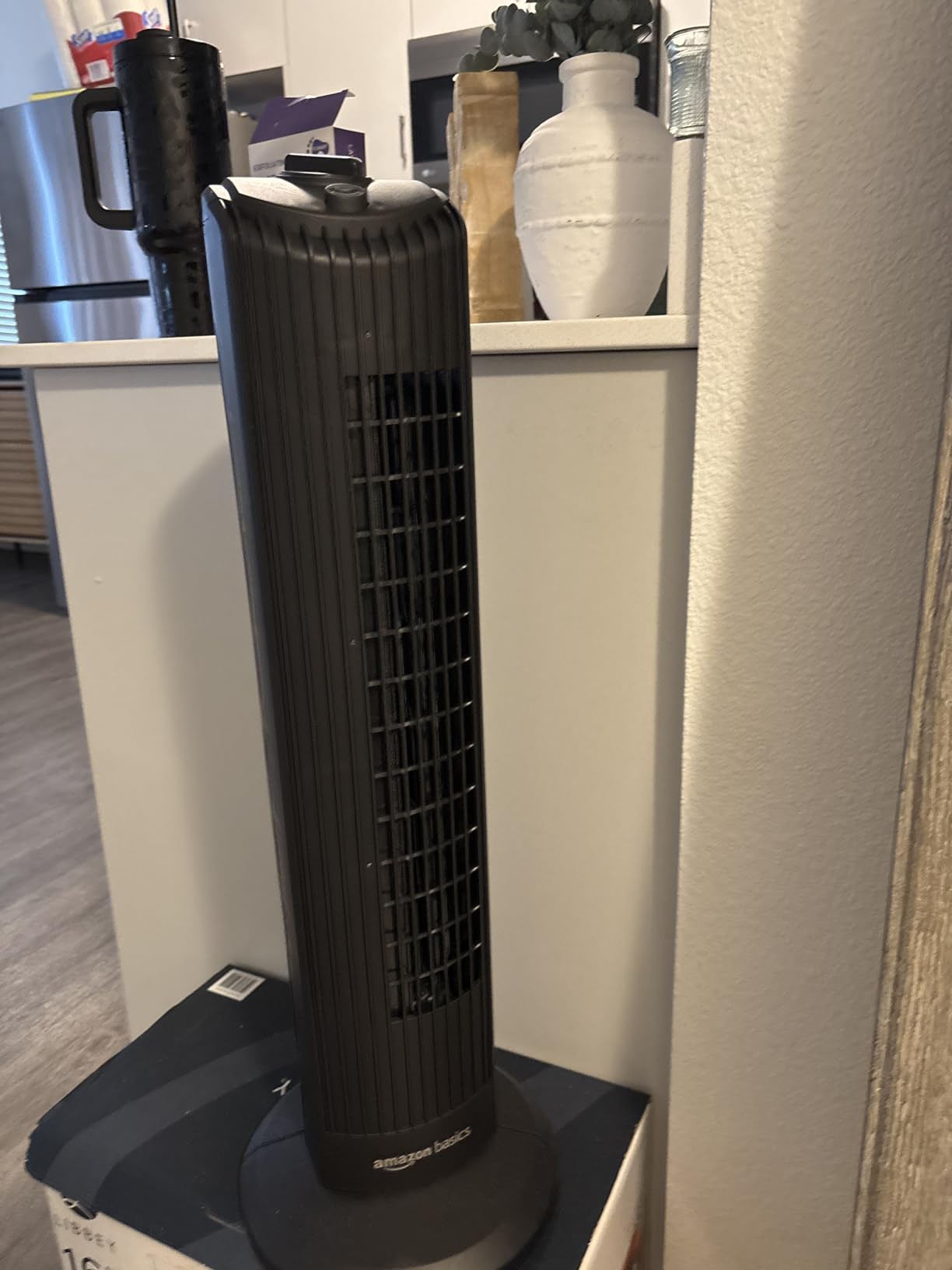
Oscillation runs smoothly with no rattle at the ends of the sweep, and the remote responds at unusual angles, which is a small thing that separates a good remote from a frustrating one.
The catch is airflow. Owners compare it directly against a comparable Lasko tower and report that this one moves noticeably less air, and the 70-degree oscillation is narrower than the 90-degree sweeps used by the DREO and PELONIS models.
With 937 reviews, this is the smallest sample in the roundup, so treat the 4.4 rating as a reasonable signal rather than a settled one.
Is 70 degree oscillation a real limitation?
Yes, in a square room. A 70-degree sweep leaves the corners behind you relatively still, while a 90-degree sweep covers most of the width of a room from a corner position. If the fan sits in a corner, the difference is obvious.
The slow sweep is the other quirk. The head lingers at the end of each pass, which some owners read as the fan stalling rather than pausing.
Do the indicator lights ruin it for a bedroom?
They annoy more sleepers than any other single feature in this category, and that is the main reason this fan is not higher on the list. The top indicator lights stay lit and there is no dim setting.
If a dark bedroom is your use case, pick a model with either no indicator lights at all, such as the DREO 307, or a display that dims, such as the DREO 42-inch.
Before you narrow anything down further, it helps to know the shape of the category. Our guides on the best tower fans for bedrooms and the best tower fans for living rooms go deeper on room-specific picks, and the best shop fans guide covers small-space circulation where a tower is more than you need.
How to Narrow the 10 Picks Down to One
Four questions will narrow these ten fans to one or two candidates in under a minute. Answer them in order, because each one eliminates more options than the last.
1. How big is the room, and how many people are in it?
One person in a room up to about 150 square feet: the 30-inch PELONIS or the slim Levoit. One person in a large bedroom: the DREO 307 or the Lasko 42-inch, both of which push air over a bed. Two or more people in an open living room: the DREO 42-inch at 1397 CFM or the Lasko U35115 if the space is a garage or gym.
2. Is the fan mainly for sleeping?
If yes, prioritise the published low-speed noise figure and ignore everything else. That points to the DREO 307, the PELONIS 40-inch and the Levoit, all of which sit between 25 and 28 dB. If you need a light-dimming control, add the DREO 42-inch or the Lasko 42-inch to the list.
3. Does anyone in the house need quiet while someone else needs airflow?
This is the day-versus-night conflict that owners complain about most. The honest answer is that a fan under 100 dollars struggles to be near-silent and high-output at the same time, because the same motor is doing both jobs. The best workaround is a fan with more speed steps, so you can find a quiet middle setting, which is why the nine-speed DREO 42-inch and the eight-speed Honeywell rank where they do.
4. How much do you actually need smart features?
Less than most buyers expect. None of the ten picks here has Wi-Fi or app control, and at this price ceiling that is a reasonable trade. Temperature-sensing auto modes appear on the DREO 42-inch and the Levoit, and both work well without a phone. Paying more for app control means crossing the 100-dollar ceiling, and we cover that trade below.
Buying Guide: What to Check Before You Buy a Tower Fan
These are the specs that actually change how a tower fan performs day to day. Everything else on a product page is decoration.
Noise level is a range, not a number
Published noise figures describe the quietest setting unless the listing says otherwise. In this roundup the numbers run from 25 dB on the DREO 307 to 60 dB on the Amazon Basics, but those two figures describe opposite ends of different fans.
As a rough guide, the mid-20s to high-20s range is quiet enough for a bedroom and disappears under conversation. Around 30 dB is a normal quiet room. The mid-40s and above is a fan you will hear across a room, which is fine for daytime circulation and wrong for sleeping.
Oscillation angle decides how much of a room you cover
Sixty degrees covers a decent arc from a corner. Ninety degrees covers most of a room. Seventy degrees sits in between and, in a square room with the fan against a wall, leaves corners behind.
Oscillation quality matters as much as angle. Brushless DC motor fans turn silently, while brushed motors can develop a squeak at the ends of the sweep after a few seasons.
Number of speeds predicts how long the compromise lasts
Three speeds is a coarse control that works until two people with different preferences share a room. Eight or nine speeds give you a usable middle setting, and that middle setting is the answer to most noise complaints.
Modes add less than the speed count. Sleep mode on one of the picks in this guide is indistinguishable from the top speed, while on the Lasko 42-inch it genuinely dims the display and steps down.
Motor type explains the noise
Brushless DC motors are quieter, more efficient and do not develop the mechanical rattle that brushed motors get over time. Every quiet pick in this guide uses one, and the audible ones use either an AC motor or a brushed motor.
Energy use from published wattage
Wattage tells you the running cost without needing a price. At eight hours a day across a full year, the 10-watt Honeywell QuietSet draws roughly 29 kWh, the 30-watt DREO 42-inch about 88 kWh, and the 96-watt Lasko U35115 about 280 kWh.
That spread is the practical argument for a whole-room fan: the Honeywell moves plenty of air in a large space for a fraction of the energy the high-velocity tower uses to do the same job in a garage.
Size, footprint and cleaning
Base width is the number people forget. A 6.5-inch base fits beside a bed; a 13-inch base may not. Height matters too, because a taller column discharges air higher into the room and mixes better with the ceiling air.
Cleaning difficulty is the most commonly reported complaint in this category, and the difference between fans is large. Models with a removable back grille and impeller, such as the DREO 307 and the Levoit, take minutes. Models with a six-screw grille, such as the Lasko 2510, take considerably longer.
Bladeless versus bladed
Bladeless designs are quieter and safer around children and pets, with a smooth column that wipes clean. Bladed designs move more air per watt and take abuse better, which is why the garage and workshop pick here uses one.
Most buyers in this price range are better served by a bladeless model unless they have a workshop, a basement or a very large open room.
How to Deep-Clean a Tower Fan
Cleaning is the task owners complain about most, so it is worth doing properly and on a schedule. Allow about fifteen minutes and do it before you need the fan rather than during the first heatwave.
The routine, step by step
First, unplug the fan and set it on a towel. Dust on a fan is mostly skin, hair and fibre, and it will end up on your floor otherwise.
Second, remove the rear grille. This is where the six-screw versus clip-on difference shows up. If yours unscrews, put the screws in a cup in the order you removed them.
Third, vacuum the impeller and the back of the column with a brush attachment while the blades are still. Never rotate the blades by hand with the power connected, and never run the fan dry with the grille off.
Fourth, wipe the front outlet grille and the vertical vents with a damp cloth and a mild detergent. Bladeless columns wipe down in a single pass because they have no crevices.
Fifth, check the base and the oscillation joint for creaking. A drop of light machine oil on the joint every year or two prevents the squeak owners report developing in older models.
What the 100-Dollar Ceiling Does Not Buy You
Three things, honestly. The first is airflow ceiling. The strongest model here moves 1397 CFM, and a premium fan in the 200 to 300 dollar range moves meaningfully more while staying quiet at that output.
The second is build quality and materials. The budget tier is overwhelmingly plastic with plastic grilles and a one-year warranty. The premium tier adds metal grilles, longer warranties of up to five years and serviceable parts, which matters if you plan to keep the fan for a decade.
The third is smart-home integration. None of these ten has Wi-Fi or app control, because at this price point the manufacturing cost goes into airflow instead. If app control matters to your household, you are shopping in a different category and should not expect it here.
What the ceiling does not cost you is reliability. Four of the ten picks here are designs that have been in production for years with tens of thousands of reviews, and long production runs are a durability signal in their own right.
If you also need air circulation in a workshop or an attic rather than a bedroom, our best attic fans guide covers a different job entirely.
Frequently Asked Questions
What is the best affordable tower fan?
The DREO Tower Fan 307 is the best tower fan under 100 dollars for most people. It is a 36-inch bladeless tower with a brushless DC motor, 8 speeds across 4 modes, 90-degree oscillation and a listed 25 dB noise level. For large rooms pick the DREO 42-inch 9-Speed model, which moves 1397 CFM.
Which is better, a tower fan or an evaporative cooler?
A tower fan circulates and evaporates sweat on your skin without changing the room temperature, so it works in any climate. An evaporative cooler actually lowers the air temperature, which makes it effective in dry climates and weak or useless in humid ones. In a humid summer, the tower fan is the more reliable of the two.
Is there a standing fan that blows cold air?
No fan produces cold air. A tower fan moves room-temperature air across your skin, and the cooling sensation comes from sweat evaporating faster. The drafts you feel from a high-output fan like the DREO 42-inch or the Lasko U35115 are the strongest version of that effect, not a change in the air temperature itself.
How loud is a tower fan in decibels?
Published figures for the fans here run from 25 dB to 60 dB, and those numbers describe the quietest setting rather than a fixed output. Somewhere in the mid-20s to high-20s is quiet enough for a sleeping room. The mid-40s and above is audible across a room and suits daytime circulation rather than sleep.
Are bladeless tower fans better than regular tower fans?
Bladeless designs are quieter, safer around children and pets, and easier to wipe clean because they have no exposed impeller and fewer crevices. Traditional bladed towers move more air per watt and tolerate dusty environments better. Choose bladeless for bedrooms and homes with young children, and bladed for garages, basements and workshops.
How do I clean a tower fan?
Unplug it first, then remove the rear grille, vacuum the impeller and the back of the column with a brush attachment, and wipe the front outlet grille and vertical vents with a damp cloth and mild detergent. Do not rotate the blades by hand while connected, and never run the fan with the grille removed. A yearly drop of light machine oil on the oscillation joint prevents squeaking.
Our Verdict: The Best Tower Fans Under 100 Dollars
The DREO Tower Fan 307 takes the top spot among the best tower fans under 100 dollars because it is the only pick in this guide that is genuinely good at both ends of the range: quiet enough to sleep beside and strong enough to move a real room of air. Add the 90-degree silent oscillation, the detachable grille and included remote batteries, and it is hard to argue with.
Buy the DREO 42-inch 9-Speed instead if your room is large or you share it. Buy the Honeywell QuietSet HYF290B if you want whole-room coverage at 10 watts alongside central air. Buy the PELONIS 40-inch if quiet airflow is the priority and you want the longest timer here. Buy the Lasko 42-inch if a dedicated nighttime mode and a finish that belongs in a bedroom matter more than decibel figures.
One last thing worth repeating from earlier: a tower fan does not cool a room. It moves air across you so sweat evaporates faster, which feels like cooling and costs a fraction of what an air conditioner does. If you need the room itself colder, pair the fan with a portable or window unit and let it push that cold air where you are sitting.
Use the buttons in each section to see the current listing, and check the specifications against your room before you order. Both the performance and the pricing move.