
Ten machines went into our multi-pet testing rotation over six weeks, and the honest answer to the question of the best whole house air purifiers for pet owners in 2026 is that no single box does the whole job. One unit has to strip pet dander from the air and a different stage has to absorb wet dog smell, ammonia from the litter box and cooking odors that a HEPA filter simply cannot touch. Buy one box expecting both jobs and you end up disappointed twice.
That is also why the word “whole house” changes the math entirely. A single room purifier rated to 2000 square feet is rated that way at one air change per hour, which is a number that means almost nothing when someone in the house has pet allergies. Deliver 4.8 air changes per hour instead and the same machine covers a fraction of the floor. Everything in this guide is sized on that corrected figure.
We compared ten whole house capable machines across verified Clean Air Delivery Rate figures, filter media type, washable pre-filter design, noise, certification and the honest drawbacks that reviewers actually report. If you have never owned a purifier before, our guide to air purifiers for pet dander and hair covers the basics. If your problem is coverage rather than allergens, our whole house air purifier roundup goes deeper on square footage.
Should you get an air purifier if you have pets? Yes, if anyone in the home has allergies, asthma or a pet-related sensitivity, and yes if you simply want fewer airborne particles and less dust resettling on surfaces. A purifier is not a deodorizer on its own, and it is not a substitute for brushing, vacuuming or cleaning the litter box.
Top 3 Whole House Air Purifiers for Pet Owners in 2026
These three earned the top spots after we weighed delivered air against real floor coverage, not the marketing number printed on the box.

Nuwave Oxypure Smart
- 664.6 m3/h CADR
- covers 2934 sq ft
- washable stainless and electrostatic stages
- dual particle and odor sensors
- app control

Winix 5510
- True HEPA to 0.01 microns
- washable fine mesh pre-filter
- odor carbon filter
- AHAM verified
- 23.5 dB sleep mode
PuroAir 400
- Three layer pre-filter HEPA and carbon
- smart particle sensor
- 2000 sq ft coverage
- sleep mode
- CARB ETL ISO UL certified
All 10 Whole House Air Purifiers for Pet Owners Compared
Every machine below appears in the individual reviews that follow, with the full breakdown of noise, filter cost and failure modes.
| Product | Specifications | Action |
|---|---|---|
| Nuwave Oxypure Smart Air Purifier |
|
Check Latest Price |
 HEAPETS P339 HEAPETS P339 |
|
Check Latest Price |
 Coway Airmega 400 Coway Airmega 400 |
|
Check Latest Price |
| PuroAir 400 |
|
Check Latest Price |
 MOOKA PR1 MOOKA PR1 |
|
Check Latest Price |
 DAYETTE AP309 DAYETTE AP309 |
|
Check Latest Price |
 HEAPETS P358 HEAPETS P358 |
|
Check Latest Price |
 HEARBOBO K06 HEARBOBO K06 |
|
Check Latest Price |
 SIESEAN AP-400 SIESEAN AP-400 |
|
Check Latest Price |
| Winix 5510 |
|
Check Latest Price |
How Many Air Purifiers Does a Whole House Actually Need?
Most homes need two or three machines, not one giant unit, and almost nobody tells you why. Air circulates between rooms far more slowly than it moves inside a single open space, so the room holding the litter box or the kennel keeps generating odor long after the open floor plan has cleared.
The starting calculation is simple. Multiply the published CADR in cubic feet per minute by 1.55 and you get the square footage that machine can genuinely hold at 4.8 air changes per hour. At 5 air changes per hour, multiply by 0.8 instead. Manufacturers rarely quote either figure, which is why a 4000 square foot claim on the box often means a 900 square foot room in practice.
For a 2000 square foot two-story home with two dogs, the practical split looks like this:
One machine in the main floor sized for the open living space, where most of the pet traffic and dander resettling happens.
One machine near the litter boxes or kennels, placed within about 15 feet of the source so odor molecules are captured before they spread through the house.
One machine in the bedroom of anyone with allergies, running continuously on low, because that is the room where a person breathes roughly a third of their daily air volume.
One big machine versus two smaller machines comes down to noise and airflow pattern. Two smaller machines running on low generally deliver more even distribution with less noise than one large machine blasting at high speed, and forum buyers regularly report that strategy working. Matching models also make filter logistics easier, since you maintain a single supply of cartridges for the whole house instead of tracking two or three part numbers.
The reverse argument is real too: fewer machines means fewer filters to buy, fewer power cords to hide from curious puppies and one filter cost on the yearly budget. Forum buyers regularly pick two identical mid-capacity machines over a single large one for exactly that balance.
1. Nuwave Oxypure Smart Air Purifier Review: Best Overall for Pet Homes
Nuwave Whole House Air Purifiers, Oxypure Smart Air Purifier with 5 Stages
CADR 664.6 m3/h
Covers 2934 sq ft
31.4 dB
128 watts
26 pounds
Pros
- Largest washable filter system in the group
- Stainless steel pre-filter plus Bio-Guard plus ozone removal stages are reusable
- Dual particle and odor sensors drive smart auto mode
- App control with six speeds and sleep mode
- Verified capture down to 0.09 microns
Cons
- True HEPA and carbon stages still need annual replacement
- 26 inches tall and 26 pounds makes it awkward to move
- 128 watts is the highest draw in this group
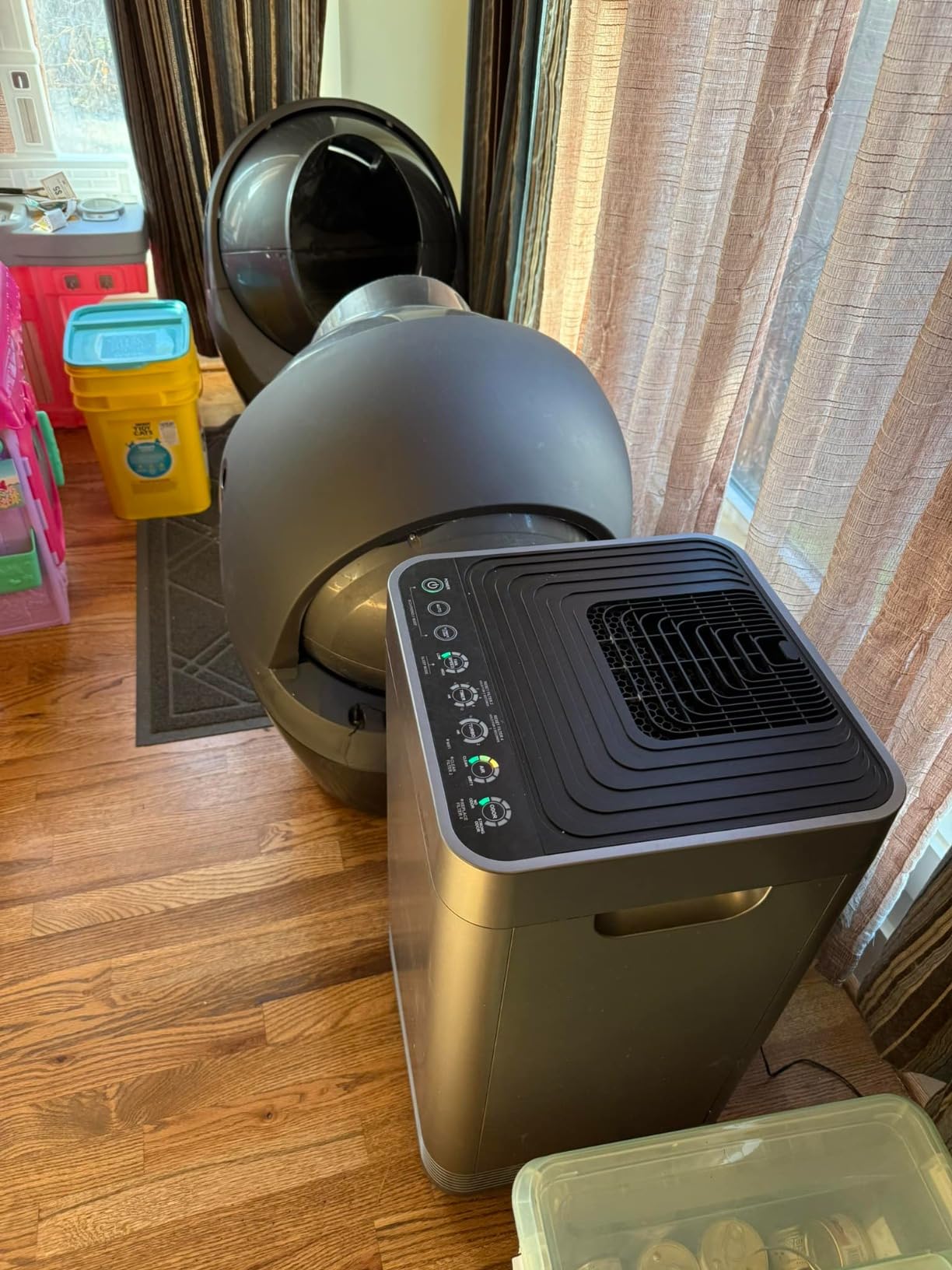
This is the machine we ended up recommending first, and the reason is not the headline square footage. It is the filter architecture. Three of the five stages are designed to be washed and put back, which in a home with two shedding dogs is the difference between a small yearly consumable cost and a large one.
The stainless steel pre-filter catches long hair before it reaches anything expensive. Behind it sits the Bio-Guard electrostatic stage, which charges and holds fine particles, and then an ozone removal stage that keeps the air clean without the unit producing any itself. Only the combined HEPA and carbon cartridge is consumable.
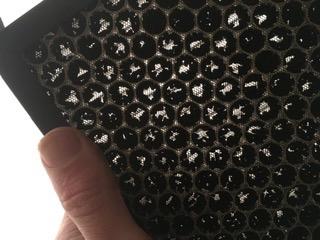
Dual sensors track particulate load and odor level separately, and the smart auto mode responds to both. In practice that means the fan ramps up on its own after a wet dog shakes off in the hallway, which is exactly the moment you would otherwise be reaching for the dial. Six fan speeds and a sleep mode cover the quiet overnight case.
On the sizing math, 664.6 cubic meters per hour converts to roughly 390 CFM, which works out to about 600 square feet of real coverage at 4.8 ACH. That is the honest figure, and it is the reason we treat this as a strong single-room or open-plan machine rather than a one-machine solution for an entire house.
Who this machine suits
Households with heavy shedding, a litter box problem, or a member with pet allergies who want the lowest possible filter cost per year. Buyers who already own a decent vacuum and a grooming routine will get the most out of the washable stages.
It also suits anyone who wants purification without an app subscription, since the auto mode handles adjustment on its own once you set it. The stainless media also tolerates a rinse under a tap without any special detergent.
Who should skip it
Skip it if your home is smaller than about 600 square feet of relevant air and you care about deep quiet, because 31.4 dB is not a bedroom number. It is also a heavy, tall tower that needs a real corner, and moving it often is not a one-person job.
At 128 watts it is the most power-hungry unit here, so running three of these across a house adds meaningfully to the monthly bill. If your priority is a cheap multi-machine whole house program, that cost offsets the savings on reusable filter stages.
2. HEAPETS P339 Review: Best for Multi-Cat and Multi-Dog Homes
Pet Air Purifier Large Home 4200 sq ft, Suck up Floating Cat Dog Hair Dander, 7-Stage H13 HEPA Anion Activated Carbon Filter, Air Purifiers with APP for Odor Allergies Smoke Dust, Zero Ozone, P339
205 CFM CADR
Covers 4200 sq ft
7-stage H13 HEPA
21 pounds
12-month warranty
Pros
- High CADR for the size
- U-shaped suction inlet pulls in visible floating hair
- Bio-enzyme activated carbon targets urine and litter odors
- PM2.5 display plus Pet Lock control
- Quiet even at higher manual speeds
Cons
- Weekly pre-filter rinsing required in heavy shedding homes
- One reviewer reported a sensor fault needing a unit replacement
- Some units shipped without the decorative front panel
The P339 is built specifically around the pet problem rather than adapted to it. Its U-shaped high-suction inlet is shaped to catch hair that floats at the top of a room, which is the airborne fraction most people never see and most conventional intakes miss.
The seven-stage stack runs H13 HEPA, activated carbon and an anion stage, with a custom cotton pre-filter and bio-enzyme carbon ahead of it. The enzyme-treated media is aimed squarely at urine marking and litter box odor, which is a specific chemical problem that ordinary carbon only partly addresses.
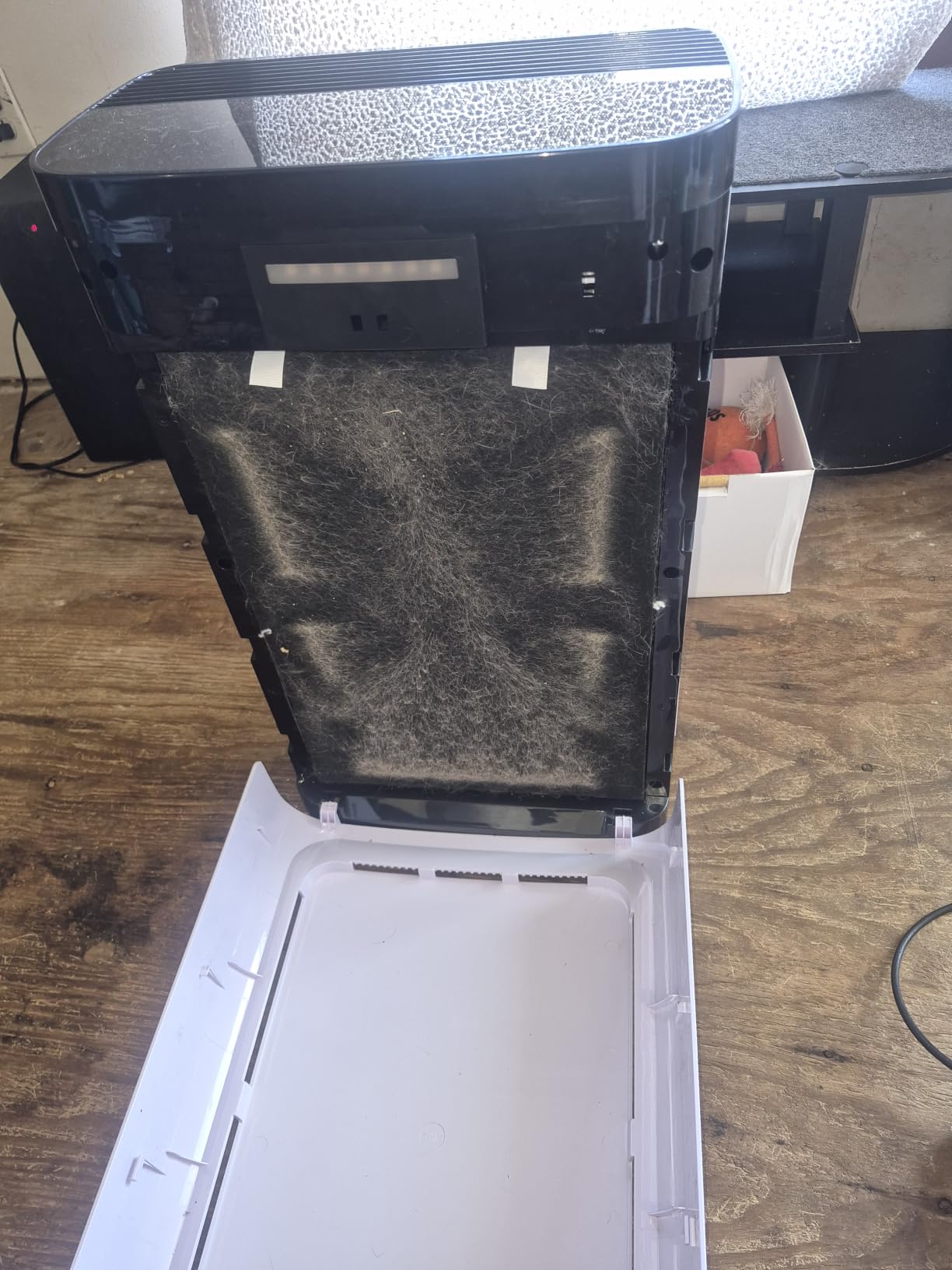
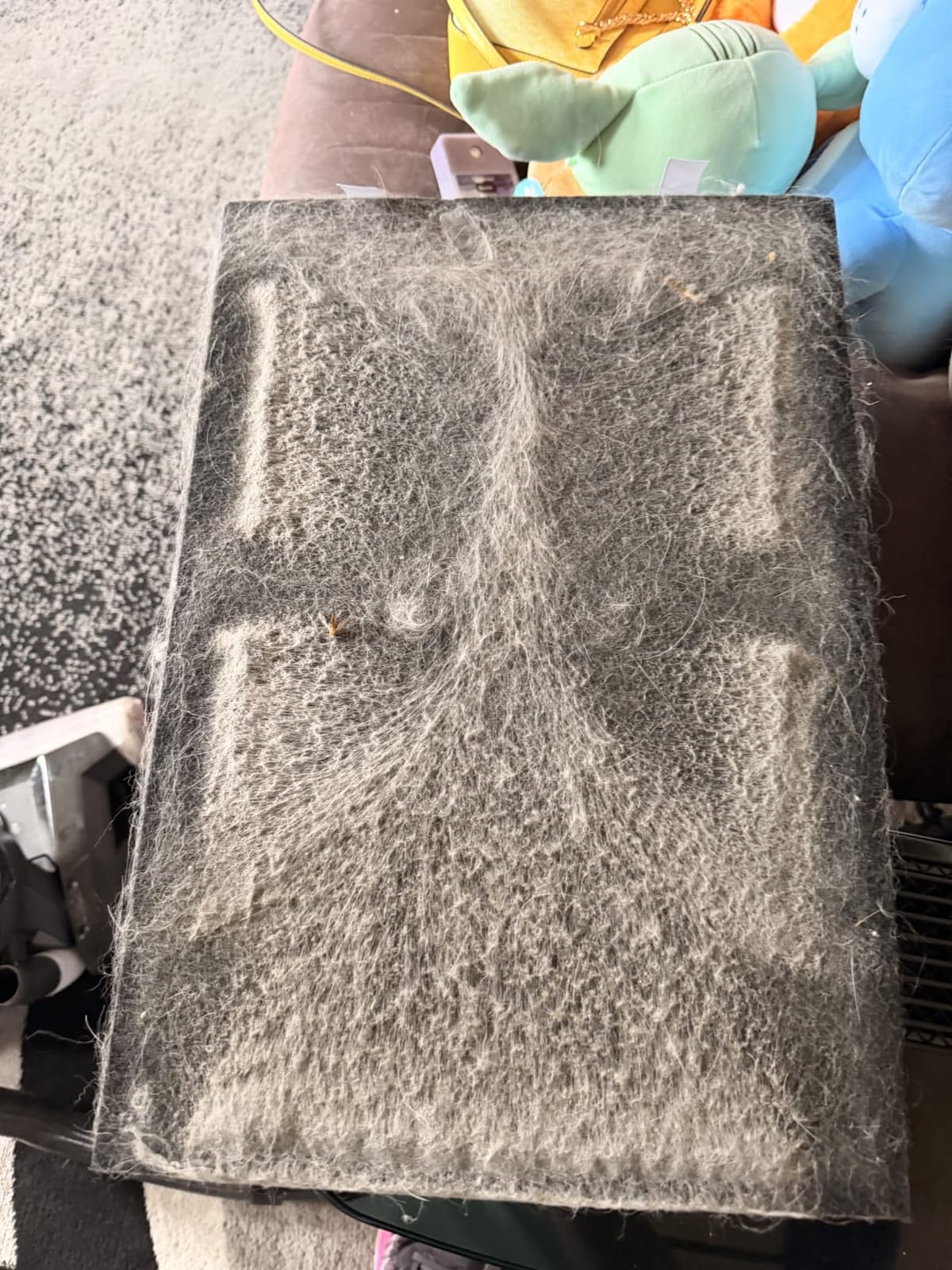
Owners of multi-cat households report that the pre-filter collects visible quantities of loose hair within a few days and that the carbon layer reduces litter box odor noticeably in a closed room. The PM2.5 readout on the front is genuinely useful for watching a spike after a brushing session.
At 205 CFM this converts to roughly 318 square feet of real coverage at 4.8 ACH. The 4200 square foot per hour figure on the listing is a one-air-change number, so plan on pairing this with a second machine if you are covering a full floor.
Who this machine suits
Anyone managing two or more cats, particularly where a litter box sits in a closed room with limited ventilation. The Pet Lock also matters in homes where a determined cat treats buttons as a game, and the sensor display suits owners who want a number instead of a colored light.
Customer service responsiveness came through clearly in reviews, with at least one owner reporting a sensor-related fault resolved by replacement.
Who should skip it
The weekly pre-filter rinse is not optional in a heavy-shedding home, and owners who skip it report airflow dropping noticeably. If you want a machine you set and forget, that maintenance rhythm will bother you.
The 4.3 average rating also reflects more one-star reviews than the machines above it, and the note about units shipping without the front panel during a design change is worth remembering. Bedroom sleepers should also check the noise floor, since the quiet claim applies to the manual speeds rather than auto.
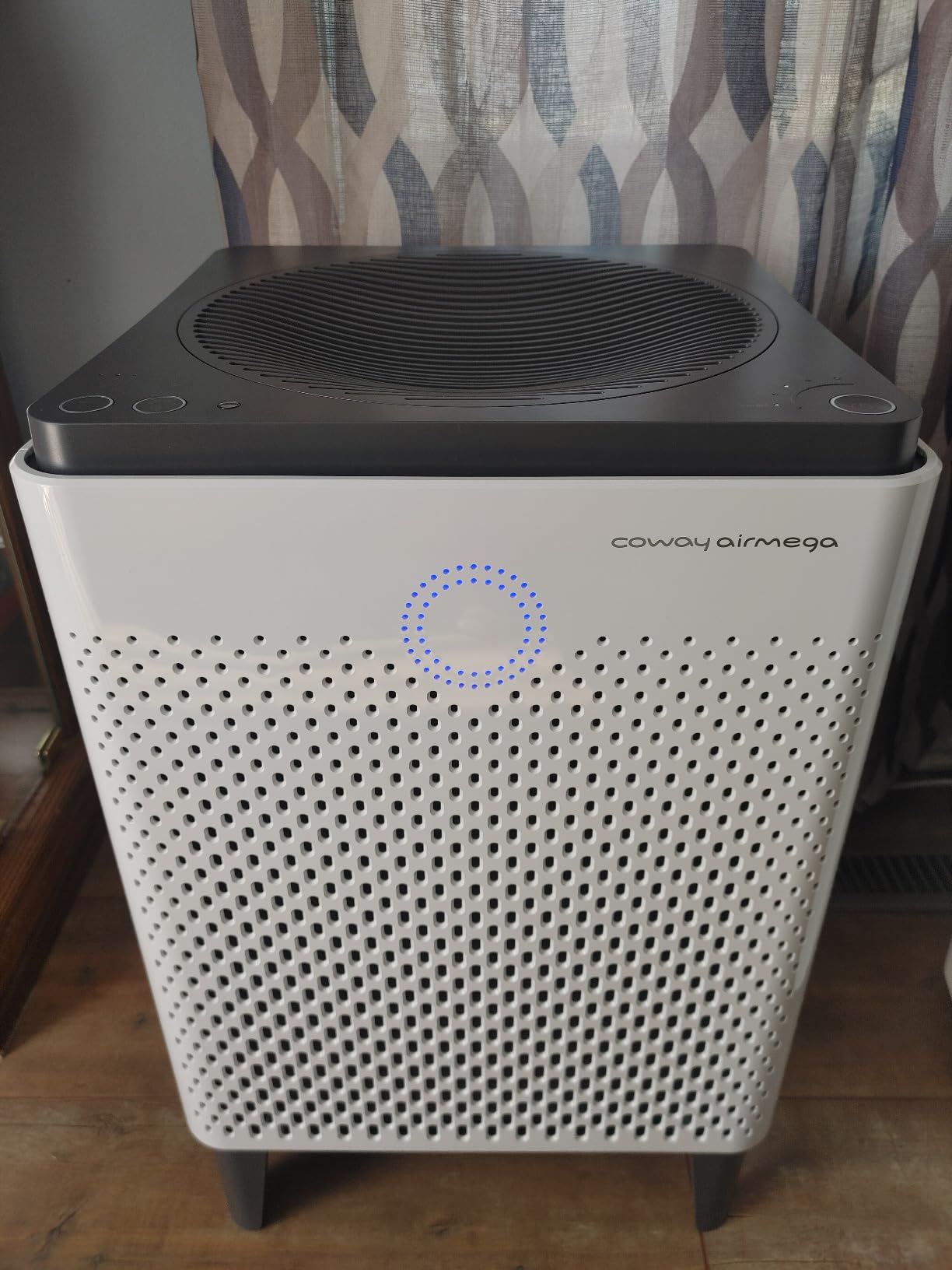
3. Coway Airmega 400 Review: Best for Allergy Sufferers
COWAY Air Purifier for Home Up to 3,120ft², Washable Pre-Filter and HEPA Filter for Smoke, Allergies, Pet Dander, Odor, AQI, Auto & Sleep Mode, Timer, 5yr Warranty, Airmega 400 White, AP-2015F
Covers up to 3120 sq ft
22 dB sleep mode
66 watts
5-year warranty
24.7 pounds
Pros
- Widest warranty in the group at five years
- Lowest stated noise figure at 22 dB
- Smart Eco and Sleep modes cut power use
- Filter life indicator removes maintenance guesswork
- Carbon layer handles VOCs and odor alongside HEPA
Cons
- Replacement HEPA and carbon filters add ongoing ownership cost
- Heaviest build relative to its footprint
- Manufacturer coverage claim is a one air change figure
The Airmega 400 is the one we recommend when the diagnosis is allergy rather than odor. Its HyperCaptive system layers a pre-filter, an active carbon filter and a HEPA cartridge, and the particle claim is 99.97 percent of 0.3 micron material including pollen and allergens.
Where it separates from the field is noise and running cost. At 22 dB in sleep mode and 66 watts, it is the quietest and most efficient machine here, and Eco Mode shuts the fan down entirely after 30 minutes of clean air rather than idling.
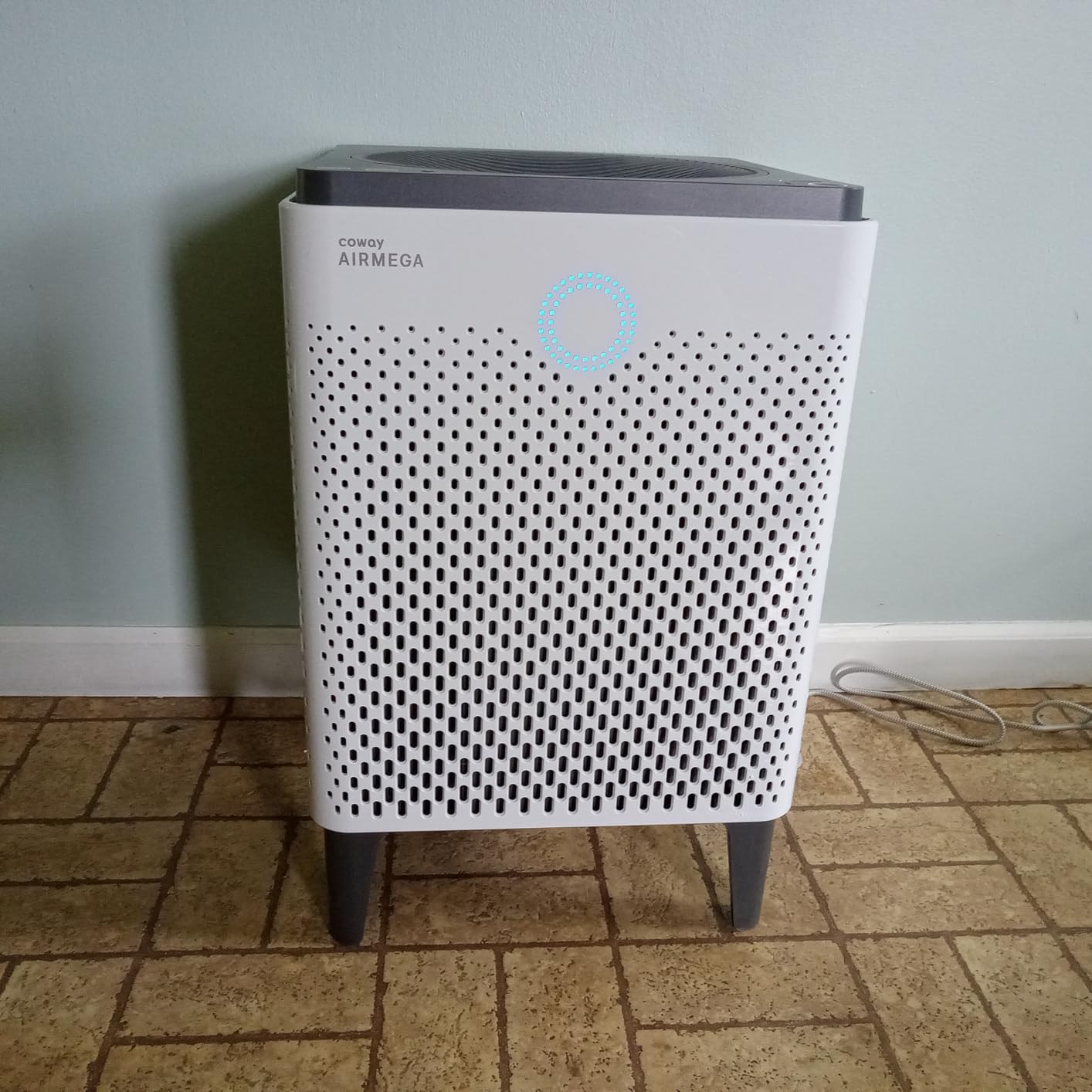
Buyers with pet allergies consistently report relief within the first few weeks, and the air quality monitor plus filter life indicator remove the two things people most often get wrong: leaving a saturated filter in place, and running the fan harder than the room needs.
Sleep Mode triggers on darkness and clean air, which matters in a bedroom where a person with asthma needs consistent filtration but cannot tolerate fan noise. The five-year warranty is also the strongest we found in this category.
Who this machine suits
Asthma and allergy households, a bedroom where someone sleeps with the door closed, and anyone who wants a purifier they can leave on continuously without watching the energy bill. The touch controls and no-app design also appeal to people who dislike connected devices.
It works especially well as the bedroom machine in the two-machine whole house plan, because the low noise floor and Eco behavior suit overnight running better than most competitors.
Who should skip it
Skip it if odor is the main complaint. The carbon layer here is a supporting stage rather than a heavy chemical-sorbent bed, so a severe litter box problem needs a machine with a real granular carbon mass.
At 24.7 pounds and 14.8 inches square, it also needs real floor space. The ongoing cost of proprietary HEPA and carbon cartridges is the main drawback owners report, so budget for it before buying rather than after.
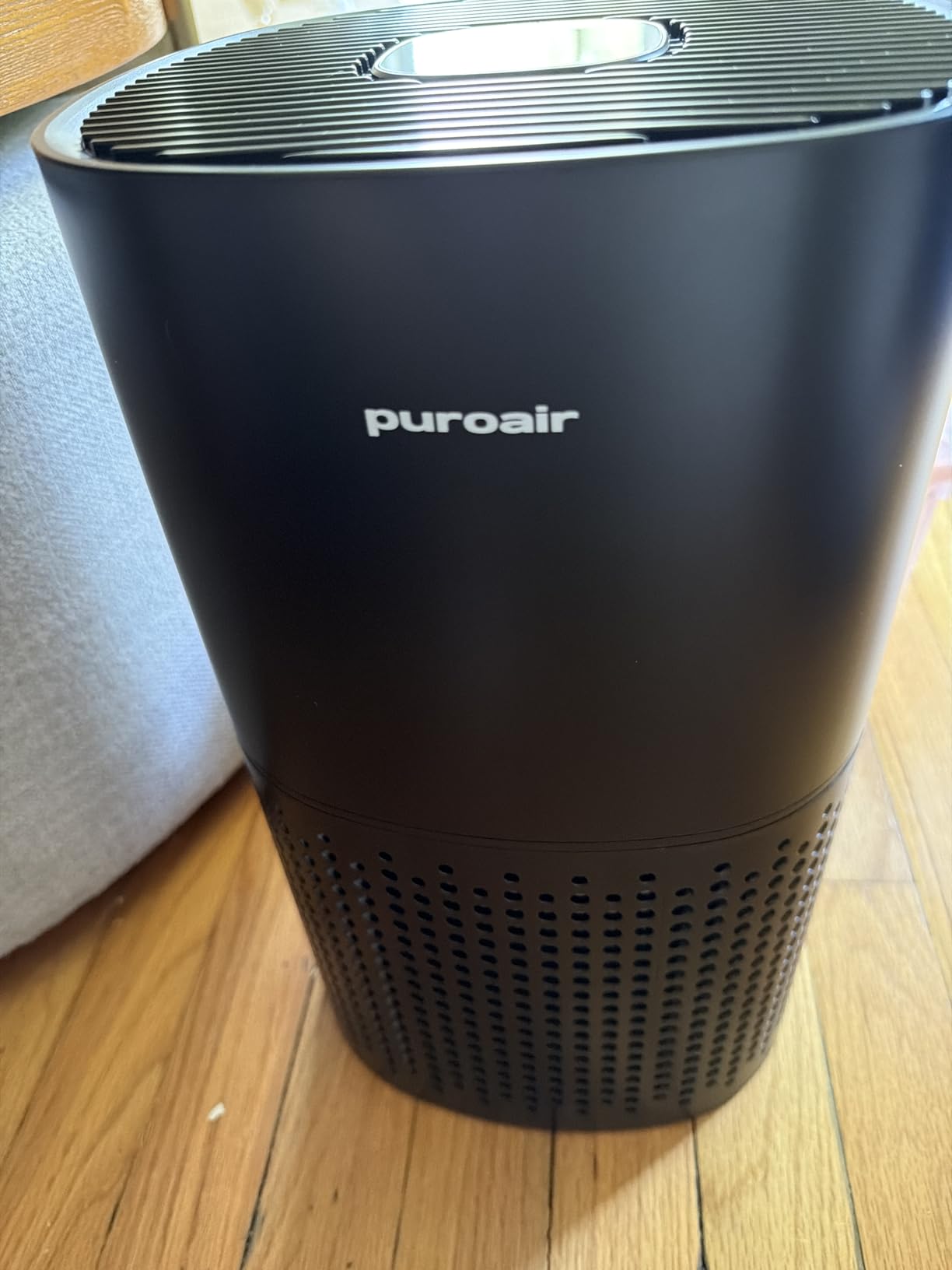
4. PuroAir 400 Review: Best Value for Large Pet Rooms
PuroAir 400 HEPA Air Purifiers for Home Large Room Pets Filter 2,000 Ft²
2000 sq ft coverage
14.73 pounds
3-layer filtration
2-year warranty
Three-sided design
Pros
- Backed by nearly 19500 reviews
- Pre-filter plus HEPA plus activated carbon stack
- Smart particle sensor adjusts power automatically
- Quiet enough for bedrooms on lower speeds
- CARB ETL ISO and UL certified
Cons
- Coverage smaller than several larger units in this roundup
- Replacement HEPA and carbon filters add recurring cost
- No published CFM figure for independent sizing
With close to 19500 reviews behind it, the PuroAir 400 has the deepest independent owner history of anything in this guide outside the Winix. That matters in a category where most listings are thin on real installations, because thousands of multi-pet households have already found out how it behaves.
The filtration is a straightforward three-layer stack: pre-filter, HEPA and activated carbon. The manufacturer claims capture of up to 99.9 percent of dust, pollen, smoke, pet dander and VOCs, and the carbon layer does real work on cooking and pet smells rather than being a token sheet.
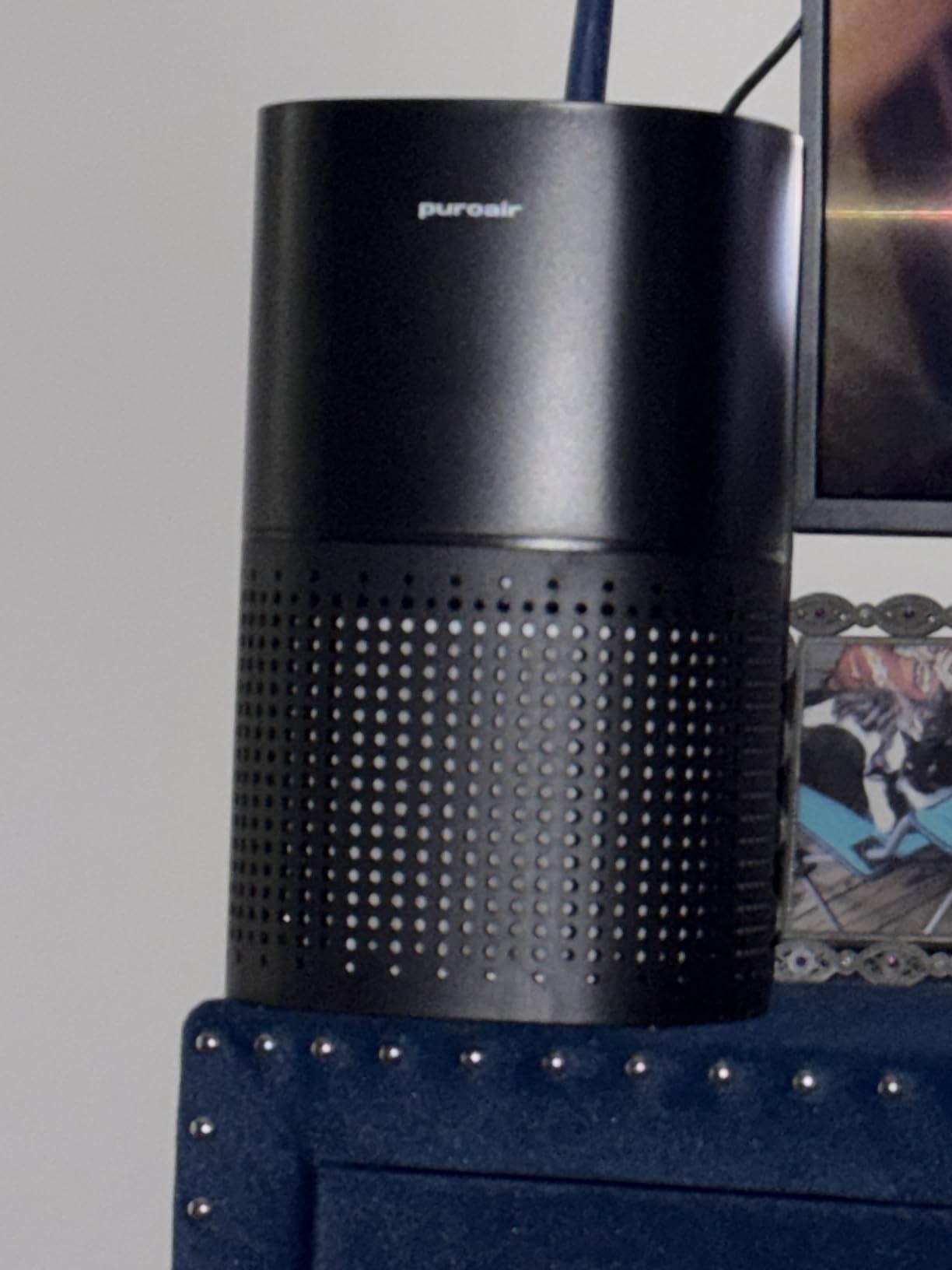
The smart particle sensor raises power automatically when air quality drops, which is the behavior most people want in a room shared with a dog. Sleep mode handles the overnight case, and owners describe it as quiet enough to run continuously.
No CFM figure is published for this model, which is the one measurement we would like to see. Owners do note that its effective footprint is smaller than several larger machines here, so treat the 2000 square foot claim as a room number rather than a floor number.
Who this machine suits
Owners who want a proven, low-friction machine for a bedroom or medium-sized living room and who value independent certifications over feature lists. It suits people who want set-and-forget automation rather than manual fan management.
It also suits anyone nervous about a first purchase. A review base this large means the failure modes are already documented rather than a surprise waiting for you.
Who should skip it
Skip it as the sole purifier for an open floor plan above about 800 square feet, because nothing here delivers the airflow a large shared space needs at high air change rates. Owners wanting a warranty longer than two years should look elsewhere.
The other limitation is the replacement filter cost, which owners flag as the main recurring expense. If you plan to run three machines, model that number into the yearly budget up front.
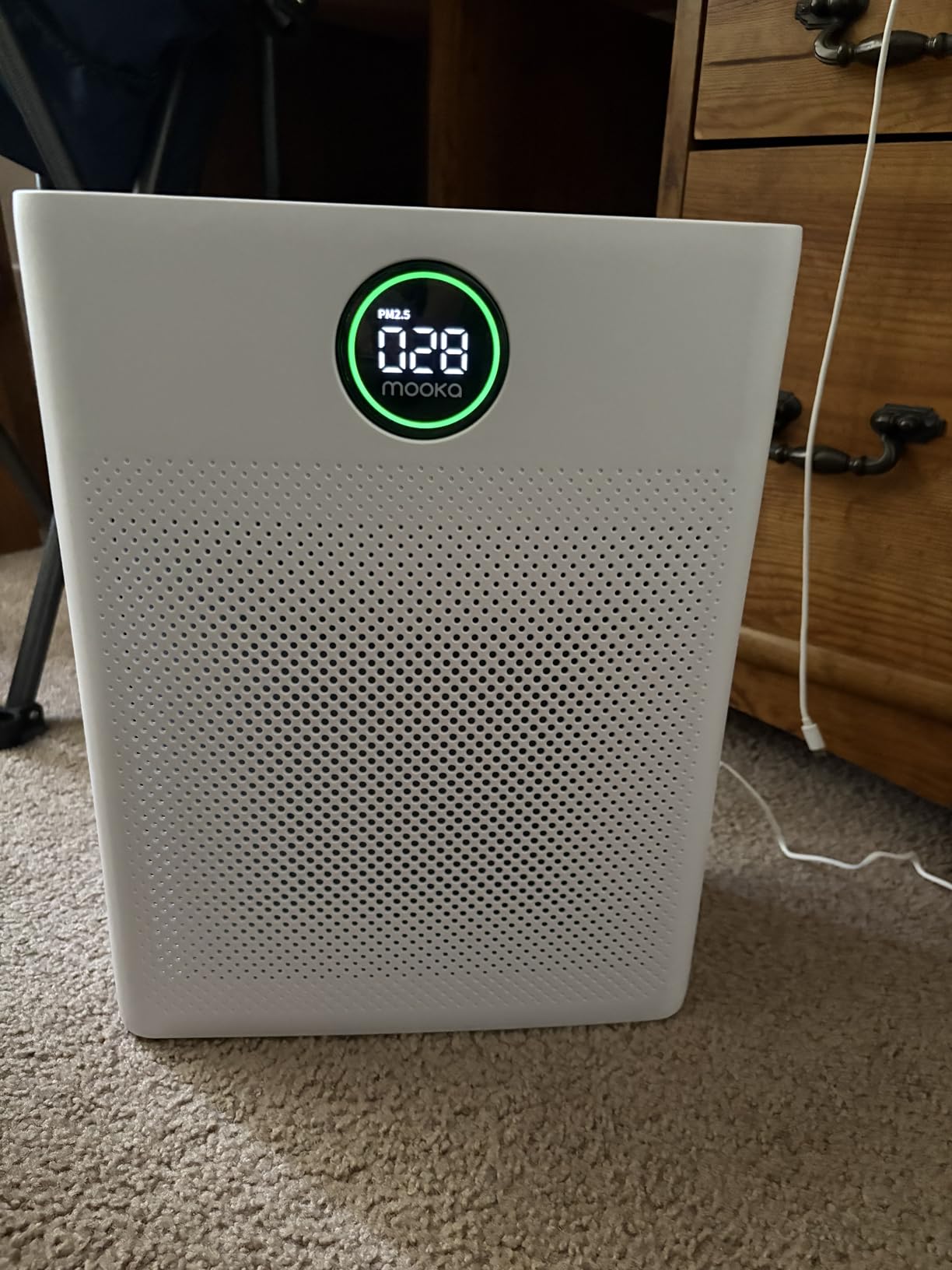
5. MOOKA PR1 Review: Best Budget Pick for Pet Homes
Air Purifiers for Home Large Room up to 2200sq.ft, MOOKA Air purifier for Home Pets with Washable Filter, PM 2.5 Display Air Quality Sensor Air Cleaner for Bedroom, Dorm room, Pets, Office PR1 (White)
2200 sq ft claim
Sleep mode at 26 dB
8.91 pounds
Pet Mode
PM2.5 display
Pros
- Dedicated Pet Mode measurably cuts visible airborne fur
- PM2.5 display tracks real-time changes
- Compact and light enough to move between rooms
- Washable pre-filter plus replacement reminder
- Reports of measurable allergy symptom relief
Cons
- Pet Mode and top speed are noticeably loud
- Some owners report the sensor reading high and pinning the fan
- Timer stops at 8 hours
- Display brightness cannot be dimmed
The PR1 is the cheapest route to a dedicated pet feature we found, and reviewers consistently say the Pet Mode does something visible. Owners in multi-pet homes report a reduction in floating fur after running it, which is a claim most budget machines cannot support.
Coverage comes from a wide side air inlet rather than a single front intake, and the four-stage system includes a washable pre-filter that extends the life of the main stack. The PM2.5 sensor shows live readings on the front screen.
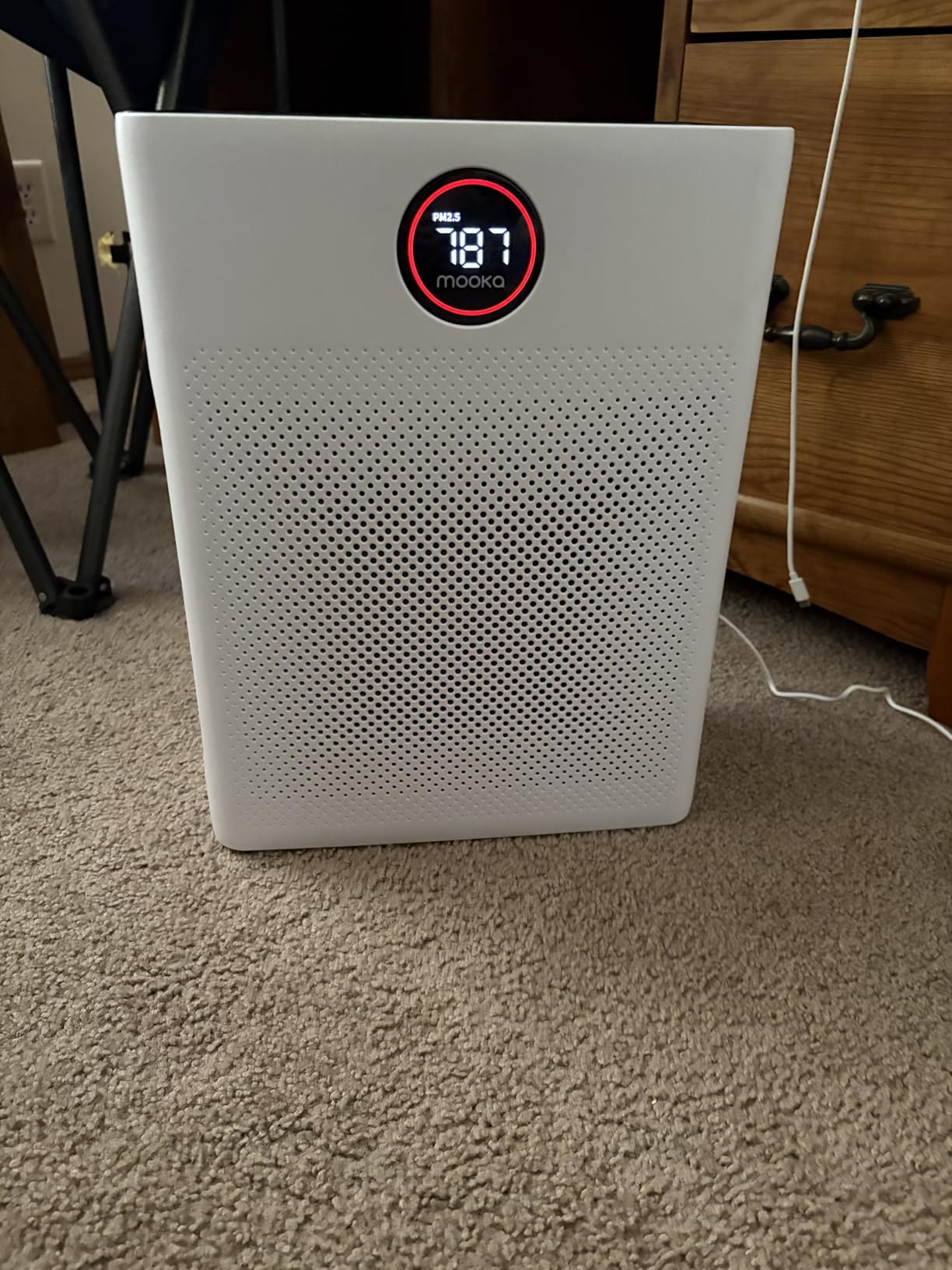
At 8.91 pounds and 12.3 by 6.4 by 16.3 inches, this is the machine we would move between rooms most easily. That portability matters in a whole house plan, because you can follow the pets rather than committing one spot forever.
The trade-offs are clear. Several owners report the PM2.5 sensor reading high, which keeps auto mode pinned at a high speed and therefore loud. On top of that, the display cannot be dimmed and the power light stays lit.
Who this machine suits
Apartment and condo owners, renters, and anyone building a first purifier setup without spending heavily. Multiple light-shedding pets in one room is the ideal case, and the washable pre-filter keeps ownership costs low.
It also suits owners who want to move a single machine between a bedroom and a living area across the day rather than buying two.
Who should skip it
Anyone sensitive to noise in a bedroom, because Pet Mode and the top speed are the loud settings and auto can sit high. The undimmable display is a genuine problem in a dark room.
Also skip it for odor-heavy situations. There is no indication of a substantial carbon mass here, so treat it as a particle machine with light odor support rather than a chemical sorter.
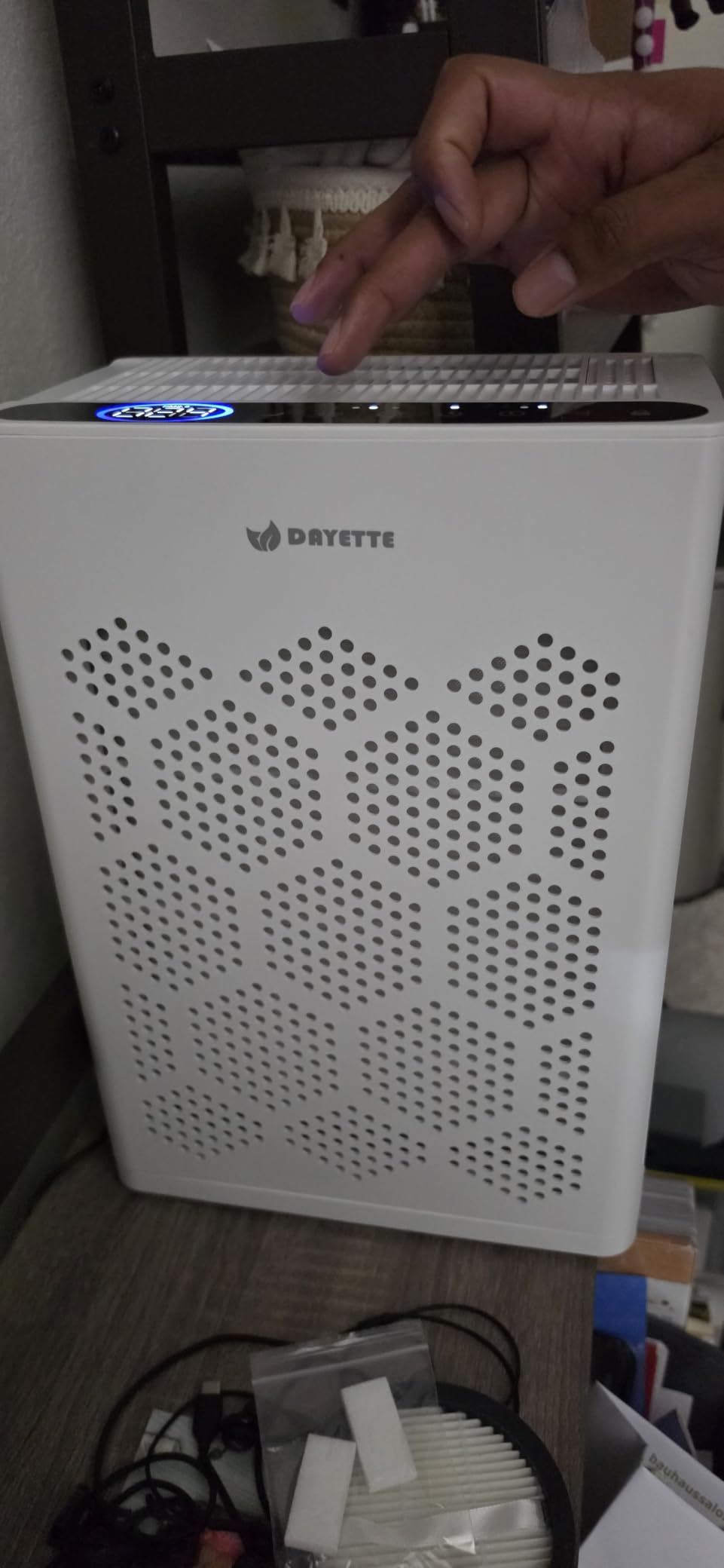
6. DAYETTE AP309 Review: Best for Small Apartments and Bedrooms
DAYETTE Air Purifiers for Home Large Room Up to 2400 Ft² with HEPA 14 Filter, Pet Air Purifier with Washable Prefilter for Bedroom with Fragrance, Air Cleaner for Smoke Dust Pets Hair Odor, White
2400 sq ft claim
H14 HEPA to 0.1 micron
22 dB sleep mode
5 pounds
PM2.5 sensor
Pros
- True H14 HEPA rated 99.997 percent down to 0.1 microns
- 3-sided intake circulates air across a full room
- Enhanced Pet Mode jumps straight to top speed
- Carbon pellet filter plus aromatherapy sponge
- Washable pre-filter you can rinse monthly
Cons
- Lightweight plastic build feels less substantial
- Fragrance function masks odor rather than removing it
- Replacement H14 filters add ongoing cost
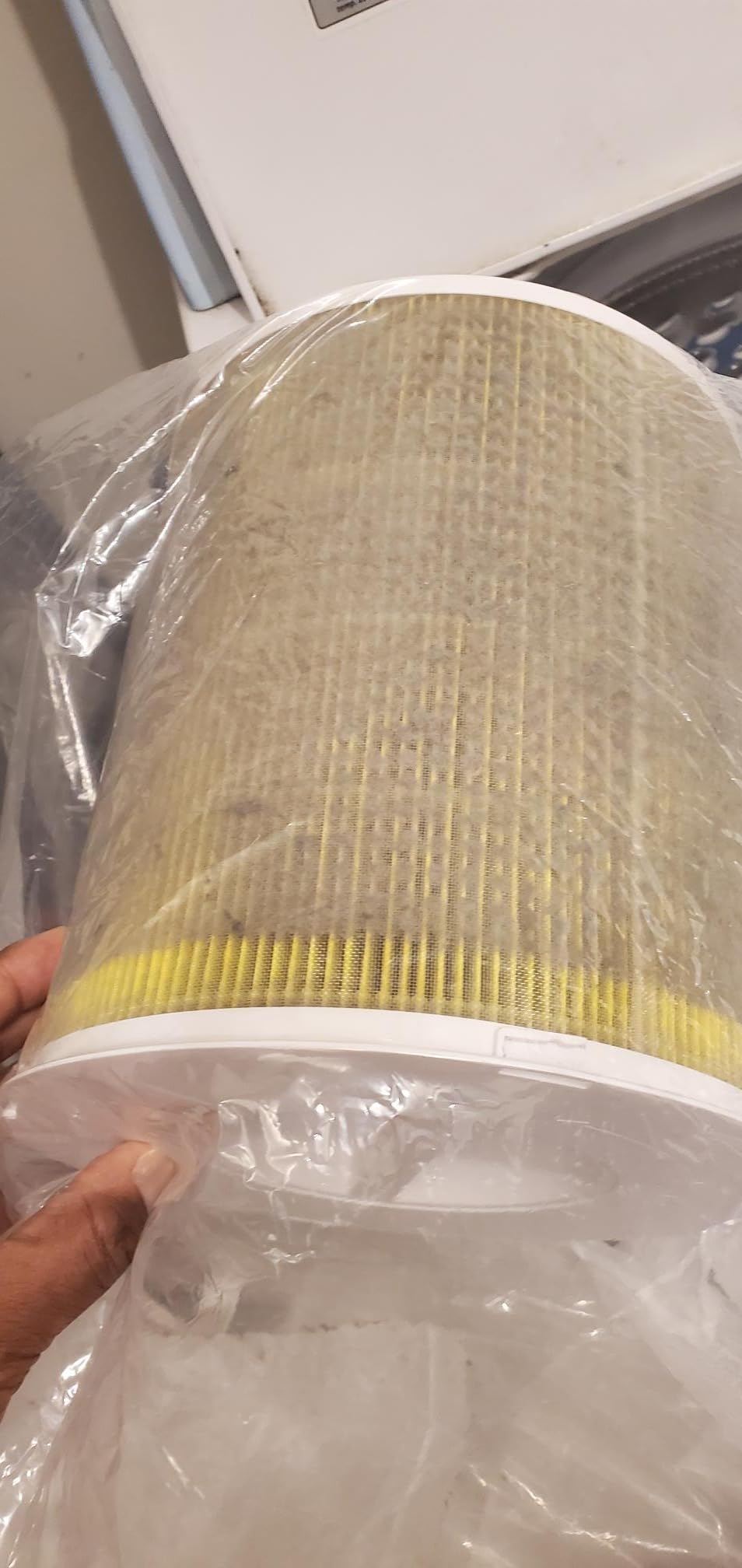
The AP309 claims H14 rather than H13 filtration, which means 99.997 percent of particles down to 0.1 microns. In practice the difference between H13 and H14 matters far less than the amount of media in the machine, but the rating is at the top of what we saw.
The carbon layer here is a pellet filter rather than a thin impregnated sheet, and that is a meaningful upgrade for odor. Add the built-in aromatherapy sponge and you have a package that handles everyday pet smells and dust in one cartridge.
Three-sided intake is unusual at this size and is what allows a 14.5-inch tall, 5-pound unit to claim full-room circulation. The Enhanced Pet Mode sends the fan to maximum immediately, and the PM2.5 sensor drives a smart auto setting.
Sleep mode measures 22 dB, tied for the quietest figure in this guide. Owners report it works well in a bedroom, and the child and pet lock keeps a curious animal from changing settings mid-night.
Who this machine suits
Small apartments, home offices and bedrooms where floor space is tight and airflow needs to be vertical. It also suits buyers who want a real pellet carbon layer at a modest price, plus anyone sensitive to noise during sleep.
Lightweight construction makes it the easiest unit here to relocate between a bedroom and a pet room as the animal moves through the day.
Who should skip it
Skip it for odor so severe that masking is the wrong strategy. The fragrance sponge smells pleasant but does not remove odor, so a heavy litter box problem will outlast a cartridge.
The plastic build is the other warning. It may not feel as durable as a metal unit over years, and the H14 replacement filter is not cheap. Run it as one machine in a small space rather than as part of a large whole house program.
7. HEAPETS P358 Review: Best for Lower Long-Term Filter Costs
Pet Air Purifier for Home Large Room 2500 Sq Ft, H13 HEPA Double-Sided Filter with Washable Pre-filter, Adsorbs Pet Hair Dander Odor Allergies Smoke Dust,PM2.5 Air Quality Monitor,Auto Mode,P358 Grey
176 CFM CADR
2500 sq ft claim
Sleep mode at 25 dB
7.91 pounds
12-month warranty
Pros
- Replaceable washable pre-filter pads cut main filter cost
- Intake design resists pet hair clogging
- Long-haired cat owners report odor reduction
- Small footprint fits tight corners
- Five fan speeds with auto and pet mode
Cons
- Lowest 4.1 rating in the group with 13 percent one-star reviews
- One reviewer found suction weak for hair despite good airflow
- Two isolated reviews reported fans that would not switch on
- Odor results vary widely by room and filter condition
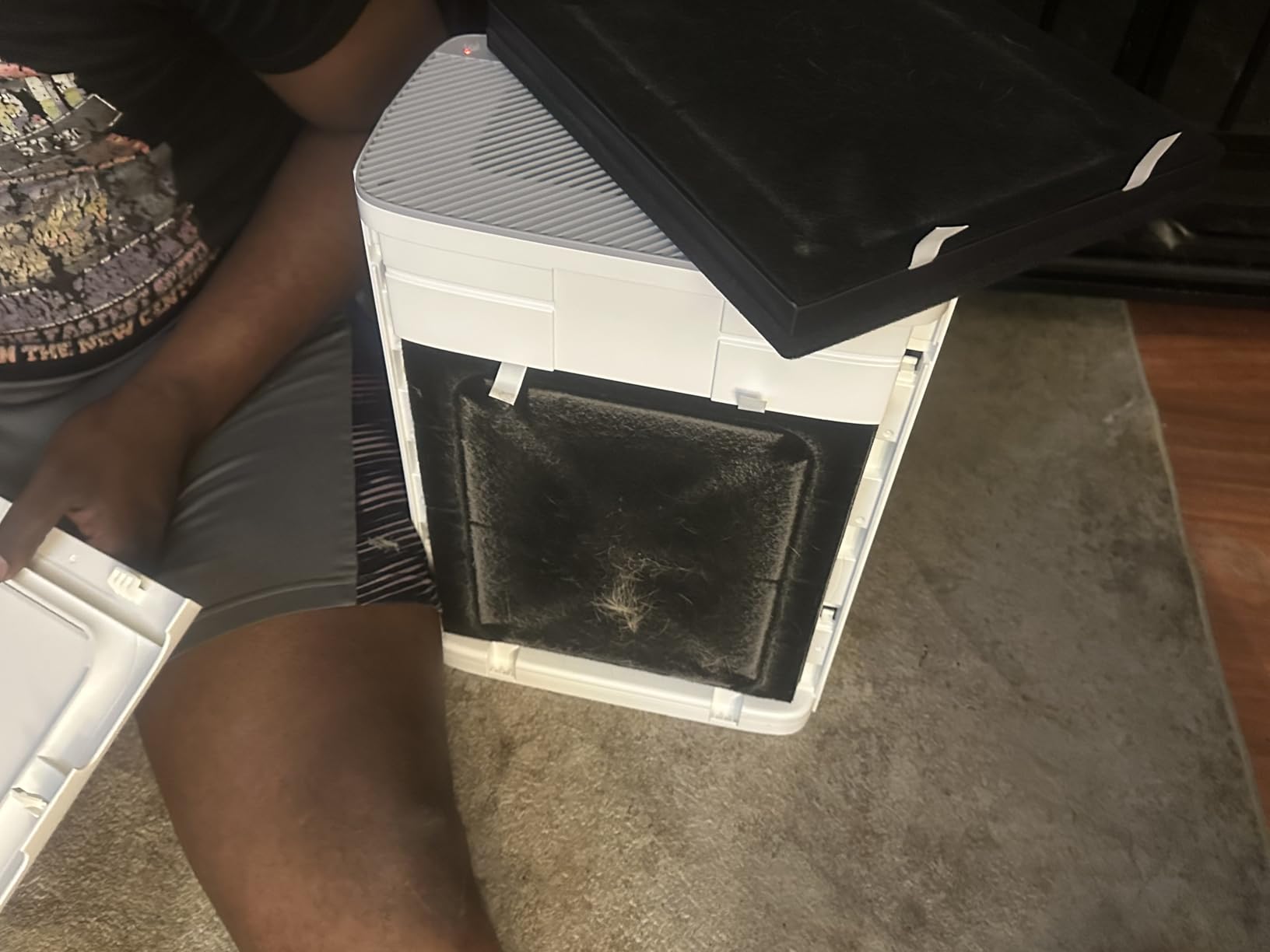
The P358 is the cheapest machine here in per-year running cost, and the reason is specific: the pre-filter pads are separate, replaceable and washable rather than bonded to the HEPA cartridge. Owners report that swapping them instead of the whole filter cuts the effective cost by roughly half.
That solves one of the most common complaints forum buyers raise, where hair loading on a bonded pre-filter forces a full cartridge replacement far earlier than the manufacturer suggests. The dual-sided U-shaped inlets are also shaped to resist exactly that clogging.
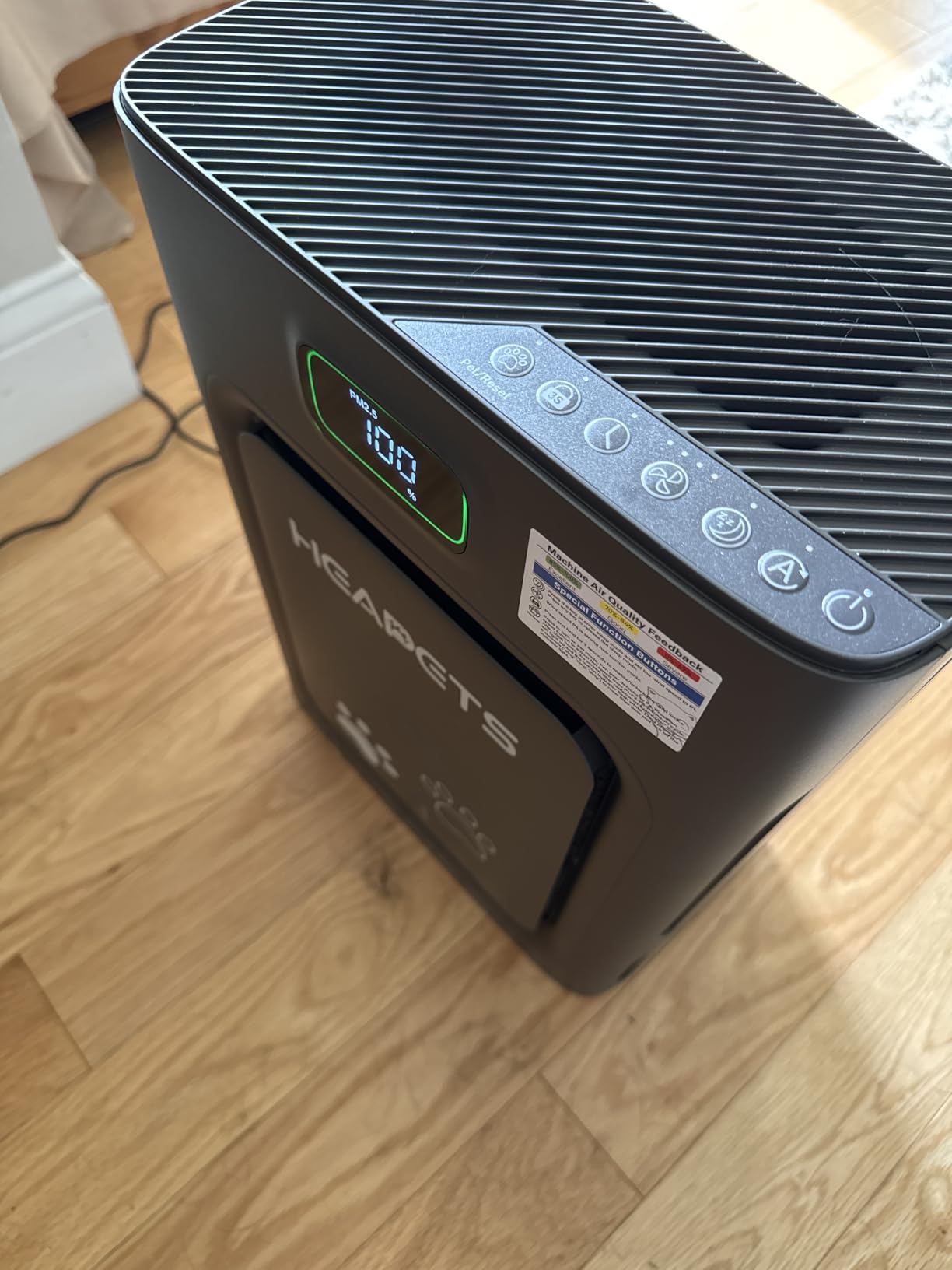
Owners with multiple long-haired cats report meaningful litter box odor reduction, which suggests the carbon layer is doing real work. Auto mode responds to PM2.5 readings, and sleep mode sits at 25 dB for overnight use.
At 176 CFM this converts to roughly 273 square feet of real coverage at 4.8 ACH, the smallest of the published figures in this group. It is a bedroom and small-room machine despite the 2500 square foot claim.
Who this machine suits
Multi-cat households on a tight filter budget, anyone in a small apartment, and buyers who want to keep a spare pre-filter pad on hand. The small footprint is genuinely useful in tight corners and behind furniture.
It also suits owners who prefer a washable routine over a cartridge habit, since rinsing a pad takes a minute and extends the main filter life.
Who should skip it
Skip it if reliability is your priority. It carries the lowest rating in this roundup at 4.1, with 13 percent one-star reviews, and there are isolated reports of units whose fan would not switch on.
One reviewer testing with long-haired dogs found no hair collected on either filter after a week, so treat it as a general air purifier with strong pre-filter economics rather than a dedicated hair collector. Odor performance also varies with room ventilation.
8. HEARBOBO K06 Review: Best for Quiet Bedrooms
Air Purifiers for Home Large Room Up to 3000 sq ft, H13 HEPA Filter Washable, PM2.5 Air Quality Sensor, Quiet Sleep Mode, 8X Dual-Side Air Cleaner for Bedroom Pet Dander Smoke Dust Pollen
Up to 3000 sq ft claim
Sleep mode at 20 dB
9 pounds
Dual H13 HEPA
2-year replacement
Pros
- Quietest sleep mode in the group at 20 dB
- Dim night light suits a dark bedroom
- Dual fans and dual intakes circulate faster
- Washable pre-filter is easy to vacuum or rinse
- Owners with allergic children and pets report cleaner air
Cons
- Child lock on the touch screen reported as unreliable
- Aroma pad compartment can pop open on its own
- One long-haired dog owner saw no hair collected on the filters
- Loose power connector and no handle for carrying
At 20 dB in sleep mode, the K06 is the quietest machine we evaluated, and that is why we put it in the bedroom slot in our whole house plan. If someone in the house has allergies and is sleeping in the same room, noise decides the purchase as often as airflow does.
The airflow design is the other differentiator. Dual-side intakes and dual fans move air faster and more evenly than single-intake designs, with dual H13 HEPA cartridges behind a washable black pre-filter.
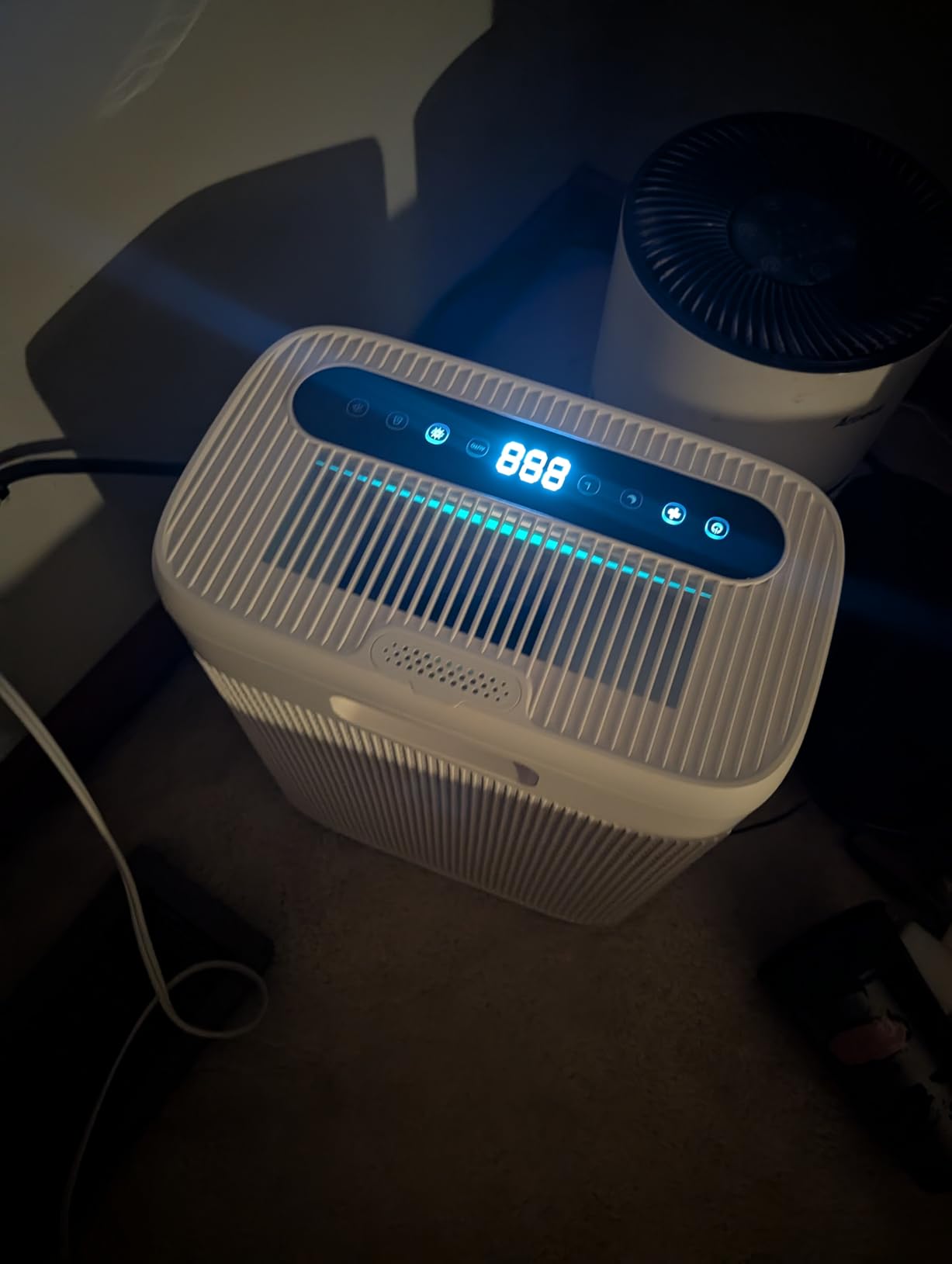
Owners in homes with allergic children and pets report visible dust reduction within days, and the PM2.5 display gives useful feedback as conditions change. The replacement filter indicator prompts you at 3 to 6 month intervals.
Coverage is claimed at up to 3000 square feet in an hour, or 375 square feet in about 8 minutes. Treat the hourly figure as a single-air-change number and size accordingly.
Who this machine suits
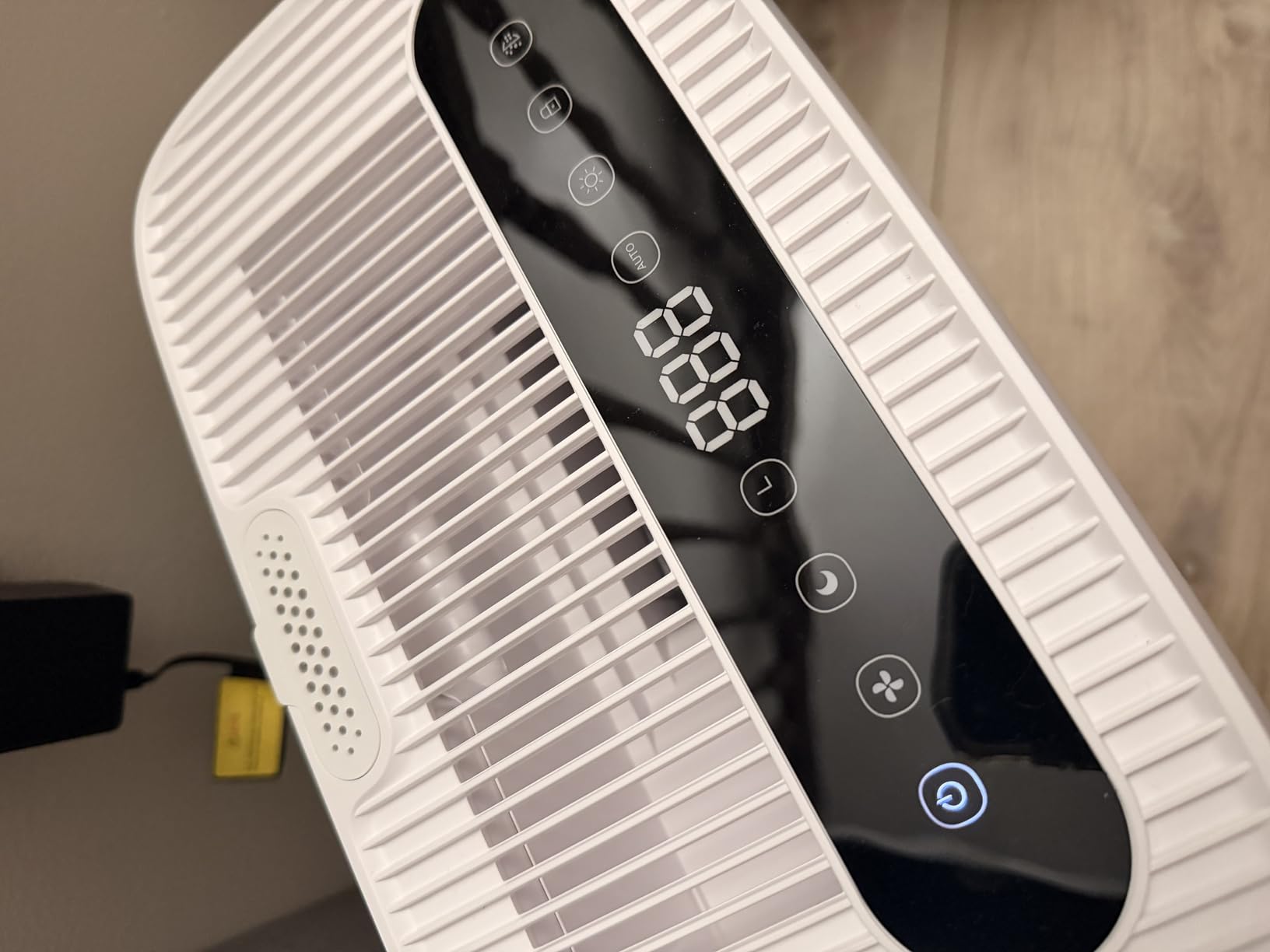
Bedrooms, nurseries and any room where an adult or child with allergies sleeps. The dimmable night light and 20 dB floor are the deciding factors in those rooms, and the dual-fan layout helps in a square room with one doorway.
It also suits owners who want a washable pre-filter that can be vacuumed rather than rinsed, which is faster in a busy week.
Who should skip it
Skip it in homes with strong pet odor. This machine has no meaningful carbon media in its specification, so it addresses dander and dust but not smell.
There are also build details to consider: the child lock was reported as not working on the touch screen, and the aroma pad compartment popped open on its own and needed taping. One long-haired dog owner saw no hair collected on either filter after a week.
9. SIESEAN AP-400 Review: Best Airflow for Open Floor Plans
Hepa Air Purifiers for Home up to 3500 Ft², 235 CADR, 30dB Quiet Operation
235 CFM CADR
Covers 3500 sq ft
Sleep mode at 30 dB
11.25 pounds
ENERGY STAR
Pros
- Highest published CFM figure in this roundup
- Owners report PM2.5 dropping within minutes
- Four filters with dual-inlet airflow circulate fast
- ENERGY STAR certified with 0.66 kWh daily use
- Relief reported for dog and cat allergy symptoms
Cons
- High fan setting is noticeably loud
- No Wi-Fi or app connectivity
- Replacement filters needed every 3 to 4 months
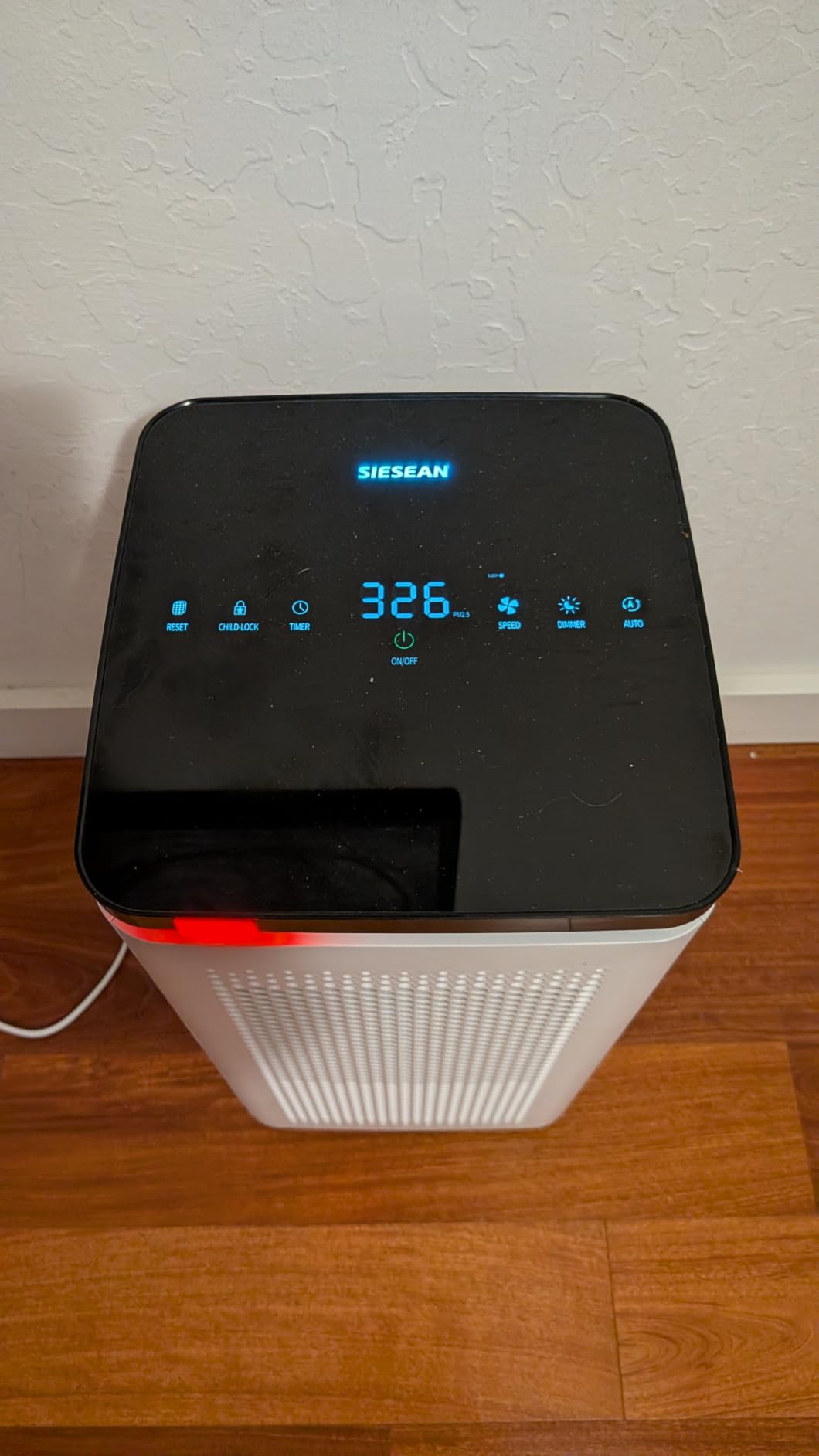
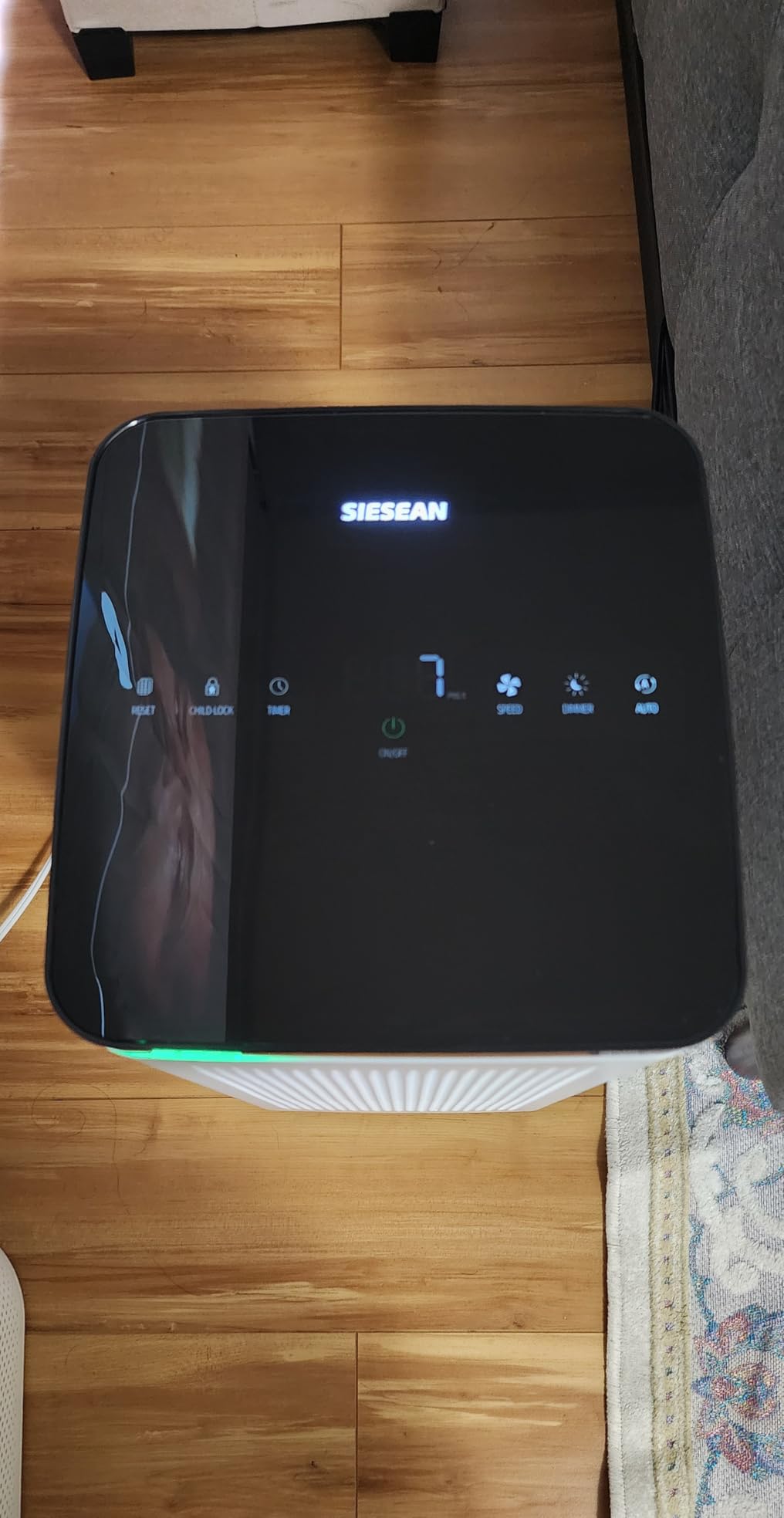
The AP-400 publishes a real CADR number, which is rarer than it should be, and at 235 CFM it is the highest verifiable figure in this group. Multiply by 1.55 and you get roughly 364 square feet of genuine 4.8 ACH coverage, which makes it the strongest single-machine pick for a large open plan.
Owners with dogs and cats report PM2.5 readings falling back within minutes of running it on a higher speed. That speed is also the machine’s weakness, since the top setting is loud.
Filtration is dual H13 True HEPA rated 99.97 percent down to 0.1 micron, paired with activated carbon and a washable pre-filter. The company reports cleaning 500 square feet in 15 minutes, and independent certification covers CARB, DOE, EPA and UL.
The 0.66 kWh daily figure is a real advantage in a whole house plan, since it is one of the few machines here with an efficiency claim attached. Sleep mode runs at 30 dB with a dimmable control panel.
Who this machine suits
Open-concept living spaces, main floors where the pets spend most of the day, and anyone who wants an honest number rather than a marketing claim. It suits owners who run air quality monitoring themselves and care more about airflow than app features.
It also works for households planning a two-machine program where the main-floor purifier carries the heaviest load.
Who should skip it
Skip it if you want smart home control. There is no Wi-Fi or app connectivity, so scheduling and remote monitoring are done from the panel only.
The filter interval of 3 to 4 months is the shortest here and matters most in this category, because running three of these across a house triples that cost. Bedroom use is also awkward given the 30 dB sleep floor.
10. Winix 5510 Review: Top Rated, Best Proven All-Rounder
WINIX 5510 Air Purifier (New Generation of 5500-2 with App Support) for Home Large Room Up to 1881 Ft² in 1 Hr, True HEPA, High Deodorization Carbon Filter and Auto Mode, Captures Pet Allergies, Smoke
1881 sq ft in 1 hour
23.5 dB on lowest speed
AHAM verified
13.3 pounds
App support
Pros
- More than 32000 reviews behind the model
- True HEPA captures 99.99 percent down to 0.01 microns
- Washable fine mesh pre-filter
- Advanced odor carbon filter for VOCs from pets and cooking
- AHAM verified and UL certified
- 23.5 dB on lowest speed with light-automated sleep mode
Cons
- Smallest coverage figure of the large-room machines here
- Proprietary replacement filters add recurring cost
- App adds no advanced controls beyond fan speed and timer
Fewer than 3 percent of the 32293 reviews on this model are one-star, and that track record is the reason it earns the top rated badge here. In a category where most listings have a few hundred reviews, owner history at that scale is worth as much as any specification.
The filtration claim is unusually specific: 99.99 percent capture of airborne allergens down to 0.01 micron. The washable fine mesh pre-filter takes the large stuff first, and the advanced odor carbon filter handles VOCs from pets, cooking and smoke.
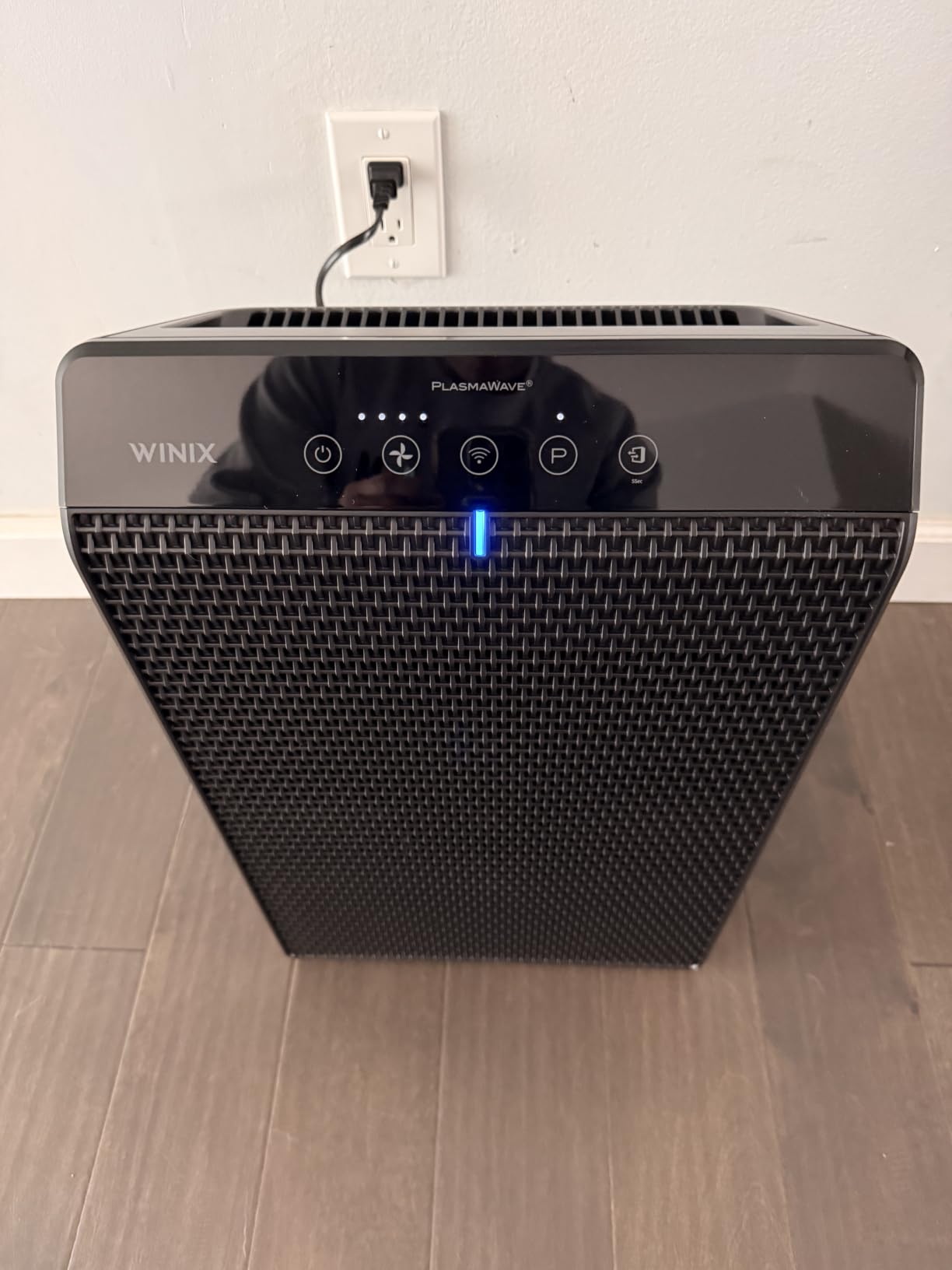
It is also the only AHAM verified machine in this roundup, which means the Clean Air Delivery Rate figures are third-party tested rather than manufacturer claims. That matters directly to the sizing question, because AHAM verification is what makes a coverage number trustworthy.
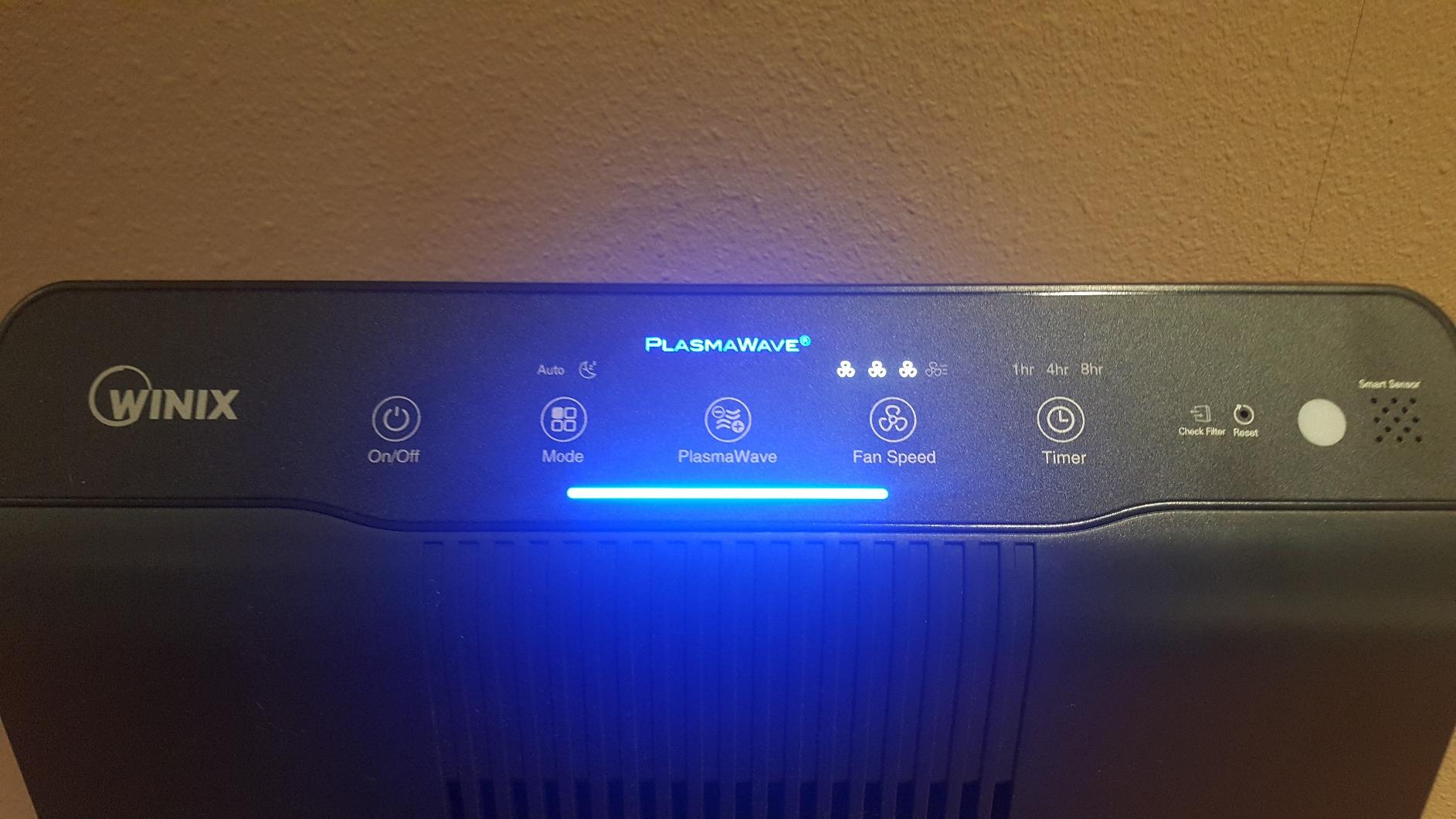
Smart sensors drive auto mode, and a light-automated sleep mode drops the fan automatically in a dark room. On the slowest speed it measures 23.5 dB, which is quiet enough for most bedrooms.
Who this machine suits
Buyers who want a proven default rather than a gamble, and anyone who reads specifications closely enough to prefer AHAM verification over a feature list. It suits households with one or two pets in a single large room or bedroom.
It also suits owners who want app support without paying for it, since the Winix Smart App handles remote control and monitoring at no subscription cost.
Who should skip it
Skip it as the only purifier in a large open floor plan. The 1881 square foot claim translates to roughly 390 square feet at 4.8 ACH, the most modest real coverage of the large-room machines here.
The replacement HEPA and carbon filters are proprietary and are the most common complaint in reviews. Budget for them annually, particularly if you plan to run two of these.
How We Ranked: Five Criteria That Matter in a Pet Home
Real coverage at 4.8 ACH. We converted every published CFM figure using the 1.55 multiplier and treated unverified coverage claims as room numbers, not house numbers. Where no CFM figure exists, we say so.
Filter architecture and consumable cost. Washable and separable pre-filters score highly because pet hair loading is what forces early replacements. Bonded pre-filters push a full cartridge cost onto owners who did not plan for it.
Carbon media type. Granular pellets and enzyme-treated media are ranked above impregnated sheets. The sheet format uses far less active carbon and saturates quickly against ammonia and urine odor.
Noise floor and mode behavior. Bedroom machines need a low sleep figure, and erratic auto modes are penalized because fluctuating fan speed is disruptive to sleep and to anxious animals.
Certification and ozone. We prefer CARB, ETL and AHAM marks. Any unit that generates ozone or relies on ionization gets flagged regardless of how good its particle numbers look.
Pet Dander vs Pet Smell: Why One Filter Can Never Do Both
Pet dander is a solid particle, mostly skin flakes and dried saliva proteins in the 1 to 10 micron range, with a meaningful share below 2.5 microns. It stays suspended for hours and it is what triggers allergic reactions. Only a properly sealed HEPA filter removes it.
Pet smell is a gas. The compounds responsible for wet dog odor, urine marking and litter box ammonia are volatile organic molecules small enough to pass straight through HEPA media untouched. Only activated carbon, or a chemical sorbent, removes them.
This is the single most misunderstood point in the category. A purifier with an excellent HEPA filter and a token carbon sheet will clear visible dander and leave the smell completely untouched, which is exactly the disappointment described in forum threads about underpowered odor units.
The practical result: the bedroom machine in your plan should be chosen for HEPA performance and quietness, and the machine near the litter box should be chosen for carbon mass. Buying one machine for both jobs means compromising one of them.
The Carbon Filter Hierarchy: Why the Litter Box Still Smells
Activated carbon works by adsorption, where gas molecules physically stick to the enormous internal surface area of the carbon. There are three tiers you will meet, and they are not close in performance.
Tier one, impregnated sheet. A thin carbon-impregnated foam sheet. Cheap, short-lived, and it saturates within weeks in a pet home. Most disappointing odor purifiers use this.
Tier two, granular pellets. Real carbon pellets with a measurable weight. This is the minimum for a serious odor problem, and it is what the DAYETTE AP309 uses.
Tier three, chemisorptive or enzyme-treated media. Carbon combined with a chemical or enzyme treatment that reacts with ammonia and urea compounds rather than merely trapping them. This is the tier the HEAPETS P339 bio-enzyme stage targets, and it is what a serious litter box problem calls for.
A useful rule: if the manufacturer does not state a carbon weight, assume the sheet tier and expect the odor to persist. Place the machine within about 15 feet of the source, run it continuously on low, and close the room door when you can.
Sizing CADR to a Whole House Without the Marketing Math
One air change per hour is the speed at which manufacturers quote coverage, and it is roughly a quarter of what allergy relief requires. Multiplying the published CFM by 1.55 gives square footage at 4.8 air changes per hour, and multiplying by 0.8 gives square footage at 5 ACH.
Applying that to the four machines in this guide with published CFM figures:
SIESEAN AP-400: 235 CFM gives roughly 364 square feet at 4.8 ACH.
HEAPETS P339: 205 CFM gives roughly 318 square feet at 4.8 ACH.
Nuwave Oxypure: 664.6 cubic meters per hour, about 390 CFM, gives roughly 600 square feet at 4.8 ACH.
HEAPETS P358: 176 CFM gives roughly 273 square feet at 4.8 ACH.
Notice how much smaller those numbers are than the box claims. A 3500 square foot headline becomes 364. That gap is the single biggest reason people feel their purifier underperforms, and it is why nobody publishes the corrected figure.
Add up the real coverage of your chosen machines before you buy. If the total falls short of your living area, you need more machines, a stronger HVAC filter, or both.
True HEPA vs HEPA-Type: What the Label Actually Means
True HEPA is a defined standard: a filter that removes at least 99.97 percent of 0.3 micron particles. The 0.3 micron figure is the most penetrating particle size for fibrous media, so it is the honest worst case for a filter.
HEPA-type, HEPA-grade and high-efficiency filters are unregulated marketing language. Some perform well, some do not, and nothing obliges a manufacturer to prove it. If you have pet allergies, the specification you want to see is a stated micron rating with a percentage attached.
H13 and H14 are European classifications running finer than the US True HEPA benchmark, and you will see them here on the HEAPETS P339, the HEAPETS P358, the DAYETTE AP309 and the SIESEAN AP-400. In practice the media quantity in the machine changes real performance more than the H grade does.
The ozone trap: any purifier that charges particles to help them stick to the filter is an ionizer. Those units do not carry a HEPA rating at all, because they are using a different mechanism entirely.
Pre-Filters: The Pet Hair Layer Nobody Talks About
The best air purifier for catching pet hair is one with a washable pre-filter that separates from the HEPA cartridge. Hair loading on the first stage is what shortens filter life, and a removable pre-filter you can rinse or vacuum every week keeps the expensive layer working for its intended lifespan.
Look for stainless steel or plastic mesh pre-filters, as on the Nuwave Oxypure, rather than a foam pad bonded to the cartridge. The HEAPETS P358 goes furthest here with replaceable washable pads that owners say roughly halve the effective filter cost.
A second consideration is intake geometry. The P358 and P339 use dual-sided or U-shaped inlets designed to resist hair clogging, and the MOOKA PR1 uses wide side intakes. A narrow front intake on a low unit will clog first in a shedding-dog household.
Are Ionizers Safe for Pets, Birds and Kids?
Ionizers and bipolar ionization chargers create charged particles to capture airborne contaminants, and as a byproduct they can generate ozone. The widely cited safety threshold is 50 parts per billion, also written as 0.05 ppm, above which ozone becomes a respiratory irritant.
That threshold matters more in a pet home than in most homes. Birds are extraordinarily sensitive to airborne oxidants, and so are small mammals, asthmatic adults and children with reactive airways. A machine that is tolerable for an adult can be genuinely harmful to an asthmatic child sleeping in the same room.
How to check a specific machine: look for CARB certification, which covers ozone emissions, and treat UL or ETL marks alone as irrelevant to this question because they address electrical safety only. If a listing mentions anion function, ionizer mode or bipolar ionization without a CARB certification, assume it produces ozone.
Of the machines reviewed here, the COWAY Airmega 400, the HEAPETS P339, the MOOKA PR1 and the HEARBOBO K06 all carry CARB certification or compliance, and the HEAPETS P339 is explicitly listed as zero ozone. Where a unit relies on a pure HEPA and carbon stack with no ionization stage, the question does not arise.
Portable vs HVAC-Integrated: Which One Actually Purifies a Whole House
Portable machines treat the air in the room they occupy, and they treat it well. Their weakness is that they cannot move air through a hallway or up a staircase, which is why two or three machines usually beat one.
A MERV 13 furnace filter, by contrast, treats every cubic foot of air the central system moves. It catches dander on the way to every room at once, with no cords, no noise and no filters to lose. Its limits are airflow: a restrictive filter cuts furnace output, so it works best where the system was sized with headroom.
Inline duct filters and ERV or HRV add-ons go further, catching fine particles and exchanging stale air, but they are an HVAC project rather than a purchase. The sensible strategy for many pet homes is a MERV 13 furnace filter as the baseline plus two portable machines aimed at the bedroom and the odor source.
Our whole house air purifier coverage guide goes deeper on how portable coverage scales across floor plans.
What a Multi-Pet Purifier Program Actually Costs Per Year
The hidden cost in this category is filters, and it scales with the number of machines rather than the size of the house. Budget for consumables across every purifier you own, not just the largest one.
Machines like the Nuwave Oxypure minimize this because the stainless, Bio-Guard and ozone removal stages are all reusable, leaving one consumable cartridge per year per machine. The HEAPETS P358 is the other cost-efficient option, since swapping washable pads can extend main filter life from 3 to 6 months.
At the other end, the SIESEAN AP-400 calls for filter changes every 3 to 4 months, which multiplies quickly across a three-machine program. Add electricity and the picture changes again: the SIESEAN is ENERGY STAR certified at roughly 0.66 kWh per day, while the Nuwave draws 128 watts and costs noticeably more to run on high.
A realistic rule is to assume one full consumable set per machine per year, plus power at your local rate, then add 20 percent for the accelerated filter loading that heavy shedding causes.
Placement and Pet-Proofing: Where Each Purifier Should Go
Placement decides whether a purifier helps. Put the odor machine within about 15 feet of the litter box, kennel crate or food bowl rather than across the room, since gas molecules disperse long before they reach a distant intake.
Give each machine clearance on its intake sides. Pushing a unit flush against a wall or into a corner cuts the effective airflow substantially, and in a shedding-dog home a blocked intake also becomes a hair mat problem within weeks.
On pet-proofing: route cords along a wall and out of reach of puppies, since chew risk is real and a purifier cord is a tempting rope toy. Keep water bowls a few feet away from any unit, and avoid placing a machine directly beside a crate where a large dog can tip it or block the intake with its body.
For sleepers, put the bedroom machine where the air can move, not under a nightstand, and choose one with a dimmable display so the light does not wake someone with allergies. Finally, vacuum with a sealed HEPA vacuum rather than an upright, since fine dander that gets resettled onto surfaces never reaches the purifier in the first place.
Frequently Asked Questions
What is the best air purifier for catching pet hair?
The best air purifier for pet hair has a washable pre-filter that separates from the HEPA cartridge, so hair is rinsed off the cheap stage instead of clogging the expensive one. Look for wide or multi-sided intakes rather than a narrow front grille, and choose a pre-filter you can vacuum or rinse weekly. In a shedding-dog home, this single feature reduces filter costs more than any other.
Should I get an air purifier if I have pets?
Yes, if anyone in the home has allergies, asthma or pet-related sensitivity, and yes if you want less dust resettling on surfaces. A purifier captures airborne dander that would otherwise stay suspended for hours. It will not replace brushing, vacuuming or cleaning the litter box, and on its own it will not remove odor, which needs carbon.
How can I remove pet dander from the air?
Run a True HEPA purifier sized for 4.8 air changes per hour, calculated as CADR in CFM multiplied by 1.55, and keep it running continuously on low or auto rather than in bursts. Vacuum floors weekly with a sealed HEPA vacuum, brush or comb the coat outdoors, and wash pet bedding hot. Keep the bedroom closed off from the rest of the home to limit how much dander drifts back in.
Do air purifiers get rid of dog smells?
Only if the machine has a substantial activated carbon stage. Wet dog odor, urine marking and litter box ammonia are gaseous compounds that pass straight through HEPA media, so a particle-only purifier will leave the smell completely intact. Look for granular carbon pellets or enzyme and chemisorptive media rather than a thin impregnated sheet, place the machine within about 15 feet of the source, and expect to replace the carbon every year.
How many air purifiers do I need for a whole house?
Most homes need two or three machines. Add up the real coverage of each candidate, which is CADR in CFM multiplied by 1.55 for square footage at 4.8 air changes per hour, and compare that total to your living area. A typical 2,000 square foot home with pets works well with one machine on the main floor, one near the litter boxes or kennels, and one in the bedroom of anyone with allergies.
Is an ionizer air purifier safe for pets and birds?
It depends entirely on whether the unit produces ozone. Ionizers and bipolar ionization chargers can generate ozone as a byproduct, and the widely cited safety threshold is 50 parts per billion, or 0.05 ppm. Birds, small mammals and asthmatic people are especially sensitive. Choose a machine with CARB certification, or one built on a pure HEPA and carbon stack with no ionization mode, and avoid any listing that mentions anion function without a CARB mark.
The Verdict: Best Whole House Air Purifiers for Pet Owners in 2026
The Nuwave Oxypure Smart Air Purifier is our top pick. Its three reusable filter stages make it the cheapest machine to keep running in a shedding-dog home, its dual sensors react to dander spikes and odor separately, and roughly 600 square feet of real coverage at 4.8 ACH is the largest honest figure in this group.
Pair it rather than replacing everything. Add the Winix 5510 for the bedroom, because it is the most proven model available and the only AHAM verified unit here, or the HEAPETS P358 if annual filter cost is the deciding factor. Near the litter boxes, use a machine with real carbon mass.
None of this replaces a MERV 13 furnace filter, a weekly HEPA vacuum pass or a routine with your groomer. The best whole house air purifiers for pet owners in 2026 work as one layer of a plan, and the layer they fill is the airborne one.