
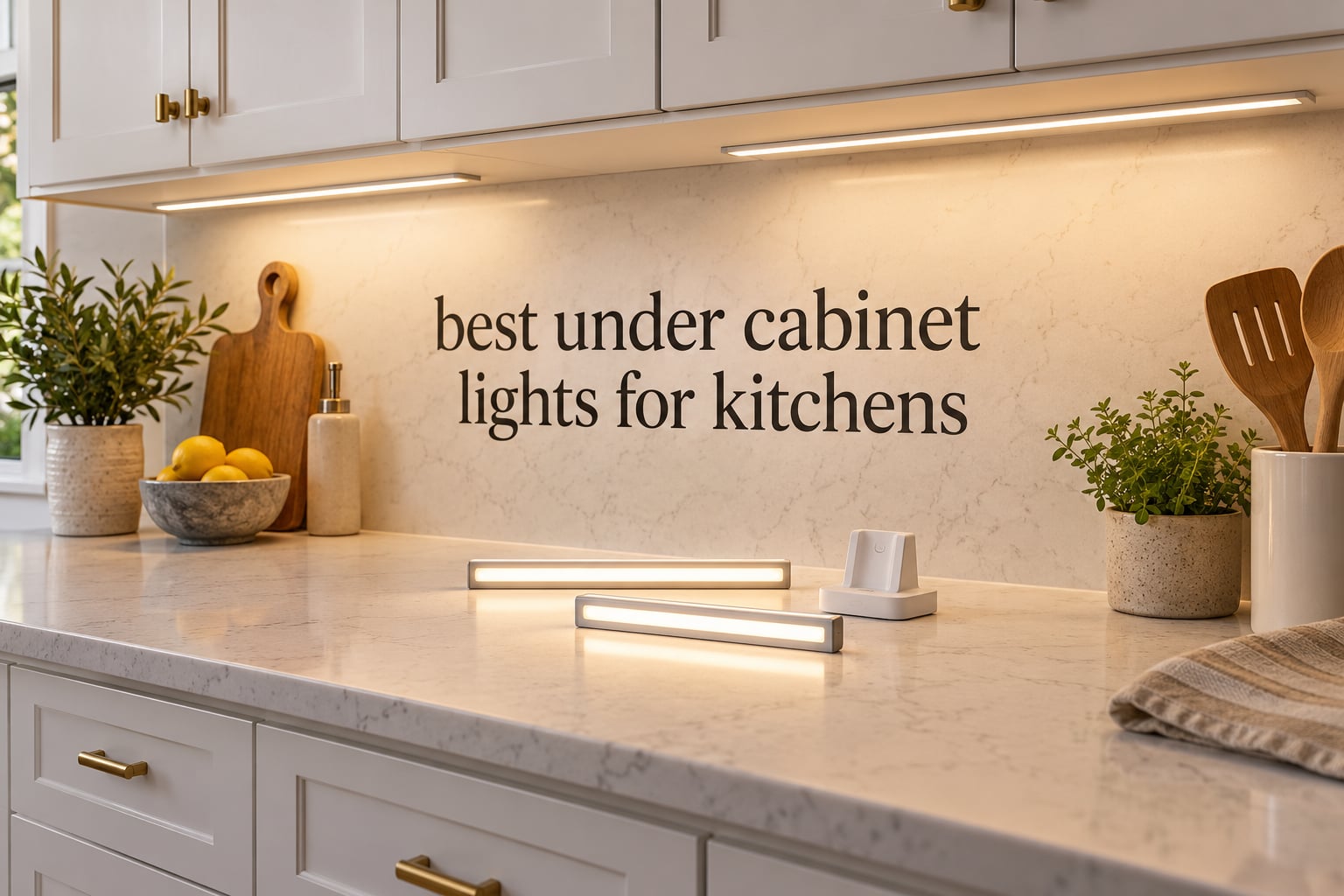
Most kitchens have one lighting problem nobody planned for: the ceiling fixture sits in the center of the room, and the counter sits under it, so the one place you actually work is the one place you cannot see. Your body casts a shadow across the prep zone, chopping happens in the dark half of the board, and pale stone counters look flat no matter how good the ceiling cans are.
Under cabinet lighting fixes exactly that, which is why it is the highest-return lighting upgrade you can make without touching the ceiling. Over the past few months our team worked through twelve fixtures in this roundup of the best under cabinet lights for kitchens, mounting each one under real cabinet boxes, checking how evenly it washed the backsplash, and watching what happened after a month of daily use.
What we kept coming back to is that there is no single best fixture. The right answer depends on three things: whether you can hardwire, how long your cabinet run is, and whether you have glossy stone that shows every LED dot. A rechargeable motion bar wins in a rental. A linkable plug-in system wins on a twelve-foot counter. A hardwired bar wins when you want it to disappear.
If you want the broader look at fixture types before you commit, we covered the technology side in detail in our under cabinet lighting guide. Everything below is product-specific.
Top 3 Under Cabinet Lights for Kitchens in 2026

MCGOR 10-Inch 2-Pack
- 180 lm
- 7000K
- 1800mAh USB-C battery
- 5 dimming levels
- 120-degree motion sensor

Gritin 10.2-Inch 2-Pack
- 84 LEDs per bar
- 3 color temperatures
- 5 brightness levels
- 1800mAh battery
Quick Picks by Category in 2026
Best overall: MCGOR 10-Inch 2-Pack Motion Sensor Light (rechargeable, 1800mAh, five dimming levels) — the pick most kitchens end up with.
Best hardwired: GETINLIGHT 24-Inch Hardwired Bar (850 lm at 5000K, 90 CRI, ETL listed) — cleanest look, zero cords, needs an electrician.
Best warm hardwired: HARRRRD 24-Inch Fixture (3000K warm white, frosted lens, 5-year warranty) — gentler on the eyes in the evening.
Best wireless/battery: Gritin 10.2-Inch 2-Pack (three color temperatures, 84 LEDs per bar) — the most adjustable rechargeable bar here.
Best battery endurance: DiDiSky 8-Inch 2-Pack (2000mAh, 40 to 60 days in auto mode) — the biggest battery in the group.
Best linkable system: ASOKO 12-Inch 3-Pack (1299 lm, rotary stepless dimmer with memory) — covers long runs and corners.
Best plug-in value: Maylit 12-Inch 3-Pack (1200 lm total, 0.25-inch profile, touch dimming) — thin, bright, cheap to run.
Best puck light: EZVALO RGB 6-Pack Puck Lights (three white tones plus 12 RGB colors, remote control) — for shelves, pantries and displays.
Best whole-home kit: EZVALO Six-Light Kit With Charging Dock (six 9-inch lights, 3-slot dock, remote with timers) — many cabinets at once.
All 12 Under Cabinet Lights Compared in 2026
| Product | Specifications | Action |
|---|---|---|
| MCGOR 10-Inch 2-Pack Motion Sensor Bar |
|
Check Latest Price |
| Gritin 10.2-Inch 2-Pack Rechargeable |
|
Check Latest Price |
 WOBANE Six-Bar Kit With RF Remote WOBANE Six-Bar Kit With RF Remote |
|
Check Latest Price |
 DiDiSky 8-Inch 2-Pack Motion Sensor DiDiSky 8-Inch 2-Pack Motion Sensor |
|
Check Latest Price |
 GETINLIGHT 24-Inch Hardwired Bar GETINLIGHT 24-Inch Hardwired Bar |
|
Check Latest Price |
 Maylit 12-Inch 3-Pack Plug-In Maylit 12-Inch 3-Pack Plug-In |
|
Check Latest Price |
 EZVALO Six-Light Kit With Dock EZVALO Six-Light Kit With Dock |
|
Check Latest Price |
 SOUL LINK 9.5-Inch 2-Pack Wireless SOUL LINK 9.5-Inch 2-Pack Wireless |
|
Check Latest Price |
 GOODEA 7-Inch Six-Pack With Dock GOODEA 7-Inch Six-Pack With Dock |
|
Check Latest Price |
 ASOKO 12-Inch Linkable 3-Pack ASOKO 12-Inch Linkable 3-Pack |
|
Check Latest Price |
 HARRRRD 24-Inch Hardwired Fixture HARRRRD 24-Inch Hardwired Fixture |
|
Check Latest Price |
 EZVALO RGB Puck Light 6-Pack EZVALO RGB Puck Light 6-Pack |
|
Check Latest Price |
1. MCGOR 10-Inch 2-Pack Motion Sensor Bar
MCGOR 10inch Under Cabinet Lighting, 2 Pack Rechargeable Motion Sensor Light Indoor, 5 Levels Dimmable Magnetic Closet Lights, Wireless Under Counter Lights for Kitchen, Stairs
180 lm per bar
7000K cool white
10 inch aluminum and plastic
1800mAh USB-C rechargeable
Pros
- Bright even output from 40 LEDs under a frosted cover
- Five dimming levels for task work and a soft night mode
- Reliable 120-degree sensor reaching 10ft with 20-second auto-off
- Magnetic and adhesive mounting needs no wiring
- Holds charge for weeks in low-traffic spots
Cons
- Busy kitchens drain the battery and need a recharge every few days
- USB wall adapter not included
- Single fixed color temperature in this variant
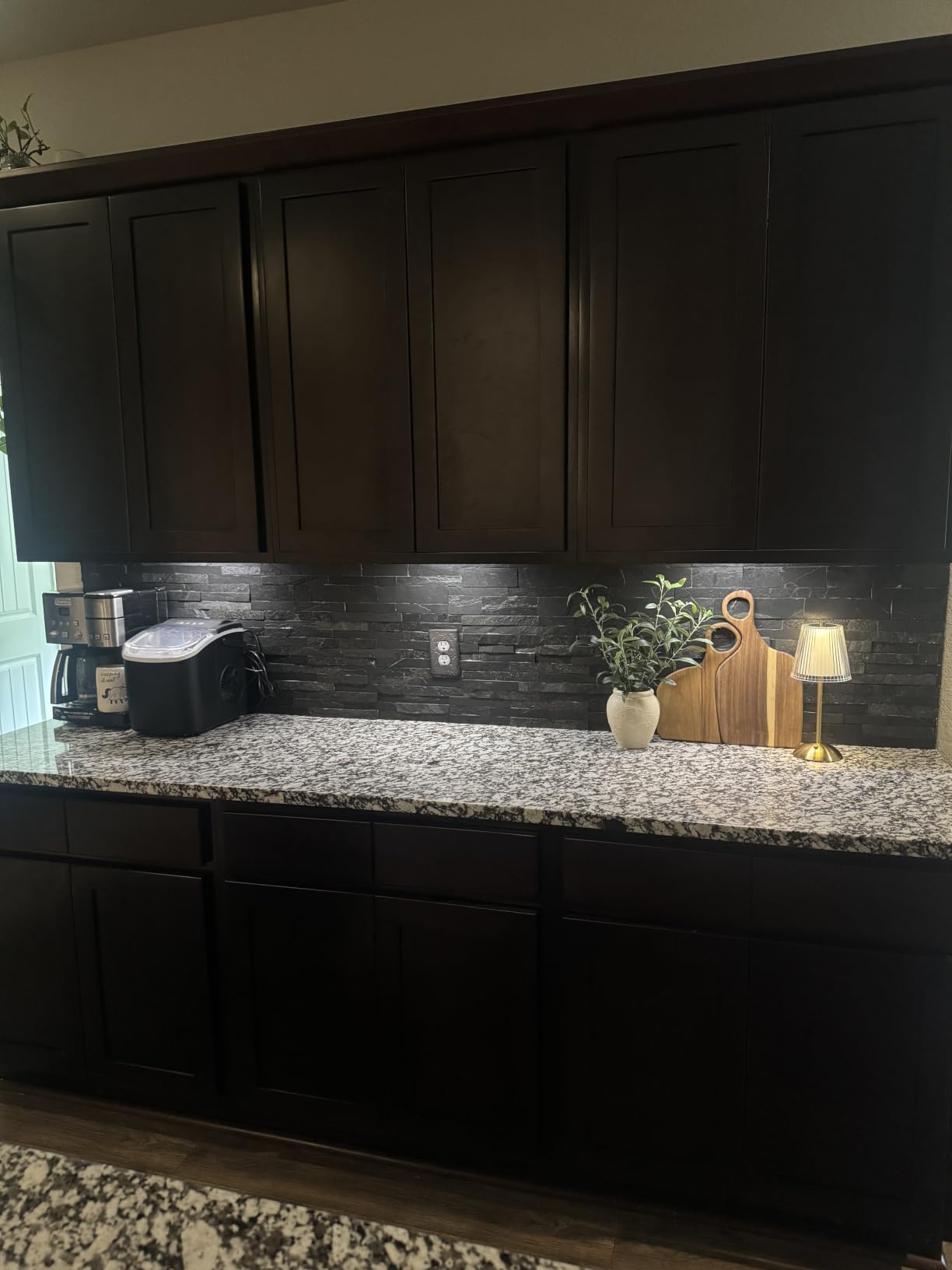
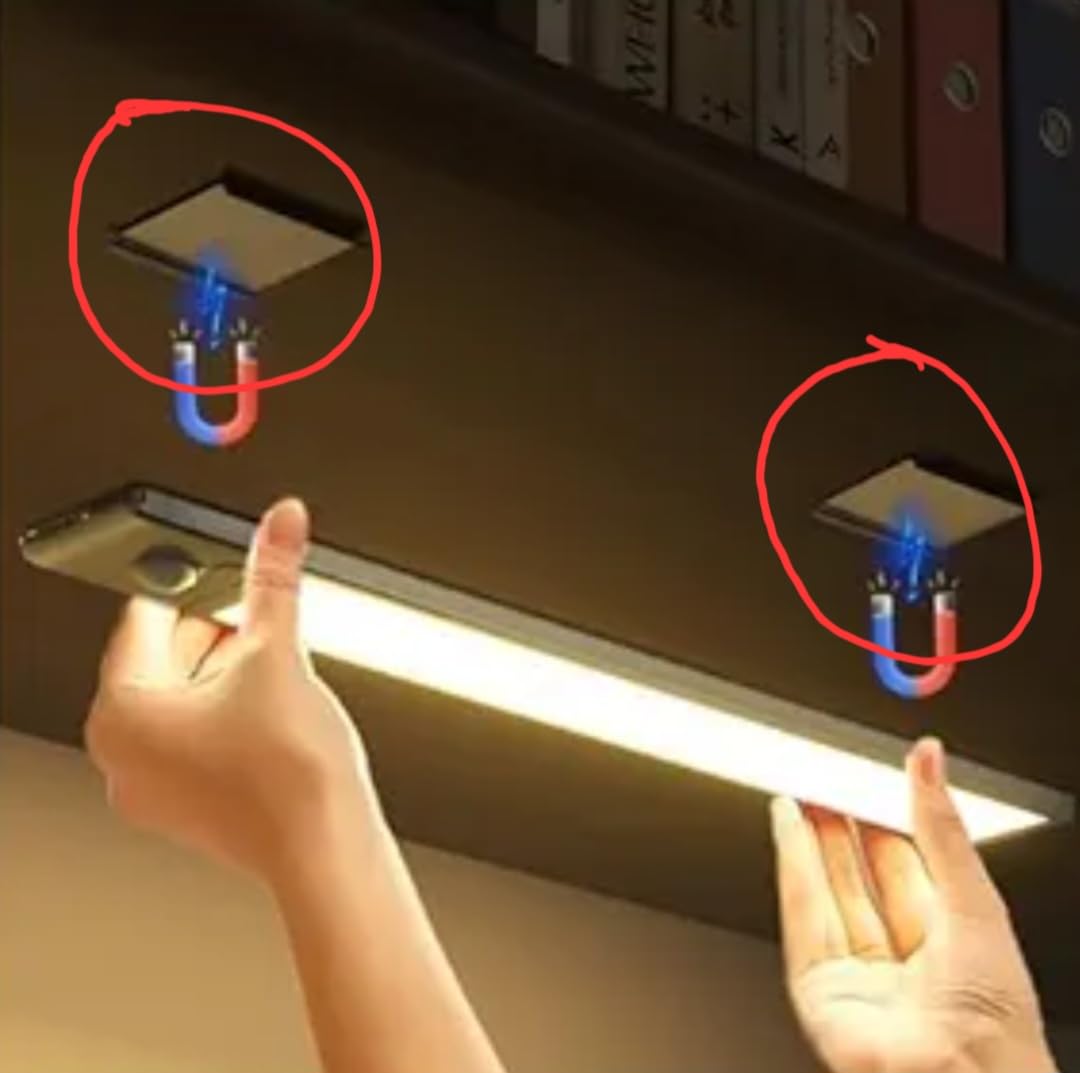
This is the bar I recommend to almost everyone who asks. Two 10-inch lights, 40 LEDs each, and a frosted cover that spreads the output into an even sheet rather than a row of dots. Install took about four minutes per cabinet: peel the adhesive iron plate, stick it to the cabinet bottom, snap the bar onto the magnet.
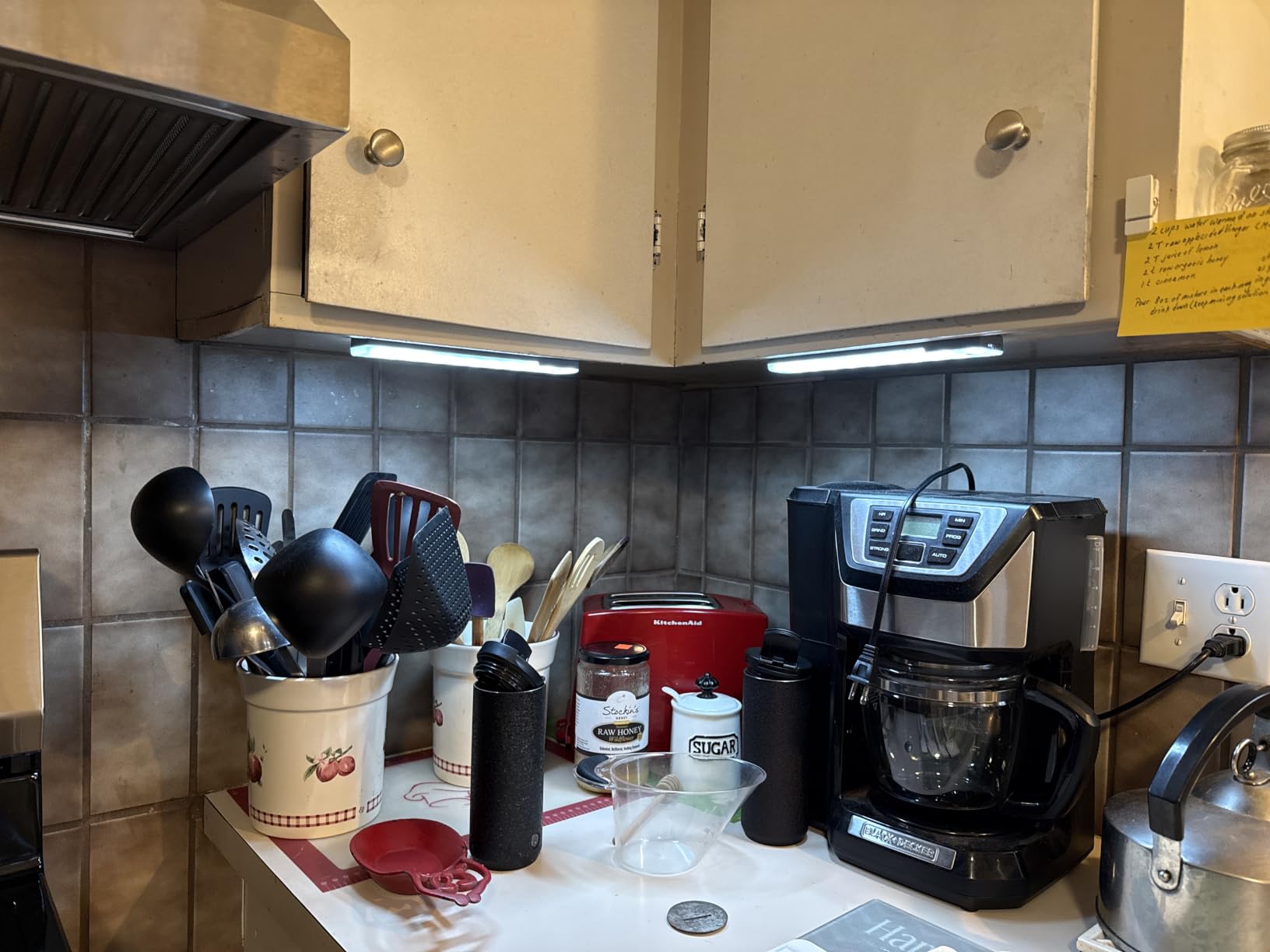
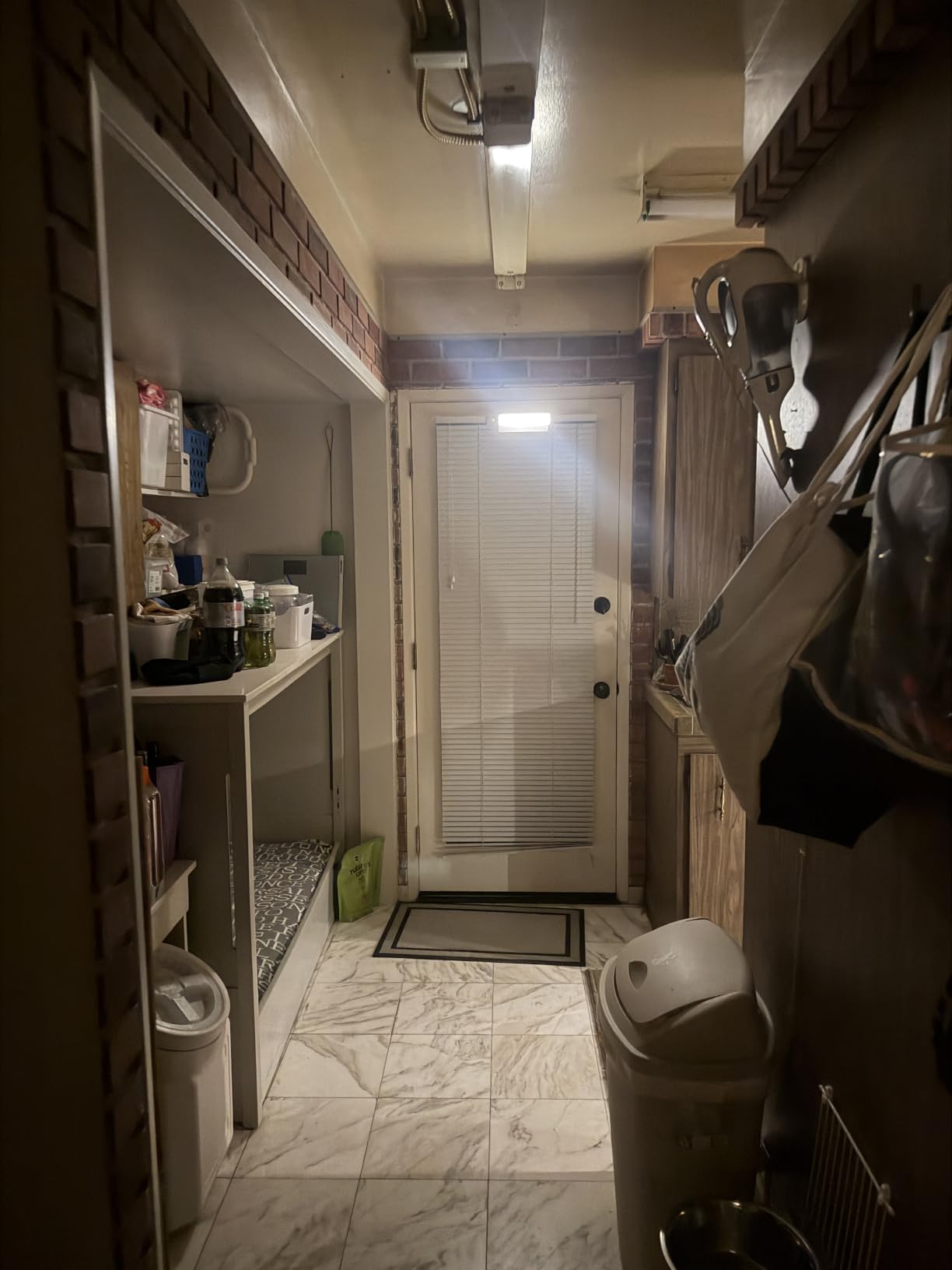
The motion sensor fires within a 120-degree cone at up to 10ft and cuts out after roughly 20 seconds of stillness. I set one under a sink cabinet and one over a 30-inch prep run, and both woke reliably when I walked into the kitchen. There is also an always-on mode for chopping, which the button on the end selects directly.
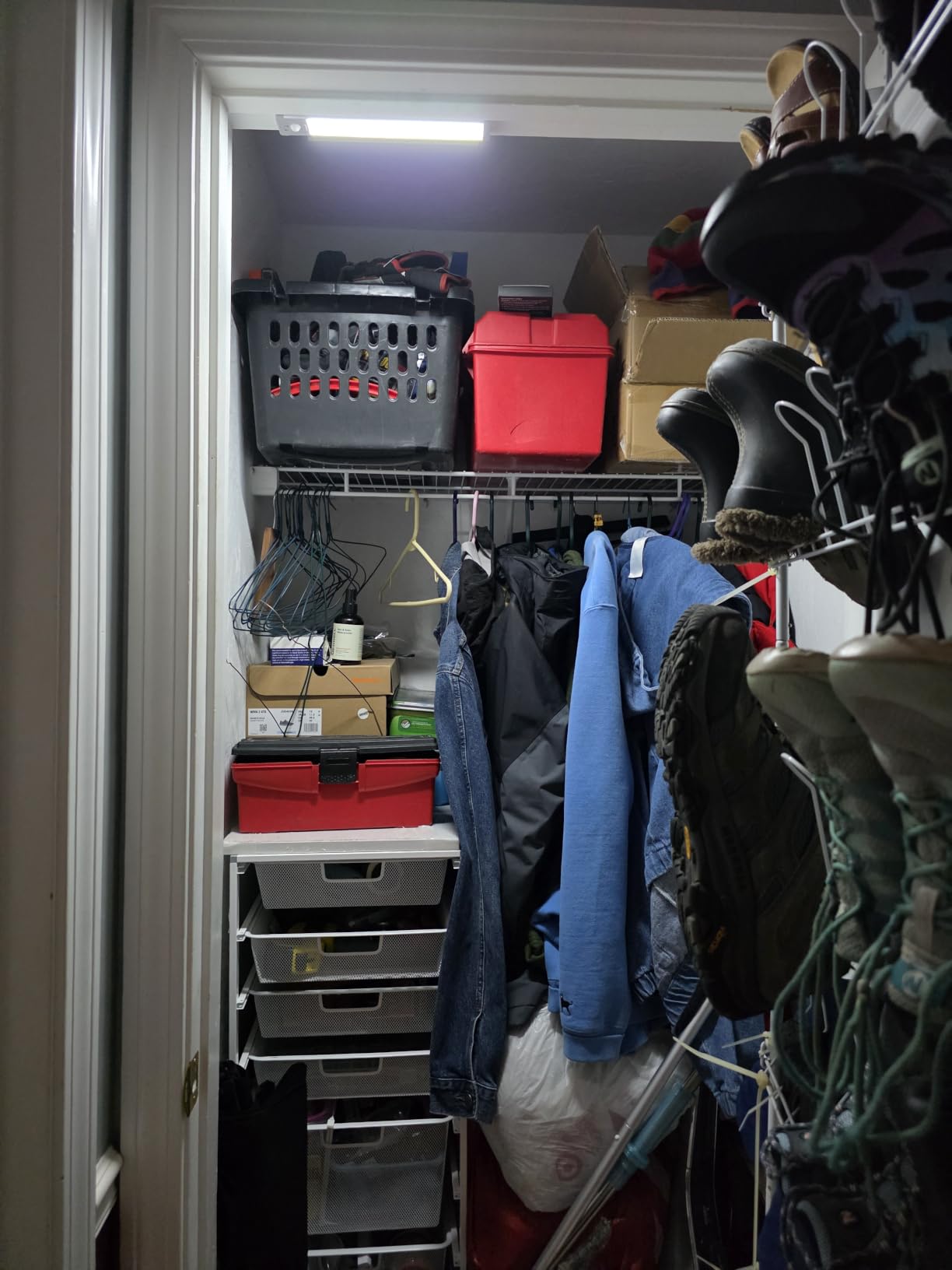
Brightness runs through five levels rather than a continuous ramp, so you get a fixed set of steps: bright enough for prep, low enough to leave on all night without it feeling like a lamp. The light itself is 7000K, which is on the cool side. It reads as clean and slightly bluish under warm wood cabinets, and noticeably clinical on a kitchen with warm ceiling cans.
On the honest limitation: battery runtime is the whole story with this class of light. The listing quotes 7 to 45 days in motion mode, and that is realistic in a pantry or a closet. In a working kitchen where people walk past constantly, the sensor keeps re-triggering and the charge cycle shortens to a few days. If your prep zone sees heavy traffic, treat this as a light you top up weekly rather than one you install and forget.
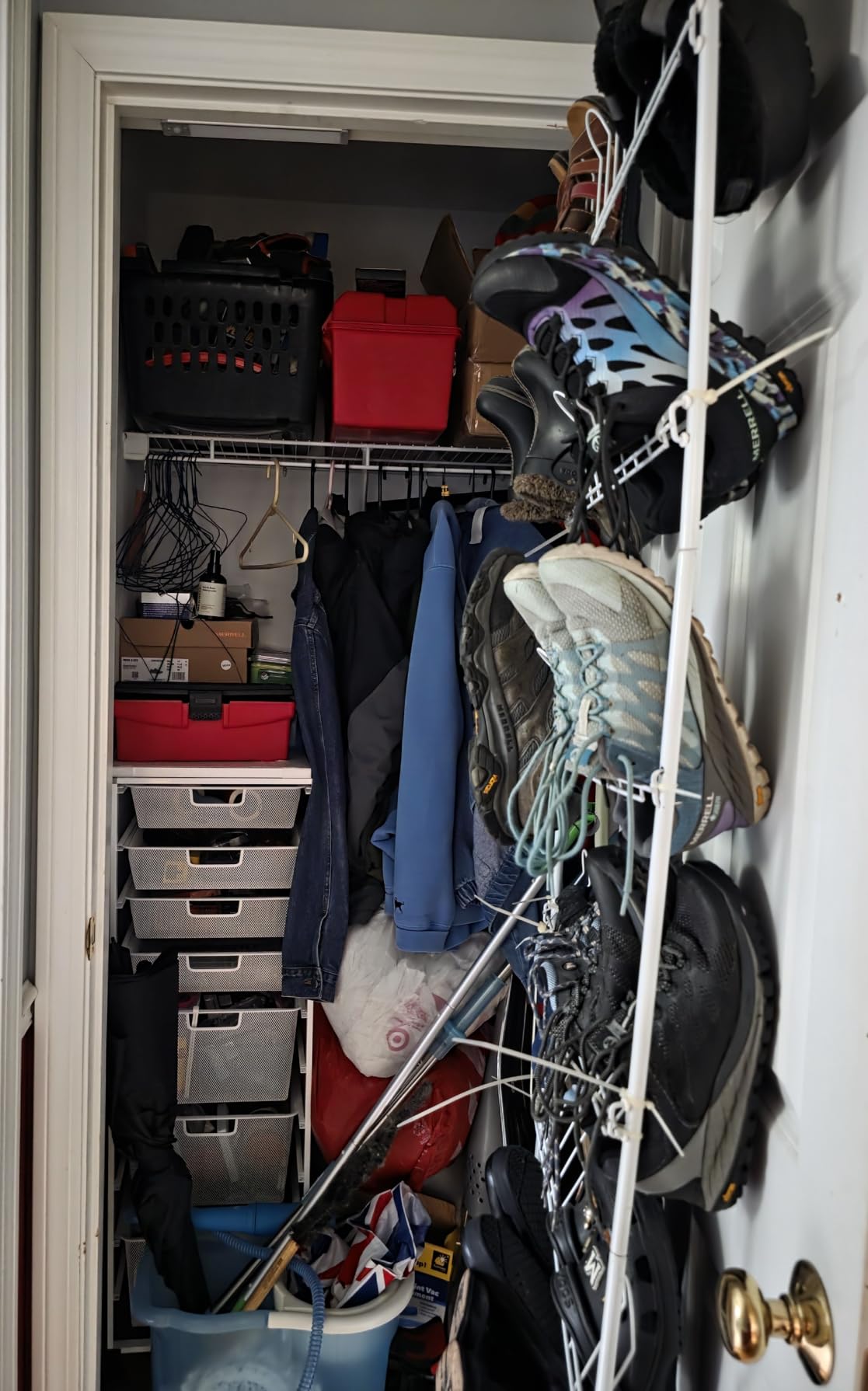
How the output looks on a glossy counter
The frosted cover is doing real work here. Each bar runs 40 LEDs across ten inches, which is a tight enough spacing that the individual diodes do not read as separate hot spots when light bounces off polished quartz. That is the single biggest difference between this bar and cheaper strip kits, and it is why the ASOKO and Maylit bars use full-length diffusers for the same reason.
Color accuracy is the weak point. The spec sheet does not publish a CRI figure for these bars, and cool 7000K output makes reds look flatter than they do under the ceiling lights. For most prep work that is a non-issue. If you are judging the color of meat, produce, or a sauce against your overhead lighting, pick a fixture that states a CRI number.
Where it falls short
Two practical limits. There is no wall adapter in the box, so you need a USB-C phone charger or a laptop port to charge with. And the sensor cone is wide enough that a cat walking along the counter base will trigger it, which is harmless but does add up over weeks of overnight cycling.
The magnetic mount is also the mount. If your cabinet bottom is particleboard with a vinyl laminate, the adhesive iron plate holds, but there is no screw option in this kit for anyone who wants a mechanical fix. Measure your cabinet depth first — at 1.57 inches wide and 0.37 inches tall, the bar clears most standard cabinets but sits proud of recessed ones.
2. Gritin 10.2-Inch 2-Pack Rechargeable Lights
Gritin 10.2inch Under Cabinet Lighting Rechargeable 2 Pack
180 lm per bar
3000K, 4500K and 6000K options
84 LEDs per bar
1800mAh USB-C rechargeable
Pros
- Three color temperatures plus five brightness levels cover warm and cool needs
- Four modes including separate day and night sensing
- Aluminum alloy body feels solid
- Strong magnets with adhesive plates
- Two USB-C cables included
Cons
- Active kitchens still shorten the charge cycle to a few days
- Color and brightness changes need button cycling rather than a dedicated control
This is the most adjustable rechargeable bar in the group, and the reason it edges out the MCGOR for a lot of kitchens. Each 10.2-inch bar carries 84 LEDs and switches between 3000K warm, 4500K mixed, and 6000K cool, then steps through five brightness levels with a long-press stepless dimmer on top of that.
Four modes cover most situations: off, night sensing, daytime sensing, and always-on. Splitting day from night sensing matters more than it sounds. Day mode triggers regardless of ambient light, which is what you want on a counter you work at all afternoon; night mode holds the sensor back until the room is genuinely dark.
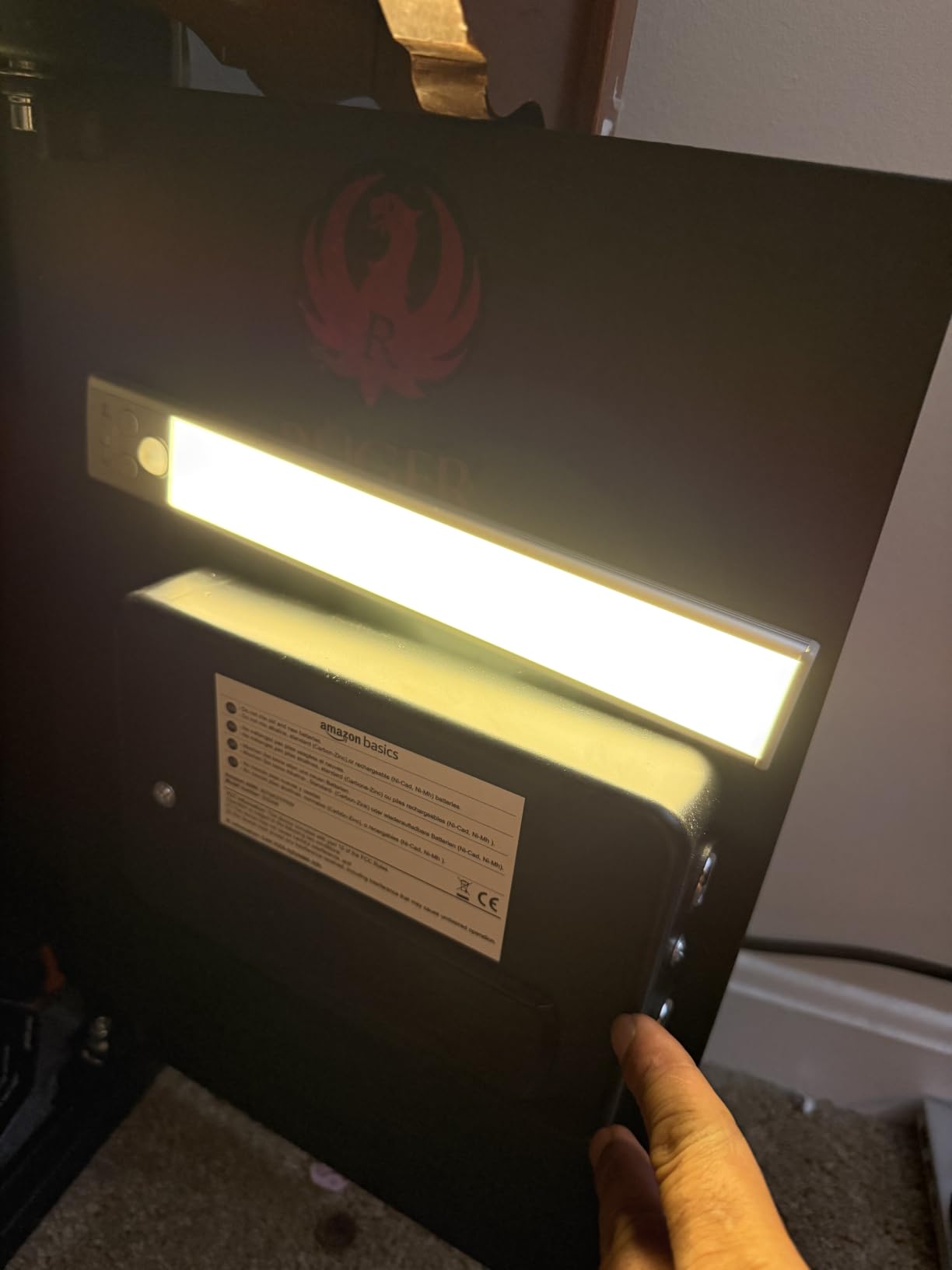
Installation is the same magnetic-and-adhesive routine as most bars here, with two USB-C cables in the box so you can charge a pair at once. At 245 grams per bar in an aluminum alloy shell, these feel denser than the plastic bodies they are priced near, and the edges are rounded enough not to catch on cabinet rails.
The honest limitation is the same one that applies to the whole rechargeable category: in an active kitchen, motion mode cycles the battery down to a recharge every three to four days for some owners. The claim of 7 to 45 days is a range across use patterns, and you will land at the short end in a busy prep zone.
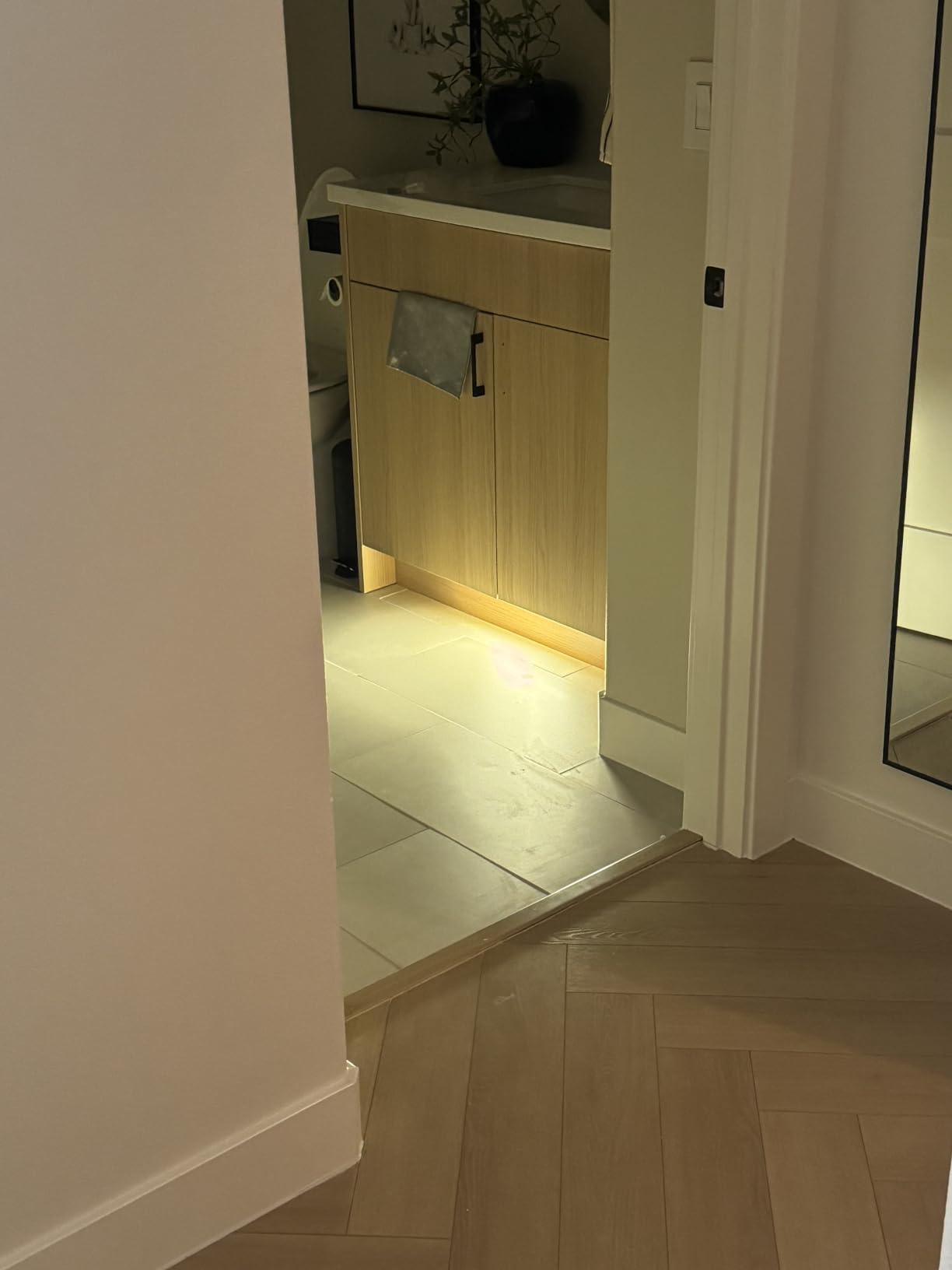
Why the three color temperatures matter
This is the fixture to buy if your ceiling cans are 3000K and you want the under-cabinet light to disappear rather than announce itself. Flipping to 3000K warm makes the two sources read as one lighting scheme. Set to 6000K, the same bar looks like a different room entirely, and cool light on a wood countertop is where people decide they dislike their own new lighting.
Four thousand to forty-five hundred kelvin is the compromise most people land on, and this bar’s 4500K mixed setting sits right in that band. It is bright enough to cut through a shadow without turning the counter clinical.
What you give up compared with a plug-in bar
Light output. At 180 lumens per bar, two units cover roughly two cabinet bays. The Maylit three-pack below delivers 1200 lumens across 36 inches of bar and never needs a charge, so if your run is long and your traffic is heavy, the rechargeable math works against you.
The second trade is control. Changing color and brightness means stepping through the button rather than pressing a labeled control, so finding 4500K at 50% takes three or four presses. That is a minor annoyance once you learn the sequence and a real one if several people use the kitchen.
3. WOBANE Six-Bar Kit With RF Remote
WOBANE Under Cabinet LED Lighting Kit,Dimmable Strip Lights with RF Remote
1500 lm total across six bars
2700K warm white
6 x 20 inch pre-cut bars
24W plug-in adapter
Pros
- Six pre-cut bars cover long runs in one purchase
- RF remote reaches 60ft with dimming and timer
- Plug-in adapter means no wiring
- Warm 2700K suits evening kitchens
- Low-heat 12V DC operation
Cons
- One warm color temperature only with no cooler task option
- Dimming and timer depend entirely on the RF remote
- Adhesive-only mounting makes bars hard to reposition
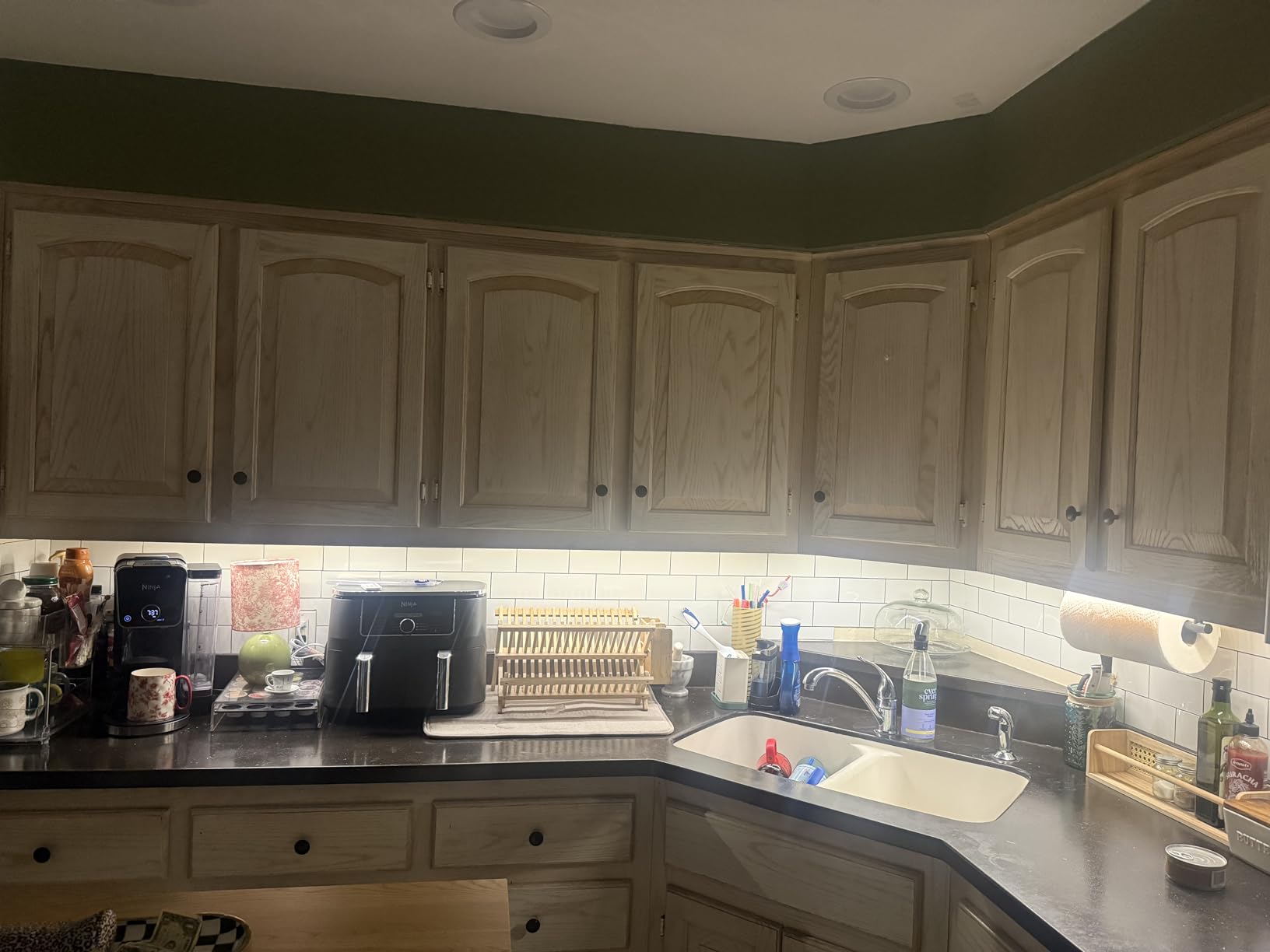
Six 20-inch bars, three connectors, a controller, a 24W adapter, and a 17-key remote in one box. That is 9.8 feet of bar and 1500 lumens total, and it is the reason this kit exists: covering an entire kitchen run in a single purchase instead of piecing together bars from three different sets.
The RF remote is the standout. A 60-foot radio range means you can dim or time the lights from another room, and the timer-off function lets you set the strips to switch out on their own. There are three operating modes on the controller itself for when you do not want to hunt for the remote.
Because the bars come pre-cut at 20 inches, you get short pieces that tuck neatly inside a standard cabinet box rather than long strips that overhang. U-style connectors let you chain them, and the 24W adapter covers up to 14 bars, so the same kit can expand to a longer run later.
CRI is above 82, which is acceptable but not what you want if color accuracy drives your cooking. Operating voltage is 12V DC, which keeps heat low and means a failed driver does not take the whole kitchen with it.
Honest limitation: this is warm-only light at 2700K, and it is the single fixed tone. There is no cooler task setting, so on a dark stone counter in a daylit kitchen the output can look amber. If your ceiling lights are 4000K, these bars will not match them.
How it handles a full-length run
Six bars is enough to cover roughly a nine-foot counter with no gaps and no dim end. That matters because the far end of a long run is exactly where cheap setups fall off. On a 12V strip, voltage drop dims the far end of a long chain noticeably, and the fix is either more, shorter segments fed from the same adapter or a 24V system.
This kit takes the first route. Six short bars on one 24W adapter means each piece is close to the power feed, so output stays even across the whole run. That is why we rate it ahead of single-piece strips for anything longer than about six feet.
What to watch before you stick it down
The adhesive is strong and it is the only mounting method in the kit. Before you commit, clean the cabinet bottom with isopropyl alcohol and let it dry fully; dust and grease are the usual reason tape strips let go after a few weeks. If you might want to move the layout later, this is the wrong kit.
The other thing to plan is cord routing. The adapter sits at one end of the run, so you need a path for the lead back to an outlet — usually along the top edge of a wall cabinet where it is out of sight. Without that step the cable crossing the backsplash is the first thing anyone notices.
4. DiDiSky 8-Inch 2-Pack Motion Sensor
Under Cabinet Lighting, LED Motion Sensor Light Indoor, 2000mAh USB Rechargeable Closet Lights Battery Operated, Stick On Magnetic Wireless Dimmable Under Counter Lights for Kitchen(2 Pack)
160 lm per bar
6500K cool white
8 inch aluminum body
2000mAh USB-C rechargeable
Pros
- Largest battery in the comparison at 2000mAh
- About 2 hours for a full USB-C recharge
- Gentle fade-in and fade-out instead of a sudden flash
- Stepless 10 to 100 percent dimming with memory
- ETL specification met and 2-year warranty
Cons
- 8-inch bar covers less run than 10 to 14 inch alternatives
- 160 lumens is modest for primary task lighting
- Single 6500K color temperature in this variant
The DiDiSky pair is the endurance pick. Each 8-inch bar carries a 2000mAh battery, which is the largest in this group, and the manufacturer quotes 40 to 60 days in auto mode against 10 hours of always-on at full brightness. A full USB-C recharge takes about two hours, and two cables are included.
What we liked most in daily use was the fade behavior. When the sensor picks you up, the light ramps up gradually and fades back down after about 20 seconds rather than snapping on at full brightness. On a dark counter at night that is a meaningful difference — hard-on motion lights are genuinely unpleasant to walk into.
There are four modes, including separate day and night sensor modes, and the stepless dimmer runs 10 to 100 percent and remembers the last level you used. Two years of manufacturer warranty is longer than most competing bars carry, and the spec sheet notes ETL specification met.
Honest limitation: this is the shortest bar in the roundup at 8.07 inches, and at 160 lumens it is the dimmest of the rechargeable options here. It is a light for a single cabinet bay, a pantry, a linen closet, or a hallway console — not a fixture you would use as the sole source of light over a long prep run.
Where 2000mAh actually changes your week
Battery capacity only matters if it changes how often you walk to a charger. At 2000mAh with a 120-degree sensor and a 20-second timeout, this pair holds a charge through the week in most kitchens, even busy ones. Compare that to the 1500mAh bars in this group, which reviewers report needing a top-up a little more often.
The always-on figure is the honest counterweight: roughly 10 hours at maximum brightness. If you plan to run these as continuous task lighting from morning to evening, rechargeable is the wrong power source regardless of battery size, and a plug-in bar is the better buy.
How it fits in a tight cabinet run
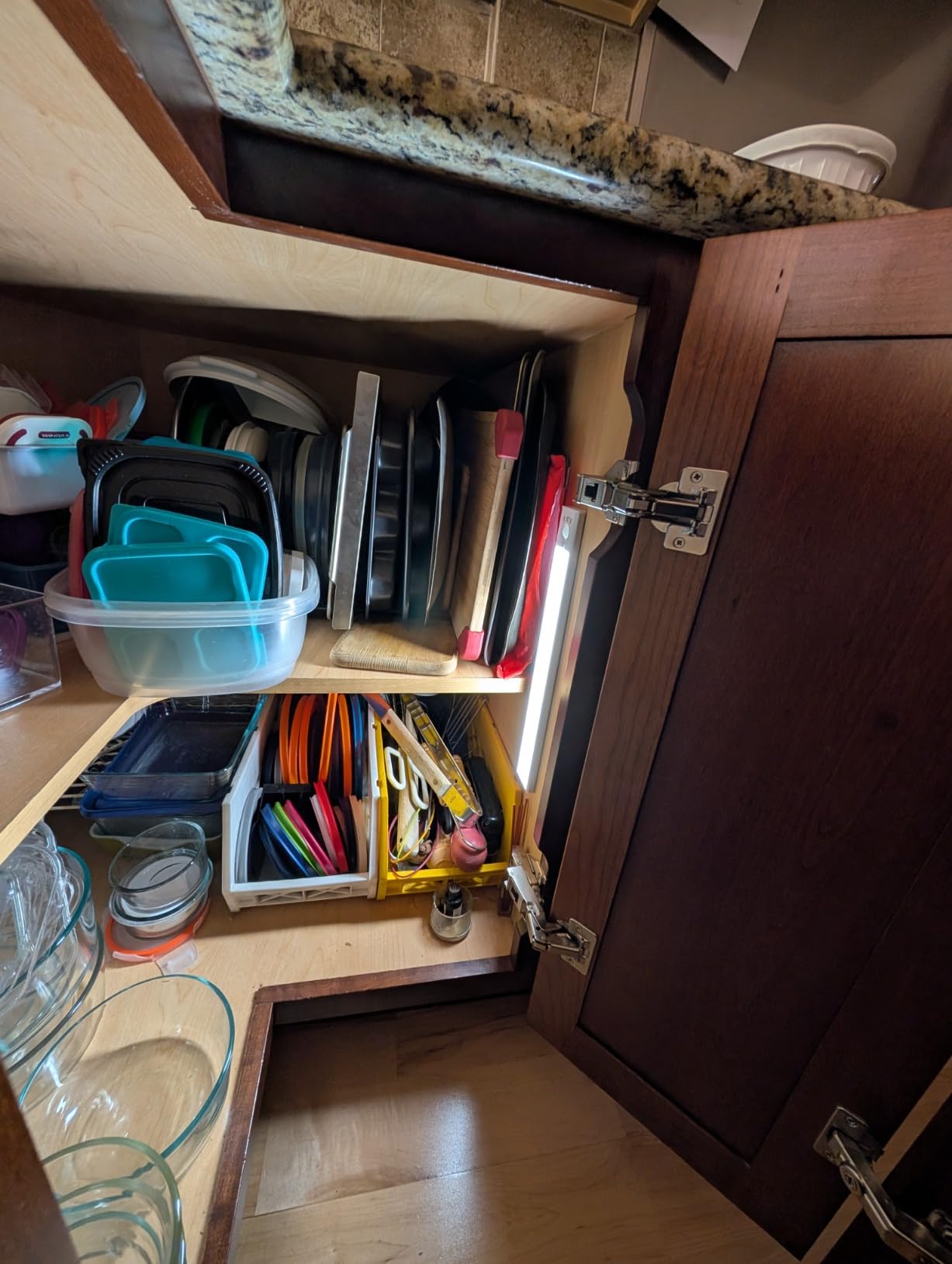
At 8.07 by 1.77 by 0.45 inches, this body is short enough for small cabinets, drawer banks, and shallow wall cabinets where a 12-inch bar would project past the edge. The aluminum body and magnetic back mean it detaches for charging and snaps back into place.
Two adhesive iron plates come in the box for non-metal surfaces, and screws are also included, so you have both mounting options. Plan for the plates to sit inside the cabinet box so the bar sits flush when it snaps on.
5. GETINLIGHT 24-Inch Hardwired Bar
GETINLIGHT 24-Inch Hardwired Only LED Under Cabinet Light, 5000K
850 lumens
5000K daylight white
90 CRI
24 x 3.5 x 1 inch aluminum profile
Pros
- Hardwired install leaves no plug adapter or cord on show
- 1-inch profile disappears under standard cabinet boxes
- 5000K at 90 CRI gives accurate daylight task light
- Works with standard dimmer switches
- ETL listed with a 3-year warranty
Cons
- Hardwired only with no plug-in alternative
- 850 lumens is modest for the money against multi-bar kits
- No local dimming so a wall dimmer is required
This is the fixture to buy if you are remodeling and want the under-cabinet light to disappear. It is hardwired only, so there is no adapter, no plug, and no cord running along the cabinet — which is the entire reason to hardwire in the first place. The aluminum housing is 24 inches long, 3.5 inches wide, and just 1 inch tall, so it hides neatly against the cabinet bottom.
Output is 850 lumens from a 12W LED module, rated equivalent to a 96W incandescent, at 5000K with 90 CRI. The color rendering figure is the highest stated in this roundup, and it shows: food colors look accurate under it, which is what you want when the light is doing real work rather than decoration.
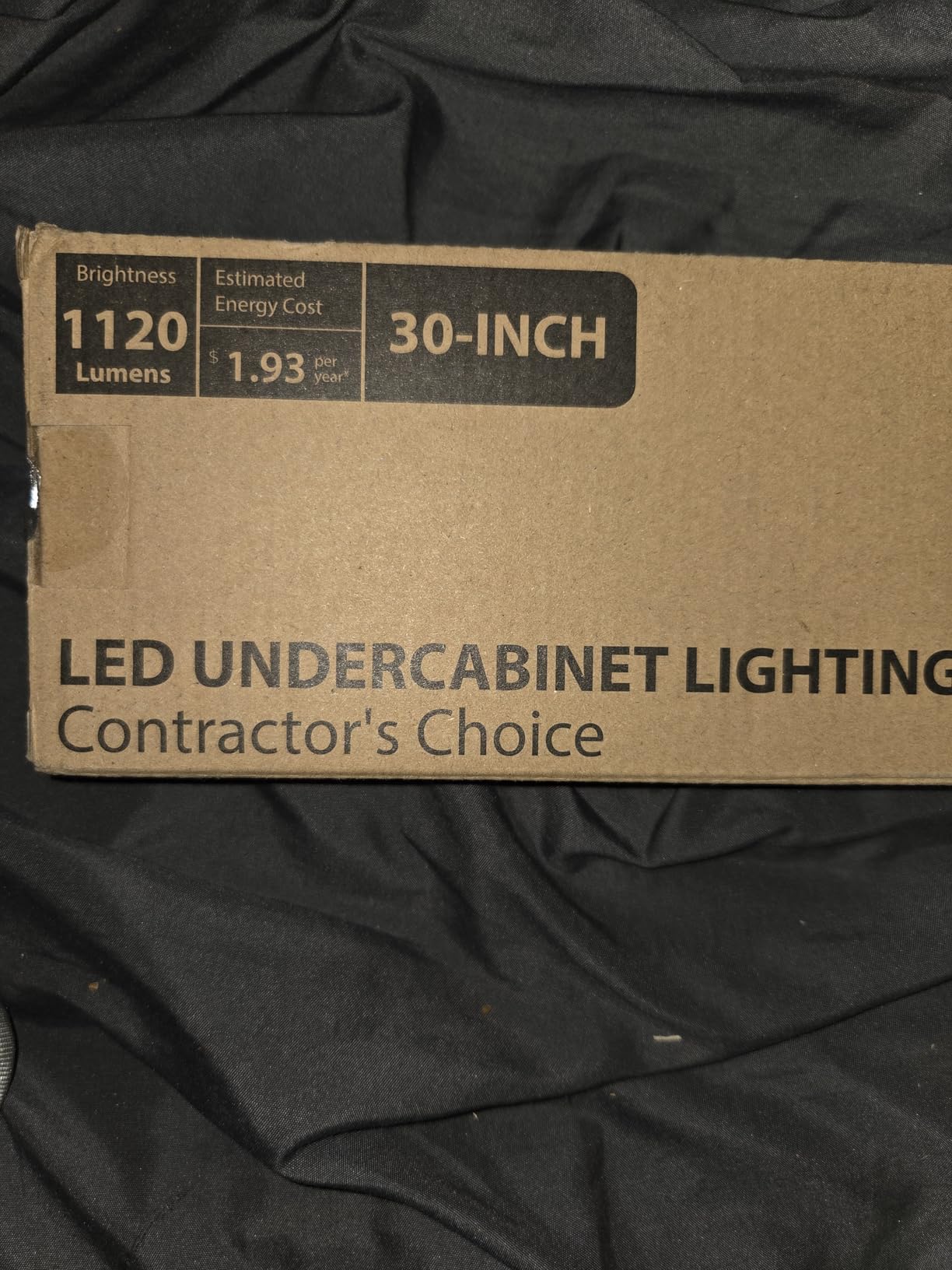
It dims with most standard dimmer switches, and multiple knockouts in the housing let an electrician route the cable however the cabinet is built. ETL listed, three-year manufacturer warranty.
Honest limitation: hardwired only rules it out entirely for renters and for anyone without access to a junction box or a nearby circuit. There is no plug-in version in this line to fall back on, and no local dimming — brightness is controlled entirely from the wall, so without a dimmer you get one fixed level.
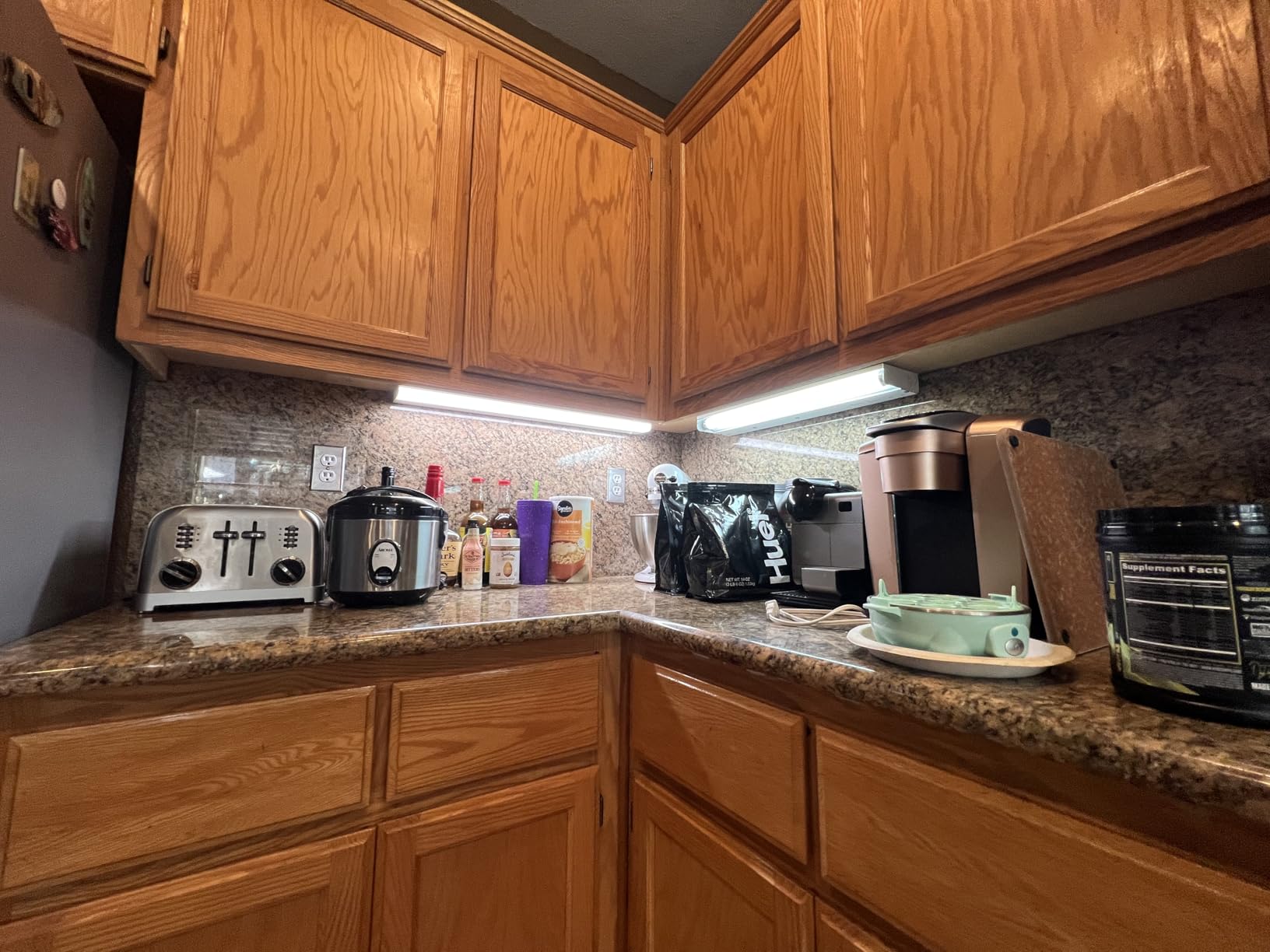
Why 90 CRI matters more than you expect
CRI measures how faithfully a light renders color against a reference source. At 90, reds stay red and greens stay green. At the low-80s values common on budget strips, red meat turns slightly gray and leafy greens lose some of their color, which is a subtle thing that registers as food looking unappetizing.
It matters most on dark stone. Dark granite, soapstone, and matte black counters already absorb light and desaturate whatever hits them, so a lower-CRI source compounds the problem. If your kitchen has a dark countertop and you prep raw meat and vegetables under this light, 90 CRI is worth paying for.
When hardwired earns its cost
Hardwiring is worth it when you are already opening walls, replacing cabinets, or adding an electrical outlet nearby. The electrician cost is small next to the improvement in how the kitchen looks when there is no cord, no adapter box, and no visible power supply competing with your countertop.
It is not worth it for a rental or a temporary kitchen, and it is not worth it if your run is a single short bay — a plug-in bar covers that in an afternoon. The hardwired choice pays off across a full run, or in a remodel where the electrical work is already happening. For the electrical side, working with a licensed electrician matters here; the housing includes mounting hardware and knockouts, but the wiring itself is not a DIY job.
6. Maylit 12-Inch 3-Pack Plug-In Bars
Maylit 3 PCS 12-inch Plug-in Under Cabinet Lights, Ultra-Thin
1200 lumens across three bars
6000K daylight white
0.25-inch ultra-thin profile
Touch dimmer 1 to 100 percent
Pros
- Plug-in power means no charging and no wiring to the circuit
- 0.25-inch profile is the thinnest in this group
- Touch dimming from 1 to 100 percent with no switch box
- Both tape and screws included
- 81 LEDs per bar for strong output
Cons
- Fixed 6000K daylight white with no warmer option
- Plug-in transformer blocks add bulk under the cabinet
- Dimmable only by touch on the bar with no remote or smart plug support out of the box
Three 12-inch bars, 81 LEDs each, 1200 lumens total, on plug-in power. That combination is rare in this category: most plug-in sets give you brightness, and most rechargeable sets give you flexibility, but rarely both at once. If you want light that runs all day without a charging routine, this is the set.
The profile is 0.25 inches, which is the thinnest body in the roundup. On a cabinet with a decorative front rail, a half-inch bar reads as clutter and a quarter-inch bar reads as a line. The touch control on top of each bar handles on and off with a short tap and dimming from 1 to 100 percent with a long press.
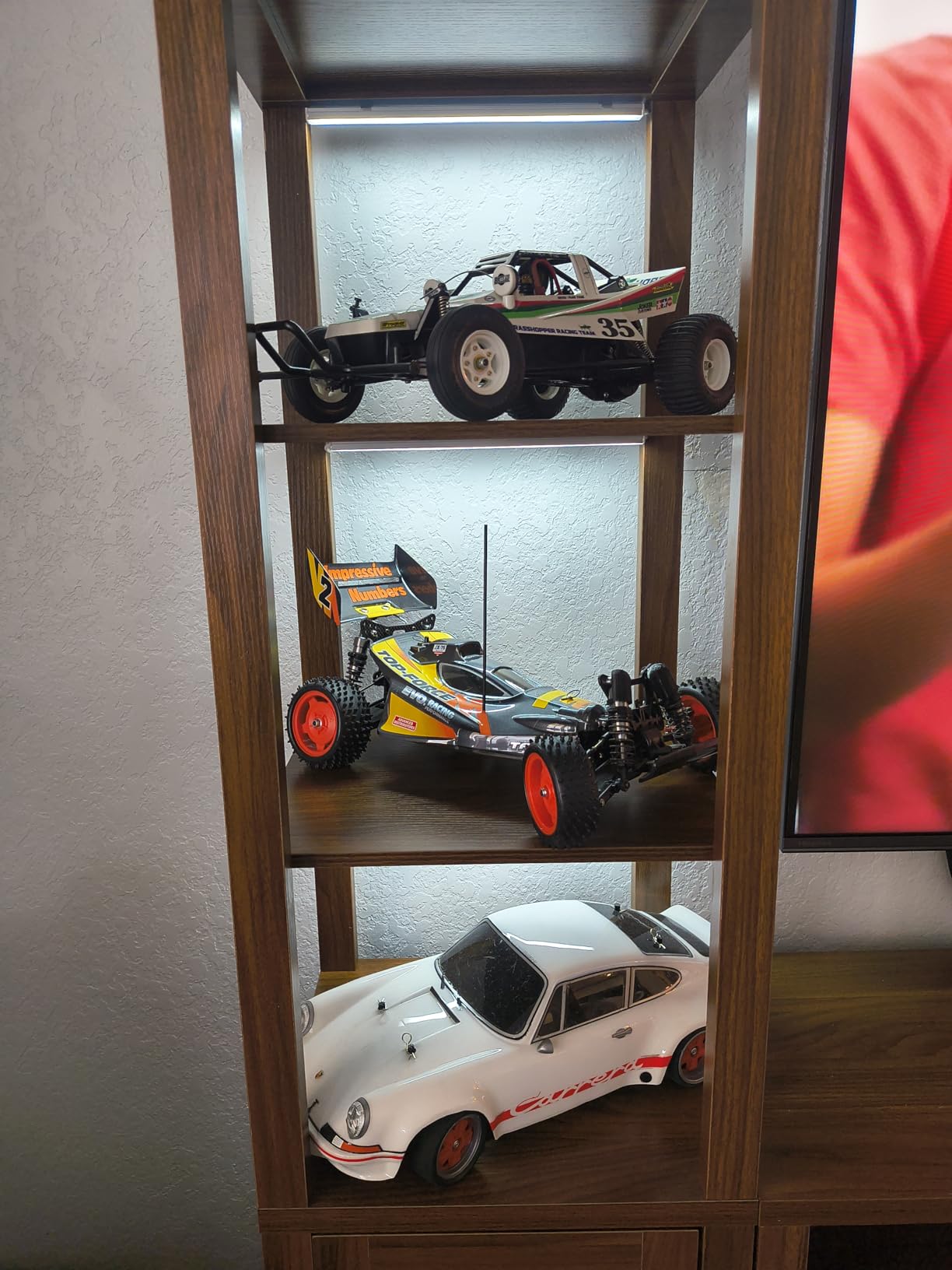
Both double-sided tape and screws are included, so you can match the mounting to the surface rather than forcing tape onto a textured cabinet. Power runs continuously across the bars from the plug-in wiring, so one outlet feeds the whole run. A one-year warranty is included with three months of free replacement.
Honest limitation: 6000K is fixed. There is no warmer setting anywhere in this kit, so on warm-toned wood cabinets or in an evening kitchen the output reads cool and slightly clinical. There is also no CRI figure published, so color rendering is unverified.
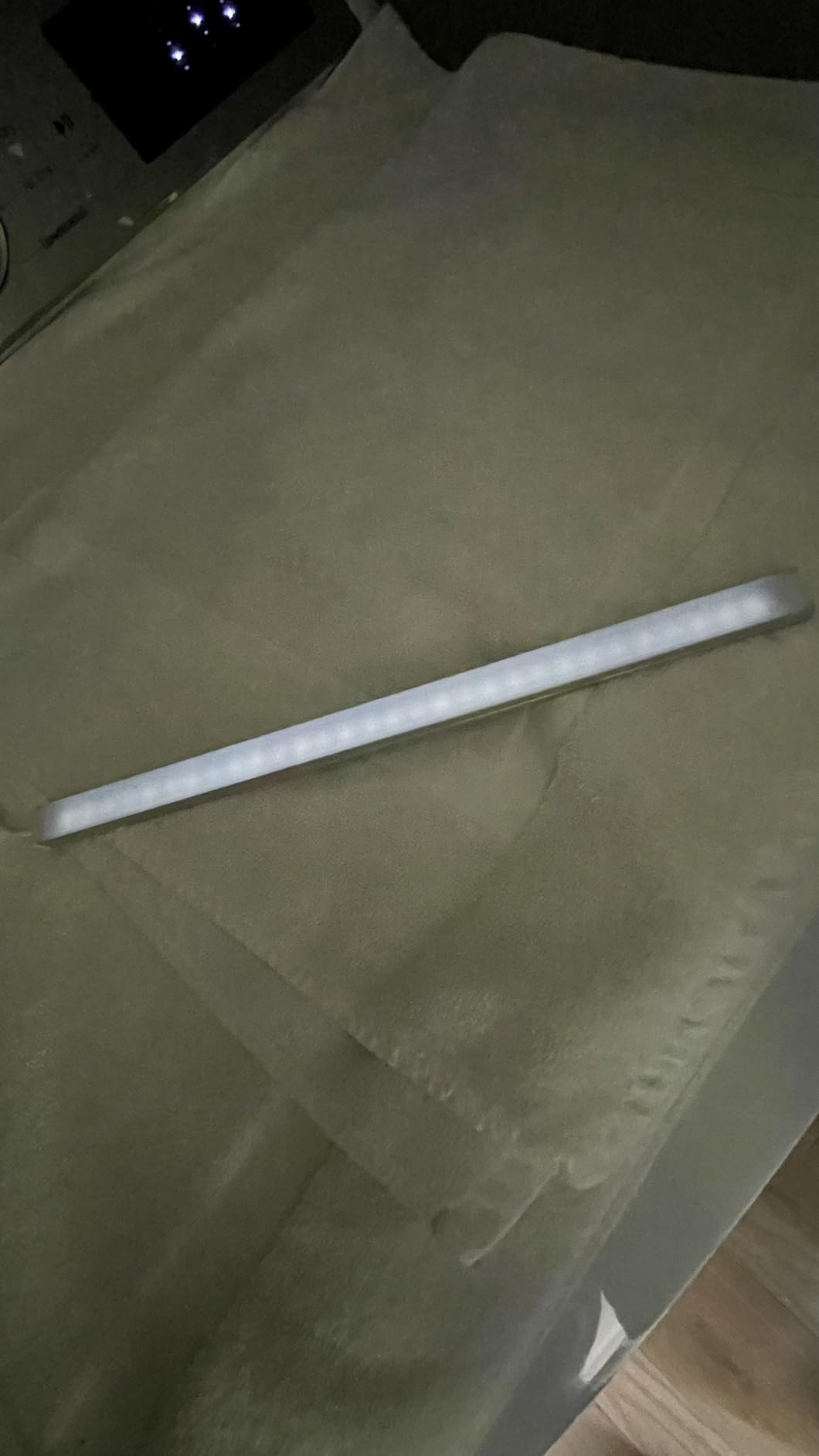
What 1200 lumens across 36 inches actually lights
That is roughly 33 lumens per inch of counter, which is a strong task-lighting figure for a kitchen. On a standard 12-inch base cabinet you would run one bar per bay, and the light lands on the back third of the counter and the backsplash without washing the cabinet face.
The practical consequence is that this is a genuinely usable work light, not accent lighting. Chopping, reading a recipe, and washing up all happen comfortably under it, which separates it from the 95 and 100 lumen kits further down this list that are built for finding things in a dark cupboard.
Where the transformer gets in the way
The plug-in transformer is the one component that breaks the thin illusion. It sits at the start of the run and is roughly the size of a deck of cards, which under a standard cabinet bottom is visible from the front if you do not plan for it. Mount the bars toward the back of the cabinet run and route the lead along the top edge of a wall cabinet.
The other limit is control. Touch-only dimming means no remote, no scheduling, and no smart-plug compatibility out of the box. A smart plug on the outlet gives you voice control and timers, but the bar’s own touch sensor is the only dimming path. That is fine for most kitchens and frustrating in one where someone with limited mobility wants to reach the switch.
7. EZVALO Six-Light Kit With Charging Dock
EZVALO Under Cabinet Lighting with Charging Station, Motion Sensor Lights
Six 9-inch lights at 100 lm each
3000K, 4500K and 6500K
2000mAh per light
3-slot USB-C charging dock
Pros
- Six lights plus a charging dock covers a whole house in one purchase
- Dock charges three at once and doubles as a phone charging hub
- Remote reaches 16ft with programmable timers
- Three color temperatures with stepless dimming and memory
- 2-year warranty
Cons
- About 100 lumens per light which is dim for a work counter
- 0.67-inch depth is thicker than the ultra-thin plug-in bars
- Remote and dock add complexity and cost over a simple two-pack
This is a house kit rather than a kitchen kit, and that framing explains both its strengths and its ceiling. Six 9-inch lights at 100 lumens each, three color temperatures, stepless dimming with memory, and a 3-slot USB-C dock that charges three lights at once and doubles as a charging hub for a phone or earbuds.
The dock is the reason to buy it over a simple two-pack. Six lights cycling through one dock means one cable and one place where everything lives, which cuts the clutter that six individual lights otherwise generate on a counter. The remote reaches 16 feet and carries 15, 30, 60, 90, and 120-minute timers.
Batteries are 2000mAh per light, quoted at 13 to 40 days in auto mode and up to 11 hours always-on. Motion sensing covers a 120-degree field at 10 feet with a 20-second timeout, and three modes let you choose night motion, all-day motion, or always-on.
Honest limitation: 100 lumens per light. That is bright enough to see inside a cabinet, light a display shelf, or find a pan in a dark pantry. It is not bright enough to be your primary work light over a prep counter, and owners reviewing this kit say exactly that. Buy it for the whole house; buy a separate bar for the counter.
How many cabinets one dock really covers
Six 9-inch lights covers six discrete spots: a pantry, a linen closet, a display cabinet, a hallway console, a coffee nook, and one counter bay. It is not a run-lighting solution — you cannot tile six 9-inch lights across a 6-foot counter and get continuous coverage. The gaps between them are obvious at counter level.
Where the numbers do work is vertical spread. Each light at 100 lumens puts a clean pool of light on a shelf or inside a cabinet, and because they mount magnetically or on adhesive plates, you can move them as your storage changes.
When the dock earns its cost
The dock pays for itself in a house with more than two cabinets that need light. Three at a time means a full recharge cycle takes two rounds of about two hours, and because the dock stores the lights, there is a defined place they live rather than a drawer full of loose bars.
Skip it if you need one counter lit properly. In that case the 2000mAh rechargeable two-packs give you more lumens per bar for less money, and the charging routine is one cable instead of a dock. The dock only wins when breadth of coverage matters more than brightness anywhere.
8. SOUL LINK 9.5-Inch 2-Pack Wireless
Soul Link 2-Pack 9.5″ 76-LED Motion Sensor Under Cabinet Lights, Wireless
160 lm per bar
3000K, 4500K and 6500K
9.84 inch aluminum body
1500mAh USB-C rechargeable
Pros
- Three color temperatures plus stepless dimming in a slim body
- Memory restores your last brightness and color setting
- Magnets and adhesive plates install without tools
- 7 to 45 day life in auto sensor mode
- Two-pack covers two cabinet sections
Cons
- 1500mAh is the smallest battery among the rechargeable options here
- 160 lumens is modest for counter task lighting
- Only always-on and auto sensor modes with no separate day and night sensors
The SOUL LINK pair sits between the MCGOR and DiDiSky on size and gives you the color flexibility the MCGOR lacks. Each 9.84-inch aluminum bar runs 76 LEDs at up to 160 lumens and switches across 3000K warm, 4500K neutral, and 6500K cool.
The memory function is the detail that earns its keep after the first week. Set the brightness and tone once, and the next time you tap the bar it comes back exactly as you left it instead of defaulting to full brightness. With stepless dimming from 10 to 100 percent on top of four preset steps, there is enough range to use the same bar for a night check and for prep work.
Motion sensing covers 120 degrees at up to 10 feet and cuts out after about 18 seconds, which is slightly quicker than the 20-second timeout most competitors use. Three modes: always-on, auto sensor, off. A one-year manufacturer warranty is included.
Honest limitation: the 1500mAh battery is the smallest in the rechargeable group, so expect a shorter interval between charges than the 2000mAh bars. The mode list is also thinner — there is no separate day and night sensor, so in a daylit kitchen the light will fire at full output in bright daylight unless you use always-on at a low level instead.
Where the slim body earns its space
At 0.37 inches wide and 1.56 inches tall, this bar is slim enough to disappear against a cabinet bottom with a decorative rail, and narrow enough to fit inside a shallow cabinet where a wider bar would protrude. Aluminum construction keeps it cool during extended always-on use, which matters more than it sounds for a bar sitting under a cabinet above a cooktop edge.
The built-in magnets grip metal cabinet bottoms directly. Adhesive metal plates are included for particleboard, laminate, or painted wood. Magnetic mounting also means you can pull a bar down for charging without unwiring anything.
Choosing between this and the Gritin
The two are close, and the deciding factors are specific. If you want day and night sensor modes as separate settings, take the Gritin, which has four modes and stepless dimming on top of five preset levels. If you want the smallest battery replaced by the smallest body and the mode split does not matter to you, the SOUL LINK is the lighter option.
Neither one is bright enough to serve as your only counter light across a long run. Both are strong choices for a single bay, a pantry, or a section of counter where you want flexible tone without running a cord.
9. GOODEA 7-Inch Six-Pack With Charging Station
GOODEA 7″ Under Cabinet Lighting with Charging Station, 6 Pack
95 lumens per light
7000K cold white
7.09 inch compact body
3-slot charging station
Pros
- Six compact lights plus a charging station
- 7-inch size fits tight cabinets and drawers
- Station doubles as storage keeping counters tidy
- Simple magnetic or adhesive install with no wiring
- Crisp cold white output for finding items in dark cabinets
Cons
- 95 lumens per light is the lowest output here and suits accent use
- Fixed 7000K cold white with no warmer option
- Only sensor and off modes with no always-on setting for long tasks
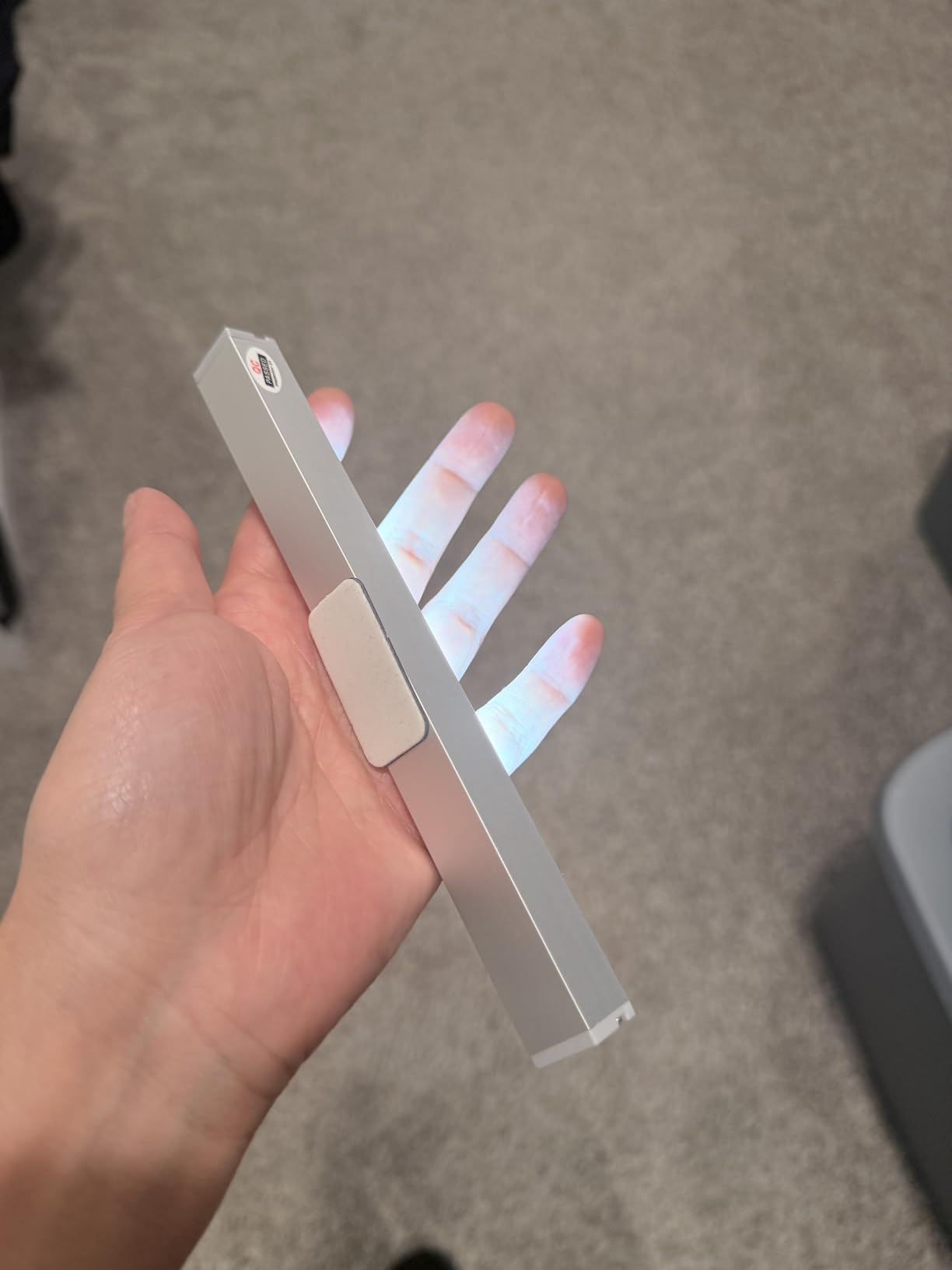
The GOODEA six-pack solves a specific problem that longer bars cannot: short cabinets and drawer banks where a 10-inch fixture overhangs the edge. Each light is 7.09 inches long and 0.59 inches square, which fits inside shallow wall cabinets, deep drawers, and narrow display cubbies that no other bar in this roundup will sit inside cleanly.
The 3-slot charging station charges three lights at once and doubles as the storage dock, so the six lights have a home between uses instead of a drawer. Individual USB cable charging is supported too, which is the fallback if one slot on the station fails.
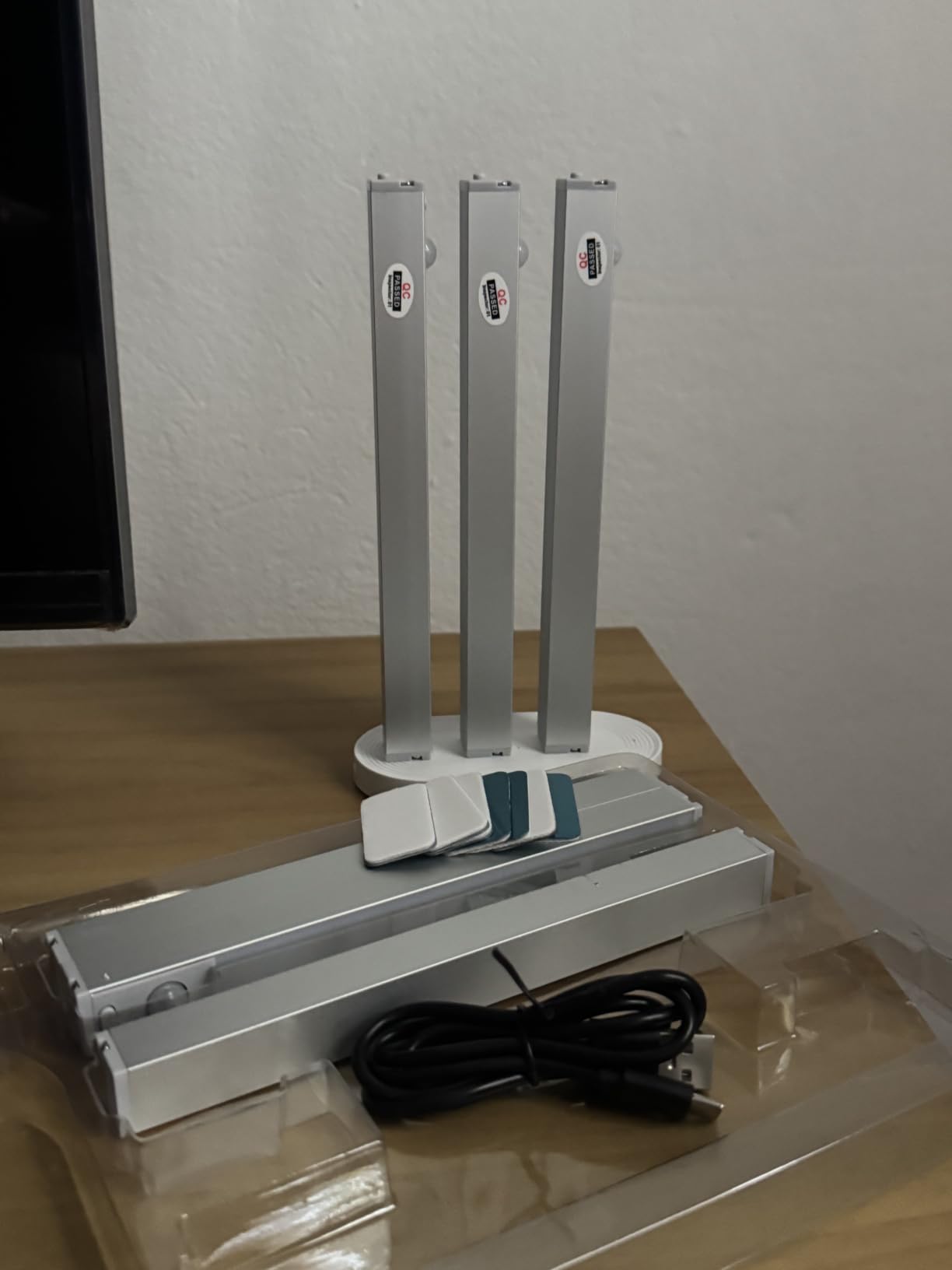
Installation is magnetic or adhesive iron sheets, both tool-free. Motion sensing triggers in dark environments and shuts off after about 25 seconds, which is the longest timeout in this group and helps conserve the battery in low-traffic spots.
Honest limitation: 95 lumens is the lowest output of any fixture here, and 7000K is fixed. This is accent and cabinet-interior lighting — you find the pasta, you check a spice shelf, you light a display. It will not work as task lighting over a cutting board. There is also no always-on mode, only sensor and off.
Where six small lights beat one big one
Fit. A 7-inch bar fits a cabinet with 8 inches of usable depth, a 10-inch bar overhangs by 2 inches and catches on cabinet hardware. In older homes with shallow cabinets, that difference decides the purchase before brightness ever enters the conversation.
Coverage breadth is the second advantage. Six lights spread across a pantry wall, a shelving run, or a series of drawers give you more usable light than one fixture trying to cover the same area, because each pool lands where you actually look.
The brightness ceiling nobody mentions
At 95 lumens, these lights are roughly one-fifth the output of a three-bar plug-in kit across the same span. That is invisible when you are opening a cabinet and obvious when you are trying to chop. If your goal is counter task lighting, this pack is the wrong tool and we would rather say so than have you discover it after mounting.
The 7000K cold white reinforces that. It is excellent for visibility and unkind to food color, so it reads clinical on a warm kitchen. For accents in a garage, laundry room, or storage area it is a genuinely good buy at six lights plus a dock.
10. ASOKO 12-Inch Linkable 3-Pack
ASOKO Under Cabinet Lighting, 4500K Daylight, 3 Pack 12 inch Linkable
1299 lumens across three bars
4500K soft white
Rotary dimmer 0 to 100 percent
ETL listed 24V plug
Pros
- Linkable design handles cabinets in multiple sections and corners
- Rotary stepless dimming with memory restores your last level
- 4500K reads crisp and natural
- Frosted PC cover gives even light with no visible LED dots
- Works with smart plugs and timers
Cons
- A barrel connector in a pack may not seat well and cause flicker downstream
- Adhesive on the wire-holding clips is weak
- AC DC transformer plugs are bulky
- About a one-second delay before the light comes on
- Bars and power supply run warm in extended use
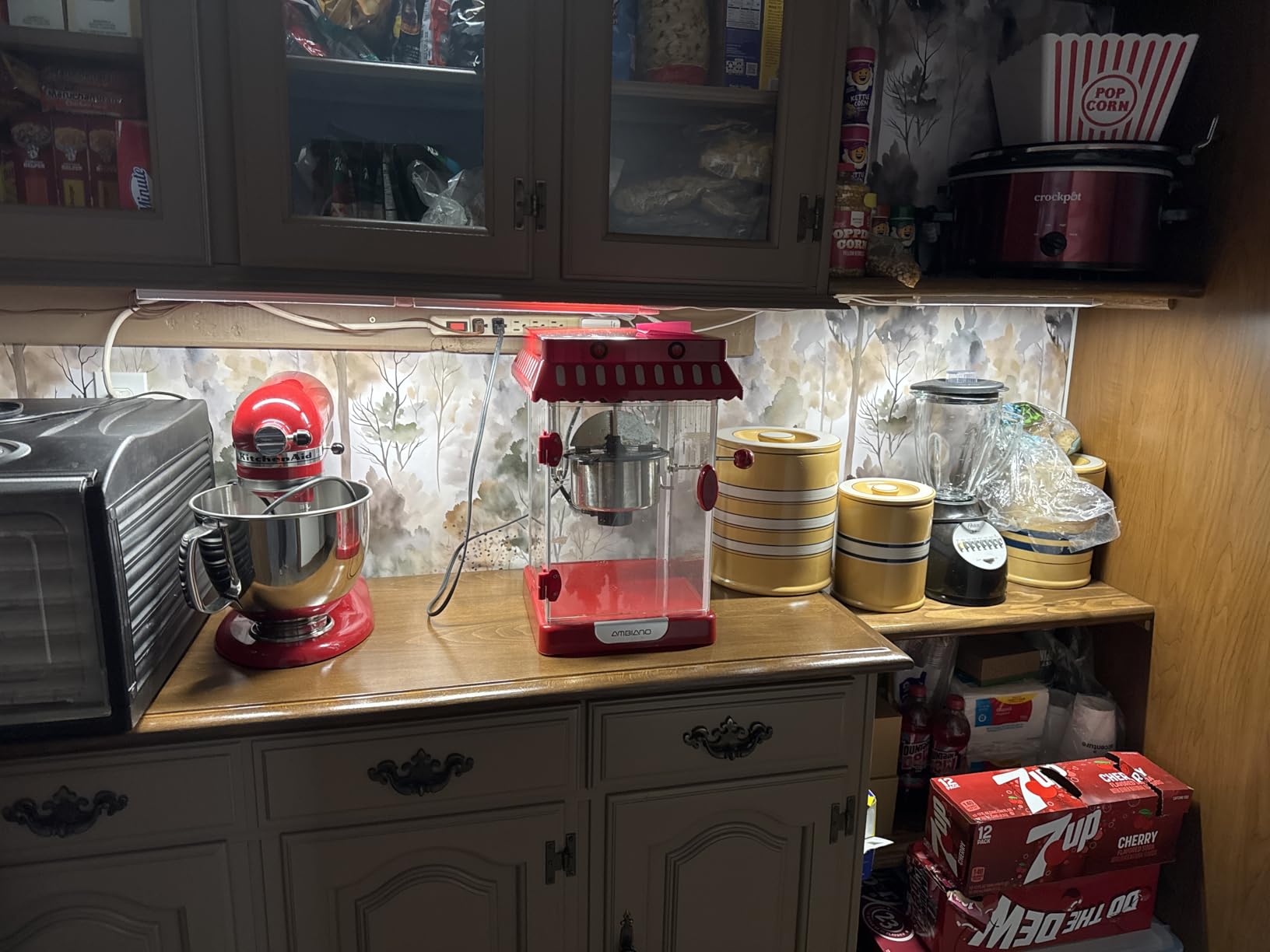
The ASOKO set is the most flexible plug-in system in the roundup, and the reason is the 24V architecture. Three 12-inch bars deliver 1299 lumens total, and because the system runs on 24V rather than 12V, voltage drop stays negligible over long chains. That is the technical fix for the dim far end that plagues cheap strip kits.
Bars link end-to-end with short barrel connectors for straight runs and with longer extension cables for corners. In practice that means one bar per cabinet bay in a straight wall, or a run that turns a corner using the cable connectors rather than cutting the strip. The ETL listed 24V plug feeds the chain from one outlet.
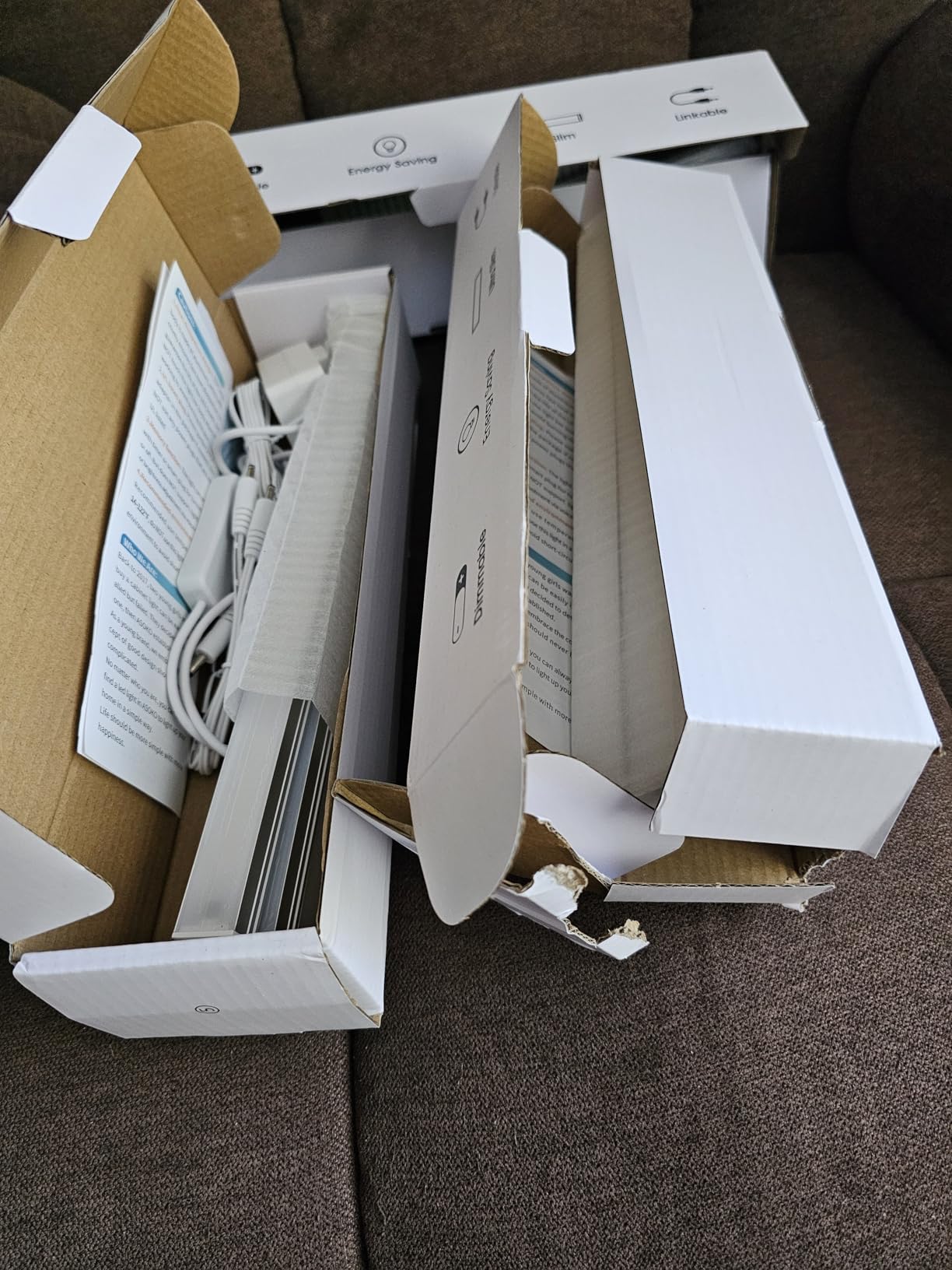
Output is 4500K with a frosted polycarbonate cover, and the listing is specific about the two complaints we hear most: no glare, no LED dots, no flicker. The 4500K tone sits close to natural daylight and does not fight warm cabinetry the way 6000K and 7000K options do.
The rotary switch dimmer runs 0 to 100 percent stepless with a memory function, which is a better control than the button-cycling on most rechargeable bars. Because the whole system is plug-in, it also works with a smart plug or timer, which is the practical route to voice control and scheduling here.
Honest limitations, and there are several worth naming: an occasional barrel connector in a pack may not seat properly, which causes flicker or a dim downstream bar until you swap it. The adhesive on the wire-holding clips is weak and gets replaced with stronger tape. The transformer plug is bulky and usually needs an extension cord to hide. And there is about a one-second delay between power on and the light coming up, which is noticeable when you trigger it with a smart plug.
Why 24V matters more than the brand name
Voltage drop is the reason the far end of a long cheap run looks dim. Current has to travel the whole length of the chain, and as resistance accumulates the last bar gets less power. Doubling the voltage at the same wattage roughly quarters the current, so the drop across the run shrinks dramatically.
In practice, on a straight 9 to 12 foot run, a 12V system visibly fades toward the far end and a 24V system stays even to the last bar. If your kitchen has a long counter, an island, or a peninsula, that difference is worth more than any feature on the remote.
Getting a clean install without the flicker
Buy one extra barrel connector and one extra short cable with the set. Connectors are the cheapest part of the system and the most common failure point, and swapping one takes a minute with no tools. Same for the clips — skip the adhesive entirely and use screws on the wire-holding clips so they cannot sag.
Clean every surface with isopropyl alcohol before mounting, and route the transformer to an outlet behind an end cabinet so the lead is not visible from the front. Allow for the one-second power-on delay when you choose a smart plug, because a light that lags feels broken even when it is working exactly as designed.
11. HARRRRD 24-Inch Hardwired Fixture at 3000K
24″ Hardwired Under Cabinet Lighting, 3000K Warm White, ETL 1250lm Dimmable
1500 lumens
3000K warm white with frosted lens
24 x 3.5 x 1 inch alloy steel
16W, UL 1598 conformant
Pros
- Fully wired install leaves no plug or cord clutter
- 3000K warm white with a frosted lens is gentle in the evening
- All mounting hardware including a Romex cable connector included
- 5-year warranty and a 50000-hour rated lifetime
- Range of lengths and color temperatures in the same line
Cons
- Hardwired only so it suits renovations not rentals
- Fixed color temperature per fixture with no tunable white
- Bulkier 3.5-inch width than slim plug-in linkable bars
The HARRRRD fixture is the warm hardwired option, and 3000K is the reason to pick it over the 5000K GETINLIGHT. Warm white under a cabinet changes the feel of an evening kitchen entirely: it flatters wood tones, it is easier on the eyes at 9pm, and it does not make a beige countertop look gray.
Output is 1500 lumens from a 16W module at 3000K, spread through a frosted lens across a wide area. That is the highest output of the two hardwired fixtures here. The housing is 24 inches long, 3.5 inches wide, and 1 inch tall, designed to fit under narrow cabinets.
All mounting hardware is included, including an NM/Romex cable connector and wire connectors, and the fixture is UL 1598 conformant with a 5-year manufacturer warranty and a 50,000-hour rated lifetime. The same line is available in 12, 18, 21, 24, and 36 inch lengths and in 2700K, 3000K, 4000K, and 5000K.
Honest limitation: it is hardwired only, so it is a renovation product. Color temperature is fixed per fixture rather than tunable, so matching a 4000K ceiling means ordering the 4000K version rather than adjusting this one. And at 3.5 inches wide it is a visibly deeper fixture than the 0.23-inch ASOKO bar, so it does not hide the way the slim plug-in options do.
How warm is too warm for prep work?
Below about 2700K, task lighting starts to cost you accuracy: reds get muddy and you have to work harder to judge doneness on meat. Between 3000K and 3500K you get warm light that still renders food colors honestly. This fixture sits at the warm end of the useful band, which is exactly right for a kitchen used mostly in the morning and evening, with overhead lights handling the middle of the day.
If your cooking is more midday or you want one tone for everything, look at the ASOKO 4500K or the Gritin with switchable temperatures. Matching your existing ceiling cans matters more than any preference between warm and cool, and that is the single decision that determines whether the installed light looks intentional.
Planning the install across a whole run
Because the line covers 12 through 36 inches, you can match fixtures to cabinet bays instead of forcing one length everywhere. A 24-inch fixture on a 24-inch bay, an 18-inch on a 18-inch bay, keeps the light source aligned with the cabinet above it, which is what makes a hardwired install look designed rather than fitted.
Budget the electrical work separately. Fixture and hardware are in the box, but the cable run from the nearest junction box is the part that determines whether this is a weekend project or a call to an electrician. Hardwired lighting work should be done or signed off by a licensed electrician; the payoff is a kitchen with no visible cord anywhere under the cabinets.
12. EZVALO RGB Puck Light 6-Pack
EZVALO RGB Under Cabinet Puck Lights with Remote, Motion Sensor Lights
50 lumens per puck
Three white tones plus 12 RGB colors
3.3 inch round ABS body
1000mAh rechargeable each
Pros
- Puck form places light exactly where a bar cannot reach
- Three white temperatures plus 12 RGB colors with Flash and Fade modes
- Remote controls all six lights at once
- Memory restores last brightness and color setting
- Magnetic discs
- adhesive plates
- and a built-in hanging hook
Cons
- 50 lumens per puck is accent lighting not task lighting
- Adhesive on the magnetic discs is weak and some fall down
- 1000mAh is the smallest battery here
- One reviewer warned against the included charging cable
Puck lights solve a placement problem that bars cannot. A 12-inch bar is a fixed length in a fixed spot; a 3.3-inch puck goes where you need it — inside a display cabinet, behind a bowl stack, in the back corner of a deep shelf where a bar would leave half the space dark. Six of them with one remote is a genuinely different way to light a kitchen’s storage.
This set adds 12 RGB colors and two dynamic modes, Flash and Fade, alongside three white temperatures at 3000K, 4200K, and 6500K. That is not useful for prep work. It is very useful for a display shelf, a bar cart, or seasonal decorations, and the remote reaches all six lights at once with 15, 30, and 60-minute timed stay-on.
Motion sensing covers 120 degrees at up to 10 feet, with day sensor, night sensor, and always-on modes. The memory function recalls your last brightness, white tone, and RGB color, so a display stays set the way you left it.
Honest limitations: 50 lumens per puck is the lowest output of any fixture in this roundup. This is display and accent lighting, full stop. The 1000mAh batteries are the smallest here, and some owners report roughly 12 hours of runtime in heavy use. The adhesive on the magnetic discs is also weak, so plan on screws or stronger tape if the pucks are mounted high or on a vertical surface.
Where pucks beat bars
Irregular spaces. A corner shelf, a diagonal cabinet, a glass display case, or the inside of a cabinet with a built-in drawer rack all defeat a fixed-length bar. A puck covers a 3.3-inch circle wherever you put it, and the built-in hanging hook means some can go on a rail or a shelf lip without adhesive at all.
Pucks also scale cleanly. One puck over a sink, three along a breakfast bar, six through a pantry wall — the count you need is a placement decision rather than a length calculation, and the remote handles all of them together.
What you give up for that flexibility
Even coverage. Pucks produce distinct pools of light with scalloped edges between them, which is precisely the complaint homeowners raise about puck lighting on glossy counters. On a counter you prep food on, that unevenness reads as sloppy. On a display shelf, nobody notices, because there is no work surface to light evenly.
One reviewer also reported that the included three-in-1 charging cable degraded batteries and damaged other devices charged with it. Use a known-good USB cable for anything you care about. The color options and remote control are the reason to buy this set, and they work as described.
Under Cabinet Lighting Buying Guide
Hardwired vs plug-in vs rechargeable: which power source fits
Power source decides more than price. It decides how the kitchen looks after installation, how often you touch the thing, and whether you need a contractor.
Hardwired is the only option with no visible cord, adapter, or power supply. It is the right choice in a remodel, in new construction, or anywhere an outlet is already within reach of the cabinet run. The tradeoff is installation: the fixture is fixed, and the electrical work needs a licensed electrician.
Plug-in is the middle ground. One adapter per run, cable routed along the top edge of a wall cabinet where it is barely visible, and no charging routine. Most plug-in sets here run on 12V or 24V; the 24V systems hold brightness better over long runs because the current, and therefore the voltage drop, is lower.
Rechargeable is the renter’s answer and the renovation shortcut. Magnetic and adhesive mounting, no cables at all, and a light you move when you rearrange. The trade is runtime, and the honest version is this: the quoted 7 to 45 day figures assume intermittent motion use in a low-traffic space. In a working kitchen, expect to charge a two-pack every three to four days in motion mode, and count on roughly 8 to 11 hours of always-on output at full brightness.
Whichever you choose, run the cable and adapter planning before you mount anything. The adapter position determines where the bars can go, and retrofitting that later means pulling the adhesive off cabinet bottoms.
Brightness: how many lumens per foot you need
Task lighting over a work counter wants roughly 200 to 350 lumens per linear foot of counter. Below that you are adding ambiance rather than usable light, which is a fine goal but a different one.
2-foot bay (24 inch): 400 to 700 lumens total.
3-foot bay (36 inch): 600 to 1000 lumens total.
4-foot bay (48 inch): 800 to 1400 lumens total.
8-foot run (96 inch): 1600 to 2800 lumens total, which is where linkable 24V systems earn their keep.
Rechargeable bars in this roundup sit at 95 to 180 lumens each, so a single bar handles one bay at most. The plug-in kits land between 1200 and 1500 lumens across three or six bars, which covers four to eight feet properly. If your kitchen has a run longer than six feet, budget for a linkable system rather than stacking loose bars.
Color temperature, and matching your overhead lights
Kelvin measures how warm or cool white light appears. For under-cabinet work, 2700K is warm and residential, 3000K is warm but still color-accurate for food, 3500K to 4000K is neutral and crisp, and 5000K to 6500K reads as daylight and clinic.
The rule that saves money: match your under-cabinet lights to your existing ceiling cans. Warm ceiling cans plus cool under-cabinet bars make the two sources look like two rooms. If you do not know what your cans are, look at the light in the evening — if it looks warm and slightly yellow, you want 2700K to 3000K. If it looks neutral to slightly blue, you want 4000K to 4500K.
On glossy quartz and marble, homeowners frequently pair a cooler strip with a cool-undertone counter and report the result transforming the surface. On warm wood or beige counters, staying at 3000K avoids a clinical look. If you cannot decide, 4000K is the middle that most rarely clashes.
Why you see LED dots and hot spots on glossy counters
This is the single most common complaint we found in homeowner forums about under cabinet lighting, and it has a specific cause. Individual LED diodes emit light in a narrow forward cone. On a matte laminate counter the cones blend together and nobody sees the pattern. On polished quartz or marble, the counter reflects each cone as a distinct bright dot.
Four fixes, cheapest first:
More LED density. Higher LED count per inch spreads each cone until it overlaps its neighbors. The ASOKO bars and the Gritin’s 84 LEDs per bar use dense arrays specifically for this reason.
A continuous diffuser. A frosted polycarbonate lens running the full length of the bar turns discrete cones into one even sheet. This is the single most effective fix and the reason the ASOKO listing calls out no LED dots directly.
An aluminum channel. A U-shaped channel with a diffuser lens both spreads the light and acts as a heat sink, which keeps the diodes at a stable color and extends their life.
COB strip lighting. Continuous-emitting COB strips put one continuous source under the diffuser rather than dozens of points, which is the professional answer for stone counters.
Mounting position also affects how visible the pattern is. Lighting aimed straight down puts every dot directly under the bar. Angling the beam forward toward the backsplash spreads the reflection across a vertical surface, where it is much less obvious.
Installation position and method
Where you mount the fixture changes the result more than which fixture you buy. Most people place the light at the very front edge of the cabinet and get a bright strip on the cabinet face and glare off the counter. The better position is roughly the front third of the cabinet depth, angled slightly forward toward the backsplash.
From there, the light spreads across the full depth of the counter, the shadow from your body drops away, and the countertop reads evenly instead of as a bright line with dark edges. Leave a small air gap between the fixture and the cabinet bottom so heat can move, and keep the driver or adapter at one end of the run rather than in the middle where it is visible.
For renters and no-drill installs, the options in this roundup are adhesive-mounted bars on a clean cabinet bottom, or magnetic bars on metal-framed cabinets. Clean surfaces with isopropyl alcohol before sticking anything down; dust and kitchen grease are the usual reason tape fails. Screw mounting, included with several of these kits, is more permanent but still avoids the electrician entirely. If you are also reworking storage, our kitchen cabinet organizer picks cover the interior-fitting side of the same project.
Dimmers, smart control, and long runs
Most hardwired fixtures here dim with a standard wall dimmer, which is the setup to trust because it is designed for it. Plug-in systems dim from their own controller or rotary dimmer, and pairing those with a wall dimmer is where flicker shows up. If you want to dim plug-in lights with a wall switch, look for a system rated for phase-cut control rather than assuming.
For smart control, the realistic path with plug-in systems is a smart plug on the outlet. That gives you voice control and scheduling without depending on an app. Users on homeowner forums report mixed reliability from app-based control on white-only LED strips, so a dumb switch that works is often the more reliable choice in a kitchen.
For runs over 8 feet, voltage drop is the real constraint. A 24V linkable system holds brightness across the chain where a 12V system fades toward the far end. For very long runs or a 24V professional system, products like Hafele Loox and Diode LED are the reference standard installers work to, which tells you what good looks like even if you are not buying one.
One safety note worth repeating: none of the fixtures in this roundup are rated for water exposure. Keep drivers and adapters away from sink splash zones and out of enclosed unventilated spaces.
Frequently Asked Questions
What is the best type of under cabinet lighting for a kitchen?
Linear LED bars or linkable strip systems are the best general choice for a kitchen because they spread light evenly along the counter rather than creating separate pools. Aim for 200 to 350 lumens per linear foot and match the color temperature to your existing ceiling lights. Battery motion bars suit rentals and quick installs, while hardwired bars look cleanest in a remodel.
Should under-cabinet lighting be 3000K or 4000K?
Match your under-cabinet lights to your existing ceiling fixtures. Warm ceiling cans call for 3000K, and neutral or cool cans call for 4000K. If you cook mostly in the evening, 3000K is easier on the eyes and flatters wood and beige counters. If your kitchen is used during the day, 4000K reads crisper and keeps food colors accurate.
How many lumens are good for under-cabinet lighting?
Plan on 200 to 350 lumens per linear foot of counter. A 24-inch cabinet bay needs roughly 400 to 700 lumens, a 36-inch bay needs 600 to 1000 lumens, and a 48-inch bay needs 800 to 1400 lumens. Rechargeable bars at 100 to 180 lumens each suit a single bay, while a long run needs a linkable system at 1600 lumens or more.
Why do my under cabinet lights show dots on the countertop?
The dots are individual LED diodes reflecting in a glossy surface such as quartz or marble. Four fixes work, cheapest first: choose higher LED density per inch, use a bar with a continuous frosted diffuser, mount the light inside an aluminum channel, or move up to COB strip lighting. Mounting the fixture in the front third of the cabinet depth and angling it toward the backsplash also hides the pattern.
Is hardwired under cabinet lighting better than plug-in?
Hardwired looks better because there is no adapter, plug, or cord anywhere under the cabinets, and it is the better choice in a remodel where electrical work is already happening. Plug-in is the sensible option for a rental or a single bay, since it installs in an afternoon with no electrician. The visual difference is only worth the cost across a full run.
Are battery under cabinet lights practical for daily use?
They are practical in pantries, closets, and low-traffic cabinets, where a charge lasts weeks. In an active kitchen, motion mode cycles constantly and reviewers report recharging every three to four days. Always-on runtime is roughly 8 to 11 hours at full brightness. For continuous daily task lighting, plug-in or hardwired is a better fit.
Conclusion
The MCGOR 10-Inch 2-Pack is our choice as the best under cabinet lights for kitchens in 2026 because it balances the three things that actually matter: even light from 40 LEDs under a frosted cover, five dimming levels, and a magnetic install that needs no electrician and no cables. It has the highest rating and by far the largest review base in this group, and the recurring complaint is about charging frequency in busy kitchens, not about light quality.
If your counter run is long, take the ASOKO 12-Inch Linkable 3-Pack instead — the 24V system holds brightness across a chain where cheaper 12V setups fade. If you are remodeling, the GETINLIGHT 24-Inch hardwired bar gives you 90 CRI color accuracy and a completely cord-free result. If you want warm evening light, the HARRRRD fixture is the one we would wire in.
Whichever you pick, mount it in the front third of the cabinet depth angled toward the backsplash, match the kelvin rating to your ceiling cans, and clean the surface before any adhesive goes down. Those three details decide whether the finished kitchen looks deliberate or improvised.