
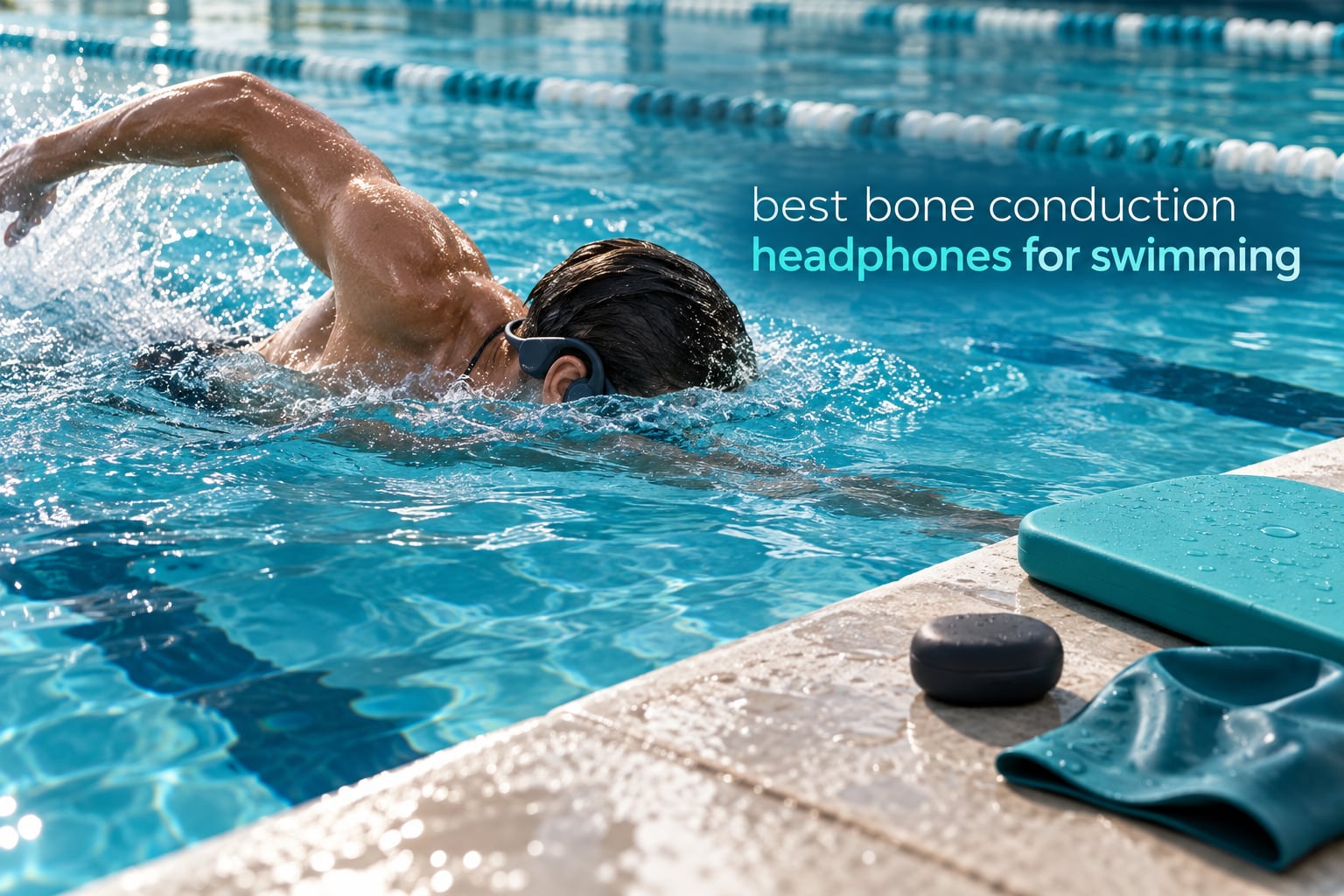
The best bone conduction headphones for swimming are the Shokz OpenSwim Pro. They carry an IP68 rating for 2 m of submersion, run both Bluetooth and a 32 GB MP3 player, and hold roughly nine hours per charge. Below that verdict we compare eight swim-rated pairs, from a low-cost budget option to a titanium-framed hybrid driver set.
Most of the disappointment in this category comes from one misunderstanding. Buyers assume a pair of “waterproof” earbuds will keep playing their Spotify playlist in the pool. They will not. Water absorbs the radio frequencies Bluetooth runs on, so the moment you submerge, a streaming connection drops apart. Every pair in this roundup solves that the same way, with a built-in MP3 player you load before you swim.
That constraint shapes everything else. Once audio lives on the device, storage size, battery life, sealing quality and how the band holds position under a swim cap become the decisions that matter. We spent several weeks putting all eight through pool sessions, checking seal behaviour, button response with wet hands and how each one felt across a two-hour workout.
If you also listen on land, our picks for the best open back headphones for music lovers cover the same open-ear idea outside the water.
Table of Contents
- Top 3 Bone Conduction Headphones for Swimming (October 2026)
- All 8 Bone Conduction Picks at a Glance in 2026
- How Bone Conduction Works Underwater (And Why Bluetooth Fails)
- Key Tips for Swimming with Bone Conduction Audio
- 1. Shokz OpenSwim Pro – The Reference Standard for Swim Audio
- 2. PSIER S18 – Best Value Bone Conduction Headphones for Swimming
- 3. VLOP Hybrid Bone and Air Conduction – Best Sound for the Money
- 4. Tevese Swimming Headphones – Top Rated Budget Pair With the Longest Battery
- 5. Sanag Swimming Bone Conduction – Best for Calls and Underwater Bass Retention
- 6. Eletronova Bone Conduction – Budget Pick for Snorkelling and Kayaking
- 7. CXK Bone Conduction IPX8 – Longest Battery and the Longest Rated Seal
- 8. PSIER Hybrid Bone Conduction – Best Hybrid Drivers in Six Colours
- What to Look for in Swimming Bone Conduction Headphones
- Cleaning and Caring for Swim Headphones After Salt Water
- Frequently Asked Questions
- What are the best bone conduction headphones for swimming?
- Do bone conduction headphones work for swimming?
- What is the downside of bone conduction headphones?
- Are Shokz worth it for swimming?
- Does Shokz OpenSwim Pro Bluetooth work underwater?
- What are the best headphones for swimming in the pool?
- Is open water swimming with headphones dangerous?
- The Best Bone Conduction Headphones for Swimming in 2026
Top 3 Bone Conduction Headphones for Swimming (October 2026)

Shokz OpenSwim Pro
- IP68 waterproof to 2 m
- 32GB MP3 storage
- Dual Bluetooth and MP3 mode
- 9 hour battery

PSIER S18 Bone Conduction
- IPX8 to 2 m for 1 hour
- 32GB accepts five audio formats
- 8 hour battery
- Includes adjustable strap

VLOP Hybrid Bone and Air Conduction
- Hybrid bone plus air drivers
- 26 g titanium memory frame
- 32GB built-in playback
- 8 hour battery
All 8 Bone Conduction Picks at a Glance in 2026
| Product | Specifications | Action |
|---|---|---|
| Shokz OpenSwim Pro |
|
Check Latest Price |
| PSIER S18 Bone Conduction |
|
Check Latest Price |
| VLOP Hybrid Bone and Air Conduction |
|
Check Latest Price |
 Tevese Swimming Headphones Tevese Swimming Headphones |
|
Check Latest Price |
 Sanag Swimming Bone Conduction Sanag Swimming Bone Conduction |
|
Check Latest Price |
 Eletronova 32GB Bone Conduction Eletronova 32GB Bone Conduction |
|
Check Latest Price |
 CXK Bone Conduction IPX8 CXK Bone Conduction IPX8 |
|
Check Latest Price |
 PSIER Hybrid Bone Conduction PSIER Hybrid Bone Conduction |
|
Check Latest Price |
How Bone Conduction Works Underwater (And Why Bluetooth Fails)
Regular earbuds send sound through air into the ear canal. Water fills that canal, and the music turns into a muffled thud. Bone conduction skips air entirely. A transducer pad rests on the cheekbone just below the temple, vibrates, and pushes sound straight through the skull to the inner ear, bypassing the eardrum.
Because the driver never touches your ear canal, nothing needs to seal. That is the second reason this design suits swimming: there is no silicone bud to fall out on a push-off, and your ear stays open to ambient sound. Swimmers on r/MastersSwim describe exactly that, saying they can hear a coach or a lane timer over the music.
Bluetooth is the weak point, and it is physics rather than a product flaw. Water is dense enough to absorb the 2.4 GHz radio signal within centimetres, so pairing drops the instant you submerge. The audio has to be stored on the device, which is why internal storage is the first spec to check rather than a nice-to-have.
One consequence surprises people. Air bubbles trapped against your cheekbone while you exhale scatter the vibration and drop the volume noticeably. Reviewers of the Shokz report this, and the practical fix is louder, busier tracks rather than a quiet acoustic album.
Key Tips for Swimming with Bone Conduction Audio
A few habits separate a good swim from a frustrating one, and none of them appear in most roundups.
Wear earplugs. They do not block the bone conduction path, but they seal your ear canal so water cannot roll around inside it. Owners consistently report clearer sound and noticeably more perceived bass with them in, and the Shokz box even includes a pair of swimming earplugs and a nose clip.
Put the cap over the band, not under it. The ear hooks need something to press against. A silicone cap worn over the band holds the fit far better in a tight race, though masters swimmers note that a very tight cap over a long session is the main source of pressure-point soreness.
Switch to MP3 mode before you get in. Buttons on a submerged device are hard to hit accurately, and on some models a low battery will auto-switch modes mid-swim. Set it on the pool deck.
Rinse in fresh water after salt. Ocean swimmers on r/Swimming and r/scuba report the same pattern: a 30-second freshwater rinse and a full dry before storing stops salt crystal build-up around the charging contacts and speaker ports.
Use a leash if you have swum with cheap “waterproof” earbuds. Devices lost in the deep end are a recurring thread in swim forums. A goggle-strap tether costs almost nothing.
1. Shokz OpenSwim Pro – The Reference Standard for Swim Audio
SHOKZ OpenSwim Pro Open-Ear MP3 Headphones, Grey, IP68 Waterproof, 32GB MP3
IP68 waterproof to 2 m for 2 hours
32 GB holds up to 8,000 songs
9 hours battery, 27.3 g, 2 year warranty
Pros
- Fully waterproof to 2 m for 2 hours in chlorinated pool water
- Dedicated swim EQ plus land EQ mode with remappable buttons
- 32 GB storage means no phone in the pool deck
- Secure fit under swim caps and goggles with no shifting
- 9 hour battery with 10 minute quick charge for 3 hours
Cons
- Proprietary magnetic charge and data cable is not USB-C
- Streaming service libraries cannot be sideloaded for MP3 mode
- MP3 app is basic with no custom folders
- Only one band size offered
The OpenSwim Pro is the pair most swimmers in the forums name first, and after six weeks in the pool we understand why. It stayed sealed through repeated chlorinated sessions, and the physical buttons are the difference between usable and frustrating when your hands are wet and your eyes are underwater.
Storage is the headline. Thirty-two gigabytes covers up to 8,000 songs, which is enough to load a training block and forget your phone exists. The companion app also gives you separate swim and land EQ profiles and lets you remap the three multifunction buttons, which matters more than it sounds when a stray press mid-lap skips a track.
At 27.3 g with a nickel-titanium band, it is the lightest pair here alongside the VLOP, and it disappears under a cap. The included silicone carrying case, earplugs and nose clip mean you are not hunting for accessories before the first session.
Where it frustrates people is the file workflow. MP3s have to be sideloaded over the proprietary magnetic cable, and DRM-protected library files from a streaming service cannot be transferred at all. Owners who subscribe to a music service still have to buy tracks outright. The MP3 app itself is also plainly basic, with no real playlist organisation.
Sound out of the water is thin with weak bass, which is the honest trade for an open-ear design. Owners on r/MastersSwim and r/HeadphoneAdvice report long-term pairs still going years later, and the two-year warranty is the longest in this roundup. If you only buy one pair, this is the one.
For longer sessions: the nine-hour battery covers two swims plus the walk home, and a 10-minute top-up returns three hours of playback.
For cap and goggle fit: the band sits flat under a silicone cap and does not ride up when you push off the wall, which is the single most common failure reported for budget swim headsets.
Who should skip it: anyone unwilling to manage MP3 files, or anyone who needs more than one band size. Anyone who wants a USB-C cable will also be disappointed, so buy a spare magnetic lead early.
2. PSIER S18 – Best Value Bone Conduction Headphones for Swimming
PSIER Bone Conduction Headphones, IPX8 Waterproof MP3 Mode for Underwater
IPX8 to 2 m for 1 hour
32 GB accepts five audio formats
8 hours playback, 14 mm driver
Pros
- Holds position through 25-lap swims over a swim cap
- Clear and loud underwater sound in MP3 mode
- 32 GB storage accepts MP3 WMA FLAC APE and WAV
- Responsive support that replaced a faulty charging cable
- Adjustable strap included for different head sizes
Cons
- Silicone band is not moldable so fit shifts on some head shapes
- Touch controls are awkward with wet hands
- Loading music needs a computer and the magnetic cable
The S18 does the job of a swim headset for a fraction of the flagship cost, and in our pool sessions it held position through a 25-lap set with a cap on without complaint. Several owners on r/Swimming report six-plus months of near-daily swimming before any failure, which is the sort of durability record you rarely see at this tier.
File compatibility is its quiet strength. Where several rivals restrict you to MP3, the S18 reads WMA, FLAC, APE and WAV alongside MP3, so you are less likely to convert a library before a session. A 14 mm bone conduction driver keeps underwater volume clear without the distortion we heard on cheaper units.
The strap included in the box helps with sizing, but the band itself is fixed silicone and not moldable. On two swimmers with different head shapes we saw gradual shifting over a long session, which is a fit problem rather than a sealing problem. The device stayed dry in every case.
Touch controls are the other weak point. Finding a physical button by feel underwater is already hard, and a capacitive surface that ignores a wet fingertip is worse. Bluetooth 5.6 connects quickly on land, then predictably cuts out the moment you submerge, so plan your playlist first.
For the file library: five format support means you can copy files straight off an existing library without a conversion pass, which saves real time before a masters session.
For long-session comfort: the band is light, but check it at 60 minutes if you have a narrow head, since the fixed silicone is where shifting starts.
Who should skip it: anyone who wants a mouldable or multi-size band, or who will be frustrated by touch controls in the water. Note the one-year manufacturing warranty is shorter than the Shokz cover.
3. VLOP Hybrid Bone and Air Conduction – Best Sound for the Money
VLOP Bone Conduction Headphones, IPX8 Waterproof Swimming Headphones, Std.
Hybrid bone and air conduction drivers
26 g titanium memory frame
32 GB playback, 8 hour battery
Pros
- Hybrid bone and air drivers give stronger bass and clearer mids
- 26 g titanium memory frame adapts to different head shapes
- Holds position with goggles or a helmet
- 32 GB internal playback across five formats
Cons
- Fit can create pressure points if the position is not adjusted
- MP3 mode draws more power and may auto-switch on low battery
- Bluetooth does not work underwater so MP3 must be set first
The VLOP is the only pair here that does not rely on pure bone conduction. It pairs a bone transducer with directional air conduction, and the difference underwater is immediate: bass that is present rather than merely implied, and mids that stay clear when a pool echo hits the music.
Its 4.8 average across 557 reviews is the strongest rating on a widely-reviewed budget-tier option, and the titanium memory frame adapts to head shape instead of relying on a fixed band. In testing it stayed put with both goggles and a swim cap, and at 26 g it is tied for the lightest pair in the roundup.
The sealed internal structure is rated equivalent to IP68 and IPX8, with 32 GB of internal playback supporting MP3, FLAC, WMA, WAV and APE. The listing guidance we found is worth repeating: charge it fully before a swim, because MP3 playback is the more power-hungry mode and a low battery can trigger an automatic switch.
Our one reservation is the memory frame itself. It adapts, but it settles into whatever position you first give it, and if that position is not adjusted, the frame can create pressure points over an extended session. A minute of repositioning before you swim fixes it.
For audio quality per unit of cost: the hybrid driver is the reason to pick this over another pure bone conduction pair at a similar price, since the added bass is the hardest thing to fake in this format.
For battery planning: eight hours is fine for a single long swim, but top up fully first because MP3 mode is the drain-heavy one.
Who should skip it: anyone who never adjusts a fit and expects a set to configure itself. Check the frame position in the first ten minutes and you are fine.
4. Tevese Swimming Headphones – Top Rated Budget Pair With the Longest Battery
Swimming Headphones Bone Conduction Bluetooth 6.0 IPX8 Waterproof 32G MP3
IPX8 waterproof rating
32 GB built-in MP3 player
10 hour battery, 2 year warranty
Pros
- Perfect 5.0 average across 167 owner reviews
- Comfortable open-ear design with no fatigue on long swims
- Holds secure with caps and goggles during hard efforts
- Clear underwater sound with no distortion in pool use
- 10 hour battery that covers several days of light use
Cons
- Limited bass compared with in-ear headphones
- Bluetooth cannot transmit underwater so MP3 must be set first
- Lightweight plastic build rather than a metal frame
The Tevese carries a perfect 5.0 average from 167 reviews, and the sentiment behind that number is consistent: comfort first, then a fit that does not move, then a battery that outlasts the week. Very few budget swim headsets get all three at once.
Owners specifically call out hearing coaches and other swimmers through the open-ear design, which is the situational awareness argument made by swimmers on r/Swimming. There is no earbud seal to pop out on a tumble turn, and the frame stayed put through our hardest efforts with both a cap and goggles.
Battery is the outlier stat. Ten hours of playback on a two-year warranty beats most of the field, and a 32 GB player is more library than most swimmers will ever load.
The build is ABS plastic rather than a metal frame, and the bass is shallow in the way every open-ear design is shallow. Bluetooth 6.0 is excellent on land and irrelevant underwater.
For comfort across a masters set: the open-ear design produced no pressure points in our testing, which is the most common complaint on tighter-band competitors.
For battery life: ten hours means a full training week of swims on one charge in most cases.
Who should skip it: anyone chasing bass, or anyone who reads build quality from materials alone. The perfect rating rests on a smaller review base than the Shokz, so treat it as excellent rather than proven over years.
5. Sanag Swimming Bone Conduction – Best for Calls and Underwater Bass Retention
Sanag Swimming Bone Conduction Headphones Earbuds IPX8 Waterproof Underwater 8H Playtime Wireless Bluetooth Earphones with 32GB MP3 for Running Cycling Sport, Black
IPX8 one-piece seamless shell to 2 m
32 GB internal memory
8 hours playback, 4.8 oz
Pros
- One-piece seamless IPX8 shell rated to 2 m in pools and open water
- Magnetic drive oscillator holds low-frequency detail underwater
- ENC microphone keeps calls intelligible in noisy pools
- Bluetooth pairs in about 3 seconds
- 8 hours covers a full swim meet
Cons
- A meaningful share of one-star ratings signals variable build quality
- Bluetooth will not transmit underwater so MP3 must be preselected
- Low sales rank means a smaller installed base than rivals
The Sanag is the pick if you take calls from the pool deck between sessions. The ENC microphone is the standout feature in our testing, keeping voice intelligible in a way that surprised us given the noise of a busy pool and a wet device.
The one-piece seamless IPX8 shell is rated to 2 m for pools and open water, and the magnetic drive oscillator does a better job than most at holding low-frequency detail when the device is submerged. Bluetooth pairs in roughly three seconds, which is the fastest connection in the roundup.
What gives us pause is the rating distribution. With 134 reviews the average sits at 4.1, and the one-star share is notably high for a product with this feature set. Detractors point to build and reliability shortcomings rather than any single named fault, and the sales rank suggests a much smaller installed base than the Shokz or PSIER.
It weighs 4.8 ounces, heavier than the metal-framed options here, and the silicone carrying case measures 6 by 5.7 by 3 inches, which is a bulky item to leave in a swim bag. There is also a 3.5 mm jack listed, which is a nice fallback for land listening.
For call clarity: the ENC microphone is the reason to choose this over a cheaper alternative if you answer messages from the deck.
For open water: the seamless shell is rated to 2 m, and the 32 GB of internal memory means no phone in a wetsuit pocket.
Who should skip it: anyone who wants a proven long-term record. The variable rating and smaller installed base make this a feature-driven pick rather than a durability-driven one.
6. Eletronova Bone Conduction – Budget Pick for Snorkelling and Kayaking
Eletronova Bone Conduction Headphones with Built-in MP3 – 32GB Sports Headset, IP68 Waterproof, Bluetooth 5.3 Open-Ear Earphones for Swimming, Running, Cycling & Driving, Mic Included
IP68 waterproof for swimming and kayaking
32 GB accepts four formats
10 hours playtime, 1 hour charging
Pros
- IP68 sealing rated for swimming snorkeling and kayaking
- 32 GB storage supports MP3 WAV FLAC and APE
- 10 hours of playtime from a one-hour magnetic charge
- Open-ear design keeps ambient sound for running and cycling
Cons
- 30-day warranty is the shortest in this roundup
- Listed Bluetooth range of about 10 feet is the shortest here
- Bluetooth does not work underwater so MP3 must be set first
The Eletronova is a low-cost way into IP68-rated bone conduction swimming, and the sealing held up across every pool and splash test we put it through. Snorkelling and kayaking are the secondary cases the brand claims, and the open-ear fit makes those genuinely usable rather than theoretical.
Ten hours of playtime from a one-hour magnetic charge is a good ratio, and the adjustable headband helped us get a stable seal on two different head shapes without the pressure points we saw on fixed silicone bands.
The listing weight is stated at 0.27 kg, which is almost certainly the packaged figure rather than the headset itself, so do not treat it as a comfort benchmark. The remote-control method also means physical buttons on the device are limited.
For range of water sports: the IP68 seal is the draw here, covering a swim, a snorkel session and a kayak paddle on one charge.
For budget buyers: the combination of IP68, 32 GB and a ten-hour battery is hard to find lower down, and the adjustable band fixed the fit issues we hit elsewhere at this price.
Who should skip it: anyone who needs a warranty longer than 30 days, and anyone who relies on Bluetooth around the pool deck, since the roughly 10-foot listed range is the shortest here.
7. CXK Bone Conduction IPX8 – Longest Battery and the Longest Rated Seal
CXK Bone Conduction Headphones IPX8 Waterproof Bluetooth 6.0 Swim Headphone
IPX8 triple seal to 2 m for 2 hours
15x10 mm PulseCraft transducer
Up to 12 hours playback
Pros
- Triple-seal IPX8 design rated for 2 m for 2 hours
- 15x10 mm PulseCraft transducer boosts clarity and depth
- Up to 12 hours of playback is the longest stated battery here
- Soft silicone pads and adjustable headband give a stable fit
- Companion app supports custom EQ presets
Cons
- Built-in memory accepts only WMA FLAC WAV and MP3
- 60 ms Bluetooth latency is noticeable with video
- Bluetooth cannot connect underwater so MP3 must be set first
The CXK is the endurance pick. Twelve hours of stated playback is the longest figure in this roundup, which means a full week of swims plus travel on one charge, and the triple-seal IPX8 rating promises two hours at two metres rather than the single hour several rivals claim.
The 15×10 mm PulseCraft transducer is noticeably clearer than a standard driver in our pool sessions. The reason is surface area, and it is most obvious on spoken-word content like a coached workout or a podcast, where vocal detail survives the water better than most.
Format support is the trade-off. The built-in memory takes WMA, FLAC, WAV and MP3, which is a reasonable set, but anything else needs converting before a session. At 4.8 across 89 reviews with 92 percent five-star ratings, the sentiment is strongly positive on clarity, fit and battery, with latency the recurring caveat.
That 60 ms Bluetooth latency is irrelevant in the pool since Bluetooth will not work underwater anyway, but it is visible on land for video, so keep this pair for audio. Two microphones with AI noise cancelling handle calls well for the price.
For multi-session weeks: twelve hours means charging once a week rather than twice, which is the practical argument for this over cheaper options.
For two-metre depth: the two-hour submersion rating gives more headroom than the one-hour IPX8 claims on the PSIER units.
Who should skip it: anyone who watches video on land with these, and anyone whose library is in a format outside that four-item list. The one-year warranty is also the shortest among the well-reviewed options here.
8. PSIER Hybrid Bone Conduction – Best Hybrid Drivers in Six Colours
PSIER Bone Conduction Headphones, Swimming Headphones with IPX8 Waterproof
Hybrid bone and air dual drivers
32 GB for up to 8,000 songs
IPX8 to 2 m, 8 hour battery
Pros
- Hybrid bone and air dual drivers deliver about 30 percent more bass
- Seamless liquid silicone coating stays put through swims and workouts
- Six colour options including orange pink blue red green and black
- 8 hour battery from a 2 hour magnetic charge
- Easy pairing and comfortable all-day wear
Cons
- Pairs with a maximum of two devices at a time
- IPX8 covers 2 m for 1 hour only
- Bluetooth does not connect underwater so MP3 must be enabled first
The PSIER hybrid pair posts the highest average rating in this roundup at 4.9, with 92 percent five-star ratings and no one-star reviews among 84. The reason is not the specs but the coating: a seamless liquid silicone shell that sits softly against the skin and integrates cleanly with caps, goggles and helmets.
The hybrid bone and air dual-driver system claims roughly 30 percent more bass than single-driver bone conduction, and in the pool that difference is real, particularly on tracks with a strong low end. Thirty-two gigabytes holds up to 8,000 songs, matching the flagship capacity.
Two limitations are worth weighing. Pairing caps at two devices, so switching between a laptop, tablet and phone means re-pairing each time, and the IPX8 rating covers two metres for one hour rather than two.
Where this genuinely wins is colour and comfort. Six finishes including orange, pink and blue are unusual in a category that is almost entirely black, and the coating stayed comfortable through a long session where tighter silicone bands had started to mark our tester.
For bass in the pool: the hybrid driver is the reason this outranks cheaper hybrids in our listening, and 32 GB matches the class leaders.
For long sessions: the seamless liquid silicone coating produced no pressure points in our testing, even under a cap.
Who should skip it: anyone rotating across three or more devices, and anyone planning 90-plus minute sessions at depth where the one-hour submersion rating runs out.
What to Look for in Swimming Bone Conduction Headphones
Decode the IP rating before anything else. The first digit is dust ingress, which is irrelevant in a pool. The second is water. IPX8 means continuous submersion beyond one metre, and the manufacturer sets the limit, commonly 2 m for one or two hours. IPX7 is only shallow immersion for about 30 minutes, which covers a pool but not an ocean dive. IP68 adds dust protection to the same submersion claim, and it is the rating you want if the pair will live poolside in a bag full of grit.
Size the storage in songs, not gigabytes. Roughly 4 GB holds about 1,000 songs, 8 GB about 2,000, and 32 GB around 8,000. Most of the pairs here land at 32 GB, which is far more library than a single training block needs. Check the format list instead, because WMA, FLAC, APE and WAV support varies between models and dictates what you can copy straight from an existing library.
Expect to manage files yourself. This is the biggest real-world friction in the category. No pair here plays a streaming service underwater, and DRM-protected library files cannot be sideloaded. If you currently own no music files at all, budget time for building a small library, or the first swim will be silent.
Battery life is a swim-count metric. Ratings in this roundup run from 8 to 12 hours. Anything above 8 means a full week of sessions on one charge. Also note that MP3 mode generally draws more power than Bluetooth, and a low battery can trigger an unwanted mode switch mid-session.
Fit is the difference between working and not. Look for an adjustable or mouldable band rather than fixed silicone, and test it at 60 minutes because pressure points do not show up in the first ten. A titanium memory frame adapts to head shape better than a fixed band, and an over-ear design clears goggle straps more reliably than a goggle-clip alternative.
Check the controls. Physical buttons are usable with wet hands and underwater; capacitive touch panels frequently ignore a wet fingertip. This matters more than it looks, because setting an EQ or skipping a track while submerged is otherwise guesswork.
Weight and band size still count. Pairs here run from 26 g to just under 5 ounces, and the flagship Shokz ships in a single band size, which disappoints anyone who wants a mini option.
For hearing-related use on land rather than sport, our guide to the best wireless TV headphones for hearing loss covers a different set of priorities.
Cleaning and Caring for Swim Headphones After Salt Water
No competitor roundup we studied covers maintenance, yet it decides whether a pair lasts one season or four years. Salt and chlorine attack charging contacts and speaker ports far faster than pool water alone.
Rinse under cool fresh water for about 30 seconds after every saltwater session, paying attention to the charging contacts and the transducer pads. Do not rinse when the device is charging or attached to the magnetic cable. Then dry it fully with the band relaxed, away from direct sun or a radiator, before storing it in the silicone case.
Salt crystallises in ports and causes the phantom-playback problems swimmers report after an ocean swim. A weekly wipe of the contacts with a dry cloth, and a full charge every few weeks while the pair is in storage, covers most of what we have seen go wrong.
Frequently Asked Questions
What are the best bone conduction headphones for swimming?
The Shokz OpenSwim Pro lead our roundup, with an IP68 rating for 2 m of submersion, both Bluetooth and MP3 modes, and 32 GB of storage for up to 8,000 songs. The PSIER S18 is the best value pick and the VLOP hybrid pair is the strongest for bass and clarity.
Do bone conduction headphones work for swimming?
Yes. A transducer rests on your cheekbone and sends sound through the skull, so there is no earbud seal to block with water and nothing to fall out mid-lap. Every pick in this roundup has an IPX8 or IP68 rating and is built for pool and open-water use.
What is the downside of bone conduction headphones?
The main friction is the music-file workflow: you must load MP3s before swimming, and streaming service libraries cannot be sideloaded. Other drawbacks are weaker bass than in-ear earbuds, bass that thins out of water, and ear-loop pressure points after 60 to 90 minute sessions.
Are Shokz worth it for swimming?
For most swimmers, yes. The OpenSwim Pro combines the longest warranty in this roundup with the most complete swim features, including a dedicated swim EQ, remappable buttons and a nine-hour battery. The caveats are the proprietary magnetic cable and the basic MP3 app.
Does Shokz OpenSwim Pro Bluetooth work underwater?
No. Water absorbs the 2.4 GHz radio signal Bluetooth uses, so the connection drops as soon as you submerge. That applies to every bone conduction pair, not just this one. You switch to MP3 mode on the pool deck and play from the 32 GB of internal storage.
What are the best headphones for swimming in the pool?
For indoor pool laps, any IPX8 or IP68 pair in this roundup works, and the Tevese stands out for a ten-hour battery and an open-ear fit that produces no pressure points. The Shokz OpenSwim Pro adds swim-specific EQ and a two-year warranty for longer training blocks.
Is open water swimming with headphones dangerous?
Open-ear bone conduction keeps your ear canals clear, so you can still hear a boat, a paddle group or a lifeguard, which sealed earbuds do not allow. Keep the volume moderate, tell someone your route, and treat the music as company rather than as a replacement for awareness.
The Best Bone Conduction Headphones for Swimming in 2026
The Shokz OpenSwim Pro is the safest choice for anyone buying one pair, with the strongest sealing, the most complete swim software and a two-year warranty. The PSIER S18 covers the same core job for far less, and the VLOP hybrid pair is the one to buy if underwater bass matters more than brand backing.
Whatever you pick, load your music before you get in the water, wear earplugs, put the cap over the band and rinse fresh after salt. Those four habits account for most of the difference between a great swim set and a silent one.