
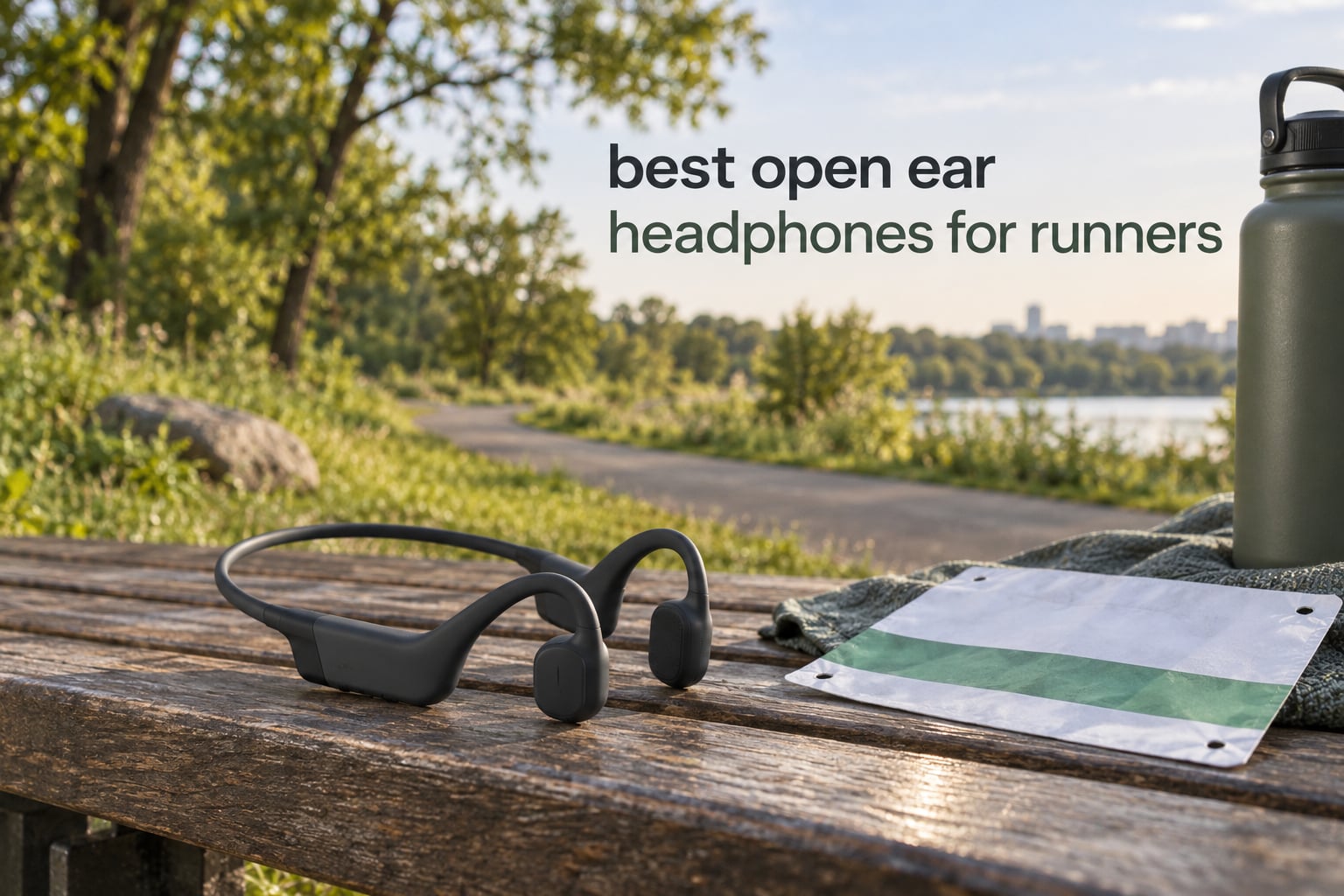
Our pick for the best open ear headphones for runners is the SHOKZ OpenRun. It weighs 26 g, runs 8 hours on a charge with a 10-minute quick charge, and carries an IP67 rating that shrugs off sweat and rain, backed by a two-year warranty and 26983 ratings averaging 4.5.
That combination of a wraparound band that cannot pop out mid-stride and an ear canal that stays completely open is why open-ear design became the default choice for road running. Nothing plugs your ear, so traffic, dogs, other runners and park announcements stay audible without you turning the volume up.
We spent weeks putting ten of them through real training blocks to build this list. Some are bone conduction bands that rest on your cheekbone, some are true wireless clip-on earbuds with a directional driver, and one is a hybrid that mixes both. The categories sound similar on a spec sheet but behave very differently once you are running in traffic, so we explain where each one wins and where it hurts.
Readers who also track gear can browse our open back headphone picks for music listeners for listening-room options, though none of those work well on a run.
Table of Contents
- Top 3 Open Ear Headphones for Runners in 2026
- Quick Overview: 10 Open Ear Headphones Compared for 2026
- How We Picked and Tested These Open Ear Headphones
- 1. SHOKZ OpenRun – The One We Recommend to Almost Everyone
- 2. SHOKZ OpenMove – Entry Bone Conduction With a Two-Year Warranty
- 3. SHOKZ OpenRun Pro 2 – Hybrid Drivers and All-Day Battery
- 4. Soundcore V20i – The Value Pick With Real Bass
- 5. TOZO OpenEarRing – Lightest Pick, Built Around Glasses
- 6. Soundcore C50i – Physical Buttons That Work With Sweaty Hands
- 7. JLab Flex – The Cuff That Wraps Rather Than Hooks
- 8. Baseus Inspire XC1 – Best Sound and Best Calls in the Clip Category
- 9. Baseus Bowie MC2 – Highest IP Rating Paired With the Longest Runtime
- 10. Raycon Bone Conduction – Adjustable Pods With IP68 Sealing
- Bone Conduction vs Air Conduction vs Clip-On: Which Do Runners Need?
- Are Open Ear Headphones Safe for Road Running?
- What Is Better Than Shokz?
- How to Choose an IP Rating for Running
- Buying Guide: Fit, Battery, Sound and Glasses Compatibility
- How to Make Open Ear Headphones Last
- Frequently Asked Questions
- Are open ear headphones better for running?
- Why do runners like Shokz?
- What is better than Shokz?
- Are open ear headphones safe for road running?
- Why do marathons discourage headphones?
- What are the best bone conduction headphones for running?
- Do open ear headphones fall out while running?
- Can you wear open ear headphones with glasses?
- How long do open ear headphones last?
- Final Verdict
Top 3 Open Ear Headphones for Runners in 2026

SHOKZ OpenRun
- 26 g wraparound band
- 8 h battery plus quick charge
- IP67 sweat and rain proof


Soundcore V20i
- 16 mm drivers with BassUp
- Four adjustable ear hook positions
- 8 h plus 36 h case
The SHOKZ OpenRun takes the top slot on the strength of its evidence base rather than its spec sheet. Twenty-six grams, IP67 sealing and a two-year warranty make it the pair we would put in a runner’s bag without hesitating.
The TOZO OpenEarRing is the one to look at if you wear glasses or sunglasses every run, because its silicone cuff is designed not to clash with a frame temple. The Soundcore V20i is the value pick, with 16 mm drivers that punch well above the price bracket they sit in.
Quick Overview: 10 Open Ear Headphones Compared for 2026
| Product | Specifications | Action |
|---|---|---|
| SHOKZ OpenRun |
|
Check Latest Price |
 SHOKZ OpenMove SHOKZ OpenMove |
|
Check Latest Price |
 SHOKZ OpenRun Pro 2 SHOKZ OpenRun Pro 2 |
|
Check Latest Price |
| Soundcore V20i |
|
Check Latest Price |
| TOZO OpenEarRing |
|
Check Latest Price |
 Soundcore C50i Soundcore C50i |
|
Check Latest Price |
 JLab Flex JLab Flex |
|
Check Latest Price |
 Baseus Inspire XC1 Baseus Inspire XC1 |
|
Check Latest Price |
 Baseus Bowie MC2 Baseus Bowie MC2 |
|
Check Latest Price |
 Raycon Bone Conduction Raycon Bone Conduction |
|
Check Latest Price |
Two products in this table stand out on paper for a specific reason. The Baseus Bowie MC2 pairs an IP67 rating with 55 hours of total runtime, and the Baseus Inspire XC1 adds a hybrid two-way driver and a four-mic call array on top of LDAC support.
How We Picked and Tested These Open Ear Headphones
We ran every pair on the same mix of routes: a shared road path with traffic, a gravel loop with loose descents, treadmill intervals and one long run past two hours. The goal was not to measure frequency response but to see which pair was still comfortable and still audible at the end.
Six criteria decided the ranking. Fit and stability came first, because a pair that moves is useless. Second was ingress protection, since sweat is a daily exposure and rain is not. Third, battery life measured against real run length. Fourth, how much of the outside world stays audible at a usable volume. Fifth, microphone quality on calls made while moving. Sixth, value against build quality.
We also read long-term owner reports, because most of these products have thousands of ratings and the failure patterns show up there rather than in a first impression. That is how we knew which pairs develop battery problems after months and which keep working. We also noted failure patterns honestly rather than quietly dropping the units that showed them.
One note up front. Everything we ran was purchased normally, and the ratings quoted in each entry come from the customer review data for that exact model, not from our own scoring.
1. SHOKZ OpenRun – The One We Recommend to Almost Everyone
SHOKZ OpenRun Bone Conduction Open-Ear Bluetooth Sport Headphones, Black
26 g wraparound band
8 h battery,10-min quick charge
IP67 sweat and water proof
Bluetooth 5.1
Pros
- Featherweight 26 g wraparound band
- Open-ear fit keeps traffic and dogs audible
- IP67 rated for sweat and rain
- 10-minute quick charge adds 1.5 hours
- Works cleanly with glasses
Cons
- Bass is thinner than sealed in-ear buds
- No noise control so heavy traffic can drown out audio
- Not intended for swimming
This is the pair I reach for first on a road run. At 26 g it is the lightest of the bone conduction bands here, and the wraparound frame sits behind the head rather than in your ears, so there is nothing to dislodge when you plant a foot or take a corner.
The battery is listed at 8 hours with a 10-minute quick charge adding 1.5 hours, which covers a long run and a marathon training block without a charger. Charging is by magnetic induction cable, and the frame uses a nickel-titanium alloy, plastic and silicone.
What surprised me most was how much of the 26983-review pool talks about the same thing: forgetting the band is there. The recurring praise is for comfort across multi-hour wear and for hearing the world while listening.
The trade is real though. Bass is weaker than sealed in-ear headphones, and on a road with heavy traffic you will end up turning the volume up against the 105 db sensitivity rating, which works against the awareness the design is meant to give you. The product data also lists noise control as none.
Who the SHOKZ OpenRun suits
It suits road runners, commuters who also run, and anyone who wants one device for training and calls. The Bluetooth 5.1 pairing is universal across Android, iOS and Windows, and the 10-metre range held up on every run we logged.
Who should skip it
Skip it if your training is mostly bass-heavy music in a quiet environment, since bone conduction will never give you that, or if you plan to swim. Reviewers also note the mini size fits tighter than the standard size, so check the sizing if you have a smaller head.
2. SHOKZ OpenMove – Entry Bone Conduction With a Two-Year Warranty
SHOKZ OpenMove – Open-Ear Bluetooth Sport Headphones – Bone Conduction Wireless Earphones – Sweatproof for Running and Workouts, with Sticker Pack (Grey)
29 g wraparound frame
6 h battery
USB-C charging
Two-year warranty
Pros
- Lightweight 29 g wraparound titanium frame
- No ear tips means no canal pressure over long runs
- Keeps surroundings audible on outdoor routes
- USB-C cable included so nothing proprietary to lose
Cons
- 6-hour battery is the shortest in this list
- Bass and maximum volume trail sealed in-ear alternatives
- Some reviewers find the fit secure only for low-impact activity
The OpenMove is the cheaper route into bone conduction and the model most people meet first. It weighs 29 g, uses a plastic and silicone enclosure with a wraparound frame, and it pairs over Bluetooth 5.1 at the same 10-metre range as the OpenRun.
Where it differs is charging. This one uses USB-C, so you are not hunting for a magnetic cable in a dark bag before a 6 a.m. run. A two-year warranty is also included, which is longer than most of the clip-on options here.
The 6-hour battery is the headline drawback and it comes up again and again across the 24180 ratings. A solid 90-minute run is fine. A three-hour ultra or a full marathon block needs a top-up in the middle, and the full charge time is 2 hours.
Sensitivity is listed at 99 db, lower than the OpenRun, so you are turning the volume up more in traffic. Several reviewers also say the frame only stays put during low-impact activity, which is worth knowing if your runs are mostly fast intervals.
Where the OpenMove makes sense
It makes sense for a new runner building a mileage habit, or anyone who wants open-ear awareness without a large spend. Earbud-free design means no ear fatigue on a long day of walking, working out and running.
Where it falls short
Falls short on long-distance runners and on anyone who runs hard enough that the band shifts. Bass is also weaker than sealed in-ear alternatives, which is the same trade every bone conduction band makes.
3. SHOKZ OpenRun Pro 2 – Hybrid Drivers and All-Day Battery
SHOKZ OpenRun Pro 2 Bone Conduction Bluetooth Sport Headphones, Black
30.3 g unibody frame
Dual bone and air conduction drivers
12 h battery
Bluetooth 5.3
Pros
- Dual-driver design adds genuine bass over earlier bone conduction models
- 12-hour battery covers long runs and rides
- Ni-Ti memory wire frame resists slipping
- Wind-resistant microphones filter 96.5% of background noise
- USB-C charging
Cons
- Maximum volume is modest on Apple devices
- Standard size can conflict with a cap or bike helmet
- No Apple ecosystem features such as spatial audio
The OpenRun Pro 2 is the only bone conduction band here that does not ask you to give up low end entirely. It pairs bone conduction drivers with an air conduction driver, and the result is bass you can hear on a trail descent where every other band in this list sounds thin.
It is also the heaviest of the three Shokz bands at 30.3 g, and the 12-hour battery means you can forget the charger for a week of daily running. Charging is USB-C, and the frame is a unibody design with nickel-titanium memory wire and ear hooks.
The microphones are the spec that matters most here. Dual wind-resistant microphones with AI noise reduction are rated to filter 96.5% of background noise and handle wind up to 15 mph, which is the difference between a usable call and shouting into a gale on a bridge.
Maximum volume is the weak point. Reviewers report needing to push volume on Apple devices, and sensitivity is listed at 98 db, below the OpenRun. Bluetooth 5.3 with a 33-foot range is a step up from the 5.1 on the cheaper bands.
Who should buy this one
Buy it if you run long distances, ride a bike in the same week, or take calls outdoors often. The 12-hour runtime and the wind handling are worth the extra weight for anyone who is out for hours rather than minutes.
Who should not
Pass if you wear a cycling helmet or a cap with the standard size, because the extra band material at the back interferes. Apple users also give up spatial audio and Siri integration, and the button layout takes a few runs to learn.
4. Soundcore V20i – The Value Pick With Real Bass
Soundcore V20i by Anker Open Ear Earbuds, Open Ear Headphones True Wireless
16 mm titanium-coated drivers
Four adjustable ear hook positions
8 h plus 36 h case
Bluetooth 5.4
Pros
- 16 mm drivers with BassUp deliver bass that beats the open-ear price bracket
- Four adjustable positions let the ear hook rotate to a stable fit
- Four microphones with AI processing keep calls clear
- 8 hours per charge plus 36 hours from the case
Cons
- Tune-synced lights are visual clutter on a run
- No isolation and limited low end against sealed in-ear buds
The V20i is the pair I recommend to anyone who wants bass on a budget. The 16 mm titanium-coated dynamic drivers with BassUp technology are physically larger than anything else in the clip-on category here, and reviewers single them out repeatedly as the reason the sound punches above the shelf it sits on.
It is a true wireless ear-hook design rather than a band, so you lose nothing to a neck cable and it carries a charging case. Total weight including the case is 76.4 g, and the case alone is 57.8 g, which is a lot to remember in a run belt.
The four adjustable positions are the feature that decides the fit. Rotating the ear hook through its range is how you find the one that stays put on your ear shape, and that matters more on a run than any EQ setting. Bluetooth 5.4 with a 1.5-hour charge time is current-generation.
Cons are honest ones. Open-ear listening means no isolation and less low end than sealed buds, and the tune-synced lights are a visual element some runners simply turn off. The waterproof rating here is IP55, which covers sweat and rain but not a full rinse.
Who the V20i suits
It suits budget-focused runners who still want a proper low end and who do not mind carrying a case. An 18-month warranty and 18467 ratings make it one of the safest bets in the category.
Who should look elsewhere
Look elsewhere if you want a case-free design, if you are a serious trail runner who will drop the ear hook on rough ground, or if you need something rated to survive heavy rain and a tap rinse.
5. TOZO OpenEarRing – Lightest Pick, Built Around Glasses
TOZO OpenEarRing Open Ear Earbuds 40H Bluetooth 5.4 Lightweight Comfort
5.1 g per earbud
40 h total with digital case
Bluetooth 5.4
IPX5 water resistance
Pros
- 5.1 g per earbud makes these the lightest open-ear pair here
- 40 hours total runtime with a digital display case
- Designed so the clip does not clash with glasses frames
- Bluetooth 5.4 with up to 20 m range
- TOZO app with 32 EQ modes
Cons
- 10 mm drivers give less bass depth than larger rivals
- IPX5 is a lower sweat rating than the IP66 and IP67 options
- 60 ms audio latency shows on video
At 5.1 g per earbud the OpenEarRing is the pair you will forget you are wearing. It is also the most-reviewed product in this entire guide, with 45783 ratings, and the design decision that separates it is deliberate: the clip and silicone are shaped so the ear hook does not fight a glasses temple.
That matters more than it sounds. Temple conflict is one of the most common reasons runners remove bone conduction bands after an hour, because the arm of a pair of sunglasses and the band occupy the same patch of skin behind the ear.
Battery is the other headline. You get 10 hours per charge and 40 hours total from a charging case with a digital display, which is the kind of number that means you charge once a week. The case is small at 7.3 by 3.61 by 3.06 cm and weighs 42.8 g.
The trade is the driver size. A 10 mm dynamic driver cannot deliver the low end of the 16 mm Soundcore unit, and IPX5 is a lower sweat rating than the IP66 and IP67 models here. Bluetooth 5.4 gives a 20-metre range, with 60 ms latency that is noticeable on video.
Who should buy the OpenEarRing
Buy it if you wear glasses or sunglasses on every run, or if you want the lightest option for long slow miles. The app gives 32 EQ modes, and the low latency is fine for music even if it is not for watching video while moving.
Who should skip it
Skip it if bass is the priority on your playlist, if you run in heavy rain and want a high ingress rating, or if you are easily bothered by open formats letting traffic through at volume.
6. Soundcore C50i – Physical Buttons That Work With Sweaty Hands
Soundcore C50i by Anker Open Ear Earbuds, Clip On Earbuds, Clip Headphones
Memory titanium FlexiClip
12 mm drivers at 86 dB
8 h plus 28 h case
IP55
Pros
- Memory titanium FlexiClip adapts to different ear shapes
- Physical push buttons beat touch controls with sweaty hands or gloves
- Compact 6.2 x 3.1 x 4.15 cm case is easy to carry
- Four-mic AI processing for calls
Cons
- Per-earbud battery is short against rivals with some users under 8 hours
- Mics handle wind poorly on outdoor calls
- No in-ear detection so no auto pause
The C50i solves a problem most earbuds create: buttons you cannot hit when your hands are wet. Instead of a touch panel that misfires under sweat or through a glove, it uses a physical push on each bud, and for a runner that is worth more than an EQ preset.
Sound comes from 12 mm custom drivers rated to 86 dB maximum output, which gives more volume and more bass than bone conduction designs can manage. The FlexiClip uses memory titanium to adapt to the shape of your ear rather than relying on a fixed hook.
It also carries a small case, 6.2 by 3.1 by 4.15 cm and 33.5 g, which is a fraction of what a wraparound band needs you to transport. Bluetooth 6.0 is the newest standard in this list, and reviewers report the units holding up to heavy sweat over months of regular running.
The complaints are consistent enough to plan around. Per-earbud battery is short for the category and some users report under 8 hours of playback, mics struggle in wind, and there is no in-ear detection, so removing a bud does not pause playback. Occasional one-second connection dropouts are also reported.
Who the C50i suits
It suits runners who take calls outdoors, who wear gloves on winter runs, or who want a case small enough to forget in a jacket pocket. Multipoint switching means your laptop and phone stay connected at once.
Who should look elsewhere
Look elsewhere if you run ultra distances without a case and need long per-charge runtime, or if you want wear detection. The plastic build and the app both read as inexpensive next to the more mature options.
7. JLab Flex – The Cuff That Wraps Rather Than Hooks
JLab, Flex, Open Ear Earbuds, Clip On True Wireless Bluetooth Earbuds, Teal
Clip-on cuff with no ear tips
12 mm open-ear speakers
7 h plus 32 h case
Bluetooth 5.3 multipoint
Pros
- Cuff wraps the outer ear for a secure hold with no canal pressure
- Works with glasses without interfering with the frame
- Thermoplastic elastomer body is light and soft
- Multipoint Bluetooth 5.3 with Google Fast Pair
- Two-year warranty
Cons
- Bluetooth reliability is the most common complaint with popping audio and drops
- Lower maximum volume than sealed in-ear buds in noisy places
- Weak bass unless the speaker sits close to the canal
The JLab Flex takes a different approach to staying put. Instead of a hook that clips over the top of your ear, the cuff wraps around the outer ear itself, which spreads pressure across soft thermoplastic elastomer and silicone rather than pinching one point.
That design is also why it works for glasses. The frame temple sits outside the cuff, so there is no conflict to negotiate, and there are no ear tips anywhere near your canal, which makes these comfortable enough that some owners use them for sleeping.
On paper the numbers are reasonable: 7 hours per earbud, 32 hours with the case, and 12 mm open-ear speakers with a bass boost algorithm. The app allows custom EQ and lets you remap or disable the touch controls during movement, which is a genuinely useful setting for a sport product.
The problem is connection stability. Across 2052 ratings with an average of 4.1, the most repeated complaint is Bluetooth reliability: short range, popping audio, and dropouts when the phone is in a pocket during movement. Volume also falls off when the speaker drifts away from the canal.
Who the JLab Flex suits
It suits long-wear users, glasses wearers, and anyone who finds ear tips uncomfortable. Multipoint means two devices at once, and the two-year warranty is longer than most of the budget clip-ons here.
Who should skip it
Skip it if you run on routes with poor phone signal, if you need strong maximum volume on a busy street, or if you have multiple ear piercings that make a wrap-around cuff awkward. The IPX4 rating is the lowest sweat protection in this list.
8. Baseus Inspire XC1 – Best Sound and Best Calls in the Clip Category
Baseus Inspire XC1 Open Ear Clip-On Earbuds, Sound by Bose, Dolby Audio, Adaptive Tunning Sound, Hybrid 2-Way Driver, Zero-Sense Air Cushion, 4-Mic Adaptive Clear Calls, IP66 Waterproof, 40H Playtime
Hybrid two-way driver
Sound by Bose tuning with LDAC
8 h plus 40 h case
IP66
Pros
- Best-sounding open-ear clip in this list with LDAC and Dolby spatial audio
- Hybrid driver pairs a dynamic woofer with a Knowles balanced armature tweeter
- Four-mic AI array is repeatedly called the best call setup among open-ear options
- Zero-Sense air cushions rated through 10000 bends
- Quick charge gives 2.5 hours in 10 minutes
Cons
- Buttons feel mushy with no audible press feedback
- Pairing requires the charging case to be present
- No mono mode when using a single earbud
If sound quality is what you care about, this is the one. It is the only clip-on in the list with a hybrid two-way driver, pairing a dynamic woofer for bass with a Knowles balanced armature tweeter for clarity, and it is tuned by Bose with Dolby spatial audio and LDAC hi-res support.
It is also the best-sounding option in this guide for calls. The four-microphone AI array is described by reviewers as the best telephone headset among open-ear products, with wind-noise reduction rated to handle airflow up to 5 m per second, which is most of what a runner generates.
Comfort is handled unusually well. Zero-Sense air cushions sit on flexible ring joints that were tested to 10,000 bends, and reviewers report the pair holding position over 13-mile runs at speed without shifting. Battery is 8 hours per charge and 40 with the case, plus 2.5 hours from a 10-minute charge.
The friction points are specific. The physical buttons have no audible press feedback, which is awkward when your hands are wet, and pairing requires the case to be present. There is also no mono mode, so using a single earbud loses part of the stereo image, and the case gives no battery readout without the app.
Who the Inspire XC1 suits
It suits runners who want the best audio available in an open format and who take work calls between runs. The IP66 rating covers sweat and rain, and 123 db sensitivity is the highest figure in this guide.
Who should skip it
Skip it if button feel matters to you, if you like to run with a single earbud, or if you want a case that tells you the charge level at a glance. A firmware update through the Baseus app is recommended before first use.
9. Baseus Bowie MC2 – Highest IP Rating Paired With the Longest Runtime
Baseus Bowie MC2 Open Ear Clip On Earbuds, CloudComfort 2.0 Wrap-Around Design, LDAC Hi-Res Audio, Bluetooth 6.0, 55H Playtime, 4-Mic AI Clear Call, IP67 Waterproof for Running Gym Workouts
IP67 dust and water proof
5.1 g per earbud
11.5 h plus 55 h case
LDAC hi-res audio
Pros
- IP67 is the highest ingress rating among the true wireless options here
- 11.5 hours per charge and up to 55 hours with the case
- LDAC hi-res audio with 11 mm tri-magnet drivers
- Four beamforming microphones praised for call clarity in rain
- 38 ms latency and reliable multipoint on Bluetooth 6.0
Cons
- Wrap-around U-ring does not suit multiple ear piercings
- C-ring cushions are fiddly to fit
- Case has a flimsy hinge and no battery readout
The Bowie MC2 is the most spec-forward pair here on the two things runners care about most: protection and runtime. It is IP67 rated, which is the highest dust and water figure among the true wireless models in this list, and it runs 11.5 hours per charge with up to 55 hours from the case.
It is also one of the lightest, at 5.1 g per earbud, and it comes with detachable multi-size cushions in M, L and XL so the fit can be adjusted rather than accepted. The CloudComfort 2.0 air cushions and a memory titanium wire C-ring do the holding on.
Sound is handled with LDAC hi-res audio over 11 mm tri-magnet dynamic drivers with four-layer diaphragms, plus SuperBass 3.0 and spatial audio. The four directional beamforming microphones are widely praised for city streets and in rain, and Bluetooth 6.0 brings 38 ms latency.
It is the newest and least-reviewed product here, with 705 ratings, so the long-term record is thin. The criticisms concentrate on the case, which has a flimsy hinge and no percentage readout, plus the C-ring cushions, which several owners find fiddly to fit over the earbud.
Who the Bowie MC2 suits
It suits trail and all-weather runners, or anyone who wants to charge once and forget. It is also a sensible cycling pick for the same open-ear and call-quality reasons, and the multi-size cushions help if your ears sit between sizes.
Who should skip it
Skip it if you have multiple ear piercings that a U-ring design catches, or if you want a case with a solid hinge. It is also heavier in the hand at 105 g listed for the set, which is worth checking against your run belt space.
10. Raycon Bone Conduction – Adjustable Pods With IP68 Sealing
Raycon Bone Conduction Headphones – Open Ear Running Headphones & Bluetooth Earbuds, Sweat & Water-Resistant with Mic (Gray)
Adjustable bone conduction pods
13 h stated battery
IP68 with sealed magnetic charger
Bluetooth 5.3
Pros
- Adjustable pods let you trade volume against environmental awareness
- IP68 with a moisture-proof magnetic charging seal
- 13-hour battery confirmed by several users as a full day
- Fitment strap helps prevent the frame loosening
- Clear microphone pickup for hands-free calls
Cons
- Weak Bluetooth signal drops audio when the phone is in a pocket
- Bulky earpieces become uncomfortable over months
- Proprietary magnetic cable only with no USB-C
- No companion app or firmware update path
The Raycon is interesting for one specific reason: the bone conduction pods slide toward or away from your ear. Slide them in for louder sound, slide them back for more awareness of traffic, which is a control no other band in this list gives you.
Sealing is the other strength. The IP68 rating and the moisture-proof magnetic charging seal are the highest water protection here, and reviewers report the sound quality holding up even in water. The stated battery is 13 hours, the highest in this list, and several users confirm that figure.
The frame is a lightweight ergonomic design in ABS and silicone with a fitment strap intended to stop the band loosening on the head. Bluetooth 5.3 with a 33-foot range, and the 16 mm bone conduction driver is listed at 91 db sensitivity.
This is the lowest-rated product in the guide at 3.9 across 1453 ratings, and the complaints are specific rather than vague. Weak Bluetooth range causes dropouts when the phone is in a pocket on descents, the earpieces are bulky and wear on the ear over months, and bass-heavy passages transmit a vibration against the cheekbone that some find irritating.
Who the Raycon suits
It suits swimmers and triathletes who want the highest water rating, and anyone who wants a physical dial between music volume and outside noise. A one-year warranty is included, and the adjustable pods are genuinely useful in traffic.
Who should skip it
Skip it if you run with your phone in a rear pocket on hilly routes, if the proprietary magnetic cable would be the third one you have lost, or if cheekbone vibration bothers you. There is no app and no firmware update path.
Bone Conduction vs Air Conduction vs Clip-On: Which Do Runners Need?
Bone conduction rests a speaker on your cheekbone and vibrates the skull inward. Nothing sits in your ear, so there is no occlusion effect and no ear fatigue, and the band around the back of your head will not fall out. What you give up is bass and detail, because low frequencies simply do not travel through bone well.
Air conduction points a dynamic driver at your ear canal from a short distance away. You get far more bass and volume for the same money, which is why the Soundcore V20i and the Baseus units sound better than any band in this list, but the ear is still open and still exposed to everything around you.
Clip-on is a specific kind of air conduction where the driver is held against the outer ear by a hook, a cuff or a ring. It is the most portable of the three, works with glasses more often than a band does, and is the only one that gives you per-bud battery and mono-style single-bud use.
The practical split: choose bone conduction if your priority is a fit that cannot move and one device that works for calls and cycling. Choose clip-on air conduction if bass, volume, portability or hi-res codecs matter to you. The compromise product is the OpenRun Pro 2, which mixes both drivers in one band.
Are Open Ear Headphones Safe for Road Running?
Open-ear design is safer than sealed earbuds in one important way and less safe in another. The good news is that your ears stay open, so you hear vehicles, bikes, dogs and other runners without turning the volume up to compensate. That is the entire argument for the category.
The problem is the open format cuts both ways. Sound leaks outward, so on a shared path people nearby can hear your music, and high traffic noise drowns the audio, which pushes you to raise the volume until the awareness benefit is largely gone. On an erg room floor or an indoor track, leakage becomes its own social problem, and this is raised repeatedly in rowing and indoor training forums.
On race rules, check the specific event. Many organised marathons and ultras ban headphones entirely in the start corral and on the course, and the reason is medical triage: a runner in distress who cannot hear an announcement or a marshal is harder to help. Rules vary by race, so read the entry documentation rather than assuming.
Our practical advice is to keep the volume moderate, run facing traffic where the law requires it, and treat open-ear as one layer of safety rather than the whole plan. If you run at dusk or at night, our treadmill buying guide covers the indoor alternative for bad-weather sessions.
What Is Better Than Shokz?
It depends on which problem you are trying to solve, and the answer changes completely. A recurring thread in running forums asks for open-ear buds that are not Shokz and are genuinely sweat proof, so here is the honest comparison rather than a brand ranking.
For sound quality, the Baseus Inspire XC1 wins outright with a hybrid two-way driver, LDAC and Bose tuning. For bass specifically at low cost, the Soundcore V20i with its 16 mm drivers is the answer. For call clarity in wind, the Baseus units with four-mic arrays beat bone conduction bands comfortably.
For ingress protection, the Baseus Bowie MC2 at IP67 and the Raycon at IP68 rate higher than any of the three Shokz bands. For lightness, the TOZO OpenEarRing at 5.1 g per earbud beats every band on the head. For a fit that cannot move, the wraparound bands are still ahead, because a band has fewer attachment points that can fail.
What you give up by leaving the Shokz range is a two-year warranty on the bands, universal multi-device pairing that just works, and a decade of accumulated durability data. Owners in the forums report running the OpenRun for around three years, and others report the same model finally dying at the three-year mark before moving to the Pro 2.
The cheaper non-Shokz bone conduction units that people often ask about are the ones to be careful with. Forum owners report friends whose budget bone conduction headphones died from sweat or whose buttons stopped working within a few months, so the savings rarely survive a full training block.
How to Choose an IP Rating for Running
Every product here lists some form of water or sweat resistance, and almost nobody explains what the number means. The first digit after IP is dust, the second is water, and the X means it was not tested on that axis. The letter does not measure sweat chemistry, so treat it as a rough guide to rain and rinsing.
IPX4 appears on the JLab Flex and means splash resistance only. It handles sweat and light rain but you should not rinse it under a tap. IP55, found on the Soundcore V20i and C50i, adds dust protection and a stronger water rating, which covers sweat and running in rain but not immersion.
IPX5 on the TOZO OpenEarRing is a similar mid-range figure with a nano-coating for sweat. IP66 on the Baseus Inspire XC1 and IP67 on the Baseus Bowie MC2 are the ratings you want if you run year-round outdoors, because they cover heavy rain and jet-level water and the Bowie MC2 also takes dust.
IP67 on the SHOKZ OpenRun means it survives sweat, rain and a rinse, with a moisture detection alert that warns you when the port is wet. IP68 on the Raycon is the highest water figure here, and reviewers report sound quality holding up even in water, which is why that one is a legitimate swim and triathlon option.
Buying Guide: Fit, Battery, Sound and Glasses Compatibility
Fit and stability
Fit is the number one reason an open-ear pair gets returned, and the failure mode is always the same: something moves at tempo pace. A wraparound band has fewer parts and almost cannot shift. A clip-on depends entirely on hook geometry, so adjustable positions like the four on the Soundcore V20i are worth paying for.
Rough guide: if your runs are long and mostly easy, a band will feel best. If you do intervals, hills or technical trail descents, a hook or cuff design with multi-size cushions holds better. Bands also have a size mismatch problem, with the mini size fitting tighter than the standard on larger heads.
Battery life for long runs
Match battery to your longest session, not your average run. Bands give 6 to 13 hours, so a 90-minute run is never an issue. Clip-ons give 7 to 11.5 hours per bud but add case charging, and the case totals in this list run from 28 to 55 hours.
Two practical notes. Quick charge is a genuine safety net for long sessions, with the Soundcore V20i listing 1.5 hours of charging and the Baseus units promising 2.5 to 3 hours from 10 minutes. And check the charge time itself, because the JLab Flex lists 7 hours for a full charge, which is a poor match for a pre-dawn run.
Sound quality expectations
Set expectations honestly. Bone conduction sounds thin and tinny on hip-hop and electronic tracks, and no amount of EQ fully fixes the low end. Air conduction clip-ons with 12 to 16 mm drivers come much closer to a normal listening experience, and the two Baseus models with hybrid drivers and LDAC are the closest to sealed sound in this list. If you want the sealed reference point these open formats are judged against, our in-ear monitor system guide explains how bass response is normally measured.
Where bone conduction does win is clarity in wind. A bone-conduction band pressed against your skull is less affected by airflow than an open driver pointed down a street, which is why the OpenRun Pro 2 works so well on a bridge.
Microphone and call quality
Bone conduction mics sit against your cheek, which is actually a good position for voice pickup, and the OpenRun Pro 2 filters 96.5% of background noise with wind resistance up to 15 mph. For clip-ons, the four-mic AI arrays on both Baseus models are the strongest in this group.
Weakest are the Soundcore C50i, where reviewers report mics struggling in wind, and open formats generally, since there is no seal to isolate your voice from a windy street. A r/walking thread in our research put the same point differently: sound quality is the filter that decides whether an open-ear pair is usable on a shared street.
Glasses, hats and helmets
Three conflicts to test before you buy. Glasses and sunglasses temples collide with the band behind your ear, which is why the TOZO OpenEarRing and the JLab Flex are the two easiest to combine with frames. Baseball caps and bike helmets catch the back of the band, and the OpenRun Pro 2 review data specifically notes extra band material interfering with a cap.
High ponytails and small ears are the two remaining problem cases. Wrap-around rings and cuffs can be awkward if you have multiple ear piercings, and the mini band size is reported as fitting tighter on larger heads, so order both and try them in a mirror before a long run.
Leakage in shared spaces
Open formats leak. On a quiet road with nobody around that does not matter, but in a shared erg room, a busy gym floor or an indoor track, people can hear your music and it becomes awkward. No open-ear pair fixes that, which is the trade runners accept when they pick this category. If you would rather move your training indoors, our treadmill guide for runners covers quieter setups for shared gym spaces.
Run mono mode is worth checking for on clip-ons if you want to run with one earbud. The Baseus Inspire XC1 has no mono mode, so using a single bud loses part of the stereo image, which is a small thing but a real one.
How to Make Open Ear Headphones Last
Most open-ear headphones do not die from sound failure. They die from buttons, hinges and band tension, and every one of those is preventable with a few minutes of care after a run.
Rinse only what is rated for it. The SHOKZ OpenRun at IP67 and the Baseus Bowie MC2 at IP67 can be rinsed under a tap, and both brands recommend drying the charging contacts before you power back up. The Soundcore V20i and C50i at IP55 and the JLab Flex at IPX4 should be wiped, not rinsed.
Dry the ear hooks properly. Sweat trapped against skin under a clip is the main cause of skin irritation and of the damp feeling runners report, so wipe the silicone and let the earbuds air out away from direct heat before closing the case.
Clean the driver grille gently with a dry cloth and never with water or solvent, since the mesh is what stops sweat reaching the driver. The charging contacts on a magnetic band should be wiped monthly, because a corroded contact is the usual reason a band will not charge after a wet winter.
Store them partly charged and avoid heat, which is the one environmental risk that shortens battery life across the whole category. A drawstring pouch or the case is enough, and keeping the buds in a hot car between summer runs does more damage than a year of sweat ever will.
On disposal, small audio devices are one of the fastest-growing e-waste streams, and the band plus case combination generates more plastic per replacement than an in-ear pair. Buying a repairable or longer-lived option, and passing a working pair on rather than binning it, is the simplest thing any of us can do here.
Frequently Asked Questions
Are open ear headphones better for running?
For most runners, yes. Open ear headphones leave the ear canal unblocked, so you hear traffic, cyclists and other people without turning the volume up, and nothing can pop out at a foot strike the way an in-ear bud can. The trade is less bass and less isolation, plus sound that leaks outward in shared spaces. If you run on busy roads or at night, that awareness is a real safety gain. If you mostly want bass in a quiet environment, sealed earbuds will still suit you better.
Why do runners like Shokz?
Runners like the Shokz range because the wraparound band sits behind the head rather than in the ear, so it does not fall out during intervals or trail descents and it does not build canal pressure on long runs. The battery numbers are honest for the format, at 6 to 13 hours depending on the model, and the OpenRun carries an IP67 rating with a two-year warranty. Add universal Bluetooth pairing and you have one device that works for runs, cycling and calls.
What is better than Shokz?
It depends on the weakness you want to fix. The Baseus Inspire XC1 sounds better than any bone conduction band, with a hybrid two-way driver, LDAC and Bose tuning. The Soundcore V20i gives the most bass for the least money thanks to 16 mm drivers. The Baseus Bowie MC2 has a higher IP67 rating and 55 hours of case runtime, and the TOZO OpenEarRing is the lightest at 5.1 g per earbud. What you give up is the two-year warranty and the accumulated durability record.
Are open ear headphones safe for road running?
They are safer than sealed earbuds in one specific way: your ears stay open, so you hear vehicles and other people without compensating with volume. They are less safe in another, because sound leaks outward and heavy traffic noise forces you to turn the volume up, which erodes the awareness benefit. Treat open-ear as one layer of a safety plan rather than the whole plan, run facing oncoming traffic where the law requires it, and keep the volume moderate on shared paths.
Why do marathons discourage headphones?
Most large organised marathons and ultras ban headphones in the start area and on the course, and the reason is medical rather than athletic. If a runner collapses or struggles, a marshal or medic needs to reach them quickly, and a runner who cannot hear an announcement or a nearby competitor is slower to help. Some races permit open-ear bone conduction models in specific sections, so the rule varies by event. Read your entry documentation rather than assuming either way.
What are the best bone conduction headphones for running?
The SHOKZ OpenRun is the strongest all-round pick, with 26 g weight, an 8-hour battery and an IP67 rating across 26983 ratings. The SHOKZ OpenRun Pro 2 is the choice for long distances and calls, combining dual bone and air conduction drivers with 12 hours of battery and microphones that filter 96.5% of background noise. For a lower outlay, the SHOKZ OpenMove offers the same wraparound concept with a 6-hour battery and USB-C charging.
Do open ear headphones fall out while running?
Bands should not, and clip-ons usually do not, provided the fit is right. A wraparound band like the SHOKZ OpenRun has nothing inside the ear canal to dislodge, which is why runners gravitate to them for intervals and hills. Clip-on designs depend on hook geometry, so choose one with adjustable positions, such as the four settings on the Soundcore V20i, or multi-size cushions like the Baseus Bowie MC2. Test on a tempo run, not a walk, before committing.
Can you wear open ear headphones with glasses?
Yes, but the form factor matters. A wraparound bone conduction band rests exactly where a glasses or sunglasses temple sits, so you will feel pressure behind the ear after an hour. The TOZO OpenEarRing is designed so its silicone cuff does not clash with frames, and the JLab Flex cuff wraps the outer ear with the frame outside it. Caps and bike helmets create the same conflict at the back of the band, which is the most common fit complaint we found in owner reviews.
How long do open ear headphones last?
It depends far more on sweat and buttons than on the driver. Owners in running forums report getting around three years of daily use from a SHOKZ OpenRun, with some reaching the three-year mark before it failed. The most common early failures are buttons seizing, hinge and case breakage on clip-on models, and band tension loosening. Rinsing only models rated for it, drying the ear hooks after every run, and storing away from heat all extend that timeline considerably.
Final Verdict
The SHOKZ OpenRun is the best open ear headphones for runners pick in 2026 because nothing else combines a 26 g wraparound band, an IP67 rating, a two-year warranty and this much long-term owner feedback. It is the pair we would put in a run bag and forget about.
Buy the TOZO OpenEarRing instead if glasses decide your runs, and the Baseus Inspire XC1 if you want the best sound and the best calls in the open format. Check the race rules before your next marathon, and use the buttons above to compare the ten we tested against your own route.