
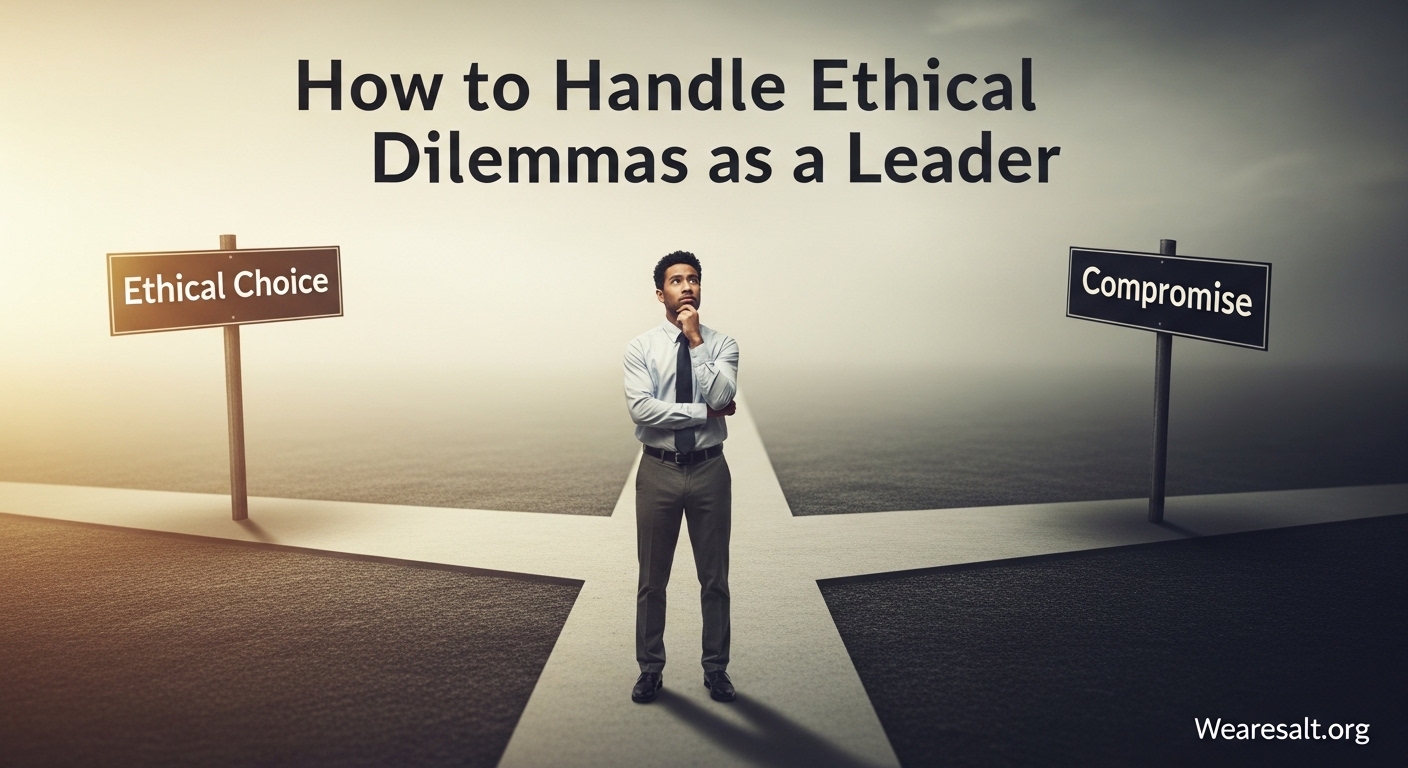
You are faced with a decision that makes your stomach turn. A senior executive asks you to present inflated numbers to the board. A team member confides they witnessed misconduct but fears retaliation if it gets out. Your company could save millions by using a supplier with questionable labor practices.
These are the moments that define leadership. Not the strategic plans or quarterly results, but the choices made when no option feels completely right. Learning how to handle ethical dilemmas as a leader is not about finding perfect solutions. It is about developing a reliable process for navigating moral complexity with integrity.
In my years of working with leaders across industries, I have noticed a common thread. The leaders who sleep well at night are not the ones who never face ethical challenges. They are the ones who have built a personal framework for making these difficult decisions. This guide will walk you through that framework step by step.
Table of Contents
How to Handle Ethical Dilemmas as a Leader
Handling ethical dilemmas as a leader requires a structured approach that balances competing values, considers stakeholder impacts, and aligns with core ethical principles. The process involves recognizing the ethical nature of a situation, gathering facts, consulting relevant parties, evaluating options through ethical frameworks, and taking decisive action while accepting accountability for the outcome.
Unlike routine business decisions, ethical dilemmas involve situations where there is no clear right answer. Different values conflict with each other. Stakeholders have competing legitimate interests. Organizational pressures push in opposing directions. The challenge is not simply solving a problem but navigating moral complexity while maintaining trust and integrity.
Research consistently shows that organizations with strong ethical leadership outperform their peers over time. Employees in ethical workplaces are more engaged, customers are more loyal, and the business avoids costly legal and reputational problems. But these benefits only come when leaders are prepared to handle the inevitable ethical challenges that arise.
Understanding Ethical Dilemmas in Leadership
Before you can handle ethical dilemmas effectively, you need to understand what they actually are and how they show up in leadership contexts.
What Is an Ethical Dilemma in Leadership?
An ethical dilemma occurs when you face a situation where you must choose between two or more options, and none of them is clearly right. These situations involve conflicting values, responsibilities, or stakeholder interests. Every choice has significant consequences, and there is no perfect solution available.
In leadership, ethical dilemmas often involve tensions between loyalty to individuals and responsibility to the organization, between short-term results and long-term values, or between different stakeholder groups with legitimate but competing needs. The complexity comes from the fact that reasonable people can disagree about the right course of action.
What makes leadership ethical dilemmas particularly challenging is that your decisions affect others. As a leader, you have power and authority that amplifies the impact of your choices. Your team members, customers, shareholders, and the broader community all have a stake in your decisions.
The 4 Main Types of Ethical Dilemmas
Understanding the different categories of ethical dilemmas helps you recognize them faster and apply appropriate frameworks. The four main types are:
Truth versus Loyalty: This dilemma pits honesty against allegiance. You might discover a colleague cutting corners and face the choice of reporting the behavior or staying loyal to a friend. Whistleblowing situations often fall into this category.
Individual versus Community: This involves tensions between what benefits one person versus what serves the greater good. Laying off employees to save a company, or favoring a high-performing toxic employee over team wellbeing, are examples of this type.
Short-term versus Long-term: This dilemma involves choosing between immediate gains and future consequences. Pressuring sales teams to hit quarterly targets using questionable tactics, or cutting safety investments to boost current profits, illustrate this tension.
Justice versus Mercy: This pits fairness against compassion. Firing a long-tenured employee who made a serious mistake, or applying policies rigidly when extenuating circumstances exist, are common examples leaders face.
Common Ethical Challenges Leaders Face
Forum discussions and real-world case studies reveal consistent patterns in the ethical challenges leaders encounter. The most common include pressure to compromise safety or quality standards, conflicts between profitability and social responsibility, handling misconduct by high performers or senior leaders, managing confidential information appropriately, and balancing transparency with appropriate discretion.
Many leaders report feeling unprepared for these moments. Formal business education often focuses on financial and strategic skills while neglecting ethical decision-making. The result is that capable leaders find themselves in difficult situations without a clear framework for navigating them.
A 7-Step Framework for Handling Ethical Dilemmas
When you face an ethical dilemma, you need a structured process to work through it systematically. This framework gives you that structure. I have refined it over years of helping leaders navigate difficult choices.
Step 1: Recognize and Define the Ethical Issue
The first step is recognizing that you are dealing with an ethical dilemma, not just a routine business problem. Ask yourself whether the situation involves conflicting values, significant consequences for stakeholders, or uncertainty about the right course of action.
Clearly define what makes the situation ethically challenging. Name the specific values in conflict. Identify who will be affected by the decision and how. Articulate why the right choice is not obvious. This clarity helps prevent the natural tendency to minimize or rationalize ethical concerns.
Common mistakes at this stage include dismissing the ethical dimension by calling it just a business decision, assuming there is a clear right answer without examining the complexity, or avoiding the issue altogether hoping it resolves itself. Resist these tendencies. Take time to properly define the dilemma.
Step 2: Gather All Relevant Facts
Before making any decision, collect the facts you need to understand the situation fully. What exactly happened? Who was involved? What are the specific circumstances? What policies, laws, or regulations apply?
Separate facts from assumptions and rumors. In emotionally charged situations, people often jump to conclusions based on incomplete information. Take the time to verify what you actually know versus what you have been told or assume.
Be thorough but do not let fact-gathering become an excuse for delay. Some ethical situations require quick action. Gather enough information to make an informed decision, then move forward. Perfect information is rarely available, and waiting too long can itself be an ethical failure.
Step 3: Identify Stakeholders and Their Interests
Every ethical decision affects multiple parties. Identify all the stakeholders who have an interest in the outcome. This typically includes employees, customers, shareholders, suppliers, the community, and potentially broader society.
For each stakeholder group, understand their legitimate interests and how they will be affected by different decisions. What do they stand to gain or lose? What rights do they have? What responsibilities do you have toward them?
Consider both direct and indirect impacts. A decision to outsource production might save money for shareholders but harm local employees and the community. A data privacy choice affects customer trust and potentially their safety. Mapping these stakeholder impacts helps you see the full picture.
Step 4: Consult Your Core Values and Organizational Ethics
Examine how the options align with your personal values and your organization stated ethical commitments. Most organizations have codes of ethics, mission statements, or value declarations that should guide decision-making.
Ask yourself which option you could defend publicly without embarrassment. Which choice aligns with the kind of leader you want to be? What would you advise someone else to do in this situation?
If your personal values conflict with organizational pressure, that is itself important information. Ethical leaders sometimes must choose between their position and their integrity. Understanding this conflict early helps you prepare for the potential consequences of standing by your principles.
Step 5: Evaluate Options Using Ethical Frameworks
Several established ethical frameworks can help evaluate your options systematically. You do not need to be a philosopher to apply them. They simply provide different lenses for examining your choices.
The utilitarian approach asks which option produces the greatest good for the greatest number. Calculate the benefits and harms for each stakeholder group and choose the option with the best overall outcome.
The rights-based approach focuses on protecting fundamental human rights. Which option best respects the dignity, autonomy, and wellbeing of affected parties? This framework is especially relevant when vulnerable populations are involved.
The justice approach emphasizes fairness and equality. Which option treats people impartially and distributes benefits and burdens equitably? This framework highlights concerns about discrimination and exploitation.
The virtue approach asks what a person of good character would do. Which option reflects the values you want to embody as a leader? This personal focus helps ensure your decisions align with your integrity.
Step 6: Make the Decision and Take Action
After working through the previous steps, you need to make a decision. Indecision is itself a choice, and often not the ethical one. Gather your courage and commit to a course of action.
Document your reasoning. Write down the facts you considered, the stakeholders you identified, the frameworks you applied, and why you chose the option you did. This documentation protects you if questions arise later and helps you learn from the experience.
Communicate your decision clearly to those affected. Explain your reasoning without becoming defensive. Be prepared for disagreement. Not everyone will agree with your choice, but they should understand how you reached it. Transparency builds trust even when people disagree with specific decisions.
Step 7: Reflect and Accept Accountability
After implementing your decision, take time to reflect on the outcome. Did it achieve what you intended? Were there unintended consequences? What would you do differently in a similar situation?
Accept accountability for your choice and its consequences. Ethical leaders do not hide from responsibility. If your decision caused harm you did not anticipate, acknowledge it and work to make things right. If the outcome was positive, recognize what you did well so you can repeat it.
Use the experience to strengthen your ethical judgment. Each dilemma you navigate builds your capacity to handle future challenges. Over time, this reflective practice develops the moral wisdom that distinguishes truly ethical leaders.
Building an Ethical Culture as a Leader
Individual ethical decision-making matters, but leaders also shape the ethical environment for their entire organization. The culture you create either supports ethical behavior or undermines it.
Leading by Example
Your actions speak louder than your words. Team members pay close attention to what you do, especially in difficult moments. When you prioritize ethics over convenience, you signal that integrity matters. When you cut corners or rationalize questionable behavior, you give permission for others to do the same.
Be transparent about your own ethical decision-making process. When appropriate, share how you worked through a difficult choice. This modeling helps team members develop their own ethical reasoning skills. It also humanizes the process, showing that even experienced leaders struggle with these questions.
Admit your mistakes openly. When you make an ethical error, acknowledge it, apologize to those affected, and explain how you will prevent similar mistakes. This vulnerability builds credibility and creates psychological safety for others to acknowledge their own ethical struggles.
Fostering Transparency and Open Communication
Ethical cultures thrive on transparency. Create channels where people can raise ethical concerns without fear. This includes regular team discussions about ethical challenges, anonymous reporting mechanisms, and explicit protection for whistleblowers.
Invite disagreement and questioning. When team members challenge decisions or raise ethical concerns, treat these as valuable contributions rather than insubordination. Ask probing questions yourself. Why are we doing this? Who benefits? What are the risks? This inquiry habit keeps ethical considerations visible.
Communicate about ethics regularly, not just during crises or compliance training. Discuss ethical scenarios in team meetings. Share articles about ethical leadership. Make ethics an ongoing conversation rather than a checkbox exercise.
Creating Accountability Mechanisms
Ethical cultures require systems that support and enforce ethical standards. Ensure your organization has clear codes of ethics, accessible ethics training, confidential reporting channels, and fair processes for investigating concerns.
Apply consequences consistently. When unethical behavior occurs, respond appropriately regardless of who is involved. Protecting high performers or senior leaders from accountability destroys trust and signals that ethics are optional for the powerful.
Recognize and reward ethical behavior. When team members make difficult ethical choices, acknowledge their integrity. When people raise concerns that prevent problems, celebrate their courage. What gets recognized gets repeated.
The 5 P’s of Ethical Leadership
A useful framework for building ethical culture is the 5 P’s of ethical leadership. These five elements work together to create an environment where ethics can flourish.
Purpose: Connect daily work to a larger mission that includes ethical considerations. People are more likely to act ethically when they understand how their work contributes to meaningful goals beyond profit.
Pride: Build organizational pride based on ethical reputation and principled conduct. When people feel proud of how their organization operates, they are motivated to maintain high standards.
Patience: Recognize that ethical results often take longer than shortcuts. Resist pressure for immediate results that compromise integrity. Model patience in your own decision-making.
Persistence: Stay committed to ethical principles even when it is difficult. Ethics are tested in hard times, not easy ones. Your persistence through challenges sets the standard for the organization.
People: Prioritize the wellbeing of people affected by organizational decisions. Treat employees, customers, and communities as ends in themselves, not merely means to business goals.
Real-World Scenarios and Applications
Theory is valuable, but practical application matters most. Let us examine how the framework works in specific scenarios drawn from real leadership challenges.
Scenario 1: Pressure to Cut Corners
You are leading a product launch that is behind schedule. The CEO privately suggests shipping the product without full safety testing to meet the quarterly deadline. Missing the deadline means lost revenue and potential layoffs. What do you do?
Applying the framework: First, recognize this as an ethical dilemma involving safety versus financial performance. Gather facts about the actual safety risks and the real consequences of delay. Identify stakeholders including customers who could be harmed, employees facing layoffs, and shareholders expecting returns.
Consult your values. Would you be comfortable defending this decision publicly if a customer was injured? Apply the rights-based framework. Customers have a right to safe products. Make your decision based on principle, not pressure.
Take action by presenting alternatives to the CEO. Propose a limited launch to tested markets, additional resources to accelerate testing, or a delayed launch with transparent customer communication. Document your concerns and recommendations. Accept that you might face career consequences for refusing the unethical request.
Scenario 2: Conflicting Stakeholder Interests
Your company must close a factory to remain competitive. Closing it will harm the local community that depends on the jobs, but keeping it open endangers the entire company and all its employees. How do you handle this ethically?
Recognize this as an individual versus community dilemma. Gather facts about the financial necessity and community impact. Map all stakeholders including factory workers, the local community, other company employees, customers, and shareholders.
Apply the utilitarian framework. Which option produces the best overall outcome? Apply the justice framework. How can you distribute the burden fairly? The decision might be necessary, but you can minimize harm through generous severance, transition assistance, and extended timelines.
Communicate transparently about the decision and your reasoning. Accept responsibility for the consequences. Learn from the experience to anticipate similar situations earlier in the future.
Scenario 3: Reporting Unethical Behavior by Superiors
You discover evidence that your direct manager is taking kickbacks from vendors. Reporting it could end your career at the company. Staying silent makes you complicit. What is the ethical path forward?
This is a truth versus loyalty dilemma. Gather solid facts and documentation before acting. Consult your values and the organizational code of ethics. Most codes explicitly prohibit retaliation for reporting legitimate concerns.
Consider your options using multiple frameworks. The rights-based view suggests reporting to protect the organization and ensure fair vendor selection. The virtue approach asks what kind of person tolerates corruption.
Take action by using established reporting channels. Start with ethics hotlines or HR if available. Document everything. If internal channels fail, consider external reporting to regulatory authorities. Accept that this might mean finding a new position, but you will leave with your integrity intact.
Frequently Asked Questions
What are the 5 P’s of ethical leadership?
The 5 P’s of ethical leadership are Purpose, Pride, Patience, Persistence, and People. Purpose connects work to meaningful mission. Pride builds reputation based on principled conduct. Patience accepts that ethical results take time. Persistence maintains principles through challenges. People prioritizes the wellbeing of all stakeholders affected by decisions.
What are the 5 C’s of ethics?
The 5 C’s of ethics are Competence, Character, Courage, Commitment, and Community. Competence means having the skills to recognize ethical issues. Character involves having strong moral principles. Courage is the willingness to act ethically despite pressure. Commitment means consistently prioritizing ethics. Community considers the broader impact of decisions on society.
How do you manage and resolve ethical dilemmas in a leadership role?
Manage ethical dilemmas by following a structured framework: 1) Recognize and define the ethical issue clearly, 2) Gather all relevant facts, 3) Identify stakeholders and their interests, 4) Consult your core values and organizational ethics, 5) Evaluate options using ethical frameworks, 6) Make a decision and take action with transparency, and 7) Reflect on the outcome and accept accountability.
What are the 4 main ethical dilemmas?
The 4 main types of ethical dilemmas are: Truth versus Loyalty, where honesty conflicts with allegiance to others; Individual versus Community, where personal benefit conflicts with collective good; Short-term versus Long-term, where immediate gains conflict with future consequences; and Justice versus Mercy, where fairness conflicts with compassion.
Conclusion
Learning how to handle ethical dilemmas as a leader is one of the most important investments you can make in your leadership development. Ethical challenges are inevitable. No organization, industry, or position is immune. What matters is not avoiding these moments but developing the capacity to navigate them with integrity.
The framework we have explored gives you a systematic approach for working through difficult decisions. By recognizing ethical issues clearly, gathering facts, considering stakeholders, consulting your values, applying ethical frameworks, taking decisive action, and reflecting on outcomes, you build both competence and confidence in handling moral complexity.
Remember that ethical leadership is not about being perfect. It is about being intentional. Every dilemma you work through strengthens your ethical judgment. Every difficult choice you make with integrity builds your character. Every mistake you acknowledge and learn from deepens your wisdom.
Start today by examining your own ethical framework. What values are non-negotiable for you? What processes will you use when facing dilemmas? How will you build an ethical culture in your sphere of influence? The leaders who make the biggest positive impact are those who have answered these questions and committed to leading with integrity, even when it is hard.