
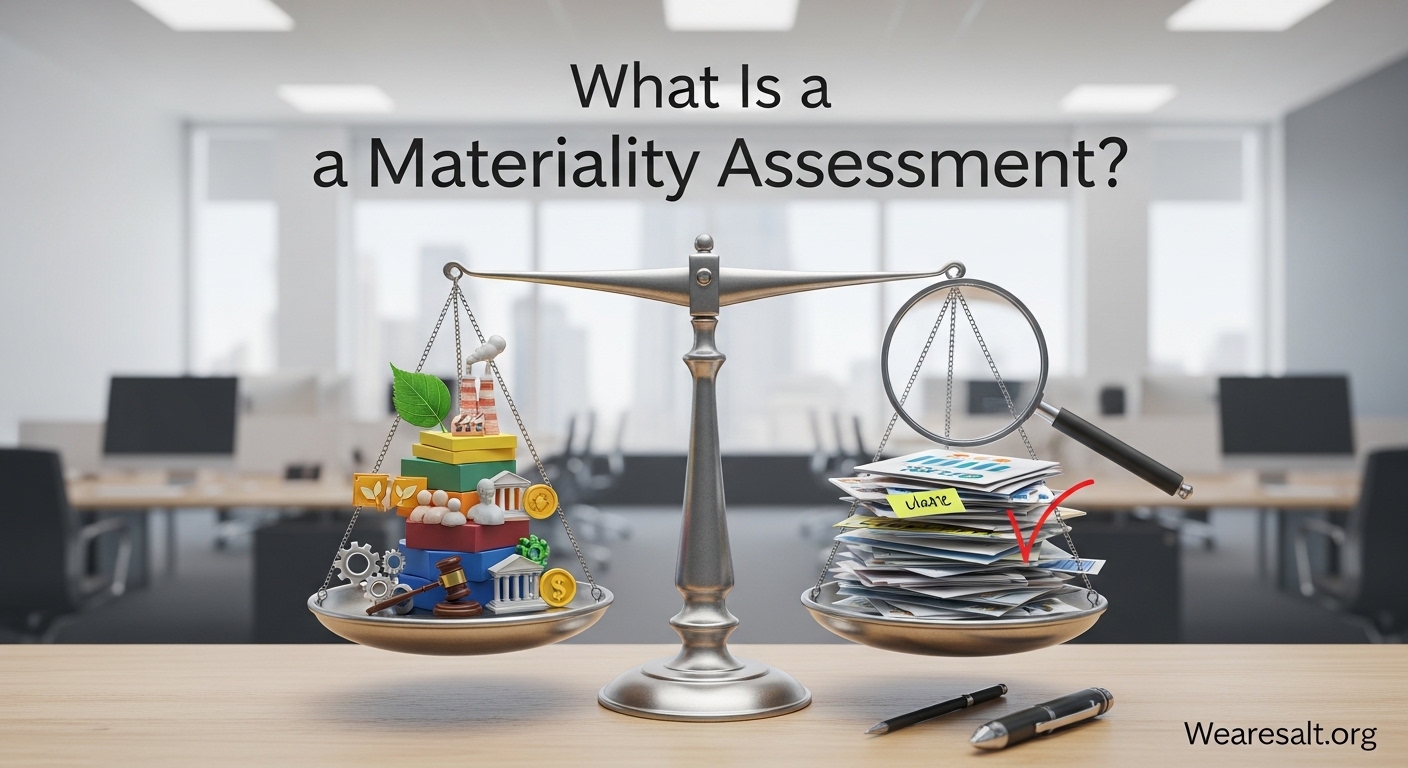
A materiality assessment is a structured process that helps businesses identify and prioritize the most significant environmental, social, and governance (ESG) issues relevant to their operations and stakeholders. Think of it as a strategic filter that separates the sustainability topics worth your attention from the noise. In 2026, with regulations like the Corporate Sustainability Reporting Directive (CSRD) reshaping how companies report on their impact, understanding materiality assessments has become essential for any organization serious about sustainability.
I have seen too many companies spread themselves thin trying to address every possible ESG issue under the sun. They publish 100-page sustainability reports that nobody reads because they are packed with irrelevant data. A materiality assessment prevents this by focusing your resources on what actually matters to your business and the people who care about it.
Whether you are a sustainability manager building your first ESG strategy, a consultant helping clients navigate CSRD compliance, or a business leader wondering where to start with sustainability reporting, this guide will walk you through everything you need to know about materiality assessments in 2026.
Table of Contents
What Is a Materiality Assessment?
A materiality assessment is a systematic process used to identify, evaluate, and prioritize ESG issues that are most significant to an organization and its stakeholders. The term comes from the accounting concept of “materiality,” but in the sustainability context, it has evolved to encompass much more than financial impact.
Materiality in Simple Terms
In everyday language, material simply means important or significant. When we talk about materiality in business, we are asking: “What issues are significant enough that they could influence the decisions of stakeholders or the success of the business?” A materiality assessment answers this question methodically.
Here is the key distinction that confuses many people. In traditional accounting, materiality refers to information that could influence the economic decisions of investors. If omitting or misstating a piece of information could change an investor’s decision, that information is material. In ESG and sustainability contexts, materiality has expanded to include impacts on the environment, society, and a broader range of stakeholders beyond just shareholders.
The Core Components
Every materiality assessment, regardless of company size or industry, involves four essential elements:
Stakeholder identification: Determining who has a legitimate interest in or is affected by your company’s activities. This includes employees, customers, suppliers, investors, regulators, local communities, and NGOs.
Issue identification: Creating a comprehensive list of potential ESG topics relevant to your business. This might include climate change, water usage, labor practices, data privacy, supply chain ethics, and dozens more.
Prioritization methodology: A structured approach to ranking issues based on specific criteria. Most organizations use a combination of stakeholder importance and business impact.
Validation and reporting: Confirming your findings with key stakeholders and transparently communicating the results in your sustainability reporting.
Why Materiality Assessments Matter
Conducting a materiality assessment is not just a box-checking exercise for sustainability reports. When done right, it becomes a strategic tool that shapes how your business operates and communicates. Here is why organizations are investing time and resources into these assessments in 2026.
Regulatory Compliance and Reporting Standards
The regulatory landscape has shifted dramatically. The European Union’s Corporate Sustainability Reporting Directive (CSRD), effective for many companies starting in 2026, requires double materiality assessments as part of mandatory sustainability reporting. Over 50,000 companies will need to comply with these requirements.
Beyond the EU, the International Sustainability Standards Board (ISSB) has released its first standards, and the SEC has introduced climate disclosure rules in the United States. While specific requirements vary, all these frameworks expect companies to demonstrate that they have identified and are addressing their most significant ESG impacts.
Strategic Resource Allocation
I have worked with companies that were spending millions on sustainability initiatives that their stakeholders barely noticed. Meanwhile, they were neglecting issues that kept their customers awake at night. A materiality assessment fixes this misalignment by ensuring your sustainability budget goes where it creates the most value.
Microsoft, for example, uses its annual materiality assessment to guide its environmental strategy. By understanding that cloud computing energy use and AI ethics are top concerns for their stakeholders, they can invest confidently in renewable energy and responsible AI frameworks.
Risk Management
Material ESG issues often translate into business risks. Water scarcity might threaten your manufacturing operations. Poor labor practices could disrupt your supply chain. Data privacy failures might trigger regulatory penalties. By identifying these material issues early, you can develop mitigation strategies before they become crises.
Stakeholder Trust and Reputation
In an era where consumers and employees increasingly make decisions based on company values, demonstrating that you understand and care about the issues that matter to them builds trust. Transparently sharing your materiality assessment process shows accountability and invites constructive dialogue.
How to Conduct a Materiality Assessment
Now we get to the practical part. How do you actually run a materiality assessment? While specific approaches vary based on company size and resources, the fundamental process follows seven clear steps. I have refined this approach over multiple engagements, and it works whether you are a startup or a Fortune 500 company.
Step 1: Define Your Scope and Objectives
Start by clarifying what you want to achieve. Are you conducting this assessment primarily for CSRD compliance? To inform your sustainability strategy? To engage stakeholders ahead of a major initiative? Your objectives will shape every subsequent decision.
Also define your boundaries. Will you assess materiality at the corporate level, or for specific business units? Will you include your entire value chain, or focus on direct operations? The CSRD requires value chain consideration, which adds complexity but provides a more complete picture.
Step 2: Identify Your Stakeholders
Map out everyone who has a legitimate interest in your company’s ESG performance. Common stakeholder groups include:
Internal stakeholders: Employees, management, board members, worker representatives
External stakeholders: Customers, suppliers, investors, regulators, local communities, NGOs, industry peers, media
For each group, consider their specific interests and how they might be affected by your operations. A community living near your factory cares about different issues than an institutional investor holding your stock.
Step 3: Compile Your Long List of ESG Issues
Create a comprehensive inventory of potential ESG topics. Do not filter yet. Common sources for this list include:
Industry-specific ESG frameworks like SASB standards
GRI Universal Standards topic list
ESRS topical standards under the CSRD
Issues raised in previous stakeholder engagements
Media coverage and NGO campaigns in your sector
Regulatory developments on the horizon
Most companies end up with 30 to 50 potential issues on their initial list.
Step 4: Gather Stakeholder Input
This is where the magic happens. You need to understand which issues your stakeholders actually care about, not just which ones you think they care about. Common methods include:
Surveys: Efficient for reaching large numbers of stakeholders. Online tools make distribution and analysis straightforward.
Interviews: Deep one-on-one conversations with key stakeholders provide nuance that surveys miss. I recommend conducting 10-20 interviews with representatives from your most important stakeholder groups.
Focus groups: Bringing together small groups of similar stakeholders can surface shared concerns and reveal areas of disagreement.
Document analysis: Reviewing existing feedback channels, complaint logs, media coverage, and regulatory filings provides additional input.
Step 5: Rate and Prioritize Issues
With input gathered, it is time to score each issue. Most assessments use a materiality matrix with two axes: importance to stakeholders and importance to the business.
Rate each issue on a scale (typically 1-5 or 1-10) for both dimensions. Importance to stakeholders comes directly from your engagement data. Importance to the business requires honest evaluation of strategic relevance, financial impact, and risk exposure.
Plotting these ratings creates a visual map of your material issues. The top-right quadrant contains your most material topics, those scoring high on both dimensions.
Step 6: Validate and Finalize
Before finalizing your material topics, validate your findings. Share the draft results with key stakeholders and your sustainability team. Does this align with their expectations? Are there any surprises that warrant reconsideration?
It is also worth benchmarking against peers. How do your material topics compare to companies in your industry? Significant deviations might indicate blind spots, or they might reflect genuine strategic differences.
Step 7: Report and Act
The final step is communicating your results and using them to drive action. Include your materiality assessment process and results in your sustainability report. Explain how you engaged stakeholders, what methodology you used, and which topics emerged as material.
More importantly, integrate your material topics into business strategy. Update your policies, set targets, allocate resources, and establish KPIs for each material issue. The assessment is only valuable if it drives real change.
Understanding the Materiality Matrix
The materiality matrix is the visual centerpiece of most assessments. It transforms complex stakeholder data into an intuitive format that supports decision-making.
How the Matrix Works
A standard materiality matrix displays ESG issues as points on a two-dimensional grid. The horizontal axis typically represents importance to external stakeholders, while the vertical axis shows importance to the business.
Issues in the top-right quadrant are your priority material topics. These matter significantly to both your stakeholders and your business success. The bottom-left quadrant contains low-priority issues. The other two quadrants represent areas of stakeholder concern with limited business impact, or business risks with limited stakeholder interest.
Reading the Quadrants
High stakeholder importance, high business impact: These are your must-address issues. They typically become the focus of your sustainability strategy and reporting. Examples might include product safety for a consumer goods company, or data privacy for a tech firm.
High stakeholder importance, low business impact: These issues matter to your stakeholders even if they do not directly affect your bottom line. Community relations and certain social issues often fall here. Addressing them builds goodwill and social license to operate.
Low stakeholder importance, high business impact: These are operational risks that stakeholders may not fully appreciate. Supply chain resilience or regulatory compliance often fit here. Internal management is crucial even if external communication is limited.
Low importance on both axes: These are non-material issues. Monitor them but do not dedicate significant resources unless circumstances change.
Using the Matrix for Strategy
Beyond prioritization, the matrix helps allocate resources and set boundaries. It justifies why you are focusing on certain issues while de-emphasizing others. When stakeholders question why you are not addressing a particular topic, you can point to the assessment process that determined it was less material than other priorities.
Single vs Double Materiality: What Is the Difference?
One of the most significant developments in sustainability reporting is the distinction between single and double materiality. Understanding this difference is essential for CSRD compliance and strategic clarity.
Single Materiality (Outside-In)
Single materiality takes an outside-in perspective. It asks: “What ESG issues outside the company could affect its financial performance or enterprise value?” This is the traditional approach used in financial reporting and many investor-focused sustainability disclosures.
For example, climate change is material from a single materiality perspective if it creates physical risks to your assets, transition risks from regulation, or liability risks from litigation. The focus is on how external ESG factors impact the business.
Double Materiality (Outside-In + Inside-Out)
Double materiality adds an inside-out dimension. It also asks: “How do the company’s activities impact the environment and society?” This perspective considers the company’s outward impact on people and planet, regardless of whether that impact creates financial risk.
For example, if your company operates in a water-stressed region, single materiality would flag water scarcity as a risk to your operations. Double materiality would also consider whether your water usage is affecting local communities’ access to water, even if that does not currently create financial liability for your business.
The CSRD and Double Materiality
The EU’s Corporate Sustainability Reporting Directive mandates double materiality assessments. This means companies subject to CSRD must report on both financial materiality (impacts on the company) and impact materiality (impacts by the company).
This requirement has significant implications for data collection and reporting. You need information not just about risks to your business, but about your actual impacts on stakeholders and the environment. This often requires new measurement systems and deeper value chain visibility.
Choosing Your Approach
If you are subject to CSRD, double materiality is not optional. For other organizations, the choice depends on your objectives. Single materiality may suffice if you are focused primarily on investor communication and financial risk management. Double materiality provides a more complete picture of your sustainability position and is increasingly expected by stakeholders.
Frequently Asked Questions
What is the meaning of materiality assessment?
A materiality assessment is a systematic process used to identify, evaluate, and prioritize environmental, social, and governance (ESG) issues that are most significant to an organization and its stakeholders. It helps businesses focus their sustainability efforts on the topics that matter most.
How do you conduct a materiality assessment?
Conducting a materiality assessment involves seven key steps: (1) Define scope and objectives, (2) Identify stakeholders, (3) Compile a long list of ESG issues, (4) Gather stakeholder input through surveys and interviews, (5) Rate and prioritize issues using a matrix, (6) Validate findings with stakeholders, and (7) Report results and integrate into strategy.
What is materiality in simple terms?
In simple terms, materiality means importance or significance. A material issue is one that is significant enough to influence stakeholder decisions or business success. In sustainability, materiality identifies which ESG topics a company should prioritize and report on.
What is the 5% materiality rule?
The 5% materiality rule is a guideline from traditional accounting, not ESG materiality assessments. It suggests that misstatements or omissions exceeding 5% of a relevant financial base (like net income or total assets) are generally considered material. ESG materiality uses different criteria based on stakeholder importance and business impact rather than fixed percentages.
Conclusion
A materiality assessment is the foundation of any serious sustainability strategy. It transforms vague good intentions into focused action by identifying the ESG issues that truly matter to your business and stakeholders. In 2026, with the CSRD bringing double materiality requirements to thousands of companies, understanding and conducting these assessments has moved from nice-to-have to essential.
The process takes effort. Stakeholder engagement requires time and relationship-building. Data collection and analysis demand resources. But the payoff is clarity. You will know where to focus your sustainability investments. You will be able to defend your priorities with evidence. You will build trust through transparent reporting on the issues your stakeholders actually care about.
If you are just starting out, begin with a simple assessment using the seven steps outlined in this guide. As you mature, you can expand to double materiality and more sophisticated stakeholder engagement. The key is to start. Your stakeholders are waiting to tell you what matters to them. The question is whether you are ready to listen.