
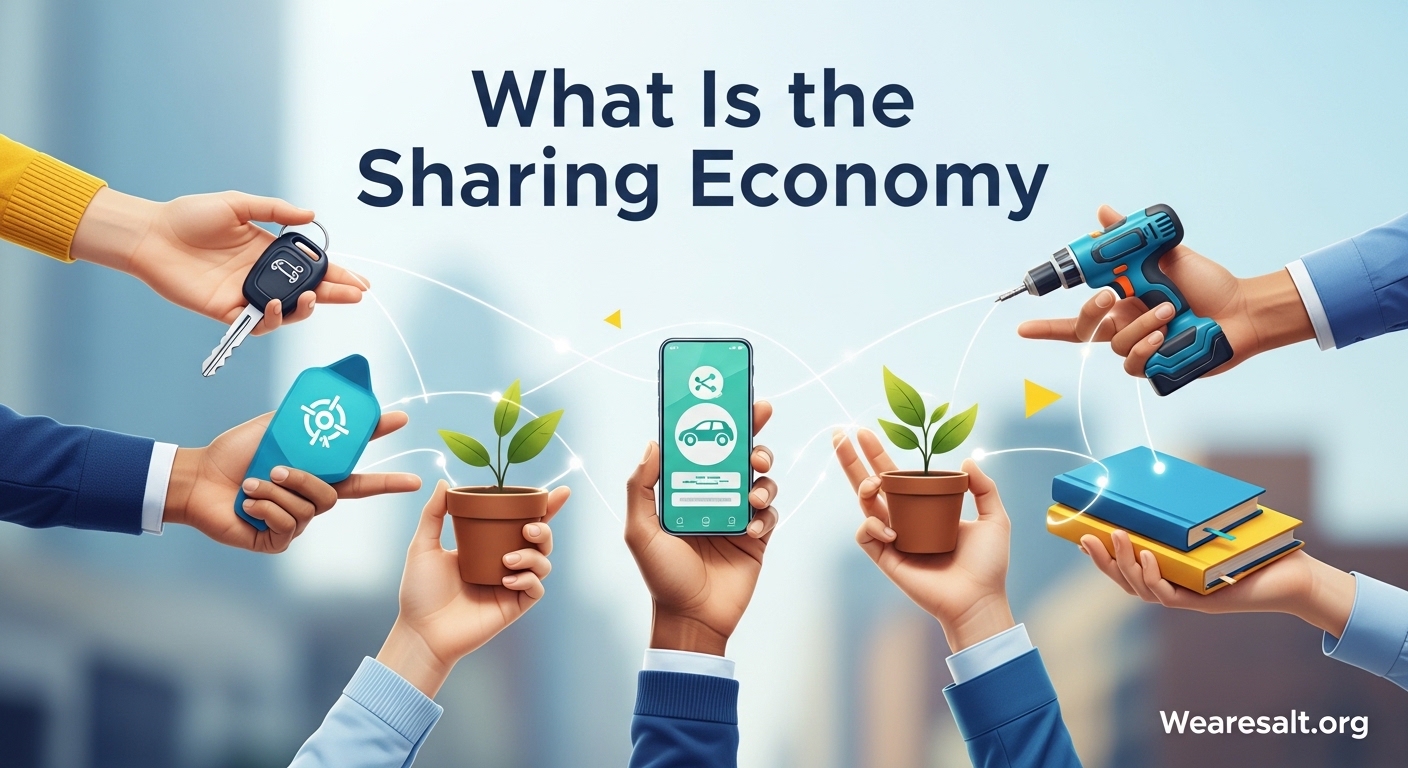
The sharing economy is a peer-to-peer economic model where individuals share assets and services through community-based platforms. It allows people to monetize idle resources and access goods without permanent ownership.
This economic system has transformed how we think about ownership, access, and community exchange in 2026. I have spent years researching these platforms and their impact on modern commerce.
- Peer-to-peer connections: Direct transactions between individuals, not corporations
- Asset utilization: Making use of underused resources like spare rooms or vehicles
- Digital platforms: Technology that connects providers with users efficiently
- Access over ownership: Renting or borrowing instead of buying
- Trust systems: Ratings and reviews that build confidence between strangers
In this guide, I will explain exactly how the sharing economy works, why it matters for your wallet and your community, and what you need to know before participating.
Table of Contents
What Is the Sharing Economy?
The sharing economy is a socio-economic system built on sharing underutilized assets and services between individuals. Unlike traditional commerce where businesses sell to consumers, this model enables peer-to-peer exchange through digital platforms.
At its core, collaborative consumption connects people who have resources sitting idle with those who need temporary access to them. A spare bedroom becomes a hotel alternative. A car parked in the driveway becomes a rental vehicle. These transactions create value for both parties while making more efficient use of existing resources.
The term gained popularity in the late 2000s as platforms like Airbnb and Uber demonstrated the viability of this model at scale. However, the concept itself is much older, dating back to traditional practices like tool libraries and carpooling.
The Evolution from Traditional Sharing
Human societies have always shared resources within communities. What makes the modern sharing economy different is the scale and efficiency enabled by technology. Digital platforms can now match thousands of providers with millions of users in real time.
Traditional sharing happened between neighbors and friends with limited reach. The access economy uses algorithms and mobile apps to create trust and facilitate transactions between complete strangers across cities and countries.
Some economists distinguish between true sharing and what they call the access economy. True sharing involves non-monetary exchange or cooperative ownership. The commercial version we see today focuses on short-term paid access to privately owned assets.
How Does the Sharing Economy Work?
The sharing economy operates through a simple but powerful mechanism. Platform companies create digital marketplaces where providers list their assets or services, and users search for and book what they need.
These multi-sided platforms solve a fundamental economic problem: matching supply with demand efficiently. When I need a drill for a weekend project, I can find someone nearby who owns one but rarely uses it. Both parties benefit from the transaction.
The Four Steps of a Sharing Economy Transaction
- Listing: An asset owner creates a listing on a platform, describing their resource, availability, and pricing
- Discovery: A potential user searches the platform and finds a matching asset based on location, price, and reviews
- Transaction: The platform facilitates payment, provides insurance or guarantees, and enables communication between parties
- Exchange: The physical asset or service changes hands temporarily, followed by ratings and reviews from both sides
Trust is the critical ingredient that makes these transactions possible between strangers. Platform economics rely heavily on reputation systems where user ratings create accountability.
Most platforms also provide insurance coverage, identity verification, and dispute resolution to reduce risk. These safety measures address the natural hesitation people feel about sharing with strangers.
Technology as the Enabler
Smartphones, GPS tracking, and secure payment processing make the sharing economy viable at scale. Mobile apps allow users to find and book resources instantly. Location services connect nearby providers and users. Digital payments eliminate the friction of cash transactions.
Big data and algorithms play a crucial role in optimizing these platforms. Pricing algorithms adjust rates based on demand. Recommendation engines suggest relevant listings. Fraud detection systems protect users from bad actors.
Key Characteristics of the Sharing Economy
Several defining features separate the sharing economy from traditional business models. Understanding these characteristics helps clarify what qualifies as genuine sharing economy activity versus standard rental or employment.
Peer-to-Peer Structure
The fundamental characteristic is peer-to-peer exchange between individuals rather than business-to-consumer transactions. When you rent from a traditional car rental company, that is B2C commerce. When you borrow a neighbor’s car through a platform, that is P2P sharing.
This distinction matters because it changes the power dynamics and economic relationships. Both parties are typically individuals, not corporations. The platform acts as an intermediary rather than the provider of goods.
Asset Utilization and Idle Resources
The sharing economy specifically targets underutilized resources. Studies suggest the average car sits idle 95% of the time. Spare bedrooms in homes often go unused. Tools in garages gather dust between projects.
By monetizing these idle assets, providers earn income from resources they already own. This creates economic value without producing new goods, which has significant environmental implications.
Access Over Ownership
A generational shift is driving interest in the sharing economy. Younger consumers increasingly prefer access to ownership. They want the benefit of using a product without the burden of storing, maintaining, and eventually disposing of it.
This temporary ownership model works particularly well for items used infrequently. You do not need to own a power washer that you use twice a year. Renting one when needed saves money and storage space.
Real-World Examples of the Sharing Economy
The sharing economy manifests across many industries and use cases. These examples illustrate how the model works in practice and demonstrate its versatility.
Accommodation Sharing: Airbnb
Airbnb is perhaps the most recognizable example of the sharing economy. The platform allows homeowners and renters to list spare rooms, apartments, or entire homes for short-term rental to travelers.
Hosts earn income from space that would otherwise sit empty. Guests access accommodations often cheaper and more unique than hotels. The platform handles booking, payment, and provides some insurance coverage.
Since its launch in 2008, Airbnb has grown to millions of listings worldwide. It has disrupted the traditional hospitality industry and changed how many people travel.
Ride Sharing: Uber and Lyft
Ride sharing platforms connect drivers using their personal vehicles with passengers needing transportation. Unlike traditional taxi services, drivers are independent contractors using their own cars on their own schedules.
The model creates flexible income opportunities for drivers while providing convenient, often cheaper alternatives to taxis for riders. GPS tracking, upfront pricing, and cashless payments differentiate these services from traditional transportation.
Whether Uber and Lyft truly represent the sharing economy is debated among economists. Some classify them as part of the gig economy since drivers provide labor rather than sharing idle assets.
Task and Service Platforms: TaskRabbit
TaskRabbit connects people who need help with tasks to individuals willing to perform those services. Tasks range from furniture assembly to grocery shopping to virtual assistance.
This model represents service-based sharing rather than asset sharing. Taskers monetize their skills and available time. Clients get help without hiring permanent employees.
Car Sharing: Getaround and Turo
Car sharing platforms like Getaround and Turo let car owners rent their vehicles when not in use. This is distinct from ride sharing: you are renting the car itself, not a driver service.
Owners earn money during hours their car would otherwise sit parked. Renters get vehicle access without the costs of ownership. These platforms often include insurance and roadside assistance for peace of mind.
Co-Working Spaces: WeWork and Local Variants
Co-working spaces represent a form of shared office space. Freelancers, remote workers, and small businesses rent desk or office space temporarily rather than leasing permanent premises.
This model reduces overhead for small businesses and provides professional environments for workers who would otherwise work from home. It also creates communities of professionals who might collaborate or network.
Traditional Economy vs Sharing Economy
Understanding the differences between traditional economic models and the sharing economy clarifies why this shift matters. The comparison reveals fundamental changes in how commerce operates.
| Aspect | Traditional Economy | Sharing Economy |
|---|---|---|
| Ownership Model | Purchase and permanent ownership | Access and temporary use |
| Transaction Type | Business-to-consumer (B2C) | Peer-to-peer (P2P) |
| Provider | Companies with inventory | Individuals with idle assets |
| Platform Role | Seller of goods/services | Matchmaker and facilitator |
| Asset Source | Commercial production | Existing underutilized resources |
| Pricing | Set by business | Set by individual providers |
In the traditional model, a hotel company builds and operates properties. In the sharing economy, individuals share space they already have. The capital requirements and business structures differ dramatically.
This distinction creates both opportunities and tensions. Traditional businesses face competition from individuals with minimal overhead. Regulators struggle to apply existing rules to new models. Consumers benefit from lower prices but may face inconsistent quality.
Benefits of the Sharing Economy
The sharing economy delivers advantages for participants on both sides of transactions. These benefits explain why the model has grown rapidly and attracted millions of users.
Economic Benefits
For providers, the sharing economy creates income opportunities from existing assets. A spare room can generate thousands of dollars annually. A car can earn money during hours it sits unused. This supplemental income helps many people afford housing, pay off debt, or save for goals.
For users, sharing economy services often cost less than traditional alternatives. An Airbnb stay frequently beats hotel prices. A car share can be cheaper than ownership for occasional drivers. These savings matter especially for budget-conscious consumers.
Environmental Impact
The sharing economy promotes sustainability through more efficient resource use. When fewer people need to buy their own power tools because they can borrow them, manufacturing demand decreases. When cars are shared rather than sitting idle, the total number of vehicles needed drops.
Research from the World Economic Forum suggests sharing economy models could significantly reduce carbon emissions by maximizing utilization of existing assets rather than producing new ones.
Community and Social Benefits
Beyond economics, the sharing economy creates connections between people. Guests meet hosts who share local knowledge. Borrowers meet lenders with similar interests. These interactions can build community ties in increasingly isolated urban environments.
The model also supports entrepreneurship with lower barriers to entry. Starting a traditional business requires significant capital. Listing a spare room on Airbnb requires only the space you already have.
Criticisms and Challenges
Despite its benefits, the sharing economy faces significant criticism and operational challenges. These issues have sparked debates among economists, regulators, and social advocates.
Regulatory and Legal Issues
Sharing economy platforms often operate in legal gray areas. Existing regulations were written for traditional business models and do not cleanly apply to peer-to-peer transactions.
Airbnb has faced bans and restrictions in numerous cities concerned about housing availability and neighborhood disruption. Ride sharing has battled with taxi commissions and driver licensing requirements worldwide.
Participants themselves may face legal uncertainties. Insurance coverage can be unclear if an accident occurs while your car is rented. Tax obligations for sharing economy income are often poorly understood.
Worker Classification Concerns
A major criticism centers on worker status. Are gig economy drivers employees or independent contractors? This classification determines access to benefits, minimum wage protections, and employment rights.
Platforms typically classify workers as contractors, avoiding payroll taxes, benefits, and labor protections. Critics argue this creates a race to the bottom where workers bear all risks without security.
Courts and legislatures worldwide are grappling with this question. Some jurisdictions have passed laws requiring minimum pay or benefits for gig workers. The legal landscape continues evolving in 2026.
Safety and Trust Concerns
Sharing with strangers introduces real risks. What happens if a guest damages your home? What if a borrowed item breaks? What if a driver has a poor safety record?
While platforms provide insurance and background checks, these measures are not perfect. Dispute resolution can be frustrating. The legal liability in sharing economy transactions remains complicated.
Forum discussions reveal that safety concerns are a major barrier for potential participants. Many people feel uncomfortable letting strangers into their homes or using assets shared by unknown individuals.
Market Disruption
Traditional industries have suffered from sharing economy competition. Hotels face reduced occupancy. Taxi drivers have seen income decline. These disruptions create economic hardship for established workers.
Critics argue that sharing economy platforms gain unfair advantage by avoiding regulations that traditional businesses must follow. This regulatory arbitrage undermines the level playing field and can reduce overall service quality and safety.
The Future of the Sharing Economy
The sharing economy continues evolving as technology advances and social attitudes shift. Several trends suggest where this economic model may be heading.
Expansion into new categories seems likely. Tool libraries and equipment sharing are growing. Food sharing platforms reduce waste by connecting people with surplus food to those who need it. Clothing rental services address fast fashion concerns.
Blockchain and decentralized platforms may reduce reliance on large corporate intermediaries. Peer-to-peer transactions could happen directly without platform fees. Smart contracts could automate trust mechanisms.
Regulatory frameworks are slowly catching up. Governments are developing clearer rules for sharing economy activities. These regulations may legitimize the model while addressing safety and labor concerns.
Sustainability will likely drive continued growth. As environmental concerns intensify, the efficiency advantages of sharing underutilized assets become more compelling. The access economy aligns well with circular economy principles.
Frequently Asked Questions
What is sharing economy in simple words?
The sharing economy is a system where people share things they own but are not using, like spare rooms or cars, with others who need them. Instead of buying something permanently, you can temporarily use what someone else already has, usually through a website or app that connects you.
How does the sharing economy work?
The sharing economy works through digital platforms that connect people who have underused assets with people who need them. The platform handles payments, provides insurance, and uses ratings and reviews to build trust between strangers. Owners list their available assets with pricing and availability, while users search and book what they need.
What is an example of the sharing economy?
Airbnb is a classic example where homeowners rent spare rooms or entire homes to travelers. Uber connects drivers using their personal vehicles with passengers needing rides. TaskRabbit links people needing help with tasks to individuals willing to perform services. These platforms enable peer-to-peer transactions rather than traditional business-to-consumer sales.
Is the sharing economy the same as the gig economy?
They overlap but are not identical. The sharing economy focuses on sharing underutilized assets like rooms or cars. The gig economy focuses on short-term, flexible work arrangements. Ride sharing blurs this line because drivers provide labor using their vehicles. True sharing economy involves asset utilization, while the gig economy centers on freelance labor.
What are the risks of participating in the sharing economy?
Risks include safety concerns when sharing with strangers, unclear insurance coverage for damaged assets, potential tax complications from income earned, and regulatory uncertainty in some jurisdictions. Participants should verify platform protections, understand insurance terms, report income properly, and check local regulations before participating.
Conclusion
The sharing economy represents a fundamental shift in how we think about ownership, access, and community exchange. By enabling peer-to-peer transactions through digital platforms, it creates value from underutilized resources while providing affordable access to goods and services.
What is the sharing economy ultimately? It is an economic model that balances efficiency with connection. It maximizes asset utilization while creating income opportunities for individuals. It offers consumers alternatives to ownership while building communities of trust.
As the sharing economy continues evolving in 2026, it will face ongoing challenges around regulation, worker protection, and safety. However, the core value proposition, making efficient use of resources we already have, remains compelling. Whether you participate as a provider earning income or a user saving money, understanding this economic model helps you navigate the modern marketplace.