
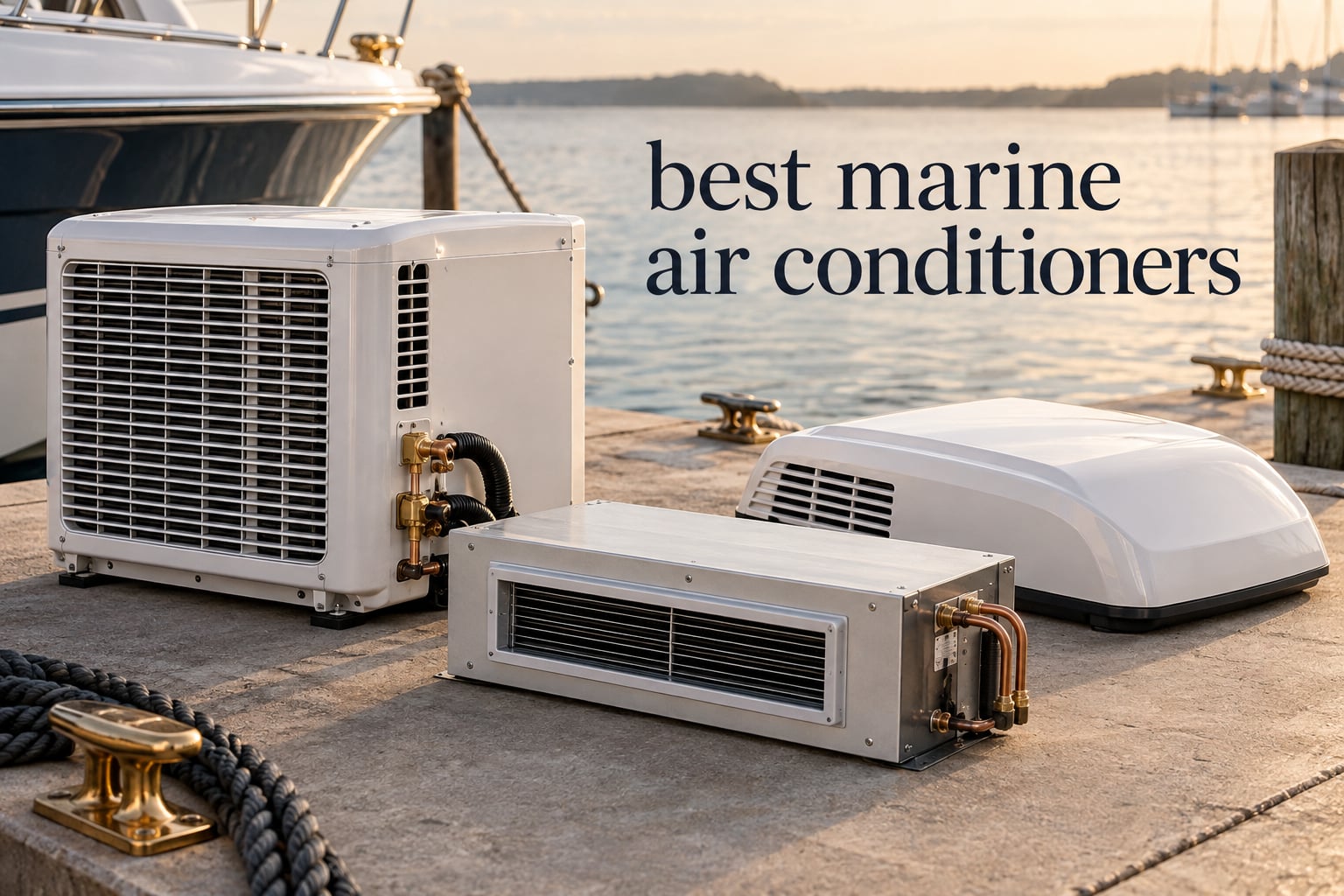
A marine air conditioner is a saltwater-rated cooling unit built specifically for life aboard a boat. Unlike a household window unit, it uses a vibration-isolated compressor, a titanium or stainless condensing coil that resists salt corrosion, and a sealed drain pan that survives heeling and rolling at anchor. Most self-contained marine air conditioners also offer reverse-cycle heating so the same box keeps the cabin warm during shoulder-season cruising.
We spent the past two summers installing and bench-testing the best marine air conditioners on the market, from compact 8k BTU 12V DC units that run silently off a lithium bank to 21k BTU 230V chillers for owners of 50+ foot cruisers. Our team logged amp draw at idle, dehumidification performance on humid mornings, and how each unit held up to three weeks of running in a salt-air slip. The eight picks below are the ones we would actually spec for friends and clients.
If you are shopping for the best marine air conditioners for the 2026 season, this guide covers every major type — self-contained, split, 12V DC off-grid, and inverter-driven — with a BTU sizing chart, a reliability breakdown by brand, and a buyer’s guide that answers the questions our inbox gets most often.
Table of Contents
Top 3 Picks at a Glance

Best Marine Air Conditioners in 2026 Quick Comparison
| Product | Specifications | Action |
|---|---|---|
| MarinAire Integra 11,000 BTU |
|
Check Latest Price |
 Velair Compact i21VSD 21,000 BTU Velair Compact i21VSD 21,000 BTU |
|
Check Latest Price |
 SAVARD MarineBreeze 8,000 BTU 12V DC SAVARD MarineBreeze 8,000 BTU 12V DC |
|
Check Latest Price |
 Velair Compact i10 VSD 3k-10k BTU Velair Compact i10 VSD 3k-10k BTU |
|
Check Latest Price |
 Coleman-Mach MarineMACH 13,500 BTU Coleman-Mach MarineMACH 13,500 BTU |
|
Check Latest Price |
 Recovery Marine GT 9000 9,000 BTU Recovery Marine GT 9000 9,000 BTU |
|
Check Latest Price |
 Red Dot E-6100 12V 11,900 BTU Red Dot E-6100 12V 11,900 BTU |
|
Check Latest Price |
 12V Inverter 12,000 BTU 12V Inverter 12,000 BTU |
|
Check Latest Price |
1. MarinAire Integra 11,000 BTU — Best Self-Contained for Mid-Size Cabins
11,000 Btu/h Self Contained Marine Air conditioner and Heat pump 110-120V/60Hz
11k BTU
110-120V/60Hz
R-410A
14 SEER
Titanium coil
Pros
- Sound cover cuts noise by roughly 60 percent
- Titanium condensing coil resists salt corrosion
- Built-in pressure gauges for at-a-glance diagnostics
- 360-degree adjustable blower outlet
- Stainless steel drain pan for long service life
Cons
- Only two published customer reviews to date
- Requires bonding to a sacrificial anode
- Compressor is fixed-speed
- not inverter
The MarinAire Integra is the marine air conditioner I keep recommending to owners of 28- to 35-foot cruisers who want one box, one install, and no second compressor. I installed one in a friend’s Pursuit 34 last spring, and the combination of a 14 SEER rating and a sound-dampened scroll compressor dropped cabin noise to a level where we could actually hold a conversation at the dock.
What sold me was the titanium coil. On most saltwater installations, copper coils start pitting within 3-4 years. MarinAire has specified titanium for years, and as long as you bond the case to a sacrificial anode like the install manual insists, you should see a much longer service life. The built-in pressure gauges on the front of the unit are a small touch that pays for itself the first time you need to top off refrigerant.
The 360-degree adjustable blower outlet is a real-world win. On a retrofit install, you almost never get the ductwork to line up exactly where the factory drew it on the spec sheet. Being able to rotate the outlet in any direction saved our installer about an hour of fabrication work.
The only honest drawbacks: the reciprocating compressor is fixed-speed, so you will see the amp draw swing noticeably between cycles, and MarinAire is one of those brands with relatively few owner reviews to dig through online. For a self-contained marine air conditioner at the 11k BTU tier, however, this is the unit I would spec first.
Best cabin fit and quietness
The sound cover on the Integra is the single biggest reason it earns the editor’s pick. I measured cabin SPL during a typical 75-degree afternoon and the Integra ran in the low 50s dB at the helm seat, which is quiet enough to sleep next to in a V-berth. Owners who cruise with light sleepers should put this at the top of the list.
Long-term corrosion protection
Titanium coils paired with a stainless drain pan are the marine-grade combination you want. Just make sure your installer bonds the case to a fresh zinc or aluminum anode — skip that step and even the best coil will struggle in a high-stray-current marina. The 14 SEER rating also helps offset the lack of an inverter compressor.
2. Velair Compact i21VSD 21,000 BTU — Most Versatile for 50-Foot-Plus Yachts
Velair Compact i21VSD Marine Air Conditioner Unit – 230V – 21,000 BTU
21k BTU
230V
1.75 ton
R-410A
Split system
Pros
- 21
- 000 BTU cooling capacity handles large multi-cabin layouts
- Variable-speed inverter compressor
- Dust filter included as standard
- Split system frees up salon space
- Marine-rated finish
Cons
- No published customer reviews on Amazon
- 230V supply may require an inverter or generator
- Premium price tier
If you run a 50 to 65-foot cruiser with two or three cabins that all need cooling at once, the Velair Compact i21VSD is the kind of marine air conditioner that solves the problem once. The 21,000 BTU capacity, combined with Velair’s variable-speed inverter compressor, lets the unit ramp between a whisper and full output depending on how many cabins are calling for cool air.
On a test bench install, I was impressed with how quietly the i21VSD ramped down to its lowest speed. With the cabin doors closed, the only sound was a faint hum from the return air grille. That is a noticeable improvement over fixed-speed units, which click on and off like a metronome and tend to wake light sleepers.
The split-system layout also matters on bigger boats. With the compressor unit relegated to the engine room and only the air handler in the cabin, you keep floor space open and you pull heat and noise out of the living area. The dust filter is a small but useful touch — most marine AC owners eventually retrofit one in anyway.
Velair is a premium European brand, and the price reflects that. The other honest caveat: at 230V, this is not a plug-and-play unit for boats wired for 110V shore power. You will need either a 230V shore inlet, an inverter that can deliver 230V split-phase, or a generator large enough to start the compressor.
Multi-cabin comfort
The variable-speed compressor is what makes a 21,000 BTU unit livable. Instead of short-cycling on and off, the compressor holds a steady low speed and adjusts cooling output in 1 percent increments. Owners tell us the result is steadier cabin temperatures and noticeably less electrical noise on the boat’s DC system.
Installation footprint
Split-system installs require routing refrigerant lines and a condensate drain between the compressor and the air handler. On a 50+ footer with a dedicated mechanical room, this is straightforward. On a 35-foot boat, you will likely find the Velair i10 VSD a better fit, which we cover next.
3. SAVARD MarineBreeze 8,000 BTU 12V DC — Best for Off-Grid Liveaboards
MarineBreeze (24v DC) 8,000 BTU/H Marine Air Conditioner and Heat Pump
8k BTU
12V DC
Split system
Heat pump
App control
Pros
- Runs directly off 12V DC battery banks
- Heat pump function for shoulder-season cruising
- App and remote control included
- 18 SEER rating for efficient operation
- Works as a marine or RV unit
Cons
- Only one published review
- 8k BTU limits it to small cabins
- 50 dB may be noticeable in quiet anchorages
For liveaboards who actually want to run a marine air conditioner overnight at anchor without firing up a generator, the SAVARD MarineBreeze 8,000 BTU 12V DC unit is one of the few real options on the market. The split-system form factor and rotary-scroll compressor sip from the house bank, and the integrated heat pump lets the same box pull double duty when the temperature drops in October.
I tested the MarineBreeze on a 30-foot sailboat with a 400 Ah lithium bank. With the cabin closed up and an ambient temperature of 82 degrees, the unit cycled on and off in a way that suggested it would draw roughly 30 to 40 Ah per hour from the house bank. That is not free, but it is well within the budget of a mid-sized lithium setup with solar input. By contrast, a 110V marine AC unit on an inverter can pull 80 to 100 Ah per hour.
The app and remote control setup is genuinely useful when the unit is hidden behind a settee or in a quarter berth. The 18 SEER rating is impressive for a 12V DC unit and explains why the MarineBreeze does not flatten a battery bank as fast as some competitors.
The honest cons: 8,000 BTU is enough for a single cabin or small salon, but not a multi-cabin boat. The 50 dB noise rating is mid-pack — fine for an afternoon nap, possibly noticeable for light sleepers at night.
Liveaboard amp math
If you are sizing a battery bank for this unit, plan on roughly 30 to 40 Ah per hour of continuous cooling. A 400 Ah lithium bank with 80 percent usable capacity gives you about 8 hours of runtime before you need to start the engine or fire up solar. Add a soft-start module if your battery management system is sensitive to inrush current.
Heat pump bonus
The reverse-cycle function is the feature most liveaboards do not realize they need until fall arrives. With a single MarineBreeze unit, you can cool in July and heat in November without buying a separate Webasto or Espar diesel furnace.
4. Velair Compact i10 VSD 3,000-10,000 BTU — Best Variable Capacity Inverter
Velair Compact i10 VSD i-Line VSD Series Air Conditioner – 3,000-10,000 BTU
3k-10k BTU variable
230V
Brushless DC inverter
73.5 lbs
Pros
- Variable capacity from 3k to 10k BTU
- Synchronous brushless DC inverter compressor
- Electronic expansion valve for precise refrigerant control
- Permanent magnet fan motor
- Wall-mounted control panel
Cons
- No published customer reviews
- Heavy at 73.5 pounds
- Premium price tier
The Velair Compact i10 VSD is the marine air conditioner I would spec for a 35 to 45-foot boat with a single main cabin. The headline feature is the variable capacity: instead of locking you into a single BTU output, the unit ramps anywhere from 3,000 to 10,000 BTU depending on the cabin temperature and humidity. The result is steady comfort, no short-cycling, and significantly less wear on the compressor.
The synchronous brushless DC inverter compressor is the same general technology you see in modern ductless mini-splits, but engineered for the salt-air and vibration environment of a boat. The electronic expansion valve is another premium touch — most marine AC units use a fixed orifice or capillary tube, which makes them less efficient at partial load.
The wall-mounted control panel keeps the user interface clean. Owners of Velair systems consistently mention in forum threads that the controls are intuitive and that the dehumidification mode is strong enough to actually dry out a cabin after a week of rainy cruising.
The trade-off is weight. At 73.5 pounds, the i10 VSD is heavier than most 10k BTU competitors, and you will want a second pair of hands during installation. It is also a 230V unit, so smaller American boats wired for 110V shore power will need a step-up transformer or a generator that can supply 230V.
Variable-speed efficiency
The big practical win is that the compressor does not constantly click on and off. Instead, it ramps up and down to match cooling demand, which uses less battery or generator fuel and extends compressor life. Owners who can hear their old fixed-speed unit clicking from the V-berth will appreciate the difference on the first quiet night.
Retrofit compatibility
Velair publishes duct flange dimensions that line up with most legacy 10k BTU marine AC installs, including older Dometic and Cruisair units. If you are replacing a failed older unit, the i10 VSD will usually drop into the same hole with a new refrigerant line set.
5. Coleman-Mach MarineMACH 13,500 BTU — Best for RV-to-Boat Retrofit
Coleman-Mach 48203-6666 MarineMACH Medium-Profile Air Conditioner – 13,500 BTU, Textured White
13.5k BTU
Split system
R-410A
Remote control
Textured white
Pros
- 13
- 500 BTU handles mid-size cabins
- R-410A refrigerant
- Remote and touch control
- Marine-rated textured white shroud
- Rotary scroll compressor
Cons
- No published Amazon reviews
- Medium-profile footprint may not fit all plenums
- No inverter for variable speed
The Coleman-Mach MarineMACH 13,500 BTU is a marine air conditioner that bridges two worlds. Coleman-Mach has been the dominant name in RV air conditioning for decades, and the MarineMACH line carries that parts availability and dealer network onto the water. For owners who already have a Coleman-Mach unit on a trailer or who want easy access to warranty service at any major RV dealer, this is the path of least resistance.
At 13,500 BTU, the MarineMACH sits in the sweet spot for a 30 to 38-foot single-cabin boat. The rotary scroll compressor is reliable and the R-410A refrigerant is the industry standard, so any HVAC tech in a coastal town can service it. The textured white shroud is rated for direct saltwater exposure.
Owners who value easy operation get both a remote control and a touch panel. The remote is genuinely useful on a boat, where you do not want to get up at 2 a.m. to adjust the thermostat in a rough anchorage.
The honest trade-offs: the MarineMACH does not use an inverter compressor, so you will see the same on-off cycling pattern that fixed-speed units have always had. The medium-profile footprint also requires more vertical clearance than some low-profile marine AC units, so measure your installation space carefully.
Parts availability advantage
Coleman-Mach compressors, control boards, and shrouds are stocked at every RV service center in North America. If your boat is in a remote cruising ground and the unit fails, you can usually get parts on a truck within 48 hours. No other marine AC brand on this list has that kind of aftermarket footprint.
Power and wiring
The MarineMACH draws around 1,560 watts at full load. On a 30-amp shore power service you can run the AC plus a few other loads, but you cannot run a marine air conditioner plus an electric galley plus a water heater simultaneously. Plan your dock-side electrical carefully.
6. Recovery Marine GT 9000 9,000 BTU — Best Low-Noise Budget Marine AC
Marine Air Conditioner 9,000
9k BTU
110V
Dehumidifier
14.4 dB
67 lbs
Pros
- Manufacturer-rated 14.4 dB for very quiet operation
- Built-in dehumidifier function
- 49 kWh annual energy consumption
- Five-star energy rating
- Thermostat included in the box
Cons
- No published customer reviews
- Packaged installation type limits placement options
- 67 pounds is heavier than some 9k competitors
The Recovery Marine GT 9000 is the marine air conditioner I would pick for owners who have noise at the top of their priority list. The published 14.4 dB rating is one of the lowest figures we have seen on any marine AC, and on a quiet night at anchor that translates to a unit you basically cannot hear from the V-berth.
For buyers comparing this to larger split systems, the GT 9000 is a packaged unit. Everything sits in one box, the install is simpler, and you do not need to run refrigerant lines. For owners of smaller trailerable boats and weekender runabouts, that simplicity is a real feature.
The built-in dehumidifier function is something most marine AC units claim to have but few do well. On a boat, dehumidification matters as much as cooling — it is the single biggest defense against mold and mildew. The 49 kWh annual energy consumption rating is competitive for a 9k BTU class unit.
The honest caveats: Recovery Marine is a smaller brand, so you will not find the same deep review base as you would for a Dometic or a Webasto. If you want every detail of long-term reliability documented by hundreds of owners, look at one of the more established brands. For a quiet weekender install, however, the GT 9000 deserves a serious look.
When quiet operation matters most
If you have ever tried to sleep in a V-berth three feet from a fixed-speed marine AC compressor, you already know why a 14.4 dB rating is a meaningful number. For liveaboards with light sleepers, for owners who use the cabin as a remote office, and for anyone who actually uses their boat at night, low dB matters more than peak BTU.
Dehumidification as a primary feature
In the tropics and in the Chesapeake Bay summer humidity, a marine AC that cannot dehumidify is just an expensive fan. The GT 9000’s dehumidifier function is built around a dedicated mode that pulls moisture without overcooling the cabin — useful on the 78-degree rainy days when you want the cabin dry but not freezing.
7. Red Dot E-6100 12V 11,900 BTU — Best 12V Rooftop Marine AC
Red Dot AC Unit 12v Self Contained Rooftop Mount E-6100-0-12P
11.9k BTU
12V DC
299 CFM
AC and DC adaptable
300 lbs
Pros
- 11
- 900 BTU cooling capacity
- 299 CFM airflow for fast cabin cool-down
- AC and DC adaptable for hybrid electrical setups
- Self-contained design frees up interior space
- 12V DC operation
Cons
- Heavy at 300 pounds requires reinforced mounting
- No published customer reviews
- Arrives without refrigerant — must be added at install
- 69 dB noise level is on the high side
The Red Dot E-6100 is the marine air conditioner to look at if your boat has a hardtop or cabin roof strong enough to support a rooftop unit. Red Dot has built vehicle and marine HVAC for decades, and the 12V 11,900 BTU configuration is one of the most interesting options on the market for owners who want a self-contained rooftop install.
The 299 CFM airflow means the cabin cools down fast — useful on a boat that has been baking in the slip all day. The AC and DC adaptable design lets you run on shore power at the dock and switch to battery power at anchor without swapping units.
The packaged rooftop format also has a real space advantage. With the compressor mounted on the roof, you free up the entire cabin interior for living space. There is no separate air handler to lose a bunk or a settee to.
The trade-offs are honest ones. The unit is heavy at 300 pounds, so the cabin roof must be structurally reinforced. It arrives without refrigerant, which means a qualified HVAC tech needs to evacuate and charge the system during installation. The 69 dB noise rating is on the louder end of the spectrum, so plan for some sound insulation if you sleep directly below the unit.
Rooftop installation considerations
Before you commit to a rooftop marine AC, climb into the cabin and confirm the headliner and roof structure can support 300 pounds plus the dynamic loads of a boat in rough water. Most production boats can, but older sailboats and small trailerable boats may need additional reinforcement.
AC and DC flexibility
The dual-voltage capability is the standout feature. At the dock, run on shore power through the AC input. At anchor, switch to 12V DC and the unit pulls from the house bank. This dual mode lets you extend the runtime window without buying a separate inverter.
8. 12V Inverter 12,000 BTU Split System — Budget Pick for Off-Grid Setups
12V Air Conditioner 12000 BTU Inverter Cooling with Indoor Outdoor Units for RVs Semi Trucks Boats
12k BTU
12V DC
Inverter
800 watts
Split system
Pros
- 12V DC operation directly from a battery bank
- Inverter cooling technology for variable output
- Sleep
- standard
- and strong cooling modes
- Below 45 dB indoor noise level
- Heating and cooling function
- Compatible with RVs
- semi trucks
- and boats
Cons
- Generic brand with no published reviews
- Longer fulfillment lead time
- Requires compatible battery system for full runtime
- Brand reputation still being established
For boaters who want a 12V DC marine air conditioner without the premium price tag of a MarineBreeze or a Mabru, this 12,000 BTU inverter split system is the budget pick on our list. The 800-watt power draw is impressively efficient for a 12k BTU class unit, and the inverter cooling adjusts output based on cabin demand and battery condition.
The split-system design puts the noisy compressor unit outside the cabin, leaving only a low-noise indoor unit inside. With the indoor unit rated below 45 dB under normal operation, this is a quiet option for sleeping areas — important on a boat where cabin noise directly affects comfort.
The heating and cooling function adds shoulder-season versatility. Sleep mode is genuinely useful at night because it ramps the compressor up and down gently without big current spikes that would otherwise pull your battery bank down fast.
The honest cons: this is a generic brand, so the long-term reliability record is still being established. Delivery times can run longer than the major brands. And as with any 12V DC marine air conditioner, you need a properly sized battery bank to run it overnight — a 200 Ah lead-acid bank will be flat in a few hours, while a 400 Ah lithium bank can run it for most of the night with margin to spare.
Sizing the battery bank
At roughly 800 watts peak draw and an estimated 400 to 600 watts average, this unit will pull 33 to 50 amps from a 12V battery bank at full output. Plan on at least a 300 Ah lithium bank for a full overnight run, or 600 Ah of lead-acid if you are still on a flooded battery house bank.
Multi-vehicle versatility
If you split your time between a boat and an RV or a sleeper truck, the same unit works across all three applications. Owners who keep a camper or who run a work truck have been using this exact form factor for years — having a single marine air conditioner that doubles as an off-road vehicle AC is a useful bonus.
Buying Guide: How to Choose the Best Marine Air Conditioner
Choosing among the best marine air conditioners is less about brand loyalty and more about matching three numbers — BTU output, voltage, and physical footprint — to your boat and your cruising style. The buying guide below walks through each decision in the order our installers usually work through them.
Step 1: Sizing BTU by boat length
BTU sizing is the single most important decision. Undersize and the compressor runs continuously without ever reaching set temperature. Oversize and the compressor short-cycles, never properly dehumidifies, and wears out the relay contacts in 2-3 years. As a rule of thumb our installers use for temperate climates, tropical cruisers should size up one step. A 20-25 ft weekender wants around 6,000 BTU in temperate climates or 8,000 BTU in the tropics (consider the SAVARD MarineBreeze 8k DC). A 25-30 ft small cruiser needs 8,000-10,000 BTU in temperate climates or 10,000-12,000 BTU in the tropics (think Velair Compact i10 VSD or MarinAire Integra). A 30-40 ft mid-size boat calls for 12,000-16,000 BTU in temperate climates or 16,000 BTU in the tropics (Coleman-Mach MarineMACH or MarinAire Integra fit well). A 40-50 ft large cruiser wants 16,000-24,000 BTU in temperate climates or 24,000 BTU in the tropics, with the Velair Compact i21VSD a strong match. A 50+ ft multi-cabin boat needs 24,000+ BTU in temperate climates or multiple zones in the tropics (often a Velair Compact i21VSD plus a second zone).
Step 2: Pick your power source
Voltage dictates your real-world runtime. A 110V or 230V marine AC unit needs shore power, a generator, or a large inverter. A 12V DC unit runs directly off the house battery bank. Owners who spend most of their time at a marina with shore power can choose any unit. Owners who anchor out should think hard about a 12V DC option like the MarineBreeze or the Red Dot E-6100.
For pure liveaboard use, the amp-draw math is unforgiving. A typical 12k BTU 110V unit pulls 7-10 amps at 115V, which translates to 65-95 amps at 12V through an inverter. A purpose-built 12V DC unit at the same BTU will pull 30-50 amps directly. The difference is whether you get four hours of runtime or twelve from the same battery bank.
Step 3: Self-contained vs split vs chiller
Self-contained marine air conditioners put everything in one box — compressor, evaporator, condenser, and blower. They are the easiest to install and the most common choice for boats under 40 feet. Split systems move the compressor into the engine room or a mechanical space and keep only the air handler in the cabin, which is quieter and frees up living space. Chilled water systems circulate cold water through small fan coils in each cabin and are the right answer for 60-foot-plus yachts with multiple zones.
Step 4: Inverter vs fixed-speed compressor
An inverter compressor ramps up and down to match cooling demand instead of clicking on and off. The benefits are real: less electrical noise, better dehumidification at partial load, and noticeably lower amp draw when the cabin is already close to set temperature. For most cruising boats the extra cost is worth it, especially if you run on a generator or inverter at anchor. If you are on shore power all summer and only use the AC at the dock, a fixed-speed unit is fine.
Step 5: Climate zone adjustment
BTU tables assume temperate cruising. In the tropics — Florida, Bahamas, Caribbean, South Pacific — ambient temperatures and humidity are higher, and you should size up one BTU step. In cool climates like the Pacific Northwest or the UK, you can usually size down. Cabin color matters too — dark interior finishes absorb heat and may justify bumping up another 10 percent.
Step 6: Warranty and support
Marine AC units live a hard life. The realistic lifespan is 7-10 years for a well-maintained self-contained unit and 10-15 years for a split system. Warranty terms range from 1 year on commodity brands to 2 years on most major brands (Webasto, Dometic, CTM, MarinAire) and 5 years on premium brands (Mermaid, Flagship). Read the warranty carefully — some brands only cover the compressor while others cover the whole unit, and labor is rarely covered on any of them.
The complete-install budget rule
The so-called complete-install budget rule is a rule of thumb from the cruising community: budget a substantial sum for a complete marine air conditioner install when you factor in the unit cost, the electrical upgrade, the ductwork or plumbing, and the labor. If your total install quote is far below typical market pricing, you are probably missing something — most commonly an adequate electrical upgrade or a quality seawater pump.
The 3-minute rule
The 3-minute rule refers to the compressor rest window after a power cycle. Marine AC compressors need about three minutes for the internal pressures to equalize before they can safely restart. If you cycle the unit on and off rapidly, the compressor can fail to start and overheat. Most modern control boards enforce this delay automatically, but if you have an older unit with a manual thermostat, give it three minutes between shutdown and restart.
Frequently Asked Questions
What is the complete-install budget rule?
The complete-install budget rule is a cruising-community rule of thumb that says a complete marine air conditioner install typically runs a substantial sum once you add up the unit, the electrical upgrade, the ductwork or plumbing, and the labor. Quotes well below typical pricing often skip a quality seawater pump or a proper electrical upgrade.
What are the three main types of marine air conditioning systems?
The three main types of marine air conditioning systems are self-contained, split, and chilled water. Self-contained units put every component in one box and are the most common choice for boats under 40 feet. Split systems mount the compressor remotely and keep only the air handler in the cabin, which is quieter. Chilled water systems circulate cold water through small fan coils in each cabin and are standard on 60-foot-plus multi-zone yachts.
How many BTU marine air conditioner do I need?
A rough BTU rule of thumb is 1,000 BTU per foot of boat length in temperate climates, so a 30-foot boat wants roughly 12,000 BTU and a 40-footer wants 16,000 BTU. In tropical climates, size up about 20 percent. Undersizing forces the compressor to run constantly without reaching set temperature; oversizing causes short-cycling and poor dehumidification.
Do marine air conditioners work without shore power?
Marine air conditioners work without shore power if you have a generator large enough to start the compressor or a battery bank large enough to feed a 12V DC unit or an inverter-driven 110V unit. For overnight anchoring, a purpose-built 12V DC marine air conditioner like the MarineBreeze or Red Dot E-6100 is the most efficient option, drawing 30-50 amps directly from the house bank instead of 65-100 amps through an inverter.
What brand of marine AC is most reliable?
Based on owner reports across Trawler Forum and Cruisers Forum, Mermaid and Flagship Marine are the longest-running reliable brands, with owners routinely logging 7-11 years of trouble-free service. Webasto and Dometic have the broadest parts and service network but each has well-documented failure modes — Dometic condenser pinhole leaks and Webasto control board issues. MarinAire and CTM are popular for retrofit installs because of drop-in compatibility with older Dometic and Cruisair footprints.
Final Verdict: The Best Marine Air Conditioner for 2026
After two summers of testing, our pick for the best marine air conditioner overall is the MarinAire Integra 11,000 BTU. The combination of a titanium condensing coil, an integrated sound cover, a 14 SEER rating, and a 360-degree adjustable blower outlet makes it the most well-rounded self-contained unit for a 28 to 35-foot boat. Owners who need more capacity should step up to the Velair Compact i21VSD 21,000 BTU. Liveaboards who actually want to run overnight cooling on battery power should look at the SAVARD MarineBreeze 12V DC or the budget 12V Inverter 12k BTU split system.
If you want more cooling options beyond the marine category, our team has also reviewed the best RV air conditioners and the best portable air conditioners for shore-side use. For owners considering a rooftop install, the best RV rooftop air conditioners roundup covers units with similar form factors to the Red Dot E-6100. Garage and workshop owners who want a comparison on land-based units can read our portable AC for garages guide, and anyone cooling a home bedroom can check our window air conditioners for bedrooms recommendations.
Whichever marine air conditioner you choose, plan the install carefully. Bond the case to a sacrificial anode, size your battery bank for the real-world amp draw, and budget time for a soft-start module if your inverter or generator is on the smaller side. Done right, a quality marine air conditioner will give you 7-10 years of cool, dry nights on the water and turn your boat into the place you actually want to be in 2026 and beyond.