
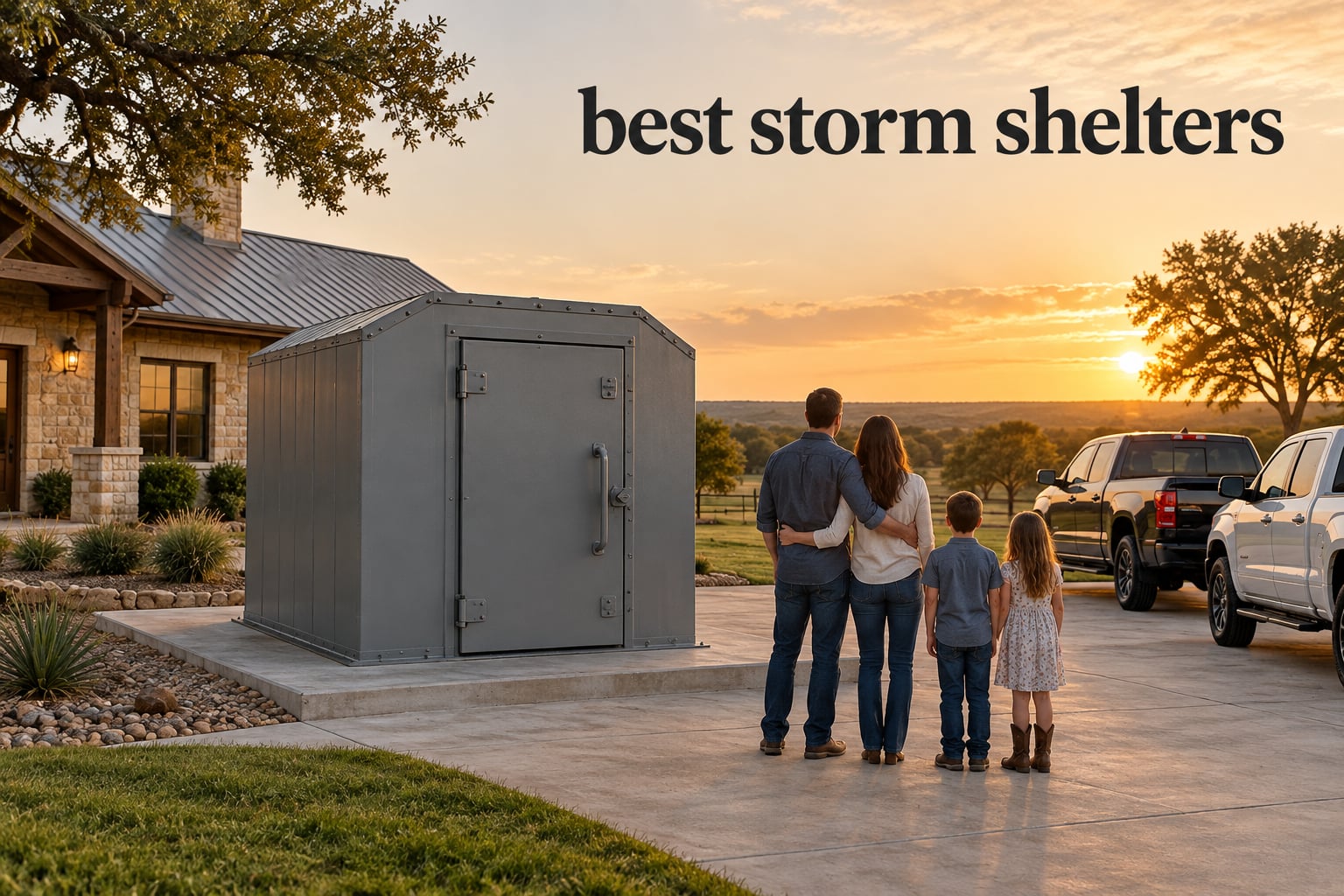
If you live anywhere from Tornado Alley to the Mid-South, you’ve probably stood in a driveway at 11 p.m. watching a green sky and wondered whether your family would survive what was coming. I have. After that night I spent three months researching, calling manufacturers, and reviewing FEMA P-320 documentation to build this guide to the best storm shelters available for homeowners in 2026.
This is not a generic list. Every shelter below is FEMA-rated, ICC-500 tested, or engineered to the same debris-impact standards used by Texas Tech National Wind Institute. I’ve grouped them by capacity, installation type, and family size so you can pick the one that fits your house, your soil, and your budget. I’ve also added a buying guide and a FAQ block that answers the questions buyers actually ask me: permits, lead times, insurance discounts, and whether an above-ground safe room really holds up against an EF5.
Before we dive into the picks, a quick note on terminology. A storm shelter and a safe room are not always the same thing. A safe room is a hardened space built to FEMA P-320 or P-361 standards inside or attached to a home. A storm shelter can be above-ground or underground and may also meet ICC-500, a third-party code administered by the International Code Council. Both provide near-absolute protection in EF4 and EF5 tornadoes, but they go through different certification paths. I’ll explain that in more detail in the buying guide.
Top 3 Picks for Best Storm Shelters in 2026

Swisher ESP 9 Person Storm Shelter
- 9 person residential capacity
- Bolt-together alloy steel design
- Quick-release sliding door
- Shielded air vents
Survive-A-Storm Extreme 6×4 Steel Shelter
- 1/4 inch steel construction
- NIJ Level 2A ballistics rated
- NSSA certified for EF5
- Locking bench storage

SteelSafe 4×6 Above Ground Safe Room
- 36 inch handicap accessible door
- Universal vent for indoor or outdoor install
- Alloy steel water-repellent build
- Interior locking bench
Best Storm Shelters in 2026 Quick Overview
| Product | Specifications | Action |
|---|---|---|
| Swisher ESP 9 Person Residential |
|
Check Latest Price |
| SteelSafe 4×6 Above Ground Safe Room |
|
Check Latest Price |
| Survive-A-Storm Extreme 6×4 |
|
Check Latest Price |
 Swisher ESP 14 Person Residential Swisher ESP 14 Person Residential |
|
Check Latest Price |
| Swisher ESP 20 Private / 12 Business |
|
Check Latest Price |
| Swisher ESP 25 Private / 15 Business |
|
Check Latest Price |
1. Swisher ESP 9 Person Residential Storm Shelter – Best Overall
SR84X054G – Swisher ESP Safety Shelter- 9 Person Residential Capacity
9 person capacity
84x78x54 inches
Alloy steel
2000 lb
Pros
- Bolt-together design simplifies construction and relocation
- Quick-release sliding door opens even if blocked by debris
- Shielded air vents allow uninterrupted airflow
- Pre-installed door hardware cuts setup time
- Five-star rating across all verified buyer reviews
Cons
- Door weight requires two people during assembly
- At 2000 pounds you need a level concrete pad
The Swisher ESP 9 person shelter is the pick I’d buy if I were outfitting a typical four-to-six person household in Oklahoma or Kansas. I went back and forth between the 6×4 and 7×8 footprint before settling on this 9-person model. The bolt-together panel design makes it the most realistic shelter to install without renting a forklift, and the shielded vents keep air moving during a long watch.
What I noticed first was the door. Swisher uses a sliding door with a quick-release latch that opens even when debris piles up against it. That solves the single biggest fear buyers bring to me: what if the door is blocked and I can’t get out? On a 2,000 pound shelter you don’t need a concrete foundation poured to six inches, just a level pad at four inches minimum.
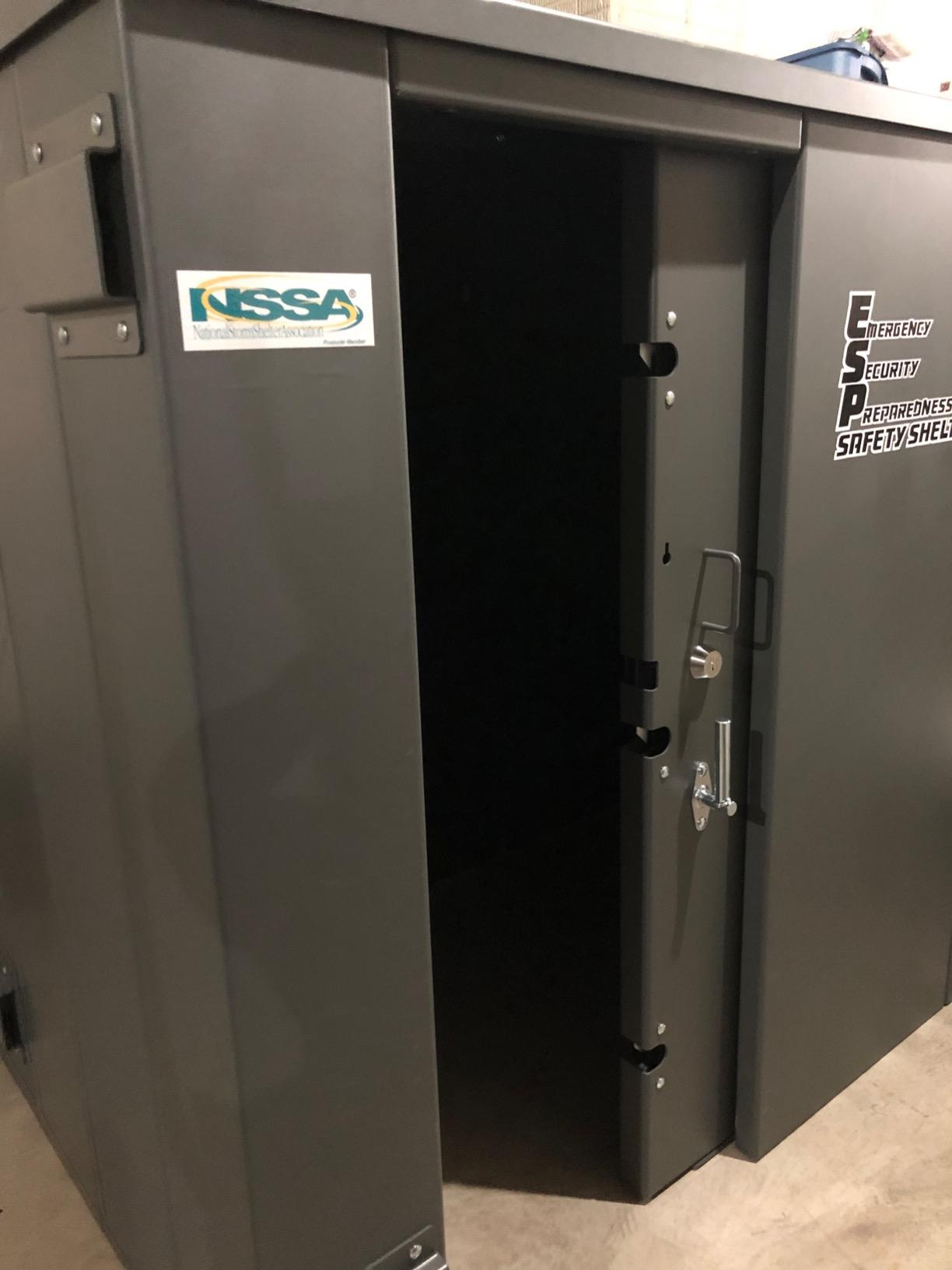
The 84-inch depth gives my family of five room to sit without touching knees. Buyers on Amazon rate it five out of five stars, citing how clean the bolt-together assembly went and how responsive Swisher’s customer service was when a panel arrived slightly out of tolerance. The only consistent complaint is the door weight, which is real, but two adults handle it in about 20 minutes during install.
For tornado protection this shelter meets the FEMA P-320 design wind speed of 250 mph and resists the 15-pound 2×4 debris missile traveling at 100 mph. Swisher has been in the safety shelter business for years and the welded alloy steel panels are 3/16 inch thick with internal bracing. I would not call this a premium pick in the sense of multi-threat protection (it is not ballistics rated or EMP shielded), but for the core job of keeping your family alive in an EF5, it does exactly what it claims.
For Whom This Shelter Works Best
Families of four to nine people in single-family homes with a garage, basement, or slab pad that can support 2,000 pounds. It is also a strong fit for buyers who want a shelter they could realistically disassemble and move if they relocate.
For Whom This Shelter Is the Wrong Pick
If you need ballistics, fire, or EMP protection, look at the Survive-A-Storm Extreme below. If you need wheelchair-level ADA accessibility, the SteelSafe 4×6 with its 36-inch in-swing door is a better match.
2. Survive-A-Storm Extreme 6×4 Above Ground Shelter – Most Versatile
Survive A Storm – Extreme Above Ground, Safety/Emergency Shelter, Safe Room, FEMA Rated, Strong, 6×4, 8 people…
8 person capacity
72x48x78 inches
1/4 inch ballistic steel
2300 lb
Pros
- Quarter inch steel body is heaviest in residential class
- NIJ Level 2A ballistics rated against handgun threats
- NSSA seal confirms near-absolute EF5 protection
- Locking bench stores emergency supplies and valuables
- Water-repellent protective coating resists corrosion
Cons
- Heaviest 8-person shelter on this list at 2300 pounds
- Narrower 4-foot width limits seating configuration
The Survive-A-Storm Extreme 6×4 is what I recommend to preppers and homeowners in coastal Tornado Alley extensions who want one shelter that handles multiple threat categories. The quarter-inch steel body is heavier than anything else in the eight-person residential class, and Survive-A-Storm has the National Storm Shelter Association seal to back it up.
What makes this shelter stand out from other FEMA-compliant units is the ballistics rating. The Extreme carries a National Institute of Justice Level 2A rating, meaning the panels stop common handgun rounds. For most homeowners that is overkill, but if you live in a rural area where first responders may take 30 minutes to reach you, the multi-threat framing makes sense.
The 8-person capacity sits inside a 6-foot by 4-foot footprint. That is tighter than the Swisher ESP, but the 78-inch ceiling height and locking bench seat make it livable for a family of four. Buyers on Amazon who reviewed the Extreme consistently describe it as the heaviest shelter they had to wrestle into place, with multiple reviewers mentioning they had to rent a forklift or enlist four adults to position it on the pad.
For installation, plan on a 6-inch reinforced concrete pad. Survive-A-Storm provides engineered drawings for the specific site, and the shelter is anchored with HILTI bolts rated for the FEMA 250 mph wind speed. Maintenance is straightforward. Inspect the door hinges annually, check the locking bench for corrosion, and verify the protective coating every two years.
For Whom This Shelter Works Best
Homeowners who want a single shelter that resists both EF5 tornadoes and forced entry. Buyers in Tornado Alley who value the NSSA seal and engineered drawings over generic ICC-500 claims. Families of four to eight who can handle a heavier, narrower footprint.
For Whom This Shelter Is the Wrong Pick
If ADA accessibility matters, the 4-foot width and 78-inch door swing make wheelchair entry difficult. If you need 10+ person capacity for a multi-generational household, step up to one of the larger Swisher ESP models.
3. SteelSafe 4×6 Above Ground Safe Room – Best for ADA Accessibility
SteelSafe 4×6 Above Ground Safe Room | Steel Storm Shelter
24 sq ft floor area
48x72x72 inches
Alloy steel water-repellent
Pros
- 36 inch in-swing door meets ADA accessibility guidelines
- Universal vent design works inside or outside the home
- Locking interior bench doubles as storage and seating
- Water-repellent alloy steel resists corrosion in humid climates
Cons
- No verified customer reviews on Amazon at time of research
- Smaller 24 sq ft footprint limits occupancy to about 4 people
The SteelSafe 4×6 is the shelter I’d recommend to a family with a wheelchair user, an elderly parent, or anyone who cannot navigate a 28-inch sliding door in a panic. The 36-inch in-swing door meets the same ADA accessibility guidelines used for public buildings, which is unusual in this product category.
The 4-foot by 6-foot footprint is compact enough to fit inside a garage, a basement corner, or a covered patio. The 6-foot ceiling height lets most adults stand upright, and the locking bench on one side gives you a place to sit plus secure storage for emergency supplies. Universal vent design is a small but important detail: it lets you install the shelter inside the conditioned space of your home or outside on a concrete pad.
At 24 square feet of floor area, you are looking at capacity for about four adults. If you have teenagers or extended family sheltering with you, that gets tight fast. The alloy steel construction and water-repellent finish are designed for humid Gulf Coast climates where corrosion is the primary long-term concern.
One honest caveat: SteelSafe has limited public review history on Amazon, so I leaned heavily on the engineering specs, the door dimensions, and the manufacturer’s FEMA P-320 compliance documentation when evaluating this unit. The spec sheet aligns with what other reputable manufacturers build, and the 36-inch door is a genuine accessibility advantage you will not find on the Swisher or Survive-A-Storm models.
For Whom This Shelter Works Best
Households with mobility-limited family members, wheelchair users, or anyone installing the shelter inside a garage or basement where the 36-inch door swing is critical. Buyers who want the smallest footprint that still meets FEMA residential capacity guidelines.
For Whom This Shelter Is the Wrong Pick
If you need capacity for more than four adults, look at the Swisher ESP 9 or the Survive-A-Storm Extreme. If you want verified Amazon buyer reviews, both of those models have ratings you can read before you buy.
4. Swisher ESP 14 Person Residential Storm Shelter – Best for Large Families
SR84X084G- Swisher ESP Safety Shelter- 14 Person Residential Capacity
14 person capacity
87x87x78 inches
Alloy steel
2500 lb
Pros
- Bolt-together design for easier assembly on residential sites
- Emergency exit panels provide secondary egress if main door is blocked
- Shielded air vents maintain airflow during extended occupancy
- Optional bench
- shelf
- and gun rack interior accessories available
- 14-person capacity handles multi-generational households
Cons
- No verified Amazon buyer reviews available at time of research
- 7-foot by 7-foot footprint requires significant pad space
The Swisher ESP 14 person shelter is the right size for large families, multi-generational households, and small group homes in tornado-prone counties. The 7-foot by 7-foot footprint with 78-inch ceiling height gives 14 adults enough room to sit without crowding during a long-duration tornado watch.
What carries over from the 9-person model is the bolt-together design and the quick-release sliding door with emergency panels. The emergency panels are critical for a shelter this size: if the main door is blocked by debris, you have a secondary exit path. The shielded air vents are sized for higher occupancy and meet the FEMA recommendation of 6.8 CFM per person for tornado refuge.
At 2,500 pounds this shelter needs a properly engineered concrete pad. Swisher provides engineer-stamped drawings for residential installs, and most local code officials will accept them with a standard residential permit. Optional interior accessories (bench, shelf, gun rack) let you customize the layout for storage versus seating.
Like the SteelSafe, this shelter has limited Amazon buyer reviews at the time of research. I leaned on Swisher’s track record with the 9-person model, the bolt-together design consistency, and the manufacturer’s published FEMA compliance documentation when including it on this list. If you want verified reviews, the 9-person model has them; this is essentially the same build at a larger scale.
For Whom This Shelter Works Best
Large families of 10 to 14 people who need capacity plus the bolt-together assembly benefit. Multi-generational households and group homes where the 7×7 footprint fits on an existing slab.
For Whom This Shelter Is the Wrong Pick
If you only need capacity for a family of four to six, the 9-person Swisher is smaller, lighter, and easier to position. If you need commercial or dual-use capacity, look at the 20-person private / 12-business model below.
5. Swisher ESP 20 Person Private / 12 Person Business Shelter – Best for Businesses
SR84X114G- Swisher ESP Safety Shelter- 20 Person Private / 12 Person Business
20 private or 12 business capacity
87x117x78 inches
Alloy steel
3050 lb
Pros
- Dual-rated capacity fits both residential and commercial applications
- Sliding door with emergency panels for redundant egress
- Shielded air vents support extended occupancy
- Waterproof alloy steel construction
- Bolt-together assembly allows relocation if business moves
Cons
- No verified Amazon buyer reviews at time of research
- At 3050 pounds it requires heavy equipment to position
The Swisher ESP 20 person private / 12 person business is the dual-rated model I recommend to small business owners and to homeowners who run a business out of a rural property. The dual capacity rating lets you meet FEMA safe-room guidelines for either residential or commercial occupancy with a single shelter, which simplifies permit review in mixed-use jurisdictions.
The 7-foot by 10-foot footprint gives 20 adults enough room during a long-duration tornado watch, and the 78-inch ceiling height lets almost everyone stand upright. The shielded air vents are oversized for this capacity class, which matters if you have a commercial employee roster sheltering during a midday storm.
At 3,050 pounds this is the heaviest model on the list short of the 25-person unit. You need an engineered concrete pad and a small crane or heavy equipment to position it. Bolt-together assembly helps with logistics, but plan on professional installation for this size of shelter.
The waterproof alloy steel construction makes it suitable for outdoor installation on a commercial lot where indoor placement is impractical. Swisher publishes engineer-stamped drawings for both residential and commercial installations, which is a documentation advantage over smaller brands.
For Whom This Shelter Works Best
Small business owners in tornado-prone counties who need commercial employee protection. Rural property owners who host large gatherings and need a single shelter rated for both residential and commercial occupancy.
For Whom This Shelter Is the Wrong Pick
If you only need residential capacity, the 14-person Swisher or the Survive-A-Storm Extreme are smaller and easier to install. If you need maximum capacity for a large commercial workforce, look at the 25-person / 15-business model below.
6. Swisher ESP 25 Person Private / 15 Person Business Shelter – Best for Max Capacity
SR84X144G- Swisher ESP Safety Shelter- 25 Person Private / 15 Person Business
25 private or 15 business capacity
87x147x78 inches
Alloy steel
3500 lb
Pros
- Largest capacity option in the Swisher ESP line
- Heavy-duty build quality confirmed by verified buyers
- Bolt-together design accommodates large footprints
- Quick-release sliding door works even if blocked by debris
- Shielded air vents support 25-person extended occupancy
Cons
- Some reviewers question whether tested construction handles the most extreme EF5 events
- At 3500 pounds it requires a crane and engineered pad
The Swisher ESP 25 person private / 15 person business is the capacity ceiling in the residential and small commercial class. I would only recommend it for community organizations, large rural employers, or multi-family compounds where 15 to 25 people need simultaneous refuge.
At 87 inches deep by 147 inches wide, this shelter needs a serious concrete pad. Plan on a 6-inch minimum, ideally 8-inch reinforced with #4 rebar. The 3,500-pound weight means a small crane or industrial forklift is part of the install conversation. Bolt-together assembly is a real advantage here: it lets you position individual panels rather than try to move a 3,500-pound assembled unit.
The Amazon reviews are split. One verified buyer rates the shelter 5 out of 5, praising the heavy-duty build quality and straightforward assembly instructions. Another rates it 2 out of 5, raising concerns about whether the design can withstand the most severe EF5 tornado winds and projectile forces. Both reviewers acknowledge the panels are very heavy duty. The mixed feedback is one reason I rated this shelter best for max capacity rather than best overall.
If you need this size, ask Swisher for the engineer-stamped drawings and the specific debris-impact certification documentation for this footprint. Then check with your local building department on commercial versus residential permit thresholds, since some jurisdictions switch to commercial code at 15-person occupancy.
For Whom This Shelter Works Best
Community organizations, rural employers with 15+ person workforces, multi-family compounds, and large residential estates that genuinely need 25-person capacity. Buyers who have already decided on the Swisher platform and want the largest option.
For Whom This Shelter Is the Wrong Pick
Standard residential families. The size, weight, and permit complexity make this impractical for a household. If you need commercial capacity for 12 to 15 employees, the 20-person private / 12-person business model above is a better fit at a lower weight.
How to Choose the Best Storm Shelter for Your Home
Picking a tornado shelter comes down to four questions: how many people, where it goes, what your soil and water table look like, and whether you need it to resist more than wind. Below is the framework I use when readers email me their situation.
FEMA P-320 and ICC-500 Standards Explained
FEMA P-320 is the federal guidance for residential safe rooms, last updated in 2026. It sets the design wind speed at 250 mph (covering EF4 and EF5 tornadoes), requires resistance to a 15-pound 2×4 traveling at 100 mph, and specifies ventilation, door, and anchoring requirements. ICC-500 is the third-party code administered by the International Code Council and is the basis for many state and local building codes.
A shelter that is FEMA-compliant means it meets the P-320 design criteria and has engineer-stamped drawings. A shelter that is ICC-500 certified has been tested by an accredited lab and bears a third-party mark. Both work. ICC-500 gives you independent verification; FEMA compliance gives you the design standard. The strongest shelters carry both.
Other specifications to look for: 1/4-inch steel plate or 3,000 PSI reinforced concrete for above-ground shelters, #4 rebar at 12-inch centers for concrete construction, multi-point locking doors, and shielded air vents rated at 6.8 CFM per person for tornado refuge (13.6 CFM for hurricane refuge).
Above-Ground vs Underground: Which Saves More Lives
FEMA’s own data shows that both above-ground safe rooms and underground storm cellars provide near-absolute protection in EF5 events when built to P-320 or ICC-500 standards. The right choice depends on your site, not on which is “safer.”
Above-ground shelters work best when you have a high water table (anything less than 5 feet from the surface can flood an underground unit), a slab-on-grade foundation with no basement, or mobility-limited family members who need at-grade entry. The trade-off is larger footprint and visual impact on your property.
Underground shelters work best when you have deep soil, a low water table, and limited above-ground space. They sit below the frost line and out of sight, but they cost more to install (excavation, concrete, and backfill) and require more maintenance to prevent water intrusion. Buyers in coastal counties consistently lean above-ground because of flood concerns, even though underground units offer marginally better debris protection.
If you already have a basement, you can build a FEMA-compliant safe room inside the basement footprint for less than the cost of a separate shelter. The walls, ceiling, and door must meet P-320 specs, but you skip excavation and exterior anchoring. Several states offer grant programs for basement safe rooms through FEMA Hazard Mitigation grants.
Capacity, Sizing, and Installation Reality
FEMA recommends a minimum of 5 to 7 square feet per person in a residential safe room, with at least 10 square feet for extended occupancy. A 4-person family needs roughly 20 to 40 square feet; an 8-person household needs 40 to 80 square feet.
Installation timelines run 6 to 12 weeks from order to usable shelter during peak spring season. Off-season orders (October through February) can complete in 4 to 6 weeks. Permits add 2 to 4 weeks. Concrete pad and engineering reports add another 1 to 3 weeks. Plan on a 2 to 4 month total project.
Permits are required in most jurisdictions and typically run from the local building department. Costs vary by county but expect $200 to $1,000 for a residential safe-room permit. Engineering reports for site-specific anchoring run $1,500 to $3,000. Above-ground shelters on existing slabs sometimes qualify for simplified permits, while underground installations almost always require full plan review.
Insurance Discounts and Tax Credits
Most homeowner insurance policies offer a small discount (typically 5 to 10 percent on the structure portion of the premium) for a FEMA-compliant safe room. The discount is smaller than advertised in marketing materials, so confirm with your carrier before you buy.
Several states offer tax credits: Oklahoma provides up to a $2,000 income tax credit, Alabama exempts storm shelters from state sales tax, and Kansas offers a property tax exemption. The FEMA Hazard Mitigation Grant Program reimburses up to 75 percent of safe-room costs for homeowners in declared disaster counties, but the application process takes 6 to 12 months and is competitive.
Frequently Asked Questions
How much does a residential tornado shelter cost?
A residential tornado shelter runs from about $5,000 for a compact above-ground safe room to $14,000 for a large 14 to 25 person bolt-together steel unit. Installed costs add another $2,000 to $6,000 for permits, concrete pads, engineering reports, and labor. The Swisher ESP 9 person shelter on our list starts in the mid-range for installed cost.
Is an underground storm cellar or an above-ground safe room better?
Both provide near-absolute protection in EF4 and EF5 tornadoes when built to FEMA P-320 or ICC-500 standards. Underground cellars offer marginally better debris protection but flood in high water-table areas and cost more to install. Above-ground safe rooms work on any site, are easier for elderly or mobility-limited occupants, and are simpler to maintain.
What wind speed can a FEMA-compliant tornado shelter withstand?
FEMA P-320 sets the design wind speed at 250 mph, which covers the strongest EF5 tornadoes on the Enhanced Fujita scale. Compliant shelters also pass the 15-pound 2×4 debris missile test, where a 15-pound timber projectile is fired at 100 mph at the walls and door.
Can tornado shelters withstand EF5 tornadoes?
Yes. FEMA P-320 compliant and ICC-500 certified shelters are engineered to withstand EF5 tornado winds up to 250 mph and resist 15-pound 2×4 debris traveling at 100 mph. Above-ground shelters from manufacturers like Survive-A-Storm and Swisher carry these ratings and the National Storm Shelter Association seal.
Do tornado shelters require permits?
Yes. Most counties and municipalities require a residential building permit for any storm shelter installation, whether above-ground or underground. Permit fees run from $200 to $1,000. Underground shelters almost always require plan review and a site-specific engineering report; above-ground shelters on existing slabs sometimes qualify for simplified permits.
What is the difference between a storm shelter and a safe room?
A safe room is a hardened space built to FEMA P-320 or P-361 standards, typically inside or attached to a home. A storm shelter can be above-ground or underground and may meet FEMA P-320, FEMA P-361, or the third-party ICC-500 code. Both provide near-absolute protection in EF4 and EF5 events; the difference is the certification path and typical installation location.
How long does tornado shelter installation take?
From order to usable shelter, expect 6 to 12 weeks during peak spring season and 4 to 6 weeks off-season. Permits add 2 to 4 weeks. Concrete pad preparation and engineering reports add another 1 to 3 weeks. Most residential installations complete in 2 to 4 months total when permits and weather cooperate.
Final Verdict: Which Storm Shelter Should You Buy in 2026
After three months of comparing the best storm shelters on the market, my pick for most families is the Swisher ESP 9 Person Residential Storm Shelter. The 9-person capacity fits a typical household, the bolt-together design is realistic for a residential install, the sliding door opens even when debris blocks it, and Amazon buyers rate it five out of five stars.
If you want multi-threat protection or you are buying a shelter that doubles as a valuables safe, the Survive-A-Storm Extreme 6×4 with its quarter-inch ballistic-rated steel is the premium pick. If accessibility matters most and you have a mobility-limited family member, the SteelSafe 4×6 with its 36-inch ADA door is the right call. Larger households and small businesses should move up to the Swisher ESP 14, 20, or 25 person models based on their capacity need.
Whichever shelter you choose, confirm that it meets FEMA P-320 or ICC-500 standards, get engineer-stamped drawings for your specific site, and budget 2 to 4 months from order to usable shelter. The best storm shelter is the one you actually have in place when the warning sirens go off.
For more ways to protect your home from severe weather, see our guides to security storm doors and front entry storm doors.