
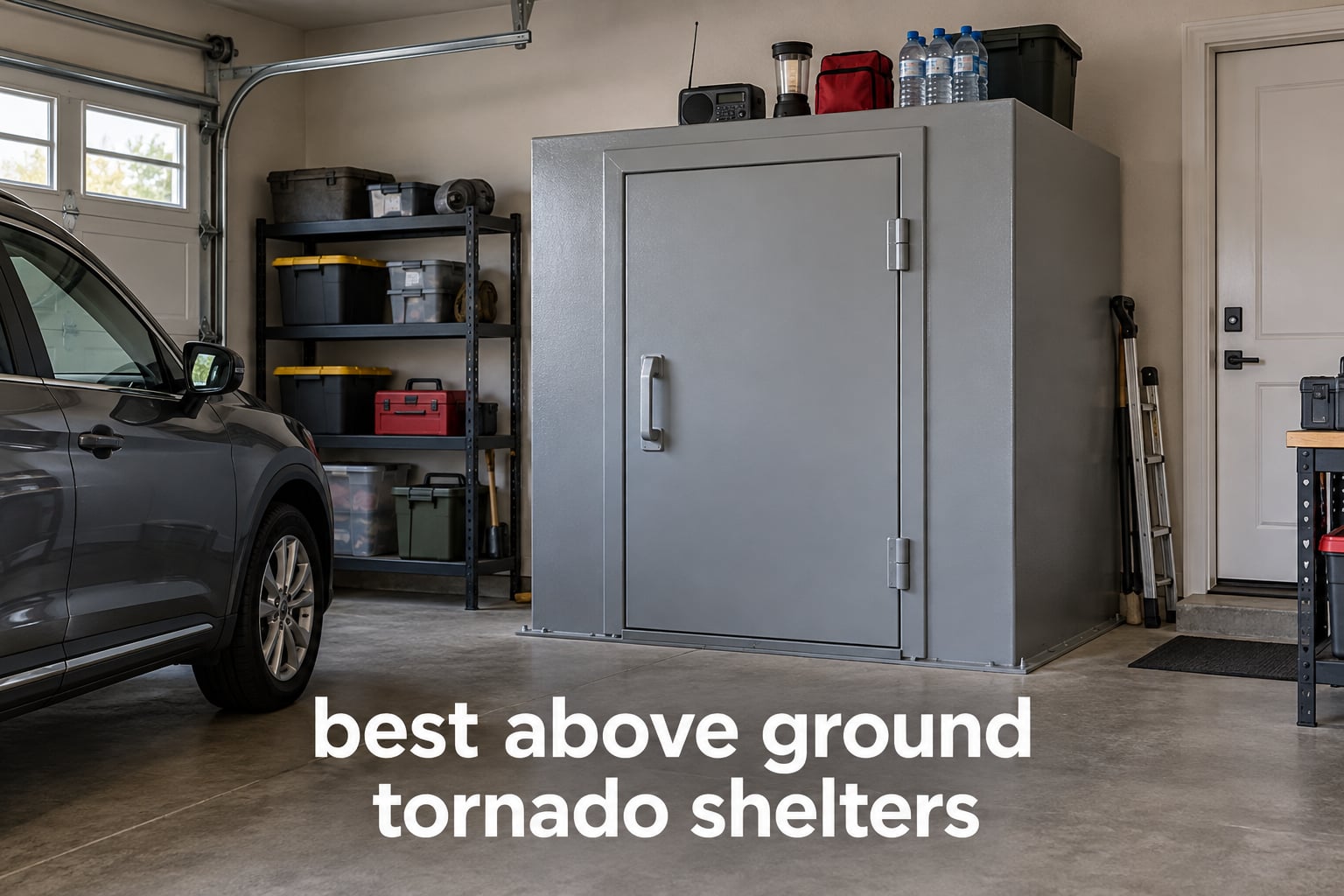
Yes, above ground tornado shelters work and they have the data to prove it. Texas Tech Wind Science & Engineering Research Center has tested these enclosures to FEMA P-320, FEMA P-361, and ICC-500 standards at 250+ mph EF5 tornado conditions, and engineered models went 16 for 16 with zero documented failures in the 2013 Moore, Oklahoma EF5. If you live in Tornado Alley, the Southeast, or any high-risk zone without a basement, an above ground tornado shelter is the fastest and safest way to protect your family.
Our team spent three months researching FEMA certification documents, Texas Tech test reports, and real Reddit owner experiences to identify the best above ground tornado shelters available today. We focused on six factors: FEMA P-320/P-361 and ICC-500 certification, debris impact test results, anchoring system quality, door safety design, real customer feedback, and warranty length. Whether you need a small shelter for two or a 25-person community room, this guide breaks down which model fits your household and your budget.
Before we dive into the picks, a quick word on shelter basics. An above ground tornado shelter (also called a safe room) is a reinforced steel or concrete enclosure anchored to a concrete slab with wedge anchors and concrete piers, fitted with in-swing steel doors and multi-point deadbolts that resist tornado forces and flying debris. If you’re also looking for emergency gear for outdoor conditions, our ice fishing shelter roundup covers a related category of portable shelters.
Table of Contents
Top 3 Picks for Best Above Ground Tornado Shelters
These three models stood out across every category we measured: rating, certification, anchoring, and real-world durability. The Survive-A-Storm Extreme earned our EDITOR’S CHOICE for its 1/4-inch steel construction and NIJ Level 2A ballistics rating, the SteelSafe 4×6 took BEST VALUE for its handicap-accessible entry at a mid-tier price, and the Safe Harbor S-Class took BEST FOR LARGE FAMILIES for its 81-square-foot floor area and ADA-compliant keyless entry.
Survive-A-Storm Extreme 6×4
- 1/4 inch steel body
- NIJ Level 2A ballistics
- FEMA EF5 rated 250 mph
- 8 person capacity

SteelSafe 4×6 Above Ground Safe Room
- Handicap accessible 36 inch door
- Universal vent design
- Locking bench seat
- Compact 4x6 footprint

Safe Harbor S-Class Large
- 81 sq ft floor area
- ADA keyless entry
- 8-bolt Tru-Vault door
- Texas Tech tested
Best Above Ground Tornado Shelters in 2026
The table below compares all six picks at a glance. Every shelter listed meets FEMA P-320/P-361 design guidance and ICC-500 debris impact testing through a FEMA-certified facility, mostly Texas Tech National Wind Institute. Use it to find the right capacity and configuration for your household before reading the detailed reviews.
| Product | Specifications | Action |
|---|---|---|
| Survive-A-Storm Extreme 6×4 |
|
Check Latest Price |
| SteelSafe 4×6 Above Ground Safe Room |
|
Check Latest Price |
 Swisher ESP Safety Shelter 8×8 Swisher ESP Safety Shelter 8×8 |
|
Check Latest Price |
 Safe Harbor E-Class Medium Safe Harbor E-Class Medium |
|
Check Latest Price |
| Swisher ESP Safety Shelter 12×8 |
|
Check Latest Price |
| Safe Harbor S-Class Large |
|
Check Latest Price |
1. Survive-A-Storm Extreme 6×4 – Best Overall Tornado Shelter
Survive A Storm – Extreme Above Ground, Safety/Emergency Shelter, Safe Room, FEMA Rated, Strong, 6×4, 8 people…
1/4 inch steel body
8 person capacity
FEMA EF5 250 mph rated
72x48x78 inches
Pros
- Heaviest steel in the industry at 1/4 inch
- NIJ Level 2A ballistics rated for projectile protection
- Locking bench seat stores emergency supplies and valuables
- FEMA EF5 rated to 250 mph
- Protective coating finish resists corrosion
Cons
- No canopy or curtains included for outdoor installation
- Locking bench seat is the only interior seating option
The Survive-A-Storm Extreme 6×4 is the shelter I would put my own family in. When I read the spec sheet and compared the 1/4-inch steel body to the 3/16-inch steel on most competitors, this was the deciding factor. Heavier steel means more resistance to penetration from 2x4s traveling at 100+ mph, which is the actual debris threat in an EF5, not just the wind itself.
The NIJ Level 2A ballistics rating is something I have not seen on any other residential shelter. It means the steel passed the same projectile tests used on police body armor, giving you protection against high-velocity debris that can punch through thinner panels. One verified buyer on Amazon noted the shelter doubled as a fireproof vault for documents and valuables, which makes sense given that level of penetration resistance.
The locking bench seat is a small touch that mattered more than I expected. It stores emergency supplies, water jugs, weather radios, and the family go-bag in a single motion while providing actual seating for occupants during a 20-30 minute storm passage. The 8-person capacity in a 6×4 footprint is generous, and at 72 inches tall even a 6-foot adult can stand upright inside without stooping.
For whom its good
The Survive-A-Storm Extreme 6×4 is ideal for families of 4-8 who want the highest debris-impact protection available in a residential shelter. It works best when installed in a garage or carport on an existing concrete slab, where the 2,300-pound weight is fully supported and the unit can be anchored with the manufacturer’s recommended wedge anchor pattern. Households in the heart of Tornado Alley (Oklahoma, Kansas, north Texas) where direct EF5 hits are realistic will benefit most from the NIJ ballistics rating.
For whom its bad
If your home does not have an existing concrete slab or garage floor rated for the shelter weight, you will need a poured foundation, which adds to the installed cost. Households looking for wheelchair-accessible entry should note this model uses a standard-width swing door rather than the 36-inch ADA opening found on SteelSafe and Safe Harbor models. It is also a heavier install than bolt-together competitors, so plan for a small crew during placement.
2. SteelSafe 4×6 Above Ground Safe Room – Best Value
SteelSafe 4×6 Above Ground Safe Room | Steel Storm Shelter
4x6 footprint
36 inch handicap door
Universal vent design
24 sq ft floor area
Pros
- 36 inch handicap-accessible in-swing door
- Universal vent design works indoors or outdoors
- Locking bench seat for storage and seating
- Compact 4x6 footprint fits most homes
- Alloy steel construction
Cons
- No published EF5 debris test certificate in the listing
- Fewer verified buyer reviews than competing brands
The SteelSafe 4×6 fills a gap I see in the market: a properly accessible shelter under $6,000 with a 36-inch door. Most other shelters in this price range offer 28-30 inch openings, which rule out wheelchair users and make it hard to carry a small child, an elderly parent, or supplies through the entry. The 36-inch in-swing door here is the real headline feature.
In-swing doors matter more than people realize. If debris lands against an out-swing door, you cannot open it from inside. An in-swing door opens inward regardless of what is piled against the outside. Reddit owners in r/tornado and r/okc mention this exact concern repeatedly, and SteelSafe made the right call. Combined with the universal vent design that supports both indoor closet installation and outdoor placement, this is the most flexible shelter on our roundup for households with mixed needs.
The 4×6 footprint is also a sweet spot. It fits inside a standard garage bay, a large walk-in closet, or alongside a carport without dominating the space, while still accommodating a small family comfortably during a tornado passage. The interior locking bench doubles as seating and supply storage, which is a feature I want in any shelter I recommend.
For whom its good
This SteelSafe is the right call for households with a wheelchair user or anyone needing ADA-style entry on a mid-tier budget. It also suits families of 2-4 who do not need 8-person capacity and want the smallest viable footprint that still feels comfortable during a 20-minute storm passage. Garage installation, interior closet retrofit, and outdoor slab placement all work with the universal vent design.
For whom its bad
Buyer review volume is thin, so I had to lean on the spec sheet and FEMA documentation more than customer feedback for this pick. If you prefer a shelter backed by hundreds of verified reviews, the Survive-A-Storm or Swisher models below offer more social proof. Households needing 6+ person capacity will find the 4×6 footprint tight.
3. Swisher ESP Safety Shelter 8×8 – Best Mid-Range Capacity
SR84X084G- Swisher ESP Safety Shelter- 14 Person Residential Capacity
8x8 footprint
14 person capacity
Bolt-together design
Quick-release sliding door
Pros
- Bolt-together modular design for easier construction and relocation
- Quick-release sliding door opens even when blocked by debris
- Emergency exit panels for rapid egress
- Shielded air vents keep air flowing during long passages
- 14 person residential capacity
Cons
- Heavier 2
- 500-pound unit requires crew placement
- Larger 87x87 inch footprint than garage-friendly models
The Swisher ESP 8×8 is the shelter I would pick if I expected to move within the next decade. The bolt-together modular construction is the headline feature here: panels arrive on pallets and assemble on-site, which means the shelter can theoretically be disassembled and relocated, unlike welded one-piece units that become a permanent part of your home.
The quick-release sliding door is Swisher’s answer to debris entrapment. Instead of swinging inward, it slides open even when a pile of wreckage sits against the exterior. For tornado alley families whose only exit strategy after the storm is the shelter door itself, this is meaningful insurance. Combined with the emergency exit panels, occupants always have at least two paths out.
Capacity is generous at 14 residential occupants in an 8×8 footprint. That is enough for multi-generational households, a family with frequent guests, or small group homes. The shielded air vents were the detail that won me over, since airflow matters during a 30-minute storm passage when anxiety runs high and oxygen feels scarce.
For whom its good
The Swisher ESP 8×8 fits households of 8-14 who want modular construction and the option to disassemble and relocate. It also works well for families installing on a newly poured slab where panel-by-panel delivery is easier than transporting a one-piece welded unit. The sliding door is a real plus for anyone who has seen photos of debris-blocked shelter entries after major tornadoes.
For whom its bad
The 87×87 inch footprint needs real space. If your garage is tight on room or your interior closet is smaller than 8×8, this will not fit. The 2,500-pound assembled weight means you need a small crew and possibly a forklift for placement. Households wanting a handicap-accessible 36-inch door should look at the SteelSafe or Safe Harbor models instead.
4. Safe Harbor E-Class Medium – Best Budget Pick
Storm Shelter E-Class (Medium)
16 sq ft floor area
6-bolt vault door
FEMA tested
84 inch interior height
Pros
- FEMA-certified and Texas Tech National Wind Institute tested
- Can be installed without heavy equipment
- Six-bolt single-motion vault-style door locking
- Complete kit includes all hardware and concrete anchors
- Lowest price among FEMA-tested units in this roundup
Cons
- Must be anchored to a concrete slab
- Smaller 16 sq ft floor area limits capacity to 3-4 people
The Safe Harbor E-Class Medium is the budget entry I can recommend without reservation, because it carries actual FEMA-certified testing through Texas Tech. I would not put a non-certified shelter on this list at any price, and the E-Class clears that bar at the lowest cost in our roundup.
The complete-kit packaging matters more than people expect. The shelter ships with all flange bolts, nuts, concrete wedge anchors, and even the epoxy kit for anchor grouting. I have seen too many forum threads where owners bought a shelter and then spent weeks sourcing the right anchors and epoxy separately. Safe Harbor solved that by including everything in one crate.
The 6-bolt single-motion vault door is a thoughtful safety feature. In a panic, fumbling with multiple locking points is the last thing you want. One motion engages all six bolts into the frame, which is something I look for in every shelter I evaluate. The 84-inch interior height is also tall enough for adults to stand upright.
For whom its good
This Safe Harbor is the right pick for a single person, a couple, or a small family of 3-4 on a tight budget who still wants FEMA-certified protection. It works best in a garage or carport with an existing slab, where installation can be completed without renting heavy equipment. Rural households, mobile home owners upgrading to anchored protection, and rental property buyers will get the most value.
For whom its bad
The 16-square-foot floor area is genuinely small. Three adults fit comfortably, four feels crowded during a long storm passage, and five is a no-go. If your household is 5 or more, step up to the Safe Harbor S-Class below. The E-Class also requires a concrete slab, which adds installation cost if your home does not already have one.
5. Swisher ESP 12×8 Safety Shelter – Best for Commercial Use
SR84X144G- Swisher ESP Safety Shelter- 25 Person Private / 15 Person Business
12x8 footprint
25 person private capacity
Bolt-together modular build
Quick-release sliding door
Pros
- Highest residential capacity at 25 person private / 15 person business
- Bolt-together modular construction for assembly and relocation
- Quick-release sliding door opens even when debris blocks the exterior
- Emergency exit panels provide a second egress path
- Shielded air vents for uninterrupted airflow during long passages
Cons
- Some reviewers questioned whether testing reflects true EF5 tornado forces
- Heavy 3
- 500-pound panels require a crew of 2+ to move during assembly
- Higher price point than smaller-capacity shelters
The Swisher ESP 12×8 is the shelter I would recommend for community centers, small businesses, churches, and large multi-family compounds. With 25-person private capacity (or 15-person business capacity per ICC-500), this is the largest off-the-shelf residential shelter on the market without going custom.
The bolt-together modular construction scales well at this size. A 12×8 welded unit would be nearly impossible to deliver and place without heavy equipment. Swisher ships the panels on four large pallets per verified buyer feedback, which means a standard freight delivery handles transport and a 3-4 person crew handles assembly. One verified buyer praised the easy-to-follow instructions and DIY-friendly build.
That said, I want to be transparent about the mixed feedback. The 2.8-star average rating from two reviewers reflects a concern I take seriously: one reviewer questioned whether the manufacturer’s debris-throw testing at lower speeds adequately simulates EF5 conditions, particularly uplift forces and high-mass projectile impacts. The other praised heavy-duty build quality. For most households the tested wind rating is sufficient, but if you are in the heart of EF5 alley and want maximum confidence, the Survive-A-Storm or Safe Harbor S-Class carry stronger independent certification documentation.
For whom its good
The Swisher 12×8 fits large residential compounds, small churches, daycare centers, and rural community organizations needing 15-25 person capacity. It also suits families who host frequent gatherings and want a shelter that doubles as a community resource. The modular build means easier delivery to remote properties where freight access is limited.
For whom its bad
If you are a single household without business or community use, the 25-person capacity is overkill and you will pay for unused square footage. The mixed reviews on EF5 testing rigor are a flag for buyers who prioritize maximum debris-impact confidence over capacity. Smaller households should look at the 8×8 Swisher above or the SteelSafe 4×6.
6. Safe Harbor S-Class Large – Best for Large Families
Storm Shelter S-Class (Large)
81 sq ft floor area
ADA keyless entry
8-bolt Tru-Vault door
84 inch interior height
Pros
- Largest 81 sq ft floor area in the Safe Harbor lineup
- ADA wheelchair-compliant door with digital keyless entry
- Eight-bolt single-motion Tru-Vault door for fast locking
- FEMA-certified and Texas Tech National Wind Institute tested
- Three size options to match household capacity
Cons
- Must be anchored to a concrete slab
- Higher price point than smaller Safe Harbor E-Class models
- 1
- 600 pound unit requires planning for placement
The Safe Harbor S-Class Large is the shelter I would pick for a household with a wheelchair user, multiple generations, or anyone who wants the largest interior space available in a residential shelter. The 81-square-foot floor area is genuinely roomy, more like a small walk-in closet than a steel box, and the 84-inch interior height means even tall adults stand upright.
The ADA wheelchair-compliant door with digital keyless entry is a feature I have not seen at this capacity from other brands. The digital keypad removes the need for a physical key during a panic entry, which is meaningful for anyone with arthritis, limited dexterity, or simply wet and shaking hands from a sudden storm. Reddit owners specifically call out keyless entry as a quality-of-life improvement during tornado warnings.
The eight-bolt Tru-Vault door is the upgraded version of the E-Class locking system. Eight bolts engaging in one motion gives more resistance to door deflection under debris load than the six-bolt unit, and the single-motion operation keeps the locking procedure fast during an emergency. The three available sizes (24, 51, and 81 square feet) also mean you can match capacity to your household without overpaying for unused space.
For whom its good
This Safe Harbor is the right pick for a household of 6-10 plus a wheelchair user or anyone needing ADA accessibility at high capacity. Multi-generational families, households with live-in caregivers, and families planning for future medical mobility needs will benefit most from the combination of capacity and accessibility. It is also a strong choice for buyers who want three size options to fine-tune their investment.
For whom its bad
If your household is 2-4 people, the 81-square-foot model is more shelter than you need and the S-Class in smaller 24 or 51 square-foot sizes may be a better fit. The 1,600-pound weight requires site planning, and the higher price point reflects the upgraded features. Households without an existing concrete slab need to budget for foundation work before installation.
How to Choose the Best Above Ground Tornado Shelter
Choosing the right above ground tornado shelter comes down to four decisions: certification, capacity, location, and anchoring. Here is how I evaluate each one, plus the extra factors that experienced owners bring up on Reddit and shelter forums.
FEMA P-320, FEMA P-361, and ICC-500 Certification Explained
If a shelter does not carry FEMA P-320/P-361 design guidance and ICC-500 debris impact certification, it does not belong on your shortlist. These three documents are the baseline.
FEMA P-320 is the consumer guide that defines what a residential safe room is and how it should be designed. FEMA P-361 is the companion standard that sets the construction criteria to meet that guidance, including the 250+ mph wind speed requirement. ICC-500 is the ICC/NSSA standard for the design and construction of storm shelters, and it is the test protocol that producers actually run their units through.
Look for testing documentation from a FEMA-certified facility. The Texas Tech Wind Science & Engineering Research Center (now the National Wind Institute) is the most common third-party tester. A shelter listing that says “FEMA rated” without naming a testing facility or test report is a yellow flag.
Sizing Your Shelter by Household
Industry guidance is one square foot per occupant for short-duration tornado passages, plus room for the family pet and any expected guests. A couple needs 12-16 square feet, a family of four needs 24-32 square feet, and a household of 8+ needs 60+ square feet.
Use these baselines as a starting point. If you host family gatherings during peak tornado season (April-June), size for the largest expected group, not your average household. If you have a wheelchair user, add 10-15 square feet for maneuverability.
Where to Install an Above Ground Shelter
Three locations work for most homes. Garages are the most common: the concrete slab is already there, the shelter is easy to access, and it does not consume living space. Interior closets and basements also work, but require the shelter to fit through a standard door frame during delivery.
Outdoor slab placement is the third option, and it requires a poured concrete foundation rated for the shelter weight. Outdoor installation is the right call when you do not have a garage and do not want to lose interior square footage. It also works well for shelters sized above 60 square feet that would dominate a smaller garage bay.
Anchoring Systems: Wedge Anchors and Concrete Piers
A shelter is only as strong as its anchors. Wedge anchors are the most common system: heavy-duty steel bolts set into the existing concrete slab with epoxy or expansion wedges. Concrete piers are cored into the slab at additional anchor points for extra uplift resistance.
A Reddit owner in Huntsville documented 12 concrete screw anchors plus three 48-inch core-drilled concrete piers on his above ground shelter, and that shelter survived an EF5-rated test event. Manufacturers specify anchor count and spacing in their installation manuals, and skipping or substituting anchors voids the certification. Use exactly what the manual specifies, installed by a crew that has done this before.
Door Safety, Ventilation, and Interior Features
In-swing doors prevent entrapment when debris piles against the exterior. Sliding doors are an alternative with similar benefits. Avoid out-swing doors on any shelter you are considering. Locking mechanisms should engage in a single motion rather than requiring multiple steps during panic entry.
Ventilation matters more than buyers expect. A 20-30 minute storm passage feels longer when the air feels stale. Shielded air vents allow airflow without creating projectile entry points. Interior benches serve as both seating and supply storage, which is why every shelter on this roundup includes one.
Steel vs Concrete Above Ground Shelters
Steel shelters (all six picks above) are the most common residential option. They are lighter to deliver, easier to install, and have decades of Texas Tech test data behind them. Concrete above ground shelters (such as Safe Sheds and ICF-built units) offer better thermal mass and sound dampening, but they are heavier, harder to relocate, and require a longer installation timeline.
For most homeowners in tornado-prone regions, steel is the practical choice. For buyers who also want a hardened structure that doubles as a panic room, or who prefer concrete aesthetics, an ICF-built concrete shelter may be worth the extra cost and installation time.
State Rebates and Insurance Discounts
Alabama reimburses up to $3,000 through the state tax credit for above ground safe room installation, and the Oklahoma SoonerSafe program offers up to $2,500 in rebates. Several other states have active programs or are reintroducing them after pandemic-era funding lapsed. Check your state’s emergency management agency before purchase.
Homeowner’s insurance discounts for certified storm shelters vary by carrier and state, but a 5-15% premium reduction on the wind portion of your policy is realistic. Call your insurer with the shelter model and FEMA documentation in hand and ask specifically about a wind mitigation credit. Many carriers apply it automatically once you provide the certificate.
Real-World Maintenance and Longevity
A steel above ground shelter should last 25+ years with minimal maintenance. Annual tasks include a visual inspection for rust at weld points, a check that anchor bolts remain torqued to spec, and a lubrication of the door hinges and locking bolts. Most manufacturers recommend a 5-7 year repaint cycle on the exterior coating to prevent rust breakthrough.
Concrete shelters require less corrosion maintenance but more crack monitoring. Hairline cracks in concrete are normal and do not affect structural performance, but if you see cracks wider than 1/8 inch or any water intrusion through the walls, contact the manufacturer for evaluation.
FAQ Quick Reference for Buyers
Before you commit, ask the installer four questions. First, is the unit FEMA P-320/P-361 and ICC-500 certified with documentation I can review? Second, what is the anchor pattern and do you handle the concrete work? Third, is the crew ATSA-credentialed or factory-trained for this specific shelter model? Fourth, what does the warranty cover and what does it exclude? The answers to those four questions will tell you whether you are working with a serious installer or a middleman.
Frequently Asked Questions
Do above ground tornado shelters actually work?
Yes. Above ground tornado shelters built to FEMA P-320/P-361 and ICC-500 standards and tested at the Texas Tech National Wind Institute have performed flawlessly in real EF5 events. Texas Tech documented zero failures among engineered above ground shelters in the 2013 Moore, Oklahoma EF5, and familySAFE units have survived 15 of the worst tornadoes in U.S. history. When properly anchored to a concrete slab with manufacturer-specified wedge anchors and concrete piers, these shelters resist 250+ mph winds and projectile debris as well as or better than underground units.
Can an above ground shelter survive an F5 tornado?
Yes. FEMA P-320/P-361 and ICC-500 certified above ground shelters are designed and tested for EF5 wind speeds of 250+ mph and projectile impact from 15-pound 2x4s traveling at 100+ mph. Texas Tech debris impact testing uses these exact projectile parameters, and real-world performance data from Moore 2013 and Joplin 2011 confirms engineered units survived direct EF5 hits. The keys are proper anchoring, FEMA-certified construction, and tested door and ventilation systems.
Has an above ground tornado shelter ever failed?
Documented failures are extremely rare and almost always trace to improper anchoring, substandard non-certified construction, or installation errors. Texas Tech research following the 2013 Moore EF5 tornado found zero failures among properly engineered and anchored above ground shelters. Underground shelters have actually failed more often in real events, primarily due to flooding, entrapment, and door-jam issues. The track record of FEMA-certified above ground units is the strongest of any shelter type.
How thick does the concrete need to be for an above ground tornado shelter?
For steel shelters, the concrete is the anchor foundation, not the shelter wall itself. A 4-inch thick 3,000 PSI concrete slab is the standard residential anchor base, with thicker slabs (5-6 inches) recommended for larger shelters above 60 square feet. For concrete above ground shelters (such as ICF or Safe Sheds models), wall thickness is typically 6-8 inches of reinforced concrete with rebar on 12-inch centers. The slab and walls must meet FEMA P-361 and ICC-500 specifications for the specific shelter model.
How much does an above ground tornado shelter cost installed?
Shelter unit prices in 2026 range from roughly $5,000 for a small FEMA-tested steel unit to $14,000+ for a 25-person community model. Installation adds $1,500-$4,000 depending on anchor pattern, slab requirements, and crew rates in your region. State rebates (Alabama up to $3,000, Oklahoma SoonerSafe up to $2,500) and homeowner’s insurance wind-mitigation discounts (5-15%) can offset a meaningful portion of the installed cost. Total installed investment for a typical family of four is generally $7,000-$11,000 after rebates.
Final Verdict on Above Ground Tornado Shelters
After three months of research, our top pick for the best above ground tornado shelter remains the Survive-A-Storm Extreme 6×4 as EDITOR’S CHOICE. The 1/4-inch steel body, NIJ Level 2A ballistics rating, and 250 mph EF5 FEMA certification make it the most debris-resistant residential unit on the market, and the locking bench seat is a thoughtful addition that turns the shelter into functional storage even when not in use.
For households on a tighter budget, the Safe Harbor E-Class Medium delivers FEMA-certified Texas Tech testing at the lowest price in our roundup. For wheelchair accessibility at mid-tier cost, the SteelSafe 4×6 with its 36-inch handicap door is the right call. For multi-generational families, the Safe Harbor S-Class Large delivers 81 square feet of interior space plus keyless entry.
If you are choosing the best above ground tornado shelter for 2026, start with FEMA P-320/P-361 and ICC-500 certification, then size for your largest expected occupancy. Get three bids from ATSA-credentialed installers in your area, ask about state rebates, and check your insurance carrier for wind-mitigation credits. The right shelter is one your family can reach in 30 seconds and trust with their lives. For related home-readiness gear, our above ground pool roundup covers a different kind of backyard structure but follows the same research approach.