
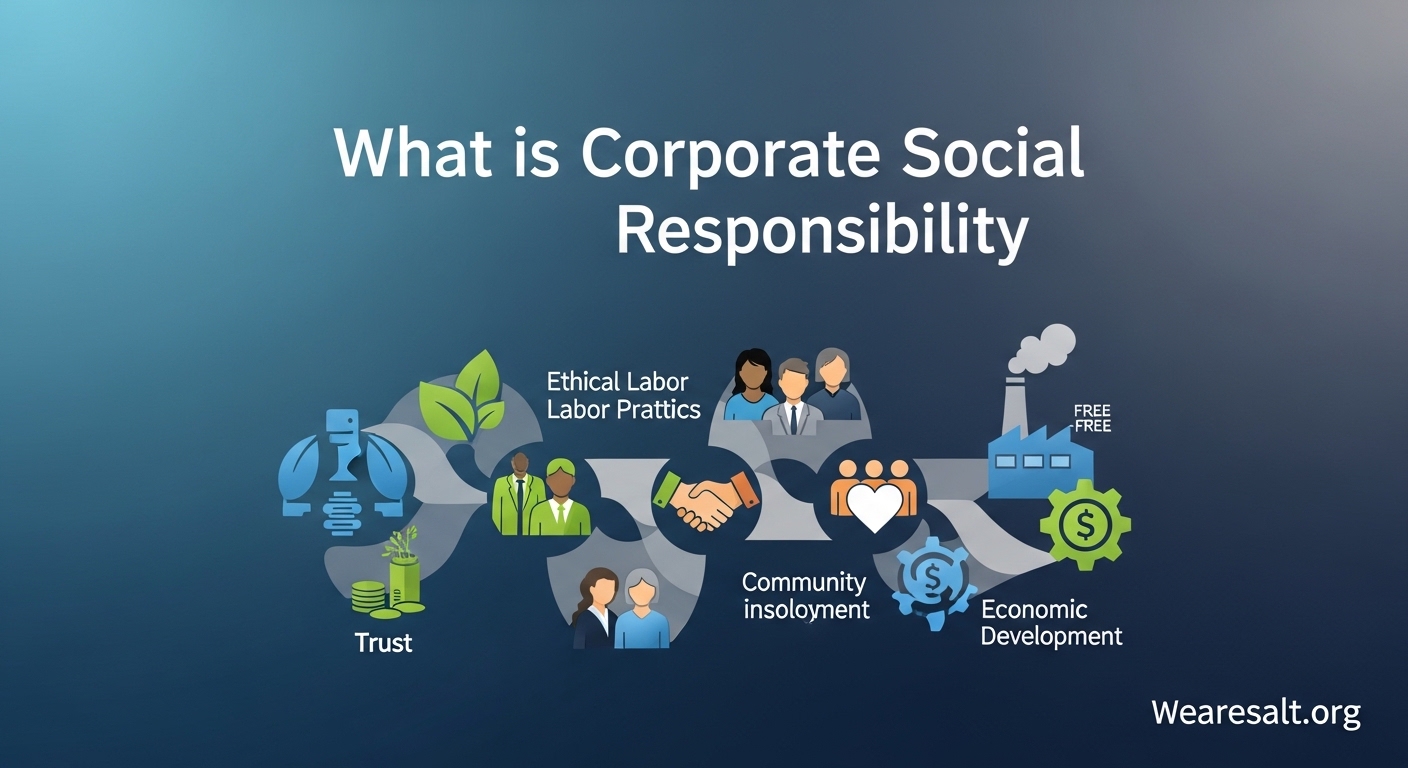
Corporate social responsibility (CSR) is a self-regulating business model that helps companies be socially accountable to themselves, their stakeholders, and the public. It means operating in ways that enhance society and the environment instead of contributing negatively to them.
Understanding what corporate social responsibility means has become essential for businesses of all sizes in 2026. Consumers, employees, and investors increasingly expect companies to operate with purpose beyond profit. This guide explains everything you need to know about CSR, from its core definition to practical implementation steps.
In this article, we will explore the four types of corporate social responsibility, examine real-world examples, discuss why CSR matters for your business, and address common concerns about authenticity and greenwashing.
Table of Contents
What Is Corporate Social Responsibility?
Corporate social responsibility is a management concept where companies integrate social and environmental concerns into their business operations and stakeholder interactions. It goes beyond legal obligations, requiring businesses to act ethically and contribute positively to economic development while improving quality of life for employees, their families, and the local community.
Think of CSR as corporate citizenship. Just as individual citizens have responsibilities to their communities, businesses have obligations to society. These responsibilities include operating sustainably, treating employees fairly, giving back to communities, and making decisions that balance profit with purpose.
The concept emerged from the understanding that businesses do not operate in isolation. They rely on resources from society, employ community members, and impact the environment. CSR acknowledges this interdependence and commits companies to giving back.
The Triple Bottom Line Framework
A helpful way to understand CSR is through the triple bottom line framework. Instead of focusing solely on profit (the traditional bottom line), this approach measures success in three areas: people, planet, and profit.
Companies following the triple bottom line ask three questions when making decisions. How does this affect our employees and community (people)? What is the environmental impact (planet)? And does this make financial sense (profit)?
This framework helps businesses move beyond purely financial metrics. It encourages them to consider social and environmental outcomes as equally important measures of success.
How CSR Differs from Regular Business Ethics
While all businesses should operate ethically, CSR goes further than basic ethical compliance. Standard business ethics involves following laws and avoiding harm. CSR means actively working to create positive impact.
For example, complying with minimum wage laws is ethical business practice. Paying a living wage and providing exceptional benefits goes beyond compliance into CSR territory. Similarly, meeting environmental regulations is expected. Reducing carbon footprint to zero and restoring natural habitats exceeds those expectations.
CSR represents a voluntary commitment to making the world better, not just avoiding making it worse.
What Are the 4 Types of Corporate Social Responsibility?
Corporate social responsibility typically breaks down into four main categories. Understanding these types helps businesses develop comprehensive strategies that address multiple stakeholder needs.
Most successful CSR programs incorporate elements from all four categories. They recognize that environmental protection, ethical operations, community support, and economic sustainability are interconnected.
1. Environmental Responsibility
Environmental responsibility focuses on minimizing a company’s negative impact on the natural world. This type of CSR recognizes that businesses consume resources and generate waste, creating obligations to protect ecosystems.
Common environmental initiatives include reducing carbon emissions, minimizing waste through recycling programs, conserving water and energy, sourcing sustainable materials, and protecting biodiversity. Some companies go further by restoring damaged environments or funding conservation projects.
Patagonia exemplifies environmental responsibility. The outdoor clothing company uses recycled materials, repairs products rather than replacing them, and donates 1% of sales to environmental causes. They have also committed to becoming carbon neutral by 2026.
Environmental responsibility increasingly matters to consumers. Studies show that 73% of global consumers would change their consumption habits to reduce environmental impact. Companies ignoring this shift risk losing market share to more sustainable competitors.
2. Ethical Responsibility
Ethical responsibility involves conducting business in a fair and ethical manner. This extends to all stakeholder relationships including employees, suppliers, customers, and competitors.
Key ethical responsibilities include fair labor practices, diversity and inclusion initiatives, transparent supply chains, honest marketing, and respectful treatment of customers. Companies must also ensure suppliers meet ethical standards.
The clothing brand Everlane demonstrates ethical responsibility through its “Radical Transparency” policy. They publicly disclose the true cost of each product, reveal factory conditions, and share information about their supply chain partners.
Ethical responsibility also means standing up for what is right, even when not legally required. This could involve paying employees above minimum wage, refusing to work with suppliers using child labor, or speaking out on social issues aligned with company values.
3. Philanthropic Responsibility
Philanthropic responsibility refers to how companies give back to communities and causes. Unlike environmental or ethical responsibilities tied directly to operations, philanthropy focuses on charitable giving and community engagement.
Common philanthropic activities include donating money to nonprofits, supporting employee volunteer programs, sponsoring community events, funding educational initiatives, and providing pro bono services. Many companies establish foundations to manage their giving strategically.
Microsoft demonstrates philanthropy through its Employee Giving Program, which matches employee donations and volunteer time. In 2026, they donated over $2 billion in cash and software to nonprofits worldwide.
Effective philanthropy aligns with company expertise and values. A tech company might focus on digital literacy programs. A food company might address hunger and nutrition. This alignment creates more meaningful impact than random giving.
4. Economic Responsibility
Economic responsibility ties CSR to financial performance. It recognizes that businesses must be profitable to survive, but asserts that profit-making should happen responsibly.
This type of CSR includes making decisions that balance profit with social impact, investing in sustainable practices that may cost more upfront, sacrificing short-term gains for long-term sustainability, and transparent financial reporting.
Companies practicing economic responsibility understand that sustainable profits require healthy communities, stable environments, and engaged employees. They reject the false choice between doing well and doing good.
Unilever demonstrates economic responsibility through its Sustainable Living Brands. These products grow 69% faster than other brands while delivering 75% of the company’s growth. This proves that sustainability and profitability can reinforce each other.
Why Corporate Social Responsibility Matters
CSR matters because it creates value for businesses while addressing pressing social and environmental challenges. Companies embracing CSR often outperform competitors who ignore these responsibilities.
The business case for CSR has grown stronger as research demonstrates concrete benefits. These advantages span talent acquisition, customer loyalty, investor relations, and risk management.
Attracting and Retaining Top Talent
Modern workers, particularly millennials and Gen Z, prioritize purpose-driven employers. They want to work for companies whose values align with their own.
A study by Cone Communications found that 64% of millennials consider a company’s social and environmental commitments when deciding where to work. Furthermore, 64% would not take a job if the employer did not have strong CSR practices.
Employees at companies with strong CSR programs report higher job satisfaction and engagement. They feel proud of their employer and motivated by work that contributes positively to society. This translates into lower turnover rates and higher productivity.
Building Brand Reputation and Customer Loyalty
Consumers increasingly make purchasing decisions based on company values. They reward responsible companies with loyalty and punish irresponsible ones with boycotts.
Research from Accenture shows that 62% of consumers want companies to take a stand on current and broadly relevant issues like sustainability and fair employment practices. Meanwhile, 76% of CEOs agree that they need to pivot their business models to be more sustainable.
Companies known for CSR enjoy enhanced brand reputation. When controversies arise, they benefit from goodwill built through positive actions. Customers trust them more and are willing to pay premium prices for their products.
Appealing to Investors and Reducing Risk
Investors increasingly use environmental, social, and governance (ESG) criteria to evaluate companies. Those with strong CSR practices often enjoy lower capital costs and higher valuations.
A Boston Consulting Group study found that companies with high ESG ratings command valuation premiums of up to 10-15%. Investors recognize that responsible companies manage risks better and are positioned for long-term success.
CSR also helps companies avoid regulatory, legal, and reputational risks. Ethical supply chain management prevents scandals involving labor abuses. Environmental initiatives reduce exposure to climate-related regulations. Transparent operations minimize compliance issues.
Contributing to Long-Term Sustainability
Ultimately, CSR matters because it helps ensure business longevity. Companies depleting natural resources, exploiting workers, or alienating communities cannot sustain operations indefinitely.
Resource scarcity, climate change, and social inequality pose existential threats to many industries. Companies addressing these challenges proactively position themselves to thrive in a changing world. Those ignoring them face increasing costs and constraints.
CSR vs ESG: What Is the Difference?
You may have heard both CSR and ESG discussed in business contexts. While related, these concepts differ in scope and application.
CSR refers to the broad concept of corporate social responsibility. It is a business philosophy and set of practices focused on ethical operations and positive social impact. CSR is often voluntary and self-directed by companies.
ESG stands for Environmental, Social, and Governance. It provides a framework for measuring and reporting specific aspects of corporate responsibility. ESG focuses on quantifiable metrics that investors use to evaluate risk and opportunity.
Think of CSR as the “what” and ESG as the “how.” CSR defines a company’s commitment to social responsibility. ESG provides standardized metrics to track and report progress on that commitment.
Many companies today integrate both approaches. They adopt CSR as their guiding philosophy while using ESG frameworks to measure, report, and improve their performance. Together, they help businesses balance profit with purpose.
Real-World Examples of Corporate Social Responsibility
Understanding CSR becomes clearer when examining how actual companies implement these principles. Here are notable examples across different industries.
These companies demonstrate that CSR is not limited to any particular sector. From technology to retail to finance, businesses find ways to create positive impact while remaining profitable.
Technology Sector: Salesforce
Salesforce pioneered the 1-1-1 model of corporate philanthropy. They donate 1% of product, 1% of equity, and 1% of employee time to charitable causes. This model has been adopted by thousands of other companies.
The company also achieved net zero residual emissions in 2026, matching 100% of its electricity use with renewable energy. Their commitment extends to advocating for climate action and sustainable practices throughout their supply chain.
Retail Sector: Costco
Costco demonstrates economic responsibility by paying employees significantly above minimum wage. Their average hourly wage exceeds $24, well above retail industry norms. They also provide excellent benefits including healthcare and retirement plans.
This investment in employees has paid off. Costco enjoys remarkably low turnover rates and high employee satisfaction. Customers benefit from knowledgeable, motivated staff. Shareholders benefit from consistent performance.
Food and Beverage: Ben & Jerry’s
Ben & Jerry’s has integrated social mission into their business model since inception. They source Fairtrade certified ingredients, ensuring farmers receive fair compensation. They advocate for social justice causes including climate action and racial equity.
The company is a certified B Corporation, meeting rigorous standards of social and environmental performance, accountability, and transparency. This certification provides third-party validation of their CSR commitments.
Finance: Bank of America
Bank of America has committed $1.5 trillion to sustainable finance through 2026. They finance renewable energy projects, support affordable housing, and invest in community development financial institutions.
Their CSR efforts also include workforce development programs helping unemployed individuals gain skills for available jobs. They recognize that healthy communities create conditions for successful banking relationships.
How to Implement CSR in Your Business
Implementing CSR does not require massive budgets or dedicated departments. Even small businesses can practice corporate social responsibility meaningfully.
The key is starting where you are and building over time. CSR is a journey, not a destination. Here is a practical approach for getting started.
Step 1: Assess Your Current Impact
Begin by evaluating how your business currently affects stakeholders. Consider your environmental footprint, employee satisfaction, supplier relationships, and community presence.
Identify areas where you already perform well and areas needing improvement. This honest assessment provides a baseline for measuring future progress.
Step 2: Define Your Priorities
CSR works best when aligned with your business mission and capabilities. A restaurant might focus on food waste reduction and sourcing local ingredients. A software company might prioritize digital inclusion and sustainable computing.
Choose one or two focus areas where you can make meaningful impact. Spreading efforts too thin dilutes effectiveness and makes progress harder to measure.
Step 3: Set Measurable Goals
Effective CSR requires specific, measurable objectives. Rather than vague commitments like “be more green,” set targets like “reduce energy consumption by 20% within two years” or “achieve zero waste to landfill by 2026.”
These metrics help track progress and demonstrate accountability to stakeholders. They also make it easier to identify what works and adjust what does not.
Step 4: Engage Stakeholders
Successful CSR involves everyone connected to your business. Engage employees in generating ideas and implementing initiatives. Communicate with customers about your commitments. Partner with community organizations for greater impact.
Stakeholder involvement increases buy-in and generates better ideas. Employees often know exactly where improvements are needed. Customers can tell you which issues matter most to them.
Step 5: Communicate Transparently
Share your CSR commitments and progress with stakeholders. Transparency builds trust and creates accountability. It also allows others to learn from your experience.
Be honest about both successes and challenges. Authentic communication resonates more than polished perfection. Admitting areas for improvement shows integrity and commitment to growth.
Greenwashing: What to Avoid
As CSR has gained popularity, so has greenwashing. This practice involves making misleading claims about environmental or social practices to appear more responsible than reality supports.
Greenwashing undermines trust in legitimate CSR efforts and can damage company reputations when exposed. Consumers increasingly sophisticated at identifying false claims make this risky strategy.
Common Greenwashing Tactics
Watch for vague language without specifics. Terms like “eco-friendly” or “natural” mean little without standards or certifications backing them up. Be wary of irrelevant claims highlighting minor improvements while ignoring major problems.
Be cautious of hidden trade-offs, where one positive attribute masks other negatives. A product might use recycled packaging but contain harmful chemicals. The packaging claim distracts from the larger issue.
Avoid the sin of lesser of two evils, where dangerous products are framed as better choices. Organic cigarettes remain harmful regardless of organic certification.
How to Practice Authentic CSR
Avoid greenwashing by backing claims with evidence. Obtain third-party certifications from reputable organizations like B Corp, Fairtrade, or Energy Star. These provide independent validation of your commitments.
Set specific, measurable goals and report progress honestly. Transparency about both achievements and shortcomings builds credibility. Admitting you are working toward something is more trustworthy than claiming perfection.
Ensure your actions match your words. Marketing campaigns touting sustainability should reflect actual operational practices. Employees should experience internally the values you promote externally.
Focus on meaningful impact rather than superficial signals. Real CSR creates measurable benefits for people and planet, not just positive press releases.
Frequently Asked Questions About Corporate Social Responsibility
What is the meaning of corporate social responsibility?
Corporate social responsibility (CSR) is a self-regulating business model where companies commit to operating ethically and contributing positively to society. It involves managing business processes to produce an overall positive impact on society, the environment, and stakeholders while remaining profitable.
What are the 4 types of CSR?
The four types of CSR are: 1) Environmental Responsibility – minimizing negative environmental impact through sustainable practices, 2) Ethical Responsibility – conducting business fairly and treating all stakeholders with respect, 3) Philanthropic Responsibility – giving back to communities through charitable donations and volunteer work, and 4) Economic Responsibility – making financial decisions that balance profit with social and environmental impact.
What is the main purpose of CSR?
The main purpose of CSR is to ensure businesses operate in ways that benefit society while remaining economically viable. It helps companies build trust with stakeholders, attract talent and customers, manage risks, and contribute to long-term sustainability. CSR recognizes that business success depends on healthy communities and environments.
What is CSR and give an example?
CSR is when companies voluntarily operate in ways that enhance society beyond legal requirements. For example, Patagonia practices CSR by using recycled materials, offering product repair services to extend product life, donating 1% of sales to environmental causes, and committing to carbon neutrality. These actions go beyond what is legally required to create positive environmental impact.
What is corporate social responsibility in simple terms?
In simple terms, corporate social responsibility means businesses taking responsibility for their impact on society and the environment. It is companies choosing to do good things for people and the planet, not just focusing on making money. This includes treating employees well, reducing pollution, giving to charities, and making ethical decisions.
What are the 4 principles of CSR?
The four principles of CSR align with the four types: environmental stewardship (protecting nature), ethical conduct (doing what is right), philanthropic giving (helping communities), and economic sustainability (remaining profitable while being responsible). Together these principles guide businesses to balance profit with positive social impact.
Is CSR the same as ESG?
CSR and ESG are related but different. CSR is the broader philosophy of corporate social responsibility guiding how a company operates. ESG (Environmental, Social, Governance) provides specific metrics for measuring and reporting CSR performance. Think of CSR as the commitment and ESG as the measurement framework used to track progress on that commitment.
How can small businesses practice CSR?
Small businesses can practice CSR by starting with realistic steps: use energy-efficient lighting and equipment, source from local suppliers, offer flexible work arrangements, support local charities through volunteer time or donations, reduce waste through recycling, and treat employees fairly. Even small actions add up, and authentic commitments matter more than large budgets.
Conclusion: Embracing Corporate Social Responsibility
Corporate social responsibility represents more than a business trend. It reflects a fundamental shift in how society expects companies to operate. Businesses can no longer focus solely on profit while ignoring their impact on people and planet.
Understanding what corporate social responsibility means helps you navigate this new landscape. Whether you are a business leader, employee, investor, or consumer, CSR knowledge empowers better decisions. It helps you identify genuinely responsible companies and avoid those merely pretending.
The four types of CSR provide a framework for comprehensive responsibility. Environmental stewardship protects the natural world we all depend on. Ethical conduct ensures fair treatment of everyone touched by business operations. Philanthropic giving addresses community needs that business activity alone cannot solve. Economic responsibility ties these commitments to sustainable business practices.
Companies practicing authentic CSR in 2026 enjoy measurable benefits. They attract dedicated employees who share their values. They build customer loyalty that transcends price competition. They satisfy investors seeking long-term stability. They manage risks that threaten less responsible competitors.
Yet CSR should not be pursued merely for these advantages. The ultimate purpose remains creating genuine positive impact. When companies treat employees well, reduce environmental harm, and strengthen communities, everyone benefits. Society becomes healthier, fairer, and more sustainable.
If you have not yet integrated CSR into your business, now is the time to start. Assess your current impact. Define your priorities. Set measurable goals. Engage your stakeholders. And remember that authentic commitment matters more than perfection.
Corporate social responsibility is not about being perfect. It is about being better today than yesterday and continuing to improve. Every step toward greater responsibility, however small, contributes to a better world and a more sustainable business.