
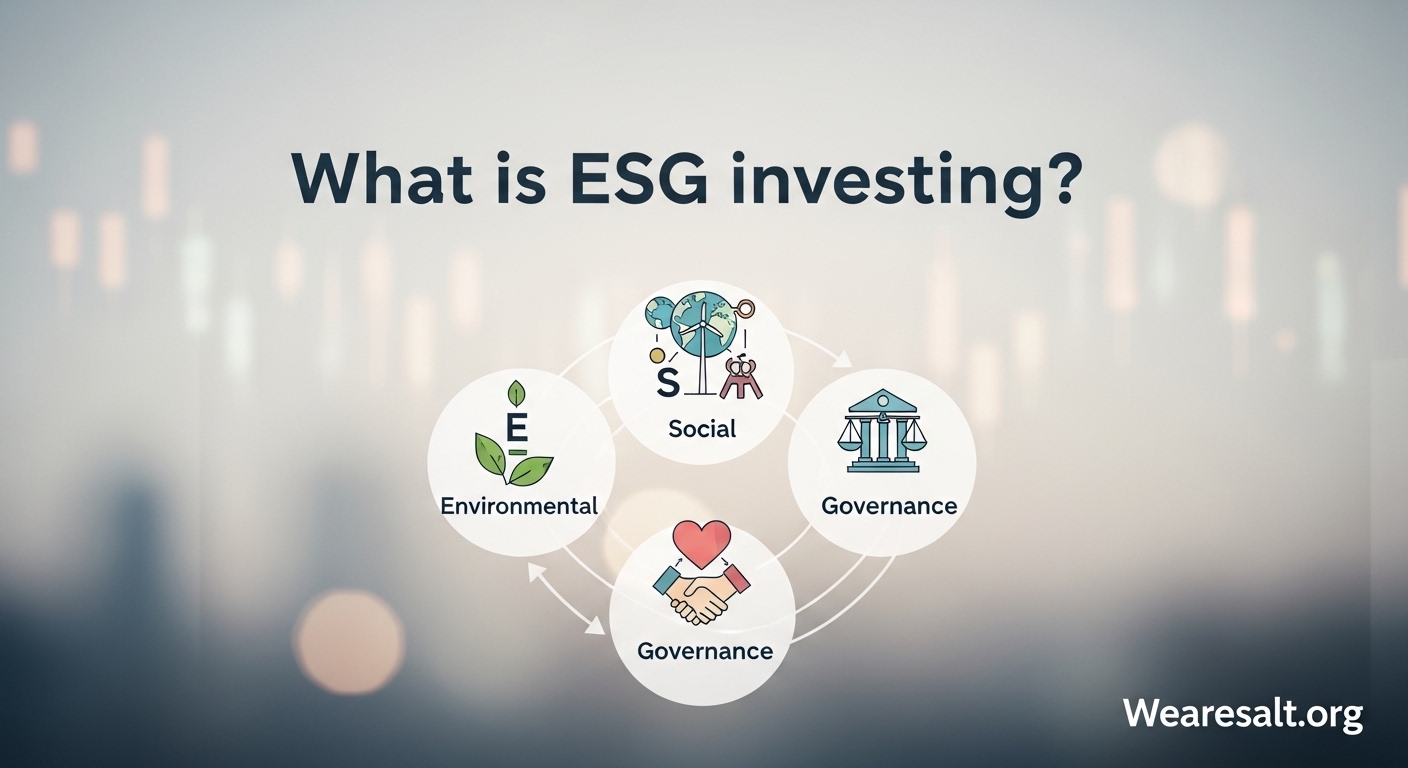
What is ESG investing? It is a strategy that evaluates companies based on their environmental impact, social practices, and governance standards before making investment decisions. Investors use these non-financial factors to identify material risks and growth opportunities that traditional financial analysis might miss. This approach has grown from a niche concept to a mainstream investment philosophy embraced by individual investors and institutional funds alike.
I have researched ESG investing extensively and spoken with financial advisors who have implemented these strategies for over a decade. The key insight they share is that ESG is not about sacrificing returns for values. It is about recognizing that companies with strong environmental, social, and governance practices tend to be better managed and more resilient over the long term.
In this guide, you will learn exactly what ESG investing means, how the three components work together, how ESG ratings are calculated, and practical steps to incorporate ESG principles into your own portfolio. We will also address the criticisms and challenges honestly so you can make informed decisions.
Table of Contents
What Does ESG Stand For
ESG stands for Environmental, Social, and Governance. These three categories represent the core criteria investors use to evaluate companies beyond traditional financial metrics. Each category contains specific factors that analysts assess when determining a company’s ESG profile.
The Environmental component examines how a company impacts the natural world. The Social component looks at how a company treats people. The Governance component evaluates how a company is managed and controlled. Together, these three pillars provide a comprehensive view of a company’s sustainability and ethical practices.
Here is what each component includes:
- Environmental: Climate change impact, carbon emissions, energy efficiency, waste management, water usage, pollution, resource depletion, and biodiversity
- Social: Labor standards, employee relations, diversity and inclusion, human rights, community engagement, customer satisfaction, and data privacy
- Governance: Board composition, executive compensation, shareholder rights, business ethics, transparency, and anti-corruption policies
ESG investing applies these criteria through various methods. Some investors use negative screening to exclude companies in controversial industries like tobacco or fossil fuels. Others use positive screening to seek out companies demonstrating leadership in sustainability. Many integrate ESG factors directly into their traditional financial analysis.
Environmental Factors
Environmental factors assess how a company’s operations affect the natural world and how environmental risks might affect the company. This category has become increasingly important as climate change poses material risks to businesses across all sectors.
Carbon emissions and climate impact sit at the top of most environmental assessments. Companies report their Scope 1 emissions from direct operations, Scope 2 emissions from purchased energy, and increasingly their Scope 3 emissions from their entire value chain. Investors look for companies with concrete plans to reduce emissions and transition to renewable energy sources.
Energy efficiency matters too. Companies that use less energy per unit of output typically have lower operating costs and reduced exposure to energy price volatility. Waste management and water usage complete the picture. Industries like agriculture, manufacturing, and technology face particular scrutiny for their water consumption and waste generation.
Environmental compliance is another key consideration. Companies with poor environmental records face regulatory fines, remediation costs, and reputational damage. Strong environmental practices signal competent management and reduced regulatory risk.
Social Factors
Social factors examine how a company manages relationships with its employees, suppliers, customers, and communities. These factors directly impact a company’s ability to attract talent, maintain productivity, and build customer loyalty.
Labor standards and employee relations form the foundation of social analysis. Investors evaluate workplace safety, fair wages, benefits, and worker treatment. Companies with poor labor practices face higher turnover, lower productivity, and increased risk of strikes or legal action. Strong employee relations correlate with better business performance.
Diversity and inclusion have gained prominence in ESG analysis. Research consistently shows that diverse teams make better decisions and that diverse leadership correlates with stronger financial performance. Investors examine board diversity, executive diversity, and workforce diversity across all levels.
Human rights extend beyond the company’s direct employees to its entire supply chain. Companies face increasing scrutiny for labor practices at their suppliers, particularly in developing countries. Community relations and customer satisfaction round out the social assessment. Companies that contribute positively to their communities and maintain high customer satisfaction tend to enjoy stronger long-term performance.
Governance Factors
Governance factors evaluate how a company is directed and controlled. Strong governance practices protect shareholder interests and reduce the risk of fraud, corruption, and value destruction.
Board composition and independence matter immensely. Independent directors provide oversight that aligns with shareholder interests rather than management interests. Investors look for boards with relevant expertise, diverse perspectives, and enough independent members to challenge management when necessary. Board tenure and refreshment policies also receive scrutiny.
Executive compensation receives careful evaluation. Pay packages should align executive interests with long-term shareholder value creation. Excessive compensation, complex pay structures, and golden parachutes raise red flags. Transparency about compensation practices and clear performance metrics earn positive marks.
Shareholder rights and business ethics complete the governance picture. Investors prefer companies that treat shareholders fairly, provide adequate disclosure, and maintain strong ethical standards. Anti-corruption policies, political spending transparency, and lobbying disclosures all factor into governance assessments. Companies with weak governance face higher risks of scandals, regulatory action, and value destruction.
How ESG Investing Works
ESG investing works by incorporating environmental, social, and governance factors into the investment selection and management process. This integration happens through several distinct approaches that investors can choose based on their goals and values.
ESG integration involves analyzing ESG factors alongside traditional financial metrics. Portfolio managers consider how environmental risks, social practices, and governance quality might affect a company’s future earnings and stock price. This approach treats ESG data as material information that can improve investment decisions without necessarily excluding any companies.
Negative screening removes companies or sectors that do not meet certain ethical standards. Common exclusions include tobacco, firearms, fossil fuels, and companies with poor human rights records. This approach aligns investments with specific values but may limit diversification.
Positive screening seeks out companies demonstrating leadership in ESG practices. Investors might target companies with low carbon emissions, strong diversity programs, or exemplary governance. Thematic investing focuses on specific ESG themes like renewable energy, clean water, or affordable housing.
ESG ratings provide standardized scores that make comparison easier. Major rating agencies include MSCI, Sustainalytics, Refinitiv, and S&P Global. Each agency uses its own methodology, which explains why the same company might receive different scores from different providers. These ratings typically assess multiple criteria within each ESG category and aggregate them into overall scores.
ESG vs SRI vs Impact Investing
These three approaches to values-based investing overlap but have important distinctions. Understanding the differences helps you choose the approach that aligns with your goals.
ESG investing focuses on material factors that affect financial performance. ESG investors believe that environmental, social, and governance practices impact long-term returns. The primary goal remains financial performance, with ESG factors serving as risk management and opportunity identification tools.
SRI (Socially Responsible Investing) predates ESG and focuses more explicitly on ethical considerations. SRI typically uses negative screening to exclude companies in controversial industries regardless of their financial prospects. SRI puts values first and accepts that this might affect returns.
Impact investing goes a step further by seeking measurable social or environmental outcomes alongside financial returns. Impact investors want their capital to directly create positive change. Examples include investing in affordable housing projects, renewable energy installations, or companies serving underserved communities.
Here is a quick comparison:
- ESG Investing: Integrates non-financial factors into financial analysis. Primary goal is risk-adjusted returns. Includes most companies.
- SRI: Screens investments based on ethical criteria. Primary goal is values alignment. Excludes controversial industries.
- Impact Investing: Targets specific measurable outcomes. Primary goal is creating positive change. Often involves private investments.
These approaches are not mutually exclusive. Many investors combine elements of all three based on their priorities.
Benefits of ESG Investing
ESG investing offers several potential benefits that have attracted growing numbers of investors over the past decade. These benefits extend beyond feeling good about your investments.
Risk management ranks as the primary benefit. ESG factors often identify risks that traditional financial analysis misses. Companies with poor environmental practices face regulatory and litigation risks. Companies with weak governance face scandal and fraud risks. Companies with poor labor practices face turnover and productivity risks. Identifying these risks early helps investors avoid losses.
Long-term performance potential attracts many ESG investors. Companies with strong ESG practices tend to be better managed and more forward-thinking. They often enjoy stronger customer loyalty, easier talent recruitment, and lower cost of capital. Multiple studies have shown that ESG funds have performed competitively with traditional funds over extended periods.
Values alignment allows investors to put their money where their beliefs are. Many investors want their portfolios to reflect their concern for environmental sustainability, social justice, and ethical business practices. ESG investing makes this possible without necessarily sacrificing returns.
Access to growing opportunities represents another benefit. The transition to renewable energy, the push for diversity and inclusion, and the demand for sustainable products create investment opportunities. Companies positioned to benefit from these trends often score well on ESG metrics.
Criticisms and Challenges
ESG investing faces legitimate criticisms that every investor should understand. Acknowledging these challenges leads to more informed decision-making.
Greenwashing tops the list of concerns. Some funds market themselves as ESG while holding companies with questionable practices. Marketing materials might emphasize environmental commitments while portfolios contain major polluters. Investors need to look beyond labels and examine actual holdings.
Rating inconsistencies create confusion. Different rating agencies use different methodologies and often reach different conclusions about the same company. One agency might give a company high marks for governance while another focuses on environmental concerns. This inconsistency makes it difficult to compare ESG investments.
Higher expense ratios affect returns. ESG funds often charge higher fees than comparable traditional funds. These fees compound over time and can significantly reduce long-term returns. Investors should compare expense ratios carefully and ensure that ESG benefits justify any additional costs.
Limited real-world impact concerns some critics. Holding shares in a company does not directly fund its operations in the way that buying bonds or participating in IPOs does. Critics argue that ESG investing changes little about how companies actually behave. Impact investors address this concern by seeking direct, measurable outcomes.
Political debates have emerged around ESG. Some policymakers argue that ESG considerations in pension fund management inappropriately mix politics with investment decisions. These debates create regulatory uncertainty in some jurisdictions.
Despite these challenges, ESG investing continues to grow. Thoughtful investors can navigate the criticisms by researching funds carefully, understanding rating methodologies, and maintaining realistic expectations about impact.
How to Get Started with ESG Investing
Starting with ESG investing does not require becoming an expert overnight. Follow these practical steps to incorporate ESG principles into your portfolio.
Step 1: Define your priorities. Identify which ESG issues matter most to you. Some investors care deeply about climate change. Others prioritize labor practices or governance quality. Your priorities will guide your investment choices.
Step 2: Decide on your approach. Choose between ESG integration, negative screening, or thematic investing. ESG integration works well for investors who want to maintain broad diversification. Negative screening suits those with strong values-based exclusions. Thematic investing appeals to those who want to target specific opportunities.
Step 3: Research ESG funds and ratings. Look for funds with clear ESG methodologies that align with your priorities. Examine the actual holdings, not just the marketing. Compare expense ratios to traditional alternatives. Consider consulting multiple rating agencies for perspective on individual companies.
Step 4: Start with index funds or ETFs. ESG index funds and ETFs offer diversified exposure with lower fees than actively managed funds. Popular options track ESG-screened versions of major indexes like the S&P 500. These provide an easy entry point for beginners.
Step 5: Monitor and adjust. ESG ratings change as company practices evolve. Review your holdings periodically to ensure they still meet your criteria. Stay informed about developments in ESG standards and rating methodologies.
Starting small makes sense. You might begin by replacing one traditional fund with an ESG alternative and expand from there as you become more comfortable with the approach.
Frequently Asked Questions
What is ESG investing in simple terms?
ESG investing is a way of investing in companies based on their commitment to environmental, social, and governance factors. It evaluates how companies treat the environment, their employees and communities, and how well they are managed. Investors use these non-financial factors alongside traditional financial analysis to identify risks and opportunities.
Why is ESG criticized?
ESG faces criticism for several reasons. Greenwashing occurs when funds claim ESG credentials while holding questionable companies. Rating agencies use different methodologies, creating inconsistent scores. ESG funds often charge higher fees than traditional funds. Some critics argue that simply owning stocks does not create real-world impact. Political debates have also emerged about whether ESG considerations are appropriate for certain institutional investors.
What is an example of ESG investing?
An example of ESG investing would be choosing a mutual fund that screens out fossil fuel companies and prioritizes businesses with strong renewable energy commitments. Another example is investing in a company because it has diverse leadership, strong worker safety records, and transparent governance practices. Many investors use ESG index funds that track versions of major indexes like the S&P 500 but exclude companies with poor ESG ratings.
Is ESG investing good?
ESG investing can be good for investors who want to align their portfolios with their values while managing long-term risks. Studies show ESG funds have performed competitively with traditional funds over time. However, ESG investing involves higher fees in many cases and requires careful research to avoid greenwashing. Whether it is right for you depends on your financial goals, values, and willingness to research ESG funds and ratings.
Conclusion
What is ESG investing? It is an approach that evaluates companies based on environmental impact, social practices, and governance quality alongside traditional financial metrics. This strategy has evolved from a niche concept to a mainstream investment philosophy embraced by millions of investors worldwide.
The three ESG components work together to provide a comprehensive view of company sustainability. Environmental factors assess climate impact and resource use. Social factors examine how companies treat people. Governance factors evaluate management quality and ethical standards. Together, they help identify material risks and opportunities that financial statements alone might miss.
ESG investing is not perfect. Greenwashing, rating inconsistencies, and higher fees present real challenges. However, for investors willing to research carefully, ESG offers a way to align portfolios with values while potentially improving risk-adjusted returns.
If you are interested in ESG investing, start by defining your priorities. Then research funds and ratings that align with those priorities. Consider beginning with low-cost ESG index funds while you learn more about the approach. With thoughtful implementation, ESG investing can help you build a portfolio that reflects both your financial goals and your values.