
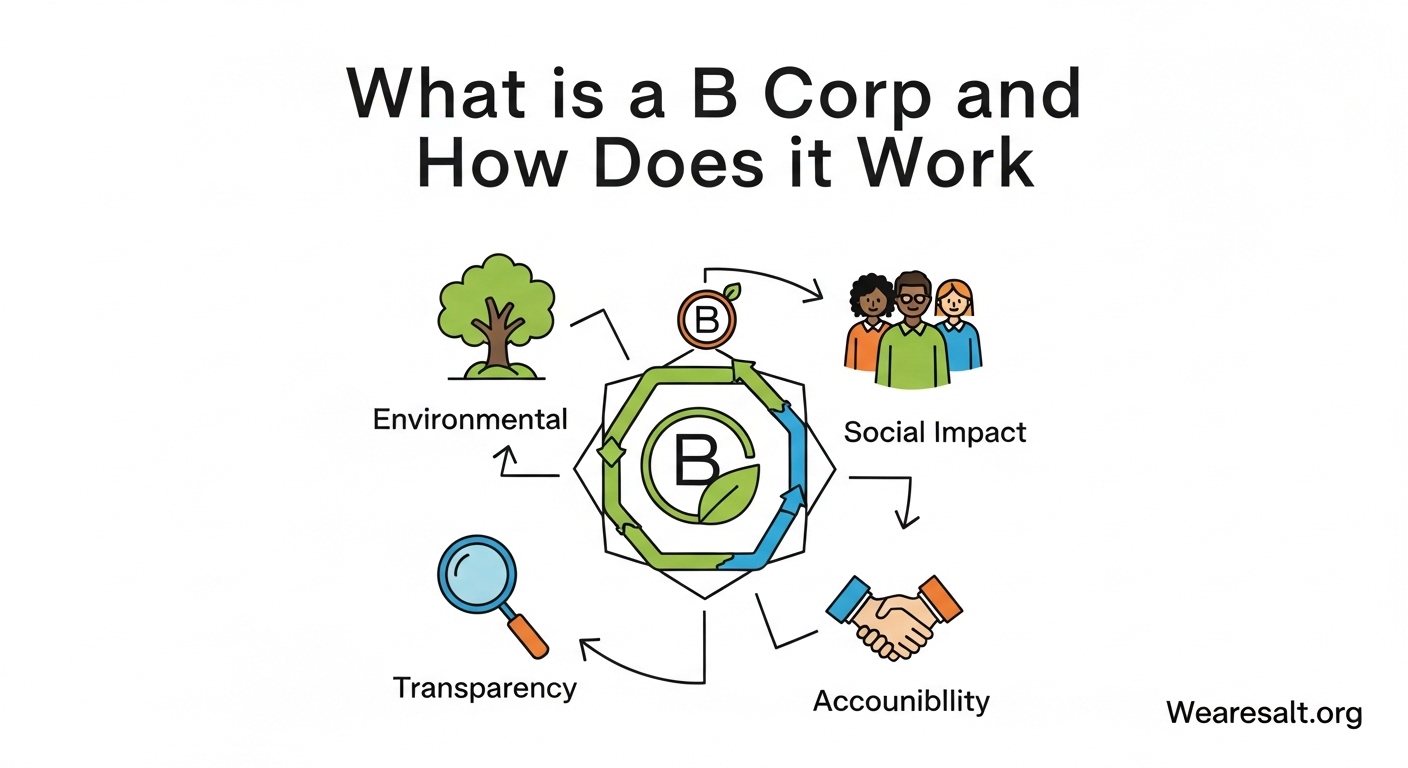
A B Corp is a for-profit company certified by the nonprofit B Lab for meeting rigorous standards of social and environmental performance, transparency, and accountability. As of 2026, over 10,300 companies across 103 countries have earned this designation, representing a global movement to use business as a force for good. In this guide, I will explain exactly what B Corp certification means, how the process works, and whether pursuing it makes sense for your organization.
Table of Contents
What is a B Corp?
A Certified B Corporation (commonly called a B Corp) is a business that has been verified to balance profit and purpose. The “B” stands for “Benefit,” reflecting these companies’ commitment to creating positive outcomes for all stakeholders, not just shareholders.
Unlike traditional corporations that prioritize maximizing shareholder returns, B Corps legally commit to considering the impact of their decisions on workers, customers, suppliers, community, and the environment. This is not just marketing language. The certification requires companies to amend their governing documents to reflect this stakeholder approach, making it legally binding.
B Lab, the nonprofit organization that administers the certification, evaluates companies across five key impact areas: governance, workers, community, environment, and customers. To become certified, a company must score at least 80 points out of 200 on the B Impact Assessment. The median score for ordinary businesses is just 50.9 points, making the 80-point threshold genuinely demanding.
The Declaration of Interdependence
Every B Corp signs the Declaration of Interdependence, a statement of values that binds the community together. It acknowledges that businesses depend on each other and the living systems we all share. All B Corps commit to being the change they seek in the world, conducting business as if people and place matter, and aspiring to do no harm while benefiting all through their products, practices, and profits.
What is B Lab?
B Lab is the nonprofit organization behind the B Corp movement. Founded in 2006, B Lab’s mission is to transform the global economy to benefit all people, communities, and the planet. They accomplish this through three main activities: certifying B Corporations, advocating for benefit corporation legislation, and building collective action across the business community.
The organization operates globally with regional partners in the UK, Australia, Europe, and Latin America. B Lab maintains the B Impact Assessment, updates certification standards, and conducts the verification reviews that determine whether companies qualify for certification. They also help companies improve by providing tools and resources to address gaps identified during the assessment process.
B Lab is funded through certification fees paid by B Corps and grants from foundations. This funding model ensures independence while keeping the organization accountable to the community it serves.
How Does B Corp Certification Work?
The certification process involves five main stages, each designed to ensure companies meet the high standards required to join the B Corp community. Most companies complete certification within 6 to 12 months, though complex organizations or those starting from scratch may take longer.
Step 1: Complete the B Impact Assessment
Companies begin by registering on the B Lab website and completing the B Impact Assessment, a comprehensive questionnaire covering approximately 200 questions about company practices. The assessment evaluates operations across governance, workers, community, environment, and customer impact areas.
The questions are weighted based on industry, company size, and geography to ensure fair comparison. A company must score at least 80 points to proceed to the next step. Many companies use this initial assessment to identify improvement opportunities before formally applying.
Step 2: Submit Documentation and Verification
After achieving an 80+ score, companies submit documentation to verify their answers. B Lab reviewers request evidence such as policies, financial records, employee handbooks, environmental reports, and supplier agreements. This verification process ensures companies cannot simply claim good practices without proof.
The review typically takes several weeks and may involve follow-up questions. B Lab uses a risk-based approach, with higher scrutiny for companies in controversial industries or those making exceptional claims about their impact.
Step 3: Meet Legal Requirements
Certified B Corps must legally embed their commitment to stakeholders into their governing documents. For corporations, this typically means amending the Articles of Association to require the board to consider all stakeholders when making decisions, not just shareholders.
The specific legal requirement varies by jurisdiction. In the United States, companies may need to become benefit corporations (a specific legal structure) or add stakeholder provisions to their bylaws. In the UK, companies amend their Articles of Association. B Lab provides jurisdiction-specific guidance to help companies comply.
Step 4: Sign the B Corp Agreement
Companies sign a formal agreement with B Lab that outlines their commitments as a Certified B Corporation. This includes the Declaration of Interdependence and agreement to maintain transparency by making their B Impact Report public.
The agreement also establishes the terms for recertification and confirms that the company will update B Lab about significant changes that might affect certification status, such as acquisitions, major operational changes, or legal restructuring.
Step 5: Pay the Certification Fee
Companies pay an annual certification fee based on their revenue. Fees range from approximately $1,000 for very small businesses to $50,000+ for large multinational corporations. This fee supports B Lab’s operations and the ongoing development of standards and tools.
The fee structure is designed to be accessible to small businesses while ensuring larger companies that benefit more from the certification pay proportionally more. Some companies view this as an investment in marketing and credibility that pays dividends through increased customer trust.
Understanding the B Impact Assessment
The B Impact Assessment is the heart of the B Corp certification. It measures a company’s entire social and environmental performance across five distinct impact areas, with each area contributing to the total score.
Five Impact Areas Explained
Governance: This area evaluates how a company manages its operations to create positive impact. It covers mission alignment, transparency, ethical conduct, and how the company integrates stakeholder interests into decision-making. Questions examine board composition, shareholder rights, and corporate policies.
Workers: This section assesses how companies treat their employees. It covers compensation, benefits, training, ownership opportunities, work environment, and worker feedback mechanisms. High-scoring companies often offer living wages, comprehensive benefits, profit-sharing, and strong professional development programs.
Community: Community impact evaluation looks at how companies engage with the areas where they operate. It covers diversity and inclusion practices, civic engagement, local sourcing, charitable giving, and supply chain management. Companies are assessed on their relationships with suppliers, distributors, and the broader community.
Environment: This area measures environmental management practices. It examines resource use, energy consumption, waste management, emissions, and product design. Questions address everything from office recycling programs to manufacturing processes and supply chain environmental standards.
Customers: The customers section evaluates whether a company’s products or services create positive impact. It covers product safety, quality, ethical marketing, data privacy, and educational value. For companies with mission-aligned products, this area can contribute significantly to the overall score.
Scoring and Verification
The assessment uses weighted scoring to account for industry differences. A manufacturing company faces different environmental questions than a professional services firm. B Lab adjusts the weightings to ensure fair evaluation across sectors.
Companies scoring 80-99.9 points achieve standard certification. Those reaching 110+ points may qualify as Best for the World honorees in specific impact areas. The median score for businesses that take the assessment is approximately 50.9, making the 80-point requirement meaningfully above average.
Benefits of Becoming a B Corp
Our team has observed that companies pursue B Corp certification for multiple strategic reasons. The benefits extend beyond marketing to operational improvements and stakeholder relationships.
Consumer Trust and Brand Differentiation
With greenwashing rampant in modern marketing, the B Corp certification provides third-party verification that a company’s claims are legitimate. Consumers increasingly seek trustworthy brands, and the B Corp logo signals genuine commitment. Research consistently shows that younger consumers, particularly Millennials and Gen Z, prefer buying from companies with demonstrated social responsibility.
The certification differentiates companies in crowded markets. When customers see the B Corp logo, they understand the company has met rigorous standards verified by an independent nonprofit. This trust translates into customer loyalty and willingness to pay premium prices for products from certified companies.
Employee Attraction and Retention
Forum discussions consistently highlight that employees at B Corps report higher job satisfaction. Purpose-driven workers increasingly seek employers whose values align with their own. The certification helps companies attract mission-aligned talent who want their work to matter beyond the paycheck.
B Corps often implement progressive workplace policies required to score well on the assessment. These include flexible working, professional development opportunities, and inclusive cultures. Such practices naturally improve retention and reduce recruitment costs.
Investor Appeal
Impact investors and funds focused on ESG (Environmental, Social, and Governance) criteria increasingly view B Corp certification as a shortcut to due diligence. The certification signals that a company has already been scrutinized for its social and environmental practices.
Some institutional investors specifically seek B Corps for their portfolios. The certification can open doors to capital from investors who might otherwise overlook smaller or unconventional companies. Patagonia’s founder Yvon Chouinard has noted that B Corp status helped validate the company’s mission to skeptical investors early on.
Community and Networking
B Corps gain access to a global network of like-minded businesses. This community provides opportunities for collaboration, mentorship, and partnership. Regional B Corp gatherings, online forums, and industry-specific working groups help certified companies learn from each other.
In some markets, B Corps receive preferential treatment from retailers and procurement teams. Major retailers like Waitrose in the UK and certain Whole Foods regions feature B Corp products prominently. Some corporate procurement policies give preference to certified suppliers.
Continuous Improvement Framework
The B Impact Assessment provides a structured framework for improvement. Many companies report that the assessment itself is valuable, revealing gaps and opportunities they had not previously considered. The requirement to recertify every three years ensures companies continue evolving rather than resting on past achievements.
Companies often use the assessment to benchmark against peers and track progress over time. The detailed feedback helps leadership teams prioritize initiatives that deliver both impact and business value.
Disadvantages and Considerations
Despite the benefits, B Corp certification is not right for every business. The process demands significant investment of time, money, and organizational attention. Companies should carefully weigh these costs against expected benefits.
Certification Costs
The direct costs include the annual certification fee, which varies by revenue but starts around $1,000 for small businesses and increases substantially for larger companies. Companies also incur costs for legal amendments, consulting support, and staff time to complete the assessment and gather documentation.
Small businesses with tight margins sometimes find the fees burdensome. While B Lab offers some support for companies in developing economies, the costs remain a barrier for some organizations that might otherwise qualify.
Time Investment
The certification process typically takes 6 to 12 months from initial assessment to final certification. This timeline assumes the company is already performing well on many metrics. Companies needing to implement new policies or change operations may need significantly longer.
Staff time represents a hidden cost. Someone must own the certification project, coordinate documentation, respond to B Lab questions, and manage legal changes. For small companies without dedicated sustainability staff, this can divert attention from core business activities.
Ongoing Recertification Requirements
B Corps must recertify every three years, which means repeating much of the original process. Standards evolve over time, so companies cannot simply maintain previous practices. They must demonstrate improvement or at least maintain their scores as requirements tighten.
This ongoing commitment requires sustained attention to impact measurement and reporting. Companies that treat certification as a one-time marketing exercise will struggle to maintain their status.
Legal Complexity
The legal requirement to amend governing documents creates complexity, particularly for companies with existing shareholders or complex ownership structures. Some investors may resist provisions that explicitly require considering stakeholders beyond shareholders.
Companies pursuing venture capital or planning public offerings should consult securities lawyers about potential conflicts. While many investors appreciate B Corp status, some traditional investors view the legal requirements as limiting their returns or exit options.
Higher Operational Standards
Maintaining the practices required for certification often costs more than conventional business operations. Living wages, comprehensive benefits, sustainable supply chains, and environmental management systems all require investment. These costs may put B Corps at a competitive disadvantage against companies that externalize social and environmental costs.
Forum discussions reveal that some small business owners struggle with the ongoing operational demands. Certification is not a set-it-and-forget-it achievement. It requires continuous attention to high standards across multiple dimensions.
Famous B Corp Examples
The B Corp community includes some of the world’s most recognized purpose-driven brands. These companies demonstrate that B Corp certification works across industries and business models.
Patagonia
Outdoor clothing company Patagonia became a certified B Corp in 2011 and has consistently scored among the highest-rated companies. Founder Yvon Chouinard has been vocal about using business to address environmental crises. In 2022, Chouinard transferred ownership of Patagonia to a trust and nonprofit organization to ensure the company’s profits forever fund climate action.
Patagonia demonstrates how B Corp principles can scale to large organizations. The company’s environmental activism, fair labor practices, and transparent supply chain management exemplify what B Corp certification represents in practice.
Ben & Jerry’s
The ice cream company joined the B Corp community after its acquisition by Unilever, proving that large multinational subsidiaries can maintain independent certification. Ben & Jerry’s has long integrated social mission into its business model, supporting progressive causes and maintaining supply chain standards that exceed industry norms.
The company’s B Corp status required Unilever to respect Ben & Jerry’s independent board and social mission provisions. This arrangement shows how B Corp legal structures can protect mission integrity even within larger corporate structures.
The Body Shop
The cosmetics retailer founded by Anita Roddick has been a pioneer in ethical business since the 1970s. The Body Shop achieved B Corp certification in 2019 after returning to independent ownership. The certification validates decades of campaigning against animal testing and supporting community trade sourcing.
The Body Shop’s B Corp status reinforces its positioning as an ethical alternative to conventional beauty retailers. The company’s continued advocacy on issues like plastic pollution and women’s rights demonstrates how B Corps can use business as a platform for change.
Etsy
The online marketplace for handmade and vintage goods became a certified B Corp in 2012, making it one of the first publicly traded B Corps. Etsy’s certification covers its marketplace operations, commitment to carbon-neutral shipping, and support for creative entrepreneurs worldwide.
Etsy’s B Corp status helped differentiate the platform from larger e-commerce competitors by emphasizing its support for individual sellers and sustainable consumption. The company has maintained certification through leadership changes and strategic pivots.
Danone North America
The North American subsidiary of French food giant Danone became the largest B Corp in the world when it certified in 2018. This certification covers major brands like Dannon, Silk, and Horizon Organic. Danone’s certification demonstrates that large-scale food production can meet B Corp standards.
Danone’s parent company has stated its intention to become the first multinational food company to achieve B Corp status globally. The North American certification serves as a pilot for broader organizational transformation.
B Corp vs Benefit Corporation: What’s the Difference?
This distinction creates significant confusion. While the terms sound similar, they refer to entirely different concepts with different purposes. Understanding the difference is essential for businesses considering either option.
A B Corp is a certification administered by B Lab. It is voluntary, requires meeting performance standards, and must be renewed every three years. Any business structure can become a B Corp if it meets the requirements and pays the certification fee.
A benefit corporation is a specific legal structure available in certain jurisdictions. It is not a certification and does not require meeting any performance standards. Instead, it is a type of corporation that legally requires the board to consider stakeholder interests alongside shareholder returns.
Companies can be one, both, or neither. A traditional corporation can become a B Corp without changing its legal structure. A benefit corporation can exist without B Corp certification. However, many companies choose to be both, using the legal structure to lock in stakeholder governance and the certification to verify and communicate their impact.
In the United States, benefit corporation legislation exists in most states, but the specifics vary. Some states use the term “benefit corporation” while others use “public benefit corporation.” B Lab has advocated for this legislation to create legal frameworks supporting the B Corp philosophy.
Recertification and Maintaining B Corp Status
Certification is not permanent. B Corps must recertify every three years to maintain their status. This requirement ensures companies continue meeting standards and prevents certification from becoming a static marketing badge.
The recertification process involves completing the B Impact Assessment again and submitting updated documentation. Standards evolve, so companies must demonstrate that they remain above the current 80-point threshold, which may be harder to achieve as requirements tighten over time.
B Lab also requires companies to update them about significant changes that might affect certification. Acquisitions, major operational changes, or legal restructuring could impact status. Companies that fall below standards or fail to complete recertification lose their certification and must stop using the B Corp logo and trademarks.
This accountability mechanism distinguishes B Corp from self-declared sustainability claims. The three-year cycle forces continuous improvement and prevents companies from coasting on past practices that may no longer represent best-in-class performance.
Frequently Asked Questions
What are the disadvantages of B Corp?
The main disadvantages include certification costs ranging from $1,000 to $50,000+ annually depending on company size, significant time investment (typically 6-12 months to certify), ongoing recertification requirements every three years, legal complexity from amending governing documents, and higher operational costs from maintaining rigorous social and environmental standards.
What is B Corp in simple terms?
A B Corp is a for-profit company certified by the nonprofit B Lab for meeting high standards of social and environmental performance, transparency, and accountability. The B stands for ‘Benefit,’ indicating these businesses legally commit to creating positive impact for workers, communities, customers, and the environment, not just maximizing profits for shareholders.
Is Tesla a B Corp?
No, Tesla is not a B Corp. While Tesla produces electric vehicles that reduce carbon emissions, the company has not pursued B Corp certification. Some critics note that Tesla’s governance practices, workplace conditions, and lack of transparency on certain metrics would likely make certification challenging even if the company applied.
Is it worth getting B Corp?
B Corp certification is worth it for purpose-driven businesses seeking to differentiate from competitors, attract mission-aligned employees and customers, access impact investment capital, and join a community of like-minded companies. However, the time and cost investment may not be justified for companies without genuine commitment to social and environmental performance, or those operating on very tight margins.
How long does B Corp certification take?
Most companies complete B Corp certification within 6 to 12 months from starting the B Impact Assessment to final certification. Companies already performing well on social and environmental metrics may certify faster, while those needing to implement new policies or operational changes may take 18 months or longer.
What does B Corp certification cost?
B Corp certification costs include an annual fee based on company revenue (starting around $1,000 for small businesses and increasing to $50,000+ for large corporations), plus indirect costs for staff time, legal amendments to governing documents, and consulting support. The total investment varies significantly by company size and starting position.
Conclusion
What is a B Corp and how does it work? As we have explored, B Corp certification represents a rigorous, third-party verified commitment to using business as a force for good. The process involves completing the B Impact Assessment, meeting an 80-point threshold, embedding stakeholder governance into legal documents, and committing to recertification every three years.
For businesses already operating with strong social and environmental values, certification offers a way to communicate those commitments credibly to customers, employees, and investors. The B Corp community includes over 10,300 companies across 103 countries, from small local businesses to multinational subsidiaries, proving that this model scales across industries and geographies.
However, certification demands genuine commitment. The costs, time investment, and ongoing requirements make it unsuitable for companies seeking quick marketing wins or those operating on margins too thin to support higher standards. As forum discussions reveal, the B Corp community itself debates whether certification ensures meaningful change or risks becoming another form of corporate greenwashing.
Ultimately, B Corp certification works best for companies that view it not as an endpoint but as a framework for continuous improvement. If your organization is ready to balance profit with purpose, measure what matters, and join a global movement redefining business success, B Corp certification may be the right path forward in 2026 and beyond.