
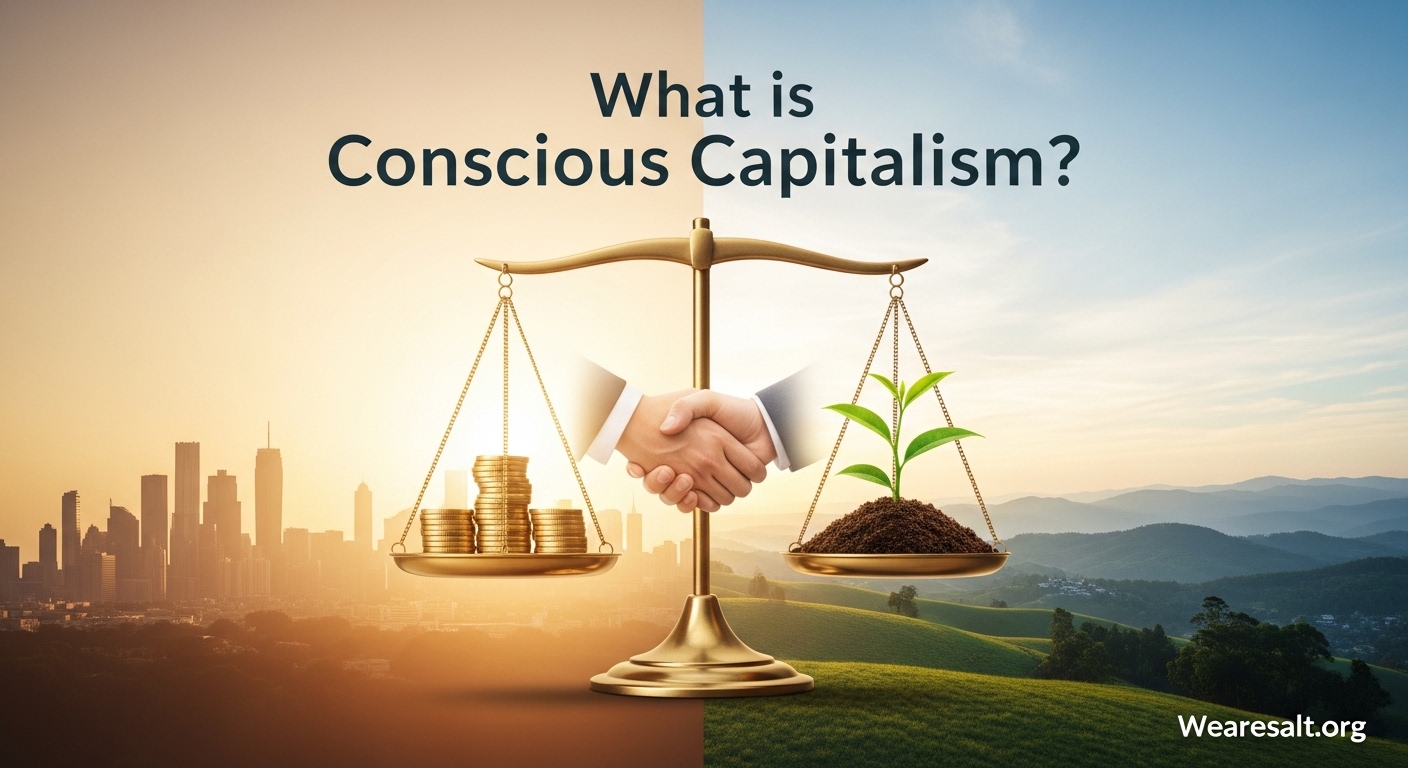
I first encountered conscious capitalism while researching what makes certain companies outperform their competitors year after year. These businesses seemed to share something beyond smart strategy or market timing. They operated with a fundamentally different philosophy about why companies exist and who they serve.
Conscious capitalism is a business philosophy that encourages companies to operate ethically while pursuing profits, emphasizing the importance of serving all stakeholders rather than just shareholders. It challenges the traditional view that a business exists solely to maximize returns for investors.
In this guide, I will break down exactly what conscious capitalism means, explore its four core tenets, examine real companies putting it into practice, and address whether this approach actually delivers results. Whether you are a business leader, entrepreneur, or simply curious about better ways of doing business, this article will give you a complete understanding of the movement reshaping capitalism in 2026.
Table of Contents
What is Conscious Capitalism?
Conscious capitalism is a business philosophy that advocates for companies to operate ethically while pursuing profits, emphasizing service to all stakeholders rather than just shareholders. The term was popularized by John Mackey, co-founder of Whole Foods Market, and Raj Sisodia, a business professor, through their 2013 book “Conscious Capitalism: Liberating the Heroic Spirit of Business.”
At its core, this philosophy rejects the notion that business is a zero-sum game where one party must lose for another to win. Instead, it views business as a vehicle for creating widespread value. Companies practicing conscious capitalism believe that when they focus on purpose beyond profit and care for all stakeholders, financial success follows naturally.
The movement emerged as a response to growing dissatisfaction with traditional shareholder capitalism, particularly after the 2008 financial crisis exposed the dangers of short-term profit maximization at any cost. Conscious capitalism offers a framework for businesses that want to be profitable while also making a positive impact on society.
The Four Pillars of Conscious Capitalism
Conscious capitalism rests on four interconnected tenets that work together to create a more holistic business model. These pillars provide a practical framework for implementing the philosophy in any organization, regardless of size or industry.
Higher Purpose
A higher purpose goes beyond simply making money. It answers the fundamental question: why does this business exist? Conscious companies discover and articulate a purpose that inspires employees, attracts customers, and creates genuine value for society.
Unlike traditional mission statements that often gather dust on office walls, a higher purpose guides daily decisions and strategic direction. It becomes the north star that keeps everyone aligned when facing difficult choices.
For example, Google exists to organize the world’s information and make it universally accessible. Tesla aims to accelerate the world’s transition to sustainable energy. These purposes drive innovation and attract talent who want to contribute to something meaningful.
Stakeholder Orientation
Traditional capitalism focuses primarily on shareholders, the people who own stock in the company. Conscious capitalism expands this focus to include all stakeholders affected by the business: employees, customers, suppliers, communities, and the environment.
This does not mean ignoring shareholders. Rather, it recognizes that long-term shareholder value is best created by serving all stakeholders well. When employees are engaged, customers are satisfied, suppliers are treated fairly, and communities thrive, the business naturally prospers.
Think of stakeholders as an interdependent ecosystem. Each group supports and reinforces the others. Damage one part of the system, and the entire system suffers. Nurture each part, and the whole thrives.
Conscious Leadership
Conscious leaders serve as stewards rather than dictators. They focus on the company’s higher purpose and all its stakeholders, not just personal gain or short-term metrics. This approach connects closely to servant leadership, where the leader’s primary role is to serve the needs of their people.
These leaders demonstrate high levels of emotional intelligence, self-awareness, and systems thinking. They understand that their decisions ripple through the entire stakeholder network. They model the values they want to see throughout the organization.
Conscious leaders also embrace transparency and authenticity. They admit mistakes, share information openly, and create psychological safety for employees to speak up. This builds trust that becomes the foundation for a healthy organizational culture.
Conscious Culture
Culture represents the values, beliefs, and behaviors that characterize an organization. Conscious cultures are built on trust, transparency, and care. The Conscious Capitalism organization uses the TACT framework to describe the key elements: Trust, Authenticity, Caring, and Transparency.
In a conscious culture, people feel safe bringing their whole selves to work. They know their contributions matter and that their leaders genuinely care about their wellbeing. This environment fosters innovation, collaboration, and commitment that transactional workplaces cannot match.
Building such a culture requires intentional effort. It means hiring for values alignment, not just skills. It involves designing policies that reflect care for people. And it requires consistent reinforcement of desired behaviors through recognition and storytelling.
Conscious Capitalism vs Traditional Capitalism
Understanding conscious capitalism requires contrasting it with the traditional model that has dominated business thinking for decades. The differences go deeper than surface-level philanthropy or corporate social responsibility programs.
Traditional shareholder capitalism, championed most famously by economist Milton Friedman in the 1970s, holds that a company’s sole social responsibility is to maximize profits for shareholders. This view treats businesses as money-making machines and views social concerns as distractions from this primary duty.
Conscious capitalism fundamentally disagrees with this narrow definition. It argues that business is the greatest value creator in society and that this value should be shared broadly. Profit matters, but it is a result of creating value for others, not the sole reason for existence.
The practical differences show up in decision-making. A traditional company might cut employee benefits to boost quarterly earnings. A conscious company would invest in employees, knowing that engaged workers create better customer experiences that drive long-term profitability.
Traditional capitalism often focuses on short-term metrics and quarterly results. Conscious capitalism takes a longer view, making decisions that strengthen the business for decades rather than just the next earnings report.
Companies Practicing Conscious Capitalism
The best way to understand conscious capitalism is to see it in action. Several well-known companies exemplify these principles in how they operate, treat their people, and serve their communities.
Whole Foods Market
John Mackey co-founded Whole Foods Market in 1980 with a commitment to natural foods and environmental stewardship. The company built its reputation on stakeholder orientation, paying careful attention to how it sourced products, treated team members, and served customers.
Whole Foods pioneered transparency in food retail, requiring suppliers to meet strict quality standards. The company shares detailed financial information with all employees, trusting them with data most businesses keep secret. After Amazon acquired Whole Foods in 2017, questions arose about whether these practices would continue.
The company remains a frequently cited example of conscious capitalism principles in action, even as it navigates the challenges of scale and ownership changes.
Costco
Costco Wholesale demonstrates that treating employees well can be a competitive advantage. The company pays hourly workers significantly above retail industry averages and provides comprehensive benefits including health insurance and retirement contributions.
This investment in people pays off through lower turnover and higher productivity. Costco employees stay longer, know their jobs better, and provide superior customer service. The company generates strong returns while maintaining a reputation as one of the best employers in retail.
Costco also maintains ethical supplier relationships and careful attention to product quality. Their stakeholder orientation extends to customers who trust the company to curate quality products at fair prices.
Starbucks
Starbucks has built its brand around a higher purpose of inspiring and nurturing the human spirit, one person, one cup, and one neighborhood at a time. This purpose guides programs like ethical coffee sourcing through C.A.F.E. Practices and comprehensive employee benefits.
The company provides healthcare to all employees, including part-time baristas, and offers tuition reimbursement through its college achievement plan. During economic downturns, Starbucks has sometimes chosen to invest in employees rather than cut costs, believing that people are the core of the business.
While Starbucks has faced criticism on various issues over the years, its commitment to stakeholder welfare remains a central part of its business philosophy.
TOMS and Trader Joe’s
TOMS Shoes built its entire business model around conscious capitalism with its famous one-for-one model: for every pair purchased, the company donated a pair to someone in need. This higher purpose attracted customers who wanted their purchases to make a difference.
Trader Joe’s takes a different approach, creating a unique culture that treats employees well and builds community among staff and customers. The company pays above-average wages, offers solid benefits, and maintains a fun, quirky environment that differs dramatically from typical grocery retail.
Both companies show that conscious capitalism can take many forms depending on industry, company size, and founder values.
Does Conscious Capitalism Work?
Skeptics often ask whether this philosophy actually delivers results or if it is just well-intentioned idealism. The data strongly suggests that conscious capitalism works not just ethically but financially.
Raj Sisodia researched companies he called “Firms of Endearment” that embodied conscious capitalism principles. These companies outperformed the S&P 500 by a factor of 10.5 to 1 over a 15-year period. They delivered returns of 1,646 percent compared to the S&P’s 157 percent.
The Conscious Capitalism organization has documented similar results across their network of certified conscious companies. Businesses that treat stakeholders well consistently outperform those that focus narrowly on short-term profit extraction.
This performance makes sense when you consider the underlying mechanics. Engaged employees are more productive. Satisfied customers buy more and refer others. Trusted suppliers provide better terms and priority service. Strong community relationships create goodwill that buffers companies during crises.
Conscious capitalism does not mean sacrificing returns for ethics. It means understanding that the best way to generate sustainable returns is by creating genuine value for everyone the business touches.
Criticisms and Limitations
Despite its benefits, conscious capitalism faces legitimate criticism that deserves honest consideration. Understanding these limitations helps leaders implement the philosophy more thoughtfully.
Some critics argue that conscious capitalism is simply marketing, a way for wealthy business leaders to feel good about making money. They point to cases where companies talk about stakeholder value while treating workers poorly or damaging communities.
The Whole Foods example itself illustrates this tension. Some critics argue that despite its philosophy, Whole Foods charged high prices that made healthy food inaccessible to lower-income communities. The Amazon acquisition raised further questions about whether conscious capitalism can survive the pressures of scale and public markets.
Other critics note that conscious capitalism differs little from traditional corporate social responsibility or ESG frameworks. They question whether it offers anything genuinely new or simply rebrands existing practices.
Implementation challenges also exist. Small businesses with tight margins may struggle to pay above-market wages or invest heavily in benefits. Leaders trained in traditional management approaches may find the transition to conscious leadership difficult.
These criticisms do not invalidate conscious capitalism, but they remind us that implementation matters. The philosophy requires genuine commitment, not just surface-level adoption of trendy language.
How to Implement Conscious Capitalism
Transitioning to conscious capitalism does not happen overnight, but any business can begin the journey with intentional steps. Here is how leaders can start applying these principles in their organizations.
Start by clarifying your higher purpose. Gather your leadership team and ask why the company exists beyond making money. What problem are you solving? How do you make customers’ lives better? What would be lost if your business disappeared? Articulate this purpose clearly and communicate it constantly.
Map your stakeholders and assess how well you serve each group. Employees, customers, suppliers, communities, and shareholders all deserve attention. Identify gaps where you are underperforming and create plans to address them.
Develop conscious leadership capabilities. This might involve training for existing leaders or bringing in new leaders who embody servant leadership qualities. Focus on emotional intelligence, systems thinking, and authentic communication.
Build your conscious culture intentionally. Hire people who share your values. Create policies that reflect care for people. Recognize and reward behaviors that align with your desired culture. Be patient, as culture change takes time.
Finally, measure what matters beyond financial metrics. Track employee engagement, customer satisfaction, supplier relationships, and community impact. What gets measured gets managed, so expand your dashboard to include stakeholder wellbeing.
FAQ
What is the concept of conscious capitalism?
Conscious capitalism is a business philosophy that encourages companies to operate ethically while pursuing profits. It emphasizes serving all stakeholders rather than just shareholders, operating with a higher purpose beyond profit, and creating value for employees, customers, suppliers, communities, and the environment.
How does Costco practice conscious capitalism?
Costco practices conscious capitalism by paying hourly workers significantly above retail industry averages and providing comprehensive benefits including health insurance and retirement contributions. This stakeholder orientation creates lower turnover, higher productivity, and superior customer service while generating strong financial returns.
What are the 4 types of capitalism?
The main types of capitalism include laissez-faire capitalism with minimal government intervention, state capitalism with significant government control, crony capitalism where businesses succeed through relationships with government, and conscious capitalism which emphasizes ethical operation and service to all stakeholders beyond just shareholders.
Does conscious capitalism work?
Yes, research shows conscious capitalism works financially. Raj Sisodia’s study of Firms of Endearment found companies practicing these principles outperformed the S&P 500 by 10.5 to 1 over 15 years. These businesses delivered returns of 1,646 percent compared to the S&P’s 157 percent.
How is conscious capitalism different from corporate social responsibility?
Conscious capitalism is an integrated business philosophy where stakeholder welfare is central to strategy, while corporate social responsibility is often an add-on program separate from core business operations. Conscious capitalism affects every decision, whereas CSR may exist alongside traditional profit-maximizing practices.
Who founded conscious capitalism?
Conscious capitalism was popularized by John Mackey, co-founder of Whole Foods Market, and Raj Sisodia, a business professor at Babson College. They co-authored the 2013 book Conscious Capitalism: Liberating the Heroic Spirit of Business and founded Conscious Capitalism, Inc. to promote the movement.
Conclusion
Conscious capitalism offers a compelling vision for business in 2026 and beyond. By focusing on higher purpose, stakeholder orientation, conscious leadership, and conscious culture, companies can create both financial success and positive social impact.
The research is clear. Companies that practice these principles consistently outperform their peers. They attract better talent, build stronger customer relationships, and create sustainable competitive advantages that pure profit-maximizers cannot match.
What is conscious capitalism at its heart? It is the recognition that business is the greatest force for value creation in society, and that this value should be shared broadly rather than extracted narrowly. It is a philosophy that trusts in the power of enterprise to solve problems and lift humanity when guided by consciousness and care.
Whether you lead a small startup or a large corporation, the principles of conscious capitalism offer a path to building something that matters. The question is not whether you can afford to adopt this philosophy, but whether you can afford not to.