
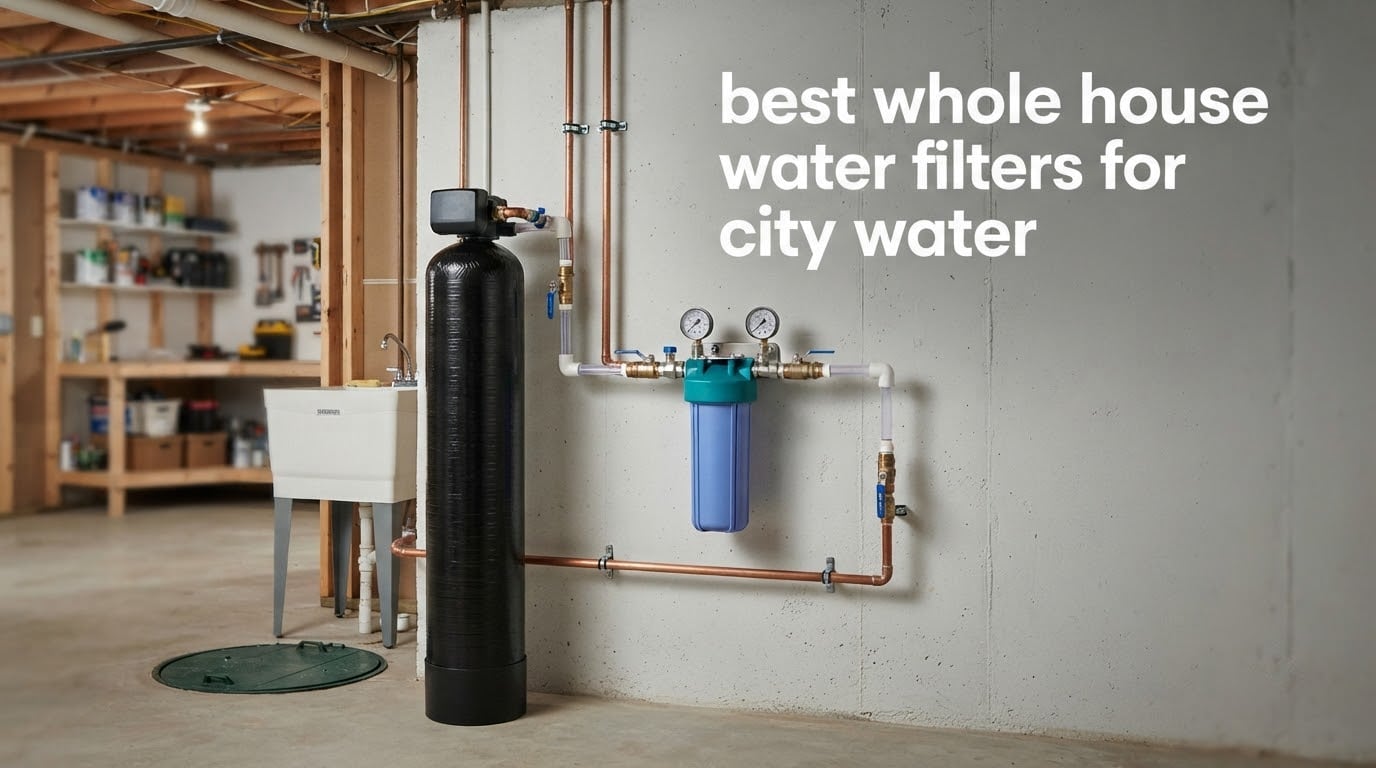
Short answer: yes, most city-water households benefit from one, and the reason is chemistry rather than fear. Municipal water leaves the treatment plant carrying a residual disinfectant, usually free chlorine or monochloramine at roughly 0.5 to 2 ppm, that keeps it safe inside the distribution pipes. That residual is what makes tap water smell like a pool, dry out skin and hair, fade laundry colors, and add oxidative wear to a water heater. A point-of-entry whole house filter pulls it out once, at the main line, instead of at every sink.
This roundup covers the best whole house water filters for city water across every format that actually works on municipal supply: multi-stage cartridge manifolds, single-cartridge sanitary quick change heads, central carbon tanks, and the premium tank systems. We compared all eight on published flow rate, gallon capacity, media type, certification scope, replacement cadence, and the fit and finish complaints their owners actually report.
One thing to clear up before you keep reading. A whole house carbon filter does not soften water, does not pull dissolved iron out of solution, and does not reduce total dissolved solids. It is a taste, odor, sediment, and certified-contaminant device, and treating it as anything else is the most common mistake we see in these forums. We will say so again in the buying guide.
If your supply is coming from a private well instead, the contaminant profile is completely different and a carbon tank will not help. Our well water whole house filter guide covers iron, manganese, and sulfur systems for that case.
Table of Contents
Top 3 Best Whole House Water Filters for City Water

iSpring WGB32B-KSNC
- 3-stage filtration
- SGS-tested to 94.4 percent chloramine removal
- 15 GPM
- up to 100000 gallons

iSpring WGB21B-KSNC
- 2-stage compact manifold
- catalytic carbon for chloramine
- 15 GPM
- 50K gallon rating

Express Water WH300SCKP
- Free-standing 3-stage frame
- 17 GPM
- pressure gauges
- polyphosphate anti-scale
All 8 Whole House Water Filters for City Water Compared in 2026
Every system below treats water at the main shutoff rather than at one fixture. The table is ordered exactly as the full reviews run below, so you can jump straight to the one that matches your household.
| Product | Specifications | Action |
|---|---|---|
| iSpring WGB32B-KSNC 3-Stage |
|
Check Latest Price |
| iSpring WGB21B-KSNC 2-Stage |
|
Check Latest Price |
| Express Water WH300SCKP |
|
Check Latest Price |
 A. O. Smith AO-WH-Filter A. O. Smith AO-WH-Filter |
|
Check Latest Price |
 3M Aqua-Pure AP904 3M Aqua-Pure AP904 |
|
Check Latest Price |
 Aquasana Max Flow WH-1010-CT-LM Aquasana Max Flow WH-1010-CT-LM |
|
Check Latest Price |
 Waterdrop WHF21-FG Waterdrop WHF21-FG |
|
Check Latest Price |
 iFilters LWH-D iFilters LWH-D |
|
Check Latest Price |
1. iSpring WGB32B-KSNC – Best Overall for Chloramine City Water
iSpring Chloramine & Heavy Metals Whole House Water Filter System
3-stage POE filtration
Sediment plus GAC/KDF plus catalytic carbon
15 GPM
Up to 100000 gallons
Pros
- SGS-tested catalytic carbon block rated to remove up to 94.4 percent chloramine
- GAC and KDF stage targets lead mercury hydrogen sulfide pesticides and radon
- Three discrete stages keep sediment out of the carbon bed
- 15 GPM on 1 inch NPT ports
- Rated for up to 100000 gallons or 12 months
Cons
- Plastic inlet and outlet fittings leak unless heavily wrapped in PTFE tape and carefully torqued
- Heavy manifold needs solid mounting because drywall anchors are not adequate
- Housings are difficult to remove and very heavy when full
The WGB32B-KSNC is the one we keep coming back to because it is the only system in this roundup that stages the problem properly instead of asking one cartridge to do everything. A 10 inch polypropylene sediment stage catches grit first, a GAC and KDF stage handles the heavy metals, and a separate FC15B-NC catalytic carbon block does the disinfectant removal without the first two stages eating its capacity.
On chloraminated municipal supply, that third stage is the whole ballgame. SGS tested this catalytic carbon media to NSF/ANSI 42 and it is rated to remove up to 94.4 percent of chloramine, which is a claim most competitors in this price bracket simply do not make. Owners running chlorine test strips report readings dropping from 3 to 5 ppm down under 0.2 ppm shortly after install.
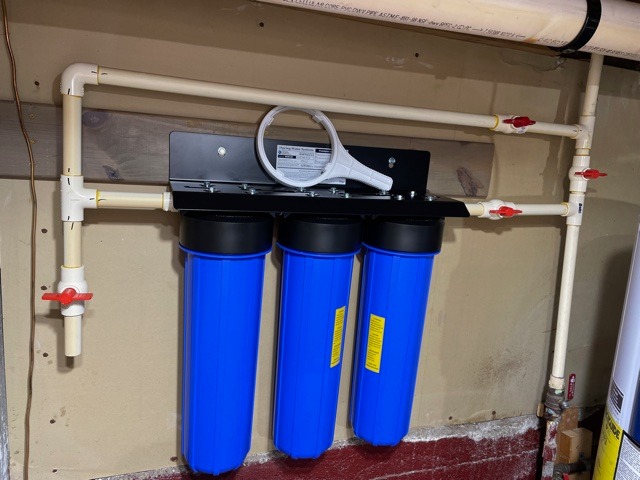
The catalogued flow ceiling is 15 GPM on 1 inch NPT connections, which is enough headroom for a 1 to 3 bathroom house running a shower and a laundry cycle at the same time. The rating is up to 100,000 gallons or 12 months, whichever comes first, and on a family of four you will usually hit the calendar first. The whole assembly weighs 52.7 pounds and measures 24.5 by 8 by 28 inches, so plan a floor or a solid stud location rather than a closet shelf.
Technical notes worth knowing: the GAC and KDF stage (FG25B-KS) is the one that carries the lead, mercury, hydrogen sulfide, and radon claims, and the KDF copper-zinc media is what makes the heavy metal claim credible rather than decorative. Operating temperature is rated to 100 degrees F, and the power source is simply water pressure, so there is no electrical requirement and nothing to plug in.
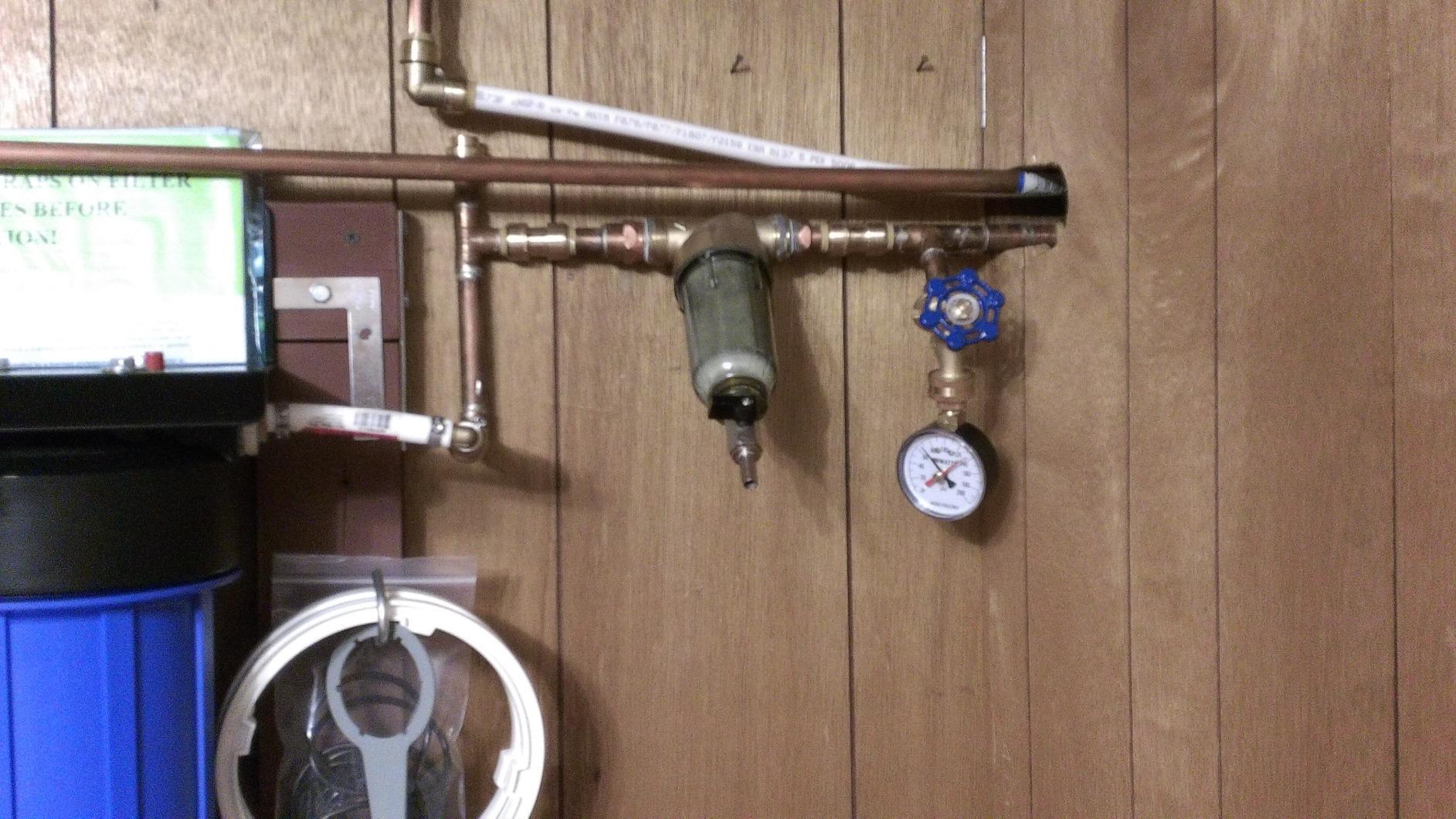
What the WGB32B-KSNC does well
The staging is genuinely useful rather than decorative. Because the sediment stage is separate, the carbon and KDF beds never see the grit that would otherwise blind them in the first year, and owners regularly describe the sediment filter water as visibly muddy at change time. That is a sign the system is protecting its own downstream media.
The support story is the other differentiator. Reviewers across the 2233-review base repeatedly single out lifetime US-based tech support and free replacement manifolds, which is unusual at this tier. If a housing cracks during a cartridge change, you are not buying a new stage to find out.
What gives buyers pause
Installation is the recurring friction point, and it is mechanical rather than electrical. The supplied plastic threaded adapters are a known leak location, and owners who report success wrap them heavily in PTFE tape and torque them properly rather than hand-tightening. The manifold itself is heavy enough that drywall anchors will pull out, so it needs a stud, a joist, or masonry.
Service is also physical. A wet 20 inch housing is awkward to remove one-handed, which is why a low-point drain and a second filter wrench make the change job much easier. And like every carbon system here, it does not reduce total dissolved solids, so if your utility report shows elevated TDS, this is the wrong tool.
2. iSpring WGB21B-KSNC – Best Compact System for Apartments and Condos
iSpring WGB21B-KSNC Whole House Water Filter System, SGS-Tested to Remove up to 94.4% of Chloramine, 5-Layer Filtration Reduces Heavy Metals, Lead, Chlorine, Sediment, VOC, 10” x 4.5” Filters
2-stage compact POE system
GAC/KDF stage plus catalytic carbon
15 GPM
50K gallon rating
Pros
- Highest review count in the roundup at 4271 with a 4.6 average rating
- SGS-tested to remove up to 94.4 percent chloramine
- Compact 10 inch by 4.5 inch housings fit tight mechanical spaces
- Only 23 pounds and 16 by 8 by 18 inches
- 1 inch NPT connections for a straightforward DIY hookup
Cons
- 50K gallon capacity is the second lowest here
- Two stages combine sediment and carbon duties rather than separating them
- Does not reduce total dissolved solids
The WGB21B-KSNC is the same chloramine-capable media idea as its bigger sibling, compressed into a footprint you can actually find room for. Stage one is an FG15KS GAC and KDF cartridge for lead, mercury, hydrogen sulfide, pesticides, and herbicides, and stage two is an FC15B-NC catalytic carbon filter for chloramine and chlorine. It ranks fourth in Tools and Home Improvement and fourth in the whole house water treatment category, which tells you how many people have bought it.
That 4271-review base at a 4.6 average, with an 81 percent five-star share, is the largest owner feedback pool in this roundup. The recurring themes are strong chloramine and heavy metal reduction, straightforward 1 inch NPT hookup with the included manual and video tutorials, and a smaller body than the usual 20 inch cartridge manifolds.
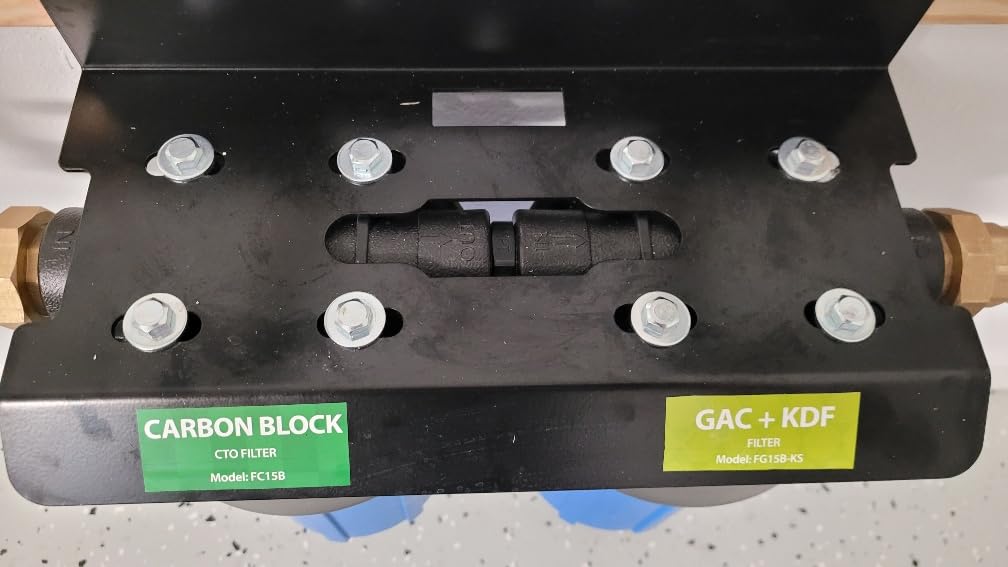
Flow is a genuine strength: 15 GPM on 1 inch ports, in a box that measures 16 by 8 by 18 inches and weighs 23 pounds. For a condo, a rental where you have permission to cut the main line, or a small house with a cramped mechanical area, that size-to-capacity ratio is the reason to buy this one.
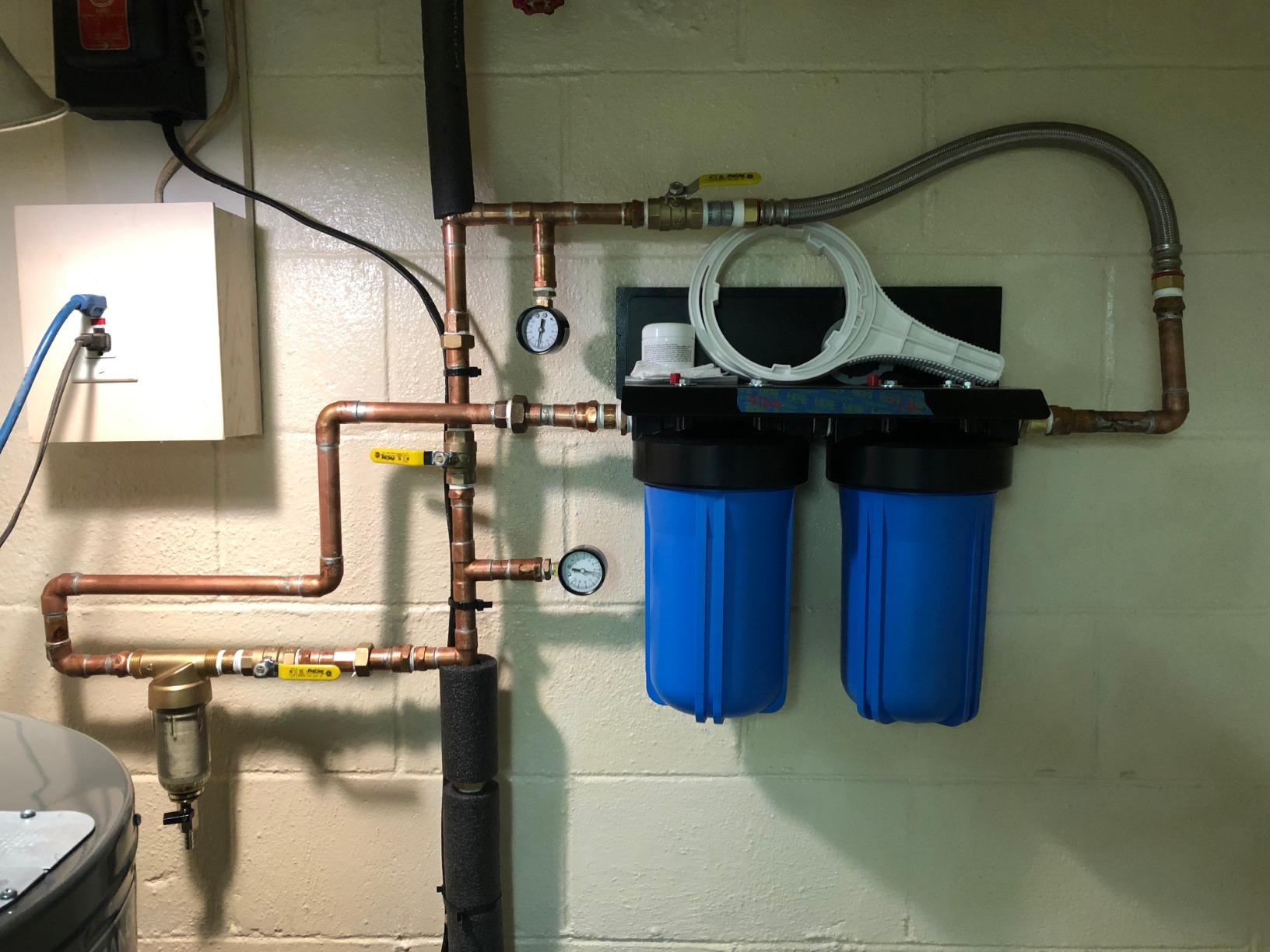
The trade-off is 50,000 gallons of rated capacity, which is the second lowest figure in this list. A household of four on municipal water can run through that faster than a year, and the two-stage layout means the GAC and KDF cartridge is doing sediment duty too. It also retains healthy minerals rather than reducing TDS, which is the right behavior for city water but will not satisfy anyone chasing reverse osmosis numbers.
Where this compact manifold earns its place
Space is the deciding factor in almost every case we would recommend it. Apartments, condos, townhomes, and cottages with a small utility chase are exactly the homes that get ruled out by the 20 inch and 24 inch manifolds, and this is one of the few chloramine-rated options that fits under a sink cabinet or in a wall cavity.
It also suits short-term and low-volume households well. If you are one or two people on municipal supply, 50,000 gallons of carbon capacity is genuinely adequate, and you get catalytic carbon media that most competing compact units do not offer.
Where it falls short
There is no separate sediment stage, so the KDF and GAC cartridge is the first thing water hits. On municipal water that is usually acceptable, but on a supply with meaningful sediment it shortens carbon life and makes the change interval less predictable than the three-stage design above it.
Do not buy it expecting heavy-duty whole-property treatment in a 4+ bathroom home running multiple fixtures continuously. The flow rating suggests headroom, but the bed volume is small, and you will be replacing cartridges on a schedule rather than on a decade timeline. For a larger home, step up to the free-standing frame or the central tank options below.
3. Express Water WH300SCKP – Best Free-Standing 3-Stage for Large Homes
Express Water Whole House Water Filter System, Ultimate Protection, 3-Stage
Three-stage free-standing POE
17 GPM max flow
20 to 80 PSI
100000 gallon capacity
Pros
- Highest flow rating in this roundup at 17 GPM for simultaneous fixtures
- Stainless steel free-standing frame with three pressure gauges and per-filter pressure release buttons
- Sediment plus chlorine and chloramine plus heavy metal plus scale coverage in one assembly
- Polyphosphate anti-scale media needs no salt and no brine
- Wide 20 to 80 PSI operating range
Cons
- Heaviest unit in the roundup at 63 pounds
- Three cartridges mean three replacement costs every cycle
- Does not reduce total dissolved solids
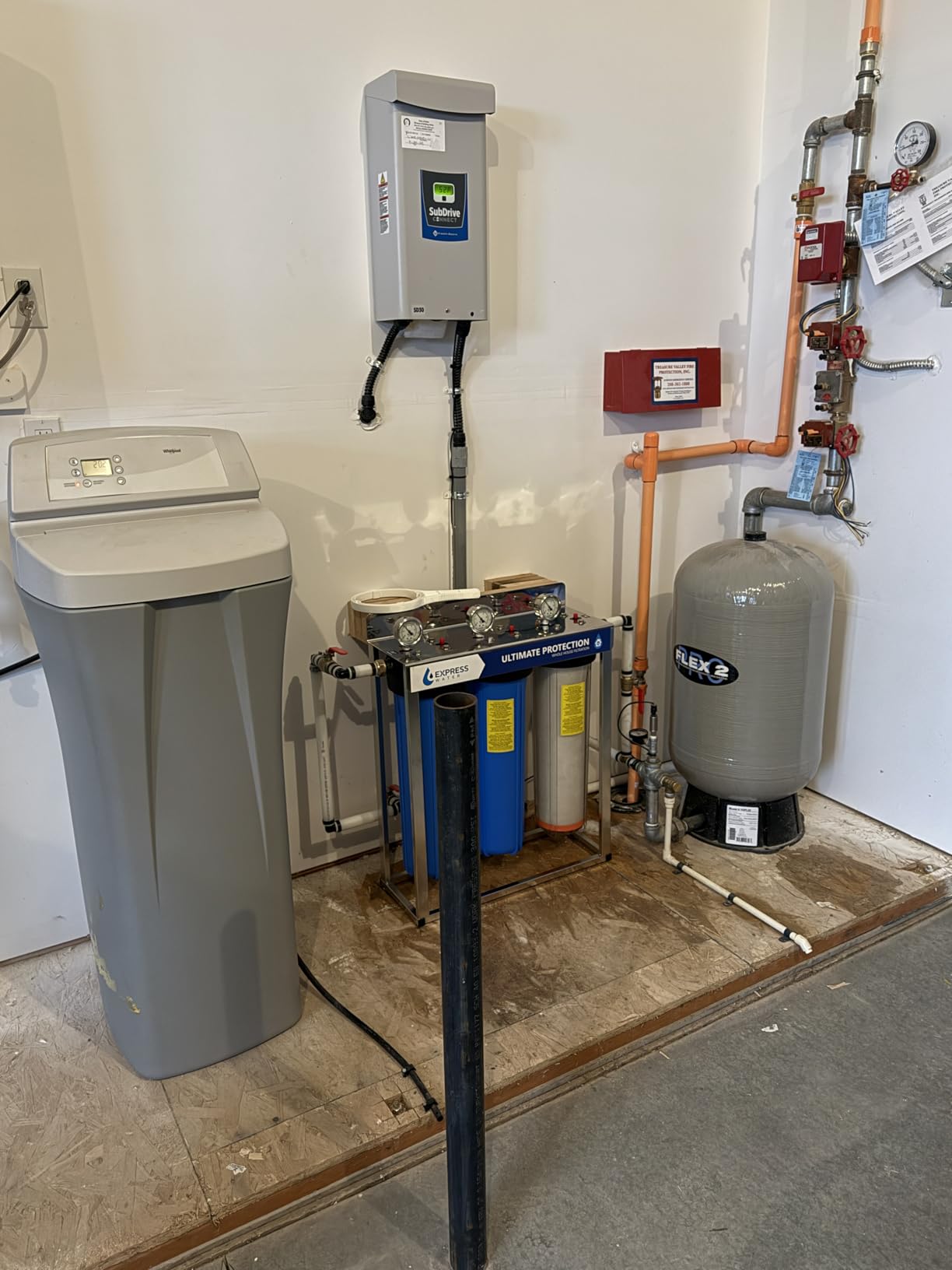
The WH300SCKP is the most complete single box in this roundup, and the stainless free-standing frame is the reason. It does not hang on a bracket and disappear into a wall. It stands on the floor, which is exactly what you want in a basement or garage where a 63 pound assembly is awkward but a floor is available.
Filtration is three stages applied at every fixture: sediment, then chlorine and chloramine reduction, then heavy metals including lead, arsenic, chromium, and mercury, with laboratory-packed polyphosphate for salt-free anti-scale protection of pipes, water heaters, and appliances. 17 GPM is the highest flow rating of any system here, and the operating range of 20 to 80 PSI with a 100 degree F upper limit is a wide, forgiving envelope.
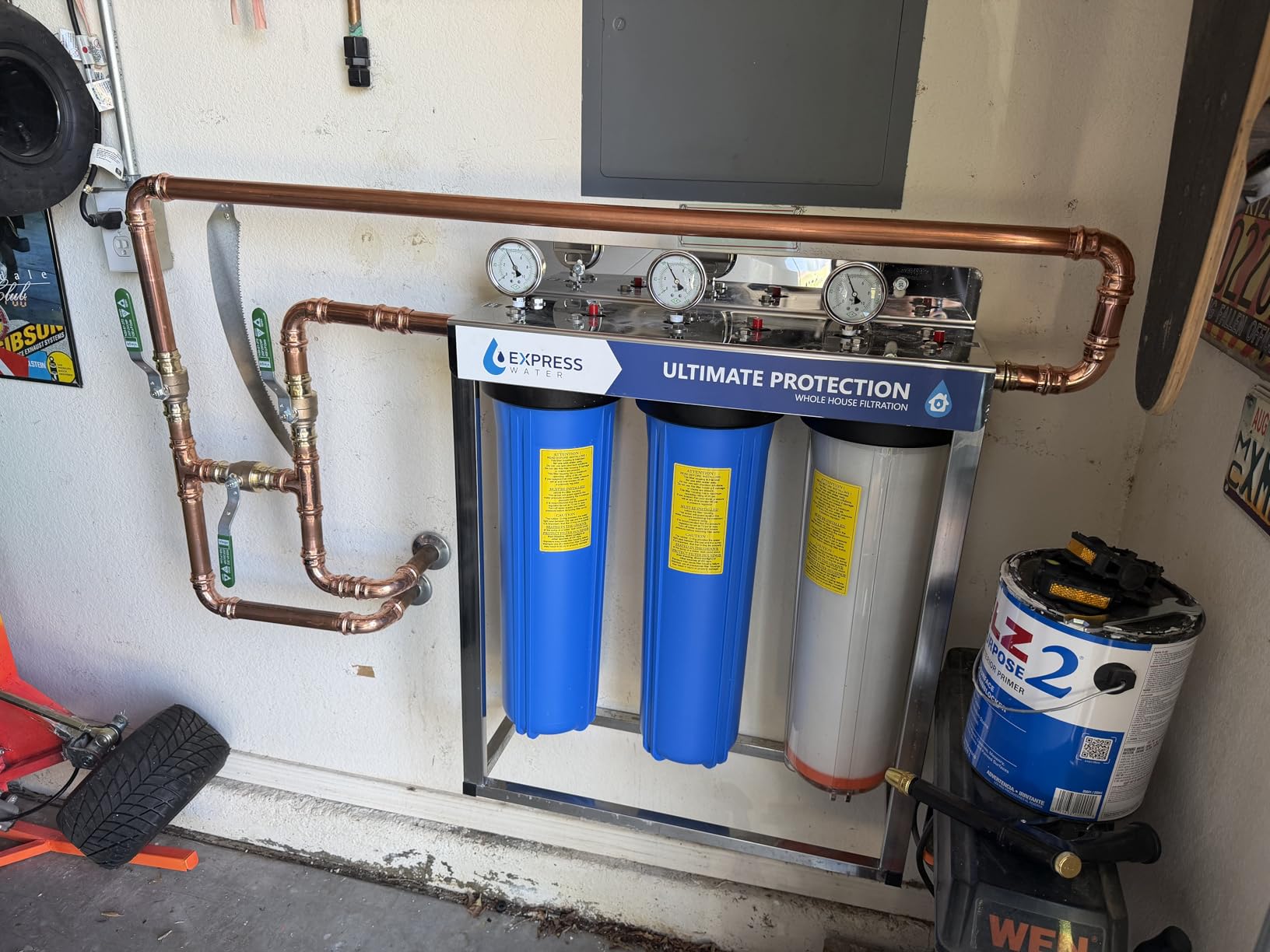
The Deluxe Series hardware is the quiet differentiator. Three inline pressure gauges let you see which stage is loading up rather than guessing, and per-filter pressure release buttons make cartridge swaps far less messy. Capacity is rated at 100,000 gallons with filters replaced every 6 to 12 months, and the 1 inch connections are rated 0.25 gallons per second between 45 and 80 PSI.
Measured at 29 by 8.5 by 30 inches and 63 pounds, it is the biggest object in the guide, and that is a real constraint. Measure the plumbed space before you commit, and make sure the floor will take the weight. Upper temperature limit is 100 degrees F and lower is 40 degrees F, so do not put it in an unheated shed in a climate that freezes.
Why large homes like this one
Flow is the honest answer. 17 GPM means a 4 bathroom house can run two showers, a dishwasher, and a washing machine without the pressure sag that owners complain about with 7 GPM tanks. The staged design also means the sediment filter protects the carbon and heavy metal stages rather than fighting them for capacity.
The polyphosphate scale media is a bonus most people underrate. It is salt-free, so there is no brine discharge and no softener to plumb around, and it targets the scale build-up that shortens water heater and appliance life. If you have hard city water but do not want a softener, this is a reasonable middle path.
Why it might not suit you
The 6 to 12 month replacement cycle on three cartridges is the real long-run cost in this design, and it is the one to budget honestly. Over a decade you are buying media on a schedule, not a decade-long tank. Buyers who want a one-time decade commitment should look at the central carbon tank or the premium tank system instead.
It also does not reduce total dissolved solids, and the 800 ppm TDS ceiling listed for it is a compatibility range, not a performance claim. If your utility report shows high conductivity, you need reverse osmosis at a fixture, not this.
4. A. O. Smith AO-WH-Filter – Best Lowest-Maintenance Central Tank
A. O. Smith Whole House Water Filter System | 600K Gal | AO-WH-Filter
Central carbon tank
600000 gallon and 6 year filter life
7 GPM
20 to 100 PSI
NSF/ANSI 42 certified
Pros
- Longest service interval here at 600000 gallons or 6 years per cartridge
- 6-year limited warranty plus 6 years of spare part availability
- Reduces 96.9 percent of chlorine taste and odor with NSF/ANSI 42 certification
- No drain line no backwashing no salt and no water waste
- Compact tank footprint of 30.2 by 9.5 by 9.4 inches
Cons
- 7 GPM is the lowest flow rating in this roundup
- 3/4 inch inlet and outlet is smaller than the 1 inch ports competitors use
- Single carbon stage means no separate sediment or heavy metal media
- Will not reduce total dissolved solids sulfur or iron
The AO-WH-Filter is what set-and-forget looks like in a water filter. One central fiberglass tank, one cartridge, a six-year rated life at 600,000 gallons, and a six-year limited warranty. If your only problem is chlorine taste and odor and you would rather not think about it again for six years, this is the design.
It is explicitly a chlorine reduction device and nothing more. The manufacturer states a 96.9 percent reduction in chlorine taste and odor, and the unit is NSF/ANSI 42 certified for that claim. It also states plainly that it is not a water softening system and will not reduce total dissolved solids, sulfur, or iron. That honesty is rarer than it should be in this category.
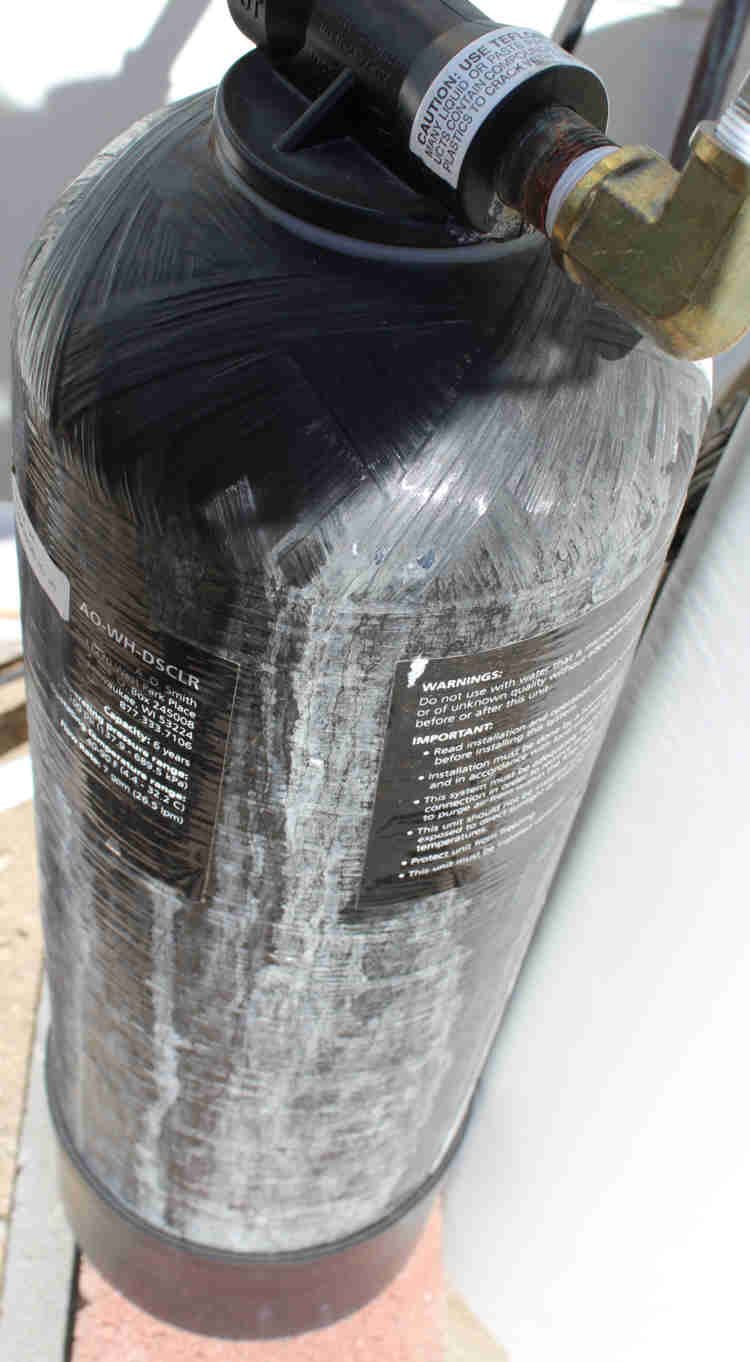
Operationally it is about as simple as these get: no drainage, no backflushing, no water waste, no salt, no power. The kit includes a central filter, shut-off valve, nipple, and hose adapter, and the manufacturer calls for a simple DIY install with a pre-filter recommended upstream. The operating range of 20 to 100 PSI is the widest in this roundup.
The constraint is 7 GPM on 3/4 inch inlet and outlet fittings. That is fine for a 1 to 3 bathroom house, but it is the lowest flow figure here and it is the reason some owners in the 1965-review base walked away. The 1-star share of 8 percent comes mostly from people who needed more treatment capability than a single carbon stage provides.
Who this tank is built for
Households with moderate daily use who are tired of cartridge schedules. Six years between changes changes how you think about cost, and a pre-filter in front of it is cheap insurance against the sediment that shortens carbon life.
It is also a good fit for anyone who does not want a drain line. There is no backwash discharge, no brine, and nothing to plumb into a floor drain, which makes it attractive for a basement or a slab home where drainage is awkward.
Who should skip it
Large homes with 4 or more bathrooms and high peak demand. Seven GPM simply does not leave room for two showers and a laundry cycle at once, and the 3/4 inch ports are the bottleneck before the media even comes into the conversation.
It is also the wrong pick for chloramine-heavy municipalities or anyone chasing heavy metal reduction, because a single carbon stage with no KDF and no sediment pre-stage is not built for that. The manufacturer’s own documentation says so, which is a point in its favor.
5. 3M Aqua-Pure AP904 – Best for High Flow and 3 or More Bathrooms
3M Aqua-Pure AP900 Series Whole House Water Filtration System AP904
Single cartridge sanitary quick change
Up to 20 GPM
100000 gallon capacity
1 year cartridge life
304 stainless head
Pros
- Highest flow capacity in this roundup at up to 20 GPM on 1 inch connections
- Sanitary Quick Change head means annual service needs no filter wrench and no contact with the media
- 304 stainless steel head is far more durable than a plastic manifold
- NSF Standard 42 and NSF/ANSI 372 certified
- Works on both chlorinated municipal and well supply
Cons
- Single cartridge format offers no separate sediment stage no heavy metal media and no anti-scale chemical
- Thinnest long-term owner feedback base here at 452 reviews
- Highest one-star share at 11 percent reflecting fitment friction
- Does not address dissolved solids or hardness
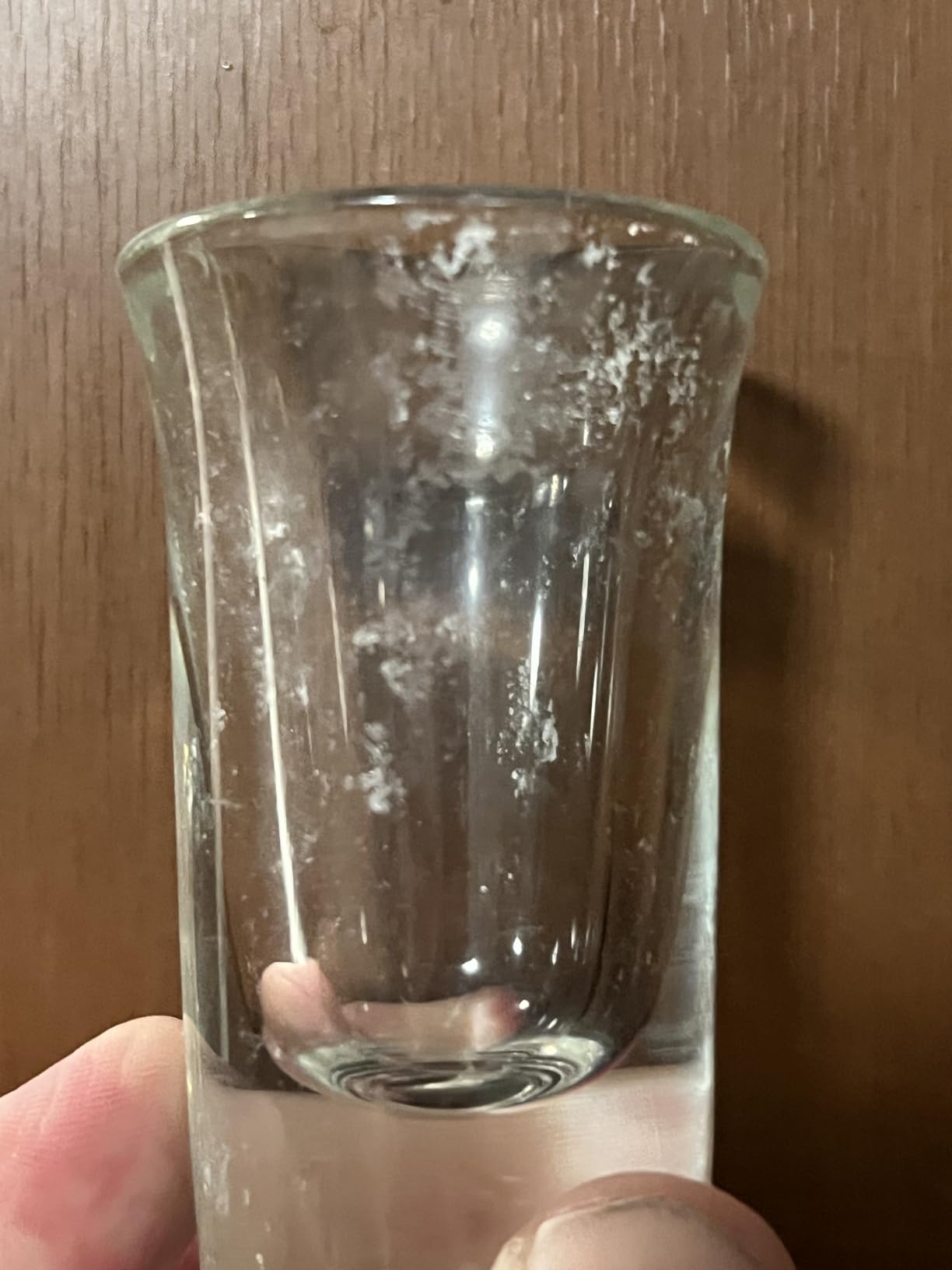
The AP904 is the flow and build-quality answer to the problem. At up to 20 GPM on 1 inch connections it is the highest capacity system in this guide, and the 304 stainless steel head is a different materials class entirely from the plastic manifolds on the cartridge systems above. The unit weighs 10.4 pounds and stands 25.06 inches tall on a 4.5 inch footprint, which is a small package.
The Sanitary Quick Change system is the feature that changes how maintenance feels. The cartridge twists out by hand, with no filter wrench and no contact with the spent media, and 3M designed it to cut down on the leaking and mess that defines a conventional housing change. Cartridge life is up to one year at 100,000 gallons with an activated carbon block and non-woven pleat media.
On the water chemistry side it is tested to NSF Standard 42 and NSF/ANSI 372 for lead-free compliance, and it reduces sediment, chlorine taste and odor, and lime scale while extending the life of water heaters and appliances. 3M rates it for homes with three or more bathrooms, and it works on both chlorinated municipal and non-chlorinated well supply.
One practical warning: the AP900 family is sold in AP902, AP903, and AP904 configurations with different cartridges, so confirm the cartridge number matches your filtration goal before you commit. It ships with the AP917HD-S cartridge and a mounting bracket.
Where the AP904 wins
High-flow homes. With three or more bathrooms, 20 GPM means you do not have to plan showers around each other, and 1 inch connections match most modern main lines without reducing them to 3/4 inch.
Serviceability and durability are the second win. A stainless head will outlast plastic manifolds by years, and a wrench-free annual change is genuinely less of a chore. If you are not handy with pipe wrenches, this is the least intimidating install in the roundup.
Where the single-cartridge limit bites
One cartridge means one media type, and that media is carbon and pleat sediment. There is no KDF stage for heavy metals, no dedicated sediment pre-filter, and no anti-scale chemical beyond what the carbon block does incidentally. It is a taste, odor, and sediment device with scale inhibition, not a treatment train.
Also weigh that 452 reviews is a much thinner owner base than the 4271 behind the iSpring compact model, and the 11 percent one-star share here is the highest in the group. That usually points at fitment and installation rather than filtration performance, but it means you have less long-term feedback to lean on.
6. Aquasana Max Flow WH-1010-CT-LM – Best for a 10-Year Media Life
Aquasana Max Flow Whole House Water Filter | Carbon & KDF | WH-1010-CT-LM
Four-stage tank system
Pre-filter plus carbon and KDF tank plus salt-free conditioner plus post-filter
14.5 gpm peak
1 million gallons
10-year warranty
Pros
- Longest rated media life in the roundup at up to 1 million gallons or 10 years with a 10-year limited warranty
- Pre-filter carbon and KDF tank salt-free conditioner and post-filter all in one assembly
- Peak flow up to 14.5 gpm suits larger homes running multiple fixtures
- Salt-free scale control with no backwashing no salt bags and no draining
- Owners report reduced staining on fixtures and glassware
Cons
- Most expensive system in the roundup by a wide margin
- Plastic threaded connections between standing filters leak and need brass fittings
- Warranty is void on self-installation which pushes cost toward a plumber
- Flush instructions for the carbon stages are frequently described as unclear
- Requires water under 15 gpg hardness pH below 8.3 and iron under 0.3 ppm to work as designed
The Max Flow is the decade answer. It purifies up to 1,000,000 gallons or lasts 10 years, carries a 10-year limited warranty, and 10 years of spare part availability behind it. Per gallon the manufacturer puts the running cost under one cent, and that math is the entire argument for it.
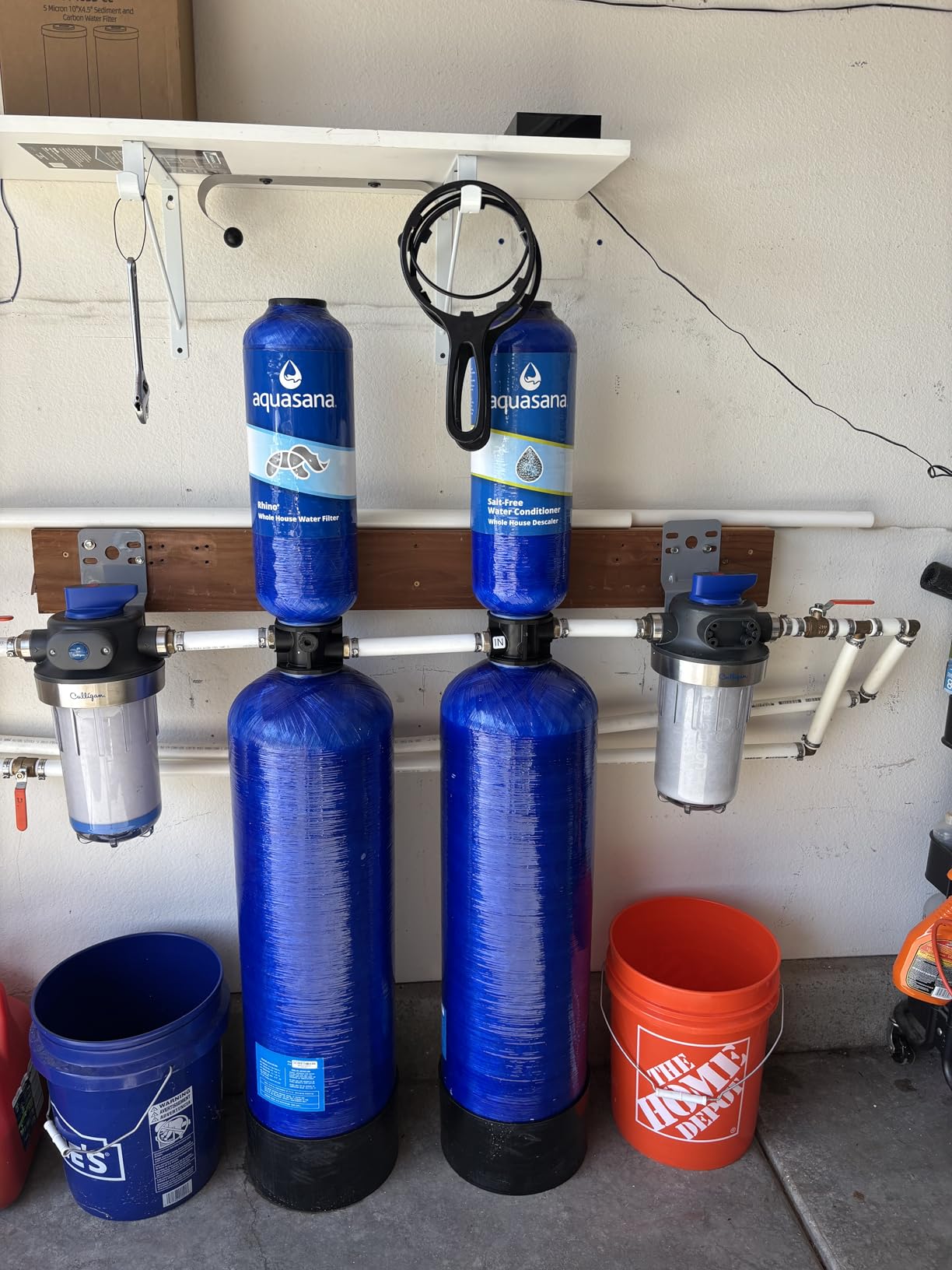
The assembly is genuinely multi-stage: a 20 inch low-maintenance pre-filter that lasts up to 6 months, the central carbon and KDF filter tank, a tall salt-free scale conditioner, and a 10 inch post-filter. Peak flow is up to 14.5 GPM for larger homes, with 7 GPM as the rated continuous figure, and the operating range is 20 to 100 PSI.
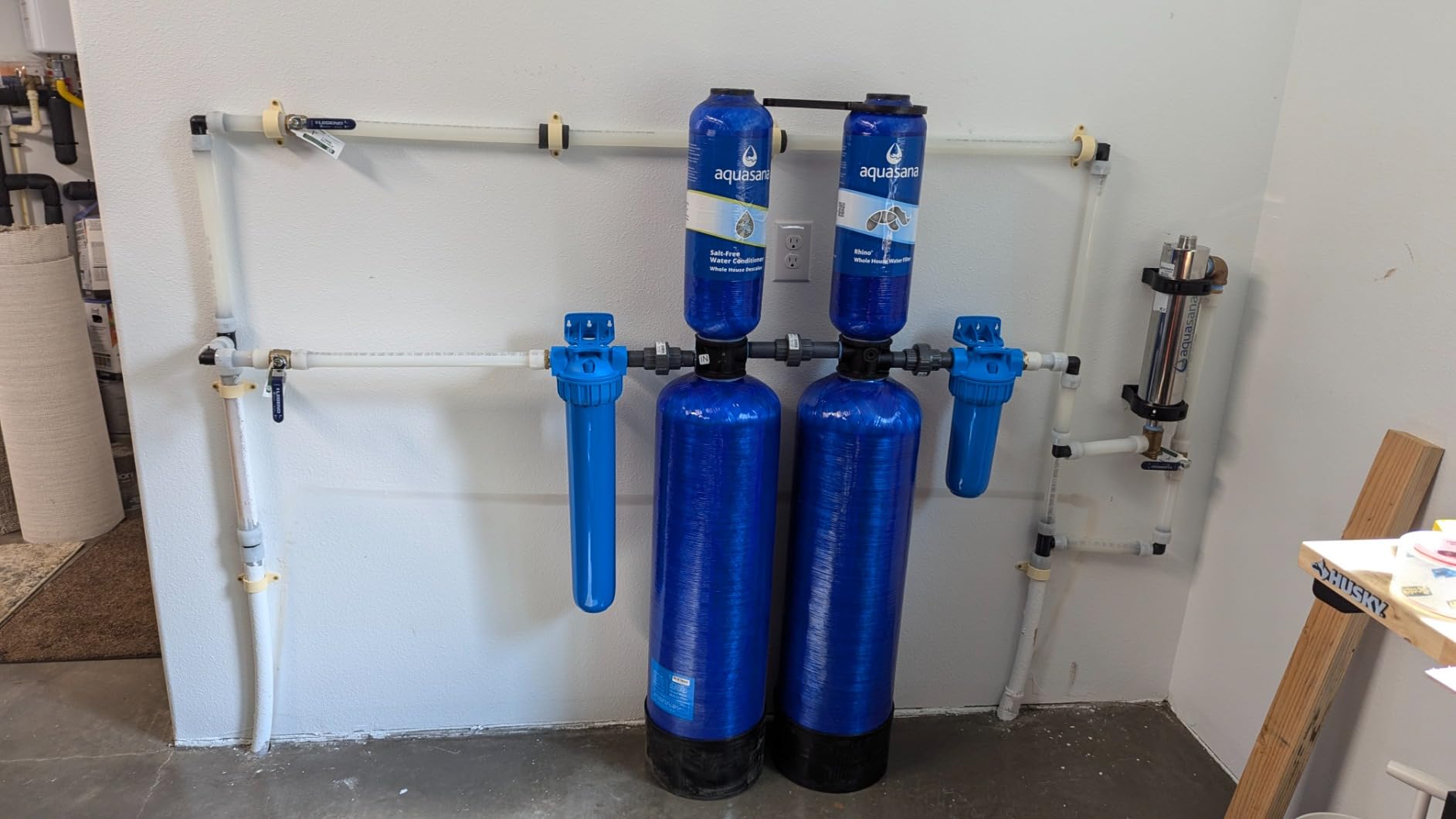
Scale control is salt-free and chemical-free, so there is no backwashing, no salt bags, and nothing to drain. The manufacturer specifies moderate hardness conditions for it to work as designed: water under 15 gpg hardness, alkalinity under 250 mg/L, pH below 8.3, and iron under 0.3 ppm. It reduces 97 percent of chlorine and sediment, inhibits bacteria growth, and preserves healthy minerals without softening or demineralizing.
It is also the largest object here by a margin, at 11 by 47 by 57 inches, which is a full vertical bay in a garage or basement. Plan the footprint and the drain-free floor space before ordering.
What makes the decade math work
You replace a pre-filter twice a year and then essentially do nothing for a decade. That is a fundamentally different ownership curve from a three-stage cartridge manifold, and on a household that actually uses its water, the per-gallon cost gap grows every year.
Owners with moderate-hardness municipal supply report the real quality win: better taste, less staining on fixtures and glassware, and appliances running cleaner. One owner in the 686-review base still had a working unit after five years.
What to watch out for
Installation dominates the complaints, and it is not about filtration. The plastic threaded connections between the standing filters leak repeatedly, and owners report needing brass fittings and an install kit to resolve it, which adds real cost to an already expensive system. The warranty is voided by self-installation, so budget for a plumber.
Second, read the flush instructions carefully for the carbon stages, because owners describe them as unclear or ineffective, with some seeing black fines and others not knowing what to expect. Third, verify your water against the hardness, pH, and iron limits above before you buy, because outside those bounds the scale control is not doing what the marketing implies. This is a condition-limited system, not a universal one.
7. Waterdrop WHF21-FG – Best for Iron and Manganese Reduction
Waterdrop WHF21-FG 2-Stage Whole House Water Filter System, 5 Micron
Two-stage 10 inch system
Iron and manganese stage plus coconut shell GAC
15 GPM
50000 gallon and 6 month life
Pros
- Third-party tested removal of up to 96.4 percent iron 98.2 percent manganese and 95.63 percent chlorine
- Reinforced brass threads and dual high-sealing O-rings address the leak problems common on cheaper manifolds
- Only 10.1 pounds and a 14.37 by 7.48 inch footprint for tight mounting spaces
- Wrench bracket and expansion screws included with pre-installed cartridges
- Both cartridges meet NSF/ANSI 372 lead-free standards
Cons
- Marketed around iron and manganese so it suits iron-bearing supply more than chloramine-heavy city water
- 50000 gallon and 6 month cartridge life means frequent replacement
- Not certified to NSF/ANSI 42 for chlorine reduction
- 5 micron nominal filtration is coarse
The WHF21-FG is the odd one out in this roundup, and that is exactly why it is here. Where every other system is aimed at chlorine and chloramine, this one leads with iron and manganese reduction, which makes it a better fit for a city supply with known iron content than some of the carbon-first units on this list.
Stage one is an iron and manganese reduction filter, stage two is natural coconut shell GAC carbon. Third-party testing puts removal at up to 96.4 percent iron, 98.2 percent manganese, and 95.63 percent chlorine, and it filters rust, sediment, and particles larger than 5 microns. It also reduces mercury, lead, cadmium, chromium, and copper.

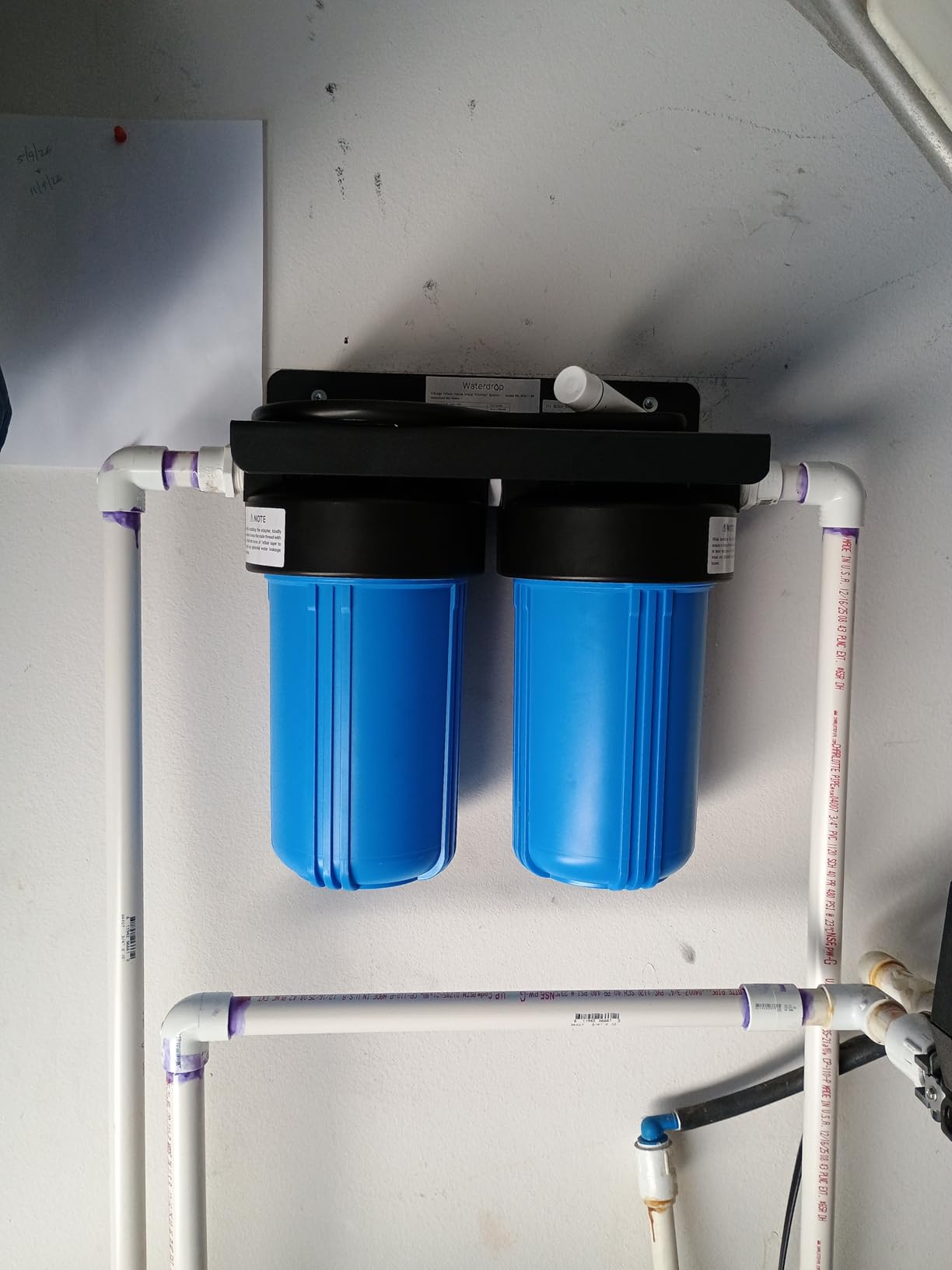
The hardware is the quiet strength. Reinforced brass threads and dual high-sealing O-rings were clearly designed in response to the leaking plastic manifolds that dominate this category, and the unit passed over 100,000 water hammer and pressure tests. It weighs 10.1 pounds and measures 14.37 by 7.48 by 15.55 inches, so it mounts in tight spaces where the 24 inch manifolds will not go.
Flow is 15 GPM on 1 inch NPT ports, both cartridges meet NSF/ANSI 372 lead-free standards, and the box includes pre-installed filters, a mounting bracket, a wrench, and expansion screws with a 1-year warranty and lifetime technical support. Rated life is 50,000 gallons or 6 months per cartridge, with TDS support up to 1000 ppm.
Where this two-stage box fits
Homes on a supply with meaningful dissolved or particulate iron, and anyone who wants a small, light, brass-threaded manifold that will not leak at the joints. The 73 percent five-star share across 1577 reviews lines up with what owners actually say about the fittings.
It is also a good budget step up for a renter with permission to install, or a small house, because 15 GPM is more flow than most compact systems and 10 pounds is easy to handle on a ladder.
Where it is the wrong call
On a chloramine-treated municipal supply, this is not the system we would pick. It is not certified to NSF/ANSI 42 for chlorine reduction, and its chloramine story is a byproduct of the carbon stage rather than a tested catalytic media claim. If your utility uses chloramine, the SGS-tested catalytic carbon units in positions one and two are a better match.
The 6 month, 50,000 gallon cartridge life also means you will be buying media twice a year, and 5 micron nominal filtration is coarse compared with the pleat media in the stainless head above it. Check your utility report for iron before buying, and if there is none, this is money spent on a capability you do not need.
8. iFilters LWH-D – Best Budget Point-of-Entry Sediment and Carbon
iFilters LWH-D 2-Stage Whole House Sediment Carbon Water Filter System
Two-stage point-of-entry
4-layer true depth sediment plus coconut shell GAC
3 GPM
3/4 inch NPT ports
6 month cartridge life
Pros
- Lowest cost way to put sediment and carbon in front of a whole house
- Clear housings allow visual inspection of the cartridges during maintenance
- Integrated pressure relief button makes routine changes easier
- Compact at 9.75 by 5.75 by 14.5 inches and only 7.8 pounds
- Long-term owners report the plastic housings lasting 7 to 8 years
Cons
- Outlet-side female threads are finicky and drip if engaged wrong
- Thin painted steel bracket rusts in damp installations
- Proprietary cartridges cost more than standard 10 inch filters and are shorter
- 3 GPM and 3/4 inch ports are the smallest here
- Highest one-star share in the group at 12 percent
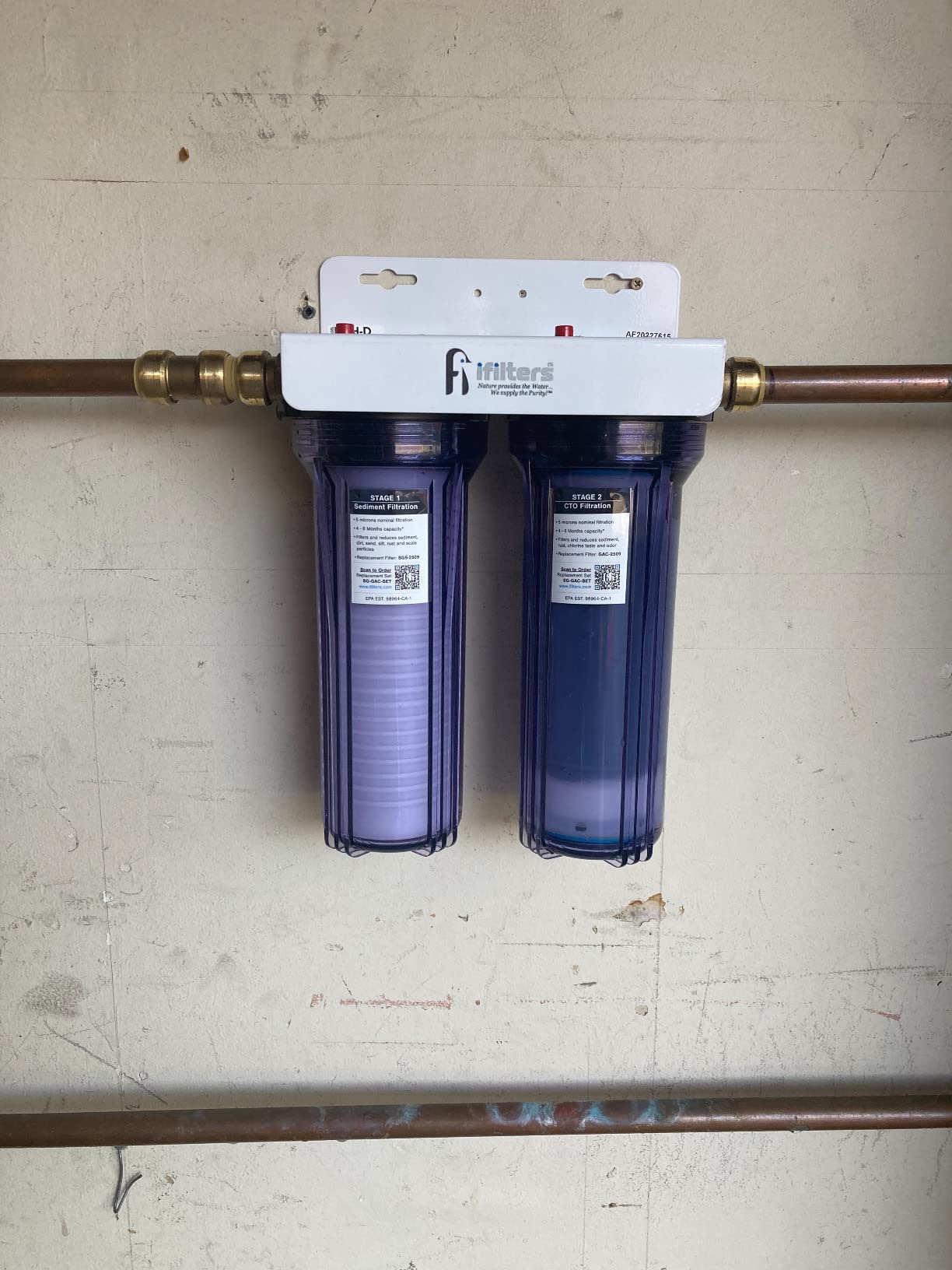
The LWH-D is the honest budget floor. It is a two-stage point-of-entry system that pairs a 100 percent polypropylene true-depth grooved sediment filter with four layers of filtration that catch larger particles first, then adds sediment pre-filtration and coconut shell activated carbon for chlorine taste and odor. That is a real treatment train for a modest outlay.
It is designed for homes with one to four or more bathrooms on drinking, cooking, bathing, and laundry, and its job is protecting fixtures, faucets, valves, water heaters, washing machines, and dishwashers from sediment, dirt, rust, sand, and silt. 3 GPM on 3/4 inch NPT ports, clear housings, and an integrated pressure relief button are the practical highlights.
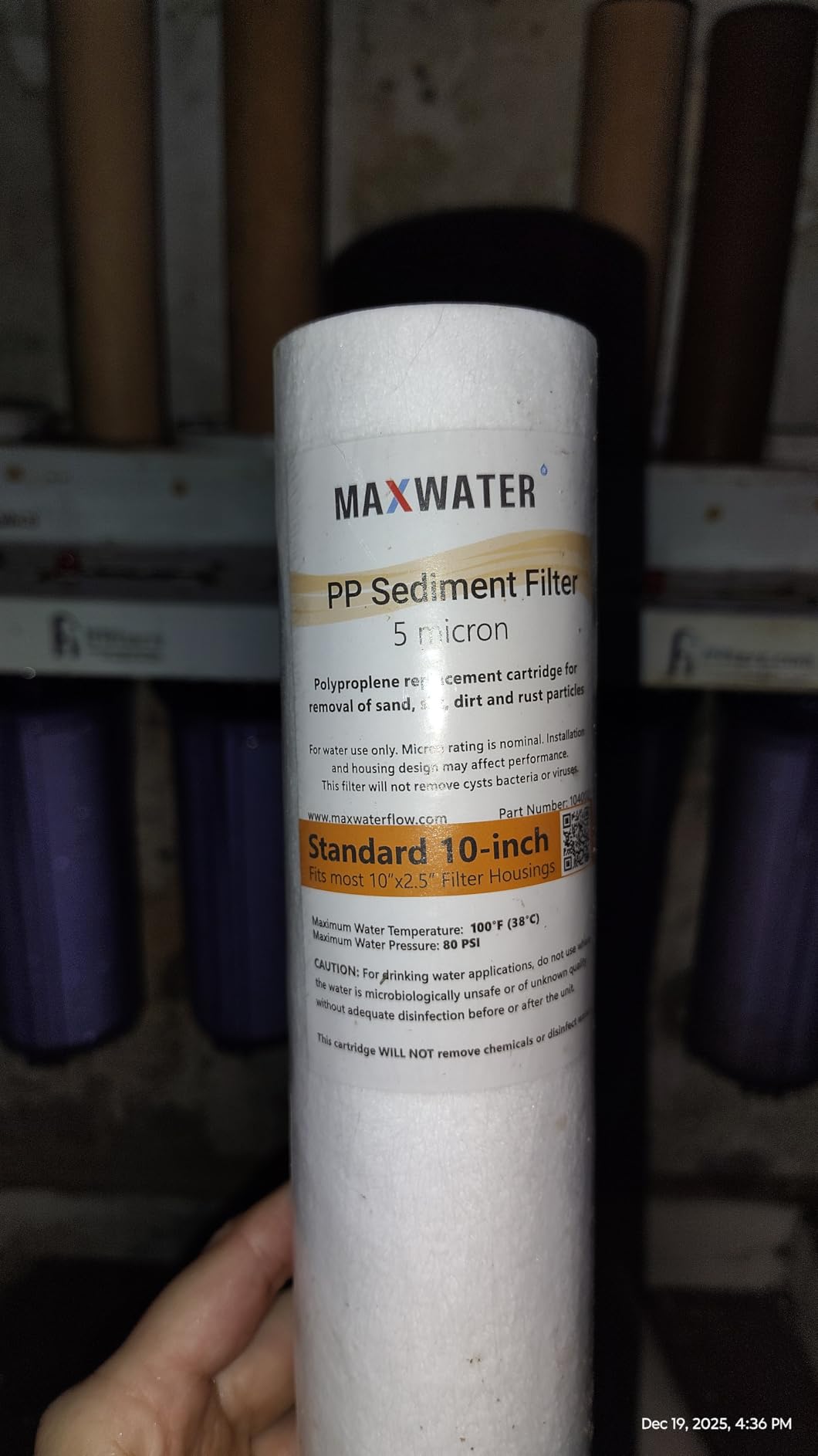
Maintenance is genuinely easy. The clear housings let you see the cartridge without opening anything, which means you can spot a loaded sediment filter instead of guessing on a schedule, and the pressure relief button bleeds the housing before you twist it. Replacement is recommended every 6 months depending on usage and water quality, and it fits iFilters SG-GAC-SET cartridges.
One compatibility trap: generation 1 uses a black gasket and generation 2 a blue gasket, and the two are not interchangeable. If you have inherited one of these, match the gasket color before ordering a filter, or you will end up with a cartridge that does not seal.
What makes it worth buying
It is the cheapest way to stop sediment from reaching your water heater and appliances while cutting chlorine taste and odor, and owners report the plastic housings running for 7 to 8 years on well water. It also accepts standard 10 inch inserts, so you can substitute a third-party cartridge when the proprietary one is not worth the premium.
At 7.8 pounds and under 10 inches wide, it mounts anywhere, including inside a cabinet in a small unit where a manifold will not fit.
Why owners get frustrated
The outlet-side female thread is the single most repeated complaint in the reviews. Multiple buyers report persistent dripping until the male thread is run in almost fully by hand first and then sealed with high-quality tape. Get that connection right before you judge the system.
Beyond the fitting, the 3 GPM rating and 3/4 inch ports are the smallest here, which limits it to modest homes. The thin painted steel bracket rusts in damp installations, the 12 percent one-star share is the highest in the group, and a few owners report internal housing fractures or a carbon cartridge seam failure shedding carbon fines. Budget accordingly.
How to Choose a Whole House Water Filter for City Water in 2026
Step 1: Find out whether your utility uses chlorine or chloramine
This single fact decides your media, and utilities rarely publish it in a place you would think to look. Call customer service and ask directly which primary disinfectant the system uses, and what the residual level in distribution is. Then pull the annual Consumer Confidence Report from the utility website and search it for the terms free chlorine and monochloramine, or look in the treatment technique description.
If your utility uses free chlorine, standard granular activated carbon handles it very well, and one owner in the water treatment forums reported that a catalytic carbon alone managed their free chlorine supply effectively enough to cut a whole KDF stage. If it uses chloramine, you want catalytic carbon media, because chloramine resists ordinary activated carbon and will chew through it.
Step 2: Size the system to your real flow, not your fixture count
Add up the gallons per minute of the fixtures that could run at once, and buy a system rated above that number. A shower, a laundry machine, and a dishwasher together is a realistic morning peak, and a 7 GPM system is where owners start reporting pressure drop. If you are choosing between ratings, the 15 to 20 GPM systems cover a 3 to 4 bathroom house without you thinking about it.
Then think about media capacity rather than flow. A 15 GPM system with 50,000 gallons of carbon will need replacement far sooner than a 7 GPM system with 600,000 gallons. Those are two different systems serving the same house, and the tank-based options win on lifetime cost while the cartridge manifolds win on upfront cost and serviceability.
Step 3: Read the certification scope, not the brand name
NSF/ANSI 42 covers aesthetic claims: taste, odor, and sediment. NSF/ANSI 53 covers health contaminants: lead, cysts, and specific chemicals. NSF/ANSI 372 is lead-free compliance of the components themselves. A system certified to 42 for chlorine taste and odor has not been certified to reduce lead, and a sales page that implies it has is overclaiming. In the forums, this is the single most common source of buyer frustration.
For your utility report, match the contaminant column to the certification column. Chlorine and chloramine need 42 or 53 chloramine reduction claims. Lead needs 53. PFAS needs 53 with an explicit PFOA and PFOS claim, and most of the systems in this roundup do not carry one, so treat generic PFAS marketing with suspicion.
What a whole house filter will not fix
Hardness. Carbon media does not soften water, and a salt-free conditioner prevents scale rather than removing it. If your taps show white crust and you want soft water, you need ion exchange, which is a softener. Our whole house water softener guide covers that decision.
Dissolved iron. Iron that is dissolved in the water will pass straight through a carbon filter and stain downstream. It needs an oxidation media system, which is exactly what the two-stage unit in position seven is built for.
Total dissolved solids. None of these systems reduce TDS. If your utility report shows high conductivity, you need reverse osmosis at a fixture, not a point-of-entry carbon tank.
Bacteria and viruses. Only a UV module inactivates them, and none of these units include one. Carbon can even feed bacterial growth in rare cases, which is why the pre-filter and post-filter arrangement in the premium tank assembly is not just cosmetic.
PFAS without certified media. A carbon system with a general 42 certification has not been tested for PFOA or PFOS. Do not buy a claim you cannot find on the certification listing.
Filter, softener, or both
Install the filter first, then the softener, downstream of it. Sediment and carbon protect the softener resin from fouling, and resin is far more expensive to replace than a filter cartridge. The reverse order means your softener works harder and costs more to run.
On hard city water, the salt-free conditioner path is worth considering if you do not want brine. It prevents scale in pipes and appliances, which protects your water heater, but it does not make the water feel or measure soft. If you want soft water, buy a softener. Our broader whole house filtration roundup covers the mixed systems if you want one reference for everything.
If you rent, or cannot cut into the main line
Every system in this guide requires a main-line cut-in, which is not an option in most apartments and condos without owner permission. The alternatives are point-of-use: an under-sink reverse osmosis for drinking and cooking water, and a shower filter for chlorine and chloramine in the bath. You lose whole-property protection for the water heater and appliances, but you keep the taste and odor improvement where people notice it most.
Installation and the maintenance cadence
Every unit here is a DIY job with a wrench and PTFE tape, provided you have a main shutoff you can reach and roughly 30 minutes. Budget for a plumber if you cannot shut off the water, if the space is cramped, or if you are installing the premium tank system, whose warranty does not survive self-installation.
For maintenance, install pressure gauges upstream and downstream and write the numbers down. Falling downstream pressure at a constant flow rate is your early warning that a stage is loading up, and it is the cheapest diagnostic tool in the category. Replace sediment stages on a 6 month schedule, carbon blocks on a 6 to 12 month schedule, and central carbon tanks on their multi-year rating. Budget the cartridges up front, because that ongoing cost is the real difference between a cartridge manifold and a decade-long tank.
Frequently Asked Questions
Do you need a whole house water filter on city water?
Usually yes, and the reason is chemistry. Municipal water carries a residual disinfectant, free chlorine or monochloramine at roughly 0.5 to 2 ppm, that keeps it safe in the distribution system. That residual causes taste and odor complaints, dries skin and hair, and adds oxidative wear to water heaters and appliances. A point-of-entry filter removes it once at the main line rather than at each sink. It will not soften hard water or reduce total dissolved solids.
How do I know if my city uses chlorine or chloramine?
Call your utility customer service line and ask which primary disinfectant the system uses and what the distribution residual is. Then download the annual Consumer Confidence Report from the utility website and search it for free chlorine or monochloramine. Chloramine systems need catalytic carbon media because ordinary activated carbon is slowly consumed by it, while free chlorine is handled well by standard granular activated carbon.
What size whole house water filter do I need?
Size by peak flow and by capacity. Add up the gallons per minute of fixtures that could run at once, usually a shower plus a laundry machine plus a dishwasher, and buy above that figure. Fifteen to twenty GPM covers a three or four bathroom house, while seven GPM suits one to three bathrooms. Then check gallon capacity, because a high-flow system with a small carbon bed will need cartridge changes far more often than a low-flow tank system.
Does a whole house water filter remove PFAS?
Only if the system carries a specific certification for it. Look for NSF/ANSI 53 certification with an explicit PFOA and PFOS reduction claim on the certification listing. A system certified only to NSF/ANSI 42 for taste, odor, and sediment has not been tested for PFAS, and a marketing page implying otherwise is overclaiming. Several general carbon systems do reduce some PFAS in practice, but that is not a certified performance figure you should plan around.
What are the most reputable water filter brands?
Reputation in this category tracks certification scope, warranty length, and replacement media availability rather than brand name alone. Look for manufacturers that state clearly which certifications they hold and which they do not, publish spare part availability windows, and support lifetime technical help. A. O. Smith backs its central tank with a six-year limited warranty and six years of spare parts, and the premium tank systems in this roundup carry ten-year limited warranties, which is the strongest support commitment available here.
Our Final Verdict for City Water in 2026
The iSpring WGB32B-KSNC is our pick for the best whole house water filter for city water, because it is the only system in this group that separates sediment, heavy metal, and chloramine duties into three stages and backs the carbon stage with an SGS test to NSF/ANSI 42 at up to 94.4 percent chloramine removal. It is also the only one with enough owner feedback to feel that claim under load.
For a condo or a tight mechanical space, the iSpring WGB21B-KSNC gives you the same certified chloramine media in a much smaller box. For a large home that needs flow, the Express Water WH300SCKP on its stainless frame is the most complete plumbed package. If you never want to think about cartridges again, the A. O. Smith AO-WH-Filter trades capability for a six-year service life, and the Aquasana Max Flow is the only one here with a decade-long media warranty, provided your water sits inside its hardness, pH, and iron limits.
Before any of them, call your utility and find out whether you have chlorine or chloramine. That one question costs you five minutes and determines whether the rest of your purchase makes sense.