
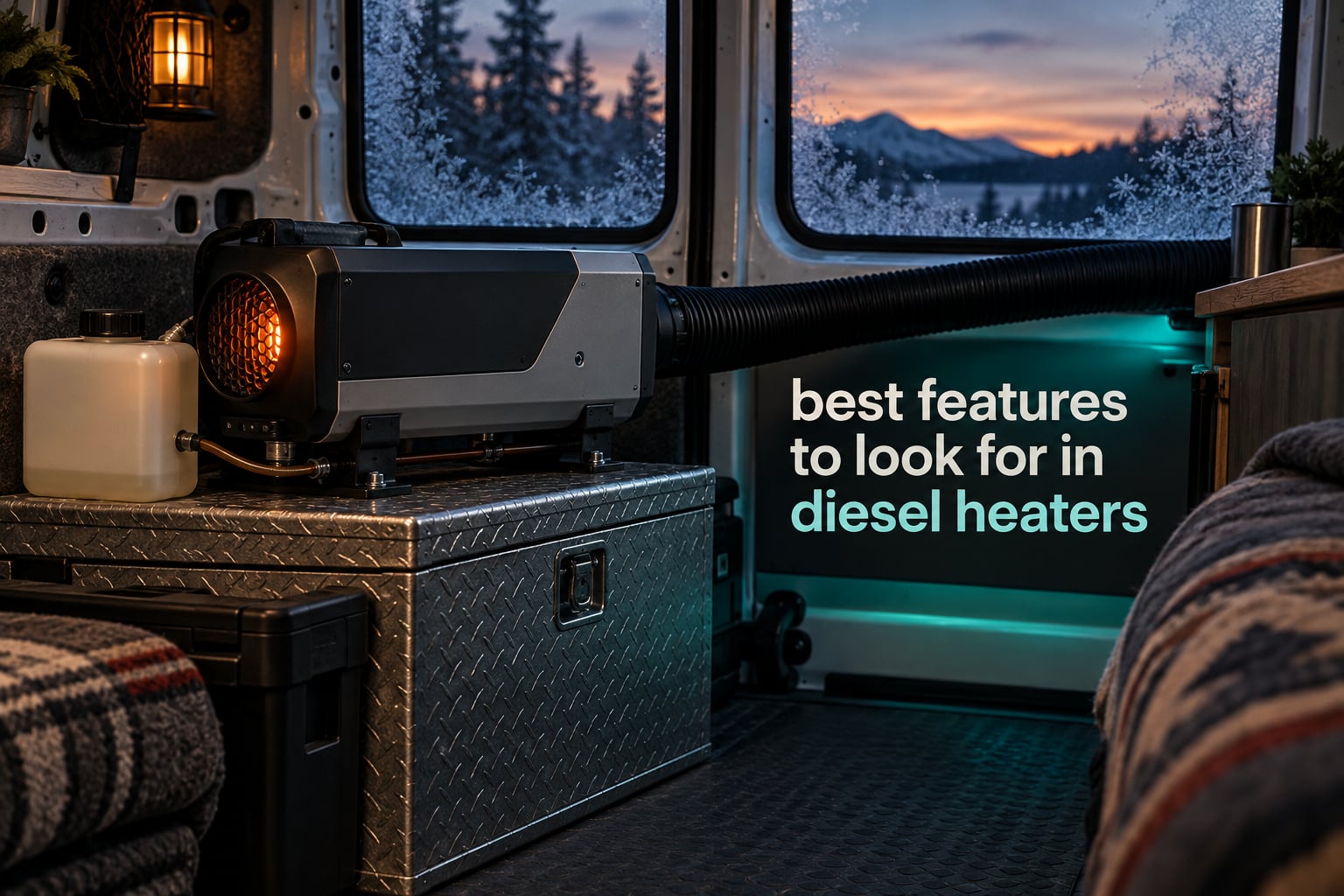
A diesel heater is a compact 12V furnace that burns diesel or kerosene to warm air for a van, truck camper, boat, tent or workshop. A fuel pump sprays a fine mist into a combustion chamber, a glow plug ignites it, and a blower pushes the resulting heat through a heat exchanger and out of a duct. Because the burned gases leave through a separate exhaust pipe, the air you breathe inside stays dry.
When people ask about the diesel heater features to look for, they usually get a flat list of specifications. We spent six weeks reading through owner feedback on ten of the most-reviewed heaters in this category and ranking those specifications by how much they actually change your experience in the cold. Three features separate a heater that works from one that frustrates you: how it handles carbon monoxide, how much power it needs to start, and whether it compensates for altitude. Everything else is a preference.
This guide covers the features that matter, in order, and then puts ten heaters through that framework. Every unit below runs on 12V DC as a portable all-in-one design with an integrated fuel tank, which keeps the comparison honest. We also cover sizing, battery planning and cold-weather fuel handling for anyone building out a van or working winter trips.
Top 3 Diesel Heater Features (October 2026)

VEVOR 8KW All-in-One
- 8KW all-in-one
- 5L integrated tank
- 98ft remote and LCD
- Under 9843 ft rated

VEVOR 8KW App Control
- Bluetooth app to 98ft
- Altitude compensation to 18045 ft
- 5L tank
- Overheat cutoff
Best Diesel Heaters at a Glance in 2026
The table below is the fastest way to compare the ten heaters in this guide. The full breakdown of each one follows below the feature framework.
| Product | Specifications | Action |
|---|---|---|
| VEVOR 8KW All-in-One Diesel Heater |
|
Check Latest Price |
 LF Bros 5KW 12V 24V 110V LF Bros 5KW 12V 24V 110V |
|
Check Latest Price |
| VEVOR 8KW with App Control |
|
Check Latest Price |
 VEPURLT 8KW 15L Tank VEPURLT 8KW 15L Tank |
|
Check Latest Price |
 maXpeedingrods 2KW maXpeedingrods 2KW |
|
Check Latest Price |
 HCALORY 8KW 7.5L Toolbox HCALORY 8KW 7.5L Toolbox |
|
Check Latest Price |
 LF Bros 5KW Plateau Mode LF Bros 5KW Plateau Mode |
|
Check Latest Price |
 BougeRV 5KW All-in-One BougeRV 5KW All-in-One |
|
Check Latest Price |
 HCALORY 8KW 120V and 24V HCALORY 8KW 120V and 24V |
|
Check Latest Price |
 BSMTEK 8KW 9L Tank BSMTEK 8KW 9L Tank |
|
Check Latest Price |
The Diesel Heater Features to Look For, Ranked
The features that matter most on a diesel heater fall into three tiers. Safety features are non-negotiable, power and fuel specs are what determine whether it works in your rig, and control features decide how pleasant it is to live with. Here is the order we rank them in.
Carbon monoxide protection and a sealed exhaust system. A heater burns fuel inside an enclosed space, so fumes escaping into your sleeping area is the one failure mode that cannot be tolerated. Look for a unit with overheat protection, a threaded or lockable fuel cap, and an exhaust port that routes completely outside the living space.
Startup power draw, listed separately from running draw. This is the most overlooked number on any product page. The glow plug draws a heavy surge before combustion catches, and a heater that runs quietly on 3 amps can still ask for 10 to 15 amps at the moment it starts. If you plan to run from a small power station or a 10A 12V port, this decides whether you wake up to a flat battery.
Automatic altitude compensation. Above roughly 1,500 meters the air is thinner, so the fuel pump delivers more fuel into less oxygen. Without compensation you get weak heat, heavy carbon buildup and eventually a shutdown. Look for a barometric or plateau mode with a stated rated elevation rather than a vague “suitable for high altitude” claim.
Overheat protection with multiple temperature sensors. A single sensor can miss a hotspot. Protection that cuts fuel delivery at a stated temperature, such as the 518F cutoff found on one of the heaters below, is a genuine feature worth paying for.
Heat output matched to your space, not the biggest number available. Roughly 1kW per 14 cubic meters works for a well-insulated room, and van interiors need less per cubic meter than that because the space is small. An oversized heater cycles on and off, wastes fuel and shortens the life of the burner.
Fuel consumption in litres per hour, with a usable range. Look for a low and high figure, not a single number. Below about 0.2 L/h is trickle-heat territory; above 0.5 L/h is full-blast territory you rarely want to run all night.
Integrated fuel tank size and cap design. A 5L tank covers a night of intermittent use, a 7.5L tank covers a cold weekend, and a 15L tank means fewer refills on a bus or boat. A threaded internal cap matters more than people expect on rough roads, because vented caps spill diesel every time the rig moves.
Thermostat control you can actually place in the room. A control panel mounted on the heater reads the heater’s own temperature, not your space. Remotes that double as room sensors, or an extension cable that relocates the panel, are what turn a heater into a thermostat that works.
Low fuel pump noise. The steady tick of a pulse-driven fuel pump is the most common complaint from van owners who sleep next to it. Blower speed that varies with output and a pump designed for low-frequency pulse drive make a measurable difference.
Controls and build quality. Bluetooth app control, timers and voice prompts are conveniences, and they sit at the bottom of this list on purpose. A heater with excellent combustion control and a weak app is a better heater than the reverse.
One more practical detail deserves its own note, because it silently disables features you paid for. On many portable heaters, stowing the remote or thermostat inside the heater case means the unit can no longer read room temperature, so thermostat mode and any built-in CO sensing tied to that sensor stop functioning. Keep the sensor outside the case.
Forum consensus supports this ranking. Owners with Webasto and Eberspacher units running for years in the same van treat CO detection and sealed exhaust as the deciding factors, and describe budget units as a quality-control variance rather than a failed category, with many running for seasons without trouble.
1. VEVOR 8KW All-in-One – Our Overall Pick for Feature Coverage
VEVOR 8KW Diesel Heater All in One, DC12-24V, Fast Heating Diesel Air Heater with Remote Control and Color Digital Display, Low Noise, Voice Announcement, for RV, Truck, Camper, Van, Boat and Trailer
8KW output
Coverage 161-215 sq ft
5L tank,0.18-0.36 L/h
Rated under 9843 ft
Pros
- Warm interior in about 10 minutes
- Low fuel burn at roughly half a cup per hour
- 98ft remote for preheating before entry
- Compact all-in-one body
- Quiet once at temperature
Cons
- Weak printed instructions
- Needs priming before first start
- Some examples do not stop at setpoint
- Very hot exhaust port
The VEVOR 8KW all-in-one is the most-reviewed heater we looked at, with 1,974 ratings averaging 4.2 out of 5. That volume matters in this category. When a burner design is shared across several brands, a large review base tells you what the failure modes actually are, and for this model they are consistent and narrow rather than structural.
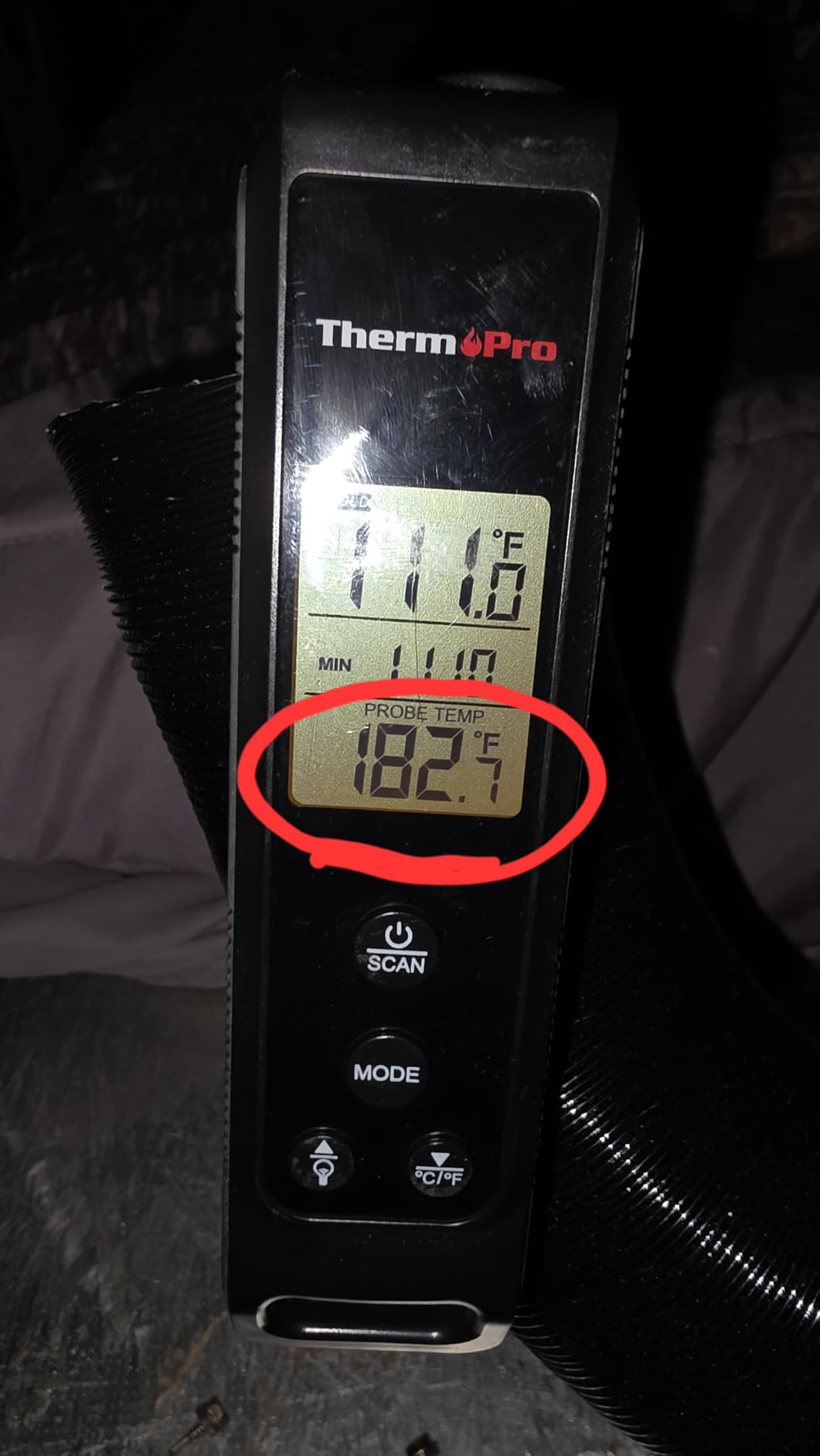
Owners report a warm camper interior within about 10 minutes of startup, and fuel consumption in the range of 0.18 to 0.36 L/h. Owners describe roughly half a cup per hour at full output, which works out to about a gallon across a night of intermittent running. Combustion efficiency is listed at 90 percent or better, and the ceramic igniter gives fast cold starts when the temperature drops.
Feature-wise this is the complete package for a portable build. You get dual 12V and 24V operation, a 5L integrated tank with a fuel gauge, a color digital display, a 98ft remote, and adjustable output from 32F to 104F. The heat-insulated exhaust shield and threaded leak-proof fuel cap are details that cheaper designs often skip, and both matter on a road that shakes.
What it does not have is altitude compensation. The rated ceiling is 9843 ft, which covers most US mountain passes and most of western Europe, but a camper running in the Rockies above tree line in deep winter is working near the limit. Rated under 9843 ft is also the only altitude claim on the product page, so treat it as the number to plan around rather than a promise.
Why we picked it over the app-controlled VEVOR?
The competitor one slot down has a better feature list on paper, with Bluetooth control and altitude compensation to 18,045 ft. This model wins on evidence volume and on the specifics that get used every night. A 98ft remote gets you a preheated cab before you climb in, which solves the same problem an app does, without a pairing step.
It also burns less fuel at low output, topping out at 0.36 L/h against 0.62 L/h on the app model. For overnight use in a van that difference compounds across a season, and a heater that cycles less hard also builds less carbon on the heat exchanger.
Where it falls short for high-altitude travel?
The rated ceiling is the real limitation. Above 9843 ft the fuel pump has no compensation to lean on, and thin air means incomplete combustion, which shows up first as a sooty exhaust and eventually as hard starting in the morning. If your trips are coastal or valley-based, that will never come up.
Two smaller issues: the unit must be primed before first start or it will not fire, and a minority of owners report it not stopping at setpoint, instead dropping to reduced output and continuing to run. Both are manageable, but the second one is worth knowing about if you plan to run it unattended overnight.
2. LF Bros 5KW – Best Value for Multi-Voltage Flexibility
LF Bros 5KW Diesel Heater, 12V/24V/110V Diesel Parking Air Heater
5KW, 4700-17000 BTU
0.18-0.53 L/h
215-269 sq ft
Works from -40F to 104F
Pros
- Runs on 12V
- 24V and household 110V
- Very wide -40F to 104F operating range
- Threaded fuel cap resists spills
- Remote is paired at the factory
- Booklet plus QR install tutorial
Cons
- Needs a 15A supply for full 12V output
- Audible blower and fuel pump
- Translation quality is poor
- Heavy at roughly 26 lb
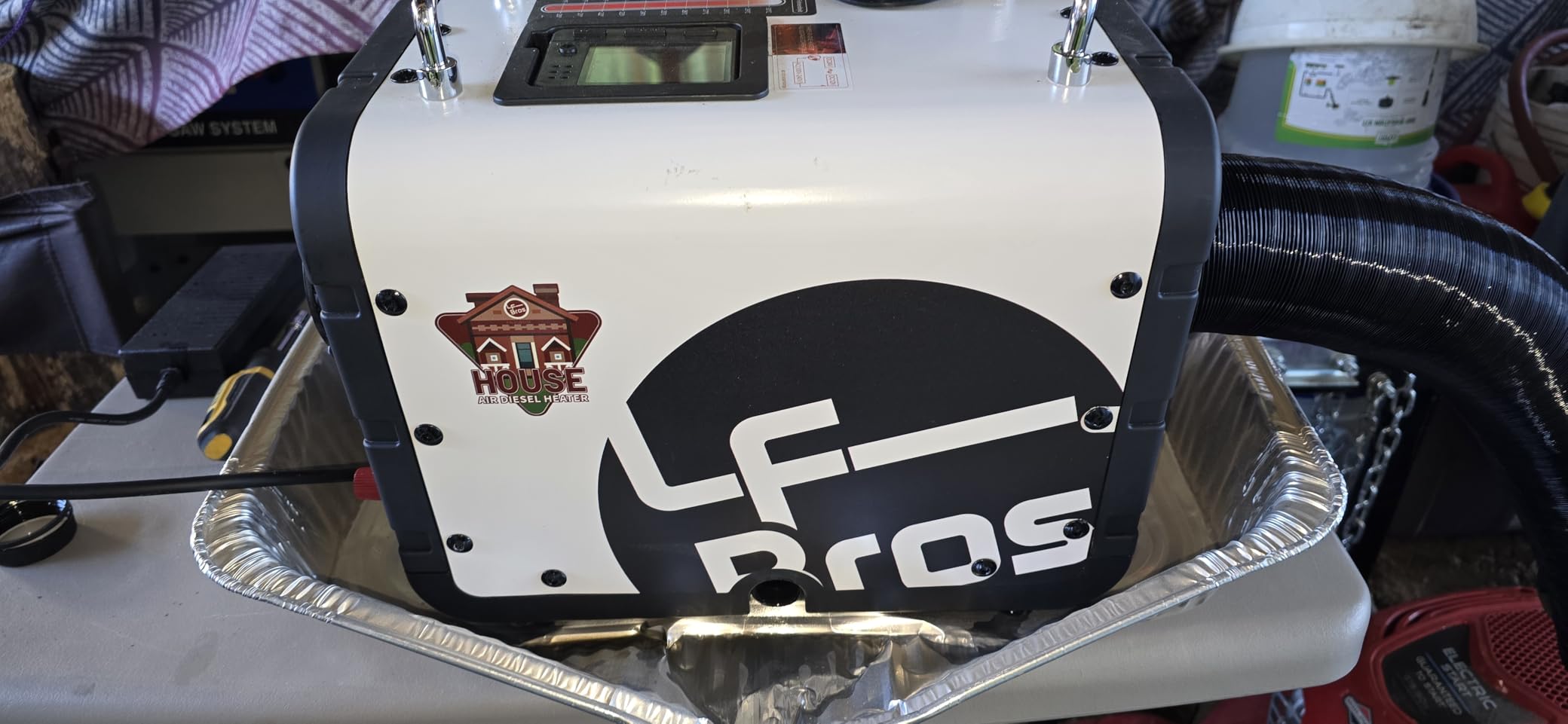
This 5KW model earns its place for one reason no other heater in our set matches: the included 110V transformer. It means the same box heats a van on 12V, a truck on 24V, and a garage or shed off a household outlet, which turns a camping purchase into a year-round tool.
Output is listed at 4700 to 17000 BTU with coverage of 215 to 269 square feet, and fuel consumption between 0.18 and 0.53 L/h. The working temperature range of -40F to 104F is among the widest here, which matters more for arctic camping than the headline wattage does.
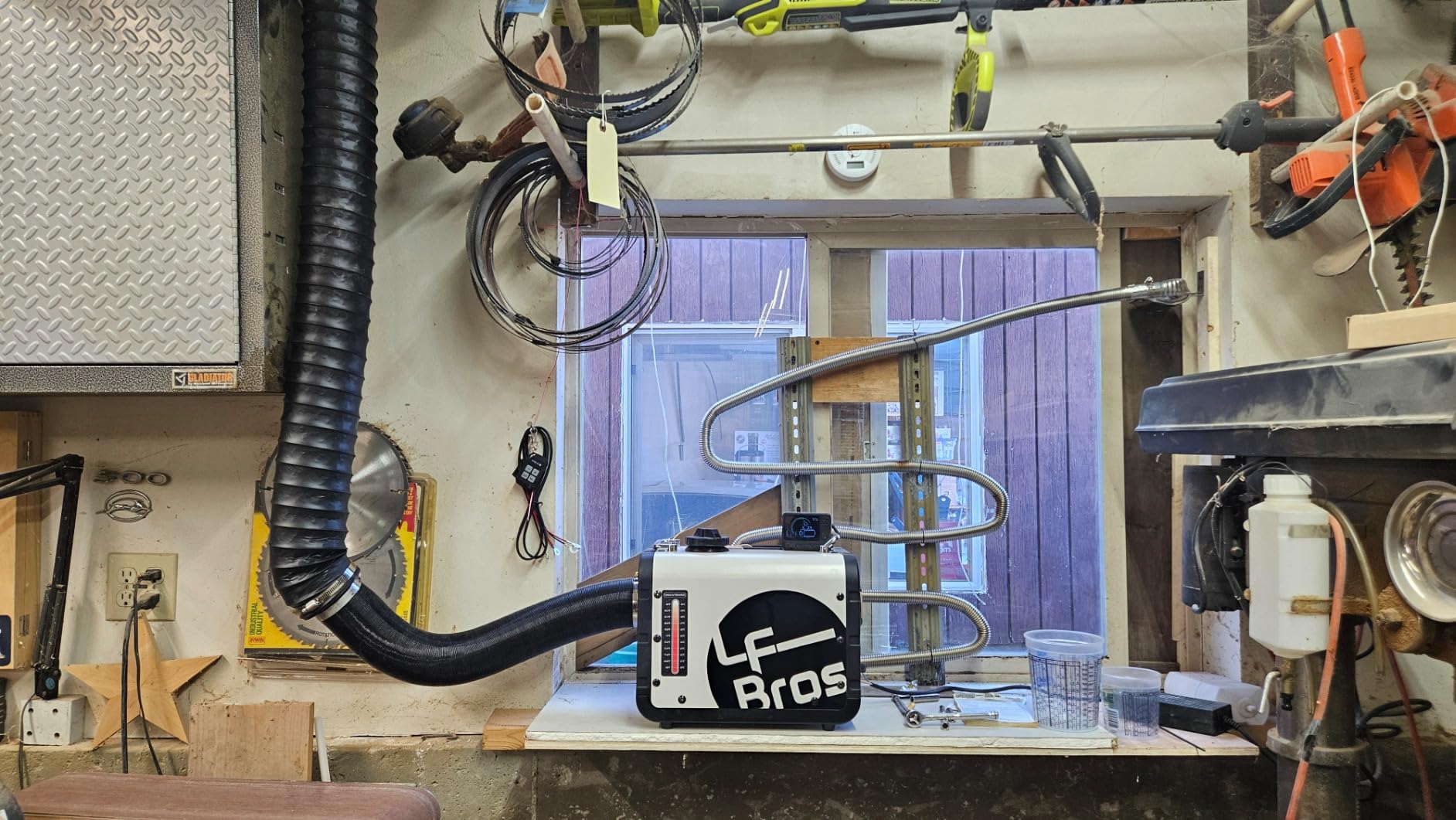
Other details that came up repeatedly in owner feedback: the LCD switch shows working status clearly, the remote is factory-paired and reaches 100ft out of the box, and the threaded internal fuel tank cap resists diesel slopping out over bumps. Setup comes with a printed booklet and a QR code linking to an install tutorial, which is more documentation than most budget heaters ship with.
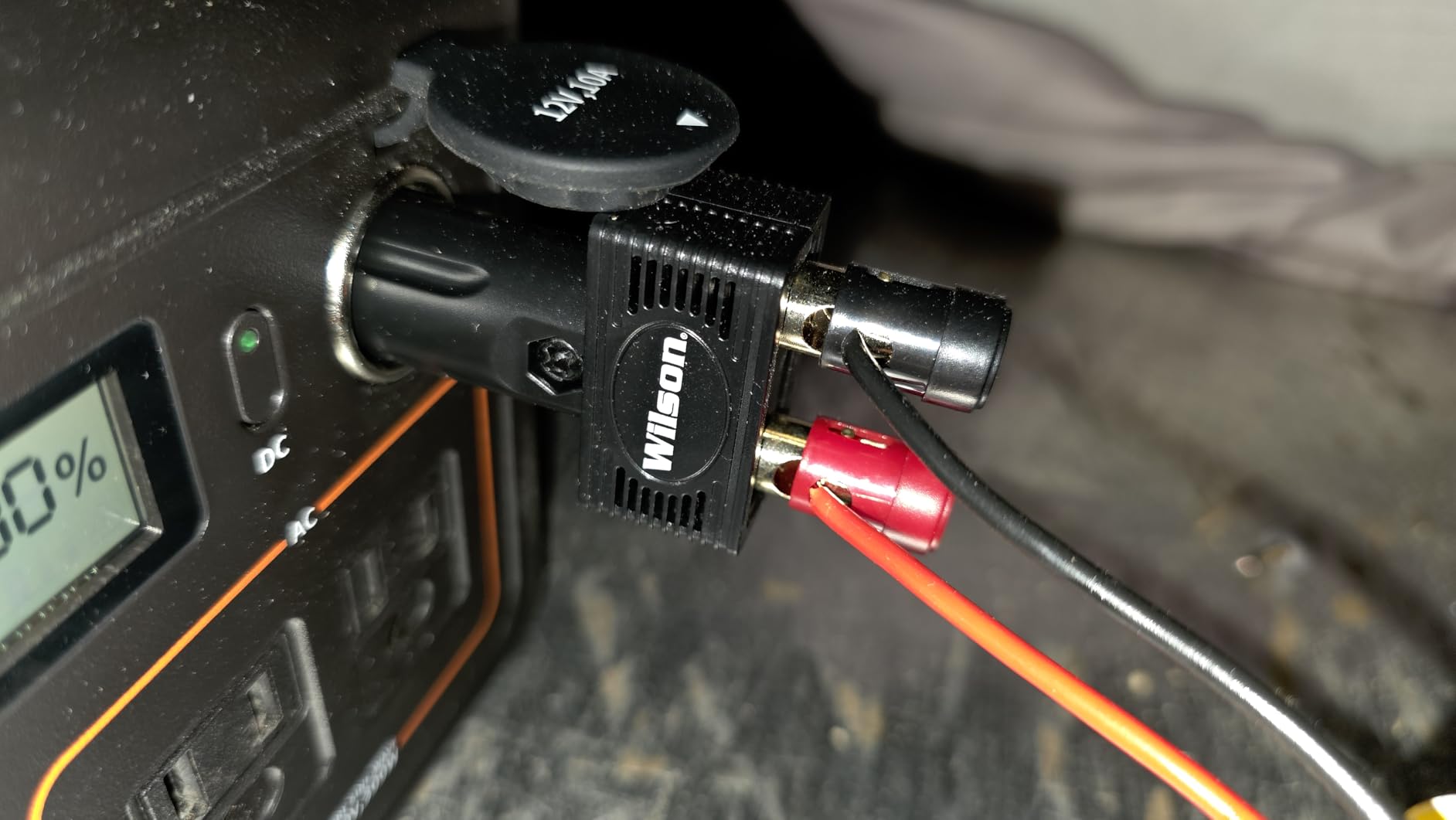
The 15A amperage figure is the one to read carefully. That is the supply the unit wants for full 12V operation, so a small power station with a 10A 12V port will not deliver what it asks for on high. Size your supply before you size your heater.
Best fit for someone who needs heat in more than one place
If you are splitting time between a van trip in winter and a workshop in the shoulder seasons, the voltage flexibility alone justifies the choice. Owners using it in uninsulated spaces report steady output across the full temperature range rather than a strong result only at moderate conditions.
It is also a sensible middle ground on power for a build running off a single auxiliary battery. Five kilowatts of output sits well below the 8KW class while drawing less than an installed OEM unit would from a house circuit.
What you give up for that flexibility?
Weight is the first cost. At roughly 26 pounds this is one of the heavier models here, and in a van that is pounds you have to lift through the door and secure on every stop. The bulkier footprint also limits placement options in a tight install.
Second, there is no app control and no altitude rating stated on the product page. Above around 1,500 meters this unit has no compensation, and there is no published figure telling you where it stops working. The documentation is also translated awkwardly, so budget time for the QR tutorial.
3. VEVOR 8KW with App Control – Best Feature Set on Paper
VEVOR Diesel Heater, 12V All-in-one Diesel Air Heater with Remote Control and LCD Display, 5L Fuel Tank Fast Heating Portable Diesel Parking Heater for RV, Truck, 8KW, Upgrade – APP Control, Orange
8KW, 12V
215-269 sq ft
0.16-0.62 L/h, up to 8 hours
Altitude to 18045 ft
Pros
- Bluetooth app to 98ft plus remote and LCD
- Automatic altitude compensation
- Ready to use with no separate tank
- Aluminum exchanger warms in about 10 minutes
- Overheat cutoff at 518F with timer
Cons
- Bluetooth pairing can be finicky
- Heavy at 22.4 lb for a 12V unit
- Fuel gauge misleads if not primed
- Translated documentation
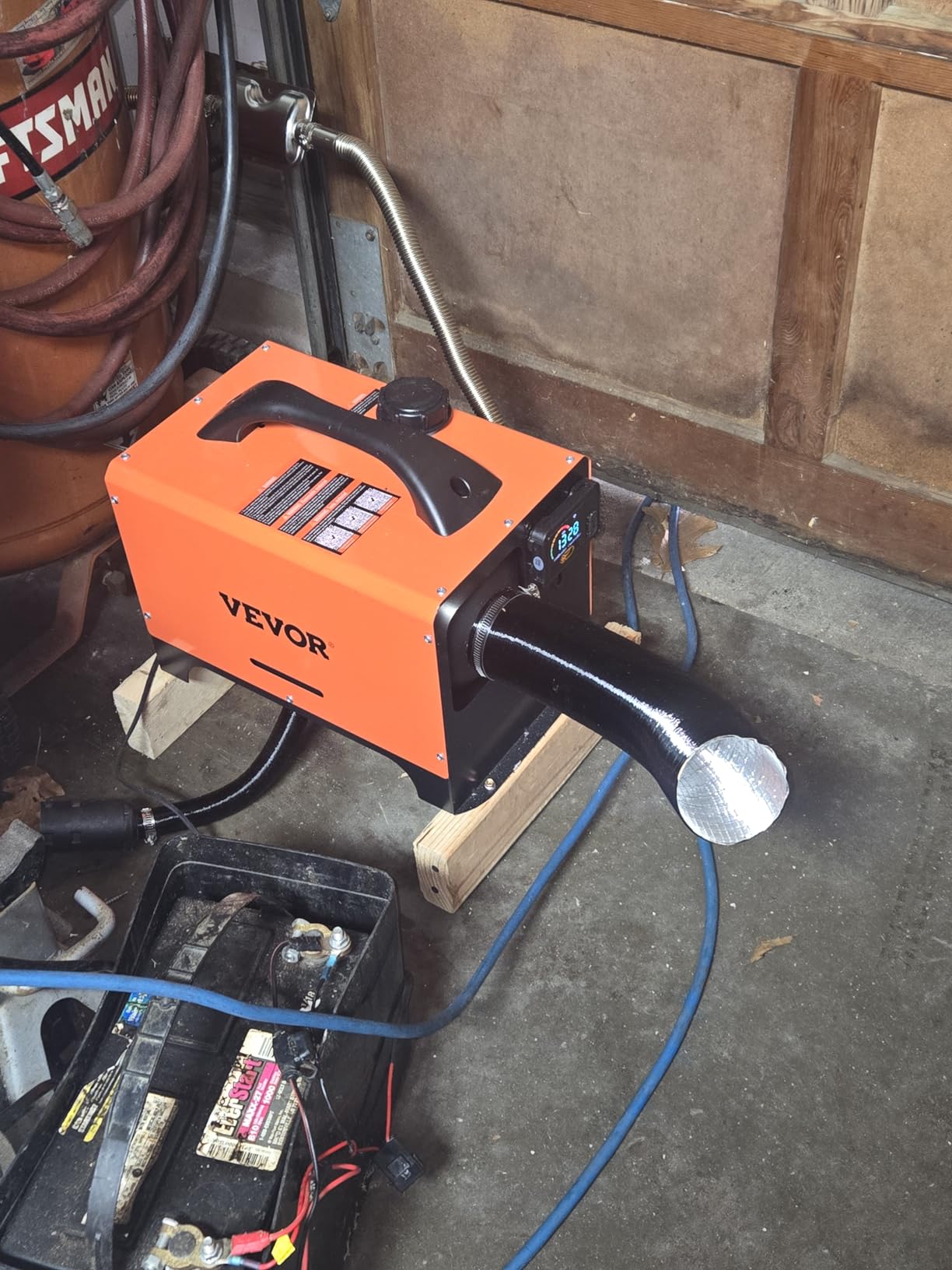
This is the most feature-dense heater in the group and the one that most directly answers the question this guide exists to answer. It has automatic altitude compensation to 18,045 ft, Bluetooth app control out to 98ft, overheat protection with a stated 518F cutoff, a timing function and voice announcements, all in an all-in-one box with a 5L tank.
Owners like that nothing else is required to run it. There is no separate tank to plumb and no fuel pump to angle, so it is genuinely ready out of the box. The sandblasted aluminum heat exchanger brings a space to temperature in about 10 minutes across a 215 to 269 square foot range.
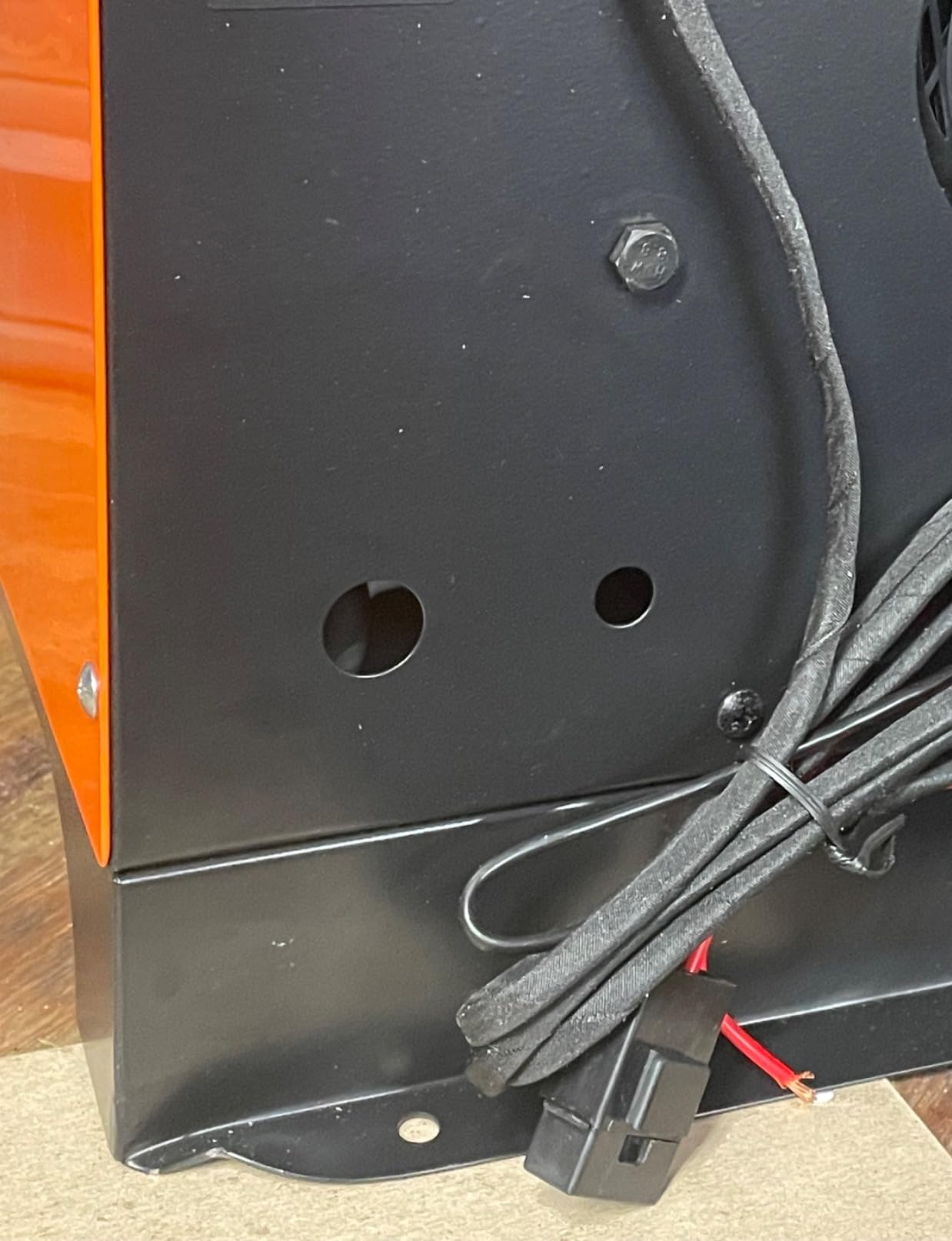
The altitude figure is the headline. Automatic compensation means the fuel pump retunes for thinner air rather than you guessing at a switch position, which removes the most common high-country failure mode. Coverage of 215 to 269 square feet covers a truck camper or a mid-size workshop.
Temperature is adjustable from 46.4F to 96.8F, and the tank gives up to 8 hours of heat at 0.16 to 0.62 L/h. The wide fuel range is worth understanding: the low figure is gentle background heat, the high figure is maximum blast.
Who gets the most out of this feature set?
Anyone moving between elevations gets real value from the automatic compensation. So does anyone who wants a genuine thermostat rather than a duty cycle, because the app, the 32ft remote and the LCD give three ways to set and read the target temperature.
It is also a good choice for a boat or a permanent motorhome install, where the built-in timer means you can set a start time and climb into a warm cabin without remembering to turn anything on.
Where the extra features cost you?
Weight is the main penalty at 22.4 pounds for a 12V unit. In a van that is a real handling consideration, and the split layout is less tidy to mount than a simple box.
Bluetooth pairing can take retries on first setup, and the fuel gauge and app status can both mislead you if the heater has not been primed. Owners also report needing to cross-reference the translated documentation against install videos. None of these affect heating performance, but they are the difference between a ten-minute setup and an evening one.
4. VEPURLT 8KW with 15L Tank – Best for Long Unattended Runs
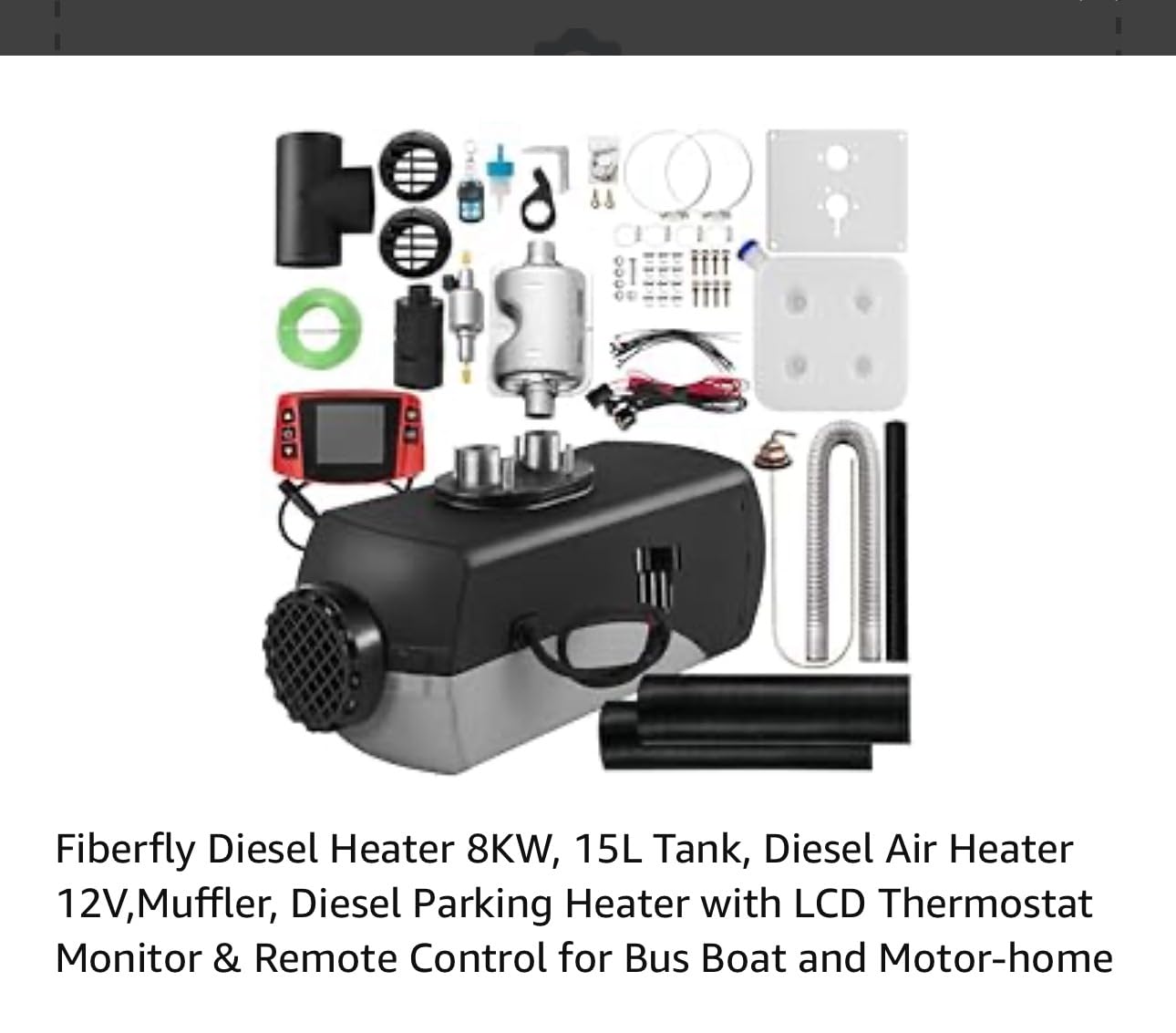
VEPURLT Diesel Heater 8KW, 15L Tank, Diesel Air Heater 12V,Muffler, Diesel Parking Heater with LCD Thermostat Monitor & Remote Control for Bus Boat and Motor-home
8KW, 12V
15L integrated tank
0.2-0.5 L/h
Operates down to -40C
Pros
- 15L integrated fuel tank
- Works down to -40C
- Automatic control with adjustable setpoints
- Euro IV compliant exhaust
- Muffler included
Cons
- LCD and remote are basic
- No app control or altitude rating
- Exhaust routing needs adapting
- Documentation takes study
This is the endurance pick. A 15L integrated tank is three times the capacity of a 5L portable, and for a bus, a boat or a motorhome that runs heat through the night it removes refilling from the routine entirely. At 0.2 to 0.5 L/h that tank is measured in days rather than evenings.
It is also among the most capable in extreme cold, with a working temperature down to -40C and an oil pump rated to -40C as well. The ceramic ignition plug vaporizes the fuel for fast, complete combustion, which is what makes starting reliable when everything else is cold.
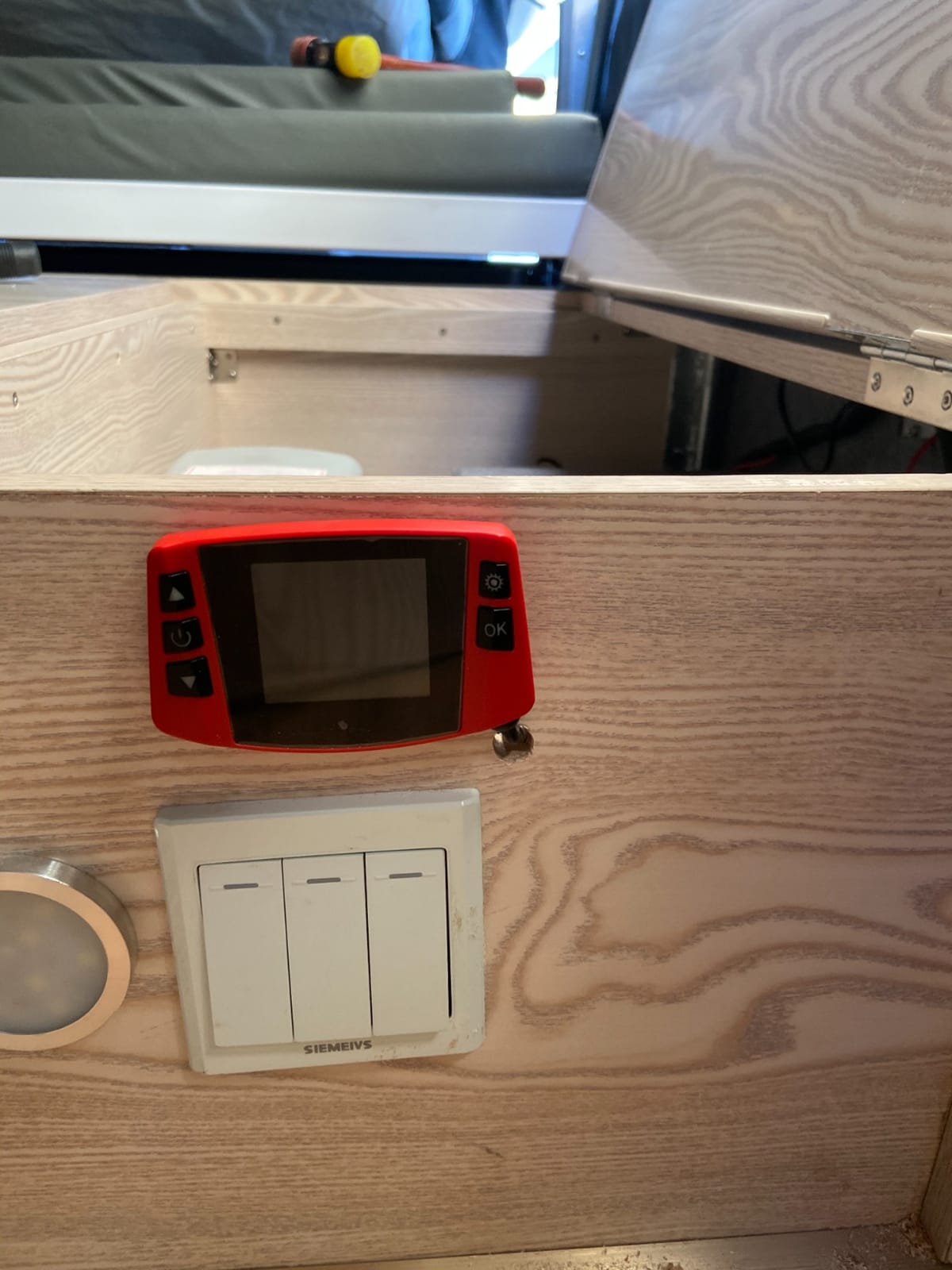
Two features stand out. The exhaust meets Euro IV emissions requirements, so combustion is cleaner than older budget designs and the heat exchanger should pick up less carbon over time. The muffler is included, which softens exhaust noise without you sourcing a separate part.
Automatic control lets you set fuel, power and temperature levels independently, and the unit handles faults on its own. The LCD thermostat monitor and remote are dated next to an app-controlled rival, but they do the job.
Why tank size beats smart features in some builds?
If your heater runs unattended for long stretches, capacity is a convenience feature. A 15L tank means a weekend of intermittent heat without carrying a second fuel container or finding fuel along the route, and the fewer refills you make the fewer chances for a spill or a mistake.
For commercial work, a bus, or a boat cabin where the heater cycles through the night, that arithmetic is straightforward. Owners consistently describe this as a straightforward workhorse rather than a feature-led purchase.
The trade-offs for a smaller rig
Fifteen litres of diesel is a lot of dead weight for a campervan, and the listed shipping weight is over 16 pounds before fuel. For a small van that changes the calculation entirely, and a 5L tank is the more sensible size.
There is also no app control and no published altitude rating on this model, so high-country use needs manual retuning. Owners report needing to adapt the exhaust and intake routing, and the wiring diagrams take real study. Budget an afternoon for setup.
5. maXpeedingrods 2KW – Best for Battery-Sensitive Installs
maXpeedingrods 2KW Diesel Heater 12V/24V, App Remote Control,LCD Control
2KW output, 12V and 24V
0.16-0.24 L/h
Altitude compensation above 5500 m
12.79 lb
Pros
- Lowest power draw in this group
- Among the lowest fuel consumption figures
- App
- LCD and remote control
- Quiet blower and pulse-driven pump
- Compacts into tight install spaces
Cons
- 2KW suits small spaces only
- Needs priming on first start
- App pairing can require retries
- Split body is less tidy to mount
Two kilowatts sounds small until you understand what it is for. This is the heater for a small van, a truck cap, a hunting blind or an ice fishing shanty, and it is the only model here that treats battery life as the primary constraint rather than an afterthought.
Fuel consumption of 0.16 to 0.24 L/h is the narrowest and lowest band in the set, and owners of small vans repeatedly describe 2kW as ample for their space. At that burn rate, an auxiliary battery sized for a weekend of trickle heat is realistic rather than aspirational.
Control is unusually thorough for the class: Bluetooth app through the Booyood app, an LCD panel and a physical remote. The ceramic igniter and gasification combustion are specified for rapid, complete combustion, which is what keeps a small burner from sooting.
Where 2kW is genuinely the right size?
Van owners on forums describe 2kW as ample and 5kW as unnecessary for the average conversion, largely because a van interior is a small volume with a fast heat loss to warm. A 2kW unit here also has a smaller footprint, which matters when every piece of floor space is already spoken for.
For anyone running off a small power station with a 10A 12V output, this is the model that pairs sensibly with it. Sizing the battery for the lowest realistic draw is the feature nobody advertises and everybody notices at 6am.
Where it will disappoint you?
It will not heat a workshop. Coverage is not the point of this heater, and anyone expecting to warm a garage or an uninsulated space will find the output modest. If your heat demand is above small-space trickle heating, move up a class.
It also needs the fuel line primed before first start, the app pairing can require several attempts, and the split-body format is less tidy to mount than an all-in-one box. The listed 12.79 pound weight is light for this output class, which partly offsets the bulk.
6. HCALORY 8KW 7.5L Toolbox – Best Remote Room Thermostat
8KW Diesel Heater, All in One 7.5L Toolbox MAX Diesel Air Heater 110/12/24V Parking Heater with App Control, Wireless Temperature Sensing and Altitude Mode for RV Garage Camper 2025 Upgraded
8KW with 7.5L tank
110V, 12V and 24V
Up to 62.5 hours
Altitude to 18000 ft
Pros
- Wireless remote acts as a room thermostat
- Up to 62.5 hours on one tank
- Usable heat in about 3 minutes below freezing
- Silent fuel pump
- Toolbox form keeps heater and fuel together
Cons
- Lowest rating here at 4.0
- Heaviest at 26.8 lb
- Quality control issues on early production
- 65 dB duct outlet still audible
- App adds complexity
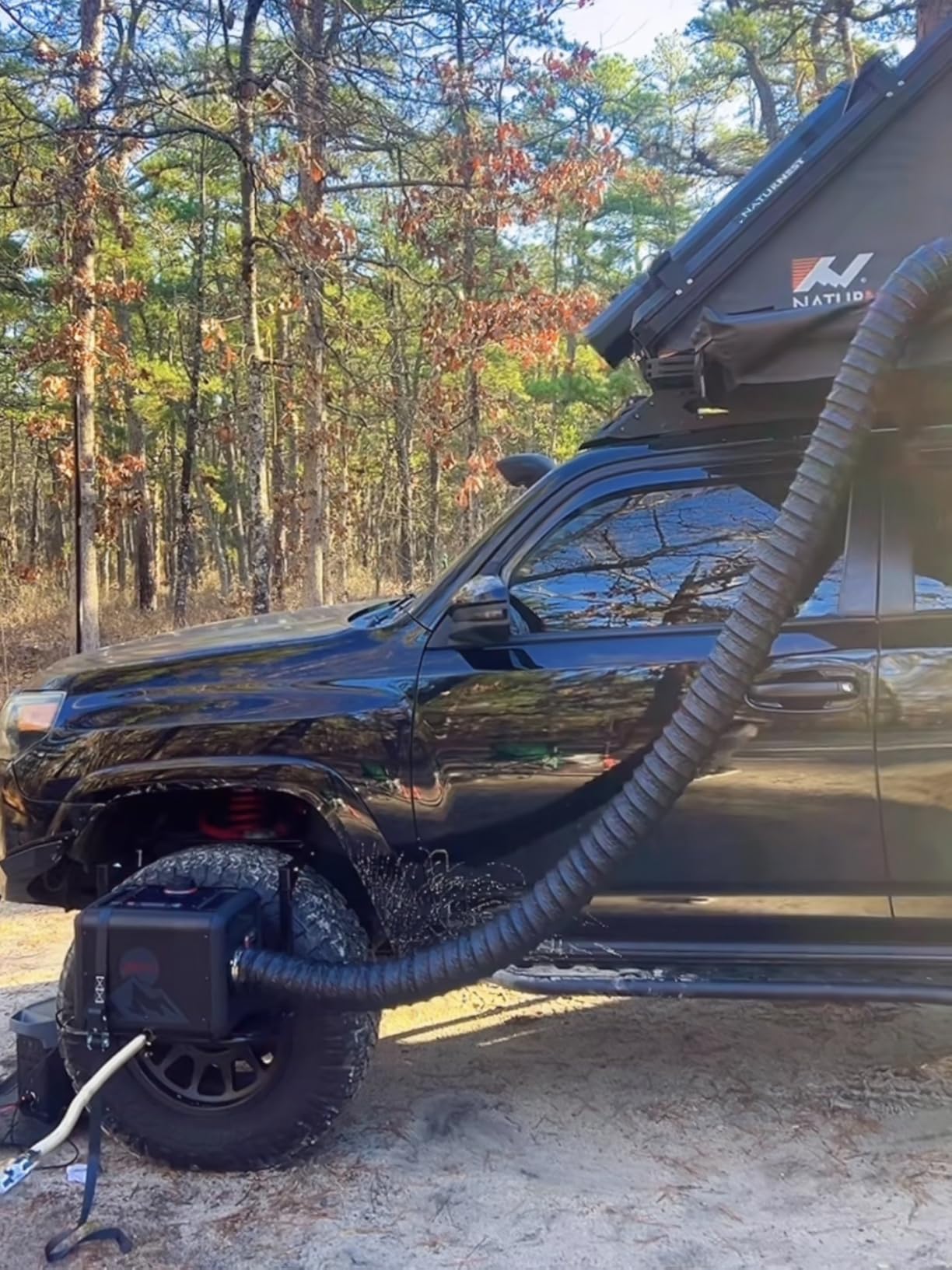
The design idea here is genuinely good. The wireless remote doubles as an indoor thermostat that senses room temperature, which lets the heater body itself live outside the living space. In a van or a tent that is the difference between a heater you can place sensibly and one that occupies the middle of the floor.
The 7.5L toolbox tank is also substantial, giving up to 62.5 hours of runtime at minimum setting. Owners report usable warmth in about 3 minutes in sub-zero conditions, and a fuel efficiency improvement of 36 percent over comparable units is claimed for the current model year.
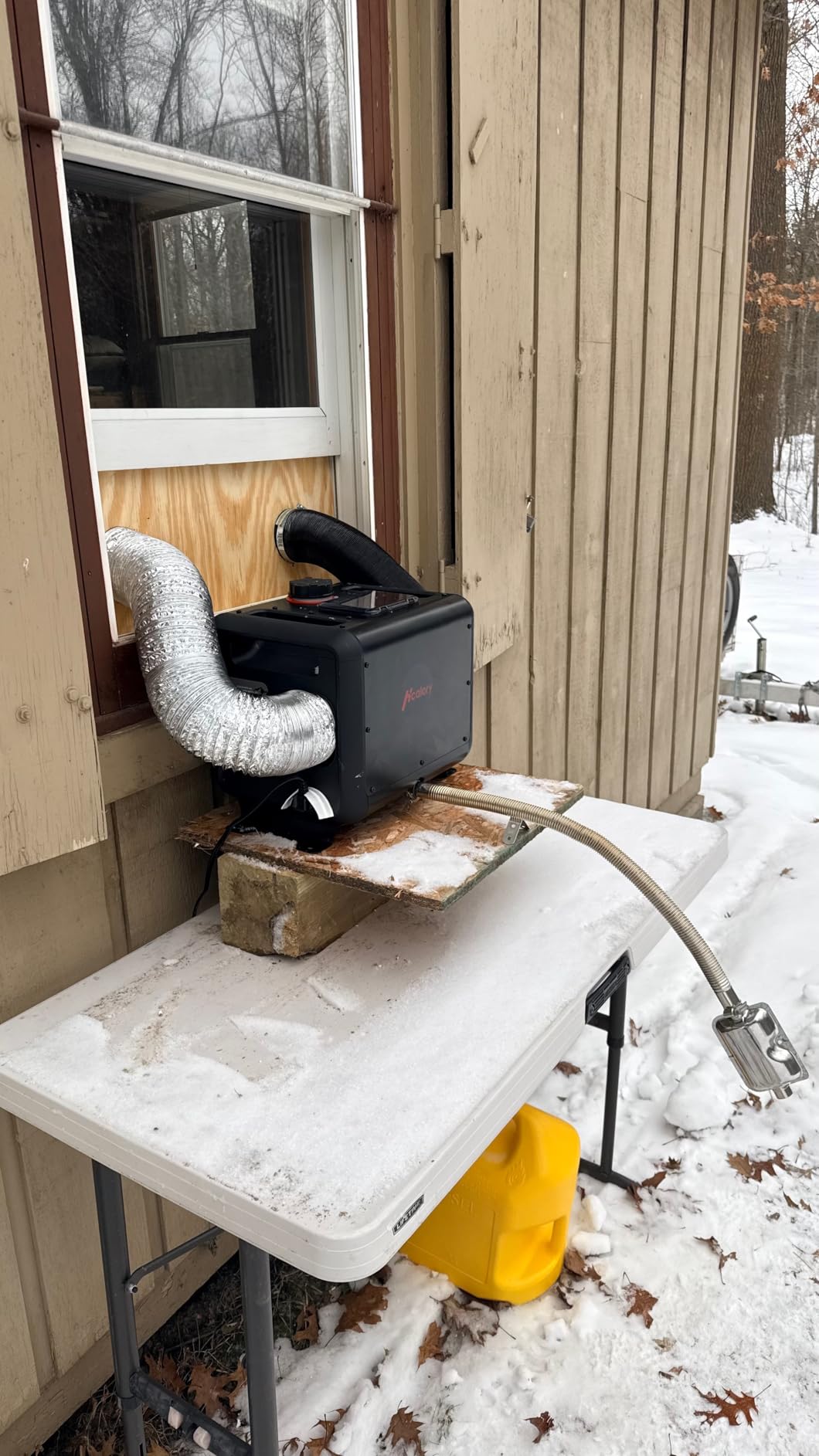
Noise handling is the other strength. The fuel pump is silent, removing the usual ticking inside a sleeping space, and the duct outlet is measured at about 65 dB. Multi-voltage support covers 110V, 12V and 24V, and automatic combustion adjustment is rated to 18,000 ft.
The toolbox form factor is practical in a way that sounds minor and is not. Heater and fuel stay together and stow as one piece, so nothing gets forgotten at the trailhead.
Why the remote thermostat changes placement?
Every other portable in this group reads temperature from a panel attached to the heater, which means the heater has to sit in the space you want warm. A wireless room sensor removes that constraint, and for a van with a bed and a galley it is the feature that unlocks the layout.
Owners using this in tents and off-grid cabins single out that remote, plus the three-minute warm-up, as the reasons they keep it. Combined with the 18,000 ft rating, it is well suited to winter camping and cold-weather touring.
Reasons to look elsewhere first
This is the lowest-rated heater in our set at 4.0, with 18 percent one-star reviews, and the complaints cluster around quality control on this newer model year. Owners report heaters arriving with faulty components, and the failures tend to be early rather than gradual.
It is also among the heaviest at 26.8 pounds, awkward to lift into a high van floor. If you are buying blind and cannot check the unit in person, a model with a longer review history is the safer route. The app-dependent features also add complexity for anyone who only needs on and off.
7. LF Bros 5KW Plateau Mode – Best for High-Altitude Campgrounds
LF Bros 110V/12V 5KW All-in-1 Diesel Heater, 5L Air Diesel Parking Space Heater with Plateau Mode, Come with Remote, T4 LCD Controller and Timer, Suitable for Home Shop Garage Camper
5KW with 5L tank
Plateau mode tested at 17000 ft
12V plus 110V transformer
5KW high, 1.4KW low cycling
Pros
- Plateau mode holds output above 8000 ft
- Includes an AC inverter
- Starts with no priming
- Very quiet running
- T4 controller supports thermostat and timer
Cons
- Diesel odor in hot air during startup
- Thermostat mode drops to 1.4KW instead of stopping
- Exhaust joining piece does not fit
- Fuel level hard to read
- High draw until setpoint is reached
This model is built around one problem, and owners confirm it solves it. Plateau mode was tested at 17,000 ft, and buyers running it at campsites above 8,000 ft report stable output instead of the weak heat and eventual shutdown that plagues uncompensated heaters up there.
The aviation-grade ignition plug and antifreeze power cord are specified for extreme cold starts, and unlike several others here it fires without manual priming. Owners also describe it as very quiet once running, with a near-silent fuel pump.
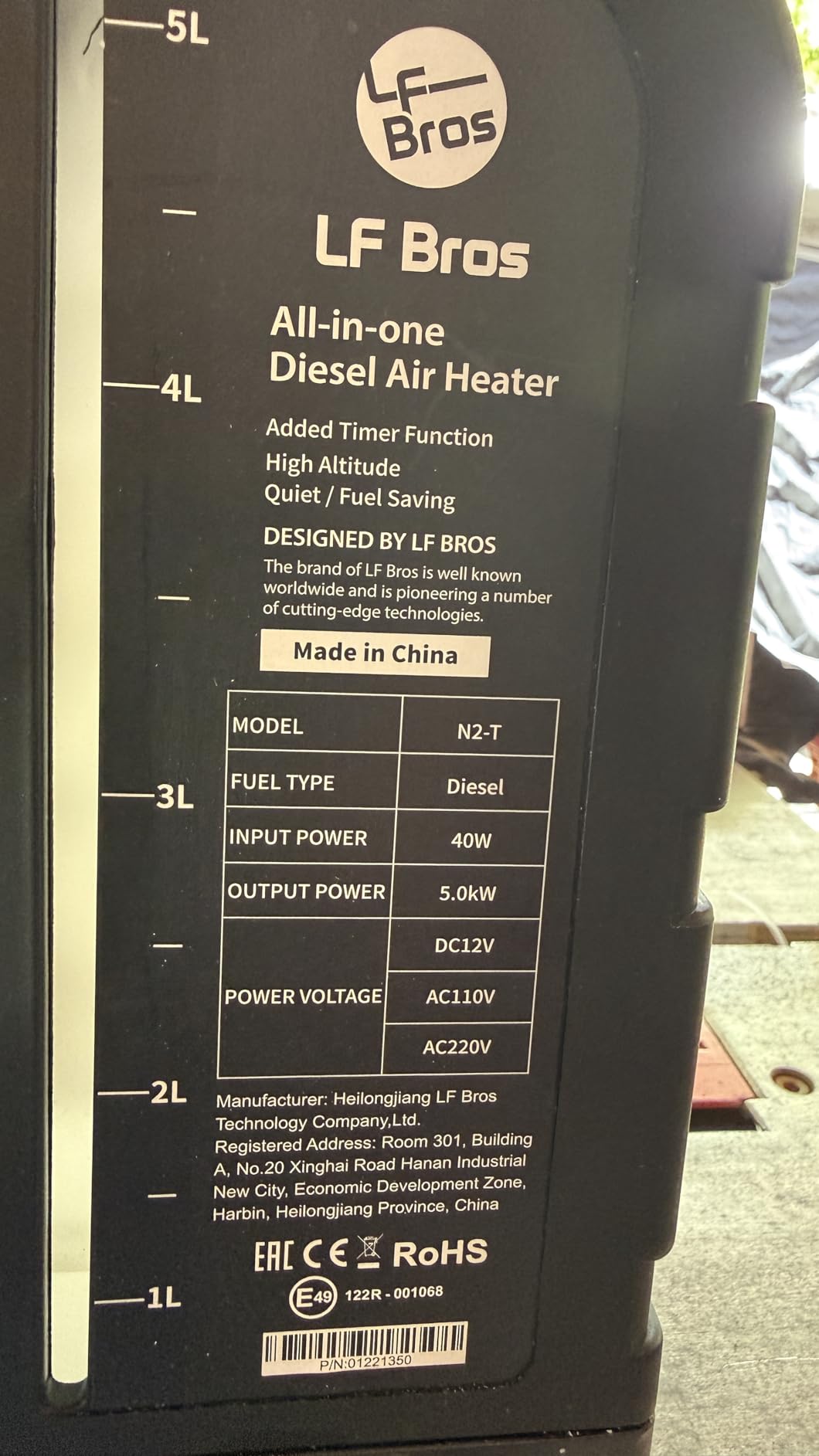
The T4 LCD controller is the feature that makes overnight use practical. It supports thermostat mode plus an on and off timer, and it can be extended and mounted away from the heater for genuine room-temperature control. A 100ft pre-paired remote is included, and an AC inverter means a single battery bank can power both the heater and the controller.
Fuel consumption is not stated as a range on this model, but the thermostat cycles between 5KW high and 1.4KW low, which is the mechanism that controls overnight burn.
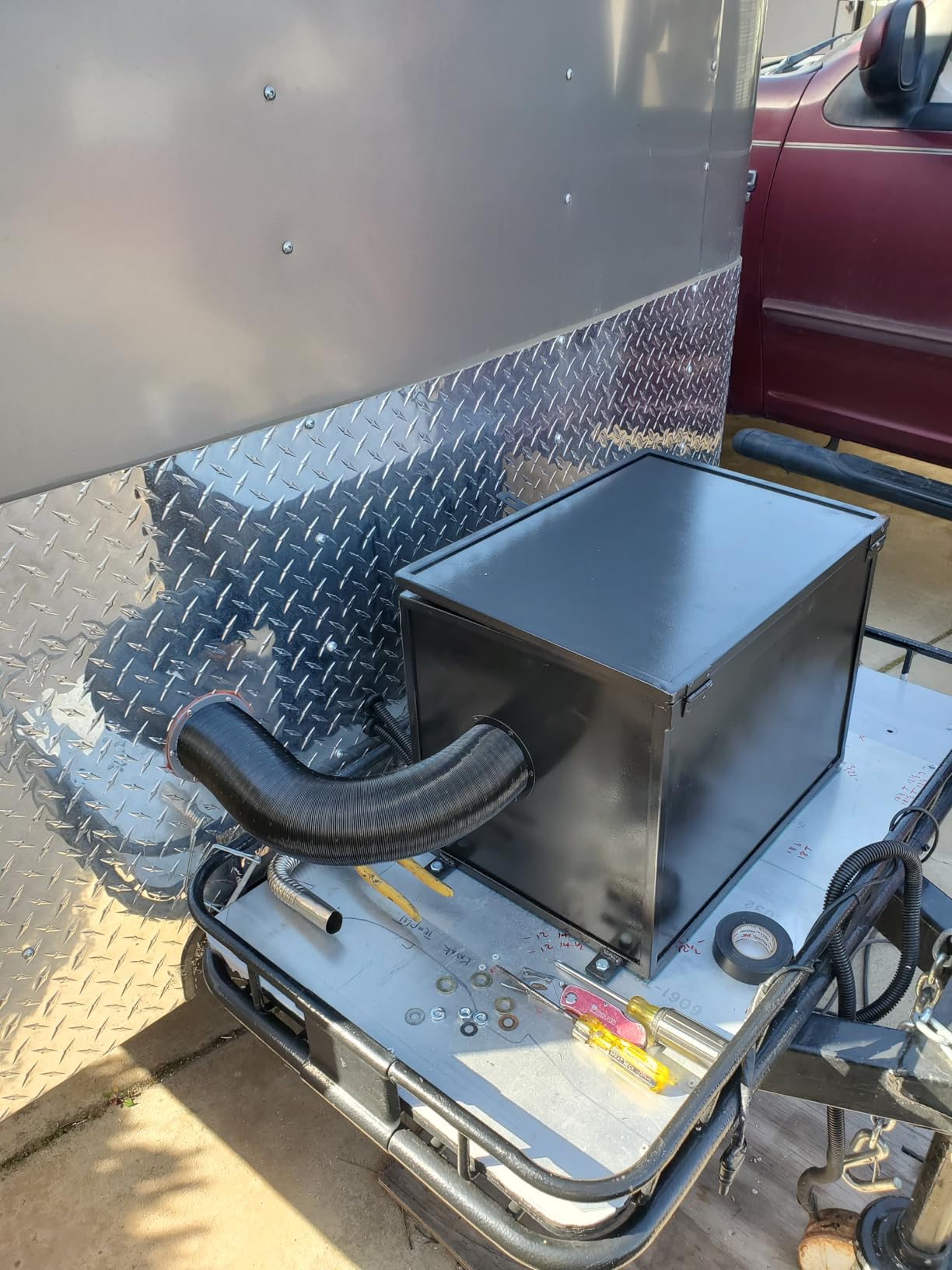
What plateau mode actually buys you?
Thin air changes combustion. A fixed fuel pump delivers too much fuel for the oxygen available, so you get a lean, sooty burn, weak heat and a heat exchanger that carbon-builds fast. A dedicated high-altitude mode retunes the air and fuel mix, which is why the rated figure here is as high as it is.
For a winter trip through the Rockies or the Alps, this is the single most important feature on the list after CO safety. Owners who camp high consistently rate this model on that basis.
Two things to fix before you rely on it
The supplied exhaust joining piece does not fit properly and has to be replaced, which several mechanically inclined owners did themselves. That is a five-minute job if you are comfortable with it, and worth knowing before your first cold night.
Owners also report diesel odor in the hot-air output during startup, and a thermostat mode that never fully shuts off, dropping to 1.4KW rather than stopping. The draw stays high until setpoint is reached, so budget your power supply accordingly. The tank’s fuel window is also hard to read in low light.
8. BougeRV 5KW – Highest Rated and Quietest Running
BougeRV 5KW Diesel Heater, 5L All-in-One Portable Air Diesel Parking Heater
5KW, 5L tank
Warms 307 cu ft in about 8 minutes
0.18-0.53 L/h
11-27 hour runtime
Pros
- Highest rated at 4.4 out of 5
- Near-silent pump plus muffler
- Assembles in under 2 minutes
- Reliable app control
- Hot enough for tents and garages
Cons
- Exhaust is small and soots up
- External control panel is not weatherproof
- Threaded exhaust is fiddly to assemble
- Fuel window reads high when new
This heater carries the highest average rating in the group at 4.4 out of 5, and the reviews are unusually specific about why. The quiet drivetrain comes from a mute filter oil pump combined with a muffler, which removes the fuel pump tick that owners complain about most in enclosed vans.
It also warms 307 cubic feet in about 8 minutes, with a 5L tank giving 11 to 27 hours of runtime at 0.18 to 0.53 L/h. Owners report it hot enough to take the chill off an uninsulated garage or a dog kennel, not just a camper interior.
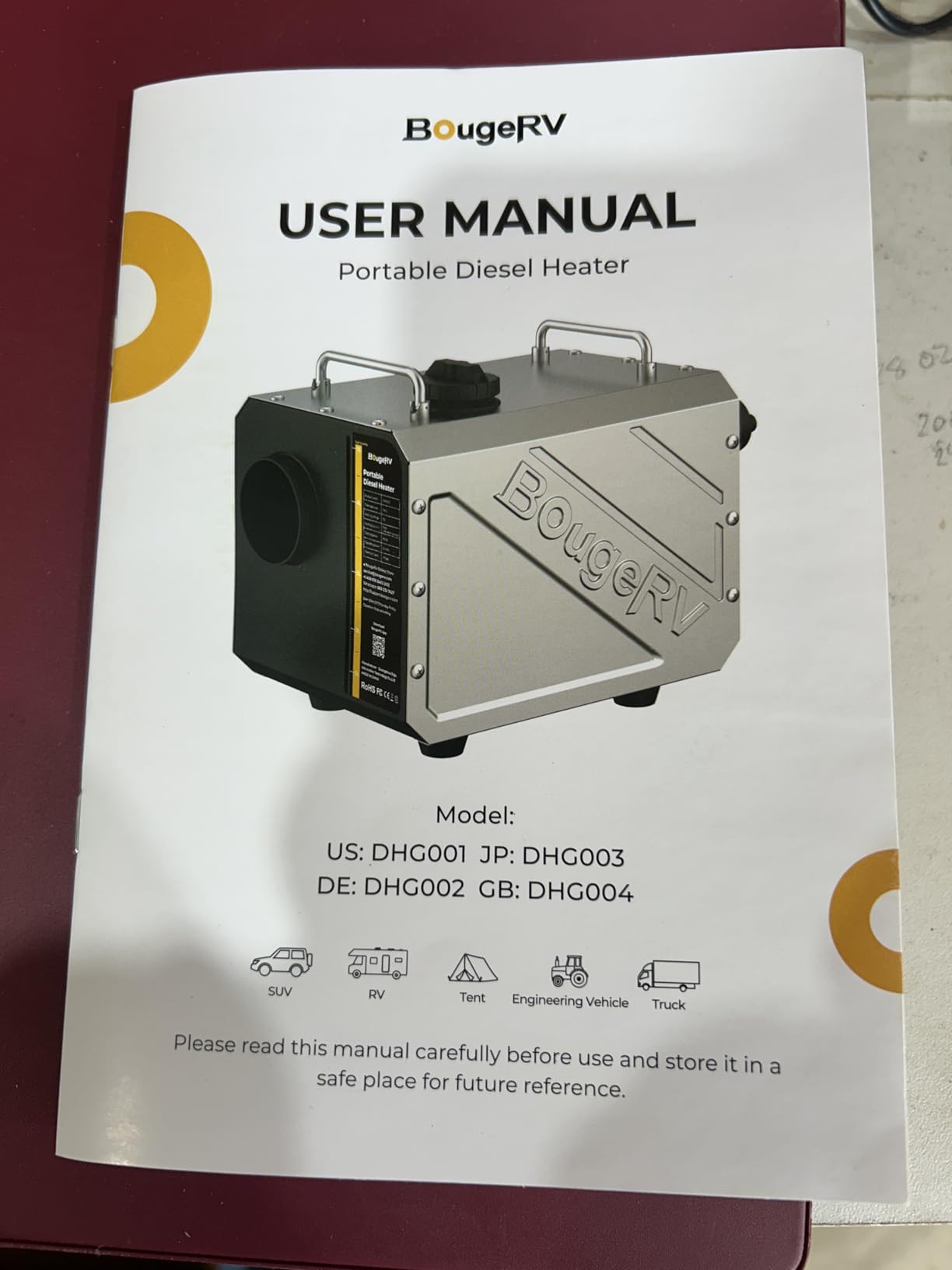
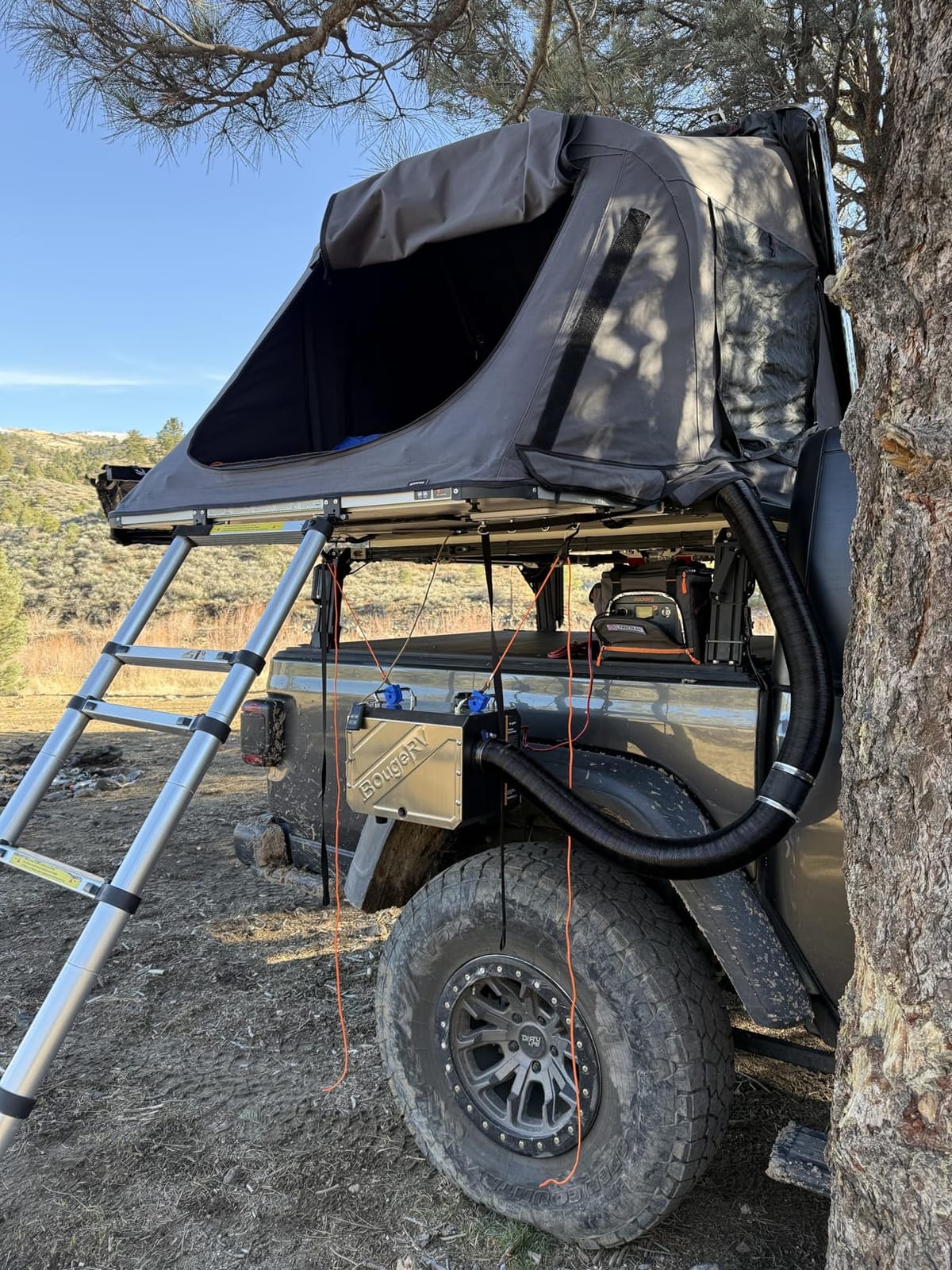
Setup is quick. It assembles in under two minutes with a secure threaded exhaust pipe and a 3.XT60 quick-release power connector, and it is compatible with a cigarette lighter socket, direct positive and negative wire, and adapters. App control handles preheat and timer settings and pairs reliably.
Protection covers overheat, voltage and short circuit, and there is a foldable handle for moving it between the van and the workshop. Owners running it off a 100Ah battery report no difficulty, and customer service has resolved issues with replacements.
Best pick for a tent, garage or kennel
Because 307 cubic feet covers a workshop or a garage bay, this is the model we would reach for if the heat needs to be intermittent and spread across a larger space rather than held steadily in a small van. Owners confirm it is hot enough to be useful in uninsulated spaces.
The dual noise reduction matters most when the heater sits inside the space you are trying to sleep in. A mute filter oil pump plus muffler is a more thorough approach than a muffler alone, and owners consistently describe the result as near-silent.
The exhaust issue you must plan around
The single serious thread in these reviews is the exhaust. It is undersized, soots up quickly, and if it is neglected diesel fumes can come back through the hot air vent into the space you are heating. That is a safety item, not a maintenance nuisance, and it applies to any diesel heater installed indoors.
Plan periodic exhaust cleaning into your schedule, and route the discharge away from the intake. The external control panel also protrudes and is not weatherproof for storage, and the fuel sight window can read as partly full on a new tank.
9. HCALORY 8KW 120V and 24V – Best for Dual Household and Vehicle Power
12V Diesel Air Heater, Portable Diesel Heater with App Control, 10-Temperature Settings, 28% Boost in Burning Efficiency, Auto Start-Stop, and 120V AC 24V DC, for Car, RV, Campers, 2025 Upgraded
8KW with 28 percent efficiency boost
120V AC and 24V DC
Coverage up to 256 sq ft
Dual altitude to 16400 ft
Pros
- Only heater here with 120V AC plus 24V DC
- Ten temperature settings with 1-10 fine adjustment
- Auto start-stop cycles at set temperature
- Extension cable moves the panel indoors
- Ran a full night in -20F for some owners
Cons
- Panel can read heater temp not room temp
- Auto stop overshoots by 6-7 degrees
- Some measured closer to 5KW than 8KW
- Quality control variance
- Bluetooth needed a replacement on one
The distinguishing feature here is input flexibility. This is the only model in our set that accepts 120V AC household power alongside 24V DC vehicle power in the same box, and it also runs on 12V. For anyone moving between a garage circuit and a truck, that removes the transformer step entirely.
The latest aluminum body upgrade claims a 28 percent boost in burning efficiency, and the unit covers up to 256 square feet, reaching 122F in about 3.5 minutes. Dual high-altitude mode is rated to 16,400 ft with automatic air-fuel ratio optimization.
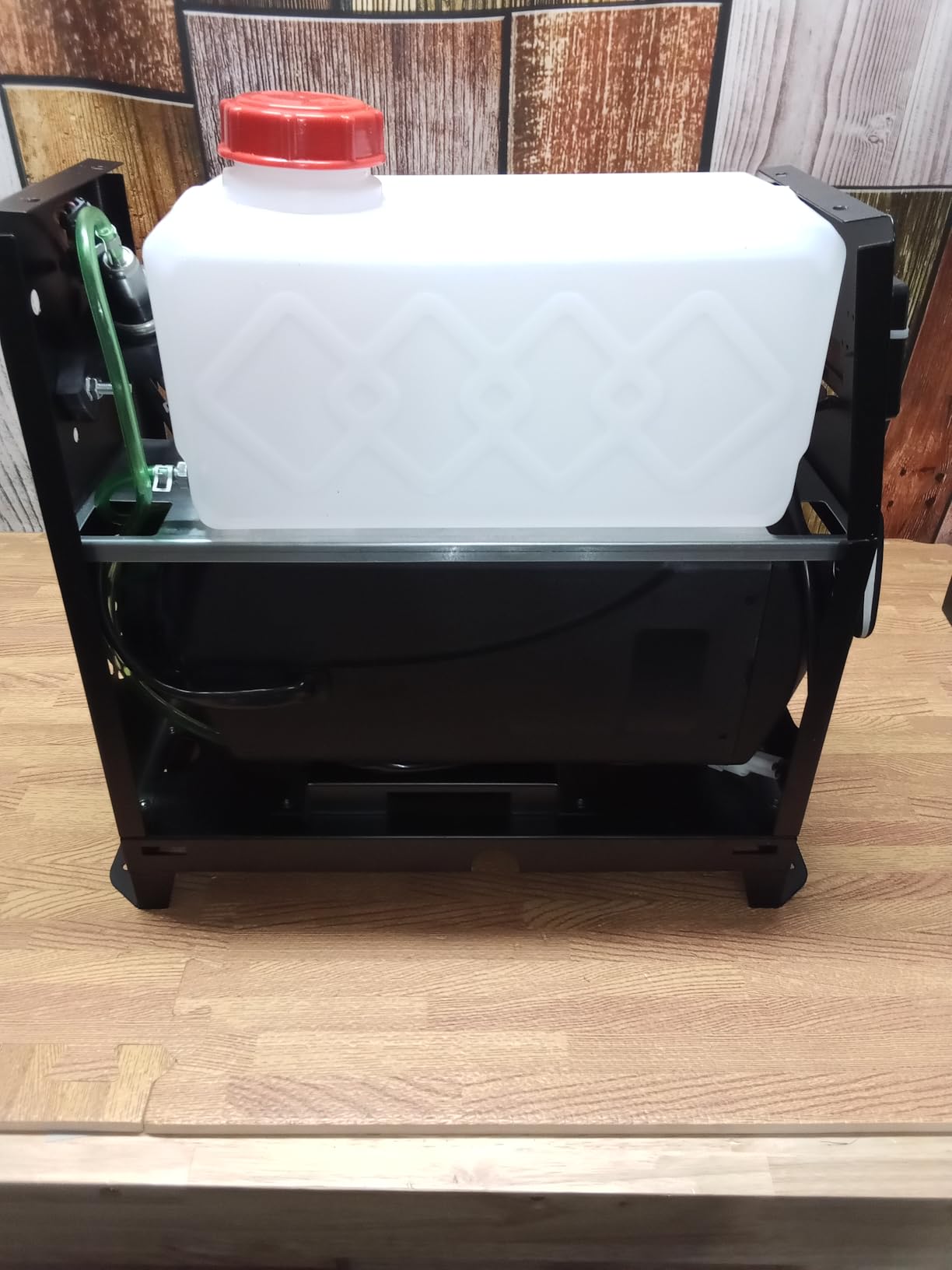
Control is where this model puts its effort. The app offers ten temperature settings with 1 to 10 fine adjustment, timer programs, live monitoring and adjustable fan modes, and auto start-stop cycles the burner once the set temperature is reached. Overheat, short-circuit, reverse connection and over-voltage protection are all covered.
Owners report some running a full night on one tank in -20F conditions. The box includes a power supply, a direct battery cable and an extension cable, so it works out of the box on either input.
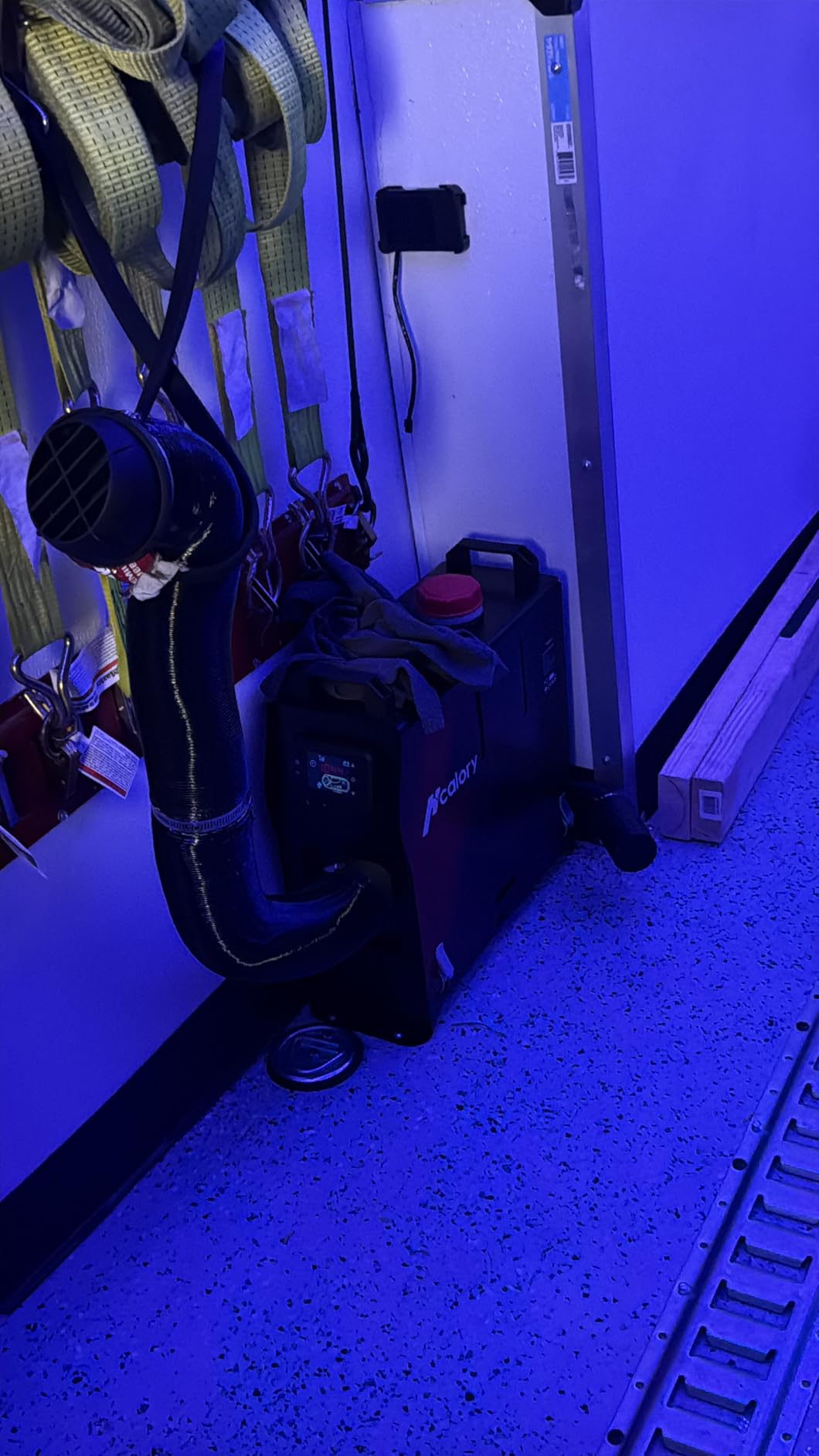
When 120V plus 24V is worth more than extra output?
If your heat demand alternates between a vehicle and a building, a heater that accepts both means one purchase instead of two and no transformer to store. The extension cable adds a 5 ft run so the control panel can sit indoors, which is how you get real room-temperature control instead of a thermostat reading the heater.
Auto start-stop is also a genuine feature here rather than a marketing line, and owners find it works well once the panel is moved away from the unit.
Where the extra controls fall short?
The control panel can read the heater’s own temperature if it is mounted close to the unit, which defeats the thermostat. Use the extension cable. The auto start-stop cycle also overshoots the set temperature by roughly 6 to 7 degrees in both directions, so expect swing rather than a steady hold.
Quality control is uneven on early production. Some owners measured output closer to 5kW than the advertised 8kW, and reports include a bad glow plug, a pinched fuel line, a Bluetooth controller that needed replacing and one unit that smoked heavily on startup. Treat the 8kW figure as a class rating rather than a measured value.
10. BSMTEK 8KW 9L Tank – Widest Voltage Support and 24-Hour Runtime
9L Large Diesel Heater, 8KW 240V/110V/12V/24V All in One Diesel Air Heater with LCD Switch, Remote Control, Suitable for Truck, RV, Home, Car, Campers, Boat, Orange
8KW, 12V rated
9L tank, up to 24 hours
0.16-0.62 L/h
Works from -45F to 109F
Pros
- 240V 110V 12V and 24V in one unit
- 9L tank gives up to 24 hours of heat
- Quiet running with an inaudible fuel pump
- Ten heat settings for dialing output down
- Upgraded fuel cap with added rubber seal
Cons
- Supplied power supply failed on one
- Output felt cooler than other 8KW models
- Screen is basic beyond on and off
- One early burner failure left black soot
The 9L tank gives this model up to 24 hours of continuous heating on a single fill. With fuel consumption listed at 0.16 to 0.62 L/h, that is a heater you can leave running through a long cold stretch without thinking about fuel. The 7.5L toolbox model elsewhere in this guide stretches further on one fill, but only at minimum setting.
Voltage support is the widest here: 240V, 110V, 12V and 24V, with an included adapter for household outlets. That makes it usable off a normal wall circuit in a workshop, which is unusual at 8kW.
Owners describe it as very quiet once at operating temperature, with an inaudible fuel pump, and ten heat settings let you reduce output for efficiency rather than running full blast. The working range of -45F to 109F covers the widest span of any model in the set.
The upgraded internal-thread fuel cap with an added rubber sealing ring improves spill resistance, and the muffler, air filter, air outlet pipe and converter are all included in the box.
Where the capacity and voltage range pay off?
Long unattended runs are the clear use. A boat cabin, a bus, a market stall or a workshop where refilling is inconvenient all benefit from a 9L tank and 24 hours of runtime, and the four-voltage support means the same box works in a home, a shop or a vehicle.
On fuel economy, the low end of the 0.16 L/h range is competitive, and the ten heat settings give finer control than most rivals expose, which lets you hold a temperature without cycling at full output.
What to watch for?
The feedback here is thin at 52 reviews, and the negative notes concentrate on accessories rather than heating. One owner had a supplied power supply fail after about 15 minutes, and another unit failed after roughly two weeks and filled the space with black soot, which is a combustion failure worth watching for early in ownership.
Owners also report output temperature felt lower than other 8kW heaters, and the screen interface is not worth exploring beyond on and off. The exhaust runs very hot and must be routed away from the air intake.
Diesel Heater Buying Guide: Sizing, Power and Fuel Planning
Once you have the feature framework, the remaining decisions are arithmetic. Three numbers decide almost everything: the output class, the fuel burn rate, and the startup draw.
Sizing. A useful working rule is roughly 1kW per 14 cubic meters in a house, with van interiors needing proportionally less because the volume is small. Most van owners describe 2kW as ample and 5kW as unnecessary for an average conversion. A 5kW unit stopped making sense in our reading only when a truck camper needed to hold temperature through a freezing night or a workshop needed to heat a bay. The jump from 5kW to 8kW matters mostly for open or uninsulated spaces, where heat escapes before it accumulates.
Power. Size your battery for startup, not running. The glow plug draws a heavy surge before combustion catches, so a heater that idles at 3 amps can still pull 10 to 15 amps at the moment it fires. That is why the 5kW model in this group lists a 15A supply, and why small power stations with 10A 12V ports fail overnight. A separate auxiliary battery is the cleanest answer and keeps your starter battery out of it entirely.
Fuel and cold. Diesel gelling is a real winter failure mode, not a theoretical one. Fuel that has not already gelled is the fix: use No. 1 diesel or a winter-grade blend in sustained cold, keep the tank reasonably full, and add an anti-gel additive if you store fuel through a long freeze. Owners also report that keeping the tank inside the heated space prevents gelling but means carrying fuel through a living space, which is a trade-off you should make deliberately.
Carbon buildup. The most repeated maintenance tip from owners is to run the heater on high for about 10 minutes before shutting down, which burns off accumulated soot. The other half is to avoid very short runs, which is the condition that creates carbon in the first place.
First 30 minutes. Prime the fuel line until you see fuel at the pump inlet. Expect visible smoke and a burning smell on the first start, which is normal and settles. Run it for a full 30 minutes and confirm the exhaust is hot end to end. Check that the exhaust and combustion air intake are routed outside the space and separated from each other. Mount any remote or thermostat sensor outside the heater case so thermostat mode and any built-in CO sensing actually engage.
If your heat need is a fixed building rather than a vehicle, our guides to garage heaters and radiant heaters cover the permanently installed options, and patio heaters cover outdoor heat where fuel logistics are not the constraint.
Frequently Asked Questions
What diesel heater puts out the most heat?
Among the heaters in this guide, the 8KW models put out the most heat, with several of them listing coverage between 215 and 269 square feet. The 5KW and 2kW models deliver 215 to 269 square feet and 307 cubic feet respectively. Bigger is not automatically better: an oversized heater in a small van cycles on and off, wastes fuel and builds carbon faster on the heat exchanger.
Is a 2kW diesel heater enough?
For most van conversions, truck caps, hunting blinds and ice fishing shelters, yes. Owners on campervan forums consistently describe 2kW as ample for an average conversion and 5kW as unnecessary. A 2kW unit draws less power and burns less fuel, typically 0.16 to 0.24 L/h, which makes it easier to run from a single auxiliary battery over a weekend.
Is there a difference between a 5kW and an 8kW diesel heater?
Yes. A 5kW heater is sized for an enclosed space such as a van, truck camper or small workshop, while an 8kW unit reaches useful temperatures in open or uninsulated areas like a garage, a boat cabin or a tent. The 5kW class also draws less power at start, which matters more for battery life than the headline output does.
What is the best diesel heater for high altitudes?
The heater with automatic altitude compensation is the right choice, and the published rated elevation is what you should compare. Models in this guide carry published ratings ranging from 16,400 ft up to 18,045 ft. Without compensation, thin air above roughly 1,500 meters causes incomplete combustion, weak output, heavy carbon buildup and eventually shutdown.
Do diesel heaters need ventilation?
Yes, always. The combustion process generates carbon monoxide, so the exhaust must be routed completely outside the space you occupy and the combustion air intake drawn from a separate opening. Keep the exhaust and intake separated, run the exhaust pipe with a continuous downward slope, and never trim the supplied pipe. Clean the exhaust regularly, since a soot-clogged exhaust can allow fumes back through the hot air vent.
Conclusion
The diesel heater features to look for are the same three every time, in this order: carbon monoxide protection with a sealed exhaust, a startup draw your power source can actually deliver, and automatic altitude compensation if you travel above 1,500 meters. Everything from Bluetooth apps to voice prompts is a convenience layered on top of those.
Our pick is the VEVOR 8KW All-in-One, with the largest review base in the category and a feature set that covers safety, fuel range and remote preheat without a pairing step. If your trips are above 1,500 meters, the app-controlled VEVOR 8KW with altitude compensation to 18,045 ft is the stronger buy. For a battery-limited small van, the 2kW model burns roughly 0.16 to 0.24 L/h against 0.18 to 0.36 L/h for our pick.
Work out your output class, size the battery for the surge rather than the run, and route that exhaust outside before you buy anything. That is a short evening of planning that prevents nearly every complaint we read in six weeks of owner feedback.