
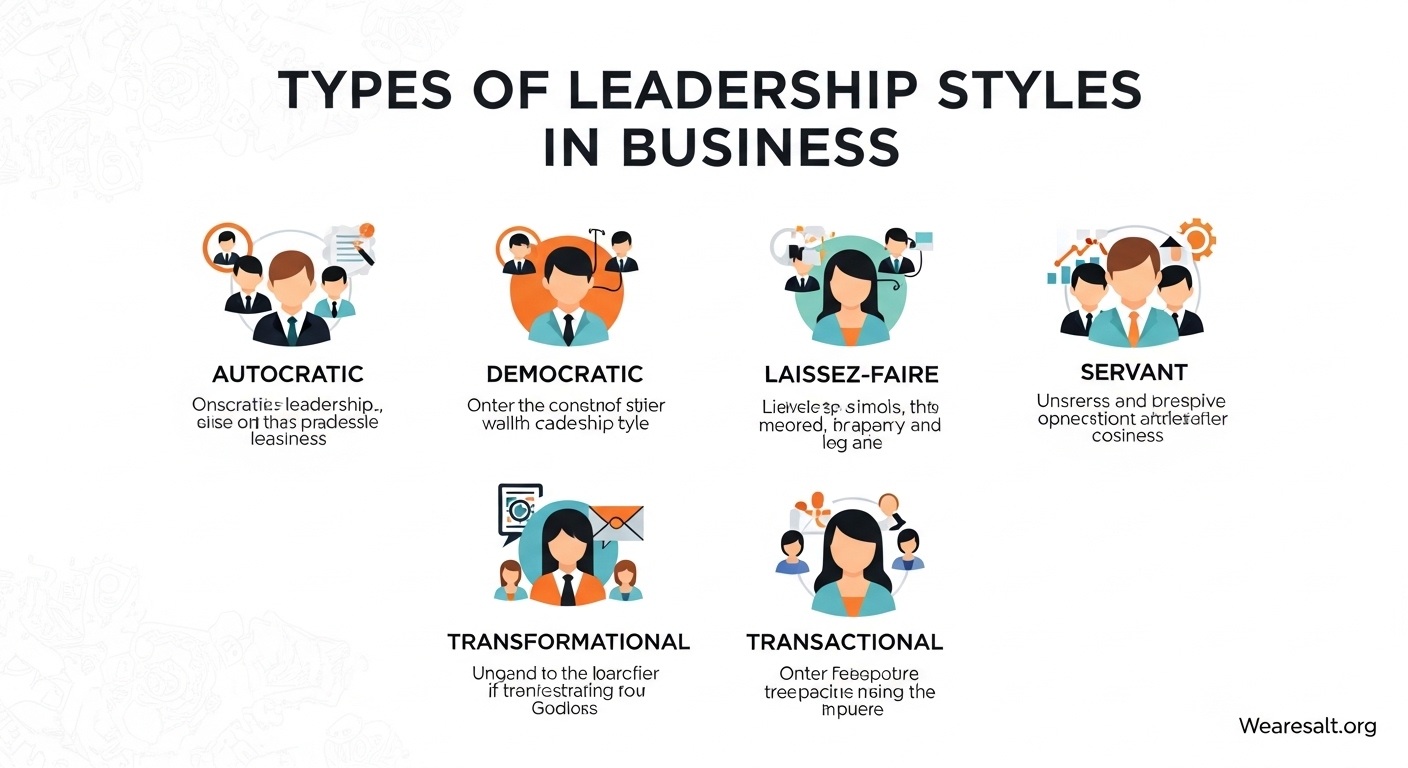
Understanding the different types of leadership styles in business is essential for anyone who manages people or aspires to lead. I have spent over a decade studying how leadership approaches impact team performance, employee satisfaction, and organizational success. The style you choose affects everything from daily decision-making to long-term strategic direction.
There is no single “best” leadership style that works in every situation. Effective leaders recognize that different contexts demand different approaches. A crisis might require direct control, while creative projects thrive with autonomy.
In this guide, I will walk you through eight distinct leadership styles used in business today. You will learn the characteristics of each approach, when to apply them, and how to identify your natural leadership tendencies.
Table of Contents
What Is a Leadership Style?
A leadership style refers to the specific behaviors, methods, and approaches a leader uses to guide, motivate, and manage their team members. It encompasses how you make decisions, communicate with employees, handle conflicts, and drive results.
Your leadership style develops through a combination of personality traits, past experiences, organizational culture, and training. Some leaders naturally gravitate toward collaboration while others prefer clear authority structures.
The most successful leaders do not rigidly stick to one style. They develop what researchers call “situational flexibility” — the ability to adapt their approach based on team maturity, project complexity, and organizational needs. This adaptability separates good managers from exceptional leaders.
Leadership Styles Comparison Overview
Before diving into each style individually, here is a quick comparison of all eight leadership approaches. This summary helps you understand the fundamental differences at a glance.
| Leadership Style | Decision-Making | Key Characteristics | Best For |
|---|---|---|---|
| Autocratic | Leader makes all decisions | Direct control, clear hierarchy, fast execution | Crisis situations, urgent deadlines |
| Democratic | Team input before decisions | Collaboration, shared ownership, participation | Complex problem-solving, team buy-in |
| Laissez-Faire | Minimal leader involvement | Autonomy, trust, hands-off approach | Expert teams, creative projects |
| Transformational | Vision-driven decisions | Inspiration, innovation, change focus | Organizational change, growth phases |
| Transactional | Reward/punishment based | Clear expectations, structured systems, performance focus | Routine operations, sales teams |
| Bureaucratic | Rule-based decisions | Procedures, compliance, standardization | Regulated industries, safety-critical work |
| Servant | Team needs prioritized | Empathy, development, putting others first | Team building, employee development |
| Coaching | Development-focused | Mentoring, growth mindset, skill building | Skill development, long-term potential |
Autocratic Leadership: Direct Control for Critical Decisions
Autocratic leadership centers on individual control over all decisions with minimal input from team members. The leader maintains clear authority and expects compliance with their directives.
This approach works best in crisis situations where quick decisions are essential. Military operations, emergency response teams, and manufacturing safety protocols often rely on autocratic leadership. The style eliminates ambiguity and ensures rapid execution.
Steve Jobs was known for his autocratic tendencies at Apple, particularly during product development cycles. He made final decisions on design elements without committee approval. This approach enabled Apple to maintain a cohesive vision and move quickly in competitive markets.
The advantages include fast decision-making, clear chain of command, and consistent direction. However, autocratic leadership can stifle creativity, reduce employee engagement, and create dependency on the leader. Teams may become demotivated if they feel their input does not matter.
Democratic Leadership: Collaborative Decision-Making
Democratic leadership, also called participative leadership, involves team members in the decision-making process. The leader retains final authority but actively seeks input, feedback, and ideas from the group.
This style builds strong team commitment and generates more creative solutions. When people contribute to decisions, they feel ownership of the outcomes. Google has long used democratic leadership principles, encouraging engineers to spend time on passion projects and contribute ideas to product development.
The democratic approach works especially well when solving complex problems that require diverse expertise. It is effective in knowledge work environments where team members possess specialized skills the leader may not have.
On the downside, democratic leadership slows down decision-making. Not all decisions benefit from group input, and some team members may dominate discussions while quieter voices go unheard. Leaders must balance inclusion with efficiency.
Laissez-Faire Leadership: Hands-Off Empowerment
Laissez-faire leadership provides maximum autonomy to team members with minimal interference from the leader. This delegative approach assumes employees are capable of managing their own work and making appropriate decisions.
The style shines when leading highly skilled, self-motivated experts. Research and development teams, creative agencies, and academic research groups often thrive under laissez-faire leadership. When team members have more expertise than the leader in specific areas, excessive oversight becomes counterproductive.
Warren Buffett exemplifies laissez-faire leadership in his management of Berkshire Hathaway subsidiaries. He acquires companies with strong management teams and gives them complete operational independence. This approach has built one of the most successful conglomerates in business history.
The risks include lack of coordination, unclear direction, and potential accountability gaps. Without sufficient structure, some team members may struggle with priorities or deadlines. This style fails when team members lack experience or motivation.
Transformational Leadership: Inspiring Change and Innovation
Transformational leadership focuses on inspiring team members to exceed expectations and embrace change. These leaders create a compelling vision of the future and motivate people to achieve extraordinary results.
The style emphasizes four key components: idealized influence (acting as a role model), inspirational motivation (articulating a clear vision), intellectual stimulation (encouraging innovation), and individualized consideration (coaching each team member). Together, these elements create high-performing, engaged teams.
Satya Nadella demonstrated transformational leadership when he became CEO of Microsoft in 2014. He shifted the company culture from internal competition to collaborative growth, embracing cloud computing and open source. Under his leadership, Microsoft regained its position as a technology leader.
Transformational leadership excels during organizational change, growth phases, and competitive disruption. The approach builds strong organizational culture and long-term commitment. However, it requires significant emotional energy from the leader and may overlook operational details in pursuit of big-picture goals.
Transactional Leadership: Structured Rewards and Consequences
Transactional leadership operates on a clear system of rewards, punishments, and exchanges between leader and follower. The leader clarifies expectations and team members receive specific outcomes based on their performance.
This approach resembles a traditional management contract: employees understand exactly what they need to deliver and what they will receive in return. Sales organizations frequently use transactional leadership, with clear commission structures and performance bonuses tied to specific targets.
The style produces predictable results in stable environments with well-defined processes. It eliminates ambiguity about expectations and provides immediate feedback on performance. Teams often appreciate the clarity transactional leadership provides.
However, this approach can limit innovation and intrinsic motivation. When people work only for external rewards, they may stop improving once targets are met. Transactional leadership works poorly in creative fields where output cannot be easily measured or standardized.
Bureaucratic Leadership: Rule-Based Management
Bureaucratic leadership emphasizes following established rules, procedures, and hierarchies. The leader ensures compliance with organizational standards and maintains consistent processes across all operations.
This style dominates in highly regulated industries like healthcare, aviation, finance, and government. When safety, compliance, or quality standards are critical, bureaucratic leadership ensures nothing falls through the cracks. Every process has documentation, every decision has precedent.
Bureaucratic leadership creates fairness through consistency. Everyone follows the same rules, reducing favoritism or arbitrary decisions. The approach scales well across large organizations and creates institutional knowledge that survives personnel changes.
The limitations include slow adaptation to change, reduced innovation, and employee frustration with rigid procedures. When circumstances require flexibility, bureaucratic leaders may struggle to respond appropriately. Excessive focus on rules can overshadow business outcomes.
Servant Leadership: Putting Team Needs First
Servant leadership inverts the traditional power pyramid. Instead of the team serving the leader, the leader serves the team — focusing on their growth, well-being, and success as the primary goal.
Robert K. Greenleaf coined the term in 1970, describing leaders who “serve first” rather than “lead first.” These leaders prioritize listening, empathy, healing relationships, awareness, persuasion, conceptual thinking, foresight, stewardship, commitment to people, and building community.
Howard Schultz built Starbucks using servant leadership principles. He provided comprehensive benefits to part-time workers, created stock ownership programs, and focused on employee development. This approach created legendary customer service and remarkable employee loyalty in an industry known for high turnover.
Servant leadership builds deep trust and long-term commitment. Team members feel genuinely valued beyond their output. The approach requires patience, as results may take longer than command-and-control methods. Some critics argue servant leaders struggle to make difficult decisions that hurt individuals for organizational benefit.
Coaching Leadership: Developing Individual Potential
Coaching leadership, sometimes called authoritative leadership in business contexts, focuses on developing each team member’s long-term potential. The leader acts as a mentor, providing guidance, feedback, and opportunities for growth.
This style resembles a sports coach more than a traditional boss. The leader identifies individual strengths and weaknesses, creates development plans, and provides regular constructive feedback. Success is measured not just by current output but by team members’ growth over time.
Coaching leadership works particularly well in professional services firms, educational institutions, and organizations investing in succession planning. When retaining talent matters more than immediate results, this approach builds deep bench strength.
The approach demands significant time investment from leaders. Not all managers have coaching skills, and some team members resist feedback or development efforts. Coaching leadership fails when immediate crisis management takes priority over long-term growth.
How to Identify Your Leadership Style
Recognizing your natural leadership tendencies is the first step toward becoming more effective. Many new managers struggle to articulate their style in interviews or performance reviews. Self-awareness helps you leverage strengths and address blind spots.
Start by reflecting on past situations. How do you typically make decisions? Do you gather consensus quickly or analyze independently? How do you handle conflict? What feedback have you received from team members about your management approach?
Several validated assessment tools can provide objective insights. CliftonStrengths (formerly StrengthsFinder) identifies your natural talents and how they influence your leadership approach. The VIA Character Strengths survey reveals your core values and how they shape decision-making. Many business schools also use the Leadership Practices Inventory or DISC assessments.
Ask for specific feedback from colleagues, supervisors, and direct reports. Ask what you do well as a leader and where you could improve. Pay attention to patterns in the responses rather than isolated comments.
Most leaders discover they naturally gravitate toward one or two styles but can develop others with practice. The goal is not to change your personality but to expand your toolkit of leadership approaches.
Choosing the Right Leadership Style for Each Situation
Situational leadership theory suggests effective leaders adapt their style based on context. The same approach that works for experienced engineers will fail with new hires. What succeeds during stable operations will collapse during crisis.
Consider four factors when selecting your approach. First, assess team maturity — experienced professionals need less direction than novices. Second, evaluate task complexity — routine work requires different management than innovation projects. Third, consider time constraints — urgent deadlines may force autocratic decisions. Fourth, match organizational culture — some companies expect consensus while others reward decisive action.
The best leaders develop what I call “leadership agility.” They maintain their core values and personality while flexing their behavioral approach. This does not mean being inauthentic; it means recognizing that different situations require different responses.
Practice shifting styles deliberately. If you are naturally democratic, try making a few decisions autocratically to build that muscle. If you default to laissez-faire, experiment with more structured check-ins. Over time, these shifts become natural and automatic.
Frequently Asked Questions About Leadership Styles in Business
What are the four types of leadership styles?
The four foundational leadership styles are autocratic (leader makes all decisions), democratic (team input is sought), laissez-faire (hands-off approach with maximum autonomy), and transformational (inspiring change through vision). These represent the classic framework first established in leadership research and provide a baseline for understanding more specialized approaches.
What are the 7 main leadership styles?
The seven main leadership styles include autocratic, democratic, laissez-faire, transformational, transactional, servant, and bureaucratic leadership. Each approach offers different advantages depending on team composition, organizational culture, and situational requirements. Many business schools and leadership programs use this expanded framework.
What leadership style is most effective?
No single leadership style is universally most effective. The best approach depends on your team, organizational context, and specific situation. Research consistently shows that leaders who can adapt their style situationally outperform those who rigidly apply one approach. Democratic and transformational leadership often produce the highest employee engagement, while autocratic leadership works best in crisis situations.
How do I identify my leadership style?
Identify your leadership style through self-reflection on past decisions, validated assessment tools like CliftonStrengths or VIA Character Strengths, and gathering feedback from colleagues and team members. Notice patterns in how you make decisions, handle conflict, and motivate others. Most people naturally gravitate toward one or two styles but can develop others with intentional practice.
Can a leader use multiple leadership styles?
Yes, effective leaders regularly use multiple leadership styles and adapt their approach based on the situation. This flexibility, called situational leadership, allows you to apply autocratic direction during emergencies while using democratic collaboration for strategic planning. Developing style flexibility takes practice but significantly improves leadership effectiveness across diverse contexts.
What leadership style works best for startups?
Startups typically benefit most from transformational and democratic leadership styles. Transformational leadership helps small teams embrace ambitious visions and rapid change, while democratic approaches leverage the diverse expertise common in early-stage companies. As startups scale, founders often need to incorporate more structured approaches like transactional or bureaucratic leadership to maintain operational consistency.
How do leadership styles affect employee engagement?
Leadership style significantly impacts employee engagement. Transformational and servant leadership typically produce the highest engagement levels by connecting work to meaning and demonstrating genuine care for team members. Autocratic leadership generally produces lower engagement except in crisis contexts where clarity provides security. Democratic leadership builds engagement through ownership, while laissez-faire approaches only work with highly self-motivated employees.
Conclusion: Developing Your Leadership Skills for 2026 and Beyond
Understanding the types of leadership styles in business gives you a framework for growth and adaptation. Whether you naturally gravitate toward autocratic directness or servant empathy, awareness of different approaches expands your effectiveness.
I have seen leaders transform their careers by deliberately developing styles outside their comfort zone. The democratic leader who learns to make autocratic decisions in crisis situations. The transactional manager who develops coaching skills to retain top talent.
Start by identifying your current style using the assessment approaches outlined in this guide. Then experiment with different approaches in low-stakes situations. Pay attention to how your team responds. Over time, you will develop the situational flexibility that distinguishes exceptional leaders from adequate managers.
The business world of 2026 demands leaders who can navigate complexity, inspire diverse teams, and adapt quickly to change. Your leadership style is not a limitation but a foundation — one you can build upon throughout your career.