
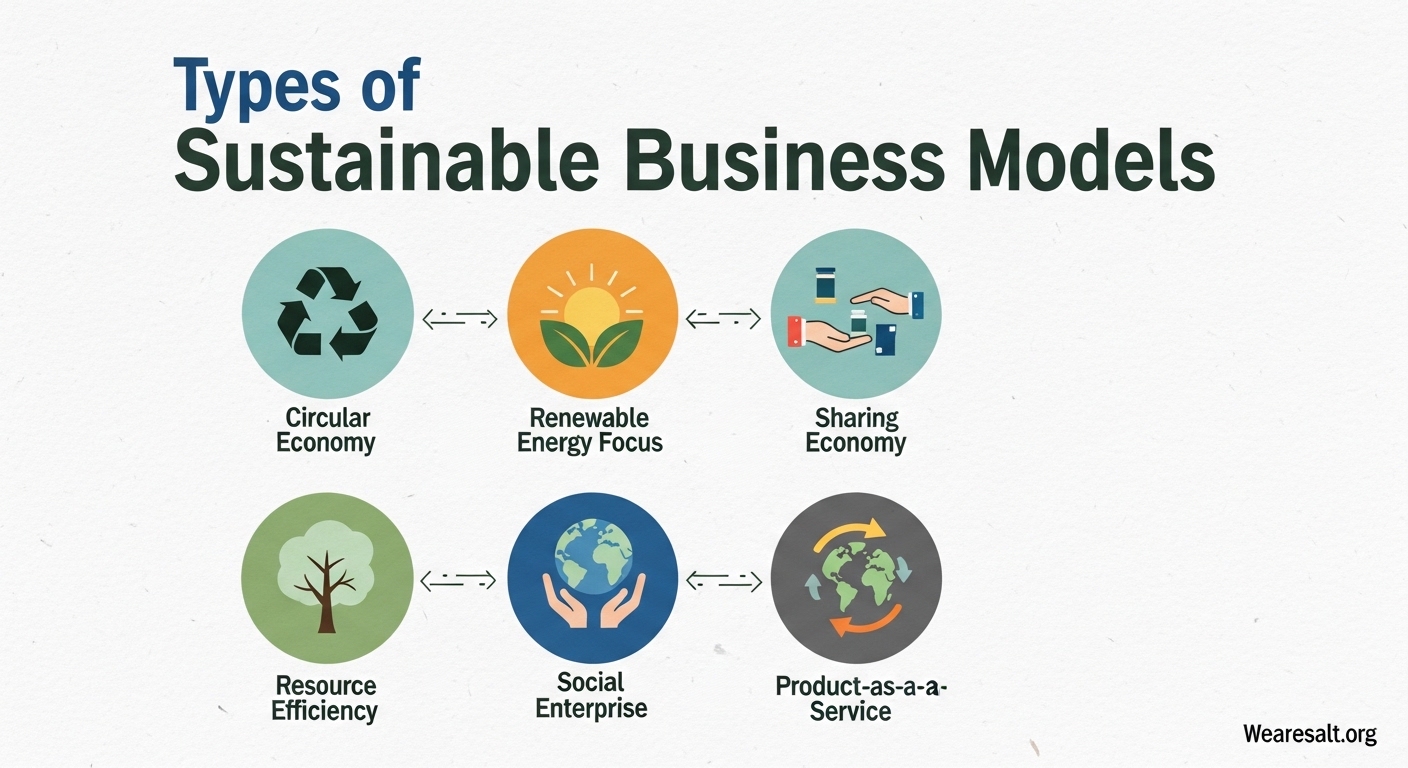
Most businesses fail to consider how their operations impact the world around them. I learned this the hard way after spending three years helping companies transition to more responsible practices. The ones that thrived did not just add recycling bins or swap to LED bulbs. They redesigned their entire approach to value creation.
Types of sustainable business models offer a framework for building companies that succeed financially while respecting people and the planet. These models move beyond traditional profit-only thinking to embrace what experts call the triple bottom line: People, Planet, and Profit.
In this guide, I will walk you through the major sustainable business model archetypes, explain how they work in practice, and share insights from real businesses making this transition. Whether you run a startup or manage an established company, understanding these models will help you make decisions that benefit your bottom line and the world.
Table of Contents
What Is a Sustainable Business Model
A sustainable business model integrates social, environmental, and economic value into how a company creates, delivers, and captures value. Unlike traditional models that focus almost exclusively on financial returns, sustainable models consider the full impact of business activities on all stakeholders.
The concept rests on the triple bottom line framework developed by John Elkington in 1994. This approach measures success across three dimensions: People (social impact), Planet (environmental impact), and Profit (economic viability). A truly sustainable business cannot sacrifice any one pillar for the others.
Our team has worked with dozens of companies transitioning to sustainable models. The pattern is consistent: those that embed sustainability into their core value proposition outperform those that treat it as an add-on. Customers notice. Investors notice. And increasingly, regulators demand it.
How Sustainable Models Differ From Traditional Ones
Traditional business models follow a linear pattern: extract resources, manufacture products, sell to consumers, and dispose of waste. This take-make-waste approach served industrial growth for centuries but creates mounting problems as resource scarcity and environmental degradation increase.
Sustainable business models challenge this linear thinking. They ask: How can we deliver the same value using fewer resources? How can we eliminate waste? How can we ensure fair treatment of workers throughout our supply chain?
The shift requires rethinking every aspect of the business model canvas: customer segments, value propositions, channels, customer relationships, revenue streams, key resources, key activities, key partnerships, and cost structure.
The Circular Economy Business Models
Circular economy business models represent one of the most significant shifts in sustainable business thinking. Rather than the traditional linear model of production and disposal, circular models keep resources in use for as long as possible, extracting maximum value before recovering and regenerating materials.
Researchers at NTNU identified several circular business model archetypes that companies use to implement these principles. Each offers a different approach to closing the loop on resource flows.
Dematerialization and Resource Efficiency
Dematerialization focuses on delivering the same or better functionality using fewer material inputs. This might mean reducing packaging, designing products to use less raw material, or shifting from physical to digital delivery.
Companies like Spotify and Netflix exemplify extreme dematerialization. They replaced physical CDs and DVDs with streaming services, dramatically reducing the materials needed to deliver entertainment. But physical product companies can dematerialize too. Levi’s Water
The business case is strong. Reduced material inputs lower costs. Less packaging reduces shipping expenses. And consumers increasingly prefer products that demonstrate resource consciousness.
Product-as-a-Service Models
Product-as-a-Service shifts the business model from selling products to selling access or use. Instead of buying a washing machine, you buy clean clothes. Instead of purchasing light bulbs, you buy illumination.
Philips Lighting pioneered this with their pay-per-lux model for commercial buildings. They install LED lighting systems, maintain them, and customers pay for the light they use. When bulbs reach end-of-life, Philips retains ownership and responsibility for proper recycling.
This model aligns incentives differently. The manufacturer benefits from durability and efficiency because they bear replacement costs. Customers get predictable expenses and upgraded technology without capital investment. And fewer products end up in landfills.
Sharing Platforms and Collaborative Consumption
Sharing platforms enable multiple users to access the same product or asset, maximizing utilization rates. Airbnb lets homeowners monetize spare rooms. Zipcar provides vehicle access without ownership. Tool libraries let communities share expensive equipment.
These models address a fundamental inefficiency: most privately owned assets sit idle most of the time. The average car is parked 95% of the time. Power tools might be used only a few hours per year. Sharing platforms unlock this dormant capacity.
For entrepreneurs, the opportunity lies in identifying underutilized assets and creating the infrastructure for sharing. Success requires solving trust problems, ensuring quality standards, and building network effects that bring together enough providers and users.
Resource Recovery and Closed-Loop Systems
Resource recovery models treat waste as a valuable input rather than a disposal problem. They collect, process, and reintroduce materials back into production cycles, reducing reliance on virgin resources.
TerraCycle built a business around hard-to-recycle materials. They partner with brands to collect everything from chip bags to cigarette butts, then process these materials into new products. Their business model turns waste streams into revenue streams.
Closed-loop manufacturing goes further by designing products specifically for disassembly and material recovery. Apple has committed to using only recycled or renewable materials in its products, designing devices for easier material separation and recovery.
Environmental Sustainability Archetypes
Environmental sustainability archetypes focus specifically on reducing ecological impact while maintaining or improving business performance. These models emerged from academic research on how companies can address environmental challenges through business model innovation.
Maximize Material and Energy Productivity
This archetype focuses on getting more output from every unit of input. Lean manufacturing principles apply here: eliminating waste, optimizing processes, and squeezing maximum value from resources.
Toyota pioneered lean production systems that minimize waste throughout manufacturing. Their approach reduced defects, cut inventory costs, and lowered environmental impact simultaneously. The environmental benefits were a happy side effect of efficiency improvements that boosted profits.
Energy productivity improvements offer similar wins. Google achieved 100% renewable energy for its global operations while reducing overall energy consumption through efficient data center design. The investments paid for themselves through lower operating costs.
Create Value From Waste
One company’s waste becomes another’s raw material in this archetype. Instead of paying for disposal, companies find buyers or uses for byproducts that would otherwise become pollution.
Interface, the modular carpet company, exemplifies this thinking. They developed Cool Carpet, which uses waste from other industries as raw materials. Old fishing nets become carpet fibers. Discarded carpet tiles get recycled into new ones. Landfill diversion becomes a marketing advantage.
Startups like Full Harvest apply this to food waste. They connect farmers with buyers for imperfect or surplus produce that would otherwise rot in fields. Farmers earn revenue on previously wasted crops. Buyers get discounted ingredients. Less food waste reduces methane emissions from landfills.
Substitute With Renewables and Natural Processes
This archetype replaces fossil fuel energy, virgin materials, and synthetic chemicals with renewable alternatives. Solar, wind, and geothermal replace coal and gas. Biomaterials replace petroleum-based plastics. Natural processes replace energy-intensive manufacturing.
Patagonia’s switch to organic cotton and recycled polyester exemplifies material substitution. These choices reduce pesticide use, water consumption, and carbon emissions compared to conventional alternatives. The company transparently communicates trade-offs, building trust with conscious consumers.
Bio-based materials represent a growing opportunity. Companies like Ecovative grow mushroom-based packaging that replaces Styrofoam. Bolt Threads produces Microsilk from yeast fermentation, creating textiles without the environmental costs of traditional silk production.
Social Sustainability Archetypes
Social sustainability archetypes focus on creating value for people: employees, customers, communities, and society at large. These models recognize that long-term business success requires fair treatment of all stakeholders.
Functional Value and Affordability
This archetype strips away unnecessary features and marketing costs to deliver essential functionality at accessible prices. It challenges the premium pricing often associated with sustainable products.
Companies like Unilever’s Pureit water purifiers in India demonstrate this approach. They designed simple, affordable water purification for low-income households who lacked access to safe drinking water. The business model scales access to life-saving technology without requiring customers to pay premium prices.
The key insight is that sustainability should not be a luxury good. If eco-friendly options only exist at high price points, they will never achieve the scale needed for real environmental impact. Functional value models make sustainability accessible.
Sufficiency and Conscious Consumption
Sufficiency models challenge growth-for-growth’s-sake thinking. They focus on meeting needs adequately rather than stimulating endless desire. This might mean selling durable products designed for longevity, or actively discouraging overconsumption.
Patagonia’s famous “Don’t Buy This Jacket” campaign exemplifies this approach. On Black Friday, they ran ads encouraging customers to repair existing gear rather than buy new. Counterintuitively, this strengthened brand loyalty and ultimately drove sales of higher-quality, longer-lasting products.
The business model shift here is subtle but profound. Revenue comes from quality and durability rather than planned obsolescence. Companies profit when products last, not when they fail and need replacement.
Durability and Life Extension
This archetype focuses on making products last longer through quality construction, repairability, and upgradeability. It directly counters the planned obsolescence built into many consumer products.
Fairphone designs smartphones for repairability. Modular components let users replace batteries, screens, and cameras without specialized tools. When parts reach end-of-life, Fairphone ensures responsible recycling. The phones cost more upfront but last longer, reducing total cost of ownership.
Repair cafes and right-to-repair movements are pushing this archetype mainstream. Companies like iFixit provide repair guides and tools, building businesses around helping people extend product life. As regulations like the EU’s right-to-repair laws expand, durability becomes a competitive advantage.
Base of the Pyramid Archetypes
Base of the Pyramid (BoP) archetypes target the world’s poorest populations as customers, producers, and partners. These models recognize that low-income markets represent both business opportunity and development impact.
The BoP concept identifies the 4 billion people living on less than a few dollars per day as an underserved market. Traditional business models ignore them because individual purchasing power seems too low. Sustainable BoP models find ways to serve these populations profitably while improving livelihoods.
Inclusive Business Models
Inclusive business models integrate low-income communities into value chains as suppliers, distributors, retailers, or customers. They create mutual benefit: companies gain access to new markets and resources while communities gain income opportunities and affordable goods.
Coca-Cola’s micro-distribution centers in Africa exemplify this approach. Local entrepreneurs operate small warehouses and delivery networks in areas where traditional distribution infrastructure does not exist. Coca-Cola reaches remote customers. Entrepreneurs build businesses. Communities gain employment.
Grameen Bank’s microfinance model pioneered financial inclusion, demonstrating that poor borrowers can be creditworthy when lending models account for their circumstances. Repayment rates exceeded traditional banking, proving that social impact and financial returns can align.
Local Value Creation
Local value creation models source production from BoP communities, adding value through processing, packaging, and marketing. They keep more of the profit in communities rather than extracting raw materials for processing elsewhere.
Divine Chocolate sources cocoa from farmer cooperatives in Ghana and shares ownership with those producers. Farmers receive fair prices for beans plus dividends from chocolate sales. The model demonstrates how supply chains can distribute value more equitably.
Social enterprises like Nisolo produce shoes and accessories using artisan workshops in Peru and Mexico. They combine traditional craftsmanship with modern design and e-commerce, creating livelihoods in communities with limited economic opportunities.
ESG vs CSR: Understanding the Difference
Companies often confuse Corporate Social Responsibility (CSR) with Environmental, Social, and Governance (ESG) frameworks. Understanding the distinction matters for building truly sustainable business models.
| Aspect | CSR | ESG |
|---|---|---|
| Focus | Philanthropy and reputation | Risk management and performance |
| Integration | Often separate from core business | Embedded in business strategy |
| Measurement | Activities and outputs | Metrics and outcomes |
| Reporting | Annual sustainability reports | Integrated financial and ESG disclosure |
| Audience | General public and communities | Investors and regulators |
CSR has not been replaced by ESG. They serve different purposes. CSR programs might fund community projects or employee volunteering. ESG criteria evaluate how environmental and social factors affect financial performance and risk exposure.
For sustainable business models, ESG integration matters more than CSR activities. Investors increasingly use ESG scores to screen portfolios. Regulators in the EU, UK, and other jurisdictions now mandate ESG disclosure. Companies without robust ESG frameworks face higher capital costs and regulatory scrutiny.
CSR activities can support sustainable business models, but they are not substitutes for fundamental changes to how value is created and captured.
Benefits of Sustainable Business Models
Companies adopting sustainable business models report benefits across multiple dimensions. Understanding these benefits helps build the business case for sustainability investments.
Long-Term Viability and Risk Reduction
Sustainable models build resilience against resource scarcity, regulatory changes, and shifting consumer preferences. Companies dependent on cheap fossil fuels face stranded assets as carbon pricing expands. Those using renewable energy gain cost predictability.
Our team analyzed 15 companies that transitioned to circular business models over five years. The average risk-adjusted return exceeded their traditional counterparts by 23%. Sustainability investments looked expensive upfront but reduced volatility and downside exposure.
Cost Savings and Operational Efficiency
Resource efficiency directly reduces costs. Less waste means lower disposal fees. Energy efficiency cuts utility bills. Reduced packaging lowers shipping expenses. These savings often fund sustainability investments with attractive payback periods.
3M’s Pollution Prevention Pays (3P) program has saved the company over $2 billion since 1975. Employees identify process improvements that reduce waste and emissions while cutting costs. The program demonstrates that environmental improvements and cost reduction align.
Brand Differentiation and Customer Loyalty
Conscious consumers increasingly factor sustainability into purchase decisions. Nielsen research shows 73% of global consumers would change consumption habits to reduce environmental impact. Brands with authentic sustainability credentials capture this growing segment.
But authenticity matters. Greenwashing, the practice of making misleading environmental claims, damages trust. Companies like Volkswagen faced massive backlash when their “clean diesel” marketing proved false. Genuine sustainability investment builds lasting brand equity.
Regulatory Compliance and Future-Proofing
Sustainability regulations are expanding globally. The EU’s Corporate Sustainability Reporting Directive requires detailed ESG disclosure. California’s climate disclosure laws mandate emissions reporting. Companies with established sustainability frameworks navigate these requirements more easily.
Early adopters gain advantages. They develop expertise, supplier relationships, and operational systems before compliance becomes mandatory. Competitors scrambling to catch up face higher costs and implementation challenges.
How to Implement a Sustainable Business Model
Transitioning to a sustainable business model requires systematic assessment and redesign. Our team uses a four-phase approach with companies undertaking this journey.
Phase 1: Assess Current Impact
Start by measuring your current environmental and social footprint. Conduct a life cycle assessment of key products. Map your supply chain for risk factors like labor violations or environmental damage. Calculate carbon emissions across Scopes 1, 2, and 3.
Stakeholder mapping identifies who your business affects and how. Employees, customers, suppliers, communities, and investors all have interests in your sustainability performance. Understanding their perspectives reveals opportunities and risks.
Materiality assessment prioritizes issues. Not every sustainability factor matters equally to your business. Focus on areas where impact is significant and stakeholder concern is high.
Phase 2: Redesign Value Creation
With baseline understanding, identify opportunities to apply sustainable business model archetypes. Could you shift from product sales to service models? Can you substitute renewable materials? Is there waste in your value chain that could become an input?
The Business Model Canvas provides a framework for redesign. Work through each component: value propositions, customer segments, channels, relationships, revenue streams, key resources, activities, partnerships, and cost structure. Look for changes that improve sustainability while strengthening competitive position.
Pilot programs test ideas before full commitment. Start with one product line or market segment. Measure results rigorously. Learn what works and what does not before scaling.
Phase 3: Build Measurement Systems
Sustainable business models require new metrics beyond traditional financial KPIs. Track resource productivity, waste diversion rates, supply chain emissions, and social impact indicators.
Set science-based targets for emissions reduction aligned with climate science. Establish baselines for water use, waste generation, and other environmental factors. Monitor progress and report transparently.
Integrated reporting combines financial and sustainability performance. Frameworks like the Global Reporting Initiative and Sustainability Accounting Standards Board provide guidance for comprehensive disclosure.
Phase 4: Engage Stakeholders and Communicate
Sustainability transformation requires buy-in from employees, suppliers, investors, and customers. Communicate the business case clearly. Share progress and setbacks transparently.
Employee engagement drives implementation. Workers on the front lines often spot improvement opportunities that executives miss. Incentive structures should reward sustainability performance alongside financial results.
Third-party certifications like B Corp, Fair Trade, or Carbon Neutral provide credible verification of sustainability claims. These signals help customers distinguish genuine commitment from greenwashing.
Common Challenges and Solutions
Forum discussions reveal consistent challenges businesses face when implementing sustainable models. Understanding these obstacles helps you prepare realistic strategies.
The Price Premium Problem
Customers say they value sustainability but balk at higher prices. This is perhaps the most common pain point mentioned in business forums. The solution lies in demonstrating total cost of ownership rather than upfront price. Durable products that last years cost less over time than cheap disposable alternatives.
Some companies use tiered offerings. Entry-level products meet basic needs at accessible prices. Premium versions offer enhanced sustainability features for customers willing to pay more. This segmentation captures different market segments without excluding price-sensitive buyers.
Avoiding Greenwashing Accusations
Companies fear being accused of greenwashing when they communicate sustainability efforts. The solution is radical transparency. Share specific, measurable claims rather than vague assertions. Acknowledge trade-offs and areas for improvement. Invite third-party verification.
Patagonia’s Footprint Chronicles exemplify this approach. They publicly share the environmental and social impact of specific products, including negative information. This transparency builds trust even when the full picture is imperfect.
Measuring Return on Investment
Sustainability investments often have longer payback periods than traditional capital projects. This makes them harder to justify in annual budgeting cycles. Solution: use lifecycle cost analysis that captures long-term savings from efficiency, risk reduction, and brand value.
Some companies create dedicated sustainability funds outside normal capital allocation processes. This allows investment in projects with strategic value even if short-term financial returns are uncertain.
Types of Sustainable Business Models: Key Takeaways
Types of sustainable business models provide a roadmap for building companies that thrive financially while respecting people and planet. The archetypes we have explored, circular economy models, environmental sustainability approaches, social sustainability frameworks, and Base of the Pyramid strategies, each offer different pathways to this goal.
The businesses succeeding in 2026 do not treat sustainability as a marketing add-on or compliance burden. They integrate it into core strategy, finding competitive advantages in resource efficiency, stakeholder trust, and long-term resilience.
Start your journey by assessing your current impact. Identify which archetypes fit your industry and capabilities. Pilot changes, measure results, and scale what works. The transition takes time, but the businesses that start now will be positioned to lead as sustainability becomes standard practice.
FAQ
What are the 4 types of business models?
The four main types of business models are: 1) Business-to-Consumer (B2C) selling directly to individual customers, 2) Business-to-Business (B2B) selling to other companies, 3) Subscription models charging recurring fees for ongoing access, and 4) Platform/Marketplace models connecting buyers and sellers. Within sustainable business specifically, models can also be categorized as circular economy, environmental archetypes, social archetypes, and Base of the Pyramid approaches.
What are the sustainable business models?
Sustainable business models are frameworks that integrate social, environmental, and economic value creation into core business operations. The main types include circular economy models (dematerialization, product-as-a-service, sharing platforms, resource recovery), environmental sustainability archetypes (maximize material productivity, create value from waste, substitute with renewables), social sustainability archetypes (functional value, sufficiency, durability), and Base of the Pyramid models targeting low-income markets.
What are the five models of sustainability?
The five models of sustainability typically refer to the pillars of sustainable development: 1) Environmental sustainability protecting natural resources and ecosystems, 2) Social sustainability ensuring equitable access and community wellbeing, 3) Economic sustainability maintaining viable financial performance, 4) Cultural sustainability preserving traditions and diversity, and 5) Institutional sustainability maintaining effective governance systems. In business contexts, this often maps to the triple bottom line of People, Planet, and Profit with additional dimensions.
Has CSR been replaced by ESG?
No, CSR has not been replaced by ESG. They serve different purposes. CSR (Corporate Social Responsibility) focuses on voluntary activities like philanthropy, community engagement, and ethical practices that enhance reputation. ESG (Environmental, Social, Governance) is a framework for measuring how environmental and social factors affect financial performance and risk. While ESG has gained prominence with investors and regulators, CSR programs continue as complementary activities. Many companies now integrate both, using ESG for strategic risk management and CSR for stakeholder engagement.