
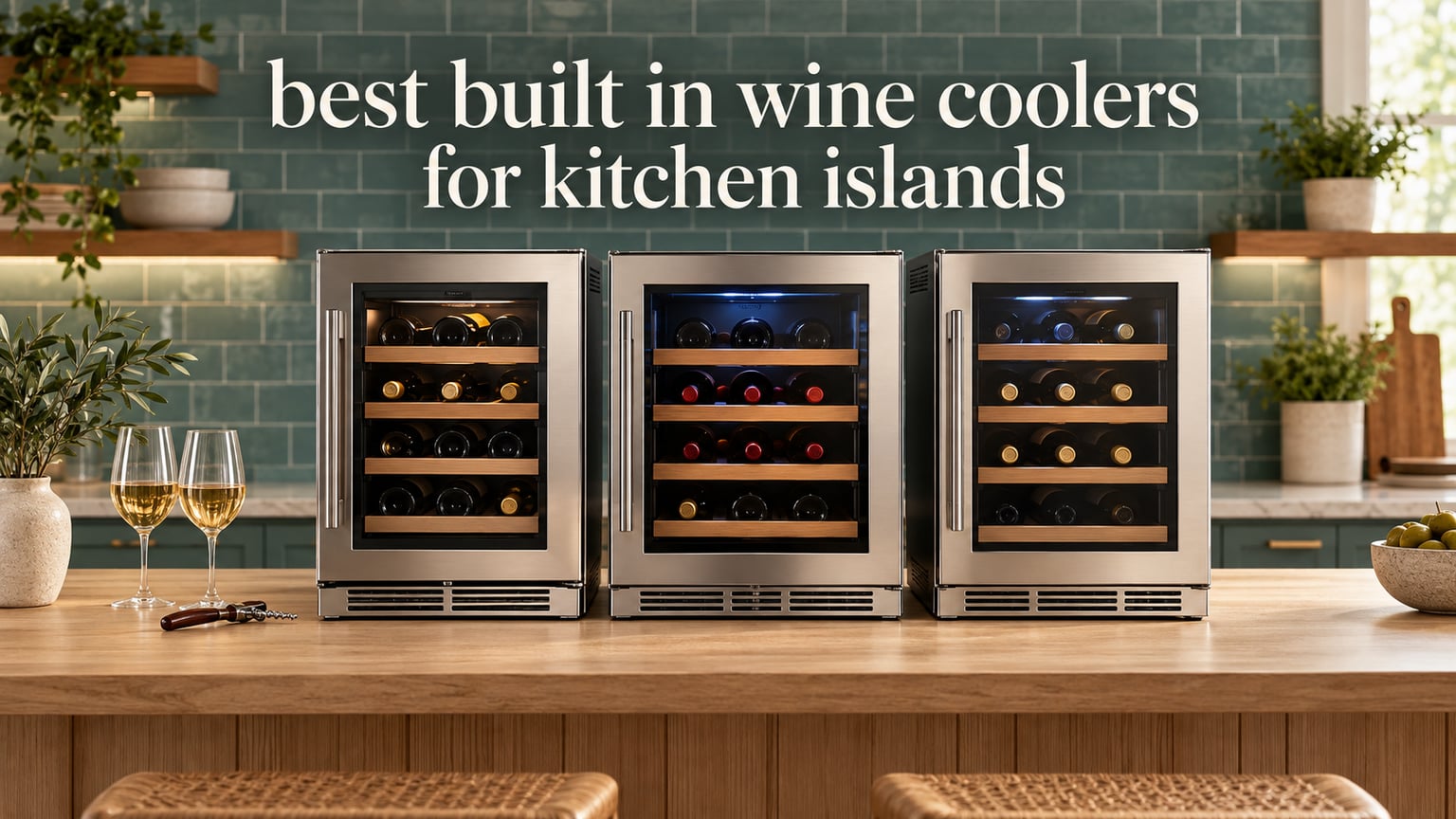
The short answer: the Tylza 15-inch 30-bottle dual-zone cooler is the best built in wine cooler for most kitchen islands, the Velieta 12-inch is the one to buy when the cabinet opening is tight, and the ORYMUSE 15-inch is the pick if you want the simplest single-zone install. All three are front-vented and rated for built-in or under-counter placement, which is the single most important thing to check before you commit to anything.
A built-in wine cooler is an undercounter wine refrigerator engineered to sit inside kitchen cabinetry. It has a defined cutout size, front ventilation instead of vents hidden behind the unit, and a compressor that runs quietly and without the vibration that shakes sediment out of an aging bottle. That is a different appliance from a freestanding wine fridge with the same capacity on paper, and the difference decides whether the compressor survives five years or fifteen.
A kitchen island is the hardest place in the house to put one. There is no wall behind the cabinet for airflow, no open side to dissipate heat, and an outlet that often has to be added before the countertop is templated. If you are planning the island itself, start with our kitchen island guide before you finalize cabinet widths, then come back here for the appliance. We compared the twelve units below on the specs that decide island fit: cutout footprint, ventilation type, zone layout, noise, weight, warranty, and how owners describe the fit after living with them.
Everything in this guide was last checked for 2026. The page is a working reference for homeowners, designers, and the cabinetmaker who has to cut the opening.
Top 3 Best Built-In Wine Coolers for Kitchen Islands in 2026
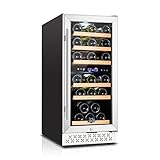
Tylza 15 Inch 30 Bottle Dual Zone
- 30 bottles in 3.6 cu. ft.
- Dual zone 40-55F and 55-65F
- Front-ready built-in or freestanding
- Double-glazed door with air filter
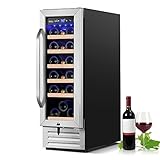
Velieta 12 Inch 18 Bottle
- 12-inch width for narrow cabinets
- Front ventilation
- 41-72F range
- 2-year warranty

ORYMUSE 15 Inch 30 Bottle
- 30 bottles in 3.1 cu. ft.
- About 38 dB compressor
- Front-venting built-in design
- Stainless frame with glass door
The Tylza earns the top spot because it combines the widest zone split in a 15-inch footprint with a review base big enough to trust. Six beech wood shelves, two independent zones, and a double-glazed door with a built-in air filter cover the two things island owners ask about most: keeping reds and whites apart and keeping heat out.
The Velieta 12-inch is the narrow-cabinet answer. At 11.61 inches wide it fits an opening most 15-inch units cannot, and its 1127 reviews are among the largest of any product here, which makes the quiet-operation and temperature-stability claims easy to verify.
The ORYMUSE is the straightforward single-zone install. Around 38 dB, a stainless frame, and front venting in a simpler package than the other two.
Best Built-In Wine Coolers for Kitchen Islands at a Glance in 2026
Best overall: Tylza 15-inch 30-bottle dual zone, 3.6 cu. ft., front-ready built-in or freestanding.
Best for a narrow cabinet opening: Velieta 12-inch, 11.61 inches wide, front-vented, 2-year warranty.
Best quiet operation: ORYMUSE 15-inch, measured at roughly 38 dB.
Best temperature control: BODEGA 15-inch, two zones adjustable from 41-72F in 1F steps.
Best warranty backup: Zephyr Brisas 15-inch, 5 years on the compressor and 2 on parts.
Best full-width opening: Velieta 30-inch dual-zone wine and beverage unit, 29 bottles plus 110 cans.
| Product | Specifications | Action |
|---|---|---|
| Tylza 15 Inch 30 Bottle Dual Zone Wine Cooler |
|
Check Latest Price |
| Velieta 12 Inch 18 Bottle Built-In Wine Cooler |
|
Check Latest Price |
| ORYMUSE 15 Inch 30 Bottle Built-In Wine Cooler |
|
Check Latest Price |
 BODEGA 15 Inch 30 Bottle Dual Zone Wine Cooler BODEGA 15 Inch 30 Bottle Dual Zone Wine Cooler |
|
Check Latest Price |
 Ca’Lefort 15 Inch 33 Bottle Wine Cooler Ca’Lefort 15 Inch 33 Bottle Wine Cooler |
|
Check Latest Price |
 Kalamera 24 Inch 37 Bottle Dual Zone Wine Cooler Kalamera 24 Inch 37 Bottle Dual Zone Wine Cooler |
|
Check Latest Price |
 Zephyr Brisas 15 Inch Slim Under Counter Wine Cooler Zephyr Brisas 15 Inch Slim Under Counter Wine Cooler |
|
Check Latest Price |
 NewAir 15 Inch Dual Zone 29 Bottle Wine Cooler NewAir 15 Inch Dual Zone 29 Bottle Wine Cooler |
|
Check Latest Price |
 Velieta 30 Inch Dual Zone Wine and Beverage Cooler Velieta 30 Inch Dual Zone Wine and Beverage Cooler |
|
Check Latest Price |
 FoMup 30 Inch Dual Zone Wine and Beverage Refrigerator FoMup 30 Inch Dual Zone Wine and Beverage Refrigerator |
|
Check Latest Price |
 Velivi 24 Inch Dual Zone Wine and Beverage Fridge Velivi 24 Inch Dual Zone Wine and Beverage Fridge |
|
Check Latest Price |
 Kalamera 24 Inch Single Zone Beverage and Wine Cooler Kalamera 24 Inch Single Zone Beverage and Wine Cooler |
|
Check Latest Price |
1. Tylza 15 Inch 30 Bottle Dual Zone Wine Cooler
Tylza Mini Fridge 15 Inch Wine Cooler Under Counter, 30 Bottles Dual Zone Wine Fridge with Safty Lock, Wine Refrigerator Freestanding, Built-in Wine Cellars
3.6 cu. ft.
30 bottles
40-55F and 55-65F zones
23.03D x 14.96W x 33.46H in
Pros
- Two zones hold reds and whites together
- 30 bottles on six beech wood shelves
- Adjustable feet suppress vibration
- Double-glazed door with built-in air filter
- Temperature memory after power loss
Cons
- Must stand upright 24 hours after delivery
- Zone ranges are fixed rather than fully independent setpoints
- Long list of colour variants makes the listing confusing
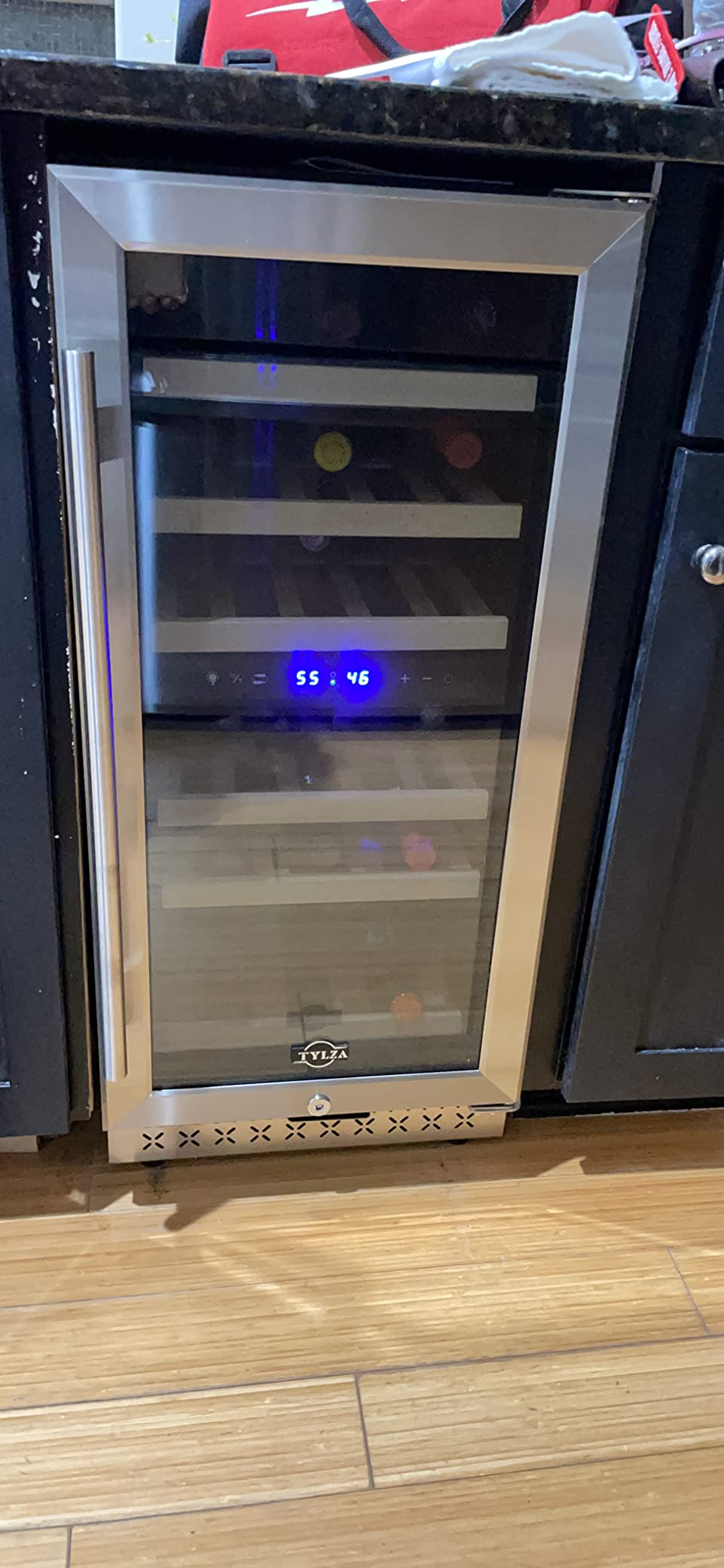
This is the unit I would put in my own island. It measures 23.03 inches deep by 14.96 wide by 33.46 tall, which sits neatly inside a standard 15-inch cabinet box, and the listing rates installation as built-in or freestanding. The upper zone holds 40-55F and the lower 55-65F, which is the split most collectors actually need: reds and fuller-bodied whites up top, sparkling and lighter whites below.
Six beech wood shelves carry up to 30 standard 750ml bottles, and they pull out so you can fit larger formats. Compressor cooling with adjustable cabinet feet handles vibration, which matters more in an island than in a pantry because the cabinet is freestanding and transmits movement straight into the floor.
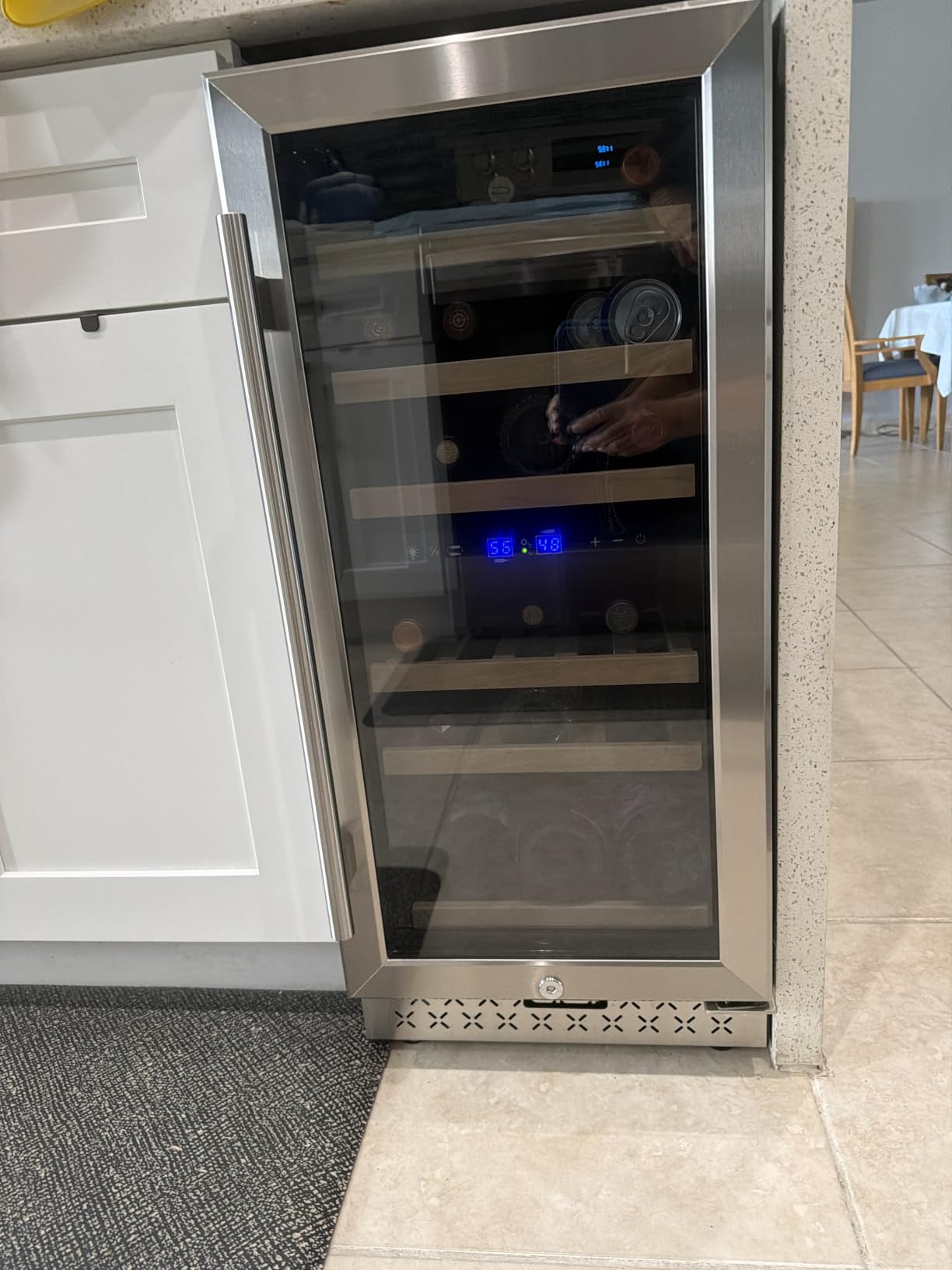
Reviews on this unit come back at 4.5 stars across 999 ratings, and the pattern is consistent. Owners talk about cooling strength first, then quiet operation, then value for a 30-bottle built-in appliance. The wood shelving and the two zones get named most often as the reasons they would buy again.
One of the details worth planning around: the door is glass over stainless steel, and there is a built-in air filter behind it. On an island where the cooler sits in plain view and near cooking, that filter matters more than it would in a closed pantry.
The temperature memory function is small but genuinely useful. In a kitchen where the island circuit gets switched off with the rest of the room overnight, the unit comes back to the setting it was holding rather than to a default.
What you need to know before it goes in the cutout
Depth is the number to watch. At 23.03 inches this needs a counter that leaves roughly an inch of clearance behind it, so measure the cabinet box from the face frame to the back wall rather than trusting the island’s overall depth.
The delivery note matters too. The manufacturer requires the unit to stand upright for 24 hours after transport before first use, so plan the install around a delivery date, not around the countertop templating date.
Where it fits and where it does not
This works in a 15-inch island cabinet with a standard 34-inch opening height, and it works in a 15-inch base cabinet against a wall if you leave the required ventilation gap.
It is the wrong choice if you need two genuinely independent setpoints, because the zone ranges are fixed bands rather than separately controlled targets. Anyone splitting a cellar between reds at 62F and whites at 54F with precise control should look at a unit with separate zone readouts.
2. Velieta 12 Inch 18 Bottle Built-In Wine Cooler
Velieta 12 Inch Wine Cooler Refrigerator,Mini Wine Fridge 18 Bottle Capacity,Built-in or Freestanding Professional Wine Chiller with Quiet and Stable Temperature Control Systems.
2.12 cu. ft.
11.61 in wide
Front vent
41-72F
22.63D x 11.61W x 34.25H in
Pros
- 12-inch width fits narrow island cabinets
- Front ventilation for true built-in install
- Whisper-quiet soundproofed compressor
- 41-72F range
- 2-year warranty
Cons
- Real capacity is well below the headline figure for wide-bodied wines
- Shelf spacing is tight for larger formats
- Display brightness can be distracting in a dark room
Island cabinets rarely come in 12-inch widths, which is exactly why this one solves a problem the 15-inch units cannot. At 11.61 inches wide and 22.63 deep, it fits openings that a standard 15-inch box would swallow by half an inch. That half inch is where a lot of island projects get stuck.
Front ventilation is stated in the listing, not implied, and the installation type is listed as built-in, under counter, or freestanding. The compressor is a rotary scroll running through a 41-72F range, which covers everything from sparkling service to a light red.
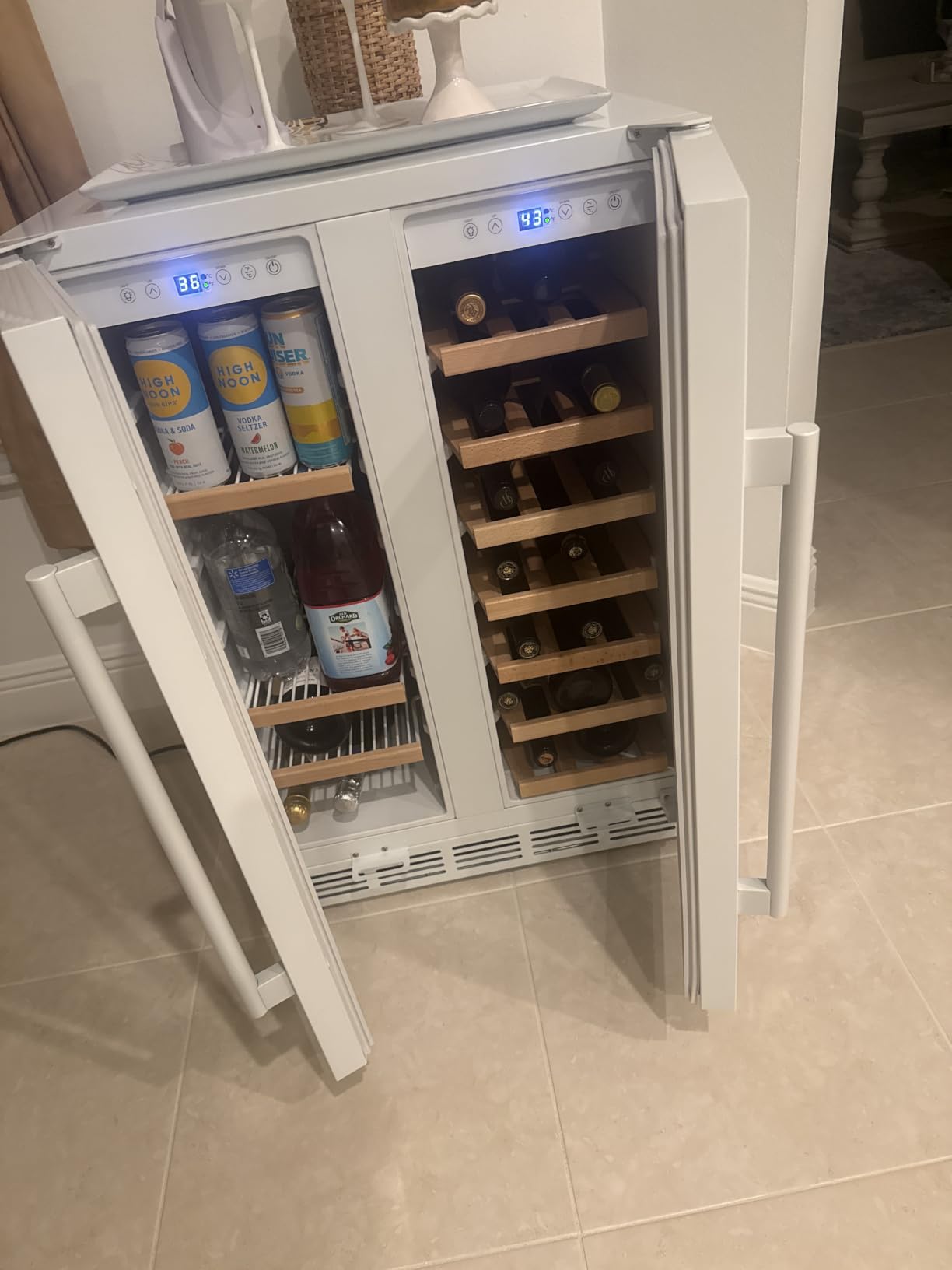
At 4.3 stars across 1127 ratings, this has the largest review base of anything in the guide, and it is worth knowing why that matters here. Large sample sizes are how we distinguish a genuinely stable compressor from a lucky first unit.
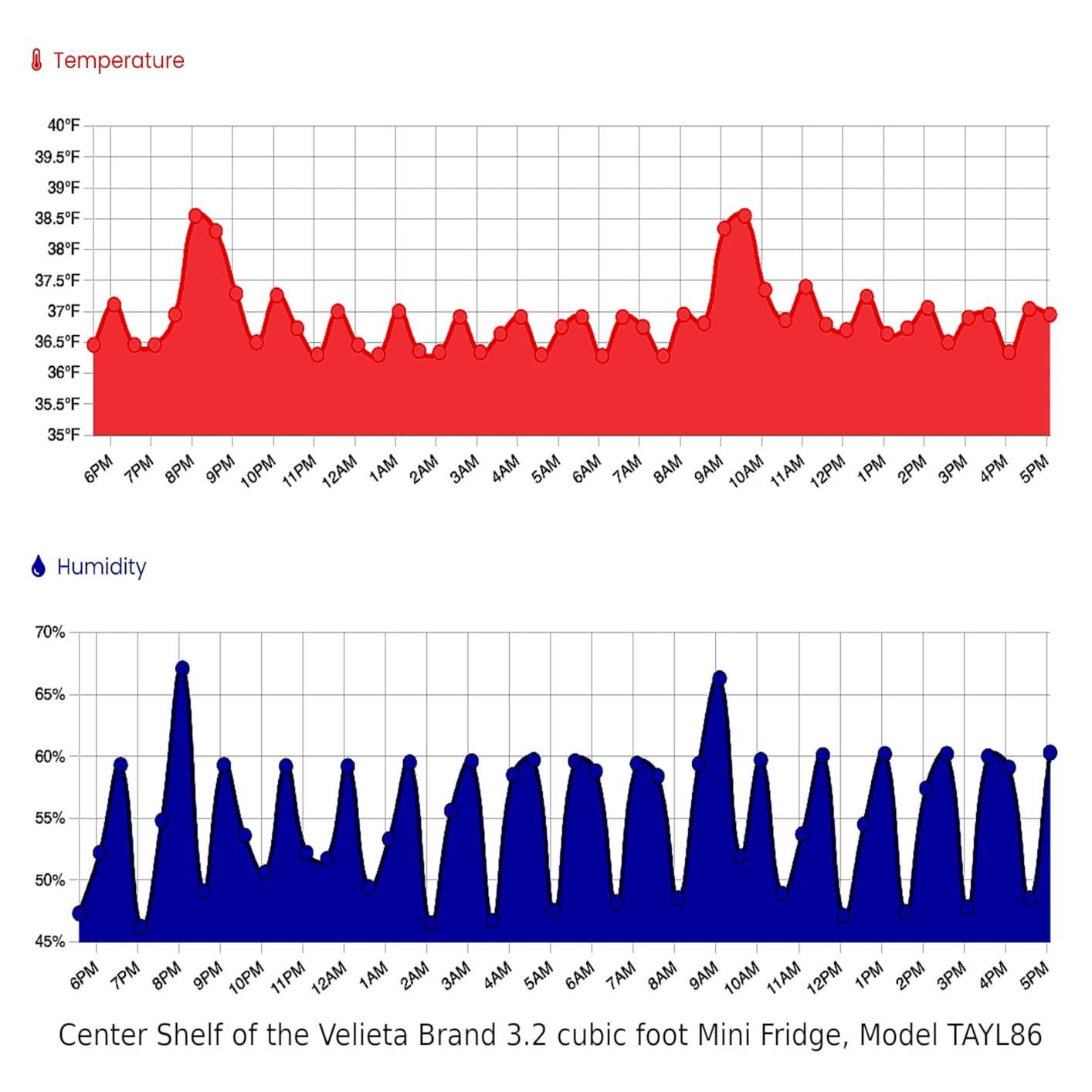
The recurring theme in those reviews is front-vent design being the reason the install works, plus quiet operation and steady temperature control. Customer service is described as unusually responsive, which counts for a lot when a 34-inch-tall appliance has to be pulled back out to fix.
The honest caveat is capacity. Owners repeatedly warn that real-world loading is roughly half the headline number if your bottles are wide-bodied. Plan the shelf layout before the cabinet is built, not after.
How narrow is too narrow for your island
Below 12 inches wide you are into portable territory, where the condenser is small and the airflow margin is thin. This unit is the narrowest here that still describes itself as front-vented and built-in rated.
Two shelves of spacing means magnums and sparkling bottles need to be double-stacked or laid on their side rack. If your collection skews toward large formats, budget for a wider box.
What owners would change
The most common request in the reviews is more shelf spacing. The second is a dimmer display control, because the blue ambient lighting and panel are bright in a dim room.
The 2-year warranty is the longest among the compact units here, which matters more than the extra year suggests when the appliance is boxed into cabinetry with limited access for service.
3. ORYMUSE 15 Inch 30 Bottle Built-In Wine Cooler
ORYMUSE 15 Inch Wine Fridge, 30 Bottle Under Counter Wine Cooler Built-In
3.1 cu. ft.
30 bottles
About 38 dB
40-65F
23.03D x 14.96W x 33.46H in
Pros
- Front venting for built-in or freestanding placement
- Roughly 38 dB compressor operation
- Adjustable and removable beech wood shelves
- LCD touch panel with temperature memory
- Stainless frame with tempered glass door
Cons
- Single zone so reds and whites share one setting
- Weak door magnet lets the door bounce open
- Some shelf edges are not fully level
If you only drink one style of wine, one zone is the correct answer and this is the cleanest way to get it. The digital panel covers 40-65F in a single setting, with a memory function that restores your last choice after a power cut.
The footprint matches the Tylza almost exactly at 23.03 by 14.96 by 33.46 inches, so it drops into the same cabinet opening. At 52 pounds it is also the lightest of the 15-inch units here, which makes a two-person install far easier.
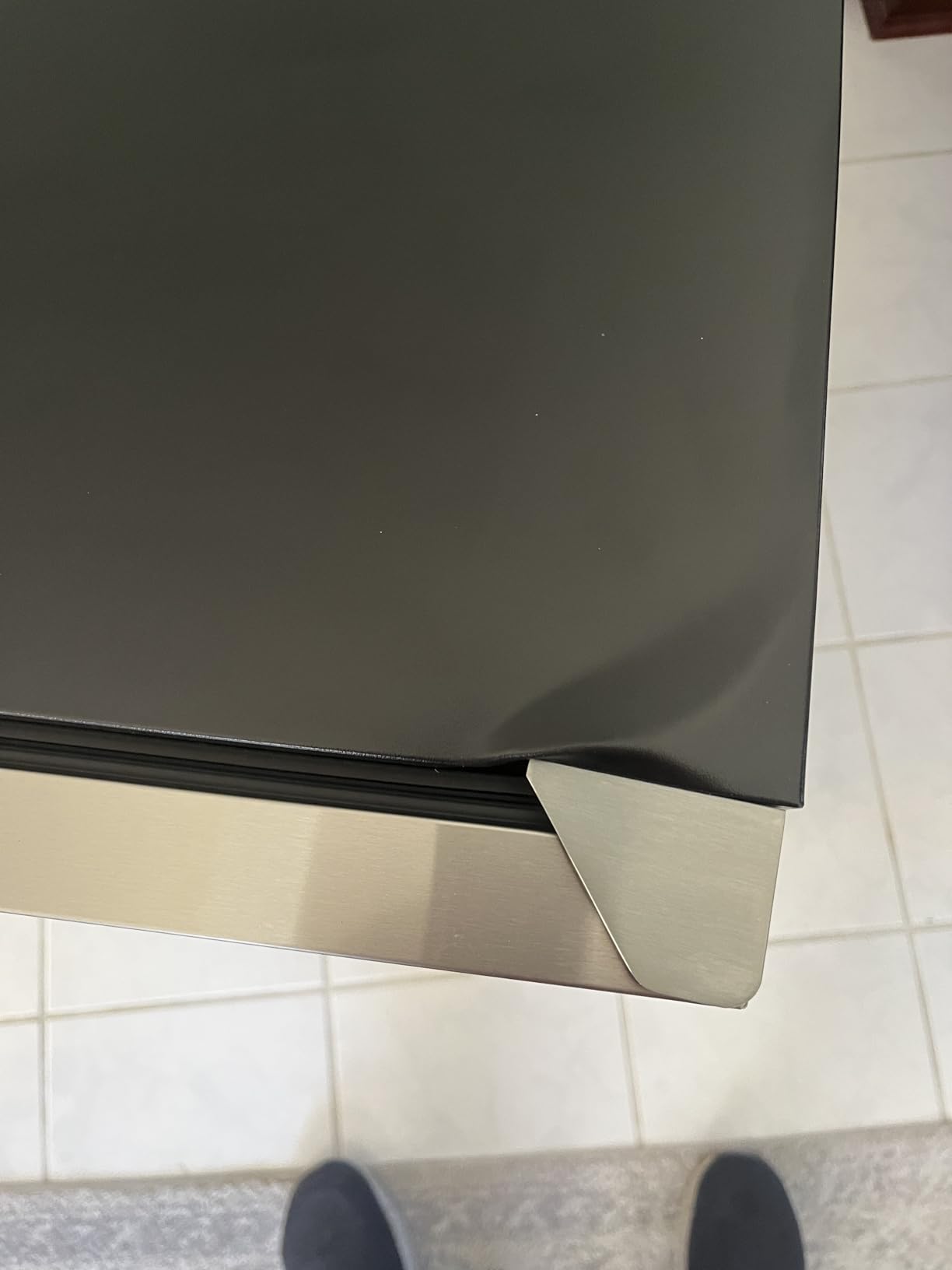
Owner reviews describe it as a solid mid-tier cooler that fits neatly under a counter, runs quietly, and looks modern. The stainless frame with a double-layer tempered glass door is the part people mention when they talk about how it looks in a finished kitchen.
The 4.5-star average comes from 180 ratings, which is a smaller pool than the leaders here. Treat the star figure with some caution, but the reported noise level of roughly 38 dB is the quietest figure published by any product in this guide and is consistent across those reviews.
Listed annual energy consumption is 162 kilowatt hours per year, which is among the lowest figures published by any product in this guide. That is the number to compare if the island sits in an open-plan room and the unit runs year-round.
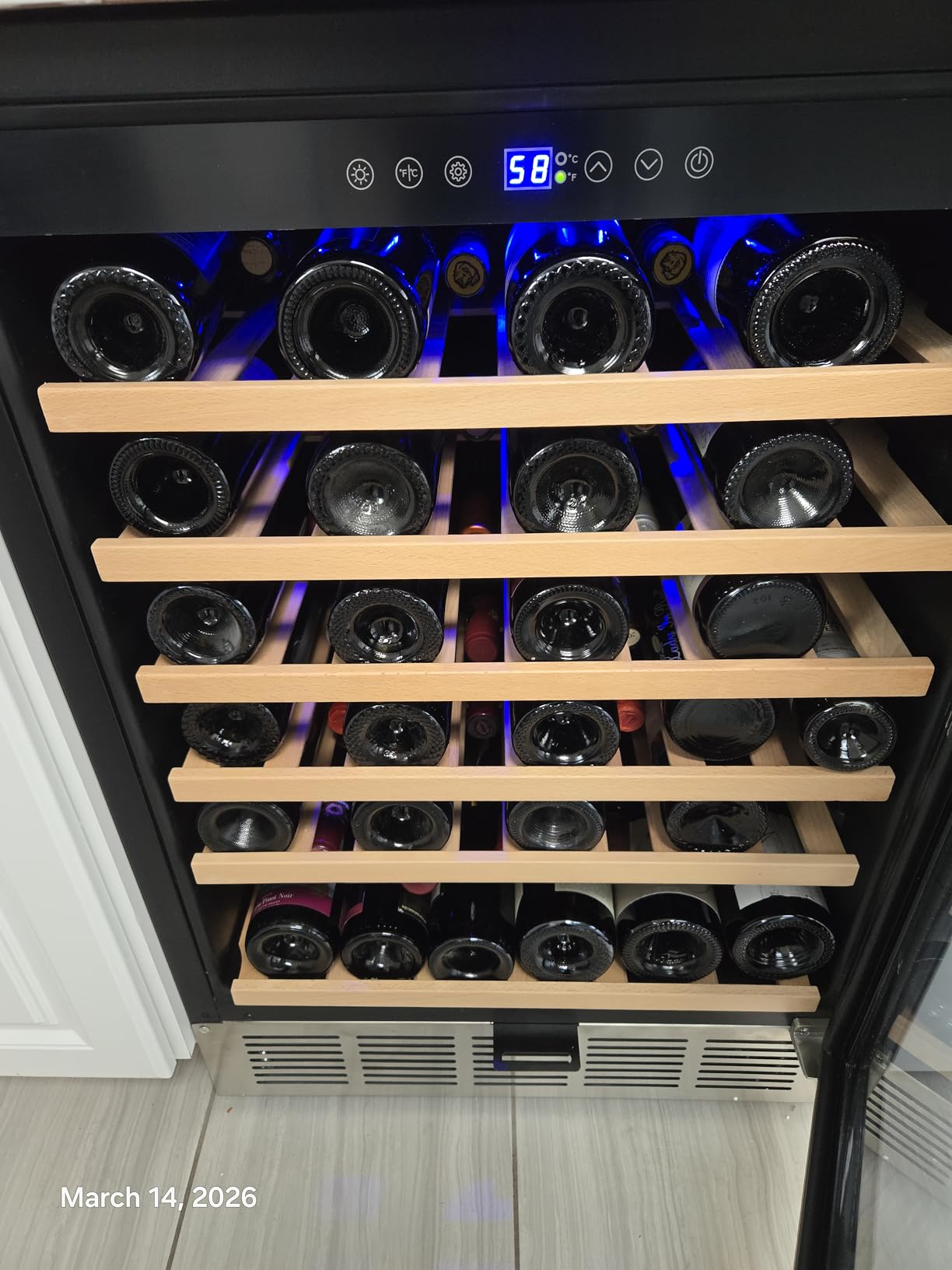
Why single zone is often the right call
Two independent zones mean two evaporator sections and a shorter cabinet interior. In a small island cutout you are frequently choosing between zone count and bottle count, and a single zone frequently holds more bottles for the same width.
If you serve reds at 64F and nothing else, this unit does exactly what you need without wasting half the interior on an unused second compartment.
The two flaws owners actually report
The door magnet is weak enough that the door can bounce back open, which matters in an island where the handle faces a walkway. The other repeated note is that some shelf edges are not perfectly level, which tips bottles when a shelf is pulled forward.
Neither is a deal breaker, but check the shelves on arrival before the cabinetmaker closes the box around it.
4. BODEGA 15 Inch 30 Bottle Dual Zone Wine Cooler
BODEGA 15 Inch Wine Fridge, 30 Bottle Dual Zone Wine Cooler, 41-72℉ Compressor Wine Refrigerator with Tempered Glass Door, Built-in or Freestanding Wine Cooler for Home Kitchen Bar (3.2 cu.ft).
3.2 cu. ft.
41-72F dual zone
42 dB
22.44D x 14.96W x 33.58H in
Pros
- Two zones adjustable in 1F steps
- Double-tempered glass blocks roughly 99% of UV
- Five removable shelves
- Front air vent built-in design
- Soft blue LED lighting
Cons
- Only five shelves for a 30-bottle claim so spacing is tight
- Some variants market dual zone without independent control
- Setup questions can need patience with support
The temperature control is the story here. Both zones adjust from 41-72F in single-degree steps, which is finer control than most 15-inch dual-zone units offer and is what separates this from the fixed-band approach on the Tylza.
The door is double tempered glass with UV protection listed at roughly 99 percent blocking, and the cabinet is a 304 stainless frame. For a cooler sitting in an open kitchen next to a window, that glass specification does real work.
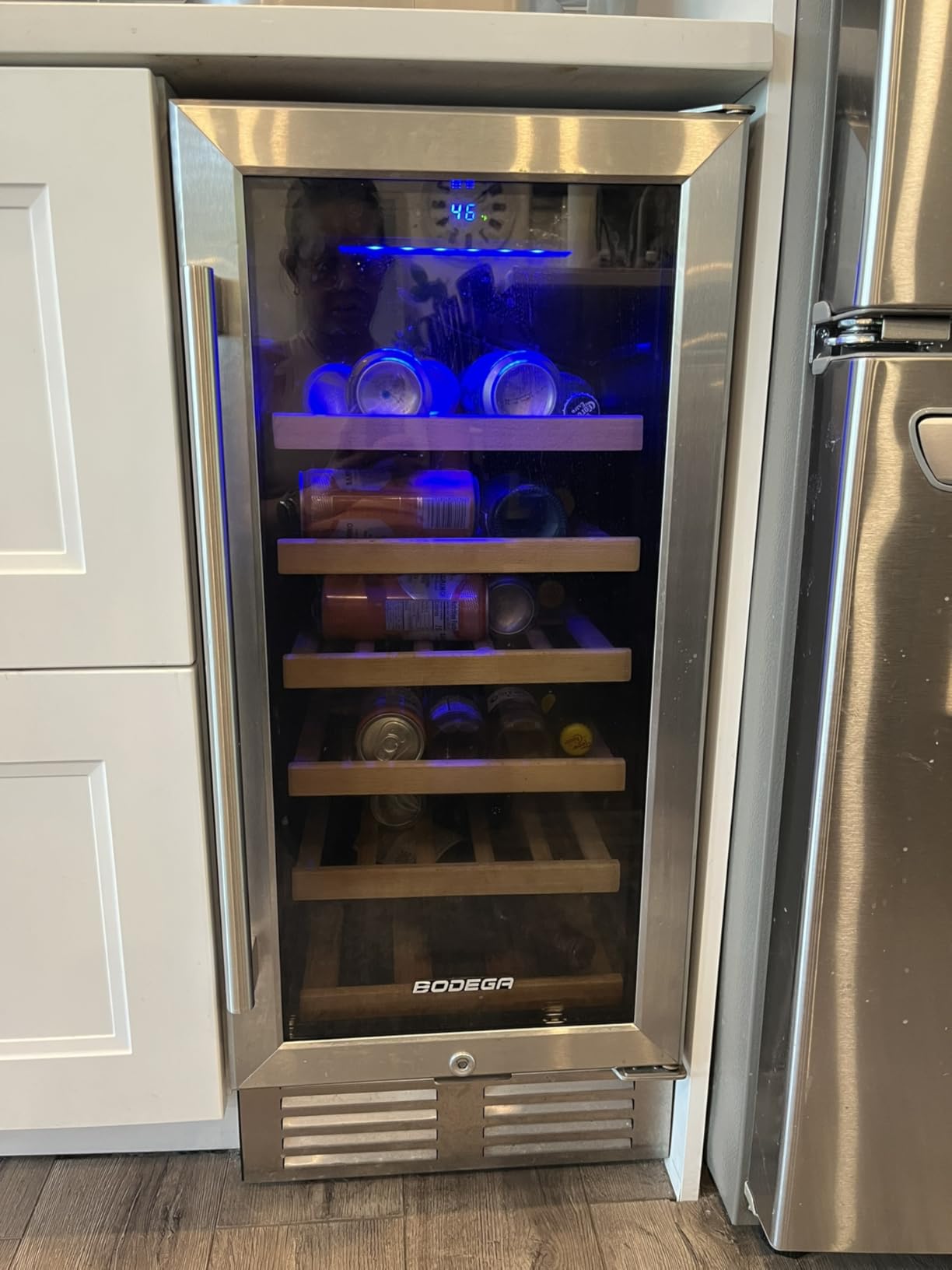
At 4.2 stars across 447 ratings, this sits mid-pack on rating but well above the compact tier on features. Buyers single out the compact footprint and the independent zone temperatures for a kitchen island specifically, which is a good sign that the use case matches the design.
Noise is listed as low as 42 dB with compressor cooling and built-in air circulation. That is a touch louder than the ORYMUSE figure but still in the range most people stop hearing within a few days in an open plan.
Five removable wood-look shelves hold up to 30 standard bottles plus champagne. The shelves also adjust at the feet, which lets you level the unit on an island floor that is not perfectly flat.
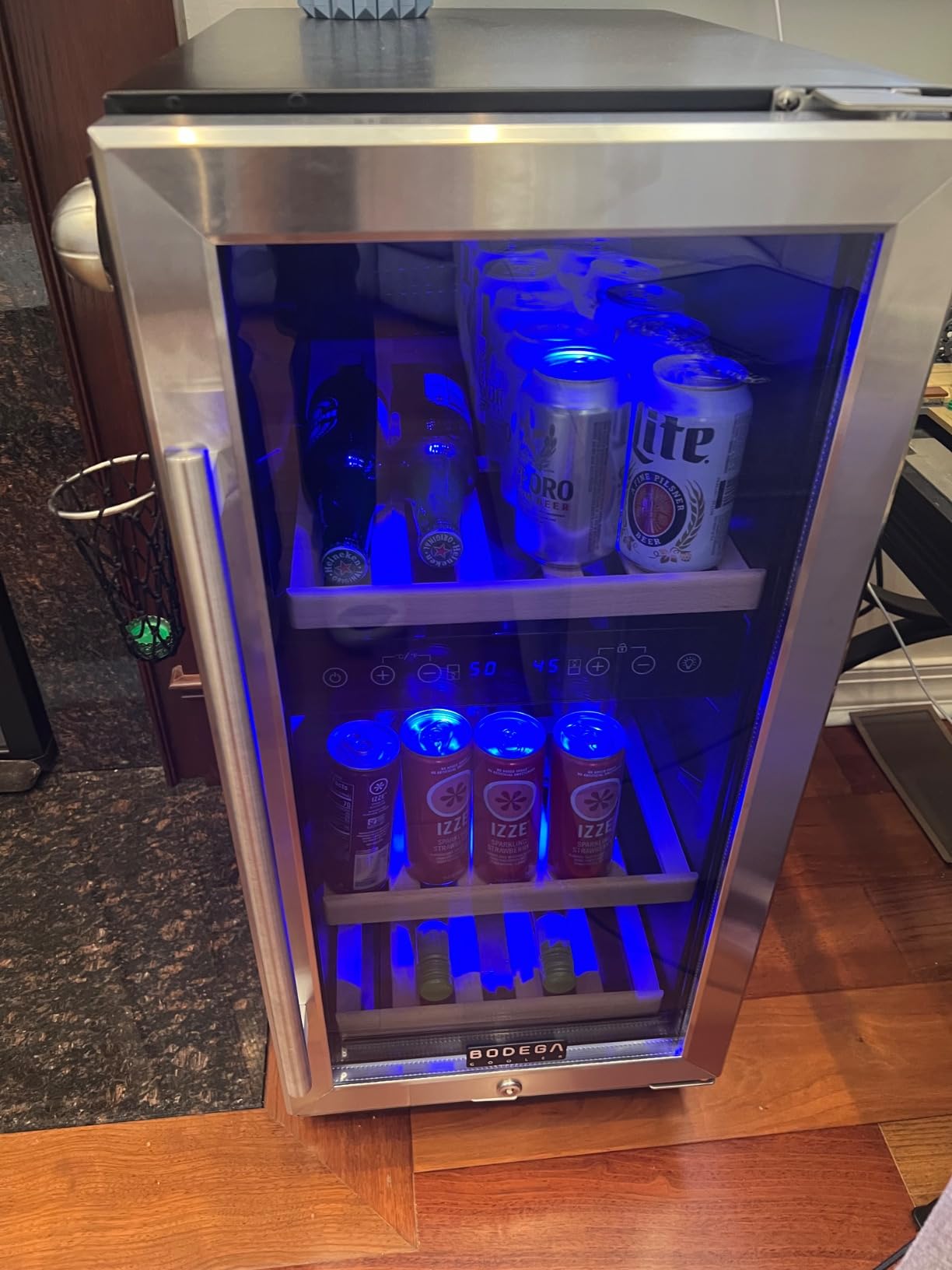
The capacity question on this one
Five shelves supporting a 30-bottle claim means spacing is tight. Owners with a mix of wide Bordeaux and tall sparkling report running out of usable rows well before the bottle count.
If your collection is mostly standard 750ml bottles with one or two large formats, the shelves pull out and it works. If large formats are more than a quarter of the collection, look at a wider unit.
Where the buyer should push back
Some variants of this product line market dual-zone control that is not fully independent. Before committing, confirm with support which zone readouts are separately adjustable on the exact model number.
The other point worth raising early is support response for setup questions. It is not slow on hardware problems, but configuration questions can take a couple of exchanges to resolve.
5. Ca’Lefort 15 Inch 33 Bottle Wine Cooler
Ca’Lefort 15 Inch Wine Fridge, 33-Bottle Wine Cooler Refrigerator
3.0 cu. ft.
33 bottles
Front vent
40-65F
22.4D x 14.8W x 34H in
Pros
- Front-vent design for built-in under-counter or freestanding use
- Accurate 40-65F readings on an external thermometer
- Sapele wood shelves with three LED colours
- Power outage memory
- 1 year machine 2 years parts 3 years compressor
Cons
- Shelves are removable but not height-adjustable
- A few degrees of variance between top and bottom racks
- Wood shelf finish and missing UV film on the door
- 85 pounds is a heavy two-person lift
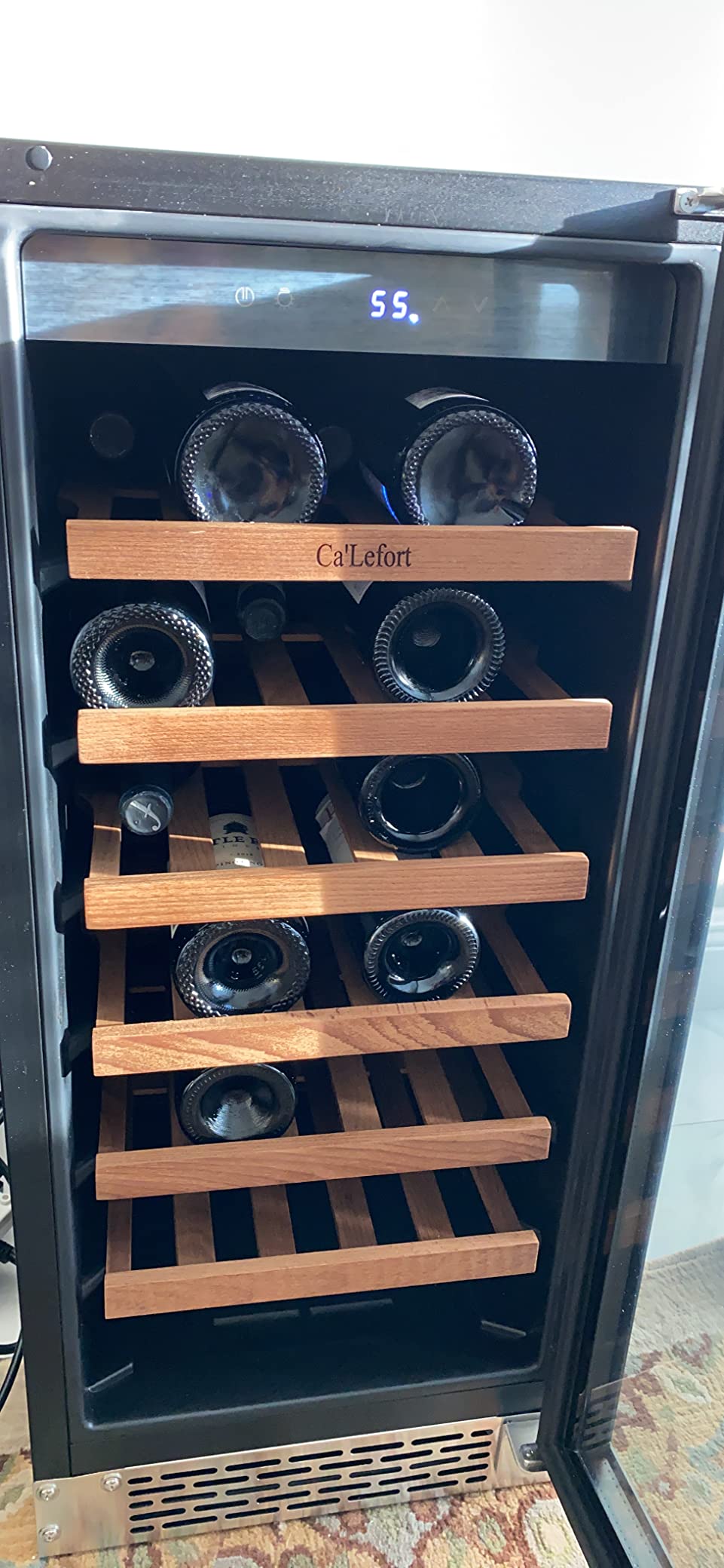
This is the one we would trust in a house where the appliance has to be installed once and stay installed. The warranty structure is among the strongest of the 15-inch group: one year on the machine, two on parts, three on the compressor. A compressor is the part that ends these units, so that third year is the number that matters.
At 22.4 by 14.8 by 34 inches it is also the shallowest 15-inch cabinet in the guide, which gives you more tolerance on an island with a tight counter overhang.
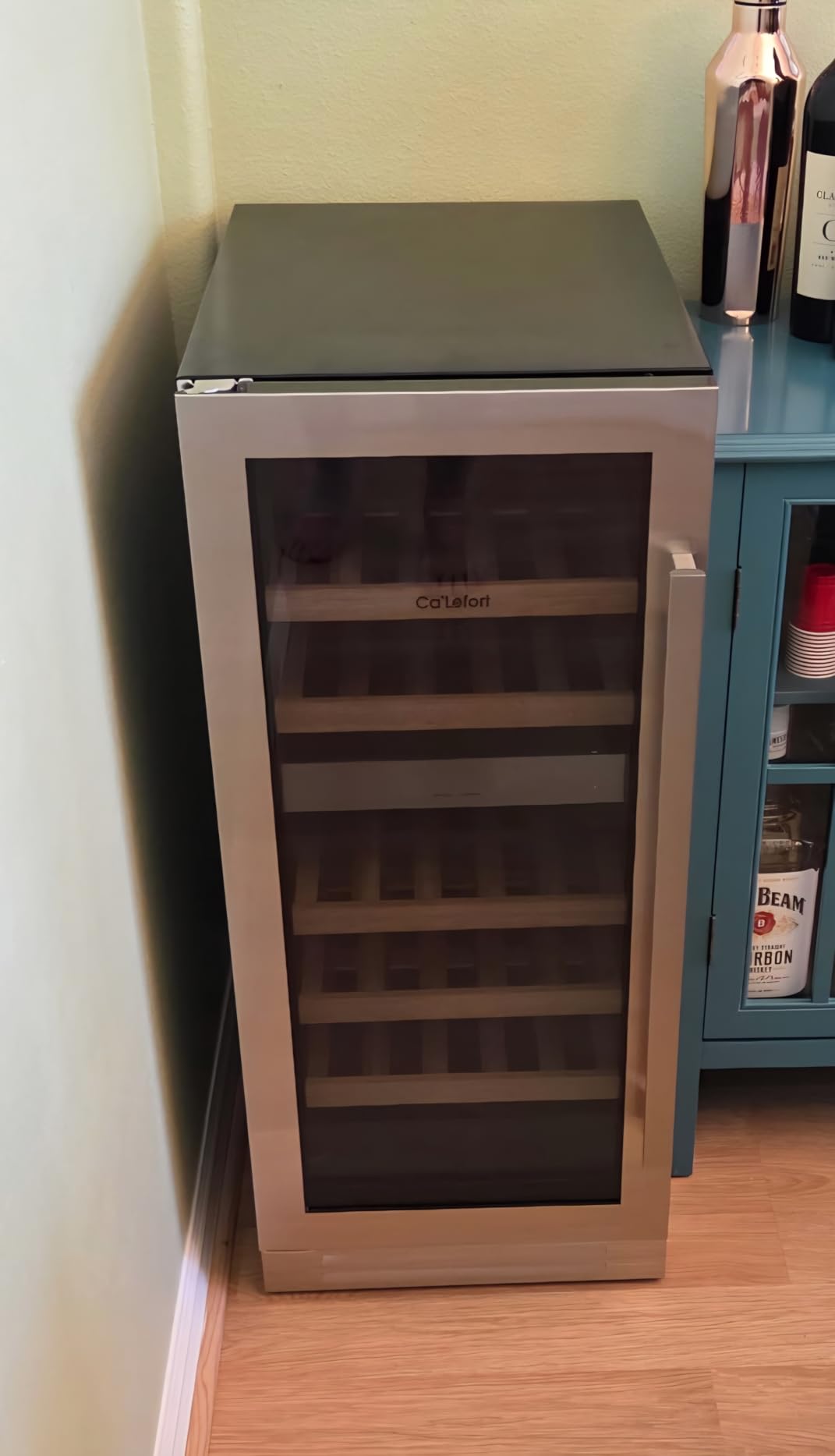
Reviewers consistently praise build quality, quiet operation, and temperature accuracy, and several specifically mention checking readings with an external thermometer and finding the control held. That is the strongest form of validation a thermostat claim can get.
Several owners also fitted it under a counter without retrofit, which is the outcome you want from a built-in purchase. The listing ranks in the top ten of its category on Best Sellers Rank, which tells you the volume of real installs behind those numbers.
Three selectable interior LED colours, amber, blue, and white, is a small touch that matters more in a finished island than in a utility room, because the interior is on display whenever the door is open.
What the weight means for your install
At 85 pounds this is not a one-person lift into a base cabinet. Plan a second person on install day, or a panel-cart with the toe-kick off, because the last ten inches is where back injuries happen.
The removable sapele shelves keep the shipping weight lower than the figure suggests, so removing them before the lift helps a little.
The honest limitations
Owners report a few degrees of variance between the top and bottom racks, so if you are aging reds and drinking whites from the same cabinet, do not expect the top shelf to behave like the bottom one.
The shelves are removable but not height-adjustable, which limits mixed bottle sizes. The wood finish also reads as unfinished to some owners, and the door has no UV film.
6. Kalamera 24 Inch 37 Bottle Dual Zone Wine Cooler
Kalamera 24 inch Wine Cooler, 37 Bottle Dual Zone Built-in or Freestanding
5.3 cu. ft.
24 in wide
40-50F and 50-66F zones
22.4D x 23.4W x 33H in
Pros
- Dual zone split across a 24-inch cabinet
- FSC-certified wooden frame dampens vibration
- Shelf stoppers stop bottles tipping
- Temperature memory
- Built-in or freestanding
Cons
- Lowest average rating here at 4.0 with a 15 percent one-star share
- Headline capacity assumes standard bottles
- 102 pounds is a difficult cabinet lift
- Uses a higher-GWP refrigerant than R-600A rivals
- LED visibility limited in a deep cavity
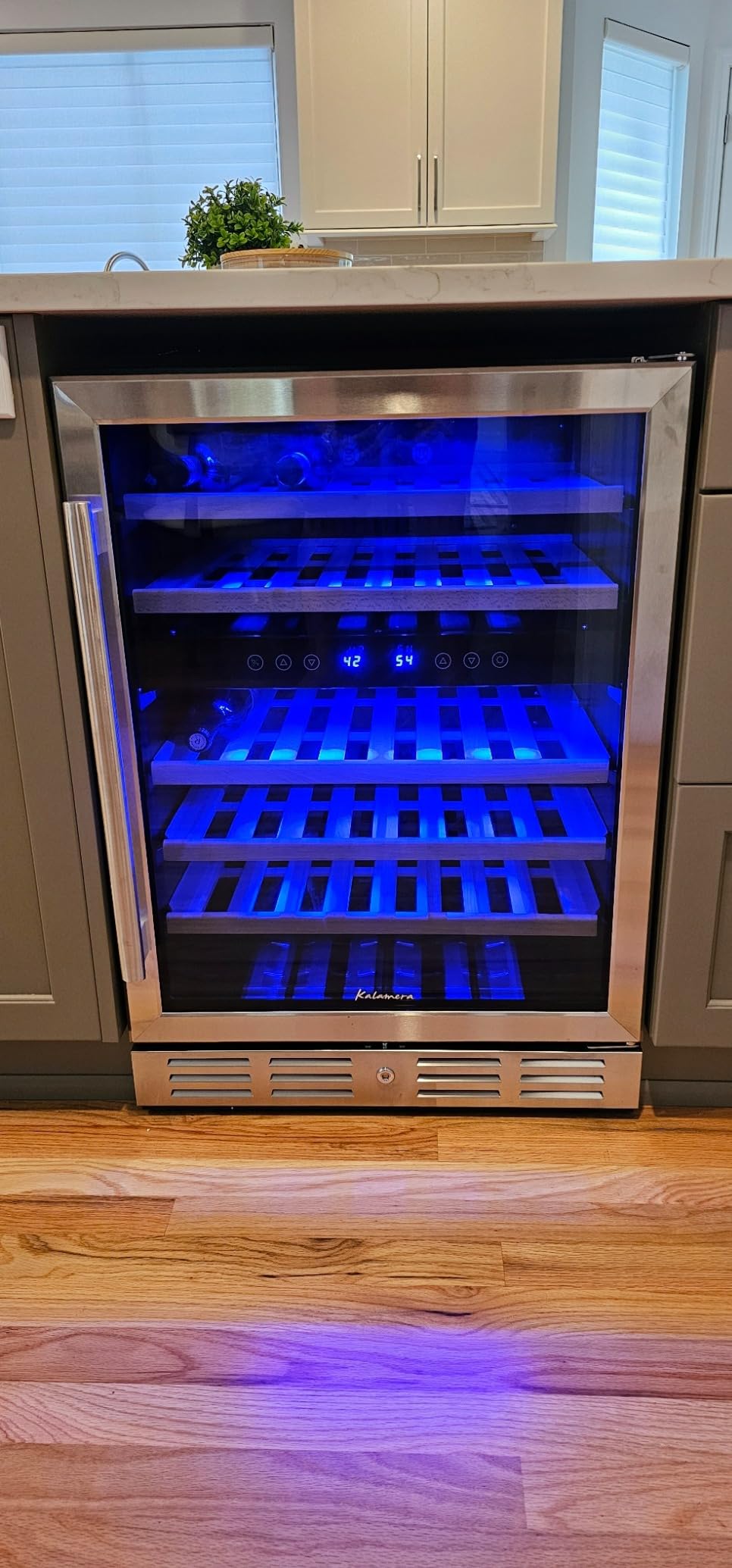
A 24-inch opening is the standard width for an island wine cavity, and this fills it with 5.3 cubic feet across two zones. The upper zone runs 40-50F and the lower 50-66F, giving you a cold lower zone for sparkling and whites that the 15-inch single-zone units cannot match.
The FSC-certified wooden frame is a genuine feature rather than a marketing line. Wood construction absorbs vibration, and vibration is the thing that moves sediment out of an aging bottle and shows up as audible hum at a seating overhang.
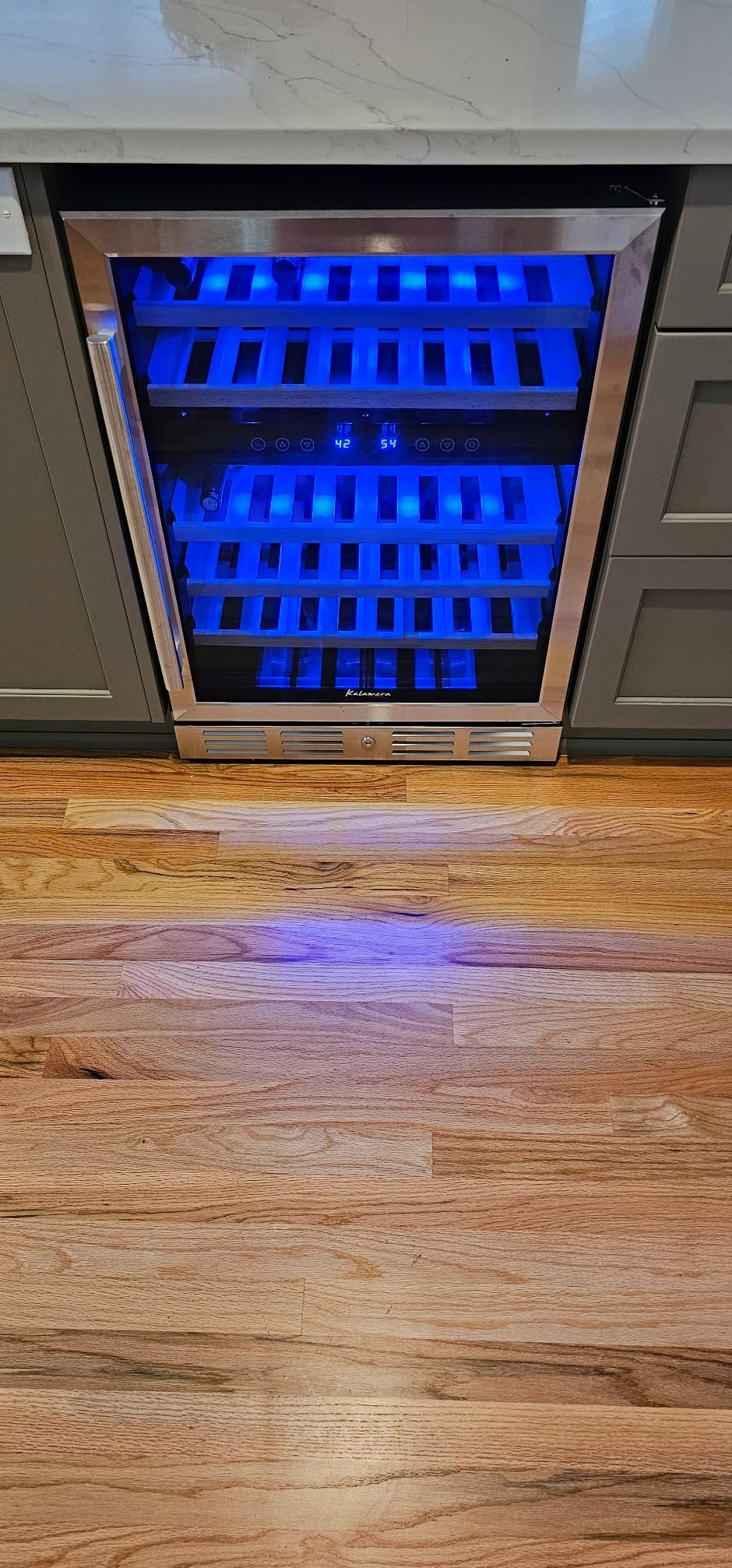
We want to be straight about the ratings here. At 4.0 stars across 465 reviews this has the widest spread of any product in the guide, with a meaningful share of one-star reviews focused on noise, cooling consistency, and weight during installation. That does not disqualify it, but you should know the distribution before you buy.
The positives owners name most are the wooden frame, the dual-zone range, and the fact that a 24-inch width drops straight under a counter. Shelf stoppers that keep bottles from tipping when a rack is pulled out are a nice detail at a seating-height install.
Annual energy consumption is listed at 332.15 kilowatt hours per year, the highest figure published by any product in this guide, which reflects the larger cabinet volume.
Who this suits and who it does not
If your island is built with a 24-inch appliance cavity and you want reds and whites genuinely separated, this is one of the few options at that width. If your cavity is 15 inches, this unit does not fit and no modification of the cabinet will change that.
It is also the wrong choice for anyone sensitive to noise in an open-plan room. The one-star reviews naming noise are consistent enough that we would not put it next to a seating area without hearing it first.
Capacity and the environment note
The 37-bottle figure assumes standard 750ml bottles. Owners note Pinot and Champagne reduce it sharply, and shelf geometry means large formats take more than one row.
This unit uses a higher global-warming-potential refrigerant than the R-600A models elsewhere in the guide. If you care about the environmental profile of a permanently installed appliance, the 15-inch compressors are the better choice.
7. Zephyr Brisas 15 Inch Slim Under Counter Wine Cooler
Zephyr Brisas 15 Inch Slim Wine Fridge Single Zone Under Counter – Narrow Mini Wine Cooler Small Cabinet Wine Refrigerator Home Bar Freestanding with Glass Door – 28 x 750ml Bottles
3.4 cu. ft.
28 bottles
Reversible hinge
25.38D x 15W x 33.88H in
Pros
- 5-year compressor warranty
- PreciseTemp digital control with Active Cooling
- Vibration dampening for sediment protection
- Field-reversible hinge
- Deep blue LED matches modern cabinetry
Cons
- Most expensive 15-inch unit here with a lighter feature set
- Black wire racks instead of wood shelving
- Reversing the hinge can leave plastic plugs missing
- Some units arrive dented from transit
- A few reports of fan hum with slow support follow-up
Zephyr is a dedicated appliance brand rather than a marketplace seller, and the practical difference shows up in the warranty: five years on the compressor, two on parts, one on labour. That is the strongest compressor coverage of any 15-inch unit here and the main reason to look past the feature list.
PreciseTemp digital control with Active Cooling Technology is aimed at even cooling rather than just a setpoint, and the vibration dampening system is specified with sediment in mind. For a collection that includes older vintages, that is worth more than a second LED colour.
Owners like the styling, the quiet operation, and the reversible hinge, and several cite in-home fan repairs as a service experience they did not expect to get at this tier. The deep blue LED lighting and capacitive touch controls are the features most often mentioned as matching modern cabinetry.
The deductions in reviews are mostly physical logistics: dents to kick plates or corners in transit, and difficulty sourcing replacement hardware. Inspect the unit on the pallet before it goes into the cabinet.
At 4.2 stars across 170 ratings it has the smallest review base among the 15-inch units here, so the quiet-operation claim rests on a thinner sample than the leaders.
Check your depth before anything else
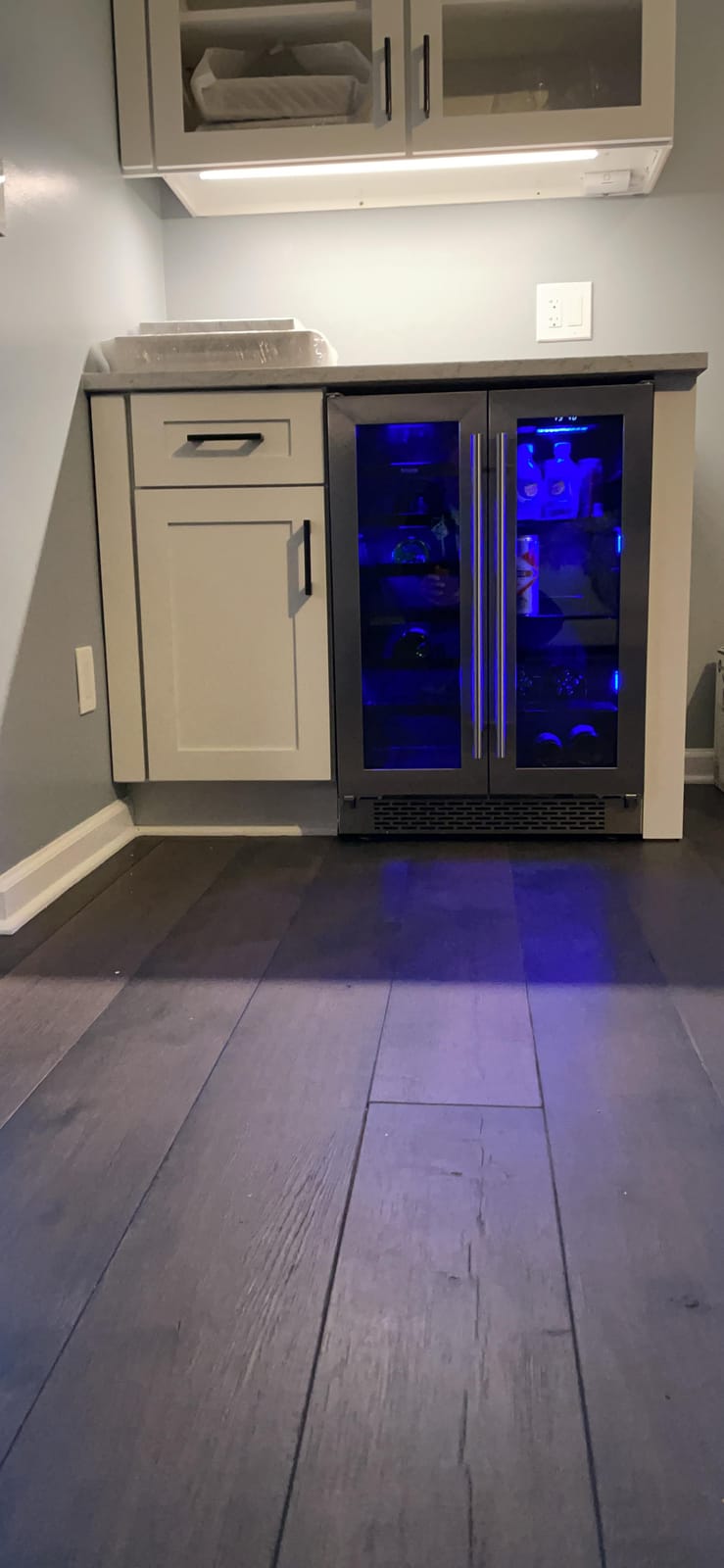
This is the deepest 15-inch unit in the guide at 25.38 inches. On an island with a 25-inch cabinet box and a standard overhang, that is a very tight fit and often the reason this unit gets ruled out late in a project.
Measure to the back wall of the cavity, not to the counter edge. If you have under 26 inches of usable depth, this is not the model.
Where the extra spend goes
Honestly, the feature set is thinner than cheaper 15-inch rivals: black wire racks instead of wood shelves, and a smaller interior for the money. What you are paying for is the warranty, the service response, and the reversible hinge.
If your island build is a one-time cost you want to forget, that is a reasonable trade. If you are replacing appliances often, a cheaper unit is the better value.
8. NewAir 15 Inch Dual Zone 29 Bottle Wine Cooler
NewAir 15″ Dual Zone Wine Fridge for 29 Bottles | Built-In or Freestanding Wine Cooler Refrigerator with Glass Door | Precision Cooling & Wood Shelves for Red and White Wines | Black Stainless Steel
3.2 cu. ft.
29 bottles
Dual zone
24.25D x 14.8W x 33.75H in
ETL CEC DOE
Pros
- Two independent temperature zones
- Low-vibration compressor cooling
- UV-protected double-pane glass door
- Five smooth-gliding wood shelves
- Front ventilation for built-in install
- ETL CEC and DOE certified
Cons
- Two-pin corded plug instead of the usual three-pin cord
- 24.25-inch depth is deeper than most 15-inch cutouts allow
- Smaller review volume than generic competitors
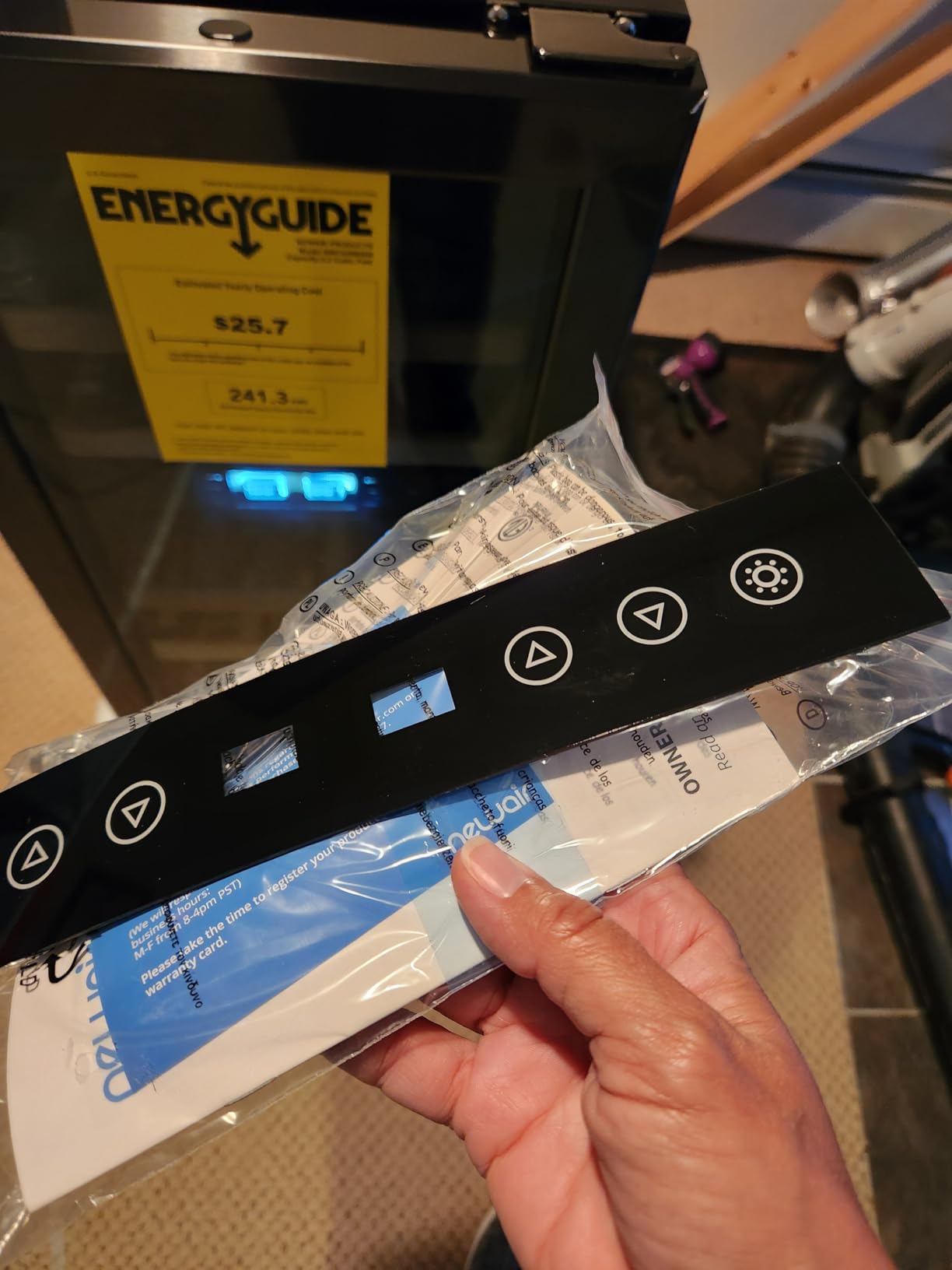
The certification marks on this one are ETL, CEC, and DOE certified, which is a level of third-party verification that is harder to find on marketplace listings. The refrigerant is in the low-impact R-290 and R-600A family, which matters for a unit that runs permanently inside cabinetry.
Two independently controlled zones with low-vibration compressor cooling and a UV-protected double-pane door make this a proper dual-zone wine unit rather than a beverage cooler with a wine label. Five smooth-gliding wood shelves hold up to 29 standard bottles.
Reviewers highlight the dual-zone storage, the quiet compressor, and the wood shelves. Listed annual energy consumption is 260 kilowatt hours per year, which is a reasonable figure for a permanently installed dual-zone cabinet.
The smaller review base of 178 ratings is the most common thread in the critical feedback. At this price point, most buyers compare against marketplace listings with several times the volume, and that shows in how they judge support and consistency.
The front ventilation is explicit in the listing and installation type is listed as built-in, which is what makes it a legitimate island candidate rather than a freestanding unit that happens to fit.
The plug question needs an answer early
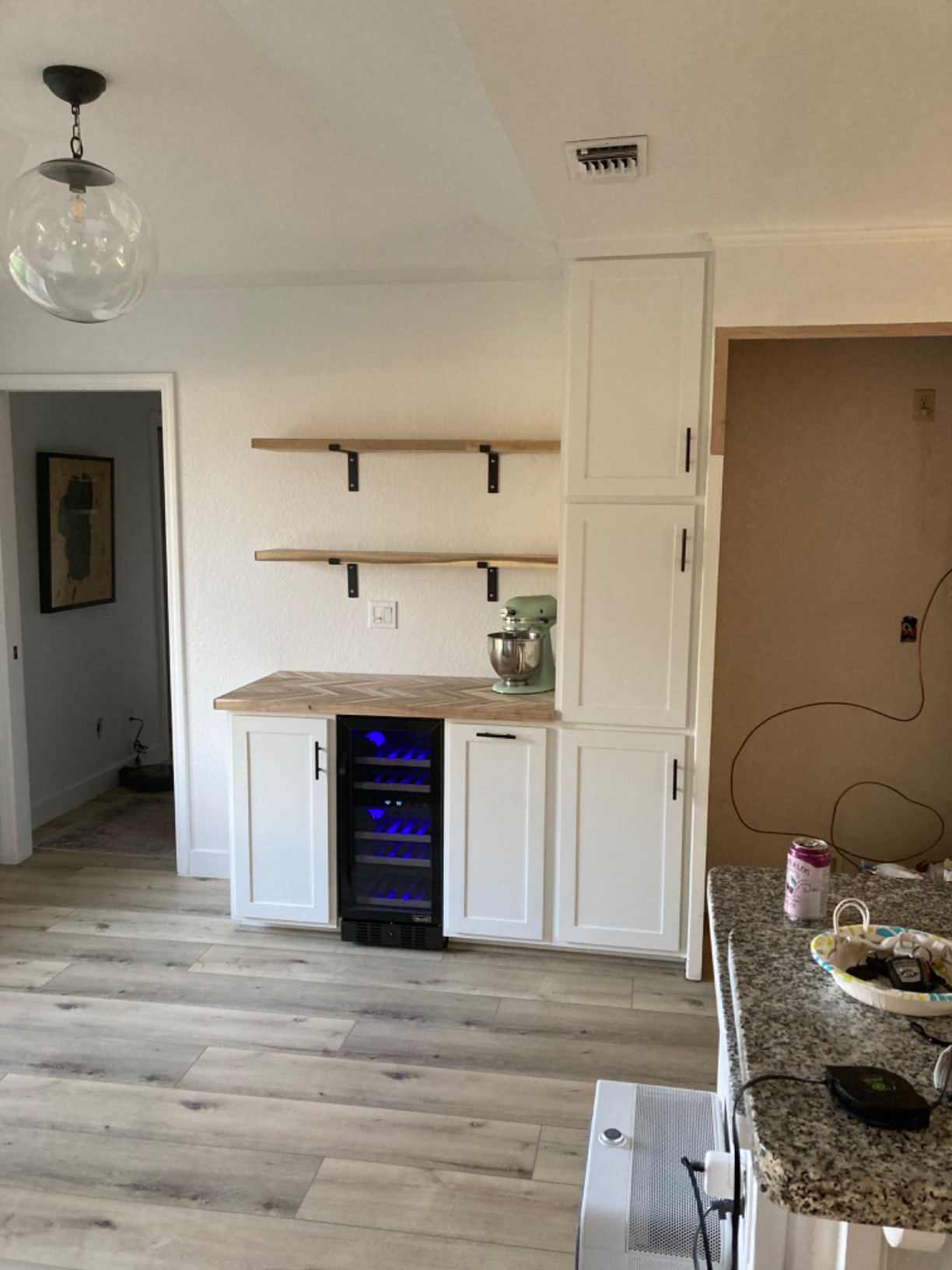
This unit comes with a Type A two-pin plug rather than the three-pin cord most appliances ship with. On an island where the outlet has to be added new, this is a conversation with your electrician before the countertop is templated, not after.
Two-pin corded connections are still common in this category, but the outlet type needs to match what your jurisdiction allows for a permanently installed appliance.
Depth is the deciding spec
At 24.25 inches deep, this is the second-deepest 15-inch unit in the guide. Most 15-inch island cavities handle that, but overhangs and back-splash clearances eat into it quickly.
Where it wins is the combination of a named brand, third-party certification, and dual independent zones at 15 inches. That combination is rarer than the listing pages suggest.
9. Velieta 30 Inch Dual Zone Wine and Beverage Cooler
Velieta Wine and Beverage Refrigerator 30 Inch, Upgrade Dual Zone Wine Cooler, 30” Wine beverage Fridge Built in or Freestanding Under Counter Large Capacity Glass Door Advanced Cooling System
6.2 cu. ft.
29 bottles and 110 cans
Dual zone
28D x 30W x 35H in
Pros
- Two independently controlled zones with 35-50F and 41-64F ranges
- 29 Bordeaux bottles plus 110 standard cans
- Quiet inverter compressor with fan circulation
- Front vent for built-in install
- Smart touch screen with keyed door lock
Cons
- 30-inch width needs a full-width cabinet opening
- Temperature varies by shelf position
- Panel reading does not always match an internal thermometer
- About 55 kg so a sturdy base and dedicated outlet are required
This is a beverage center that also holds wine properly, and at 6.2 cubic feet it is tied for the largest capacity in the guide. The beverage compartment runs 35-50F for cans and the wine compartment 41-64F for bottles, so beer and wine genuinely stay apart.
Capacity is the headline: 29 standard Bordeaux bottles alongside 110 standard cans. The quiet inverter compressor with fan circulation keeps the interior aired out, which prevents the mixed-load odour problem that usually shows up in a dual-purpose unit after a few months.
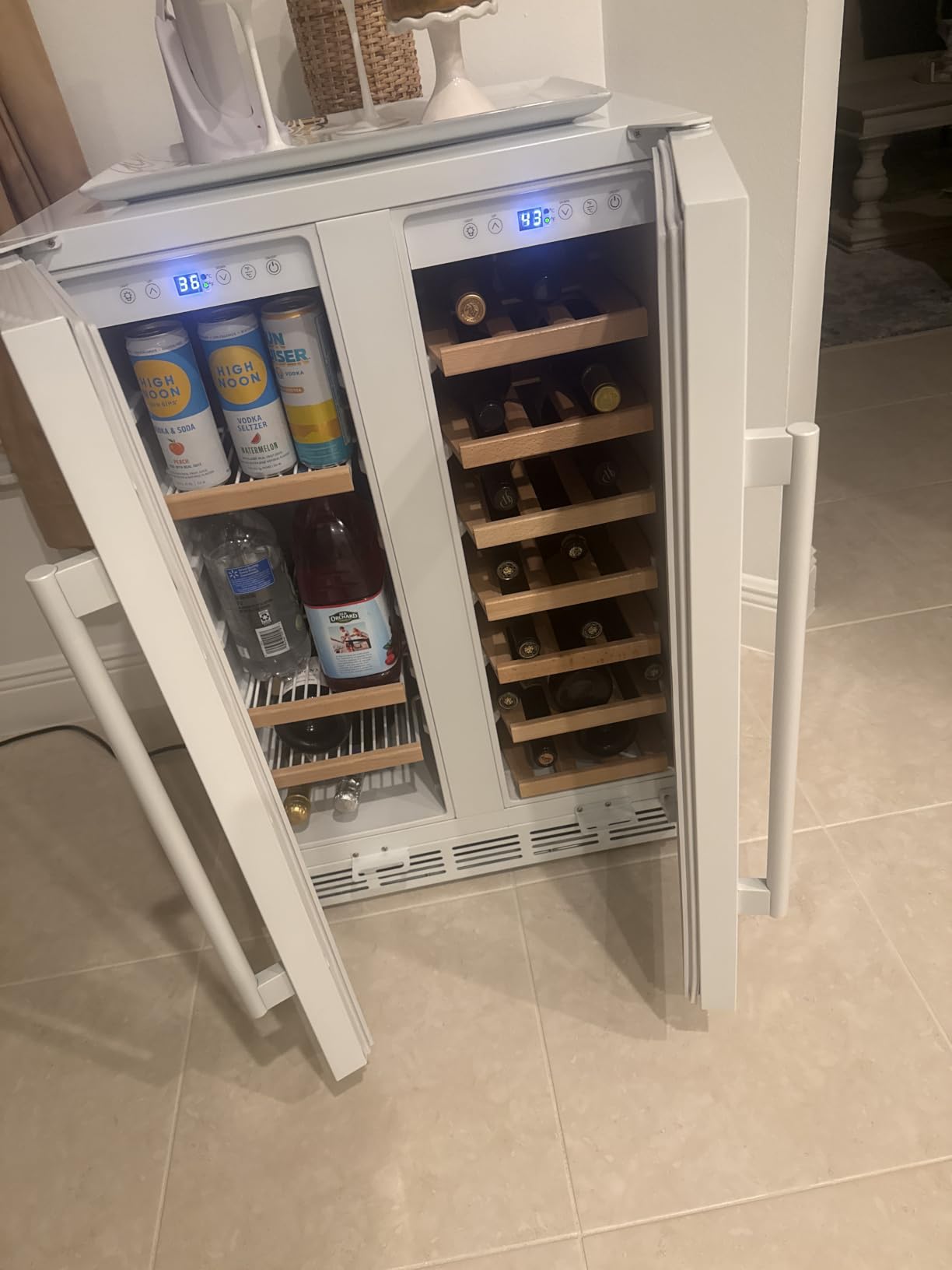
With 1131 ratings at 4.4 stars, this has the largest review base in the guide, and buyers consistently name capacity, dual-zone control, quiet operation, and an easy under-counter fit. Repeated mentions of a second unit being purchased by the same owner is a signal worth paying attention to.
Recurring complaints cluster on three things: uneven cooling between shelves, a panel reading that drifts from an internal thermometer, and units that never reached setpoint in either compartment. Velieta’s replacement service is praised repeatedly in the same reviews where the failures are reported, which is a better outcome than no support at all.
Listed annual consumption is 170 kilowatt hours per year for a 6.2 cubic foot dual-zone cabinet, which is efficient for the class.
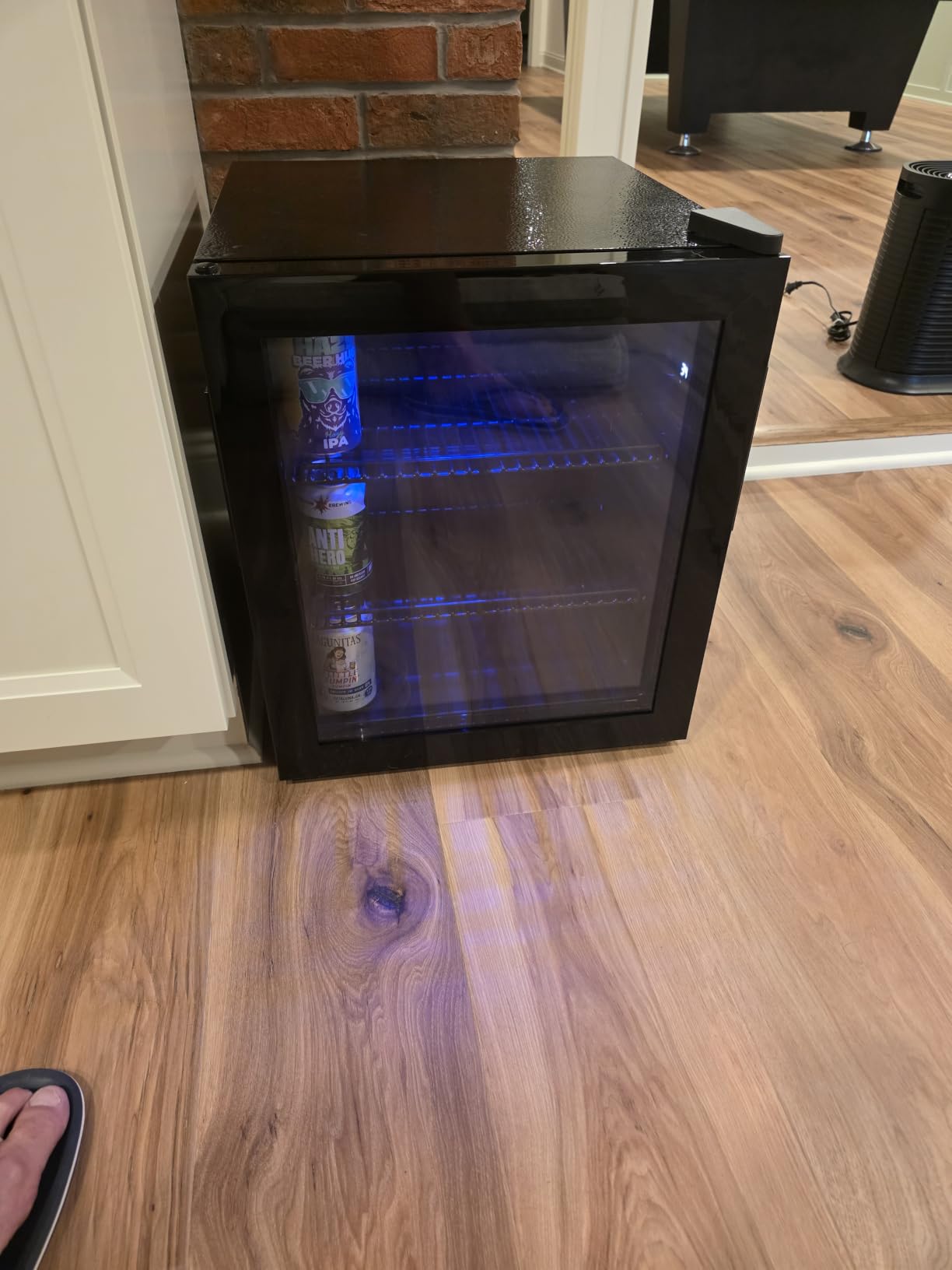
What a 30-inch opening means for island design
At 30 inches wide and 35 inches tall, this needs a full-width cabinet bay rather than a slim appliance slot. That is a design decision made at the cabinet drawing stage, not a retrofit, and it eats the knee space of a seating overhang.
Both doors are removable-shelved and there is a keyed lock on each, which is useful in a house with children around a central island.
Who should skip it
Anyone with a serious wine collection and no interest in cans is paying for capacity they will not use, and giving up shelf flexibility. A 15-inch or 24-inch wine-only unit stores more bottles per cubic foot.
Anyone who needs precise zone control at the bottle level should buy a wine-only unit, because the compressor sitting beside the lowest zone is what produces the shelf-to-shelf variance owners report.
10. FoMup 30 Inch Dual Zone Wine and Beverage Refrigerator
30″ Dual Zone Wine and Beverage Refrigerator, Under Counter or Freestanding
6.2 cu. ft.
29 bottles and 110 cans
23.03 in deep
Wine 41-64F
Pros
- Separate wine and beverage cooling zones
- Slim 23.03-inch depth for a 30-inch unit
- Temperature memory after a power restart
- Keyed locks on both doors
- Touch screen with LED display and auto defrost
Cons
- Controls sit inside the cabinet so the door must open
- Wire rack spacing lets cans tip while loading
- Interior LED strip switches off on its own
- Some buyers report freight damage on arrival
Depth is the reason to look at this one. At 23.03 inches deep and 30.31 wide, it is several inches shallower than the other 30-inch dual-zone unit in this guide, and on a shallow island with a seating overhang that difference decides the install.
The zones are a wine side at 41-64F and a beverage side at 35-50F, holding 29 Bordeaux bottles and 110 standard cans in 6.2 cubic feet. Temperature memory restores your settings after a power restart, which is worth having on an island circuit.
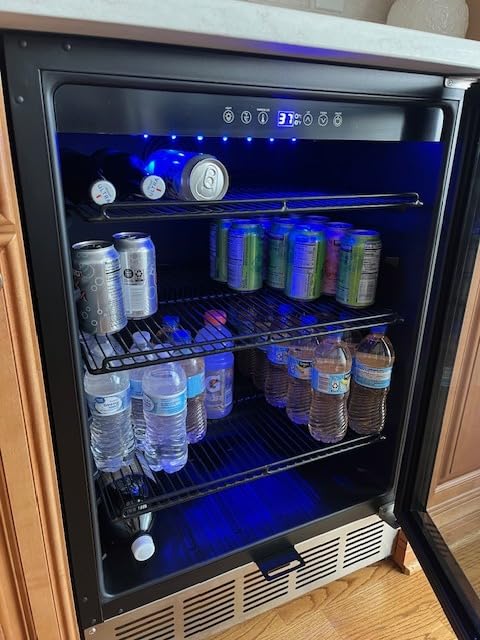
At 4.4 stars across 485 ratings, owners describe it as quiet, well built, and correctly holding temperature within a few degrees, and several mention buying a second unit. That repeat-purchase pattern is one of the stronger reliability signals available in review data.
Negative reviews concentrate on small control and lighting quirks rather than cooling. The most common specifics: controls inside the cabinet so you open the door to check anything, wire rack spacing wide enough that cans tip while loading, and an LED strip that switches itself off.
One long-term owner reported repeated leaks and eventual failure after about eighteen months with no support response, which is a single report in a much larger set of positive ones.
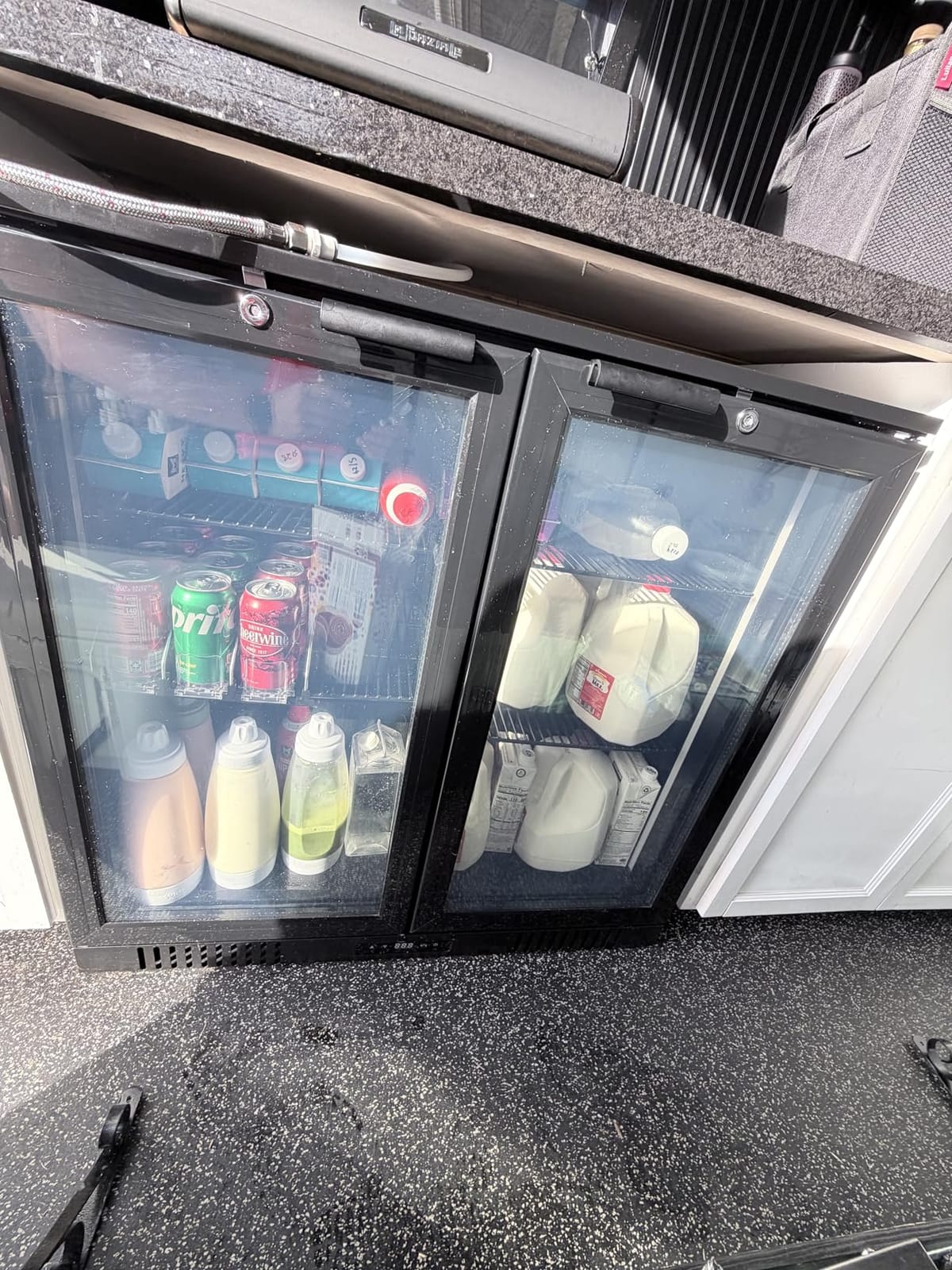
Where controls belong on an island
Interior controls mean every temperature check costs you a door opening, which lets warm room air into the cabinet each time. In an open-plan island that runs in front of people all day, exterior controls are a real quality-of-life difference.
If you can live with opening the door, the shallower depth and the price-to-capacity ratio make this the stronger 30-inch option for most islands.
Installation realities
At 121 pounds this is the heaviest unit in the guide and needs a proper base, not a thin panel shelf. Automatic defrost is a plus for an enclosed cabinet, since a manual defrost cycle inside sealed cabinetry is a service headache.
Inspect for freight damage on arrival. Several buyers report dented or cracked kick plates, which is easy to fix but much easier to catch before the cabinet goes on.
11. Velivi 24 Inch Dual Zone Wine and Beverage Fridge
Velivi 24”Beverage Refrigerator Undercounter Wine and Beverage Fridge
4.9 cu. ft.
24 in wide
Dual zone
Compressor under 40 dB
Pros
- Independent zones at 35-50F and 41-64F
- Fits standard 24-inch cabinetry with front ventilation
- Compressor below 40 dB with vibration damping
- Glass door with LED lighting
- Nine shelves including pull-out drawers
Cons
- Short drawer gliders make back-row bottles hard to reach
- Lights are always on or always off with no door trigger
- Larger-format bottles are a tight fit
- Some reports of audible humming and floor vibration
A 24-inch dual-zone unit is the most useful width in a kitchen island, because it matches a standard cabinet bay while still separating beer from wine. The beverage zone runs 35-50F and the wine zone 41-64F, with a side-by-side glass door.
Front ventilation is listed for built-in or freestanding installation, and the compressor runs below 40 dB with vibration damping. Nine shelves including pull-out drawers handle a mixed load of cans, bottles, and larger formats.
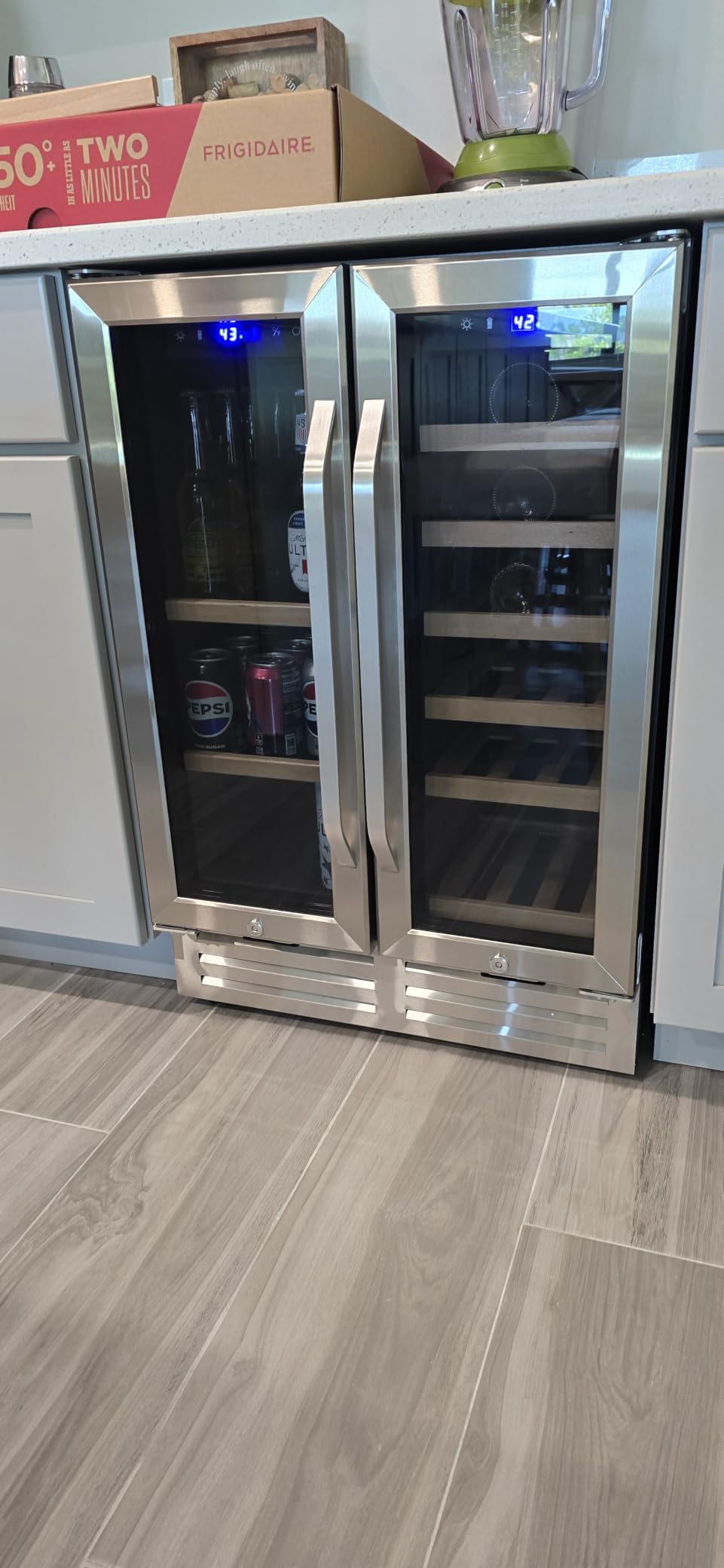
Owners praise the modern styling, quick cooling, and a clean under-counter fit in a new kitchen. Several reviewers highlight quiet compressor behaviour on most units, which is notable for a cabinet that will sit metres from a seating area.
The main criticisms are mechanical rather than electrical: shallow drawer gliders that leave bottles at the back hard to reach, no door-activated lighting option, and an isolated cluster of door-hinge bracket failures on arrival with slow support response.
One owner reports heavy humming and floor vibration audible through the room. That is a single report against a much larger body of quiet-operation comments, but it is worth listening for in person if you can.
Why 24 inches is the sweet spot width
At 23.4 inches wide this fits a standard 24-inch cabinet bay without cutting the cabinet run. It gives you dual zones and meaningful capacity while preserving the cabinet rhythm of the rest of the island.
The 4.9 cubic foot interior holds less than the 30-inch dual-zone units, but it uses a far smaller share of your island footprint, and the drawers are what make a mixed load manageable day to day.
The fit issues to design around
Drawers on short gliders mean back-row bottles need the whole drawer pulled out. If your island has seating directly in front of the unit, plan for that reach rather than assuming it will not matter.
Larger-format wine bottles are a tight fit, and the door lacks UV film protection. Check the glass specification before committing if the island sits in direct afternoon light.
12. Kalamera 24 Inch Single Zone Beverage and Wine Cooler
Beverage Fridge 24 Inch Beverage and Wine Cooler Built-in or Freestanding – 120 Cans & 16 Bottles Capacity Wine Refrigerator Cooler
5.3 cu. ft.
120 cans and 16 bottles
22.4D x 23.4W x 33H in
Auto defrost
Pros
- 120 cans and 16 bottles in a 23.4 by 22.4 inch footprint
- Whisper-quiet compressor holds setpoint
- Automatic defrost every six hours
- Stainless frame with double tempered glass
- Door reverses in about 25 minutes
Cons
- Single zone so beer and wine share one setting
- Condensation drainage has been reported leaking onto the cabinet base
- Racks can tip when pulled out loaded
- Controls and light switch are inside the cabinet
- 116 pounds needs a dolly and two people
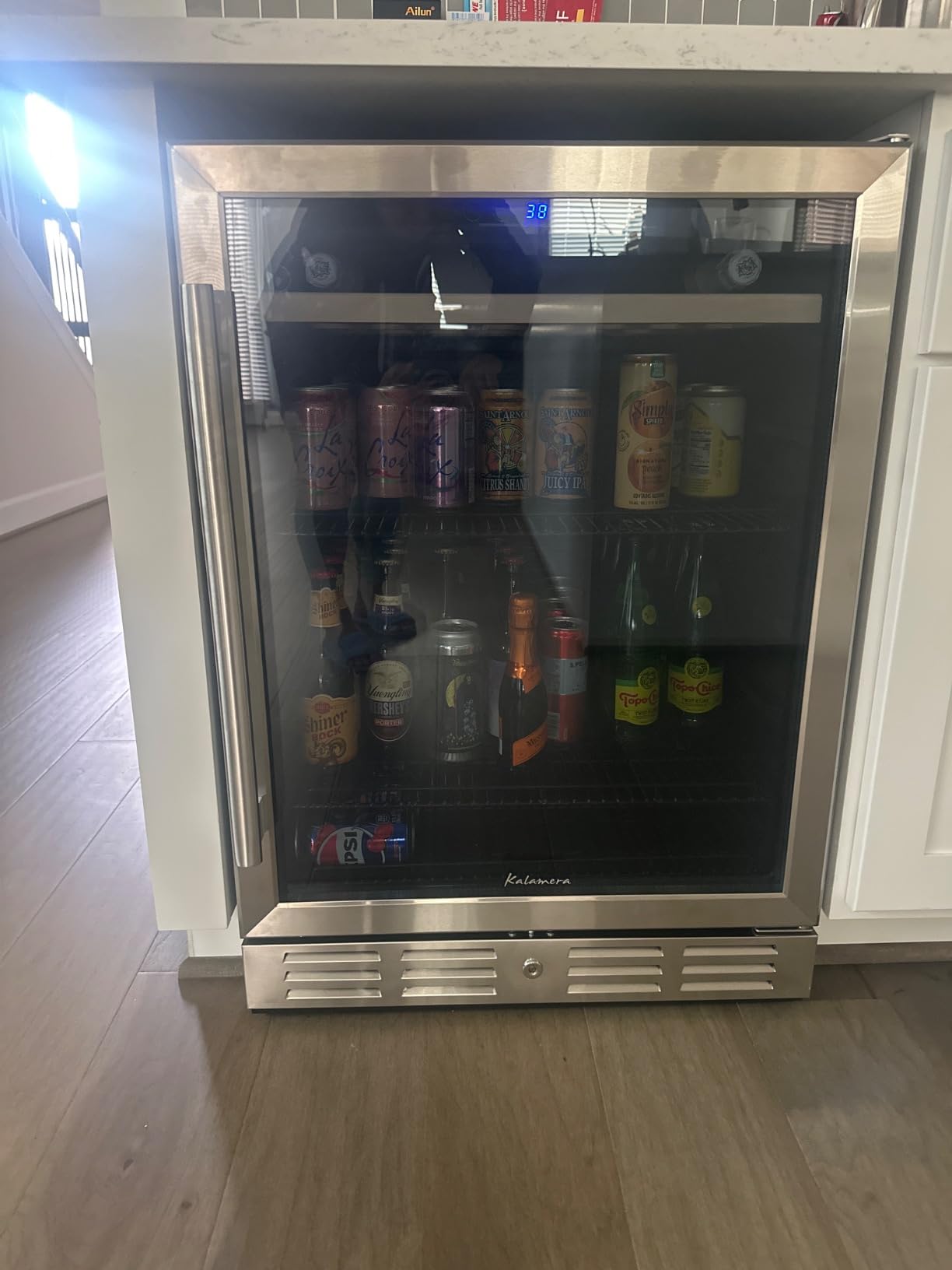
If your island is really a bar, this is the unit. It holds 120 cans and 16 wine bottles in a 23.4 by 22.4 by 33 inch cabinet, the highest can count in the guide, and the automatic defrost runs every six hours with no manual cycle.
The stainless frame with two layers of tempered glass reduces fogging, and the FSC-certified wooden frame reduces bottle vibration. The door reverses in about 25 minutes, which is the single most useful feature on any island install because it lets you match the hinge to the cabinet run.
What stands out here is the long-term reporting. Multiple owners describe multi-year reliability and a roughly 30-minute pull-down to 38F, and reviews mention accurate bottom-of-cabinet temperatures. That is the kind of data you only get from people who have owned the unit long enough to be useful.
At 4.2 stars across 501 ratings, the critical feedback splits into two groups. One set complains that controls and the light switch are inside the cabinet rather than on the door face. The other reports condensation drainage leaking onto the floor and cabinet base, with support unable to resolve it.
Listed annual energy consumption is 309.6 kilowatt hours per year, higher than the mid-size units here because of the cabinet volume.
Single zone means one number to hit
Everything in the cabinet sits at one temperature. That is fine at 38 to 42F for a bar full of beer and everyday whites, and wrong for a serious red collection. Know which side of that line you are on before you buy.
Reported temperature readings vary a few degrees between the top and the bottom of the cavity, so place reds low if you are mixing formats.
The two issues we would raise with the maker
Condensation drainage leaking onto the cabinet base is the most serious complaint in the reviews because it damages cabinetry. Ask about the drain routing and the pan capacity before installation, and check under the unit after the first week of cooling.
At 116 pounds this needs a dolly and two people to place. Also confirm the door reversal procedure, because doing it after the cabinet is closed is a bad afternoon.
How to measure your kitchen island cutout before you buy
Measure the cavity three times: at the front, at the middle, and at the back of the cabinet box. Cabinets are rarely square, and the smallest of the three readings is the one that decides whether the unit fits.
Then measure the height under the countertop, not the height of the cabinet box from the floor. Toe kicks and uneven flooring take up space that the appliance drawing does not account for.
Depth is where island projects go wrong. Measure from the front face frame to the back wall of the cavity, then compare against the product’s install depth plus the clearance the manufacturer requires. Zephyr’s Brisas at 25.38 inches deep is the unit that most often fails this test.
Finally, check the counter overhang. If the island has seating, the counter usually overhangs far enough that the unit must sit forward in the box, which means the door face ends up proud of the cabinet line.
The five-point pre-purchase checklist
Is the unit rated for built-in installation, with front ventilation?
Does the manufacturer’s cutout width, height, and depth fit your measured cavity?
Can a technician reach the coil and filter once the cabinet is closed?
Is there a suitable outlet inside the island, and on which circuit?
Does the door swing avoid island seating and any adjacent drawers?
On that last point, our bar stool guide for kitchen islands is worth reading before the stools are ordered, because the stool positions and the appliance door swing have to agree.
To hand a spec sheet to a cabinetmaker, give them four numbers: cavity width, cavity height, cavity depth to the back wall, and the appliance’s required clearances on each side. Everything else on the page is marketing. If a supplier cannot supply those four numbers, treat the unit as unmeasured rather than as a good deal.
Front-vented vs rear-vented cooling inside an enclosed island
A front-vented unit draws air in at the bottom of the door and expels it at the top, entirely inside the cabinet opening. A rear-vented or freestanding unit pushes its heat out the back into the cabinet cavity, where it has nowhere to go.
This is the single biggest cause of premature failure in this category. A freestanding compressor box installed inside island cabinetry runs its compressor continuously, cools unevenly from top to bottom, draws more electricity, and fails years early. It is a remodel-level mistake that is invisible until it is expensive.
Compact units are less tolerant of restricted clearance than full-size refrigerators, because the condenser fan is smaller and moves less air. The assumption that a smaller appliance copes better in a tighter space is exactly backwards.
Symptoms that point at a ventilation problem
The compressor runs constantly and never visibly rests.
The top shelf is warmer than the bottom, or the back of the cabinet is hot to the touch.
Temperature readings drift between shelf positions rather than holding steady.
Frost or condensation builds on the interior glass.
Noise and vibration increase over the first year as the compressor works harder.
If any of those show up within the first year, stop stacking anything on top of the unit and check the clearance figures before assuming a part has failed. Owners who time the compressor run and rest rhythm as a health check report that this simple habit catches problems early.
Single zone or dual zone, and how many bottles you actually need
Headline bottle capacity assumes standard 750ml bottles placed in a single row. Wide Bordeaux, magnums, and sparkling bottles each take more than one row, so a 30-bottle unit may hold 18 to 22 bottles of a mixed collection. Ask the manufacturer for the shelf spacing in inches rather than relying on the count.
Two zones mean two independent temperature targets, which is what you need if you drink reds and sparkling from the same cabinet. They also mean a shorter interior and slightly higher energy draw, because there are two sections to cool.
For most kitchen island installs, one zone is the correct answer if you serve a single style, and two zones are worth it if you genuinely keep both reds and whites long enough to care about the difference. A 15-inch single-zone unit typically holds more usable bottles than a 15-inch dual-zone unit.
Width is the next decision. Twelve inches solves a tight cabinet but limits formats. Fifteen inches is the workhorse. Twenty-four inches gives real dual-zone capacity in a standard bay. Thirty inches is a beverage center and needs a full-width opening.
Panel-ready, stainless or integrated doors for custom cabinetry
A stainless or glass-front built-in is a finished appliance that happens to fit a cabinet opening. A panel-ready unit ships with a frame designed to accept a custom wood or painted panel, so the cooler disappears into the cabinetry run.
For a custom island, panel-ready is the only option that looks deliberate. The trade-offs are that you must match your cabinetmaker’s panel specifications exactly, and the door will not show your collection to guests the way a glass door does.
The retrofit option exists. You can order a stainless unit now and have a wood panel fabricated later, but it costs more than specifying panel-ready from the start and leaves visible gaps around the frame if the panel is not machined to the appliance.
Also look at hinge direction. Several units in this guide, including the NewAir and the Kalamera 24-inch, have reversible doors, which lets you choose the swing after the cabinet run is fixed. That flexibility is worth more than a small feature difference when an island has seating on one side only.
Electrical, noise and maintenance before the countertop goes in
Islands rarely have a convenient outlet. A permanently installed compressor appliance should go on a dedicated circuit rather than sharing a small-appliance circuit with a microwave or a second fridge, and the outlet needs to sit inside the island rather than in a drawer that gets opened constantly.
Decide this at the electrical rough-in stage. Adding a circuit after the countertop and cabinetry are templated is the expensive way to solve a problem that costs very little to plan for. Some coolers in this guide come with two-pin corded plugs, so confirm the outlet type your unit needs before the electrician orders fittings.
Noise is the consideration people skip and then regret. An island is open on two or three sides, so there is no wall to absorb compressor hum or vibration. Owners of the quieter units here describe numbers in the high 30s to low 40s dB, which is generally acceptable; the complaints in the reviews cluster on the units that sit next to seating rather than across a walkway.
Service access decides how long the unit lasts. You need to reach the condenser coil and any air filter with the cabinet closed, and you need to be able to slide the unit out without removing the countertop. Several coolers here use a removable air filter behind the door, which is the reason we prefer them in an enclosed island.
On running costs and environmental profile, published annual consumption figures in this group range from 162 kilowatt hours per year for the ORYMUSE to just over 332 for the Kalamera 24-inch dual-zone. Right-sizing to the collection you actually own does more than a settings change ever will: an underfilled cabinet runs its compressor harder to hold the same temperature, and R-600A and R-290 refrigerant models carry a much lower global-warming profile than the older HFC-based units.
Frequently Asked Questions
Which built-in wine cooler is the best?
For most kitchen islands the Tylza 15-inch 30-bottle dual-zone cooler is the strongest all-round choice, because it combines two temperature zones, six wood shelves, front ventilation rated for built-in installation, and the strongest review base among dual-zone 15-inch units. If the cabinet opening is under 15 inches, the Velieta 12-inch front-vented unit is the narrowest built-in rated cooler here and the one that fits.
How much clearance does a built-in wine cooler need?
Measure the cavity at the front, middle, and back, then use the smallest figure. You need the manufacturer’s cutout width, height, and depth plus the stated clearance on each side, and enough depth behind the unit for airflow. Depth is the usual failure point on islands: units range from 22.4 inches deep to 25.38 inches deep, and a counter overhang eats into that space.
Can you install a wine cooler in a kitchen island?
Yes, provided the unit is rated for built-in installation and vents through the front of the door. Installing a freestanding or rear-vented unit inside island cabinetry traps its heat, so the compressor runs constantly, cools unevenly, uses more electricity, and fails years early. Plan the outlet inside the island on a dedicated circuit before the countertop is templated.
Is it normal for a wine cooler to run constantly?
A compressor cooler cycles on and off, but it should rest periodically. Running continuously usually means restricted airflow, an undersized condenser, or a room that is warmer than the unit’s rated ambient range. Compact units tolerate blocked clearance less well than full-size refrigerators because their condenser fans move less air.
How many bottles do I actually need in an island wine cooler?
Plan on roughly two-thirds of the headline figure for a mixed collection, because wide Bordeaux, magnums, and sparkling bottles each take more than one row. A 15-inch single-zone unit holds more usable bottles than a 15-inch dual-zone unit, so count your actual formats before deciding how many zones you need.
Should I buy a panel-ready wine cooler for a custom island?
If the island has custom cabinetry, panel-ready is the only option that looks deliberate, because the door frame accepts a panel matched to the rest of the run. Stainless and glass-front units read as appliances. Retrofitting a custom panel later costs more than specifying panel-ready from the start and leaves visible gaps around the frame.
Which built-in wine cooler for your island is right
For most people building a new island, the Tylza 15-inch 30-bottle dual-zone cooler is the pick. It hits the combination that matters most: two genuinely separate temperature bands, front ventilation rated for built-in use, wood shelves, and enough owner feedback to know how it performs.
If your cabinet opening is tighter than 15 inches, the Velieta 12-inch is the answer and there is no real substitute in this group. If you want a full-width beverage bay rather than a wine cabinet, the Velieta 30-inch and the FoMup 30-inch both hold 29 bottles plus 110 cans, and the FoMup is the shallower of the two.
Whichever you choose, measure the cavity three times, confirm front ventilation in writing, and get the outlet into the island before the countertop is templated. Those three steps prevent nearly every failure we read about in owner reviews. Our broader wine cooler guide for the home covers freestanding options if the island turns out to be the wrong room for the appliance.
This guide was checked and updated for 2026. Appliance specifications change, so confirm the cutout dimensions and installation requirements against the manufacturer’s current documentation before you order.