
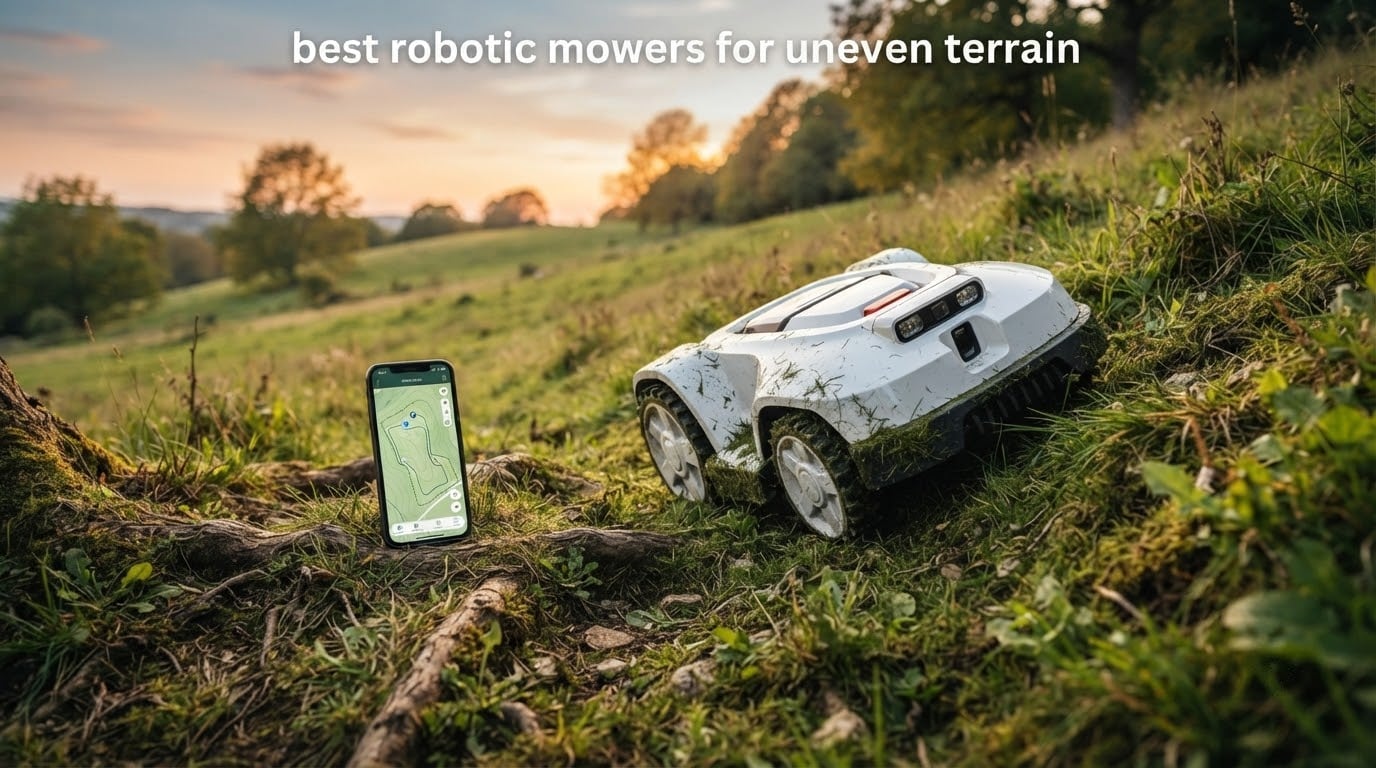
Most robot mowers are sold for flat, tidy suburban lawns, and that is exactly where the marketing photos come from. Put the same machine on a property with real rolls, a bank down to the road, exposed tree roots and a few divots, and the picture changes fast. Wheels spin on damp grass, the deck scalps high spots and misses low ones, and the machine ends up parked at the bottom of a slope with its blades off the ground until somebody walks up and pushes it home. That is the problem this guide solves. I have spent the last several weeks working through the current crop of battery mowers built specifically for broken ground, and this is my ranking of the best robotic mowers for uneven terrain, ordered by how much punishment each one can take.
The short version: an all-wheel-drive chassis, a slope rating of 45 percent or higher, and a floating deck are the three things that separate a robot mower that survives a real yard from one that spends its life being rescued. Dual-style navigation, accurate edge cutting and quiet operation matter, but they come second. A beautifully mapped machine that cannot climb your hill is a very expensive lawn ornament.
It is worth saying up front that a robot mower is a maintenance product, not a set-and-never-touch-it appliance. On rough ground you will clean the underside, check the wheels and replace blades more often than you would on a bowling green. If you have a heavily shaded yard, you also have to think about how the machine finds its way home, which is a different problem from how it drives once it gets there. Owners of self-cleaning pool robots face the same divide between navigation reliability and mechanical endurance, and the comparison we ran on robotic pool cleaners turned up the same pattern.
Table of Contents
Top 3 Best Robotic Mowers for Uneven Terrain
These three are the ones I would put on a shortlist first, and each solves a slightly different version of the uneven-ground problem.

Mammotion LUBA mini 2 AWD 1500H
- 360 degree LiDAR plus dual cameras
- 80% slope with adaptive suspension
- Dedicated edge cutting disc
- 260 owner reviews

Mammotion LUBA 3 AWD 3000
- LiDAR plus NetRTK plus AI vision
- 80% slope climbing
- 500 square meters per hour
- 30 zones with no-go areas

MOVA LiDAX Ultra 1000
- RTK-free 360 degree 3D LiDAR mapping
- 45% slope with off-road wheels
- Edge cutting within 2 inches
- 3-year warranty
Best Robotic Mowers for Uneven Terrain in 2026
Every machine below is wire-free, meaning no boundary cable in the ground. Key features are drawn from the manufacturer listings so you can compare traction and navigation at a glance.
| Product | Specifications | Action |
|---|---|---|
| Mammotion LUBA mini 2 AWD 1500H |
|
Check Latest Price |
 Mammotion LUBA 2 AWD 3000HX Mammotion LUBA 2 AWD 3000HX |
|
Check Latest Price |
| Mammotion LUBA 3 AWD 3000 |
|
Check Latest Price |
 Lymow One Plus Lymow One Plus |
|
Check Latest Price |
 Segway Navimow i215 LiDAR Segway Navimow i215 LiDAR |
|
Check Latest Price |
 Segway Navimow i206 AWD Segway Navimow i206 AWD |
|
Check Latest Price |
 Sunseeker X5 AWD Sunseeker X5 AWD |
|
Check Latest Price |
 Roborock RockNeo Q110H Roborock RockNeo Q110H |
|
Check Latest Price |
| MOVA LiDAX Ultra 1000 |
|
Check Latest Price |
 Dreame A3 AWD 1000 Dreame A3 AWD 1000 |
|
Check Latest Price |
1. Mammotion LUBA mini 2 AWD 1500H for the Most Owners
(2026 Upgrade) Mammotion LUBA mini 2 AWD 1500H Robot Lawn Mower, for 0.37 Acres, 360° LiDAR+Dual-Camera AI Vision, 80% Slope, DropMow, 20 Multi-Zone Management
360 degree LiDAR plus dual cameras
80% (38.6 degree) slope
Adaptive suspension over 75mm
7.9 inch cutting width
Pros
- Largest review pool in the lineup at 260 ratings
- Dual sensing stack improves obstacle detection
- Custom charge limits and off-peak charging
- Dedicated edge cutting disc for a clean finish
Cons
- Cut quality depends on settings and may need multiple passes
- Coverage figures assume short passes
- Mapping and app pairing friction during setup
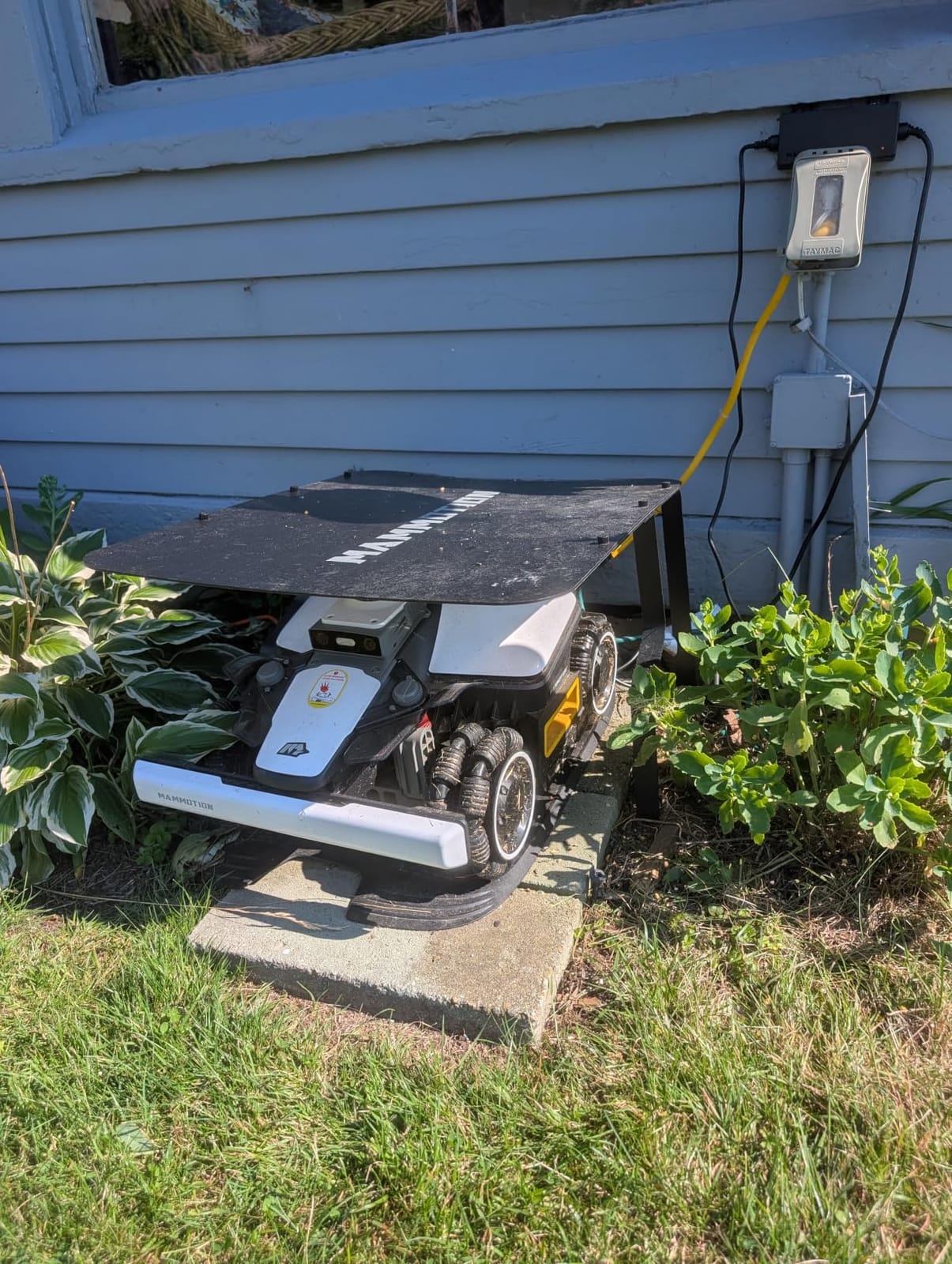
With 260 owner ratings averaging 4.4, this is the best-evidenced machine in the group, and for most uneven lawns it is the pick I would actually make. Two independent 88 watt motors drive all four wheels to the same 80 percent slope capability as the larger LUBA models, which is remarkable in something sized for 0.37 of an acre.
The suspension is the part that changes the character of the machine. Adaptive suspension steps over curbs, roots and thresholds up to 75mm, so the deck does not slam down every time it crosses a root or a raised bed edge. On a lawn that is genuinely broken rather than merely rolling, that is worth more than any navigation upgrade.
Sensing is doubled up: a 360 by 45 degree field of view LiDAR paired with dual cameras. Owners like the redundancy because it means the mower still detects a pet, a toy or a dropped hose when one system is confused by low evening light. Physical bumpers add a final layer underneath both.
Battery management is unusually thoughtful. You can set a custom charge limit and schedule charging for off-peak hours, which both prolongs battery life and lowers the electricity cost of a long mow. Average battery life is quoted at 60 minutes, covering about 500 square meters per charge, and the machine returns to the dock and resumes rather than stalling where it stopped.
What You Get That Smaller Machines Lack
The main cutting disc has automatic height adjustment, and there is a separate edge cutting disc that handles the strip where grass meets a hard surface. On a lot with a driveway or a path cutting through it, that removes a recurring weekend job.
There is also a DropMow mode that needs no mapping at all. Place the machine, press mow and start, and it works a defined area. That is useful for a neglected patch or a recently cleared area where mapping a whole new lawn feels like overkill.
What to Watch Before You Order
Cut quality is settings-dependent. Owners note that multiple passes may be needed to keep uneven turf tidy, and that the published coverage assumes short passes without heavy turning and backing. On a hilly lawn with tight corners, plan on adjusting the cutting height and pattern in the app before the first session rather than after.
Some buyers hit mapping and app pairing friction during setup. It is solvable, but expect to spend an evening with it. I would also read the width into your planning, because a 7.9 inch deck is narrower than the 15 inch decks on the bigger models and coverage per charge is lower as a result.
2. Mammotion LUBA 2 AWD 3000HX for Pattern Work on Steep Property
Mammotion LUBA 2 AWD 3000HX Robot Lawn Mower with 4G, All-Wheel-Drive for 80% Slope, Perimeter Wire Free for 0.75 Acre, UltraSense AI Vision & RTK Auto-Mapping, 2.2″-4.0″ Adjustable Cutting Height
165W four-wheel drive
80% (38 degree) slope
15.8 inch cutting width
2.2 to 4.0 inch cut height
Pros
- Handles steep bumpy and hilly ground without getting stuck
- Very quiet with built-in lights for night mowing
- Precise boundary following and clean pattern mowing
- Configurable mowing patterns with 3D lawn printing
Cons
- Demanding setup with a long complicated manual
- Grass tears on right-angle turns
- RTK house mount sold separately
- 4G needs a subscription after the first year
This is the machine I keep coming back to for genuinely sloped ground. Four independent 165 watt drive motors give it real climbing ability, and the manufacturer rates it for 80 percent, which is about 38 degrees. Owners who took it onto rough, hilly property report that it kept working rather than stalling, which is the single thing you are buying.
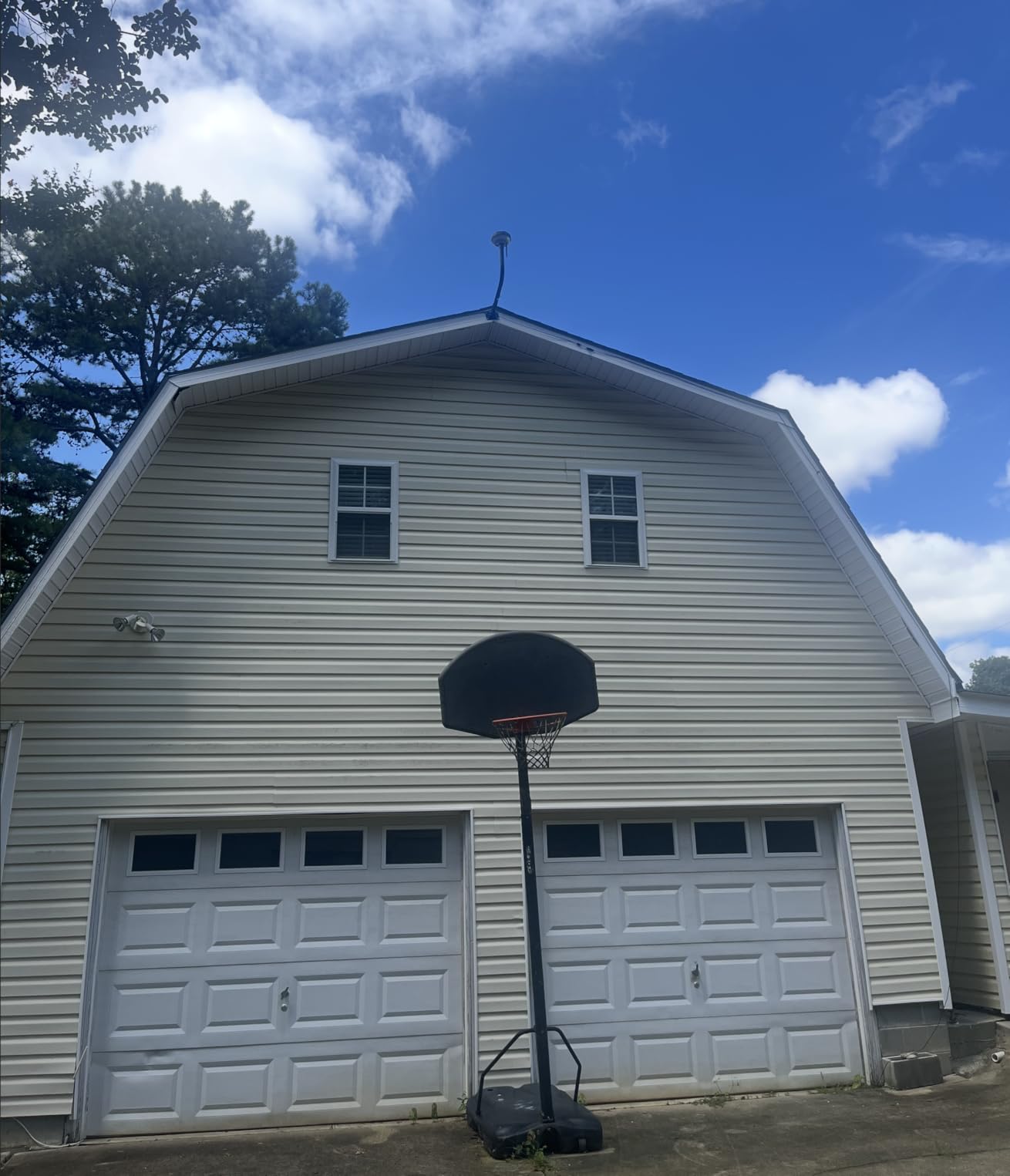
The navigation is a hybrid. RTK positioning handles open ground, and UltraSense AI vision takes over where satellite signal degrades under tree cover. That combination matters on broken land because hills and tree lines are exactly where a pure RTK machine starts to wander.
What impressed me most in the owner feedback was the cutting pattern work. This model can run parallel lines, checkerboard or a diamond grid, and the riding-style edge cutting gets close to walls and fences without a separate trimmer pass. Razor blades take off a small amount at a time, so the lawn stays even between visits rather than being attacked once a week.
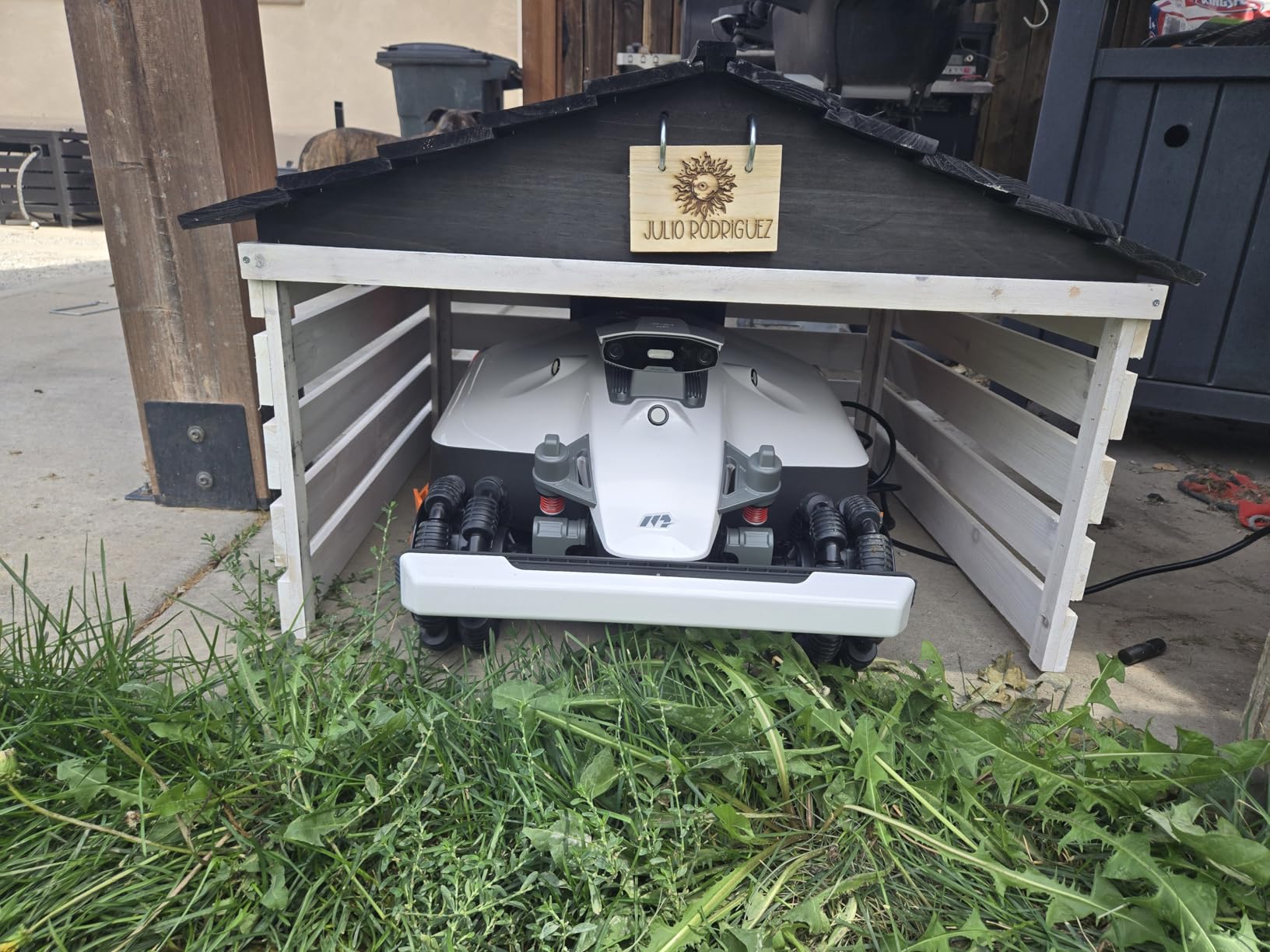
The setup is the weak point, and I want to be straight about that. Owners describe the manual as long and complicated, and the RTK house or roof mount is a separate purchase that has to be mounted high for the system to hold accuracy. If you are not comfortable running an install, budget time for it. The 4G connection also stops being free after the first year, which is a running cost you should factor in rather than discover later.
When the LUBA 2 AWD 3000HX Is the Right Call
Choose this one if your property is large, spread out and steep, and if the finished look matters more to you than setup convenience. It handles up to 30 mowing areas with no-go zones, so a complicated lawn with flower beds, trees and a pool can all be separated cleanly. Owners also report precise boundary following, which reduces the unmowed fringe you have to strim later.
It is also the pick for anyone who wants the mower to work at night. Built-in lights and low noise mean it can run while the household is asleep.
Where It Falls Short
The right-angle turn behaviour is the flaw I would watch. Owners report the mower tearing grass where it pivots, and the fix is a gradual-turn algorithm in the app. On delicate thin grass that scuff mark is visible.
There is also a report of the machine occasionally stalling on small driveway ramps, which is a reminder that an 80 percent rating applies to sustained gradients rather than sudden steps. At least one owner reports an unrepaired malfunction under warranty, so confirm the local service arrangement before committing.
3. Mammotion LUBA 3 AWD 3000 for Large Rolling Lawns
Mammotion LUBA 3 AWD 3000 Robot Lawn Mower with Cleaning Stand (Ship Separately), 360° LiDAR+NetRTK+AI Vision, AWD for 80% Slopes, 5400 sq.ft/h, Cutting Height 1.0″-2.7″
LiDAR plus NetRTK plus AI vision
80% (38.6 degree) slope
500 square meters per hour
Cut height 1.0 to 2.7 inch
Pros
- AWD gets through very irregular coarse thick turf
- Very quiet with a night light
- LiDAR holds position on treed yards
- Very low electricity cost per mow
Cons
- Online manual is largely unhelpful
- App is hard to use for mapping in bright sunlight
- Battery may not finish a quarter acre on one charge
- WiFi reconnect issues and a spider web can stop it
This is the most capable machine in the Mammotion range for acreage, and the tri-fusion navigation stack is the most elaborate here. A 360 degree LiDAR with a 59 degree vertical field of view and a range of 230 feet is fused with NetRTK positioning and dual-camera AI vision. Each system covers the failure mode of the other two, which is why owners say it holds position on treed yards without needing a satellite receiver at all.
Two 165 watt motors drive 6-blade discs, and the drive is four-motor all-wheel drive rated to 80 percent, about 38.6 degrees. Adaptive suspension takes it over curbs, roots and thresholds up to 50mm. The quoted output is 500 square meters per hour off a battery that runs up to 175 minutes per charge, which is the number that matters on a large rolling lawn.
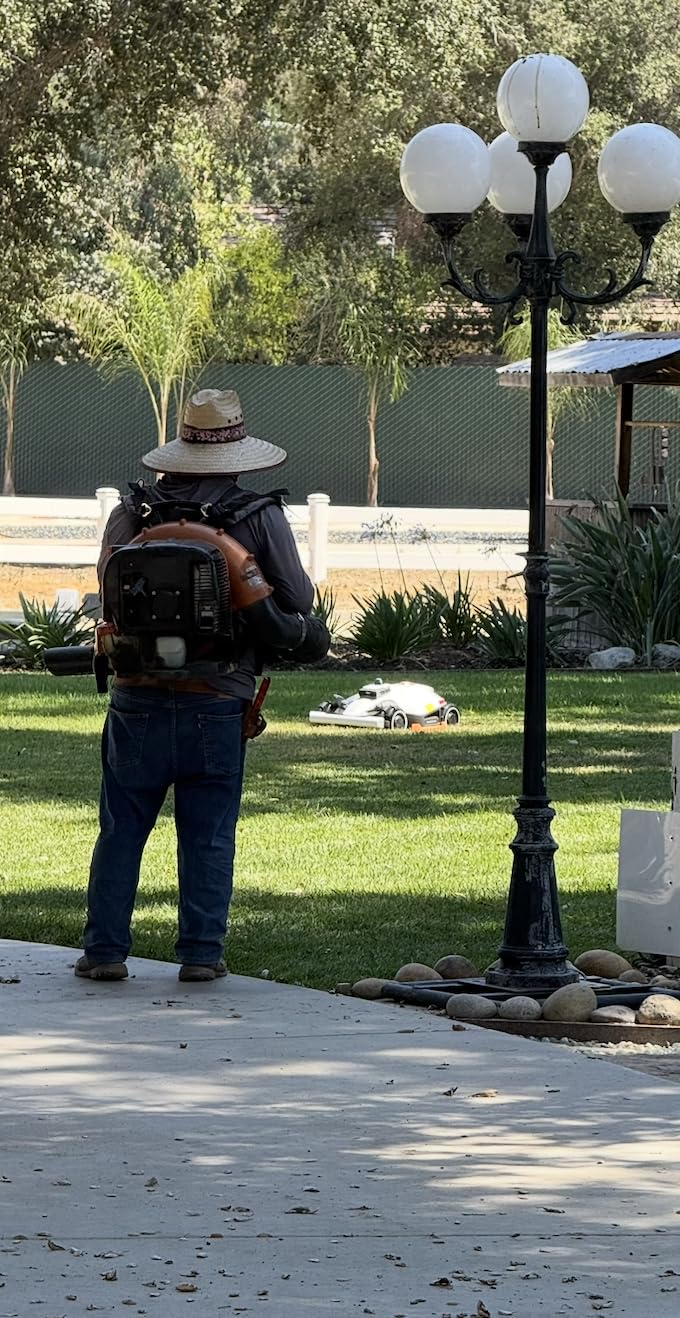
The running cost figure owners report is striking. One reviewer puts a full mow of 0.75 acres at roughly ten cents of electricity. Against a petrol mower, or even a corded electric one, the economics of automation start making sense on acreage rather than on a small suburban patch.
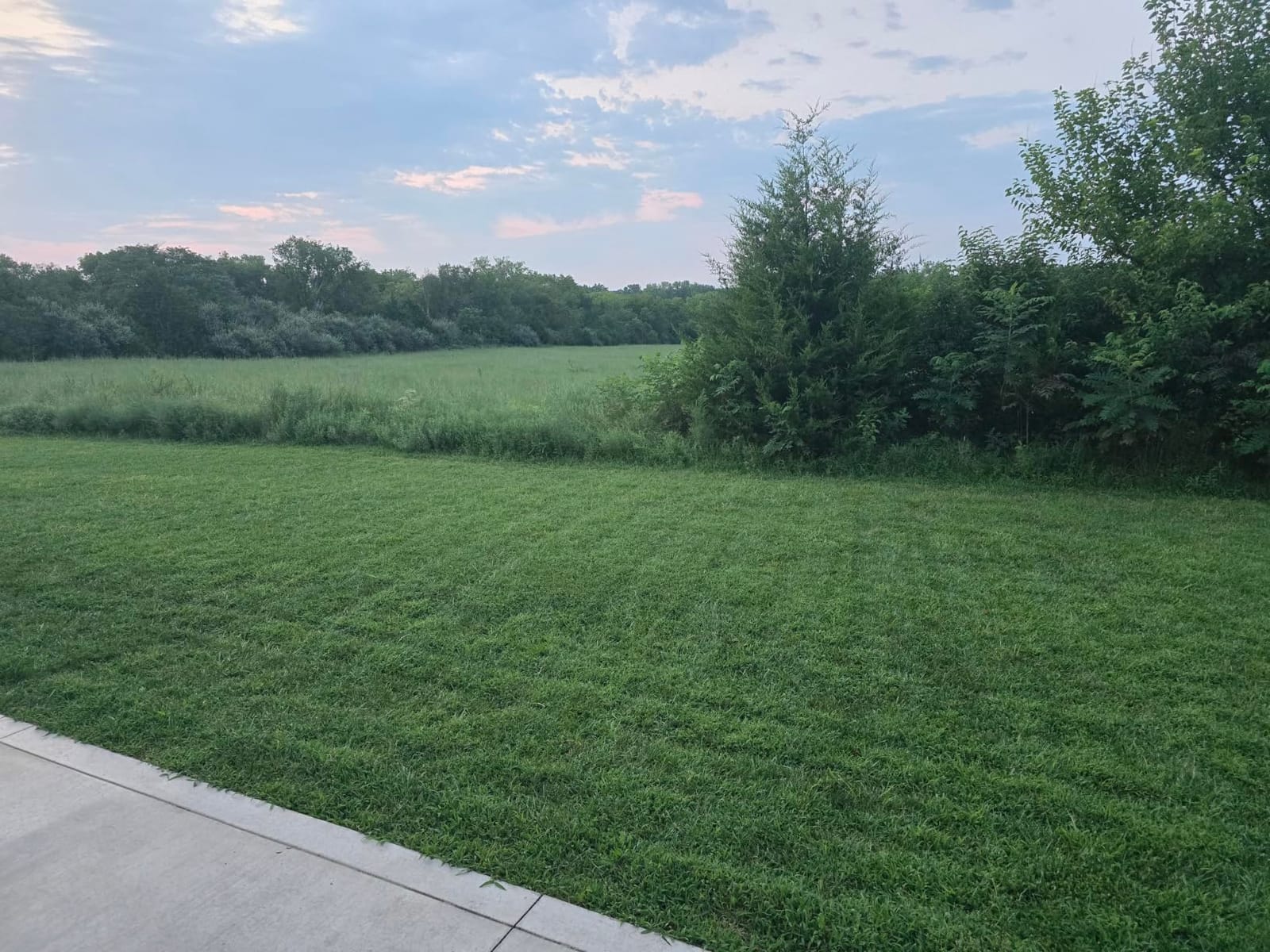
Traction is where owners single it out. Multiple accounts describe it working through very irregular, coarse, thick St Augustine turf that stalls lighter machines, and it stays quiet enough that the loudest noise is the body creaking. Rain sensing, lift detection and phone-based tracking of where the machine is all come as standard.
Buying This One for Larger Properties
It handles up to 30 mowing zones with no-go areas and offers perimeter, zigzag, checkerboard and adaptive zigzag patterns. The adaptive patterns are the sensible choice on hilly ground because they adjust to the contour instead of forcing a straight line across a slope.
A cleaning stand is included in a box of its own, and an extra blade set comes in the main box. On a machine working this hard, the cleaning stand is a worthwhile addition rather than a luxury, because mud and grass build up under the deck on exactly the kind of ground this mower is built for.
The Honest Downsides
Documentation is the biggest complaint. Owners say the online manual is largely unhelpful and that video tutorials are the practical guide. The app is also difficult to use for mapping in bright daylight because of screen glare, which is annoying if your only free time to set it up is a weekend lunch outdoors.
There is a cut-quality complaint that matters on rough ground: the mower pushes grass over rather than lifting it, so the finish can look ragged unless you tune blade RPM, pattern and cutter overlap. Owners also report the battery not always finishing a quarter acre on one charge at default settings, and occasional WiFi reconnect issues.
One specific maintenance item worth knowing: a spider web on the vision sensor can stop it cold, and the fix is a glance with a stick. That is a two-minute job, but it will happen.
4. Lymow One Plus for Genuinely Broken Ground
Lymow One Plus Robot Lawn Mower, Wire-Free RTK+Vision Navigation, 1.73 Acres Daily Coverage, 100% Slope (45°) Climbing, 1.2″-4″ Cut Height, AWD All-Terrain Automatic Robotic Mower, App Control
Heavy-duty track drive
45 degree (100%) slope climbing
2.8 inch obstacle crossing
16 inch dual rotary blades
Pros
- Tracked chassis handles swampy and wet ground with far less rutting
- 45 degree claim holds up on steep banks and swales
- Large coverage of 1.73 acres per day
- Steel blades and a self-lifting deck
Cons
- Weak manufacturer support and unresolved link issues
- Heat-related battery and blade failures reported
- Loose deck hardware and failing hub bearings
- Steep learning curve with many zones
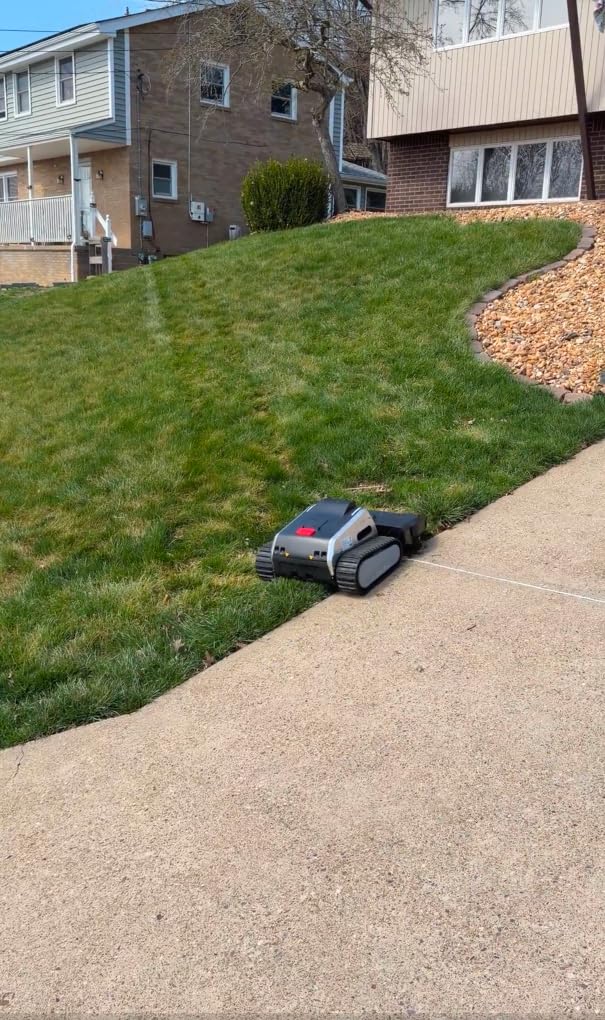
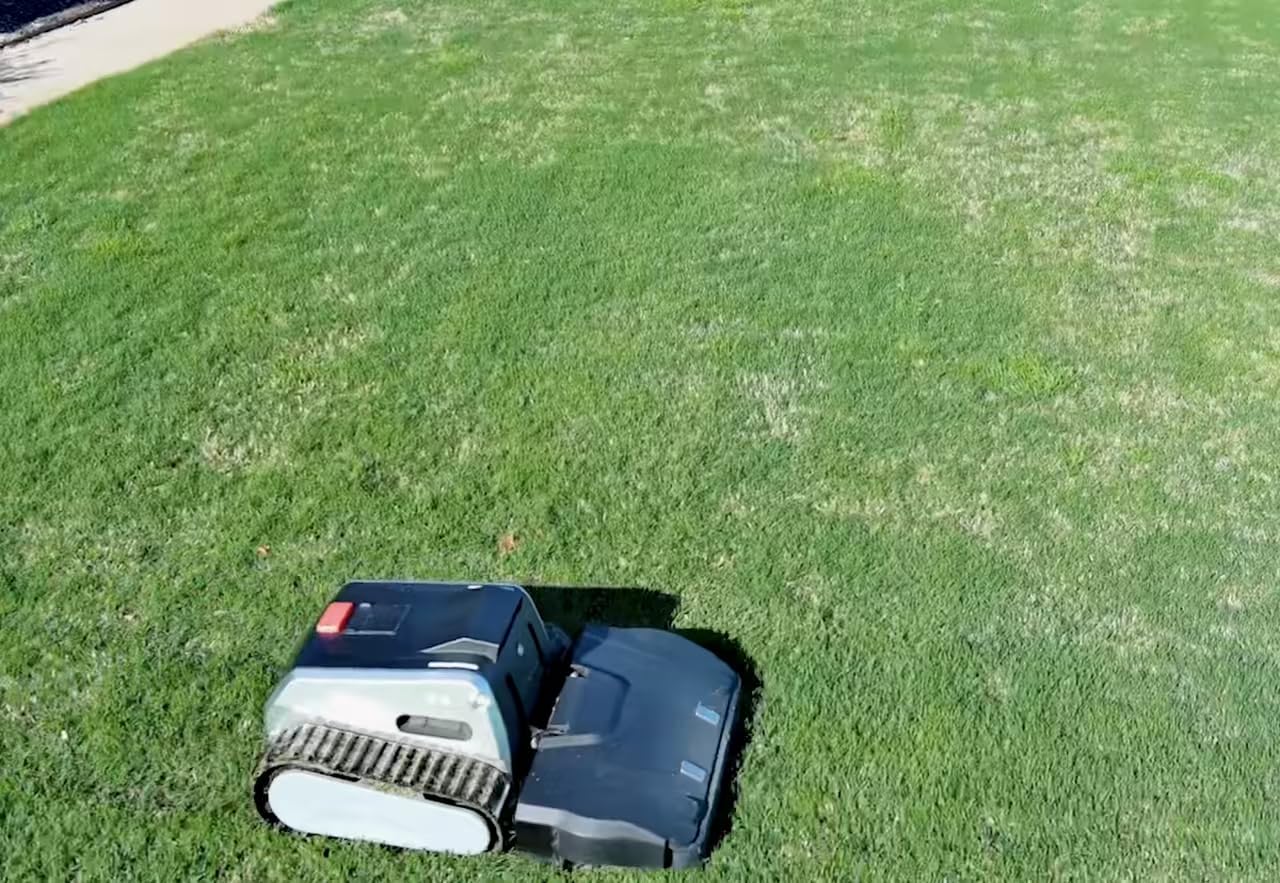
Everything else in this list rides on wheels. The Lymow One Plus runs on a heavy-duty track drive system, and that single design decision changes how it behaves on soft, wet and broken ground. A track spreads the machine’s weight across a wide contact patch, so it floats over mud that would bog down a wheeled mower and ruts far less.
The climbing figure is the highest here: 45 degrees, which is a 100 percent grade. It also crosses obstacles up to 2.8 inches, more than double what most of the field manages. Owners with steep banks and swales report that the claim holds up in practice rather than on paper.
Cutting hardware is serious. Dual SK5 tool-steel blades rated at 50 HRC spin on a 1785 watt peak motor reaching 6000 rpm, and a cyclone airflow system lifts flattened grass back up into the blade path so the stripes come out even. A single-side discharge keeps clippings off the lawn edge, and the deck self-lifts for cleaning.
Coverage is substantial as well. The 15,000mAh LiFePO4 battery is rated for over 2000 cycles, delivers about 0.57 acre per three-hour charge and can run up to three cycles a day for a stated 1.73 acres of daily coverage. Navigation is RTK combined with VSLAM visual mapping, which is why it stays stable near tall trees and high walls.
When a Tracked Mower Earns Its Place
If your ground is genuinely broken rather than merely sloped, this is the honest answer. Owners who replaced a riding mower on swampy, uneven terrain report far less rutting and far less grass tearing. The aluminum frame carries an IPX6 waterproofing rating and the 10 kg weight is genuinely portable when you need to recover the machine.
It also supports up to 80 managed zones including no-go zones, with auto-recharge and rain resume. A roof-mounted antenna gives it a solid signal on large or wooded properties, which is a real advantage when the alternative is watching a machine wander off the mapped area.
Where Support and Build Quality Concern Me
The 3.9 rating is not about capability, it is about what happens when something breaks. Owners report heat-related failures where the battery refuses to charge when hot and blades can stop while the mower keeps moving. There are also reports of loose cutting decks, broken front-wheel springs and failing bottom bearings on the hub motor.
Support is the real concern. Manufacturer chat links reportedly go nowhere, and satellite-link problems cannot be resolved remotely. With only 28 ratings behind it, there is limited long-term data. If you go this route, buy from a seller who will stand behind the machine, and keep expectations on the support side honest.
5. Segway Navimow i215 LiDAR for the Quietest Run
Segway Navimow i215 LiDAR Robot Lawn Mower, Wire Free Robotic Lawn Mower for 0.37 Acre, LiDAR & Vision Dual Fusion, Auto Mapping, Off-Road Wheels for 45% Slopes, Quiet 59 dB(A) Mowing
Solid-state LiDAR and vision fusion
45% slope with stability control
59 dB(A) mowing
7.1 inch cutting width
Pros
- Satellite-free navigation that works day and night
- Off-road wheels and stability control for 45% slopes
- One-tap auto mapping with no wire or antenna
- Built-in GPS geo-fence and Find My alerts
Cons
- 7.1 inch cutting width means more passes
- Off-road wheels rather than true four-wheel drive
The Navimow i215 is the quietest machine in this roundup at a stated 59 dB(A), and on a lawn where the mower runs at night that number matters more than it looks on paper. Owners specifically mention the operating noise dropping to the point where dogs stop reacting to it, which tells you something about the character of the sound.
Navigation is a solid-state LiDAR fused with onboard vision sensors, and it does not need satellite signal at all. That is the practical advantage on uneven ground bordered by trees and walls, where a satellite-dependent machine loses position. Owners report the fusion holding up day and night with genuine three-dimensional awareness of the space.
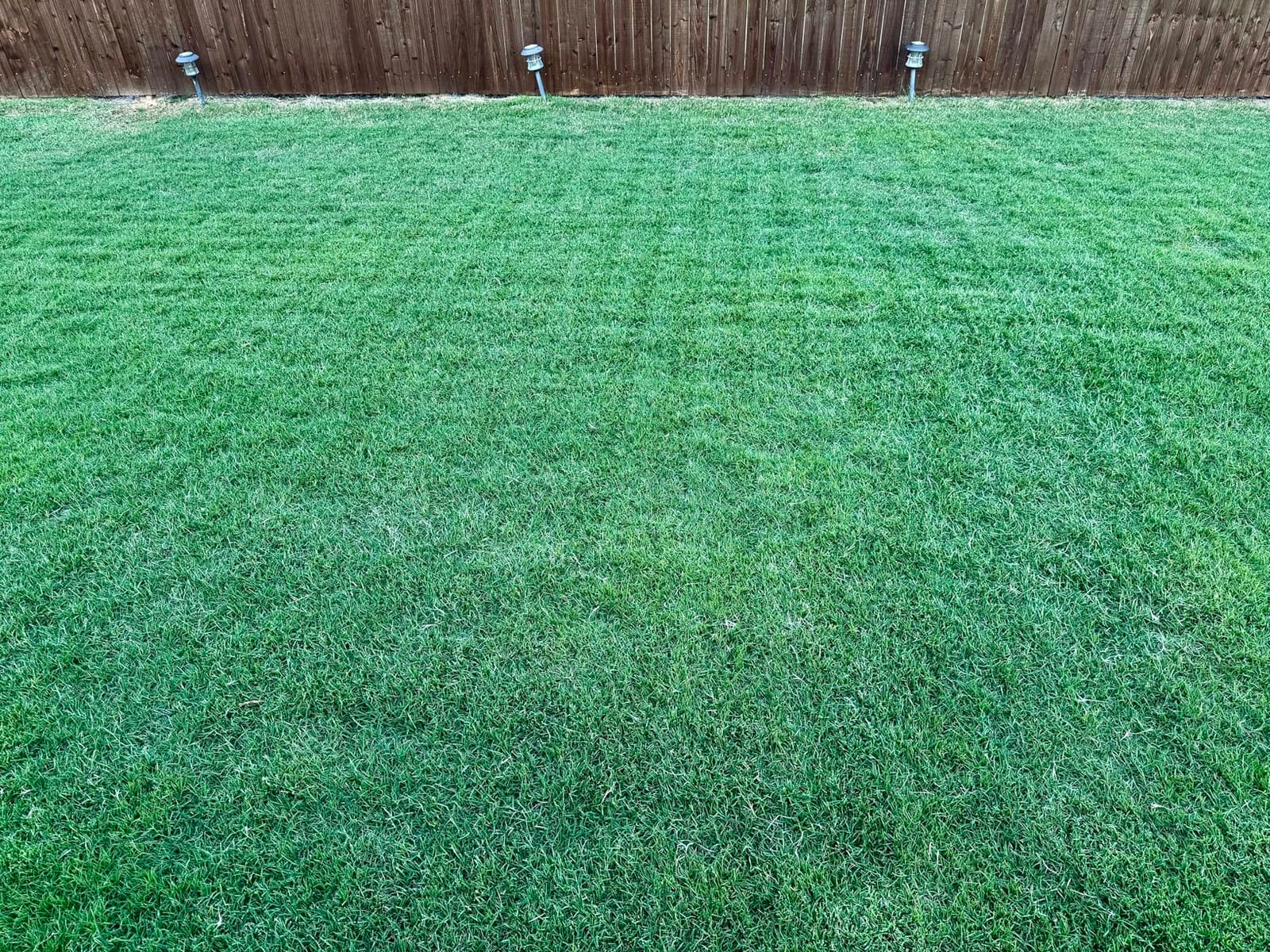
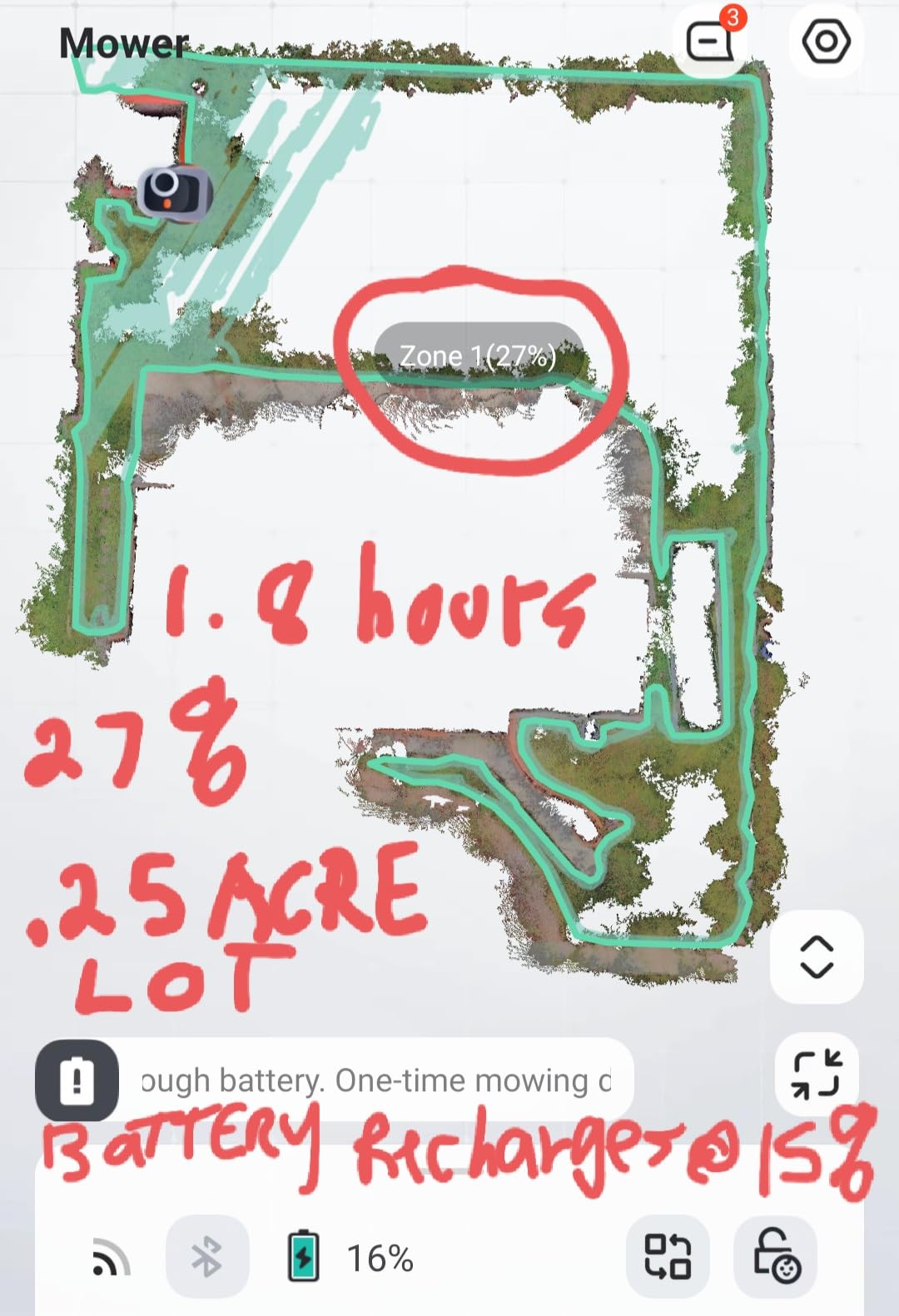
One-tap auto mapping removes both the boundary wire and the antenna installation. That matters more than it sounds on a rough property, because running a boundary cable through rocky, rooted ground is one of the most frustrating parts of installing a conventional robot mower. You can create up to 20 editable mowing zones, use the GeoSketch precision mapping, and draw patterns with the in-app Doodle tool.
Obstacle detection uses AI VisionFence, which classifies more than 200 object types at 0.4 inch accuracy. EdgeSense ride-on mode cuts along fences and pathways rather than leaving a gap, and cutting height adjusts between 2 and 4 inches across four positions.
Why This Works Well on Rolling Ground
The drive is off-road wheels combined with Electronic Stability Control, rated to 45 percent. The stability control does real work here, because on a side slope it is what stops the machine leaning and losing grip. A 100 watt motor with a 6-blade disc is adequate rather than powerful, and that shows in one specific place.
Security is unusually thorough for this class. You get GPS, a geo-fence, lift detection and Apple Find My alerts, plus auto-docking in extreme weather. Alexa and Google Home voice control are supported. On a property where the mower might be 200 feet from the dock, that combination is worth real money.
The Honest Limitation
Two things to weigh. First, the 7.1 inch cutting width is the narrowest deck here, so on anything over a quarter acre you will be making a lot of passes. Second, and more important for this article, this model uses off-road wheels rather than four driven wheels.
It handles a 45 percent slope with stability control rather than with drive torque, and on muddy or soft ground that is a meaningful difference from a true AWD chassis. If your problem is slope, it is fine. If your problem is soft wet soil that swallows traction, look further down this list.
6. Segway Navimow i206 AWD for Small Yards With Real Hills
Segway Navimow i206 AWD Robot Lawn Mower, New i105N, 0.15 Acre, 45% Slopes
All-wheel drive with stability control
45% slope climbing
Zero-turn steering
1350 square feet per charge
Pros
- AWD works on terrain where two cheaper robot mowers failed
- Zero-turn steering stops the turf tearing
- Very quiet operation
- Excellent phone-based customer service
Cons
- Auto mapping often fails and needs manual zone creation
- Maps can be lost and need remapping if the mower is lifted
- Leaves an unmowed swath along fences
- Occasionally gets stuck in lawn undulations on new sod
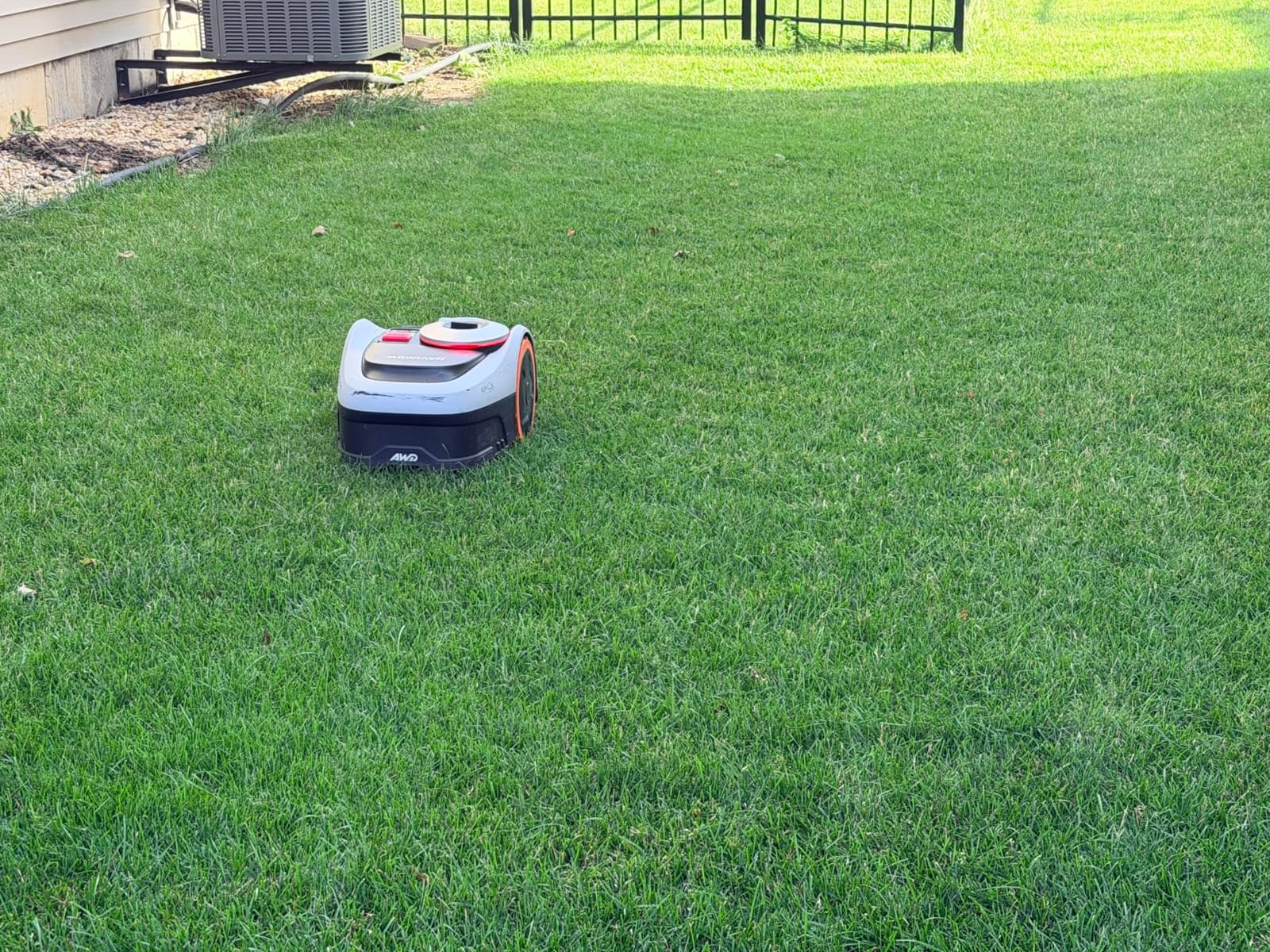
This is the compact entry in the Navimow AWD range, covering 0.15 of an acre, and several owners bought it specifically because two cheaper robot mowers had already failed on their ground. That is the clearest endorsement this drivetrain can get: it works where rear-wheel-drive machines did not.
Two design choices stand out. The all-wheel drive system uses automotive-grade stability control for 45 percent slopes, and the zero-turn steering pivots the machine in place without driving the wheels through the turf. On uneven ground that second feature is quietly important, because conventional turning arcs are exactly where grass gets torn and edges get ragged.
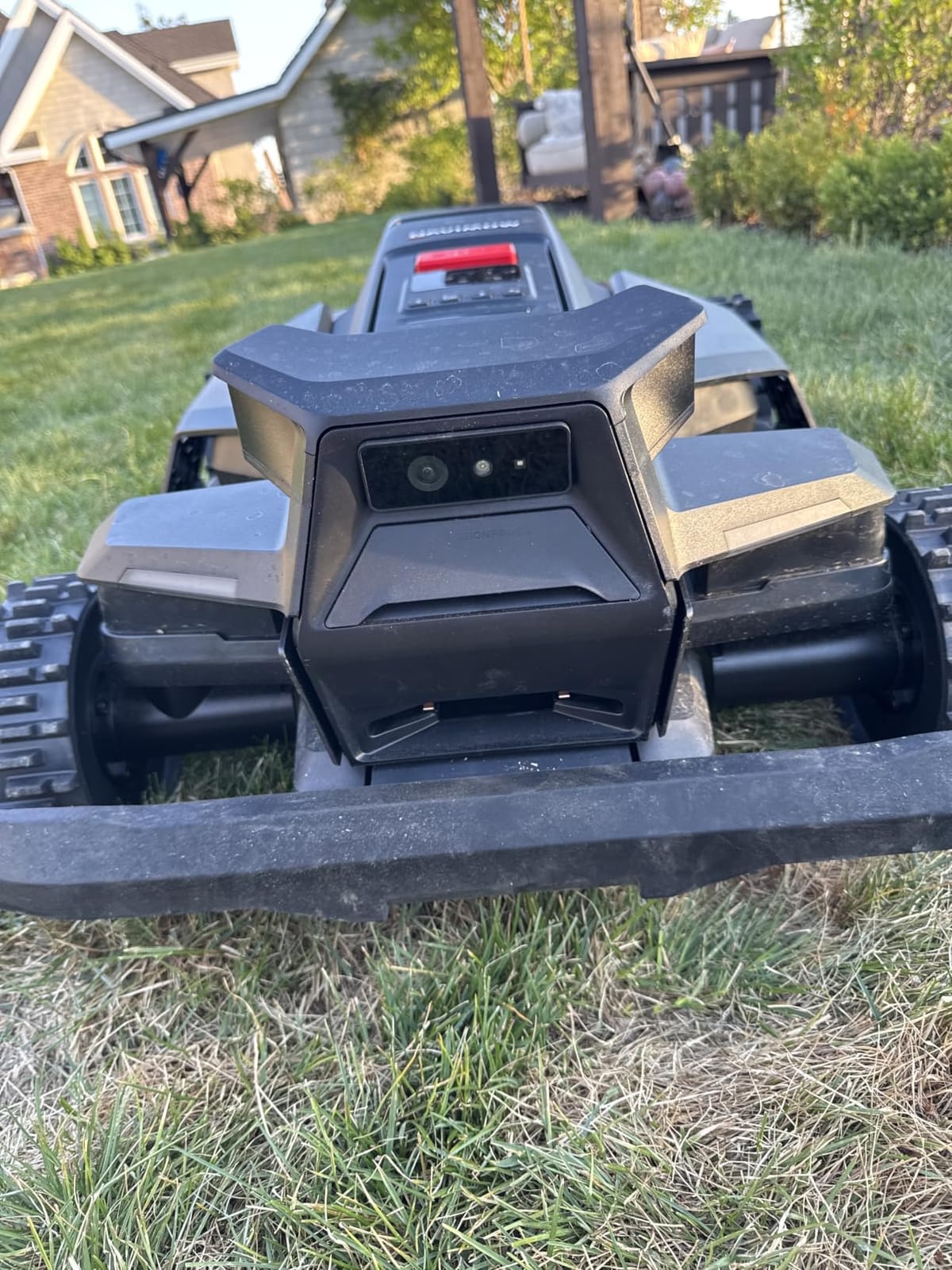
Owners also praise the adaptive power delivery, which conserves energy on easy passes and pushes harder when it meets thick grass or an incline. The 2.5Ah battery covers about 1350 square feet per charge, which on a small yard is a full mow. Auto-resume charging takes over from there, with up to 20 distinct mowing zones on optimised routes.
Customer service deserves a mention because it is unusual. Owners report free replacement parts being sent, a courtesy garage being provided, and phone support that is genuinely good. That kind of after-sales backing is worth more than a spec-sheet line, and it is the reason several buyers on this list came back to the brand.
Best Use Case for This Model
It suits a compact but awkward lawn: a small front plot with a sharp drop, a side return with a bank, a narrow path between two beds. Under a quarter acre, the 7.1 inch deck is not a real penalty. Setup was easy after a firmware update, and alternating mowing patterns produce clean stripes that owners repeatedly compliment.
Real-time GPS lift and off-course alerts give you a way of knowing when something has gone wrong, which matters on a small yard where you can walk out and look.
Where the Mapping Falls Short
Auto mapping is the real weak point and it is a recurring complaint. It often fails, leaving you creating zones manually, which is tedious on an uneven lawn. Maps can also be lost and need remapping if the machine is lifted or if a rear wheel sits on an incline, which on hilly ground is not an unusual event.
There are three more honest limitations. It leaves an unmowed swath along fences and boundaries, so you will still need to trim edges periodically. Very tall grass clumps cause it to mow around them for several passes. And owners do report it occasionally getting stuck in lawn undulations on new sod, so give a freshly laid lawn a season to settle.
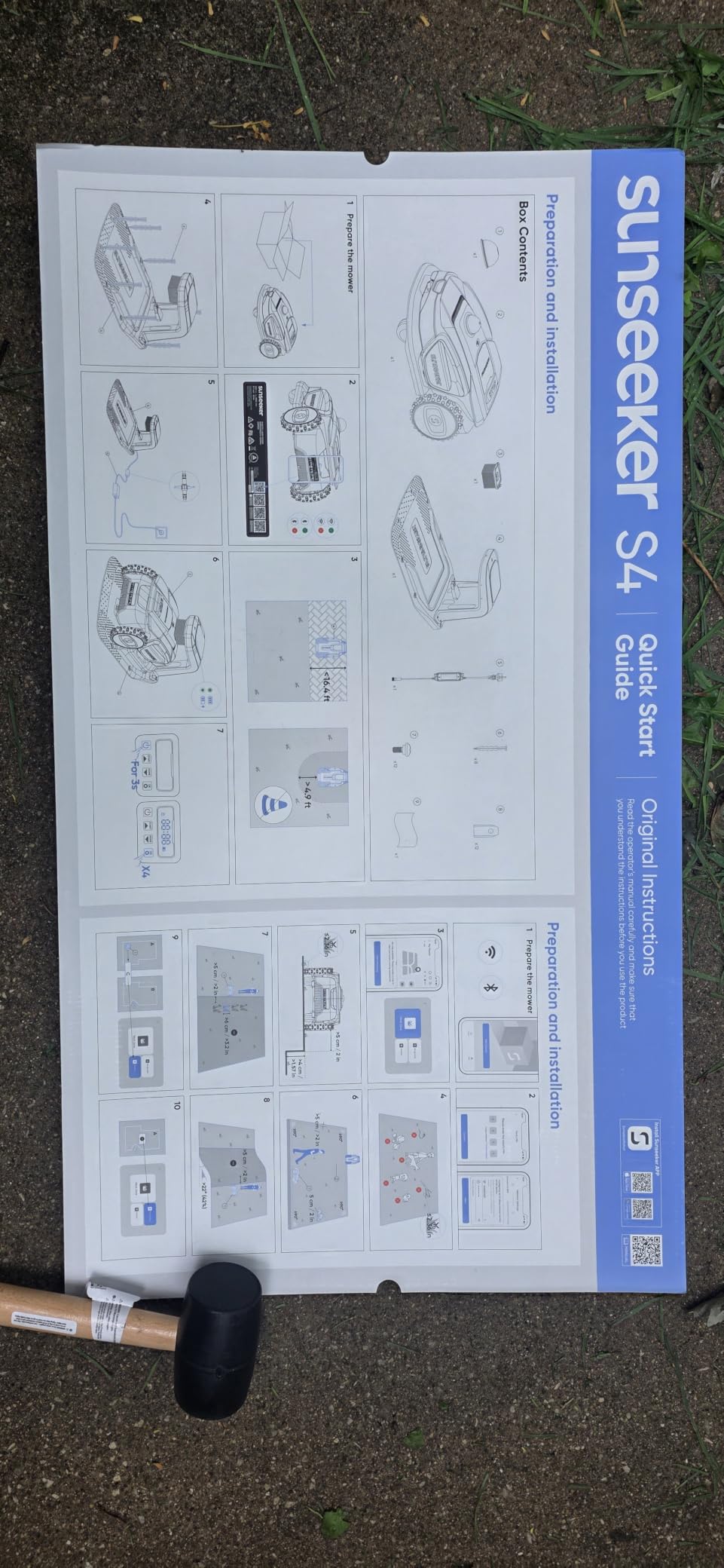
7. Sunseeker X5 AWD for Flower Beds and Narrow Passages
Sunseeker X5 AWD Robot Lawn Mower, RTK, Vision AI, 0.5 Acre, Wire-Free
AWD drivetrain
30 degree (60%) slope rating
8.7 inch floating cut deck
Handles 31.5 inch passages
Pros
- AWD drivetrain noticeably better than two-wheel-drive models
- Handles shaded and treed areas without losing position
- Produces clean straight stripes and custom patterns
- Very quiet and easy to schedule around rain
Cons
- Gets stuck on small transitions like a hump or a dip
- Boundary offsets leave roughly 18 inches needing manual trimming
- Tall grass gets treated as an obstacle
- Requires WiFi extenders on some properties
The Sunseeker X5 AWD covers up to 21,780 square feet, which is more than most of the quarter-acre machines here, and it does it at 26 pounds, light enough to lift without much strain. That weight matters on hilly ground for a practical reason: if the machine does get stuck, you are more likely to be able to recover it yourself.
Its slope rating of 30 degrees, or 60 percent, sits in the middle of this group. It will not tackle the 45 degree banks the tracked machine climbs, but it comfortably covers rolling ground, roots and thicker turf. Rugged tires and independent front suspension do the work over uneven surfaces.
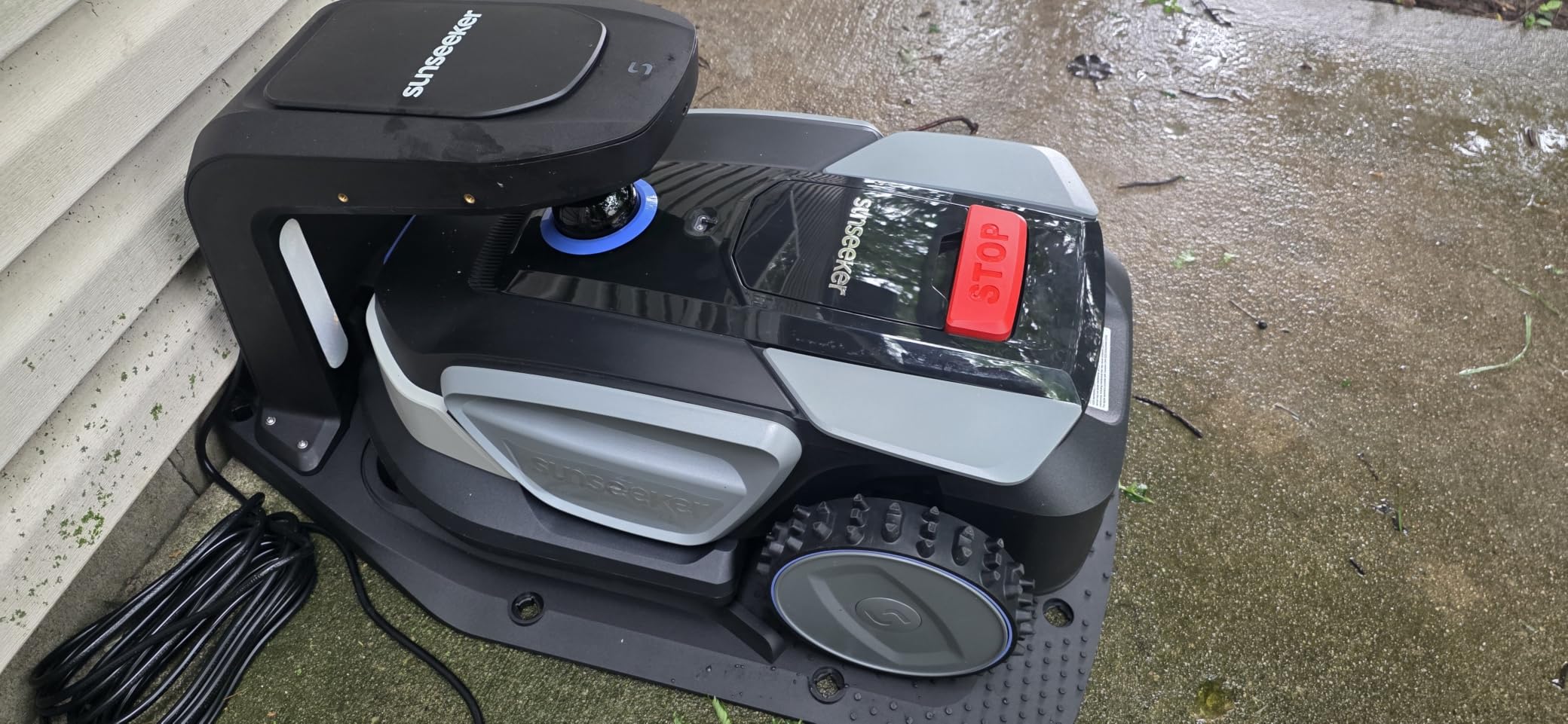
Navigation is RTK satellite positioning fused with VSLAM and Vision AI, which is what lets it hold coverage under trees, in shade and where the RTK signal is weak, day or night. Owners with heavily shaded backyards report that it keeps working without losing position or stopping, which is one of the most common reasons a robot mower is returned.
The 8.7 inch floating cut deck adjusts between 1.6 and 3.2 inches and follows ground contours, so the cut height stays consistent across bumps instead of scalping the high points. It also handles passages as narrow as 31.5 inches, and the striped finish comes out clean enough that owners use the preloaded patterns to mow numbers and symbols.
Where It Shines on a Decorated Lawn
This is the machine to look at if your yard is a patchwork of beds, paths and lawn. Owners report it handling hilly backyards with lots of flower beds, and the 31.5 inch passage capability means it will not be blocked by every strip of path you have laid.
Scheduling is the other strength. You can run it around the clock, and it waits two hours after sensing rain before restarting. A 2-year warranty with US-based support is also more reassuring than the thinner coverage on some newer brands.
The Small-Transition Problem
The most common complaint is specific and worth understanding before you buy. Owners report it getting stuck on small transitions such as a hump where grass meets a sidewalk or a slight dip. A floating deck improves the cut but does not stop the chassis snagging on an abrupt change in level, so if your lawn has hard edges, check them first.
Two more limitations. Because the virtual boundary offsets are generous for safety, roughly 18 inches of perimeter still needs weed-eating. And it treats tall grass as an obstacle, so it must be sent out frequently or it will start refusing to enter a patch. Some properties also need WiFi extenders to cover the far corners of the app signal.
8. Roborock RockNeo Q110H for the Entry-Level Budget
Roborock RockNeo Q110H Robot Lawn Mower, Wire-Free Robotic Lawn Mower with Full-Band RTK + VSLAM Navigation, Auto Mapping, AI Vision Obstacle Avoidance, App Control, 45% Slope, Covers Up to 1/4 Acre
Full-band RTK plus VSLAM navigation
45% slope and 1.57 inch obstacles
Floating cutting deck
27 pound machine
Pros
- Very quiet
- essentially just wheels turning
- Headlights allow night mowing
- Handles small dips bumps and a walkway drop without getting stuck
- Familiar app for anyone who owns a Roborock vacuum
Cons
- No auto-mapping
- you must walk the perimeter manually
- Conservative boundaries leave 1 to 1.5 feet unmowed
- Wheels struggle in thick coarse turf such as St Augustine
The RockNeo Q110H is the cheapest way into wire-free mowing with respectable navigation, and for a mild, rolling lawn it does a decent job. The full-band RTK combined with VSLAM holds position under dense tree canopies, near high fences and in shaded corners, which is more capability than most machines in this bracket can claim.
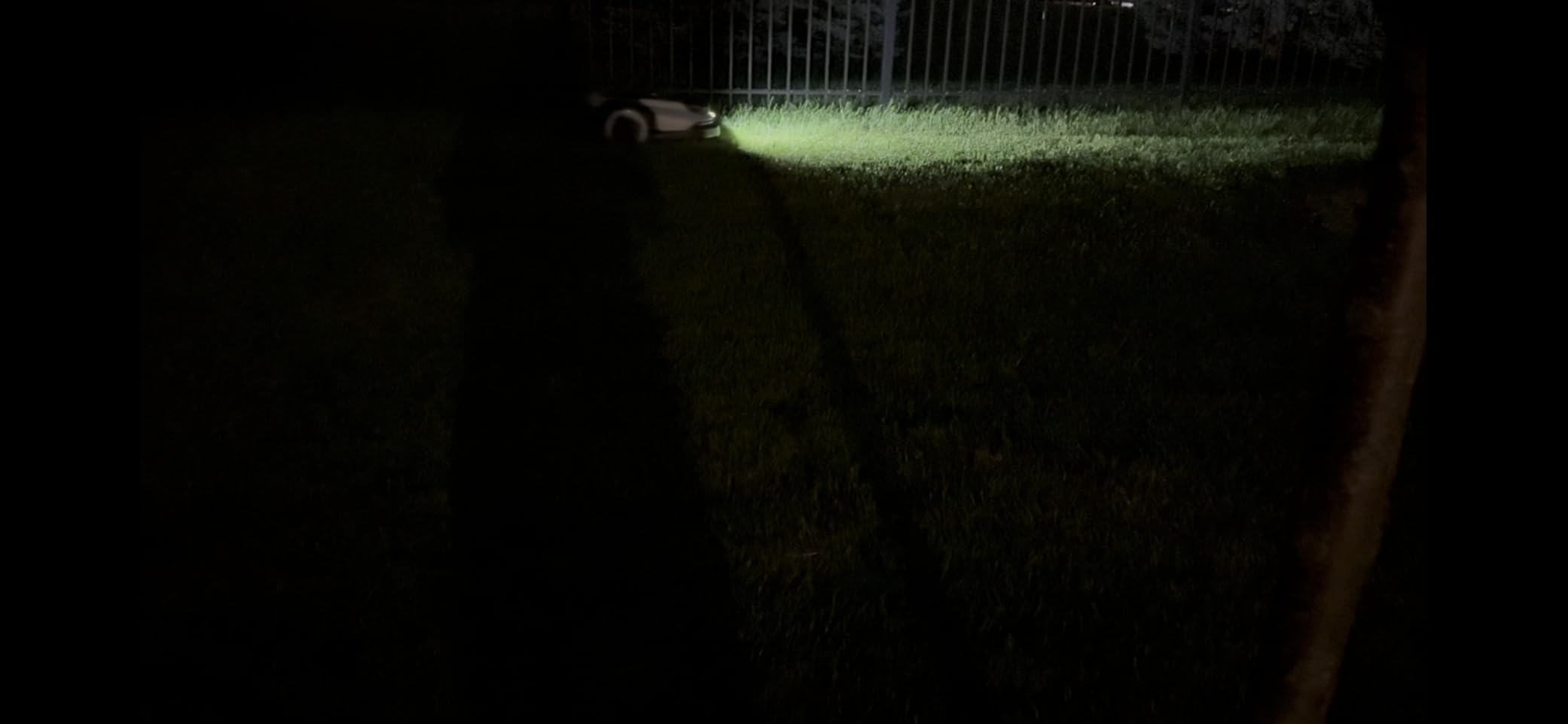
Obstacle avoidance uses a stereo dual-camera setup that identifies both static and moving objects, and owners report it routing around garden furniture, toys, people and pets without drama. It is also very quiet, with headlights for night work, and the app will be instantly familiar to anyone who owns a Roborock vacuum.
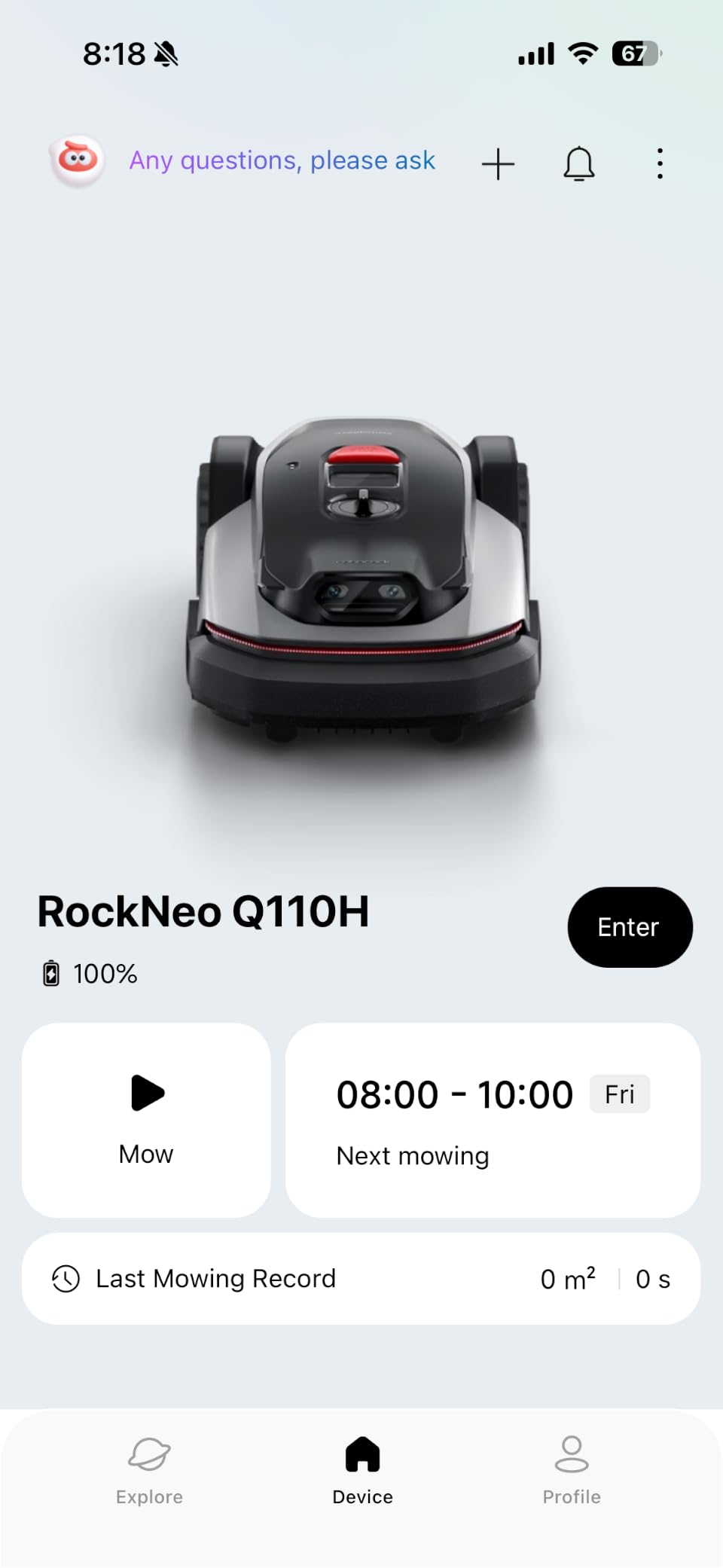
On uneven ground specifically, the floating cutting deck and large-diameter wheels are doing useful work. It handles 45 percent slopes and 1.57 inch obstacles, and owners report it transitioning over small dips, bumps and a walkway drop without getting stuck. Passages as narrow as 2.3 feet are fine. Battery life averages 130 minutes, covering up to a quarter acre.
This is the lowest-rated machine in the group at 3.8, and the reviews are consistent about why. It is not the navigation, which is genuinely good for a non-LiDAR machine. It is the setup friction and the boundary behaviour.
What You Sacrifice at This Level
Auto-mapping is not available on this model, so you have to drive it around the perimeter by hand. Maps then cannot be edited in the app without walking the machine again, and there is no partial zone mowing. On a complicated uneven lawn that manual process is a real chore, and it is the single biggest reason to consider spending more.
The boundary logic is conservative to a fault. Between 1 and 1.5 feet of grass is left unmowed along fences, trees, bushes and even its own antenna pole, and the edge trimming module that would fix this is not available in the US. Plan on a strimmer visit every week or two.
Traction Is the Weak Point on Thick Turf
Owners report that traction struggles in thick coarse turf such as St Augustine, and that the lift sensors can be triggered falsely on small bumps, leaving the machine stopped and convinced someone picked it up. That combination is exactly the failure mode this article is about, so I would be careful with this one on dense, coarse grass.
The 16 inch deck is also small, which means longer cut times on anything but a small lawn. If your ground is broken rather than merely bumpy, the money is better spent one tier up.
9. MOVA LiDAX Ultra 1000 for the Best Balance of Features
MOVA LiDAX Ultra 1000 Robot Lawn Mower Wire Free for 1/4 Acre, RTK-Free+360° 3D LiDAR+AI Vision Auto Mapping, Zero-Edge Cutting, Cutting Height 1.2″-3.9″, 45% Slope, Up to 150 Managed Zones Dual Maps
RTK-free 360 degree 3D LiDAR mapping
45% slope and 1.6 inch obstacles
Edge cutting within 2 inches
Up to 150 managed zones
Pros
- RTK-free auto-mapping needs no wire and no base station
- Off-road wheels climb 45% slopes and clear 1.6 inch obstacles
- Edge cutting within 2 inches of walls and hedges
- Dual maps manage separate front and back yards
- 3-year warranty with 24/7 support
Cons
- Rear-wheel drive rather than full AWD
- 8 inch deck is the narrowest here
- AI vision can be over-cautious around tall weeds
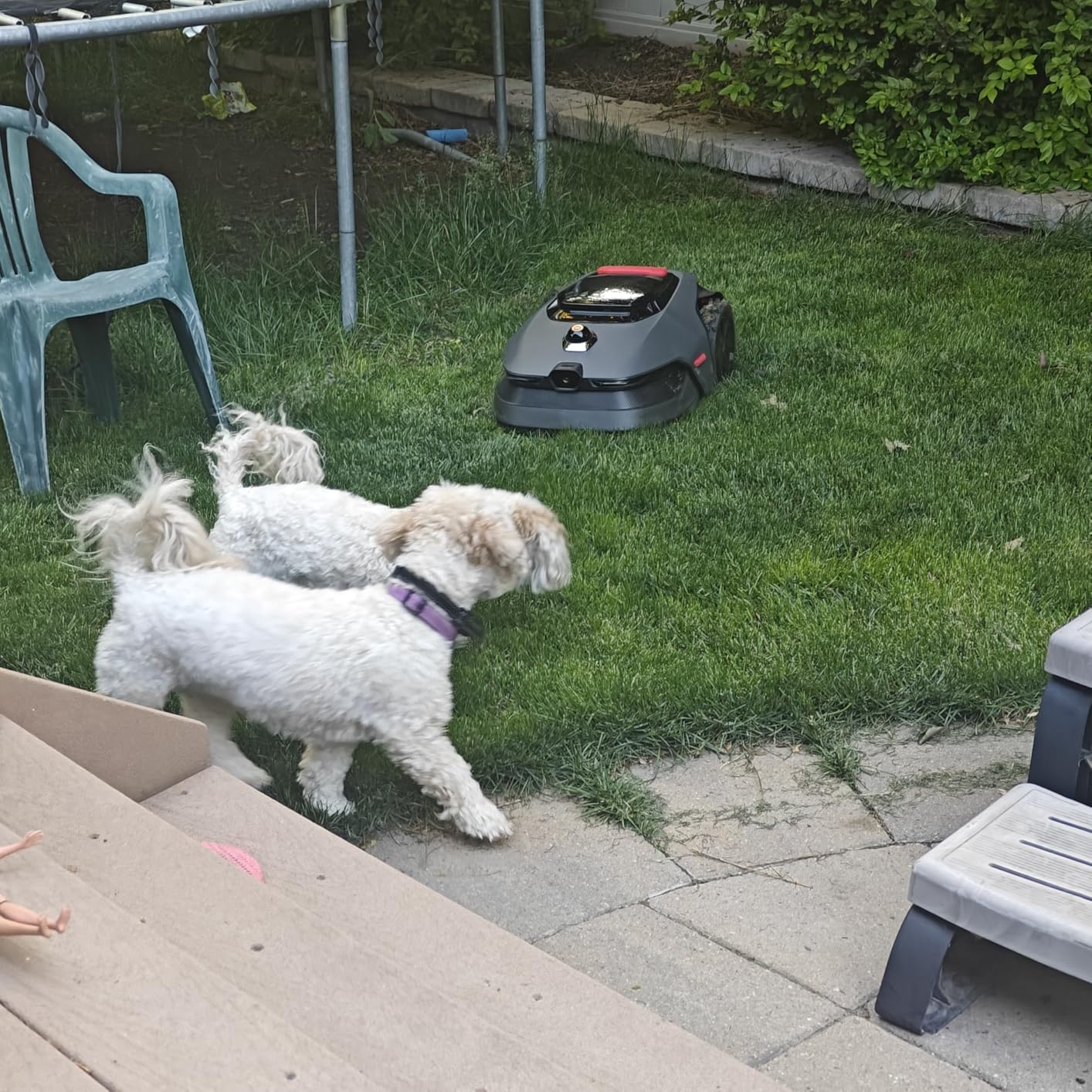
What makes the MOVA LiDAX Ultra 1000 interesting on uneven ground is that it needs nothing installed. There is no boundary wire and no RTK base station, because setup is handled by AI vision working with a 360 degree 3D LiDAR doing centimetre-accurate auto-mapping. On a rocky, rooted property where installing cable is the worst part of the job, removing that step is a genuine saving in effort.
It covers up to a quarter acre and handles 45 percent slopes, 1.6 inch obstacles and pits with off-road wheels on rear-wheel drive. Paths as narrow as 23.6 inches are manageable, and the self-lifting UltraTrim disc cuts within 2 inches of walls, hedges and raised edges.
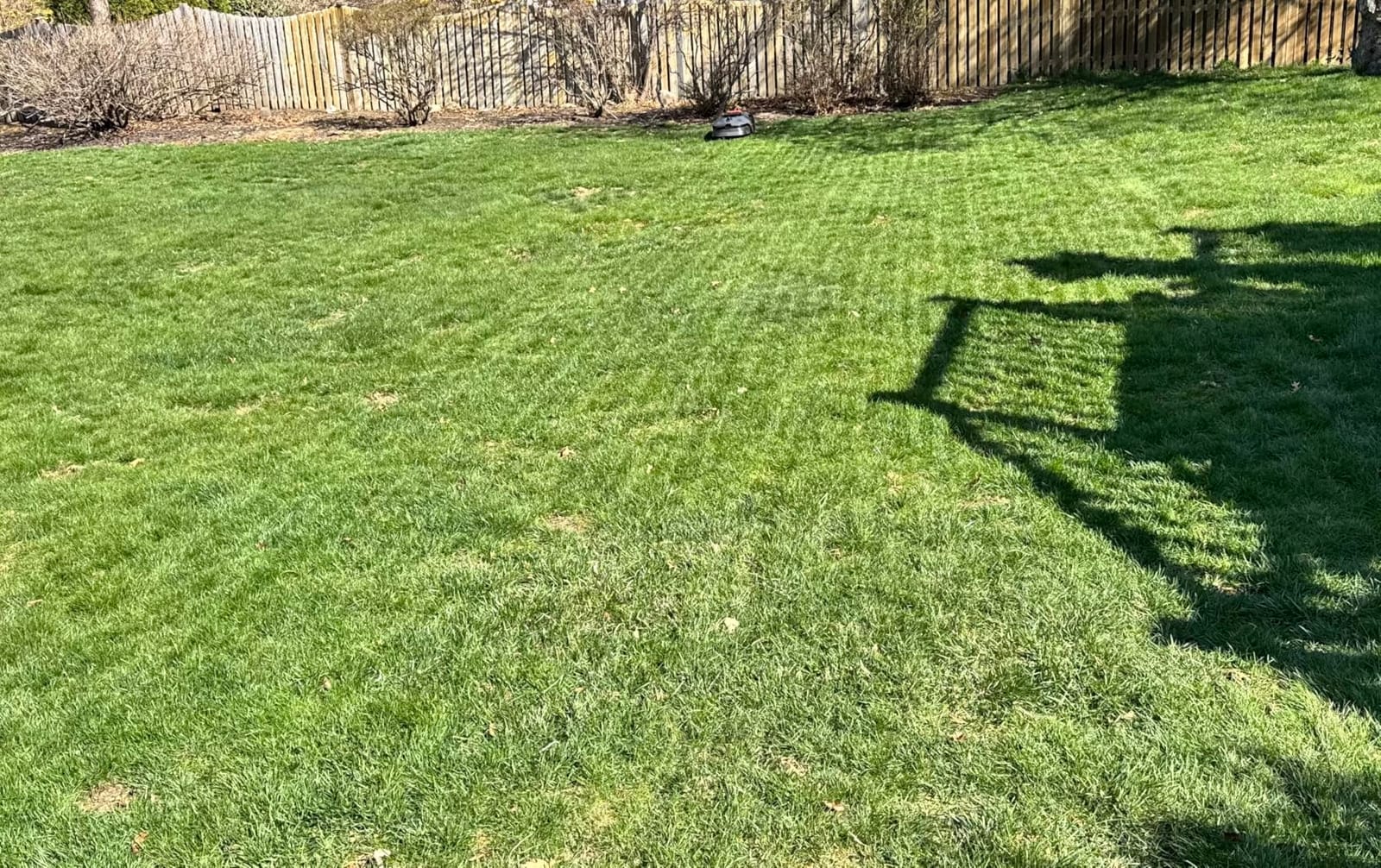
Zone management is unusually generous: up to two independent maps and up to 150 managed zones. That means one machine can run separate front and back yards, which is a real saving if your property is split, and you can carve out no-go areas around planting you never want touched.
Owners also point out that the combination of 3D LiDAR and AI vision works in dim light and in harsh daylight, so the machine is not confined to a narrow window. TrueGuard anti-theft monitoring is built in, with an optional link module for real-time tracking.
Where It Handles Uneven Ground Well
The off-road wheels and 45 percent climbing figure are the relevant numbers for this article, and owners confirm the machine handles slopes, pits and uneven terrain without difficulty. For a lawn that rolls but is not steep, that is sufficient, and the obstacle detection covers more than 300 types through the 3D point cloud.
The 3-year manufacturer warranty with 24/7 after-sales service is also worth more attention than it gets. Among newer brands with thin track records, warranty length is one of the few proxies buyers have for build confidence.
Why It Is Not My Top Pick Here
This particular model uses rear-wheel drive rather than full all-wheel drive, and that is the deciding factor for rough ground. Rear-wheel drive on a slope means one driven wheel, so traction depends heavily on weight distribution and how much the uphill wheel is loaded. It works, but a true AWD chassis has margin this one does not.
The 8 inch cutting width is the narrowest deck in the lineup, so pass counts are high. And the AI vision can be over-cautious around taller weeds and garden clutter, which on a neglected section means it steers around the grass it was sent to cut. If your terrain is severe, the AWD versions of this same family are the ones to look at instead.
10. Dreame A3 AWD 1000 for the Steepest Climb in the Test
[All-Terrain Wire-Free] DREAME LiDAR Robot Lawn Mower A3 AWD 1000 + Cleaning Set+Blade Set, 360° 3D LiDAR & AI Dual Vision Smart Robotic Mowers for 0.25 Acre
AWD hub motors
80% (38.7 degree) inclines
2.17 inch obstacle clearance
26.4 pound aluminum body
Pros
- AWD hub motors hold 80 percent slopes and 2.17 inch obstacles
- Traction stays consistent on complex multi-zone lawns and rolling hills
- LiDAR and binocular vision stay precise under heavy tree cover
- 45 minute recharge and 3-year warranty
Cons
- Smallest cutting width in the lineup at 7.87 inches
- Edge precision is 1.97 inches without the separately sold trimmer module
- Accessories sold separately
- Only 30 ratings so far
The Dreame A3 AWD 1000 has the highest owner rating in this group at 4.7, with 84 percent of ratings at five stars, and on the specific question of steep ground it is arguably the strongest machine here. AWD hub motors hold 80 percent, or 38.7 degrees, and clear 2.17 inch obstacles, which is the largest obstacle figure of any machine on this list.
That obstacle number is not a marketing detail. Mole holes, lifted sod and exposed roots on a broken lawn are obstacle problems, and a machine that stalls its blades in a divot is a machine that needs rescuing. Owners report traction staying consistent across complex L-shaped and wrap-around multi-zone lawns and on rolling hills.
![[All-Terrain Wire-Free] DREAME LiDAR Robot Lawn Mower A3 AWD 1000 + Cleaning Set+Blade Set, 360° 3D LiDAR & AI Dual Vision Smart Robotic Mowers for 0.25 Acre customer photo 1](https://www.wearesalt.org/wp-content/uploads/2026/10/B0H761SNFG_customer_1.jpg)
Navigation is a 360 degree 3D LiDAR paired with binocular AI vision, and it is wire-free. Owners confirm it holds precision under heavy tree cover and right next to tall walls, which are the two places where satellite-only navigation tends to fail. OmniSense 3.0 navigation with EdgeMaster 2.0 puts edges within 1.97 inches, and a separately sold trimmer module brings that under 1.18 inches.
Charging is quick: a 5A adapter recharges in 45 minutes, 22 percent faster than the industry standard, so even a large lawn completes within a day. The body is hard-anodized aluminum and stainless steel at 26.4 pounds, which keeps it light enough to recover from a hill yourself.
Reasons to Favour This Machine
Avoidance covers more than 300 object types, including pets, children’s toys and garden hoses, which is the category that matters most on a lawn with young children on it. The built-in 4G module with an HDR camera gives real-time monitoring and theft protection, and the warranty runs three years with a year of free 4G service included.
A cleaning set and blade set are in the bundle, which on a mower working this hard on rough ground is more useful than it sounds.
What the Thin Review Pool Means
Thirty ratings is the second-smallest pool in this roundup, and I want to be direct that the 4.7 is encouraging rather than proven. Newer brands raise reasonable questions about parts availability and long-term service, and a robot mower is a machine you expect to keep for several seasons.
The 7.87 inch cutting width is also the smallest here, so on anything over a quarter acre you will spend a long time mowing. And the trim module is not included, so the edge finish is 1.97 inches out of the box. On steep, root-filled ground with pets and children, though, this is the combination I would put at the top of a shortlist to test.
What Makes a Robot Mower Good on Uneven Ground
Uneven terrain defeats a standard mower in three separate ways, and you need to solve all three. Missing one of them is why so many owners end up disappointed.
Loss of traction on slopes. On flat ground, a mower with two driven wheels has plenty of grip because weight transfers backward and the machine just sits there. On a side slope the same machine has two wheels sharing the load with very little margin. All-wheel drive pushes torque to every wheel, so no single wheel spins free and climbs a deficit. Rear-wheel drive sits somewhere in between, which is why the MOVA model on this list handles moderate rolls well but is not the pick for a genuine hill.
Blades missing grass in dips and bumpers. A fixed deck keeps a constant height relative to the chassis, so over a bump the blade lifts and scalps, and in a dip the blade drops and leaves grass standing. A floating deck rides on the ground contour and holds a consistent height above the actual turf. On rough ground this is the difference between stripes and a patchwork.
High-centring in divots and over roots. Ground clearance and obstacle-climbing height are the two specs buyers skip, and they are the two that decide whether a machine gets over a mole hill or stops dead. Values here range from 1.57 inches on the budget model to 2.8 inches on the tracked machine. If your lawn is genuinely pitted, measure your worst hole before choosing.
Wheel design matters as much as drive. Deep lug tread dig into soil instead of shearing across the top of wet grass, which is the difference between climbing and spinning. Suspension matters too, because a floating deck still benefits from the chassis absorbing a root rather than stopping dead.
Finally, wire-free versus boundary wire. A cable gives an absolute physical limit that nothing overrides, which is why it was the default. On rocky, rooted, uneven ground, installing that cable is genuinely hard, and owners consistently say wire-free is the feature they care most about. Every machine in this roundup is wire-free, and my view is that on broken land the navigation has now matured enough to make the cable optional rather than essential. The same split between hardware endurance and sensing reliability shows up in our spa robotic cleaner testing.
RTK, LiDAR and Vision AI on Broken Ground
Navigation technology decides whether a capable mower stays on your lawn. Three approaches dominate, and the newest machines combine them.
RTK is satellite positioning corrected to centimetre accuracy using a base station or network. It is extremely accurate in open ground with a clear view of the sky. Its weakness is exactly the terrain this article is about: tree cover, walls and the side of a house block the signal, and the machine can lose its position or drift toward a boundary it should not cross.
LiDAR is a spinning or solid-state laser scanner that builds its own map. It does not care about satellites at all, works at night, and handles shade and trees without degrading. It costs more, and the sensor is a component that can fail.
Vision AI uses cameras to recognise objects and edges. It is cheap and increasingly good, but it struggles in darkness, in glare and when grass is tall, and it can be over-cautious and treat weeds as obstacles.
The practical answer for uneven terrain is a hybrid, and the strongest machines here run two or three systems at once. The LUBA 3 AWD fuses 360 degree LiDAR, NetRTK and dual-camera vision, so when trees block the satellite the LiDAR keeps position and when the LiDAR is confused by clutter the camera recognises the object. The MOVA LiDAX goes RTK-free entirely, which removes a physical installation step at the cost of relying on LiDAR and vision alone.
One trust signal worth weighing: the buyers most satisfied with navigation on hard ground consistently prioritise models that map automatically. Manual mapping, which the budget RockNeo requires, is what owners complain about most when the lawn is complicated.
Real-World Failure Modes Owners Report
Specification sheets do not tell you how these machines fail. Owners do, and the patterns repeat across brands.
Stalling at the bottom of a slope. The most common report. A mower with a marginal slope rating reaches the base of a wet incline, the wheels spin, and it sits there. The fix is always the same: buy with margin above your measured slope, because wet grass cuts effective grip substantially.
Mud clogging wheels and blades. On wet clay soil, owners report needing 30 minutes of cleaning daily, and in one case a wheel that eventually blocked permanently despite regular cleaning, which ended that ownership. If you have heavy clay, clean the underside more often than you think you need to and accept that this is part of the deal.
No-go zone breaches. Machines driving into mapped exclusion areas and off the mapped ground, then staying there. Several reviews across brands mention mapping being lost and needing to be redone, particularly when a wheel sits on an incline or the machine is lifted.
App going offline mid-session. Connectivity drops leave owners unable to monitor or rescue a machine that is stuck. That is why on-call phone support matters more than app polish when your mower might be 200 feet away on a hillside.
Recovery as a safety issue. Machines in this class are heavy and awkward to handle, with several weighing around 26 to 32 pounds. Lifting one out of a hollow on a slope is a genuine injury risk, and it is the failure nobody plans for. It is the strongest argument for choosing a lighter machine if your ground is only moderately uneven.
When a Robot Mower Is the Wrong Purchase
I would rather talk you out of this than sell you the wrong machine, so here is when a robot mower is a bad idea.
Ground steeper than 80 percent is beyond what any of these machines is designed for, and the only genuinely capable option, a tracked chassis, comes with the thinnest support in the group. A sustained 45 degree bank is not a lawn problem. If you already manage slopes like that by hand, our all-terrain knee scooter picks cover the other side of that problem.
Very heavy wet clay soil is the second warning sign. Traction problems compound, cleaning becomes a daily chore, and clogging is the leading cause of returns in owner reports. Fix drainage first if you can.
If there is nowhere to put a charging station with power and a reasonably flat approach, the machine will spend its life dragging a cable across the yard. A dock also needs to be reachable, because a mower that cannot get home does not get recharged.
There is one piece of advice from owner forums that I agree with completely, and it is the least glamorous: fix the lawn before you buy. Filling divots, cutting mole hills flat, removing loose rocks and letting new sod settle will improve the performance of any machine on this list. Buying a more capable mower to compensate for a lawn that is still settling is a more expensive way to solve the same problem.
How to Choose the Right Mower for Your Ground
Work through these in order and the choice narrows quickly.
1. Measure your slope. Use the method above and then buy with margin. Below 25 percent, navigation and edge quality matter more. Between 45 and 80 percent, all-wheel drive is not optional.
2. Judge the drive system against your surface. Wheeled AWD handles slopes, roots and compacted ground. Rear-wheel drive handles moderate rolls. Tracked drive is the only real answer for swampy, soft or badly broken land.
3. Check the deck. A floating deck follows contours and gives an even cut on bumpy ground. A wider deck means fewer passes, so weigh deck width against how much time you want to spend, especially for a 7.9 inch deck on anything over a quarter acre.
4. Check coverage per charge, not maximum acreage. Published acreage assumes a full battery on flat, open ground. Hills, thick grass and constant turning drain far more. Automatic resume and auto-return are more valuable than a large headline number.
5. Match navigation to your trees and walls. Heavy canopy or a house on one side of the lawn means you want LiDAR or a hybrid, not RTK alone. And check whether auto-mapping is included, because manual mapping on a broken lawn is a genuinely tedious evening.
6. Look at obstacle climbing height and clearance. This is the spec that decides whether the machine gets over a mole hill. It ranges from 1.57 to 2.8 inches across this list, and for a pitted lawn the higher figure is worth paying for.
7. Factor in what happens after the warranty. Some models include 4G or RTK service for a year and then charge a subscription. Blades, battery packs and hub motors are consumable items eventually. Support quality and parts availability are worth more attention on rough ground, where hardware takes more punishment.
On support specifically, I would weight a brand with reachable phone support and free replacement parts above a slightly better spec sheet. One owner on this list replaced a failed component and received a courtesy garage, which is the difference between a bad afternoon and a returned machine.
Frequently Asked Questions
Can robotic lawn mowers work on uneven ground?
Yes, but only specific models. A robot mower handles uneven ground well when it has all-wheel drive, a slope rating of 45 percent or more, and a floating cutting deck that follows the terrain. Standard two-wheel-drive machines with fixed decks lose traction on slopes, high-centre in divots and scalp the high spots while missing grass in the dips. Measure your steepest slope before buying and choose a machine rated comfortably above it, because wet grass reduces grip significantly.
Which mower is best for cutting uneven terrain?
The Mammotion LUBA mini 2 AWD 1500H is the best all-round choice, with 360 degree LiDAR plus dual cameras, 80 percent slope capability and adaptive suspension that clears 75mm obstacles. For the steepest ground, the Dreame A3 AWD 1000 holds 80 percent slopes and clears 2.17 inch obstacles. For genuinely broken, swampy terrain, only the tracked Lymow One Plus is designed for it, climbing 45 degrees. The Mammotion LUBA 2 AWD 3000HX is the pick if you also want patterned mowing.
What is the best electric lawn mower for uneven ground?
Among electric options, a battery robotic mower is the right choice only if your ground is moderate. A robot mower with all-wheel drive and a 45 percent or higher slope rating is the answer for hills, roots and small divots. If your terrain is severely broken, steeper than 50 percent, or very wet clay, a self-propelled cordless or petrol walk-behind with large rear wheels is more honest than a robot that will need rescuing. Fill divots and let new sod settle before automating anything.
What type of mower is best for rough terrain?
It depends on how rough. A tracked robotic mower is the only automated option built for genuinely broken, swampy or very steep ground, and it climbs 45 degree slopes. An all-wheel-drive robotic mower handles hills up to 45 to 80 percent, roots and uneven turf. A wheeled robot with stability control is fine for lawns under about 25 percent. Beyond that, or where the ground is soft and wet, use a self-propelled walk-behind with large rear wheels, or a remote-controlled ride-on mower, and stop expecting an autonomous machine to cope.
Can robot mowers get stuck on wet grass?
Yes, and wet grass is the most common cause of a robot mower stalling on a slope. Water fills the tread and cuts the grip that dry grass provides, so a machine at its rated limit on a dry day will not make the same climb after rain. Owners on clay soil also report mud clogging wheels and blades, needing around 30 minutes of cleaning daily and, in one case, a permanently blocked wheel. Buy with margin above your measured slope, keep the underside clean, and avoid scheduling heavy mowing right after rain.
Final Verdict
The best robotic mowers for uneven terrain all share three things: four driven wheels, a slope rating well above what you measured, and a deck that floats. If you want one machine that does all of it, and you would rather have the most proven design than the biggest spec sheet, the Mammotion LUBA mini 2 AWD 1500H is the pick with the deepest owner evidence behind it. The LUBA 2 AWD 3000HX takes over if patterned mowing and tight boundary work matter more to you than an easy setup.
For the steepest and most broken ground, the Dreame A3 AWD 1000 climbs hardest and the Lymow One Plus is the only machine here that floats over soft, swampy soil. For smaller, awkward yards with a drop, the Navimow i206 AWD keeps the purchase simpler and lighter. Measure your slope first, because every one of these decisions depends on that single number.