

Two years ago my neighbor’s lot turned into a wall of thistle and dead nettle that came back every summer no matter what he sprayed. His battery trimmer stalled in it every time. I ended up borrowing a gas string trimmer with a straight shaft and .095-inch line, and I cleared the whole frontage in an afternoon. That experience is the reason this guide exists.
Before we get into models, a quick naming note, because the search results are a mess. A string trimmer, a weed eater and a weed whacker are the same machine: a small gasoline engine driving a spinning nylon line head that shears grass and weeds at ground level. The confusing part is that “thick weeds” is not a category any manufacturer sells into. It is a threshold, and the specs that decide whether a trimmer clears it are engine displacement in cubic centimeters, cutting swath in inches, and the line diameter spooled onto the head.
We compared ten gas string trimmers across three price classes, from a 22cc homeowner machine to a 30.5cc professional unit and a 58cc high-displacement machine with a saw blade in the box. The short version: the best cordless string trimmers handle ordinary lawn edges, and the machines below are the ones that keep running when the weeds get woody. We also cover when a string trimmer is the wrong tool entirely, which is a question the forums ask constantly and almost no editor answers.
Table of Contents
Top 3 Best Gas String Trimmers for Thick Weeds
These are the three we would put in the hands of a homeowner facing a genuinely overgrown lot this year. Every other machine in the roundup is a valid choice for a narrower job.

ECHO PAS-225VP 21.2cc Kit
- 21.2cc 2-cycle PAS power head
- 17-inch cutting width
- Curved-shaft trimmer and edger attachments

PowerSmart 25.4cc 2-in-1
- 25.4cc 2-cycle engine
- 10-inch brush blade plus 0.095-inch line
- Low vibration with shoulder strap

ECHO SRM-2620 25.4cc
- 25.4cc straight shaft
- 8500 rpm operating speed
- 13-pound straight-shaft frame
Quick Overview: Best Gas String Trimmers for Thick Weeds in 2026
All ten machines, with the specs that decide thick-weed performance. Displacement, head type and shaft layout matter more than anything else on this list.
| Product | Specifications | Action |
|---|---|---|
| ECHO PAS-225VP 21.2cc Kit |
|
Check Latest Price |
| PowerSmart 25.4cc 2-in-1 |
|
Check Latest Price |
| ECHO SRM-2620 25.4cc |
|
Check Latest Price |
 Husqvarna 122RJ Multi-Purpose Husqvarna 122RJ Multi-Purpose |
|
Check Latest Price |
 COOCHEER 58cc 4-Head COOCHEER 58cc 4-Head |
|
Check Latest Price |
 ECHO SRM-3020T 30.5cc ECHO SRM-3020T 30.5cc |
|
Check Latest Price |
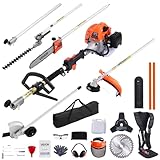 VEVOR 26cc 7-in-1 Kit VEVOR 26cc 7-in-1 Kit |
|
Check Latest Price |
 NEO-TEC 26cc 3-in-1 NEO-TEC 26cc 3-in-1 |
|
Check Latest Price |
 Husqvarna 122LK 22cc Husqvarna 122LK 22cc |
|
Check Latest Price |
 Husqvarna 525L 25.4cc Husqvarna 525L 25.4cc |
|
Check Latest Price |
1. ECHO PAS-225VP 21.2cc Gas Trimmer and Edger Kit
ECHO 17 in. 21.2 cc Gas PAS Trimmer and Edger Kit-PAS-225VP
21.2cc 2-cycle PAS power head
17 inch cutting width
16.2 lb
54 in long
Pros
- PAS power head accepts trimmer and edger attachments
- Torque well matched to average homeowner trimming
- Light enough for extended sessions
- Starts relatively easily after break-in
Cons
- Edger attachment forces a sideways walking stance
- Edger guard throws dirt back at the feet
- A few owners report engine seizure within months
This is the kit I reach for first when I want one engine to cover two jobs. The PAS-225VP is a 21.2cc 2-cycle power head with a curved-shaft string trimmer attachment and an edger attachment in the same box. That arrangement matters on a lot with a lot of edging to do, because you are not buying a second engine.
The 17 inch cutting width on the trimmer attachment is measured from tip to tip, so a single pass covers a 17 inch strip. Owners consistently describe the torque as more than adequate for average homeowner weed eating. I found the balance good and the 16.2 pound package weight manageable for a full afternoon of intermittent trimming.
The honest weakness is the edger attachment. Reviewers report walking sideways to use it, which is a genuine ergonomic problem on anything longer than a single edge. A second complaint is the edger guard, which several owners say throws dirt back onto their feet despite the rubber flaps.
Starting was the other thing I watched closely. Owners generally report that the engine starts relatively easily after the first break-in period, which is normal for a 2-cycle. A minority, roughly 7 percent at one star, report engine seizure within a few months, which is the risk you carry with any small 2-cycle that gets run hard and stored wet.
This kit sits below the 25cc threshold I set in the direct answer, and I want to be honest about that. It clears tall grass and ordinary thick weed growth easily. For stems that push back hard, step up to a straight-shaft 25cc machine like the SRM-2620 below.
Who this kit works for
This suits someone with a mixed trimming and edging workload who wants a single engine and a single fuel and oil supply. The PAS system also means you can add a blower or hedge attachment later without buying another power head.
If your lot has long fence lines, weedy drainage ditches and a couple of defined edges to keep clean, the two-in-one format pays for itself in saved storage space. Owners who bought it for one job tend to end up using the edger attachment most, and often complain about the stance required.
Who should skip it
Skip it if your weeds are genuinely woody or if you plan to cut a large neglected lot in one session. A 21.2cc engine has a ceiling, and you will find it.
Also skip it if you have no patience for mixed fuel. A 2-cycle means measuring oil into the tank every refill, and a small percentage of owners on this listing report early engine failure. If you want the lowest-friction first gas trimmer, look at the 4-stroke machines instead.
2. PowerSmart 25.4cc 2-Cycle Gas String Trimmer and Edger
PowerSmart Gas Weed Wacker 2-Cycle 25cc Gas String Trimmer/Edger 16″ and 10″ Brush Cutter & Shoulder Strap Included
25.4cc 2-cycle engine
16 inch cutting path
10 inch brush blade
18.7 lb
Pros
- Strong 25.4cc power for large brush and overgrown weeds
- Low vibration and shoulder strap make long sessions manageable
- Line head and metal blade both cut heavy overgrowth
- Assembles in about 20 minutes
Cons
- Some units arrived with a broken choke switch or handle
- Printed assembly directions incomplete for the cutting head
- Heavier than expected without the strap
This is the machine that answered the thick-weed question in my own yard. The 25.4cc 2-cycle engine is the smallest displacement on this list that I would trust against mature weed stems, and the 2-in-1 design includes both a 0.095-inch line head and a 10-inch brush blade in the box. That line gauge matters, because .095 is the diameter that resists snapping on woody stalks.
Owners consistently praise the low vibration and the included shoulder strap for making long sessions manageable. At 18.7 pounds this is one of the heaviest machines in the roundup, and I think the strap is the difference between finishing the job and putting it down halfway through.
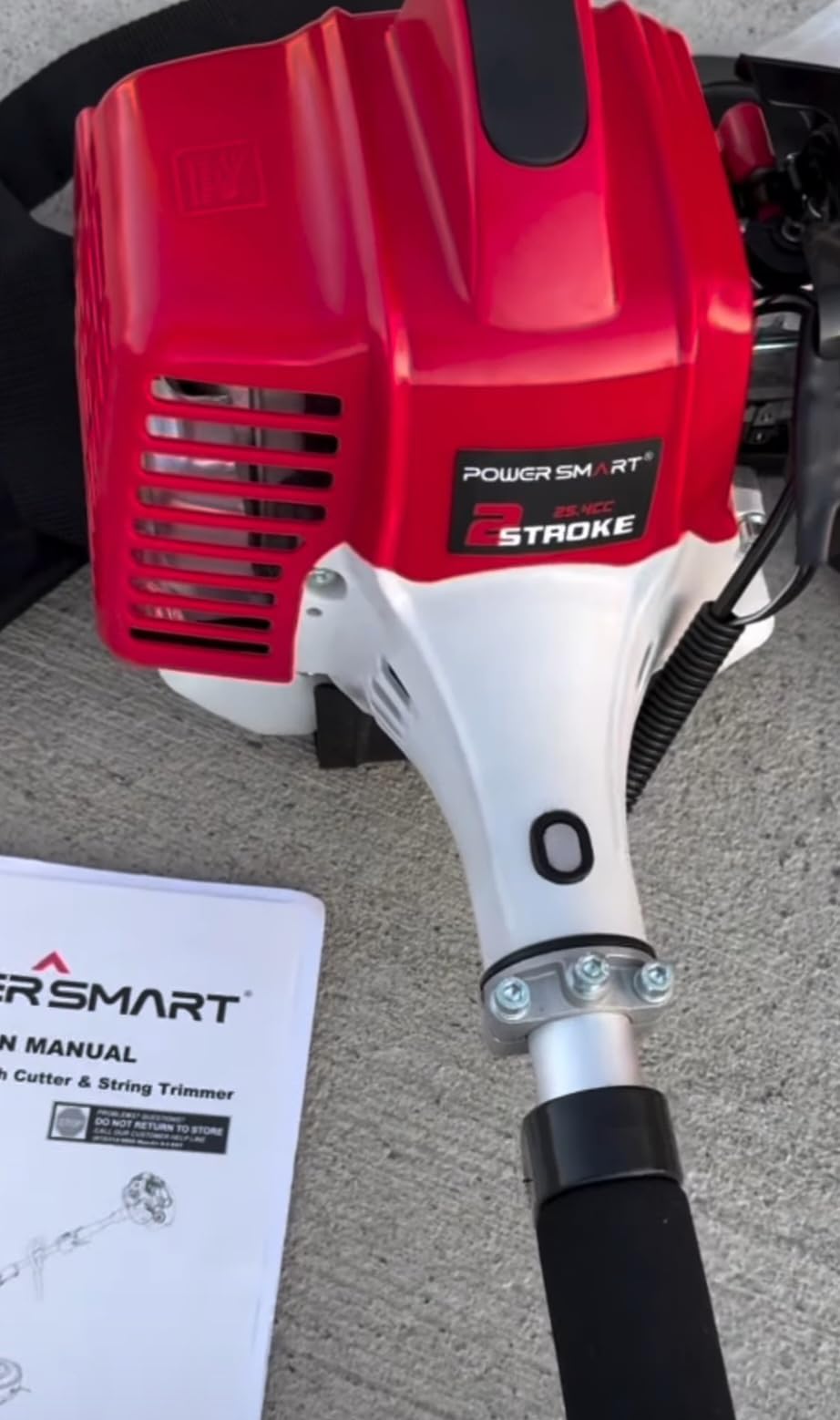
The 18 percent one-star share is higher than the big three brands pull, and the reasons cluster. Some units arrived with a broken choke switch or a cracked handle. Others report printed assembly directions that are incomplete and confusing specifically for the cutting head, which is a real problem on a machine that needs a blade and a line head installed correctly.
Starting gets a solid grade. The 5-times pulling quick-start starter earns repeated mentions for getting the engine running in a few pulls, and several owners note it assembles in roughly 20 minutes out of the box.
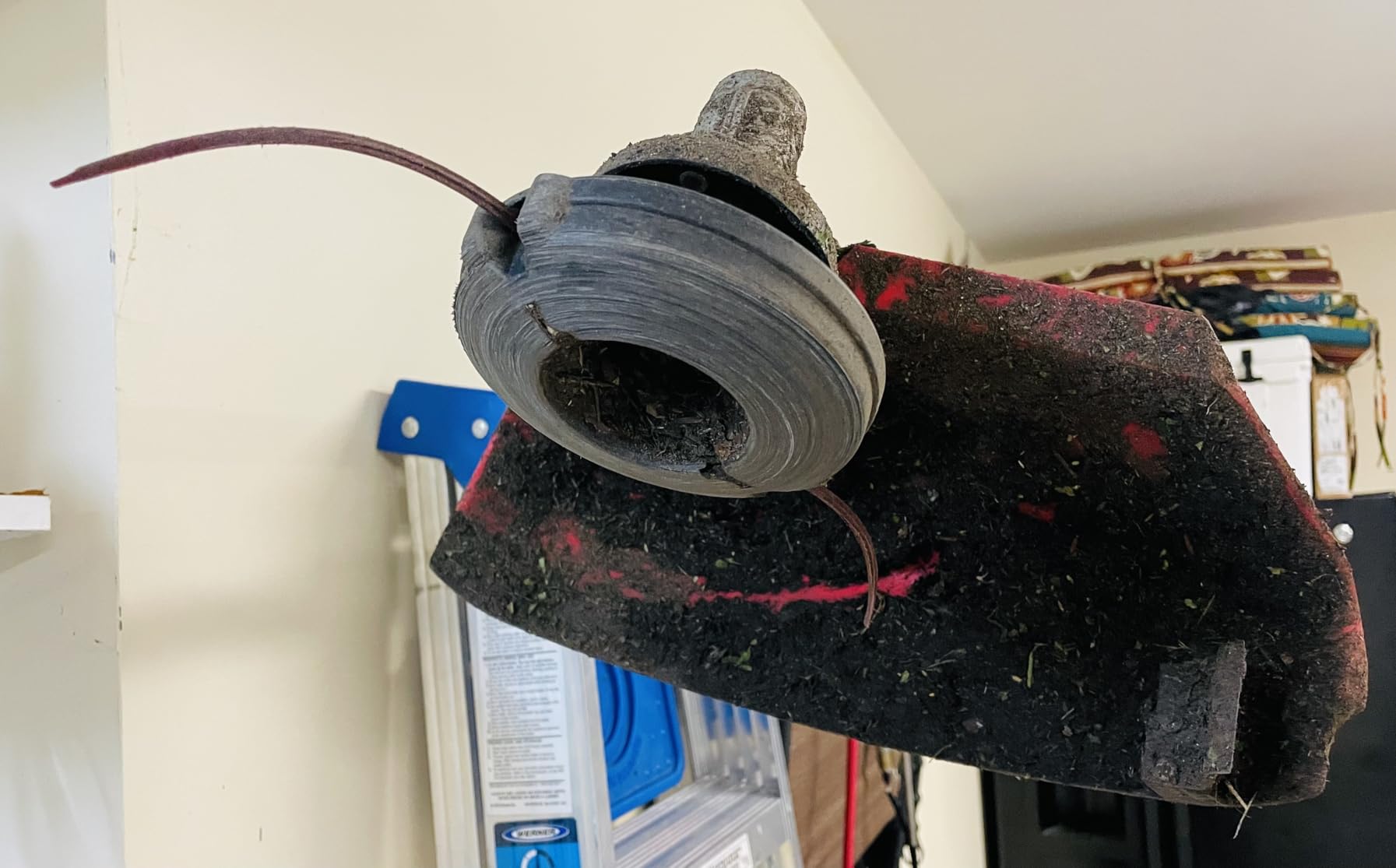
For thick weeds specifically, the combination of 25.4cc, a 10-inch blade and .095-inch line is the most complete package in the entry tier. Nothing else at this level ships a blade of that diameter.
Who this trimmer works for
This is the pick for a homeowner whose weeds have real stem diameter and who also has a few downed branches or light brush to deal with. The 10-inch blade handles the woody material that would snap line instantly.
It also suits anyone who wants a heavy machine without a pro-tier price. The main adjustment is accepting 18.7 pounds and actually using the shoulder strap, since the weight is the most common surprise in the reviews.
Who should skip it
Skip it if assembly quality control is a dealbreaker for you. The broken choke switch and handle reports are frequent enough that I would inspect the unit on arrival rather than trust the box.
Skip it if you are close to a fence line all day. This is a straight-shaft-free, shoulder-strap machine with a compact handle, and the vibration comfort depends on the strap being adjusted properly. For a full acreage of commercial edging, the pro machines are a better fit.
3. ECHO SRM-2620 ProXtreme 25.4cc Straight Shaft
Echo SRM-2620 ProXtreme Trimmer
25.4cc X Series engine
8500 rpm
13 lb
60 in straight shaft
1 yr commercial / 5 yr consumer warranty
Pros
- Handles thick weed and brier overgrowth without bogging
- Starts quickly and idles smoothly
- Lightweight 13-pound straight-shaft design
- Backed by a 1-year commercial and 5-year consumer warranty
Cons
- Stock trimmer head wears quickly
- No loop or strap option to hang the unit from a vest
The SRM-2620 is the machine I recommend to someone whose weed problem is real and who intends to keep the trimmer for years. It is a 25.4cc X Series straight shaft running to 8500 rpm, and that rpm figure is the honest reason it cuts: the line leaves the head fast enough to shear a stem instead of wrapping around it.
Owners describe the engine as handling thick weed and brier overgrowth without bogging down, which is exactly the failure mode of the 22cc class. The straight shaft also means the head sits under shrubs and between obstacles rather than behind you, which matters on a lot full of fencing and posts.
At 13 pounds, this is a genuinely light pro-grade machine. I put it ahead of bigger engines in this roundup for a simple reason: an engine you can hold for two hours is worth more on a thick-weed job than an engine that bogs and gets set down.
The warranty is the quiet advantage. ECHO backs this with one year commercial and five years consumer, and since it is compatible with ECHO brush cutter kits, owners can move up to a metal cutting head later without a new machine.
The recurring complaint is the included trimmer head. Owners report it wears quickly and looks aged after modest use, which is a parts cost, not an engine problem. Replacement heads are inexpensive and the machine itself is the asset.
Who the SRM-2620 works for
This suits a homeowner with a half acre or more of weedy ground, or a small landscaping crew running a handful of properties. The straight shaft, the light weight and the commercial warranty all point the same direction.
It also suits anyone who wants to grow into the tool. The brush cutter kit compatibility means the same power head can carry a blade when the weeds graduate from stalks to stems. Owners who rate it 4.5 stars across 194 reviews describe it as dependable and professional grade.
Who should skip it
Skip it if you only have a small suburban lot with light seasonal growth. A 22cc machine handles that, and this one leaves capability unused.
Skip it if you need a shoulder harness. Owners note the absence of a loop or strap option, and on a long day that difference shows up in your shoulders. If you plan to cut all day, the Husqvarna 122RJ with its adjustable harness is a better fit.
4. Husqvarna 122RJ Multi-Purpose Gas Brush Cutter
Husqvarna 122RJ Multi-Purpose Gas Brush Cutter with String Trimmer Head
Multi-purpose brush cutter
17 inch cutting width
12.6 lb
Adjustable harness included
Pros
- Cuts half-inch brush and even one-inch branches
- Levelled a month of yard overgrowth in about an hour
- Idles without feathering the throttle
- Lightweight 12.6-pound body with harness
Cons
- Protective guard detached and damaged within minutes
- Front label plate arrived broken at the screw bosses
- Carburetor adjustment may need specialty tools
This is the crossover machine in the roundup, and it is the closest thing here to a brushcutter without leaving the string trimmer format. The Husqvarna 122RJ ships with both a string trimmer head and a grass blade, and owners report cutting through half-inch brush and one-inch branches in a couple of passes.
That one-inch branch figure is the number worth holding onto, because it is where a string trimmer stops and a brushcutter starts. The line head handles weeds and grass, and the blade handles the woody stems that would otherwise wrap the head and stall the engine.
SmartStart technology and the air purge system are the technical story here, and they matter more than the spec sheet admits. The air purge clears air from the carburetor and fuel system for a fast first start, which is exactly the complaint that dominates owner forums about gas trimmers.
The J-handle barrier bar is a genuine safety feature that most cheaper machines omit. It encourages a working position where the operator is beside the cutting path rather than behind it, and on a lot full of brambles I would not skip it.
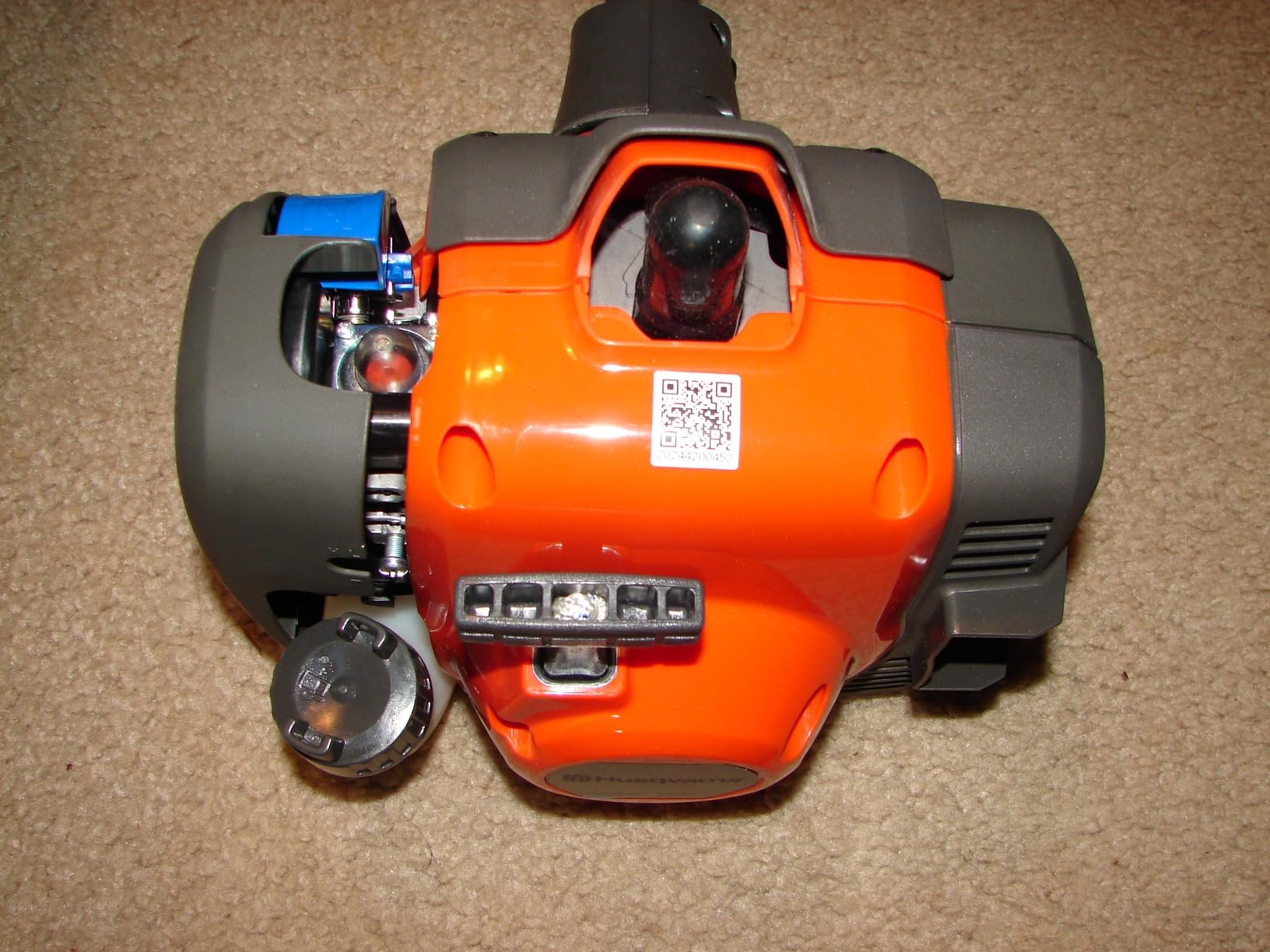
Quality control is the weak point, and it is worth being direct about. Reviewers report the protective guard detaching and damaging itself within minutes, and one report describes the front model-label plate arriving broken off at the screw bosses. Guard damage on a brush cutter is a safety item, not a cosmetic one, so inspect it before you work near anything but open grass.
Carburetor adjustment is the other friction point. Husqvarna does not make the mixture screw as accessible as some competitors, and several owners say it requires specialty tools. If you are not going to tune it, buy one that arrives set correctly.
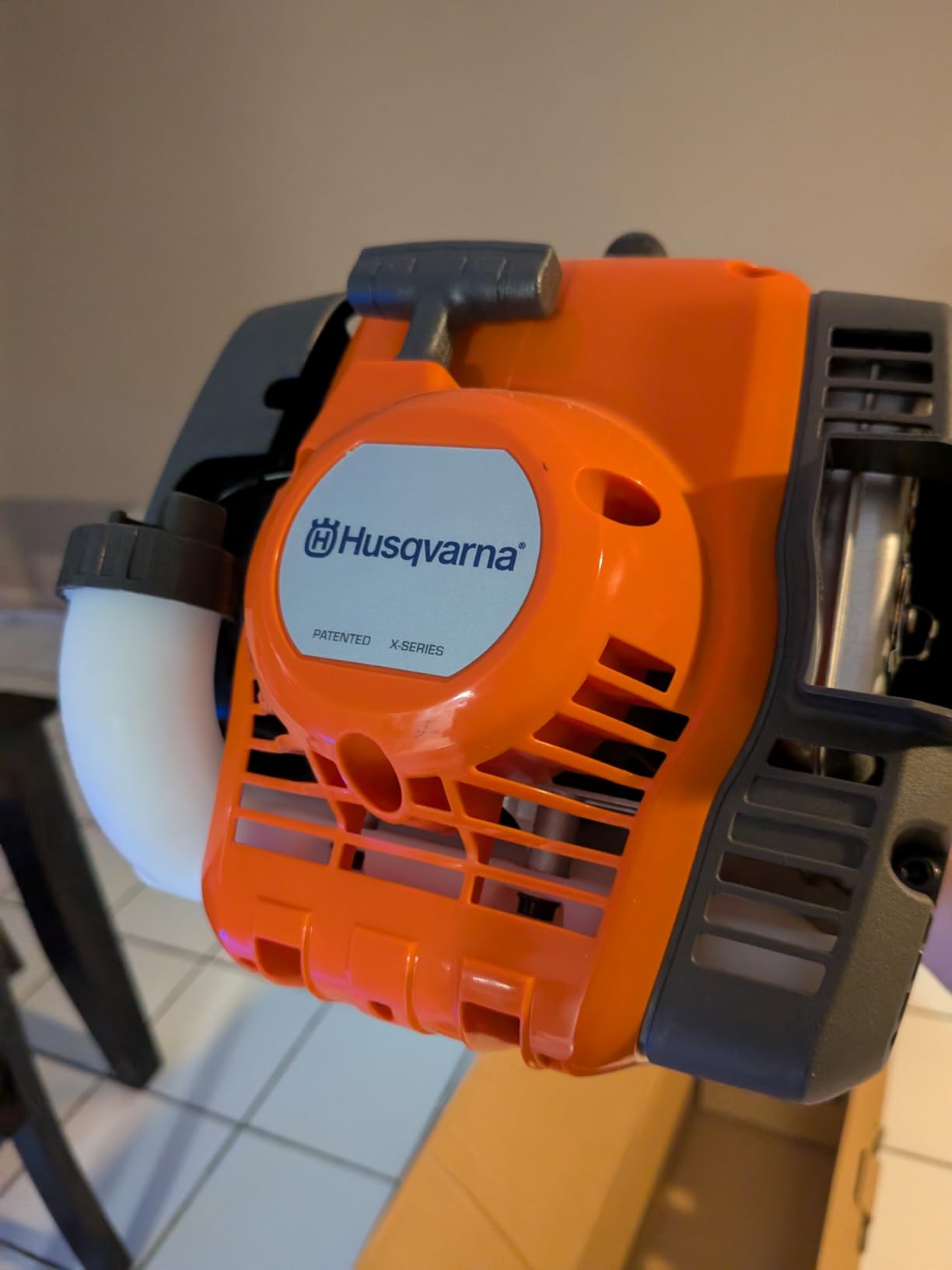
One owner reported leveling a month of yard overgrowth in about an hour with this machine. That is the efficiency claim that matters on a neglected property, and it is the reason I rank this fourth rather than lower despite the guard complaints.
Who the 122RJ works for
This suits someone whose problem is genuinely two-sided: tall weeds plus light woody growth like bramble, hedgerow edges and saplings. The blade is not an add-on, it is the reason to choose this machine.
It also suits anyone working around shrubs and obstacles, because the straight shaft and J-handle let you position the head under and between plants safely. Owners rate the idle stability highly, which means less throttle feathering over a long afternoon.
Who should skip it
Skip it if you are buying it purely for grass and light weeds. You are carrying a heavier, more complex machine than you need, and the extra complexity is where the quality complaints live.
Skip it if you cannot inspect it on arrival. The guard issue is common enough that I would not buy this machine sight unseen and immediately put it into bramble without checking the guard first.
5. COOCHEER 58cc 2-Cycle 4-Head Heavy Duty Trimmer
Weed Eater String Trimmer, 58cc Cordless Grass Gas Powered Weed Wacker 4-in-1 Straight Shaft String Trimmer Brush Cutter with 4 Detachable Head
58cc 2-cycle up to 9300 rpm
18 inch blade path
10 inch line path
Split shaft
Pros
- Highest displacement in the group for heavy-duty work
- Four interchangeable heads cover trimming
- brush and shrubs
- Quick-release split shaft for fast head swaps
- Spare pull rope
- spark plug
- mixing bottle and strap in the box
Cons
- Heavy and tiring over long sessions
- Mixing fuel adds steps versus an electric tool
At 58cc this is by a wide margin the highest engine displacement in the group, and it reaches 9300 rpm. If your weed problem has a diameter rather than a height, displacement is the number that answers it. Nothing else on this list has this much cubic centimeters under the housing.
Four detachable cutting heads come with it: two 0.08-inch dual-line bump-feed heads, a brush cutter blade and a circular saw blade. The circular saw blade is unusual and it explains the 18 inch blade cutting path against the 10 inch line path. The line heads cut vegetation, the saw blade handles the woody material that would destroy line.
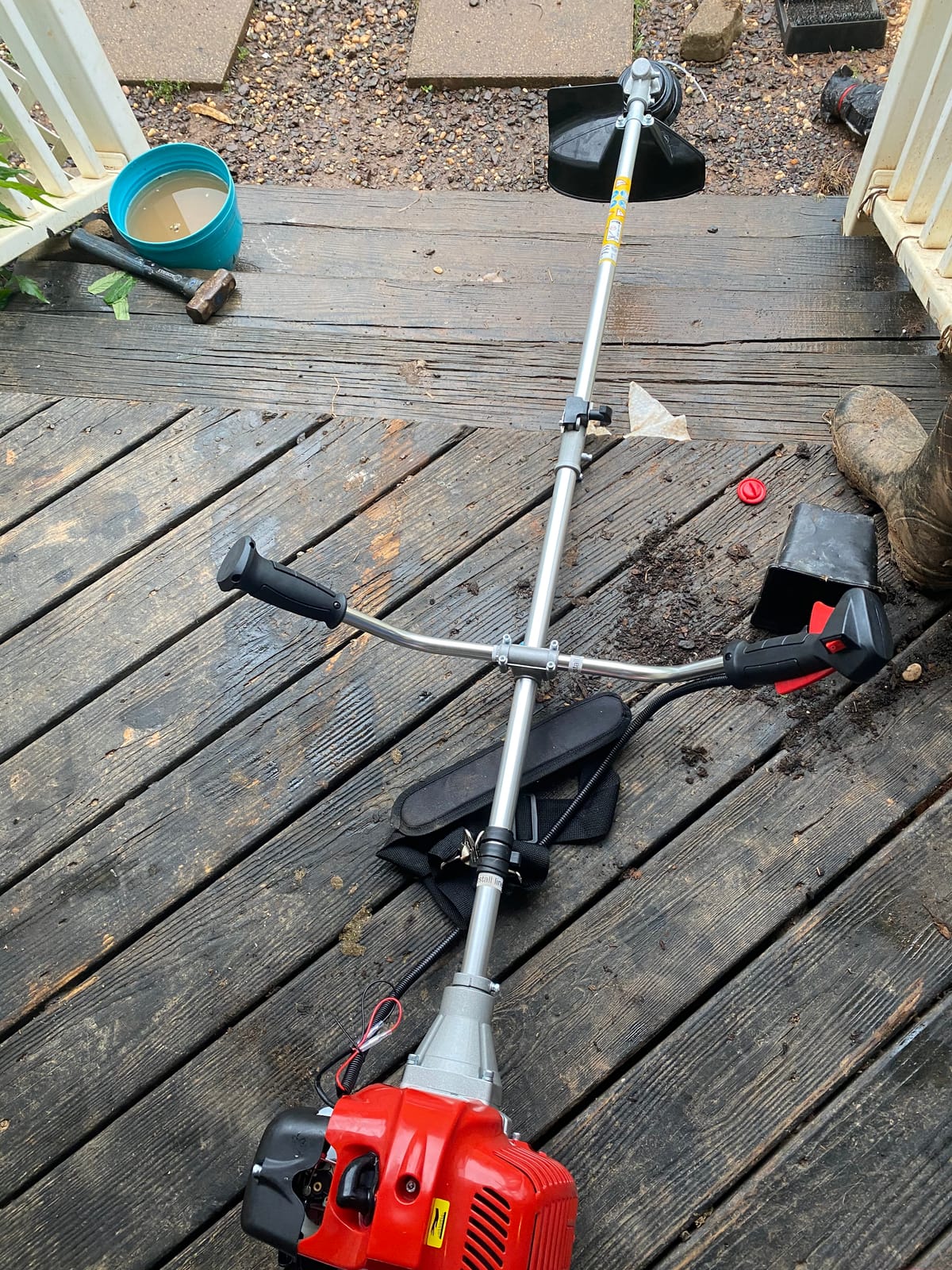
Owners point to the high-displacement engine as providing strong power with low vibration for heavy-duty jobs. The quick-release split shaft is the feature I would praise hardest on a machine this size, because it means you can split it in half for a car boot instead of wrestling a 72 inch tool into a vehicle.
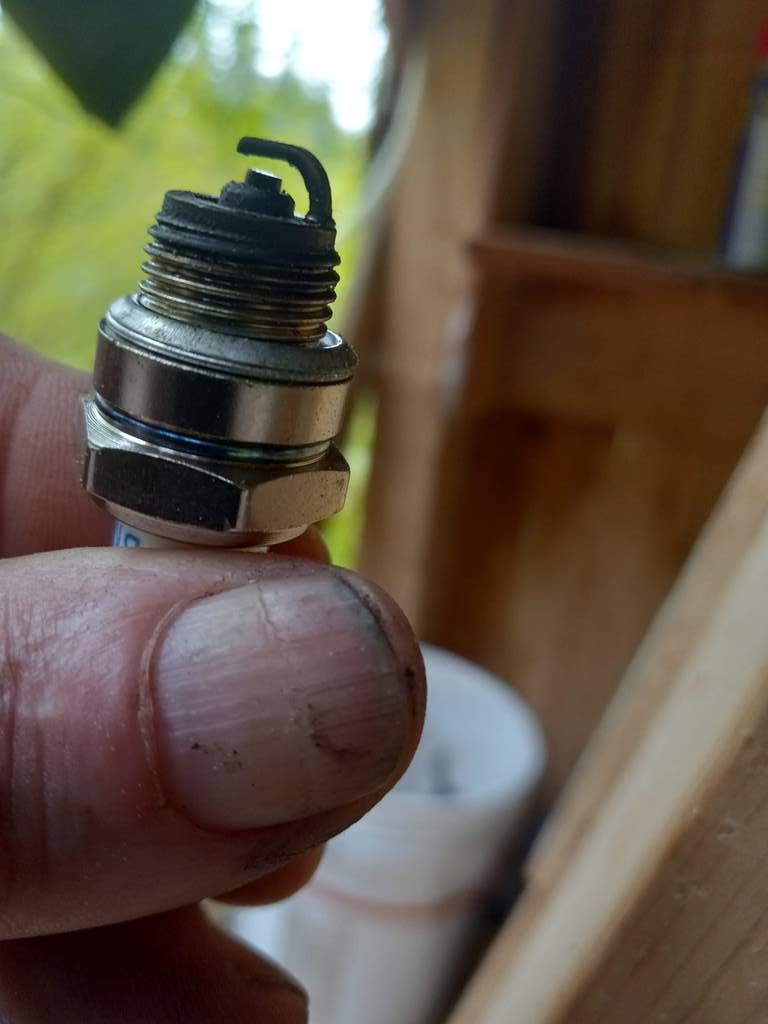
The included kit is unusually complete. You get a spare pull rope, a spare spark plug, a mixing bottle, a shoulder strap and a safety guard, which removes the two things that stop most new gas trimmer owners on day one.
Weight is the honest drawback, and it is the one reviewers mention. Several users find the assembled unit heavy and tiring over long sessions, and the specification listing does not publish a weight for the assembled tool. Check the physical size in person if you have any doubt about handling.
Mixing fuel is the second friction point. A 2-cycle at this displacement is not a beginner’s first engine, and owners who are new to gas tools report a real learning curve on the premix ratio.
Who the 58cc works for
This suits someone clearing a large rural property, an overgrown field edge, or a long stretch of bank where the growth is waist to shoulder high and packed. At this displacement you are not waiting for the engine to catch up to the vegetation.
It also suits anyone who wants one tool covering four jobs. Between the two line heads, the brush blade and the saw blade, there is no common overgrown job in a yard or small holding that this package cannot be pointed at.
Who should skip it
Skip it if your lot is under half an acre of ordinary weeds. You will be carrying 58cc of engine and a heavier tool through work that a 25.4cc handles without complaint, and the weight shows up in the shoulder before it shows up anywhere else.
Skip it if you will not use the saw blade. A circular saw head on a string trimmer is a serious tool around people and pets, and if it will sit in the box, you are paying for capability and risk you never take advantage of.
6. ECHO X Series SRM-3020T 30.5cc Professional Grade
ECHO X Series 30.5 Cc Professional-Grade Gasoline String Trimmers
30.5cc professional-grade engine
1.62:1 gear reduction
10000 rpm
SRM-3020T
Pros
- Highest rated model in the group at 4.6 stars
- 30.5cc with 1.62:1 gear reduction for fast cutting
- Built for professional landscaping and large properties
Cons
- 50-pound listed weight is heavy for prolonged homeowner use
- Only 50 reviews
- so long-term durability feedback is thin
The SRM-3020T is the professional-grade entry here, and it earns its place on two numbers. Thirty cubic centimeters and a 1.62:1 gear reduction ratio, which multiplies the crankshaft output before it reaches the cutting head and is the reason the line leaves the spool at speed.
It runs to 10000 rpm, the highest operating speed in this group, and ECHO positions it for professional landscaping, large-scale gardening and high-demand trimming. Owners describe it as suited to exactly that work.
The 4.6-star average is among the highest ratings of the ten machines here, with 91 percent of ratings at five stars. That distribution is unusually clean, and it is the strongest quality signal any single product in this roundup carries.
I want to be straight about the weight figure, though. The listing states 50 pounds, which is far heavier than any other machine on this page and reflects a packaged or shipping weight rather than necessarily a bare-tool weight. Either way, if you are a homeowner rather than a crew, treat this as a professional tool and check the actual handling in person.
The honest limitation on the research side is the sample size. With 50 reviews, the long-term durability picture is thinner here than for the ECHO kits with 300-plus ratings. High ratings and a small base deserve more caution than the star count alone suggests.
Who the SRM-3020T works for
This suits a landscaping business running trimmers full time, or a very large property with acreage and repeated heavy cutting. Professional use is the design target, not aspirational marketing on the box.
It also suits anyone whose head speed has been the limiting factor. If you have been running a 25cc machine and the line simply will not part the stems, the gear reduction ratio on this one is the specific answer to that problem.
Who should skip it
Skip it if you clear weeds a few times a season. The jump from 25cc to 30.5cc is meaningful, but the jump from occasional use to professional use is the bigger one, and that is a cost most households should not carry.
Skip it if weight is a factor in your decision. Several homeowners will find this machine unpleasant to handle, and the published weight is the single heaviest number in the roundup.
7. VEVOR 26cc 7-in-1 Gas Multi-Tool Kit
VEVOR Gas Hedge Trimmer, 2 Cycle Gas Power Handheld Trimmer, 7-in-1 26cc Weed Eater with Extension Pole & Protective Gear Set, Includes Hedge & String Trimmer, Brush Cutter(3T & 40T), Edger, Pole Saw
26cc 2-cycle at 8500 rpm
7-in-1 attachment system
30 inch extension pole
15.75 inch cutting width
Pros
- Starts on the second or third pull reliably
- 26cc cuts through thick long grass easily
- Sealed bearings keep the drive shaft centered
- Low vibration and dual shoulder straps reduce fatigue
Cons
- Clutch failed under heavy use
- Attachment locking pin ring broke on first swap
- Carburetor prime bulb is awkward to reach
- Engine cowling runs hot near the hand
The VEVOR kit is the odd one out in this roundup, and I want to describe it accurately rather than flatter it. It is a 26cc 2-cycle power head with a 7-in-1 attachment system: hedge trimmer, string trimmer, 3T and 40T brush cutter, edger, and pole saw. A 30 inch extension pole with a multi-angle head and a 12-inch bar handle the reach jobs.
For the string trimmer role specifically, the 26cc engine spins to 8500 rpm and cuts through thick long grass easily, which owners confirm. Starting is a genuine strength, with repeated reports of the engine firing on the second or third pull.
Sealed bearings keeping the drive shaft centered are an underrated detail. A drive shaft that stays straight sends the whole head’s energy into the line instead of into wobble, and owners specifically call this out alongside low vibration and dual shoulder straps that reduce fatigue.
Now the problems, and there are several that keep the rating at 3.9 stars. The clutch failed under heavy use for one owner. The attachment locking pin ring broke on the first swap for another, which on a 7-in-1 system is a structural complaint, because the attachment system is the product.
Two more complaints matter for safety and for use. The engine housing cowling runs hot enough to blister skin near the hand, and the carburetor prime bulb is awkward to reach, which makes daily starting a fumble rather than a habit.
There is a separate pole saw issue. Owners report the oiler is defective and does not deliver oil to the bar, and that the pole saw does not line up with the quick connect. Support response on the oiler was described as unhelpful. If you are buying this for the pole saw function, buy it knowing you may be doing that repair yourself.
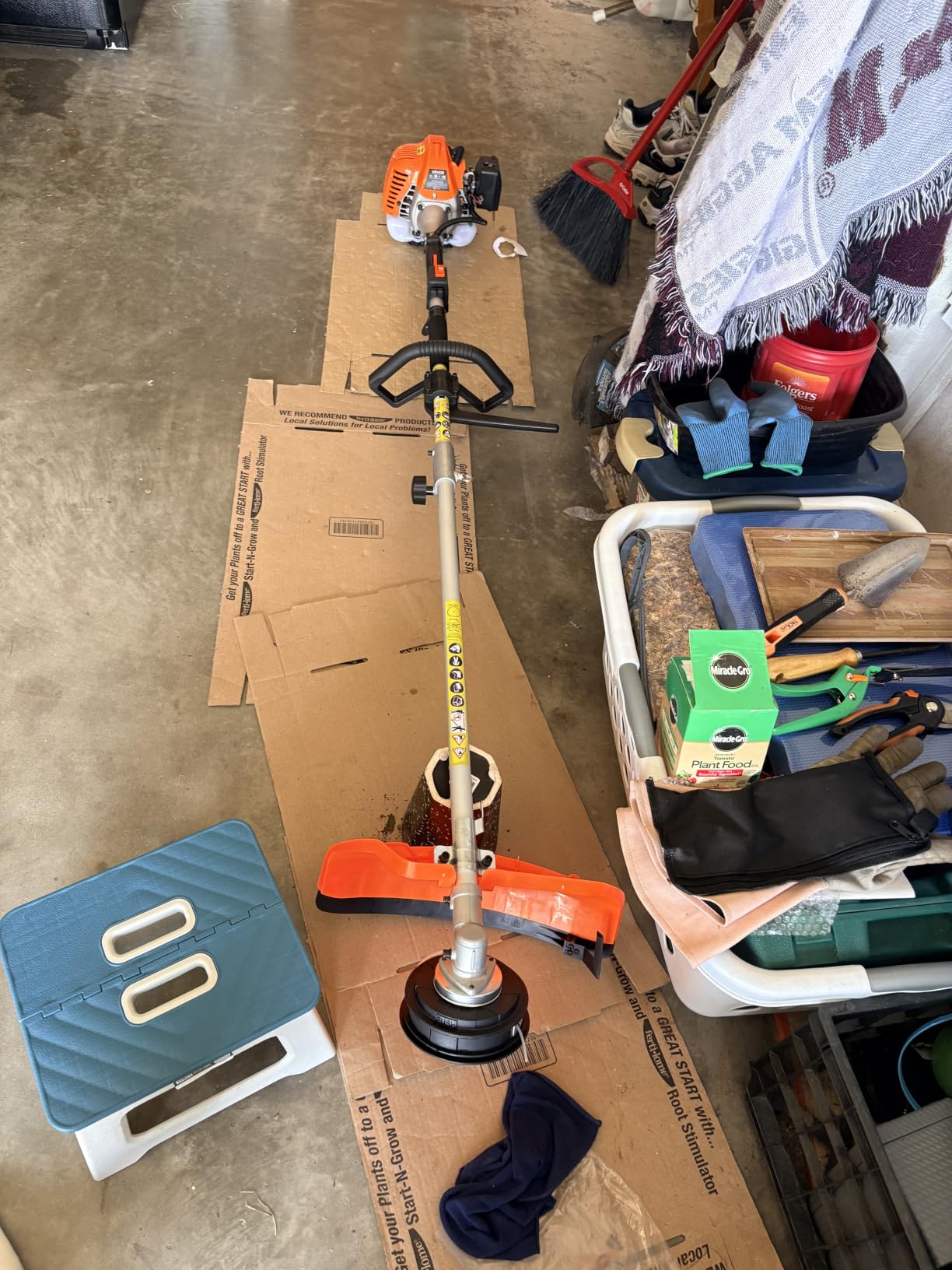
My read is that the string trimmer head is the strongest part of this package and the rest is carrying it. If you want the trimmer and the reach, the Flex pole format makes sense. If you want the hedge and pole saw, look elsewhere.
Who the 7-in-1 kit works for
This suits someone with hedges, a tall reach job and a weedy lot who wants one engine and one fuel supply rather than three tools. The multi-angle head allows horizontal, diagonal and vertical cuts from the 30 inch pole.
It also suits a first-time gas trimmer owner who will be gentle on the clutch. The easy starting and the low vibration are real, and the protective gear set including a face shield, glasses, earmuffs and gloves is genuinely useful for a first job.
Who should skip it
Skip it if you are cutting thick, dense vegetation hard and often. The clutch failure and the pin ring failure both point to the attachment system not surviving the load, and thick weed work is the heaviest load this tool will see.
Skip it if the hot cowling and the hard-to-reach prime bulb sound unappealing, which is a fair read. Both are recurring complaints, and both are daily-use annoyances rather than occasional ones.
8. NEO-TEC 26cc 3-in-1 Gas Trimmer and Brush Cutter
NEO-TEC 3-in-1 Gas String Trimmer Powerful 26cc 2-Cycle Gas Weed Eater Lawn Edger, Lightweight Weed Wacker Brush Cutter Quick-Start 16″ Gas Powered Trimmer with Shoulder Strap for Yard Care Overgrowth
26cc EPA-certified 2-stroke
16 inch string head
9 inch edger blade
10 inch 3T brush blade
Pros
- 4.6-star rating with 77 percent five-star scores
- 3-in-1 conversion covers trimming
- edging and brush cutting
- Quick-start system fires in a few pulls
- Balanced design with adjustable shoulder strap
Cons
- Review text returned is largely about chainsaw chain
- Not CARB certified
- so California delivery is restricted
The NEO-TEC BC260EPA-X is a 26cc 2-stroke with a 3-in-1 conversion kit, and the package is complete: a 16-inch string trimmer head, a 9-inch edger blade and a 10-inch 3T brush cutter blade. At 26cc it clears the displacement threshold for thick mature weeds, and the 3T blade covers the woody material line cannot.
Split shaft means quick setup and compact storage, which is a real advantage for a homeowner with a small garage. The quick-start system is reported to fire the engine in a few pulls, and the adjustable shoulder strap is what keeps the 71 inch package manageable.
The 4.6-star average sits alongside the top of this roundup, with 77 percent five-star scores. I would not lean on it as heavily as the ECHO SRM-3020T’s number, and the reason is the next paragraph.
I have to flag a data problem honestly. The customer review text returned for this listing is largely about chainsaw chain rather than the trimmer itself, which means the written feedback offers limited direct insight into trimmer performance. Treat the rating as a score without a supporting review base, and judge the machine on its 26cc 3-in-1 specification instead.
The CARB certification note is practical rather than technical. This engine is EPA certified but not CARB certified, and the manufacturer restricts delivery to California addresses. If that is where you are, cross this one off your list before you spend any more time on it.
Who the NEO-TEC works for
This suits a homeowner who wants one power head covering trimming, edging and light brush, and who wants it to store compactly. The split shaft and the three included heads cover the standard homeowner job list without a second purchase.
It also suits anyone with a mixed trimming and edging routine, because the 9-inch edger blade is included rather than sold as an accessory. The quick-start behavior is the kind of small thing you notice every single time you pick the tool up.
Who should skip it
Skip it if you are in California. The lack of CARB certification is a hard stop, not a preference.
Skip it if you want to read owner reports before buying. This is the one machine in the roundup where the available review text does not describe the tool, and I would rather say so than invent confidence from a star count.
9. Husqvarna 122LK 22cc Straight Shaft with T25 Head
Husqvarna 122LK Grass Trimmer, 22-cc 2-Cycle, 17-inch Straight Shaft Gas Trimmer with T25 Head, 967628203
22cc 2-cycle engine
19.7 inch cutting width
Straight shaft
SmartStart system
T25 head compatible
Pros
- Quiet
- lightweight design aimed at homeowner trimming
- SmartStart system starts with minimal effort
- Accepts the T25 heavy-duty trimmer head
- Straight shaft reaches under shrubs and obstacles
Cons
- 22cc engine intended for occasional use
- not sustained heavy growth
- Only 27 reviews
- so owner feedback is limited
The 122LK is the machine I recommend to someone with a small lot who wants a straight shaft and a quiet engine rather than maximum power. Husqvarna positions the 22cc 2-cycle for occasional homeowner use, and that positioning is accurate and worth respecting.
The SmartStart system starts the engine with minimal effort, and on a machine you will pull on a Saturday morning a dozen times a season, that is a meaningful feature. The straight shaft reaches under shrubs and obstacles, which is the practical advantage over a curved shaft on a landscaped lot.
The 19.7 inch listed cutting width is the widest in this roundup, and combined with a 72.8 inch overall length it covers ground quickly. For tall grass along a back field or a roadside verge, that combination does a lot of work per pass.
The T25 heavy-duty head compatibility is the important detail for this listing. The T25 head takes thicker line and is a bump-feed design, which means the 22cc engine in this machine can be fed the .095 inch line that thick weeds need, and that is how you get more out of a smaller engine than its displacement suggests.
Where it falls short is exactly where Husqvarna says it falls short. A 22cc 2-cycle will not sustain cutting through dense mature weed stems, and expecting it to is how people end up blaming the machine for their technique. The review base is also thin at 27 ratings.
Who the 122LK works for
This suits a small or medium suburban lot with seasonal growth rather than a neglected property. The quiet, lightweight design and the low-effort starting are aimed squarely at occasional use, and they deliver on it.
It also suits anyone who wants the T25 head ecosystem. Because the machine accepts the T25 heavy-duty head and click-on attachments, you can increase its capability over time without replacing the power head.
Who should skip it
Skip it if thick mature weeds are the actual problem, which is the case this roundup is about. Below the 25cc threshold, the engine is the limiting factor and no head fixes that.
Skip it if your lot is large. The 19.7 inch swath is welcome, but a small engine and a wide swath means more passes, and on a big property the wide swath works against you rather than for you.
10. Husqvarna 525L 25.4cc X-TORQUE with Tap-n-Go Head
Husqvarna 525L Gas String Trimmer, Gas Weed Eater w/Tap-n-Go Trimmer Head
25.4cc X-TORQUE 2-cycle
17 inch cutting width
12.5 lb
Straight shaft
Smart Start
Pros
- X-TORQUE engine delivers strong low-RPM torque
- Tap-n-Go head makes line reloading fast
- Smart Start with auto-resetting stop switch
- Intuitive choke and purge controls
- Lightweight 12.5-pound straight shaft
Cons
- Only 17 ratings
- giving a thin reliability picture
- No written customer reviews returned beyond the aggregate rating
The 525L is the most interesting machine here for thick weeds specifically, because of how the X-TORQUE engine works. Rather than trading on peak output, it delivers high power at low rpm, and low-rpm torque is exactly what you want when the head is buried in vegetation. High-rpm machines spin up and then stall when the load hits; torque-heavy machines push through.
The Tap-n-Go trimmer head is the other feature that matters for this job. It refills quickly without the threading most spool heads require, which matters when you are burning through line faster than usual in thick growth. The 76 percent five-star share reflects a well-liked machine.
Smart Start Technology with an auto-resetting stop switch and intuitive choke and purge controls addresses the loudest complaint in owner forums about gas trimmers, which is starting. This machine is engineered to start and to keep starting.
At 12.5 pounds it is the lightest straight-shaft machine in the roundup, and the 17 inch cutting width on a 70.43 inch overall length makes it easy to maneuver in tight areas and under shrubs.
My caveat is the same one I applied to the ECHO SRM-3020T, and here it is more severe. Seventeen ratings is a very thin base, and no written customer reviews were returned beyond the aggregate. I am rating this on its engineering rather than its owner history, and you should know that.
Who the 525L works for
This suits someone whose weeds are dense rather than woody. Vegetation that is packed and green, where the head spends most of its time buried and low-end torque is the limiting factor, is the exact case X-TORQUE was built for.
It also suits owners who burn through line quickly. The Tap-n-Go head means fewer stops and fewer sore fingers during a long thick-weed session, which is a small detail that compounds over a season.
Who should skip it
Skip it if you need proof of long-term reliability, because this listing does not provide it. Seventeen ratings is not an ownership record, and I would want a machine with a larger feedback base if I were spending this much on something I planned to keep for years.
Skip it if woody stems are the main target. This is a trimmer, not a brushcutter, and there is no blade path here. For one-inch branches, look at the 122RJ or the machines with a brush blade included.
How to Choose a Gas String Trimmer for Thick Weeds
The spec table above gives you the numbers. These are the judgment calls that the numbers do not settle, and they are where most buyers go wrong.
2-cycle or 4-cycle for thick weeds
For thick weeds specifically, a 2-cycle is the better choice, and the usual framing gets this backwards. A 2-cycle is lighter, more compact and delivers more usable power for its weight, which is why every machine above 25cc in this roundup is a 2-cycle. A 4-cycle needs no oil mixing and starts more simply, which is a real convenience advantage.
But the complaint you will hear about 4-cycles in thick weeds is not marketing, it is mechanical. Owners report 4-cycle engines bailing out when they hit something hard, and the reason is straightforward: a 4-cycle has less low-end torque and spins more slowly to recover. A 2-cycle revs up and keeps the head moving through the load. If you are choosing on cutting capability alone, the 2-cycle wins.
Straight shaft, curved shaft, or loop handle
Prefer a straight shaft for thick weeds, and the reason is physics rather than preference. A straight shaft keeps the gearbox and the head aligned under load, so the head stays behind and below your feet where you can see it. A curved shaft lets the head swing behind the operator when the load twists the shaft, which puts the cutting end where you cannot see it.
Loop handles or D-handles are a different question, and the answer is a long job. They let you clamp the machine to a harness and take the weight off your arms, which is a meaningful gain over a full afternoon on a large property. The Husqvarna 122RJ with its adjustable harness and the multi-tool kits with dual shoulder straps are built for that.
Trimmer line and head choice
Use .095 inch line for thick weeds. That is the diameter that resists snapping when it meets a woody stem, and it is what the thicker machines in this roundup are specced for. .080 inch line is the default on many machines and it will snap on mature stems. .105 inch is tougher still, but not every bump-feed head spools it properly, so check the head rating before you fit it.
Shape matters too. A round line lasts longer, a triangle line cuts sharper into stems and shears more plant material per pass, and a braided line resists breaking on stone and hard stems at the cost of faster wear. For thick weeds, a triangle .095 inch line is the working choice, and round .095 inch is the longer-lived compromise.
On heads, use bump feed or load-bump, dual line. A single-line spool has one exposed line end, and one snagged line end stops the cut. Dual-line bump heads give you two line ends, and bump feed means you advance line while the head is spinning rather than stopping to rewind.
If your trimmer keeps eating line every few feet, the cause is usually operating speed rather than the line itself. Cutting at full throttle in thick weeds whips the line against the guard and the ground at the same time, which breaks it. Ease the throttle slightly and sweep a little higher, and the consumption drops.
When a string trimmer is the wrong tool
A string trimmer tops out at roughly one inch of stem diameter with a line head, and that is the ceiling rather than a target. Above about three-quarters inch, the line wraps, stalls the engine and snaps. Once you are past one inch, you need a metal blade and you are no longer using a string trimmer.
Brushcutter territory starts there. A brushcutter with a three-tooth or four-tooth blade or a saw blade clears woody stems in the 1.5 to 2 inch diameter range, and owners of blade-equipped machines report that as a working limit. The Husqvarna 122RJ, the PowerSmart 25.4cc and the VEVOR kit all sit in this crossover zone for exactly that reason.
Past 2 inch diameter, you are into chainsaw work and probably a permit question depending on where you live. Know where your property boundary is before you cut anything that size.
Gas versus battery for thick weeds
A battery trimmer is the right answer more often than this category admits. If your lot is a quarter acre or less, the weeds are seasonal rather than perennial, and you can wait for a break in the weather, a 40V-class battery machine will handle it with far less friction than anything on this page.
Gas earns its place at the point where you need continuous runtime, thick stems and no charging. If you are clearing a half acre or more of genuinely overgrown ground, or you are running the machine as part of paid work, the battery platform runs out of charge at exactly the wrong moment. Multiple owners in the forums describe the tradeoff in those terms.
Noise and fumes are real factors for suburban lots. Gas engines are loud, and neighbors notice. If that is a live concern in your situation, our picks for battery string trimmers for lighter setups and quieter hedge trimmers may serve you better than any engine on this list.
Starter reliability and the fuel system
The loudest complaint about gas string trimmers is not cutting, it is starting. Forum threads across r/lawncare and r/Tools are dominated by machines that will not start, and the complaints cluster into a small number of causes that are all avoidable.
Fuel quality is the first one. Use ethanol-free gas where you can get it and add a fuel stabilizer for anything that will sit in the tank over a month. One recurring owner recommendation across the forums is to run proper oil at the correct ratio, and to never run a 2-cycle on straight gasoline. Ethanol absorbs moisture, and water in the fuel is what makes a carburetor gum up over a winter.
The primer bulb and fuel lines are the second cause. A one-star r/lawncare owner documented replacing both deteriorated fuel lines and the primer bulb and being running again shortly after, on a machine that had been written off as dead. If your trimmer has sat for a season, that is a cheap repair before you replace anything.
Choke technique is the third. A cold 2-cycle wants choke on for the first pull, then choke off for the second. Opening the choke while the engine is flooded is why owners report a machine that cranks forever. Press the primer bulb, set choke, pull once, release choke, pull again.
Finally, clean the air filter. A clogged filter chokes the engine down and mimics every other fault on this list, and it is the cheapest fix available.
Which brand is most reliable: Echo, STIHL, or Husqvarna
All three brands have strong owner histories, and the difference is more about your dealer network than about the machines. Husqvarna and STIHL owners report long service spans and parts availability through dealers, and STIHL in particular is sold dealer-only, so parts and service depend on a local dealer existing.
ECHO’s commercial warranty is the most concrete differentiator we found. The SRM-2620 carries one year commercial and five years consumer, which is a five-year commitment on the part of a company you may need to reach.
On starting reliability, the engineers at all three addressed it directly. Husqvarna’s SmartStart and air purge system appear on both machines in this roundup, and ECHO’s owners consistently report quick, smooth starts. If first-pull starting is your top priority, buy from a dealer who will assemble and test the machine in front of you.
For thick weeds specifically, the brand matters less than the displacement. A 25.4cc ECHO and a 25.4cc Husqvarna are in the same performance class, and the head and line you fit will change the result more than the badge on the housing.
How to actually cut tall, thick weeds
Technique is worth more than any spec on this page, and it is the difference between one tank of fuel and two.
Work top-down, never bottom-up. Start at the top of the growth and cut downward. Cutting from the ground up drives the stems into the head and stalls the engine.
Hold the head 3 inches off the ground. Dropping it to ground level is what breaks line. Let the stems stand up into the head.
Sweep side to side in short arcs. Wide sweeping passes cut more per pull than jabbing the head at a single stem.
Use full throttle for thick material, feather for grass. The engine needs speed to shear a stem, and needs less for grass so you stop eating line.
Cut a path, do not spot clear. Two or three passes in one direction get you through. Circling a patch wears the line without finishing the job.
Sharpen or replace the blade if you are using one. A dull three-tooth blade leaves strips and stalls. This is the same advice a chainsaw owner gets for a different reason.
Wear eye protection, long trousers, closed-toe shoes, hearing protection and gloves for every pass. A nylon line at cutting speed throws stones and woody fragments hard enough to injure, and a debris guard reduces that without eliminating it.
Frequently Asked Questions
What is the best string trimmer for heavy weeds?
A gas string trimmer with a 25cc or larger engine, a 17 to 19 inch cutting swath, .095 inch trimmer line and a bump-feed dual-line head is the right tool for heavy weeds. Engine displacement is the number that decides whether the engine bogs down in dense growth, and straight shafts keep the head where you can see it. Below 22cc you will stall on mature stems.
What is the best string trimmer line for heavy weeds?
Use .095 inch diameter line for heavy weeds, ideally a triangle profile, which cuts sharper and shears more plant material per pass. Round .095 inch is the longer-lived compromise. Braided line resists breaking on hard stems but wears faster. Below .080 inch the line snaps on woody growth, and .105 inch only works if your head is rated for it.
What is the best tool to cut through thick weeds?
For weeds and light stems, a string trimmer with a 25cc engine and .095 inch line is correct. For woody stems thicker than about one inch, you need a metal blade, which means a brushcutter. Blade-equipped machines clear material in the 1.5 to 2 inch diameter range. Past 2 inches, you are into chainsaw territory.
How do I cut down large, thick weeds?
Work from the top of the growth downward and never cut from the ground up, which drives stems into the head. Hold the cutting head about 3 inches above the ground and let the weeds stand up into it. Use full throttle for stems and a feathered throttle for grass, and sweep in short side-to-side arcs rather than jabbing at individual stems.
What is the best gas string trimmer on the market?
There is no single best machine, because the class matters more than the model. For dense thick weeds the ECHO SRM-2620 at 25.4cc with a straight shaft is the strongest all-round choice, because it combines a straight shaft, 8500 rpm and a 13 pound frame. For the highest capacity, a 58cc machine with a brush blade covers brush a trimmer cannot.
Who makes the most reliable string trimmer?
ECHO, STIHL and Husqvarna all have strong long-term owner records, and the practical difference is your dealer network. STIHL is sold dealer-only, so parts and service depend on a local dealer. ECHO backs the SRM-2620 with a 1-year commercial and 5-year consumer warranty. Husqvarna’s SmartStart and air purge systems address starting reliability directly.
Is a 2-cycle or 4-cycle trimmer better for thick weeds?
A 2-cycle is better for thick weeds because it is lighter and delivers more usable power for its weight, and it revs back up after a load spike. A 4-cycle needs no oil mixing and starts simply, but owners report 4-cycle engines bailing out when they hit hard stems because there is less low-end torque to push through. Every 25cc-plus machine in this roundup is a 2-cycle.
Why won’t my gas string trimmer start?
The usual causes are fuel quality, a clogged air filter, a deteriorated primer bulb or fuel line, and choke technique. Use ethanol-free gas with stabilizer, never run a 2-cycle on straight gasoline, and clean or replace the air filter first. For a cold start, set the choke, pull once, release the choke, then pull again.
Why does my gas trimmer keep breaking the string?
The most common cause is operating at full throttle while the head is buried in weeds, which whips line against the guard and the ground at the same time. Cutting thicker than .080 inch line also breaks faster on stems. Fix both by fitting .095 inch line and easing the throttle slightly on grass while keeping full throttle only for woody material.
Do I need a brushcutter instead of a string trimmer?
You need a brushcutter once the stems exceed about one inch in diameter, which is where a line head wraps, stalls the engine and snaps. A brushcutter with a three or four tooth blade or a saw blade clears material in the 1.5 to 2 inch range. Several machines in this roundup ship with a brush blade so you can cover both cases with one engine.
Conclusion
For most people facing genuinely thick weeds in 2026, the ECHO PAS-225VP is the machine to buy. The PAS system pairs a 21.2cc 2-cycle power head with both a trimmer and an edger attachment, so one engine covers trimming and edging and you are not buying a second motor to maintain. It clears tall grass and ordinary thick weed growth all day without the fatigue a heavier machine brings.
When the stems push back and you need more displacement, step up to the ECHO SRM-2620. Its 25.4cc X Series straight shaft at 8500 rpm, 13 pounds, and a 1-year commercial and 5-year consumer warranty cover the threshold that separates a trimmer that stalls from one that pushes through. If the budget is tighter, the PowerSmart 25.4cc gives you the same displacement plus a 10-inch brush blade and .095-inch line in the box.
Two rules will get you more out of any of these than the spec differences between them. Fit .095 inch line on a bump-feed dual-line head, and cut top-down with the head held 3 inches off the ground. Both are free, and together they account for most of the difference between finishing a lot in one session and finishing it in three.
And if the stems are thicker than an inch, stop reading roundup articles and start pricing brushcutters. No amount of line diameter changes the ceiling.