
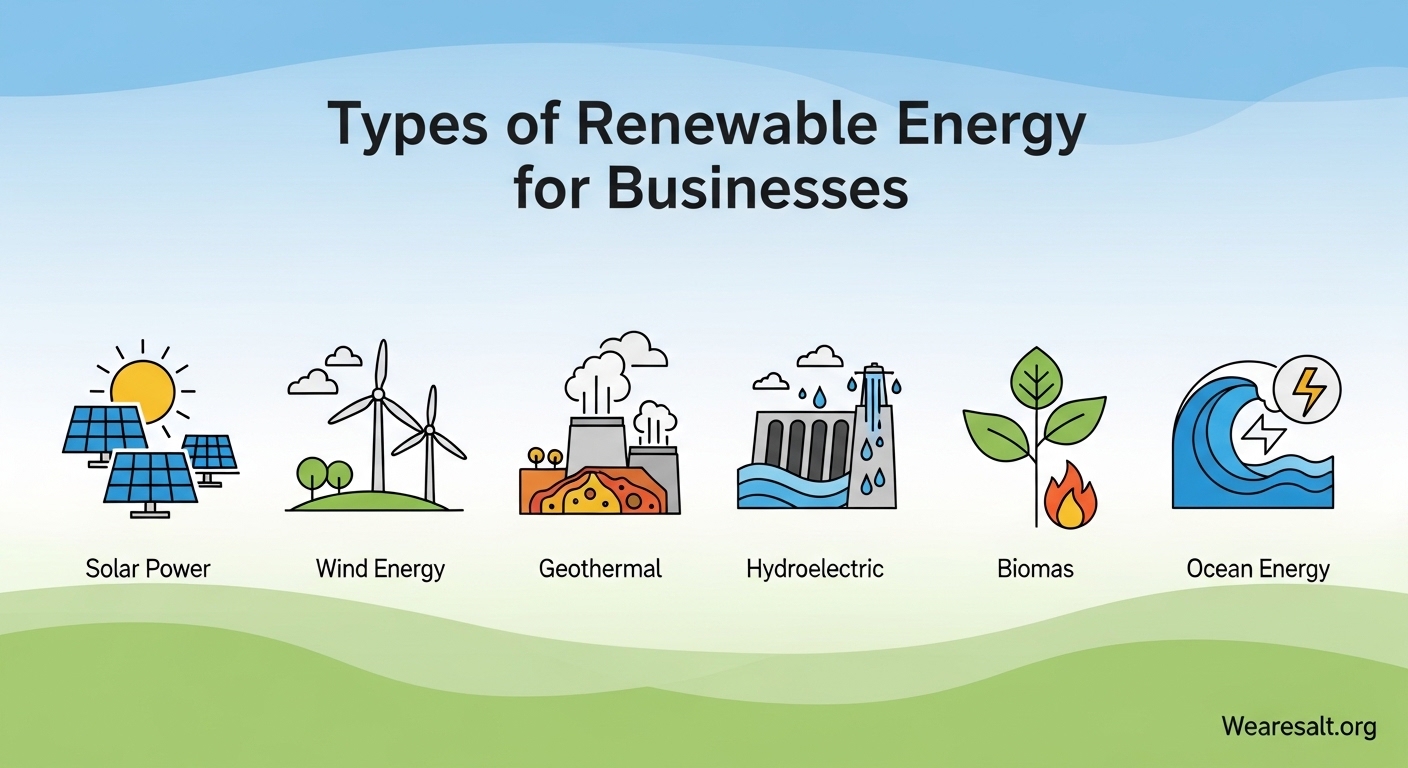
Switching to renewable energy is one of the smartest moves a business can make in 2026. Whether you run a small retail shop or manage a large manufacturing facility, understanding the types of renewable energy for businesses helps you cut costs, reduce your carbon footprint, and future-proof your operations against rising energy prices.
In this guide, I will walk you through every major renewable energy option available to businesses today. You will learn how each technology works, what it costs, and which might be right for your specific situation. I have also included real payback period data and practical steps to get started.
Table of Contents
What Is Renewable Energy?
Renewable energy comes from natural sources that replenish themselves. Unlike fossil fuels, which take millions of years to form and release harmful emissions when burned, renewable sources like sunlight, wind, and water flow are constantly available and clean.
For businesses, renewable energy typically means generating your own power through solar panels, wind turbines, or other clean technologies. It can also mean purchasing green energy from suppliers who use renewable sources. The key benefit is that you reduce reliance on fossil fuels while often lowering your long-term energy costs.
The main types of renewable energy for businesses include solar power, wind energy, hydropower, geothermal energy, and bioenergy. Each has unique advantages depending on your location, facility type, and energy needs.
Solar Energy for Businesses
Solar energy is the most accessible renewable option for businesses today. Photovoltaic panels convert sunlight directly into electricity, and they can be installed on rooftops, parking structures, or ground-mounted arrays.
For commercial buildings, rooftop solar is typically the easiest starting point. Most businesses have adequate roof space to generate a significant portion of their electricity needs. The technology has improved dramatically over the past decade, with modern panels producing more power even in low-light conditions.
The upfront cost for commercial solar installations ranges from $2 to $4 per watt installed, depending on system size and location. A typical 100kW system might cost $200,000 to $400,000 before incentives. However, with federal tax credits, depreciation benefits, and state incentives, most businesses see payback periods of 4 to 8 years.
Key Benefits of Solar for Business
- Reduce electricity bills by 50-90% depending on system size and energy usage
- Minimal maintenance requirements with 25+ year panel warranties
- Works in most climates and weather conditions
- Increases property value and attracts eco-conscious customers
- Protection against rising utility rates
Wind Energy for Businesses
Wind energy harnesses moving air to generate electricity through turbines. While massive offshore wind farms grab headlines, smaller on-site turbines can work well for businesses with adequate space and consistent wind resources.
Small commercial wind turbines typically range from 10kW to 100kW capacity. They require open space, minimal obstructions, and average wind speeds of at least 10 mph to be cost-effective. Rural businesses, farms, and industrial sites on large plots are often ideal candidates.
A 50kW wind turbine installation costs approximately $150,000 to $300,000, depending on tower height and installation complexity. Payback periods vary widely based on wind resource quality but typically range from 6 to 15 years. Businesses in windy regions can see much faster returns.
Wind Energy Considerations
Before investing in wind energy, conduct a thorough wind assessment at your site. Local zoning laws may also restrict turbine height or placement. Maintenance costs are higher than solar because moving parts require regular service.
Some businesses combine wind with solar to maximize energy production throughout different weather conditions. Wind often picks up in evening hours when solar production drops, creating a complementary energy profile.
Hydropower for Businesses
Hydropower generates electricity from flowing water. While large dams power entire cities, small-scale hydroelectric systems can work for businesses located near rivers or streams with adequate flow.
Run-of-river hydro systems divert a portion of stream flow through a turbine without requiring dams or reservoirs. These systems work best for businesses with access to flowing water year-round and sufficient vertical drop (head) to drive turbines effectively.
Small hydro installations range from $3,000 to $6,000 per kilowatt of capacity. A 25kW system might cost $75,000 to $150,000. The main advantage is consistent power generation 24/7, unlike solar or wind which depend on weather conditions. Payback periods typically fall between 8 and 12 years.
Regulatory requirements for hydro can be complex. You will need water rights, environmental permits, and possibly federal licenses depending on system size and location. The upfront paperwork often takes longer than the actual installation.
Geothermal Energy for Businesses
Geothermal energy taps into the earth’s constant underground temperature to provide heating and cooling. Geothermal heat pumps transfer heat between your building and the ground, using the earth as a natural temperature regulator.
This technology works exceptionally well for businesses with significant heating and cooling needs. Office buildings, schools, and manufacturing facilities can reduce HVAC costs substantially. Geothermal systems work in any climate since ground temperatures remain stable year-round.
Commercial geothermal installations cost $15 to $30 per square foot of building space served. A 50,000 square foot building might invest $750,000 to $1.5 million in a complete system. While upfront costs are higher than conventional HVAC, geothermal systems cut energy use by 30-70% and pay back in 5 to 10 years.
The system requires drilling vertical boreholes or excavating horizontal loops, making it easier to install during new construction. Retrofitting existing buildings is possible but more expensive due to landscaping disruption.
Bioenergy and Biomass for Businesses
Bioenergy converts organic material into usable energy. Biomass systems burn wood chips, agricultural waste, or dedicated energy crops to produce heat and electricity. Biogas systems capture methane from decomposing organic matter.
This option suits specific industries particularly well. Food processing businesses, farms, and forestry operations often have waste streams that can fuel biomass systems. Anaerobic digesters can turn food waste, manure, or sewage into biogas for heating or electricity generation.
Biomass boiler systems for commercial heating cost $100,000 to $500,000 depending on size. Biogas digesters for farms or food processors range from $200,000 to over $1 million for large installations. Payback periods vary from 5 to 15 years based on fuel costs and availability.
Businesses using bioenergy must secure reliable fuel supplies. Transportation costs for biomass fuel can offset savings if sources are distant. However, companies producing their own organic waste can essentially generate free energy from material they would otherwise pay to dispose of.
Emerging Renewable Technologies
Beyond the established options, several emerging technologies show promise for business applications. Hydrogen fuel cells convert hydrogen into electricity with only water as a byproduct. Companies like Microsoft and Amazon are already testing hydrogen backup power systems for data centers.
Ocean energy including tidal and wave power remains largely experimental for commercial use. Coastal businesses may eventually benefit as these technologies mature. Currently, costs are prohibitive for most applications.
Renewable Energy Certificates (RECs) offer another pathway for businesses to support clean energy without installing equipment. When you purchase RECs, you are buying the environmental benefit of renewable energy generated elsewhere. This approach works well for businesses that cannot install on-site generation due to space, zoning, or ownership constraints.
Comparing Renewable Energy Options for Businesses
Choosing the right renewable energy type depends on your location, facility characteristics, and budget. Here is how the main options compare:
| Energy Type | Upfront Cost | Payback Period | Best For | Space Required |
|---|---|---|---|---|
| Solar | $2-4/watt | 4-8 years | Most businesses | Rooftop or ground |
| Wind | $3-6/watt | 6-15 years | Rural, coastal | Open land |
| Hydropower | $3-6/watt | 8-12 years | Near water source | Water access |
| Geothermal | $15-30/sq ft | 5-10 years | Heating/cooling heavy | Land for loops |
| Bioenergy | Varies widely | 5-15 years | Waste-producing industries | Fuel storage |
Solar energy offers the broadest applicability and fastest payback for most businesses. It requires minimal maintenance and works regardless of business type. Wind and hydro require specific geographic conditions. Geothermal excels for climate control needs. Bioenergy fits businesses with organic waste streams.
Why Businesses Should Switch to Renewable Energy
The business case for renewable energy has never been stronger. Companies adopting green energy report benefits across financial, operational, and reputational dimensions.
Cost Savings
After the initial payback period, renewable energy provides essentially free electricity or heating for decades. Solar panels typically last 25-30 years, meaning 15-20 years of nearly zero energy costs after payback. With utility rates rising 2-4% annually historically, renewable energy protects your business from price volatility.
Carbon Reduction
Businesses switching to renewable energy dramatically reduce greenhouse gas emissions. A typical 100kW solar system prevents approximately 140 metric tons of CO2 annually, equivalent to planting over 3,000 trees each year. This measurable impact supports corporate sustainability reporting and ESG goals.
Brand and Competitive Advantage
Consumers increasingly prefer environmentally responsible companies. Displaying solar panels or publicizing your renewable commitment differentiates your brand. Many Fortune 500 companies now require suppliers to meet sustainability standards, making renewable energy a competitive necessity.
Regulatory Compliance
Environmental regulations tighten every year. Businesses using renewable energy stay ahead of compliance requirements. In some jurisdictions, renewable energy users avoid carbon taxes or climate change levies. Early adopters avoid the scramble that comes when mandates eventually take effect.
Energy Independence
On-site generation reduces dependence on utility grids and external suppliers. During grid outages, businesses with solar plus battery storage can continue operating. This resilience protects against increasingly common extreme weather events and grid failures.
Challenges and Drawbacks to Consider
Renewable energy makes sense for most businesses, but honest evaluation requires acknowledging limitations. Understanding these challenges helps you plan accordingly.
Upfront Investment
The main barrier for many businesses is capital cost. Even with financing options, renewable energy requires significant initial investment. However, solar loans, leases, and power purchase agreements (PPAs) can eliminate upfront costs while still delivering savings.
Weather Dependency
Solar panels do not produce at night and generate less on cloudy days. Wind turbines need wind to spin. This intermittency requires either grid connection, battery storage, or backup generators for businesses needing constant power. Battery costs have dropped 70% over the past five years, making storage increasingly viable.
Space Requirements
Wind turbines need open space and clearance from buildings. Geothermal systems require land for underground loops. Not every business has adequate space. Rooftop solar minimizes this concern but still needs sufficient roof area and structural capacity.
Grid Connection Issues
Connecting renewable systems to utility grids sometimes faces delays, fees, or technical requirements. Net metering policies vary by state and utility, affecting how much you earn for excess generation. Research local interconnection policies before committing.
ROI and Payback Periods by Energy Type
Business decision-makers need hard numbers. Here are realistic payback scenarios based on current costs and incentives available in 2026.
Solar ROI
A typical commercial solar installation delivers 4-8 year payback with the 30% federal investment tax credit (ITC). After payback, businesses enjoy 15-20 years of nearly free electricity. Over system lifetime, total returns often exceed 200% of initial investment.
For example, a $200,000 solar system saving $25,000 annually in electricity pays back in 8 years with ITC. Over 25 years, that business saves $625,000 in energy costs on a $200,000 investment, generating $425,000 in net savings.
Wind ROI
Wind energy payback varies dramatically by location. In Class 4+ wind zones, payback can match solar at 4-7 years. In marginal wind areas, payback extends to 15+ years. Conduct professional wind assessments before investing.
Geothermal ROI
Geothermal systems cost more upfront than conventional HVAC but deliver consistent savings. A $500,000 geothermal system replacing $80,000 annual heating/cooling costs pays back in 6-7 years. The system lasts 20-25 years, delivering $1.2-1.6 million in savings over its lifetime.
Factors Affecting Your Payback
- Local utility rates (higher rates mean faster payback)
- Available federal, state, and local incentives
- Financing method (cash purchase vs. loan vs. lease)
- Energy consumption patterns
- Site-specific conditions (sun exposure, wind resource, etc.)
How to Get Started with Renewable Energy
Moving from consideration to implementation requires systematic evaluation. Follow these steps to evaluate renewable energy for your business.
Step 1: Assess Your Energy Usage
Review 12-24 months of utility bills to understand your consumption patterns. Identify peak usage times and seasonal variations. This baseline helps size any renewable system appropriately.
Step 2: Evaluate Your Site
For solar, assess roof condition, age, orientation, and shading. For wind, research local wind resources. For geothermal, evaluate land availability. Match your site characteristics to suitable technologies.
Step 3: Research Incentives
The Database of State Incentives for Renewables and Efficiency (DSIRE) catalogs available incentives by location. Check federal tax credits, state rebates, utility programs, and depreciation benefits. These can reduce costs by 30-50%.
Step 4: Get Multiple Quotes
Request proposals from at least three qualified installers. Verify licenses, certifications, and references. Compare equipment quality, warranties, installation timelines, and financing options, not just price.
Step 5: Evaluate Financing
Compare cash purchase, loans, leases, and power purchase agreements. Each structure affects your tax benefits, monthly costs, and system ownership. Choose the option aligning with your cash flow and accounting preferences.
Step 6: Plan for Installation
Work with your installer on permits, interconnection agreements, and construction scheduling. Plan for minimal business disruption during installation. Most commercial solar installations complete in 1-3 months.
Frequently Asked Questions
What are the 7 types of renewable energy?
The seven types of renewable energy are solar energy, wind energy, hydropower, geothermal energy, bioenergy and biomass, hydrogen fuel cells, and ocean energy (tidal and wave power). Solar and wind are most common for business applications. Hydrogen and ocean energy remain emerging technologies with growing commercial potential.
What are the 5 main types of renewable energy?
The five main types of renewable energy used by businesses are solar power, wind energy, hydropower, geothermal energy, and bioenergy. These established technologies offer proven reliability and measurable returns. Most businesses choose solar due to accessibility and fast payback.
Which renewable energy is most profitable for businesses?
Solar energy typically offers the fastest payback and highest profitability for most businesses. With 4-8 year payback periods and 25-year system lifespans, solar delivers 200%+ lifetime returns. Businesses in windy regions may see similar returns from wind energy. Geothermal excels for heating and cooling intensive operations.
How do Renewable Energy Certificates work?
Renewable Energy Certificates (RECs) represent the environmental benefits of one megawatt-hour of renewable electricity. When renewable energy generators produce power, they create both physical electricity and RECs. These can be sold separately from the electricity itself. Businesses buying RECs support renewable development and can claim the environmental benefits even if their physical electricity comes from the grid.
Can small businesses afford renewable energy?
Yes, small businesses can access renewable energy through several pathways. Solar leases and power purchase agreements require zero upfront investment. Small business loans and PACE financing spread costs over time. Many states offer specific rebates and incentives for small commercial installations. Even modest solar arrays can meaningfully reduce electricity bills.
How long do renewable energy systems last?
Solar panels typically carry 25-30 year warranties and often function longer. Wind turbines last 20-25 years with proper maintenance. Geothermal systems last 20+ years for indoor components and 50+ years for ground loops. Bioenergy systems vary by technology but generally operate 15-25 years. These long lifespans deliver decades of savings after payback.
Conclusion
Understanding the types of renewable energy for businesses empowers you to make informed decisions about your energy future. Solar energy offers the most accessible path for most companies, delivering strong returns with minimal maintenance. Wind, geothermal, hydropower, and bioenergy each serve specific niches where conditions align.
The business case for renewable energy keeps strengthening as technology costs fall and utility rates rise. With payback periods as short as 4-8 years and system lifespans exceeding 25 years, renewable energy represents one of the safest long-term investments a business can make.
Start by assessing your energy usage and site characteristics. Research available incentives. Get quotes from qualified installers. Even modest first steps toward renewable energy reduce costs, cut carbon emissions, and position your business as a sustainability leader. The transition to clean energy is no longer just environmentally responsible, it is financially smart.