
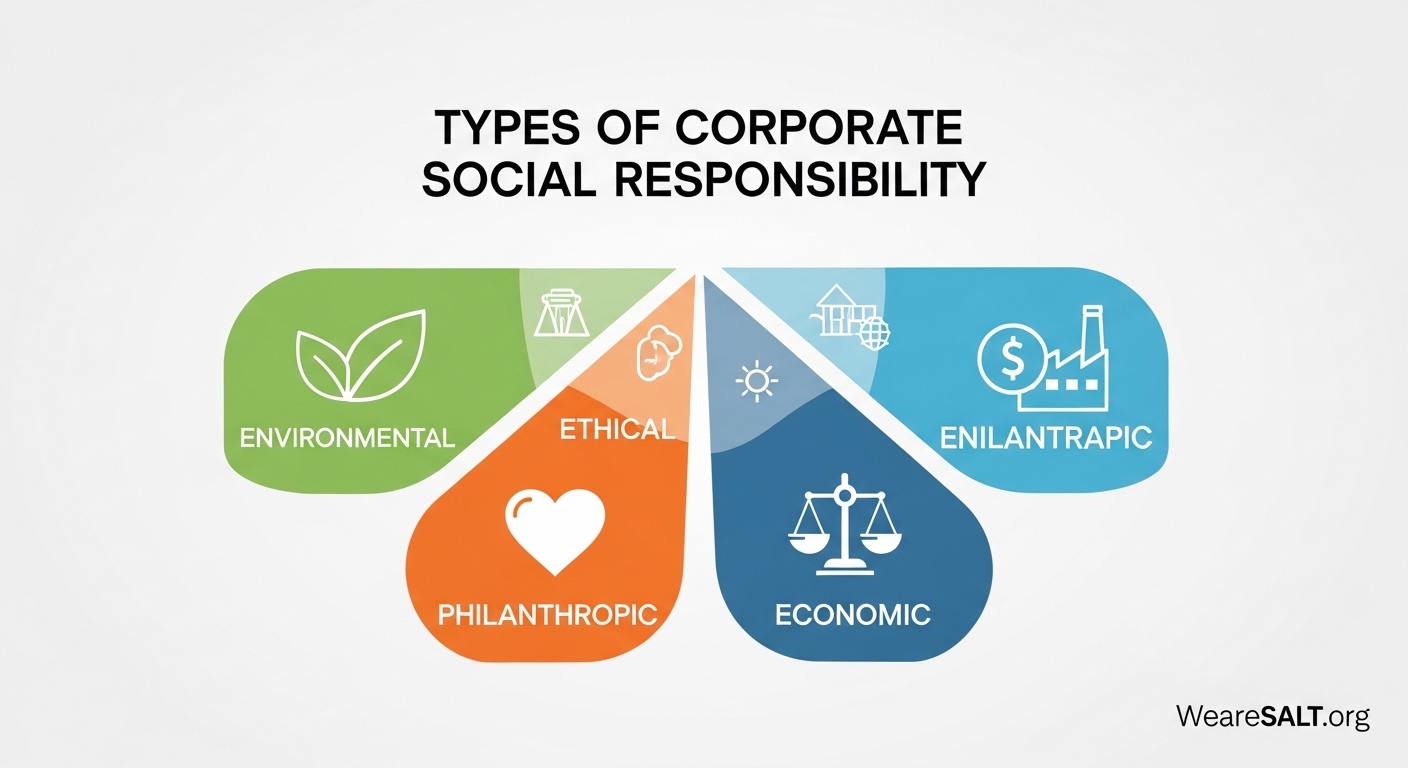
Corporate social responsibility (CSR) has become essential for businesses that want to build trust with customers, attract top talent, and create lasting positive impact. Understanding the types of corporate social responsibility helps companies develop comprehensive strategies that go beyond profit-making to address environmental, ethical, philanthropic, and economic concerns.
CSR is traditionally broken into four categories: environmental responsibility, ethical responsibility, philanthropic responsibility, and economic responsibility. These four pillars work together to create a framework for businesses to operate sustainably while contributing positively to society.
Our team has analyzed hundreds of CSR programs over the past three years. We have seen firsthand how companies that embrace all four types of responsibility consistently outperform their competitors in employee retention, customer loyalty, and long-term profitability.
Table of Contents
What Is Corporate Social Responsibility?
Corporate social responsibility is a self-regulating business model that helps companies be socially accountable to themselves, their stakeholders, and the public. CSR represents a commitment to operating ethically, sustainably, and in ways that positively impact society beyond what is required by law.
The concept emerged in the 1950s and 1960s as businesses began recognizing their broader role in society. Today, CSR has evolved into a sophisticated framework that includes environmental stewardship, ethical labor practices, charitable giving, and economic sustainability. Companies practicing CSR operate according to the triple bottom line principle: people, planet, and profit.
Modern CSR differs from simple philanthropy. It involves integrating social and environmental concerns directly into business operations and stakeholder relationships. This approach is often called corporate citizenship or creating shared value. The goal is to generate economic value in a way that also produces value for society.
Many organizations now align their CSR efforts with ESG (Environmental, Social, and Governance) criteria. ESG provides measurable standards for assessing corporate behavior on environmental impact, social relationships, and leadership ethics. Investors increasingly use ESG scores to evaluate companies, making CSR not just a moral imperative but a financial one.
The 4 Types of Corporate Social Responsibility
The four types of corporate social responsibility provide a comprehensive framework for businesses to address their impact on the world. Each type addresses different stakeholders and concerns, working together to create a holistic approach to responsible business practices.
Companies do not need to implement all four types equally. The right balance depends on your industry, company size, stakeholder expectations, and available resources. However, addressing all four areas demonstrates a genuine commitment to operating responsibly.
Environmental Responsibility
Environmental responsibility means operating in ways that minimize harm to the environment and actively contribute to ecological sustainability. This type of CSR has gained significant attention as climate change and resource depletion have become urgent global concerns.
Companies demonstrate environmental responsibility through various initiatives. These include reducing carbon emissions, implementing renewable energy programs, minimizing waste through recycling and circular economy principles, and designing sustainable supply chains. Some businesses go further by pursuing carbon neutral or net-zero status.
Patagonia exemplifies environmental responsibility through its Worn Wear program, which repairs and resells used clothing to extend product lifecycles. Microsoft has committed to being carbon negative by 2030, removing more carbon from the atmosphere than it emits. Unilever’s Sustainable Living Brands grow 69% faster than other brands in its portfolio, proving environmental responsibility can drive profitability.
Small businesses can implement environmental responsibility without massive budgets. Start with simple steps: switch to LED lighting, reduce paper usage through digital processes, source locally to cut transportation emissions, and partner with recycling programs. These actions demonstrate commitment while building operational efficiency.
Ethical Responsibility
Ethical responsibility means operating in a fair and ethical manner that respects human rights, labor standards, and stakeholder interests. This type of CSR focuses on doing the right thing even when not legally required to do so.
Ethical responsibility encompasses fair labor practices throughout the supply chain. Companies must ensure workers receive fair wages, work in safe conditions, and are treated with dignity. This extends beyond direct employees to include suppliers and contractors. Fair trade certification helps verify ethical sourcing for products like coffee, chocolate, and textiles.
Transparency and honest reporting are core components of ethical responsibility. This includes accurate financial reporting, clear communication about business practices, and honest marketing claims. Companies practicing ethical responsibility avoid misleading advertising and greenwashing, which occurs when businesses exaggerate or fabricate environmental claims.
Stakeholder engagement is essential for ethical responsibility. This means considering the interests of employees, customers, suppliers, communities, and shareholders in business decisions. The stakeholder theory suggests businesses have obligations to all parties affected by their operations, not just shareholders.
Starbucks demonstrates ethical responsibility through its C.A.F.E. (Coffee and Farmer Equity) Practices, which verify ethical sourcing for 99% of its coffee. The program ensures fair wages, safe working conditions, and environmental standards throughout the supply chain. This commitment has helped Starbucks maintain brand trust despite operating in a controversial industry.
Philanthropic Responsibility
Philanthropic responsibility involves actively contributing to society through charitable donations, community investment, and volunteer programs. This type of CSR goes beyond preventing harm to actively making the world better.
Corporate philanthropy takes many forms. Direct charitable giving supports nonprofits addressing social issues like education, health, poverty, and environmental conservation. Many companies establish foundations to manage their philanthropic efforts strategically. Google.org, for example, has donated over $100 million annually to various causes while providing technical expertise to nonprofits.
Employee volunteer programs represent another key aspect of philanthropic responsibility. These programs encourage or enable employees to donate time to community causes. Volunteer time off (VTO) policies provide paid time for employees to serve their communities. Salesforce gives employees seven paid days of VTO annually, resulting in millions of volunteer hours.
Donation matching programs amplify employee giving by matching individual contributions to eligible nonprofits. This approach extends corporate philanthropy while respecting employee choice about which causes to support. Companies like Microsoft, Apple, and Google match employee donations up to $10,000 or more per year.
Community investment focuses on the areas where companies operate. This might include supporting local schools, funding community centers, or investing in local infrastructure. Unlike generic philanthropy, community investment builds direct relationships between businesses and their neighbors.
TOMS Shoes pioneered the “one-for-one” model, donating a pair of shoes for every pair purchased. While the model has evolved, it demonstrates how philanthropic responsibility can be integrated directly into business operations. Warby Parker adapted this approach to eyewear, donating over 10 million pairs of glasses to people in need.
Economic Responsibility
Economic responsibility means making financial decisions that prioritize doing good while doing well. This type of CSR recognizes that businesses must be profitable to survive, but profitability should not come at the expense of other responsibilities.
Economic responsibility involves investing in initiatives that generate both financial returns and social impact. This includes funding research and development for sustainable products, investing in employee training and development, and supporting local suppliers even when cheaper alternatives exist overseas.
Long-term value creation distinguishes economic responsibility from short-term profit maximization. Companies practicing economic responsibility make decisions that strengthen their position over years or decades rather than focusing solely on quarterly earnings. This might mean accepting lower margins to build supplier relationships or investing in expensive green technology that pays off over time.
The triple bottom line framework helps businesses balance economic responsibility with other CSR types. By measuring success in terms of people, planet, and profit, companies can evaluate whether they are truly operating sustainably. B Corporations are certified businesses that meet rigorous standards for social and environmental performance, accountability, and transparency.
Interface, a carpet manufacturer, demonstrated economic responsibility through its Mission Zero commitment to eliminate environmental impact by 2020. The company invested heavily in sustainable manufacturing, which initially increased costs but eventually saved $450 million through waste reduction and efficiency improvements.
Additional CSR Areas and Considerations
While the four types of corporate social responsibility provide a solid foundation, modern CSR increasingly encompasses additional areas. Understanding these expanded categories helps businesses develop more comprehensive responsibility strategies.
Diversity and Inclusion
Diversity and inclusion (D&I) has become a core component of CSR for most major companies. This involves creating workplaces that welcome people of all backgrounds, ensuring equal opportunities for advancement, and addressing systemic inequalities. Companies with diverse leadership teams are 33% more likely to outperform competitors on profitability.
Corporate Governance
Good governance ensures companies operate with integrity, accountability, and transparency at the leadership level. This includes diverse boards of directors, executive compensation tied to social and environmental metrics, and anti-corruption policies. Strong governance provides the foundation for all other CSR efforts.
Employee Well-being
Beyond basic labor rights, many companies now prioritize comprehensive employee well-being. This includes mental health support, flexible work arrangements, parental leave policies, and wellness programs. Companies investing in employee well-being see reduced turnover and increased productivity.
Supply Chain Responsibility
Modern CSR extends responsibility throughout the supply chain. Companies are increasingly held accountable for the practices of their suppliers, even when those suppliers operate in other countries. This has led to stricter supplier codes of conduct and regular audits to ensure compliance.
Benefits of Implementing CSR
Companies that embrace corporate social responsibility see tangible benefits across multiple dimensions. These benefits answer the common question: does CSR actually pay off? The research consistently shows that it does.
Talent attraction and retention represent major CSR benefits. 65% of job seekers prefer to work for socially responsible companies, and 64% of millennials consider a company’s social commitments when deciding where to work. Employees at companies with strong CSR programs report higher job satisfaction and are less likely to leave.
Customer loyalty increases when consumers feel good about supporting responsible businesses. 88% of consumers want brands to help them live more sustainably, and 73% of global consumers say they would change consumption habits to reduce environmental impact. CSR provides a competitive advantage in crowded markets.
Brand reputation and trust build over time through consistent CSR practices. Companies known for responsibility weather crises better and enjoy stronger relationships with regulators, communities, and media. This intangible asset translates directly into business value.
Risk management improves through CSR as companies identify and address social and environmental risks before they become crises. Climate change, labor disputes, and supply chain disruptions pose real threats to business continuity. Proactive CSR helps mitigate these risks.
Access to capital has become easier for responsible companies as ESG investing has grown. Major institutional investors now screen portfolios for ESG criteria, and green bonds provide favorable financing for sustainable projects. Companies with strong CSR credentials increasingly enjoy lower costs of capital.
How to Implement CSR: A Practical Guide
Implementing corporate social responsibility does not require massive budgets or dedicated departments. Even small businesses can develop meaningful CSR programs that create real impact while supporting business goals.
Start with Assessment
Begin by assessing your current impact and stakeholder expectations. Identify the areas where your business naturally intersects with social and environmental issues. A restaurant might focus on food waste and local sourcing, while a tech company might prioritize digital inclusion and e-waste recycling.
Set Specific Goals
Vague commitments to “be greener” or “help the community” fail to drive action or build trust. Instead, set specific, measurable goals like “reduce energy consumption by 20% in two years” or “donate 1% of revenue to local nonprofits.” Specific goals enable accountability and demonstrate genuine commitment.
Avoid Greenwashing
Greenwashing occurs when companies exaggerate or fabricate environmental claims. Consumers and regulators increasingly scrutinize CSR claims, and greenwashing damages trust permanently. Avoid vague terms like “eco-friendly” without specifics. Support claims with data and third-party certifications when possible.
Engage Employees
Employee buy-in is essential for successful CSR. Involve team members in developing and implementing initiatives. Volunteer programs work best when employees help choose causes. Environmental efforts succeed when workers understand their role and see leadership commitment.
Measure and Report
Track progress on CSR goals and communicate results transparently. Annual sustainability reports have become standard for public companies, but even small businesses can share updates through websites, social media, or customer communications. Honest reporting about challenges alongside successes builds credibility.
Small Business CSR on a Budget
Small businesses can implement meaningful CSR without massive resources. Start with operational changes that save money while reducing impact, like energy efficiency and waste reduction. Partner with local nonprofits for volunteer opportunities that require time rather than money. Source from local suppliers to support the community while potentially reducing costs.
Consider joining business associations that provide CSR resources at scale. B Corp certification, while rigorous, provides a comprehensive framework for small businesses wanting to formalize their commitment. Local chambers of commerce often offer sustainability programs that help small businesses get started.
Frequently Asked Questions
What are the 4 types of corporate social responsibility?
The 4 types of corporate social responsibility are environmental responsibility (minimizing environmental harm), ethical responsibility (fair treatment of stakeholders), philanthropic responsibility (charitable giving and community investment), and economic responsibility (profitable operations that prioritize doing good).
What are the 7 pillars of CSR?
The 7 pillars of CSR expand beyond the 4 traditional types to include diversity and inclusion, corporate governance, and employee well-being. These additional areas address modern expectations for responsible business conduct beyond the classic framework. Some frameworks also include supply chain responsibility, innovation, or community engagement as additional pillars.
Does CSR actually pay off?
Yes, CSR pays off through multiple channels. Companies with strong CSR programs attract better talent, retain customers longer, build stronger brand reputation, manage risks more effectively, and increasingly enjoy better access to capital. Research shows 65% of job seekers prefer socially responsible employers, and companies with diverse leadership outperform competitors by 33% on profitability.
What is the difference between CSR and ESG?
CSR is a broad business philosophy about operating responsibly, while ESG (Environmental, Social, and Governance) provides specific measurable criteria for evaluating corporate behavior. Think of CSR as the strategy and ESG as the metrics. ESG offers standardized frameworks for measuring and comparing CSR performance across companies, making it particularly valuable for investors and regulators.
How can small businesses implement CSR?
Small businesses can implement CSR by starting with operational changes that reduce costs and environmental impact, like energy efficiency and waste reduction. Partner with local nonprofits for volunteer programs, source from local suppliers, and set specific measurable goals rather than vague commitments. Join business associations for resources and consider certifications like B Corp that provide frameworks for responsible business practices.
What is greenwashing and how can companies avoid it?
Greenwashing occurs when companies exaggerate or fabricate environmental claims to appear more responsible than they are. To avoid greenwashing, support claims with specific data, use third-party certifications when possible, avoid vague terms like eco-friendly without explanation, report honestly about challenges alongside successes, and ensure marketing claims match actual business practices. Consumers and regulators increasingly scrutinize CSR claims, making transparency essential.
Conclusion
The four types of corporate social responsibility provide a comprehensive framework for businesses seeking to operate ethically and sustainably. Environmental responsibility, ethical responsibility, philanthropic responsibility, and economic responsibility work together to create companies that generate value for all stakeholders.
Understanding these types of corporate social responsibility is just the beginning. The real work involves implementing meaningful initiatives, measuring results honestly, and continuously improving. Whether you run a small local business or work for a global corporation, CSR offers opportunities to create positive impact while building stronger, more resilient organizations.
Start by assessing where your business currently stands across the four types. Identify quick wins that reduce costs while improving social or environmental performance. Set specific goals, engage your team, and commit to transparent reporting. The benefits of CSR extend far beyond marketing claims to create genuine value for your business and society.