
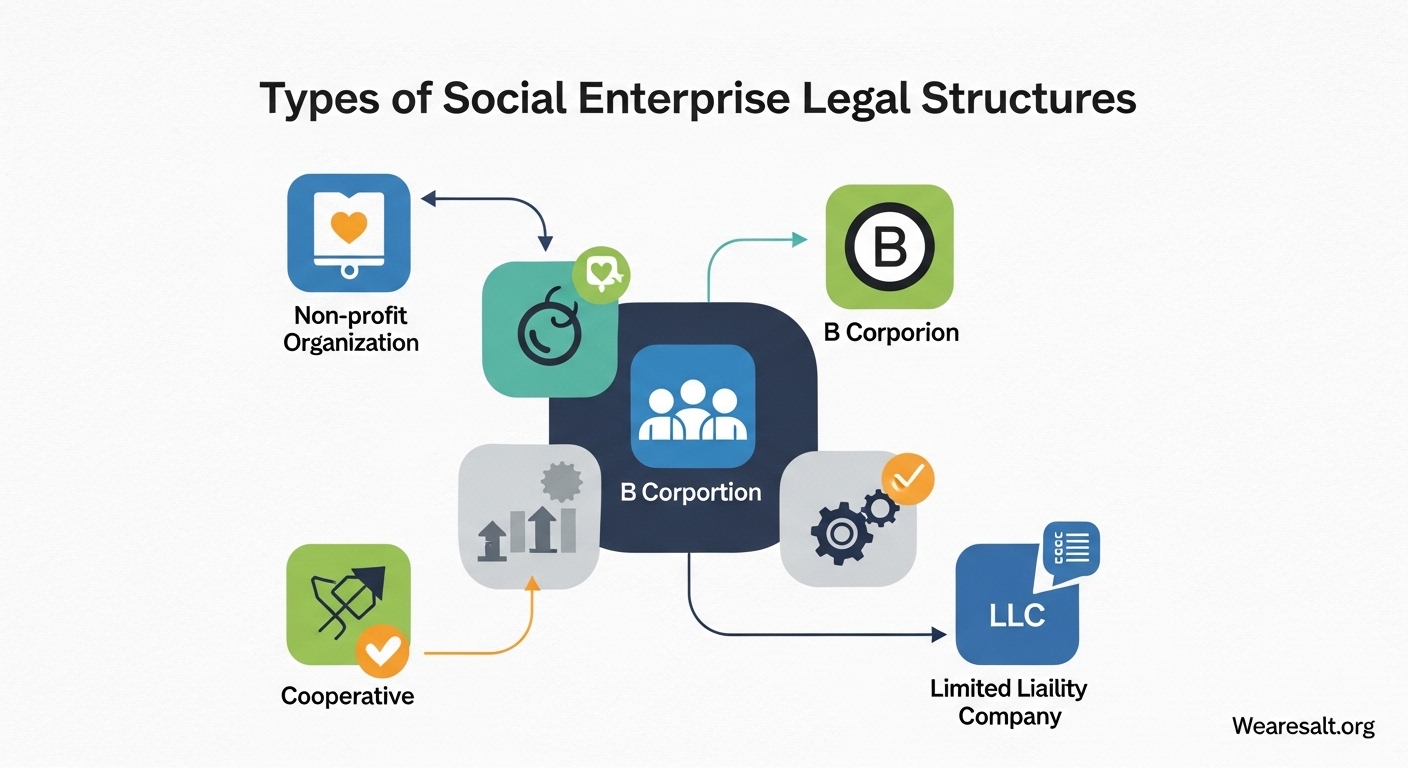
Choosing the right legal structure is one of the most important decisions you will make when starting a social enterprise. The structure you select determines how your organization is governed, who owns it, how profits get distributed, and what your tax obligations will be.
In this guide, I will walk you through every legal structure available for social enterprises. You will learn the pros and cons of each option and get a clear framework for making the right choice for your specific situation.
Table of Contents
What is a Legal Structure and Why Does It Matter?
A legal structure is the formal legal form your organization takes when you register it with the appropriate government authority. It defines your relationship with the law, your members, your customers, and your investors.
The structure affects four critical areas: personal liability protection, tax treatment, fundraising options, and governance requirements. Choose the wrong structure and you might face unnecessary personal risk, miss out on tax benefits, or limit your ability to grow.
Unincorporated Association
An unincorporated association is the simplest way to start a social enterprise. It requires no formal registration and costs nothing to establish. A group of people simply agree to work together toward a shared purpose.
However, this simplicity comes with significant drawbacks. Members face unlimited personal liability for debts and legal claims. The organization cannot enter contracts or own property in its own name. Everything happens through individual members.
This structure works best for small, short-term projects with minimal financial activity. Once you start handling significant money or assets, you should consider incorporating.
Trust
A trust structure involves trustees holding assets for the benefit of others. The trustees manage property or money according to the trust deed, which sets out the rules and purposes.
Trusts offer flexibility in how assets are managed and distributed. They can operate without the formal reporting requirements of companies. The trust deed provides clear guidance on the organization’s purpose and how trustees should operate.
The main limitation is that trustees bear personal responsibility for managing the trust properly. Trusts also lack the separate legal personality that companies enjoy, which can complicate contracts and employment.
Sole Trader (Sole Proprietorship)
Operating as a sole trader means you run the social enterprise as an individual with no legal distinction between you and the business. This is the easiest structure to set up and gives you complete control over decisions.
The major downside is unlimited personal liability. If your social enterprise incurs debts or faces legal action, your personal assets including your home are at risk. This structure also limits your ability to bring in partners or investors.
Sole trader status suits social entrepreneurs testing an idea or operating at a very small scale. Once you hire employees or take on significant commitments, incorporation becomes advisable.
Partnership
A partnership involves two or more people running a business together and sharing profits. Partnerships are relatively easy to establish and allow you to combine skills and resources with others who share your social mission.
General partnerships carry the same liability risk as sole traders. Each partner is personally liable for the partnership’s debts and for actions taken by other partners. This makes a partnership agreement essential to clarify roles, responsibilities, and dispute resolution.
Limited partnerships offer some liability protection for passive investors, but at least one partner must remain fully liable. This structure works well when founders want to bring in financial backers without giving them management control.
Company Limited by Shares (CLS)
A company limited by shares is the standard for-profit company structure. Shareholders own the company through their shares, and their liability is limited to the amount they invested.
This structure allows social enterprises to raise investment capital by selling shares. It provides clear ownership structures and well-understood governance frameworks. Limited liability protects personal assets from business risks.
The challenge for social enterprises is that shareholders typically expect financial returns. Without specific provisions in your articles of association, shareholder pressure could divert the company from its social mission. You will need to establish mission protection mechanisms.
Company Limited by Guarantee (CLG)
A company limited by guarantee has no shareholders. Instead, members agree to contribute a nominal amount (usually 1 to 10 pounds or dollars) if the company is wound up. This structure is extremely common for nonprofit organizations and social enterprises.
CLGs provide limited liability protection without the pressure to distribute profits to shareholders. Any surplus must be reinvested in the organization’s purposes. This aligns naturally with social enterprise objectives.
Most charitable companies and nonprofit social enterprises use this structure. It offers credibility with funders while protecting the people involved from personal liability.
Charitable Company
A charitable company combines the limited liability protection of a company limited by guarantee with charitable status from the relevant regulator (like the Charity Commission in England and Wales).
Charitable status brings significant tax advantages including exemption from income tax and corporation tax. Charities can claim Gift Aid on donations, increasing their value by 25% in the UK. Many grant-makers only fund registered charities.
The trade-offs include stricter governance requirements, restrictions on trading activities, and the requirement that all assets be used for charitable purposes only. You cannot distribute profits or sell the organization for personal gain.
Charitable Incorporated Organisation (CIO)
The CIO structure was created in the UK specifically to address the complexity of charitable companies. It offers the benefits of incorporation and charitable status in a single registration with the Charity Commission.
CIOs are simpler to administer than charitable companies because they only report to one regulator. They provide limited liability for trustees and members. The structure is designed specifically for charities, so the governing documents fit charitable purposes well.
The main limitation is that CIOs are currently only available in England and Wales. Scotland and Northern Ireland have different structures. CIOs also have restrictions on trading that might limit some social enterprise activities.
Community Interest Company (CIC)
The CIC was designed specifically for social enterprises that want to operate as businesses with a social purpose. CICs are limited companies that must pass a community interest test and meet an asset lock requirement.
The asset lock means the company’s assets cannot be distributed to members or sold for private benefit. If the CIC is wound up, assets transfer to another asset-locked organization. This protects the social mission permanently.
CICs offer more flexibility than charities. They can pay directors, distribute limited dividends to shareholders (in CICs limited by shares), and engage in commercial trading without restrictions. They cannot, however, claim charitable tax exemptions or Gift Aid.
Limited Liability Partnership (LLP)
An LLP combines features of partnerships and companies. Partners have limited liability like company shareholders, but the internal structure operates more like a partnership with flexibility in profit sharing and management.
LLPs work well when social enterprises want to bring together professionals with different skills and investment levels. Each partner’s liability is limited to their contribution, protecting personal assets.
The structure is less common for traditional social enterprises because it does not easily accommodate the asset lock concept. However, it suits professional service social enterprises where partners contribute expertise rather than capital.
Cooperative and Community Benefit Society
Cooperatives are owned and democratically controlled by their members, who might be employees, customers, or suppliers. Community benefit societies serve the broader community rather than just their members.
These structures embed democratic governance with one member, one vote regardless of investment level. Surplus gets distributed according to participation or reinvested in the business. Members have limited liability.
Cooperatives suit social enterprises where community ownership and democratic participation are core values. The structure can raise investment through withdrawable share capital, though this limits how much capital can be raised compared to companies.
Hybrid Models
Some social enterprises use a hybrid approach combining a nonprofit and a for-profit entity. Typically a charitable company or trust owns shares in a trading company, allowing profits to flow up to the parent organization.
This structure lets you access charitable funding through the nonprofit while running commercial activities through the for-profit subsidiary. It provides maximum flexibility for fundraising and trading.
The downside is complexity. You must maintain two sets of accounts, two boards, and manage the relationship between entities. From forum discussions, I have seen this described as “cumbersome in terms of organizational structure and documentation.” Only pursue this if the benefits clearly outweigh the administrative burden.
Comparison of Legal Structures
| Structure | Liability | Tax Status | Governance | Best For |
|---|---|---|---|---|
| Unincorporated Association | Unlimited | Pass-through | Informal | Small projects, testing ideas |
| Sole Trader | Unlimited | Personal income | Individual control | Single founder, small scale |
| Partnership | Unlimited (general) | Pass-through | Partnership agreement | Multiple founders, shared vision |
| Company Limited by Shares | Limited | Corporate tax | Board, shareholders | Investment-seeking enterprises |
| Company Limited by Guarantee | Limited | Corporate tax | Board, members | Nonprofit social enterprises |
| Charitable Company | Limited | Tax exempt | Charity Commission | Grant-dependent organizations |
| CIO | Limited | Tax exempt | Charity Commission | New charities seeking simplicity |
| CIC | Limited | Corporate tax | Company law + CIC Regulator | Trading social enterprises |
| LLP | Limited | Pass-through | Partnership agreement | Professional partnerships |
| Cooperative | Limited | Corporate tax | Democratic, member-based | Community-owned enterprises |
How to Choose the Right Legal Structure for Your Social Enterprise
Selecting a legal structure requires honest assessment of your priorities. Here are the key factors to consider.
Liability Protection
If you face significant financial risks or potential legal claims, choose a structure with limited liability. Company limited by guarantee, CIC, or charitable structures all protect personal assets.
Funding Strategy
Grants and donations favor charitable structures with tax exemption. Investment capital requires shares, making company limited by shares or CIC the better choice. Loans are available to most incorporated structures.
Growth Ambitions
Charitable restrictions can limit commercial growth. If you plan to scale through trading, CIC or company limited by shares offers more flexibility. The forum insight about concern over “restricting enterprise growth by staying under nonprofit” is worth considering here.
Mission Protection
If protecting your social mission is paramount, consider charitable status or CIC with asset lock. These structures embed your purpose legally and make it difficult to divert assets away from social goals.
Administrative Capacity
Charities and CICs have ongoing reporting requirements. If you lack administrative capacity, consider company limited by guarantee without charitable status or a cooperative structure with simpler governance.
Geographic Scope
CIO is UK-specific. Benefit corporations and L3Cs are US-specific structures not mentioned in our table. Ensure your chosen structure works in your jurisdiction and any jurisdictions where you plan to operate.
FAQ
What is the best legal structure for a social enterprise?
There is no single best structure. CIC works well for trading social enterprises, charitable company suits grant-dependent organizations, and cooperative fits community-owned models. The best choice depends on your funding strategy, growth plans, and governance preferences.
What are the four types of social enterprise?
Social enterprises typically fall into four categories based on their legal form: unincorporated associations (simplest, no registration), companies limited by guarantee (most common for nonprofits), community interest companies (asset-locked for trading), and charitable organizations (with tax exemptions).
What are three legal structures for operating a social enterprise?
The three most common legal structures are: Company Limited by Guarantee (provides limited liability without shareholders), Community Interest Company (allows trading with asset lock protection), and Charitable Incorporated Organisation (offers charitable status with simpler administration).
What are the five different social enterprise models?
Social enterprise models include: trading nonprofits (charities selling goods/services), cooperative societies (member-owned businesses), community interest companies (asset-locked companies), social firms (employing disadvantaged groups), and development trusts (community-controlled assets).
What is the difference between a CIC and a charity?
A CIC is a limited company focused on community benefit with an asset lock, while a charity is an organization with exclusively charitable purposes that provides tax benefits. CICs can pay directors and distribute limited dividends; charities cannot. Charities get tax exemptions and Gift Aid; CICs do not.
Can a social enterprise be for-profit?
Yes, social enterprises can use for-profit structures like company limited by shares or CIC. These allow profit distribution while maintaining social mission through asset locks (CIC) or mission-locked articles. The key is that social purpose remains central even when making profits.
Conclusion
Understanding types of social enterprise legal structures is essential for anyone starting or restructuring a social enterprise. The structure you choose affects everything from daily operations to long-term sustainability.
Start by clarifying your priorities around liability, funding, growth, and mission protection. Then match those priorities to the structure that best supports them. Remember that changing structure later is possible but can be complex, so getting it right from the start saves time and money.
Consider seeking professional advice from a lawyer or accountant familiar with social enterprises in your jurisdiction. They can help you navigate the specific requirements and ensure your chosen structure aligns with your social mission.