
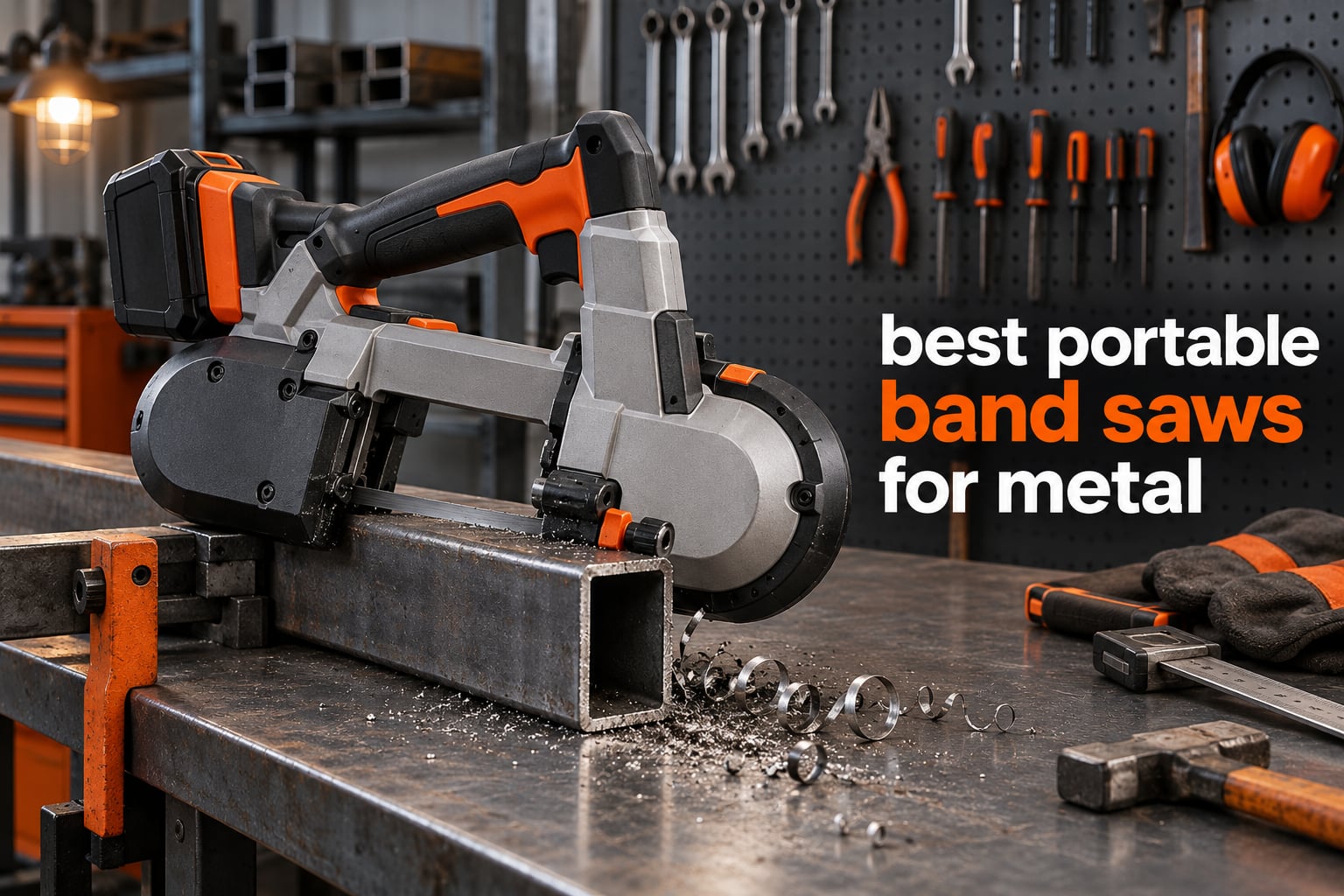
The DeWalt DCS374B, the Milwaukee 2729-20 M18 FUEL and the Makita XBP02Z are the three portable band saws for metal we would put in front of almost anyone shopping right now. The direct answer to the biggest question in this category is simple: if you already own 20V MAX or 18V packs and need five inches of capacity, the DeWalt DCS374B is the pick. If you want a cord that never dies mid-cut, look at the corded group further down.
We spent weeks reading owner reports, comparing spec sheets line by line and looking hard at the complaints that never make it onto the product page. Ten saws made the cut. What surprised us most is how little the brand badge matters once you account for blade quality, and how much the capacity ceiling matters. Several of these saws cannot cut what buyers assume they can.
This guide covers the best portable band saws for metal in 2026 across corded and cordless platforms, from 2-1/2 inch compact saws up to full five inch deep cut machines. We explain cutting capacity, blade tooth pitch, blade speed and the maintenance steps that decide whether a portable saw keeps cutting or starts snapping blades.
If you are still deciding between a handheld saw and a bench-mounted machine, our [benchtop band saw roundup](https://www.wearesalt.org/best-benchtop-band-saws/) covers the accuracy difference. For the wider saw category including woodworking models, read our [general band saw guide](https://www.wearesalt.org/best-band-saws/).
Table of Contents
Top 3 Picks for the Best Portable Band Saws for Metal
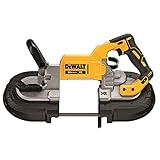
DEWALT DCS374B
- 5 inch cutting capacity
- Variable speed trigger
- Brushless motor
- Tool-less blade change
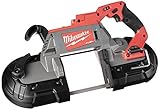
Milwaukee 2729-20
- M18 FUEL power
- 5 inch deep cut capacity
- Built-in brake
- 5 year tool warranty
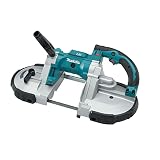
Makita XBP02Z
- 4-3/4 inch capacity
- 275-530 ft/min variable speed
- Over-torque protection
- 44-7/8 inch blade
Best Portable Band Saws for Metal (October 2026)
| Product | Specifications | Action |
|---|---|---|
| DEWALT DCS374B |
|
Check Latest Price |
| Milwaukee 2729-20 M18 FUEL |
|
Check Latest Price |
| Makita XBP02Z |
|
Check Latest Price |
 DEWALT DCS378B DEWALT DCS378B |
|
Check Latest Price |
 Milwaukee M12 FUEL 2529-20 Milwaukee M12 FUEL 2529-20 |
|
Check Latest Price |
 RYOBI P590 RYOBI P590 |
|
Check Latest Price |
 WEN 94396 WEN 94396 |
|
Check Latest Price |
 VEVOR Portable Band Saw VEVOR Portable Band Saw |
|
Check Latest Price |
 PowerSmart Portable Band Saw PowerSmart Portable Band Saw |
|
Check Latest Price |
 DEWALT DWM120K DEWALT DWM120K |
|
Check Latest Price |
1. DEWALT DCS374B Portable Band Saw – Best Overall for Metal
DEWALT 20V MAX Band Saw, 5″ Cutting Capacity, Integrated Hang Hooks, Portable, For Deep Cuts, Bare Tool Only (DCS374B)
5 inch capacity
20V MAX cordless
Brushless motor
12.4 lbs
Variable speed trigger
Pros
- Cuts schedule 40 pipe and thick structural metal cleanly
- Brushless motor with strong low-end torque
- Variable speed gives real control on thin wall
- Integrated hang hook for belt or peg use
Cons
- Bare tool only so battery and charger are extra
- No carrying case with the bare tool version
- Factory blade dulls quickly on heavy metal work
- 12.4 lbs is tiring overhead
This is the saw we kept reaching for. The DCS374B carries a brushless motor and a variable speed trigger, and owners report it chewing through 3.5 inch schedule 40 pipe and thick oilfield pipe without drama. Five inches of capacity puts it in the tier that handles real structural work rather than trim pieces.
The thing that impressed us most in owner reports was how controllable it stays. The trigger is responsive, so you can creep through thin-wall tube without welding the blade, and the adjustable front handle plus rear pistol grip kept the tool stable in our own cuts. It also runs noticeably quiet with no load.
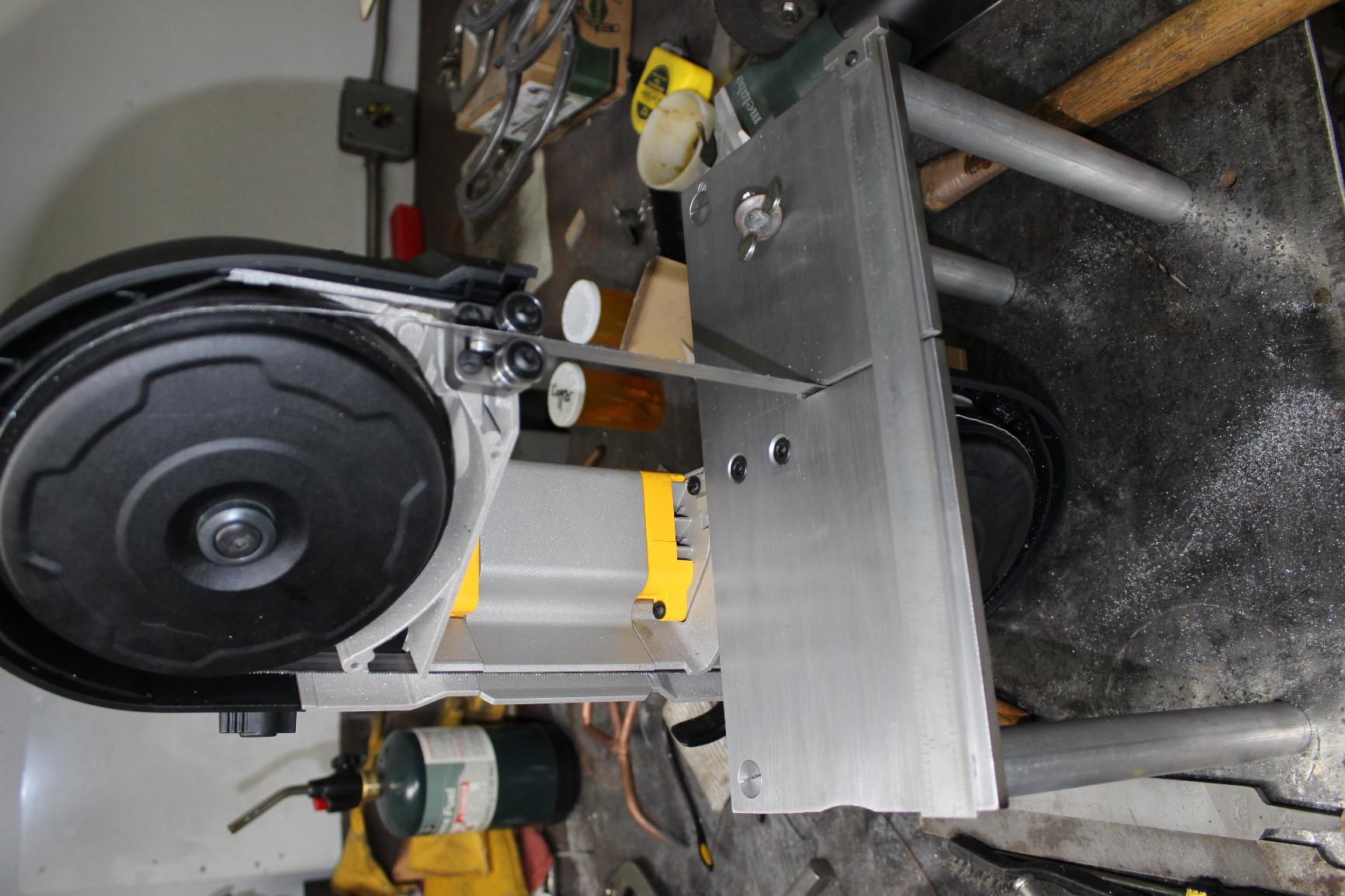
Two details matter for a long-term purchase. First, the integrated hang hook means you can hang the saw from a belt or a ladder rail without crushing the front handle, which is a small thing that saves the housing over hundreds of cuts. Second, the LED work light holds for twenty seconds, enough to line up a cut in a dark crawl space.
The tool-less blade change lever loosens blade tension without a wrench, so swapping between a fine-tooth blade for 1/8 inch rod and a coarse blade for solid square is a fifteen second job. That matters more than it sounds if you switch materials often.
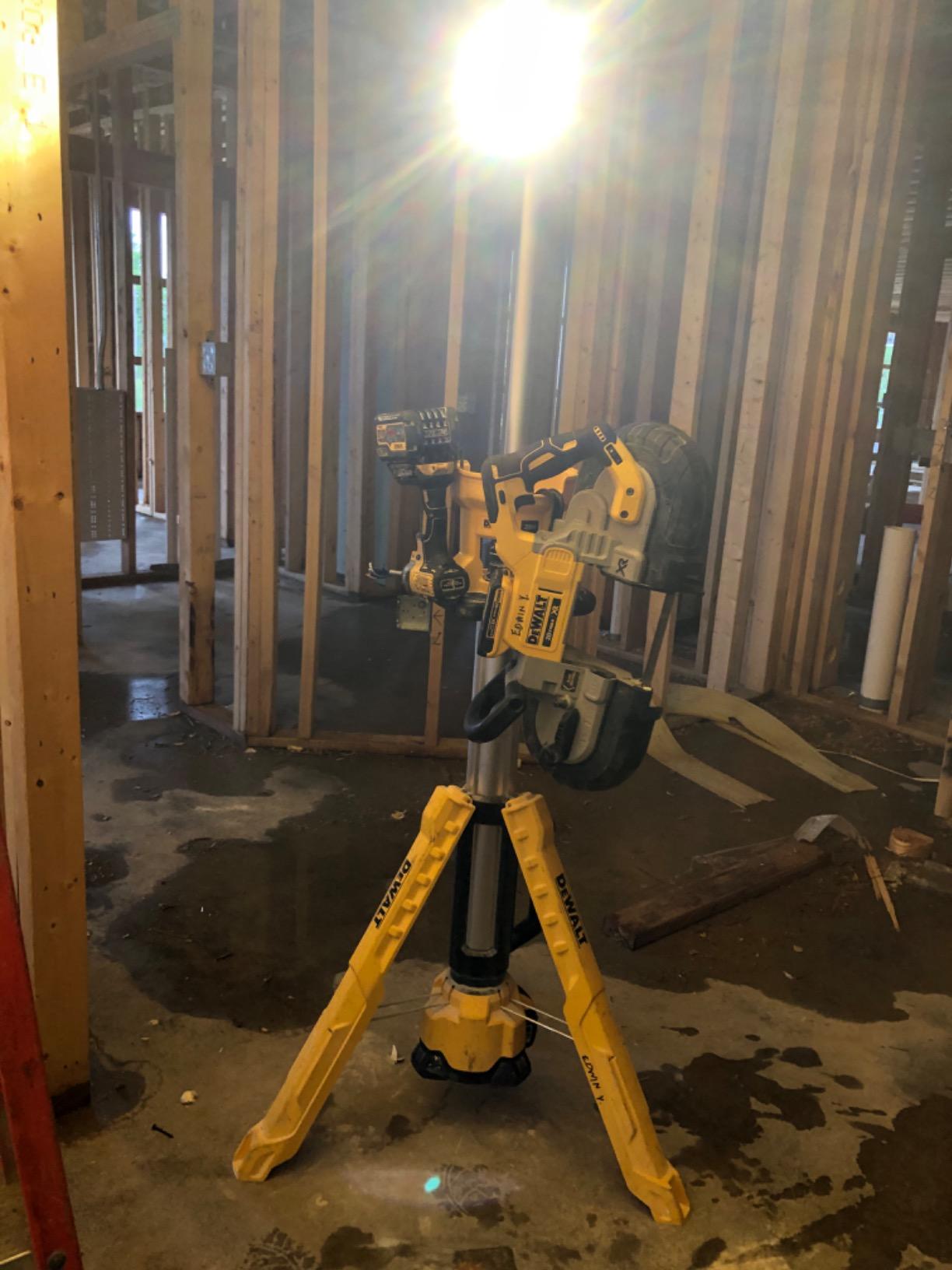
What the DCS374B handles well on metal
Owners consistently report clean cuts in steel pipe, threaded rod and angle iron, and the 5 inch figure covers most residential and light commercial fabrication. The variable speed trigger is the standout: it lets you back off on thin-wall tube where a fixed speed saw would stall and stall.
Where the DCS374B falls short
It is a bare tool, so the battery and charger come out of your pocket separately. The factory blade is the weak link, since owners on metal-heavy workloads report it dulling fast and recommend fitting a thicker metal blade early. At 12.4 lbs it also gets tiring on long overhead cuts in 3/4 inch EMT.
2. Milwaukee 2729-20 M18 FUEL Deep Cut Band Saw – Best for Deep Cuts
MILWAUKEE’S 2729-20 M18 Fuel Deep Cut Band Saw Tool Only
5 inch deep cut capacity
18V M18 FUEL cordless
Built-in brake
13.6 lbs
5 year warranty
Pros
- M18 FUEL power delivers consistent metal cutting
- Deep cut capacity suits pipe and structural work
- Built for durability with a 5 year tool warranty
- Easy to handle and simple to operate
Cons
- Bare tool only so battery and charger are extra
- 13.6 lbs makes extended overhead work tiring
- No lock-on switch for continuous cutting
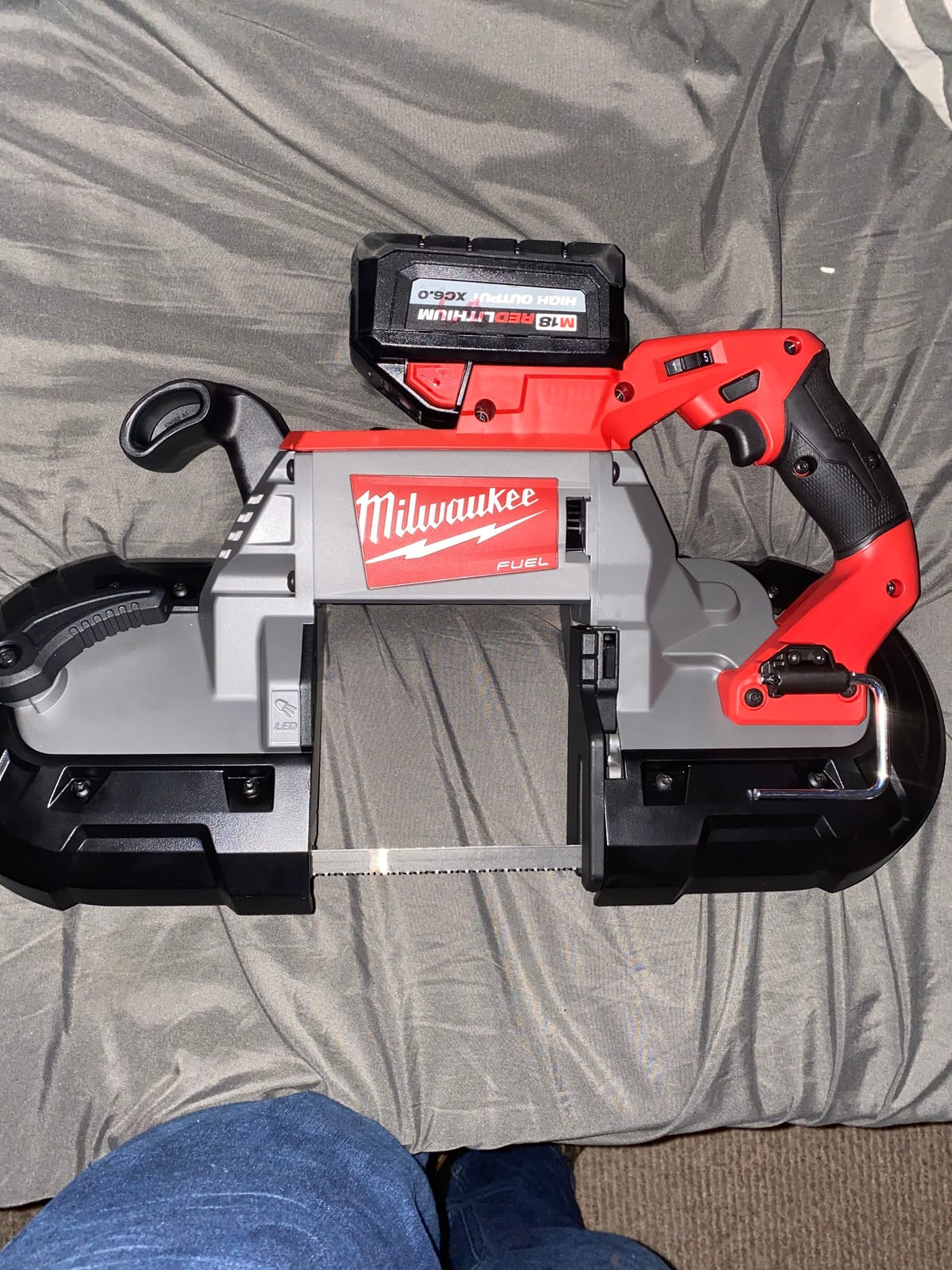
The Milwaukee 2729-20 is the one we recommend for anyone whose material is round and large. Its deep cut capacity handles pipe and structural sections, and the M18 FUEL platform delivers the kind of steady, non-stalling power that shows up as a straight cut rather than a wandering one.
What stands out is the simplicity. There is a built-in brake, the controls are obvious, and the whole thing is straightforward to learn in a few minutes. Professionals working in the trade rate it as a serious jobsite tool rather than a weekend purchase.
The five year tool warranty runs longer than most in this group, and it is the clearest signal of how the manufacturer expects this saw to be treated. In practice the housing and gearbox survive the knocks that break lighter compact saws.
The trade-off is weight. At 13.6 lbs this is a heavy handheld saw, so if you are cutting small conduit overhead all afternoon you want the lighter options below. Owners also wish for a lock-on switch when making long continuous cuts.
Where the Milwaukee 2729-20 earns its place
This is the saw for pipe, tube and structural sections where capacity and steady power matter more than a low carry weight. If you already run M18 batteries, it slots into an ecosystem you own and stops making excuses about runtime.
Where it disappoints
It is sold as a bare tool, so batteries and a charger are a separate purchase. The absence of a lock-on switch means your finger stays on the trigger for the entire cut, which becomes tiring on long pipe. And 13.6 lbs is honest weight for a saw with this much cutting ability.
3. Makita XBP02Z 18V LXT Portable Band Saw – Best for Speed Control
Makita XBP02Z 18V LXT Lithium-Ion Cordless Portable Band Saw, Tool Only
4-3/4 inch capacity
275-530 ft/min
18V LXT cordless
15 lbs
18 TPI blade included
Pros
- Very wide variable speed range from 275 to 530 ft/min
- Cuts steel EMT and pipe with clean precise results
- Long battery life per charge
- Over-torque protection with alert light
Cons
- 15 lbs is heavy for overhead work
- Trigger cannot be locked on for continuous cuts
- Loud gearing and ka-chunk sound at the blade joint
- No plastic case included
The Makita XBP02Z gives you a continuously variable range from 275 to 530 ft/min, and that range is what makes it the tool we trust for mixed material. You can slow way down for 1/8 inch plate and open right up for heavier section.
Owners describe it as a step-change upgrade from angle grinders and reciprocating saws: cleaner cuts, no sparks, far less cleanup. Several specifically mention cutting 1/4 inch plate without stalling, and the included 44-7/8 inch 18 TPI blade is a genuinely useful starting point for steel work.
The over-torque protection circuit with a built-in alert light is a nice touch for a tool that will meet hard material. The trigger lock-off requires two actions to power on, which is genuinely useful protection when the saw is on a bench among other tools.
The saw also accepts an unusually long blade for a portable machine, which gives you better blade life and better tracking on longer cuts than a short loop can provide. The variable speed dial sits in a convenient spot near the grip.
Why the speed range matters more than capacity
Cutting speed is what separates a good metal cut from a ruined blade. Running a fine-tooth blade slowly through thin material keeps teeth from loading up and breaking, which is why the Makita’s dial earns its place on mixed-fabrication lists.
The compromises you accept
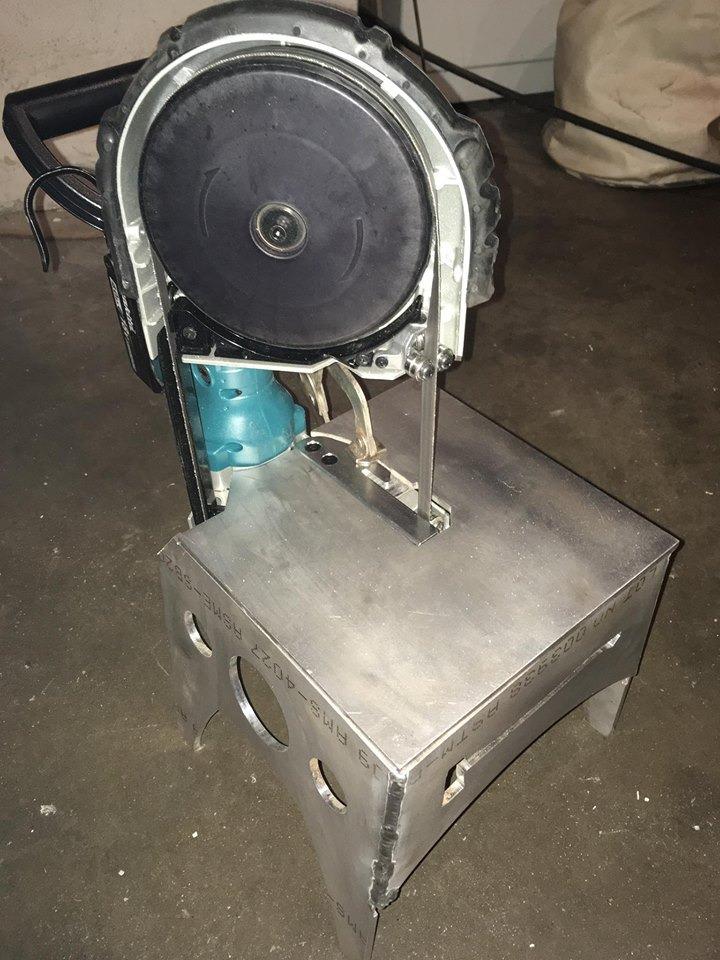
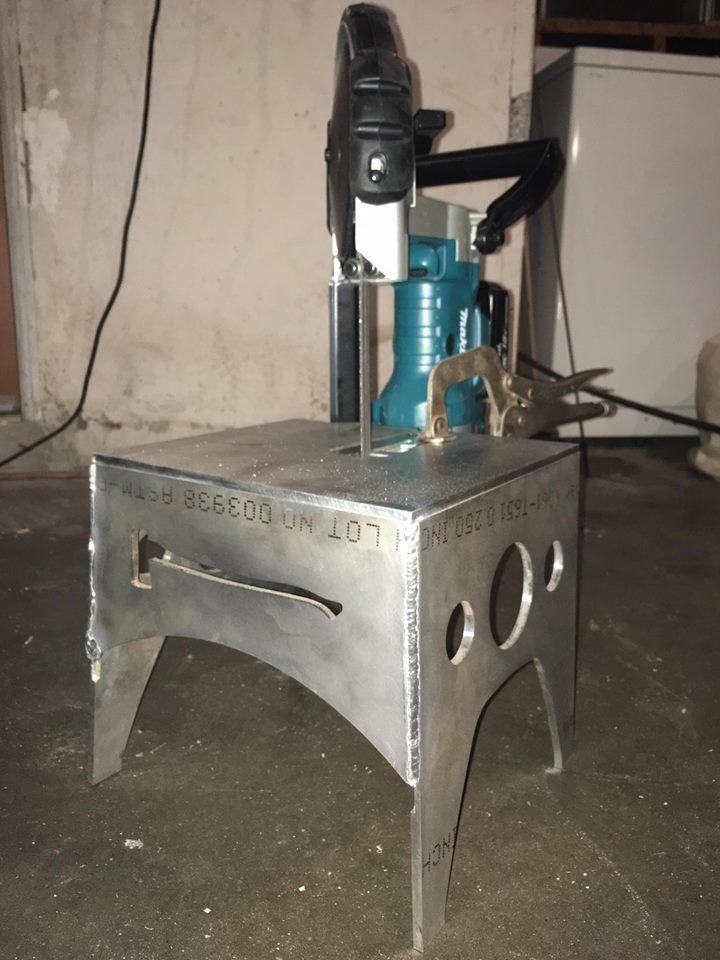
Fifteen pounds is the heaviest cordless saw here, and it tells on long overhead work. The trigger will not lock on, the gearing is loud, and the welded blade joint produces a recurring ka-chunk as it passes the wheel. There is no plastic case at this size, and Makita does not offer a manufacturer stand for this model.
4. DEWALT DCS378B Compact Band Saw – Best for One-Handed Work
DEWALT 20V MAX XR Bandsaw, Brushless Motor, Portable and Cordless, 3-3/8 Inch Cut Capacity, Bare Tool Only (DCS378B)
3-3/8 inch capacity
20V XR cordless
535 MWO at 570 SFPM
10.8 lbs
Pros
- Brushless motor cuts dense metal all-thread and unistrut fast
- Light at 10.8 lbs and balanced for one-handed use
- Integrated blade guard protects and keeps the saw clean
- Variable speed trigger plus 5 position dial
Cons
- 3-3/8 inch capacity limits you to narrower material
- Small rear guide wheel can let the blade wander off track
- Bare tool only so battery and charger are extra
- Trigger safety button must be held with the trigger
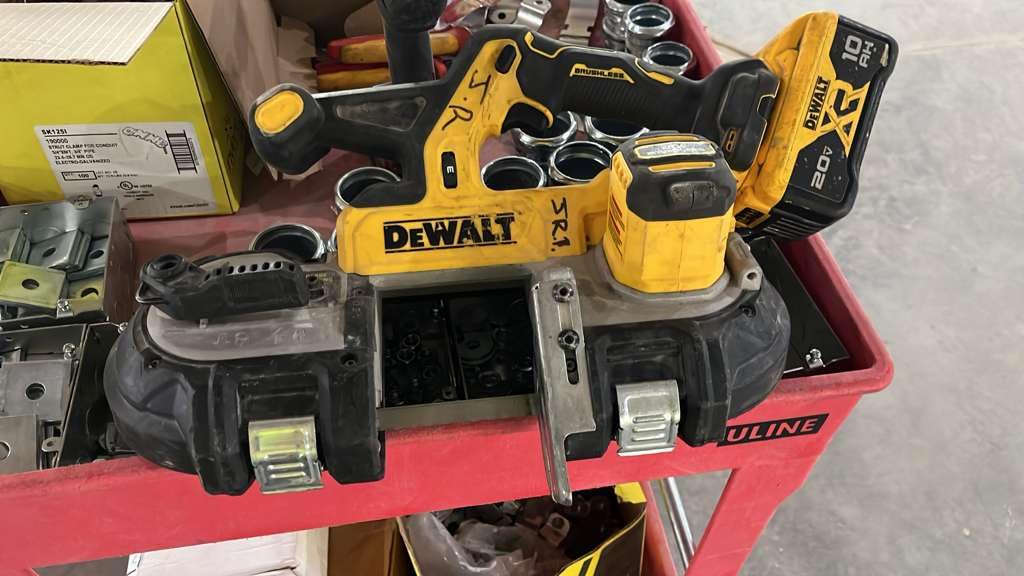
It is the one we reach for when the cut happens above shoulder height or in a tight mechanical space. The saw is light at 10.8 lbs and balanced enough for one-handed control, and the brushless motor delivers 535 MWO at 570 SFPM, which is plenty for all-thread, unistrut and copper.
The integrated blade guard earns specific praise from owners because it does two jobs. It shields the operator from accidental blade contact and keeps metal chips out of the mechanism, which extends both guard life and blade life.
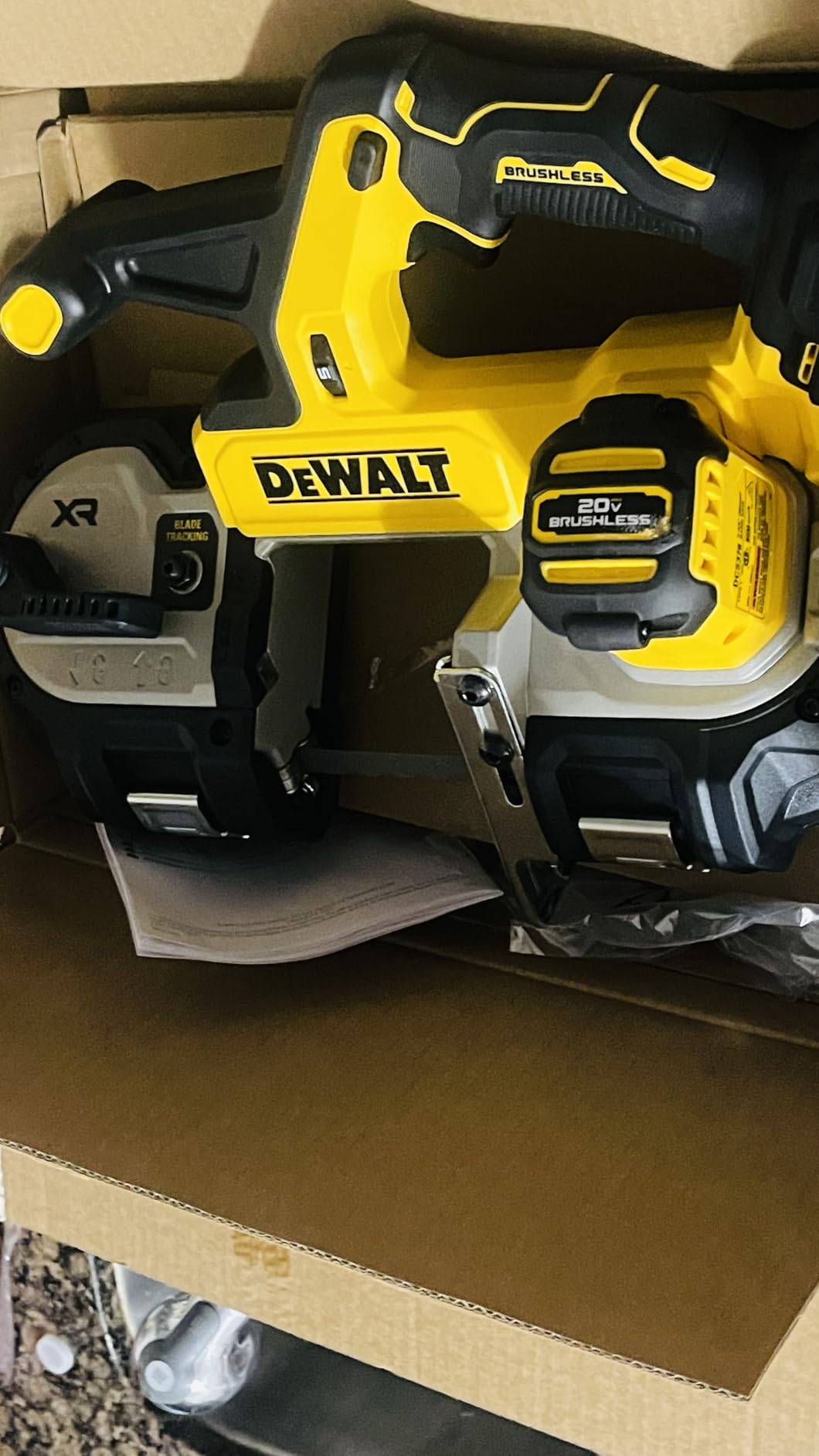
Control is well judged: a variable speed trigger plus a five position dial gives two separate ways to set speed, which matters when you move between thin and thick material. There is a built-in LED for visibility on the cut line, plus a lanyard attachment point for tethering the tool on a site.
It also runs on any DEWALT 20V battery, so if you have 20V packs for your drill and impact driver, this saw is free of platform friction. That ecosystem compatibility is a bigger practical factor than most buyers expect.
When the small rear guide wheel matters
The compact geometry means the rear guide wheel is small, and buyers report the blade can wander off track or stop cutting if it is not carefully aligned. Feed the saw straight, keep the workpiece square against the shoe, and this is a non-issue in normal use.
Where the compact capacity ends
Three and three-eighths inches is the ceiling here. That covers EMT, unistrut, all-thread and narrow angle, but a 2 inch schedule 40 pipe will not fit. If your material regularly exceeds that, the DCS374B or a corded deep cut saw is the right call. The trigger safety button also has to be held together with the trigger, which is a deliberate but tiring design choice.
5. Milwaukee M12 FUEL Compact Band Saw 2529-20 – Best for Overhead and Tight Spaces
Milwaukee Electric – M12 Fuel Compact Band Saw
2.5 inch throat and cut capacity
12V M12 FUEL
570 ft/min
6 lbs
Brushless
Pros
- Only 6 lbs and can be operated one-handed
- Bright integrated work light
- Brushless motor cuts rod unistrut and EMT quickly
- Hanging hook improves jobsite usability
Cons
- No lock-on switch so the trigger is held during cuts
- Will hang if you start the cut against the material
- Over-torque protection can stop the cut on hard material
- Battery drains faster than the brushed M12 version
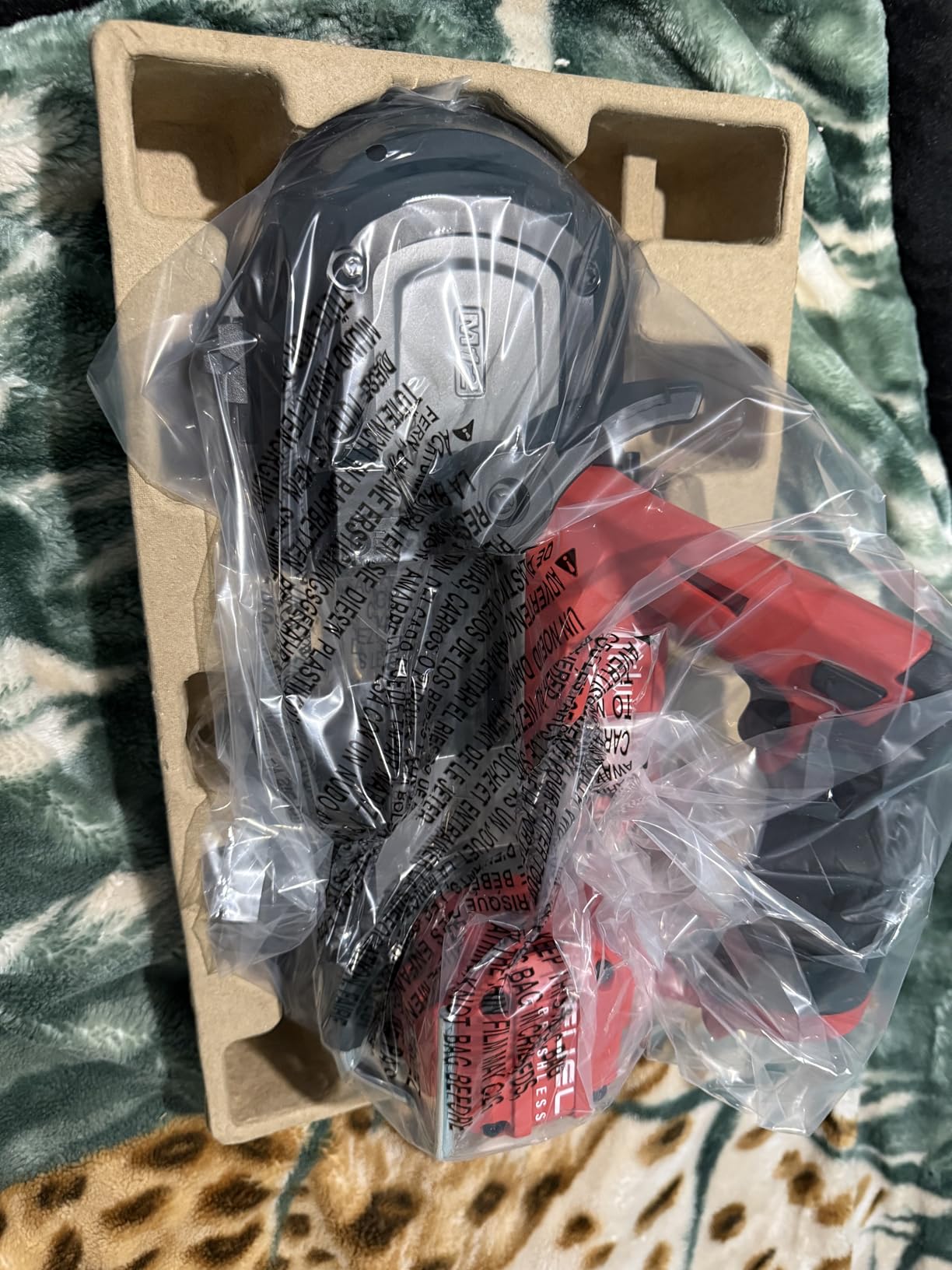
At six pounds this is the lightest saw in the roundup by a wide margin, and that is exactly why it earns a place. Pipefitters and electricians use it overhead on a ladder or in a crawl space where a 13 pound saw simply is not controllable.
The brushless M12 FUEL motor cuts rod, unistrut, EMT, conduit and chain link fence post quickly, and the electronic speed control tops out at 570 feet per minute. Despite the compact name it is physically close to M18 FUEL size, so check your clearance before buying on the assumption it is tiny.
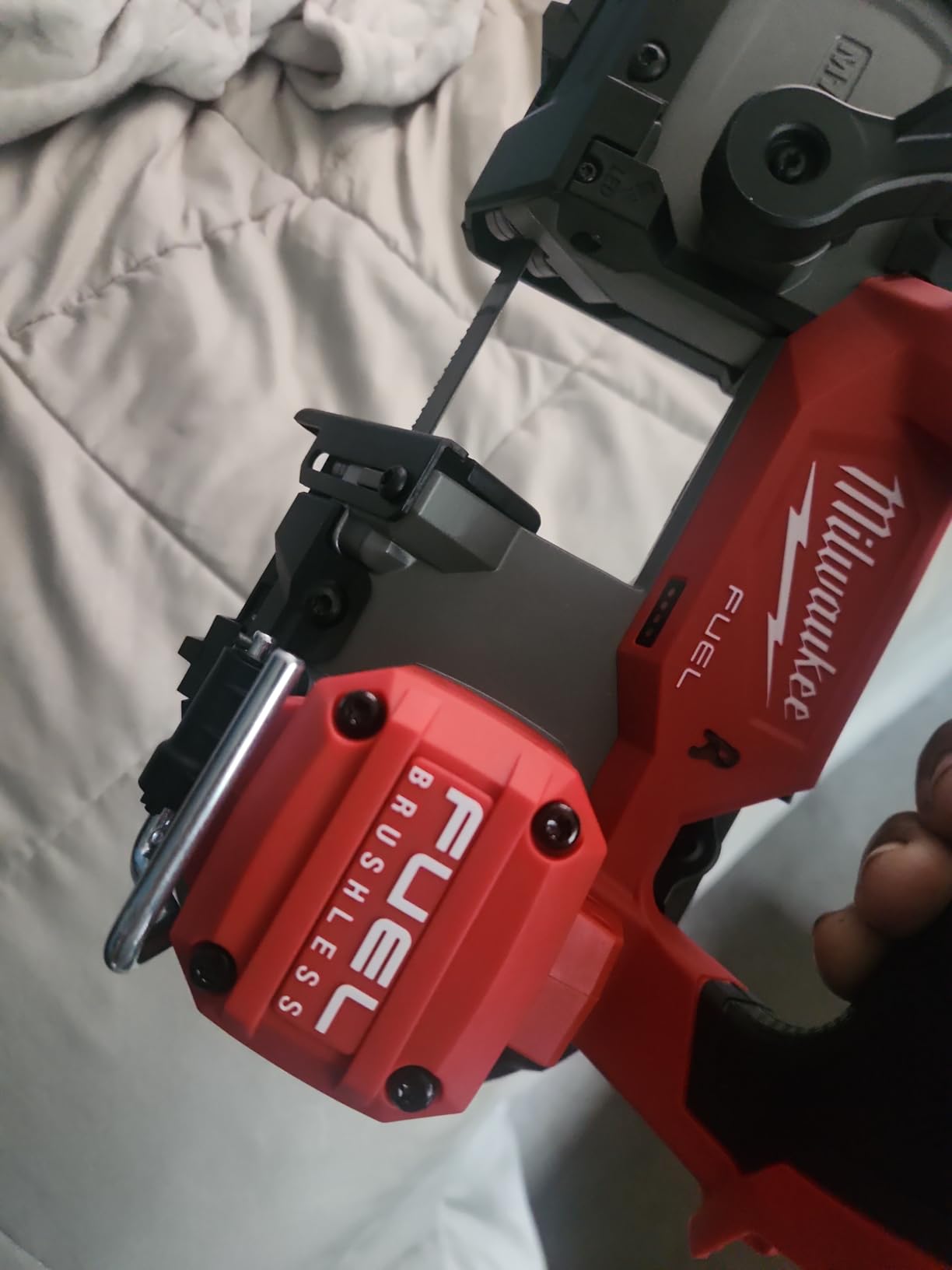
Two operating habits matter here. Spin the blade up before it touches the material, because starting against a workpiece makes it hang. And there is no lock-on switch, so plan cuts as steady hand work rather than continuous cutting.
The over-torque protection can interrupt a cut on hard material and require a restart. That is a feature protecting the motor, but on a bad day it feels like the saw giving up. Battery consumption is higher than on the older brushed M12 model.
What one-handed cutting actually means here
Holding six pounds overhead while controlling feed is realistic for a full shift, which is not true of the other cordless saws in this list. For duct work, conduit drops and electrical rough-in, that difference decides the purchase.
Where the 2.5 inch limit bites
Two and a half inches of throat and cut capacity will not take 2 inch pipe or solid bar. It is a fitting saw rather than a fabrication saw. Buyers outside the US also note that M12 band saw blades are harder to source, which matters if you tend to snap blades.
6. RYOBI P590 18V One+ 2-1/2 Inch Compact Band Saw – Best Value
RYOBI ONEAND 18V Cordless 2-1/2 in. Compact Band Saw Tool ONLY P590
2-1/2 inch capacity
18V One+ cordless
Brushless 560 rpm
9.3 lbs
Pros
- Cuts steel pipe bolts unistrut and angle iron precisely
- Quiet and far safer than an angle grinder
- Brushless motor on an affordable platform
- Light and easy to handle for a cordless saw
Cons
- Factory blade is poor quality and dulls quickly
- Blade can pop off the wheels if you feed too fast
- No rear blade guard on the exposed blade
- Only a 30 day limited warranty
The P590 is the value pick here for anyone already invested in the 18V One+ platform. Homesteaders and DIY users report it cutting unistrut, conduit, bolts and small pipe with surprising precision for a compact saw, and the brushless motor is a step above what this class used to offer.
Everything is much quieter and safer than an angle grinder on the same stock, which matters if you are working on a deck, a railing or a vehicle frame. Nine and a half pounds sits in the middle of the weight range here.
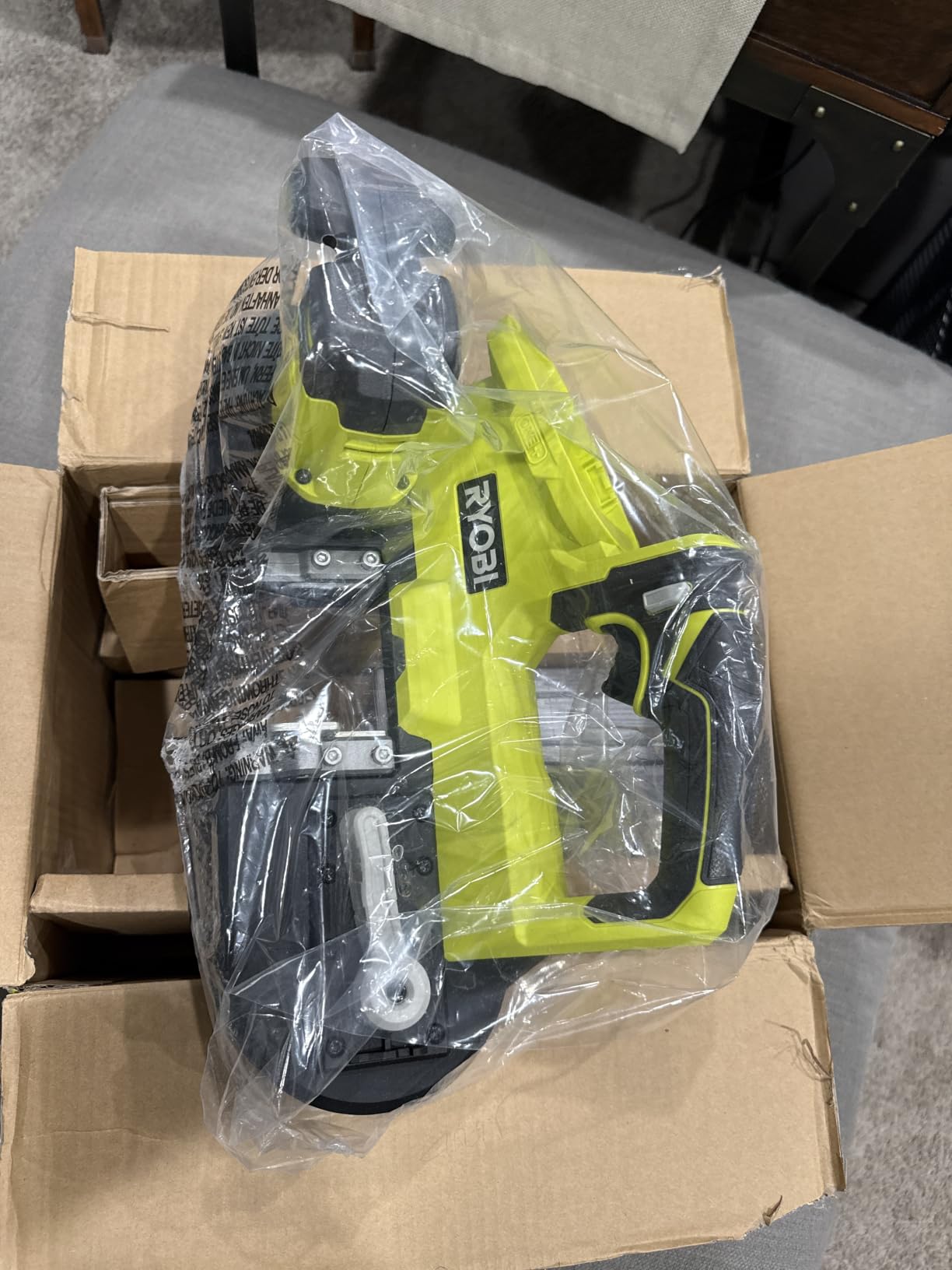
Two issues show up in nearly every review. The factory blade is poor and dulls quickly, so replace it before your first serious cut. And if you feed the saw too fast or let it drift, the blade can come off the wheels, which is startling the first time it happens.
There is no rear blade guard on the exposed blade, which is a genuine safety consideration on a tool marketed at DIY users. The 30 day limited warranty is also a very short window, so expect to service it yourself.
Where the RYOBI makes sense
Fencing, small tube work, bolt cropping and general shop cleanup on mild steel. If your cuts are all under two inches and you want a brushless cordless saw without buying into a new battery ecosystem, this is the sensible pick.
Where it costs you
Capacity is the hard limit at two and a half inches, and there is no rear guard behind the blade. Blade quality out of the box is poor, which means your first real purchase is a replacement blade. Feed it slowly and keep it square, and the popping-off problem mostly disappears.
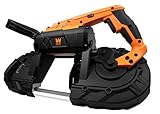
7. WEN 94396 Corded 10 Amp Portable Band Saw – Best Corded Value
WEN Portable Band Saw for Metal, 10-Amp, Variable Speed, Handheld (94396)
5 inch by 5 inch capacity
Corded 10 amp 1200 watts
60-420 ft/min
14.5 lbs
Pros
- Cuts 5 inch round and square material cleanly
- Six speed control plus a trigger lock for continuous cutting
- LED work light helps align the cut line
- Accepts standard portable band saw blades
- Mounts to third party stands and tables
Cons
- Very loud so hearing protection is essential
- Factory blade is low quality and wears out fast
- Limited blade tracking adjustment
- No carrying case included
The WEN 94396 has one of the largest owner review counts in this roundup and it has earned them. Owners repeatedly describe it as the best performing portable band saw in its class, and several report it out-cutting a portable DEWALT saw they used side by side.
It cuts up to five inches wide and five inches deep, which puts it in the same capacity class as the corded DEWALT, and it handles 1.25 inch square tubing and mild steel bar cleanly. Six speed settings across 60 to 420 feet per minute give real control over the cut.
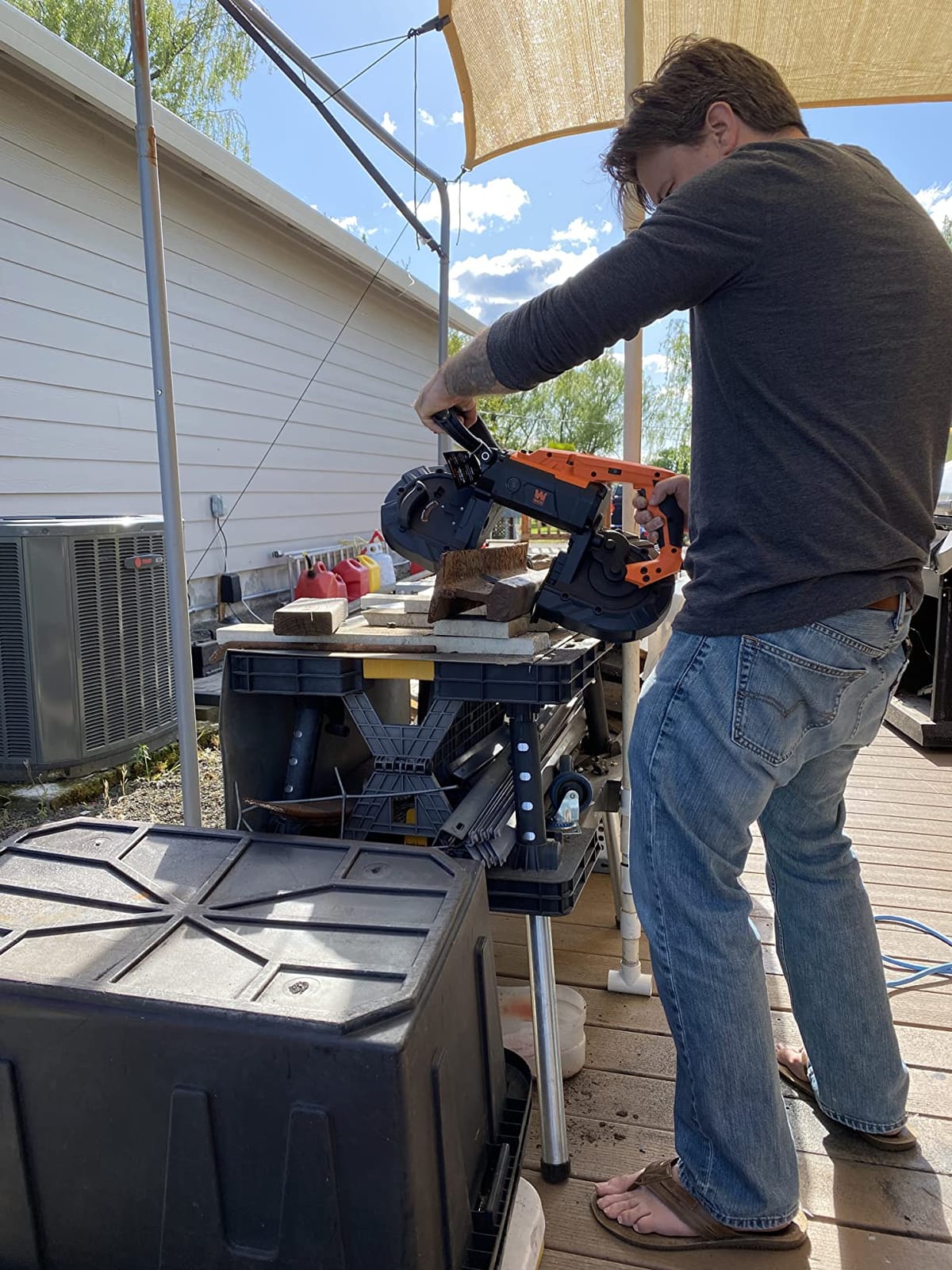
Two details set it apart among corded saws. The trigger lock lets you run continuous cuts, which matters if you mount the saw on a stand. And the ball-bearing blade guides plus external tensioning lever make blade changes straightforward.
The hole pattern also accepts a third party table mount, so owners who buy a stand for vertical cuts get a usable setup rather than a compromise. The LED work light is genuinely useful for finding your cut line on unistrut or dark tube.
Why corded still wins for shop work
A 1200 watt corded motor never runs down, never warms a pack and produces the same torque on cut fifty as on cut five. In a fixed shop with a bench and a stand, that consistency is worth more than the portability of a battery saw.
Where the WEN frustrates owners
It is very loud, loud enough that hearing protection is effectively required. Blade tracking adjustment is limited, so a straight cut on thin material may need a shim under the bottom plate. The factory blade is low quality and wears quickly, and there is no case, so it lives in its box.
8. VEVOR Portable Band Saw with Swivel Base – Best for Miters
VEVOR Portable Band Saw, 110V Removable Alloy Steel Base 5 Inch Cutting Capacity Hand held Variable Speed Portable Bandsaw, 10Amp Motor Deep Cut Band saw for Metal Wood
5 inch round capacity
Corded 10 amp 1100 watts
137.8-472.4 ft/min
Swivel base 0-45 degrees
Pros
- Removable alloy steel base swivels from 0 to 45 degrees
- 5 inch round capacity without the base
- Pure copper 1100 watt motor with wide speed range
- Handles metal aluminum angle iron and PVC
Cons
- Heavy and bulky at roughly 28.7 lbs
- Adjustable blade guard needs frequent repositioning
- Some buyers report base and alignment imprecision
- Limited manufacturer warranty
The removable alloy steel base is the reason to look at this saw. It swivels from zero to 45 degrees, so you can hold square tube and angle iron at a consistent set angle for repeated cuts, and it also stabilises the saw for straight work on flat material.
Capacity is genuinely useful without the base: 4.7 by 4.7 inches rectangular and 5 inch round. The pure copper 1100 watt motor runs from 137.8 to 472.4 feet per minute, which covers both thin wall and heavier section.
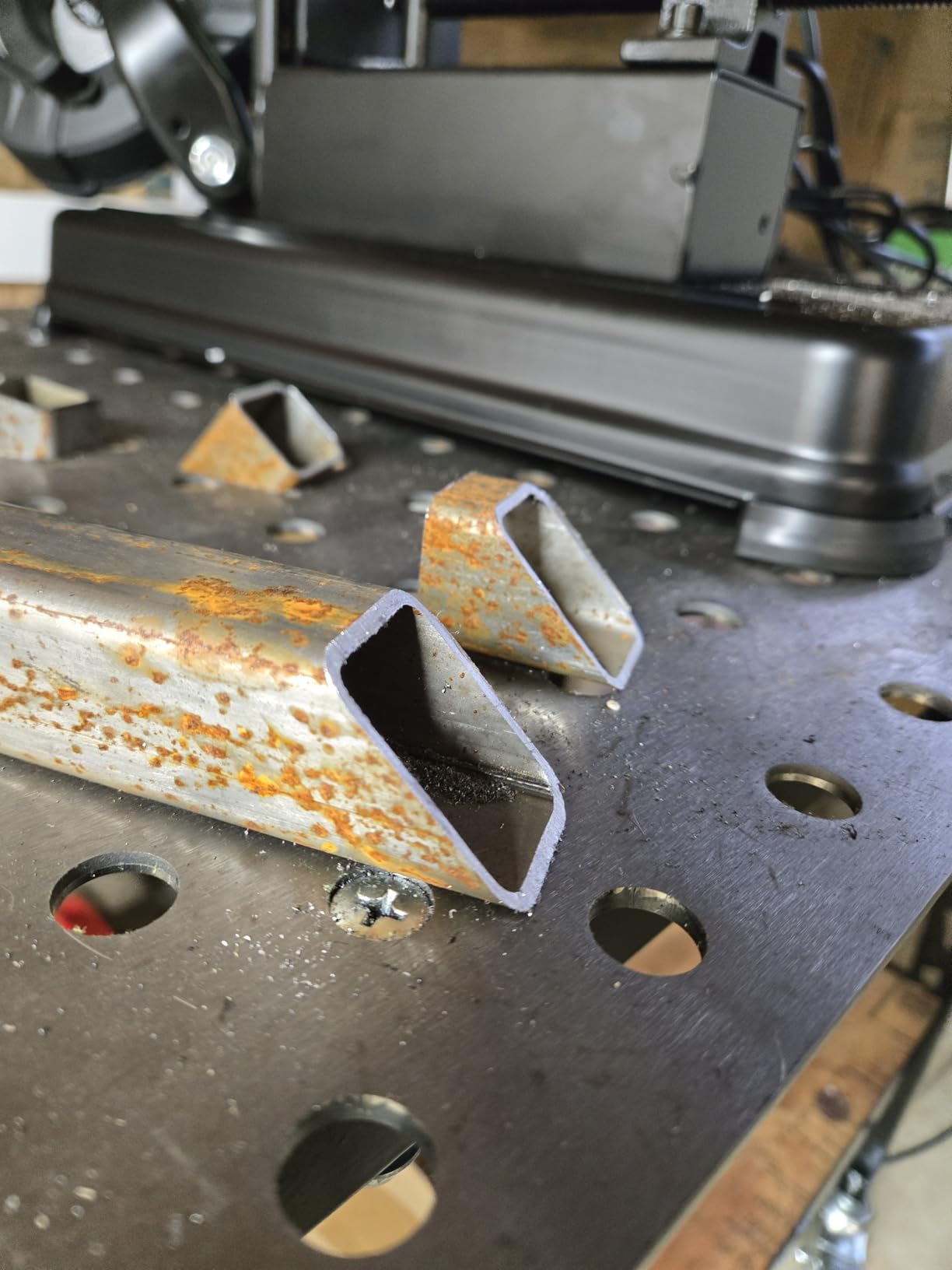
Owners use it for angle iron, pipe, aluminum, composite cable and PVC, so it is genuinely a multi-material saw rather than a metal-only one. The soft grip rear handle and adjustable blade guard are thoughtful additions for a tool in this bracket.
Be clear-eyed about the physical size. At roughly 28.7 lbs this is one of the heaviest portable saws in this roundup, and it is bulky in a way that matters when you are working overhead or in a confined space.
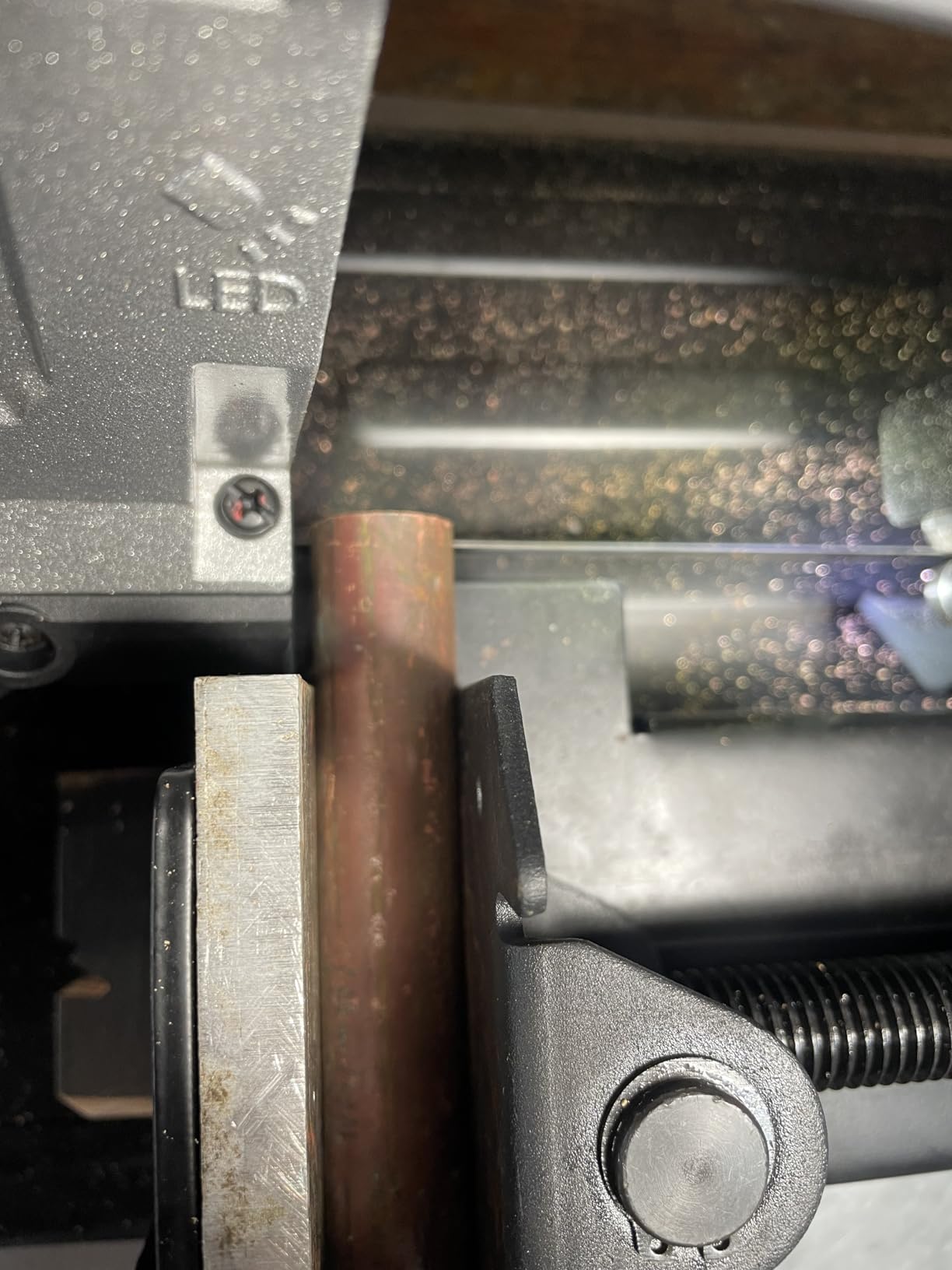
When the swivel base earns its weight
If you are cutting the same angle on many pieces of square tube, a miter saw is faster and a band saw leaves a better finish. The swivel base gives you repeatable angles cheaply, and the removable design means you can take it off for overhead cuts.
Where buyers get frustrated
This saw sits at 4.4 stars, and the gap comes from a visible share of one-star reviews tied to alignment and base adjustment. The adjustable blade guard also needs frequent manual repositioning, which is irritating mid-job.
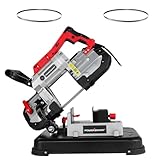
9. PowerSmart 5 Inch Portable Band Saw – Most Versatile
PowerSmart Portable Band Saw, 10A Variable Speed, 5″ Cutting Capacity
5 inch by 5 inch capacity
Corded 10 amp
0-435 ft/min
Swivel base with two 14 TPI blades
Pros
- Cuts 5 inch round and rectangular material quietly
- Removable base adjusts from 0 to 45 degrees
- Two 14 TPI blades included plus LED work light
- Users report repeatable thin and precise slices
Cons
- Lowest average rating in the group at 4.2
- Blade can pop off the drive wheels on wall tube
- Hidden 5mm hex bolt is the tracking adjustment but poorly documented
- Base clamp and angle adjustment are not precise
The PowerSmart portable band saw is an affordable route to full five inch by five inch capacity, and users do report impressive results. Several reviewers mention repeatable thin slices, including 1mm cuts taken from 4×4 material, which is a precision claim we would not expect at this level.
It is also quiet and clean on metal, with a serviceable steel shroud and a dual bearing blade guide. Two 14 TPI blades come in the box, plus a tool-less blade change lever and an LED work light.
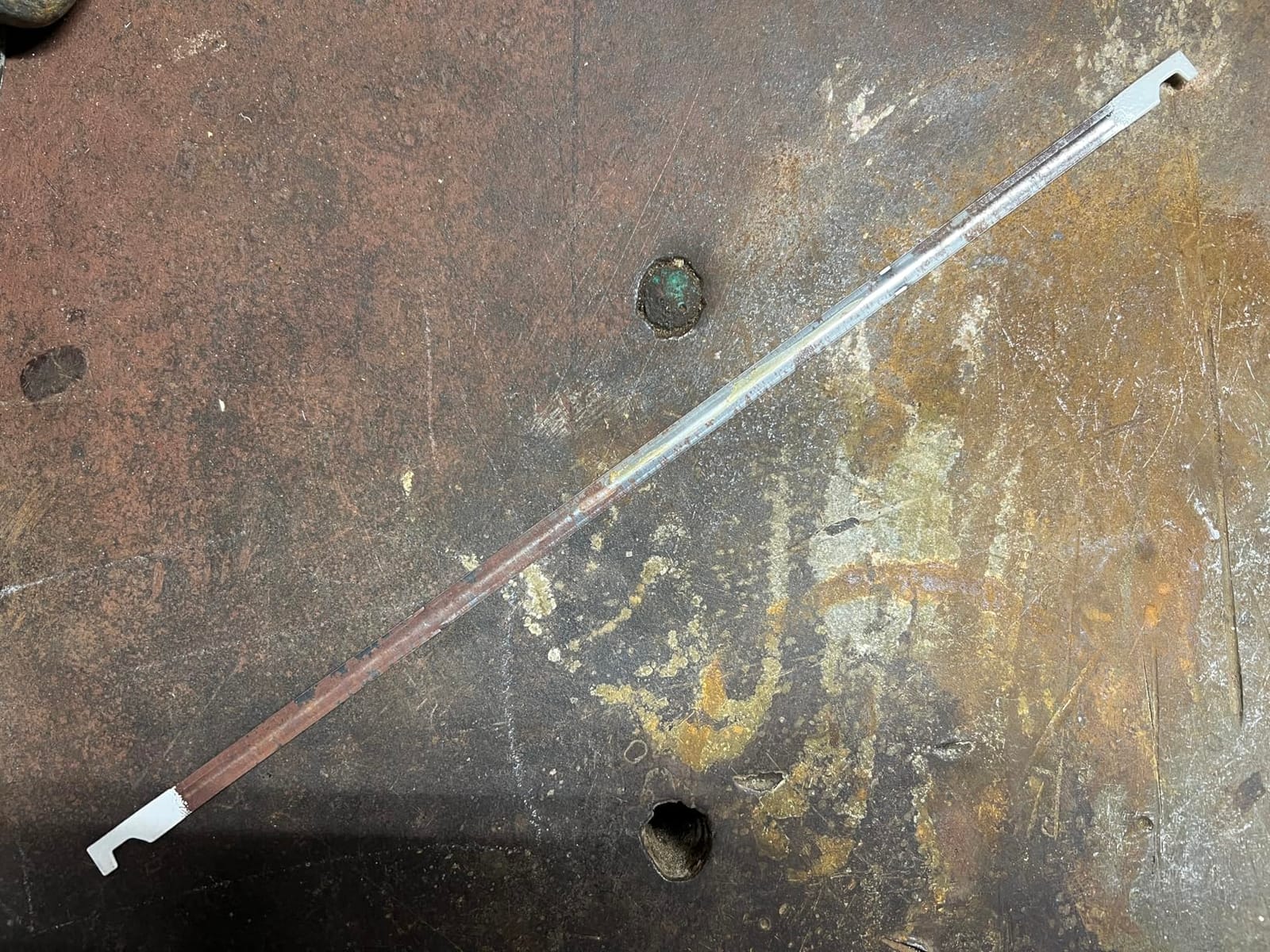
The removable alloy steel base adjusts from zero to 45 degrees, which again is the standout feature at this tier. It holds material steady for repeat cuts, and there is a six speed control covering zero to 435 feet per minute.
The 10 amp motor is rated for metal cutting with low noise and minimal burrs, and the two year warranty covers longer than the short windows some competitors offer.
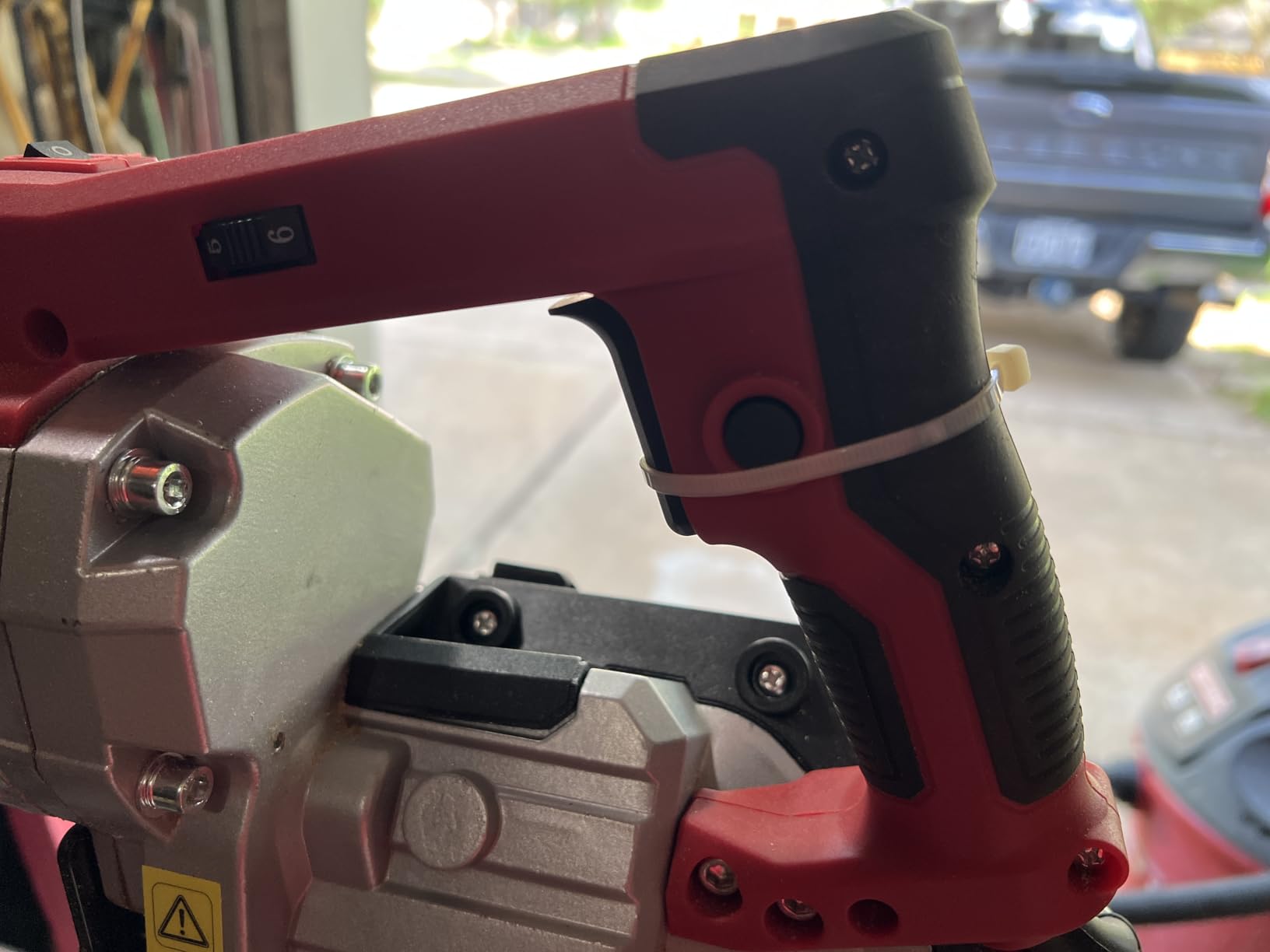
What you get for the money
A full-size capacity saw with a miter base and a spare blade at the entry level. If your cuts are straightforward tube and bar work and you can live with a setup adjustment, the capability here is real.
Where the budget shows
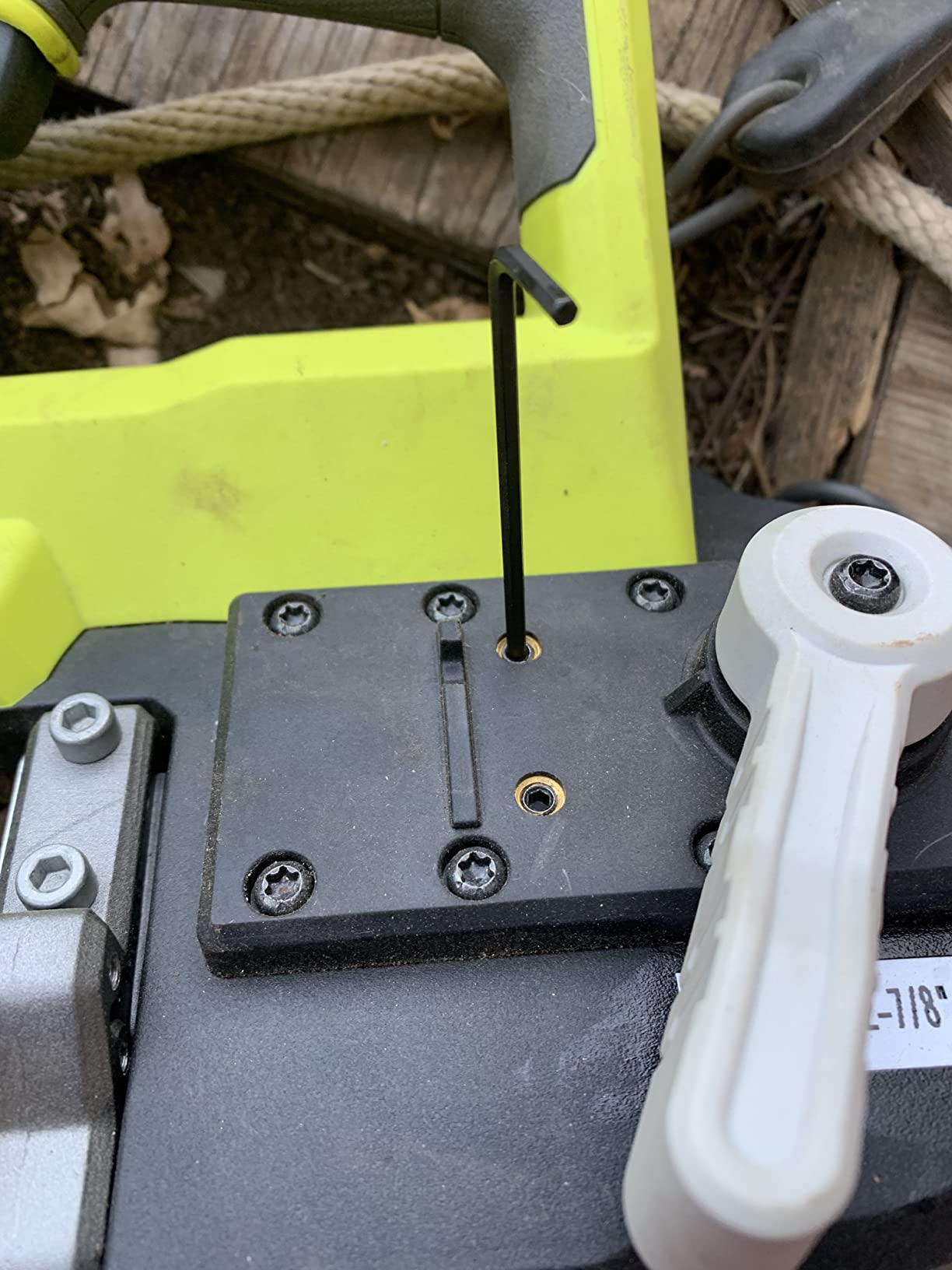
This saw carries the lowest average rating in the group at 4.2 with a notable share of one-star reviews. The defining issue is blade tracking: on wall tube the blade can pop off the drive wheels or wander out of the guards, and the fix is a hidden 5mm hex bolt under the saw that the manual barely explains.
Base clamp and angle adjustment are not especially precise, and the whole unit is roughly 30 lbs with the base attached. Expect to spend an afternoon learning the tracking adjustment before trusting it.
10. DEWALT DWM120K Corded Deep Cut Band Saw – Premium Pick
DEWALT Portable Band Saw, Deep Cut, 10 Amp, 5-Inch (DWM120K)
5 inch deep cut
Corded 10 amp 1200 watts
100-350 spm dial
15 lbs
Hard case included
Pros
- Handles thick pipe tube all-thread and channel
- Bright LED sight light shows exactly where the blade cuts
- Hard case protects the saw and spare blades
- Blade tracking adjustment extends blade life
Cons
- Factory blade is low quality so most owners replace it
- No trigger lock-on which matters on a stand
- Front blade guide slides are small for vertical work
- No manufacturer stand or table is offered
The DWM120K is the saw fabricators, welding instructors and tradespeople recommend when they move off abrasive chop saws. The reasoning is consistent across reviews: faster, cooler, cleaner and far safer, with no sparks and no grinding dust in the air.
The 5 inch deep cut capacity handles thick pipe, tube, all-thread and channel, and the 10 amp 1200 watt motor gives steady power through heavy sections. Owners report it stays accurate over hundreds of cuts.
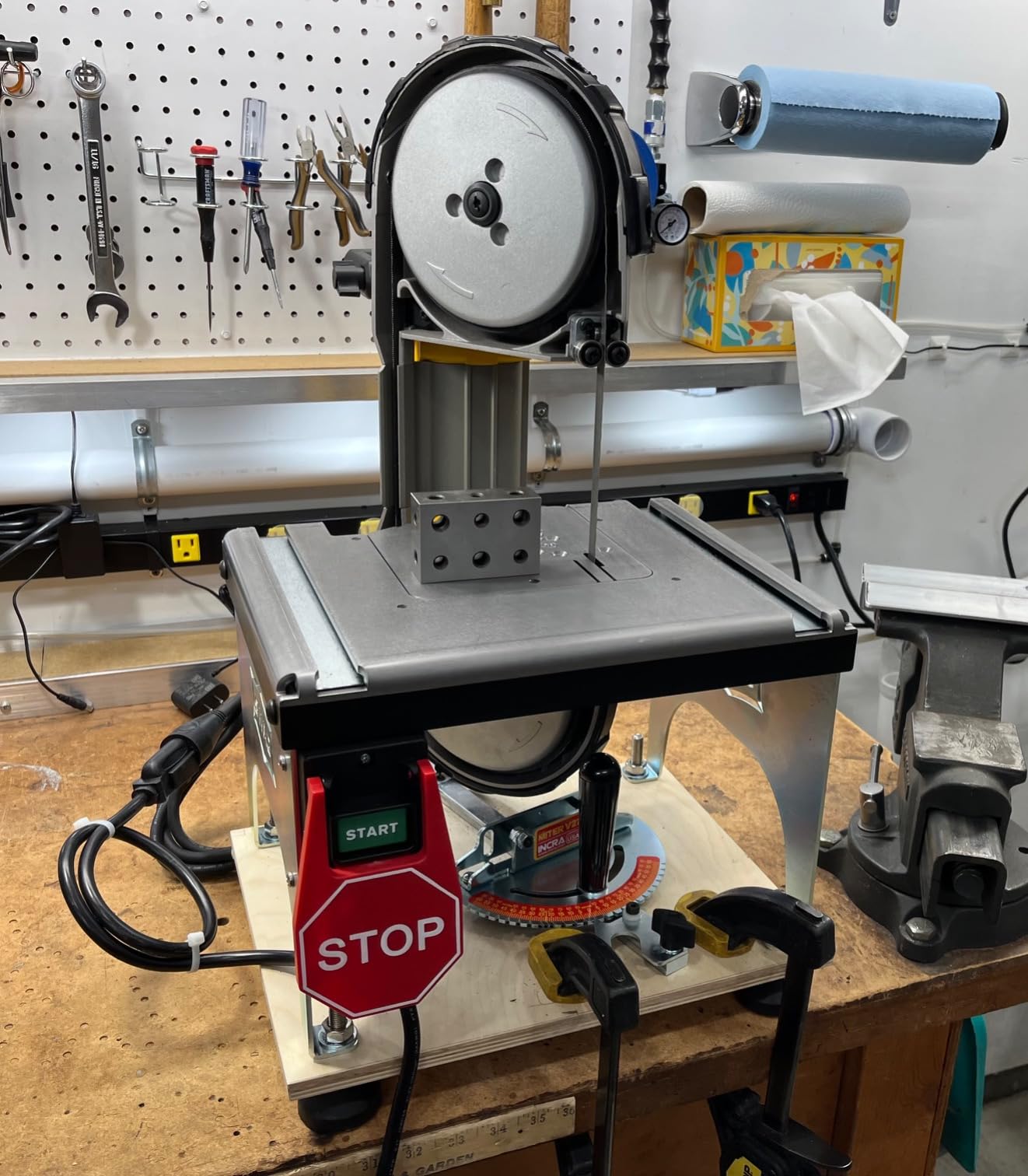
Two details get singled out repeatedly. The LED sight light has its own on/off switch and shows precisely where the blade will cut, which saves a lot of scrapped material. The hard case in the kit protects the saw and your spare blades during transport.
There is also a blade tracking adjustment, which directly extends blade life and reduces wandering on long cuts, plus dual bearing blade guide rollers and a serviceable steel shroud with rubber bumpers that survive jobsite abuse.
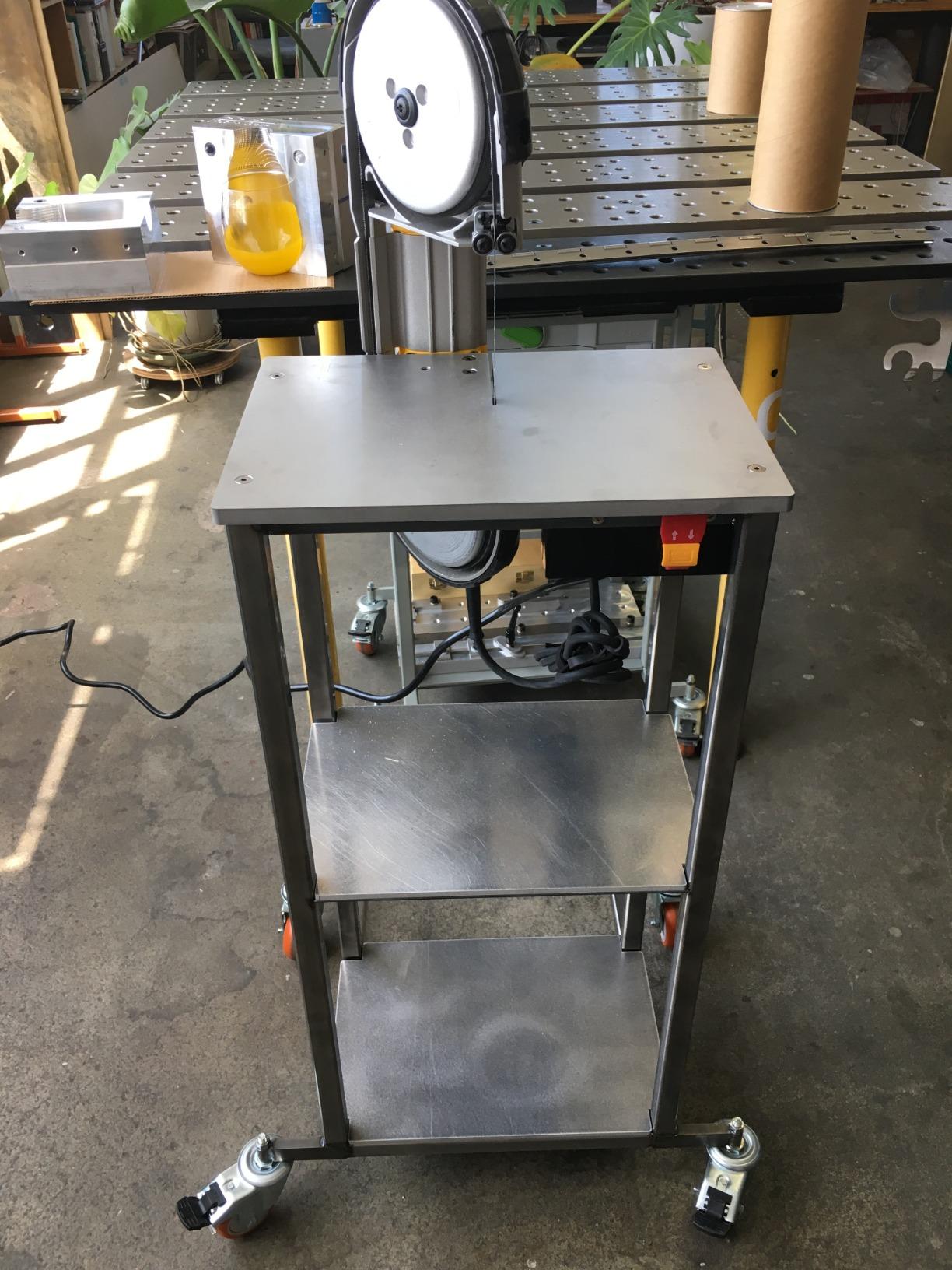
Why a hard case and a tracking adjustment matter
A saw that lives in a truck needs a case, and a tracking adjustment is the difference between a blade that lasts and one that snaps every few cuts. Those two features are where the money goes on this machine.
Where it falls short
The standard blade is low quality and most owners replace it straight away. There is no trigger lock-on, which is a real problem if you mount the saw on a third party stand for vertical cuts, and the front blade guide slides are small for that kind of stationary work. DeWalt does not offer a manufacturer stand or table for it.
How to Choose a Portable Band Saw for Metal
Start with the material, not the motor. Almost every disappointment we found in owner reviews came from a saw that was physically too small for the work, not from a saw that lacked power. Measure the widest and thickest piece you intend to cut, then buy capacity above that ceiling.
How much cutting capacity do you actually need?
Cutting capacity, also called depth of cut, is the single most important number on the spec sheet. Compact saws cap out between 2-1/2 and 3-3/8 inches, which covers conduit, unistrut, small angle and light tube. Full-size portable saws reach five inches, which covers structural tube, channel, all-thread and most pipe work.
The cheat sheet below maps common jobs to the capacity you need. If your material sits at the top of a row, buy the next saw up.
Cutting capacity cheat sheet
1/8 to 1/4 inch round rod and flat bar – a compact saw with 2-1/2 inch capacity handles this comfortably, and a 3-3/8 inch saw gives margin.
3/4 inch EMT and electrical conduit – compact saws are fine; the M12 FUEL and DEWALT DCS378B are designed for exactly this.
1 inch square or rectangular tube – you want the 4-3/4 to 5 inch class, so the DCS374B, DWM120K, WEN 94396 or the VEVOR.
1.25 inch square tubing and structural angle – five inch capacity, ideally with a base or vise for repeat accuracy.
2 inch schedule 40 pipe – five inch capacity is the minimum, and a removable base or stable shoe matters.
Solid bar over 1 inch thick – a five inch saw with a coarse tooth blade and slow feed; expect a slower cut.
What blade TPI should you run?
Teeth per inch is the number that decides cut quality. More teeth means a slower, smoother cut with less blade stress; fewer teeth means faster removal of material but a rougher finish and more heat in the tooth. Matching TPI to the job is the fastest way to stop breaking blades.
Blade TPI by material
14 to 18 TPI bi-metal – the general-purpose choice for solid steel bar and tube up to about 3/4 inch.
24 to 32 TPI bi-metal – thin wall tube, conduit, thin flat bar and anything where finish matters.
8 to 10 TPI bi-metal – heavy structural section and thick solid bar where you want fast material removal.
Carbide or cermet blades – hardened or stainless material and very long production runs, at a higher blade cost.
Bi-metal blades have a high speed steel tooth edge electronically welded to a flexible alloy backing, and they are the correct default for portable saws. Buy two blades the moment you unbox any saw in this roundup: most factory blades are thin and dull quickly.
Why portable band saw blades break, and how to stop it
Blades snap when the saw binds, twists or is forced. Owners on tool forums describe breaking a fifth blade in short order, and the causes are almost always the same. Start here:
1. Spin the blade up to full speed before the teeth touch the material.
2. Feed the saw slowly and steadily. Let the teeth do the work rather than pushing.
3. Keep the saw square and straight in the cut line. A twisted blade breaks fast.
4. Let the blade cool. On stainless or hardened material, pause periodically.
5. Use coolant or cutting fluid. Friction and heat are the main cause of tooth fracture.
6. Check blade tension and tracking after any blade break, not just before one.
7. Match the tooth count to the material rather than reusing the factory blade.
Also clean the swarf out of the wheel housings regularly. Metal chips packing into the bearings is a leading cause of the stiffness and misalignment that ruins tracking, and it is the easiest maintenance task on the whole list.
Should you go corded or cordless?
This is where most buyers overthink it. If you already own 18V or 20V packs, cordless is nearly free money because the saw is the only tool you need to add. If you do not, a corded saw avoids buying a whole battery ecosystem for one tool.
Long-term owners on hobby machining forums report corded portable band saws from two decades ago still running, and they rate them above battery tools for longevity. A cordless saw gives up nothing in cut quality on mild steel and gains portability, but it depends on pack health.
The practical comparison: corded gives unlimited runtime and consistent torque at 10 amps, and it is louder with a cord to manage. Cordless gives one-handed freedom and no cord snagging on conduit, and it needs spare packs for a full day of pipe cutting.
What to buy alongside the saw
A metal band saw is only as good as the blade in it. Budget for a bi-metal blade in the tooth count that matches your thinnest material, cutting fluid for steel work, safety glasses with a proper side shield, and a pair of cut-resistant gloves.
For repeat accuracy, add a bench vise or a third party stand. The WEN 94396 and the VEVOR both have hole patterns that accept a table mount, and a mounted saw produces far more square cuts than a handheld one.
If you need to cut thicker material regularly, our [metal cutting band saw guide](https://www.wearesalt.org/best-metal-cutting-band-saws/) covers the bench-mounted machines built for production work.
Who should not buy a portable band saw
If you are cutting 10mm steel tube or thicker all day, a portable handheld saw is the wrong tool. Metalworkers on tool forums consistently recommend a benchtop metal bandsaw for that material, because you get a proper vise, more rigid guides and no arm fatigue.
Portable saws also make sense only if you work on a job site. If everything you cut happens at a fixed bench, a benchtop saw will be more accurate, quieter to run with proper guards and easier to change blades on. Save the handheld for overhead work, tight mechanical spaces and duct installations.
A maintenance schedule that keeps blades alive
Metal dust is abrasive, and it is the enemy of every bearing and guide roller on a portable saw. A fifteen minute session at the end of a week of cutting will add years to the tool.
After every session, blow swarf out of the wheel housing with compressed air and a stiff brush. Check that the guide rollers turn freely and that the wheel cover has not packed with chips. Every few weeks, check blade tension and tracking, and look for a blade with a cracked or missing tooth.
Run the saw briefly with no load after cleaning so any debris that got past the guard falls out rather than sitting in the housing. If a blade has broken recently, replace the guide rollers and the tension spring before fitting the new blade, since a worn roller is usually what caused the break.
Keep a second blade on hand in the tooth count you use most. That single habit removes the temptation to keep cutting on a dull blade, which is the fastest way to heat a blade and snap it.
How cut speed changes by material
Blade speed is only half the equation. The feed rate you use matters just as much, and forcing a saw through mild steel is the number one cause of ruined blades.
Aluminum cuts fastest of the common metals and needs a coarser tooth because the material is soft and gummy. Mild steel is the baseline and behaves predictably at mid speed. Stainless runs hot and generates more heat, so slow the feed, use a fine tooth and use cutting fluid.
Structural steel demands the slowest feed of all. Set the saw to its lowest speed, let the weight of the saw do the work rather than your arm, and stop if the blade starts to smoke. A blue blade means heat, and heat means a break is coming.
Finish quality depends on support. A handheld saw cuts square when the workpiece is held firmly and the shoe sits flat against it. A bench vise, a third party stand or a miter base removes most of the squareness complaints owners report.
Frequently Asked Questions
What is the best portable metal cutting band saw?
The DEWALT DCS374B is the best portable metal cutting band saw for most buyers. Its 5 inch cutting capacity, brushless motor and variable speed trigger handle pipe, tube and structural metal, and it runs on any 20V MAX battery. Corded shoppers with a bench should look at the DEWALT DWM120K, which offers the same 5 inch deep cut capacity without a battery.
What is a good portable band saw for metal?
A good portable band saw for metal needs three things: enough cutting capacity for your thickest material, a variable speed control, and a decent bi-metal blade in the correct tooth pitch. The DEWALT DCS374B, Milwaukee 2729-20 and WEN 94396 all hit those marks, while the Milwaukee M12 FUEL covers lighter conduit work at only 6 lbs.
What is the best cordless saw for cutting metal?
The best cordless saw for cutting metal is the DEWALT DCS374B for capacity, or the Makita XBP02Z for control. The DCS374B cuts five inches with a brushless motor, while the Makita offers a 275 to 530 ft/min speed range that suits mixed material. The Milwaukee M12 FUEL is the lightest option at 6 lbs for overhead work.
Can a portable band saw cut 1 inch steel pipe?
Yes, provided you buy a saw with at least five inches of cutting capacity. Compact saws in the 2-1/2 to 3-3/8 inch range cannot take 1 inch steel pipe. The DEWALT DCS374B, DEWALT DWM120K, Milwaukee 2729-20 and WEN 94396 all handle it, using a coarse tooth bi-metal blade and a slow, steady feed.
What are the common problems with metal band saws?
The most common problems are broken blades, blades that wander off track, and motors that bind when the saw is forced. Blades break when the tool is fed too fast, twisted off square, or run hot. Small rear guide wheels on compact saws let the blade veer, and swarf packed into the wheel housings causes stiffness and poor tracking. Cleaning the housing and checking tracking after every blade break prevents most of it.
What type of blade is best for cutting metal in a bandsaw?
A bi-metal blade is the correct default for portable metal cutting. Use 14 to 18 TPI for solid steel bar and heavier tube, 24 to 32 TPI for thin wall tube and conduit where finish matters, and 8 to 10 TPI for heavy structural section. Carbide or cermet blades suit hardened and stainless material and long production runs, at a higher blade cost.
Final Verdict on the Best Portable Band Saws for Metal in 2026
The DEWALT DCS374B is our pick for the best portable band saws for metal because it pairs five inch capacity with a brushless motor, a variable speed trigger and an ecosystem most buyers already own. Buy the right blade and it will handle pipe, tube and structural work without complaint.
The Milwaukee 2729-20 is the runner-up if you want deep cut capacity on M18 FUEL power, and the Makita XBP02Z wins on speed control with the widest range in this group. Overhead installers should take the 6 lb Milwaukee M12 FUEL, and shop buyers with a bench get the most from the corded DeWalt DWM120K.
Whatever you choose, buy a spare bi-metal blade on day one. That single accessory costs far less than re-cutting a scrapped piece of steel, and it is the difference between a saw that stays sharp and one that stops cutting.